8 Human populations and urban systems
An overview of human populations and urban systems: how populations grow and change, how cities work as systems, why urban air becomes polluted, how the three subtopics connect, and what HL students add.
- IB Environmental Systems and Societies
- SL and HL
What 8 covers
From the subject guide: what you need to know and be able to do.
Population change, how cities work and urban air pollution.
3 subtopics in Human populations and urban systems
Each one has its own page once something is published for it.
- 8.1Human populationsnotes
- 8.2Urban systems and urban planningnotes
- 8.3Urban air pollutionnotes
An overview of 8 Human populations and urban systems
Human populations and urban systems studies the people at the centre of every environmental issue: how many there are, how fast their numbers change, where they live and how the cities they build interact with the environment. It links demography, geography, planning and atmospheric chemistry.
The world population grew from 2.5 billion in 1950 to about 8.2 billion in 2024, and by 2024 about 57.6% of people lived in urban areas, compared with 34.3% in 1960. Cities concentrate people, resources, wealth and pollution, so the way they are planned and managed has a large effect on whether human societies can live within Earth’s limits.
Sources: UN World Population Prospects 2024; UN World Urbanization Prospects via Our World in Data (2025).
Questions the topic asks
How can the size and growth of human populations be measured and compared, and how accurately can future growth be predicted?
Why do birth rates and death rates change as societies develop, and what do age–sex pyramids show about a country’s future?
Can governments manage population growth, and which policies work without violating people’s rights?
In what ways is a city like a natural ecosystem, and how do its inputs, outputs and flows affect the environment around it?
Why are more and more people moving to cities, and what happens to land, water and air as cities spread?
How can cities be planned or reimagined so that they are more sustainable, resilient and fair?
What causes urban air pollution, how does it harm people, ecosystems and buildings, and how can it be reduced?
The subtopics
Subtopic | What it covers |
|---|---|
8.1 Human populations | Births, deaths and migration as the inputs and outputs of a population; crude birth and death rates, total fertility rate, life expectancy, natural increase and doubling time; global growth and the UN’s three projection scenarios; age–sex pyramids; the demographic transition model; direct and indirect population policies; a case study of China’s population policies |
8.2 Urban systems and urban planning | Urban and rural areas; urban ecosystems and the urban heat island; the city as a system of inputs, storages and outputs; urbanisation, suburbanisation, sprawl and deurbanisation; the environmental effects of urban expansion; urban planning for sustainability and ecological urban planning; a case study of integrated transport and land-use planning in Curitiba, Brazil |
8.3 Urban air pollution | The main urban air pollutants (nitrogen oxides, sulfur dioxide, carbon monoxide and particulate matter, PM2.5 and PM10); natural and human sources; primary and secondary pollutants; measuring air quality and using lichens as indicators; strategies to reduce urban air pollution at three levels; acid deposition, its chemistry, impacts and management; a case study of air pollution and its management in Mexico City |
How the subtopics connect
The three subtopics follow people from the population as a whole into the cities where most of them now live, and then to the air those cities produce. Population growth and rural–urban migration fill cities, and life in cities in turn lowers fertility, because children cost more to raise and women have more access to education and paid work. Through urbanization, cities have become the main human habitat. They draw in food, water, energy and materials from far beyond their boundaries and release wastes, heat and pollutants. Traffic, power generation and industry make urban air one of the most direct ways in which urban systems harm human health.
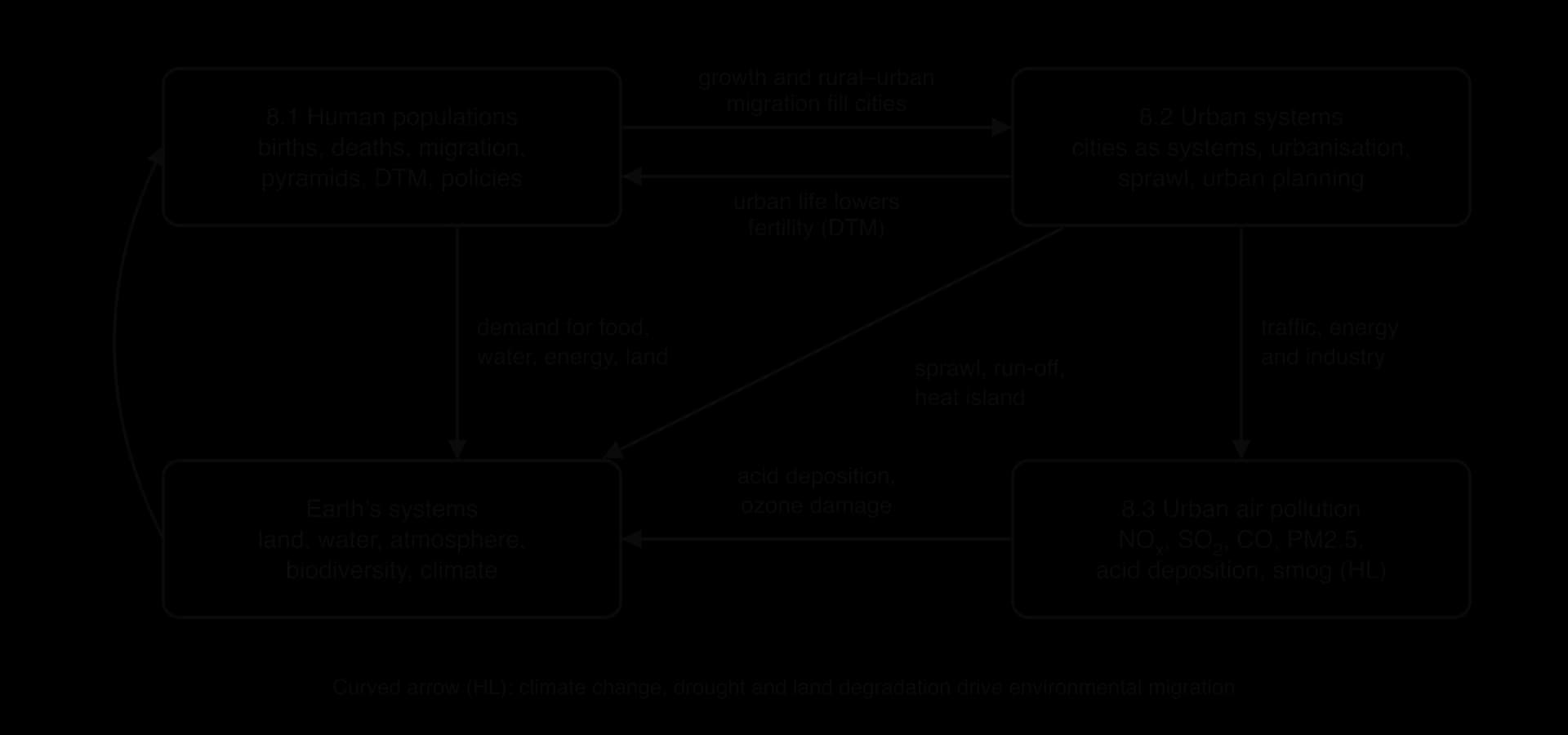
The three subtopics share the same tools. Each treats its subject as a system with inputs and outputs: a population with births, deaths and migration; a city as an urban system with flows of people, energy, water and waste; the urban atmosphere with emissions, chemical transformations and deposition. Each also uses models whose limits matter, such as the demographic transition model, the urban systems diagram and the three-level model of pollution management.
 YouTube
Perspectives, systems and sustainability
Perspectives. Population growth is seen very differently from different perspectives: as a threat to ecosystems from an ecocentric view, as a source of innovation from a technocentric view, and as a matter of individual rights from a rights-based view. Cities raise similar debates, between those who see dense cities as efficient and those who see them as polluted and unequal, and between planners, residents, businesses and developers.
Systems. Populations and cities are open systems. Feedback links them: falling death rates speed growth, urbanisation lowers fertility, and air pollution raises death rates and the costs of health care. Population momentum is a time lag built into the age structure of a population.
Sustainability. Whether a population can be sustained depends on consumption and technology as well as numbers. The topic links to the Sustainable Development Goals: SDG 3 (health), SDG 4 (education), SDG 5 (gender equality) and SDG 11 (sustainable cities and communities), and, through emissions and land use, to the planetary boundaries for climate change, land-system change and atmospheric aerosol loading.
The topic draws on the rest of the course. Carrying capacity and population growth curves come from ecology; demand for food, water and energy connects population to agriculture, water security and energy resources; urban sprawl removes habitats and farmland; and the urban heat island, emissions and acid deposition link cities to the atmosphere and climate change, soils and freshwater ecosystems.
How SL and HL differ
SL and HL students study the same core content in all three subtopics: demographic rates, projections, pyramids, the demographic transition model and population policies (8.1); urban areas as ecosystems and systems, urbanisation, suburbanisation and urban planning (8.2); and the sources, impacts and management of urban air pollution and acid deposition (8.3).
HL students also study HL-only understandings in each subtopic:
8.1 Human populations: the stress that rapid population growth places on Earth’s systems, using projections for the next 50 and 100 years, biocapacity and the doughnut model; dependency ratios and population momentum; a comparison of two countries at different stages of the demographic transition over time; and environmental migration caused by climate change, drought and land degradation.
8.2 Urban systems and urban planning: compact cities, mixed land use and social mix, and environmental justice in access to green space; cities that use circular economy or doughnut models, such as Amsterdam’s City Doughnut and circular strategy; and green architecture, including vernacular wind towers, straw-bale building and circular construction.
8.3 Urban air pollution: photochemical smog and how sunlight turns nitrogen oxides and volatile organic compounds into ozone and other secondary pollutants; the meteorological and topographical conditions, including temperature inversions, that intensify it; the direct impacts of tropospheric ozone; and its social and economic costs, which often fall hardest on poorer communities.
The three HL lenses apply across the topic.
HL lens | Populations | Urban systems | Urban air pollution |
|---|---|---|---|
Environmental law | Migration treaties such as the Falepili Union between Australia and Tuvalu | Planning and zoning law, including rules on affordable housing | Clean air legislation, emission standards and international agreements on acid deposition |
Environmental economics | Incentives and penalties in population policy | Taxes that make circular strategies profitable | Congestion and low emission zone charges, emissions trading and the health costs of pollution |
Environmental ethics | Individual rights against coercive population policies; climate justice for environmental migrants | Fair access to green space and housing | Unequal exposure of poorer neighbourhoods and outdoor workers to pollution |
Assessment
Human populations and urban systems is examined in Paper 1 and Paper 2 at both levels, and urban areas are a convenient setting for the internal assessment.
Paper 1 (unseen case study): resource booklets may describe a country or a city, with population data, an age–sex pyramid, a map of urban growth or air-quality measurements. Typical questions ask students to calculate natural increase, doubling time or (at HL) a dependency ratio, identify a stage of the demographic transition, complete an urban systems diagram, explain trends in pollution and evaluate a policy or planning strategy for that place.
Paper 2 Section A: short-answer and data-based questions on demographic rates and calculations, pyramids, the demographic transition model, urban systems, primary and secondary pollutants and the chemistry and effects of acid deposition.
Paper 2 Section B: structured essays that ask students to explain demographic or urban processes and then evaluate population policies, the sustainability of urban planning or strategies to reduce air pollution, using named examples and several perspectives. HL essays are expected to bring in legal, economic and ethical angles where relevant.
Common investigation topics include lichen surveys as indicators of air quality along a gradient from a city centre, comparisons of temperature or green space between urban and rural sites, surveys of attitudes to urban planning or transport, and database investigations testing links between socio-economic indicators and demographic data.
Flashcards for 8
The official decks for this part of the syllabus.
- 8.1 Human populations261 cards
- 8.2 Urban systems and urban planning245 cards
- 8.3 Urban air pollution215 cards
Carry on with 8 in Augment
With a free account, Augment remembers where you stopped and what you have practiced.