Notes on 3.3 Conservation and regeneration
Learning objectives
Outline aesthetic, ecological, economic, ethical and social arguments for preserving species and habitats.
Distinguish between species-based and habitat-based conservation, and between in situ and ex situ measures, with two named examples of each.
Explain how flagship and keystone species are used in a mixed approach to conservation.
Outline the aims of the Convention on Biological Diversity, the Nagoya Protocol and CITES.
Explain how the size, shape, edge effects and connectivity of a reserve affect its success, and describe the zones of a biosphere reserve.
Describe the methods of rewilding and explain how they regenerate natural processes.
Discuss how conservation at different levels can keep biodiversity within the safe operating space of the planetary boundaries.
Evaluate how perspectives and environmental value systems influence the choice of conservation strategy.
Evaluate the role of intergovernmental, governmental and non-governmental organisations in conservation. (HL)
Explain how positive feedback loops in rewilding and restoration can lead to alternative stable states. (HL)
Evaluate rewilding projects and assess the success of a conservation or restoration project at three levels. (HL)
Evaluate the benefits and costs of ecotourism in a named protected area. (HL)
Introduction
Conservation is the protection, management and sustainable use of species, habitats and ecosystems so that biodiversity and the benefits it provides last into the future. Regeneration goes a step further: it repairs ecosystems that have already been damaged, so that they recover their species and their natural processes. Both respond to the losses caused by habitat loss, overexploitation, invasive species, pollution and climate change.
Choosing how to conserve nature is never only a scientific decision. A seed bank, a national park, a fenced sanctuary and a rewilded farm each reflect different perspectives on what nature is for and who should decide. Each can also be studied as a system, with inputs of money, people and species, and outputs of protected habitat, income and conflict. Whether a strategy is sustainable depends on its ecological results and on how fairly its costs and benefits fall on people.
Why conserve biodiversity?
People argue for protecting species and habitats for many different reasons. Some reasons are about what nature does for people; others are about the value of nature in itself. Grouping the arguments into five types helps to compare them and to see which ones different groups of people find convincing.
Five types of argument
Type of argument | What it says | Example |
|---|---|---|
Aesthetic | Nature is beautiful and inspiring; its loss makes the world poorer to look at, visit and create art from. | Mountain scenery, coral reefs and bird song draw visitors and inspire painting, music and writing. |
Ecological | Species and habitats provide ecosystem services and keep ecosystems stable and resilient. | Forests regulate water flow and store carbon; pollinating insects support crops; wetlands filter water. |
Economic | Biodiversity has a money value: ecotourism, genetic resources for medicines and crops, and natural capital such as timber and fish. | Gorilla-trekking permits in Rwanda earn foreign currency; wild relatives of crops carry genes for disease resistance. |
Ethical | Other species have a right to exist and intrinsic value, whatever their use to people; humans have a duty of stewardship. | Many religions and Indigenous worldviews see people as part of nature, with duties towards other living things. |
Social | Nature provides goods and services for human well-being: food, health, cultural identity, recreation and livelihoods. | Sacred groves, traditional hunting and fishing grounds, and urban green space for mental health. |
The five types overlap. An ecosystem service such as flood protection is both ecological and economic, and a sacred forest is both ethical and social. Many arguments rest on instrumental value, the usefulness of nature to people, while ethical arguments often appeal to intrinsic value, the worth of nature for its own sake.
Strengths and weaknesses of each kind of argument
Economic arguments persuade governments and businesses because they can be counted, compared and written into budgets. Their weakness is that a species with no obvious use, such as an obscure beetle, seems to have no value, and that a more profitable use of the land can always outbid conservation. Ethical arguments protect every species equally but are harder to turn into policy, because people disagree about which values matter most.
Ecological arguments are strongest when there is clear scientific evidence that a species or habitat supports others, as with a keystone species or a mangrove forest that protects a coast. They are weaker for rare species whose loss would not noticeably change the ecosystem. For this reason most conservation campaigns combine several types of argument, so that each audience hears the one it finds most convincing.
Species-based and habitat-based conservation
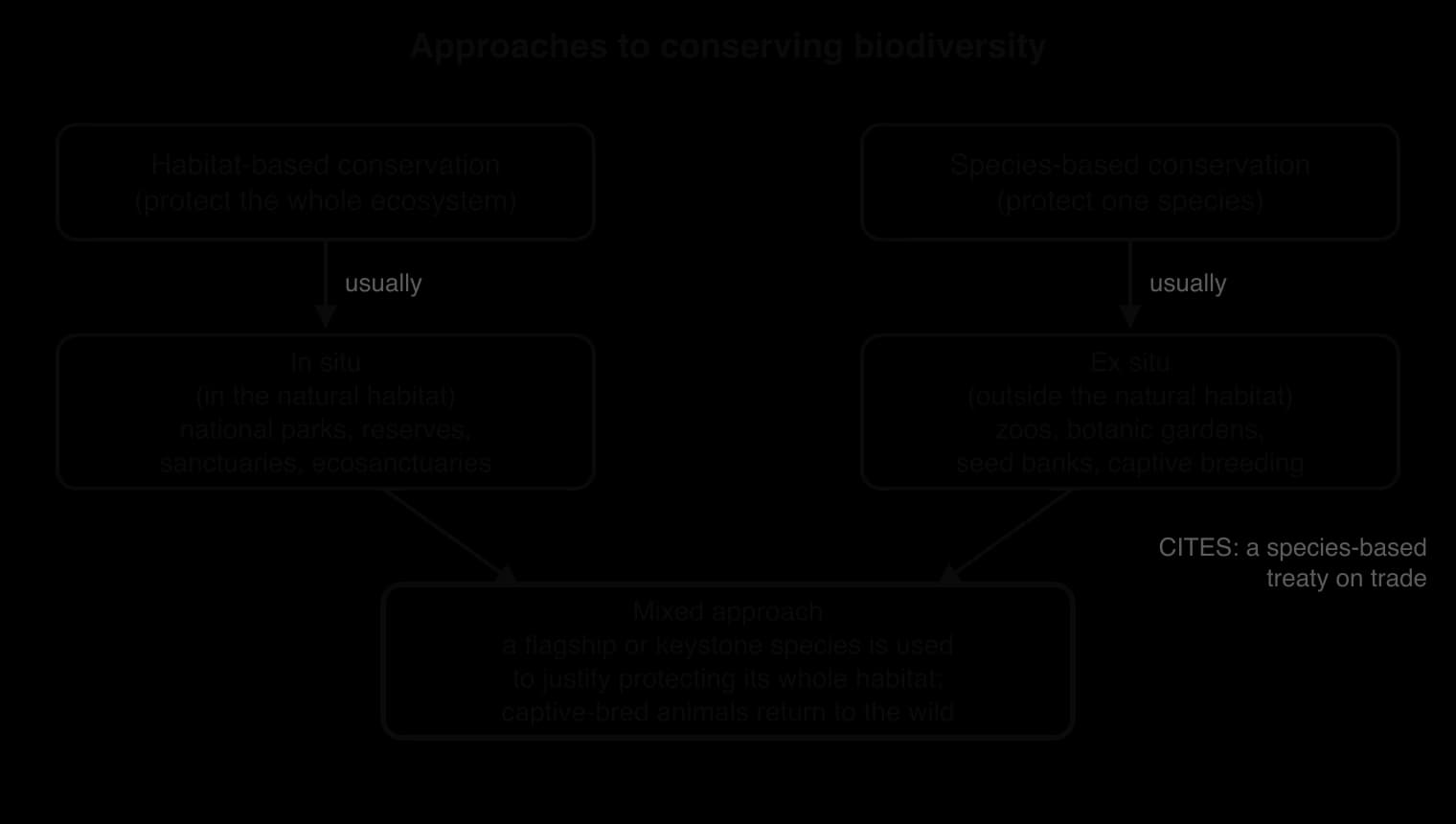
Conservation strategies can be classified in two ways: by what they protect and by where they protect it. Species-based conservation focuses on one species at a time, usually a threatened or well-known one. Habitat-based conservation protects an area so that every species living there, and the processes that link them, are kept.
The second classification is about place. In situ conservation protects species where they naturally live, while ex situ conservation keeps them somewhere else, such as a zoo or a seed vault. Species-based conservation is usually ex situ and habitat-based conservation is usually in situ, but the match is not perfect.
Ex situ conservation: zoos, gardens and gene banks
Ex situ methods keep a species, or its genes, alive when its wild habitat is too damaged or too dangerous for it to survive there. They work as an insurance policy and as a source of individuals for reintroduction later. The main types are zoos with captive breeding programmes, botanic gardens, and seed banks and other gene banks that store seeds, sperm, eggs or cells at very low temperatures.
Example 1: the Millennium Seed Bank, Wakehurst, England
The Millennium Seed Bank, run by the Royal Botanic Gardens, Kew, at Wakehurst in West Sussex, opened in 2000. By 2025 it held just under 2.5 billion seeds in about 103,000 collections from more than 40,000 wild plant species. Seeds are dried and then stored in underground vaults at −20 °C, where many species stay viable for decades or longer. Over 100 partner organisations around the world collect seeds and keep duplicates in their own countries.
Example 2: the Svalbard Global Seed Vault, Norway
The Svalbard Global Seed Vault, dug into a mountain on the Arctic island of Spitsbergen, opened in February 2008. It stores backup copies of crop seeds from gene banks around the world at −18 °C, with the surrounding permafrost acting as natural refrigeration if the power fails. By 2025 it held about 1.36 million samples from 127 depositors, out of a capacity of 4.5 million. In 2015 the International Center for Agricultural Research in the Dry Areas (ICARDA) made the first withdrawal, to rebuild its collection after war in Syria cut it off from its gene bank in Aleppo.
Sources: Royal Botanic Gardens, Kew (2025); Crop Trust and Wikipedia, Svalbard Global Seed Vault (2025).
Animal gene banks work in a similar way. The Frozen Zoo at San Diego Zoo, started in 1972, stores about 11,500 cell samples from more than 1,300 species and subspecies in liquid nitrogen at −196 °C. In 2020 cells frozen decades earlier were used to clone a Przewalski's horse, Equus ferus przewalskii, adding back genetic diversity that had been lost from the living population.
Captive breeding and reintroduction
Przewalski's horse shows what captive breeding can achieve. The last wild horse was seen in Mongolia in 1969 and the species was listed as extinct in the wild. Zoos bred the descendants of a small number of captive founders, and from 1992 horses were released back into Mongolia; by 2011 almost 400 lived in three free-ranging populations. The species was moved from Extinct in the Wild to Critically Endangered in 2008 and to Endangered in 2011.
In situ conservation: national parks and reserves
In situ methods protect the habitat itself. A national park is a large area protected by a national government for its wildlife, natural features and scenery, usually open to visitors. A nature reserve is usually smaller and managed mainly for wildlife, with tighter limits on human use. Sanctuaries protect particular groups of animals, such as birds or primates.
Example 1: Yellowstone National Park, USA
Yellowstone, created in 1872, is usually described as the world's first national park. It protects geysers, hot springs, forests and grasslands in the northern Rocky Mountains, and populations of bison, elk, grizzly bears and wolves. Protecting the whole area lets predators, herbivores and plants interact as they would without people, which no zoo can reproduce.
Example 2: Kruger National Park, South Africa
Parts of the Kruger area were first protected in 1898, and it became South Africa's first national park in 1926. Covering about 19,500 km², it holds 147 species of large mammal, more than any other African reserve. In 2002 fences along the border with Mozambique were removed to join Kruger to parks in Mozambique and Zimbabwe as the Great Limpopo Transfrontier Park, so that animals can move across a much larger area.
Being protected on paper does not guarantee safety. Kruger has lost hundreds of rhinoceroses to poaching for their horns, including more than 520 in 2013 alone, despite armed rangers. The success of any in situ site depends on funding, enforcement and the support of the people living around it.
Sources: Wikipedia, Yellowstone National Park and Kruger National Park (accessed 2026).
Comparing in situ and ex situ conservation
In situ (parks, reserves, sanctuaries) | Ex situ (zoos, botanic gardens, seed banks) | |
|---|---|---|
What is protected | Whole communities, habitats and ecosystem processes | Individual species or their genes |
Strengths | Species keep their natural behaviour, food webs and evolution; many species protected at once; ecosystem services continue | Rescues species whose habitat is gone or unsafe; controlled breeding raises numbers; research and education; seeds store cheaply in small spaces |
Limitations | Needs large areas, money and enforcement; vulnerable to poaching, fire, climate change and conflict with local people | Small populations lose genetic diversity; animals may lose wild behaviour; expensive per species; no use without habitat to return them to |
Typical perspective | Ecocentric: keep nature working as a whole | Technocentric or anthropocentric: use science to manage and store biodiversity |
CITES: protecting species from trade
Some threats can only be tackled across borders. The Convention on International Trade in Endangered Species of Wild Fauna and Flora (CITES) was agreed in Washington in March 1973 and came into force in 1975. It has 185 parties and controls international trade in more than 40,900 species, subspecies and populations of animals and plants. CITES protects species, not habitats: it does nothing about land clearance or pollution, only about buying and selling across borders.
Appendix | Which species | What trade is allowed |
|---|---|---|
I | Species threatened with extinction | No commercial trade in wild specimens; permits from both exporting and importing countries for other uses such as research |
II | Species not necessarily threatened now, but which could become so if trade is not controlled | Trade allowed with an export permit showing it will not harm the species' survival; most listed species are here |
III | Species protected in at least one country that has asked others for help | Trade allowed with permits or certificates from the listing country |
The African elephant shows both the power and the limits of CITES. Ivory poaching cut the population from about 1.3 million in 1979 to about 600,000 in 1989, so the species was moved to Appendix I in October 1989 and international ivory trade was banned from January 1990. Later "one-off" legal sales, such as 108 tonnes sold to China and Japan in 2008, were criticised for making illegal ivory easier to sell.
CITES is legally binding on its parties, but it does not replace national laws: each country must pass its own legislation, issue permits and catch smugglers. Many parties lack the laws or staff to do this, and the convention has no system of penalties of its own. It also cannot control trade within a country.
Sources: CITES Secretariat; Wikipedia, CITES and Ivory trade (accessed 2026).
Mixed approaches: flagship and keystone species
In practice many projects combine both approaches. A mixed approach focuses attention on one species but protects its whole habitat, often using captive breeding as well. The species chosen to justify the project is usually a flagship species, a keystone species, or both.
A flagship species is chosen for its appeal to people, not for its role in the ecosystem. A keystone species, by contrast, has an effect on its ecosystem that is much larger than its numbers suggest, so that removing it changes the whole community. Sea otters that control sea urchins in kelp forests, and elephants that open up woodland, are examples. Protecting a keystone species protects the processes that many other species depend on.
A related idea is the umbrella species: an animal that needs such a large area of habitat that protecting enough land for it also protects many other species. Large predators and large herbivores are often flagship, keystone and umbrella species at once, which is why so many conservation campaigns are built around them.
The giant panda and the Chengdu Research Base
The giant panda, Ailuropoda melanoleuca, lives only in mountain bamboo forests in south-west China. The Chengdu Research Base of Giant Panda Breeding was founded in 1987 with six pandas rescued from the wild; by 2008 it had recorded 124 births. Captive breeding was difficult at first, because pandas breed rarely in captivity, and research at Chengdu and other centres on panda reproduction and cub care raised survival rates. By November 2024 the world's captive population had reached 757 animals.
The species-based work at Chengdu is only half of the strategy. The panda's fame, including its use as the symbol of the World Wide Fund for Nature (WWF), has been used to justify protecting large areas of forest in situ. The number of panda reserves rose from 13 in 1998 to 40 in 2006, and a Giant Panda National Park about three times the size of Yellowstone has since been created. Because those forests also hold many other endemic birds and mammals, the panda acts as an umbrella species.
According to the fourth national survey, there were 1,864 wild pandas older than 18 months; in 2016 the IUCN moved the species from Endangered to Vulnerable. Critics point out that captive breeding is very expensive, that few captive-bred pandas have been released, and that the money might protect more species if spent directly on habitat. Supporters reply that the public appeal of pandas in zoos is what raises the funds for habitat protection in the first place.
Sources: Wikipedia, Chengdu Research Base of Giant Panda Breeding and Giant panda (accessed 2026).
International agreements: the CBD and the Nagoya Protocol
Most species and ecosystems cross national borders, and many of the forces that destroy them, such as global trade and climate change, are international. The Convention on Biological Diversity (CBD) is the main United Nations treaty that tries to coordinate how countries conserve biodiversity, covering both species and habitats.
How the CBD works
Three objectives: conserve biodiversity at all levels (genes, species, ecosystems); use its components sustainably; and share fairly the benefits that come from using genetic resources.
National strategies: each party writes a National Biodiversity Strategy and Action Plan (NBSAP) setting out how it will meet the convention's goals at home.
Protected areas at sea: the CBD has worked to identify ecologically important marine areas, including in the open ocean beyond any country's jurisdiction, so that they can be protected.
Meetings and targets: the parties meet at a Conference of the Parties (COP) every two years or so and agree shared targets.
The CBD has 196 parties, almost every country in the world. The United States has signed it but never ratified it, so it is not bound by it. Its first set of targets, the 20 Aichi Biodiversity Targets agreed in 2010 for 2020, was not met: unclear wording, weak measurement and limited funding meant that biodiversity kept declining.
The Kunming–Montreal Global Biodiversity Framework
In December 2022, at COP15 in Montreal, the parties adopted the Kunming–Montreal Global Biodiversity Framework, with four goals for 2050 and 23 targets for 2030. Its best-known target, often called "30 by 30", is to conserve at least 30% of land, inland waters, and coastal and marine areas through well-connected and fairly governed systems of protected areas. Other targets include restoring at least 30% of degraded ecosystems, halving the rate at which invasive species are introduced, cutting harmful subsidies by at least US$500 billion a year, and raising at least US$200 billion a year for biodiversity by 2030.
The framework is not a legally binding treaty, and its targets have been criticised as vague. Its strength is that it gives every country the same reference points and asks each one to report progress. It also recognises the rights of Indigenous peoples and local communities over their lands, a response to past conservation that displaced people from protected areas.
Sources: Secretariat of the CBD, Kunming–Montreal Global Biodiversity Framework targets (2022); Wikipedia, Convention on Biological Diversity (accessed 2026).
The Nagoya Protocol: sharing the benefits of genetic resources
Many medicines, crop varieties and cosmetics are developed from the genes or chemicals of wild plants, animals and microorganisms, often found in biodiverse countries of the Global South. In the past, companies from richer countries frequently collected these resources, and sometimes the traditional knowledge of local people about them, without asking permission or sharing any profit. This practice is called biopiracy.
The Nagoya Protocol puts the CBD's third objective into practice through access and benefit-sharing. A researcher or company that wants to use a genetic resource must first obtain the prior informed consent of the country that provides it, and agree mutually agreed terms on how benefits will be shared. Benefits can be money, such as royalties on a new drug, or non-monetary, such as shared research results and training. The same rules apply to traditional knowledge held by Indigenous and local communities.
By August 2025 the protocol had 142 parties. Supporters argue that it gives biodiversity-rich countries a financial reason to protect their ecosystems, and that it is a matter of environmental justice. Critics, including many scientists, say that the paperwork has slowed basic research and the exchange of specimens between museums, and that many countries have not yet passed the national laws needed to make it work.
Sources: Wikipedia, Nagoya Protocol (accessed 2026).
Protecting habitats: wild areas and active management
Habitat conservation protects species by conserving the environment they live in. It keeps the food, shelter, breeding sites and interactions with other species that no zoo can provide. It is also efficient: one protected area can hold thousands of species, most of them insects, fungi and plants that would never receive a conservation programme of their own.
Protecting a habitat can mean two quite different things. Some habitats, such as large areas of rainforest or tundra, are best left alone, with protection aimed only at keeping out logging, farming, mining and hunting. Others only exist because of human management and disappear if people stop managing them, so conservation there means actively doing something every year.
A habitat that needs active management: lowland heath
Lowland heath is an open habitat of heathers, gorse, fine grasses and lichens on poor, sandy, acid soils in north-west Europe, including southern England. It developed over thousands of years after people cleared the original forest and then grazed the land and cut its trees and shrubs; ecologically it is a plagioclimax, a community held back from its natural climax by human activity. About 80% of lowland heath has been lost since 1800, to farming, forestry plantations, housing and neglect.
If heath is simply fenced off and left, succession continues: grasses and bracken are followed by gorse and then by birch, pine and oak woodland. The specialist species of open heath, such as the Dartford warbler, the nightjar, the sand lizard and the smooth snake, then lose their habitat. Conservation managers therefore graze heaths with livestock, cut or clear invading scrub and trees, and keep a mix of young and old heather. Protecting this habitat means preventing a natural process, which shows that conservation goals depend on which ecosystem people decide to value.
Sources: Wikipedia, Lowland heath (accessed 2026).
An ecosanctuary with pest-exclusion fencing: Zealandia, New Zealand
New Zealand's native birds, reptiles and insects evolved without land mammals other than bats, so many are flightless or nest on the ground. Mammals introduced by people, especially rats, stoats, possums and cats, have driven many species to extinction or onto offshore islands. An ecosanctuary solves the problem by fencing out the predators completely and removing those already inside.
Zealandia, in a valley that was once part of Wellington's water catchment, on the edge of the city, is the best-known example. An 8.6 km fence, finished in 1999, encloses 225 ha and is designed to keep out 14 species of introduced mammal, from deer to mice; all mammalian pests inside were then removed over nine months. Species that had vanished from the mainland were brought back, including 20 little spotted kiwi in 2000, tīeke (saddleback) in 2002, hihi (stitchbird) and 70 tuatara in 2005, and takahē in 2011 and 2023.
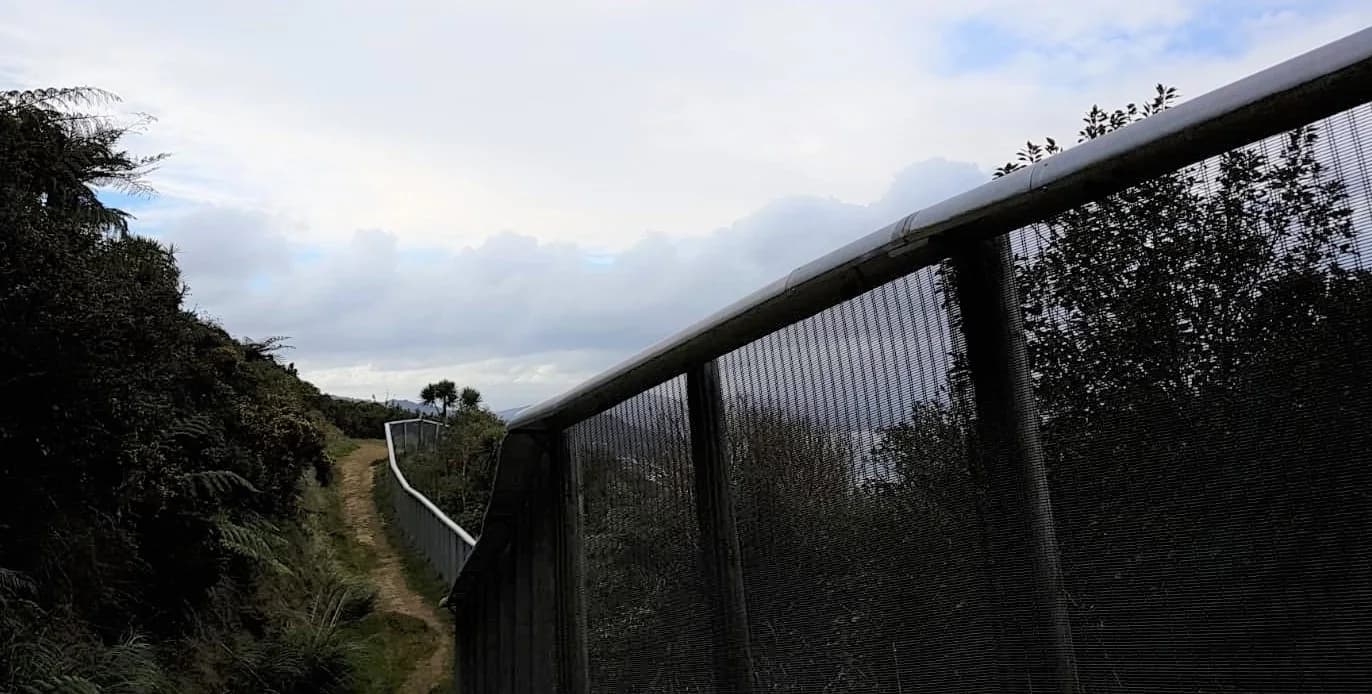
Because birds can fly over the fence, kākā and tūī from Zealandia now feed in gardens across Wellington, so a small sanctuary spreads native wildlife into the city around it. The fence needs constant inspection: house mice have got back in through small defects in the mesh and must be controlled. The sanctuary is run by a non-profit trust with a grant from Wellington City Council, membership fees and visitor income, which illustrates how an urban location can be an advantage, providing visitors, volunteers and political support.
Sources: Wikipedia, Zealandia (wildlife sanctuary) (accessed 2026).
Surroundings and distance from cities
A protected area is an open system: animals, seeds, water, fire, pollution and people cross its boundary. Its success therefore depends on the land around it. A forest reserve surrounded by plantations or extensive grazing is under less pressure than one surrounded by intensive farms that use pesticides or by roads that kill animals. Distance from cities matters in two directions. Remote reserves face less disturbance, pollution and demand for land, but they are harder to patrol and attract fewer visitors and less money; reserves near cities have more visitors, volunteers and political support, but also more pressure from housing, recreation, pets and invasive garden plants.
Designing reserves: size, shape, edges and corridors
A reserve only works if it is large enough and well enough designed for the species it is meant to protect. Effective conservation therefore starts from the biology of the target species: how much space an individual or a breeding population needs, how far animals move, what food and breeding sites they use, and how they respond to disturbance. A reserve that suits a beetle may be far too small for a leopard, which can range over hundreds of square kilometres.
Edge effects
Where a habitat meets a different one, such as a forest next to a field, conditions change. Near the edge there is more light and wind, the air is warmer and drier, trees are more easily blown over, and predators, invasive species, livestock and people enter more easily. These changes are called edge effects. Species that need the stable, shaded interior of a forest cannot survive in the edge zone, so the useful area of a reserve for them is only its core.
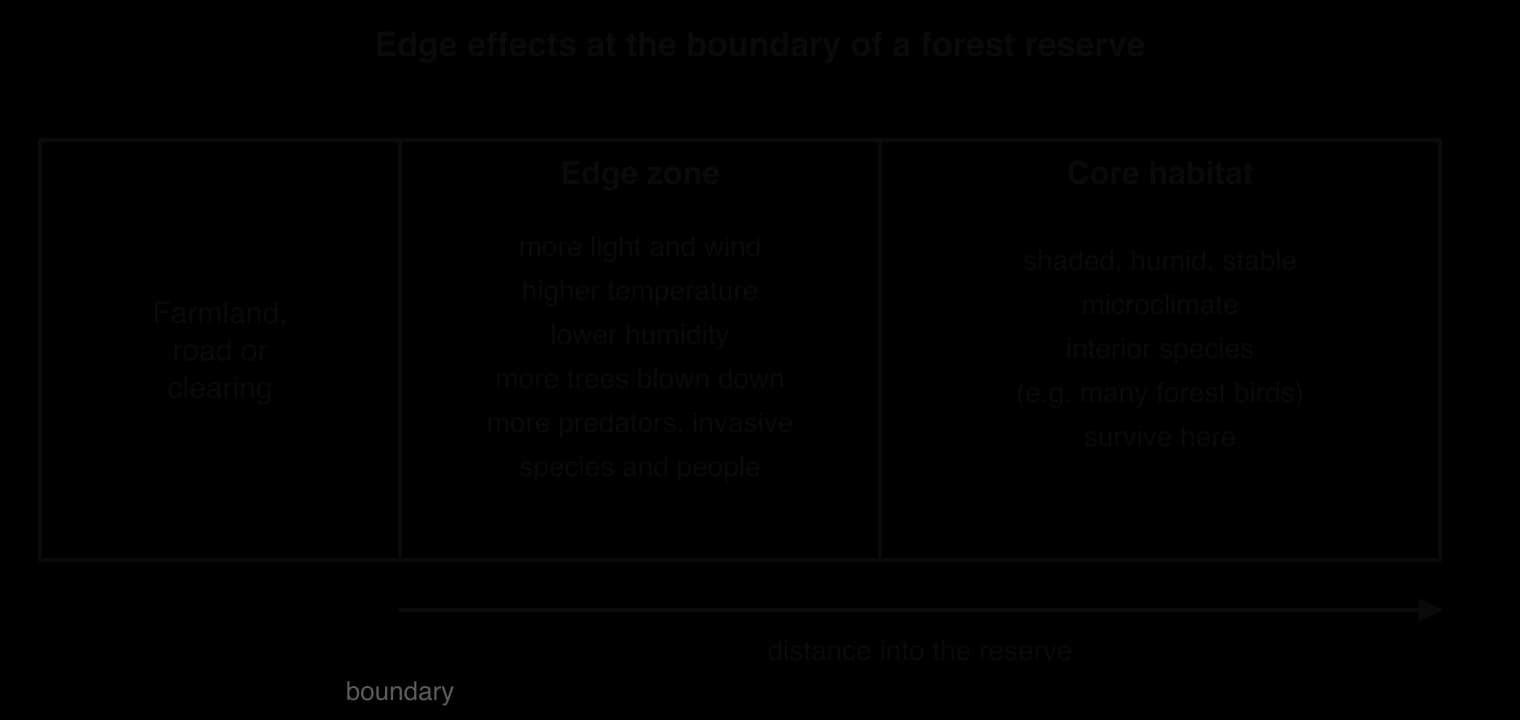
The Biological Dynamics of Forest Fragments Project near Manaus in the Brazilian Amazon has studied edge effects since 1979, by leaving fragments of 1, 10 and 100 ha isolated by cattle pasture. Birds that follow army-ant swarms disappeared completely from the 1 ha and 10 ha fragments within two years of isolation, and insect-eating birds declined in number and diversity. Small fragments behave mostly like edge, so they lose interior species first.
Sources: Wikipedia, Biological Dynamics of Forest Fragments Project (accessed 2026).
Size, shape and number: the SLOSS debate
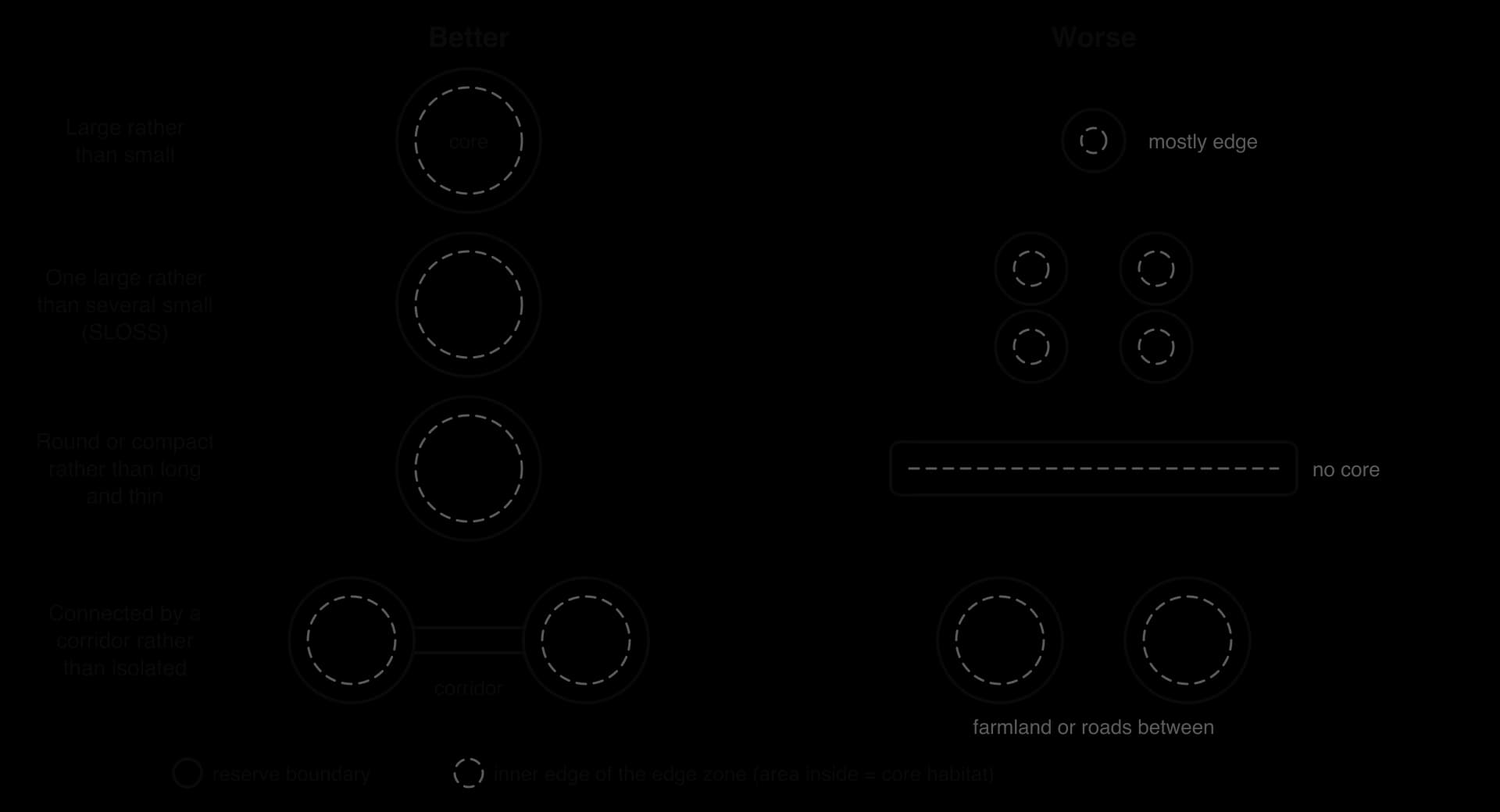
Several rules of thumb follow from edge effects and from the biology of species with large ranges. A large reserve holds more species and larger, more viable populations than a small one. A round or compact reserve has less edge for its area than a long, thin one. For a given total area, ecologists have long argued about whether a single large or several small reserves (SLOSS) protect more. One large reserve has more core habitat and suits large predators, while several small ones spread the risk that a single fire, flood or disease destroys everything, and may include a wider range of habitats.
Wildlife corridors and connectivity
Habitat fragmentation leaves populations in isolated patches. A small, isolated population can lose genetic diversity through inbreeding, cannot be "rescued" by newcomers if it declines, and cannot move if the climate changes. A wildlife corridor is a strip or chain of habitat, such as a hedgerow, a river bank, a forest belt or a bridge over a road, that links patches so that animals and plants can move between them.
Banff National Park in Canada shows how corridors can work across a major road. Along the Trans-Canada Highway the park has built six wildlife overpasses and 38 underpasses, used more than 200,000 times by animals from bears to toads; together with fencing they have cut collisions between vehicles and wildlife by about 80%. Corridors also have costs: they are expensive, they are narrow and so mostly edge, and they can help diseases, fire or invasive species to spread between reserves as well as native species.
Sources: Wikipedia, Wildlife corridor (accessed 2026).
 YouTube
Biosphere reserves: zoning people and nature
Many protected areas have people living in or around them. Excluding everyone is unfair to those people and often fails, because they lose their land and livelihoods and have no reason to support the reserve. UNESCO's Man and the Biosphere Programme, launched in 1971, instead designates biosphere reserves that combine conservation with sustainable development. By 2026 the World Network had 797 sites in 145 countries, covering more than 5% of the world's surface and home to over 260 million people.
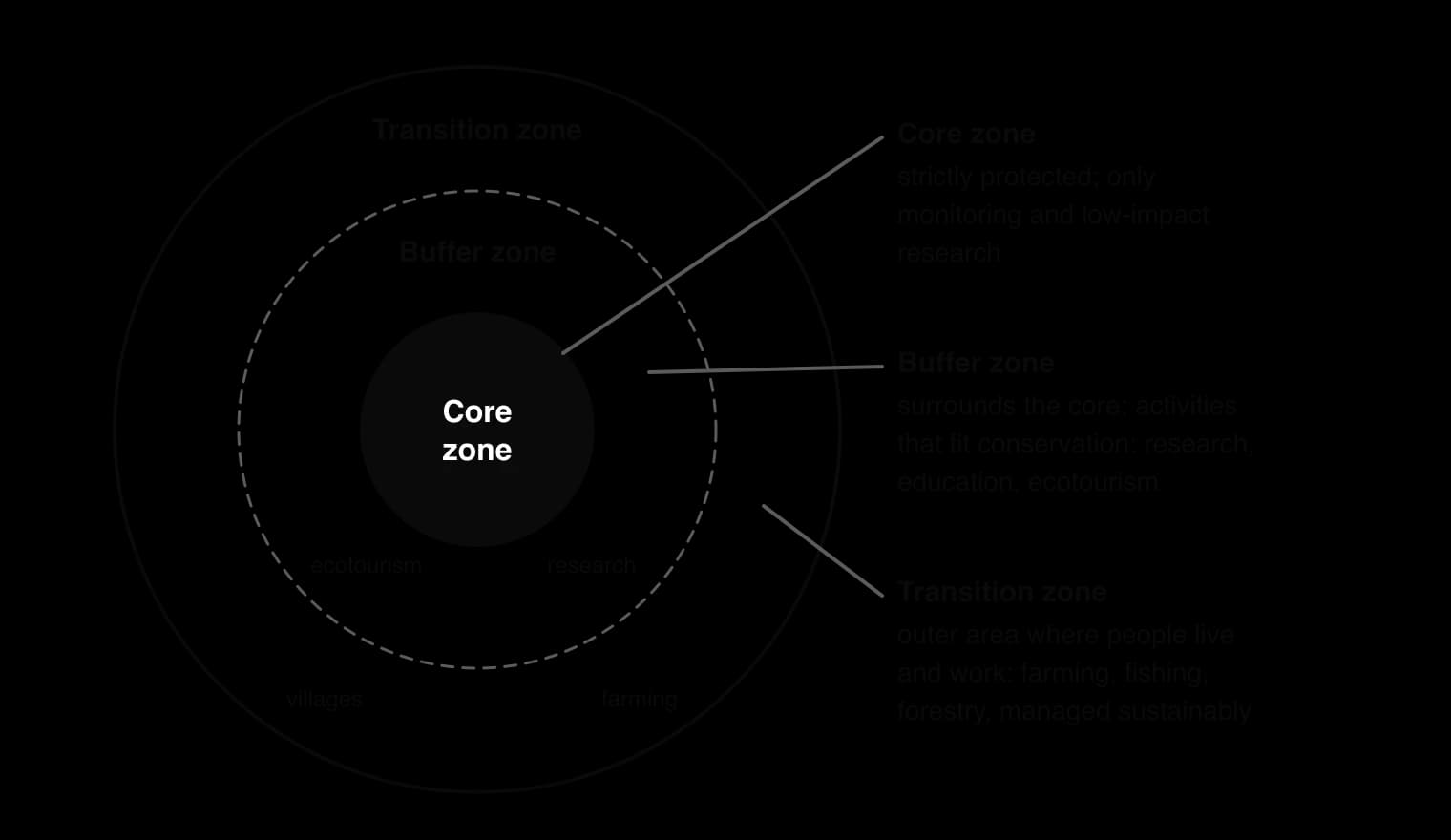
The core zone is strictly protected. It holds the most important habitats and species, and only monitoring and research that cause little disturbance are allowed.
The buffer zone surrounds or adjoins the core. Activities that fit with conservation, such as research, environmental education and ecotourism, take place here, and it absorbs edge effects before they reach the core.
The transition zone is the outer area where people live and work. Farming, fishing, forestry and settlements are allowed, managed sustainably and with local communities involved in decisions.
Sian Ka'an Biosphere Reserve, Mexico
Sian Ka'an, on the Caribbean coast of the Yucatán Peninsula in the state of Quintana Roo, was declared a biosphere reserve in 1986 and a UNESCO World Heritage Site in 1987. It covers about 5,280 km² of tropical forest, mangroves, wetlands, lagoons and a section of coral reef. Its species include the jaguar, Baird's tapir, the Yucatán black howler monkey and the American flamingo, and it contains some 23 known archaeological sites of the Maya civilisation.
The reserve lies south of the fast-growing tourist resorts of the Riviera Maya, including Tulum. Fishers, farmers and Maya communities took part in planning the reserve, and Maya communities have been trained to run ecotourism in it. Tourism and building along the coast increase the pressure on its edges, which is why zones in which local people can earn a living sustainably are needed between the developed coast and the strictly protected core.
Sources: UNESCO Man and the Biosphere Programme; Wikipedia, Sian Ka'an (accessed 2026).
Rewilding: regenerating natural processes
Most conservation tries to protect what is left. Ecological restoration tries to repair what has been damaged, for example by replanting native trees on cleared land, removing invasive species or re-flooding drained wetlands. Rewilding is a form of restoration with a particular aim: to restore the natural processes, such as predation, grazing, seed dispersal, flooding and succession, that let an ecosystem look after itself, so that people can step back.
Methods of rewilding
Reintroducing apex predators and other keystone species. Predators such as wolves, lynx or leopards control the numbers and behaviour of herbivores; keystone species such as beavers, bison or elephants engineer habitats by building dams, wallowing or opening up woodland.
Re-establishing habitat connectivity over large areas, with corridors and by joining reserves, so that animals can roam and populations are large enough to persist.
Ending agriculture and resource harvesting, such as ploughing, logging, fishing and hunting, so that vegetation and populations can recover.
Minimising human influence, including through ecological management that is reduced over time; a rewilded area should eventually need little or no intervention.
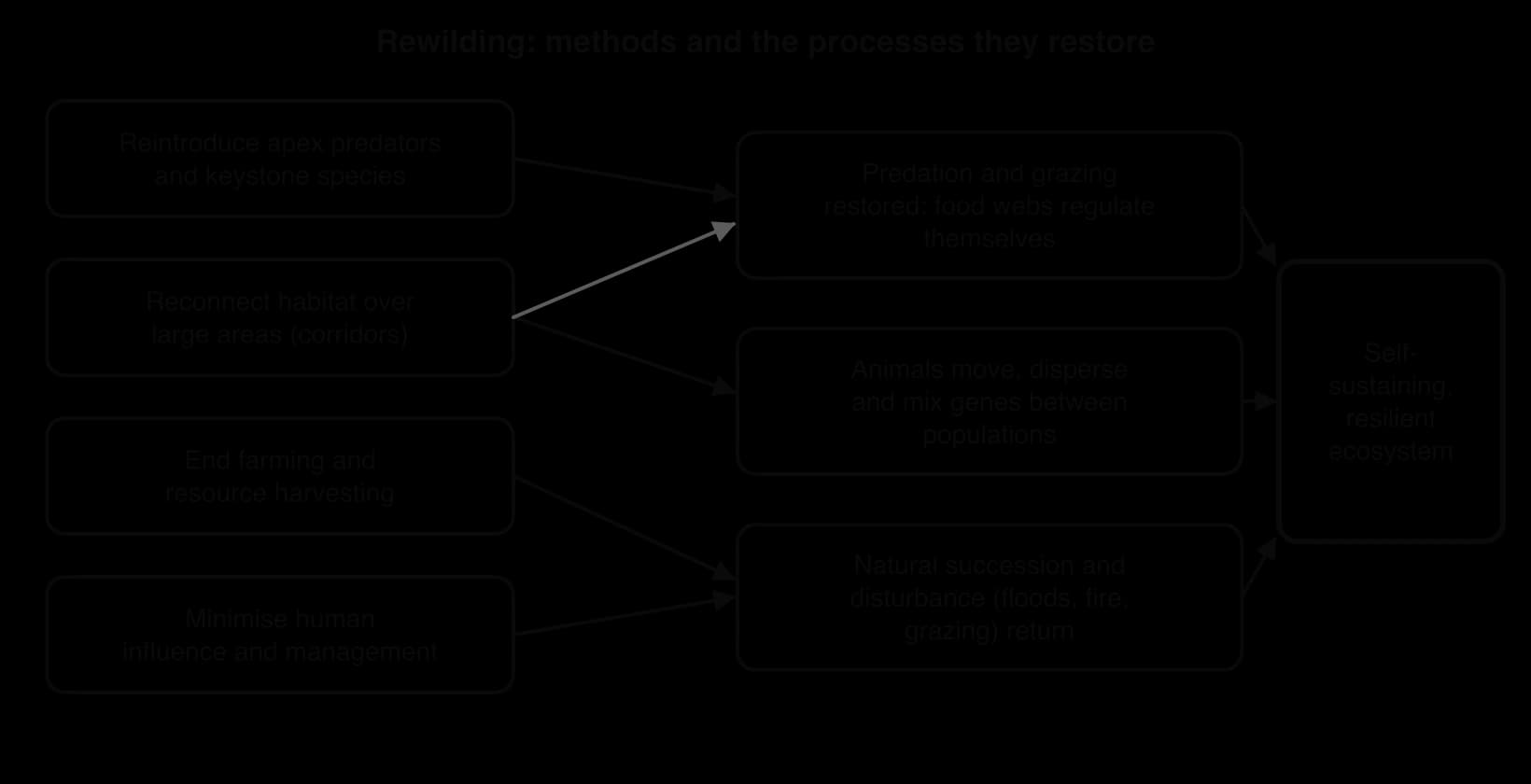
Rewilding differs from traditional conservation in its attitude to change. Managing a heath or a hay meadow keeps it in a chosen state; rewilding accepts that a site will change in ways that are hard to predict, as long as natural processes are working. It also differs from simply abandoning land, because missing species are often brought back on purpose and the process is monitored.
Hinewai Reserve, New Zealand: letting a forest return
Hinewai Reserve, east of Akaroa on Banks Peninsula, began in 1987 when the Maurice White Native Forest Trust bought a 109 ha farm block of steep, cleared hill country. It has since grown to more than 1,250 ha. Much of the land was covered in gorse, a spiny shrub introduced from Europe that farmers usually treat as a weed to be sprayed or burned. The reserve's manager, the botanist Hugh Wilson, chose instead to leave the gorse alone and let it act as a nurse plant for native trees.
Gorse grows quickly on bare, poor soil, shelters seedlings from wind and browsing, and, as a legume that fixes nitrogen, enriches the soil. Native tree seedlings, many from seeds dropped by birds, grow up through it; once they overtop the gorse, they shade it out, because gorse needs full light. Management is kept to a minimum: feral goats were eliminated by 1999 and a few invasive trees, vines and animals are removed, but otherwise the land is left alone. Native forest has regenerated rapidly across much of the reserve. The approach costs little, but it needs patience, and it depends on native seed sources nearby.
Sources: Wikipedia, Hinewai Reserve; Maurice White Native Forest Trust, Hinewai Reserve (2026).
Reintroducing an apex predator: wolves in Yellowstone
Grey wolves were eliminated from Yellowstone by 1926. In January 1995, 14 wolves from Alberta were released in the park, and 17 more from Canada followed in 1996. Between the winters of 1995 and 2004 the number of elk on the park's northern range roughly halved, from 16,791 to 8,335, while the number of wolves there rose from 21 to 106. Beaver colonies in the northern range increased from one in 2001 to nine by 2011, as willows along streams recovered.
These changes are often described as a trophic cascade started by the wolves. Many ecologists caution that the evidence is mixed: bears, human hunting, harsh winters and drought also reduced elk numbers, and in many places willows have recovered less than early reports suggested. Yellowstone is best seen as an example of reintroducing an apex predator as a rewilding method, whose wider effects are still being measured.
Sources: Wikipedia, History of wolves in Yellowstone (accessed 2026).
 YouTube
Rewilding sometimes happens without a plan. After the Chernobyl nuclear accident in 1986, people were evacuated from about 2,600 km² in Ukraine; wolves, moose and other large mammals have since increased in the exclusion zone, and Przewalski's horses were released there in 1998. Scientists still disagree about how much radiation harms the animals, so the zone is a contested example rather than a model.
Conservation and the biodiversity planetary boundary
The planetary boundaries model sets limits for nine Earth-system processes within which humanity can operate safely. The boundary for biosphere integrity has two parts, both already crossed: the extinction rate is estimated at more than ten times its boundary, and people take about 30% of the planet's plant production against a boundary of 10%.
Conservation and regeneration can help to bring biodiversity back into the safe operating space, but only if they work at a large enough scale. Protecting the last fragments of habitat slows losses; restoring and reconnecting habitats can raise populations again and reverse decline. The Kunming–Montreal targets to conserve 30% and restore 30% of degraded ecosystems by 2030 are attempts to scale action up to the size of the problem.
Sources: Richardson et al., Planetary boundaries update (2023); Potsdam Institute for Climate Impact Research, _Planetary Health Check (2025, 2026); Wikipedia, Planetary boundaries (accessed 2026)._
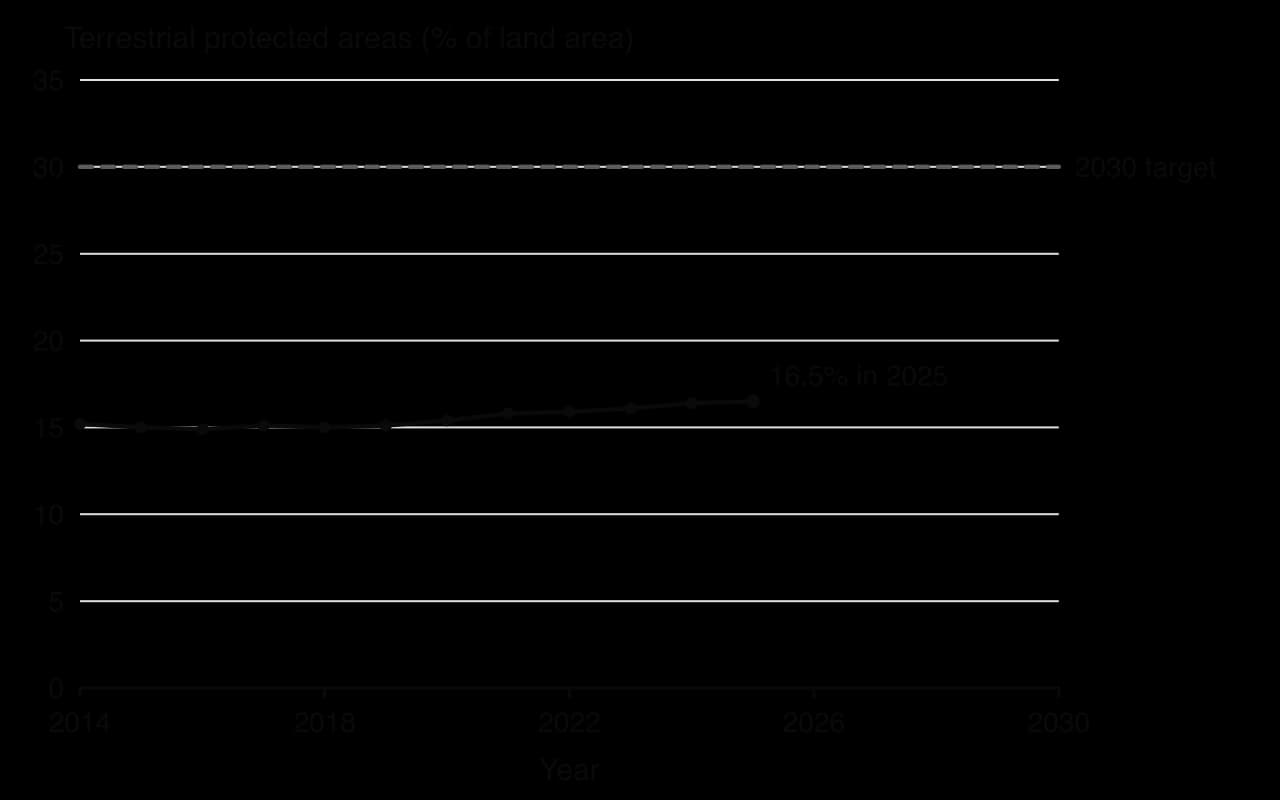
Area alone is not enough. By May 2026, according to the Protected Planet database, which includes more recent and more kinds of protected area than the World Bank series in the chart, about 17.3% of land and inland waters and 9.8% of the ocean were in protected areas. Many of these are paper parks, protected in law but without the funding, staff or enforcement to stop poaching, logging or settlement. Only about 45% of the area of the world's Key Biodiversity Areas on land is covered by protected areas, so many of the most important sites are still unprotected.
Sources: Protected Planet via Wikipedia, 30 by 30 (2026); Our World in Data, protected terrestrial biodiversity sites (2025).
Action at four levels
Level | Examples of conservation and regeneration measures |
|---|---|
Individual | Planting native species in gardens; buying certified wood, fish or palm oil; not buying wildlife products; volunteering; recording species for citizen science |
Collective (communities, NGOs, businesses) | Community-managed forests and fisheries; NGO-run reserves and ecosanctuaries; land trusts buying land for restoration, as at Hinewai; companies removing deforestation from supply chains |
National | Creating national parks; laws protecting threatened species; an NBSAP under the CBD; payments to farmers to restore habitats; banning domestic ivory sales |
International | The CBD and its Global Biodiversity Framework; CITES; transboundary parks such as the Great Limpopo; funding from richer to poorer countries for conservation |
The levels depend on each other. International targets mean little unless national governments pass laws and fund parks, and national parks fail without the support of the communities and individuals who live beside them. Linking the levels also links conservation to other Sustainable Development Goals, especially SDG 14 (life below water) and SDG 15 (life on land).
Perspectives and the choice of conservation strategy
Societies choose different conservation strategies partly because they hold different environmental value systems. A strategy that seems obvious from one perspective may look wasteful or unjust from another. Comparing them helps to explain why conservation is often contested.
Perspective | What it values in nature | Strategies it favours | Example |
|---|---|---|---|
Ecocentric | The intrinsic value of all species and ecosystems | Low-intervention in situ protection: large wilderness reserves, rewilding, letting natural processes work | Hinewai's minimal intervention; large strict reserves |
Anthropocentric | Nature's value to people: services, income, culture, well-being | Managed protected areas that also provide livelihoods; ecotourism; biosphere reserves with transition zones; sustainable harvesting | Biosphere reserves such as Sian Ka'an; community conservancies |
Technocentric | Human ability to manage nature with science and technology | Scientific interventions: zoos, captive breeding, seed and gene banks, cloning, genetic rescue | Svalbard Global Seed Vault; the Frozen Zoo; Chengdu panda breeding |
Real decisions mix these views. A national park may be justified ecocentrically, paid for by ecotourism (an anthropocentric argument) and supported by a captive-breeding programme (a technocentric tool). Indigenous and local communities often hold worldviews in which people are part of nature and responsible for it, which do not fit neatly into any of the three categories.
What makes a conservation strategy succeed?
Ecology is only part of success. Experience from many projects shows that several factors must work together:
Community support: local people who benefit from a reserve, through jobs, land rights or a share of income, protect it; those who lose their land or livelihoods may oppose it or ignore its rules.
Funding: rangers, fences, monitoring and compensation for crop damage cost money every year, not just at the start.
Education and awareness: people support what they understand and value; flagship species and visitor centres help.
Legislation and enforcement: laws that protect habitats and species, and the courts and police to enforce them.
Scientific research: knowledge of the target species' biology, population monitoring and evaluation of what works.
Conservation also raises questions of environmental justice. In the past, many national parks were created by removing Indigenous people and local communities from their land, a model known as fortress conservation. The costs of protection, such as lost farmland and wildlife damaging crops, often fall on poor rural people, while the benefits go to tourists, distant governments and the global public. Strategies that involve local people in decisions and share benefits fairly are both more just and, in many cases, more effective.
Case study: restoring Gorongosa National Park, Mozambique
Context
Gorongosa National Park lies in Sofala Province in central Mozambique, at the southern end of the East African Rift Valley. Since Mount Gorongosa was added in July 2010, it has covered 4,067 km². The valley floor holds Lake Urema and seasonally flooded grassland surrounded by savanna woodland, and the mountain holds rainforest. Parts of the area were first protected as a hunting reserve in 1920.
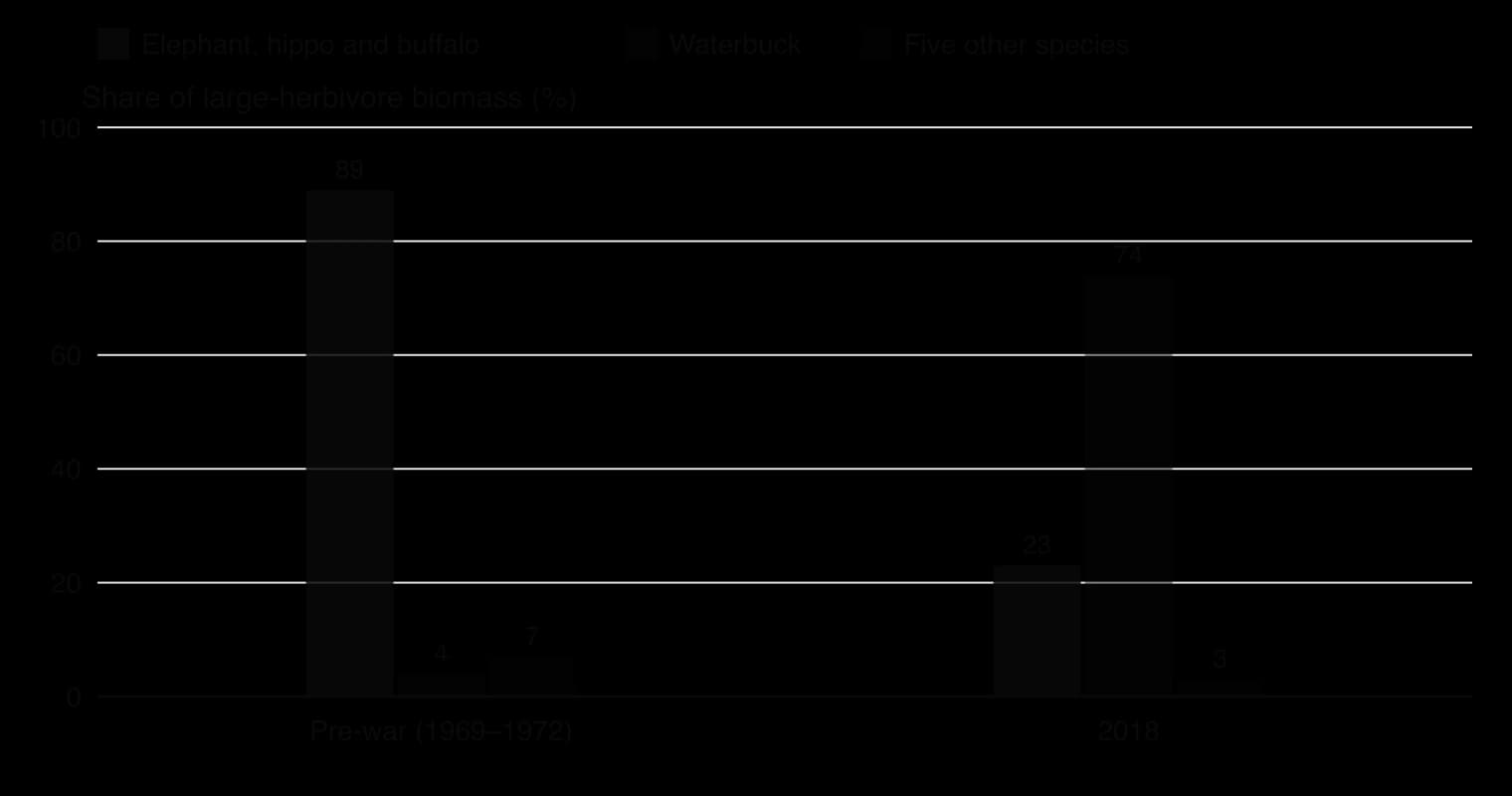
Before the war, Gorongosa had one of the densest populations of large mammals in Africa. Aerial surveys of the whole park in the late 1960s counted about 200 lions, 2,200 elephants, 14,000 African buffalo, 5,500 wildebeest, 3,000 zebras, 3,500 waterbuck and 3,500 hippos. The total biomass of the nine main large herbivores exceeded 9,000 kg per km², similar to the Serengeti and the Ngorongoro Crater.
What happened: collapse during the civil war
Mozambique's civil war lasted from 1977 to 1992. Fighting reached the park in 1981, when its headquarters at Chitengo was attacked, and the park was abandoned in 1983. Soldiers on both sides, and hungry local people, hunted large animals for meat and ivory, and hunting continued for at least two years after the ceasefire. Between the pre-war surveys and the first post-war surveys of 1994–1997, the total biomass of large herbivores fell by about 96%.
Losses were not equal. An aerial survey of 68 km² in 1994 found only 5 elephants, 6 waterbuck and 3 zebra. Buffalo, once the most abundant species, and wildebeest were not seen again until 2001 and 2007 respectively, having declined by more than 99%. Among large carnivores only the lion survived, in small numbers; leopards, wild dogs and spotted hyenas disappeared.
Data: an asymmetric recovery
Aerial counts repeated in the same 1,708 km² block of the Rift Valley floor make the changes directly comparable. With protection restored, total biomass recovered to more than half the pre-war level by 2010 and to about 95% by 2018. The species that make up that biomass, however, are very different.
Species | 1972 count | 2018 count | Change |
|---|---|---|---|
Waterbuck | 3,194 | 55,048 | about 17 times more |
Buffalo | 6,200 | 959 | −85% |
Hippo | 3,483 | 546 | −84% |
Wildebeest | 3,093 | 556 | −82% |
Zebra | 2,013 | 13 | −99% |
Elephant | 1,146 | 544 | −53% |
Sable | 111 | 768 | about 7 times more |
Sources: Stalmans et al. (2019), PLoS ONE 14(3): e0212864, S4 Table (counts in the Rift Valley count block).
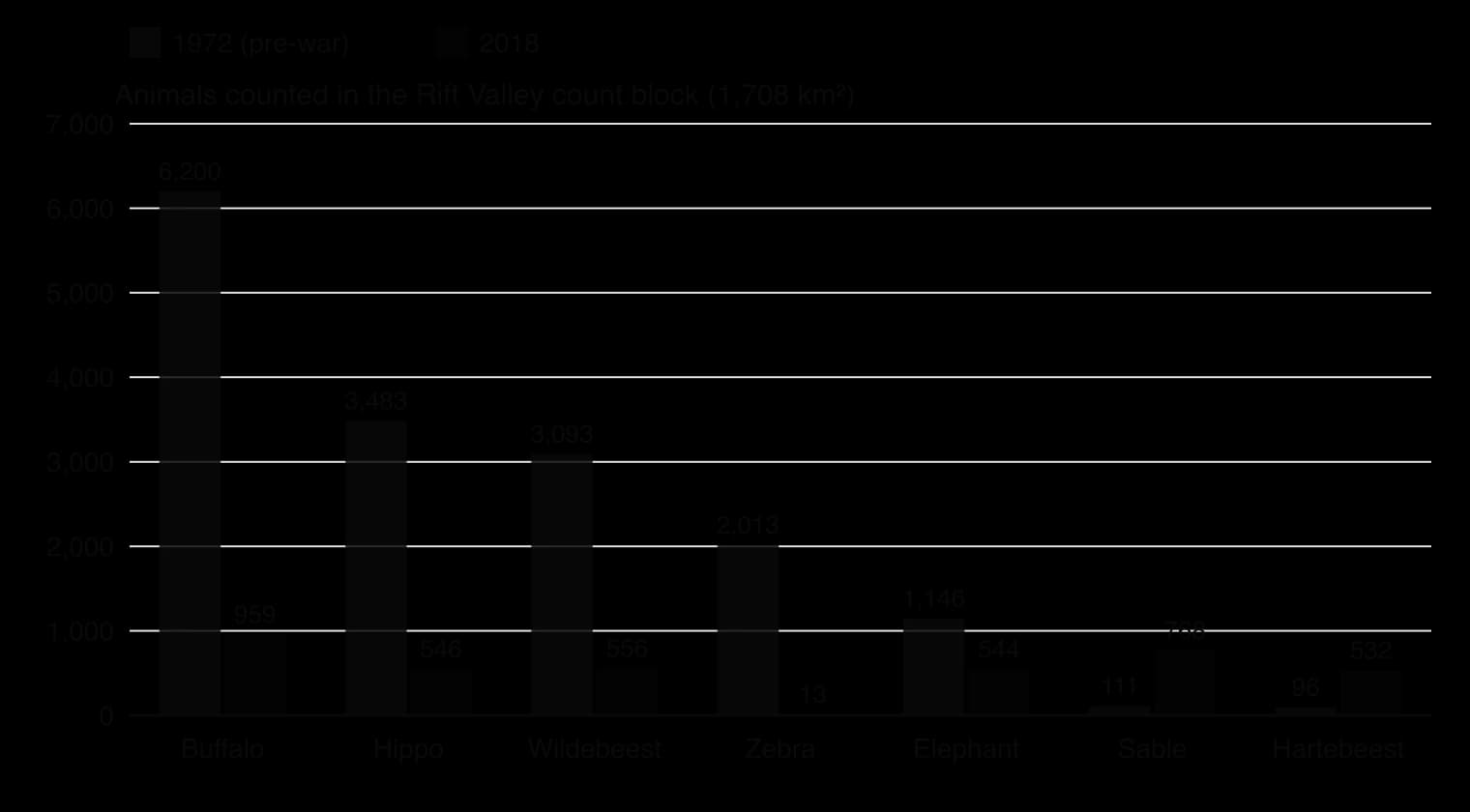
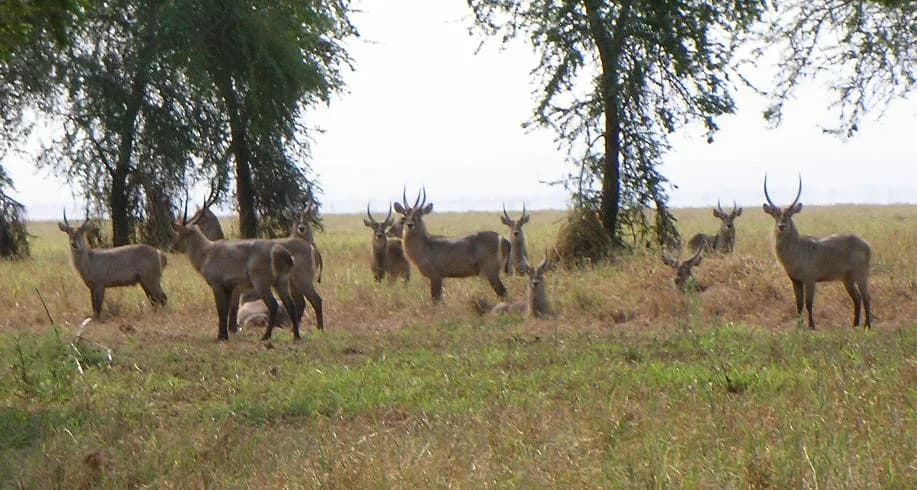
Waterbuck, which can feed year-round on the floodplain grassland and probably survived the war in larger numbers, increased about seventeenfold between 1972 and 2018, to more than 55,000. Other small and medium antelope, such as reedbuck, oribi, impala and warthog, also increased rapidly. The large, bulk-feeding grazers recovered much more slowly, because they breed slowly and few survived the war.
Management and responses
Restoration began in 1994, when a rehabilitation plan funded by the African Development Bank hired 50 new staff, most of them former soldiers. In 2004 the Government of Mozambique agreed to cooperate with the Carr Foundation, a philanthropic foundation from the United States, and in 2008 the two signed a 20-year public–private partnership to manage the park jointly as the Gorongosa Restoration Project. In 2018 the agreement was extended for a further 25 years.
Protection: rebuilding a ranger force to stop poaching; in 2025, 96 rangers were trained in human rights, biodiversity law and wildlife-crime investigation, and 42 community scouts helped to reduce conflict between people and elephants or buffalo.
Reintroductions: 465 animals of 7 species were moved in between 2007 and 2018, mainly 210 buffalo and 180 wildebeest, plus elephant bulls in 2008. Apex predators followed: African wild dogs in 2018 and 2019, leopards from 2020 and spotted hyenas from 2022.
Habitat: Mount Gorongosa, whose rainforest feeds rivers that flow into the park, was added in 2010. Farmers on the mountain are paid to grow shade coffee among native trees, combining reforestation with income: from fewer than 30 ha in 2014 the scheme grew to 484 ha managed by 1,623 producers in 2025.
Human development: in 2025, 353 mobile health clinics served about 160,000 people, a child nutrition programme helped cut chronic malnutrition among low-birthweight infants in one district from 52% to under 25%, 28 new schools were completed, and after-school clubs supported about 4,500 girls.
Ecotourism and business: tourism camps such as Chicari, opened in 2025, hire most of their staff from the communities around the park, and the profits of the project's companies are reinvested in conservation and community programmes.
Evaluation
From an ecocentric point of view, Gorongosa is one of the best examples of post-war recovery in Africa: herbivore biomass returned almost to pre-war levels within about 25 years, and most of the increase came from natural population growth once hunting stopped, not from reintroductions. It shows that protection alone can regenerate large populations if enough survivors remain. The project received the BBVA Foundation Worldwide Award for Biodiversity Conservation in 2025.
Scientists also point out that recovery of biomass is not recovery of the ecosystem. Waterbuck now dominate because predators and the large grazers that once competed with them are still scarce; in 2016 lion densities were below 30% of what the prey could support. It is not yet known whether the community will move back towards its pre-war state, as happened in Kenya's Lake Nakuru, or settle in a new, waterbuck-dominated state. This raises a basic question for any restoration project: what is the target, the 1960s community or any self-sustaining one?
From an anthropocentric and development perspective, the project treats the people around the park as part of the system, through health care, schools, jobs and coffee income. Critics ask whether a park run largely with money and decisions from a foreign philanthropist gives Mozambicans enough control, and what would happen if the outside funding stopped. Conflict also continues where elephants and buffalo raid crops in the surrounding farmland.
Stakeholder | Perspective | View of the restoration |
|---|---|---|
Conservation scientists | Ecocentric | Recovery of biomass is a major success, but the community is not yet balanced; more predators and grazers are needed |
Government of Mozambique | Anthropocentric (national development) | A source of tourism income, jobs and international reputation, managed in partnership |
Communities around the park | Anthropocentric (livelihoods) | Benefits from clinics, schools and coffee income, but costs from crop raiding and limits on hunting and farming |
Foreign donors and partners | Mixed | A model of "people and wildlife together", but dependent on continued funding |
What it shows
Gorongosa illustrates almost every idea in conservation and regeneration. It is in situ, habitat-based conservation with active management; it has a protected core surrounded by a development zone where people live; it uses reintroduction of apex predators as a rewilding method; and its success depends on community support, long-term funding and scientific monitoring. It also shows that a restored ecosystem may differ from the one that was lost, because species recover at different rates.
Sources: Stalmans et al. (2019), PLoS ONE; Gorongosa Project, 2025 Annual Highlights Report (2026); Wikipedia, Gorongosa National Park (accessed 2026).
Conservation organisations (HL only)
Three main types of organisation run conservation. Intergovernmental organisations (IGOs) are made up of member states, such as the United Nations Environment Programme (UNEP). Governmental organisations are national or local agencies, such as a national parks service. Non-governmental organisations (NGOs) are independent of government and funded by members, donors and businesses, such as the World Wide Fund for Nature (WWF).
The International Union for Conservation of Nature (IUCN) sits between these types. Founded in 1948, it has more than 1,400 member organisations, both governments and NGOs, from over 170 countries, and some 16,000 volunteer experts. It publishes the IUCN Red List and is the official adviser on natural sites under the World Heritage Convention, but it cannot enforce anything itself: it influences governments through information and advice.
What determines their success
Factor | Intergovernmental (e.g. UNEP, CBD Secretariat) | Governmental (e.g. Rwanda Development Board) | Non-governmental (e.g. WWF) |
|---|---|---|---|
Use of media | Global reports and summits gain coverage, but messages are often cautious and technical | Can run national campaigns; may avoid publicising failures | Skilled at campaigns, logos and appeals (WWF's panda); can criticise governments openly |
Speed of response | Slow: decisions need agreement among many states, often at meetings years apart | Can act quickly within its own country, by law or decree | Fast: can buy land, fund rangers or start a campaign without waiting for governments |
Diplomatic constraints | Must respect state sovereignty; cannot force a member to act | Limited by national politics and relations with neighbours | Free of diplomatic rules, but needs government permission to work in a country |
Financial resources | Depends on contributions from member states, which may be late or small | Depends on national budgets and on income such as park fees | Depends on donations; WWF had revenue of about US$433 million in 2022 |
Political influence | Sets international agendas and targets; legitimacy from wide membership | Makes and enforces laws, creates parks | Lobbies governments and businesses; influence depends on public support and reputation |
Each type has a distinct strength. The CBD and UNEP give all countries shared targets, as in the Kunming–Montreal framework, but they cannot make any country meet them. A national agency can act decisively: in May 2017 the Rwanda Development Board doubled the price of a gorilla-trekking permit and doubled the share of park revenue given to nearby communities, decisions that took effect immediately. NGOs can move fastest and reach the public best, but they rely on donations and on their reputation.
That reputation can be damaged. WWF, founded in 1961, works in more than 100 countries and has over 5 million supporters. In 2019 a news investigation alleged that rangers funded by WWF in parts of Asia and Africa had abused local people, and WWF commissioned an independent review. The case shows that an NGO's success depends on accountability to the communities where it works, not only on the funds it raises.
Sources: Wikipedia, International Union for Conservation of Nature and World Wide Fund for Nature (accessed 2026); Rwanda Development Board (2017).
Feedback loops in rewilding and restoration (HL only)
A positive feedback loop amplifies a change: the output of a process makes the same process stronger. Positive feedback is usually discussed as a danger, as in melting ice or eutrophication. In restoration it can work in nature's favour. Once a few native trees, a beaver pair or a breeding group of predators is established, their effects can make the site more suitable for more of the same, so that recovery speeds up.
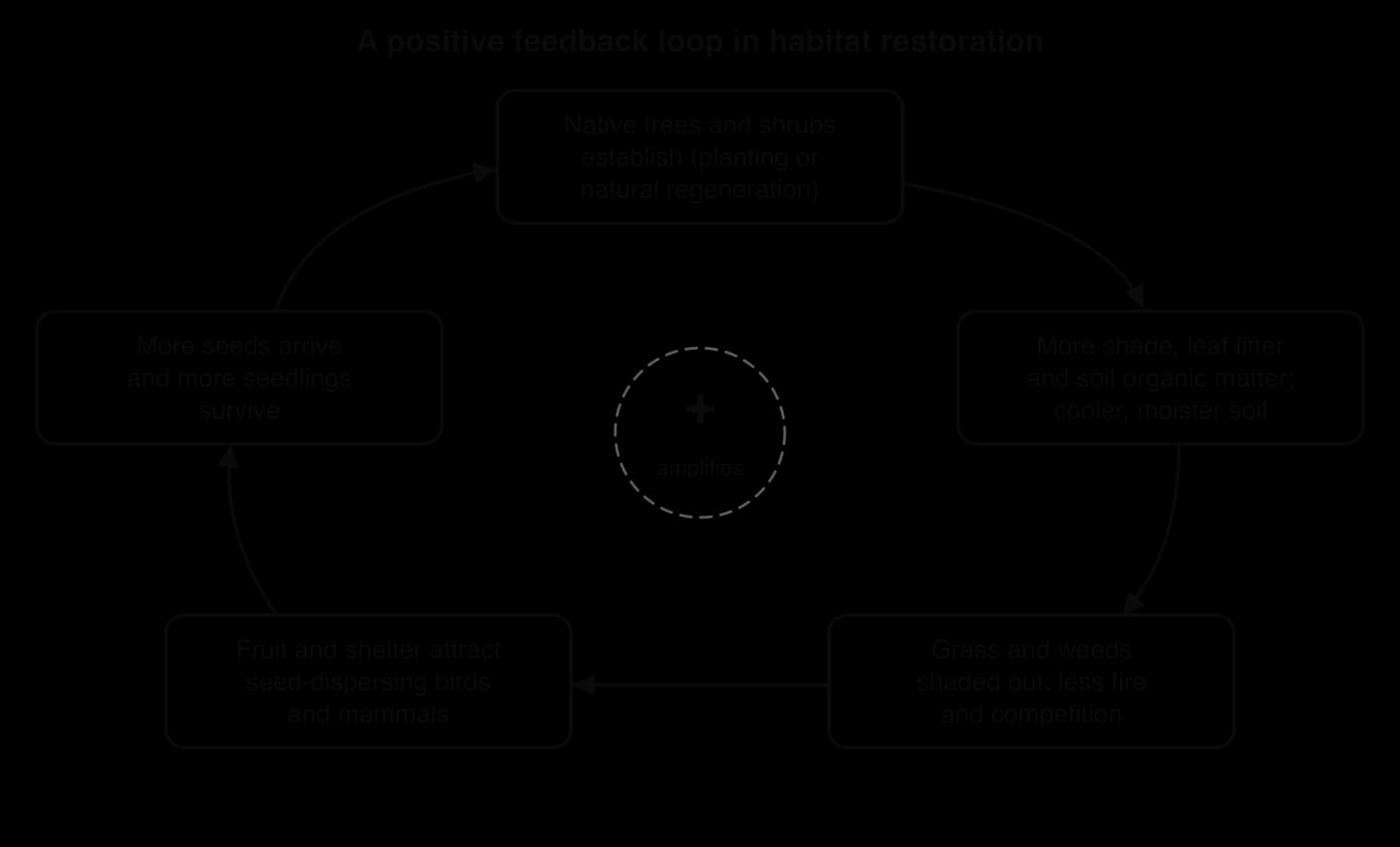
How restoration feeds on itself
Enhanced growth and biomass: trees and shrubs shade out grasses and add leaf litter; the soil gains organic matter and holds more water, so more plants grow, adding more biomass.
Enhanced reproduction: more fruit, flowers and nesting sites support more birds, bats and insects, which pollinate plants and disperse their seeds, so more plants reproduce.
Enhanced survival: shelter and food reduce mortality of young animals and seedlings; a larger population is less likely to die out by chance.
Food web interactions: returning predators and engineers change how other species behave. Beaver dams raise water levels, creating wetland that suits willows, fish and amphibians, which then support more beavers and more species.
In Yellowstone, the recovery of streamside willows has been linked to the return of beaver colonies, and beaver ponds in turn keep the ground wet and help willows to grow. At Hinewai, each patch of native forest attracts birds that bring seeds of more native trees into the surrounding gorse.
Alternative stable states
The same ecosystem can sometimes exist in two or more alternative stable states, for example open grassland or closed forest on the same soil. Each state is held in place by its own feedback loops: grass fuels fires that kill tree seedlings, while forest shade keeps grass and fire out. A positive feedback loop is a necessary condition for alternative stable states at the scale of a community, because it is what pushes the system away from the threshold and towards one state or the other.
For restoration, this means that small efforts may fail completely: a few planted trees in fire-prone grassland may burn before they can change conditions. Once enough change has been made to cross the tipping point, the positive feedback takes over and carries the system to the new state with little further help. Rewilding projects try to reach this threshold, after which people can step back.
Gorongosa may illustrate the risk. Waterbuck are increasing logistically, apparently unchecked by competitors or predators. Their grazing could hold the floodplain in a state that favours them, a new stable state, or the returning predators and grazers could push it back towards the pre-war community. Reintroducing wild dogs, leopards and hyenas is partly an attempt to restart the predator–prey feedbacks that once regulated the system.
Sources: Stalmans et al. (2019), PLoS ONE; Wikipedia, History of wolves in Yellowstone (accessed 2026).
Benefits and limitations of rewilding projects (HL only)
Rewilding is popular with many conservationists and the public, but every project has to justify using land that could produce food, timber or housing. Judging a project means weighing its gains for biodiversity, carbon and people against what is given up, and asking who decides.
Knepp Estate, England: rewilding former farmland
Knepp is an estate of about 1,400 ha in West Sussex, in south-east England. After about 17 years of trying to make intensive dairy and arable farming pay on heavy clay soils, the owners sold the dairy herd in 2000 and began turning the land over to nature. Free-roaming English longhorn cattle, Exmoor ponies, Tamworth pigs, and red and fallow deer were introduced as stand-ins for the wild grazers and browsers of the past, and their grazing, rooting and trampling create a shifting mosaic of scrub, grassland and woodland. Beavers were released in 2020.
Wildlife responded strongly. By 2011 there were 11 singing male turtle doves, a bird that has declined steeply across Britain, and by 2015 the estate had the country's largest breeding colony of purple emperor butterflies. In 2020 white storks raised chicks in the wild in England for the first time in about 600 years. The estate earns income from about 75 tonnes of organic, pasture-fed meat a year, from wildlife tourism and camping, and from government stewardship payments.
Knepp also shows the limits. Land that once produced milk and crops now produces far less food, and early critics called it "an immoral waste of land". Some ecologists question whether a fenced estate with managed herds, meat sales and safaris is truly wild. Supporters reply that the clay land was unprofitable to farm, that the meat is still food, and that restored soils, wetlands and pollinators benefit farms nearby.
Sources: Wikipedia, Knepp Wildland (accessed 2026).
Other projects: Affric Highlands and Gorongosa
The Affric Highlands initiative in the Scottish Highlands is a 30-year project, led by the charity Trees for Life with Rewilding Europe, to restore and connect habitats from Loch Ness towards the west coast. It works with many landowners, communities and businesses rather than on a single estate, aiming to expand native Caledonian pinewood and riverside woodland, restore peatland (more than a third of its soils are peaty) and build a nature-based economy of jobs in land management, wildlife tourism and venison. Its scale gives connectivity, but it depends on persuading many owners with different goals.
The restocking of Gorongosa with buffalo, wildebeest, elephants and predators, described in the case study, shows rewilding in a tropical, post-conflict setting, where the main benefits claimed are for people as well as wildlife. Many more projects, on every continent, are linked through the Global Rewilding Alliance, which defines rewilding as the large-scale restoration of ecosystems so that nature can recover and regulate itself.
Sources: Trees for Life and Rewilding Europe (2026); Global Rewilding Alliance (2026).
Weighing up rewilding
Benefits | Limitations |
|---|---|
Restores natural processes and self-sustaining ecosystems that need little management in the long term | Takes land out of food production; critics argue it can push farming elsewhere, possibly onto more valuable habitat |
Increases biodiversity, often quickly, including declining species (turtle doves, purple emperors at Knepp) | Results are unpredictable; the new ecosystem may differ from expectations (waterbuck at Gorongosa) |
Stores carbon in regrowing vegetation and soils; reduces flooding and erosion | Reintroduced predators and large herbivores can kill livestock and damage crops, causing conflict with neighbours |
Creates income from ecotourism and nature-based products; can revive rural economies | Jobs in rewilding may be fewer than in farming, and decisions may be taken by wealthy landowners or outsiders |
Connects habitats so species can move as the climate changes | Needs very large areas to restore predators and migration, which are rarely available |
The food-production debate is often framed as land sparing versus land sharing. Land sparing farms some land intensively so that other land can be fully rewilded; land sharing farms more land less intensively, with wildlife living alongside crops. Rewilding of marginal, unprofitable farmland, as at Knepp, is easier to justify than rewilding of highly productive land.
Using data to judge a rewilding project
The success of a rewilding project can be assessed with secondary data from databases, such as long-term bird surveys, aerial wildlife counts, satellite images of tree cover or national biodiversity records, compared before and after the project or with similar sites that were not rewilded. The effect on people can be explored with questionnaires asking visitors or residents how ecotourism affects their income or what values the project promotes, designed in the same way as any values survey.
Assessing the success of conservation and restoration (HL only)
Many projects announce success with one striking number: millions of trees planted, a species "brought back from the brink". Such claims need checking. A useful framework asks three questions in turn, moving from the project's own targets to its wider value.
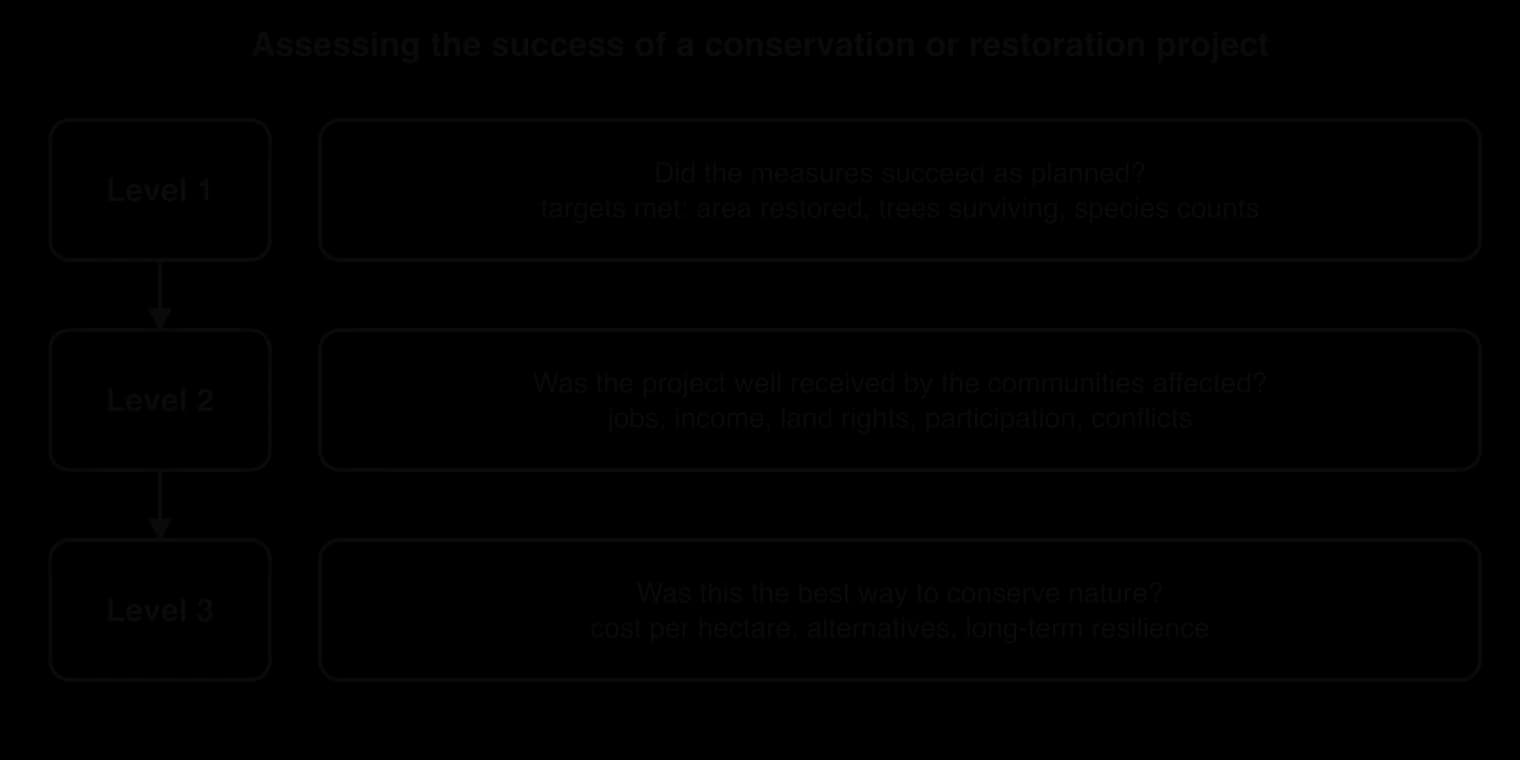
Did the measures succeed as planned? Were the stated targets met, and is the evidence independent and long-term? Trees planted are not trees surviving; animals released are not a breeding population.
Was the project well received by the communities affected? Did local people take part in decisions, gain jobs or income, keep their land rights? Or did they lose access to land, firewood or grazing?
Was this the best way to conserve nature? Could the same money have protected more biodiversity elsewhere, for example by protecting existing forest rather than replanting? Is the result resilient to drought, fire and climate change?
The Green Belt Movement, Kenya
The Green Belt Movement was founded in 1977 by Wangari Maathai, through the National Council of Women of Kenya, to respond to the problems that rural women reported: shrinking supplies of firewood, poor soils and drying streams. Women were trained to collect seeds, raise seedlings in nurseries and plant trees on farms, school grounds and public land. The movement reports that more than 51 million trees have been planted since 1977, that more than 30,000 women have been trained in forestry and related trades, and that over 4,000 community groups take part. Maathai received the Nobel Peace Prize in 2004 for this work.
The movement also became political. It campaigned successfully against a 60-storey office tower in Nairobi's Uhuru Park in 1989 and against the illegal allocation of parts of Karura Forest from 1998, and its offices were closed and Maathai was jailed by the government of the time. Its aims linked tree planting to democracy, women's rights and poverty reduction.
Level | Evidence for success | Evidence against, or uncertain |
|---|---|---|
1. Did it succeed as planned? | Very large number of trees reported; thousands of nurseries and groups | Figures are self-reported; survival rates are not published; a severe drought in 2009 killed many trees |
2. Was it well received by communities? | Run by and for rural women; income from seedlings; training; strong political voice | Faced government hostility for years; benefits uneven between regions |
3. Was it the best way to conserve nature? | Cheap, community-led, also protected existing forests such as Karura | Many trees planted on farms for fuel and fruit rather than restoring native forest; biodiversity gains not measured |
Sources: Wikipedia, Green Belt Movement (accessed 2026), which notes that many figures come from the movement itself.
Two forest restoration projects in south-east Asia
At Samboja Lestari in East Kalimantan, Indonesia, the Borneo Orangutan Survival Foundation, led by Willie Smits, began buying land in 2001 to restore about 1,800 ha of deforested land covered in alang-alang grass, Imperata cylindrica, a fire-prone grass that resists tree growth. By 2009 the site was reported to hold 1,200 species of trees and 137 species of birds, and by July 2021, 121 orangutans from its rehabilitation centre had been released into the wild.
The project has been praised as a model of ecological and economic restoration, but its cost, about US$1.05 million in 2020, is high per hectare compared with protecting existing rainforest, and some scientists say it is too early to judge it.
The Forest Restoration Research Unit of Chiang Mai University (FORRU-CMU) in northern Thailand, where Stephen Elliott has worked for many years, developed the framework species method for tropical forests. A mix of fast-growing native trees is planted at high density to close the canopy quickly and attract seed-dispersing birds and mammals, which then bring in many other species. In one plot in the upper Mae Sa Valley planted with framework species in 2000, the unit reports that a thriving evergreen forest was restored within ten years. The method relies on the positive feedback loops of restoration and on nearby forest as a source of seeds and animals.
Sources: Wikipedia, Samboja Lestari (accessed 2026); FORRU-CMU (2026).
Ecotourism (HL only)
Ecotourism can make wildlife worth more alive than dead. If local people earn more from visitors who come to see an animal than from hunting it or clearing its habitat, they have a reason to protect it. This interdependence between communities and biodiversity is the central argument for ecotourism, and it works only if a fair share of the income reaches the people who live with the wildlife.
Mountain gorillas in Volcanoes National Park, Rwanda
Volcanoes National Park covers 160 km² of montane rainforest on five of the eight volcanoes of the Virunga Mountains in north-west Rwanda, bordering protected areas in the Democratic Republic of the Congo and Uganda. It is home to mountain gorillas, Gorilla beringei beringei, studied there by Dian Fossey from 1967. The Virunga population fell to an estimated 254 gorillas in 1981; counts between 2015 and 2018 put the total population of mountain gorillas at about 1,063, and the IUCN listed them as Endangered rather than Critically Endangered in 2018.
Small groups of visitors trek to spend a strictly limited time with a gorilla group that has been habituated to people, keeping at least 7 m away. In May 2017 the Rwanda Development Board doubled the price of a permit from US$750 to US$1,500 and raised the share of park revenue paid to communities around the park from 5% to 10%, about US$150 for each permit sold. This money has paid for schools, roads and water supplies near the park. The government also plans to enlarge the park from about 13,000 ha to 23,000 ha.
Sources: Wikipedia, Volcanoes National Park and Mountain gorilla (accessed 2026); Rwanda Development Board (2017).
Positive impacts | Negative impacts |
|---|---|
Permit income pays for rangers, monitoring and veterinary care, and gives the government a strong reason to protect the forest | Gorillas can catch human diseases; infectious disease is linked to about 20% of sudden deaths, so visitor numbers and distances must be strictly limited |
Revenue sharing gives nearby communities schools, roads and water, building local support | High prices make the park a destination for wealthy foreigners; many Rwandans cannot afford to visit |
Jobs as trackers, guides, porters and in lodges | The Twa, an Indigenous forest people, were moved out of the park in the 1970s and 1980s, and planned enlargement will require more people to move |
Habituated gorillas are monitored daily, so problems are spotted quickly | Habituated gorillas lose their fear of people, which raises the risk of disease; scientists recommend keeping some groups unhabituated. Lodges and roads add disturbance |
Mountain gorilla numbers have risen, and ecotourism is one reason, together with anti-poaching patrols, veterinary work and cooperation between the three countries. Ecotourism is also fragile: wars, disease outbreaks or a pandemic can stop visitors arriving and the income with them. Gorongosa faces the same dependence on visitors, and heavily visited places such as the Galápagos Islands show that too many tourists can harm the environment they come to see.
Exam practice
Questions on conservation and regeneration appear in Paper 2 Section A short-answer questions, in Paper 1 resources about a protected area, and very often in Section B essays that ask for evaluation of strategies. Named examples with accurate detail, the correct use of terms such as in situ, edge effect and buffer zone, and balance between perspectives earn the most credit.
Paper 2 Section A
Short definitions with examples are common in Section A. A distinction needs both terms defined, not just one.
Paper 1-style resource
Resource (hypothetical data): a coastal biosphere reserve was designated in 2005. The table shows monitoring data for its core zone and for the number of residents of the transition zone employed in ecotourism.
Year | Nesting sea turtles (core zone beaches) | Mangrove area in core zone (ha) | Residents employed in ecotourism |
|---|---|---|---|
2005 | 420 | 1,850 | 35 |
2015 | 610 | 1,900 | 160 |
2025 | 780 | 1,880 | 310 |
Paper 2 Section B
HL item
Summary
Arguments for preserving species and habitats are aesthetic, ecological, economic, ethical and social; most campaigns combine several.
Species-based conservation is usually ex situ (zoos, botanic gardens, seed banks, captive breeding); habitat-based conservation is usually in situ (national parks, reserves, sanctuaries).
Mixed approaches use flagship or keystone species, such as the giant panda at Chengdu, to justify protecting whole habitats.
CITES (1973) controls international trade in listed species; the CBD (1992) sets national strategies and shared targets for all biodiversity; the Nagoya Protocol (2010) makes the sharing of benefits from genetic resources fair.
Habitats may need protection from people or active management (lowland heath); ecosanctuaries such as Zealandia fence out introduced predators.
Large, compact, connected reserves with buffer zones keep more core habitat; biosphere reserves have a core, a buffer and a transition zone.
Rewilding restores natural processes by reintroducing keystone species and apex predators, reconnecting habitat, ending harvesting and reducing management.
Conservation and regeneration at individual, collective, national and international levels are needed to bring biodiversity back within its planetary boundary.
Ecocentric perspectives favour low-intervention in situ strategies; technocentric and anthropocentric perspectives favour scientific interventions and economically justified ones.
Intergovernmental, governmental and non-governmental organisations differ in media use, speed, diplomatic constraints, funding and political influence. (HL)
Restoration can trigger positive feedback loops that lead to alternative stable states; rewilding projects such as Knepp have benefits and limitations, including lost food production. (HL)
The success of a project can be judged at three levels, and ecotourism (Volcanoes National Park) can fund protection but has social and ecological costs. (HL)
Self-check
- To do:
I can outline aesthetic, ecological, economic, ethical and social arguments for preserving species and habitats.
- To do:
I can distinguish species-based from habitat-based and in situ from ex situ conservation, with two named examples of each.
- To do:
I can explain a mixed approach using flagship and keystone species, with the example of the giant panda.
- To do:
I can outline the aims of CITES, the CBD and the Nagoya Protocol.
- To do:
I can explain edge effects, corridors and the SLOSS debate, and calculate the core area of a reserve.
- To do:
I can draw and annotate the zones of a biosphere reserve with a named example.
- To do:
I can describe the methods of rewilding with a named example such as Hinewai.
- To do:
I can evaluate how perspectives influence the choice of conservation strategy and what makes a strategy succeed.
- To do:
I can compare intergovernmental, governmental and non-governmental organisations in conservation. (HL)
- To do:
I can explain how positive feedback in restoration can lead to an alternative stable state. (HL)
- To do:
I can evaluate a rewilding project and assess a restoration project at three levels. (HL)
- To do:
I can evaluate ecotourism in a named protected area. (HL)