3 Biodiversity and conservation
How biodiversity arises and is measured, how human activity is reducing it, and how conservation and regeneration can slow or reverse the loss.
- IB Environmental Systems and Societies
- SL and HL
What 3 covers
From the subject guide: what you need to know and be able to do.
How biodiversity arises, how people threaten it and how it can be protected.
3 subtopics in Biodiversity and conservation
Each one has its own page once something is published for it.
- 3.1Biodiversity and evolutionnotes
- 3.2Human impact on biodiversitynotes
- 3.3Conservation and regenerationnotes
An overview of 3 Biodiversity and conservation
Biodiversity and conservation studies the variety of life on Earth: how it arose through evolution, how it is measured, why it is being lost at a rate far above the natural background, and what societies can do to protect and restore it. Biodiversity underpins the resilience of ecosystems and the ecosystem services that human societies depend on, so its loss is both an ecological and a social issue.
Questions the topic asks
How did the present diversity of habitats, species and genes arise, and how can it be measured and compared?
Why does diversity make ecological systems more resilient?
Which human activities reduce biodiversity, and why do several pressures together cause more damage than each alone?
How is the conservation status of a species decided, and who uses that information?
Why are shared resources, from fish stocks to the open ocean, so often overused?
Which strategies protect species and habitats most effectively, and how should their success be judged?
How do worldviews and values shape the choice between protecting wild places, managing them and restoring them through rewilding?
The three subtopics
Subtopic | What it covers |
|---|---|
3.1 Biodiversity and evolution | Habitat, species and genetic diversity and their link to resilience; evolution by natural selection and speciation; species richness and evenness; Simpson’s reciprocal index; how biodiversity data are gathered (citizen science, parabiologists). Extended example: Darwin’s finches on Daphne Major, Galápagos. |
3.2 Human impact on biodiversity | Direct and indirect threats and how they combine; measuring impact along a transect; invasive alien species; the IUCN Red List; three named species (extinct, critically endangered, recovering); the tragedy of the commons. Extended example: the Nile perch in Lake Victoria. |
3.3 Conservation and regeneration | Arguments for conservation; species-based (ex situ) and habitat-based (in situ) approaches; flagship and keystone species; CITES, the Convention on Biological Diversity and the Nagoya Protocol; habitats that need active management and fenced ecosanctuaries; reserve design, corridors and biosphere reserves; rewilding; conservation and the biodiversity planetary boundary; perspectives on conservation strategy. Extended example: the restoration of Gorongosa National Park, Mozambique. |
How the subtopics connect
The three subtopics follow one storage through time. Evolution adds to the storage of biodiversity very slowly, through mutation, natural selection and speciation over millions of years. Human activities now remove it far faster, through habitat loss, overharvesting, invasive species, pollution and climate change. Conservation and regeneration are the responses that try to slow the loss and rebuild what has gone.
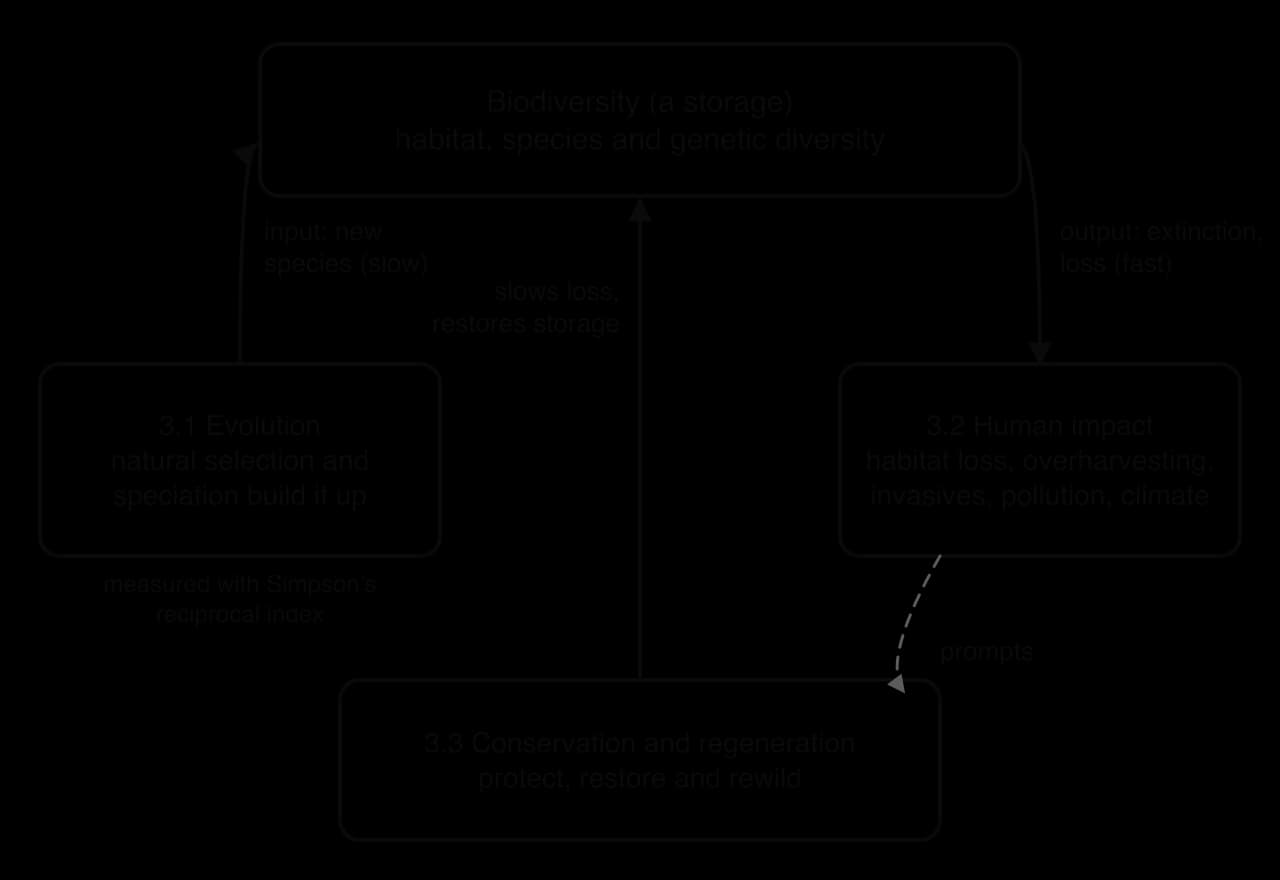
Measurement links all three. Simpson’s reciprocal index, introduced with the measurement of species diversity, is used again to detect human impact along a transect and to judge whether restoration is working. In the same way, the idea that genetic and species diversity give resilience explains why losing them matters, and why conservation aims to protect whole habitats and gene pools rather than only individual animals.
Perspectives, systems and sustainability
Perspectives
Whether biodiversity is worth protecting, and how, depends on values. Ecocentric perspectives stress the intrinsic value of species and favour protecting wild areas with little intervention. Anthropocentric perspectives value biodiversity for food, medicines, ecosystem services and tourism, and accept active management and sustainable use. Technocentric perspectives place more trust in scientific intervention: seed banks, captive breeding and genetic techniques. Indigenous and local communities often hold their own knowledge and rights over the land in question, and conservation that ignores them can create environmental injustice.
Systems
An ecosystem can be modelled as a system whose components interact through feeding, competition and nutrient cycling. Removing species changes these flows, and the loss of keystone species or whole habitats can push an ecosystem past a tipping point. Rewilding uses the same systems thinking in reverse: restoring a missing species or process can set off feedback loops that rebuild the whole system.
Sustainability
Biosphere integrity is one of the planetary boundaries, and it is among those already crossed. Sustainable use means harvesting species no faster than they can recover, which the tragedy of the commons shows is difficult when resources are shared and open to all. Sustainable Development Goals 14 (Life below water) and 15 (Life on land) set targets for protecting biodiversity, and the Kunming–Montreal Global Biodiversity Framework, adopted in December 2022, sets a target of conserving at least 30% of land, inland waters and coastal and marine areas by 2030.
How SL and HL differ
SL and HL students study the same core content in all three subtopics: the levels of biodiversity, evolution and speciation, Simpson’s reciprocal index, threats, the IUCN Red List, the tragedy of the commons, conservation strategies, the Convention on Biological Diversity, reserve design and rewilding. Each subtopic also has HL-only sections, marked “(HL only)” in the notes:
3.1 (HL): mutation and sexual reproduction as sources of variation; reproductive isolation and two contemporary examples of speciation (bonobos and chimpanzees, the apple maggot fly); island endemism and biodiversity hotspots; human-driven selection (tuskless elephants) and artificial selection; the geological timescale, the five mass extinctions and the debate over the Anthropocene.
3.2 (HL): threats to biodiversity hotspots; key biodiversity areas and the conflict between palm oil and conservation; traditional Indigenous land management; environmental justice in conservation; extinctions and the biosphere integrity planetary boundary.
3.3 (HL): the role of international, governmental and non-governmental organisations; feedback loops in rewilding and restoration; benefits and limitations of rewilding projects; assessing the success of conservation; ecotourism in protected areas.
HL students also apply the three HL lenses to this topic. Environmental law covers conventions such as CITES and the Convention on Biological Diversity, the legal protection of species and the rights of Indigenous peoples. Environmental economics covers the valuation of ecosystem services, ecotourism revenue, and the economic forces behind habitat conversion. Environmental ethics asks whether species have intrinsic value, whether humans have duties to restore what they have damaged, and who should bear the costs of conservation.
Assessment
Biodiversity and conservation is examined in both Paper 1 and Paper 2. Paper 1 can present an unseen case study with survey data, species lists, maps of protected areas or population trends, and ask for calculations (such as Simpson’s reciprocal index or percentage change), interpretation and evaluation of a conservation strategy for that place. Paper 2 Section A includes short-answer and data-based items: definitions, outlines of natural selection or speciation, calculations from tables, and explanations of threats or strategies.
In Paper 2 Section B, the topic often appears in structured essays that move from description to evaluation: for example, outlining a threat, explaining its impact on a named species or ecosystem, and evaluating conservation strategies from different perspectives. Named examples (an extinct, a critically endangered and a recovering species; an invasive species; a protected area; a rewilding project) and the ability to compare perspectives earn the highest marks. At HL, essays reward bringing in legal, economic and ethical angles, such as the role of CITES, the value of ecotourism or arguments based on intrinsic value.
 YouTube
Flashcards for 3
The official decks for this part of the syllabus.
- 3.1 Biodiversity and evolution217 cards
- 3.2 Human impact on biodiversity245 cards
- 3.3 Conservation and regeneration238 cards
Carry on with 3 in Augment
With a free account, Augment remembers where you stopped and what you have practiced.