6 Atmosphere and climate change
An overview of the atmosphere and climate change: how the atmosphere works as a system, why the climate is changing, how societies respond, and how the ozone layer was protected, with what HL students add.
- IB Environmental Systems and Societies
- SL and HL
What 6 covers
From the subject guide: what you need to know and be able to do.
The atmosphere, the causes and impacts of climate change, responses to it and the ozone layer.
4 subtopics in Atmosphere and climate change
Each one has its own page once something is published for it.
- 6.1Introduction to the atmospherenotes
- 6.2Climate change—causes and impactsnotes
- 6.3Climate change—mitigation and adaptationnotes
- 6.4Stratospheric ozonenotes
An overview of 6 Atmosphere and climate change
Atmosphere and climate change studies the thin layer of gases around the Earth: what it is made of, how it moves heat and matter around the planet, and how human activities have altered it. Two changes dominate the topic: the strengthening of the greenhouse effect by greenhouse gases, which is warming the planet and changing its climate, and the thinning of the stratospheric ozone layer by human-made chemicals, which international action has begun to reverse.
The atmosphere is shared by every country and every living thing, so the topic is about global systems and global cooperation. The concentration of carbon dioxide has risen from about 280 ppm before industrialisation to about 425 ppm today, while the Antarctic ozone hole, which grew rapidly in the 1980s, has stopped growing since the Montreal Protocol cut the chemicals that caused it.
Sources: NOAA Global Monitoring Laboratory (2025); NASA Ozone Watch (2025).
Questions the topic asks
How does the atmosphere support life, and how does it move heat from the tropics towards the poles?
How do greenhouse gases keep the Earth warm, and how have human activities strengthened this effect?
What evidence shows that the climate is changing, and how certain is it that people are the main cause?
How will climate change affect ecosystems and societies, and why are some people far more vulnerable than others?
How can societies reduce emissions, remove carbon dioxide and adapt to change that can no longer be avoided?
Why did the ozone layer thin, and what made the international response to it so successful?
The subtopics
Subtopic | What it covers |
|---|---|
6.1 Introduction to the atmosphere | The atmosphere as the boundary of the biosphere; its composition and layers; the atmosphere as a system; differential heating and the redistribution of heat; greenhouse gases, aerosols and radiative forcing; the greenhouse effect and its enhancement; a case study of the 1991 eruption of Mount Pinatubo |
6.2 Climate change: causes and impacts | Climate as the product of atmospheric processes; rising carbon dioxide since the Industrial Revolution; evidence from ice cores, tree rings and sediments; impacts on ecosystems and societies; feedback loops; the planetary boundary for climate change; perspectives; a case study of mass coral bleaching on the Great Barrier Reef |
6.3 Climate change: mitigation and adaptation | Why climate change needs global action; decarbonisation and carbon neutrality; three categories of mitigation; structural and non-structural adaptation; adaptation plans; perspectives on responses; a case study of cyclone preparedness in coastal Bangladesh |
6.4 Stratospheric ozone | Solar radiation and the UV bands; how ozone protects life; the effects of UV; the ozone layer as a steady-state equilibrium; ozone-depleting substances and ozone holes; ozone depletion compared with global warming; a case study of the Antarctic ozone hole and the Montreal Protocol |
How the subtopics connect
The introduction to the atmosphere provides the foundations for the rest of the topic: the layers of the atmosphere, the difference between short-wave radiation from the Sun and long-wave radiation from the Earth, and the mechanism of the greenhouse effect. Climate change builds on the greenhouse effect: human emissions enhance it, causing global warming and wider climate change. Mitigation and adaptation are the responses to those causes and impacts. Stratospheric ozone builds on the structure of the atmosphere and the ultraviolet part of the spectrum.
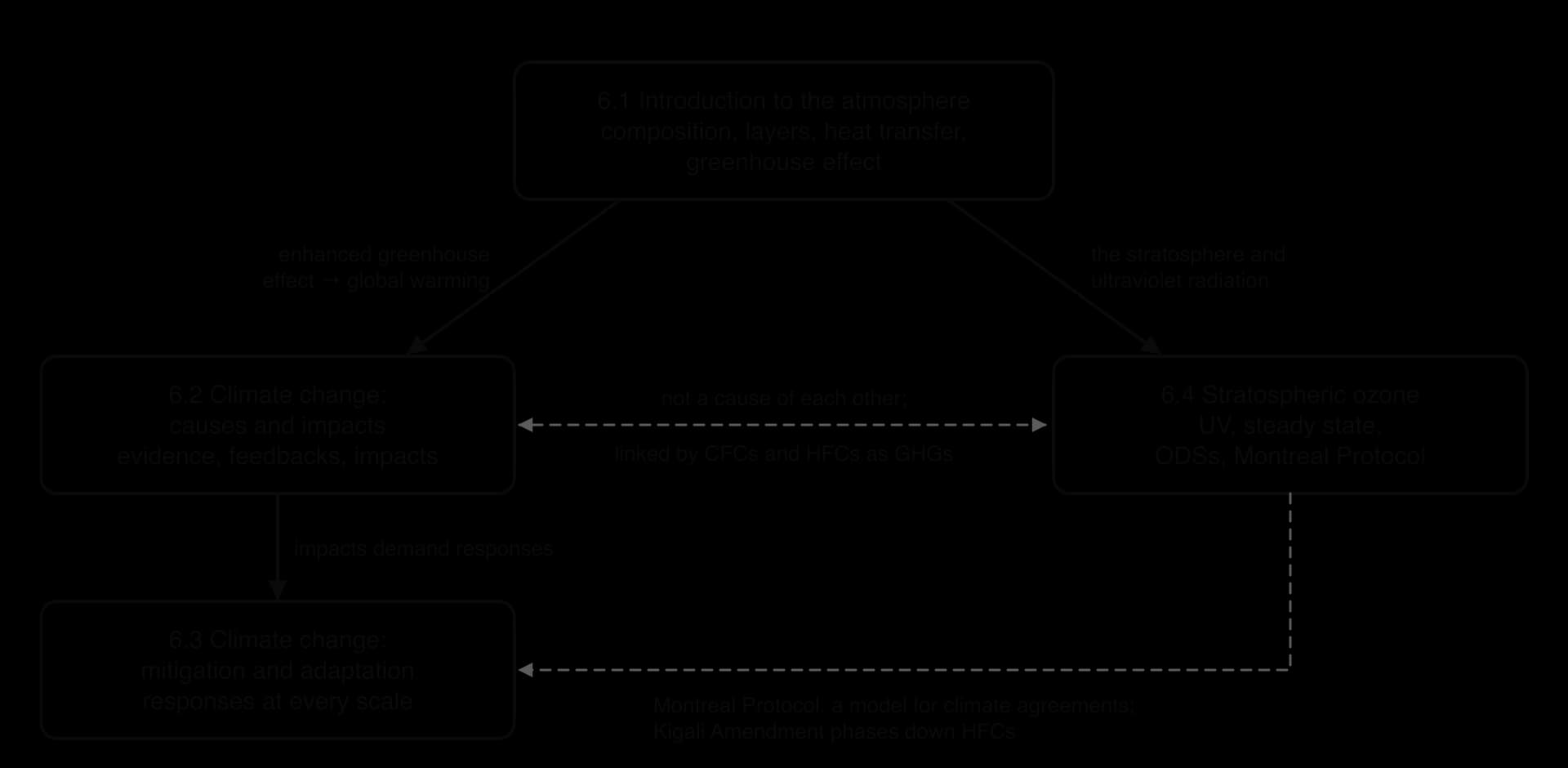
A common confusion runs across the topic: ozone depletion is not a cause of global warming. The ozone layer controls incoming ultraviolet radiation, whereas global warming results from greenhouse gases absorbing outgoing infrared. The two issues are linked in a narrower way. CFCs and the HFCs that replaced them are powerful greenhouse gases, so the Montreal Protocol and its Kigali Amendment have also slowed global warming, and the Protocol is often compared with climate agreements such as the Paris Agreement.
 YouTube
Perspectives, systems and sustainability
Perspectives. People judge climate change through their values, interests and experiences. A technocentric view puts its trust in renewable energy, carbon capture and possibly geoengineering; an ecocentric view calls for lower consumption and protection of ecosystems; an anthropocentric view stresses managing risks to people through regulation, pricing and adaptation. Perspectives also differ between generations, between coastal and inland communities, between fossil fuel exporters and importers, and between high- and low-income countries.
Systems. The atmosphere is an open system with inputs of solar energy and gases, storages of gases and heat, and outputs of radiation to space. Positive feedbacks, such as melting ice reducing albedo and thawing permafrost releasing methane, can amplify warming and push parts of the climate system towards tipping points. The ozone layer is a steady-state equilibrium that ozone-depleting substances tipped towards less ozone.
Sustainability. Climate change and stratospheric ozone depletion are two of the nine planetary boundaries: the climate boundary has been crossed, while the ozone boundary has been held thanks to the Montreal Protocol. The topic links closely to SDG 13 (climate action) and to climate justice, because the countries least responsible for emissions are often the most vulnerable to their effects.
The topic draws on almost every part of the course. The carbon and nitrogen cycles explain where greenhouse gases come from; biomes and biodiversity are shifting as the climate warms; water security, food production and soils are all affected by changing rainfall and temperature; energy choices determine future emissions; and urban air pollution shares many sources with greenhouse gases.
How SL and HL differ
SL and HL students study the same core content in all four subtopics: the composition, structure and circulation of the atmosphere and the greenhouse effect (6.1); the causes, evidence and impacts of climate change, feedbacks, the climate planetary boundary and perspectives (6.2); global action, decarbonisation, mitigation, adaptation and adaptation plans (6.3); and UV, the ozone steady state, ozone-depleting substances, ozone holes and the Montreal Protocol (6.4).
Every subtopic of atmosphere and climate change has HL-only understandings, and HL students spend more than twice as long on it:
6.1 Introduction to the atmosphere: the atmosphere as a dynamic system; why it thins with altitude and the lapse rate; Milankovitch cycles and the feedbacks that drive glacial cycles; how present warming is moving the Earth beyond the glacial–interglacial pattern of the Quaternary; and how life changed the atmosphere, as in the Great Oxidation Event.
6.2 Climate change: causes and impacts: direct and indirect (proxy) climate data; climate models and hindcasting; scenarios of future change; tipping points and tipping cascades, such as ice sheets, the Atlantic circulation and the Amazon; and responsibility, vulnerability and climate justice.
6.3 Climate change: mitigation and adaptation: economic, legal, industry and personal responses; the role of the UN, the IPCC and COP summits; IPCC emissions scenarios; technology and smart cities; geoengineering; barriers to action; stakeholders and perspectives; and the atmosphere as a global commons.
6.4 Stratospheric ozone: the chemical equations for ozone formation and destruction; halogens as catalysts; the polar vortex and polar stratospheric clouds; HFCs and the Kigali Amendment; and air conditioning and its alternatives.
The HL lenses apply strongly to this topic:
HL lens | Where it applies in atmosphere and climate change |
|---|---|
Environmental law | The UN Framework Convention on Climate Change, the Kyoto Protocol, the Paris Agreement, national climate laws, and the Montreal Protocol with its Kigali Amendment |
Environmental economics | Carbon taxes, emissions trading, subsidies, the costs of damage and adaptation, and the atmosphere as a commons that markets fail to protect |
Environmental ethics | Responsibility for past emissions, duties to future generations and to the most vulnerable, and the ethics of geoengineering |
Assessment
Atmosphere and climate change is examined in Paper 1 and Paper 2 at both levels and is one of the richest topics for data-based questions.
Paper 1 (unseen case study): resource booklets may describe a coastal city, a small island state, a glacier-fed river basin or a country’s energy policy, with data on temperature, greenhouse gas concentrations, emissions, sea level or ozone. Typical questions ask students to read graphs, calculate percentage changes or CO₂ equivalents, explain a feedback loop and evaluate mitigation or adaptation strategies for that place.
Paper 2 Section A: short-answer and data-based questions on the greenhouse effect, greenhouse gases, evidence for climate change, the ozone steady state, UV and the Montreal Protocol, often with a graph such as the Keeling curve or ozone-hole data.
Paper 2 Section B: structured essays that ask students to explain the greenhouse effect or ozone depletion and then evaluate responses: mitigation compared with adaptation, the success of international agreements, or whom climate change affects most. HL essays are expected to bring in legal, economic and ethical angles where relevant.
Common investigation topics include comparing temperatures under different surfaces or greenhouse gas concentrations in closed systems, analysing local temperature records, and surveying attitudes to climate change or to a proposed local climate measure.
Flashcards for 6
The official decks for this part of the syllabus.
- 6.1 Introduction to the atmosphere222 cards
- 6.2 Climate change—causes and impacts288 cards
- 6.3 Climate change—mitigation and adaptation244 cards
- 6.4 Stratospheric ozone189 cards
Carry on with 6 in Augment
With a free account, Augment remembers where you stopped and what you have practiced.