Notes on 5.2 Governance and human rights
Learning objectives
Define governance, human rights and digital rights, and outline the rights in the Universal Declaration of Human Rights most affected by digital systems.
Explain how digital systems affect wars, civil conflicts and regional, national and global security, at local and global levels.
Explain how digital systems change political speech, activism, and access and representation in governing bodies and institutions.
Analyse how digital systems can reduce or reinforce discrimination related to gender, race and ethnicity, ability, and religion and culture.
Identify real interventions for conflict and security, participation and representation, and diversity and discrimination, and classify each as mitigating, interceding, enhancing or resolving.
Evaluate interventions against the most relevant criteria: equity, acceptability, cost, feasibility, innovation and ethics.
Evaluate vTaiwan as an intervention in political participation, using the full framework.
Recommend steps for future action for a known or unseen intervention, considering trade-offs and implications.
Introduction
Governance is the way decisions are made and authority is exercised over a community, and human rights are the protections every person holds simply by being human. Both are a challenge in digital society because the same digital systems that let people vote, organise and report abuses also let states and other actors watch, silence, exclude or target them. Facebook's role in Myanmar before the mass expulsion of the Rohingya in 2017 is one example of how a platform designed for sharing became part of a human rights crisis.
This challenge draws on every part of the course. The concept of power explains who decides how digital systems are used; values and ethics asks whether those decisions respect people's dignity; identity and expression explain why speech, recognition and exclusion matter so much. Content topics such as data, algorithms, media and artificial intelligence describe the systems involved, and the political, social and cultural contexts are where most of the impacts are felt.
Governance and human rights as a challenge
What governance means
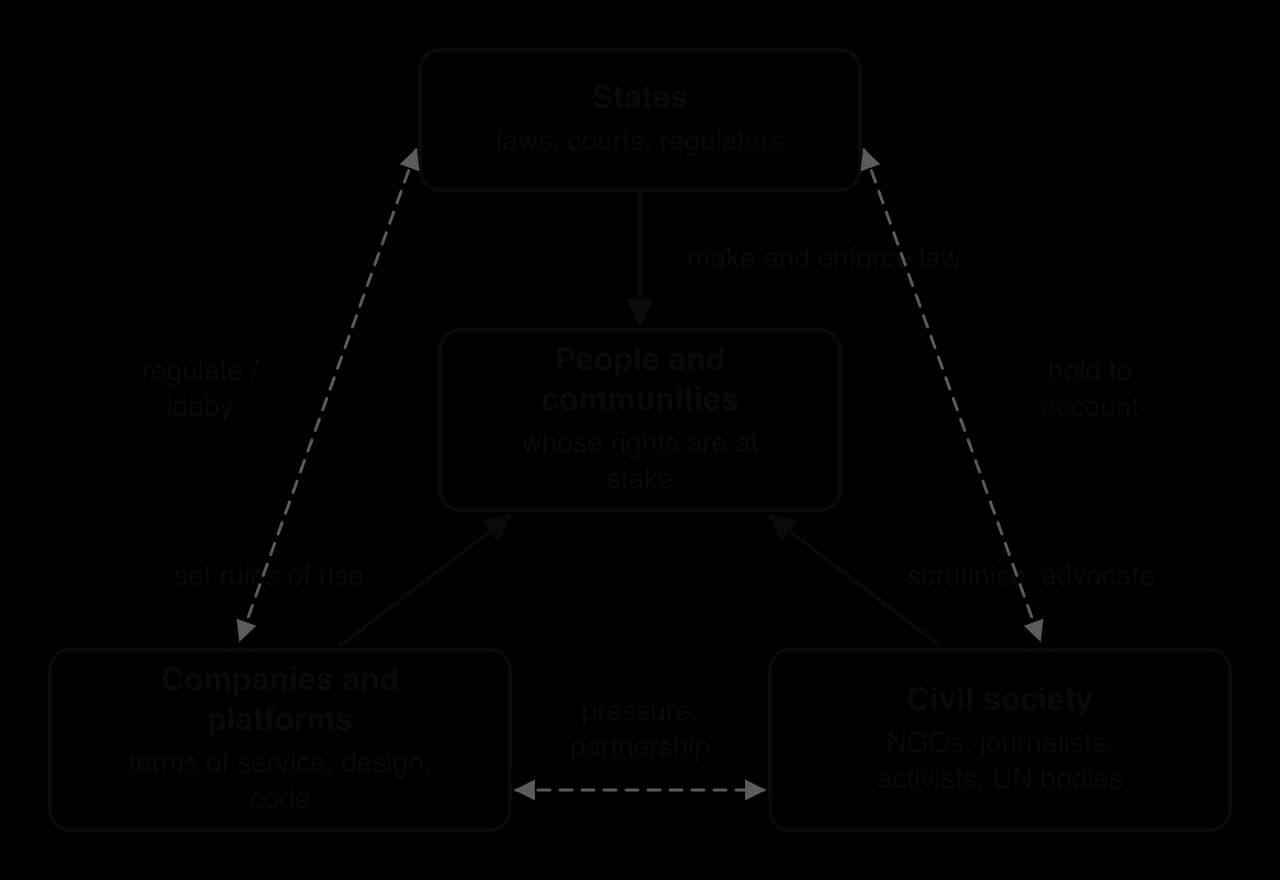
Governance is wider than government. A government is one institution, while governance includes every actor that makes or enforces rules for a community: parliaments and courts, but also companies that write terms of service, international organisations that set standards, and civil society groups that monitor how power is used.
Digital systems complicate governance in three ways. First, many of the most important rules about speech, privacy and access are written by private companies, so a platform's content policy can affect more people than most national laws. Second, digital systems cross borders, so a post written in one country can cause harm in another where the author cannot be held to account. Third, code itself acts as a rule: a messaging app that limits how often a message can be forwarded governs behaviour as effectively as a law.
The relationships between these actors are shown in the governance diagram. Each actor can both protect and threaten rights, which is why the challenge cannot be solved by any one of them acting alone.
Human rights and the Universal Declaration
Human rights are universal (they belong to everyone), inalienable (they cannot be taken away, although some may be lawfully limited) and indivisible (civil and political rights depend on economic, social and cultural rights, and the reverse). States carry the main legal duty to respect, protect and fulfil them. Companies are expected to respect them too, a principle set out in the UN Guiding Principles on Business and Human Rights of 2011.
The foundation of modern human rights law is the Universal Declaration of Human Rights (UDHR), adopted by the UN General Assembly in Paris on 10 December 1948. Its 30 articles were later turned into binding treaties, most importantly the International Covenant on Civil and Political Rights and the International Covenant on Economic, Social and Cultural Rights (both 1966).
The UDHR was written before computers were in common use, yet several of its articles are now tested every day by digital systems.
UDHR article | Right | How digital systems affect it |
|---|---|---|
Article 2 | Freedom from discrimination | Algorithms and platforms can treat people differently by race, sex, religion or other status |
Article 3 | Life, liberty and security of person | Digital tools are used to target people in conflict and to warn or protect civilians |
Article 12 | Privacy | Data collection, surveillance and spyware intrude on private life and communications |
Article 18 | Freedom of thought, conscience and religion | Online hate and surveillance can make religious minorities fear practising openly |
Article 19 | Freedom of opinion and expression, including to "seek, receive and impart information" through any media | Content moderation, censorship and internet shutdowns limit speech and access to information |
Article 20 | Freedom of peaceful assembly and association | Activists organise online; shutdowns and surveillance disrupt protests |
Article 21 | Taking part in government, directly or through freely chosen representatives | E-petitions, online consultation and e-voting change how people participate |
Article 27 | Taking part in cultural life and sharing in scientific progress | Access to digital technology is itself a condition for sharing in progress |
In 2012 the UN Human Rights Council affirmed in resolution 20/8 that the same rights people have offline must also be protected online. The phrase digital rights is used for these human rights as they apply to digital systems, together with newer claims such as a right to internet access or to an explanation of an automated decision.
Why digital systems intensify the challenge
Governance and human rights are old challenges, but digital systems change their scale, speed and the actors involved.
Scale. A single platform decision affects billions of users at once, and a single data breach can expose millions of identities.
Speed. False claims and calls to violence can spread in hours, faster than courts or regulators can respond.
Dual use. The same tool can protect or harm. Location data can guide aid to a flooded village or lead an armed group to an activist's home.
Private power. Companies make many rights decisions, but they are accountable mainly to shareholders and are not bound by human rights treaties in the way states are.
Uneven protection. A user in a country with strong data protection law and independent courts has more ways to challenge a decision than a user elsewhere.
These features mean the challenge is widespread, persistent and transnational, which is what makes it a challenge in the sense of the HL extension.
Applying the HL extension framework
The HL extension framework is taught in full in 5.1 Global well-being. Every extended inquiry follows the same four steps, shown in the framework diagram: focus on one prescribed area, explore the challenge at local and global levels, identify interventions, then evaluate them and recommend steps for future action.
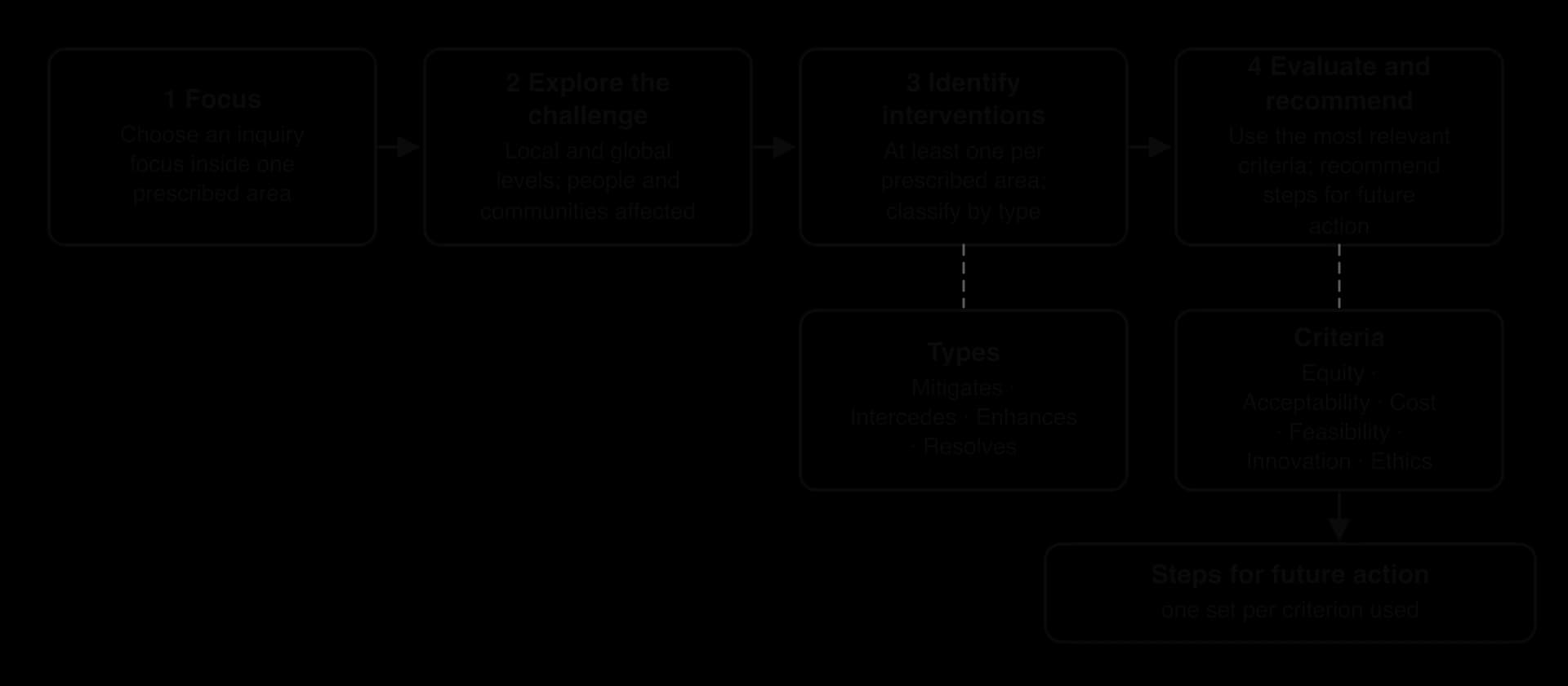
The types and criteria used throughout this challenge are summarised in the recap table, using the same terms as 5.1 Global well-being.
Part of the framework | Term | Question it asks |
|---|---|---|
Type | Mitigates | Does it reduce negative aspects of the challenge? |
Type | Intercedes | Does it change a process or trend that causes the negative aspects? |
Type | Enhances | Does it strengthen positive or effective aspects? |
Type | Resolves | Does it remove negative aspects of the challenge? |
Criterion | Equity | Does it fairly address the needs, claims and interests of the people and communities affected (fairness, inclusion, reciprocity)? |
Criterion | Acceptability | Do the people affected accept it, and is it accountable and transparent? |
Criterion | Cost | Do its financial, social, cultural and environmental costs outweigh its benefits? |
Criterion | Feasibility | Is it technically, socially and politically feasible, and what barriers stand in the way? |
Criterion | Innovation | Is the approach new or previously tried without success, and is it incremental, sustaining or disruptive? |
Criterion | Ethics | Is it ethically sound, and how and by whom is that decided? |
Few interventions resolve a governance or human rights problem completely, because its causes are political and social as well as technical; most mitigate, intercede or enhance, and many fit more than one type.
Conflict, peace and security
Digital systems in wars and civil conflicts
A war is armed conflict between states; a civil conflict takes place mainly within one state, between the government and organised groups or between groups. Both kinds now take place in an information environment shaped by smartphones, social media and satellite connections.
Digital systems play four main roles in modern conflicts.
Information and incitement. Platforms can carry hate speech, rumours and disinformation that dehumanise a group and make violence seem justified.
Surveillance and targeting. Phone data, facial recognition and drones help armed forces find and strike targets, raising questions about accuracy and civilian harm.
Documentation and witness. Civilians record events on their phones, and investigators use the footage to establish what happened and who was responsible.
Connectivity as a resource. Whoever controls the network can cut it off. Communication blackouts limit the reporting of abuses and also the delivery of aid.
Myanmar: a platform in a conflict
Facebook became the main way most people in Myanmar went online in the 2010s. Military officers and nationalist groups used it to spread hostile content about the Rohingya, a mainly Muslim minority. After military operations in Rakhine State from August 2017, more than 700,000 Rohingya fled to Bangladesh, according to UN figures. In 2018 the UN's Independent International Fact-Finding Mission on Myanmar described Facebook as a useful instrument for people seeking to spread hate, and an independent assessment commissioned by Facebook concluded that the company had not done enough to stop its platform being used to incite offline violence.
The case shows how a conflict can be local (one region of one country) and global at the same time, since the rules governing the content were written by a company in the United States that had very few Burmese-speaking reviewers when the hostile content was spreading.
Tigray: when the network is switched off
During the war in Ethiopia's Tigray region, which began in November 2020, telephone and internet services in Tigray were cut for about two years until they were restored after a peace agreement signed in November 2022. The government said the shutdown was needed to stop disinformation and hate speech. Journalists and researchers argued that the blackout made it almost impossible to verify reports from the region, which can allow rumours to spread elsewhere, and that it cut families, businesses and aid agencies off from each other.
Ukraine: civilians, companies and connectivity
The full-scale Russian invasion of Ukraine in February 2022 showed new roles for civilians and private companies. Ukraine's government invited citizens to report the movements of Russian forces through a chatbot. SpaceX activated its Starlink satellite service in Ukraine within days of a public request from Ukraine's digital minister, and thousands of terminals were later used by civilians and the armed forces. Through the concept of power, this means a private company's decisions about where its service works can shape a war, without the accountability that applies to states. Civilians who share military information may also lose some of the protection international humanitarian law gives to non-combatants, which humanitarian organisations such as the International Committee of the Red Cross have warned about.
Regional, national and global security
Security is protection from threats. In the digital age it has several levels, each with its own actors and tools, and national security is the level at which most states justify their digital powers.
Level | Typical threats | Example of a digital dimension |
|---|---|---|
National | Attacks on critical infrastructure; espionage; terrorism | In December 2015 a cyberattack on Ukrainian power companies left about 230,000 people without electricity for several hours. In May 2021 a ransomware attack shut down the Colonial Pipeline, a major fuel pipeline in the United States, for several days. |
Regional | Threats shared by neighbouring states or alliances | At its 2014 Wales summit, NATO declared that cyber defence is part of collective defence, so a serious cyberattack could trigger its mutual defence clause. In 2020 the EU imposed its first sanctions for cyberattacks. |
Global | Threats that cross every border | A UN Group of Governmental Experts agreed 11 voluntary norms of responsible state behaviour in cyberspace in 2015, such as not attacking critical infrastructure in peacetime. In December 2024 the UN General Assembly adopted a Convention against Cybercrime. |
Security and rights are often presented as a trade-off. Governments argue that mass surveillance, data retention and access to encrypted messages are needed to stop terrorism and serious crime. Human rights groups reply that these powers are often used against journalists, opposition politicians and activists. The investigations of 2021 into the Pegasus spyware, for example, found it on the phones of human rights defenders as well as suspected criminals. Several human rights organisations criticised the UN cybercrime convention on the same grounds, arguing that its data-sharing powers lacked safeguards.
The challenge at local and global levels
Conflict and security show clearly how one challenge takes different forms at different levels.
Level | How the challenge shows itself | People and communities affected |
|---|---|---|
Local | Rumours on messaging apps spark violence in a town; a local shutdown during unrest; police use of facial recognition at protests | Residents, minority communities, local journalists, small businesses |
National | Elections marked by violence; attacks on national infrastructure; national surveillance laws | Voters, opposition parties, hospitals and utilities, civil servants |
Global | Platforms setting content rules for many countries; cross-border cyber operations; global spyware markets | Platform users everywhere, diaspora communities, refugees, international organisations |
Interventions for conflict, peace and security
Peacebuilding covers efforts to prevent violence, end it and stop it returning. Digital interventions can contribute to each stage.
Crisis mapping: Ushahidi
After Kenya's disputed presidential election in December 2007, violence between supporters of rival candidates killed more than 1,000 people and displaced hundreds of thousands. A group of Kenyan technologists and bloggers built Ushahidi ("testimony" or "witness" in Swahili), a website where anyone could report incidents of violence by text message, email or the web. Reports were placed on a map, giving a picture of events that no single news outlet had.
This is crisis mapping. Ushahidi later became free, open-source software used in many countries: to track anti-immigrant violence in South Africa in 2008, after the Haiti earthquake in 2010 (where nearly 40,000 reports were received), and to monitor elections. In Kenya's 2013 election the Uchaguzi project, run with Ushahidi, collected more than 8,000 reports, and a later study found that about 75% of people who reported said their report received a response.
Open-source investigation: Bellingcat
Open-source intelligence (OSINT) is evidence gathered from publicly available material such as social media posts, satellite images and online databases. Bellingcat, founded by the British investigator Eliot Higgins in 2014 and now based in the Netherlands, became known for its investigation of the downing of Malaysia Airlines Flight MH17 over eastern Ukraine in July 2014, in which all 298 people on board died. Using photographs and videos posted online, its volunteers traced a Buk missile launcher to a Russian military brigade, a conclusion later reached by the official Dutch-led Joint Investigation Team. In 2022 a Dutch court convicted three men in their absence for their role.
OSINT intercedes in the challenge by changing a trend that contributes to abuses: the expectation of impunity. When those responsible know that evidence can be collected from public sources, the cost of committing and denying abuses rises. Its limits are also clear. Evaluated for ethics, open-source investigations can identify private individuals wrongly, expose victims and witnesses, and depend on graphic material that harms the mental health of researchers. Evaluated for acceptability, the states being investigated often reject the findings: Russia designated Bellingcat a "foreign agent" in 2021 and banned it in 2022. Steps for future action include shared ethical standards for open-source investigation, protection for researchers, and agreements with courts about how digital evidence is preserved so that it can be used in trials.
A platform's response: Facebook in Myanmar
Facebook's actions in 2018 are an example of a company intervening in a conflict linked to its own platform. In August 2018 it removed the accounts of Myanmar's military commander-in-chief, Min Aung Hlaing, and other military-linked accounts and pages. By November 2018 it had 99 native Burmese-language reviewers, changed its policy to remove misinformation that could contribute to imminent violence, and reported acting on about 64,000 pieces of hate speech content in Myanmar in one quarter.
This intervention intercedes (it changed the rules and enforcement process that had allowed incitement to spread) and mitigates (it removed harmful content). Evaluated for acceptability, it came only after the worst violence of 2017, so for the Rohingya it did little to prevent harm already done. Evaluated for ethics, it raised the question of who decides: a private company chose to remove a national military leader from a platform used by millions, a decision normally associated with courts or governments. A step for future action is human rights due diligence before a platform expands into a fragile country: reviewers who speak local languages, early warning partnerships with local civil society, and published risk assessments.
Participation and representation
Political speech and activism
Political speech is expression about government, public policy, elections and public affairs. Courts in many democracies give it the strongest protection of any kind of speech, because citizens cannot hold governments to account if they cannot criticise them.
Digital systems have lowered the cost of political speech and activism: a video can reach millions without a publisher, and encrypted messaging lets groups organise quickly. During the protests after Belarus's disputed presidential election in August 2020, the Telegram channel NEXTA, run from Poland, grew to about two million subscribers and became a main source of protest information inside the country, even while the government restricted internet access. During the protests in Iran that followed the death of Mahsa Amini in police custody in September 2022, the authorities blocked Instagram and WhatsApp and slowed mobile networks, and people used virtual private networks (VPNs) to share videos of the protests with the world.
The same systems create new risks for political speech:
Shutdowns and blocking remove the channel completely, usually during elections, protests or periods of unrest.
Surveillance of activists' phones and accounts leads to arrests and to self-censorship by others who fear the same.
Online harassment targets journalists, activists and politicians, especially women and members of minority groups.
Computational propaganda, such as networks of fake accounts, can drown out genuine voices and make a fringe view seem popular.
Platform rules written for one country may remove legitimate speech elsewhere, for example when automated systems cannot tell reporting on violence from support for it.
Participation and access to governing bodies
Political participation covers every way citizens influence government: voting, standing for office, petitioning, protesting, joining parties and taking part in consultations. Article 21 of the UDHR gives everyone the right to take part in government and equal access to public service.
Representation asks a related question: do the people in governing bodies and institutions reflect the population they serve, and are all groups' interests heard? Women held 27.5% of seats in national parliaments in January 2026, up from 11% in 1995. Representation in local government is higher on average but varies widely by region, as the chart of local councils shows.
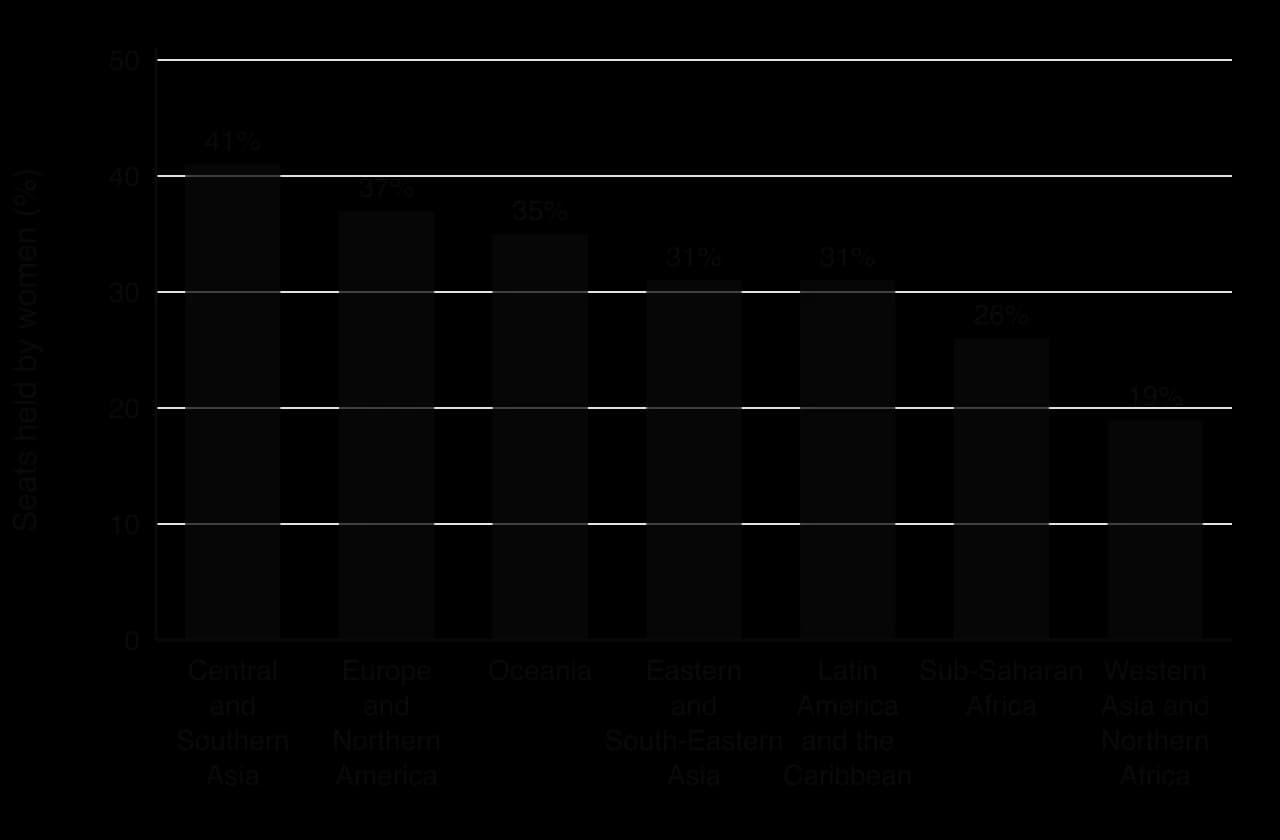
Digital systems can widen access to these institutions or narrow it. On one side, e-government services, livestreamed council meetings, online consultations and e-petitions let people take part without travelling or taking time off work. On the other, people without internet access, digital skills or confidence (often older, poorer, rural or disabled people, and speakers of minority languages) can be left further behind, a problem of the digital divide.
Civic technology as an intervention
Civic technology is the name for digital tools built to improve how citizens and governments interact. It ranges from simple tools, such as a student's website listing dates and times of local council meetings, to national platforms for writing laws.
Intervention | What it does | Type |
|---|---|---|
UK Parliament e-petitions (current site since 2015) | The government responds to petitions with 10,000 signatures; those with 100,000 are considered for debate in Parliament | Enhances participation |
Decidim (Barcelona, from 2016) | Open-source platform for proposals, debates and participatory budgeting, combined with face-to-face meetings | Enhances participation; intercedes in how budgets are set |
Iceland's constitutional council (2011) | Posted drafts of a new constitution online and invited public comments; the text was approved by 67% of voters in a non-binding referendum in 2012 | Enhances participation (not adopted by parliament) |
Estonia's internet voting (e-voting) | Lets citizens vote online with a digital identity card in national elections | Enhances access to voting; discussed further in 4.6 Political |
Student campaign publicising local meeting times | Shares when and where local decisions are made, so residents can attend | Enhances participation at local level |
E-petition systems show the difference between participation and influence. A petition in 2019 to revoke the UK's notice of withdrawal from the European Union gathered more than six million signatures, was debated in Parliament, and did not change government policy. For the people who signed, the intervention was highly accessible, but it gave them no influence over the outcome.
Diversity and discrimination
How digital systems discriminate
Discrimination is unfair treatment of a person or group because of a characteristic such as sex, race, ethnicity, disability, religion, age or sexual orientation. Article 2 of the UDHR forbids it.
Digital systems discriminate in three main ways, which help organise any analysis.
Through design. A system built without considering some users excludes them, for example an app that does not work with screen readers, or a form that offers only two gender options.
Through data. An algorithm trained on biased historical data repeats that bias, a problem of algorithmic bias covered in 3.2 Algorithms.
Through use. People use platforms to discriminate, as when hosts reject guests or users send abuse. The platform's design can make this easier or harder.
Indirect discrimination is common in digital systems, because rules written in code look neutral: a hate-speech filter that applies the same rule to every post may still remove far more posts from one community than from another.
Gender equality
Gender equality means that women, men and people of all genders have equal rights, responsibilities and opportunities. Digital systems affect it in at least three ways: access, safety and representation.
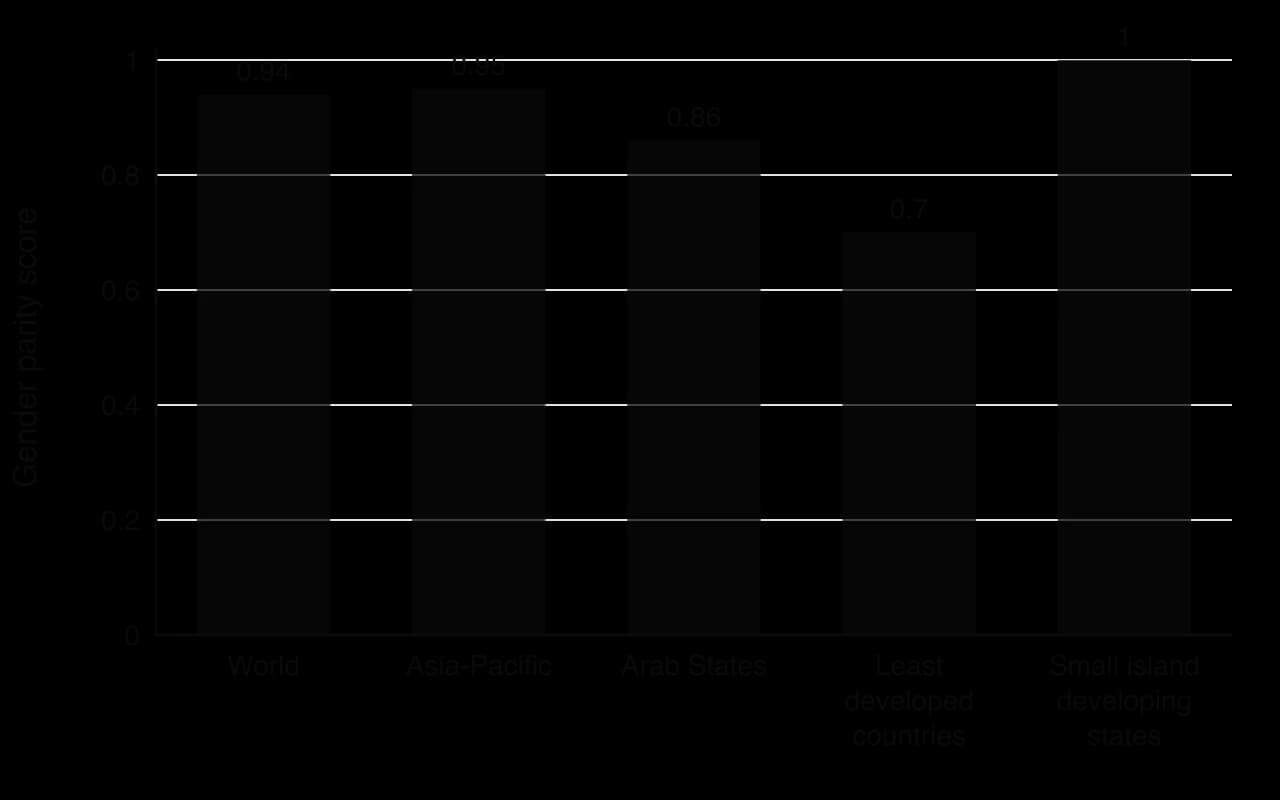
Access. In 2024, 70% of men worldwide used the internet compared with 65% of women, which meant 189 million more men than women online. The gap is far larger in some regions and income groups than others, as the parity chart shows.
Safety. Online abuse falls heavily on women in public life. In a survey of women journalists published by UNESCO and the International Center for Journalists in 2021, 73% said they had experienced online violence in their work. Abuse with sexual content, including fake sexual images made with AI, pushes some women to leave public debate or never to enter it. South Korea passed laws in 2024 making the possession and viewing of sexually explicit deepfakes a crime after a wave of cases involving school and university students.
Representation. The representation gap in parliaments and councils (see the chart of local government) is linked to both access and safety: abuse online can lead politicians, especially women, to step back from public roles.
A practical intervention is StopNCII.org, launched in 2021 by the UK's Revenge Porn Helpline with Meta. A person who fears that an intimate image will be shared creates a digital fingerprint (a hash) of the image on their own device; participating platforms then block matching uploads without the image itself ever being sent. It mitigates the harm of image-based abuse and is privacy-preserving by design, but it only works on platforms that join the scheme and only for images the person already has.
Racial and ethnic discrimination
Racial and ethnic discrimination online ranges from individual abuse to systems that affect whole populations.
On sharing-economy platforms, a field experiment by researchers at Harvard Business School (published in 2017) found that Airbnb requests from guests with distinctively African American names were about 16% less likely to be accepted than identical requests from guests with distinctively white names. After an early version of the study circulated and complaints spread under the hashtag #AirbnbWhileBlack, Airbnb introduced in 2016 a non-discrimination policy that every user must accept, later hid guest photos until a booking is accepted, and in 2020 launched Project Lighthouse, which measures acceptance rates by perceived race without linking the data to individual users.
These steps intercede by changing the booking process that allowed bias to operate. Evaluated for equity, they target the cause of the harm instead of compensating victims afterwards; evaluated for acceptability, Project Lighthouse makes the problem measurable, but its results are published by Airbnb itself and not by an independent body.
At the scale of a state, Human Rights Watch reported in 2019 that authorities in Xinjiang, China, used a data platform that combined surveillance camera footage, phone data and checkpoint records to flag Uyghur residents for questioning or detention. China's government states that its measures in Xinjiang are aimed at preventing terrorism and extremism. The case shows how surveillance aimed at one ethnic group links 5.2C to 5.2A, since security is the stated justification.
Ability, access and inclusion
The World Health Organization estimates that about 1.3 billion people, or one in six, live with a significant disability. Digital systems can remove barriers for them, through screen readers, captions, voice control and image description, or create new ones when websites and apps ignore accessibility standards such as the Web Content Accessibility Guidelines (WCAG).
Digital inclusion is the wider goal: making sure that everyone, whatever their ability, income, age, location or language, can access and use digital systems and benefit from them.
Be My Eyes, a free app from Denmark released in 2015, connects blind and partially sighted users by live video with sighted volunteers who describe what the camera shows, from a use-by date to the colour of a shirt. By 2026 it reported more than 10 million volunteers and about a million blind or partially sighted users. In 2023 it added Be My AI, which uses OpenAI's GPT-4 model to describe photos. Microsoft's free Seeing AI app, released in 2017, offers a similar AI-only service.
Be My Eyes enhances inclusion by building on two existing strengths: widespread smartphone ownership and people's willingness to help.
Evaluated for cost, it is free to blind users; the company earns money from businesses that pay for services such as accessible customer support through the app, which helps keep the service free for the people it serves. Evaluated for feasibility, it needs a smartphone, a data connection and, for volunteer calls, volunteers who speak the same language, so it works less well in low-income or minority-language settings.
Evaluated for innovation, Be My AI is a disruptive change, since it replaces a human helper with a machine, which brings speed and privacy but also the risk of confident errors, for example misreading a medicine label. Evaluated for ethics, sending images of one's home or documents to a volunteer or an AI company raises privacy questions, such as how long images are stored and whether they are used to train AI models. A step for future action is clear guidance on when to rely on AI descriptions (low-risk tasks) and when to ask a human (medicines, money, safety), together with strict limits on how images are stored and used.
Tolerance for religions and cultural differences
Tolerance in the UNESCO sense, set out in its Declaration of Principles on Tolerance (1995), is respect, acceptance and appreciation of the diversity of the world's cultures, beliefs and ways of life. It does not mean accepting injustice or giving up one's own beliefs.
Digital systems can expose people to other cultures and faiths, but they can also amplify intolerance. In March 2018, violence against Muslims in Sri Lanka's Kandy district was fuelled partly by rumours and hate speech on Facebook and WhatsApp; the government blocked several social media platforms for about a week, and in 2020 Facebook apologised after an independent assessment found that its platform may have contributed to the violence. In March 2019, a gunman livestreamed his attack on two mosques in Christchurch, New Zealand, in which 51 people were killed.
The Christchurch Call, launched in Paris in May 2019 by New Zealand's prime minister Jacinda Ardern and France's president Emmanuel Macron, is an intervention in response. Governments and technology companies made voluntary commitments to remove terrorist and violent extremist content online while respecting human rights and a free, open internet. It intercedes by changing how companies and governments coordinate, for example through shared crisis protocols when an attack is livestreamed. Evaluated for acceptability, the United States first declined to join in 2019, citing free-speech concerns, then joined in 2021. Evaluated for feasibility, the commitments are not legally binding, which made agreement possible but limits enforcement.
Deciding where intolerance becomes unlawful is difficult. The UN's Rabat Plan of Action (2012) proposes a six-part threshold test for when speech amounts to incitement to hatred: the context, the speaker, their intent, the content and form, the extent of its reach, and the likelihood of harm. The test is useful for any evaluation of content moderation, because it shows why the same words can be lawful in one setting and dangerous in another.
Automated hate-speech moderation
Every large platform now uses automated systems to label or block hate speech. Machine-learning classifiers scan posts and either remove them, reduce their reach, or send them to human reviewers. This is a form of content moderation at a scale no human workforce could match.
One widely used tool was Perspective, released by Google's Jigsaw unit in 2017, which gives a comment a score for how likely it is to be "toxic". Researchers at the University of Washington reported in 2019 that widely used hate-speech datasets and classifiers were much more likely to flag tweets written in African American English as offensive than other tweets, a form of indirect discrimination built into the training data.
Case study: vTaiwan and digital participation in Taiwan
Background
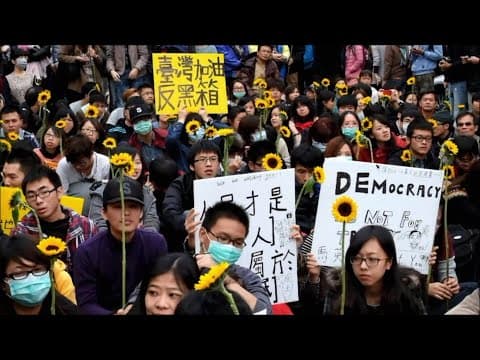
In March and April 2014, students and activists occupied Taiwan's legislature for more than three weeks in protest at a trade agreement with China that, in the protesters' view, the governing party had tried to pass without a full review. The protest, known as the Sunflower Movement, was organised and broadcast with the help of g0v ("gov zero"), a community of civic hackers founded in 2012 that builds open-source alternatives to government websites. The protest exposed a gap between the government and many young citizens, who felt that decisions were made without them.
After the occupation, the government invited members of g0v to build a way for citizens to take part in policymaking. The result was vTaiwan ("v" for virtual), launched in 2014 and first used for a major national issue in 2015. It is run by volunteers from g0v together with officials. Audrey Tang, a programmer and g0v member, became a minister without portfolio responsible for digital affairs in 2016 and was Taiwan's first Minister of Digital Affairs from August 2022 to May 2024.
vTaiwan is an example of deliberative democracy, the idea that decisions gain legitimacy through informed, reasoned discussion among citizens and not only through votes.
How the digital system works
vTaiwan follows four stages, shown in the process diagram: proposal, opinion, reflection and legislation. It focuses on issues where existing laws do not fit new technologies, especially in the digital economy.
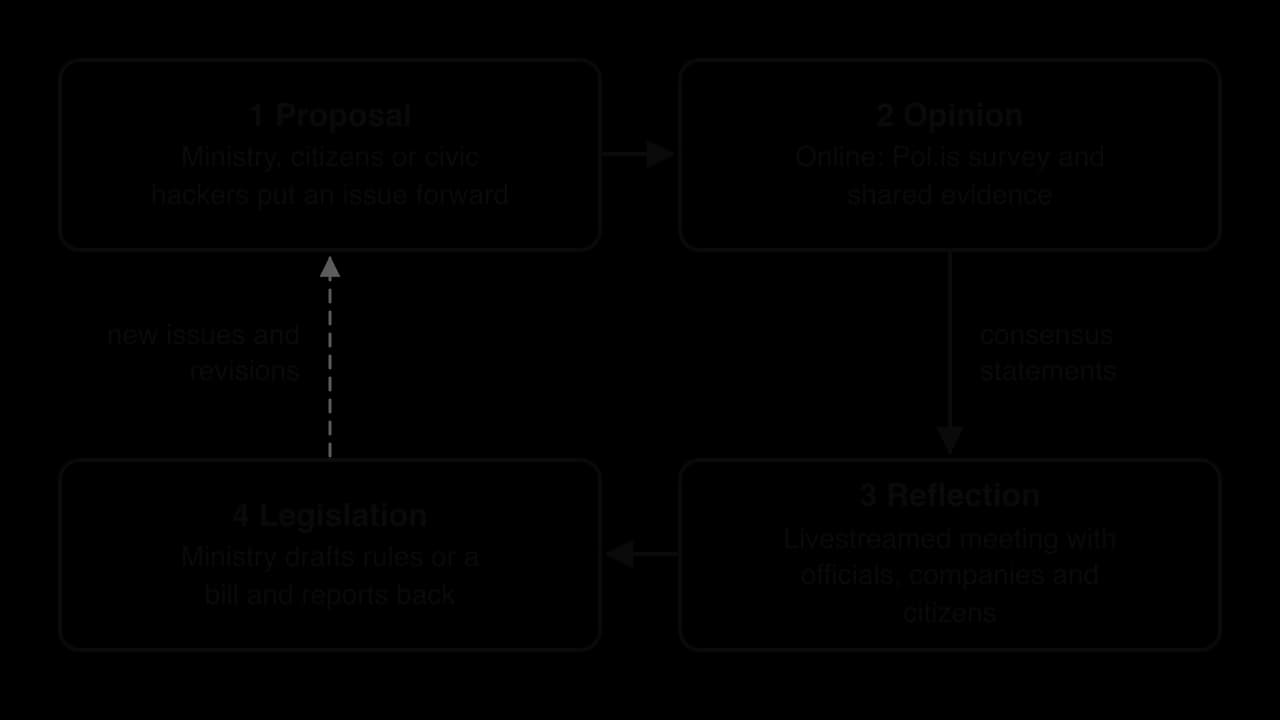
Proposal. A ministry, citizens or civic hackers put forward an issue. Background information and evidence are published openly.
Opinion. Citizens give their views through Pol.is, an open-source online tool first released in 2012.
Reflection. Officials, companies, experts and citizens meet face to face; the meeting is livestreamed and anyone can comment online.
Legislation. The ministry turns the agreed points into regulations or a draft bill and explains what it has done.
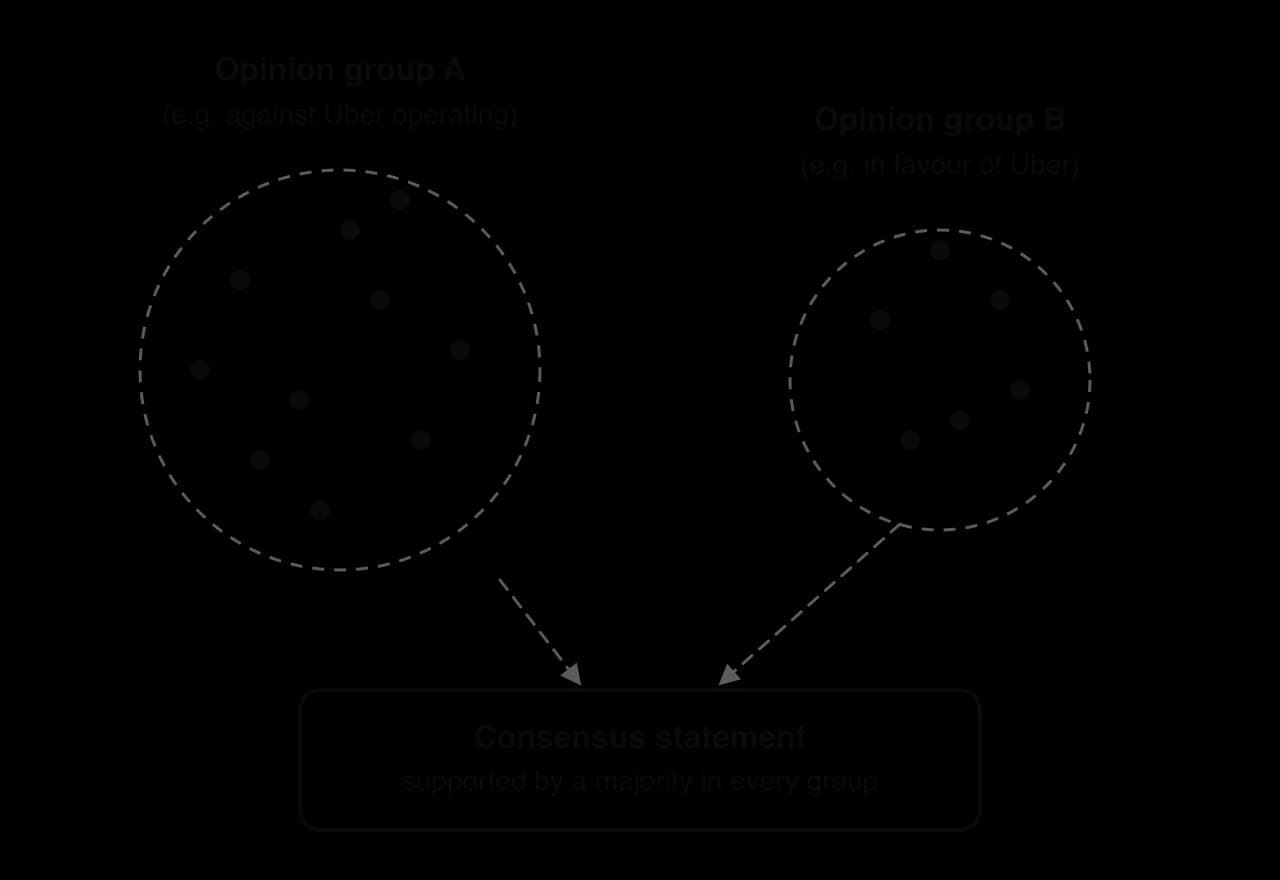
The opinion stage is the most unusual. On Pol.is, participants post short statements and vote "agree", "disagree" or "pass" on other people's statements. There is no reply button, so users cannot argue with or attack each other directly. An algorithm groups participants who vote in similar ways and shows the groups as clusters on an opinion map. Statements that win support across all groups are highlighted as consensus statements. Because these are the statements that gain visibility, participants have an incentive to write proposals that people on the other side can accept.
Taiwan's government also built Join, a national platform for petitions and consultation that uses some of the same tools. A petition that reaches 5,000 signatures within 60 days requires the relevant agency to respond point by point. By 2018 nearly five million people, about a fifth of Taiwan's population, had used Join, and its users were older and less technically skilled on average than vTaiwan's.
 YouTube
The Uber consultation
The first major test, in 2015, concerned Uber, which was operating in Taiwan without meeting the rules for taxi services. Taxi drivers demanded a ban; Uber drivers and many passengers wanted the service to continue. Thousands of people took part in a four-week Pol.is consultation (vTaiwan reports more than 4,000). The opinion map first showed two groups, for and against Uber, with the group against Uber about twice as large.
As the consultation continued, participants wrote statements on concerns both sides shared, such as passenger safety and liability insurance. A small set of statements gained near-universal support, including that private passenger vehicles should be registered and that drivers should be able to work for more than one platform. Tang took these statements into a livestreamed meeting with Uber, taxi representatives and experts. Uber accepted the consensus points, and the government committed to turning them into new regulations, which it later adopted along the lines vTaiwan had produced.
Stakeholder | Impact of the consultation |
|---|---|
Taxi drivers | Their concerns about unfair competition and safety shaped the rules; Uber did not receive an exemption from regulation |
Uber drivers | Could continue working, but under licensing and insurance rules that could raise their costs |
Passengers | Kept access to an app-based service with clearer safety and insurance protection |
Uber | Lost the advantage of operating outside the rules, but kept access to the market |
Government | Broke a deadlock and gained a regulation with visible public support |
Wider impacts and implications
vTaiwan reported that by August 2018 it had been used for 26 national issues, and that about 80% of them led to decisive government action. Outcomes included rules on online sales of alcohol and a "fintech sandbox" law passed in 2017 that lets financial technology start-ups test products under lighter rules. About 200,000 people had taken part in its discussions by 2018.
The limits are equally clear. The consensus on online alcohol sales, reached by about 450 participants in 2016, became a draft bill, but the new government that took office in May 2016 withdrew all pending bills and that bill never became law. vTaiwan's recommendations are not legally binding, and a legislator who helped launch it called it "a tiger without teeth". Ministries choose which issues go to the platform, so it was used mainly for digital-economy questions and not for divisive issues such as pensions or labour reform. Members of g0v warned that if recommendations are ignored, the process risks becoming "openwashing": an appearance of openness without real influence. People involved have described it as a low priority for government that has at times come close to collapse, dependent on the support of particular officials.
Analysis through concepts
Power. vTaiwan redistributes agenda-setting power. Before it, the main way for citizens to influence a contested technology policy was protest; through vTaiwan, ordinary participants decide which statements become the agenda for a meeting with a minister and a multinational company. Formal decision-making power stays with the government, however, which keeps the right to ignore the outcome and to choose which issues are opened up.
Systems. vTaiwan is a sociotechnical system that combines software (Pol.is), people (volunteers, officials, participants), processes (the four stages) and institutions (ministries, the legislature). Its design shows how a small change in one element alters the behaviour of the whole: removing the reply button and rewarding cross-group agreement reverses the feedback loop of engagement-driven social media, which tends to reward division.
Values and ethics. vTaiwan expresses the values of transparency (meetings are livestreamed and transcripts published) and inclusion. Ethical questions remain about who takes part: participants are self-selected, so the voices heard may be younger, more urban and more technically skilled than the population as a whole.
Change. vTaiwan turned a protest movement into an institution, and its periods of near collapse show how such change can stall when political priorities shift.
Evaluation with the framework
Classification. vTaiwan mainly enhances participation and representation by strengthening an existing democratic process with a new channel. It also intercedes in political polarization, because its design changes the process by which online opinion forms, rewarding agreement instead of conflict. It does not resolve the challenge, because unequal participation and the power of governments to ignore citizens remain.
Criterion | Evaluation | Strength |
|---|---|---|
Equity | Open to anyone online and anonymous, but participants are self-selected; older, rural and less digitally skilled citizens are under-represented. Join reaches a broader population. | Mixed |
Acceptability | High transparency (open data, livestreams, published transcripts). Accountability is weaker: the government is not obliged to act, and some outcomes were dropped. | Mixed to strong |
Cost | Low financial cost because tools are open source and run largely by volunteers; the hidden cost is volunteer time and officials' attention, which makes it fragile. | Strong financially, weak in sustainability |
Feasibility | Technically simple and copied elsewhere. Socially it needs a strong civic tech community; politically it depends on ministers who are willing to take part. | Depends on political will |
Innovation | Disruptive in its use of opinion clustering to find consensus at scale; it influenced later tools, such as the Community Notes system on X. | Strong |
Ethics | Anonymity protects participants, and the design reduces harassment; the main ethical risk is legitimacy, if self-selected participants are presented as "the public". | Mostly sound |
Judgement. vTaiwan is one of the most successful digital interventions in participation and representation because it changed how a government listens on new technology issues, with clear results such as the Uber regulations and the fintech sandbox. Its success is conditional. It worked where the issue was new, the stakes were limited and ministers committed in advance to act; it has been far less tested on divisive questions, and its non-binding status left it vulnerable to changes in government.
Recommended steps for future action
Make responses mandatory (acceptability). Require ministries to publish a reasoned response to every consensus statement within a fixed time, as Join already does for petitions, so that ignoring an outcome has a visible cost.
Recruit participants deliberately (equity). Combine open participation with invited samples of citizens chosen to reflect the population by age, region and background, with in-person sessions in community centres for those less confident online.
Protect the process from political change (feasibility). Set out the process in law or regulation, with a permanent budget and staff, so that it does not depend on individual ministers or volunteers.
Widen the issues (innovation). Test the method on a more divisive issue at local level first, where the risks are smaller, before using it nationally.
Guard against misuse (ethics). Publish how the clustering algorithm works and how the system defends against coordinated fake accounts, so that consensus cannot be manufactured.
Each recommendation has a trade-off. Binding outcomes would raise participation but could make governments more reluctant to open issues to the platform, and invited samples improve representation but cost more and weaken the open, volunteer spirit that made the process possible.
Exam practice
Paper 3 questions are based on an unseen intervention described in the exam's sources.
Self-check
- To do:
I can define governance, human rights and digital rights, and explain why governance in digital society involves companies and civil society as well as states.
- To do:
I can identify the UDHR articles most affected by digital systems and give a digital example for each.
- To do:
I can explain the four roles digital systems play in wars and civil conflicts, using Myanmar, Tigray or Ukraine.
- To do:
I can describe regional, national and global security threats with digital dimensions, and explain the tension between security and rights.
- To do:
I can explain how digital systems both support and threaten political speech and activism.
- To do:
I can explain how digital systems affect access to and representation in governing bodies, using real data.
- To do:
I can explain how digital systems discriminate through design, data and use.
- To do:
I can analyse digital impacts on gender equality, racial and ethnic discrimination, ability and inclusion, and tolerance for religions and cultures.
- To do:
I can identify at least one real intervention for each of conflict and security, participation and representation, and diversity and discrimination, and classify each by type.
- To do:
I can evaluate an intervention against the most relevant criteria, naming the people and communities affected.
- To do:
I can describe how vTaiwan and Pol.is work and evaluate vTaiwan with the full framework.