Notes on 5.1 Global well-being
Learning objectives
Define a challenge and an intervention, and outline the four steps of an extended inquiry into a challenge topic.
Distinguish between interventions that mitigate, intercede, enhance and resolve, and classify real interventions by type.
Evaluate an intervention against the six criteria of equity, acceptability, cost, feasibility, innovation and ethics, including incremental, sustaining and disruptive innovation.
Recommend steps for future action that follow from an evaluation and consider their trade-offs and implications.
Explain how economic inequality, food insecurity and unequal access to health care and medicine appear at local and global levels, and how they intersect with digital systems.
Explain how population growth, ageing and youth populations, and migration change the needs of people and communities.
Analyse how automation, insecure employment and the collective needs of workers shape the future of work.
Evaluate real digital interventions for each area of global well-being, including WFP Building Blocks, and recommend steps for future action.
Introduction
Global well-being describes how well people across the world are able to live: whether they have enough income, food and health care, can move safely, and can earn a living with dignity. Digital systems now shape all of these, from the mobile money that delivers cash aid in Kenya to the algorithms that assign orders to delivery riders in Madrid.
Global well-being is the first of three challenge topics in the HL extension, alongside governance and human rights (5.2) and sustainable development (5.3). Instead of only analysing the impacts and implications of digital systems, the extension asks how people use digital systems to respond to large problems, and how well those responses work. It draws on concepts such as power, change and values and ethics; content such as data (3.1), algorithms (3.2) and artificial intelligence (3.6); and the economic (4.2), health (4.4) and social (4.7) contexts in particular. The framework for studying challenges and interventions applies equally to 5.2 and 5.3.
Challenges and interventions
Every extended inquiry connects a challenge (the problem) with an intervention (a response to it that involves digital systems).
What makes an issue a challenge
A challenge in the HL extension is large, lasting, and beyond the power of one organisation, country or technology to solve.
Each part of the definition matters for analysis.
Feature | What it means | Example from global well-being |
|---|---|---|
Pressing | Harm is happening now | About 645 million people faced hunger in 2025 |
Complex | Many causes interact | Food insecurity stems from conflict, climate, prices and income |
Widespread | Affects many people in many places | Unequal access to health care exists in every country |
Persistent | Lasts over long periods | Global income inequality has stayed very high for decades |
Transnational | Crosses national borders | Refugees move between countries |
Transgenerational | Passes between generations | Childhood malnutrition affects adult health and earnings |
Intertwined with digital systems | Digital systems shape the problem and the responses | Automation changes jobs; apps organise gig work |
Sources: FAO and partners, The State of Food Security and Nutrition in the World 2026; World Inequality Report 2026.
The last feature is what makes a challenge part of digital society. Digital systems rarely cause a challenge such as hunger on their own, but they change how it develops, who notices it and how people respond. A digital divide, for example, can deepen economic inequality, while mobile payments can speed up aid.
What counts as an intervention
An intervention is any planned response that tries to change part of a challenge and involves digital systems in some way.
A law that changes how delivery platforms treat their workers is an intervention, because it targets digital systems (the platforms and their algorithms) even though it is not itself an app. So is a charter written by drivers on a ride-hailing platform.
Interventions can come from governments, international organisations and NGOs (such as the World Food Programme, WFP, or the UN Refugee Agency, UNHCR), companies, communities of workers or users, and individuals.
The HL extension framework
The HL extension framework is a method for studying challenges and interventions. It follows the same inquiry stages as the rest of the course (focus, explore, investigate, reflect and share), but adds a challenge to the focus and an intervention to the investigation, and ends with recommended steps for future action. It has four steps, which the flow diagram sets out.
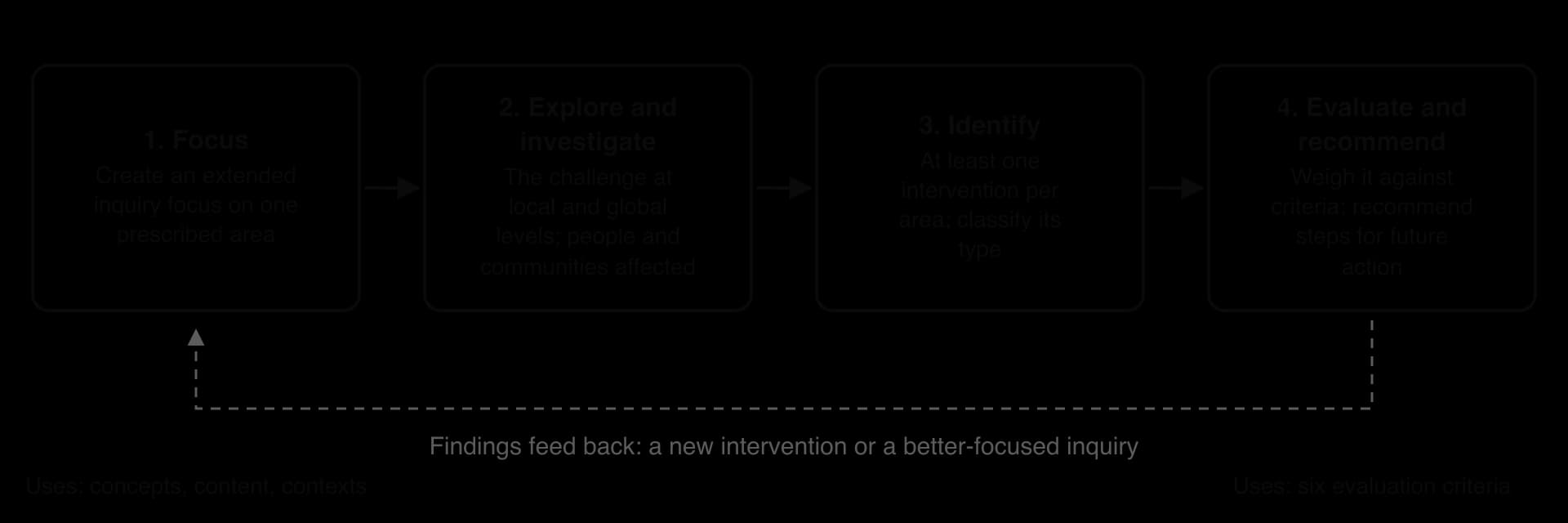
An extended inquiry can start at the beginning of the course, build on inquiries shared with SL students, and be carried out by a team in which each member brings a different concept or context. Practical and design work, such as prototyping an intervention or testing an app idea with users, is encouraged and can link to a CAS project. No inquirer can master every issue in a challenge topic; the aim is to identify, analyse and evaluate an intervention for each challenge topic, and to recommend steps for future action for an intervention met for the first time.
Step 1: Create an extended inquiry focus
The focus combines one prescribed area of a challenge topic (for global well-being: local and global inequalities, changing populations, or the future of work) with an open inquiry question. A good question is specific enough to research but open enough to allow different perspectives and a judgement.
Weak focus | Stronger focus | Why it is stronger |
|---|---|---|
"Technology and hunger" | "How effectively do digital cash transfers reduce food insecurity for refugee households in Jordan?" | Names a digital system, a group of people and a place, and asks for a judgement |
"Old people and health" | "How do remote monitoring systems affect the independence of older people living alone in rural Japan?" | Links a shifting demographic to a specific intervention and outcome |
The focus also states which concepts, content and contexts will give the most insight. An inquiry into digital cash aid, for example, might use the concept of power (who controls the money and the data), the content of data and blockchain (3.1), and the economic and social contexts.
Step 2: Explore and investigate challenges
In the second step the inquirer studies the challenge itself before judging any response to it, guided by questions such as these:
What is the relationship between digital systems and this challenge?
What is the nature and scope of the challenge in digital society?
Which course concepts, content and contexts help most in understanding it?
How does the challenge appear at local and global levels?
Which specific people and communities does it affect?
What are its impacts and implications?
The fourth question is central, because a challenge looks different at different scales. Global data on hunger shows trends and regional patterns; local evidence, such as interviews with families using a food bank in one town, shows how the challenge is experienced and which needs a global statistic hides. Strong inquiries move between the two.
Sources are judged as in any inquiry, by origin and purpose, meaning and methods, and corroboration. A report by the organisation that runs an intervention, for example, needs checking against independent sources and the views of the people it serves.
Step 3: Identify interventions
The third step identifies at least one intervention for each prescribed area of a challenge. Each intervention chosen must allow sustained investigation: there must be enough evidence about it, and it must involve specific people or communities whose experiences can be studied.
The four types of intervention
Interventions are classified by what they do to the challenge. The four types act on different parts of it, as the diagram shows.

Mitigates: the intervention reduces the negative aspects of a challenge, usually without removing their cause. Cash aid for families who cannot afford food mitigates food insecurity.
Intercedes: the intervention steps into a process or trend that produces the negative aspects and changes it. A law that changes how platforms classify their workers intercedes in the trend towards insecure work.
Enhances: the intervention strengthens positive or effective aspects that already exist. A service that helps migrants send money home more cheaply enhances the benefits that remittances already bring.
Resolves: the intervention removes a negative aspect of a challenge. Few interventions resolve a whole challenge, but some resolve one specific aspect, such as a shared registration system that ends duplicate aid payments between agencies.
The categories overlap and inform one another. An app that lets refugees register for aid on their phones mitigates hunger, intercedes in a slow paper-based process, and may enhance their access to other services. The useful question is which type describes the intervention's main effect on the specific aspect being studied.
Step 4: Evaluate interventions and recommend steps for future action
The final step judges how well an intervention works and what should happen next, with at least one intervention evaluated for each prescribed area. Evaluation uses six criteria. Not every criterion applies to every intervention: the inquirer selects those most relevant to the intervention and the people it affects, although all six must be addressed at some point across the course. Each criterion comes with guiding questions for the evaluation and for the steps for future action that follow from it.
Criterion | Guiding questions for evaluation | Steps for future action |
|---|---|---|
Equity | Does the intervention fairly meet the needs, claims and interests of the people and communities affected? Who is included and who is left out? Is there reciprocity? | What would address inequities? How could it be made fair for more people? |
Acceptability | Do the affected people and communities see it as acceptable? Is it accountable and transparent to them? | What would make it more acceptable to those affected? How could it become more accountable and transparent? |
Cost | What are its financial, social, cultural and environmental costs? Do they outweigh its benefits? | How could costs be reduced or shared so that the balance with benefits improves? |
Feasibility | Is it technically, socially and politically possible? What current or emerging barriers stand in the way? | What steps would remove or reduce these barriers? |
Innovation | Is the approach new, or has it been tried before without success? Is it incremental, sustaining or disruptive? | How could it be adapted or refined to avoid risks, failures or limitations? |
Ethics | Is it ethically sound? Who decides its ethical status, and how? | What would ensure it is developed and used ethically? |
Equity
The equity criterion asks whether an intervention fairly addresses the needs, claims and interests of the specific people and communities affected by the challenge. Equity is not the same as equality. Treating everyone the same can be inequitable if some people start with fewer resources or face barriers others do not.
Three ideas help in judging equity:
Fairness: are benefits and burdens shared in a way the affected people could accept as just?
Inclusion: can everyone who needs the intervention reach it, including people without smartphones, people with disabilities, older people, women and people who do not read the main language?
Reciprocity: do the people who give something to the intervention (their data, their time, their trust) receive a fair return?
A telemedicine app that requires a smartphone and a data plan may improve access on average while excluding the poorest patients, who often have the greatest health needs.
Acceptability
The acceptability criterion asks whether the affected people and communities themselves see an intervention as acceptable. What counts is the view of those affected, rather than that of the designers or funders. Two ideas are central:
Accountability: can affected people find out who is responsible for decisions, challenge them and obtain redress when something goes wrong?
Transparency: do affected people understand how the intervention works, what data it collects and how decisions about them are made?
Acceptability often varies between groups within one community, so evidence comes from surveys, interviews, complaints, take-up rates and the organisations that represent the people concerned.
Cost
The cost criterion weighs all the costs of an intervention against its benefits. Costs are wider than money:
Financial: development, hardware, connectivity, training, maintenance and fees.
Social: lost jobs, lower trust, time spent learning a new system.
Cultural: disrupted customs, services that ignore local languages or beliefs.
Environmental: energy used by data centres and devices, electronic waste.
The key question is whether costs outweigh benefits, and for whom: an intervention can be cheap for its operator while shifting costs onto users, who must buy data or travel to register.
Feasibility
The feasibility criterion asks whether an intervention can actually be carried out and sustained. There are three dimensions:
Technical feasibility: does the technology work reliably in the setting where it is needed (with the available electricity, connectivity, devices and skills)?
Social feasibility: will people adopt it and keep using it, given their habits, trust and digital literacy?
Political feasibility: will governments, regulators and powerful organisations allow and support it?
Barriers can be current (no mobile coverage) or emerging (a new law, a funding cut, a conflict), and many pilots fail at national scale because one dimension was ignored.
Innovation
The innovation criterion asks whether an intervention's approach is new, or whether something similar has already been tried and failed. A new approach is not automatically better: an untested idea carries risks that a proven one does not. The criterion also asks what type of innovation the intervention is.
Type | Meaning | Example |
|---|---|---|
Incremental innovation | A small improvement to an existing product, service or process | Adding SMS reminders to an existing vaccination programme |
Sustaining innovation | A significant improvement that helps existing organisations serve their current users better, without changing who leads the field | A bank moving its existing customers to mobile banking |
Disruptive innovation | A new approach, often simpler or cheaper at first, that reaches people ignored by existing providers and eventually changes how the whole field works | Mobile money reaching people with no bank account, then changing how aid, wages and remittances are paid |
The idea of disruptive innovation comes from the business scholar Clayton Christensen. Disruptive interventions often have the largest effects on well-being because they reach excluded people, but they also bring the greatest risks, since rules and safeguards have not caught up. Steps for future action under this criterion adapt or refine the intervention to avoid known risks and failures.
Ethics
The ethics criterion asks whether an intervention is ethically sound, and also who decides its ethical status and how. An aid agency, a technology company, a government, the affected community and an independent ethics board may reach different judgements about the same system.
Ethical evaluation draws on the ethical frameworks from 2.7 Values and ethics. A consequentialist judgement weighs outcomes: if biometric payments feed more people at lower cost, the benefits may justify the risks. A rights-based judgement asks whether people's rights to privacy and to give informed consent are respected, whatever the outcomes. Ethical evaluation is especially important when an intervention targets people with little power, such as refugees, children or workers who may lose their income if they object.
Steps for future action and how to write a recommendation
The end point of an extended inquiry is a set of steps for future action.
A recommendation is more than a wish. "The government should make the app fairer" names a goal but not a step. A strong recommendation has six parts:
The problem it responds to, identified in the evaluation and linked to a criterion.
The action: what exactly should be done.
The actor: who should do it (a ministry, the platform, an NGO, a community group).
How the digital system is involved: what changes in the technology, its data or its rules.
Evidence that the step could work, ideally from a real example.
Trade-offs and implications: what the step costs, who might lose, what new risks it brings, and how success would be measured.
Global well-being as a challenge
Global well-being is a significant challenge made up of many different issues and concerns, and it intersects in important ways with many digital systems. It is a family of problems that share one theme, whether people across the world can meet their basic needs and live lives they value.
Well-being is measured in several ways, from income per person to broader measures such as the UN's Human Development Index, which combines income with life expectancy and years of schooling. Because well-being has many dimensions, inequality, population change and work all affect it at once.
The three prescribed areas each connect to different parts of the course.
Area | Main issues | Concepts that give insight | Content and contexts that often apply |
|---|---|---|---|
5.1A Local and global inequalities | Economic inequality and stratification; food insecurity; access to health care and medicine | Power, space, values and ethics | Data, networks; economic, health, social |
5.1B Changing populations | Population growth; ageing and youth populations; migration | Change, identity, space | Data, AI, robots; social, political, health |
5.1C The future of work | Automation; meaningful and secure employment; collective needs of workers | Power, change, systems | Algorithms, AI, robots; economic, social |
In each area digital systems can widen gaps, for example when the benefits of automation flow mainly to the owners of technology, or narrow them, for example when mobile money lets people with no bank account receive payments.
5.1A Local and global inequalities
Inequality is the uneven distribution of resources and opportunities between people and groups. It exists between countries (global inequality) and within them (local or national inequality), and the two often look very different.
Economic inequality and stratification
Economic inequality is usually measured in two ways. Income is what people earn or receive over a period, such as wages, profits or benefits. Wealth is what people own at a point in time, such as savings, land, houses and shares. Wealth is almost always more unequal than income, because it accumulates and is passed down between generations.
The global distribution of both is extremely uneven, as the bar chart shows.
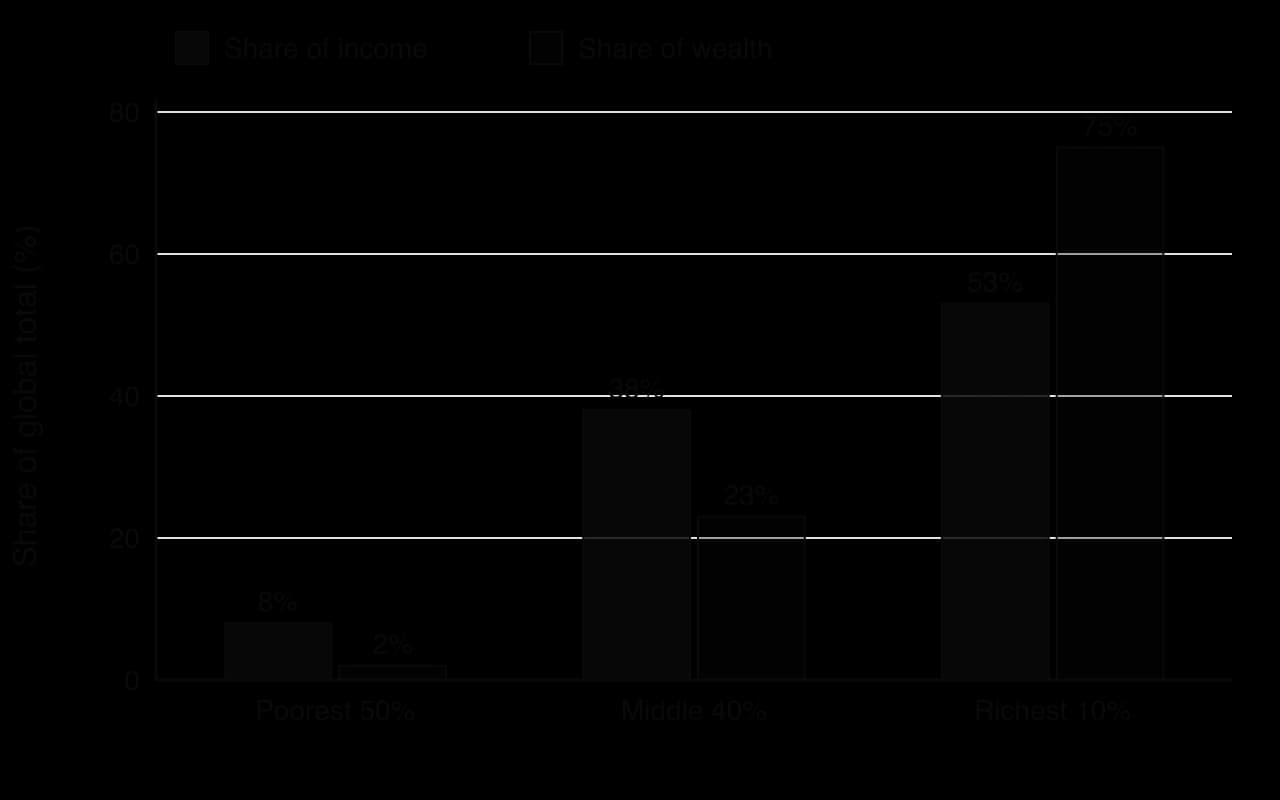
The same report finds that the wealthiest 0.001% of adults, fewer than 60,000 people, own about three times as much wealth as the poorest half of humanity combined. Inequality also has a gender dimension and a climate dimension: the richest groups account for most carbon emissions linked to private capital, while the poorest are most exposed to climate shocks.
Economic stratification adds the idea of structure to inequality. In a stratified society, being born into a lower stratum makes it harder to gain education, good jobs, health care and political influence, which in turn keeps people in that stratum. Digital systems interact with stratification in several ways:
Access: people in lower strata are less likely to own devices, afford data or have digital skills, so services that move online can leave them behind.
Returns to technology: the gains from digital platforms and automation tend to flow to those who own the technology and to highly skilled workers, widening the gap with lower-skilled workers.
Algorithmic sorting: credit scoring, hiring algorithms and targeted advertising can sort people into categories that reflect existing advantage, a pattern explored in 3.2 Algorithms.
New routes up: mobile money, online learning and remote work can open services and markets that were previously closed.
Locally, inequality is experienced as differences between neighbourhoods, schools and jobs within one city; globally, it appears as large gaps in average income between countries.
Food insecurity and access to safe, nutritious and sufficient food
Food insecurity covers more than hunger. A household can have enough calories but too little variety, or eat well most months and go hungry when prices rise.
The UN measures food insecurity on a scale from mild (uncertainty about being able to obtain food) through moderate (reducing the quality or quantity of food) to severe (running out of food and going a day or more without eating). Hunger, in the narrow sense of chronic undernourishment, sits at the severe end.
Global hunger has fallen for three years in a row, but remains high. In 2025 about 645 million people, 7.8% of the world's population, faced hunger, down from 8.6% in 2022. The pattern is uneven between regions. For the first time, more hungry people lived in Africa (about 309 million) than in Asia (about 292 million), and about one in five people in Africa faced hunger. About 2.7 billion people, nearly one in three, could not afford a healthy diet.
Food insecurity is local and global at once. Global prices, wars and climate events push up the cost of food everywhere; the disruption of shipping through the Strait of Hormuz during the 2026 war involving Iran, for example, raised fuel and fertiliser prices and affected between a quarter and a third of the inputs that farming and food systems need. The effects, however, fall on specific households, often those headed by women, refugees and rural families who spend most of their income on food. It also exists in rich countries, where food banks serve households whose incomes do not cover basic costs.
Access to health care and medicine
Access to health care has several parts: services must exist, be close enough to reach, be affordable, and be acceptable and of good quality.
According to the World Health Organization (WHO), about 4.6 billion people were not fully covered by essential health services in 2023. In 2022 about 2.1 billion people faced financial hardship because of the cost of health care, and about 1.6 billion were living in poverty or were pushed deeper into it by paying for care themselves.
Access to medicine is a related problem. Medicines may be unavailable, too expensive, or falsified. The WHO has estimated that about one in ten medical products in low- and middle-income countries is substandard or falsified, which harms patients and wastes the money of the poorest households.
Digital systems affect access in both directions. Telemedicine (4.4 Health) brings consultations to remote villages and digital records let care follow patients, but services that move online can exclude people without devices or skills, and health data creates new privacy risks.
Interventions for local and global inequalities
GiveDirectly: mobile cash transfers in Kenya
GiveDirectly is a non-profit organisation that sends cash directly to people living in poverty, using mobile money. Transfers arrive on recipients' SIM cards and are withdrawn at local mobile money agents. Recipients are selected through data, for example whole villages with high poverty rates, rather than by local officials, which reduces the scope for favouritism.
Its best-known project is a long-term study of universal basic income in rural Kenya, launched in 2016. It includes about 195 villages and some 23,000 people, with 100 further villages as a comparison group.
The study compares three designs: a long-term basic income of about US$22.50 a month promised for 12 years, a short-term basic income of the same amount for two years, and a one-off lump sum of US$500. Results published in 2023 found no evidence that cash made people work less. Hours in wage work (mostly farm labour) fell, but hours in self-employment rose by slightly more, as people started or expanded small businesses. The lump sum produced the largest rise in income and the most new businesses, while the long-term basic income increased saving and investment, and the short-term payments reduced depression and improved the variety of food people ate more than the lump sum did.
M-TIBA: a mobile health wallet in Kenya
For access to health care, M-TIBA, developed in Kenya by the company CarePay with the PharmAccess Foundation and the mobile operator Safaricom, lets users save, send, receive and pay for medical care with their phones. It enhances access by making it easier to save for care before an illness instead of paying in an emergency. Its main limitation is equity, since it cannot create clinics or doctors where there are none.
5.1B Changing populations
Populations change in size, in age structure and in where people live. Each kind of change creates new needs (for schools, jobs, health care, housing and care for older people) and puts pressure on existing systems.
Population growth
Population growth is the increase in the number of people in an area over time. It depends on births, deaths and migration.
The world's population passed 8 billion in November 2022. The United Nations projects that it will peak at about 10.3 billion in the mid-2080s and then fall slowly to about 10.2 billion by 2100. Growth is very uneven. Sixty-three countries and areas, including China, Germany and Japan, have already passed their population peak, while countries such as Niger, Angola, Somalia and the Democratic Republic of the Congo are projected to roughly double their populations between 2024 and 2054. More than half of all countries now have fertility below the replacement level of 2.1 births per woman.
Rapid population growth puts pressure on food, water, housing, schools, health services and jobs, and a fast-growing city also needs more network capacity and digital public services. Population data itself is increasingly collected by digital systems, from digital censuses to satellite images that estimate where people live.
Shifting demographics: ageing and youth populations
As countries develop, families tend to become smaller and people live longer. This process changes a population's age structure, and the bar chart shows how far countries differ.
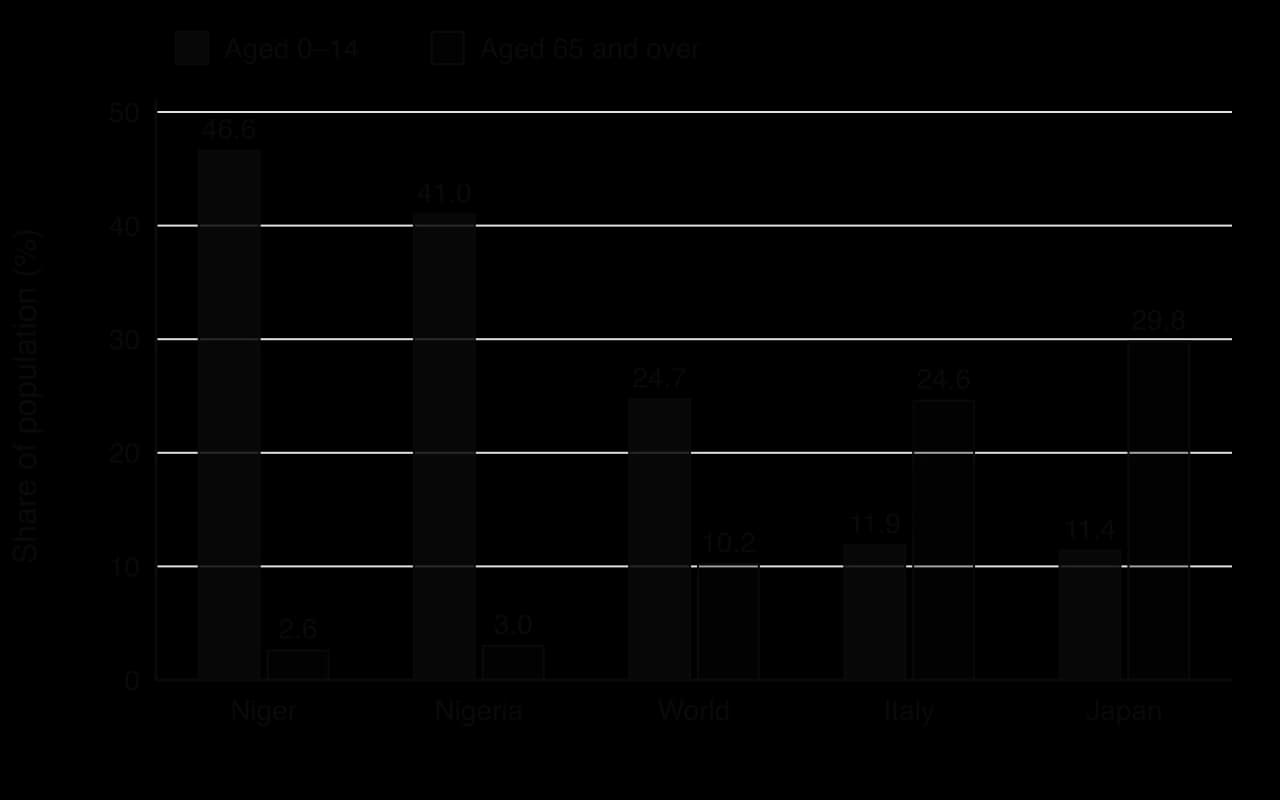
An ageing population raises demand for health care and long-term care while the share of working-age people who pay taxes and provide care falls. Japan is the clearest example: about 30% of its population is 65 or over. Older people living alone in rural areas face isolation and long distances to services. The United Nations projects that people aged 65 and over will outnumber those under 18 worldwide by the late 2070s.
Digital responses mainly mitigate these pressures. Remote monitoring sensors, telemedicine, medication reminders, and robots for care and companionship (such as the PARO therapeutic seal used in some care homes) aim to help older people live independently for longer and to make scarce care workers more productive. They also raise questions of equity (many older people have low digital skills), acceptability (some older people experience monitoring as intrusive) and ethics (whether a robot should replace human contact).
A youth bulge is the opposite pressure. Countries such as Niger and Nigeria need to create millions of jobs each year for young people entering the labour market. If they succeed, a large working-age population can boost growth (a "demographic dividend"). If they do not, youth unemployment can lead to poverty, frustration and emigration. Training young people for online work is one digital response, although platform work is often insecure and poorly paid.
Migration and the movement of people
Migration is the movement of people from one place to another with the intention of settling, temporarily or permanently. It includes movement within a country (from rural to urban areas, for example) and between countries.
Forced migration is a particular concern for global well-being, because forced migrants often lose their homes, documents, savings and social networks at once. A refugee has a specific status in international law.
People forced from their homes who stay within their own country are internally displaced people (IDPs), and they do not have refugee status. The line chart shows how both groups have grown.
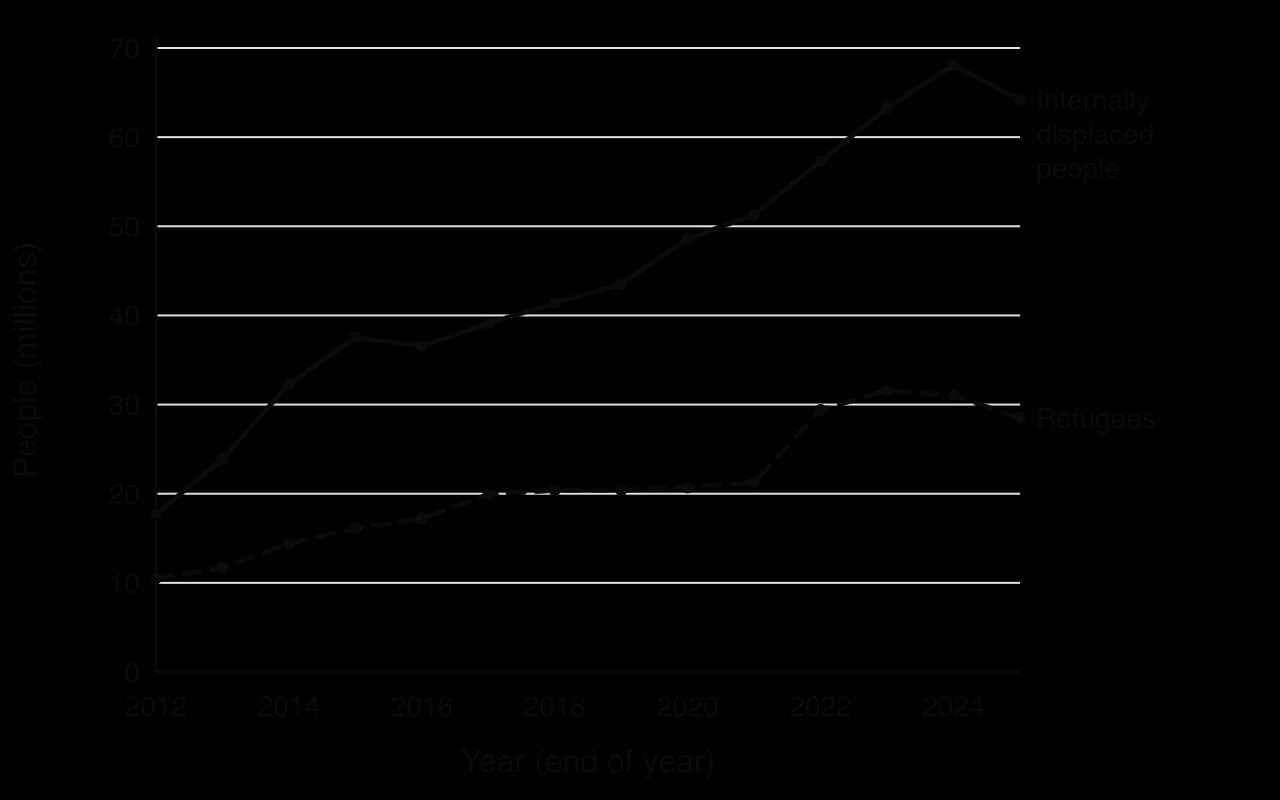
Most refugees live in neighbouring low- and middle-income countries. Jordan, for example, hosted about 650,000 registered Syrian refugees for most of the period from 2016 to 2023, a large number for a country of about 11 million people. At the local level, a refugee camp or a city neighbourhood that receives many newcomers faces pressure on water, schools, housing and jobs; at the global level, displacement is linked to wars, climate change and the funding decisions of donor governments.
Migration also produces flows of money. A remittance is money that migrants send to family in their country of origin.
Remittances are a major source of income for many low- and middle-income countries: migrants sent about US$656 billion to their home countries in 2023, more than all official development aid. Sending them is expensive. One of the Sustainable Development Goals (target 10.c) aims to reduce the cost of sending remittances to less than 3% of the amount sent, but the global average cost has remained around twice that level. Digital systems such as mobile money and online transfer services have lowered costs on some routes.
Interventions for changing populations
UNHCR biometric registration
UNHCR registers refugees so that it can protect them and provide assistance. Since the 2010s it has increasingly recorded biometric data, such as fingerprints and iris scans, in a central system. In Jordan, iris recognition supplied by the company IrisGuard is used to confirm refugees' identity at cash machines and supermarkets, so that assistance reaches the right person without cards or PINs. The same registration data underpins WFP's Building Blocks payment system in Jordan's refugee camps.
5.1C The future of work
The future of work is the study of how work is changing and will change, and what that means for workers, employers and societies.
Automation and employment
Automation uses machines and software to carry out tasks that people used to do. Digital systems have extended it from routine physical tasks to cognitive ones, such as sorting documents, translating and writing code.
Estimates of the number of jobs at risk vary widely, because they depend on method.
Study | Finding | Method and limitation |
|---|---|---|
Frey and Osborne, Oxford Martin School (2013) | 47% of US jobs at high risk of automation | Judged whole occupations; assumed that if most tasks could be automated, the job would disappear |
OECD (2019) | About 14% of jobs in OECD countries at high risk; a further 32% likely to change significantly | Looked at the tasks within jobs, which vary between workers in the same occupation |
ILO (2025) | About one in four jobs worldwide potentially exposed to generative AI; 34% in high-income countries | Exposure means many tasks could be affected, which usually means transformation rather than replacement |
World Economic Forum, Future of Jobs Report (2025) | 170 million jobs created and 92 million displaced by 2030, a net gain of 78 million | Based on surveys of large employers, who may be optimistic about their own plans |
"A job is exposed to AI" does not mean "the job will disappear". Most studies now find that automation replaces some tasks within jobs, creates new tasks and jobs, and changes the skills employers want. The impacts are unequal, however. The ILO found that women in high-income countries are much more likely to work in highly exposed jobs, mainly clerical work, than men. Workers who lose routine jobs often move into lower-paid work, while the gains go to workers with the skills to use new tools and to the owners of the technology.
 YouTube
Ensuring meaningful and secure employment
Meaningful and secure employment means work that pays enough to live on, is reasonably stable, is safe, and offers dignity and a chance to develop. The International Labour Organization (ILO) uses the term decent work.
Decent work is out of reach for a large share of the world's workers. Most workers in low-income countries are in informal employment, with no contract, sick pay or pension. Digital systems have created new forms of work that share some of these features even in rich countries. In the gig economy, platforms such as Uber, Deliveroo and Glovo treat many workers as independent contractors who are paid per task.
Gig work offers flexibility and a route into work for people who face barriers elsewhere, including many migrants. It also brings insecurity:
Income insecurity: pay per task varies with demand and with changes to the platform's pay formula.
No social protection: as contractors, workers often have no minimum wage, sick pay, holiday pay or pension.
Algorithmic management: an algorithm allocates tasks, sets pay, rates performance and can deactivate a worker's account, often without a clear explanation or a human to appeal to.
Isolation: workers rarely meet each other, which makes it harder to organise.
Universal basic income is sometimes proposed as a floor of security in a world of automation and insecure work; critics argue that it would be very expensive at national scale and does not improve the quality of work itself.
Addressing the collective needs of workers
Workers have needs they cannot meet alone, such as fair pay, safe conditions and protection against unfair dismissal, and have historically met them through trade unions and collective bargaining.
Collective bargaining is difficult in platform work, because workers are classed as self-employed and competition law in some countries treats collective agreements between independent contractors as price-fixing. Workers and their supporters have developed new approaches that use digital systems themselves:
Online organising: riders and drivers use WhatsApp and Telegram groups to share information about pay changes and to coordinate strikes.
Platform ratings: the Fairwork project, based at the Oxford Internet Institute, rates platforms in many countries against five principles (fair pay, fair conditions, fair contracts, fair management and fair representation) and publishes the scores, putting public pressure on low-scoring platforms.
Platform cooperatives: workers own and run their own platform.
Laws: governments change the rules that platforms must follow.
CoopCycle, a federation of bicycle delivery cooperatives that began in France, shares its delivery software with members under a licence that allows only cooperatives to use it. Cooperatives give workers control but struggle to compete with large platforms' marketing budgets and low prices.
Interventions for the future of work
Spain's Riders' Law
In May 2021 Spain passed Royal Decree-Law 9/2021, known as the Riders' Law (Ley Rider), which came into force in August 2021. It made two main changes to employment law:
It presumes that delivery riders working through digital platforms are employees, not self-employed contractors, when the platform organises, directs and controls their work through algorithmic management.
It gives workers' representatives in every company the right to be informed about the parameters, rules and instructions of the algorithms and AI systems that affect working conditions, hiring and dismissal.
The second change applies to all companies, not only delivery platforms, which makes the law an early example of a right to algorithmic transparency at work. The EU later adopted a Platform Work Directive (2024) based on similar principles.
Fairwork's ratings are a different kind of intervention: they enhance good practice by rewarding platforms that improve, and they work across borders without needing new laws. Their limitation is that they depend on public and investor pressure; a platform that ignores its score faces no legal consequence.
Case study: WFP Building Blocks
Background
The World Food Programme (WFP) is the UN agency that provides food assistance in emergencies. Since the late 2000s it has moved from delivering food towards giving cash or vouchers, which gives families choice and supports local shops. Cash, however, passes through banks, which charge fees and receive data about vulnerable people.
Jordan has hosted hundreds of thousands of Syrian refugees since the war in Syria began in 2011, many of them in the Zaatari and Azraq camps. WFP gives each refugee household a monthly food entitlement that it can spend in camp supermarkets. Building Blocks was WFP's attempt to deliver this assistance through a blockchain instead of through a bank. After a first field test in Sindh province, Pakistan, in January 2017, it was introduced in Jordan in 2017. By 2018 all of the roughly 106,000 Syrian refugees in the Azraq and Zaatari camps were buying food through it.
How the digital system works
Building Blocks is a permissioned blockchain, based on a version of the Ethereum software, that was run by WFP. A permissioned blockchain is a shared, tamper-resistant ledger in which only approved organisations can add records, unlike public blockchains such as Bitcoin, which anyone can join. The flow diagram shows how the parts of the system connect.
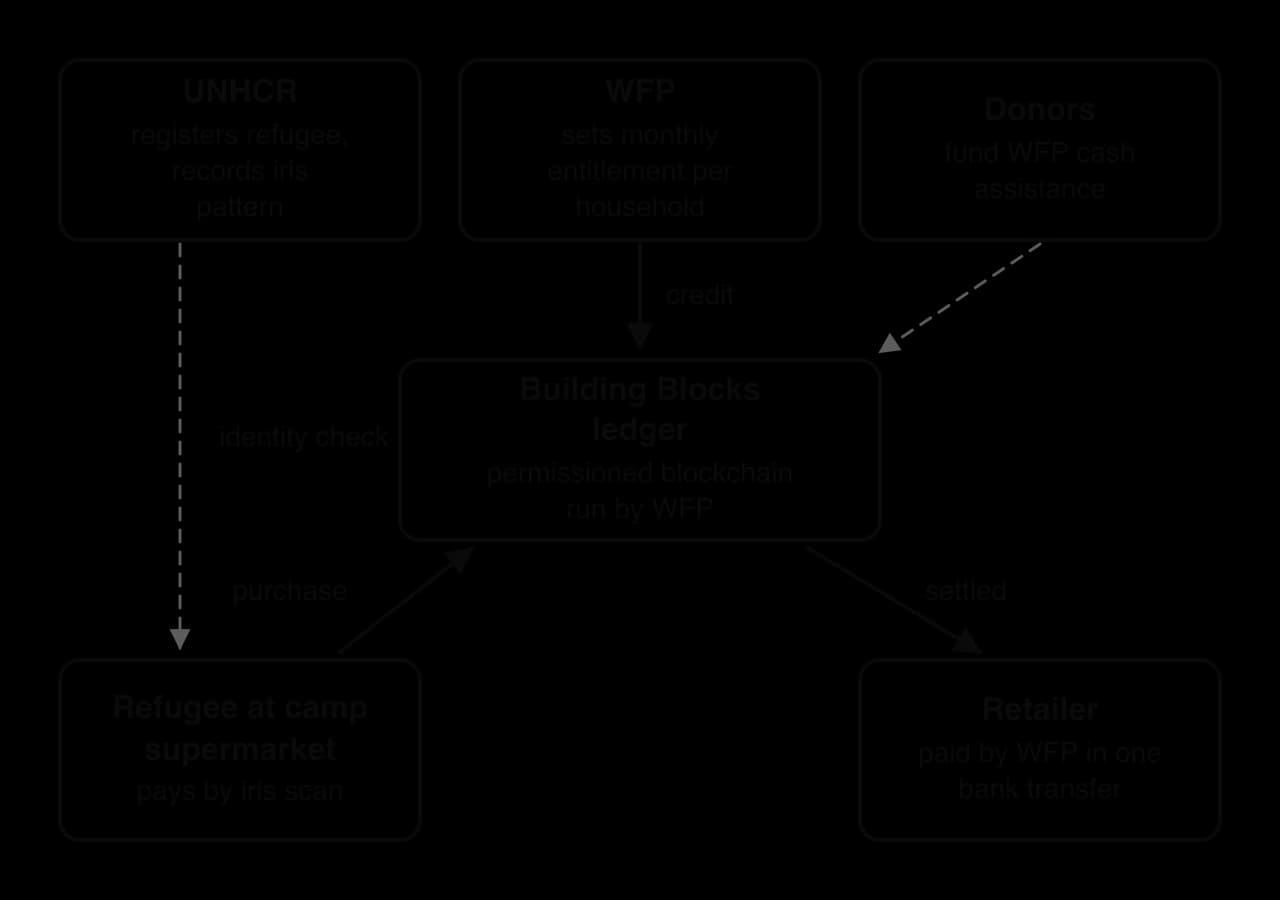
UNHCR registers each refugee and records their iris pattern, and WFP records each household's monthly entitlement on the ledger. At a camp supermarket the refugee looks into an iris scanner, the scan is checked against UNHCR's records, and the purchase is recorded on the blockchain against the family's account. WFP then settles with each retailer through a single bank payment. Because the bank is used only for this final settlement, WFP pays far fewer transaction fees and shares much less data about refugees with financial institutions. Early reports claimed a 98% reduction in fees; WFP later reported savings of about US$3.5 million in bank fees across millions of transactions.
From payments to coordination
The system grew beyond its first purpose. In 2019 UN Women joined the network in Jordan, so that refugee women in its cash-for-work programmes could collect their wages through the same iris-scan system at camp supermarkets. By 2022 Building Blocks reached more than a million refugees in Jordan and Bangladesh.
After 2022 its main use changed. In Ukraine, many humanitarian organisations were giving cash to the same displaced families, with no shared view of who had already been helped. Building Blocks became a coordination network: each organisation runs its own node on the blockchain, all members are equal co-owners, and they record which households they have assisted without sharing full personal data. WFP reports that since 2022 the network has prevented about US$288 million of unintended duplicate assistance, more than US$270 million of it in Ukraine, and that 159 organisations in Ukraine, Syria and Palestine used it in 2025.
Impacts and implications for people and communities
Stakeholder | Impacts and implications | Claims and perspectives |
|---|---|---|
Refugee households | No card or PIN to lose; repeated failed scans; little control over biometric data | Some prefer it to cards; others find failed scans frustrating |
Refugee women in cash-for-work schemes | Salaries collected securely, only by the woman herself | Supported by UN Women as giving women control of their own income |
WFP and donors | Lower bank fees, more money for food, better records and auditing | Present it as more efficient, accountable aid |
Banks | Lose fee income from millions of transactions | Their role is reduced to settlement |
Digital rights groups and researchers | Concern about biometric data, consent and experimentation on vulnerable people | Argue refugees are treated as "guinea pigs" for new technology |
Other aid agencies (Ukraine, Syria, Palestine) | Fewer duplicate payments, so assistance reaches more households | Value the shared, co-owned network |
The most important disagreement is between refugees' experience of convenience and the concerns of rights groups. Refugees in the camps have described to reporters their frustration when a scan fails at the first attempt, while rights researchers ask whether people who depend on aid for food can freely consent to biometric collection at all, which is the central ethical question.
Classifying the intervention
It mitigates food insecurity, because it delivers the food assistance that refugee households depend on.
It intercedes in the process of delivering aid, by replacing bank transactions with a blockchain ledger and so changing how money and data flow.
In its coordination role, it resolves a specific negative aspect of humanitarian aid: duplicate payments to some households while others receive nothing.
It does not resolve food insecurity itself, whose causes (war, displacement, the right to work in the host country, prices) lie outside the system.
Evaluation against the six criteria
Criterion | Strengths | Limitations | Judgement |
|---|---|---|---|
Equity | Every registered household in the camps uses the same system; no smartphone or literacy needed; women can collect their own income | Only registered refugees are included; people who cannot use iris scanners reliably face delays; refugees outside camps were not covered at first | Strong within camps, narrower beyond them |
Acceptability | Many refugees prefer it to cards and PINs; UNHCR says those who opt out keep their assistance | Refugees have little information about the blockchain and their data; complaints about failed scans | Mixed; limited by low transparency to refugees |
Cost | Large savings in bank fees; fewer duplicate payments, so more money for food | Iris scanners, software and staff training cost money; social cost of collecting biometric data | Benefits clearly outweigh financial costs; social costs harder to measure |
Feasibility | Proven at scale in camps and later across many agencies in Ukraine | Depends on electricity, networks, scanners and host-government support; a permissioned chain relies on WFP to run it | Feasible in managed settings; harder in remote or unstable areas |
Innovation | One of the first uses of blockchain in humanitarian aid; later a co-owned network | Critics, and WFP staff, accept a conventional database could have done much of the job | Disruptive in aid delivery, though the blockchain may be less essential than claimed |
Ethics | Less data shared with banks; aid reaches intended recipients | Biometric collection from people who depend on aid; risk if data were ever shared with governments they fled |
Analysis through concepts
Power. Building Blocks shifts control of aid payments from banks to WFP, and in its later form shares it among many aid agencies. Refugees have the least power in the system: they cannot design it, inspect it or easily refuse it without fearing for their assistance.
Values and ethics. The intervention shows a tension between consequentialist reasoning (it feeds more people at lower cost) and rights-based reasoning (it depends on sensitive data collected where consent may not be free).
Identity. Refugees' access to food depends on a biometric record held by an institution rather than on documents they control, so their identity in the system is defined by UN agencies.
Systems. The value of the intervention depends on other elements, such as UNHCR's registration database and the scanners in each shop.
Steps for future action
Improve acceptability and transparency. WFP and UNHCR should explain the system, the data held and the right to opt out in Arabic and in plain language at every supermarket, and set up a complaints channel run with refugee community representatives. The trade-off is staff time and cost, but higher trust would make the system more sustainable.
Strengthen ethical safeguards. UN agencies should publish independent data protection impact assessments and audits of the biometric data used by Building Blocks, and commit not to share it with any government without the individual's consent. This reduces the risk exposed in the Rohingya case, but may limit cooperation with host governments.
Offer alternatives to improve equity. Every distribution point should accept a non-biometric method, such as a card with a PIN, for people whose scans fail repeatedly or who refuse biometrics. This costs more and slightly raises the risk of fraud, which could be managed through occasional checks.
Extend the coordination model. The co-owned network used in Ukraine should be offered to agencies in other crises, with refugees' representatives included in its governance, which is slower but spreads power more evenly.
 YouTube
Exam practice
Paper 3 presents an unseen intervention and asks four questions of increasing demand; the scenario here is invented for practice.
Self-check
- To do:
I can define a challenge and an intervention, and outline the four steps of an extended inquiry.
- To do:
I can distinguish between interventions that mitigate, intercede, enhance and resolve, and classify a real intervention with a justification.
- To do:
I can explain the six evaluation criteria, including incremental, sustaining and disruptive innovation, and the steps for future action each leads to.
- To do:
I can write a recommendation that names the problem, the action, the actor, the digital system, the evidence and the trade-offs.
- To do:
I can explain economic inequality and stratification, food insecurity and access to health care and medicine, using real data at local and global levels.
- To do:
I can evaluate a digital intervention in local and global inequalities, such as GiveDirectly's mobile cash transfers.
- To do:
I can explain population growth, ageing and youth populations, and migration, including the meaning of refugee and remittance.
- To do:
I can evaluate a digital intervention in changing populations, such as UNHCR's biometric registration.
- To do:
I can explain how automation, insecure employment and the collective needs of workers shape the future of work.
- To do:
I can evaluate a digital intervention in the future of work, such as Spain's Riders' Law, and recommend steps for future action.
- To do:
I can evaluate WFP Building Blocks against the six criteria and through at least two concepts.