5 HL extension: challenges and interventions
How HL differs from SL in Digital Society, what challenges and interventions are, the three challenge topics and their areas, and the four steps HL students follow to evaluate digital interventions.
- IB Digital Society
- HL only
What 5 covers
From the subject guide: what you need to know and be able to do.
Global challenges linked to digital systems, and how well possible interventions address them.
3 subtopics in HL extension: challenges and interventions
Each one has its own page once something is published for it.
- 5.1Global well-beingnotes
- 5.2Governance and human rightsnotes
- 5.3Sustainable developmentnotes
An overview of 5 HL extension: challenges and interventions
How SL and HL differ
Standard level (SL) and higher level (HL) students study the same core course. Topic 1 Introduction, the seven concepts of Topic 2, the seven content areas of Topic 3, the seven contexts of Topic 4 and the inquiry project are identical at both levels, and they are assessed in the same way.
HL students study one further topic, the HL extension. It adds three challenge topics, which are large global problems, and asks HL students to investigate how digital systems are used to respond to them. HL students do not simply learn more technology. They apply everything from Topics 1 to 4 to problems that affect very large numbers of people, and they judge whether particular digital responses work and how they could be improved.
The HL extension is not left until the end of the course. HL students usually begin it early and return to it throughout, either through stand-alone extended inquiries or by extending inquiries they have already begun in the shared course. Practical work, such as designing or testing a small intervention, is encouraged, and so is teamwork.
Challenges and interventions
A challenge is a pressing, complex problem with far-reaching impacts and implications for many people. Challenges are widespread and persistent: they often cross national borders and last across generations, and they are bound up with digital systems, which can make them worse as well as help to address them. Climate change is a challenge in this sense; a single broken traffic-light system is not.
An intervention is an innovation that tries to reduce, change, support or solve part of a challenge. It must involve digital systems in some way, but it does not have to be an app or a device. A government rule on how delivery platforms treat their riders, or a charity's use of satellite data to track deforestation, can each count as an intervention.
The three challenges
Each challenge has three areas, and each area has its own issues. Interventions are studied for every area.
Challenge | Areas | Issues within each area |
|---|---|---|
5.1 Global well-being | A Local and global inequalities B Changing populations C The future of work | A economic inequality, food insecurity, access to health care and medicine B population growth, ageing and youthful populations, migration C automation and jobs, meaningful and secure work, the collective needs of workers |
5.2 Governance and human rights | A Conflict, peace and security B Participation and representation C Diversity and discrimination | A wars, civil conflicts, regional, national and global security B political speech and activism, access to and representation in governing bodies C gender equality, racial and ethnic discrimination, ability and inclusion, tolerance of religious and cultural difference |
5.3 Sustainable development | A Climate change and action B Responsible use of resources C Managing pollution and waste | A global, national, regional and local climate efforts B responsible consumption, production and distribution; designing shared infrastructure such as energy and transport for responsible use C monitoring, preventing and reducing pollution and waste |
The challenges are not tied to single contexts or technologies. An inquiry into migration (global well-being) might draw on the concept of identity, the content of data and the political and social contexts, while an inquiry into e-waste (sustainable development) might use systems, computers and the environmental context.
Each challenge has its own subtopic, built around one extended example. 5.1 Global well-being studies the World Food Programme's Building Blocks project, which uses a blockchain to deliver food assistance to refugees in Jordan. 5.2 Governance and human rights studies vTaiwan, a process for online public deliberation on new laws. 5.3 Sustainable development studies Fairphone, a phone designed to be repaired and upgraded rather than replaced.
Four steps of an HL inquiry
Extended inquiries in the HL extension follow the same stages of inquiry as the rest of the course, organised into four steps.
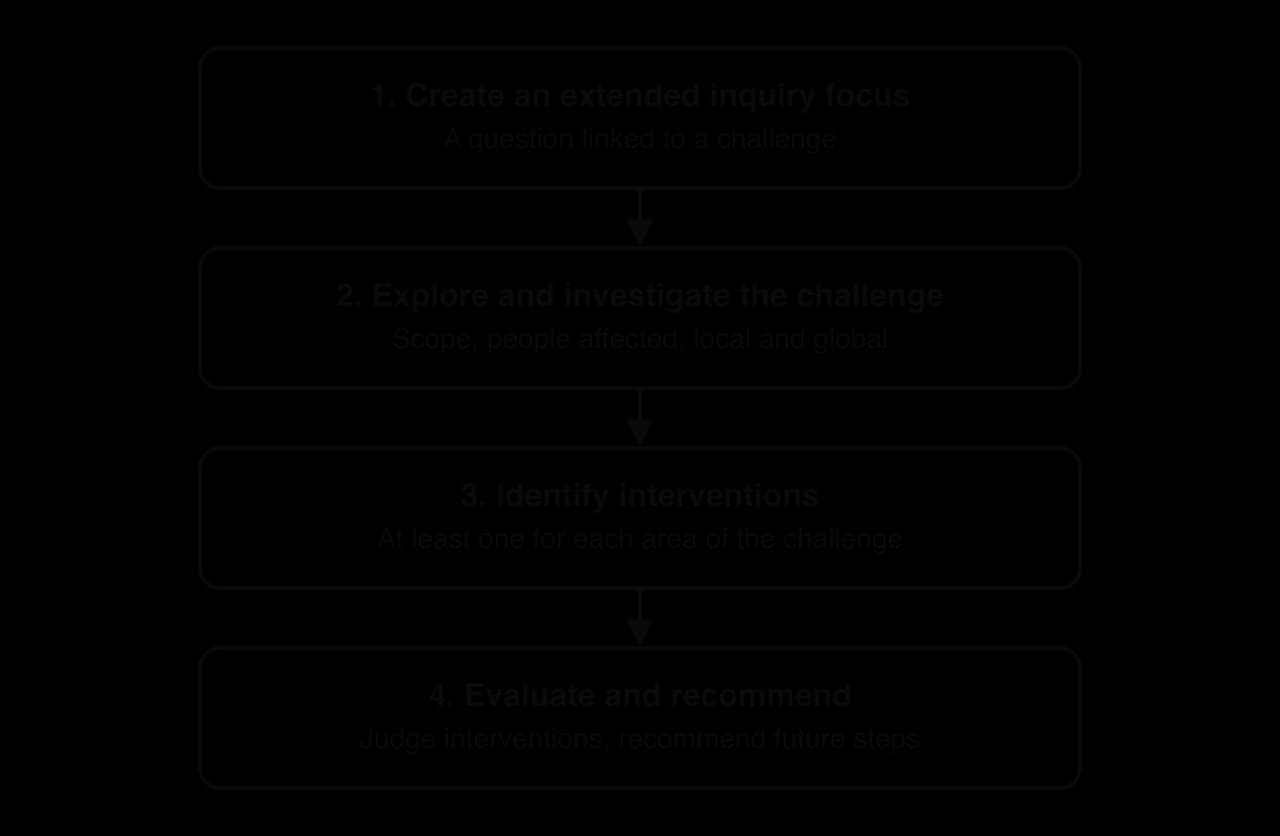
Create an extended inquiry focus. An inquiry question is linked to an area of one of the challenges.
Explore and investigate the challenge. The inquiry examines how digital systems relate to the challenge, how it appears at local and global levels, which people and communities are affected, and which concepts, content and contexts explain it best.
Identify interventions. At least one intervention is identified for each area of each challenge.
Evaluate interventions and recommend steps for future action. Each intervention is judged against the most relevant criteria, and practical improvements are proposed.
By the end of the course, HL students should be able to analyse and evaluate at least one intervention for each challenge, and to recommend steps for future action for an intervention they have never seen before. That final skill depends on the whole course: a recommendation is only convincing when it shows how the technology works, which people and communities it affects, and which concepts explain its impacts.
Carry on with 5 in Augment
With a free account, Augment remembers where you stopped and what you have practiced.