Analyse how digital systems shape social identity, social class, families, friendships and online relationships, and evaluate their impacts on people and communities, with online dating as an extended case study.
Each is in the Digital Society glossary, with every other term in the subject.
A person's position in relation to disability, including physical, sensory, intellectual, cognitive and mental health conditions, and how far the surrounding environment, including digital systems, enables or restricts their participation.
The recognition that all people share basic needs, rights, emotions and vulnerabilities, whatever their nationality, culture or other group membership.
Repeated, intentional hurtful behaviour carried out through digital systems, such as messaging, social media or games, usually among people who know each other, especially children and young people.
A person who has grown up surrounded by digital technologies such as the internet, mobile phones and social media; the term, popularised by Marc Prensky in 2001, is criticised because digital skills vary widely within the same generation.
The ways a person shows their gender to others, for example through clothing, hairstyle, voice, behaviour, name and pronouns, which may or may not match social expectations for their sex or gender identity.
Differences in values, behaviour and experience between people of different generations, which in a digital society often appear as differences in how, how much and why they use digital systems.
The tendency of people to form ties with others who are similar to them in characteristics such as age, class, ethnicity, beliefs or interests, a pattern that recommendation systems can strengthen online.
An attitude of openness to and curiosity about other cultures, languages and perspectives, combined with a sense of responsibility towards people beyond one's own community and country.
The painful feeling that one's social relationships are fewer or less satisfying than one wants, which can occur even when a person is surrounded by others; it differs from social isolation, an objective lack of contact.
The use of websites and apps to find, contact and assess possible romantic or sexual partners, usually through profiles, search filters and matching algorithms.
Hostile or threatening behaviour directed at a person through digital systems, including name-calling, threats, stalking, sexual harassment and publishing private information, which may come from strangers and need not be repeated.
A one-sided relationship in which a person feels they know and are close to a media figure, such as a streamer, influencer or celebrity, who does not know them personally.
The way a social group is shown in media and digital systems, including how often it appears, in which roles and with which characteristics, and whether its members have a say in how they are portrayed.
The practice of parents sharing information, photos and videos of their children on social media, often regularly and starting before the child can give consent.
The resources, such as information, support, trust and opportunities, that people can access through their relationships and networks.
A group of people who share a similar position in a society's ranking of economic resources, occupation, education, status and power, which shapes their life chances.
The part of a person's sense of self that comes from belonging to social groups, such as a nationality, generation, gender, ethnic group, religion or class, together with the value and feelings attached to that membership.
The movement of individuals or groups between positions in a society's class structure, either within a lifetime or between generations.
A family whose members live in different countries but keep a sense of shared belonging and responsibility, often through regular digital communication and money sent home.
A relationship with an acquaintance rather than a close friend or relative; because weak ties link people to different social circles, they often provide new information and opportunities such as jobs.
Define social identity, social class, social capital and social mobility, and outline how digital systems affect the ways people are grouped.
Explain how international-mindedness, age, gender, gender expression, sexuality, race, ethnicity, ability status and religious beliefs act as contexts in which digital systems have impacts.
Analyse how social class intersects with digital access and use, and with employment, education, health and housing.
Describe how digital systems change the ways families are understood, formed and kept in contact.
Explain the opportunities and risks of digital systems for friendship, companionship and personal relationships, including parasocial relationships and AI companions.
Distinguish between cyberbullying and online harassment, and analyse their impacts on different groups.
Evaluate the impacts of online dating on how couples meet, with reference to data from the How Couples Meet and Stay Together survey.
Apply a step-by-step method to analyse and evaluate an unseen real-world example in the social context.
The social context covers how people and communities are grouped and how they understand and form relationships with others. Digital systems now take part in both. Platforms sort users by age, location and inferred interests, and apps carry much of the everyday work of keeping families, friendships and couples together.
This context draws on several content areas. Data (3.1) records who people are and whom they know, algorithms (3.2) decide which people and posts appear in a feed, networks (3.4) connect relatives across continents, and artificial intelligence (3.6) now offers companionship as well as information. The concept of
With a free account, Augment remembers where you stopped and what you have practiced.
Sociology, the study of how societies are organised, starts from two questions. The first is how people are sorted into groups, such as age groups, classes, religions or ethnic communities. The second is how people form and keep relationships, from families and friendships to memberships of clubs and online communities. Group membership shapes relationships, and relationships in turn shape which groups a person belongs to. The part of the self that comes from such membership is a person's social identity.
In the 1970s the social psychologists Henri Tajfel and John Turner argued that people tend to favour their own group (the in-group) over others (out-groups). Digital systems make group membership more visible and measurable: profiles list a hometown and school, and advertisers target audiences by inferred age, gender and interests. Each of these turns a social category into a data field that a digital system can act on.
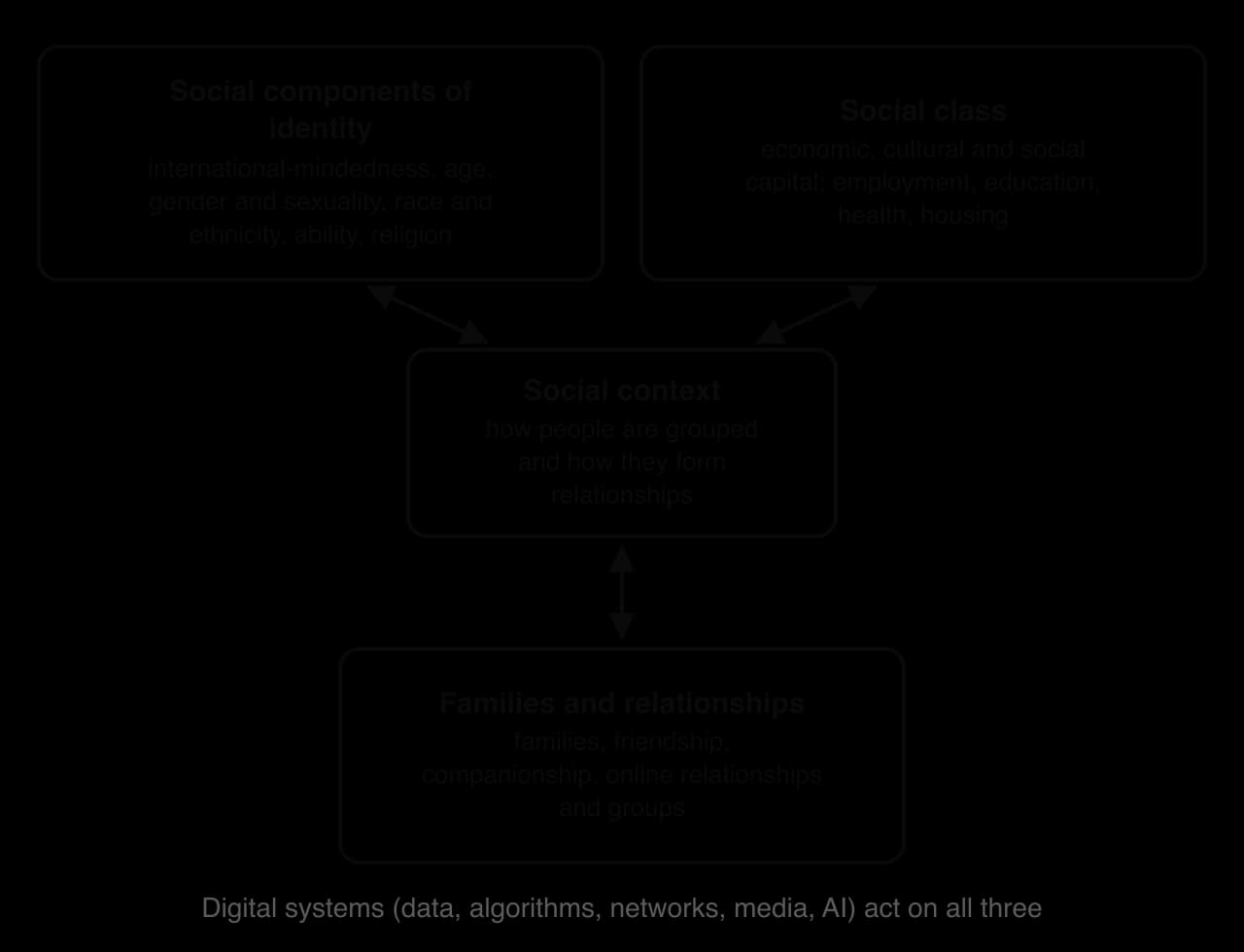
The social context has three connected areas, which the map shows. Social components of identity describe who people are as members of groups. Social class describes how groups are ranked by economic and social resources. Families and relationships describe how people connect with one another.
The areas also interact through intersectionality, the idea that different parts of identity combine to shape a person's experience. An older woman on a low income in a rural area meets digital systems differently from a young man in the same village, and differently again from an older woman in a wealthy city. Analysing a real-world example in this context therefore means asking which groups are involved and how their positions combine.
Identity as a concept is taught in 2.3. In the social context, each component of identity is treated as a setting in which digital systems have impacts: the same platform can widen opportunity for one group and expose another to harm.
Two linked ideas describe how people relate to those beyond their own groups: international-mindedness and common humanity.
International-mindedness rests on a second idea, that people everywhere share the same fundamental condition.
Digital systems create new opportunities for both. Machine translation lowers the language barrier: in June 2024 Google Translate added 110 languages in a single update, including Cantonese, Tok Pisin and Crimean Tatar, using its PaLM 2 language model. Video calls let classes in different countries meet regularly, and storytelling projects such as Humans of New York, which began in 2010 as a photographer's portraits and short interviews with strangers, have shared the stories of people in many countries with followers across the world.
After earthquakes and floods, crowdfunding pages and social media posts let people send help to strangers within hours. Through the concept of space, digital systems shrink the distance between people who would otherwise never meet.
The same systems can also narrow people's outlook. Recommendation algorithms tend to show users more of what they already engage with, which can produce a filter bubble of content from their own country, language and viewpoint. Online spaces also carry nationalist hostility, and hate speech targeting migrants or other nations spreads through the same networks that carry appeals for help. Contact with other cultures does not by itself create international-mindedness; it depends on how people use that contact.
Demographic components are the measurable characteristics used to describe a population, such as age, sex, household size, place of residence and generation. Age is the clearest example of a demographic component that shapes digital life, because people of different ages grew up with very different technologies.
The idea of a digital native draws attention to real differences between generations. In 2024, 79% of people aged 15–24 worldwide used the internet, compared with 66% of the rest of the population, and the gap is widest in low-income countries, where young people were 1.9 times as likely to be online as older people.

Young people's online lives change quickly, and data show how. In Pew Research Center's 2024 survey of US teenagers aged 13–17, 90% used YouTube and about six in ten used TikTok and Instagram, while Facebook use had fallen from 71% in 2014–15 to 32%. Nearly half of teenagers said they were online "almost constantly", up from 24% a decade earlier. Black and Hispanic teenagers were more likely than White teenagers to be online almost constantly, which shows that age and ethnicity combine.
A generation gap runs in both directions. Many older adults have adopted smartphones: in 2025, 78% of Americans aged 65 and over owned one, compared with 97% of those aged 18–29. The remaining gap matters because services increasingly assume a smartphone. During the COVID-19 pandemic, China required QR "health codes" to enter shops, stations and transport, which left some older people without smartphones unable to travel. In 2021 China's Ministry of Industry and Information Technology began a campaign requiring popular apps and websites to offer age-friendly versions with larger text and simpler layouts.
Viewed through the concept of change, adoption among older adults is uneven rather than simply slow. Many grandparents adopted video calls quickly once the purpose mattered to them, and much of the remaining difficulty lies in design that assumes young, able and confident users.
Gender refers to the roles, behaviours and identities that a society associates with being a woman, a man or another gender. Sexuality refers to a person's sexual orientation (whom they are attracted to) and how they experience it. These are distinct from each other and from gender expression.
Access. The gender gap in internet use is narrowing but persists. In 2024, 70% of men and 65% of women worldwide used the internet, which means 189 million more men than women were online. In the Least Developed Countries the gap is much wider: the ITU's gender parity score there fell from 0.74 in 2019 to 0.70 in 2024. Barriers include the cost of devices, lower literacy, and social norms in some communities that discourage women and girls from owning phones.
Representation. The way digital media portray groups shapes how those groups see themselves and are seen by others.
Video games show the issue of representation clearly. Women made up 46% of US video game players in 2024, yet content analyses of game characters have long found that most playable characters are male and that female characters are often designed as sexualised supporting figures. In 2014 the Gamergate controversy, a long online campaign of harassment against women game developers and critics, showed how disputes about representation can turn into coordinated abuse. Studios have since added more varied protagonists and character creators with wider options for body type, voice and pronouns.
Sexuality. For many lesbian, gay, bisexual, transgender and queer (LGBTQ+) people, online spaces were among the first places where they could find others like themselves, especially in families or countries where being open is unsafe. The same visibility brings risk. In 2014 reports showed that police in Egypt had used the location features of the gay dating app Grindr to find and arrest men, and Grindr responded by hiding users' distances by default in Egypt and other countries with a record of anti-gay persecution, such as Russia and Saudi Arabia. In 2021 Norway's data protection authority fined Grindr for sharing users' data with advertisers without valid consent, reasoning that even the fact of using the app discloses a person's sexual orientation.
Moderation can also affect visibility. In 2019 the German site Netzpolitik reported that TikTok had instructed moderators to limit the reach of videos by users who appeared to be LGBTQ+, disabled or overweight. TikTok said the rule was an early attempt to protect such users from bullying and had since been replaced, but the approach limited the visibility of the very people it claimed to protect.
The Pew Research Center's 2021 survey of online harassment shows a gendered pattern. Men were slightly more likely than women to experience harassment overall, but women were three times as likely to experience sexual harassment online, and 47% of women who had been harassed believed it was because of their gender, compared with 18% of men.
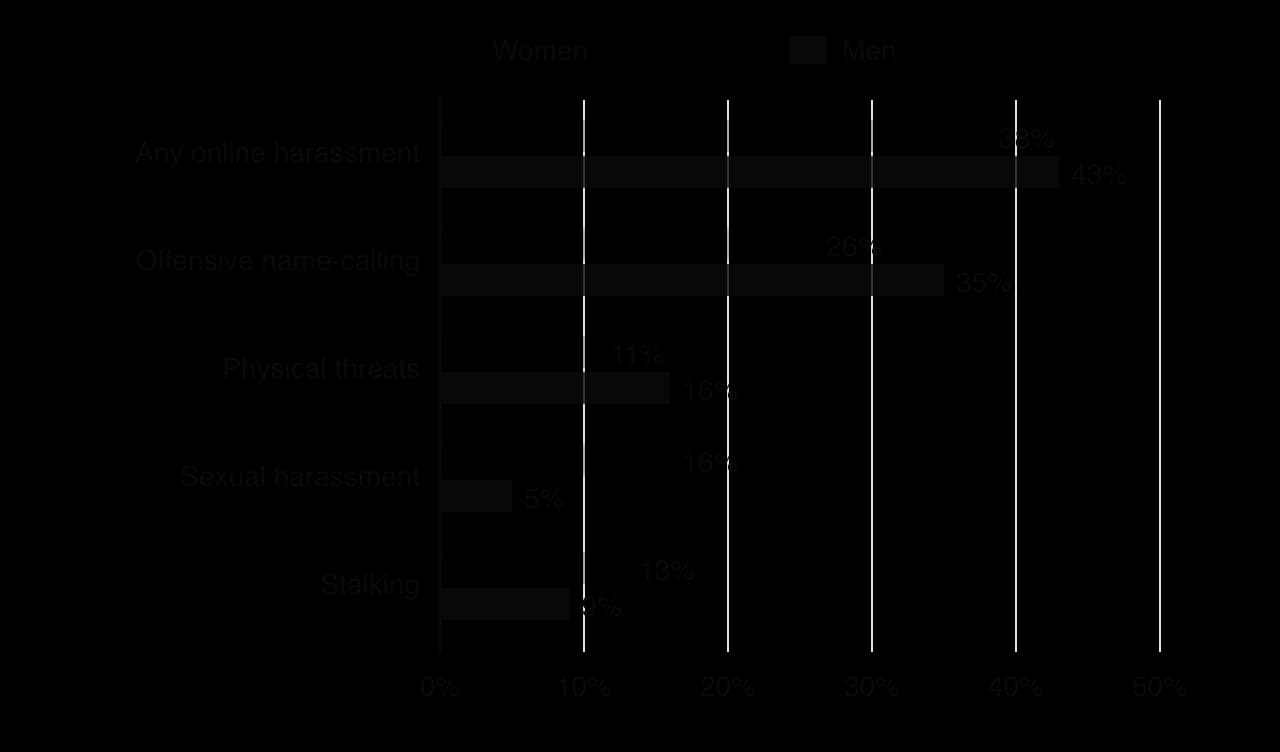
LGBTQ+ adults faced the highest rates: in the same survey about seven in ten lesbian, gay or bisexual adults had experienced online harassment, compared with about four in ten straight adults, and 51% had experienced more severe forms such as stalking or threats.
Race is a way of grouping people by perceived physical features such as skin colour, a category that social scientists regard as socially constructed rather than biologically fixed. Ethnicity refers to shared culture, language, ancestry or history. Both shape how people are treated on and by digital systems.
Platforms that show photos and names can carry offline discrimination into new markets. A 2017 field experiment by Benjamin Edelman, Michael Luca and Dan Svirsky sent identical booking requests to Airbnb hosts from fictional guests whose names were typical of either African American or white Americans. Requests from guests with distinctively African American names were about 16% less likely to be accepted. After the hashtag #AirbnbWhileBlack spread stories of rejected guests, Airbnb introduced a non-discrimination policy and changed its design so that hosts see a guest's photo only after accepting a booking.
Representation can also be built into everyday tools. Until 2015, emoji showing people had a single default skin tone; that year the Unicode Consortium, which sets the standard, added five skin-tone modifiers, and phone makers added them to their keyboards. The change shows that small design decisions affect whether users see themselves in a digital system.
Racist abuse online can target individuals at a huge scale. After England lost the final of the Euro 2020 football tournament in July 2021, the three Black players who missed penalties, Marcus Rashford, Jadon Sancho and Bukayo Saka, received large volumes of racist abuse on social media. The UK government then extended football banning orders, through the Police, Crime, Sentencing and Courts Act 2022, so that people convicted of football-related online racist abuse can be banned from matches. Through the concept of power, the case raised the question of whether platforms, governments or football bodies are responsible for protecting players, and how far platforms should verify who is posting.
Accessibility design and assistive technology are covered in the health context (4.4), which explains the social model of disability. In the social context the focus is on ability status as a basis for relationships, community and treatment by others.
Digital systems have opened new forms of social life for many disabled people. Video calling allows Deaf people to hold conversations in sign language at a distance, something text messaging and voice calls could not support; in 2020 Apple announced that Group FaceTime would detect when a participant is signing and make that person prominent on screen. People with chronic illnesses or limited mobility use online communities to find others with the same condition, to share practical advice and to campaign, for example through disability-led hashtags and forums. For people who find face-to-face interaction tiring or difficult, such as some autistic people, text-based communication can make friendship easier.
Barriers remain. Content without captions or image descriptions shuts out Deaf and blind users from conversations, and abuse targeting disabled people is common on social media. The TikTok moderation rule reported in 2019 shows a further risk: when a platform treats disabled users as a problem to be managed, it can reduce their visibility instead of tackling the bullying they face.
Religious beliefs are the ideas about the sacred, the divine and the meaning of life that a community holds; religious practices are what believers do, such as prayer, worship, fasting, pilgrimage and study. Digital systems now support many of these practices.
Practice | Digital system | Example |
|---|---|---|
Prayer and ritual timing | Location-aware apps | Muslim prayer-time and qibla (direction of Mecca) apps such as Muslim Pro |
Study of texts | Reading apps and online libraries | Bible, Qur'an and Torah apps with translations and audio |
Worship | Live streaming | Churches, mosques, synagogues and temples streaming services during COVID-19 lockdowns |
Community | Messaging groups and social media | Congregation WhatsApp groups; online study circles |
Darshan and offerings | Temple websites and apps | Hindu temples in India streaming live darshan (viewing of the deity) and accepting online donations |
These systems give believers flexibility and keep housebound members in contact with their community. They also raise questions of religious authority, such as whether watching a service online counts as attending it, and of data protection. Religious belief is a special category of personal data under the EU's General Data Protection Regulation because its misuse can lead to discrimination or persecution. In November 2020 the technology outlet Motherboard reported that location data from Muslim Pro had been sold, through the data broker X-Mode, to buyers that included contractors working for the US military. Muslim Pro said it stopped sharing data with X-Mode, but the case showed how a religious app's data can expose far more than its users intend.
Sociologists explain social class in different ways. Karl Marx defined class by a group's relationship to production: owners of capital versus workers who sell their labour. Max Weber added status and political power, so that class depends on market position as well as ownership. Pierre Bourdieu argued that class rests on three forms of "capital", not only money.
Form of capital (Bourdieu) | Meaning | Digital example |
|---|---|---|
Economic capital | Income, wealth and property | Owning a laptop and paying for fast home broadband |
Cultural capital | Knowledge, skills, tastes and qualifications valued by society | Knowing how to research online, write a professional email or present oneself on LinkedIn |
Social capital | Networks of contacts and the resources they give access to | Online connections who share job openings or give advice |
The Great British Class Survey shows both how class is studied with digital tools and the limits of doing so. Run online by the BBC's Lab UK website from January to July 2011, it measured all three forms of capital and identified seven classes, from an "elite" to a "precariat" with little capital of any kind. However, its respondents chose themselves, and most were well-educated members of the BBC's audience, so the researchers had to run a separate, representative face-to-face survey to check the results.
The political scientist Robert Putnam distinguished bonding social capital, the close ties within a group of similar people, from bridging social capital, the links between different groups. Earlier, Mark Granovetter had shown in 1973 that people often hear about jobs through acquaintances rather than close friends, because acquaintances move in different circles. Social media makes it cheap to keep many such weak ties.
A large study published in Nature in 2022, led by the economist Raj Chetty, connected social capital and social mobility using digital data. The researchers analysed 21 billion Facebook friendships among 72.2 million US users aged 25–44. They measured "economic connectedness", the share of friends with high socioeconomic status that people with low socioeconomic status have. It was one of the strongest predictors of upward mobility found so far: if children from low-income families grew up in counties where economic connectedness was as high as for the average high-income child, their adult incomes would be about 20% higher on average.
The study shows how platform data can answer social questions that surveys cannot. Through the concept of values and ethics, it also raises questions, since the data came from a private company and users were not asked directly; the researchers published only aggregated statistics by area to protect privacy.
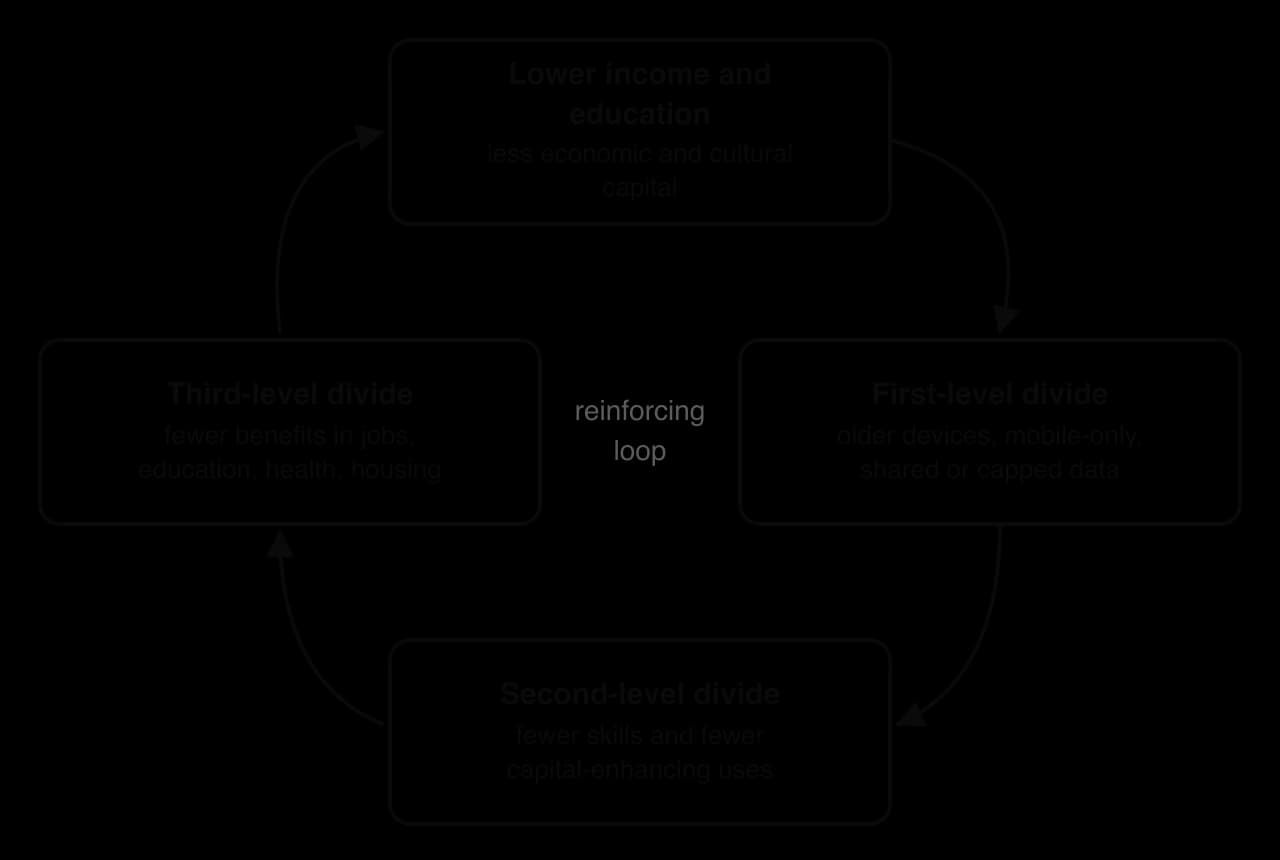
The digital divide is often first understood as a gap in access, but researchers describe three levels. The first-level divide is access to devices and connections. The second-level divide is in skills and uses. The third-level divide is in the outcomes people gain from going online, such as a better job, a cheaper loan or good health advice.
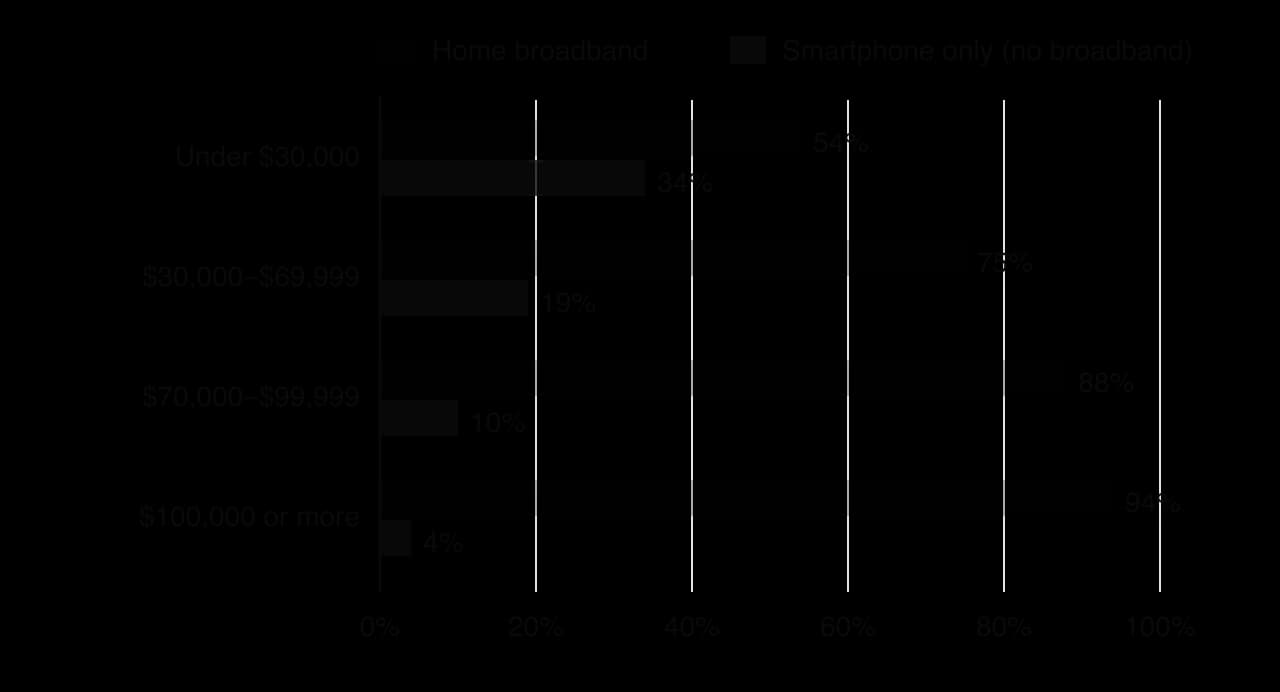
Class shapes each level. In the United States in 2025, 94% of adults in households earning US$100,000 or more had home broadband, compared with 54% of those earning under US$30,000, and a third of the lowest-income group relied on a smartphone alone.
At the second level, research in the Netherlands by Alexander van Deursen and Jan van Dijk (2014) found that people with less education spent more hours online than those with more education, but more of that time went on gaming and social interaction and less on "capital-enhancing" activities such as job searching, learning and managing finances, so equal access did not produce equal benefits.
The three levels can form a loop that reinforces class inequality, as the cycle diagram shows. A family with less income has poorer access, which limits the skills its members build, which limits what they gain online, which keeps income low.
 YouTube
Most job vacancies are now advertised and applied for online, and many large employers screen applications automatically before a human sees them. People with strong digital skills and professional networks benefit: a well-built LinkedIn profile and online connections in an industry give access to opportunities that are never advertised widely. People without those resources face more barriers. Automated screening can also reproduce class differences if it rewards features linked to class, such as unpaid internships, particular universities or gaps in employment history. The rise of platform-based gig work, covered in the economic context (4.2), adds a new class position: workers who are managed by an app and have neither employee rights nor much bargaining power.
Class affects how families use digital systems for learning. Families with more economic capital can buy devices, fast connections, paid tutoring and subscriptions to learning platforms; families with more cultural capital can guide children in using them well. During the COVID-19 school closures, these differences decided who could keep learning, as the human knowledge context (4.5) shows. Free resources such as Khan Academy reduce the cost barrier, but research on online courses has found that the people who benefit most are often those who are already well educated.
Digital health services can widen access, but class shapes who uses them. In 2017 the London-based service GP at Hand, run by the company Babylon Health within the National Health Service, began offering video consultations to anyone who registered. It attracted mainly young, healthy patients and was criticised for discouraging registration by people with complex needs, which raised the concern that digital-first services might take the easier and cheaper patients while leaving others to traditional practices. People on low incomes are also more likely to have long-term illnesses and less likely to have the broadband and skills that telehealth assumes, so a shift to digital care can widen health inequality unless other routes remain.
Digital systems now help to find, price and allocate homes through online listings, automated tenant-screening scores and rent-pricing software. In August 2024 the US Department of Justice and eight states sued RealPage, whose software used landlords' private data to recommend rents, alleging that it helped landlords avoid competing and kept rents high; San Francisco and several other cities have banned such software. Tenant-screening algorithms that rely on credit history can also disadvantage applicants who receive housing vouchers or who have little credit history, groups that are mostly on low incomes.
Area of life | How class shapes digital impacts | Real-world example |
|---|---|---|
Employment | Online networks and skills decide who hears of and passes screening for jobs | LinkedIn and automated applicant screening; gig work on platforms |
Education | Devices, connections and parental guidance differ by income and education | Learning during COVID-19 school closures; free platforms used most by the already educated |
Health and illness | Digital-first services suit people with good access and few complex needs | GP at Hand in London |
Housing | Algorithms set rents and screen tenants using data that reflects existing inequality | RealPage rent-setting software; credit-based tenant scores |
A family is a group of people linked by birth, marriage, adoption, partnership or chosen commitment who support each other. Families vary across cultures, from nuclear households to extended families spanning several generations and countries. Digital systems affect how families are understood (what counts as a family and who belongs), how they are formed and how they stay connected.
Migration separates many families, and digital systems now carry much of their contact. The anthropologists Mirca Madianou and Daniel Miller studied Filipino mothers working abroad, often in the United Kingdom, and their children in the Philippines. In Migration and New Media (2012) they described "polymedia", the way families choose among calls, texts, video chat and social media to express different kinds of care: a video call to supervise homework, a quick message to show affection, a social media post to share a celebration. Constant contact helped mothers parent from a distance, but some children experienced it as surveillance, and it could not replace physical presence.
The transnational family relies on more than communication. Mobile money services let migrants send remittances cheaply, and family members coordinate childcare, health decisions and celebrations through group chats.
Consumer DNA testing has changed how some people understand their family. Services such as 23andMe and AncestryDNA compare customers' genetic data and suggest relatives, which has helped adopted people and donor-conceived people find biological relatives, sometimes revealing family secrets that relatives had kept for decades. The data is also highly sensitive. In 2023 hackers obtained information on about 6.9 million 23andMe users through its "DNA Relatives" feature, and in March 2025 the company filed for bankruptcy, which led many customers to ask what would happen to their genetic data. One person's test also exposes information about relatives who never agreed to be tested.
Parents now make decisions about their children's digital presence from birth.
Sharenting can help families share milestones with distant relatives and give parents support. It also creates a digital footprint that the child did not choose. In 2018 the bank Barclays predicted that by 2030 sharenting could lead to about £670 million a year in online fraud against young people, because posts include names, birthdays, schools and pets' names that are used in security questions. In February 2024 France passed a law making the protection of children's privacy, including their image, part of parents' legal duties, so that a court can restrict a parent's posting where it harms the child.
Many families also use location-sharing apps and parental controls. Supporters see them as tools for safety; critics argue that constant tracking can reduce trust between parents and teenagers and limit young people's development of independence. Through the concept of values and ethics, the debate weighs a child's safety against their privacy and growing autonomy.
For most young people, friendship now continues across offline and online spaces: friends meet at school, then keep talking in group chats, play games together and share posts. The anthropologist Robin Dunbar argued that people can maintain about 150 meaningful relationships, a limit based on time and attention. Social media does not appear to raise the number of close friends, but it makes it much easier to keep in touch with weak ties, old classmates and friends who have moved away.
Research on whether online interaction helps or harms friendship is mixed. Many young people say social media helps them feel connected to friends' lives, while others describe pressure to respond at once, fear of missing out and conflicts that spread quickly in group chats. Through the concept of identity, online friendships also involve self-presentation: what people post is chosen with an audience in mind.
Loneliness is different from social isolation, which is an objective lack of contact. In June 2025 the WHO Commission on Social Connection reported that about one in six people worldwide is affected by loneliness, linked to an estimated 871,000 deaths a year. Rates were highest among adolescents and young adults, 17–21% of people aged 13–29, and in low-income countries, where about 24% reported loneliness, roughly twice the rate in high-income countries. The report listed digital technologies among the factors that can increase loneliness when online interaction replaces rather than supports face-to-face contact. Governments have responded: the United Kingdom appointed a minister for loneliness in 2018 and Japan did the same in 2021.
AI companions are a newer response. Replika, launched in 2017, lets users chat with a personalised AI character as a friend or partner, and by 2024 its founder reported more than 30 million users. Users describe comfort and practice in expressing feelings. Critics point to emotional dependence on a product that a company can change at any moment. In February 2023 Italy's data protection authority banned Replika from processing Italian users' data, citing risks to emotionally vulnerable people and minors; when the company then removed the chatbot's erotic role-play, many users described a sense of loss similar to the end of a relationship.
The term was introduced by the sociologists Donald Horton and Richard Wohl in 1956 to describe how television audiences felt about presenters. Digital media intensify the effect. Streamers on platforms such as Twitch talk directly to the camera for hours, read viewers' names aloud and respond to chat messages, so viewers can feel part of a friendship group. Paid subscriptions and donations, which unlock emotes or a mention on stream, turn that feeling into income.
People now belong to many online groups: a class group chat, a gaming clan on Discord, a neighbourhood group on Facebook, a fan forum, a support group for a rare illness. These online communities offer belonging, information and support that may be missing locally. A teenager in a small town can find others who share an unusual interest, and patients with a rare disease can compare treatments with people across the world.
Groups also shape what members see and believe. People tend to connect with others similar to themselves.
Homophily is an offline pattern, but recommendation systems can strengthen it by suggesting groups and friends that resemble a user's existing ones. The result can be an echo chamber, in which members mostly hear views that confirm their own. Group chats such as WhatsApp groups are also private and encrypted, so false rumours can spread within them without public correction.
Cyberbullying differs from offline bullying in important ways: it can follow the target home and continue at any hour, it can reach a large audience quickly, and screenshots make it hard to erase. In a 2019 U-Report poll by UNICEF of young people in 30 countries, one in three said they had been a victim of online bullying, and one in five said they had skipped school because of cyberbullying and violence.
The difference matters for analysis. Cyberbullying usually describes relationships among young people who know each other, often linked to school. Online harassment is the broader term, including attacks on adults by strangers, such as the abuse of footballers after Euro 2020. Both draw on social components of identity: in the Pew survey, half of US adults who had been harassed said it was because of their political views, a third because of their gender and 29% because of their race or ethnicity.
Responses include reporting tools, blocking, filters that hide abusive words, school policies and laws. The United Kingdom's Online Safety Act 2023 places duties on platforms to protect users, especially children, from illegal and harmful content. Each response involves trade-offs between protection, freedom of expression and privacy.
Online dating is one of the clearest examples of a digital system changing how people form the most personal of relationships.
Dating websites appeared with the graphical web in the 1990s: Match.com launched in 1995 and eHarmony, with its long compatibility questionnaire, in 2000. In India, matrimonial sites such as Shaadi.com, founded in 1997, adapted the tradition of arranged introductions, letting families search for partners by religion, language, community and education. The smartphone brought a second wave. Grindr (2009) used location to show nearby men, Tinder (2012) introduced the swipe, Bumble (2014) required women to send the first message in heterosexual matches, and Hinge relaunched in 2016 with profiles built around prompts. In China, apps such as Tantan and Momo became popular. Many of the best-known brands, including Tinder, Hinge, Match.com and OkCupid, belong to one company, Match Group.
The most detailed evidence comes from the How Couples Meet and Stay Together (HCMST) survey, run by the Stanford sociologist Michael Rosenfeld. It asks a nationally representative sample of American adults, in their own words, how they met their partner, and researchers code each answer into categories. Because one answer can fit several categories (a couple who met online and then had a first date in a bar counts in both), the shares do not add up to 100%.
Using the 2009 and 2017 surveys, Rosenfeld, Reuben Thomas and Sonia Hausen showed that the share of heterosexual couples who met online rose from 2% of those who met in 1995 to about 22% in 2009 and 39% in 2017. Over the same period, meeting through friends, the most common route since the Second World War, fell from 33% to 20%. Around 2013 meeting online overtook meeting through friends as the most common way heterosexual couples in the United States met. Same-sex couples adopted online meeting earlier: about 65% of same-sex couples who met in 2017 met online.
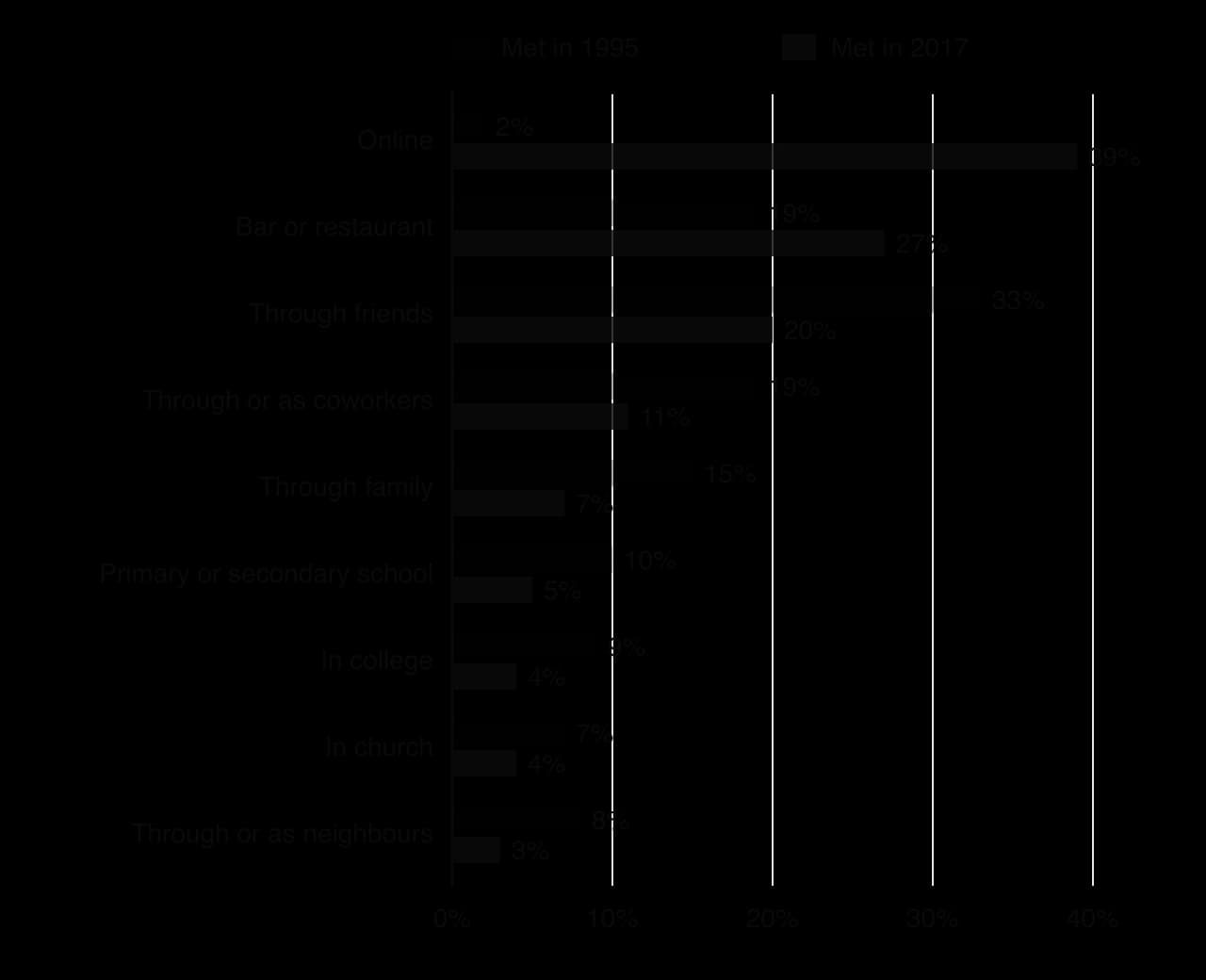
The researchers drew three further conclusions:
Disintermediation. Online dating has replaced friends and family as go-betweens. Among couples who met online, the share introduced by a third person fell from 11.2% in the 2009 survey to 3.7% in 2017, and 89.5% had been complete strangers.
The smartphone effect. Meeting through phone apps accounted for at least half of the growth in meeting online between 2010 and 2017.
No difference in quality. Earlier follow-ups found that how a couple met did not affect relationship quality or the chance of breaking up; couples who met online moved to marriage somewhat faster.
Survey data from the Pew Research Center add a wider picture of use. Its 2022 survey of 6,034 US adults found:
Measure | Share of US adults |
|---|---|
Have ever used a dating site or app | 30% |
Adults under 30 who have ever used one | 53% |
Lesbian, gay or bisexual adults who have ever used one | 51% |
Partnered adults who met their partner online | 10% |
Partnered adults under 30 who met their partner online | 20% |
Women under 50 who used dating apps and received unwanted sexually explicit messages or images | 56% |
Source: Pew Research Center, Key findings about online dating in the U.S., 2023 (survey conducted July 2022).
A dating app is a sociotechnical system that combines user data, algorithms and a business model, as the flow diagram shows.
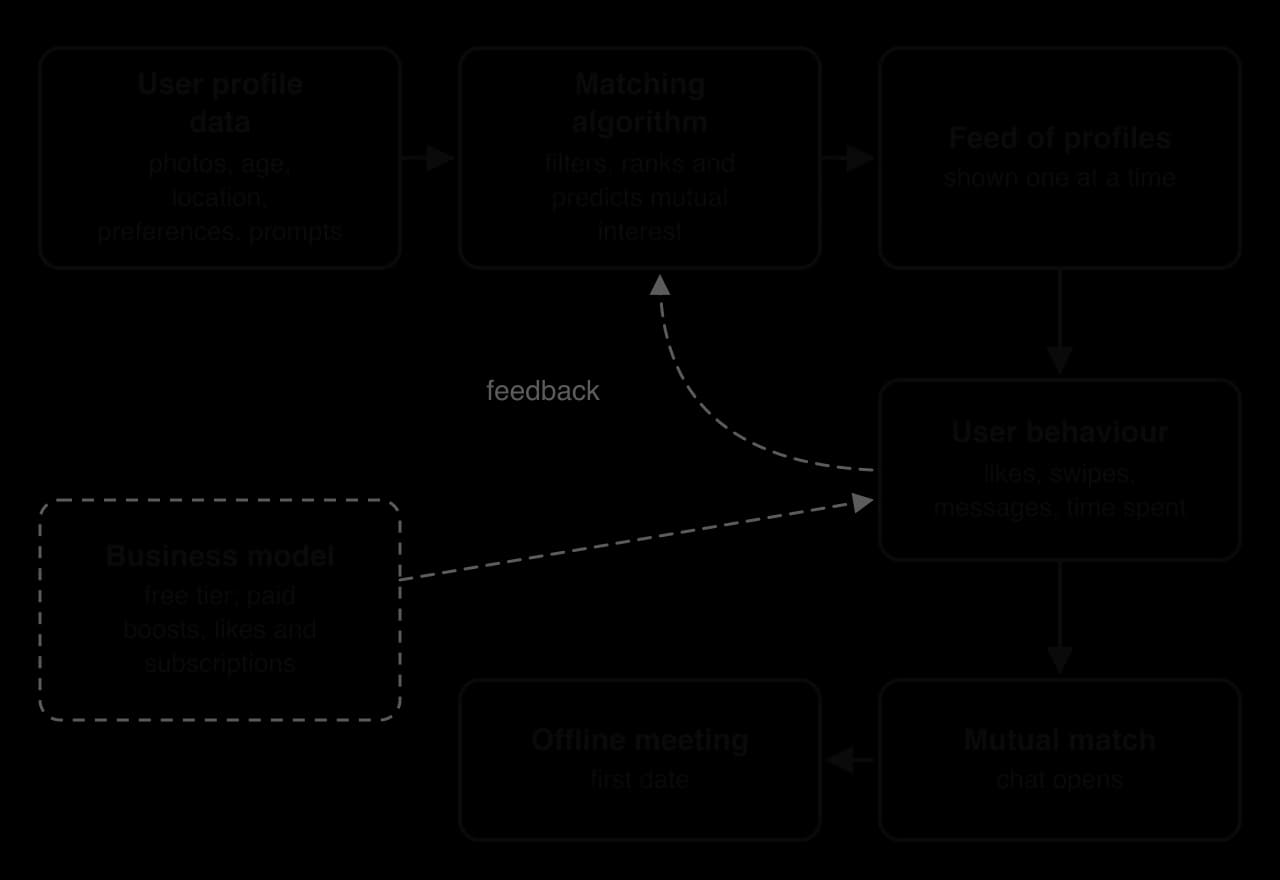
Profile data. Users supply photos, age, gender, location, what they are looking for and short written answers. Some apps also collect religion, height, education or political views.
Filtering. The app removes profiles outside the user's stated preferences, such as age range and distance.
Ranking. A matching algorithm orders the remaining profiles. In 2016 Tinder confirmed that it gave users a hidden desirability score based on who swiped right on them, and in 2019 it said it no longer relied on that score. Hinge has described its "Most Compatible" feature as based on the Gale–Shapley algorithm, which pairs people so that no two would both prefer each other over their assigned matches. Most apps also use collaborative filtering: users who liked similar profiles are assumed to have similar tastes.
Feedback. Each swipe, like and message becomes data that adjusts future rankings, forming a feedback loop.
Business model. Most apps are free to join and earn money from subscriptions and paid features, such as seeing who has liked you or "boosting" a profile to more users.
 YouTube
People and communities | Positive impacts | Negative impacts |
|---|---|---|
LGBTQ+ people | Safer, easier way to find partners where few people are openly LGBTQ+; 65% of same-sex couples meeting in 2017 met online | Risk of outing, data sharing (Grindr) and entrapment by police in some countries |
People in "thin" dating markets (rural, older, divorced, minority religions) | Access to far more potential partners than local life offers | Distance; small pools still limit choice |
Women | Control over first contact on some apps; ability to screen matches before meeting | High rates of unwanted explicit messages and continued contact after refusal (Pew) |
Racial and ethnic minorities | Ability to find partners with a shared culture or language | Users' racial preferences can exclude groups; OkCupid's own published data (2014) showed users' ratings were biased against Black women and Asian men |
Friends and families | Less pressure on social circles to act as matchmakers | Loss of the screening role that friends and family once played |
Victims of fraud | None | Romance scammers build fake relationships to request money; romance scams are among the costliest frauds reported to the US Federal Trade Commission |
Change. Online dating is a discontinuity in a pattern that had lasted for generations, in which partners were found through family, school, church, neighbours and friends. The HCMST data show the speed of the shift: the main route to partnership changed within about two decades. Some continuity remains, since couples still meet in person before forming a relationship, and many people use apps to meet others in their own city and social group.
Power. The app designer decides which profiles appear, in what order and what users must pay to be more visible. Because Match Group owns many of the leading brands, a single company's design choices and pricing shape the dating options of tens of millions of people. Users have power through their choices but cannot see how the ranking works, which is an example of algorithmic transparency being limited.
Identity. Dating profiles are a form of self-presentation in which people choose photos and words to signal who they are. Apps also turn identity into filters: age, height, religion and, on some apps, ethnicity become search criteria. This can help people find partners who share important values, but it can also reduce people to a set of categories and amplify bias.
Values and ethics. Questions arise about consent and data (dating apps hold sexual orientation, location and private messages), safety (who is responsible when a match turns violent) and fairness (whether ranking by desirability or by willingness to pay treats users with respect). The design goal also matters: an app earns more when users stay longer, while users usually want to find a partner and leave.
The evidence suggests that online dating has made it easier for many people to find partners, especially those whose local options were limited, such as LGBTQ+ people, people in rural areas and people returning to dating later in life. The HCMST follow-ups found no sign that relationships formed online are weaker, which counters the claim that apps produce shallow or short-lived partnerships.
The impacts are uneven, however. Women report high levels of harassment, minorities can face exclusion through users' preferences that algorithms may reinforce, and LGBTQ+ users face serious risks where their sexuality is criminalised or their data is shared. The decline of friends and family as go-betweens removes a source of informal screening, which helps explain the growth of romance scams.
A balanced judgement is that online dating has widened the pool of possible partners and given individuals more control over finding one, at the cost of greater exposure to strangers and greater dependence on a few companies whose income depends on keeping users engaged. Whether the balance improves depends on governance: strong protection of sensitive data, effective tools against harassment and fraud, and more transparency about how matches are ranked.
Real-world examples in the social context are often new to the reader. The same five steps apply to any of them, as the steps diagram shows.
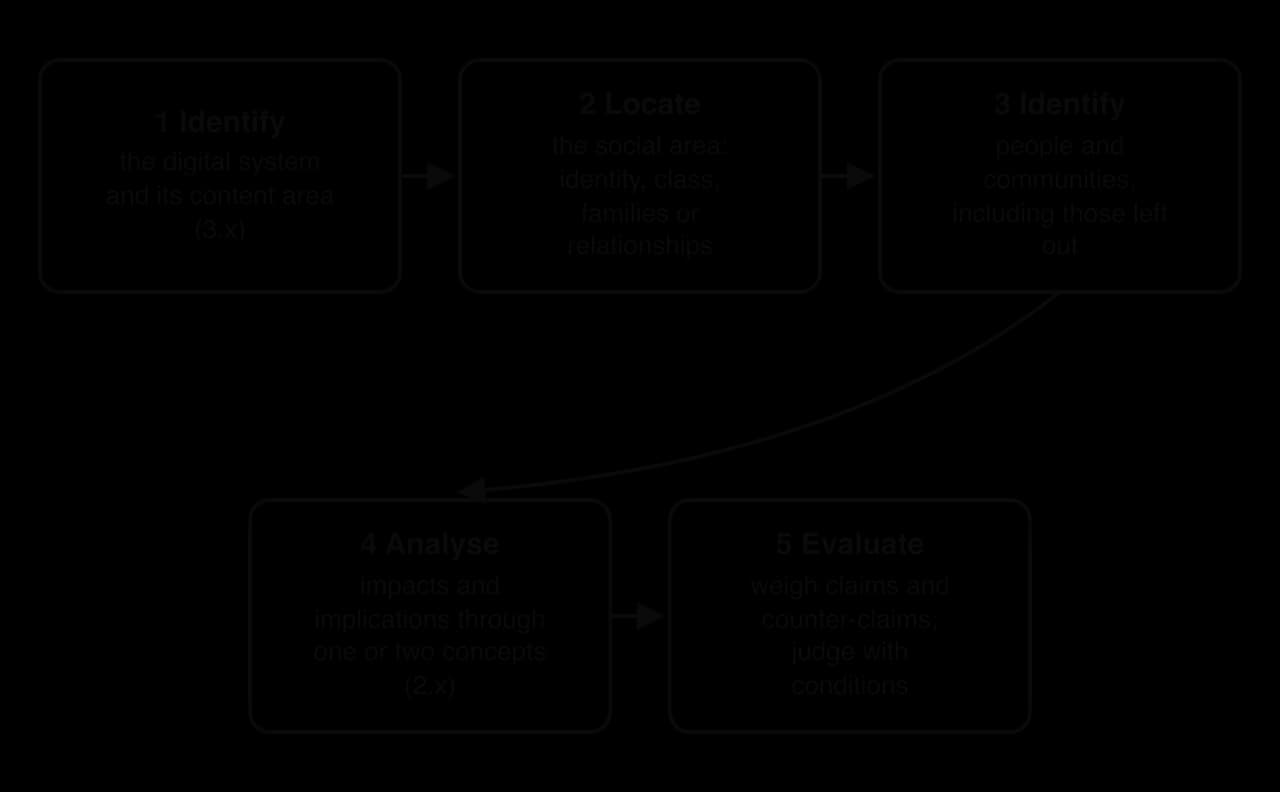
Steps 1 and 2 place the example in the content (3.x) and in one or more of the three social areas. Step 3 identifies people and communities, including those who are excluded or harmed. Step 4 applies one or two concepts (2.x) to explain impacts and implications. Step 5 weighs claims and counter-claims to reach a judgement with conditions.
Paper 2 questions ask how sources differ in what they suggest and why.
I can define social identity and explain how digital systems turn social categories into data that platforms act on.
I can distinguish between international-mindedness and common humanity, and explain how digital systems can both support and narrow them.
I can use data to explain differences in digital access and use by age, and critique the idea of the digital native.
I can distinguish gender identity, gender expression and sexual orientation, and give real-world examples of digital impacts on each.
I can explain how digital systems can reproduce or reduce discrimination by race and ethnicity, with an example such as Airbnb.
I can explain how ability status shapes people's social lives online, with examples of opportunities and barriers.
I can describe how digital systems support religious practices and explain the risks to religious data.
I can define social class, social capital and social mobility, and outline Bourdieu's three forms of capital.
I can explain the three levels of the digital divide and how they can reinforce class inequality.
I can analyse how social class intersects with digital systems in employment, education, health and illness, and housing.
I can describe how digital systems connect transnational families, change how families are understood and raise questions about sharenting.
I can explain the opportunities and risks of online friendship, AI companions and parasocial relationships, and define loneliness.
I can distinguish cyberbullying from online harassment and use data on who is targeted.
I can evaluate the impacts of online dating on how couples meet, using HCMST and Pew data and at least two concepts.
I can apply the five steps to analyse an unseen real-world example in the social context.