Define power, explain how it is exercised through digital systems and built into institutions, and evaluate whether digital technologies concentrate power in platforms or spread it to users and activists.
Each is in the Digital Society glossary, with every other term in the subject.
The capacity of individuals or groups to act independently and make their own choices, even within structures that limit what they can do.
Laws that protect competition in markets by banning cartels, blocking harmful mergers and stopping dominant companies from abusing their position. In the EU it is usually called competition law.
The small group of very large technology companies, usually Alphabet (Google), Amazon, Apple, Meta and Microsoft, that dominate many digital markets and hold great economic and political influence.
A European Union law, applied from 2023, that names the largest platforms as gatekeepers and sets them rules in advance, such as bans on self-preferencing, with fines of up to 10% of worldwide turnover.
The ability of a state or region to control the digital systems, data and infrastructure used within its territory, and to make and enforce its own rules for them.
A process through which people or groups gain more control over their own lives and more ability to influence decisions that affect them, for example by gaining access to information, tools or networks.
An organisation that controls an important point of access between businesses and users, such as a search engine or app store. Under the EU Digital Markets Act it is also a legal status given to very large platforms, which must follow extra rules.
The ability of a state or organisation to get what it wants through force or payment, such as military action, sanctions or economic pressure.
A market in which one company is the only supplier, or so dominant that it faces little effective competition and can set prices or terms for others.
The influence a digital platform gains by sitting between large groups of users, such as buyers and sellers or users and advertisers, and controlling the rules, data and algorithms that govern how they connect.
The capacity of a person or group to influence or control the actions, choices or beliefs of others, whether by force, rules, rewards, persuasion or by shaping the options available to them.
The practice of a platform giving its own products or services better treatment than those of rival businesses that depend on it, for example by ranking them higher or displaying them more prominently.
The ability of a state or organisation to get what it wants through attraction and persuasion, such as its culture, values and reputation, rather than through force or payment.
Power that is built into the rules, institutions, organisations and systems within which people act, so that it shapes their choices without any single person having to give an order.
Shoshana Zuboff's term for an economic system in which companies collect data about people's behaviour, use it to predict and influence what they will do, and sell those predictions, mainly to advertisers.
Define power and distinguish between relational, structural, soft and platform power.
Outline how global politics, social and cultural anthropology, political science, public policy, philosophy, sociology and law each approach power.
Explain how power is embedded in and exercised through specific digital systems, technologies and platforms.
Analyse structural power in institutions, organisations and governments, and whether digital systems enable or constrain its exercise.
Discuss whether the unequal distribution of power in digital society is inevitable.
Evaluate the ways digital systems shift the distribution of power, both concentrating it in platforms and empowering users and activists.
Analyse a real-world example step by step through the concept of power.
Power is the capacity of a person or group to influence or control what others do. Every digital system involves power, because someone designs it, someone owns it, someone sets its rules and many others must live with the results. When a search engine decides which shop appears first, or a government switches off mobile data during a protest, power is being exercised through a digital system.
Power is one of the seven concepts of the course. It links closely to values and ethics (whether a use of power is fair or legitimate), to systems (how power flows between connected parts) and to change (how digital technologies shift who holds power). It applies to every area of content, from the data that companies collect to the algorithms that rank it, and to every context, especially the political and economic.
With a free account, Augment remembers where you stopped and what you have practiced.
Scope: this concept covers power as a feature of all social relations, power as structural and embedded in institutions, organisations and governments, and the unequal distribution of power, together with how practitioners in global politics, anthropology, political science, public policy, philosophy, sociology and law investigate it.
In the social sciences power is a relationship between people. It exists when one actor can affect the actions, choices or beliefs of another.
Two classic definitions shape how social scientists think about power. The German sociologist Max Weber described power as the chance that one person in a social relationship can carry out their own will even against resistance. The American political scientist Robert Dahl, writing in 1957, gave a simpler test: A has power over B to the extent that A can get B to do something B would not otherwise do.
Dahl's test applies easily to platforms. When YouTube changes which videos may earn advertising money, many creators change what they make, so in Dahl's terms the platform has power over them.
Power can be exercised in several ways, and the same actor often uses several at once.
Form | How it works | Digital example |
|---|---|---|
Coercion | Forcing compliance through threats or punishment | A government blocks a social media platform that refuses to remove posts |
Authority | Power accepted as legitimate because of a role or law | A data protection regulator orders a company to delete unlawfully collected data |
Economic power (rewards) | Using money or market position to change behaviour | An app store sets the commission that every developer must pay |
Persuasion and influence | Changing what people think or want | An influencer's posts change what followers buy |
Control of information | Deciding what people can know or see | A search engine's ranking decides which sources most people read |
Scholars of international relations group these forms into two broad kinds. Hard power achieves aims through force or payment, such as sanctions, military action or economic pressure. Soft power achieves them through attraction; the American political scientist Joseph Nye introduced the term in 1990 to describe how a country's culture, values and reputation can make others want what it wants.
Digital systems carry both kinds. Export controls on computer chips, such as the restrictions the United States placed on sales of advanced chips to China from October 2022, are hard power. The global popularity of South Korean music and drama, spread through YouTube and streaming services, is often described as a source of soft power for South Korea.
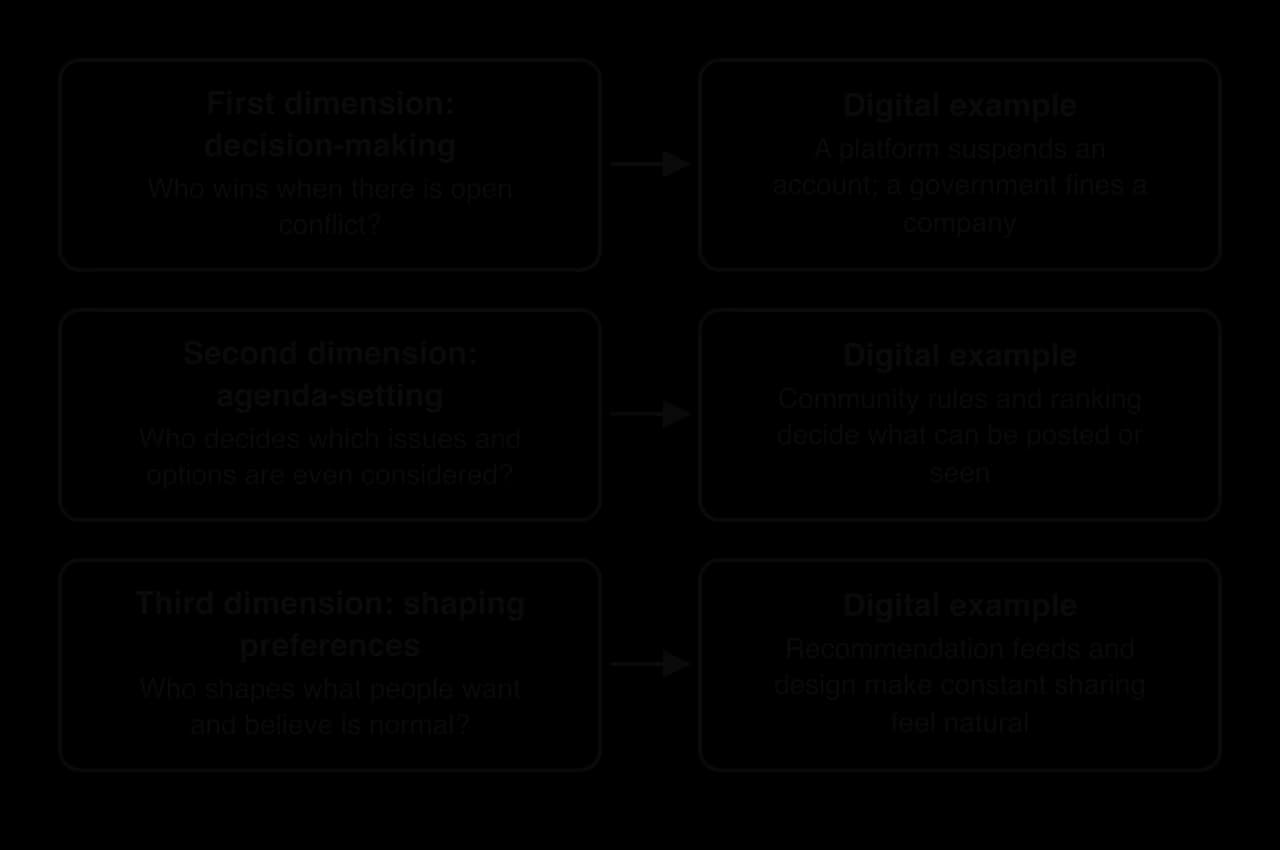
Power is not always visible as one actor defeating another. The British political theorist Steven Lukes argued in Power: A Radical View (1974) that power has three dimensions, each harder to see than the last. His model builds on Dahl's work and on an earlier idea by Peter Bachrach and Morton Baratz (1962) that power also lies in keeping issues off the agenda.
Decision-making. Power is visible when two sides disagree and one wins. A platform suspends an account; a court fines a company.
Agenda-setting. Power also lies in deciding which issues and options are discussed at all. Whoever writes a platform's community rules, or designs its ranking, decides what can be posted and what is likely to be seen.
Shaping preferences. The deepest form of power shapes what people want and believe is normal, so that conflict never appears. Recommendation feeds and design features that reward constant sharing can make it feel natural to give up personal data.
Many of the most important forms of digital power belong to the second and third dimensions in the diagram. A user who is never shown a news story cannot protest against its absence, and a user who has always shared photos publicly may never question the practice.
Power is a feature of all social relations, not only of governments and large companies. It exists between parents and children, teachers and students, employers and workers, and between friends in a group chat. The French philosopher Michel Foucault argued that power is spread through all of society. In his view it works less through orders from the top than through everyday practices, norms and forms of knowledge that shape how people behave.
Foucault used the image of the panopticon, a prison designed by Jeremy Bentham in which a guard in a central tower can see every cell without being seen, so prisoners behave as if they are always watched. Many writers apply the image to digital life: employees whose keystrokes are logged by monitoring software may change their behaviour without anyone giving an order.
Power is also rarely absolute. People keep some agency: the capacity to act independently and make their own choices within the limits around them. Delivery riders who share tips in WhatsApp groups about how a platform's algorithm assigns orders, or users who switch off personalised advertising, use agency inside systems they did not design.
Power is studied by many subjects, fields and professions. Each asks different questions with different methods, and thinking like a practitioner means choosing the approach that fits an inquiry.
Discipline | Central questions about power | Digital example |
|---|---|---|
Global politics | How do states and non-state actors compete for influence? | The US–China contest over chips, 5G and apps |
Social and cultural anthropology | How does power work in the everyday life of a specific community? | How families in one village use phones to control or escape their elders |
Political science | Who governs, how are decisions made and who wins? | How social media campaigns affect which parties win elections |
Public policy | What rules should govern a problem, and do they work? | Whether a platform law reduces market power |
Philosophy | When is power legitimate, and what do people owe each other? | Whether profiting from data users did not knowingly give is fair |
Sociology | How do social structures produce and reproduce inequality? | Whether algorithmic hiring tools disadvantage certain groups |
Law | What rights and duties exist, and how are they enforced? | Whether a dominant search engine broke competition rules |
Anthropology shows the value of method. The Why We Post project at University College London, led by Daniel Miller, placed researchers for 15 months in each of nine communities, from a factory town in China to a small town in south-east Turkey. Social media changed power relationships differently in each place, giving young people more privacy from their families in some communities and exposing them to more control in others. In sociology, Manuel Castells argued in Communication Power (2009) that in a network society power depends on the ability to shape communication networks and the messages that flow through them.
Power can be exercised through a digital system, as when a government uses a surveillance camera network to track protesters. It can also be embedded in a system, built into its design so that it shapes behaviour every time the system is used. The second kind is easy to overlook because it looks like a technical feature rather than a decision.
The legal scholar Lawrence Lessig argued in Code and Other Laws of Cyberspace (1999) that four forces regulate behaviour: laws, social norms, markets and architecture. Online, the architecture is software code, and his phrase "code is law" means that a system's design can allow or forbid actions as effectively as any law.
A messaging app that limits how many chats a message can be forwarded to, as WhatsApp has done since 2018 to slow the spread of rumours, controls behaviour through code. A video platform that blocks uploads matching copyrighted music enforces copyright before any court is involved. The people who write the code exercise power over users who rarely see the rules.
Langdon Winner made a similar point in his 1980 essay "Do Artifacts Have Politics?": design choices settle who can use a technology and on what terms. A website that cannot be used with a screen reader excludes blind users as surely as a rule banning them.
Data gives power to whoever collects and analyses it, because it allows them to predict and influence behaviour. Shoshana Zuboff, in The Age of Surveillance Capitalism (2019), argued that companies such as Google and Facebook built a new economic system on this principle, which she called surveillance capitalism. They collect data about users' behaviour far beyond what is needed to provide a service, use it to predict what people will do next, and sell those predictions to advertisers.
The result is a deep imbalance of knowledge: companies know a great deal about users, while users know little about what is collected or how it is used. Critics reply that users receive free services in exchange, and that targeted advertising changes behaviour less than the theory suggests. Facial recognition shows the same imbalance. Clearview AI, a US company, built a database of billions of facial images taken from public websites without consent and sold searches of it to police forces; the Dutch data protection authority fined it €30.5 million in 2024.
A digital platform connects different groups of users, such as buyers and sellers, drivers and passengers, or app developers and phone owners. Because it sits between them, it sets the rules of every interaction. Platform power is the influence a platform gains from this position.
Platform power grows through network effects: the more people use a platform, the more valuable it becomes to each user, which attracts still more users. Once most of the users are on one platform, businesses must be there too. This makes some platforms gatekeepers, organisations that control an important point of access between businesses and the people they want to reach.
Platform power has several sources that reinforce each other.
Rule-setting. The platform writes the terms of service and can change them at any time.
Ranking and visibility. Its algorithms decide which products, posts or apps are seen first.
Data. It sees every interaction and can use that data to improve its own products.
Access. It can remove a business or user, cutting them off from customers or friends.
Pricing. It can set the fees others must pay to reach users.
Platform power can even be turned against governments, as Facebook's week-long block of news for Australian users in February 2021 showed.
Structural power is built into the rules, institutions and systems within which people act. It shapes choices without anyone having to give a direct order. The British scholar Susan Strange, writing in States and Markets (1988), described structural power as the power to shape the frameworks within which others must operate, as opposed to the power to win a particular contest within them.
Structural power differs from relational power, the power one actor exercises over another in a particular relationship or situation, as in Dahl's test. A useful comparison is a game. Relational power decides who wins a match. Structural power decides the rules of the game, the size of the pitch and who is allowed to play.
In digital society, the actors with the most structural power are those who set the rules of the systems that everyone else must use: governments that write laws, standards bodies that define protocols and large companies that design dominant platforms.
Governments hold structural power through law, taxation, policing and control of infrastructure. Digital systems can greatly extend that power.
Rule-making. The EU's General Data Protection Regulation (GDPR) changed how companies worldwide handle personal data, because companies that want European customers must follow it.
Controlling access. In March 2022, soon after the invasion of Ukraine, Russia's communications regulator blocked Facebook and Instagram, and a Moscow court later labelled their owner Meta an extremist organisation. Millions of Russian users lost direct access to platforms they used daily, unless they turned to VPNs.
Automated decision-making. In the Netherlands, the tax authority used a risk-scoring system to flag suspected childcare benefit fraud, and it treated a second nationality as a risk factor. Tens of thousands of parents were wrongly ordered to repay large sums, with little power to challenge decisions they could not see. The government resigned over the scandal in January 2021.
Governments also seek digital sovereignty: control over the digital systems, data and infrastructure used within their territory. In June 2020, after a border clash with China, India banned TikTok and 58 other Chinese apps, citing national security. China's tight control of its domestic internet is another, more extreme, form of the same goal.
Large companies hold structural power when the systems they own become infrastructure that others depend on. Big Tech usually refers to Alphabet (Google), Amazon, Apple, Meta and Microsoft, sometimes with others such as ByteDance, Nvidia or Tencent. Businesses, schools and governments build their own services on top of their products.
A monopoly in the strict sense is a market with only one supplier. In practice, competition authorities worry about companies with a dominant position: a share of a market so large that they face little effective competition. Market dominance is not illegal in itself, but it gives a company structural power over rivals, suppliers and customers.
Structural power also runs through organisations and their supply chains. Algorithmic management tools assign shifts and measure the speed of delivery workers, enforcing managers' rules automatically. A 2023 investigation by TIME found that workers in Kenya employed by an outsourcing firm to label harmful content for OpenAI were paid between about $1.32 and $2 an hour, with very little power over pay or conditions.
The same technology can increase the power of one group and limit the power of another.
Actor | Digital systems enable power by | Digital systems constrain power by |
|---|---|---|
Governments | Surveillance, automated administration, control of networks | Exposing abuses, helping citizens organise, letting information cross borders |
Large companies | Collecting data, setting platform rules, reaching global markets | Letting users compare prices and complain publicly |
Users and citizens | Publishing without a gatekeeper, organising, learning | Exposing them to tracking, manipulation and dependence on platforms |
Some writers stress that digital systems mainly enable those who already hold power, because states and companies can afford to use data and algorithms at scale. Others stress that they constrain established power by lowering the cost of publishing and organising. The evidence suggests that both happen at once, with the balance depending on the system, the context and the period.
Power is not equally distributed in any society; it follows wealth, social position, education, gender, ethnicity and nationality. Digital society adds new sources of inequality, such as access to connectivity, digital skills and ownership of data. People on the wrong side of the digital divide have less power to find information, take part in public debate or use online public services.
Power is also unequal between countries. Most of the largest platforms are based in the United States or China, so decisions affecting users in Africa, Latin America or South Asia are often taken far away, under foreign law, and smaller countries struggle to make global companies follow their rules.
Digital markets tend to concentrate power for three linked reasons. Network effects reward the platform with the most users, data advantages let the largest platform improve fastest, and serving one more user costs almost nothing, so the leader can expand worldwide quickly.
Search engines are the clearest example, as the market share chart shows.

With such a share, a search engine's ranking decisions shape which businesses, news sources and ideas most people encounter. This is structural power of the kind Strange described, and it is the background to the EU's Google Shopping case.
Digital systems can also spread power to people who had little of it. Empowerment is the process through which people gain more control over their own lives and more ability to influence decisions that affect them.
The Arab Spring of 2010–2012 is often used as an example of power exercised by ordinary citizens. In Egypt, a Facebook page called "We Are All Khaled Said", created after a young man died in police custody in 2010, helped mobilise the protests that began on 25 January 2011. Activists used Facebook to organise and Twitter and YouTube to show the world what was happening. President Hosni Mubarak resigned on 11 February 2011.
The same events show the limits of this empowerment. Egypt's government shut down almost all internet access for about five days from 28 January 2011, and in later years several governments in the region used social media to identify and arrest activists. Many researchers concluded that digital tools make protests easier to start but do not, on their own, secure lasting political change.
In Kenya in June 2024, young people used X, WhatsApp and other platforms under the hashtag #RejectFinanceBill2024 to oppose tax rises, sharing the bill in local languages and organising marches without a formal leader. President William Ruto withdrew the bill on 26 June 2024, although the protests were met with deadly police violence.
Empowerment is not only political. Small businesses reach customers worldwide through online marketplaces and independent musicians publish without a record label, although each now depends on a platform instead of a traditional gatekeeper.
Arguments that it is inevitable | Arguments that it can be changed |
|---|---|
Network effects and data advantages push digital markets towards a few winners | Laws can break up companies, ban harmful practices and require interoperability |
Those who already hold power can afford the best technology and expertise | Open-source software and open standards spread technical capacity widely |
Global platforms are hard for any one country to regulate | Users, workers and activists can organise, as gig-worker campaigns and consumer boycotts show |
Each wave of technology has produced new dominant companies | Dominant firms have lost power before, as MySpace and Nokia did |
A balanced judgement is that some inequality of power is likely in any complex society, but its degree and form depend on choices about law, design and ownership. Laws on competition, known as antitrust in the United States and competition law in the EU, exist precisely because markets left alone can concentrate power.
The EU's Digital Markets Act (DMA), applied from May 2023, is the most ambitious attempt so far to change the distribution of platform power by law. In September 2023 the European Commission named six companies as gatekeepers: Alphabet, Amazon, Apple, ByteDance, Meta and Microsoft. Gatekeepers must follow rules set in advance, such as not ranking their own services ahead of rivals' and letting app developers tell users about cheaper offers elsewhere. Fines can reach 10% of worldwide turnover. In April 2025 the Commission issued its first fines under the DMA: €500 million for Apple and €200 million for Meta.
 YouTube
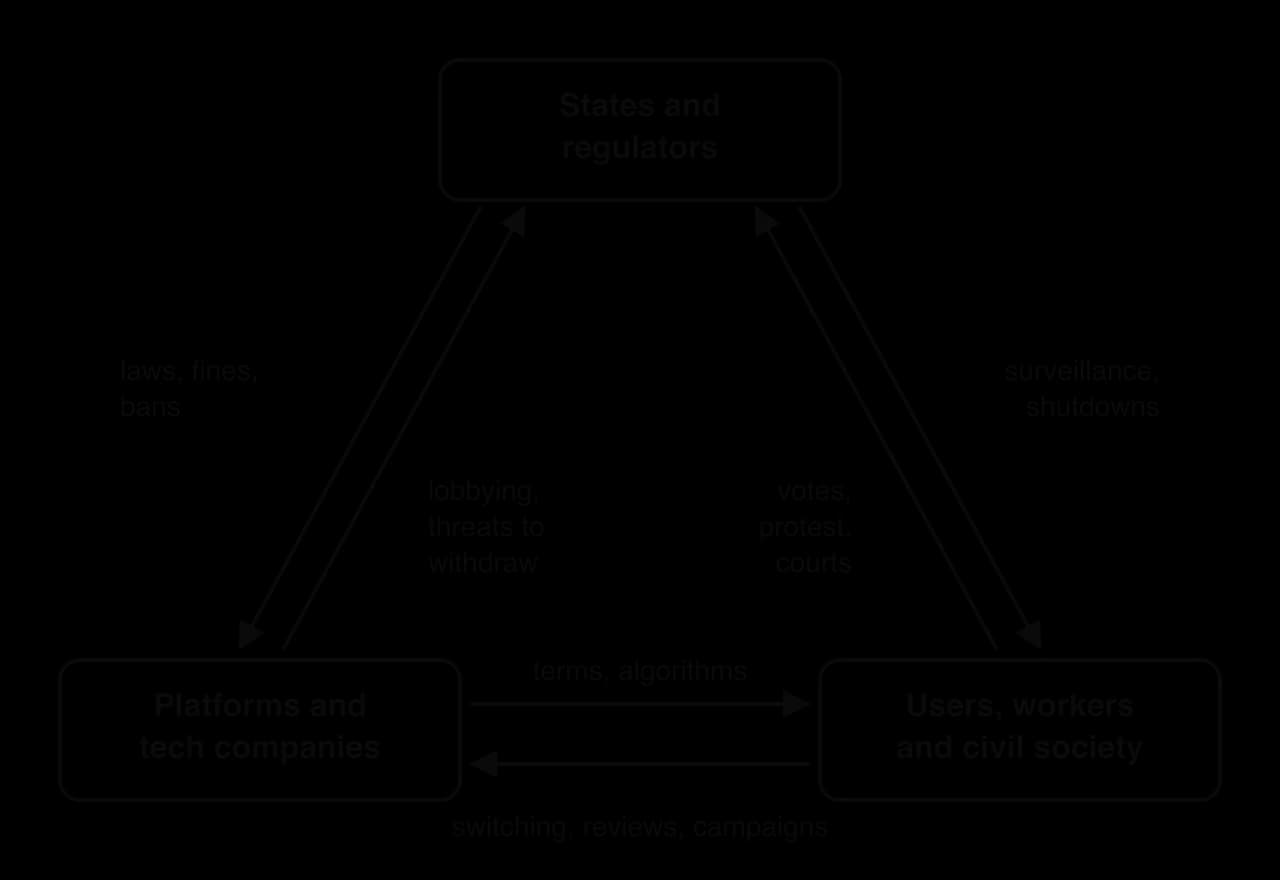
The relationship between states, platforms and citizens can be summarised as a triangle in which each side exercises some power over the others. Each pair of arrows in the diagram shows influence running in both directions, which is why no actor holds complete power.
The concept of power applies to every area of content and every context in the course.
Content or context | Real-world example | What the concept of power shows |
|---|---|---|
3.1 Data | Clearview AI's facial recognition database | Buyers of the service can identify people who never consented |
3.2 Algorithms | Dutch childcare benefits risk scoring | Automation multiplies state power over citizens who cannot see how decisions are made |
3.4 Networks and the internet | Russia's blocking of Facebook and Instagram, 2022 | Control of networks lets a state switch off a platform |
3.5 Media | Facebook's news block in Australia, 2021 | A platform can withdraw news to influence legislation |
4.1 Cultural | Global spread of South Korean music and drama online | Online distribution builds a country's soft power |
4.2 Economic | Apple's App Store and the dispute with Epic Games | A gatekeeper sets fees and rules for a whole market |
4.7 Social | Kenya's #RejectFinanceBill2024 protests | Young citizens organise without formal leaders |
Across the table, power is exercised by states, companies and citizens alike, and the most lasting power usually belongs to those who control infrastructure (networks, app stores, search engines, data).
A comparison shopping service is a website that lets people compare the prices of a product across many online shops. Google entered this market in 2004 with Froogle, renamed Google Product Search in 2007 and Google Shopping in 2012, where rivals such as Foundem in the United Kingdom, Idealo in Germany and Kelkoo in France were already established.
Comparison services depend on traffic: more visitors bring more clicks, more revenue and more shops listing products. For most of them, Google's search engine was the largest single source of visitors, so Google was both the main route to rivals' websites and a rival itself.
From the late 2000s several comparison services complained to the European Commission that Google was pushing them down its search results. The Commission opened a formal investigation in November 2010, sent Google a formal statement of objections in 2015, and announced its decision on 27 June 2017.
The Commission found that, from January 2008 in Germany and the United Kingdom and later in 11 other countries, Google treated its own comparison shopping service differently from rivals. This practice is called self-preferencing.
According to the Commission, Google did two things at once.
Prominent placement. When a user searched for a product, Google's own shopping results appeared at or near the top of the page, often as a box with pictures and prices.
Demotion of rivals. Rival comparison services appeared only through Google's general ranking algorithms, which included criteria that pushed them down. Even the highest-ranked rival appeared on average only on page four of the results. Google's own service was not subject to those demotions.

Position matters because users rarely scroll far. The Commission found that the ten results on the first page received about 95% of clicks on general results, with the top result alone receiving about 35%. The first result on the second page received only about 1%. Moving a result from first to third place cut its clicks by about half. By deciding position, Google effectively decided which services users would visit.
 YouTube
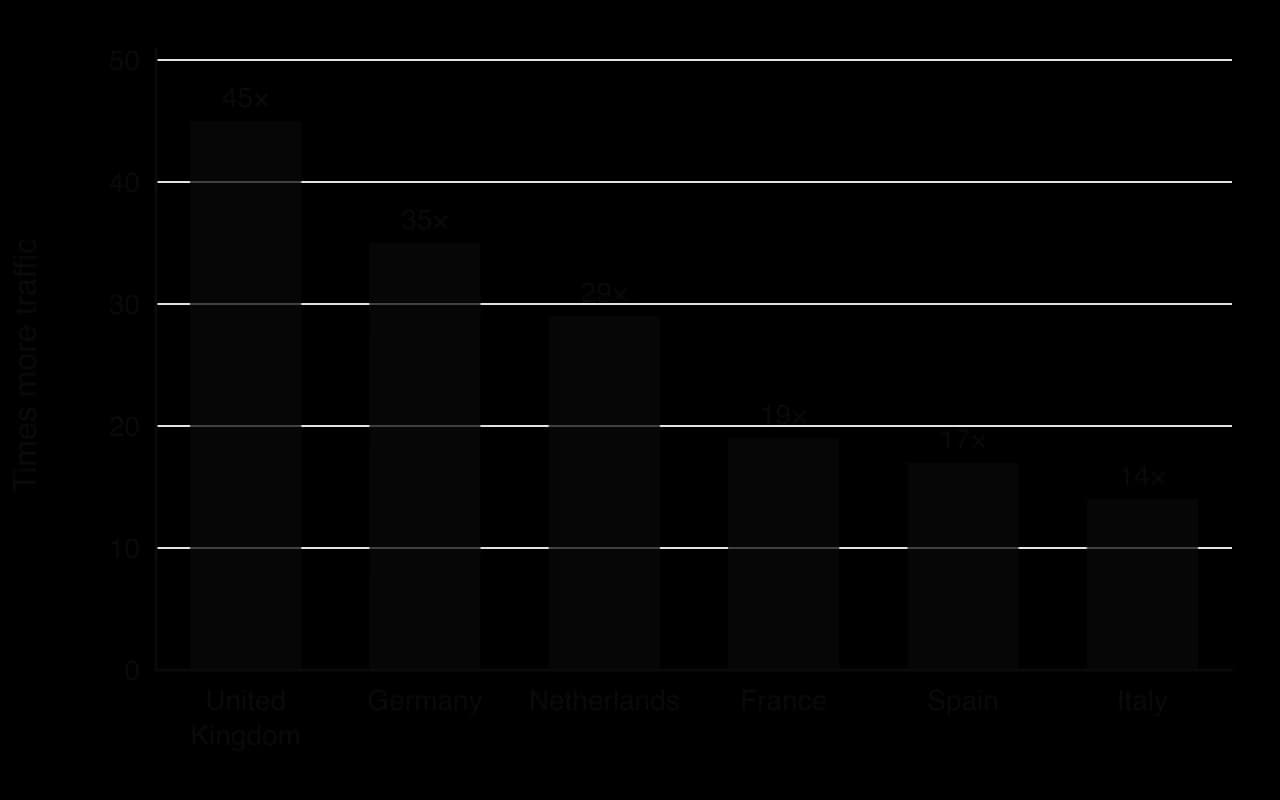
The Commission's evidence showed large shifts in traffic after the practice began in each country.
The impacts fell differently on different people and communities.
Stakeholder | Impacts | Claims |
|---|---|---|
Rival comparison services (Foundem, Idealo, Kelkoo and others) | Sudden, lasting losses of traffic and revenue | Google used its search dominance to win a separate market unfairly |
Consumers | Fewer independent services to choose from; results shaped by Google's interests | Consumers lost choice and the benefits of innovation (the Commission's claim) |
Online shops | More dependent on Google, and on paying for its shopping adverts | Their visibility depended on one company's rules |
Fined €2.42 billion; required to change how shopping results appear in Europe | It improved results for users, and rivals lost traffic because users preferred Google's format | |
European Commission and courts | Set a precedent for regulating platforms | Dominant companies have a special responsibility not to distort competition |
The implications reached beyond shopping, since the same method could favour Google's own maps, travel or video services. The case raised the wider question of whether a company should be allowed to run a dominant platform and compete on it at the same time.
Date | Event |
|---|---|
January 2008 | Self-preferencing begins in Germany and the United Kingdom, according to the Commission |
November 2010 | The Commission opens a formal investigation after complaints from rivals |
27 June 2017 | The Commission fines Google €2.42 billion and orders it to stop within 90 days |
10 November 2021 | The EU General Court upholds the fine and most of the decision |
10 September 2024 | The Court of Justice of the EU dismisses Google's final appeal |
March 2025 | The Commission says Google Search may still be favouring its own services, this time under the DMA |
November 2025 | A Berlin court orders Google to pay about €465 million in damages to Idealo |
Through the concept of power, the case shows structural power turned into advantage in a second market. Google controlled the framework within which comparison services competed, because the route to their customers ran through its search results. This is Strange's distinction between winning within a structure and shaping the structure itself.
The case also shows the second dimension of power in Lukes's model. Google did not ban rivals; it shaped what users saw, so that rivals did not appear where users looked. Most users had no reason to suspect that the ranking treated services unequally, which helps explain why the practice lasted so long.
Finally, the case shows that platform power can be limited by legal authority. The Commission and the courts used competition law to fine Google and force a change. The final judgment in 2024 confirmed that holding a dominant position is not illegal, but that using it to favour one's own services through unequal treatment can be.
Through the concept of systems, the case shows how one element can affect many others. A change to Google's ranking algorithm, made inside one company, changed the traffic and survival of businesses across 13 countries.
Through the concept of values and ethics, the case raises the question of fairness. Google argued that it served users by showing useful shopping results first; rivals argued that a neutral-looking ranking had been designed to favour Google without users being told.
Through the concept of change, the case shows how slowly law adapts to digital markets: the practice began in 2008 and the final judgment came in 2024.
The case was a legal success for the regulator. It established at the EU's highest court that a dominant platform may not use its ranking to favour its own services, and it opened the way for private damages claims such as the Berlin judgment in 2025.
Its practical effects were more limited. Google's 2017 remedy required rivals to bid in an auction for places in the shopping box, so they still paid Google to be visible, and several argued that traffic never recovered. The fine was small compared with Alphabet's annual revenue of more than $100 billion, and the decision came nearly a decade after the complaints.
These limits were an important reason for the Digital Markets Act, which bans self-preferencing by gatekeepers in advance instead of investigating each case after the harm. A reasonable judgement is that the case did not, on its own, rebalance power between Google and its rivals, but it changed the law and the political debate in ways that made later limits on platform power possible. Whether the DMA achieves more depends on how strictly it is enforced.
A lens is a way of looking at a real-world example that brings certain features into focus. Using power as a lens means asking a consistent set of questions about who can influence whom, how, and with what consequences. The steps work for any digital system.
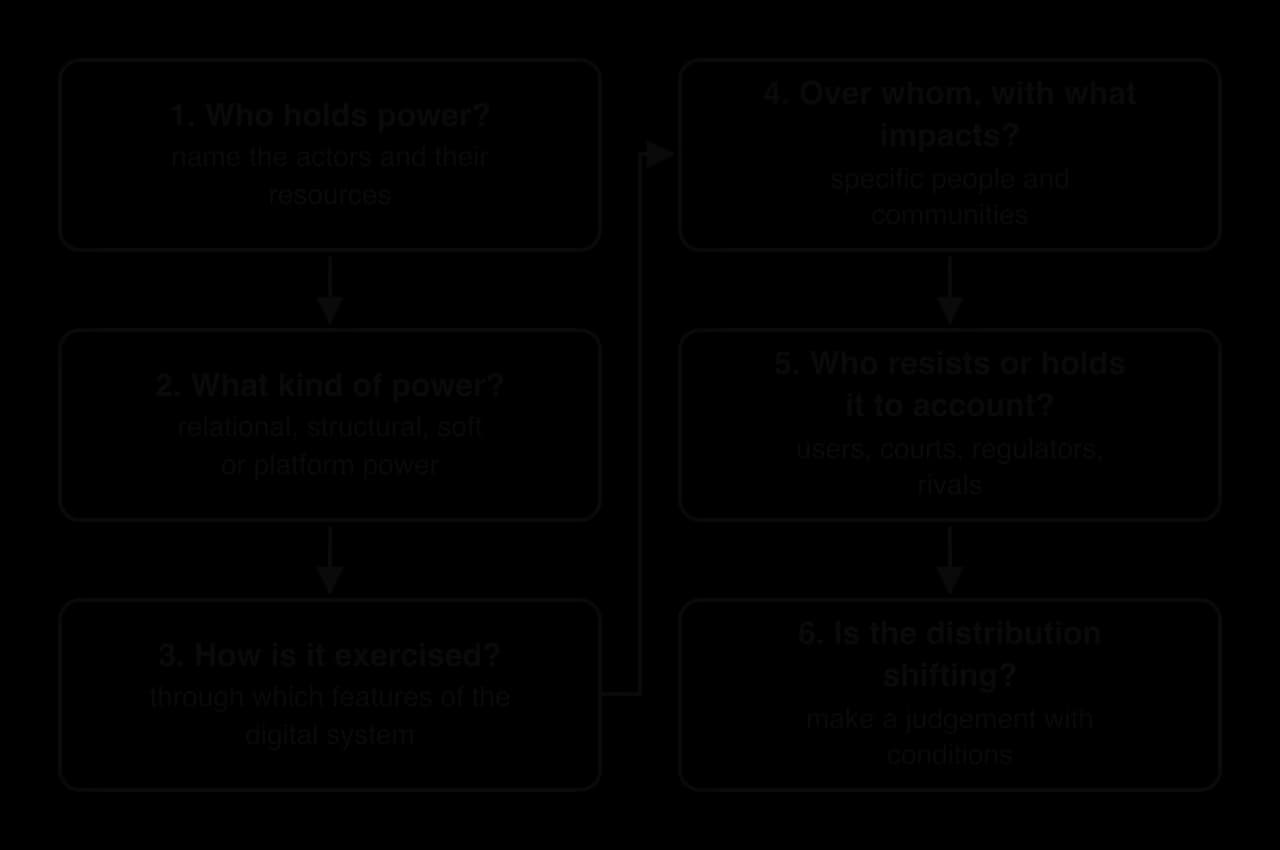
Who holds power? Name the actors and the resources each controls: data, infrastructure, money, law or numbers of people.
What kind of power? Relational, structural, soft or hard, or platform power.
How is it exercised? Identify the features of the system: design, defaults, ranking, data collection, access, pricing.
Over whom, with what impacts? Name the people and communities affected and the impacts on each.
Who resists or holds it to account? Users, workers, rivals, courts, regulators, journalists or activists.
Is the distribution shifting? Judge whether the system concentrates or spreads power, and under what conditions.
The next question is in the style of HL Paper 1 Section B, which asks for an extended response using one concept.
I can define power and give Dahl's test for when one actor has power over another.
I can distinguish between the forms of power, including hard and soft power, with a digital example of each.
I can explain Lukes's three dimensions of power and give a digital example of each.
I can explain why power is a feature of all social relations, including everyday ones, and what agency means.
I can outline how at least five disciplines approach power.
I can explain how power is embedded in a digital system's design, using the idea that code acts as rules.
I can explain surveillance capitalism and platform power, and why gatekeepers have so much influence.
I can define structural power and give examples from governments, organisations and Big Tech.
I can discuss whether digital systems enable or constrain the exercise of power.
I can explain why digital markets tend to concentrate power, and evaluate how digital systems empower users and activists, using the Arab Spring or another example, including the limits of that empowerment.
I can discuss whether the unequal distribution of power is inevitable, with reference to antitrust law and the Digital Markets Act.
I can describe the Google Shopping case and analyse it through power and at least one other concept.
I can analyse a new real-world example step by step through the concept of power.