Define identity at personal, group and institutional levels, explain how digital systems shape and change it, analyse intersectionality online, and use identity as a lens on real digital systems such as India's Aadhaar.
Each is in the Digital Society glossary, with every other term in the subject.
A graphical representation of a user in a digital environment, such as a character in a game, a figure in a chat app or a 3D body in virtual reality.
The measurement of unique physical or behavioural characteristics, such as fingerprints, iris patterns, facial features or voice, to identify or verify a person automatically.
The merging of several distinct audiences, such as family, friends, teachers and employers, into one audience on social media, which makes it hard to present the identity that suits each of them.
The record of data a person leaves through their use of digital systems, including what they share on purpose (an active footprint) and what is collected about them, often without their awareness (a passive footprint), such as location data and browsing history.
The information about a person, group or organisation that exists in digital systems, including both the identity they present online and the attributes and credentials that systems use to recognise and verify them.
A virtual model of a real object, system or person that is continuously updated with data from its real counterpart, so that its behaviour can be monitored, simulated or predicted.
The characteristics, roles, group memberships and records by which a person, group or organisation is recognised, both by itself and by others. It works at personal, group and institutional levels and changes over time and with context.
Define identity and distinguish between personal, group and institutional identity.
Outline how psychology, sociology, cultural studies, social and cultural anthropology, political science and philosophy each approach identity.
Distinguish between digital identity as self-presentation and digital identity as formal identification.
Explain how identities change over time, with context and with the perspectives of others, and how digital systems influence or construct them.
Analyse how aspects of identity intersect on digital platforms.
Discuss whether a robot or an AI system can have an identity.
Evaluate the impacts and implications of a national biometric identity system for different people and communities.
Analyse a real-world example step by step, using identity as a lens.
Identity is the set of characteristics, memberships and records that make a person, group or organisation recognisable as who they are. Digital systems are now involved in almost every aspect of it: a profile picture, a gaming avatar, a fingerprint scan at a ration shop and a recommendation feed that guesses a user's age and interests all say something about who someone is.
As one of the seven concepts, identity gives insight into any inquiry about digital society. It connects closely with expression (how people present themselves), power (who decides which identities count) and values and ethics (privacy, fairness and dignity). It applies to every content area, from the data that forms a digital footprint to robots that appear to have personalities, and to every context, especially the social context, where the social components of identity are studied in detail in 4.7.
With a free account, Augment remembers where you stopped and what you have practiced.
The process of confirming that a person is who they claim to be, by checking their claimed identity against trusted evidence such as an official document, a database record or a biometric sample.
The idea that aspects of a person's identity, such as gender, race, class, religion and sexuality, combine and interact, creating specific experiences of privilege or discrimination that cannot be understood by looking at any one aspect alone.
The identity a person builds and displays through their online activity, such as profiles, usernames, posts and avatars, which may differ across platforms and from their offline identity.
A constructed character or public image that a person or organisation adopts for a particular audience, such as a VTuber's animated character or a computer-generated influencer.
Acting online under a consistent name that is not one's legal name, so that actions link to one identity with a reputation while the person's legal identity stays hidden.
The process of managing how others see a person by choosing what to show, hide or emphasise, for example through profile photos, bios and the posts they share.
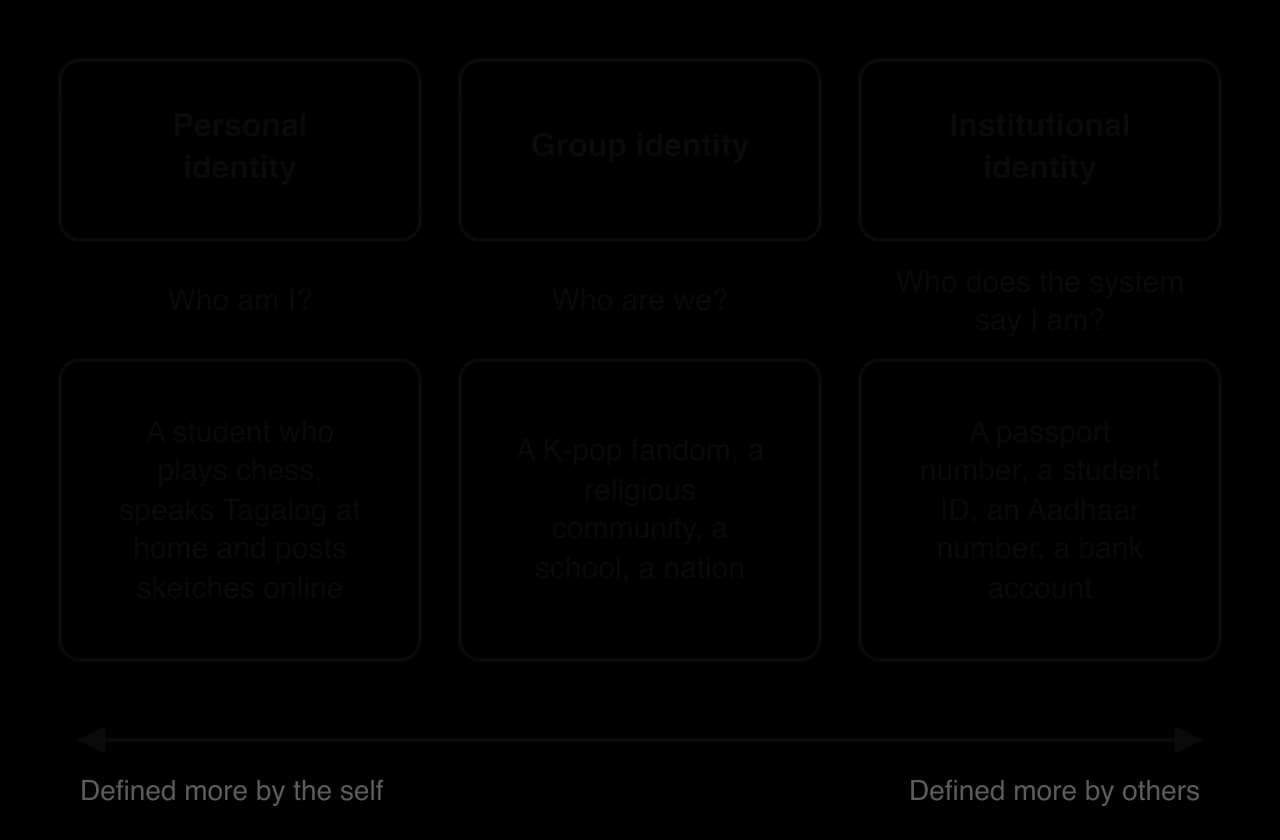
In everyday speech, identity answers the question "Who am I?". In the social sciences the term is wider. It covers how people see themselves, how others see and treat them, and how organisations record and recognise them.
Three features of this definition matter. First, identity has an inside and an outside: a person's sense of self and the labels others give them may not match. Second, identity is plural: one person can be a daughter, a footballer, a Muslim, a Kenyan and a gamer at the same time. Third, identity is relational, because it is formed through contact with other people and is often defined by difference ("we are not them").
Identity works at several levels, and each level raises different questions about digital systems.
Personal identity is an individual's sense of who they are: their values, memories, tastes, relationships and life story. Group identity is a shared sense of belonging, such as a nationality, a religion, a fan community or a profession. Institutional identity is the identity that organisations and states record and recognise: a birth certificate, a passport number, a student ID or a bank account. Organisations also have identities of their own, for example a company's brand or a university's reputation.
Level | Central question | Digital examples |
|---|---|---|
Personal | Who am I? | A Spotify profile built from listening history; a curated Instagram grid; a journaling app |
Group | Who are we? | A K-pop fan community on X or Weverse; a diaspora WhatsApp group; a Discord server for a game guild |
Institutional (individual) | Who does the system say I am? | A national eID card; a passport chip; a university login; a credit score |
Institutional (organisation) | What is this organisation? | A verified company account; a domain name; a registered business number |
The levels interact. A refugee may have a strong personal and group identity but no institutional identity that a bank will accept. The World Bank's Identification for Development (ID4D) initiative estimated in 2021 that about 850 million people worldwide had no official proof of identity, which limits their access to banking, education, health care and voting.
Identity is studied by many fields, and each asks different questions about it. Thinking like a practitioner means choosing the questions and methods of a specific field, rather than discussing identity in general terms.
Discipline | Main question about identity | Typical methods | Example of a digital inquiry |
|---|---|---|---|
Psychology | How does an individual develop a sense of self? | Experiments, surveys, clinical studies | Does using an avatar change how a person behaves? |
Sociology | How do social structures and interactions shape identity? | Surveys, interviews, observation | How do teenagers manage different audiences on social media? |
Cultural studies | How is identity represented and given meaning in media and culture? | Analysis of texts, images and media | How are Black women represented in viral memes? |
Social and cultural anthropology | How do communities live and express identity in everyday life? | Long-term fieldwork and participant observation | How do people in a small town in Chile use Facebook? |
Political science | How do identities shape power, citizenship and conflict? | Policy analysis, comparative case studies, polling | How does a national digital ID affect who can vote or claim welfare? |
Philosophy | What makes a person the same person over time? What is a self? | Argument, thought experiments | Can an AI or robot be a "self"? |
Psychologists study identity as part of individual development. Erik Erikson described adolescence as a stage of "identity versus role confusion", in which young people try out roles before settling on a stable sense of self. Social identity theory, developed by Henri Tajfel and John Turner in 1979, explains how people gain self-esteem from the groups they belong to and tend to favour their own group over others.
Digital systems give psychologists new material. In 2007 Nick Yee and Jeremy Bailenson at Stanford University found that people given more attractive avatars in a virtual environment moved closer to others and shared more about themselves, and those given taller avatars negotiated more aggressively. They called this the Proteus effect: the appearance of a digital self can change how its user behaves.
Sociologists study how identity is produced in social interaction. Erving Goffman's The Presentation of Self in Everyday Life (1959) compared social life to a theatre. People perform a "front stage" self for an audience and relax "back stage" where the audience cannot see them. The model helps to explain why people present a polished self on Instagram and a more relaxed self in private chats.
Cultural studies examines how identities are represented in media and how these representations give them meaning. Stuart Hall argued that cultural identity is a matter of "becoming" as well as "being": it is continually produced through representation, rather than fixed by origin. In a digital society this draws attention to who controls images and stories, for example which bodies appear in beauty filters or how a minority group is shown in viral content.
Anthropologists study identity through long-term fieldwork, living among a community and observing what people actually do. The Why We Post project, led by Daniel Miller at University College London, sent nine anthropologists to nine field sites, including industrial China, a town in south India, Trinidad and south-east Turkey. Published from 2016, it found that people use the same platforms very differently in each place, often to meet local expectations about family, gender and respectability.
Political scientists study identity as a source of power, belonging and conflict. Benedict Anderson described nations as "imagined communities": most members never meet, yet they share a sense of belonging, built historically through print media. Political scientists also study identity politics and how states identify citizens through registers, passports and digital ID systems.
Philosophers ask what personal identity consists of. John Locke argued in the seventeenth century that a person remains the same person because of continuity of memory and consciousness, not because of the same body. The ancient puzzle of the Ship of Theseus asks whether a ship whose planks are all replaced is still the same ship, which raises the question of whether identity survives total change of parts.
 YouTube
The term digital identity has two meanings that are often confused. One is social: how people present and express themselves through digital systems. The other is administrative: how digital systems record and verify who someone is.
Digital identity as self-presentation | Digital identity as formal identification | |
|---|---|---|
Main question | How do I present myself? | Can the system confirm who I am? |
Who controls it | Mainly the individual (within platform rules) | Mainly institutions: states, banks, platforms |
Examples | Profiles, usernames, avatars, posts | National eID, passport chip, bank login, Aadhaar |
Can there be several? | Yes, and usually there are | Usually one per person per system, by design |
Key risks | Harassment, misrepresentation, context collapse | Exclusion, surveillance, data breaches, identity theft |
An online identity is the identity a person builds and displays through online activity. It is assembled through self-presentation, the choices people make about which information, images and behaviour to show to others.
Platforms give self-presentation different shapes. LinkedIn, which passed one billion members in 2023, encourages a professional identity built from job titles, skills and endorsements. Instagram encourages a visual identity, and many teenagers respond by running a "Finsta" (fake Instagram), a second private account shared only with close friends. In Goffman's terms, the main account is front stage and the Finsta is a curated back stage.
Self-presentation online is not the same as lying, since most people select and edit rather than invent. Digital systems make selection easier and its results more permanent and visible.
Some online identities are deliberately separate from a person's legal identity.
Players in Roblox, Fortnite or World of Warcraft build avatars that may differ from their offline selves in age, gender, body or species. For some players, especially those who are disabled, transgender or socially isolated, an avatar offers a way to explore or express an identity that is difficult to express offline.
A persona is a constructed character or public image that a person or organisation adopts for a particular audience. Virtual YouTubers (VTubers), such as the performers of the Japanese agency Hololive, stream as animated characters with their own names and personalities, keeping their legal identities private. Lil Miquela, a computer-generated "virtual influencer" launched on Instagram in 2016, is a persona created by a company rather than by the person it appears to be.
Pseudonymity means acting under a consistent name that is not one's legal name. It differs from anonymity, in which actions cannot be linked to any identity at all. A pseudonym builds a reputation over time: a Reddit user, a Wikipedia editor or the unknown creator of Bitcoin, "Satoshi Nakamoto", can be trusted or criticised as a known character without their legal identity being known.
Platforms disagree about how much separation to allow. Facebook has long required users to use the name they use in everyday life. In 2014 the policy led to the suspension of drag performers and some Native American users whose real names were judged to be fake, and Facebook apologised and changed how it checked names. Supporters of real-name rules argue that they reduce abuse; opponents argue that they endanger people who need distance between online and offline identities, such as activists and survivors of abuse.
The second meaning concerns how institutions recognise people. A formal digital identity is made of attributes (name, date of birth, nationality), credentials (a card, a certificate or a login that holds or proves the attributes) and a process of identity verification that checks them.
Verification usually combines three types of evidence: something a person knows (a password or PIN), something they have (a card or phone) and something they are. The last type is biometrics.
Biometrics are attractive because they cannot be forgotten or easily lent to someone else. They also create a particular risk: a stolen password can be changed, but a stolen fingerprint template cannot. Digital identification is spreading quickly across the world:
Estonia has issued a chip-based national ID card since 2002 and, since 2014, offers e-Residency, a government digital identity that lets non-residents run an Estonian company online.
The European Union adopted a regulation in 2024 requiring member states to offer citizens a European Digital Identity Wallet, an app holding verified credentials such as ID and driving licences.
The United Kingdom's Online Safety Act has required sites showing pornography and some other harmful content to use "highly effective" age checks since July 2025, often by face-based age estimation.
Kenya suspended Worldcoin's iris-scanning programme in August 2023, after thousands of people queued to have their irises scanned in exchange for cryptocurrency tokens, raising questions about consent and data protection.
Every online action leaves traces. Together these traces form a digital footprint, which others can use to build a picture of a person's identity.
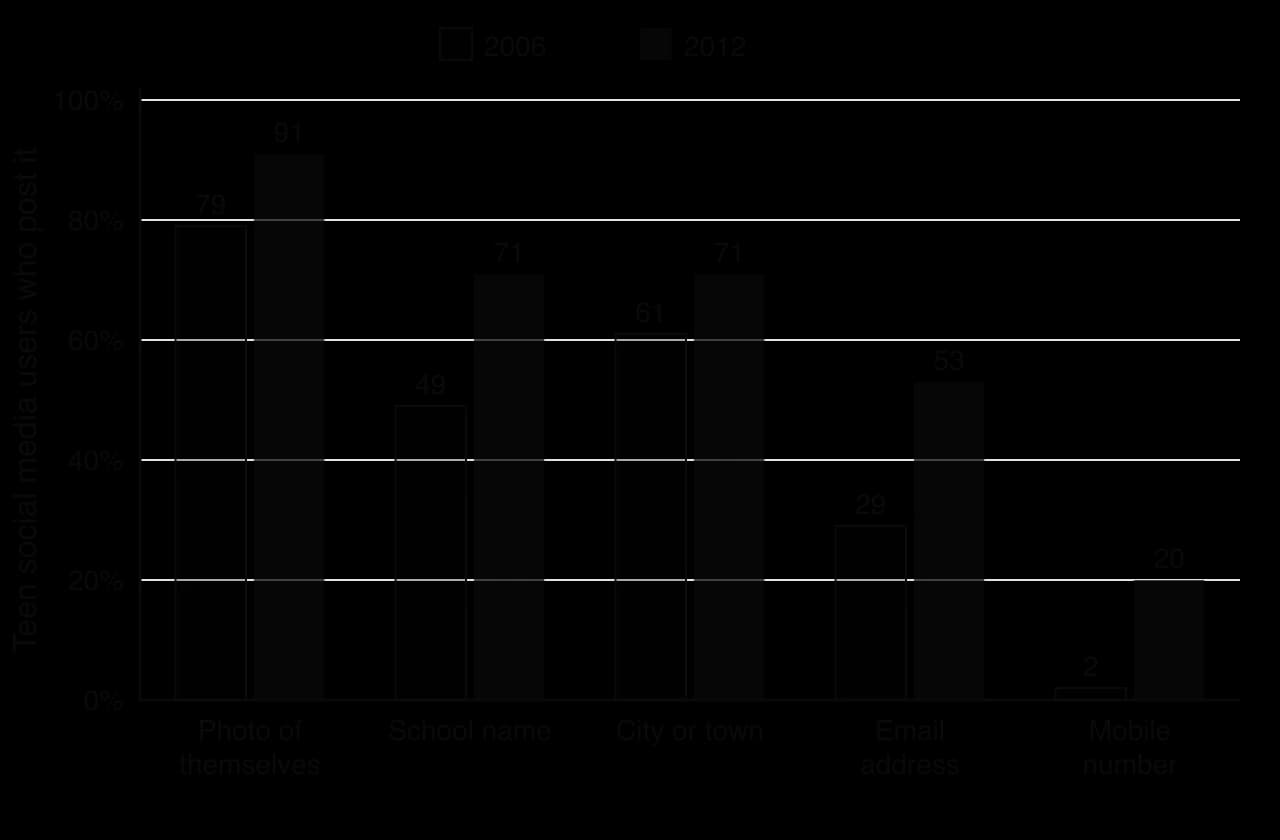
Active footprints have grown as social media has become central to young people's lives. A Pew Research Center survey of US teenagers found that the share of teen social media users posting key personal details on their profiles rose sharply between 2006 and 2012.
Passive footprints matter even more for identity, because they allow systems to infer identities that a person never stated. Advertising platforms place users into categories such as age band, gender, interests and likely income from their behaviour. The communication scholar John Cheney-Lippold called these "algorithmic identities": versions of a person built by algorithms, which change whenever the data changes and which the person usually cannot see.
The question of robot identity tests the definition of identity itself. If identity includes how others recognise and treat something, robots may already have one. If it requires an inner sense of self, they almost certainly do not.
In October 2017 Saudi Arabia announced that it had granted citizenship to Sophia, a humanoid social robot made by Hong Kong-based Hanson Robotics. In the same year, Tokyo's Shibuya ward gave a form of official residency to "Shibuya Mirai", a chatbot presented as a seven-year-old boy. The European Parliament, also in 2017, asked the European Commission to consider whether the most advanced autonomous robots might one day need a legal status as "electronic persons". Each case gave a machine an institutional identity of some kind.
Argument | Claim | Counter-claim |
|---|---|---|
Recognition | Sophia has a name, a face, a recognisable personality and (symbolic) citizenship, so she has an institutional and public identity. | These were granted by humans for publicity; a name and a passport do not make a self. Critics noted the contrast with Saudi women's rights in 2017. |
Continuity | A robot can keep a stable memory and behaviour over time, which meets Locke's memory test. | Memory can be copied, erased or moved to another body, so there is no single continuous self. |
Self-awareness | Large language models can describe themselves in the first person. | Producing text about a self is not the same as experiencing one; there is no evidence of machine consciousness. |
A related idea is the digital twin, a virtual model of a physical object, process or person kept up to date with real data. Engineers use digital twins of jet engines and factories, and medical researchers build digital twins of individual hearts to test treatments. A digital twin of a person represents their identity in data, but it does not have one of its own.
Identity is not static. It changes over time, with context and through the perspectives of others, and digital systems influence each of these changes.
Personal identity develops across a lifetime, and online identities follow. A teenager's gaming handle, a university student's activist account and an adult's professional LinkedIn profile may belong to the same person but present very different selves.
Digital systems complicate this process because they store the past. Facebook's "Memories" feature resurfaces posts from years earlier, and screenshots of old posts can be shared long after they are deleted. Public figures, including sports players and politicians, have faced consequences for posts written as teenagers. An online record captures an earlier identity, but others may judge it as if it described the person today. This is one reason for legal tools such as the right to be forgotten, studied in 3.4.
People present different sides of themselves in different situations. A student speaks one way to a grandparent, another to friends and another in a job interview. Offline, these audiences are usually separate. Online, they often merge.
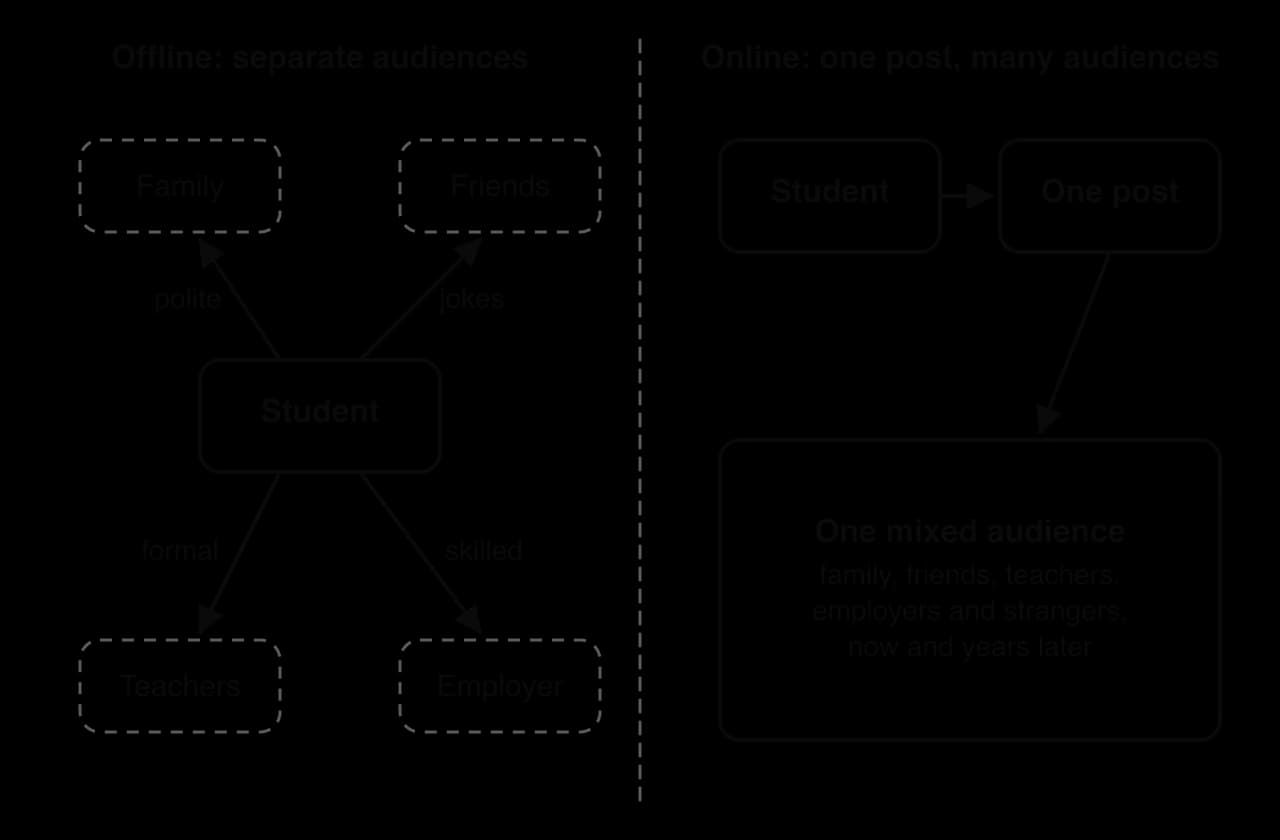
Alice Marwick and danah boyd named this context collapse in 2011: the flattening of many different audiences into one, so that a single post must work for all of them. People respond in several ways: by keeping several accounts (a main account and a Finsta), by using close-friends lists and private stories, by moving to group chats, or by self-censoring.
Identity is also shaped by how others see and label a person. Comments, likes, tags and shares give feedback that people use to adjust how they present themselves, and a label from a viral video can follow a private person for years.
Institutions and algorithms are now among the most powerful "others". A bank's credit-scoring system, a platform's content classifier or a government database can decide which category a person belongs to, and that category then shapes the offers, prices, content or services they receive. Through the concept of power, the important question is who controls these external identities and whether people can see and correct them.
Digital systems also shape, through their design, which identities can be expressed. A form that offers only two gender options makes other gender identities invisible in the data. Facebook added more than 50 custom gender options for US users in 2014, which changed what users could say about themselves on the platform. Drop-down menus for ethnicity, nationality or religion carry similar choices about which identities count.
Algorithms construct identity in a second way, by feeding back. A recommendation system that classifies a user as interested in fitness shows more fitness content, which may strengthen that interest and make the classification come true. Through the concept of systems, this is a feedback loop between the user's identity and the platform's model of it.
Each person belongs to many social categories at once: an age group, a nationality, a religion, a culture, a gender, a sexuality, a race or ethnicity, and a social and economic class. In the view known as intersectionality, these categories do not act separately. They combine to produce particular experiences of advantage and disadvantage.
The legal scholar Kimberlé Crenshaw introduced the term in 1989. She showed that US anti-discrimination law protected Black people (in cases mainly about Black men) and women (in cases mainly about white women), but failed Black women, whose experience of discrimination was a combination of both and was not recognised by either category.
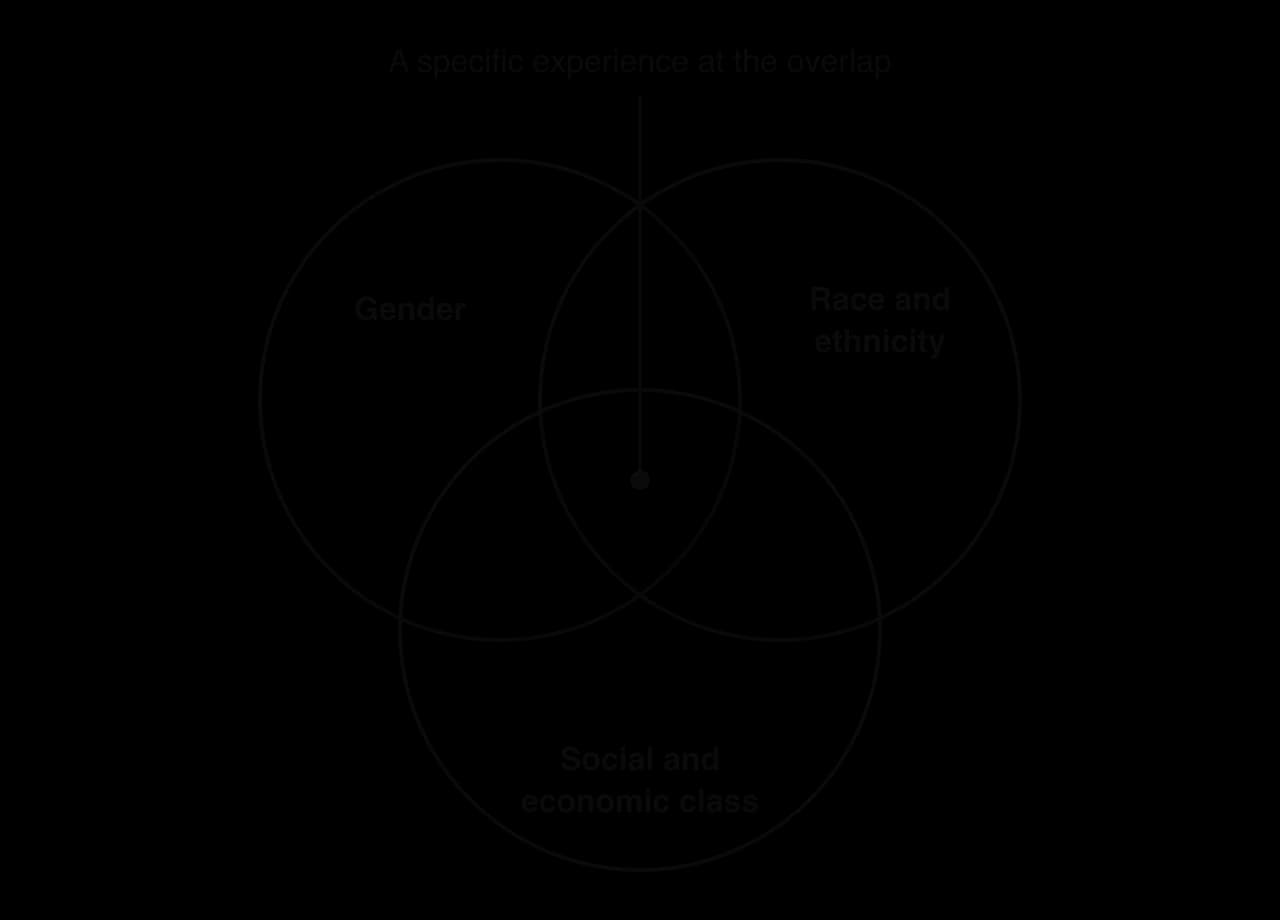
Digital systems often reproduce intersectional patterns, and can strengthen them, because they are trained and tested on data that reflect existing inequalities.
Facial analysis. The 2018 Gender Shades study by Joy Buolamwini and Timnit Gebru tested three commercial gender-classification systems. The highest error rate for lighter-skinned men was 0.8%, while for darker-skinned women error rates reached 34.7%. Looking at gender or skin type separately would have hidden the size of the gap.
Online abuse. Amnesty International's Troll Patrol study (2018) analysed tweets sent to 778 women politicians and journalists in the UK and US. Black women were 84% more likely than white women to be mentioned in abusive or problematic tweets.
Language and religion. Content moderation is weaker in many non-English languages, so religious and ethnic minorities who post in those languages can be less protected from hate speech.
Gender and class. In many low- and middle-income countries women are less likely than men to own a mobile phone, and poorer women often borrow a relative's phone, which limits the private online identity they can keep.
To what extent do aspects of identity intersect on digital platforms? The evidence suggests that they intersect strongly wherever systems sort or rank people, as with face recognition, moderation and recommendation, because these systems act on combinations of data. Platforms can also weaken the effect of some categories: a pseudonymous forum user's age, gender or class may be invisible to other users. The answer therefore depends on the design of the platform and on how much of a person's identity it collects and displays.
Identity is useful as a lens because it applies to every technology and context in the course. The table gives short examples of what the lens shows in each.
Course link | Real-world example | What the identity lens shows |
|---|---|---|
3.1 Data | Data brokers that combine purchase, location and browsing data into consumer profiles | Institutions build identities from data that people never chose to share |
3.2 Algorithms | Spotify's yearly "Wrapped" summary | An algorithm turns listening data into an identity ("your top genre") that users then share as self-presentation |
3.4 Networks and the internet | Identity theft through phishing and data breaches | A stolen formal identity can be used to open accounts in someone's name |
3.5 Media | Deepfakes using a real person's face | Media can now fake a person's identity convincingly |
3.6 Artificial intelligence | Facial recognition at airport e-gates | A face becomes a credential, and errors fall unevenly on different groups |
3.7 Robots | Sophia's Saudi citizenship (2017) | Institutions can grant identity to machines |
4.1 Cultural | K-pop fandoms organising online | Group identity can be global, with members who never meet |
4.2 Economic | Uber's Real-Time ID Check, which periodically asks drivers to take a selfie | Formal identity checks decide who can work |
4.4 Health | Electronic health records linked to a national ID | A single identifier links a person's medical history across providers |
4.6 Political | Voter registration databases | Formal identity decides who can participate in elections |
4.7 Social | LGBTQ+ young people finding community online | Online spaces support identities that are hard to express offline |
Using identity as a lens means asking a consistent set of questions about a digital system and its impacts on people and communities, which keeps an analysis focused on identity rather than on describing the technology.
Which identities are involved? Name the personal, group and institutional identities at stake.
Who defines them? Decide whether the identity is mainly self-presented, given by others, or recorded and verified by an institution or algorithm.
How does the digital system change them? Look for change over time, collapse of contexts, and classification or feedback by algorithms.
Who is affected differently, and why? Apply intersectionality: which combinations of age, gender, ethnicity, class, religion, nationality or ability lead to different impacts?
What are the implications, and what is the judgement? Weigh opportunities and risks for each group, link to other concepts (power, values and ethics) and reach a qualified conclusion.
Before 2010 many Indians, particularly the rural poor and internal migrants, had no identity document that institutions across the country would accept. Proving identity for a bank account, a SIM card or welfare benefits often required documents they did not have. Welfare programmes also suffered from "leakage", where benefits went to fake or duplicate beneficiaries.
The Government of India set up the Unique Identification Authority of India (UIDAI) in January 2009, with Nandan Nilekani, a co-founder of the technology company Infosys, as its first chair. The first Aadhaar numbers were issued in September 2010 in a village in Maharashtra. Parliament passed the Aadhaar Act in 2016, giving the system a legal basis.
Aadhaar ("foundation" in Hindi) is a random 12-digit number issued to any resident of India who has lived in the country for at least 182 days in the previous year. It is proof of identity and address, but not of citizenship. At enrolment, the resident gives:
demographic data: name, date of birth, gender (with a transgender option) and address, plus an optional mobile number and email;
biometric data: a photograph, all ten fingerprints and scans of both irises.
The biometric data is used to check that no person is enrolled twice, a process called de-duplication. The number can then be used for authentication whenever a service needs to confirm identity.
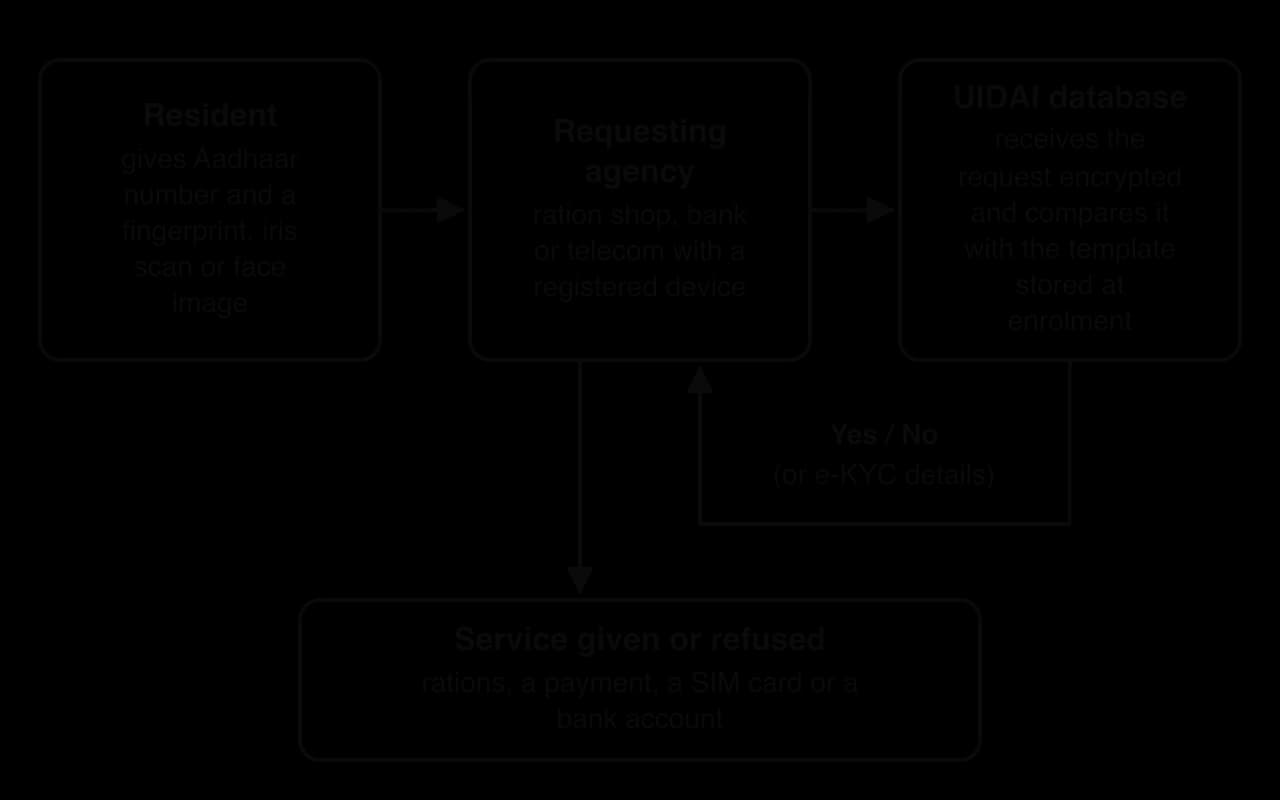
Agencies using e-KYC ("electronic know your customer") receive basic details and the photograph rather than a simple yes or no, which lets banks and telecom companies open accounts in minutes. UIDAI later added a 16-digit Virtual ID (2018), which can be used in place of the Aadhaar number, face authentication, and a feature that lets holders lock their biometrics.
Aadhaar grew very quickly after its launch.
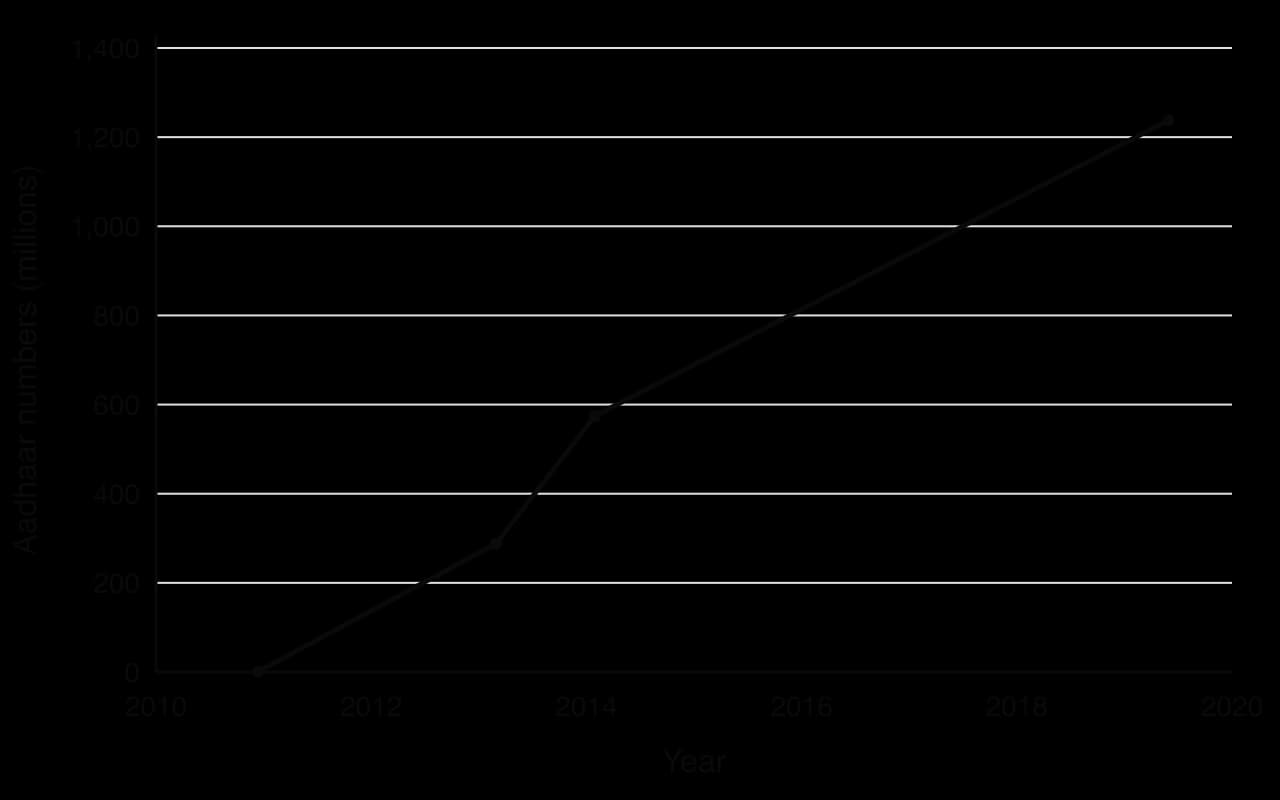
Aadhaar became the foundation for the "JAM trinity" of Jan Dhan bank accounts, Aadhaar and mobile phones, through which the government pays subsidies and benefits directly into bank accounts (Direct Benefit Transfer). The Aadhaar Enabled Payment System lets people withdraw cash from a local banking agent using only their number and a fingerprint. Authentication is now used billions of times a year, for rations, pensions, bank accounts and SIM cards.
People and communities | Positive impacts and opportunities | Negative impacts and risks |
|---|---|---|
Rural poor without documents | First widely accepted proof of identity; access to bank accounts and SIM cards | Exclusion when enrolment, linking or authentication fails |
Welfare recipients | Benefits paid directly, with fewer intermediaries taking a share | Denied rations when fingerprints fail or cards are not linked |
Manual labourers and older people | Cash withdrawal near home | Worn or faint fingerprints fail more often |
Transgender people | A gender option beyond male and female in an official record | Must still match other documents that use binary categories |
All residents | Faster access to services, fewer forms | Privacy risks from linking many databases to one number |
Government | Removal of duplicate and fake beneficiaries; cheaper delivery | Responsibility for data security and for people wrongly excluded |
The most serious criticisms concern exclusion. In 2017 Jharkhand cancelled ration cards that were not linked to Aadhaar. Santoshi Kumari, an 11-year-old girl in Simdega district whose family's card had been cancelled, died in September 2017. Her family and right-to-food activists said that she had starved after the family was refused rations for months; the state government said that she died of malaria. After national reporting of the case, the central government told states not to deny rations to people without linked cards. A randomised study in Jharkhand by the economists Karthik Muralidharan, Paul Niehaus and Sandip Sukhtankar found that requiring biometric authentication for rations did not measurably reduce leakage, while it made it harder for some eligible households to receive their rations.
Biometric failure is a further concern. In 2023 the credit rating agency Moody's said that biometric authentication was often unreliable for manual workers in hot and humid conditions, a claim UIDAI rejected. Data security has also been questioned. In 2018 journalists from The Tribune reported that they had bought access to Aadhaar details for ₹500 from sellers on WhatsApp. UIDAI denied that its central database had been breached and filed a police complaint over the report.
A challenge to Aadhaar led to two landmark Supreme Court judgments. In Justice K. S. Puttaswamy v. Union of India (August 2017), nine judges ruled unanimously that privacy is a fundamental right under India's constitution. In September 2018, a five-judge bench ruled by four to one that Aadhaar itself was constitutional and could be required for welfare and tax filing. However, it struck down the section of the Act that let private companies demand Aadhaar, and ruled that it could not be required for bank accounts, mobile phone connections or school admissions. Justice D. Y. Chandrachud dissented, arguing that the whole scheme was unconstitutional.
Through the concept of identity, Aadhaar turns a person's body into their institutional identity. For millions of people this created an identity that institutions recognise for the first time, which is a real gain in recognition and inclusion. It also means that when the body and the database disagree (a worn fingerprint, an unlinked card), the system's version of a person's identity overrides the person's own claim, even when that person is standing in front of the ration dealer. The identity also became harder to separate across contexts: one number now links banking, phones, tax and welfare, so the separate identities a person had with each institution collapse into one.
Through the concept of power, Aadhaar shifted power towards the state and the agencies that control authentication, because they decide whose identity counts. The Supreme Court judgments show power being checked: courts limited where Aadhaar could be required and established privacy as a right. Intersectionality adds detail to this picture. The people most likely to be excluded are those at the overlap of several disadvantages: poor, rural, elderly or manual workers, including many Dalit and Adivasi (tribal) households, who also have the least power to challenge errors.
Through the concept of values and ethics, the case sets the value of efficiency and inclusion at the scale of a country against the values of privacy, consent and the right to food. A utilitarian perspective may judge Aadhaar by its overall benefits, while a rights-based perspective asks whether any person should lose essential services because of a technical failure.
Aadhaar is one of the most significant digital identity systems in the world, and its impacts are mixed. It has given most Indian residents a recognised institutional identity and made digital payments and direct transfers possible on a vast scale, which is why other countries and the World Bank have studied it. Its success depends on conditions: reliable authentication, alternatives when biometrics fail, strong data protection and limits on where it can be demanded. Where these conditions were missing, as in Jharkhand in 2017, the system's errors fell on the most vulnerable people. The strongest judgement is that a biometric identity system is justified for welfare only when it is designed so that a failure of the system never becomes a denial of the person's rights.
Identity can also be examined through short sources, as in this source-based question.
I can define identity and distinguish between personal, group and institutional identity, with a digital example of each.
I can outline how psychology, sociology, cultural studies, anthropology, political science and philosophy approach identity, naming one thinker or study for each.
I can distinguish digital identity as self-presentation from digital identity as formal identification.
I can define online identity, self-presentation, avatar, persona and pseudonymity, and distinguish pseudonymity from anonymity.
I can explain identity verification and the role and risks of biometrics.
I can describe active and passive digital footprints and explain how algorithms build identities from data.
I can discuss whether a robot such as Sophia has an identity, using more than one level of identity.
I can define a digital twin and explain how it differs from having an identity.
I can explain how online identities change over time, with context (context collapse) and through others' perspectives.
I can explain how the design of digital systems constructs identity, with an example.
I can define intersectionality and analyse it on digital platforms with a real study.
I can apply identity as a lens to a technology or context in five steps.
I can describe how Aadhaar works and evaluate its impacts on different people and communities through at least two concepts.