Use space as a lens: define physical and virtual space, explain how digital systems change borders, functions, flows and scales of space, and apply the concept to real technologies, contexts and China's Great Firewall.
Each is in the Digital Society glossary, with every other term in the subject.
The interconnected virtual environment created by computer networks, especially the internet, often imagined as a single space separate from the physical world.
A legal requirement that data about a country's citizens or activities be stored, and sometimes processed, on servers located inside that country.
A boundary in virtual space, usually linked to a physical territory, where access to content, services or data changes because of the location of a user, a server or the data itself.
The movement of digital data between devices, servers and networks, including across national borders, along physical routes such as cables and through wireless links.
Restricting access to online content or services according to the user's geographic location, usually detected from the IP address of their device.
Setting up a virtual boundary around a real-world area so that a digital system responds, for example by sending an alert or blocking an action, when a device enters, leaves or stays in that area.
The material world of land, bodies, buildings, roads and objects, in which location and distance can be measured.
A specific location that people have given meaning to through experience, use, memory or identity, such as a home, a school, a city or a long-running online community.
The level or size of the area at which a space, process or impact is studied, such as local, regional, national, global or virtual.
The extent in which people, objects and information are located, arranged, connected and move, including the ways people organise, represent and give meaning to it.
A term from the sociologist Manuel Castells for the networks of data, money, goods and people that link distant places in real time, which he argued now organise economic and political power.
An inequality in access to, or use of, digital systems between places, such as between urban and rural areas, between regions of a country or between countries.
The process by which faster transport and communication technologies reduce the time needed to move people, goods or information across space, making distant places feel closer.
A space generated by digital systems in which people can interact, communicate or act, such as a platform, an online game or a virtual reality environment.
Define space, place, physical space, virtual space and cyberspace, and distinguish between them.
Outline how mathematicians, geographers, designers, anthropologists, immersive media creators, sociologists, architects and urban planners approach space.
Describe how people organise and represent space as locations, regions, borders and zones, and how digital systems change each of these.
Explain how different spaces serve distinct functions for people and communities, and where spatial digital divides exist.
Analyse how access, movement and flows of data, media and people work in digital society.
Distinguish between the local, regional, national, global and virtual scales of space.
Discuss to what extent physical space shapes virtual space, and virtual space shapes physical space.
Evaluate the impacts and implications of a digital border, using China's Great Firewall as a real-world example.
Space is the extent in which people, objects and information are located and move, and the way people divide it up, give it meaning and travel through it. Digital systems change all of these. A phone shows where its owner is to within a few metres, a video posted in Seoul can reach Lagos in seconds, and a government can draw a border around an online platform as firmly as around a territory.
As a concept, space gives insight into almost every part of the course. It connects to content such as networks and the internet (3.4), where cables and data centres give the online world a physical shape, and media (3.5), where immersive and streaming media create new spaces and flows. It situates inquiries in contexts such as the political (4.6), where states extend their borders online, and the social (4.7). Space also overlaps with other concepts, especially power, since whoever controls a space decides who may enter it and what happens there.
With a free account, Augment remembers where you stopped and what you have practiced.
In everyday language, space can mean outer space, an empty gap or a room. In Digital Society, the concept is broader and more precise. It refers to where things are, how they are arranged, how they are connected and how they move, together with the meanings people give to those arrangements.
Space is never only a neutral container. People build fences, draw maps and decide who may enter a building, and each choice shapes what others can do. The same is true online, where platform designers decide how users find each other, and governments decide which websites can be reached from inside a country.
Geographers distinguish between space and place. Space is the more abstract idea of extent, position and distance. A place is a particular part of space that has become meaningful to people through use, memory and identity. A football pitch is a set of measurements in space, but to the fans of a local club it is a place with history and feeling.
The distinction carries over into digital society. A video game map is a designed space, yet long-running online communities often describe their servers or forums as "home". When a platform shuts down such a space, users lose a setting for relationships and shared memories as well as a service.
Physical space is the material world of land, bodies, buildings, roads and objects, where distance and location can be measured. Virtual space is a space created by digital systems, such as a website, a video call, a social media platform, a multiplayer game or a virtual reality world. People experience virtual space as somewhere they can go, meet others and act, even though it exists as data processed on computers.
The two are never fully separate. Every virtual space depends on physical infrastructure: servers in data centres, submarine cables and the phones and laptops of its users. In the other direction, virtual spaces increasingly shape what happens in physical space.
Cyberspace is an older term for the whole interconnected virtual environment created by computer networks. The novelist William Gibson used the word in a short story in 1982 and popularised it in his novel Neuromancer (1984), where he described it as a shared hallucination experienced by billions. In the 1990s the term came to stand for the idea that the internet was a separate world with its own rules.
The term is still common in law and security, but many researchers prefer more specific terms, because "cyberspace" can suggest that online activity happens nowhere in particular.
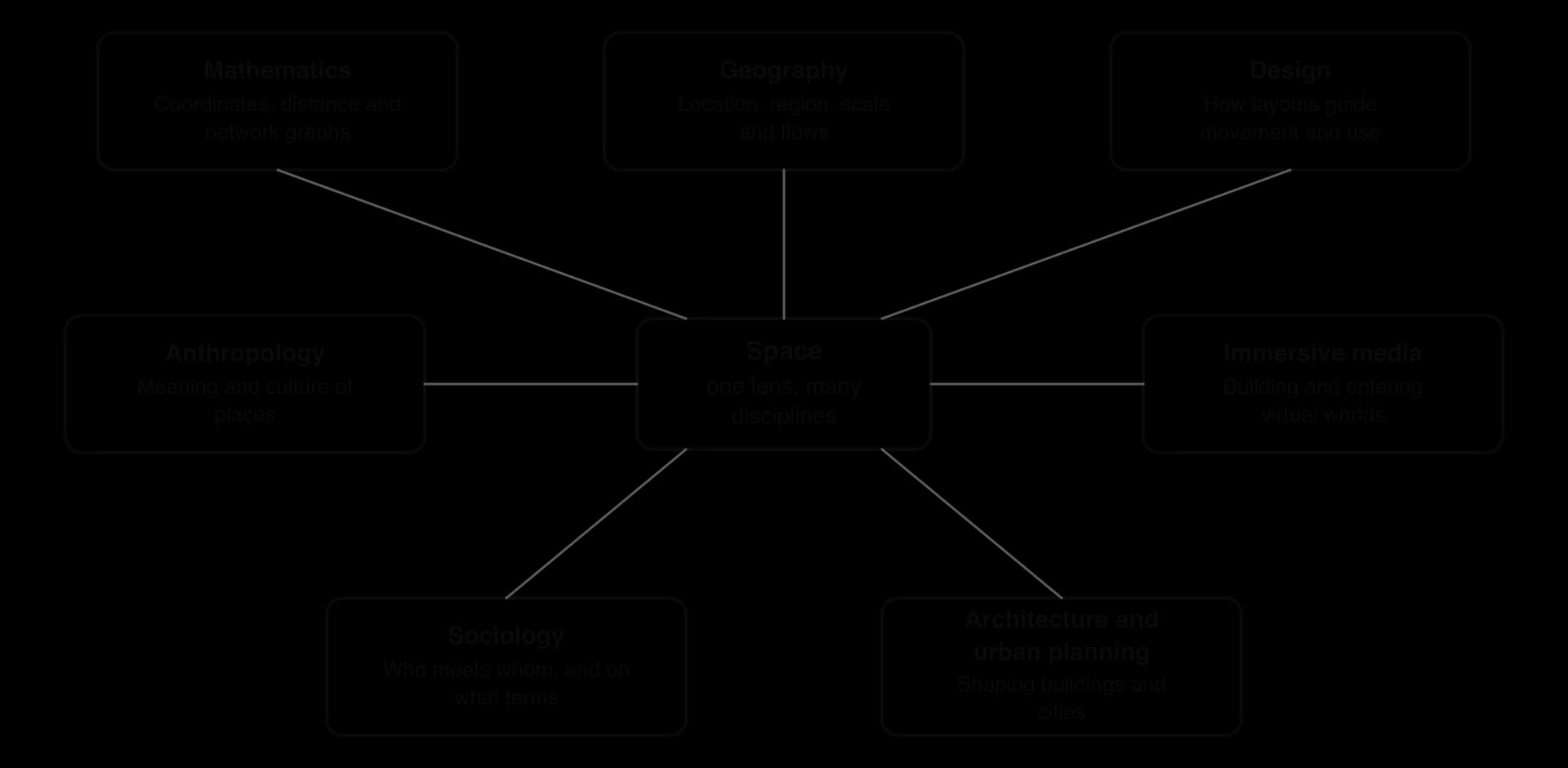
Many fields study space, and thinking like a practitioner in one of them helps focus an inquiry. A geographer looking at a delivery app asks different questions from an architect or an anthropologist, and each set of questions shows something the others miss. The diagram of disciplines summarises the main question each one asks.
Mathematics gives space its most precise description. Coordinates such as latitude and longitude fix any point on Earth, and satellite positioning systems such as GPS calculate a receiver's location from the time signals take to arrive from several satellites. Graph theory describes space as nodes joined by edges, which is how network scientists study the internet and social media. Researchers at Facebook calculated in 2016 that any two of its users were linked by an average of about 3.6 steps, a "distance" that has nothing to do with kilometres.
Geography supplies most of the concept's vocabulary (location, region, border, scale and flow), and geographers use geographic information systems (GIS) to layer data on maps. Maps are also mathematical choices. The Web Mercator projection used by most online maps keeps shapes recognisable for navigation but stretches areas near the poles. Greenland appears about as large as Africa, although Africa is roughly fourteen times bigger. Every map of the world therefore emphasises some features of space and distorts others.
Designers shape virtual spaces as deliberately as architects shape buildings. Many apps borrow the language of physical space: a computer "desktop", a chat "room", a Discord "server" with "channels", Zoom "breakout rooms". These metaphors help users understand where they are and where they can go. Immersive media goes further. Virtual reality places the user inside a computer-generated space, while augmented reality adds digital objects to a view of the real world.
Anthropologists study the meanings people give to spaces by spending long periods within a community. Tom Boellstorff's study Coming of Age in Second Life (2008) treated a virtual world as a field site with its own customs and sense of place. The University College London project "Why We Post" (2012–2016) compared social media use in nine field sites, from rural China to a town in England, and found that the same platforms were used in very different ways in different places.
Sociologists ask how spaces organise social relationships. Ray Oldenburg described "third places" (1989), such as cafés and libraries, that sit between home and work and allow informal community life. Some researchers ask whether online forums and game servers now act as third places. The sociologist Manuel Castells argued in The Rise of the Network Society (1996) that power increasingly lies in a "space of flows", the networks that carry money, data and decisions between global cities, rather than in particular territories.
Architects and urban planners decide how buildings and cities are laid out, and digital systems now inform these decisions. Singapore's government built Virtual Singapore, a detailed 3D digital twin of the city-state, so planners can model how a new building will affect wind, sunlight and pedestrian flows before it is built.
People organise space by dividing it into units and give those units names, rules and meanings. They represent it in maps, plans, addresses and, increasingly, in data. Four basic units are locations, regions, borders and zones. Each has a physical form and a digital form, as the four-part diagram shows.
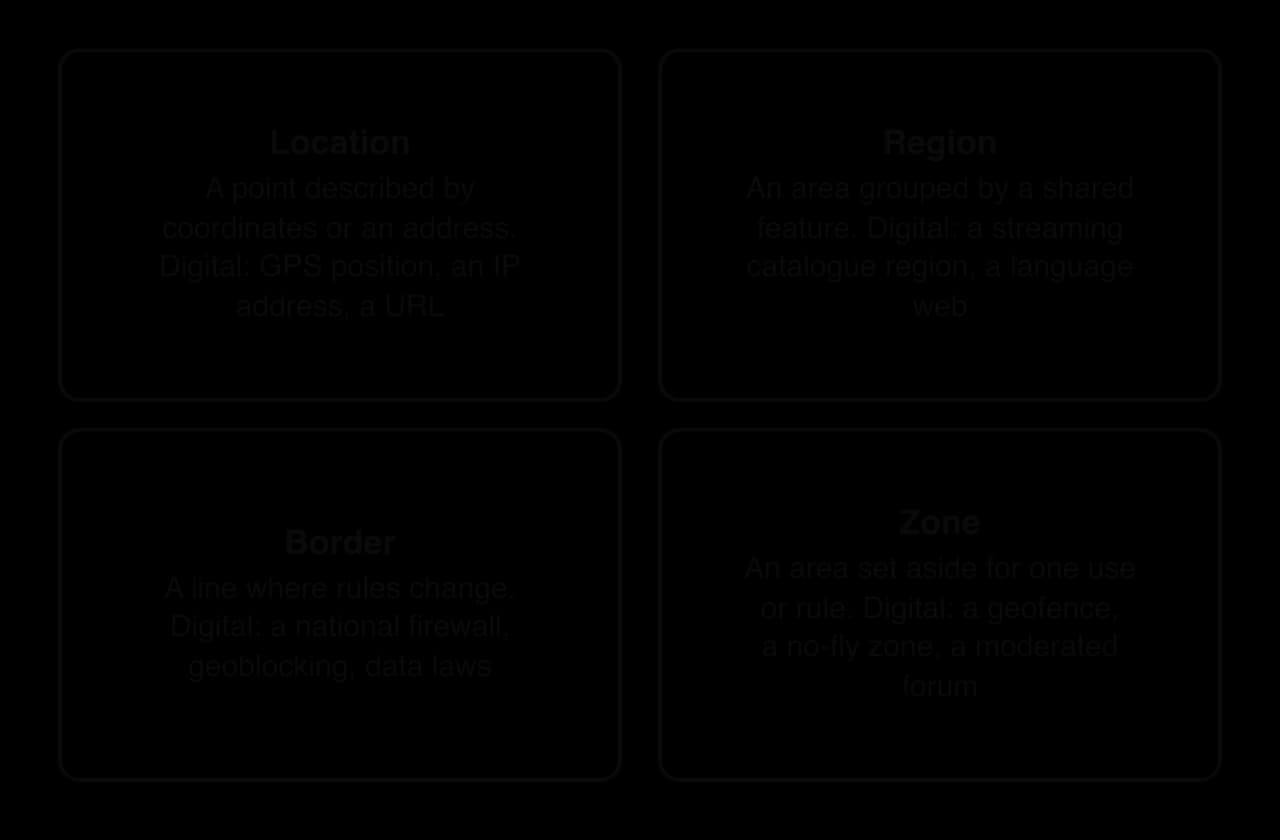
A location is a specific position in space. It can be absolute (a set of coordinates) or relative (next to the station, two streets from school). Digital systems record locations constantly. Smartphones log GPS positions, and every device connected to the internet has an IP address that roughly shows its country and often its city.
Location data changes how people experience specific places. Online maps add reviews, photos and opening times to almost every shop and street, so many people meet a place online before they visit it. Pokémon Go, released in 2016, placed virtual creatures at real locations, which turned parks, churches and monuments into game spaces. The United States Holocaust Memorial Museum and Arlington National Cemetery asked visitors not to play there, because the game treated sites of mourning as sites of play.
A region is an area grouped together because it shares a feature: a climate, a language, a government or an economic system. Digital systems create their own regions. Streaming services divide the world into licensing regions with different catalogues. Search engines and app stores run separate national versions, so a search for the same term returns different results in Mexico and in Spain.
Digital regions often follow language and culture as much as political lines. About half of all websites whose language can be identified use English, which makes English-speaking users the best-served online region and leaves speakers of many African and Asian languages with far less content in their own language.
A border is a line where rules change. Political borders separate states, which each make laws for their own territory. In the 1990s many people expected the internet to make borders meaningless. In 1996 the activist John Perry Barlow published a famous statement addressed to governments:
"Governments of the Industrial World, you weary giants of flesh and steel, I come from Cyberspace, the new home of Mind. … You have no sovereignty where we gather." John Perry Barlow, A Declaration of the Independence of Cyberspace (1996)
Three decades later, borders matter online in many ways. A digital border is any point where online access, content or data is controlled because of where a user, server or piece of data is located.
Three common forms of digital border are geoblocking, geofencing and data localization.
Geoblocking restricts access to online content according to the user's location, usually detected from the IP address. Netflix offers different catalogues in different countries because it buys film and series rights country by country. In 2016 it began blocking many users who used virtual private networks (VPNs) or proxy servers to appear to be in another country.
Geofencing draws a virtual boundary around a physical area and triggers an action when a device enters or leaves it. Drone maker DJI's software stops its drones from taking off near many airports. Shared e-scooter companies such as Lime slow scooters down or stop rides from ending inside geofenced no-parking zones.
Data localization laws require data about a country's citizens to be stored on servers inside that country. Russia's data localization law came into force in 2015, and in 2016 Russia blocked LinkedIn for not moving Russian users' data onto Russian servers. In 2018 the Reserve Bank of India required payment companies to store payment data about Indian users only in India.
Data can also be stopped at a border by privacy law. The EU's General Data Protection Regulation limits transfers of personal data to countries without equivalent protection. In 2023 Ireland's data protection regulator fined Meta €1.2 billion for transferring European Facebook users' data to the United States.
The answer depends on whose perspective is taken. For a user with a VPN, many borders are easy to cross. For a government, borders online have become stronger, because states have learned to control infrastructure, demand local data storage and fine companies under national law. For companies, borders create costs, since they must follow different rules in every market. The idea of a single, borderless internet has given way to what some call a "splinternet", a set of national and regional internets with different rules.
A zone is an area set aside for a particular use or governed by particular rules, such as a school zone, a conservation area or a special economic zone. Digital systems create zones in both physical and virtual space. Geofenced no-fly zones and scooter parking zones are physical zones enforced by software. Online, platforms create zones with their own rules: age-restricted areas, private groups, subreddits with their own moderators, and spaces set aside for verified users.
Content moderation works partly as zoning. A platform decides which content may appear in which part of its space, much as a city decides where factories or nightclubs may operate.
Different spaces serve distinct functions for people and communities. Physical spaces include homes (private life), schools (learning), workplaces (economic activity) and streets and squares (movement and public life). Virtual spaces also have functions: a family group chat is a private space, a professional network is a workplace space, a game server is a leisure space, and a public social media feed works partly as a public square.
A key distinction is between public and private space. Public space is open to anyone, while private space belongs to a person or organisation that controls entry. Much of the online world is private space that feels public. A social media platform is owned by a company that writes its rules and can remove users, yet people treat it as a public square for political debate. Through the concept of power, this raises a question that does not arise in a real town square: who decides what may be said when the "square" is owned by a company?
Digital systems also blur spaces that used to be separate. During the COVID-19 pandemic, remote working and remote learning turned bedrooms and kitchens into offices and classrooms. Work messages on phones now extend the workplace into evenings and holidays.
Online and physical spaces share many features. Both have entrances and exits, rules and norms, insiders and outsiders, and public and private areas. People form communities in both, and both can be designed to include or exclude. The sociologist danah boyd identified four features of "networked publics" (2010) that make online spaces behave differently from physical ones.
Feature of online space | What it means | Contrast with physical space |
|---|---|---|
Persistence | Posts and messages are recorded and can stay online indefinitely | Spoken words in a room disappear unless recorded |
Replicability | Content can be copied exactly and moved elsewhere | A conversation in a café cannot be duplicated exactly |
Scalability | Content can reach a very large audience quickly | The audience of a speech is limited by the size of the space |
Searchability | Content can be found later by people who were not present | A remark in a corridor cannot be searched for |
Source: danah boyd, "Social network sites as networked publics", 2010.
These features explain why behaviour that would be harmless in a physical space can have lasting effects online. A joke told to friends may be screenshotted (replicated), shared widely (scaled) and found years later by an employer (persistence and searchability).
The digital divide is the gap between people with effective access to digital systems and those without. Many divides are spatial: they depend on where a person lives, studies or works. A spatial divide is a difference in access to digital systems between places, at any scale.
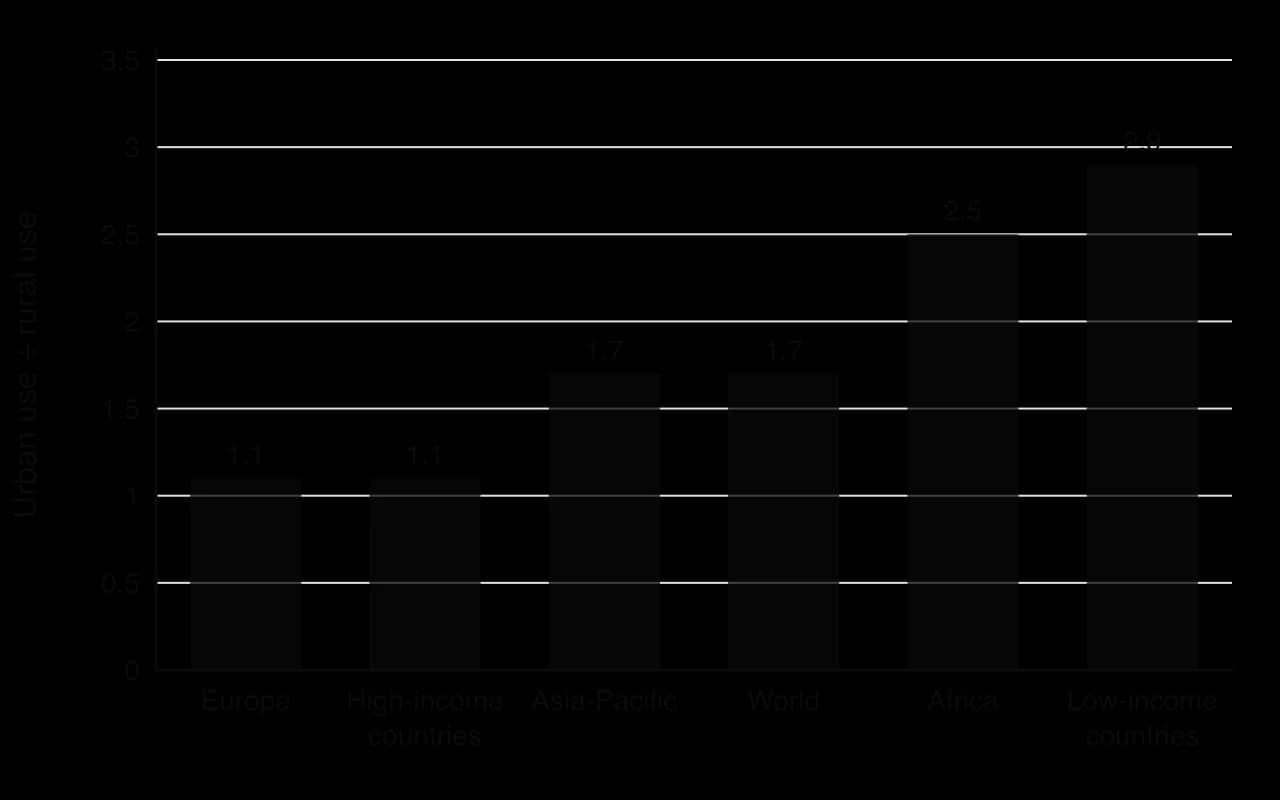
The largest spatial divide within countries is between towns and the countryside. Connecting rural areas costs more per person, because cables must cover long distances to reach fewer customers. According to the ITU, 83% of urban dwellers used the internet in 2024, compared with 48% of rural dwellers. Of the 2.6 billion people still offline, about 1.8 billion lived in rural areas. The gap is widest in the poorest regions, as the chart of urban–rural ratios shows.
Divides also exist at smaller scales. In the United States, the "homework gap" describes school students without home broadband. In 2020, during school closures, a photograph of two primary school pupils in Salinas, California, doing their homework on the pavement outside a Taco Bell restaurant to use its free Wi-Fi was shared widely. Public libraries, cafés and community centres often act as access spaces for people without connections at home, which shows how the function of a physical space can change when it fills a digital gap.
Space is not only about where things are but also about how they move. Geographers call the movement of people, goods, money and information between places "flows". Digital systems have greatly increased the speed and volume of flows, while making access to them uneven.
Flows of data are the movements of digital information between devices, servers and networks, often across national borders. A video watched in Nairobi may flow from a data centre in Europe through cables under the sea and over land, then through a mobile mast. Almost all intercontinental internet traffic travels through submarine cables rather than satellites.
The routes of these flows matter. Places on major cable routes, such as Marseille in France and Singapore, have become important internet hubs. Places with only one connection are vulnerable. In January 2022 the eruption of the Hunga Tonga–Hunga Ha'apai volcano cut Tonga's only international submarine cable, leaving the country almost without internet access for about five weeks while the cable was repaired.
Media circulates through digital society along several paths at once: recommendation algorithms push content to users likely to engage with it, users share and remix it in messaging apps and on social media, and pirated copies spread outside official channels.
These flows can move media across borders very quickly. In 2012 the South Korean music video "Gangnam Style" by PSY became the first YouTube video to reach one billion views, mostly from viewers outside Korea who did not understand the lyrics. Flows are not equal in all directions, however. Large platforms based in the United States and China host most of the world's video, and their algorithms and licensing deals affect which media travels and which stays local.
Media flows also meet borders. Geoblocking keeps films and sports broadcasts inside licensing regions. Censorship stops some content entering a country at all, while VPNs and file sharing carry media around these barriers. How far media travels therefore depends both on those who control the channels and on users who find ways around them.
Digital systems also change how people move. Migrants use smartphones to plan routes, contact family and find services; many of the refugees who travelled to Europe in 2015 relied on WhatsApp groups and online maps. Digital systems can also replace physical movement. Video calls replace some business travel, and some workers become digital nomads who work online while living in different countries. Estonia's e-Residency (2014) lets people anywhere run an Estonian company online without living there.
The geographer David Harvey used the term time–space compression (1989) for the way technology shrinks the time it takes to cross space, so that distant places feel closer. Railways, the telegraph and air travel each compressed space; digital networks have taken this furthest. A video call connects relatives on different continents with less than a second of delay, and global financial markets react to news in milliseconds.
Compression is uneven. The geographer Doreen Massey argued (1991) that people stand in different positions in relation to flows. Some control them, some benefit from them, and some are left behind by them. A software developer in Bengaluru working for a Californian company experiences a shrunken world; a farmer in a village without a mobile signal does not. Through the concept of power, flows always raise the question of who can move, who can send and who can receive.
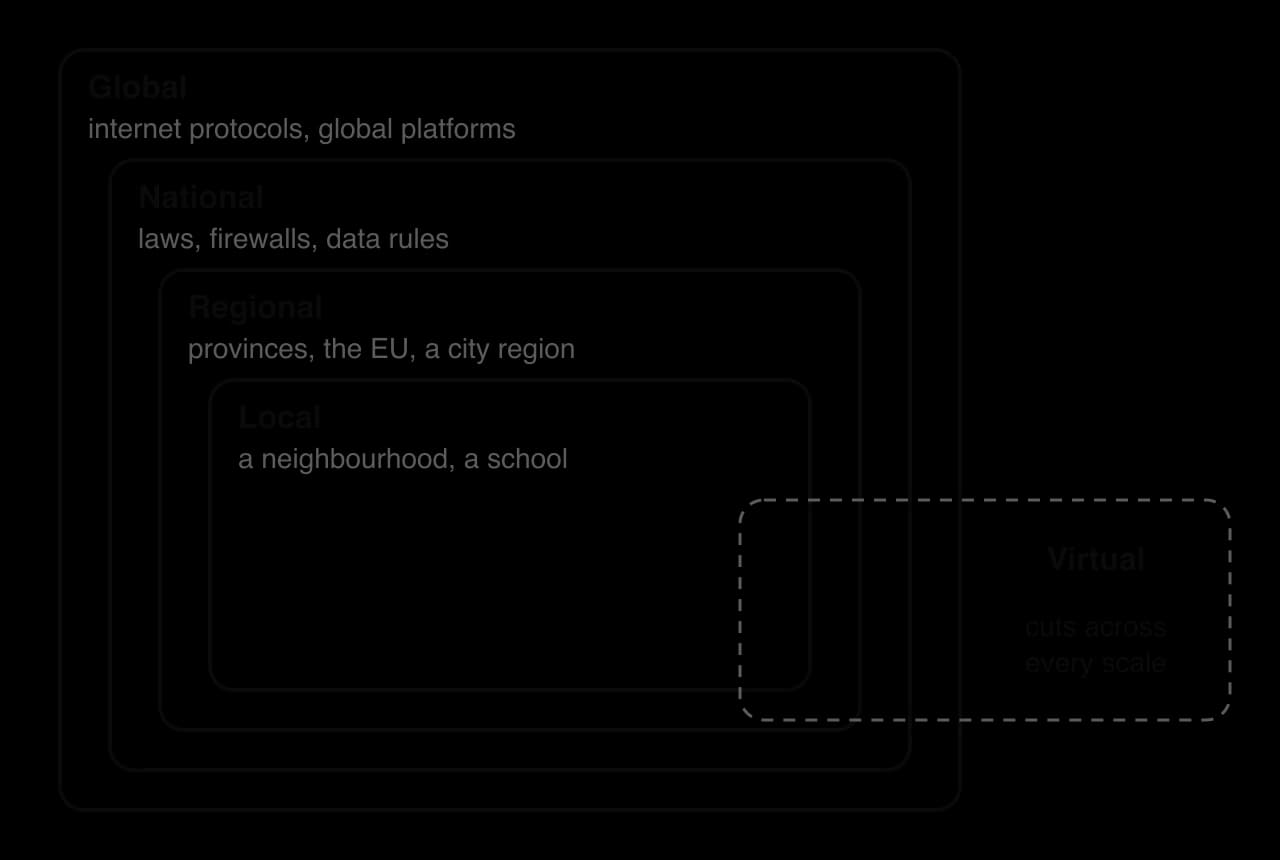
Scale is the level at which space is studied: a neighbourhood, a province, a country, the whole planet or a virtual world. The same digital system can have different impacts at different scales, so naming the scale makes an analysis more precise. The nested diagram shows how the physical scales fit inside each other and how virtual space crosses them.
Scale | Meaning | Digital example |
|---|---|---|
Local | A neighbourhood, school, village or city | Community WhatsApp groups; a mobile mast serving a few streets |
Regional | An area within a country, or a group of neighbouring countries | Since 2017 the EU's "roam like at home" rules let people use their phones across the EU at home prices |
National | A country and its government | National laws on data, national digital identity systems, national firewalls |
Global | The whole world | Internet protocols, global platforms such as YouTube, submarine cable networks |
Virtual | Spaces created by digital systems | Online games, virtual reality worlds, social media platforms |
Scales interact. A global platform such as TikTok is used locally, governed nationally and regionally (by EU law, for example) and experienced as a virtual space. A national ban on an app removes a local space where friends meet, and a local protest filmed on a phone can become a global news story within hours.
Physical space influences virtual space in several ways, as the two-way diagram shows.
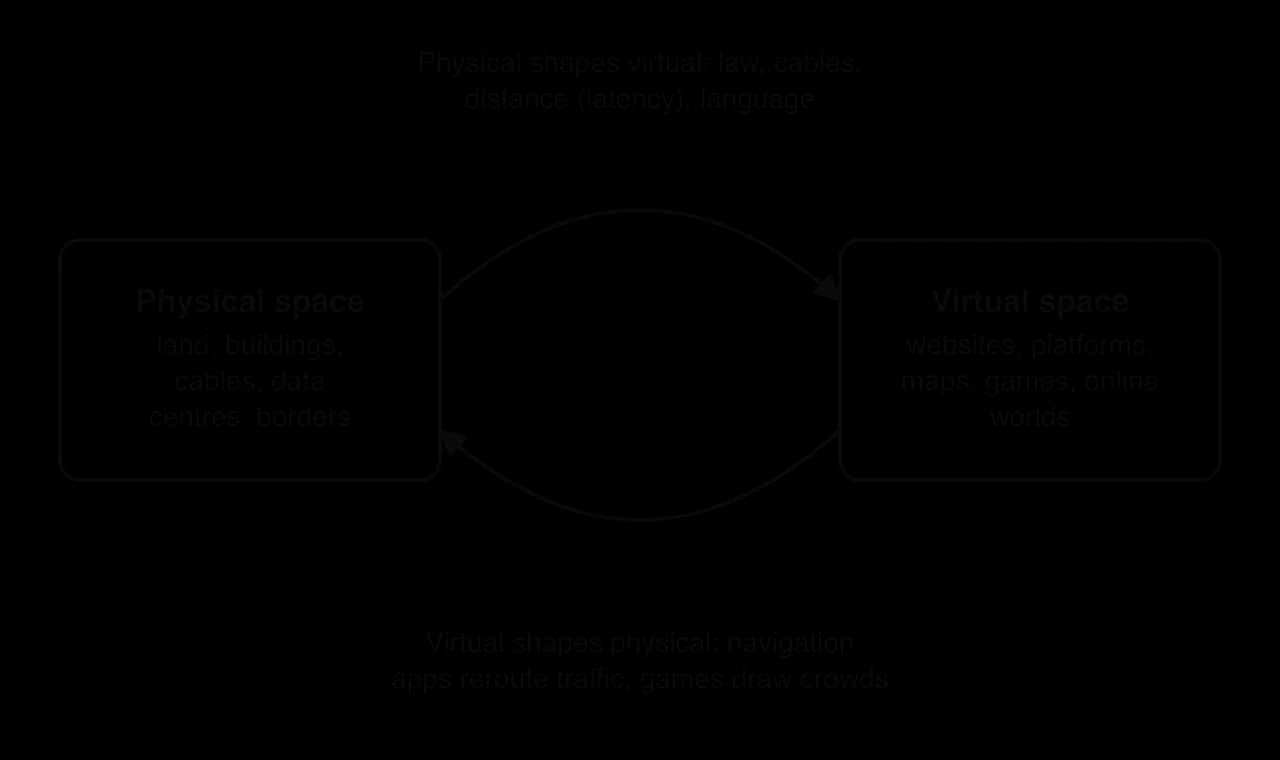
Infrastructure. Virtual spaces depend on physical cables, masts and data centres, so places with poor infrastructure have poor access, as Tonga's cable cut showed.
Distance. Data travels fast but not instantly. Latency, the delay as data travels, rises with distance, so online gamers in South America often prefer servers on their own continent.
Climate and resources. Data centres need cheap energy and cooling. Facebook (now Meta) opened a data centre in Luleå in northern Sweden in 2013, partly because its cold climate cools servers and hydroelectric power is plentiful.
Law. Virtual spaces are subject to the laws of the territory where users and servers are located, as data localization and geoblocking show.
The influence also runs the other way. Navigation apps such as Waze send drivers along shortcuts through residential streets. In January 2018 the small town of Leonia, New Jersey, close to the George Washington Bridge into New York, closed most of its residential streets to non-residents at rush hour because app-guided traffic had filled them; within weeks it began to scale the ban back after local businesses complained of lost trade. Pokémon Go drew large crowds to particular parks and landmarks. Digital twins such as Virtual Singapore shape decisions about where buildings and roads go.
To what extent does each influence the other? Physical space sets the limits of virtual space, because without cables, power and devices there is no virtual space at all. Within those limits, virtual space increasingly decides how physical space is used. The balance depends on the example and on the people involved, which makes it a good question for an inquiry.
Space can be applied to any digital system. The table shows how the concept gives insight into technologies from the content areas, each situated in a context.
Content | Context | Real-world example | What the lens of space shows |
|---|---|---|---|
3.1 Data | 4.6 Political | Apple moved the iCloud data of users in mainland China to a Chinese state-owned company's data centres in Guizhou in 2018 to comply with Chinese law | Data localization places data under the law of the territory where it is stored |
3.4 Networks and the internet | 4.5 Human knowledge | Starlink satellite internet reaching the Marubo people in the Javari Valley of the Brazilian Amazon from 2023 | Satellites bypass the cost of cables, closing a spatial divide but bringing new flows into a remote community |
3.5 Media | 4.1 Cultural | Netflix licensing different catalogues for different countries | Geoblocking creates cultural regions inside a global platform |
3.7 Robots and autonomous technologies | 4.6 Political | DJI drones geofenced away from airports | Software enforces zones in physical airspace |
Starlink, operated by SpaceX, uses thousands of satellites in low Earth orbit to connect places that cables have never reached. In September 2023 the Marubo, an Indigenous people in the remote Javari Valley of the Brazilian Amazon, received Starlink dishes and used them to contact relatives and call for help in emergencies. Reporting in 2024 also described Marubo leaders' concerns about young people spending long hours on phones and meeting pornography and social media for the first time. Through the concept of space, the case shows a spatial divide closed without infrastructure across the land in between, with new flows that bring both opportunities and risks, through a route controlled by a private company.
Applying a concept as a lens means asking the questions the concept raises and using its vocabulary. For space, a useful sequence of questions is:
Spaces and places. Which physical and virtual spaces does the digital system involve, and which places matter to the people involved?
Organisation and representation. How does the system locate, map, divide or represent space? Does it create borders, regions or zones?
Functions. What do the spaces do for different people and communities? Has the system changed those functions?
Access, movement and flows. What flows through the system (data, media, people, money)? Who has access, and who is excluded or controlled?
Scales. At which scales (local, regional, national, global, virtual) do impacts appear, and how do the scales interact?
Physical and virtual. How does physical space shape the system, and how does the system shape physical space?
Judgement. Bring the answers together into a supported conclusion, and link to another concept where it adds insight (often power, or values and ethics).
The sequence is flexible. A brief analysis may use only two or three of the questions, while an inquiry project may use all of them, always to explain impacts on specific people and communities.
The Great Firewall is the popular name for the system of laws, technologies and organisations the government of the People's Republic of China uses to control which online content can be reached from inside mainland China. It is part of a wider programme, the Golden Shield Project, begun by the Ministry of Public Security in the late 1990s and in operation from the early 2000s. China has the largest online population in the world. The China Internet Network Information Center (CNNIC) reported 1.108 billion internet users in December 2024, about 79% of the population.
The Great Firewall is the clearest real-world example of a digital border. It follows the political border of mainland China, but it is drawn in virtual space. Hong Kong and Macao, which have separate legal systems, are outside it, so the online border does not exactly match the physical one.
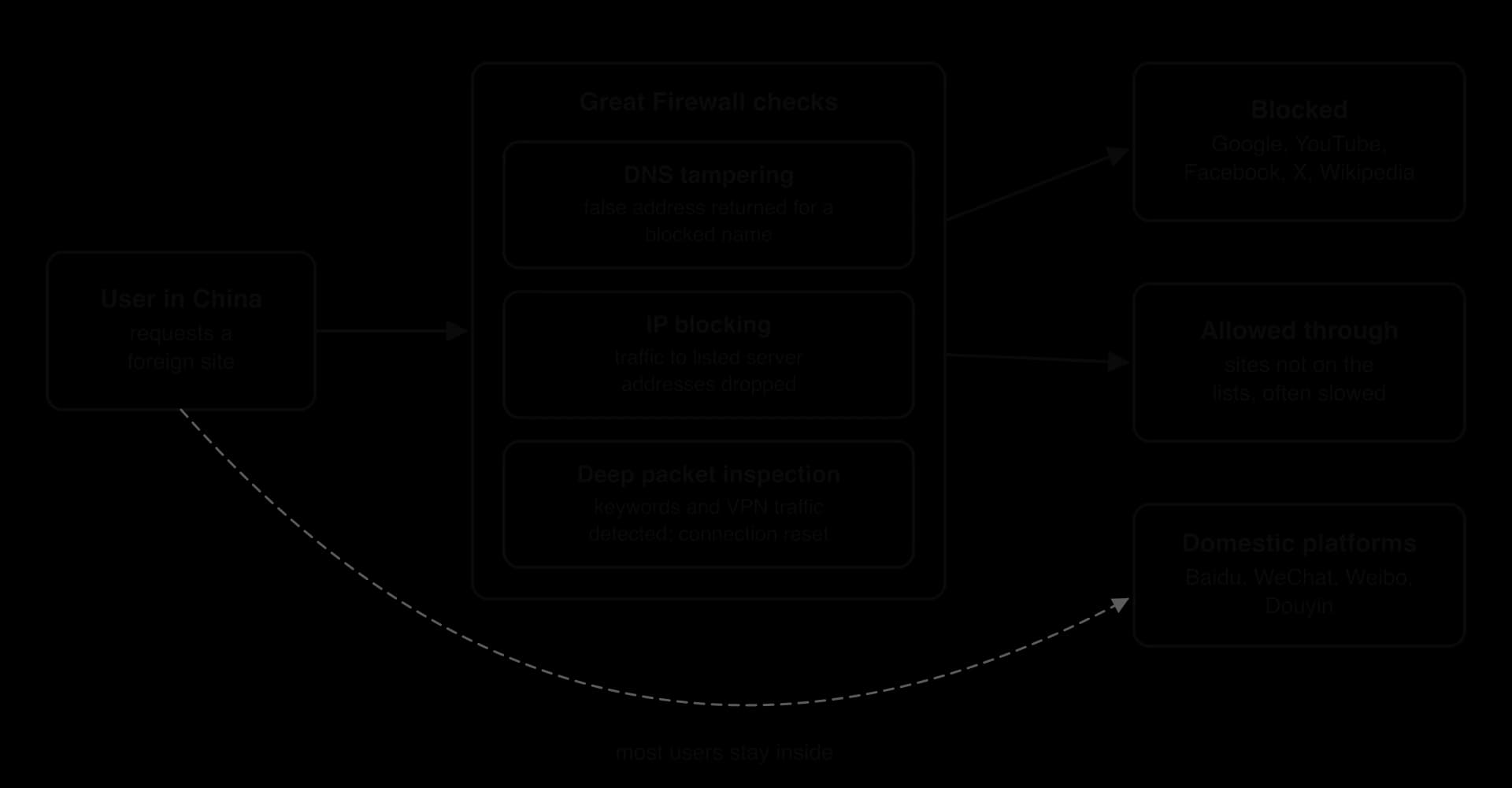
The Great Firewall works at the points where China's networks connect to the rest of the internet. Because international traffic must pass through a small number of state-controlled gateways, the government can inspect and filter it. The main techniques, shown in the flow diagram, are:
DNS tampering. When a user asks for a blocked domain name, the system can return a false address, so the site fails to load.
IP blocking. Traffic to the IP addresses of listed servers is dropped.
Keyword filtering and packet inspection. The system examines data in transit for banned words or for patterns that look like VPN traffic, and resets the connection if it finds them.
Throttling. Some foreign sites are not blocked but load very slowly, which pushes users towards domestic alternatives.
The technology is backed by law. Chinese platforms must monitor and remove content that breaks government rules. The Cybersecurity Law of 2017 requires operators of critical information infrastructure to store personal data about Chinese citizens inside China. In 2017 the government also ordered that VPN services must be government-approved, and Apple removed many VPN apps from its Chinese App Store the same year.
Many major foreign platforms are blocked. Facebook and Twitter (now X) have been unreachable since July 2009, after unrest in Ürümqi, Xinjiang. Google moved its Chinese search service to Hong Kong in 2010 after disputes over censorship and hacking, and its services are blocked on the mainland. All language versions of Wikipedia have been blocked since 2019. In their place, Chinese companies have built a separate set of platforms: Baidu for search, WeChat for messaging and payments, Weibo for microblogging and Douyin, the Chinese version of TikTok, for short video.
 YouTube
People and communities | Impacts | Implications |
|---|---|---|
Most Chinese internet users | Use domestic platforms for almost everything; rarely meet the firewall directly | Access to information about some political and historical events is restricted; views of the world are shaped by what is allowed in |
Journalists, researchers and activists | Need VPNs to reach foreign sources and academic tools; risk penalties for spreading banned content | Self-censorship grows; international research collaboration is harder |
Chinese technology companies | Protected from foreign competition inside the world's largest online market; grew into global firms such as Tencent, Alibaba and ByteDance | Must follow state rules on content and data, which affects trust in their products abroad |
Foreign companies and visitors | Google services and familiar apps are unavailable | Some firms leave: LinkedIn closed its Chinese social network in 2021, citing a more challenging operating environment |
The Chinese government | Can control information flows, respond to unrest and promote its own narratives | Sets a model of "cyber sovereignty" that other governments may copy |
Freedom House's Freedom on the Net 2025 report gave China a score of 9 out of 100 for internet freedom, the joint lowest of the 72 countries it assessed, with Myanmar. The Chinese government rejects this view. It argues that each state has the right to govern the internet within its territory, as it governs its land. It calls this position cyber sovereignty, a form of digital sovereignty.
Through the concept of space, the Great Firewall shows a political border enforced through network infrastructure. The border sits at network gateways and inside routing and filtering systems rather than at a customs post. It controls flows of data and media in both directions, since it limits what Chinese users can see and also the reach of foreign platforms into China.
The case also shows how scale matters. At the national scale the firewall creates a separate Chinese virtual space with its own platforms, culture and creators. At the global scale it contributes to the "splinternet", in which the internet divides into regions with different rules. At the individual scale it shapes the daily experience of more than a billion people, most of whom rarely think about the border.
The border is also porous. Foreign visitors using mobile data roaming from their home network can often reach blocked sites, because their data is routed through their home country. Many Chinese users with technical skills and money use VPNs, though these are often slowed or blocked at sensitive times.
Through the concept of power, the firewall shows structural power embedded in infrastructure, since control of the network gateways gives the state control over what flows through them. The state exercises power through companies, which carry out much day-to-day censorship to keep their licences. The system also shifts economic power, since domestic companies were protected while they grew.
Supporters of the system, mainly the Chinese government, claim that it protects social stability, national security and Chinese companies, and that each state has the right to set its own rules online. The rapid growth of Chinese platforms suggests that a closed national internet can still be commercially dynamic.
Critics, including human rights organisations, journalists and many researchers, argue that the firewall restricts freedom of expression and access to information and isolates Chinese users from global conversations. The costs fall hardest on those who need outside information most, such as researchers, journalists and minority communities.
A balanced judgement is that the Great Firewall is highly effective at controlling flows for the majority of users, but that its effectiveness depends on users accepting domestic alternatives and on companies carrying out censorship. It shows that political borders still have meaning online. Whether this is a reasonable exercise of state authority or a serious limit on human rights depends on the values used to judge it, which links the concept of space to the concept of values and ethics.
The second question follows the format of a source-based question.
I can define space, place, physical space, virtual space and cyberspace, and explain how they differ.
I can outline how at least five of the disciplines that study space approach it, with a digital example for each.
I can describe locations, regions, borders and zones, and give a digital example of each.
I can define geoblocking, geofencing and data localization, with a real-world example of each, and discuss whether physical and political borders still have meaning in a digital society.
I can explain how different spaces serve distinct functions, including public and private spaces online.
I can explain four ways online space differs from physical space.
I can describe spatial divides at different scales, using ITU data on urban and rural internet use.
I can analyse flows of data, media and people, explain time–space compression and say why access to flows is uneven.
I can distinguish local, regional, national, global and virtual scales, with an example of each.
I can discuss how physical space influences virtual space and how virtual space influences physical space.
I can apply the concept of space step by step to a new real-world example.
I can evaluate China's Great Firewall through the concepts of space and power.