
Define expression, explain how digital systems change its modes, media and functions, and evaluate the dilemmas it raises, from hate speech to content moderation, using #MeToo as a case study.
Each is in the Digital Society glossary, with every other term in the subject.
The creation of new artistic forms, techniques, styles or ideas, often by using new technologies or by combining existing forms in new ways.
The discouragement of lawful expression or activity across a population because people fear surveillance, punishment or harassment, even when no one has acted against them directly.
The monitoring of user-generated content on a platform and the removal, labelling, demotion or restriction of content that breaks the platform's rules or the law.
Telling a story with digital tools and media, often combining text, image, sound and video, and sometimes letting the audience shape or add to the story.
The act, process or product of representing ideas, emotions or experiences in a form that others can perceive, using one or more modes and media.
The right to hold opinions and to seek, receive and share information and ideas through any medium without interference from the state, subject only to limits set by law that are necessary to protect the rights or reputations of others, national security, public order, public health or morals.
Using a shared hashtag on social media to draw attention to a political or social cause, connect people who support it and put pressure on those with power.
Expression that attacks, insults or encourages hostility towards a person or group because of an identity characteristic such as ethnicity, religion, nationality, gender, sexuality or disability.
A type of sign or resource used to make meaning, such as written text, speech, image, moving image, sound or gesture. A single medium, such as a TikTok video, often combines several modes.
A culture in which ordinary people do not only consume media but also create and share their own, with low barriers to taking part and support from a community of other creators.
Choosing not to express an idea, opinion or experience, or changing how it is expressed, because of fear of negative consequences from the state, an employer, a platform or other people.
Creating a detailed imaginary world with its own places, history, rules and inhabitants, in which stories, games or other works can be set.
Define expression and distinguish between a mode and a medium of expression.
Outline how media studies, communications, digital humanities, languages and literature, the arts, film and art history approach expression.
Explain how digital systems influence the ways people express ideas, emotions and experiences.
Describe the main functions of expression, including storytelling, world-building, artistic innovation and political activism, with real-world examples.
Explain how digital expression brings people and communities together.
Analyse the dilemmas raised by digital expression, including hate speech, content moderation, self-censorship and the chilling effect.
Discuss who should decide the limits of digital expression, and how.
Evaluate a real-world example, such as #MeToo, through the concept of expression.
Expression is the way people turn what they think, feel and experience into something others can see, hear or read. Digital systems have made expression cheaper, faster and more public than at any time in history. A teenager with a phone can publish a song, a story or a protest message to a global audience within seconds.
Expression is one of the seven concepts of the course, the lenses used to make sense of any digital system. It connects closely with identity (people express who they are), power (who is heard and who is silenced), and values and ethics (what should be allowed). It is most visible in content about media (3.5), social media and networks (3.4) and generative artificial intelligence (3.6), and in the cultural, social and political contexts (4.1, 4.7, 4.6).
With a free account, Augment remembers where you stopped and what you have practiced.
Scope: this concept covers what expression is and how it uses different modes and media, the functions it serves (storytelling, world-building, artistic innovation and political activism), and how it brings people and communities together while raising dilemmas about whether some digital expression should be limited, and who decides.
Expression is the act, process or instance of representing ideas, emotions or experiences so that they can be communicated. The definition has three parts. The act is the moment of creating something, such as posting a photo. The process is the work behind it, such as drafting, editing and choosing a filter. The instance is the finished product, the post itself, which can be shared, archived and interpreted long after it was made.
Expression always involves a choice of form. A person who is angry about a local factory closure can write a letter to a newspaper, film a short video, draw a cartoon or compose a protest song. For this reason, studying expression means studying both what is said and how it is said.
Two terms help describe the form of any act of expression. A mode is the type of sign used to make meaning: written language, speech, still images, moving images, sound and music, gesture, or layout. A medium is the channel or technology that carries it: a printed book, a podcast, an Instagram post, a video game. One medium usually combines several modes. A TikTok video, for example, mixes moving images, music, on-screen text, speech and gesture.
Mode | Pre-digital forms | Digital forms | What the digital form adds |
|---|---|---|---|
Written text | Letters, books, newspapers | Blogs, tweets, comments, fan fiction | Instant publication, hyperlinks, hashtags, global reach |
Still image | Painting, printed photography | Smartphone photos, memes, emoji, AI-generated images | Easy editing, remixing, filters |
Moving image | Cinema, television | YouTube, TikTok, livestreams on Twitch | Anyone can broadcast; live interaction with viewers |
Sound | Radio, records, live music | Podcasts, streaming, voice notes | Low-cost recording and distribution |
Gesture and the body | Dance, theatre | Dance challenges, reaction videos, avatars in games | Movement copied and repeated by millions |
Interaction | Board games, choose-your-own-adventure books | Video games, interactive films, virtual worlds | The audience makes choices that change the work |
The expression model places every act of expression inside a context of culture, language, law and platform rules, and shows that digital audiences do not only receive a work. They respond to it, and their responses feed back to the creator.
Digital systems influence expression in at least five ways, and each one is a starting point for analysis.
Lower barriers. Publishing once needed a printer, a broadcaster or a gallery. A smartphone and a free account now give anyone a global channel. In December 2020 the Scottish postman Nathan Evans posted a sea shanty, "Wellerman", on TikTok; other users added harmonies and instruments through the app's duet feature, and in January 2021 his recording reached number one in the UK singles chart.
Speed and scale. Expression spreads in hours rather than weeks. Content can go viral, reaching millions of people through shares and recommendation algorithms.
Multimodality. Apps combine text, image, sound and video in one post. New modes have also appeared: emoji, GIFs and reaction images form a visual vocabulary of their own. In 2015 Oxford Dictionaries chose the "face with tears of joy" emoji as its word of the year.
Interactivity and remix. Audiences comment, duet, stitch and remix. The line between creator and audience blurs.
Mediation by platforms. Most digital expression takes place on privately owned platforms. Their design (character limits, filters, ranking rules) and their rules shape what people say and who sees it.
The fifth point is easy to overlook. A post on X, Instagram or YouTube does not reach an audience directly. It passes through ranking systems that favour some content over other content, so creators often adapt their expression to the system. A well-known example is "algospeak": TikTok users write "unalive" instead of "kill" or "seggs" instead of "sex" because they believe automated moderation will hide posts that use the plain words.
Expression is studied by many subjects, fields and professions, and borrowing their questions is a quick way to "think like a practitioner". The table summarises the main approaches.
Discipline | Typical questions about expression | Key idea or thinker | Digital example |
|---|---|---|---|
Media studies | How does the medium shape the message? Who owns the channel? | Marshall McLuhan, "the medium is the message" (1964) | How TikTok's short, vertical format favours fast, music-led storytelling |
Communications | Who says what, through which channel, to whom, with what effect? | Harold Lasswell's model of communication (1948); Stuart Hall's encoding and decoding (1973) | How the same meme is read differently by different audiences |
Digital humanities | What patterns appear when computers analyse large collections of texts and images? | "Distant reading" (Franco Moretti) | Google Books Ngram Viewer used to track how often words appear in books over centuries |
Languages and literature | How do language and narrative change online? | Internet linguistics (Gretchen McCulloch, Because Internet, 2019) | Emoji, hashtags and algospeak as new forms of written language |
The arts | What new forms and techniques are possible? What counts as art? | Remix and participatory art | Refik Anadol's Unsupervised (MoMA, 2022–2023), made from the museum's collection data |
Film studies | How is narrative built with moving images, and how do audiences watch? | Lev Manovich, The Language of New Media (2001) | Netflix's interactive film Black Mirror: Bandersnatch (2018), where viewers choose the plot |
Art history | How do technologies of reproduction change the value and meaning of art? | Walter Benjamin's essay on art and mechanical reproduction (1935) and the "aura" of the original | Debates about whether a non-fungible token (NFT) restores uniqueness to a copyable digital image |
Two of these ideas are especially useful in analysis. McLuhan's claim that "the medium is the message" means that a medium changes how people think and relate to each other, whatever content it carries. The endless scroll and one-tap reactions of social media, for example, encourage short, emotional expression on any topic. Stuart Hall argued that audiences decode a message in their own way, accepting, negotiating or rejecting the intended meaning; online, this decoding is visible in comments, quotes and remixes.
The humanities disciplines add a long view. Digital humanities uses computational tools to find patterns across millions of books, posts or song lyrics, rather than reading one text closely. Linguists record how online writing creates new conventions, such as all-capitals for shouting or a full stop in a text message to signal seriousness. In art history, Walter Benjamin argued in 1935 that photography and film removed the "aura" of the unique original artwork. Digital copying goes further, since a digital image can be copied perfectly and endlessly, which raises questions about originality, ownership and value that copyright law and NFTs both try to answer.
Expression serves many purposes. Four functions are especially important in digital society: storytelling, world-building, artistic innovation and political activism. A single work often serves more than one. The functions diagram links each function to a real-world example.

Storytelling is one of the oldest functions of expression: people share events, real or imagined, to make sense of experience, entertain, teach and remember. Digital storytelling uses digital tools to tell stories, often combining several modes and sometimes letting the audience take part.
Digital media make several kinds of story possible that were difficult or impossible before.
Personal and everyday stories. Instagram and Snapchat Stories, vlogs and TikTok "storytimes" let ordinary people narrate their lives as they happen.
Interactive and branching stories. In Black Mirror: Bandersnatch (Netflix, 2018), viewers chose what the main character did, leading to several different endings.
Testimony and witness. Survivors, refugees and citizen journalists tell their own stories without needing a publisher. Personal testimony was the foundation of #MeToo.
New serial forms. Webtoons, vertical-scrolling comics that began on South Korean platforms such as Naver Webtoon in the 2000s, are designed to be read on a phone, one episode at a time.
Each kind changes the relationship between storyteller and audience. In a printed novel the author controls the order of events. In a branching or collaborative story control is shared, which raises questions about authorship that link to the concept of power.
World-building is the creation of a complete imagined setting, with its own geography, history, rules, cultures and characters. Digital systems turn it into a shared and often interactive activity.
In video games, designers build worlds that players explore, and in sandbox games such as Minecraft the players build the world themselves. In fan communities, readers extend existing fictional worlds with new stories. Archive of Our Own (AO3), a non-profit site run by volunteers of the Organization for Transformative Works since 2009, hosts millions of fan works across tens of thousands of fandoms, and in 2019 it won a Hugo Award, one of the main prizes in science fiction. Finally, world-building can serve a serious purpose. In 2020 Reporters Without Borders opened the Uncensored Library, a building inside Minecraft that holds articles by journalists from countries with strong press censorship, so that young people in those countries can read them inside a popular game.
The Uncensored Library shows that world-building is more than entertainment. Through the concept of space, a virtual world can become a place where expression that is banned in physical space survives. It also connects to participatory culture, since the worlds are built and kept alive by their communities.
The media scholar Henry Jenkins developed the idea of participatory culture from his studies of fan communities. Digital platforms have made this activity mainstream: YouTube, TikTok, AO3 and Wattpad are built on it. Critics point out that participation is uneven. A small share of users create most content, and platforms profit from unpaid creative work.
Artistic innovation is the development of new forms, techniques or ideas in art. Digital systems supply both new forms, such as video games and generative art, and new tools for old ones.
Three examples show the range. Refik Anadol's Unsupervised, shown at the Museum of Modern Art in New York in 2022 and 2023, used a machine learning model trained on data from the museum's collection to create constantly changing abstract images. In March 2021 the digital artist Beeple sold an NFT of his collage Everydays: The First 5000 Days at Christie's for about $69 million, raising the question of whether a file that anyone can copy can be a valuable original. In 2022 Jason M. Allen won a prize at the Colorado State Fair with an image made with the generative AI tool Midjourney, and many artists objected that the work was not his own expression.
These cases show that artistic innovation often raises the question of what counts as art and who counts as the artist. Generative AI sharpens the question, because it is trained on millions of existing works, often without the consent of the artists who made them.
Digital activism uses digital media to raise awareness, organise protests, pressure decision-makers and document abuses. Its most visible form is hashtag activism, where a hashtag gathers many people's posts around a cause.
In Nigeria, the #EndSARS movement in October 2020 used Twitter and Instagram to share videos and testimonies of abuse by the police unit known as SARS (Special Anti-Robbery Squad). The posts fed street protests across Nigerian cities and the diaspora, and the government announced it was dissolving the unit.
Hashtag activism has clear strengths. It is cheap, fast, global and open to people who cannot attend a protest. Critics argue that it can encourage slacktivism, low-effort support such as liking or sharing a post that changes little. Activists also become visible to the governments and groups they oppose, which increases the risk of online harassment and surveillance.
Expression creates connection. When people share an idea, an emotion or an experience, others who recognise it can respond, and communities form around that shared meaning. Digital systems make this possible across distance, language and time zones.
Digital expression builds communities in several ways.
Shared interests. Fan communities, gaming guilds and music scenes form around shared tastes.
Shared experiences. People with a rare illness, a disability or a minority identity find others like them.
Shared causes. Fundraising and awareness campaigns bring together people who care about the same issue. The 2014 Ice Bucket Challenge, in which people filmed themselves pouring ice water over their heads and nominated friends, raised about $115 million for the ALS Association in the United States.
Communities built on expression also have a darker side. The same features that connect supporters of a cause connect extremist groups. Platforms that reward strong emotion can push communities into an echo chamber, where members hear only views they already hold, and can turn one group's expression into another group's target.
The power of digital expression to reach and move people is also the source of its dilemmas. A dilemma is a situation in which two important values pull in different directions, so any choice involves a cost. Most dilemmas about expression set freedom against protection from harm.
Freedom of expression is the right to seek, receive and share information and ideas of all kinds, through any medium, without interference. It is protected in Article 19 of the Universal Declaration of Human Rights (1948) and in Article 19 of the International Covenant on Civil and Political Rights (ICCPR, 1966), which most countries have ratified.
Freedom of expression is not unlimited, even in international law. The ICCPR allows restrictions only if they are set out in law and are necessary to respect the rights or reputations of others, or to protect national security, public order, public health or morals. It also requires states to ban advocacy of national, racial or religious hatred that incites discrimination, hostility or violence.
Countries draw the line in very different places. The First Amendment to the United States Constitution gives very strong protection to speech, including most offensive speech, and it only limits what governments may do, not what private companies such as Meta or YouTube may remove. Germany, because of its history, bans Holocaust denial and Nazi symbols. Authoritarian states use broad laws on "rumours", "extremism" or "insulting the state" to silence critics, which is censorship rather than a necessary limit.
Hate speech is the most common reason given for limiting expression online. There is no single legal definition. The United Nations Strategy and Plan of Action on Hate Speech (2019) describes it as communication that attacks or uses discriminatory language about a person or group because of an identity factor such as religion, ethnicity, nationality, race or gender.
Hate speech is difficult to regulate for two main reasons. First, the definition depends on context: a slur can be an attack in one post and a quotation, a news report or a reclaimed word in another. Second, deciding what counts as hate is itself an exercise of power. The UN's Rabat Plan of Action (2012) suggests a six-part test for when hateful speech should be a crime: the context, the speaker, the intent, the content and form, the reach of the speech, and the likelihood that it leads to harm.
Content moderation is the process by which platforms decide what users may post and what stays visible. It is where most decisions about the limits of digital expression are now made.
Moderation combines three methods. Automated systems, mostly machine learning classifiers, scan posts as they are uploaded and remove or flag likely breaches. Human moderators, often employed by outsourcing companies in countries such as the Philippines, India and Kenya, review flagged posts and hard cases, sometimes viewing traumatic material for hours a day. Users report content they think breaks the rules.
The scale explains why automation has grown. The proactive rate chart shows that in late 2017 Facebook's systems found less than a quarter of the hate speech it removed before a user reported it; by 2020 they found about 95%.
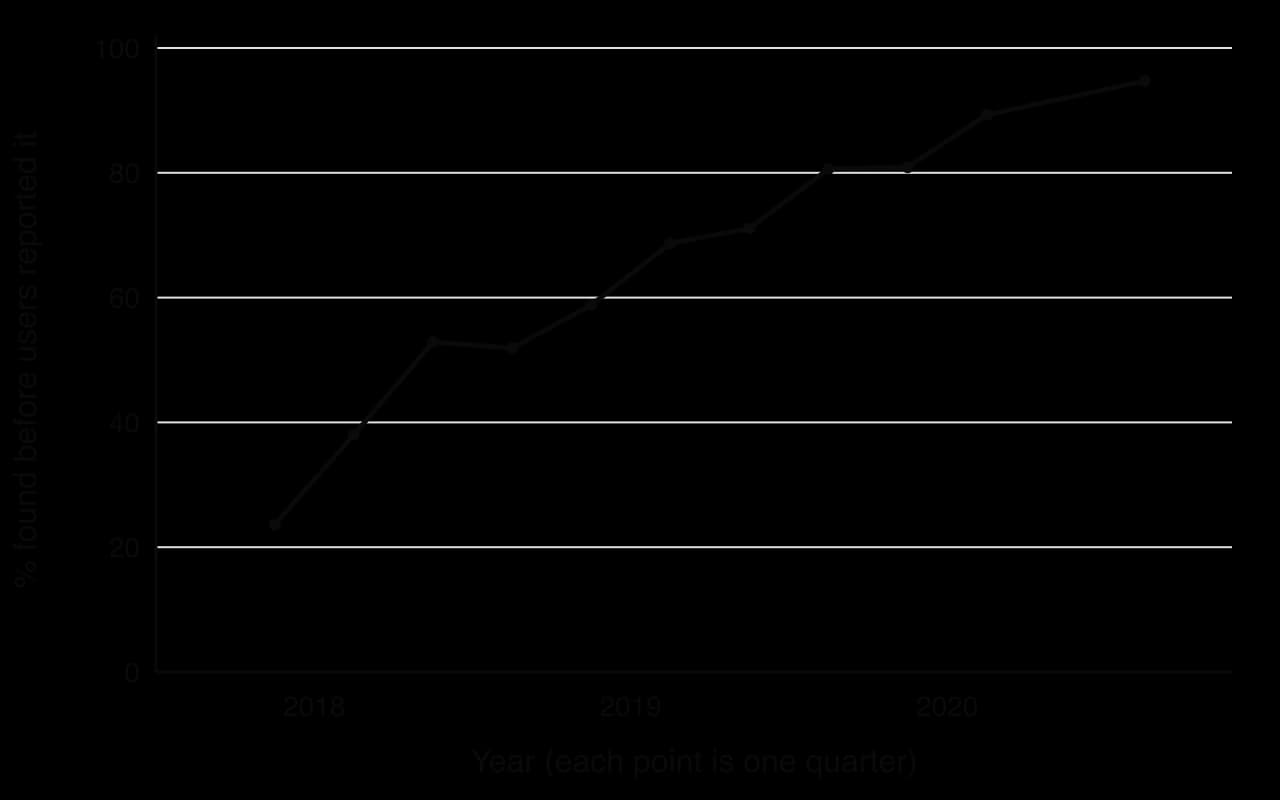
Automated moderation is fast and consistent, but it has well-documented weaknesses. Classifiers struggle with sarcasm, reclaimed slurs, news reporting and languages for which they have little training data, so they both miss harmful posts and remove harmless ones. Through the concept of values and ethics, this raises a question of fairness: errors fall hardest on minority-language speakers and on communities discussing their own experience of discrimination. Rules can also change quickly. In January 2025 Meta announced that it would end its third-party fact-checking programme in the United States, and it loosened parts of its hateful conduct policy, showing that one company's decision can alter the limits of expression for billions of users.
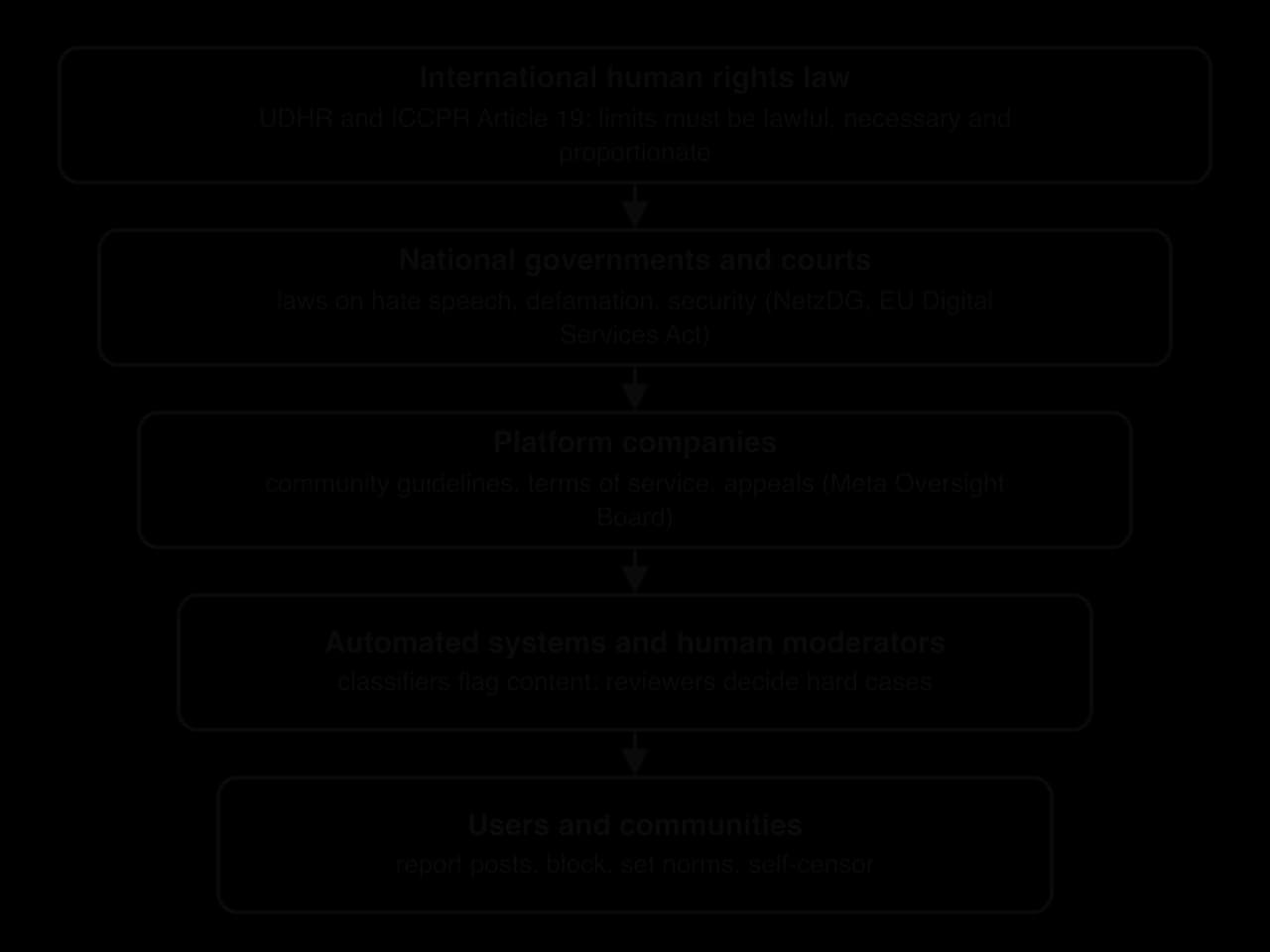
Decisions about the limits of expression are made at several levels, each with its own claims to legitimacy. The layers diagram shows them, from international law at the top to individual users at the bottom.
Who decides | How | Strengths | Weaknesses |
|---|---|---|---|
Governments and courts | Laws on hate speech, defamation, terrorism; court rulings | Democratic legitimacy (in democracies); due process and appeals | Slow; can be used to silence critics; laws stop at borders |
Platforms | Community guidelines, moderation teams, algorithms | Fast; can act at global scale; can set higher standards than law | Private companies not elected; profit motives; inconsistent and opaque decisions |
Users and communities | Reporting, blocking, community norms, volunteer moderation | Local knowledge of context | Mass reporting can be used to silence opponents; uneven effort |
Germany's Network Enforcement Act (NetzDG), fully in force from January 2018, is a clear example of a state making platforms decide. Social networks with more than two million registered users in Germany had to remove "manifestly unlawful" content within 24 hours of a complaint, and other unlawful content within seven days, or face fines of up to €50 million. Supporters argued that it made platforms obey existing German law. Critics, including the UN Special Rapporteur on freedom of expression, warned that the short deadlines and large fines would push companies to remove lawful content to be safe, a form of private censorship. The EU's Digital Services Act has since taken over much of this role across the European Union.
Platforms have also created their own quasi-courts. Meta's Oversight Board, which began taking cases in late 2020, is funded through an independent trust and can overturn Meta's decisions on individual posts. In May 2021 it upheld Facebook's suspension of the former US president Donald Trump after the attack on the US Capitol, but criticised the company for imposing an indefinite penalty with no clear rule behind it. The case showed both the value of an appeal body and its limits, since the Board decides only a tiny share of cases.
Limits on expression do not only come from outside. Self-censorship is when people hold back from saying something because they fear the consequences, such as harassment, losing a job, punishment by the state or simply disagreement.
When a law, a policy or surveillance makes many people self-censor, the result is called a chilling effect. A study by the legal scholar Jonathon Penney (2016) found that monthly views of Wikipedia articles on terrorism-related topics, such as "al-Qaeda" and "dirty bomb", fell sharply and stayed lower after Edward Snowden revealed US government mass surveillance in June 2013. A 2014 Pew Research Center survey found a similar pattern in expression: 86% of American adults were willing to discuss the Snowden revelations in person, but only 42% of Facebook and Twitter users were willing to post about them on those platforms.
Chilling effects are hard to measure, because they concern things that were not said. They matter for digital society because they can arise from digital systems alone: knowing that posts are stored, searchable and linked to a real name changes behaviour. Harassment campaigns produce the same effect. Women journalists and activists who are attacked online often reduce their activity, so abuse aimed at a few individuals can discourage many others from speaking.
Expression becomes a powerful lens when it is applied to the technologies and contexts of the course. The table shows short examples; each could be developed into a full analysis.
Content or context | How expression appears | Real-world example |
|---|---|---|
3.5 Media | New media forms combine modes and blur creator and audience | Memes built from a shared image template, reworded by millions of users |
3.2 Algorithms | Ranking decides whose expression is seen; creators adapt to it | Algospeak on TikTok to avoid automated moderation |
3.6 Artificial intelligence | AI produces text, images, music and voices, raising questions of authorship | The Midjourney image that won at the Colorado State Fair, 2022 |
3.4 Networks and the internet | Networks spread expression globally; states can cut access | Nigeria's suspension of Twitter (June 2021 to January 2022) after it deleted a post by the president |
4.1 Cultural | Fan communities and new art forms | Archive of Our Own; webtoons from South Korea |
4.6 Political | Activism, protest and state censorship | #EndSARS in Nigeria; NetzDG in Germany |
4.2 Economic | Expression as a livelihood in the creator economy | Streamers and creators who earn from Twitch subscriptions and YouTube advertising |
In the creator economy, where income depends on views, creators have reasons to express what the algorithm rewards rather than what they would otherwise choose, and a change in platform rules can remove a creator's income overnight.
 YouTube
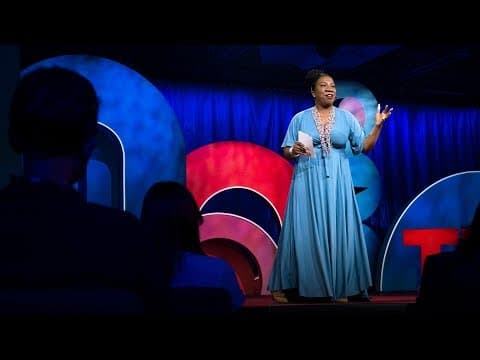
"Me Too" began long before the hashtag. In 2006 the American activist Tarana Burke started a movement under that name to support survivors of sexual violence, especially young Black women and girls, using the phrase to tell survivors that they were not alone. It was spread at first through community work and on the social network Myspace.
On 5 October 2017, The New York Times published an investigation into decades of sexual harassment allegations against the Hollywood film producer Harvey Weinstein, followed by a report in The New Yorker on 10 October. On 15 October the actor Alyssa Milano posted on Twitter a suggestion from a friend: if everyone who had been sexually harassed or assaulted wrote "me too", people might understand the size of the problem. Within days the hashtag spread worldwide. Burke was soon recognised as the movement's founder, and within a year the phrase was being used in France, China, South Korea and India.
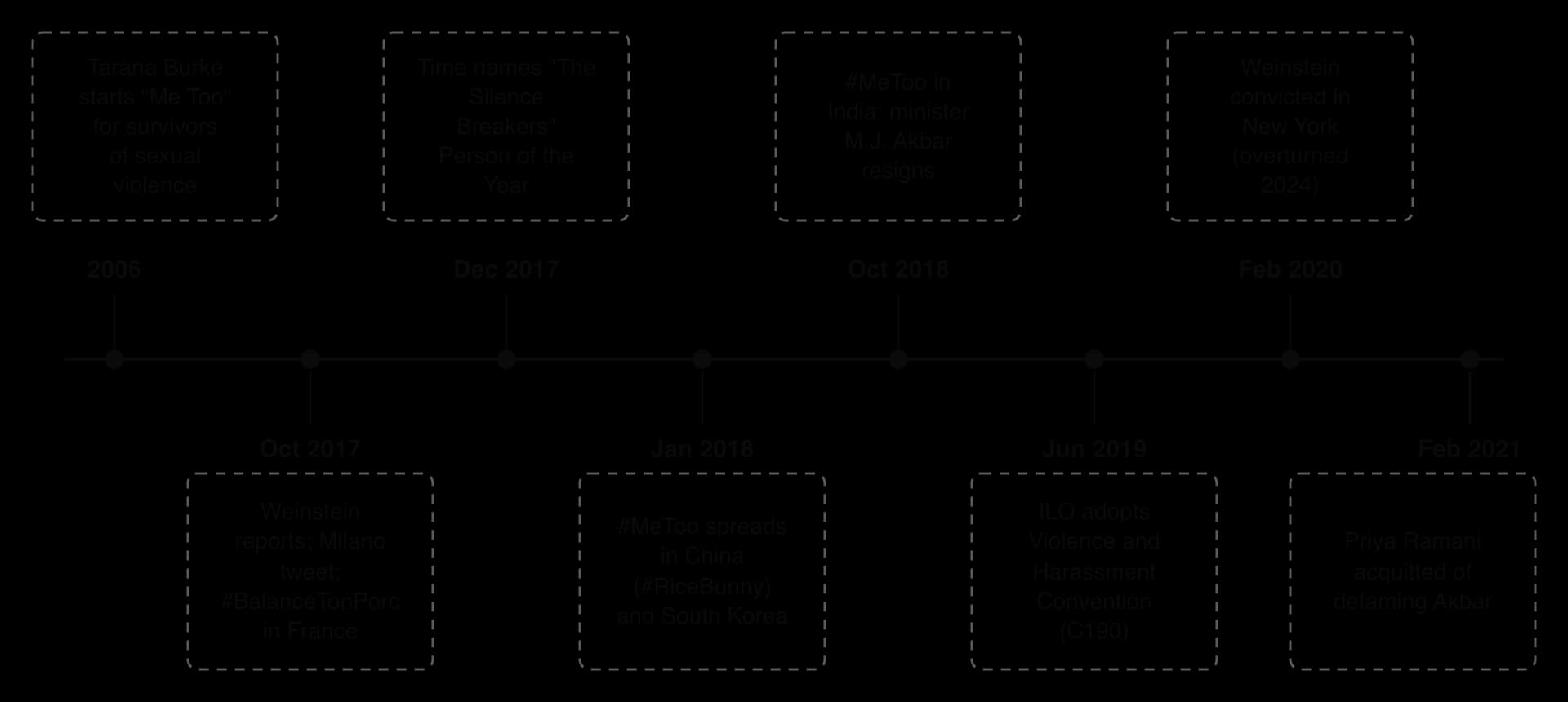
The timeline traces how a personal phrase became a global movement with legal and institutional consequences.
Several features of social media platforms turned individual posts into a collective act of expression.
The hashtag as an index. A hashtag groups every post that uses it, so each "#MeToo" joined a searchable, public collection. One person's experience became visible as part of a pattern.
Low cost of taking part. Writing two words required no account of details. Survivors could share as much or as little as they wished, from the hashtag alone to a full testimony.
Network effects. Each post appeared in followers' feeds, and celebrities with millions of followers spread it rapidly. According to Facebook, more than 12 million posts, comments and reactions about "Me Too" were made by 4.7 million users in less than 24 hours. Twitter reported that the hashtag was used nearly a million times in 48 hours.
Translation and adaptation. The hashtag could be translated or reworded for local contexts, such as #BalanceTonPorc ("expose your pig") in France, #YoTambién in Spanish-speaking countries and #QuellaVoltaChe ("that time when") in Italy.
Network effects and trending lists kept the hashtag visible for months. A Pew Research Center analysis of publicly available English-language tweets found that #MeToo was used more than 19 million times on Twitter between Milano's post and 30 September 2018, an average of about 55,000 times a day. In five periods of especially heavy use, the same study found that more than a quarter of #MeToo tweets were in other languages.
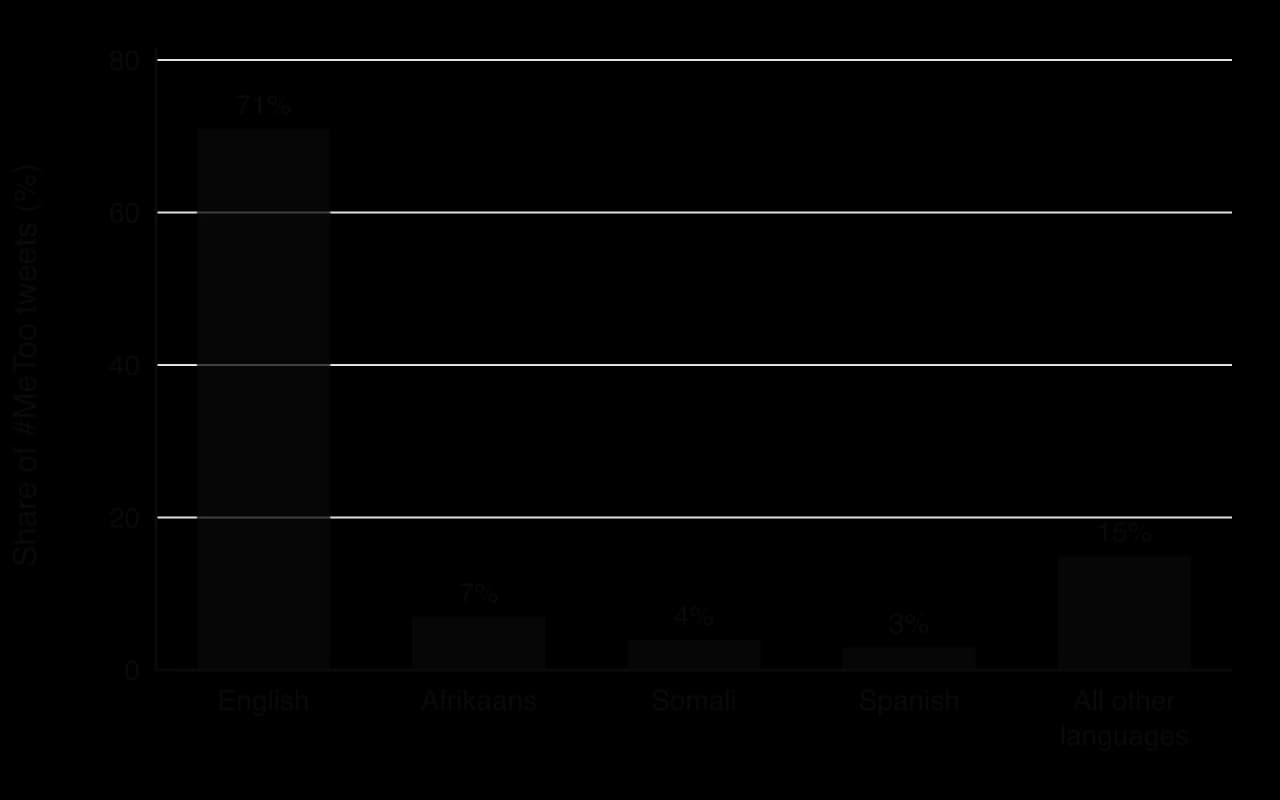
In China, where Twitter is blocked and posts on Weibo are monitored, #MeToo took a different form. In January 2018 Luo Xixi, a former PhD student at Beihang University in Beijing, posted an account on Weibo of harassment by her former supervisor, who was dismissed. When censors began removing posts with the hashtag, users switched to #RiceBunny (米兔, pronounced "mi tu") and rice-bowl and rabbit emoji, which automated filters did not recognise at first. This is a clear case of a community changing the modes of expression, from words to emoji and puns, to keep a message alive under censorship.
The table summarises the main impacts on different stakeholders.
People and communities | Positive impacts and opportunities | Negative impacts and risks |
|---|---|---|
Survivors | Recognition, solidarity, a public voice without a publisher; realising they were not alone | Re-living trauma in public; online harassment; legal threats |
Accused people | Due process through courts where cases were pursued | Loss of jobs and reputation, sometimes before any investigation; few routes to answer allegations online |
Employers and industries | Pressure to create reporting systems, training and policies | Legal and reputational costs; some managers became wary of mentoring women, according to later surveys |
Women in countries with strong censorship or weak legal protection | A shared global language for local campaigns | Censorship, defamation lawsuits and state pressure |
Some impacts were institutional. Time magazine named "The Silence Breakers" its Person of the Year for 2017. Weinstein was convicted in New York in 2020 and in Los Angeles in 2022; the New York conviction was overturned on appeal in 2024 and the case was retried. In India, a wave of #MeToo posts in October 2018 led to the resignation of the government minister M.J. Akbar. He sued the journalist Priya Ramani for criminal defamation, and in February 2021 a Delhi court acquitted her, stating that a woman's right to dignity could not be sacrificed to protect a man's reputation. Internationally, in June 2019 the International Labour Organization adopted the Violence and Harassment Convention (C190), the first international treaty on violence and harassment in the world of work.
Not every outcome was positive for those who spoke. In France, Sandra Muller, who started #BalanceTonPorc, was found liable for defamation in 2019 in a case brought by the man she had named; the ruling was overturned on appeal in 2021.
Through the concept of expression, #MeToo shows all three parts of the definition. The act was posting two words; the process was a decision, often painful, to make a private experience public; the instance was a post that joined a searchable, permanent archive of testimony. It combined storytelling (personal testimony) with political activism (demands for change), and its modes adapted to context, from long written accounts to emoji puns in China.
Through the concept of power, #MeToo shifted some power from powerful individuals and institutions to people who had been silenced, because platforms let survivors reach a mass audience without going through editors, lawyers or employers. Yet power remained unequal. Burke and others argued that media attention focused on famous, mostly white women in the entertainment industry, while low-paid workers had less visibility. The platforms themselves held power over which posts trended.
Through the concept of values and ethics, #MeToo shows the central dilemma of expression: the right of survivors to speak against the right of accused people to a fair process and to their reputation. Courts in India and France had to weigh these rights directly.
#MeToo is one of the strongest examples of digital expression producing real change. It turned private experiences into visible evidence of a pattern, changed public debate in many countries and contributed to laws, policies and an international treaty.
The evaluation depends on the people and communities considered. For survivors with public platforms and supportive legal systems, digital expression brought recognition and some accountability. For survivors facing censorship, defamation laws or online abuse, the same act carried high risks, and many chose self-censorship. The movement also shows the limits of hashtag activism. Lasting results came where online expression connected with journalism, legal action and organised campaigns, which is the point Burke makes when she calls #MeToo "a movement, not a moment". A balanced judgement is that digital expression was necessary for #MeToo's global reach but not sufficient for its outcomes.
To use expression as a lens, examine a digital system or real-world example by asking how people represent ideas, emotions and experiences through it, what functions that expression serves, and what dilemmas it creates. Six steps turn this into a method.
Step | Question to ask | What it brings out |
|---|---|---|
1. Identify | Who is expressing what (idea, emotion, experience)? | The creator and the content |
2. Describe the form | Which modes and which medium? How do they shape the message? | The role of the digital system |
3. Identify the function | Storytelling, world-building, artistic innovation, activism, or several? | Purpose and intended audience |
4. Analyse connection | Which people and communities does it bring together, and how? | Positive impacts |
5. Analyse dilemmas | Who might be harmed or silenced? Who decides the limits, and how? | Negative impacts and implications |
6. Connect and judge | Which other concepts help (power, identity, values and ethics)? What is your judgement, and under what conditions? | Evaluation |
The second question uses two short sources, in the style of the source-based paper.
I can define expression as the act, process or instance of representing ideas, emotions or experiences.
I can distinguish between a mode and a medium, and name the modes used in a digital example.
I can explain at least four ways in which digital systems change how people express themselves.
I can outline how media studies, communications, digital humanities, languages and literature, the arts, film and art history each approach expression.
I can describe digital storytelling and the new kinds of story that digital media make possible.
I can explain world-building and participatory culture with a real-world example.
I can explain artistic innovation and the questions that generative AI raises about authorship.
I can explain hashtag activism and evaluate its strengths and limits.
I can explain how digital expression brings people and communities together, and how it can divide them.
I can define freedom of expression and outline the limits allowed in international human rights law.
I can explain why hate speech is difficult to define and regulate.
I can describe how content moderation works and evaluate automated moderation.
I can discuss who should decide the limits of digital expression, using NetzDG and the Oversight Board as examples.
I can distinguish self-censorship from the chilling effect and give evidence for each.
I can evaluate #MeToo through the concept of expression and at least two other concepts.