Define change and its forms, explain how historians, STS scholars and futurists study it, use models such as diffusion of innovations, and apply change as a lens to digital systems.
Each is in the Digital Society glossary, with every other term in the subject.
Adjusting to new conditions in order to survive or keep working, usually by a person, organisation or community responding to a change it did not start.
The evolution, transformation, adaptation or movement of something, such as a technology, practice, organisation, belief or value, from one form, state or value to another over time.
The persistence of established practices, ideas, structures or values through a period of change, such as the QWERTY keyboard layout surviving on touchscreens.
A theory developed by Everett Rogers in 1962 that explains how, why and how fast new ideas and technologies spread through a population, dividing adopters into innovators, early adopters, early majority, late majority and laggards.
A break with established ways of understanding or doing things, after which the old way no longer works or is abandoned.
A person or organisation among the first to take up an innovation after the innovators, often respected by others and therefore influential in its wider spread.
Gradual, step-by-step change in which each version builds on the one before, such as yearly improvements to smartphone cameras and batteries.
Using past and present evidence, such as events, patterns and trends, to estimate what is likely to happen in the future, for example by extending trends, consulting experts or building scenarios.
A framework used in futures studies that shows the range of possible, plausible, probable and preferable futures widening the further ahead one looks from the present.
The systematic study of possible, probable and preferable futures, using methods such as trend analysis, expert panels and scenarios to help people prepare for and shape what may happen.
A model introduced by the research company Gartner in 1995 describing how expectations about a new technology rise to a peak, fall into disillusionment, and then recover to a more realistic level of use.
The process of turning a new idea into a product, service or method that people actually use; an invention becomes an innovation only when it is adopted.
When a country or community skips a stage of technological development and moves directly to a newer technology, such as adopting mobile phones without first building a network of fixed telephone lines.
A form of change in which people, things or values shift position, location or level, such as users moving from one platform to another or a price rising or falling.
Change that is judged to make things better according to particular values, such as wealth, health, knowledge, freedom or fairness; it is a value judgement rather than a measurement.
An interdisciplinary field that studies how science and technology are shaped by society, and how they in turn shape society, by examining designers, users, companies and governments.
The view that technologies are designed, chosen and used by people, so that their form and effects depend on economic interests, laws, culture and users' choices, with society and technology shaping each other.
The view that technology develops according to its own logic and is the main cause of social and cultural change, so that society adjusts to new technologies rather than shaping them.
A cluster of related innovations that spreads through the economy and society and changes how people produce, communicate and live over several decades, such as the age of information and telecommunications that began with the microprocessor.
A change in the basic form, structure or function of something, so that it works in a fundamentally different way from before.
Define change, and distinguish between evolution, transformation, adaptation and movement.
Outline how history, science and technology studies (STS) and futures studies each approach change in digital society.
Explain what a technological revolution is, and discuss whether technological change differs from historical change.
Explain the causes of change in the past and present using technological determinism, the social shaping of technology and diffusion of innovations.
Discuss the obligations people today have towards future generations, and how digital systems can help meet them.
Evaluate the claim that progress is an inevitable outcome of advances in digital systems.
Distinguish between continuity and discontinuity, and explain how past patterns and trends are used to forecast future developments.
Analyse a real-world example by applying change as a conceptual lens.
Change is the movement of something from one form, state or value to another. Digital systems have changed how people learn, work, shop and find information, often within a single generation, so the concept of change sits behind almost every question asked about digital society.
Change is one of the seven concepts of the course, alongside expression, identity, power, space, systems, and values and ethics. A concept works as a lens that directs attention to particular questions about technology. Through the concept of change, an inquiry asks what was different before and after a digital system arrived, what caused the difference, who gained and who lost, and what may happen next. These questions apply to every content area (from data and algorithms to robots) and every context (from cultural to political).
With a free account, Augment remembers where you stopped and what you have practiced.
In everyday speech, "change" can mean almost any difference. In Digital Society it has a more precise meaning, because a useful analysis has to say what changed, from what, into what, and over what period.
Three features of the definition matter. First, change always involves a comparison between at least two points in time, so an analysis needs a clear "before" and "after". Second, many things can change at once: the device, how people use it, the organisations that make it and the values people hold about it. Third, change has a scale and a speed. The shift from paper maps to satellite navigation took about two decades, while the spread of a viral app can take weeks.
The four forms named in the definition describe different kinds of movement from one state to another. They are not strict boxes: one real-world example often shows several forms at once, and the skill lies in explaining which form is most important for a given group of people.
Form | Meaning | Digital example |
|---|---|---|
Evolution | Gradual, step-by-step change in which each version builds on the last | Each year's smartphone models add better cameras, faster chips and longer battery life without changing what a smartphone is |
Transformation | A fundamental change in form, structure or function, so the result works in a different way | Netflix began by posting DVDs to subscribers, moved to online streaming from 2007 and closed its DVD service in 2023, changing how millions of people watch films |
Adaptation | Adjusting to new conditions in order to survive or keep working | Libraries that once lent only printed books now lend e-books and audiobooks through apps |
Movement | A shift in position, location or value, such as people moving between platforms or a value rising or falling | After Brazil's Supreme Court suspended X (formerly Twitter) in August 2024, many Brazilian users moved to rival platforms such as Bluesky |
Evolution and transformation are best seen as two ends of a scale. Small steps can add up to a transformation over a long period: no single year of improvements to mobile phones transformed society, but the phone of 2025 does very different things from the phone of 1995. Adaptation describes a response to change, usually by a person, organisation or community that did not start it. Movement draws attention to direction and value: who moves where, and what becomes worth more or less.
Innovation is the process of turning a new idea into a product, service or method that people actually use. An invention that never leaves the laboratory is not yet an innovation. Most innovations are small improvements to existing systems; a few create whole new industries.
The economist Carlota Perez, in Technological Revolutions and Financial Capital (2002), identifies five technological revolutions since the late eighteenth century. Each began with a visible breakthrough, attracted a wave of investment, and then changed working life, cities and institutions over 40 to 60 years. Her framework places the digital age as the fifth revolution, starting with the microprocessor.
Revolution (Perez) | Starting point | What it changed |
|---|---|---|
Industrial Revolution | 1771, Arkwright's cotton mill at Cromford, England | Factory work and mechanised production |
Age of steam and railways | 1829, the Rocket locomotive trial in England | Long-distance transport and national markets |
Age of steel, electricity and heavy engineering | 1875, the Carnegie Bessemer steel plant, USA | Electrified cities and large corporations |
Age of oil, the car and mass production | 1908, Ford's Model T, USA | Suburbs, consumer goods and road networks |
Age of information and telecommunications | 1971, the Intel microprocessor, USA | Computing, the internet and global digital networks |
Source: Perez, Technological Revolutions and Financial Capital, 2002.
Other writers use different labels for the same idea. The World Economic Forum's founder Klaus Schwab described a fourth industrial revolution in 2016, built on artificial intelligence, robotics and the fusion of physical and digital systems. Disagreement over how to count revolutions shows that calling a period a "revolution" is a judgement made by people looking back, which different writers make in different ways.
Historical change is any change in human societies over time: in governments, economies, beliefs, populations or ways of life. Technological change is the development and spread of new tools and techniques. One view treats technological change as a separate kind of change with its own logic, because it appears to build cumulatively (each computer is faster than the last) while political or cultural change can move backwards.
The other view, held by most historians, is that technological change is one strand of historical change and cannot be separated from it. The printing press, the telegraph and the smartphone all spread at speeds set by prices, laws, wars, religions and education systems. The microprocessor came out of Cold War military funding and the Californian electronics industry, and its uses were shaped by markets and governments. On this view, technology is made, adopted and resisted by the same people and forces that drive the rest of history.
Change in digital society is investigated by several academic fields, and each one asks different questions. Thinking like a practitioner in these fields helps an inquiry go beyond description.
Historians study change and continuity over time using evidence from the past, such as documents, objects, statistics and oral testimony. They ask about causes (why did this happen?), consequences (what followed?), significance (why does it matter?) and periodisation (where does one era end and another begin?). A historian of computing might compare letters, sales records and newspaper reports to explain why personal computers spread quickly in some countries and slowly in others.
Science and technology studies (STS) is an interdisciplinary field that examines how science and technology are shaped by society and how they shape it in return. STS researchers study laboratories, companies, users and governments to understand why one design succeeds while another fails. A classic STS study by Trevor Pinch and Wiebe Bijker (1984) showed that the design of the bicycle settled on the "safety bicycle" with equal wheels because of what different groups (racers, women riders, older riders) wanted and argued for, rather than because it was technically the only option.
Futures studies is the systematic study of possible, probable and preferable futures and of how present choices lead to them. Futurists do not claim to predict the future exactly. They use methods such as trend analysis, expert panels and scenarios to help governments, companies and communities prepare for several possible outcomes. Organisations such as the Institute for the Future in California, founded in 1968, carry out this work.
Field | Main question about change | Typical methods | Digital example |
|---|---|---|---|
History | What changed, why, and what stayed the same? | Archives, records, interviews, comparison of periods | How the arrival of the internet in the 1990s altered newspapers |
STS | How do society and technology shape each other? | Case studies, interviews, observation of users and designers | Why video recorder formats (VHS and Betamax) competed and one won |
Futures studies | What futures are possible, and which do we want? | Trend analysis, expert surveys, scenarios | Scenarios for work and jobs as artificial intelligence spreads |
Change involves people, ideas, objects and forces. People include inventors, entrepreneurs, users, workers and lawmakers. Ideas include beliefs about freedom, efficiency or privacy. Objects are the technologies themselves, from cables to code. Forces are larger pressures such as competition, investment, war, regulation, demography and climate. Explaining change means showing how these interact in a specific case.
The Luddites are a well-known example of how historians explain past change. Between 1811 and 1816, textile workers in Nottinghamshire, Yorkshire and Lancashire broke machines such as stocking frames and shearing frames. The British government sent troops and passed the Frame Breaking Act of 1812, which made machine breaking punishable by death. Historians such as E. P. Thompson (1963) argued that the Luddites were protesting mainly against falling wages, the loss of skilled work and employers who used machines to cut pay and quality.
The causes in this case were a mix of objects (new machinery), people (factory owners and skilled workers), ideas (beliefs about fair wages and craft skill) and forces (wartime economic hardship and a government that sided with owners). The same mix appears in present-day debates about automation, in which workers in warehouses, call centres and creative industries ask who will benefit from new machines.
Several forces drive change in digital society today. Large technology companies invest heavily in research, and competition between them pushes new products to market quickly. Governments drive change through laws (such as data-protection rules) and public services delivered online. Users drive change by adopting, adapting or rejecting systems, and sometimes by inventing uses that designers never planned. Global events can speed change dramatically: the COVID-19 pandemic pushed remote work, online shopping and video calls into everyday life for millions of people within months.
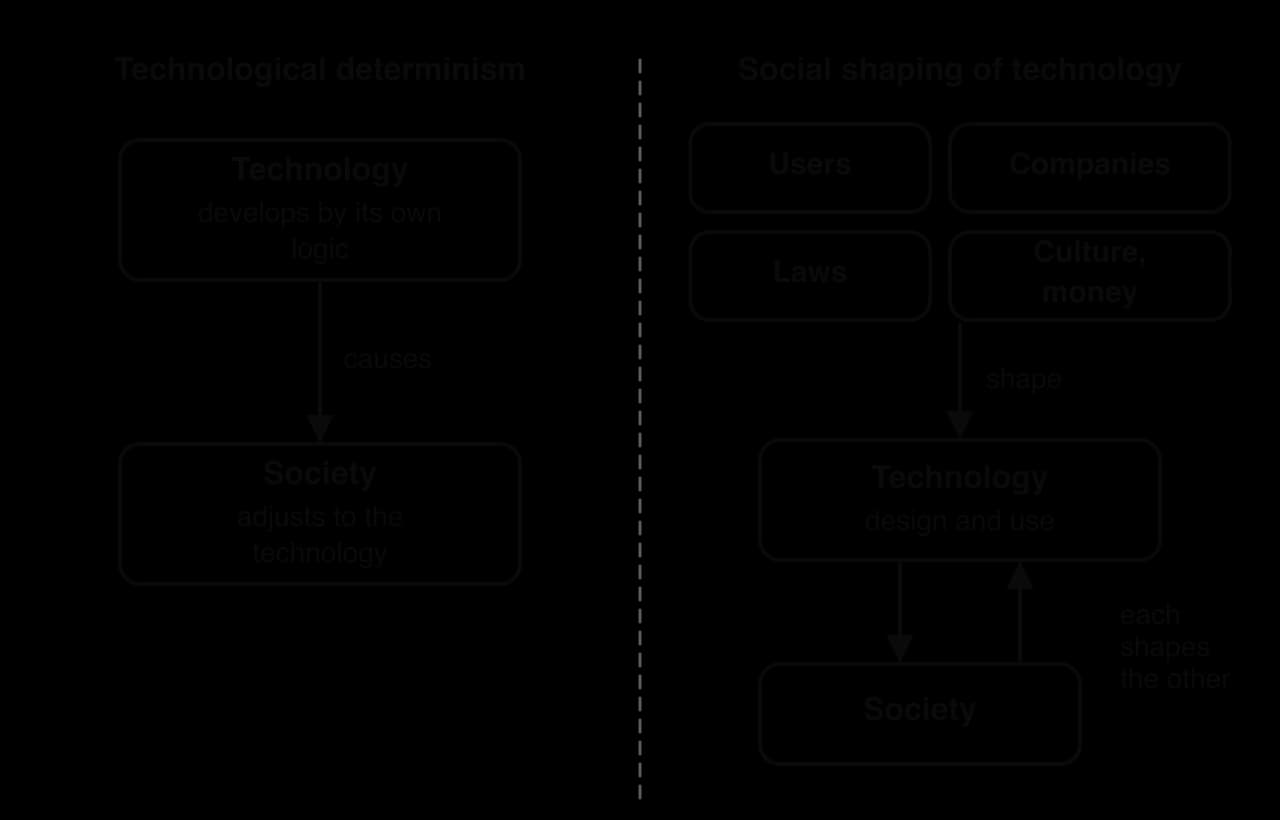
Two frameworks used by scholars give opposite answers to the question "what causes change?".
Technological determinism appears whenever people say that a technology "will" change society in a fixed way, for example that smartphones inevitably shorten attention spans. The media theorist Marshall McLuhan, who wrote in 1964 that "the medium is the message", is often read as a determinist, because he argued that new media change how people think regardless of the content they carry.
The social shaping of technology is the opposing view, set out by Donald MacKenzie and Judy Wajcman in 1985. It argues that technologies are designed, chosen and used by people, so their form and effects depend on economic interests, laws, culture and the choices of users. The two models are compared in the diagram.
The internet shows why many scholars reject strong determinism. Its early design favoured openness because it came out of academic and military research networks. Its later shape, with a few large platforms funded by advertising, came from business decisions, investment and regulation in the 2000s. Determinism still has value as a warning, because a system that is widely used can lock in habits and infrastructure that are hard to reverse.
Diffusion of innovations is a theory, developed by the sociologist Everett Rogers in 1962, that explains how, why and how fast new ideas and technologies spread through a population. Rogers divided adopters into five groups by when they take up an innovation, shown in the diagram.
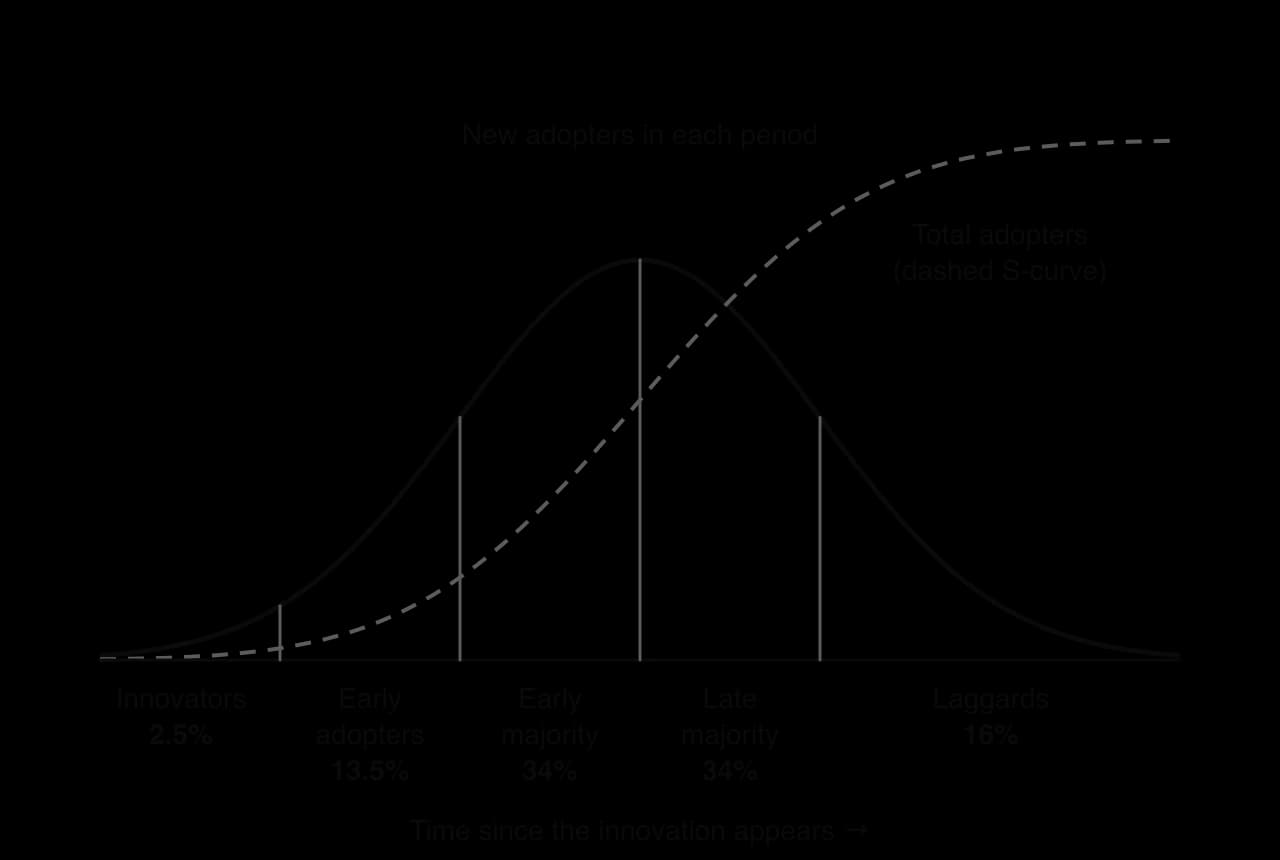
Early adopters matter most for whether an innovation succeeds. They are usually well connected and respected, so other people watch them before deciding. Rogers identified five features of an innovation that affect how fast it spreads:
Relative advantage: how much better it is than what it replaces.
Compatibility: how well it fits existing values, habits and needs.
Complexity: how hard it is to understand and use (simpler spreads faster).
Trialability: whether people can try it before committing.
Observability: how visible its results are to others.
Real adoption data often follow the upper part of the S-curve. In the United States, smartphone ownership rose quickly in the early 2010s and then slowed as almost everyone who wanted one had one, as the chart shows.
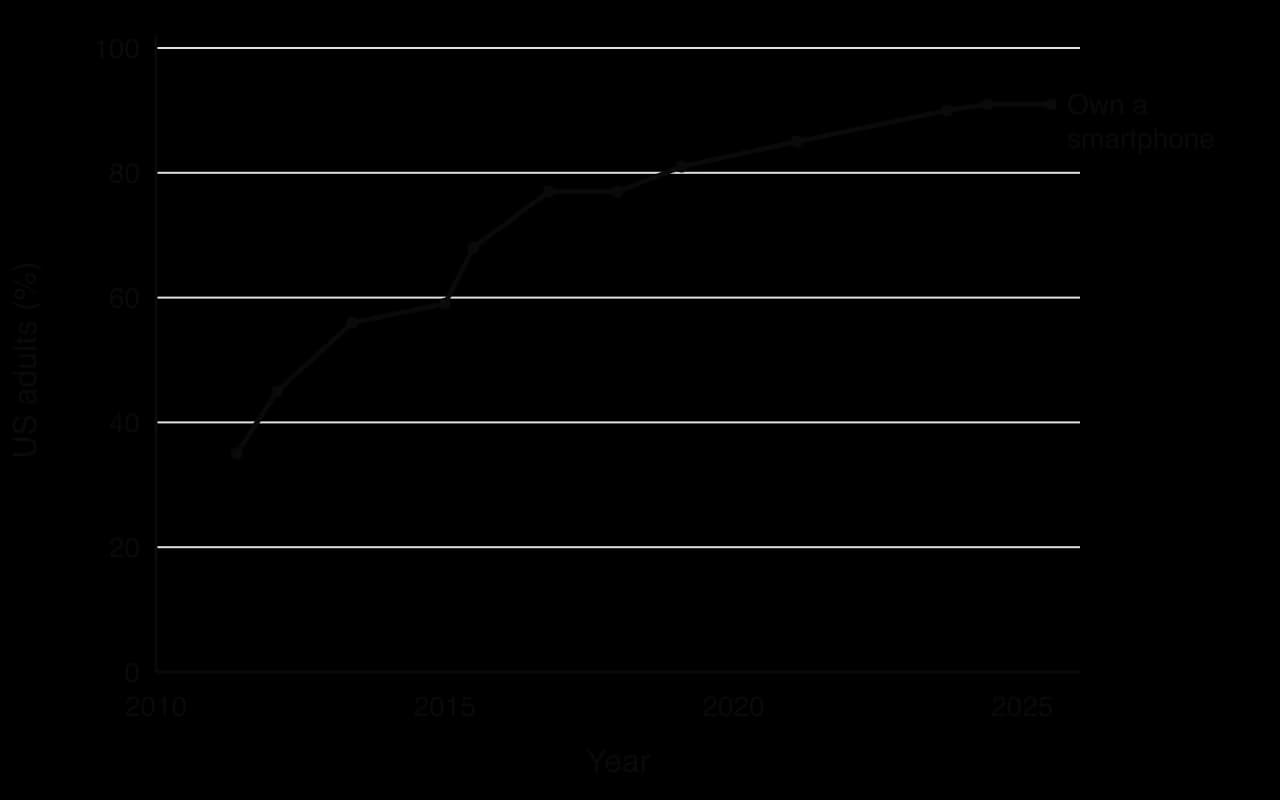
The theory has limits. It describes the spread of an innovation among people who can afford and access it, so it can hide the digital divide: the remaining 9% of US adults without a smartphone include many older and lower-income people, who are not simply "laggards" by choice. It also assumes that an innovation stays the same as it spreads, while in practice users often adapt it.
Leapfrogging is when a country or community skips a stage of technological development and moves directly to a newer technology. Sub-Saharan Africa never built an extensive network of fixed telephone lines. Instead, mobile networks spread from the early 2000s, so most people's first telephone was a mobile phone.
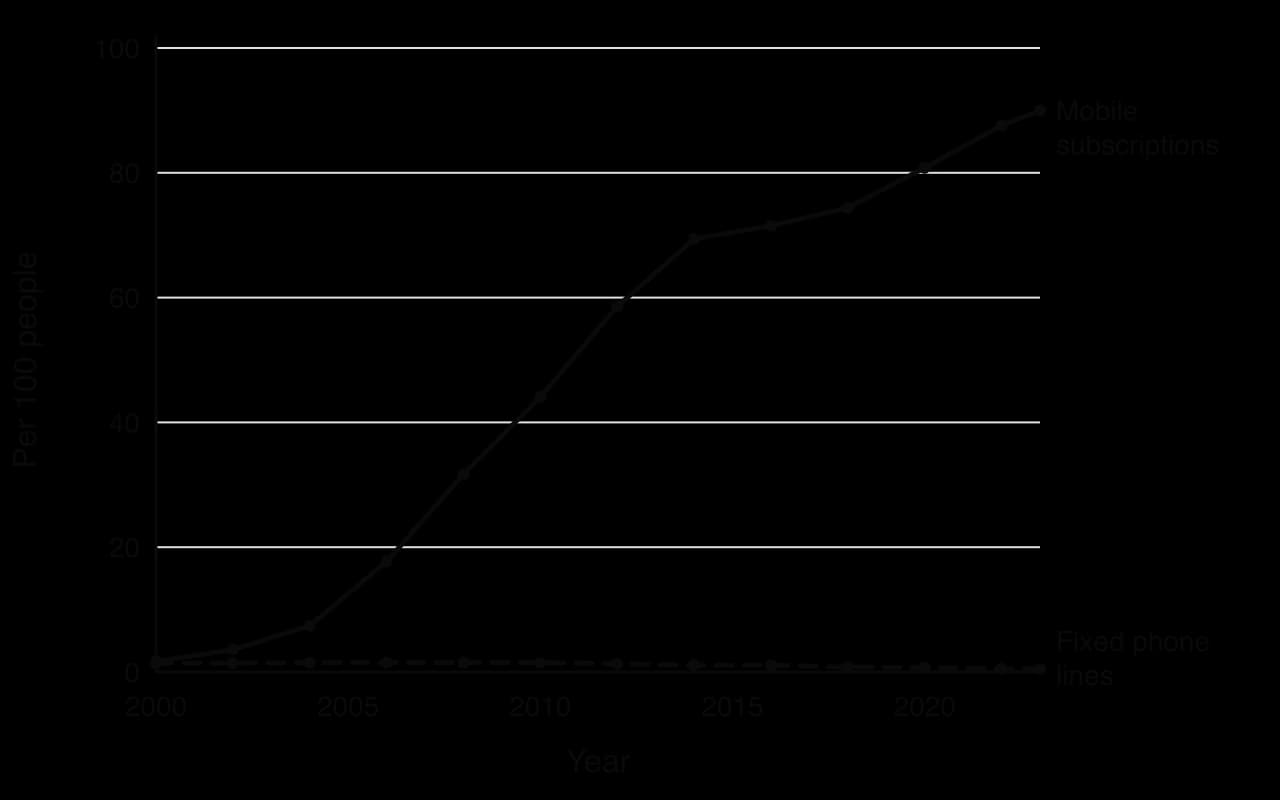
Leapfrogging shows that change does not follow a single path that every society must walk in order. Mobile phones then became the base for new services, such as mobile money, that were adopted faster in parts of East Africa than in many richer countries. Through the concept of change, leapfrogging is a discontinuity: a break with the sequence that earlier industrialised countries followed.
Change raises a question of responsibility: what do people living now owe to those who will live after them? Present choices about energy, waste and information shape the world that future generations inherit, yet those generations cannot vote or protest today.
Digital systems create new obligations. Data centres and devices use energy and materials, and discarded devices add to e-waste. Digital records can also be lost. In 2015 the internet pioneer Vint Cerf warned of a possible "digital dark age", in which files from the early twenty-first century become unreadable because the software and hardware needed to open them disappear. Digital preservation is the work of keeping digital material usable over time, through copying, migrating file formats and documenting how files were made.
Digital systems can also help meet these obligations. Climate models run on supercomputers project the effects of present-day emissions decades ahead, and the assessments of the Intergovernmental Panel on Climate Change rely on them. Some governments have created formal roles for future generations. The Well-being of Future Generations (Wales) Act 2015 requires public bodies in Wales to consider the long-term effects of their decisions and set up a Future Generations Commissioner, and in 2024 the UN General Assembly adopted a Declaration on Future Generations as part of its Pact for the Future.
The nature and importance of change are debated. People disagree about which changes matter most, whether a change is good or bad, and whether change has a direction.
Progress is therefore a value judgement rather than a measurement. A faster processor is a technical improvement, but whether it brings progress depends on who uses it, for what, and at what cost. A change can be progress for one group and a loss for another.
Supporters of this view point to large, measurable gains. Online maps, translation tools and video calls have made many tasks cheaper and quicker. Free online encyclopaedias and courses have widened access to information. Medical imaging, weather forecasting and scientific research all depend on computing power that has grown for decades. From this perspective, problems such as misinformation or job losses are temporary costs that new innovations and better rules will reduce.
Critics argue that advances in digital systems do not automatically produce progress, for several reasons. The historian of technology Melvin Kranzberg summed up this position in his first "law" of technology.
Technology is neither good nor bad; nor is it neutral. Melvin Kranzberg, "Technology and History: Kranzberg's Laws", 1986
Kranzberg meant that a technology's effects depend on the context in which it is used, and that it always has effects of some kind. Several pieces of evidence support the critics' case:
Benefits can be slow or hard to find. In 1987 the economist Robert Solow wrote that "you can see the computer age everywhere but in the productivity statistics". Large investments in computers took years to show up as gains in output, because organisations first had to change how they worked.
Innovations fail. Google Glass, smart glasses launched to early users in 2013, was withdrawn from consumer sale in 2015 after concerns about privacy, price and usefulness. Technical advance did not lead to adoption.
Benefits are unevenly shared. The gains from digital systems reach people with access, skills and money first, so change can widen gaps between groups.
Harms can grow alongside benefits. The same platforms that connect families across borders also spread harassment and false information.
The hype cycle, introduced by the research company Gartner in 1995, is a model of how expectations about a new technology rise and fall. It describes five phases: a technology trigger, a peak of inflated expectations, a trough of disillusionment, a slope of enlightenment and a plateau of productivity. The model reminds analysts that early excitement is not evidence of lasting change. Critics point out that it is drawn from experience rather than tested as a law, and that many technologies never reach the plateau.
Change rarely replaces everything. An analysis of change also asks what stayed the same.
Continuity is easy to overlook, because new technologies attract attention. Yet digital systems often carry old forms with them. Smartphones keep the QWERTY keyboard layout, designed for mechanical typewriters in the 1870s. E-book readers show pages that "turn". Email borrows the "cc" field from carbon copies, and many programs still use a floppy disk as the icon for "save", long after floppy disks disappeared.
Discontinuity is a break with established ways of understanding or doing things, after which the old way no longer works or is abandoned. Streaming services broke the link between owning a copy of music or film and being able to play it. Online banking ended the need to visit a branch for most transactions, and many branches closed. Discontinuities are often the changes that cause most disruption for the people and communities whose skills or businesses depended on the old way.
Continuity | Discontinuity | |
|---|---|---|
Meaning | Established practices, ideas or values persist | A break with established ways of doing or understanding things |
Typical speed | Gradual or unchanged | Often sudden, or a sharp turning point |
Digital examples | QWERTY on touchscreens; the "page" in e-books; school timetables in online learning | Streaming replacing ownership of copies; mobile phones in place of landlines in sub-Saharan Africa |
Question to ask | What stayed the same, and why? | What was abandoned, and who lost out? |
Forecasting is the use of past and present evidence, such as events, patterns and trends, to estimate what is likely to happen in the future. Forecasts are central to planning: governments need them to build networks, companies to plan products and schools to decide which skills to teach.
Several methods are common:
Trend extrapolation extends a measured trend forward. Moore's law, Gordon Moore's 1965 observation that the number of components on a chip doubled every year (revised in 1975 to about every two years), guided the chip industry's planning for decades. It worked partly because companies used it as a target, which makes it a forecast that helped to fulfil itself.
Expert panels, such as the Delphi method developed at the RAND Corporation in the 1950s, gather several rounds of expert judgement until views converge.
Scenarios describe several different but plausible futures instead of one prediction. The oil company Shell used scenario planning in the early 1970s and was better prepared than many rivals for the 1973 oil crisis.
Futurists often summarise their aims with a futures cone, a framework developed by Joseph Voros in 2003 from earlier work by Trevor Hancock and Clement Bezold.
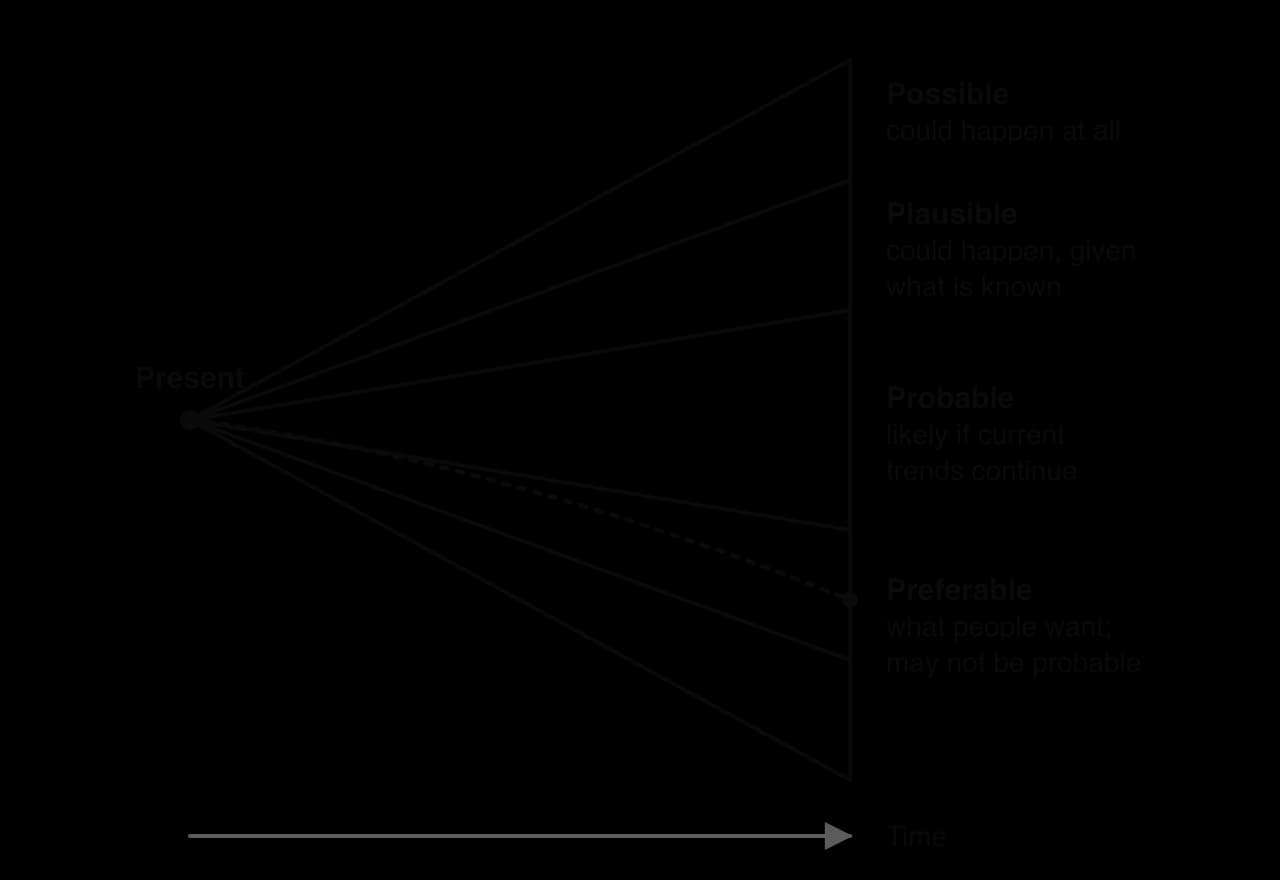
Past patterns are useful but limited guides. Roy Amara of the Institute for the Future observed that people tend to overestimate the effect of a technology in the short run and underestimate it in the long run, a pattern often called Amara's law. Discontinuities are by definition hard to forecast from trends, because they break the pattern. Forecasts can also be shaped by the interests of those who make them, such as companies that benefit from excitement about a product.
 YouTube
Using change as a lens means organising an analysis around a set of questions about a real-world example. The same steps work for any digital system:
Define the before and after. State what the situation was, what it became and over what period.
Identify the form of change. Decide whether it is mainly evolution, transformation, adaptation or movement, and explain why.
Explain the causes. Name the people, ideas, objects and forces involved, and decide whether a determinist or a social-shaping explanation fits the evidence better.
Identify continuity and discontinuity. What stayed the same, and what was abandoned?
Assess the impacts and implications. For specific people and communities, set out the impacts (effects that have happened) and the implications (opportunities and risks for the future).
Judge the change. Decide whether it counts as progress, for whom, and on what standard, and consider what may happen next.
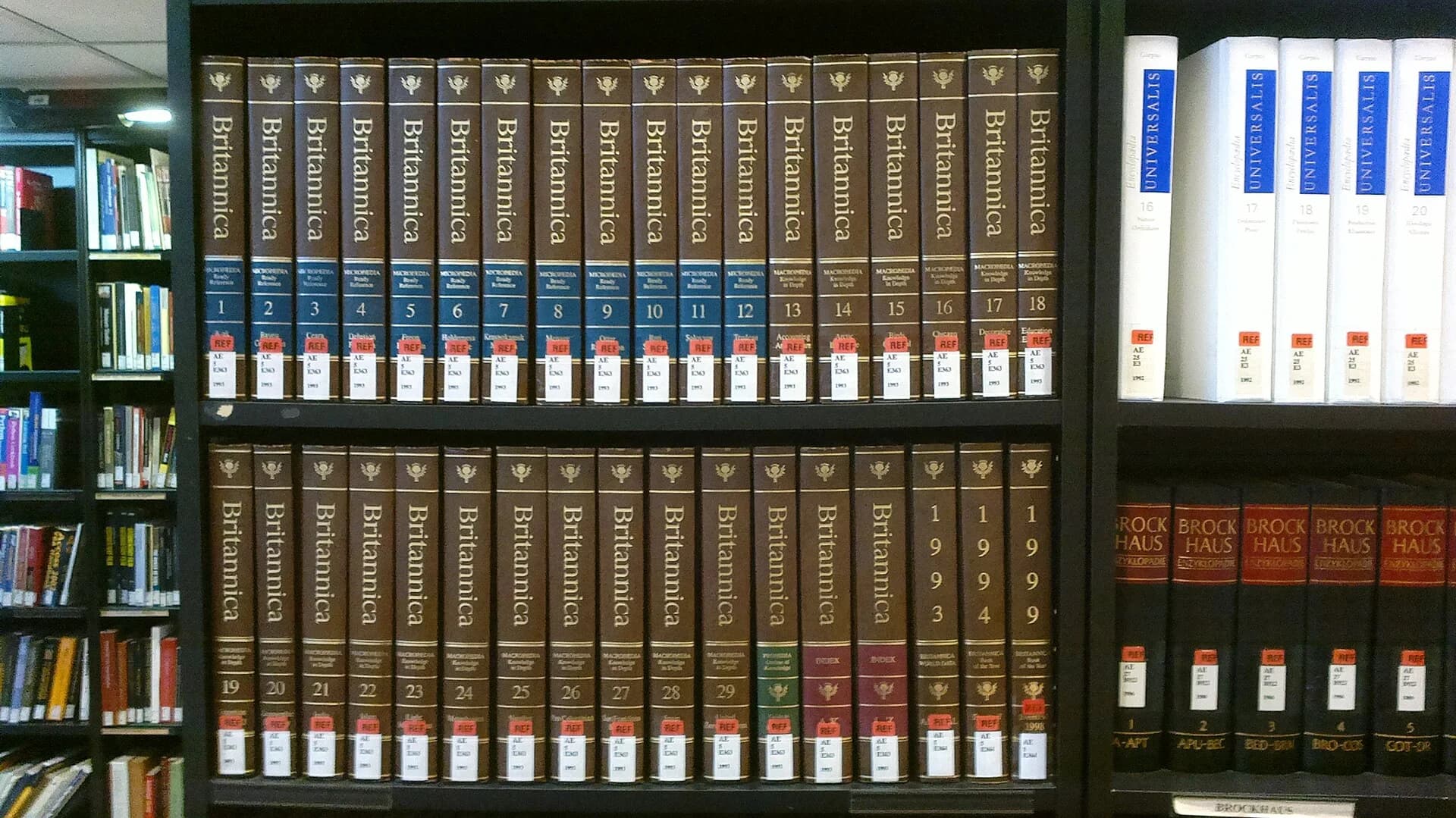
The Encyclopaedia Britannica was first published in Edinburgh between 1768 and 1771. For more than two centuries it was the best-known general reference work in English, written by paid experts and sold as a set of printed volumes. Families often bought it on instalments as an investment in their children's education, and a full set took up several library shelves, as the photograph shows.
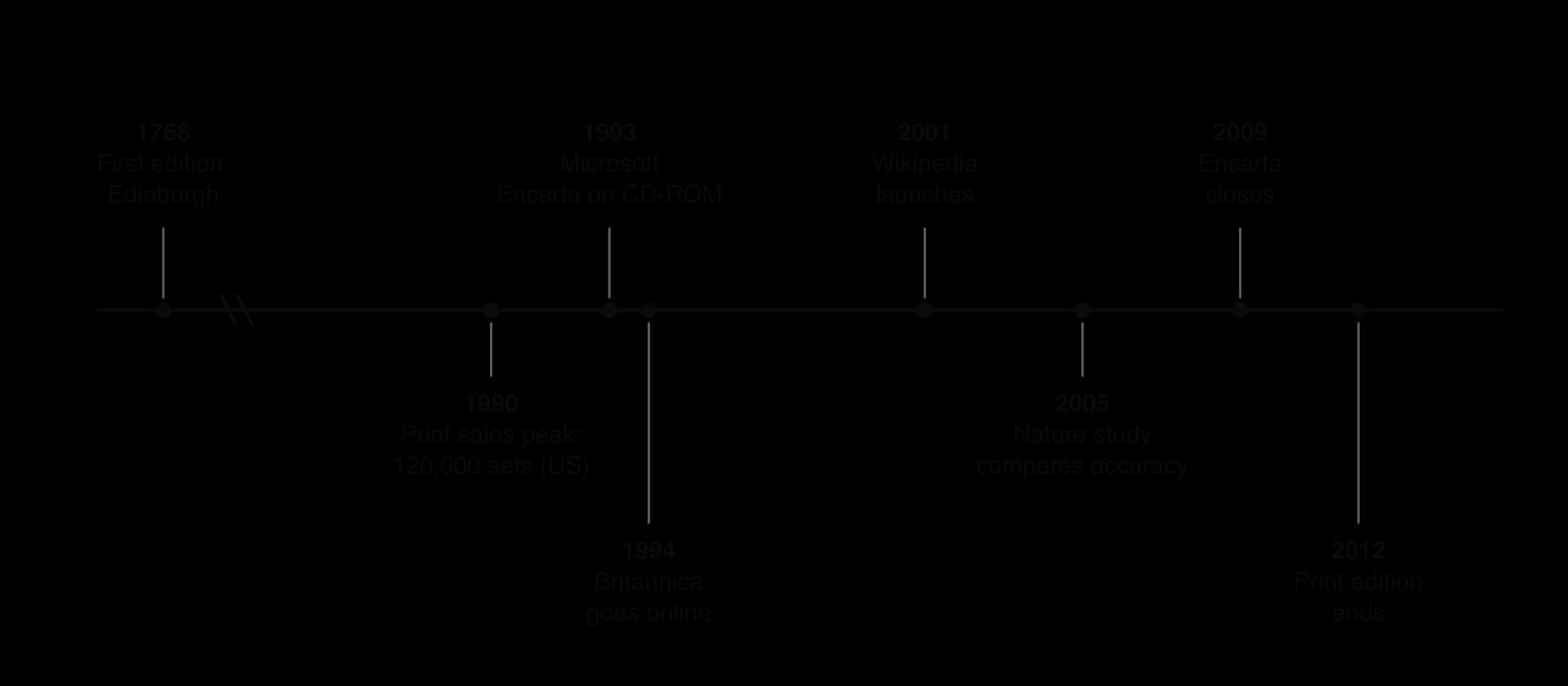
Print sales peaked in 1990, when about 120,000 sets were sold in the United States. They fell to about 40,000 a year by 1996, as cheaper encyclopaedias on CD-ROM, led by Microsoft's Encarta (launched in 1993), entered homes with personal computers. Britannica responded by launching an online version in 1994. In March 2012 the company announced that the 2010 edition, 32 volumes priced at $1,395, would be its last in print. By then print made up less than 1% of its revenue; about 85% came from educational products for schools and the rest from online subscriptions.
Wikipedia was launched on 15 January 2001 by Jimmy Wales and Larry Sanger, after a slower expert-written project called Nupedia. It is a wiki, a website that any user can edit through a web browser, and every change is stored in a public page history. Its content is user-generated content, written by unpaid volunteers instead of commissioned experts. It is an example of crowdsourcing: dividing a large task among many contributors.
Several rules make this system work. Articles must take a neutral point of view and cite published, reliable sources (the principle of verifiability). Volunteer editors watch changes, reverse vandalism and discuss disputed content on "talk" pages. Some pages are protected from anonymous editing, and automated programs (bots) fix common errors. The site is run by the Wikimedia Foundation, a non-profit organisation founded in 2003 and funded mainly by donations, so it carries no advertising.
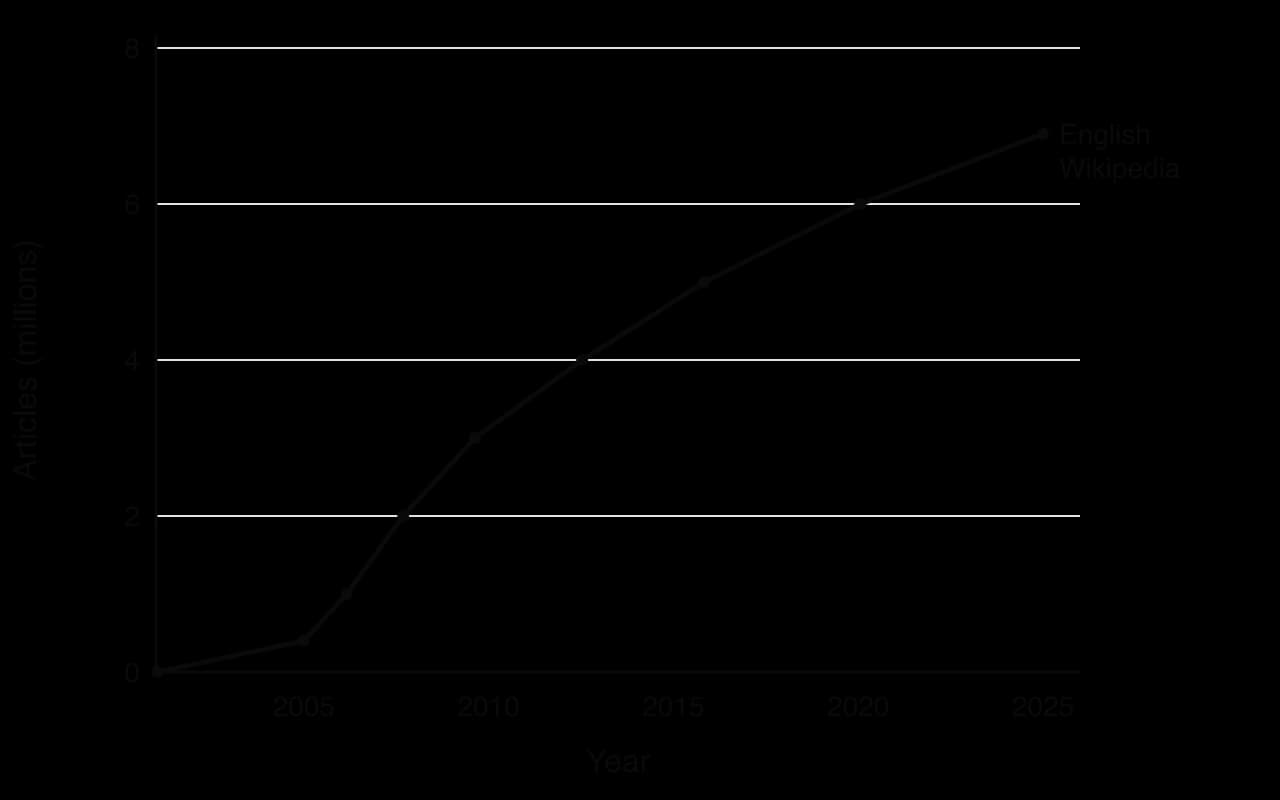
Growth was fast in the early years and then slowed, as the chart of English-language articles shows. By December 2025 there were over 66 million articles across all language editions.
 YouTube
The change affected different groups in different ways.
People and communities | Impacts | Implications |
|---|---|---|
Readers worldwide | Free, instant access to millions of articles, updated within minutes of events | Wider access to knowledge, but a risk of trusting errors or vandalism before they are corrected |
Speakers of smaller languages | Wikipedia editions exist in over 300 languages, some with no previous encyclopaedia | Opportunity to record local knowledge, but many editions remain small and some rely on automatically generated articles |
Britannica's staff and sales force | Door-to-door sales ended in 1996 and print production in 2012; the company shifted to education products | Expert-written reference work survives in schools, but in a much smaller market |
Volunteer editors | Unpaid work by a community that peaked at about 50,000 active English editors in 2007 | Dependence on volunteers whose numbers have declined; a contributor base skewed towards men and wealthier countries |
Students and teachers | A first source for almost any topic | New skills needed to check sources and judge reliability |
The question of accuracy was debated from the start. In 2005 the journal Nature asked experts to review 42 science articles from both encyclopaedias. They found 162 errors, omissions or misleading statements in Wikipedia and 123 in Britannica, an average of about four and three per article. Britannica disputed the study's methods, and Nature stood by it. The same year, a false biography of the journalist John Seigenthaler stayed on Wikipedia for months, and the site tightened its rules on articles about living people.
Through the concept of change, the end of the printed Britannica combines several forms of change:
Transformation: the encyclopaedia changed from a fixed, expert-written product sold in volumes to a continuously edited, free service written by volunteers. Who writes knowledge, who pays for it and how it is checked all changed.
Evolution: Britannica's own move from print to CD-ROM to online subscription happened in steps over about 20 years.
Adaptation: Britannica survived by changing its business towards education products and online services, while its print edition did not.
Discontinuity: the printed encyclopaedia as a household purchase ended, along with door-to-door sales.
Continuity: the encyclopaedia article itself survived. Wikipedia keeps alphabetical topics, a neutral tone, cross-references and citations, ideas that go back to eighteenth-century encyclopaedias.
Diffusion of innovations helps explain why Wikipedia spread. It had a strong relative advantage (free, searchable, up to date), high trialability (anyone could read it at once) and high observability (its articles appeared at the top of search engine results). A purely determinist account ("the internet killed Britannica") misses the human choices involved: the founders' decision to use an open licence and volunteer editing, the decline that CD-ROMs had already started, and Britannica's own strategy of shifting to schools.
Through the concept of power, the change moved authority over knowledge. Britannica's authority came from named experts and a respected brand; Wikipedia's comes from rules, citations and a community of editors. Power shifted towards the editors who interpret the rules and the search engines that send most readers to Wikipedia. Groups with less presence among editors, including many women and people in the Global South, have less influence over what knowledge is recorded and how.
The case supports the view that change in digital society is real but rarely simple. For most readers, the shift was progress in access, cost and speed, and studies such as the Nature comparison suggest that the loss of accuracy was smaller than many feared. For Britannica's employees, and for the idea of knowledge checked by paid experts, it was a discontinuity with real losses. The outcome was not inevitable: it depended on Wikipedia's non-profit model, on volunteers and on search engines, all of which could change. Wikipedia now faces its own pressure, as generative AI tools give answers drawn partly from its articles without sending readers to the site, which shows that the forces that disrupted Britannica can act on its successor too.
Paper 2 questions test the same ideas through short unseen sources.
HL students also answer an extended response that applies one concept to a challenge, such as local and global inequalities.
I can define change and give a digital example of evolution, transformation, adaptation and movement.
I can define innovation and technological revolution, and outline Perez's five revolutions.
I can discuss whether technological change is distinct from historical change.
I can outline how history, STS and futures studies each investigate change.
I can explain the causes of a past change, such as the Luddite protests, using people, ideas, objects and forces.
I can distinguish between technological determinism and the social shaping of technology, and apply both to a real-world example.
I can describe diffusion of innovations, including adopter groups and Rogers' five features, and state its limits.
I can explain leapfrogging using data on mobile phones in sub-Saharan Africa.
I can discuss what present generations owe future generations, and how digital systems can help meet those obligations.
I can evaluate whether progress is an inevitable outcome of advances in digital systems, using evidence on both sides.
I can distinguish between continuity and discontinuity with digital examples.
I can explain how forecasting methods use past patterns and trends, and outline the futures cone and its limits.
I can apply change as a lens, step by step, to a real-world example such as Wikipedia and the printed Britannica.