
Explain what digital society means and how the course studies it, then trace its names, divides, milestones, binary data, the analogue–digital shift, digitization and digitalization, with Kodak as a case study.
Each is in the Digital Society glossary, with every other term in the subject.
A way of representing data with continuous physical quantities or signals that can take any value within a range, such as the groove of a vinyl record or the grains of photographic film.
A one-sided tendency in a source or a person that favours some views, groups or outcomes over others, often because of who made the source and why.
A number system that uses only the digits 0 and 1, used by digital systems to represent all data and instructions.
A binary digit, the smallest unit of digital data, with a value of either 0 or 1.
A group of eight bits, which can represent 256 different values and is the basic unit for measuring digital storage.
An agreed table that matches each number to a character, so that text can be stored in binary; ASCII covers 128 characters and Unicode more than 150,000.
A statement put forward as true, which should be supported by evidence.
A name for the period since the mid-20th century in which electronic computers became central to work and daily life; it emphasises the machine rather than networks, data or people.
Outline how concepts, content and contexts connect in an inquiry into a real-world example, and describe the stages of inquiry and the toolkit used to study digital society.
Distinguish between impacts and implications, and identify the people and communities, including stakeholders, affected by a digital system.
Discuss why "digital society" is a contested term and why there may be several digital societies rather than one.
Compare the different names given to digital society, including the information age, post-industrial society, network society and the Fourth Industrial Revolution.
Explain why access to digital systems is uneven, using real data on digital divides.
Describe the milestones in the development of digital society, from the integrated circuit to mobile and cloud computing.
Explain how binary digits, bits and bytes represent data, and distinguish between analogue and digital signals.
Distinguish between digitization and digitalization, and evaluate their impacts and implications for organisations, including the disruption they can cause.
Digital society is a name for the way people now live, work, learn, govern and communicate through digital systems such as smartphones, online platforms and artificial intelligence. In 2024 about 5.5 billion people used the internet, while about 2.6 billion did not, so these systems affect almost everyone, but in very different ways.
Subtopic 1.1 underpins the whole course. It shows how concepts, content and contexts are linked through inquiry, and supplies the history and technical basics that later topics build on, including the two processes through which objects, services and organisations become digital.
With a free account, Augment remembers where you stopped and what you have practiced.
A powerful, pervasive and debatable idea, such as change, identity or power, that gives insight into an inquiry by acting as a lens on a real-world example.
An area of life, such as cultural, economic, environmental, health, human knowledge, political or social, that situates an inquiry by showing where and for whom a digital system matters.
Checking a source against other, independent sources to see whether they confirm, contradict or qualify its claims, as a test of its reliability.
A claim that opposes, challenges or qualifies another claim.
A way of representing data with discrete signals that take only a finite set of values, usually encoded as binary digits.
An organised collection of digital records, either digitized from analogue originals or born digital, that is stored, described and managed so that people can find and use it over the long term.
The gap between individuals, groups or countries in access to digital systems, in the skills and motivation to use them, and in the benefits they gain from that use.
The policies and actions that keep digital material accessible and usable over the long term, despite failing storage, changing hardware and software, and obsolete file formats.
Copying content from its original format, such as paper, microfilm or magnetic tape, into a digital format, so that it can be preserved and accessed without handling the original.
A contested term for contemporary life in which digital systems are part of how people communicate, work, learn, govern and form communities, and in which analogue processes and objects are increasingly turned into digital forms. Because experiences differ so much between places and groups, there may be many digital societies rather than one.
A technology, application or platform that creates, stores, processes or distributes digital data and information, such as a smartphone, a gaming platform, an AI-enabled personal assistant or a robot.
Very deep digitalization that changes an organisation's purpose, business model or a whole industry, rather than only its processes.
The use of digital systems to change the structure and/or operation of an organisation, for example its processes, services, roles or business model.
The conversion of analogue data and information, such as text on paper, film photographs or sound recordings, into digital form. It changes the form of information, not how an organisation works.
A significant change, often driven by digital systems, that upsets the established organisations, jobs, markets or practices of a sector, creating new winners and losers.
A term popularised by Klaus Schwab of the World Economic Forum in 2016 for the current period of change, in which digital, physical and biological technologies such as AI, robotics and the internet of things merge.
An effect or outcome related to a digital system, positive or negative, intended or unintended. Impacts describe what has happened or is happening.
An opportunity or risk associated with a digital system, often concerning what may follow for people and communities in the future. Implications overlap with and inform impacts.
A period in which the production, processing and distribution of information becomes the main source of economic value and social change; one of several names for digital society.
A sustained, iterative and often collaborative process of asking questions, exploring sources and investigating evidence through which learners build and reflect on their own understanding. In digital society it moves through the stages focus, explore, investigate, and reflect and share.
A set of electronic components, mainly transistors, made together on one small chip of semiconductor material such as silicon. First built by Jack Kilby (1958) and Robert Noyce (1959).
The main ideas and claims of a source, and the techniques it uses to make them (words, images, data, graphics, design), including how its evidence was gathered.
An integrated circuit that contains a computer's central processing unit, carrying out the instructions of programs on a single chip. The first commercial one was the Intel 4004 (1971).
Research that combines qualitative methods (exploring experiences and behaviours in depth) with quantitative methods (measuring and finding patterns), so that each covers the other's weaknesses.
The use of portable, wirelessly connected devices, such as smartphones, tablets and wearables, to access data and services from almost any location.
A society whose main social, economic and political structures are organised through digital information and communication networks, a term associated with Jan van Dijk and Manuel Castells.
Who made a source, when, where and why (to inform, persuade, sell or entertain), and what this suggests about its bias, value and limitations.
The individuals and groups affected by digital systems, including users, developers, workers and people who face barriers to access, who often make different claims and support different courses of action.
The point of view from which a person or group sees an issue, shaped by their position, interests, values and experiences.
A society in which most employment and wealth come from services and knowledge rather than from manufacturing, a term associated with the sociologist Daniel Bell (1973).
First-hand evidence created at the time of an event or by people directly involved, such as a platform's terms of service, census data or an interview.
A specific, existing instance involving a digital system, which can be local, global or both, and which grounds an inquiry in what has actually happened rather than in general statements.
Measuring an analogue signal at regular moments in time so that it can be converted into digital form; each sample is then rounded (quantised) to the nearest available level.
An account or analysis based on other sources, such as a news analysis, a textbook chapter, a documentary or an academic review.
Anything that provides information or evidence for an inquiry, such as a news report, dataset, interview, video, social media post or government document.
A person, group or organisation that has an interest in a digital system, either because they can influence it or because they are affected by it, directly or indirectly.
A digital society is a society in which digital systems shape most areas of life, from friendships and entertainment to work, health care, education and politics. The term describes contemporary life as a whole, not one technology.
A term is contested when people disagree about what it means or whether it is the right term at all. "Digital society" is contested for at least three reasons.
It is unclear where it begins. Some date it from the first electronic computers of the 1940s, others from the personal computer in the 1980s, the web in the 1990s or the smartphone in the late 2000s.
It suggests one shared experience. A teenager in Seoul with fast mobile broadband and a farmer in rural Niger with no connection both live in the 2020s, but their daily lives are digital to very different degrees.
It can hide continuity. Many features of "digital" life, such as news, shopping, banking and friendship, existed before computers. Critics argue that the label exaggerates what is new and plays down what has stayed the same.
Because access, culture, law and technology differ from place to place, it can be more accurate to speak of several digital societies. Estonia runs almost all of its public services online through a national digital identity card. In China, a small number of domestic platforms such as WeChat and Alipay combine messaging, payments and public services, under state rules that differ from those in Europe or the United States. In many low-income countries, most people who are online reach the internet only through a mobile phone, and many are not online at all.
Each of these digital societies is shaped by local choices about infrastructure, regulation, business and culture, yet all involve turning analogue processes and objects into digital forms. Studying digital society therefore means asking whose digital society is being described, and who is left out.
Digital society is studied through three connected elements, often called the "3 Cs". Each answers a different question about a real-world example.
Element | Question it answers | Topics |
|---|---|---|
Concepts | What lens gives insight into the example? | 2.1 Change, 2.2 Expression, 2.3 Identity, 2.4 Power, 2.5 Space, 2.6 Systems, 2.7 Values and ethics |
Content | How do the digital systems involved work? | 3.1 Data, 3.2 Algorithms, 3.3 Computers, 3.4 Networks and the internet, 3.5 Media, 3.6 Artificial intelligence, 3.7 Robots and autonomous technologies |
Contexts | In which area of life do the effects happen? | 4.1 Cultural, 4.2 Economic, 4.3 Environmental, 4.4 Health, 4.5 Human knowledge, 4.6 Political, 4.7 Social |
A concept is a big, debatable idea that can be applied to many situations. Concepts are powerful (they explain a lot), pervasive (they appear everywhere) and debatable (people disagree about them). Through the concept of power, for example, a question about a social media app becomes a question about who controls its data, who sets its rules and who can resist them.
Concepts also invite students to think like practitioners: a sociologist, a geographer and an ethicist would ask different questions about the same app.
Content is the technical detail about digital systems: how data is collected, how an algorithm makes decisions, how networks carry information and how artificial intelligence learns from examples. Content informs an inquiry, because no one can judge the effects of a system without understanding what it does. The course does not demand the depth of a computer science course; it is rooted in the social sciences and humanities.
A context is the area of life in which a digital system has its effects. The same technology can look very different in different contexts. Facial recognition used to unlock a phone (a social context) raises different issues from facial recognition used by police at a protest (a political context).
An inquiry usually combines one or more concepts, content areas and contexts, all applied to a specific example. The framework diagram shows inquiry at the centre, with each element feeding into it and linked to the others.
A worked combination makes the links clearer. An inquiry into ride-hailing apps in Jakarta might use content on algorithms (how the app sets prices and assigns drivers), the concept of power (who controls the drivers' pay) and an economic context (incomes and working conditions). Swapping the context to environmental would change the questions to traffic and emissions, while the content stays the same.
The framework also links digital society to other subjects, such as economics, geography, global politics, history, philosophy, psychology and anthropology, and to fields that study digital life directly, such as sociology, digital ethics, digital humanities, media studies and science and technology studies.
A small set of terms appears in every topic and is used with precise meanings.
A digital system can be a physical device (a fitness tracker), a piece of software (a banking app), a platform that connects many users (YouTube) or a large combination of all three (a national digital identity scheme). What they share is that they work with data in digital form.
A real-world example is a specific, existing case involving a digital system. "Social media" is a category, not a real-world example. "Brazil's Pix instant payment system, launched by the central bank in 2020" or "Kenya's Huduma Namba digital ID scheme" are real-world examples, because each names a particular system, place, time and group of people.
Real-world examples come from news, research, social media and personal experience. Combining a local example (a school's attendance app) with a global one (a multinational platform) shows how local and global experiences of digital society connect.
People and communities are the individuals and groups affected by digital systems, including users, developers, workers, gamers and people who face barriers to access. They often disagree, making different claims and supporting different courses of action.
A stakeholder is a person or group with an interest in a digital system because they affect it or are affected by it. Stakeholders can be direct (the drivers using a ride-hailing app) or indirect (taxi drivers losing passengers to the app, or residents living with more traffic).
Term | Meaning | Typical question | Example: a city's facial recognition cameras |
|---|---|---|---|
Impact | An effect or outcome related to a digital system | What has happened or is happening? | Arrests of wanted people; some people avoiding protests |
Implication | An opportunity or risk associated with a digital system | What could follow, and for whom? | Risk of misidentifying people from some ethnic groups; opportunity to find missing children faster |
Impacts and implications overlap and inform each other: an impact observed today (people avoiding protests) suggests an implication for the future (a risk to political participation), and an implication that happens becomes an impact.
Analysing impacts and implications means asking who is directly and indirectly affected, whether effects are positive or negative, intended or unintended, short or long term, and what ethical, legal or policy questions they raise.
Two further key words apply only at higher level. A challenge is a pressing, complex issue with far-reaching impacts and implications for large numbers of people, such as global inequality or climate change. Challenges are widespread and persistent, and often cross national borders and generations. An intervention is an innovation involving digital systems that tries to reduce, support or resolve part of a challenge. HL students analyse interventions and recommend steps for future action.
Inquiry is the method of the whole course. It is a sustained, practical and often collaborative process in which students ask questions, gather evidence, analyse it and build their own understanding. Inquiry is iterative, meaning that it loops back on itself as new evidence changes the question.
Inquiry moves through four stages. They overlap, they are not always followed in order, and feedback from teachers and classmates shapes each one.

Focus. An open-ended question, worth considering from different perspectives and moving beyond description, is connected to a specific real-world example and to course concepts, content and contexts. "How has the Aadhaar ID system changed access to welfare for rural workers in India?" is a focused question; "What is Aadhaar?" is not.
Explore. Sources relevant to the focus and balanced in their claims and perspectives are gathered, examined for origin and purpose, meaning and methods, and corroboration and use, and referenced so that others can find them.
Investigate. The impacts and implications of the digital system for people and communities are analysed and evaluated: who is affected, how, over what timescale, and with what ethical, legal and policy consequences.
Reflect and share. Further insight is drawn from the findings, emerging trends and future developments are considered, and the results are communicated to an audience in a suitable format.
Approach | Who leads | Typical use |
|---|---|---|
Directed | The teacher sets the focus and models how to research, investigate, reflect and present | Early in the course, to learn the stages and tools |
Guided | Teacher and students develop the inquiry together | Building independence on a shared topic |
Open | The student chooses and leads the inquiry | The inquiry project and independent research |
A single inquiry can combine approaches. A teacher might direct the focus, guide the choice of sources and leave the final investigation open.
The course toolkit is a set of skills that support inquiry: managing an inquiry project, researching, thinking critically and creatively, and communicating. Managing a project means planning (resources, deadlines, practical tasks), keeping documentation (an inquiry journal of sources, notes, mind maps and sketches) and acting on feedback.
A claim is a statement that something is true, which needs evidence to support it. A counter-claim is a claim that challenges or limits another claim. A perspective is the position from which someone sees an issue, shaped by their role, interests, values and experience.
A ride-hailing company might claim that its app gives drivers flexible work; a drivers' union might counter that the app sets pay through an algorithm drivers cannot see. Each claim reflects a perspective, shaped by the company's interest in growth or the union's interest in workers' security.
A source is anything that provides information or evidence for an inquiry: a news report, a dataset, an interview, a video, a social media post or a government document.
Type | What it is | Examples |
|---|---|---|
Primary source | First-hand evidence created at the time or by people directly involved | A platform's terms of service; a government's census data; an interview with a delivery rider; a leaked internal memo |
Secondary source | An account or analysis based on other sources | A newspaper article analysing the memo; a textbook chapter; a documentary; an academic review |
Both types have value. A primary source is close to events but may be narrow or one-sided. A secondary source can offer context and comparison but depends on how well its author used the original evidence.
Every source is examined with three pairs of questions.
Pair | Questions to ask |
|---|---|
Origin and purpose | Who made it, when and where? Why was it made: to inform, persuade, sell or entertain? What does this suggest about its bias, value and limitations? |
Meaning and methods | What are its main ideas and claims? What techniques does it use: words, images, data, graphics, design? How was its evidence gathered? |
Corroboration and use | Do other sources agree with it? How widely has it circulated and been used? How reliable, verifiable and valid is it? |
Sources are produced by research methods, and knowing the method helps to judge the evidence.
Method | Aim | Typical techniques | How findings are presented |
|---|---|---|---|
Qualitative | Explore complex characteristics, experiences and behaviours in depth | Interviews, ethnography, fieldwork, open survey questions, observation, analysis of texts | Themes and narrative accounts, often with quotations |
Quantitative | Measure facts and find patterns and relationships | Large or random samples, polls, statistics, databases | Tables, charts and statistical summaries |
Mixed | Combine both to check and enrich each other | A survey of 2,000 users followed by interviews with 20 | Numbers explained by people's own accounts |
A study that collects qualitative data might show why older adults avoid online banking, while a survey of quantitative data shows how many do. Mixed methods research uses both, so that each method covers the other's weaknesses.
Research ethics apply throughout: researchers act safely, handle sensitive topics responsibly and acknowledge others' work by referencing it.
Critical thinking means weighing viewpoints and evidence and spotting the strengths, weaknesses and biases of claims, including one's own. Creative thinking means making imaginative connections, such as linking a real-world example in one context to a concept from another. In practice, both mean asking open questions, making explicit claims supported by evidence, answering counter-claims and drawing conclusions. Communicating means choosing a purpose (to inform, explain or persuade), organising ideas clearly and combining media so that each supports understanding.
Writers have given the changes brought by computers and networks several names. Each highlights one feature of contemporary life and plays down others, which is another reason why "digital society" is a contested term.
Name | Where it comes from | What it emphasises | Limitation |
|---|---|---|---|
Information age | Common since the late 20th century; Manuel Castells' three-volume work The Information Age (1996–1998) | Information as the main source of wealth and power | Information was also central in earlier societies (printing, libraries, the telegraph) |
Computer age | Common in the second half of the 20th century; Time magazine named the computer "Machine of the Year" for 1982 | The machine itself | Focuses on devices rather than on networks, data or people |
Post-industrial society | Sociologist Daniel Bell, The Coming of Post-Industrial Society (1973) | A shift from manufacturing jobs to service and knowledge work | Manufacturing has not disappeared; much of it moved to other countries |
Network society | Jan van Dijk (1991) and Manuel Castells, The Rise of the Network Society (1996) | Social, economic and political life organised through networks | Can overstate how far networks replace older institutions such as states and families |
Fourth Industrial Revolution | Klaus Schwab, founder of the World Economic Forum (2016) | The merging of digital, physical and biological systems (AI, robotics, the internet of things, gene editing) | Describes change mainly from a business perspective; may exaggerate how sudden and new it is |
The information age treats information as the central product of the economy, much as goods were in the industrial age. The computer age names the period by its key machine, a label that now feels dated because computing is built invisibly into cars, watches and fridges.
Daniel Bell argued that in a post-industrial society universities and research laboratories become as important as factories once were. Castells argued that in a network society power comes from controlling the links between people and organisations: who is connected, who is excluded and who sets the rules.
The Fourth Industrial Revolution places current change in a sequence of industrial revolutions.
Revolution | Approximate period | Key technologies |
|---|---|---|
First | Late 18th century | Water and steam power; mechanised factories |
Second | Late 19th to early 20th century | Electricity; mass production; the assembly line |
Third | From the mid-20th century | Electronics, computers and automation (the "digital revolution") |
Fourth | From the 2010s | AI, robotics, the internet of things and biotechnology combined |
Supporters of the term argue that the speed, scale and combination of today's technologies make a new revolution. Critics argue that it is mostly a continuation of the third, and that the term is used by businesses and governments to present change as inevitable rather than as a set of choices.
Digital society is characterised by uneven access to digital systems. The digital divide is the gap between people and communities who have access to digital systems and the skills to benefit from them, and those who do not.
The International Telecommunication Union (ITU), the United Nations agency for digital technologies, publishes the main global figures. In 2024 it estimated that 68% of the world's population used the internet, but the share varied strongly with national income.

Income is only one dimension. The same ITU figures show other gaps:
Urban and rural: 83% of people in cities were online in 2024, against 48% in rural areas. In low-income countries only 16% of rural people were online.
Gender: 70% of men and 65% of women used the internet, a gap of 189 million people worldwide.
Region: use ranged from about 38% in Africa to about 91% in Europe.
In 2024, 96% of the world's population lived within range of at least a 3G mobile signal, yet only 68% used the internet. The difference, often called the usage gap, shows that infrastructure alone does not close the divide. The main barriers are the cost of devices and data, a lack of digital skills, a lack of content in local languages, and a sense that the internet is not useful or safe.
Researchers describe the divide at several levels, which is why the plural "digital divides" is often used.
Level | Question | Example |
|---|---|---|
First level: access | Can people get online at all, with a suitable device and connection? | A household with no broadband and one shared phone |
Second level: skills and use | Can people use digital systems effectively, safely and for a range of purposes? | An older adult who has a smartphone but cannot book a medical appointment online |
Third level: outcomes | Do people gain real benefits, such as jobs, income, education or health, from their use? | Two students with the same laptop, one of whom gets help from parents to use it for learning |
Age, disability (when apps are not designed for accessibility), language and education cut across these levels, so a person can be connected on one dimension and excluded on another.
As more services move online, the cost of being offline rises. When a bank closes branches or a government moves benefit claims online, people without access or skills can lose services they used to receive in person. Through the concept of power, those who design digital systems decide who can use them easily.
Through the concept of change, the picture is mixed. The share of people online in low-income countries rose from under 1% in 2005 to 27% in 2024, so access is spreading. But high-income countries started much higher, so the gap in percentage points between the two groups widened from about 52 points in 2005 to about 67 points in 2024.
Digital society grew from a series of technical milestones. Each one made computing smaller, cheaper, more connected or more personal, and each changed what people and organisations could do. The timeline places the main milestones in order.

Early computers used thousands of separate components wired together, which made them large, expensive and unreliable. An integrated circuit puts many electronic components, such as transistors, on a single small piece of semiconductor material. Jack Kilby built the first working example at Texas Instruments in 1958, and Robert Noyce at Fairchild Semiconductor developed a silicon version in 1959 that could be mass-produced.
The integrated circuit made electronics smaller, cheaper and more reliable each year. The number of transistors that fit on a chip doubled roughly every two years for decades, a trend known as Moore's law.
 YouTube
A microprocessor places all the main parts of a computer's processing unit on one integrated circuit. Intel's 4004, released in 1971, was the first commercial microprocessor. It contained about 2,300 transistors and was designed for a calculator made by the Japanese company Busicom.

The microprocessor meant that computing power could be built into almost anything: calculators, cars, washing machines and, soon, computers small enough for a desk.
A personal computer (PC) is a computer designed for one person to use. Kits such as the Altair 8800 (1975) were followed by ready-made machines such as the Apple II (1977) and the IBM PC (1981). For the first time, individuals, small businesses and schools could own a computer, and word processing, spreadsheets and games moved computing into homes and offices.
The internet is the global network of networks that carries data between devices. It grew from ARPANET, a US research network that sent its first message in 1969. In 1983 ARPANET adopted TCP/IP, the common set of rules that still lets different networks exchange data. Tim Berners-Lee's world wide web, proposed at CERN in 1989 and opened to the public in 1991, made the internet easy to use through linked pages viewed in a browser.
Online social networks let users build a profile, connect with others and share content. SixDegrees (1997) was followed by Friendster (2002), MySpace (2003) and Facebook (2004), which reported more than three billion monthly users by 2023. These social media platforms changed how people form friendships, find news, organise protests and promote businesses, and gave their owners large amounts of personal data.
Mobile computing is the use of portable devices that connect wirelessly, so that computing goes wherever the user goes. Japan's NTT Docomo launched i-mode mobile internet in 1999, and Apple's iPhone (2007) and the first Android phones (2008) made the touchscreen smartphone the most common way to go online.
Cloud computing means storing data and running software on remote servers reached over the internet, rather than on a user's own device. Amazon Web Services began selling cloud storage and computing in 2006. The two work together: a phone's photos, emails and apps are kept in data centres and reached whenever needed.
Milestones simplify history. Each depended on earlier work and many people, and its impacts depended on social choices: the internet and the web spread quickly partly because their protocols and software were open and free to use.
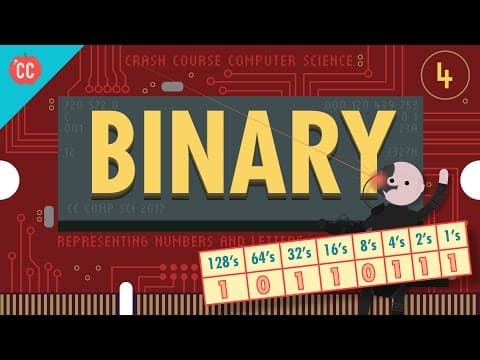
Digital systems use binary digits to represent data and information. Binary is a number system with only two digits, 0 and 1, and every photo, song, message and program is stored and processed as long sequences of them. Two digits suit electronics because circuits can reliably tell apart two states, such as a high or low voltage, so a slightly weak signal is still clearly closer to "on" than to "off".
A single bit can represent two values. Each extra bit doubles the number of possible values, so bits can represent different values.
Number of bits | Possible values | What they could represent |
|---|---|---|
1 | 2 | Yes or no; on or off |
4 | 16 | A hexadecimal digit (0–9, A–F) |
8 (one byte) | 256 | One character of English text; one shade of grey |
16 | 65,536 | One sound sample on a music CD |
24 | about 16.8 million | One pixel's colour on a screen |
A byte is eight bits. Larger quantities use prefixes: a kilobyte (kB) is 1,000 bytes, a megabyte (MB) a million bytes, a gigabyte (GB) a billion bytes and a terabyte (TB) a trillion bytes. Some operating systems count in powers of 2 instead, so a "kilobyte" can also mean 1,024 bytes.
In everyday decimal numbers, each place is worth ten times the one to its right (ones, tens, hundreds). In binary, each place is worth twice the one to its right.
Place value | 128 | 64 | 32 | 16 | 8 | 4 | 2 | 1 |
|---|---|---|---|---|---|---|---|---|
Bits of 01000001 | 0 | 1 | 0 | 0 | 0 | 0 | 0 | 1 |
The byte 01000001 has 1s in the 64 place and the 1 place, so its value is .
Numbers become text through a character encoding, an agreed table that matches each number to a character. In the ASCII encoding (1963), 65 stands for the capital letter A, so the byte 01000001 is stored as "A". ASCII covered only 128 characters, enough for English. Unicode, used on almost every device today, covers more than 150,000 characters, including Arabic, Chinese, Devanagari and emoji. Through the concept of identity, Unicode matters because, before it spread, many languages could not be written properly on computers.
Images are stored as grids of pixels, each given a number for its colour or brightness. Sound is stored as a long series of numbers, each measuring the height of the sound wave at one instant.
 YouTube
The digital is different from the analogue. The difference lies in how information is represented.
Analogue information uses continuous physical qualities and signals. A continuous quantity can take any value within a range, with no gaps between possible values. The groove on a vinyl record rises and falls smoothly with the sound wave. The chemical grains on photographic film darken in proportion to the light that hits them. The hands of a clock sweep smoothly round the face.
Digital information uses discrete signals with a finite set of values. A discrete quantity can take only certain separate values, such as the whole numbers 0 to 255, with nothing in between. A digital clock jumps from 10:41 to 10:42. A digital photo records each pixel's brightness as one of a fixed number of levels.

Turning an analogue signal into a digital one takes two steps. Sampling measures the signal at regular moments in time. Quantisation rounds each measurement to the nearest available level, which is then stored in binary. A music CD takes 44,100 samples every second and stores each one with 16 bits, so it can use 65,536 levels.
The more often a signal is sampled and the more levels are available, the closer the digital version is to the original, and the larger the file. Every digital copy is therefore an approximation, chosen to be close enough that people cannot hear or see the difference.
Feature | Analogue | Digital |
|---|---|---|
Representation | Continuous values | Discrete values, stored in binary |
Copying | Each copy loses some quality (a photocopy of a photocopy) | Copies are identical to the original |
Noise and wear | Scratches, fading and interference degrade the signal | Small errors can be detected and corrected |
Storage and sharing | Needs physical space and transport | Compact; can be sent instantly across the world |
Processing | Hard to search, edit or analyse automatically | Easy to search, edit, compress and analyse with algorithms |
Long-term risk | The object decays slowly but can still be read without special equipment | Files can become unreadable if hardware, software or formats become obsolete |
Digitization is the process of changing data and information from analogue to digital form. Scanning a printed photograph, recording a voice on a phone and photographing a page of a manuscript are all acts of digitization.
Digitization changes the form of information, not the way an organisation works. A scanned letter says the same thing as the paper original; what changes is that it can now be copied, searched and shared through digital systems.
Digital reformatting is how libraries and archives copy books, newspapers, maps, photographs, films and sound recordings into digital formats, usually to protect the originals and widen access.
The largest example is Google Books. From 2004, Google scanned books from partner libraries such as Harvard, Oxford's Bodleian Library and the New York Public Library, using software that flattened curved pages and turned images into searchable text. By 2019 it had scanned more than 40 million titles. Authors argued that this broke copyright law, but US courts ruled in 2015 that showing short "snippets" was fair use.
A digital archive is an organised collection of digital materials kept for long-term access. Some hold digitized copies of analogue originals; others hold material that was "born digital", such as websites and emails.
The British Library's Endangered Archives Programme has, since 2004, funded local teams to digitize at-risk records around the world, such as manuscripts in Djenné, Mali. The originals stay in their home countries while digital copies are shared online, which protects cultural heritage from fire, damp and conflict while leaving ownership with local communities.
Digital preservation is the work of keeping digital material usable over time. Digitization is only the first step: a digital file is not safe simply because it exists.
Digital files face their own threats:
Obsolete formats and devices, such as floppy disks and Flash animations, a form of media obsolescence.
Storage failure, as drives, discs and memory cards decay.
Link rot, as web pages are changed or deleted and links stop working.
Attacks and lack of funding at the organisations that run archives.
The Internet Archive, a non-profit founded in 1996, tackles link rot through its Wayback Machine, which has saved snapshots of web pages since the mid-1990s. By October 2025 it held more than one trillion archived pages, used by journalists, historians and courts to see what a site once said. It is vulnerable too: in October 2024 a cyberattack took it offline for several days.
Some preservation projects return to analogue media for safety. The Arctic World Archive, opened in 2017 in a former coal mine on Svalbard, Norway, stores digital data as visual codes on photographic film said to last at least 500 years; GitHub deposited 21 terabytes of open-source code there in 2020.
Digitization widens access: a student in Lagos can read a 19th-century book from Oxford without travelling. It also protects fragile originals and allows new research, such as searching millions of books for changes in language. Against this, it raises questions of power and values: who decides what is digitized first, who owns the copies, whether communities consent, and whether the files will still be readable in a century. What is not digitized can also become less visible, because it does not appear in search results.
Digitalization is the use of digital systems to change the structure and/or operation of an organisation, such as a business, a school, a hospital or a government. Where digitization changes the form of information, digitalization changes how people work, how services reach users and, often, how the organisation earns money.
The two words look alike, but they name different processes, as the diagram shows.

Digitization | Digitalization | |
|---|---|---|
What changes | The form of data and information | The structure and operation of an organisation |
Typical question | How is this stored and represented? | How does this organisation now work? |
School example | Scanning old school reports into PDF files | Moving homework, marking and parent communication onto a learning platform, with new roles and routines |
Hospital example | Scanning paper patient records | Using electronic records so that doctors across the country can see test results, book scans and prescribe online |
The two processes are linked. Digitalization usually depends on digitization, because an organisation cannot run its services online until its information is digital. But digitization can happen without digitalization: a library can scan its collection while its staff, opening hours and services stay exactly the same. Some writers use a third term, digital transformation, for very deep digitalization that changes an organisation's purpose or a whole industry.
Digitalization can cause disruption: a change that upsets existing organisations, jobs, markets or ways of life. The business researcher Clayton Christensen described "disruptive innovation" in the 1990s: a new product starts as cheaper and simpler than the leading one, serves customers the leaders ignore, then improves until it replaces the leaders. Streaming services disrupted video rental shops, and online travel sites disrupted travel agents.
Disruption is not only negative. It can lower prices, open new opportunities and serve people who were previously excluded. Through the concept of change, disruption is a moment of discontinuity, when established patterns break. Through the concept of power, it shifts influence from older organisations to newer ones, often to large technology platforms.
Schools and universities have digitalized learning platforms, assessment, libraries and communication with families. Uruguay's Plan Ceibal, launched in 2007, gave a laptop to every child and teacher in state primary schools by 2009, connected schools to the internet and extended to secondary schools from 2010. The national school system became an organisation that also runs devices, connectivity and digital learning services. Supporters credit it with narrowing the access divide among children. However, a 2014 study found no effect on reading and maths scores in the first two years, when classroom use was limited and teacher training optional, which suggests that devices need trained teachers and suitable content.
Businesses digitalize to cut costs, reach customers and collect data. Banks move customers to apps and close branches, supermarkets add self-checkouts and online ordering, and manufacturers use sensors to predict machine repairs. Digitalization can also change a company's whole business model, as the case of Kodak shows.
Estonia is one of the most digitalized states. Its X-Road data exchange, launched in 2001, lets government databases share information securely, and with a national digital ID card it allows citizens to file taxes, vote and see their medical records online. In December 2024 divorce applications moved online, which the government described as the last major public service to become digital. Through the concept of systems, Estonia shows how digitalization connects many separate organisations into one interdependent system, bringing efficiency but also the risk that one failure or attack affects many services.
E-government of this kind can reduce queues and paperwork. It can also exclude people on the wrong side of a digital divide, unless offline options remain.
Eastman Kodak was for most of the 20th century the best-known photography company in the world. Its story shows digitization (of the photograph) and digitalization (of the photography industry) working together, and the disruption that followed for a company, its workers and its home city.
Kodak was founded by George Eastman in Rochester, New York. Its first camera (1888) was sold with the slogan "You press the button, we do the rest": customers took pictures, sent the camera back to Kodak, and received prints. The Brownie camera of 1900 cost one dollar, which made photography affordable for ordinary families.
Kodak's profits came mainly from what people bought after the camera: film, chemicals, paper and processing, a "razor and blades" model in which a cheap product creates steady sales of a profitable consumable. For much of the century Kodak sold most of the film in the United States, and at its peak in the 1980s it employed about 145,000 people worldwide. In 1982 it employed 60,400 people in the Rochester area alone. Its revenue peaked at about $16 billion in 1996.
A film camera records an image by chemistry. Light changes silver crystals in the film in proportion to its brightness, an analogue process. The image becomes visible only after chemical processing.
A digital camera records an image electronically. Its sensor is a grid of millions of tiny light-sensitive cells. Each cell measures the light falling on it, an analogue-to-digital converter turns that measurement into a number, and the numbers are stored as bits. The photograph becomes a file of pixel values that can be viewed instantly, copied perfectly and sent anywhere, which is digitization through binary, sampling and discrete values.
In 1975 a young Kodak engineer, Steven Sasson, built one of the first digital cameras. It weighed about 3.6 kg, captured black-and-white images of 100 by 100 pixels (0.01 megapixels), and took 23 seconds to record each image onto a cassette tape. Kodak patented the design in 1978 but did not turn it into a product. A 1979 internal Kodak report predicted that photography would shift completely to digital by about 2010.
Kodak did not ignore digital photography. In 1991 it sold one of the first professional digital cameras, in 2001 it bought the photo-sharing website Ofoto (later Kodak Gallery), and by 2005 it was the leading seller of digital cameras in the United States.
The problem was the business model. A digital camera needs no film, no chemicals and often no prints, so every digital camera sold reduced the market for Kodak's most profitable products. Digital cameras were sold in a competitive market with thin profit margins, and Kodak's share fell quickly: by 2007 it was fourth in US digital camera sales, and by 2010 seventh. Meanwhile the entire industry was being disrupted again by smartphones, which put a camera, a screen and an internet connection in one device.

The digitalization of photography therefore came in two waves: digital cameras replaced film, then smartphones and social media replaced cameras and prints for most people. Photos moved from albums to platforms such as Facebook and Instagram.
On 19 January 2012 Kodak filed for bankruptcy protection in the United States. In the same year it stopped making digital cameras and sold Kodak Gallery to Shutterfly for $23.8 million. In April 2012 Facebook agreed to buy Instagram, a photo-sharing app with 13 employees, for about $1 billion. Kodak sold many of its digital imaging patents for about $525 million and left bankruptcy in September 2013 as a much smaller company focused on commercial printing and advanced materials. In 2024 it employed about 3,900 people.
People and communities | Impacts | Implications |
|---|---|---|
Kodak workers and the Rochester community | Tens of thousands of jobs lost between the 1980s and 2012; local suppliers and shops lost business | Risk of long-term decline for cities that depend on one employer; opportunity for new firms using Kodak's skilled workforce and buildings |
Retired employees | Pension and health benefits put at risk in bankruptcy; the UK Kodak Pension Plan took over part of the business as Kodak Alaris | Risk to workers' savings when a disrupted company fails |
Consumers | Photos became almost free to take, instant to view and easy to share | New risks to privacy and to the long-term survival of personal photos stored on devices and platforms |
Platforms and smartphone makers | Gained the users, data and advertising income that once flowed through film and prints | Concentration of the photography market in a few large technology companies |
Change. The shift from film to digital was not sudden. It took about 35 years from Sasson's prototype to Kodak's bankruptcy, and it happened in stages. Through the concept of change, Kodak shows both evolution (gradual improvements in digital sensors) and transformation (the collapse of the film-and-print system and the rise of photo sharing). It also shows continuity: people still take photos to remember events and share them with others; only the system that carries the photos changed.
Power. In the film era, power in photography lay with the companies that controlled film, chemistry and processing, chiefly Kodak and Fujifilm. After digitalization, power moved to those who control devices, software and platforms: Apple, Samsung, Google and Meta. Users gained power to create and share images, but platforms gained power over how images circulate, who sees them and how they are used for advertising.
Systems. Kodak's business was a system of linked parts (cameras, film, labs, paper, chemicals, shops). Digitalization removed several parts at once, so a company with strong digital technology still struggled, because its organisation, skills and income were built around the old system.
A common claim is that Kodak failed because it "invented the digital camera and then ignored it". The evidence supports only part of this claim. Kodak did delay a consumer digital product to protect film sales, and its own 1979 forecast suggests that managers knew the change was coming. But Kodak also invested heavily in digital products and led the US digital camera market in 2005.
A stronger explanation is that digitalization destroyed the business model that made Kodak profitable, and that no digital product could replace the profits from film. Fujifilm, Kodak's main rival, faced the same disruption but used its expertise in chemistry and materials to move into medical imaging, cosmetics and materials for electronics. Its survival suggests that Kodak's fall was not inevitable. The decisive factor was how far each organisation was willing to change its structure and operation.
The judgement also depends on perspective. For shareholders and Rochester workers, Kodak's story is one of loss; for consumers and new platforms, the same disruption brought cheaper, faster and more social photography. The impacts of digitalization fell very unevenly across people and communities.
The second question uses a short data source in the style of Paper 2.
I can explain how concepts, content and contexts connect in an inquiry, with an example of each.
I can define digital system, real-world example, people and communities and stakeholder, and distinguish impacts from implications.
I can describe the four stages of inquiry and the difference between directed, guided and open approaches.
I can evaluate a source using origin and purpose, meaning and methods, and corroboration and use, and distinguish primary from secondary sources and qualitative, quantitative and mixed methods.
I can explain why "digital society" is a contested term and why there may be several digital societies.
I can compare the information age, computer age, post-industrial society, network society and Fourth Industrial Revolution.
I can explain the levels of the digital divide and support them with ITU data.
I can describe the milestones from the integrated circuit to mobile and cloud computing, with dates.
I can convert a byte from binary to decimal, and distinguish between analogue and digital signals.
I can define digitization, digital reformatting, digital archives and digital preservation, and distinguish digitization from digitalization and its disruption.
I can analyse the Kodak case study through at least two concepts and evaluate why Kodak declined.