A4 Machine learning
How machine learning fundamentals, data preprocessing, learning approaches and ethics fit together, why two subtopics are HL only, and how machine learning links to the rest of the course.
- IB Computer Science
- SL and HL
What A4 covers
From the subject guide: what you need to know and be able to do.
Types of machine learning, how models are trained and the ethics of using them.
4 subtopics in Machine learning
Each one has its own page once something is published for it.
- A4.1Machine learning fundamentals90 questions · notes · 50 quick fire
- A4.2Data preprocessingHL only52 questions · notes · 55 quick fire
- A4.3Machine learning approachesHL only92 questions · notes · 70 quick fire
- A4.4Ethical considerations90 questions · notes · 50 quick fire
An overview of A4 Machine learning
Introduction
Machine learning studies programs that improve at a task by finding patterns in data instead of following rules written by a programmer. It covers the types of learning and where each is used, the hardware that trains and runs models, and the ethical questions that models raise; at HL it adds how data is prepared and how the main learning algorithms work.
Spam filters, film recommendations, voice assistants, medical image analysis and text generators all depend on models trained on data. Because those models make decisions about real people, such as whose loan is approved or which message is hidden, the topic pairs the technical question of how a model learns with the ethical question of whether its use is fair, private and accountable.
How the subtopics connect
The subtopics follow a model from data to deployment. Subtopic A4.1, Machine learning fundamentals, defines machine learning (ML) and its types: supervised learning, unsupervised learning, reinforcement learning, deep learning and transfer learning. It matches them to applications and describes the hardware they need, from laptops through GPUs, TPUs and edge devices to cloud platforms and supercomputers.
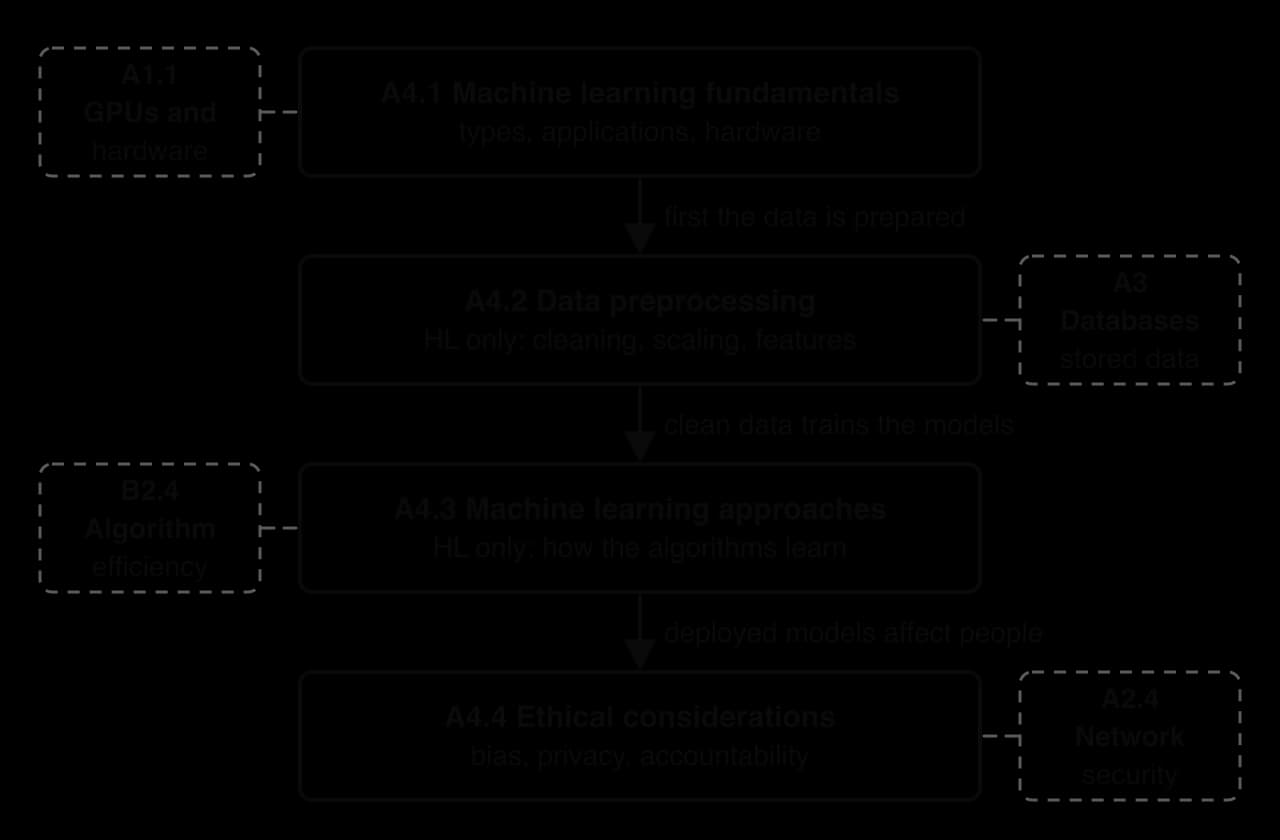
Subtopic A4.2, Data preprocessing, is HL only and prepares the raw data: data cleaning (outliers, duplicates, missing values), feature scaling, feature selection and dimensionality reduction. Subtopic A4.3, Machine learning approaches, is also HL only and explains how the algorithms learn: linear regression, k-nearest neighbours and decision trees, k-means clustering, association rules, reinforcement learning, genetic algorithms and neural networks, with the metrics used to evaluate and choose between them. Subtopic A4.4, Ethical considerations, examines what happens when models are used: algorithmic bias, fairness, accountability, privacy, consent and environmental impact, and the wider integration of computing into daily life through quantum computing, augmented and virtual reality and pervasive AI.
Subtopics at SL and HL
Machine learning splits between the levels by whole subtopics. None of its SL subtopics contains an HL-only statement, so the SL and HL versions of A4.1 and A4.4 are identical.
Subtopic | Level | HL-only statements inside it |
|---|---|---|
A4.1 Machine learning fundamentals | SL and HL | None |
A4.2 Data preprocessing | HL only | The whole subtopic: data cleaning, feature selection and dimensionality reduction |
A4.3 Machine learning approaches | HL only | The whole subtopic: regression, classification, clustering, association rules, reinforcement learning, genetic algorithms, neural networks and model selection |
A4.4 Ethical considerations | SL and HL | None |
SL students therefore meet the algorithms by name only. Subtopic A4.1 describes each type of learning without relying on A4.3, and subtopic A4.4 discusses the effects of models without needing their internal workings.
Links to other topics
Machine learning draws on almost every other topic. Its hardware comes from subtopic A1.1 (GPUs) and topic A2 (edge and cloud computing), its data usually comes from databases in topic A3, and data mining in subtopic A3.4 uses the same techniques that A4.3 explains. The word "normalisation" in A4.2 means rescaling features, not the database normalisation of subtopic A3.2.
The efficiency ideas of subtopic B2.4, Programming algorithms, also apply. A training algorithm runs over every record many times, so an approach whose work grows quickly with the size of the data becomes unusable on millions of records.
Flashcards for A4
The official decks for this part of the syllabus.
- A4.1 Machine learning fundamentals253 cards
- A4.2 Data preprocessing318 cards
- A4.3 Machine learning approaches454 cards
- A4.4 Ethical considerations271 cards
Carry on with A4 in Augment
With a free account, Augment remembers where you stopped and what you have practiced.