Discuss the ethical implications of machine learning and of emerging technologies such as quantum computing, AR, VR and pervasive AI, using evidence from real cases and reaching justified conclusions.
Each is in the Computer Science glossary, with every other term in the subject.
The obligation of the people and organisations who build and deploy a system to take responsibility for its decisions and their consequences, to explain them, and to put right any harm caused.
An input deliberately altered, often by changes too small for a person to notice, so that a machine learning model gives a wrong output.
A systematic and repeatable error in a computer system that produces unfair outcomes, such as favouring or disadvantaging one group of people over another.
The property of an automated decision system whose outcomes or error rates do not unjustly differ between groups of people, measured against a stated definition of fairness.
The condition of acting or communicating without one's identity being known; pseudonymity is acting under a consistent false name that is not linked to one's real identity.
The European Union regulation, in force from 1 August 2024 with its provisions phased in over the following 6 to 36 months, that regulates AI systems according to their level of risk.
Technology that overlays computer-generated images, sound or information onto a person's view of the real world in real time, through a phone screen, headset or smart glasses.
Discuss the ethical implications of machine learning in real-world scenarios, covering accountability, algorithmic fairness, bias, consent, environmental impact, privacy, security, societal impact and transparency.
Explain how biases enter training data and why they are hard to remove.
Discuss the ethical issues raised by machine learning in online communication: misinformation, bias, online harassment, anonymity and privacy.
Evaluate ways of reducing the harms of machine learning systems, such as bias audits, human oversight, explainability and regulation.
Discuss why ethical guidelines need to be reassessed continually as technology advances.
Discuss the implications of quantum computing, augmented reality, virtual reality and pervasive AI for society, individual rights, privacy and equity.
Machine learning (ML) systems now help decide who is shortlisted for a job, which posts appear in a social media feed, who is stopped by police cameras and which loan applications are approved. Because a model learns its behaviour from data instead of following rules written line by line, it can repeat the unfairness hidden in that data, at a scale and speed no single human decision-maker could reach. Ethics in computer science asks who benefits from a system, who is harmed, who is responsible, and what should be done about it. The same questions apply to technologies that are spreading into daily life more generally, from smart glasses that can recognise faces to quantum computers that may one day read today's encrypted messages.
90 exam-style questions on this subtopic, written in the style of the IB papers. The first has its markscheme open. Counted on
DermaScan is a company building a smartphone app that checks photos of skin moles for signs of skin cancer. It has 250 000 photos that dermatologists have labelled as benign or suspicious. It plans to use deep learning.
Outline one characteristic of deep learning.
2 marks
Award [1] for the characteristic and [1] for the development.
Uses artificial neural networks with many layers;
each layer learns more complex / abstract features than the one before;
Learns the features itself from raw data (e.g. pixels);
so programmers do not have to hand-design which features matter;
Needs very large amounts of data;
to learn its very large number of parameters / to perform well;
Needs a lot of computing power;
typically GPUs / TPUs for training;
Explain why this project is an example of supervised learning even though it uses deep learning.
2 marks
Award [1] per point, up to [2 max].
The training photos are labelled (benign / suspicious) by dermatologists;
the model learns to map an input to a known output / class;
deep learning describes the model structure (many-layer network), not how it learns;
One of 50 short multiple-choice questions on A4.4. Pick an answer to see why it's right or wrong.
A simple scoring formula used by courts is kept secret as a trade secret, so defendants cannot examine it. What is this an example of?
The official deck for this part of the syllabus.
What is ethics, as applied in computing?
Beyond whether a system works, what does an ethical question about it ask?
With a free account, Augment remembers where you stopped and what you have practiced.
A systematic test of an automated decision system, often by an independent party, that compares its outputs and error rates across groups of people to find and measure unfair differences.
A system whose inputs and outputs can be observed but whose internal reasoning cannot practically be inspected or understood, either because it is too complex or because it is kept secret.
A person's free, specific and informed agreement to their data being collected and used for a stated purpose, which they can also withdraw.
The process by which an online platform reviews user-generated content and removes, restricts or labels material that breaks its rules or the law, using automated classifiers, human moderators or both.
The principle that an organisation should collect and keep only the personal data that is adequate, relevant and necessary for its stated purpose.
An attack in which false or manipulated examples are added to a model's training data so that the trained model behaves wrongly, either in general or for inputs chosen by the attacker.
An image, video or audio recording of a real person that has been created or altered using deep learning so that it appears authentic.
The gap between people, groups or countries that have access to modern digital technology, connectivity and the skills to use them and those that do not.
False information that is created or spread deliberately to deceive, for example to influence an election, damage a reputation or make money.
Discarded electrical and electronic equipment, such as computers, phones and servers, which contains valuable and toxic materials and is often exported to countries with weaker recycling controls.
The effect of a technology on the natural environment over its life cycle, including the energy and water used to make and run it, the greenhouse gases emitted and the waste produced when it is discarded.
Fairness in how the benefits, costs and risks of a technology are distributed, taking into account that different groups start from different positions and may need different support to benefit equally.
The study of what is right and wrong in human conduct, applied in computing to the choices made when designing, building and using technology and to their effects on people and the environment.
The degree to which the reasons for a model's individual outputs can be described in terms a person can understand, such as which inputs most influenced a decision.
The use of computer vision, usually a deep learning model, to detect a face in an image and identify or verify a person by comparing the face with stored images.
A cycle in which a model's outputs influence the data later used to retrain or evaluate it, so that its errors or biases are reinforced over time.
The narrowing of the information a person sees online when personalisation algorithms keep showing content that matches their past behaviour and views, reducing exposure to other perspectives.
The European Union law, applied since 25 May 2018, that sets rules for processing personal data, gives individuals rights over their data, and allows fines of up to €20 million or 4% of a company's worldwide annual turnover, whichever is higher.
A design in which a person reviews, approves or can override an automated system's output before it takes effect, especially for decisions with serious consequences.
The freedoms and protections each person is entitled to, such as privacy, freedom of expression, equal treatment and due process, including how these apply to digital technology and data.
False or misleading information that is shared without the intention to deceive, often by people who believe it is true.
Repeated or severe abusive behaviour directed at a person through digital channels, such as threats, insults, stalking, doxxing (publishing private details) or sharing sexual images without consent.
The embedding of artificial intelligence throughout everyday objects, services and institutions, such as phones, homes, cars, workplaces and public services, so that people interact with AI systems constantly, often without noticing.
Public-key cryptographic algorithms designed to remain secure against attacks by both classical and quantum computers, intended to replace algorithms such as RSA that a large quantum computer could break.
The right of individuals to control the collection, use and sharing of information about themselves, and to be free from unwanted observation.
A feature that is not itself a protected attribute but is closely correlated with one, so that a model using it can treat groups differently without being given the protected attribute directly.
Computing that uses quantum-mechanical effects such as superposition and entanglement, with quantum bits (qubits) as the basic unit of information, to solve certain problems far faster than classical computers can.
The effect of a technology on society as a whole, including on jobs, inequality, relationships between groups, the distribution of power and how people live and make decisions.
Any person, group or organisation that affects, or is affected by, a computer system, including its developers, the organisation that deploys it, its users, the people it makes decisions about, and wider society.
The systematic monitoring of people's behaviour, communications or movements, by governments or organisations, to gather information or influence and control them.
Bias in a model that comes from the data it learned from, because some groups are under-represented (sampling bias), the data records past unfair decisions (historical bias), or the labels reflect the judgements or mistakes of the people who assigned them (labelling bias).
Openness about how an automated system works, including what data it uses, how it was trained and tested, where it is used, and its known limitations.
Technology that places a person in a fully computer-generated, interactive environment, usually through a headset that tracks the movements of their head and hands.
Every technology raises ethical questions, but machine learning raises them in a particular form. A traditional program does what its programmer wrote; if it treats one group unfairly, the unfair rule can be found in the source code. An ML model instead learns a pattern from training data, and its "rules" are millions of numerical weights that nobody wrote and few people can read. The behaviour of the system therefore depends on how the data was collected and labelled, what the model was asked to optimise, and where it is used.
Four features of ML make its ethical effects larger than those of most software. Scale: one model can make millions of decisions a day, so a small error rate becomes thousands of wrong decisions. Opacity: the reasons for an individual output are often hard to explain, even for the developers. Dependence on data: the model inherits whatever patterns the data contains, including past discrimination. Automation: decisions that used to involve human judgement, and so a chance for someone to notice a problem, can be made without anyone looking at them.
An ethical analysis starts by asking who is affected. The people affected by an ML system are often not the people who chose to build it or the people who use it day to day.
The stakeholder × issue matrix for a hypothetical company that uses an ML model to rank job applications shows how the same system raises different issues for different stakeholders. Reading across a row gives one stakeholder's view of the system; reading down a column shows everyone affected by one issue.
Stakeholder | Bias and fairness | Privacy and consent | Accountability and transparency |
|---|---|---|---|
Applicants | May be ranked lower because of patterns linked to gender, age or background | CVs and online profiles analysed without clear permission | Rejected without knowing why or how to appeal |
Employer (deployer) | Loses good candidates; risks discrimination claims | Must store applicant data securely and lawfully | Legally responsible for hiring decisions it delegates to software |
Developer (vendor) | Chose the training data, features and objective | Decides what data the model needs | Can explain the model's design; may hide it as a trade secret |
Recruiters (users) | May trust the ranking more than their own judgement | Handle the model's outputs about named people | Need enough explanation to override the model |
Society and regulators | Unequal access to jobs can widen existing inequality | Sets the limits on what data may be processed | Writes and enforces rules on automated decisions |
Ethical problems are not caused only by people who intend harm. Most of the systems behind well-known ML harms were built by teams trying to make decisions faster, cheaper or more consistent. Harm arose because of unexamined data, careless deployment, or a system being used in a context its designers did not plan for. For that reason, ethical review belongs at every stage of development and use, not only after something goes wrong.
Bias, in everyday language, means an unfair lean towards or against something. In machine learning the word describes outputs that are systematically worse, or systematically different, for some groups of people than for others.
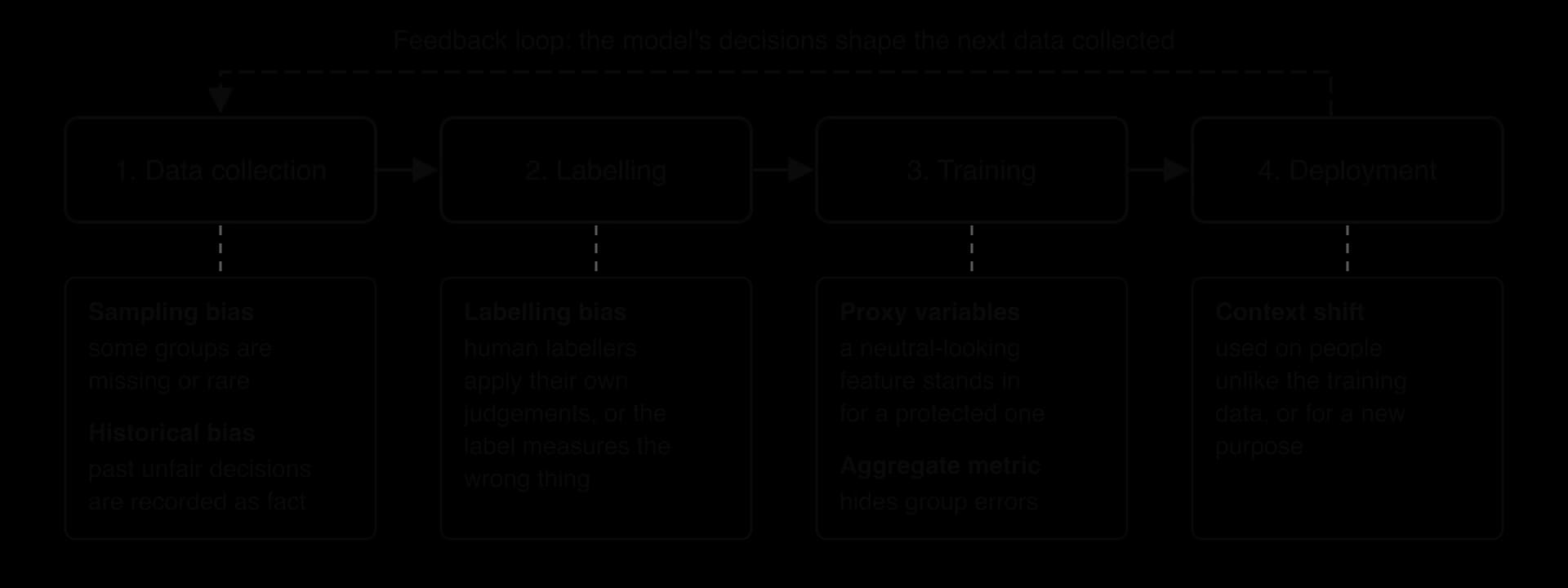
Bias usually enters through the data and through the decisions people make while building the system, and only rarely through an explicit rule in the code that treats one group worse. The bias pipeline traces an ML system from data collection to deployment and marks where bias can enter at each stage, including the feedback loop that sends the model's own decisions back into the next round of data.
Most bias begins with the data. A supervised learning model copies the relationship between inputs and labels in its training data as closely as it can, so if the data is unrepresentative or records unfair past decisions, the model learns to reproduce them.
The three kinds of training-data bias have different causes and need different fixes.
Sampling bias (representation bias). Some groups appear rarely or not at all, so the model has few examples to learn from and makes more errors for them. The face benchmarks widely used before 2018 were mostly made up of lighter-skinned faces, so systems tested on them were measured mainly on lighter-skinned people (the Gender Shades case study gives the figures).
Historical bias. The data is an accurate record of an unfair world. A model trained on past hiring decisions learns who was hired, not who would have done the job well, so any past discrimination becomes part of the pattern.
Labelling bias. The labels are wrong or slanted. Human labellers may judge the same behaviour differently depending on who shows it, or the label may measure something other than what is wanted, such as "was arrested" standing in for "committed a crime".
Amazon's experimental résumé-scoring tool shows historical bias at work. The team began building it in 2014 to give candidates one to five stars, and trained it on résumés the company had received over about ten years, most of them from men. The model learned to penalise résumés containing the word "women's" (as in "women's chess club captain") and downgraded graduates of two all-women's colleges. Engineers edited the model to ignore those terms, but could not guarantee that it would not find other ways to sort candidates by gender, and the project was abandoned; the team was disbanded by early 2017.
Source: Reuters, "Amazon scraps secret AI recruiting tool that showed bias against women", 10 October 2018.
The Amazon case points to a deeper problem. Even when a sensitive attribute is left out, other features can carry the same information.
Common proxies include postcode (for ethnicity and income), first name (for gender and ethnicity), the gap years on a CV (for parenthood, and so often for gender), and the type of phone or browser used (for income). A hypothetical model built to predict loan repayment from postcode may be accurate on average while turning down almost every applicant from a poorer district. Its developers need not intend this, and the model has no concept of ethnicity. Training keeps postcode as a feature only because it reduces the error on the training data, and an objective based on accuracy alone keeps any such feature, including features that encode discrimination.
A model can also become biased when it is used on people unlike those in its training data, or for a purpose its designers did not plan for. This context shift is the deployment-stage risk marked in the bias pipeline: a hypothetical skin-condition classifier trained mostly on images of lighter skin, for example, may be accurate in the hospital where it was developed and much less accurate in a population with darker skin.
Some bias grows after deployment. When a model's decisions change the world, and the changed world produces the next batch of training data, an initial bias can be amplified each time the model is retrained.
Predictive policing shows how this works. A model predicts where crime will happen from records of past arrests. More patrols are sent to the predicted areas, police there observe and record more offences, and the new records make the same areas look even more dangerous at the next retraining. In a 2016 study, Kristian Lum and William Isaac applied a widely used predictive policing algorithm (PredPol) to drug-crime records from Oakland, California. The model directed police mainly to neighbourhoods with more Black and low-income residents, although public-health survey data suggested drug use was spread much more evenly across the city.
Source: K. Lum and W. Isaac, "To predict and serve?", Significance, 2016.
A model can be highly accurate overall and still fail one group badly, because the overall figure is an average weighted towards the largest groups. If 90% of the test data comes from group X and 10% from group Y, a model that is 98% accurate on X and 70% accurate on Y has an overall accuracy of . The headline figure looks excellent, yet almost one in three decisions about group Y is wrong.
The video from Crash Course AI works through these sources of bias with further examples, including how biased data in image search and word associations reproduces stereotypes.
 YouTube
Reducing bias requires a precise statement of what a fair outcome would be. "Fair" can be defined in several reasonable ways, however, and the definitions can contradict each other.
Three of the most common definitions are:
Demographic parity: each group receives positive decisions (hired, approved, flagged) at the same rate.
Equal error rates: the rate of false positives (wrongly flagged) and false negatives (wrongly cleared) is the same for each group.
Calibration (predictive parity): a given score means the same thing for every group; for example, of the people flagged "high risk", the same share actually reoffend in each group.
When groups have different base rates (different proportions of real positives in the data), a model that is not perfect cannot satisfy equal error rates and calibration at the same time. Choosing a definition is therefore an ethical decision about which kind of mistake matters most, and it cannot be settled by computation alone.
COMPAS is a risk-assessment tool used by courts in several US states to estimate the chance that a defendant will reoffend. In 2016 the journalism organisation ProPublica analysed the risk scores of more than 7,000 people arrested in Broward County, Florida, and checked who was charged with a new crime within two years. Of defendants who did not reoffend, Black defendants had been labelled higher risk almost twice as often as white defendants. Of defendants who did reoffend, white defendants had been labelled lower risk much more often.
Error type | White defendants | Black defendants |
|---|---|---|
Labelled higher risk, but did not reoffend (false positive) | 23.5% | 44.9% |
Labelled lower risk, yet did reoffend (false negative) | 47.7% | 28.0% |
Source: ProPublica, "Machine Bias", 23 May 2016 (Broward County data, 2013–2014 arrests).
The tool's developer, Northpointe (now Equivant), replied that COMPAS was fair because a given score predicted reoffending equally well for Black and white defendants. Both claims were true. ProPublica measured fairness as equal error rates; Northpointe measured it as calibration. Because the two groups in the data had different recorded reoffending rates, no imperfect score could satisfy both definitions at once. The case moved the debate from "is the algorithm biased?" to "which definition of fairness should a court use, and who should decide?"
The function audit counts the four outcomes (flagged and reoffended, flagged but did not, and so on) for one group of a hypothetical risk tool and prints the group's accuracy, the share of flagged people who reoffended, the false positive rate and the false negative rate. Checking a model this way, group by group, is the core of a bias audit.
# Each count: (group, flagged as high risk?, reoffended?) -> number of people
counts = [
    ("A", True, True, 36), ("A", True, False, 24),
    ("A", False, True, 14), ("A", False, False, 26),
    ("B", True, True, 12), ("B", True, False, 8),
    ("B", False, True, 8), ("B", False, False, 72),
]


def audit(group):
    tp = fp = fn = tn = 0
    for g, flagged, reoffended, n in counts:
        if g != group:
            continue
        if flagged and reoffended:
            tp += n
        elif flagged and not reoffended:
            fp += n
        elif not flagged and reoffended:
            fn += n
        else:
            tn += n
    total = tp + fp + fn + tn
    accuracy = (tp + tn) / total
    flagged_correct = tp / (tp + fp)
    false_positive_rate = fp / (fp + tn)
    false_negative_rate = fn / (fn + tp)
    print(group, format(accuracy, ".2f"), format(flagged_correct, ".2f"),
          format(false_positive_rate, ".2f"), format(false_negative_rate, ".2f"))


print("group accuracy flagged_correct FPR FNR")
for group in ["A", "B"]:
audit(group)public class BiasAudit {
// Each row: group, flagged as high risk (1 = yes), reoffended (1 = yes), number of people
static String[] groups = {"A", "A", "A", "A", "B", "B", "B", "B"};
static int[] flagged = {1, 1, 0, 0, 1, 1, 0, 0};
static int[] reoffended = {1, 0, 1, 0, 1, 0, 1, 0};
static int[] people = {36, 24, 14, 26, 12, 8, 8, 72};
static void audit(String group) {
int tp = 0, fp = 0, fn = 0, tn = 0;
for (int i = 0; i < groups.length; i++) {
if (!groups[i].equals(group)) {
continue;
}
int n = people[i];
if (flagged[i] == 1 && reoffended[i] == 1) {
tp += n;
} else if (flagged[i] == 1 && reoffended[i] == 0) {
fp += n;
} else if (flagged[i] == 0 && reoffended[i] == 1) {
fn += n;
} else {
tn += n;
}
}
int total = tp + fp + fn + tn;
double accuracy = (double) (tp + tn) / total;
double flaggedCorrect = (double) tp / (tp + fp);
double falsePositiveRate = (double) fp / (fp + tn);
double falseNegativeRate = (double) fn / (fn + tp);
System.out.println(group + " " + String.format("%.2f", accuracy) + " "
+ String.format("%.2f", flaggedCorrect) + " "
+ String.format("%.2f", falsePositiveRate) + " "
+ String.format("%.2f", falseNegativeRate));
}
public static void main(String[] args) {
System.out.println("group accuracy flagged_correct FPR FNR");
audit("A");
audit("B");
}
}The Python version stores each count as a tuple and unpacks it in the for loop; the Java version keeps the four columns in parallel arrays, uses equals to compare strings, and casts to double before dividing so that integer division does not truncate the rates to zero. Both print the same output.
group accuracy flagged_correct FPR FNR
A 0.62 0.60 0.48 0.28
B 0.84 0.60 0.10 0.40A bias audit makes fairness measurable. Instead of trusting the developer's overall accuracy figure, an auditor tests the model on data split by group and compares the error rates.
An audit needs test data that includes enough people from each group and records which group each person belongs to. That creates a tension with privacy: measuring bias against a group requires knowing who is in it. An audit is also a snapshot, so models that are retrained regularly need regular audits.
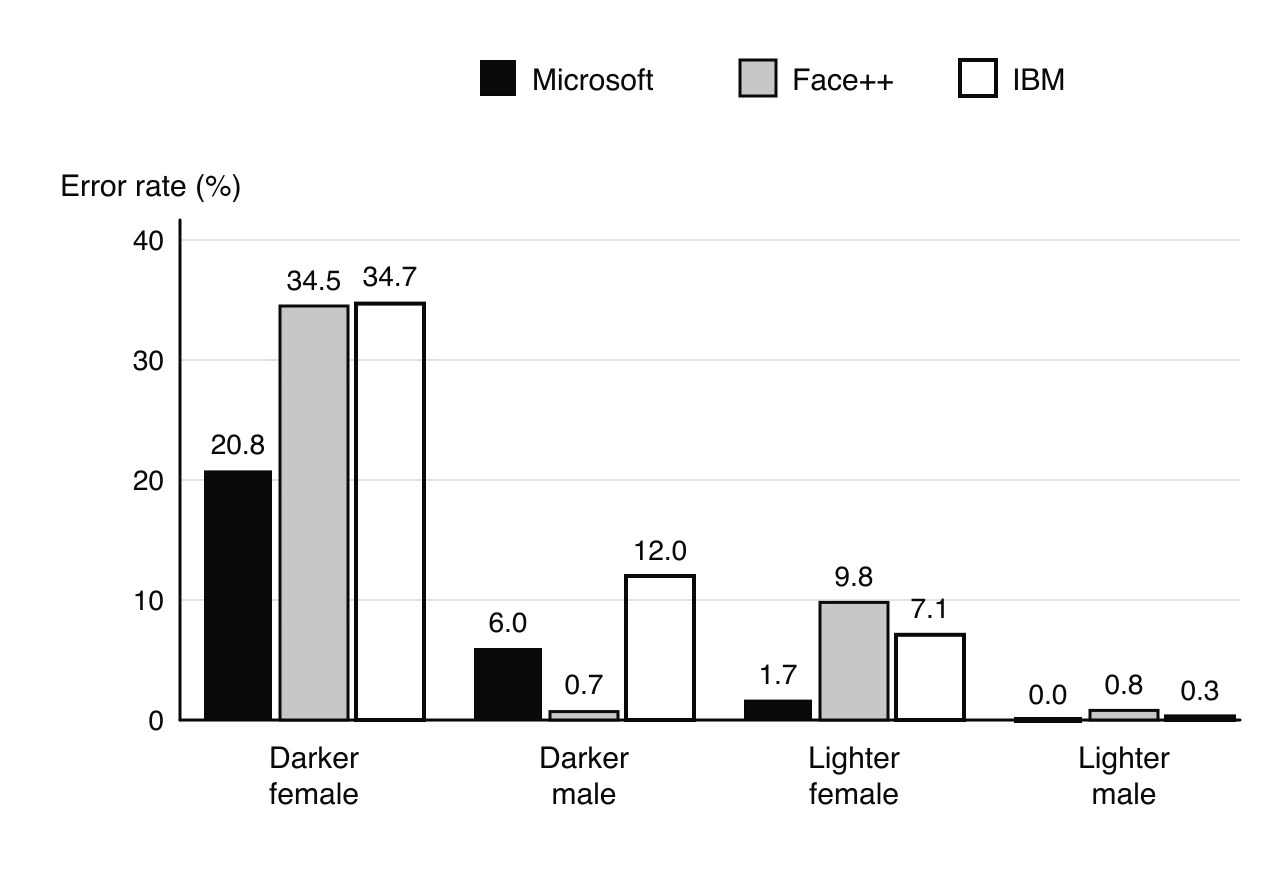
In 2018 Joy Buolamwini (MIT Media Lab) and Timnit Gebru published Gender Shades, an audit of three commercial face-analysis services sold by Microsoft, IBM and the Chinese company Face++. Each service offered a gender classifier: given a photo, it returned "male" or "female". Existing benchmark datasets were mostly lighter-skinned faces, so the researchers built a new one, the Pilot Parliaments Benchmark: 1,270 photos of members of parliament from three African countries (Rwanda, Senegal, South Africa) and three European countries (Iceland, Finland, Sweden), chosen because those parliaments are close to gender parity. A dermatologist labelled each face with a skin type on the six-point Fitzpatrick scale, which the researchers grouped into "darker" and "lighter".
The services looked accurate overall: 93.7% for Microsoft, 90.0% for Face++ and 87.9% for IBM. Splitting the results into four intersecting groups changed the picture. The bar chart of error rates by group shows every classifier performing worst on darker-skinned women and best, or nearly best, on lighter-skinned men.
The audit brings together several ideas about bias and fairness.
Sampling bias. The benchmarks the industry had used were 79.6% (IJB-A) and 86.2% (Adience) lighter-skinned, so systems could score well while hardly being tested on darker-skinned faces.
Aggregate accuracy hides group errors. IBM's 87.9% overall accuracy included a 34.7% error rate for darker-skinned women, about one in three.
Intersectional effects. Looking only at gender, or only at skin type, understates the problem; the worst results appear where the two combine.
Accountability through publication. IBM and Microsoft responded by announcing improvements to their classifiers, and the research fed a wider debate: in June 2020 IBM stopped offering general-purpose facial recognition, and Amazon announced a one-year moratorium on police use of its Rekognition service.
Sources: Buolamwini and Gebru, 2018; Wikipedia, "Joy Buolamwini" and "Amazon Rekognition", accessed October 2026.
The case also shows the limits of a technical fix. Improving accuracy for every group removes one harm, a misidentification, but leaves another: a facial recognition system that works well for everyone is also a more effective tool for mass surveillance. Buolamwini herself has argued that better accuracy alone does not remove the risk of misuse in profiling or surveillance. Whether a system should be used at all is a separate question from whether it works equally well.
When an ML system makes a harmful decision, the question of who is responsible is harder than it is for a human decision. The developer built the model, the deploying organisation chose to use it, the user acted on its output, and the data came from somewhere else again.
Responsibility is usually shared between three roles:
The developer chooses the data, the features, the objective and the testing. It is responsible for known limitations and for documenting them.
The deployer (a court, a bank, a school) decides to use the system for a purpose and is responsible to the people affected. Buying software does not transfer the duty of care to the vendor.
The user (a judge, a loan officer, a recruiter) acts on the output. Users are responsible for using judgement instead of deferring automatically to the score.
Gaps between these roles create an accountability gap: each party can point to another. In Loomis v. Wisconsin, a defendant sentenced to six years in prison in part on the basis of a COMPAS score argued that he could not challenge a score produced by a proprietary algorithm whose workings were a trade secret. The Wisconsin Supreme Court upheld the sentence in 2016 and the US Supreme Court declined to hear the case in June 2017, so the score's internal logic was never examined in court.
Accountability depends on being able to see what a system does and why.
Transparency is about the system in general; explainability is about individual decisions. A bank can be transparent by publishing that it uses a credit model and which data it draws on, yet still be unable to say why one applicant was refused.
Simple models such as a short decision tree are explainable by nature, because the path from the root to a leaf can be read as the reason for each decision. A deep learning model with millions of weights is not, and is often described as a black box.
There are two kinds of black box. A technical black box, such as a deep neural network, is hard to explain even with full access. A legal black box, such as COMPAS, may be simple inside but is hidden by trade secrecy. Explainability tools can estimate which inputs mattered most to one decision (for example, by changing each input slightly and watching the output), but these are approximations of the model's behaviour, not a reading of its true reasoning.
Approach | How it helps | Limitation |
|---|---|---|
Choose an interpretable model (decision tree, linear model) | Every decision can be traced and checked | Often less accurate on complex data such as images or speech |
Explainability tools on a complex model | Shows which inputs most affected one output | An approximation that may be incomplete or misleading |
Model cards and datasheets (documentation published with a model) | Records the training data, intended use, test results by group and known limits | Only helps if they are honest, complete and read |
Right to an explanation in law | Gives affected people a basis to ask and to challenge | Explanations may be vague; enforcement is uneven |
The most common safeguard against automated mistakes is to keep a person involved in the decision.
Human review works only if the reviewer has the time, information and authority to disagree with the model. People tend to accept an automated recommendation even when they have reason to doubt it, particularly when they are busy, so a reviewer who approves 500 automated decisions an hour adds little protection. Effective oversight gives the reviewer an explanation, a real power to override, and protection from being blamed for doing so.
ML systems need large amounts of data, and much of it is about people. Three issues follow: whether the people agreed to the use of their data, whether information about them stays under their control, and whether the system can be attacked or misused.
Many large models are trained on data that was collected for a different purpose: photos posted on social media, public web pages, medical records gathered for treatment, or text written for a forum.
Data that is publicly visible is not automatically data people have consented to have collected and reused. A photo shared with friends was not shared so that a company could build a face-search engine from it. Generative image models raise the same issue for artists, whose published work may be used as training data without permission or payment, and whose style the model can then imitate.
Privacy is about control over personal information: who can collect it, what they can infer from it, and what they can do with it.
ML threatens privacy in ways older systems did not. Models can infer sensitive facts that were never disclosed, such as health conditions, sexuality or pregnancy, from ordinary data like purchases or likes. Re-identification links "anonymised" records back to named people by combining several harmless-looking fields. Face recognition can identify a person in a crowd without their knowledge.
Clearview AI is the clearest example of the conflict between this technology and consent and privacy. The company built a face-search tool for police and other agencies by scraping images from the web and social media; its database had passed 70 billion images. Several European data-protection authorities ruled that collecting the biometric data of people who had never agreed to it was unlawful: the French, Italian and Greek regulators each fined the company €20 million in 2022, and the Dutch regulator fined it €30.5 million in 2024.
Sources: Wikipedia, "Clearview AI", accessed October 2026; Dutch Data Protection Authority announcement, 3 September 2024.
The Clearview fines were issued under Europe's main data-protection law.
GDPR applies to any organisation that processes the personal data of people in the EU, wherever the organisation is based. Several of its principles bear directly on ML: processing must be lawful, fair and transparent; data may be collected only for specified purposes; people have rights to access and correct their data; and individuals have a right not to be subject to a decision based solely on automated processing that significantly affects them, such as an automatic refusal of credit, except in limited cases and with safeguards. One of its principles limits the amount of data collected in the first place.
Data minimisation conflicts with the habits of ML development, where more data usually means a better model and features are often collected "in case they help". The principle forces developers to justify every feature, which also reduces the number of possible proxies and the damage done if the data leaks.
When collection and inference happen continuously and at scale, privacy concerns become concerns about surveillance.
Live facial recognition in public spaces, workplace monitoring software that scores employees' activity, and location tracking through phones all extend surveillance. Its effect reaches people who have done nothing wrong, because people who know they are watched may avoid lawful protests, religious meetings or clinics, which is known as a chilling effect.
Security is a separate issue from privacy. Privacy asks who should be allowed to use information; security asks whether the system can be attacked, stolen from or made to misbehave. ML adds new attack surfaces to the familiar ones covered in subtopic A2.4, Network security.
In one experiment, a few black and white stickers on a real stop sign made a road-sign classifier read it as a speed-limit sign in every image taken in the laboratory and in most video frames filmed from a moving car. Other researchers changed the label an image classifier gave to many images by altering a single pixel. For a self-driving car or a medical scanner, an adversarial example is therefore a safety risk as well as a research result.
Sources: Eykholt et al., "Robust Physical-World Attacks on Deep Learning Visual Classification", CVPR 2018; Su, Vargas and Sakurai, "One Pixel Attack for Fooling Deep Neural Networks", IEEE Transactions on Evolutionary Computation, 2019.
Data poisoning matters most for systems that keep learning from the public. Two further threats are model theft, in which an attacker queries a model many times to copy its behaviour, and the misuse of generative models to produce convincing fake audio and video for fraud.
Training and running large models uses large amounts of electricity, and the data centres involved also use water for cooling and depend on hardware with a limited life.
The energy cost of a model has two parts. Training happens once (or once per version) and can take thousands of GPUs running for weeks. Inference happens every time someone uses the model; for a popular service with millions of users, the total energy of inference over the model's lifetime can exceed that of training. The emissions depend heavily on where the data centre gets its electricity: the same computation produces far less carbon on a grid supplied mostly by hydro, wind or nuclear power.
Stage | GPT-3 (175 billion parameters) |
|---|---|
Electricity used for training | 1,287 MWh |
Emissions from training | 552 tCO₂e (tonnes of carbon dioxide equivalent) |
Comparison | About three times the emissions of a whole passenger jet's round trip between San Francisco and New York (180 tCO₂e) |
Source: Patterson et al., "Carbon Emissions and Large Neural Network Training", arXiv:2104.10350, 2021. Figures are the authors' estimates.
Hardware has its own impact. GPUs and servers in data centres are often replaced every few years as faster chips appear, and the demand for ML accelerators adds to the mining of metals and to waste.
The environmental argument is not one-sided. ML is also used to cut energy use: to forecast demand on electricity grids, schedule data-centre cooling, design more efficient materials and monitor deforestation from satellite images. A balanced judgement compares the cost of a model with the savings it makes possible, and asks whether a smaller, cheaper model would do the job as well.
Beyond individual decisions, ML changes how societies work.
The main societal effects of ML usually discussed are:
Jobs. Automation of routine tasks (document review, customer service, translation, image editing) displaces some work while creating new roles in data, oversight and maintenance. The gains and losses fall on different people and places.
Inequality. Benefits go mostly to those with data, skills and computing power; harms such as biased decisions and surveillance often fall on groups who already have less power.
Concentration of power. Training frontier models costs so much that only a few large companies and states can do it, which gives them influence over information, culture and markets.
Dependence and deskilling. People who rely on automated recommendations may lose the skills to check them, and systems built on one provider's model fail together when it fails.
Benefits. Earlier disease detection, translation between languages, accessibility tools for disabled people and scientific discovery are real gains, often largest for people who had least access before.
Social media, messaging, search and video platforms all use ML: recommender systems choose what each person sees, classifiers detect spam and abuse, and generative AI can now produce realistic text, images, audio and video. These uses raise five closely linked issues.
False content spreads online whether or not anyone intends it.
The difference between the two terms is intention: the same false claim is disinformation when a campaign creates it and misinformation when a believing friend shares it.
Recommender systems are usually optimised for engagement: clicks, watch time, shares. Content that provokes strong emotion tends to be engaging, and false or extreme content is often emotive, so a system that maximises engagement can amplify it without anyone intending to. Generative models lower the cost of producing disinformation at scale, including fake news sites, fake reviews and fake accounts that post in many languages.
Generative models can produce synthetic video and audio of real people saying or doing things they never did.
In 2024 an employee at the Hong Kong office of the engineering firm Arup transferred about US$25 million to fraudsters after a video call in which the company's senior officials appeared to give instructions; the other people on the call were deepfakes. Deepfakes are also used for non-consensual sexual images, which mostly target women, and to fake statements by politicians. The same techniques have legitimate uses in film dubbing, accessibility (restoring a voice to someone who has lost it) and education.
Source: CNN, 17 May 2024; Wikipedia, "Arup Group", accessed October 2026.
Personalisation shows each person more of what they already engage with.
The strength of the filter-bubble effect is debated. Some studies find that most people still see a range of views and that people's own choices narrow their feeds more than the algorithm does. Others find that recommendation can push some users towards more extreme content. On current evidence the concern is plausible and important but not settled.
Moderation systems can also be biased. In a study of several widely used hate-speech datasets, posts written in African American English were more often labelled offensive by the human annotators, and classifiers trained on those datasets were up to twice as likely to label such posts offensive as other posts. The labelling bias in the data therefore became a bias in moderation, so similar posts could be treated differently depending on the dialect of the person who wrote them.
Source: Sap et al., "The Risk of Racial Bias in Hate Speech Detection", Proceedings of the 57th Annual Meeting of the ACL, 2019.
ML can both cause and reduce abuse online.
Bots can send abuse at a scale no individual could, and deepfakes create new forms of harassment. Microsoft's chatbot Tay, launched on Twitter on 23 March 2016, showed how a system that learns from public interaction can itself be turned into a source of abuse. Groups of users deliberately fed it offensive messages, and it began repeating them; Microsoft shut it down about 16 hours after launch, by which time it had posted more than 96,000 tweets. Tay was a case of data poisoning carried out in public, and of a deployment without safeguards against a predictable attack.
Source: Wikipedia, "Tay (chatbot)", accessed October 2026.
Anonymity sits at the centre of the harassment debate.
Anonymity protects whistleblowers, people exploring their identity, victims of abuse and political dissidents in authoritarian states. It also lowers the cost of abuse, because harassers face fewer consequences. ML affects both sides: it can de-anonymise people by matching writing style, photos or patterns of activity across accounts, which threatens those who rely on anonymity for safety, and it can detect coordinated abusive accounts without anyone's real name being required.
Platforms decide what content to allow, label, demote or remove.
At the volume of a large platform, moderation without ML is impractical: classifiers screen content before or after it is posted and pass difficult cases to human moderators. Automated moderation is fast and consistent, and spares human moderators from viewing the worst material. Its weaknesses are false positives (removing satire, news reporting or minority dialects), false negatives (missing abuse written in coded language or in languages with little training data), and opacity (users often do not know why a post was removed). Human moderators make more contextual judgements but are slower and can suffer psychological harm.
Privacy is also at stake in online communication, because the same profiling that targets advertising, built from what people read, like and share, can reveal political views, health or sexuality. Users rarely think of a like or a pause on a video as disclosing anything, yet ML models can infer traits from such signals that the user never stated. Detailed profiles also make targeted disinformation and harassment easier, since messages can be aimed at the people most likely to respond to them.
The ethical issues of ML share a set of mitigations. None of them removes harm completely, so a strong discussion names a mitigation and its limitation.
Mitigation | What it does | Main issues addressed | Limitation |
|---|---|---|---|
Diverse, representative training data | Includes enough examples from every group the model will be used on | Sampling bias | Cannot fix historical or labelling bias; collecting group data raises privacy concerns |
Bias audits | Measure error rates by group before and after deployment | Bias, fairness, accountability | Need group labels; fairness definitions can conflict; one audit is a snapshot |
Human-in-the-loop | A person reviews or can override serious decisions | Accountability, errors | Weak if reviewers defer to the model or have too little time |
Explainability tools and model cards | Show which inputs mattered and document limits | Transparency, accountability | Approximate; only useful if read and acted on |
Impact assessments | Identify who could be harmed before a system is deployed | All issues | Can become a box-ticking exercise |
Data minimisation and privacy by design | Collect only what is needed; protect it from the start | Privacy, consent, security | May reduce accuracy |
Regulation (GDPR, the EU AI Act) | Sets legal duties and penalties | All issues | Slow to change; differs between countries; enforcement varies |
Security testing (adversarial testing, data checks) | Finds ways the model can be fooled or poisoned | Security | New attacks keep appearing |
Ethical questions call for discussion: a considered and balanced review that covers a range of arguments, supports them with evidence, and reaches a clear conclusion. A list of issue names is not a discussion, and neither is an essay that argues only one side. The discussion scaffold shows the structure of one developed point and how the cycle repeats for each issue before the final conclusion.
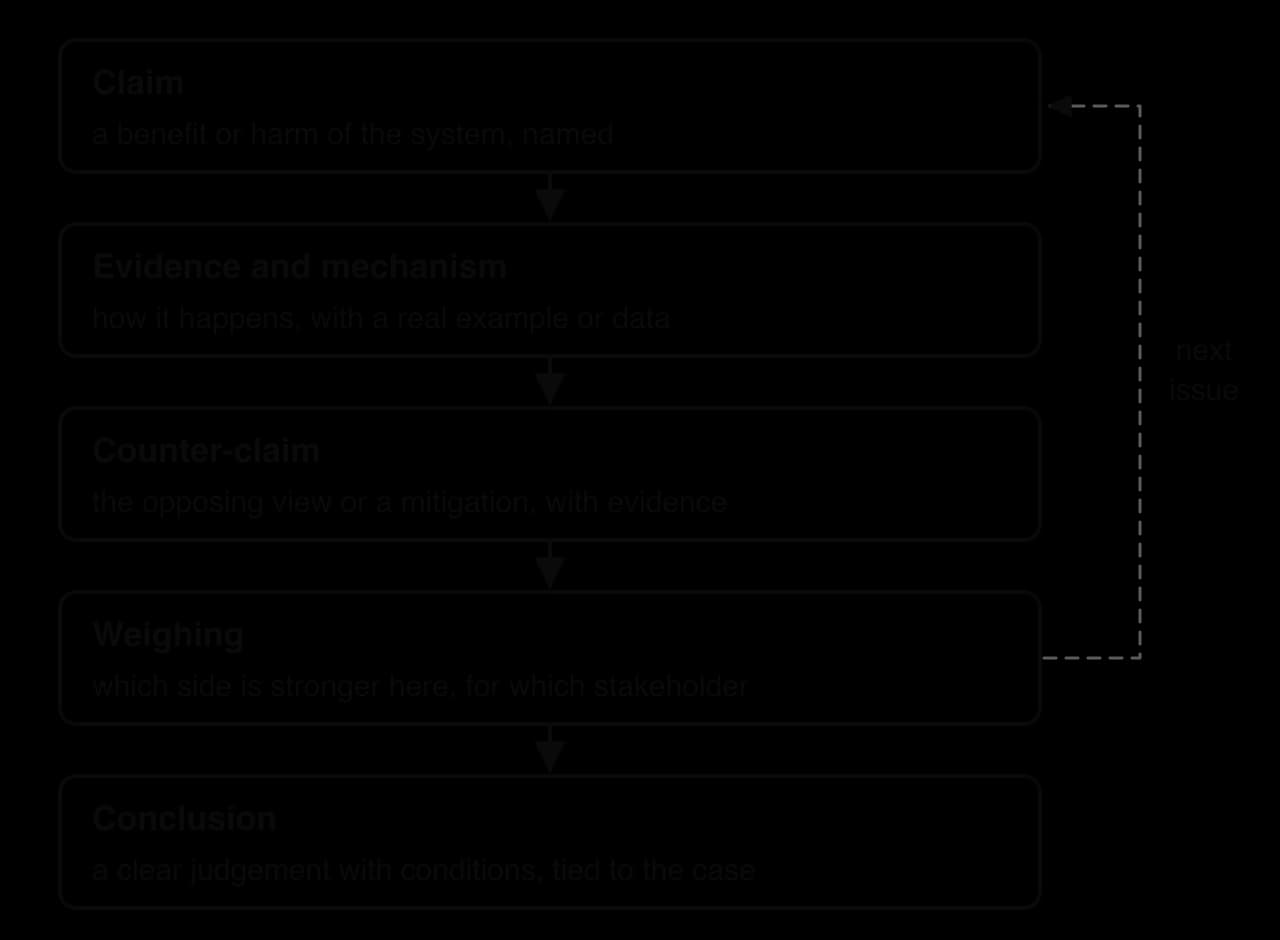
Three habits make a discussion convincing. First, every point is applied to the scenario: "the hospital's model", not "AI". Second, every claim has a mechanism: how the harm or benefit happens, such as a proxy variable or a feedback loop, not only that it happens. Third, the conclusion is conditional: it says under what conditions the system would be acceptable (for example, only with human review and annual bias audits), which shows that the weighing has been done.
Laws, professional codes and company policies are written for the technologies that exist when they are drafted. New technologies arrive faster than the rules: GDPR was agreed in 2016, before modern large language models and image generators existed, and courts are still deciding how its principles apply to training data scraped from the web. Ethical guidelines therefore need to be reassessed continually.
There are three reasons for continual reassessment:
New capabilities create new harms. Cheap, realistic deepfakes made new forms of fraud and harassment possible within a few years; rules written for edited photos did not anticipate them.
Old safeguards stop working. Anonymising data by removing names was once considered enough; ML-based re-identification has made it unreliable.
Social expectations change. As people learn how systems work, they demand more transparency and control, and practices once accepted, such as scraping public photos, are now challenged.
Professional bodies revise their codes too. The Association for Computing Machinery (ACM) carried out its first comprehensive revision of its Code of Ethics in 26 years in 2018, to reflect how far computing and its effects on society had changed since 1992. Regulators have started to build revision into the law itself.
The Act sorts AI applications into four levels of risk, with separate rules for general-purpose AI models.
Risk level | Examples | Treatment |
|---|---|---|
Unacceptable | Social scoring of people; manipulation of behaviour; real-time remote biometric identification such as live facial recognition in public spaces (with narrow law-enforcement exceptions) | Banned |
High | AI used in recruitment, education, health, critical infrastructure, law enforcement and justice | Allowed with obligations: risk management, data quality, human oversight, transparency, assessment before and after deployment |
Limited | Chatbots; systems that generate or manipulate images, audio or video (deepfakes) | Must tell people they are dealing with AI or that content is artificial |
Minimal | Spam filters; AI in video games | No new obligations |
Source: Wikipedia, "Artificial Intelligence Act", accessed October 2026.
The list of high-risk applications in the Act can be extended without rewriting the law, which is one way of keeping guidelines up to date. Critics argue that regulation of this kind is still slow, that it may push development to countries with looser rules, and that companies can shape the standards used to judge compliance. Supporters argue that clear rules give companies certainty and protect people's rights, and that the EU's market size leads companies elsewhere to follow its rules. The approaches of different countries vary widely, from detailed risk-based law in the EU to voluntary frameworks and sector-specific rules elsewhere.
The implications of emerging technologies are judged against a few recurring values.
Rights protect each person; equity concerns how benefits and harms are shared out across groups.
A common equity problem is unequal access.
Each new technology can narrow or widen the divide. Translation and accessibility tools help people who were previously excluded; expensive headsets, subscription AI services and training data dominated by English and by wealthy countries can widen it.
Classical computers store information in bits, each 0 or 1. Quantum computers use quantum effects to process information in a fundamentally different way, which makes some problems that are impractical for classical computers solvable in reasonable time.
Quantum computers are not faster general-purpose computers; for most tasks, such as word processing or web browsing, they offer no advantage. Their potential lies in specific problems: simulating molecules and materials, some optimisation problems, and factorising large numbers. Current machines are small and error-prone. Google's Willow processor, announced in December 2024, has 105 qubits and showed that adding qubits can reduce errors when they are used together for error correction, an important step, but its error rates are still far too high to run large useful algorithms.
Source: Wikipedia, "Willow processor", accessed October 2026.
The video from IBM Technology introduces qubits, superposition and the kinds of problems quantum computers are expected to help with.
 YouTube
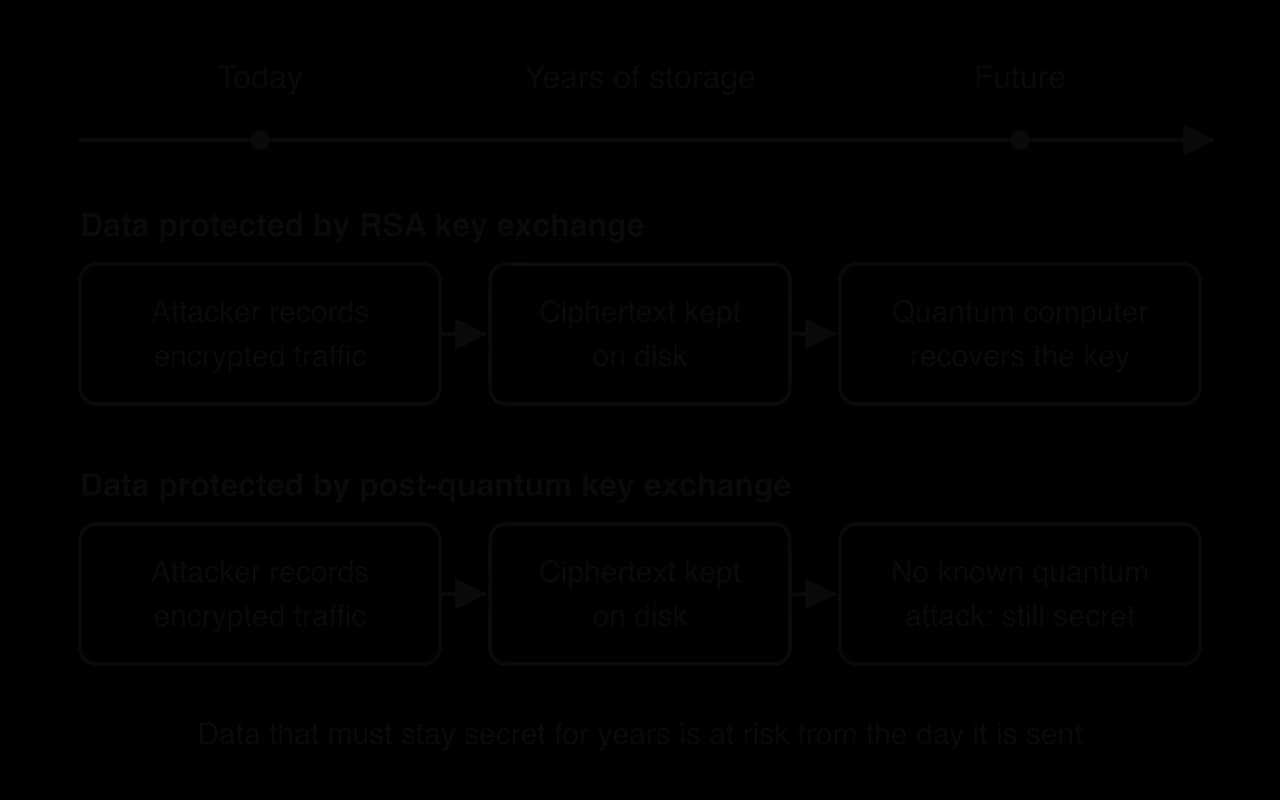
The main ethical concern about quantum computing is its threat to the public-key encryption that protects online banking, messaging and HTTPS. Algorithms such as RSA are secure because factorising a very large number into its prime factors would take classical computers an impractically long time. In 1994 Peter Shor described a quantum algorithm that could factorise large numbers efficiently, so a large, reliable quantum computer could break RSA and similar systems. Published estimates for breaking a 2,048-bit RSA key range from about a million to tens of millions of physical qubits once the overhead of error correction is included, far more than any existing machine.
The danger has already begun, because an attacker does not need to wait to collect data. The diagram of "harvest now, decrypt later" compares encrypted traffic recorded today under RSA key exchange with traffic protected by post-quantum key exchange.
The response is to replace vulnerable algorithms before large quantum computers exist.
The US National Institute of Standards and Technology (NIST) published its first three post-quantum standards on 13 August 2024 (FIPS 203, 204 and 205), and organisations have started migrating. The migration is slow and expensive because public-key cryptography is built into billions of devices, some of which, such as cars, medical implants and industrial controllers, stay in use for decades.
Aspect | Benefits | Risks and concerns |
|---|---|---|
Society | Faster discovery of drugs, batteries and materials through molecular simulation | Disruption of the security of banking, government and communications if migration lags |
Individual rights and privacy | Quantum key distribution may give provably secure links | Messages, medical and financial records recorded today could be exposed later |
Equity | Shared cloud access to quantum machines lets some universities and companies experiment | Only a few wealthy states and companies can build the machines, which could give them a strategic advantage in intelligence and industry |
Augmented reality adds digital information to a live view of the real world.
AR has clear benefits: surgeons can see scans overlaid on a patient, technicians can follow repair instructions on the machine in front of them, and visually impaired people can have signs and objects described aloud. Many of its ethical risks fall on people other than the user. Glasses with cameras record everyone nearby, often without their knowledge. In 2024 two Harvard students connected camera-equipped smart glasses to a public face-search engine and showed that they could look up strangers' names, phone numbers and home addresses in real time from a face seen in the street. The glasses' small recording light, intended to warn bystanders, is easy to miss and can be disabled.
Source: Wikipedia, "Meta smart glasses", accessed October 2026.
Further concerns are safety (users distracted from traffic or hazards), manipulation (advertising placed directly into a person's view of the world), and who controls the overlay: whoever decides what information is attached to a place or a face shapes what people see.
Virtual reality replaces the real world with a computer-generated one.
VR is used for training in dangerous jobs (pilots, surgeons, firefighters), exposure therapy for phobias and post-traumatic stress, education, and social contact for people who cannot travel. Its risks include harassment in shared virtual spaces, which can feel more physical and intrusive than abuse on a screen; motion sickness and eye strain; and heavy use by children. A less obvious risk concerns privacy, because headsets record detailed motion data many times a second, and that motion identifies people. A 2023 study trained a classification model on the head and hand movements of 55,541 players of a VR game and could identify a user among all of them with 94.33% accuracy from 100 seconds of motion, comparable to fingerprints or faces as a biometric.
Source: Nair et al., "Unique Identification of 50,000+ Virtual Reality Users from Head & Hand Motion Data", USENIX Security Symposium, 2023.
Equity is also at stake: headsets are expensive, so if VR becomes an important way to learn or work, people who cannot afford it fall further behind.
AI is moving from separate applications that people choose to open into the background of everyday life.
Pervasive AI brings real benefits: assistive technology that reads text aloud or describes surroundings, earlier detection of disease, energy-saving homes, and help with routine paperwork. The risks grow with how widely AI is used and how much it decides:
Automated decisions about people. When public services use automated risk scoring, errors affect many people at once. In the Netherlands, about 26,000 parents were wrongly accused of fraud in claiming childcare benefits between 2005 and 2019; the Dutch Data Protection Authority later found that the tax authority's processing of applicants' nationality and dual citizenship had been unlawful and discriminatory, and the government resigned on 15 January 2021.
Surveillance. Smart speakers, doorbell cameras, cars and phones together record far more about daily life than any one device.
Deskilling and dependence. People and organisations may lose the ability to work without the system and to notice when it is wrong.
Manipulation. Systems that know a person's habits and moods can be used to influence purchases or political views.
Unequal access. Those who can afford the best AI tools gain productivity and opportunities; those who cannot fall behind, between individuals and between countries.
Source: Wikipedia, "Dutch childcare benefits scandal", accessed October 2026.
Technology | Main benefit | Risk to individual rights and privacy | Effect on equity |
|---|---|---|---|
Quantum computing | Simulation for medicine and materials | Future decryption of data recorded today | Capability concentrated in a few states and companies |
Augmented reality | Information overlaid where it is needed (surgery, repair, accessibility) | Bystanders recorded and identified without consent | Benefits depend on owning costly devices |
Virtual reality | Safe training, therapy, remote contact | Motion data identifies users; harassment in shared spaces | Headset cost excludes some learners |
Pervasive AI | Everyday help, accessibility, efficiency | Constant data collection; automated decisions without explanation | Gains go to those with access; errors fall hardest on the less powerful |
Ethics of machine learning and emerging technologies is examined on Paper 1, Section A, at both SL and HL, and its issues often reappear in Section B, because case studies regularly involve the impacts and ethics of a technology. Both content statements use discuss, an AO3 command term: a considered, balanced review that covers a range of arguments and reaches a conclusion supported by evidence. Expect a short part first (state, outline or identify an issue, or explain how bias enters data, for 2–4 marks), followed by a longer discuss or evaluate part of about 6–8 marks set in a scenario such as screening job applicants, moderating content, recognising faces or deploying a new technology in schools.
Judging by earlier IB Computer Science markschemes, extended responses are usually marked with a small markband that rewards knowledge of the issues, application to the scenario, balance with evidence, and a supported conclusion. A one-sided answer, or a list of issue names with no mechanism, is usually capped in the middle band.
Other question shapes to prepare: outline how a feedback loop can increase bias (2); explain why removing a protected attribute may not remove bias (3); distinguish between misinformation and disinformation (2); explain why quantum computing is a risk to data encrypted today (3); discuss the implications of VR or AR for privacy and equity in a given setting (6–8); discuss whether ethical guidelines should be revised as a technology spreads (6).
The Section B case study for 2027 is reported by third-party sources (not confirmed here) to concern generative AI for image creation. Check the title with your teacher. If it is confirmed, consent and intellectual property in training images, bias in generated images, deepfakes and the energy cost of training and generating images are all ethical issues from A4.4 to prepare in the case's context.
Define the term proxy variable. [1]
State two stakeholders affected by a bank's use of an ML model to approve loans. [2]
Outline how a feedback loop can make a predictive policing model more biased over time. [3]
Distinguish between misinformation and disinformation. [2]
Explain why deleting the gender field from a dataset may not stop a hiring model discriminating by gender. [3]
A risk tool flags 50 of 200 people in group X, of whom 30 reoffend, and 30 of 200 people in group Y, of whom 18 reoffend. In total 60 people in X and 40 in Y reoffend. Calculate the percentage of flagged people who reoffend in each group, and the false positive rate in each group. [4]
Explain why data encrypted with RSA today could be at risk from quantum computers in the future, even though current quantum computers cannot break it. [3]
Outline one privacy risk to bystanders of augmented reality glasses. [2]
Evaluate the use of human-in-the-loop review as a way of making automated decisions accountable. [4]
A secondary school plans to give every student a VR headset for science lessons, with the headsets collecting usage data to personalise lessons. Discuss the ethical implications of the plan. [8]
A feature that is not a protected attribute but is closely correlated with one, so a model can treat groups differently through it.
Any two: loan applicants; the bank (deployer); the developer or vendor of the model; loan officers who use it; regulators / society.
The model predicts crime where past arrests were recorded; more patrols are sent there; more offences are observed and recorded in those areas; the new data makes the same areas look riskier at retraining, so the bias grows (award [1] per linked step, up to [3]).
Both are false or misleading information; misinformation is shared without intent to deceive, disinformation is created or spread deliberately to deceive.
Other features (proxies) such as names, hobbies, colleges or career gaps correlate with gender [1]; the model can learn gender from them indirectly [1]; so outcomes must be audited by group, e.g. Amazon's tool penalised "women's" with no gender field [1].
X: ; Y: . Non-reoffenders: X , wrongly flagged , FPR ; Y , wrongly flagged , FPR . Calibrated, but unequal false positive rates.
RSA relies on factorising large numbers being impractical [1]; Shor's algorithm on a large, reliable quantum computer could do it efficiently [1]; attackers can record encrypted data now and decrypt it later ("harvest now, decrypt later"), so long-lived secrets need post-quantum cryptography now [1].
Camera glasses record people nearby without their knowledge or consent [1]; combined with face recognition they can identify strangers and reveal personal details such as names and addresses [1].
Strengths: a person can catch errors, consider context and be held responsible; meets legal expectations for significant decisions. Limitations: reviewers tend to defer to the model; too little time or information makes review a formality; it is slower and costlier. Judgement: effective only if reviewers have explanations, time and real authority to override.
Award up to [8] using the markbands in the Exam focus. Benefits: immersive simulations of experiments too dangerous or expensive for the lab; engagement; access for students with disabilities. Concerns: motion and usage data can identify students and reveal behaviour (55,541-user study identified people from 100 seconds of motion); consent of minors and parents; data minimisation and who owns the data; health (motion sickness, eye strain, time limits); equity if some families must pay or if headsets are needed at home; teacher oversight of personalisation. Conclusion, e.g.: acceptable for occasional lessons if data collection is minimised, consent obtained, use time-limited and the school provides all equipment.
Machine learning raises ethical issues on a large scale because models learn from data, make many decisions automatically and are often hard to explain; ethical analysis asks who is affected (stakeholders), how, and what can be done.
Bias enters through training data (sampling, historical and labelling bias), through proxy variables that stand in for protected attributes, and through feedback loops after deployment; removing a protected attribute does not remove bias.
High overall accuracy can hide large error rates for small groups; Gender Shades found error rates up to 34.7% for darker-skinned women against at most 0.8% for lighter-skinned men.
Fairness has several definitions that can conflict; COMPAS was calibrated across groups but had unequal false positive rates, so choosing a definition is an ethical decision.
Accountability is shared by developers, deployers and users; transparency and explainability are needed for people to understand and challenge decisions, especially from black-box models.
Consent, privacy and security are distinct: data that is public is not consented to; GDPR and data minimisation limit collection; adversarial examples and data poisoning attack the model itself.
ML has environmental costs (GPT-3's training was estimated at 1,287 MWh and 552 tCO₂e) and societal effects on jobs, inequality and power, alongside real benefits.
In online communication, ML can amplify misinformation and disinformation, create deepfakes and harassment, and threaten or protect anonymity, while also making large-scale content moderation possible.
Ethical guidelines must be reassessed as technology changes; the EU AI Act regulates AI by risk level and can be extended.
Quantum computing threatens today's public-key encryption in the future (harvest now, decrypt later), answered by post-quantum cryptography; AR, VR and pervasive AI raise issues of bystander privacy, biometric data, automated decisions and equity of access.
I can define ethics, stakeholder and accountability, and name the stakeholders in a given ML scenario.
I can describe sampling, historical and labelling bias and give an example of each.
I can explain how a proxy variable lets a model discriminate without being given a protected attribute.
I can explain how a feedback loop amplifies bias, using predictive policing as an example.
I can show with a calculation why overall accuracy can hide unfairness to a small group.
I can calculate the share of flagged people who reoffend and the false positive rate for each group, and explain why calibration and equal error rates can conflict.
I can use the Gender Shades results to support a point about bias and bias audits.
I can distinguish transparency from explainability and explain what makes a model a black box.
I can distinguish privacy from security and give an ML-specific threat to each.
I can explain consent, data minimisation and the main relevant principles of GDPR.
I can calculate and interpret the environmental cost of training a model from given figures.
I can discuss misinformation, deepfakes, filter bubbles, harassment, anonymity and content moderation with real examples and both sides.
I can explain why ethical guidelines must be reassessed and describe the EU AI Act's risk levels.
I can explain the "harvest now, decrypt later" threat and the role of post-quantum cryptography.
I can write a balanced discussion with claims, evidence, counter-claims, weighing and a conditional conclusion about AR, VR, pervasive AI or an ML system.
The company must decide where to train the model and where to run it once trained.
Describe suitable hardware for:
training the model
running the model for users.
4 marks
Mark as [2] + [2].
Training:
GPUs / TPUs / cloud-based GPU or TPU instances;
because 250 000 high-resolution images need massive parallel computation;
large, fast storage (SSD / cloud storage) to hold the image set;
cloud can be rented only for the training period / scaled up to train faster;
Running (inference):
the user's smartphone as an edge device (possibly with an on-chip AI accelerator / neural processing unit);
because one prediction needs far less computation than training;
runs without an internet connection / photo stays on the phone (privacy);
OR a cloud server receives the photo and returns the result;
which allows a larger model / easy updates but needs a connection;
DermaScan intends to sell the app directly to the public without a doctor being involved.
Discuss whether DermaScan should do this.
6 marks
Candidates may discuss some of the following points.
For:
early detection: people who cannot easily see a dermatologist get a quick check;
low cost and convenient; available any time;
may encourage people to seek help sooner;
the model was trained on a large expert-labelled data set.
Against:
a false negative (suspicious mole classed as benign) may delay treatment and cause harm;
a false positive may cause anxiety and unnecessary appointments;
bias: if training photos are mostly of lighter skin, accuracy may be lower for darker skin;
phone cameras and lighting vary from the photos used in training;
accountability: who is responsible for a wrong result (company, user)?
privacy of medical images, especially if processed in the cloud;
users may treat the result as a diagnosis.
Mitigations: present results as advice to see a doctor; test on diverse skin tones; process on device; regulatory approval.
A conclusion that weighs these factors.
This part is marked using markbands. Use a best-fit approach: find the level whose descriptor best matches the response, then choose the mark within it by how fully the response meets that descriptor.
Marks | Level descriptor |
|---|---|
0 | No relevant knowledge or understanding; no appropriate terminology. |
1–2 | Basic: minimal knowledge and understanding; minimal use of terminology; the response may be little more than a list; little or no reference to the scenario. |
3–4 | Adequate: mainly descriptive; limited knowledge and/or understanding; terminology used in places; limited analysis; some reference to the scenario. |
5–6 | Competent: knowledge and understanding of the issues; appropriate terminology; analysis that weighs points on both sides and refers to the scenario; a conclusion that follows from the analysis. |
A city council is testing self-driving shuttle buses on a fixed route through the town centre. Each bus uses cameras and other sensors to detect pedestrians, cyclists and traffic signals, and decides how to steer and brake.
Identify two real-world applications of machine learning that the shuttle uses.
2 marks
The object detection model was trained on millions of labelled street images. Outline why deep learning is suited to this task.
2 marks
Describe the hardware each bus needs to run its models while driving.
4 marks
Outline one reason why the bus still needs a network connection.
2 marks
A councillor says the council should be held accountable if a shuttle injures a pedestrian. Discuss who should be held responsible when a self-driving vehicle causes an accident.
4 marks
A credit card company trains a model to detect fraudulent payments. While cleaning the data, an analyst finds a small number of payments that are hundreds of times larger than the customer's usual spending.
Define the term outlier.
1 mark
Explain why the analyst should not simply delete these payments from the training data.
3 marks
Outline one way the analyst could handle outliers that are found to be data entry errors.
2 marks