R2.3 How far? The extent of chemical change · IB Chemistry | Augment Education
R2.3 How far? The extent of chemical change
Describe dynamic equilibrium, write equilibrium constant expressions, interpret the size of K and apply Le Châtelier's principle; at HL, use Q, solve equilibrium problems and link K to ΔG⦵.
IB Chemistry
Part of R2 How much, how fast and how far?
SL and HL
Key terms introduced here
Each is in the Chemistry glossary, with every other term in the subject.
The equilibrium constant for the ionization of a weak acid in water, Ka=[HX+][AX−]/[HA]
Notes on R2.3 How far? The extent of chemical change
57 min readLast reviewed
Many chemical reactions do not go to completion. In a closed container they stop changing while a mixture of reactants and products is still present, and the composition of that mixture decides how much product can be made. The Haber process for ammonia, which supplies most of the world's nitrogen fertilizer, is designed around exactly this problem.
Questions on R2.3
157 exam-style questions on this subtopic, written in the style of the IB papers. The first has its markscheme open. Counted on
Question 1 · CHEM-004398 marks
The concentration of carbon dioxide in the atmosphere has risen from about 280 ppm before industrialization to over 420 ppm today. Over the same period, the average pH of surface seawater has fallen from about 8.2 to 8.1.
(a)
Write the equation for the reaction of carbon dioxide with water.
[1]1 mark
Markscheme (a)
CO2(g)+H2O(l)⇌H2CO3(aq)
Try a quick-fire question
One of 81 short multiple-choice questions on R2.3. Pick an answer to see why it's right or wrong.
The graph shows how the concentrations change when A is placed in a sealed flask. At which time is equilibrium first reached?
Flashcards for R2.3
The official deck for this part of the syllabus.
R2.3 How far? The extent of chemical change · front
What is a reversible reaction?
R2.3 How far? The extent of chemical change · front
In a reversible reaction, what are the forward and backward reactions?
R2.3 How far? The extent of chemical change220 cards
From the data booklet
The entries of the chemistry data booklet that R2.3 uses. Each opens in the explained booklet.
Industrial conditions chosen to balance an acceptable equilibrium yield against an acceptable rate and cost, when the conditions that favour each conflict.
The industrial manufacture of sulfuric acid, in which sulfur dioxide is oxidized to sulfur trioxide, 2SOX2(g)+OX2(g)2SOX3(g), over a vanadium(V) oxide catalyst at about 450 °C and 1–2 atm.
The state of a reversible reaction in a closed system in which the forward and backward reactions continue at equal rates, so the concentrations of all species remain constant.
The constant K given by the equilibrium law for a reaction at a particular temperature; its size shows the extent of reaction, and it changes only with temperature.
The fraction for K written from a balanced equation: products over reactants, each concentration in square brackets raised to the power of its coefficient.
At equilibrium at a given temperature, the product concentrations raised to the powers of their coefficients, divided by the reactant concentrations raised to the powers of theirs, is a constant, K.
The industrial synthesis of ammonia, NX2(g)+3HX2(g)2NHX3(g), using an iron catalyst at about 400–450 °C and about 200 atm, with unreacted gases recycled.
A table of the initial amounts, the changes (in the ratio of the coefficients) and the equilibrium amounts of each species, used to solve equilibrium problems.
A solution that contains the maximum amount of dissolved solute at a given temperature; in contact with undissolved solute it is at dynamic equilibrium.
When K is very small, the amount of reactant used up is negligible, so the equilibrium concentration of each reactant is taken as equal to its initial concentration.
An acid that ionizes only partially in aqueous solution, so the un-ionized acid is in equilibrium with its ions; examples are carboxylic acids and carbonic acid.
Reversible reactions and closed systems
Many equations are written with a single arrow, as if every particle of reactant turns into product. Many reactions can also run backwards: the products react together to re-form the reactants. A reversible reaction is shown with the double half-arrow .
Heating blue hydrated copper(II) sulfate drives off its water of crystallization and leaves white anhydrous copper(II) sulfate. Adding water to the white powder turns it blue again and releases heat:
CuSOX4⋅5HX2O(s)CuSOX4(s)+5HX2O(l)
The forward reaction is endothermic and the backward reaction is exothermic, by exactly the same amount of energy. This is true of every reversible reaction: if the forward reaction has an enthalpy change ΔH, the backward reaction has −ΔH.
Open and closed systems
Whether a reversible reaction can reach equilibrium depends on the system it takes place in. Calcium carbonate heated strongly in an open crucible decomposes completely into calcium oxide, because the carbon dioxide formed escapes into the air: CaCOX3(s)CaO(s)+COX2(g). In a sealed container at the same temperature the carbon dioxide cannot escape. It builds up until it recombines with calcium oxide as fast as it is formed, and the decomposition stops short of completion.
A closed system need not be sealed in glass. A reaction in solution in a beaker behaves as a closed system as long as no species escapes as a gas or leaves as a precipitate. In an open system, a reversible reaction that releases a gas is pulled towards products as the gas escapes, and equilibrium is never reached.
Dynamic equilibrium
When hydrogen and iodine vapour are sealed in a flask at 700 K, they react to form hydrogen iodide:
HX2(g)+IX2(g)2HI(g)
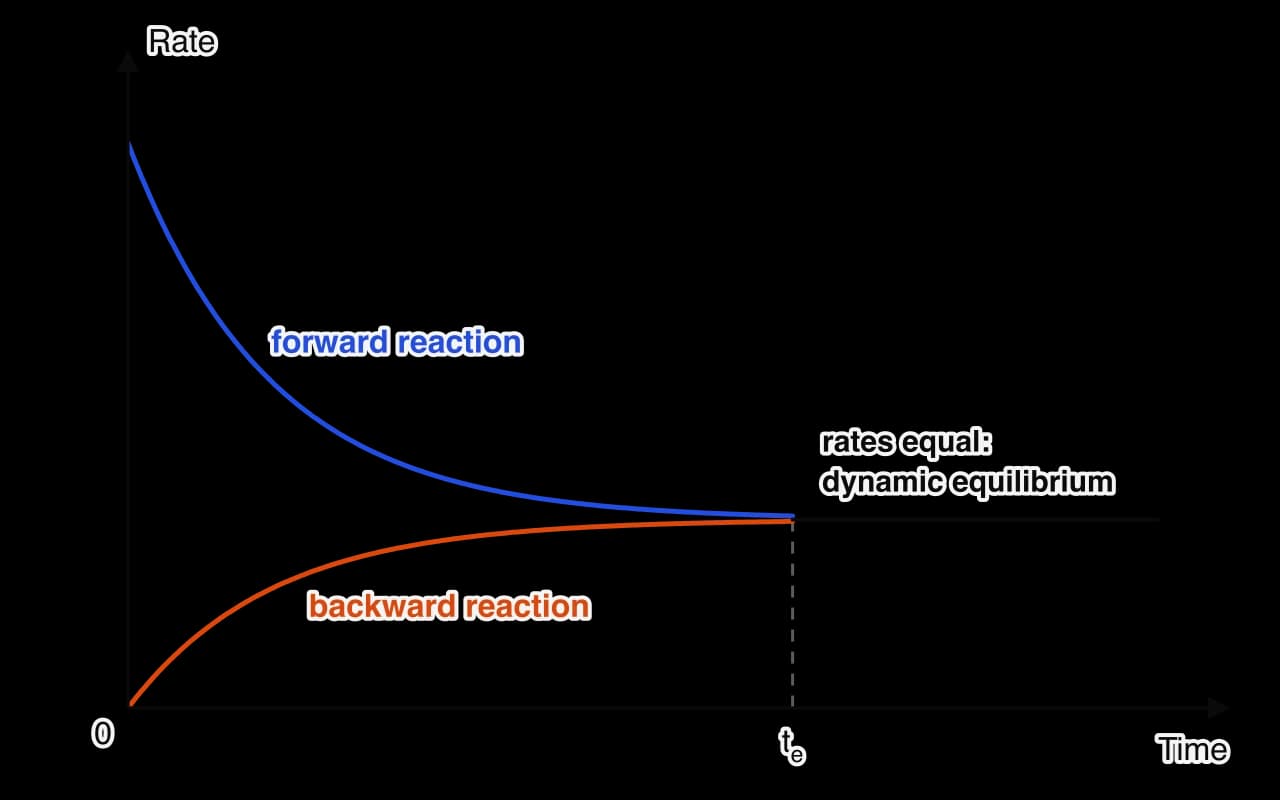
At the start only hydrogen and iodine are present, so only the forward reaction occurs and its rate is at its highest. As the reactants are used up, their concentrations fall and the forward rate decreases. As soon as some hydrogen iodide has formed, the backward reaction starts; its rate grows as the concentration of hydrogen iodide rises. Eventually the two rates become equal. From then on, hydrogen iodide is formed and decomposed at the same rate, so no further change in any concentration can be detected. The graph of rate against time shows the two rates converging.
As reactants are used up the forward rate (blue) falls, and as products build up the backward rate (orange) rises. From the time the two rates become equal, t_e, the concentrations stop changing: the system is at dynamic equilibrium.
The word dynamic matters. At dynamic equilibrium both reactions are still taking place, with molecules continually reacting in both directions; the system only appears to have stopped because the two processes cancel. The term position of equilibrium describes the composition of the equilibrium mixture. An equilibrium that "lies to the right" contains mainly products; one that "lies to the left" contains mainly reactants.
The characteristics of a system at equilibrium
Characteristic
What it means
Closed system
No reactant or product enters or leaves; otherwise the composition keeps changing.
Equal rates
The forward and backward reactions both continue, at the same rate.
Constant concentrations
The concentration of every species stays constant. The concentrations are not, in general, equal to each other.
Constant macroscopic properties
Properties that depend on the amounts of substances, such as colour, pressure, density and pH, stay constant.
Reached from either direction
The same equilibrium mixture forms from the reactants or from the products, if the same total amounts of each element are used under the same conditions.
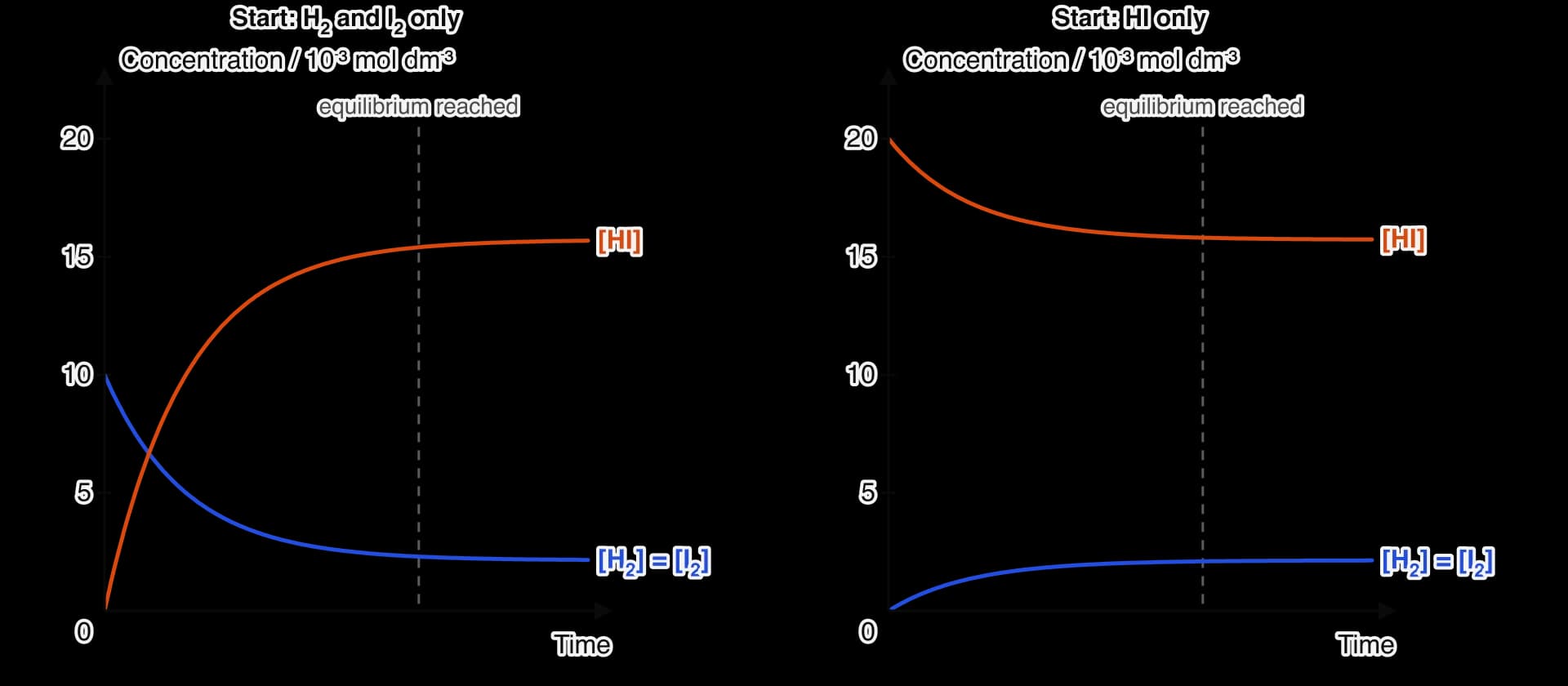
The last characteristic can be tested directly. A flask that starts with hydrogen iodide only decomposes part of it into hydrogen and iodine, and ends up with exactly the same composition as a flask that started with the equivalent amounts of hydrogen and iodine. The concentration–time graphs of the two experiments level off at the same values.
The same equilibrium mixture forms whether the flask starts with hydrogen and iodine (left) or with the equivalent amount of hydrogen iodide (right). In both, the concentrations level off once equilibrium is reached; they stay constant but are not equal. Concentrations calculated for K = 54 at 700 K.
Evidence that equilibrium is dynamic
Constant concentrations alone cannot show that both reactions are still running. Radioactive isotopes can. If a little solid lead(II) iodide containing radioactive iodine-131 is added to a saturated solution of lead(II) iodide, the solid stays the same and the concentration of the solution does not change. Yet the solution soon becomes radioactive, and the solid loses some of its radioactivity. Iodide ions must therefore be leaving the solid and others returning to it at the same rate.
The same idea works with deuterium, the heavy isotope of hydrogen. Adding a little DX2 to an equilibrium mixture of HX2, IX2 and HI produces DI and HD within the mixture, showing that hydrogen iodide molecules are still breaking up and re-forming.
Physical and chemical equilibria
Dynamic equilibrium is not limited to chemical reactions. Any reversible physical change in a closed system reaches the same kind of balance between two opposing processes.
Liquid and vapour
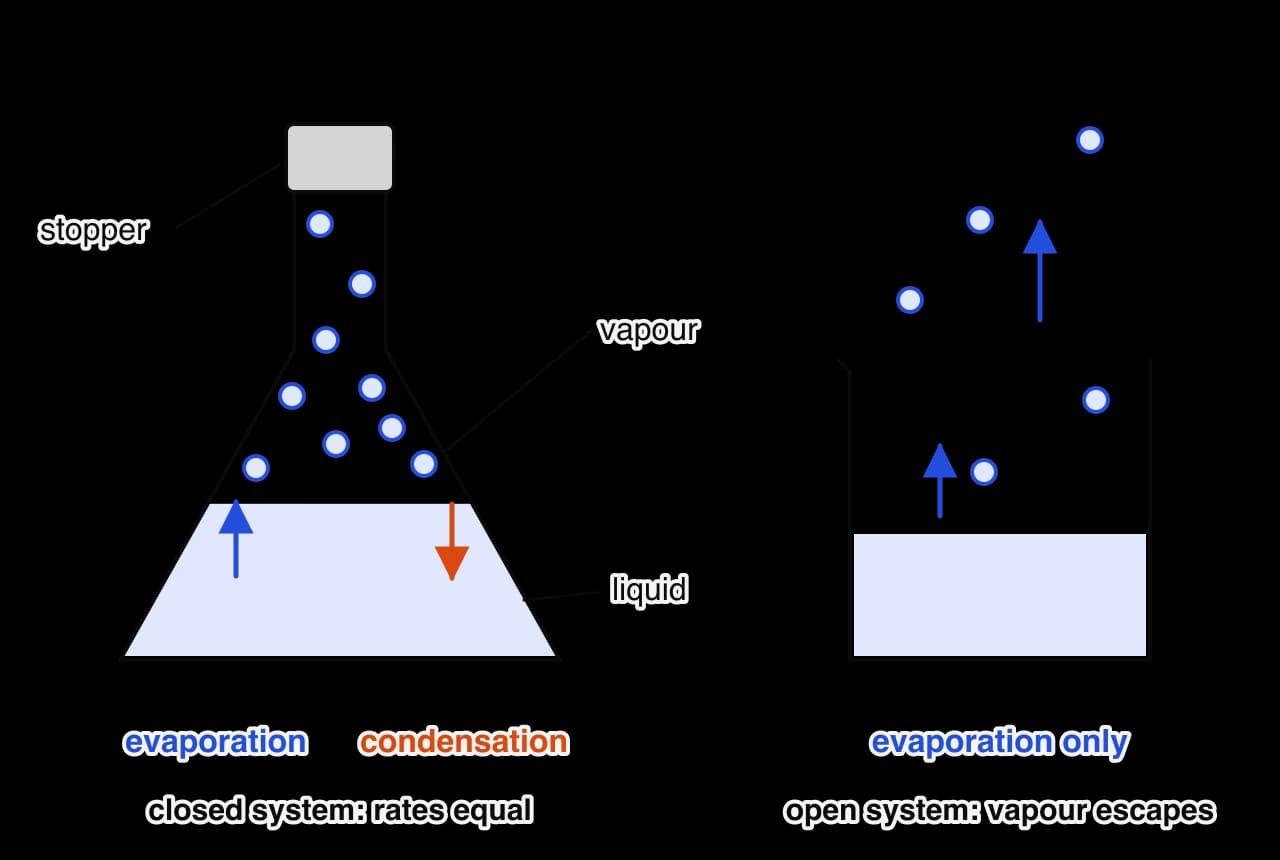
Water in a stoppered flask evaporates: the most energetic molecules at the surface escape into the space above the liquid. The vapour molecules move randomly, and some strike the liquid surface and are recaptured (condensation). As the amount of vapour builds up, the rate of condensation rises until it equals the rate of evaporation:
HX2O(l)HX2O(g)
The amount of vapour then stays constant, even though molecules continue to move in both directions. The diagram of a stoppered flask beside an open beaker shows why a closed system is needed.
In the stoppered flask (left), molecules leave the liquid (blue) and return to it (orange) at the same rate, so the amount of vapour stays constant. In the open beaker (right) the vapour escapes, so the liquid keeps evaporating and equilibrium is never reached.
A bottle of bromine shows the same equilibrium in colour: the space above the dark red liquid fills with orange-brown vapour, and the intensity of the colour stops changing once BrX2(l)BrX2(g) is at equilibrium.
Solid and saturated solution
When excess solid is stirred with a solvent, it dissolves until the solution is saturated. A saturated solution in contact with undissolved solid is at dynamic equilibrium: ions or molecules leave the solid and are deposited on it at the same rate. For sodium chloride in water:
NaCl(s)NaX+(aq)+ClX−(aq)
Gas and dissolved gas
A gas in contact with a liquid dissolves until the rate at which molecules enter the solution equals the rate at which they leave it. Carbonated drinks depend on this heterogeneous equilibrium, which responds to pressure changes as Le Châtelier's principle predicts:
COX2(g)COX2(aq)
Chemical equilibria
The same balance of rates applies to the chemical equilibria that recur throughout chemistry:
The composition of an equilibrium mixture depends on how much of each substance was put in, so the equilibrium concentrations themselves are not fixed. A particular combination of them is. The table gives three equilibrium mixtures for the hydrogen iodide reaction at 700 K, made from different starting mixtures.
Experiment
[HX2] / mol dm−3
[IX2] / mol dm−3
[HI] / mol dm−3
[HX2][IX2][HI]
[HX2][IX2][HI]2
1: start with 0.0100 HX2 and 0.0100 IX2
2: start with 0.0200 HX2 and 0.0100 IX2
3: start with 0.0300 HI
3.21×10⁻³
3.21×10⁻³
Equilibrium concentrations calculated from K=54 at 700 K. Starting concentrations in mol dm−3.
The simple ratio of product to reactants changes from one experiment to the next. When the concentration of hydrogen iodide is squared, matching its coefficient of 2 in the equation, the ratio is the same in every experiment, within rounding. This constant is the equilibrium constant, K, and the rule that produces it is the equilibrium law.
For a general homogeneous reaction with coefficients a, b, c and d,
aA+bB⇌cC+dDK=[A]a[B]b[C]c[D]d
Square brackets mean the equilibrium concentration in mol dm−3. When concentrations are used, the constant is often written Kc. Because the powers on the top and bottom of the fraction often differ, the units of K change from reaction to reaction; for simplicity K is treated as a pure number, without units.
Writing equilibrium constant expressions
Start from the balanced equation, with the correct coefficients.
Write the products on top of the fraction and the reactants underneath.
Raise each concentration to the power of its coefficient.
Multiply the terms together; never add them.
Heterogeneous equilibria and pure solids and liquids
When a pure solid or pure liquid takes part in an equilibrium, its "concentration" (the amount in a given volume of itself) cannot change, so it is left out of the expression. For the decomposition of calcium carbonate in a closed container, CaCOX3(s)CaO(s)+COX2(g), the expression is simply K=[COX2]. Le Châtelier's principle applies to heterogeneous equilibria in the usual way.
The magnitude of K and the extent of reaction
Because products are on top of the expression, a large value of K means that the equilibrium mixture contains much more product than reactant, and a small value means the reverse. The size of K therefore measures the extent of reaction: how far the reaction has gone towards products when equilibrium is reached. It says nothing about how quickly equilibrium is reached.
Values at 298 K calculated from standard Gibbs energies of formation (IB Chemistry data booklet, 2025, and NIST-JANAF tables, 1998); the value at about 1100 K from NIST-JANAF data (1998); esterification and ester hydrolysis from laboratory measurements.
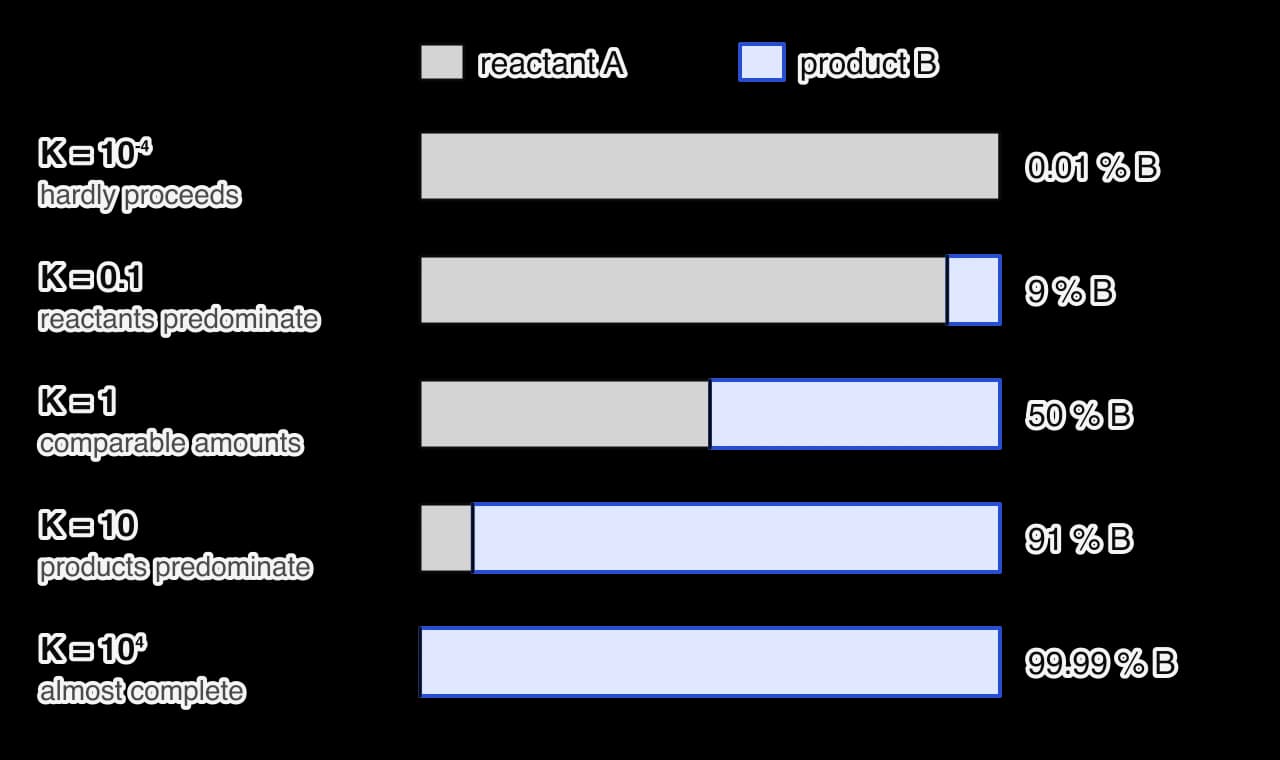
For the simplest kind of equilibrium, AB, the fraction of product at equilibrium is K/(1+K). The bar chart of equilibrium compositions turns this into a picture: a hundredfold change in K near 1 changes the mixture from mostly reactant to mostly product.
For the simple equilibrium A ⇌ B, the fraction of product at equilibrium is K/(1 + K). A small K means the mixture is almost all reactant (grey); a large K means it is almost all product (blue).
In practice, a reaction with K greater than about 1010 is treated as going to completion, and one with K smaller than about 10−10 as not happening at all. The very small value of K for the formation of nitrogen monoxide from air at room temperature explains why the nitrogen and oxygen of the atmosphere coexist without reacting. At the temperatures inside a car engine, above 1500 K, K is much larger, and enough nitrogen monoxide forms to become a serious pollutant.
K, acids and other equilibria
Weak acids give a useful example of K as a measure of extent. Ethanoic acid dissociates in water as CHX3COOH(aq)+HX2O(l)CHX3COOX−(aq)+HX3OX+(aq), with K=1.7×10⁻⁵ at 298 K. The value shows that only a tiny fraction of the acid molecules have given up a proton at equilibrium: the acid is weak. The equilibrium constant for the dissociation of an acid is called the acid dissociation constant, and the larger its value, the stronger the acid.
K depends only on temperature
At a given temperature, K has a single value for a given equation. Changing the concentration of a reactant or product, the pressure, or adding a catalyst changes the composition of the equilibrium mixture or how fast it is reached, but the ratio in the expression returns to the same value of K. Only a change in temperature changes K. For the synthesis of ammonia, an exothermic reaction, K falls steeply as the temperature rises:
Temperature / K
298
500
700
900
K for NX2(g)+3HX2(g)2NHX3(g)
5.4×10⁵
0.10
8.7×10⁻⁵
1.5×10⁻⁶
Calculated from NIST-JANAF thermochemical tables (4th edition, 1998) for ammonia, standard pressure 100 kPa.
The direction of the change depends on the sign of ΔH. For an exothermic forward reaction, K decreases as temperature increases; for an endothermic forward reaction, K increases. Le Châtelier's principle accounts for the direction.
Relating K values for related equations
The value of K belongs to the equation as written. If the equation is reversed, the expression is turned upside down. For the hydrogen iodide equilibrium at 700 K:
The same reasoning shows what happens when the coefficients are multiplied. Doubling every coefficient squares every term in the expression, so the new constant is K2. Halving every coefficient takes the square root, giving K. In general, multiplying the coefficients by n raises K to the power n.
Le Châtelier's principle
An equilibrium mixture stays the same only while the conditions stay the same. If a reactant is added, the pressure is changed or the temperature is altered, the rates of the forward and backward reactions are no longer equal, and the composition changes until a new equilibrium is reached. Le Châtelier's principle predicts the direction of the change.
"Partly" is important. The shift reduces the effect of the change but never cancels it completely: adding a reactant shifts the equilibrium to use some of it up, but its concentration at the new equilibrium is still higher than before. The principle is qualitative. It predicts the direction of the shift, but not its size; that needs K.
Three questions should be answered separately for any change: which way the position of equilibrium shifts, whether the value of K changes, and whether the rate at which equilibrium is reached changes.
Changing a concentration
Adding a reactant increases the rate of the forward reaction, because reactant particles collide more often. For a time the forward reaction is faster than the backward reaction, so more product forms, until the rates are equal again. The equilibrium has shifted to the right, using up some of the added reactant. Removing a product has the same effect, because the backward reaction slows down. Conversely, adding a product or removing a reactant shifts the equilibrium to the left.
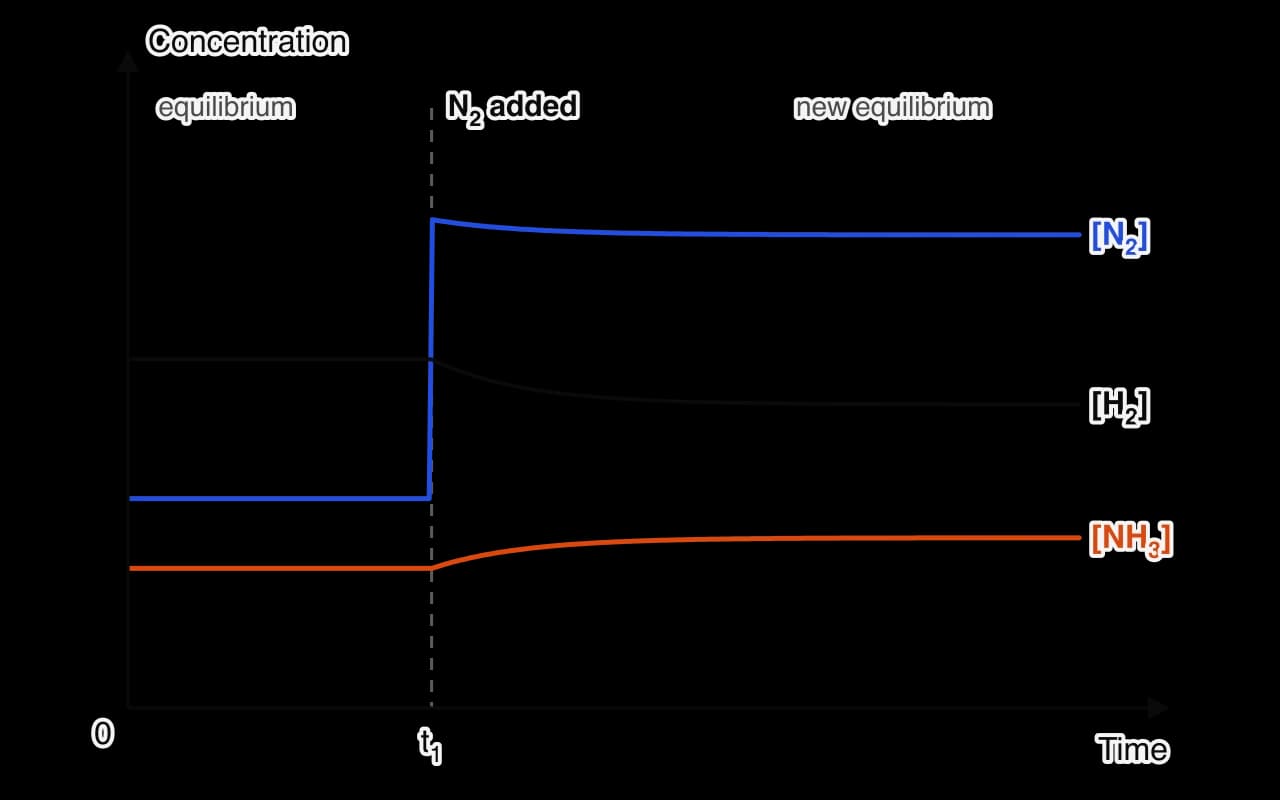
The concentration–time graph for the Haber equilibrium shows what happens when extra nitrogen is added to a mixture already at equilibrium.
When nitrogen is added at t₁, the equilibrium shifts to the right: some of the added nitrogen reacts with hydrogen, so [N₂] falls slightly, [H₂] falls three times as much and [NH₃] rises. [N₂] finishes much higher than before the addition, as the shift only partly opposes the change. The new concentrations give the same value of K as the old ones.
K is unchanged by a change in concentration. The new equilibrium concentrations are different, but when they are put into the expression they give the same value of K as before.
Colour changes that show the shift
Equilibria between coloured ions make the shifts visible in the laboratory. Chromate(VI) ions are yellow and dichromate(VI) ions are orange:
2CrOX4X2−(aq)+2HX+(aq)CrX2OX7X2−(aq)+HX2O(l)
Adding a few drops of dilute sulfuric acid increases [HX+], so the equilibrium shifts to the right and the solution turns orange. Adding sodium hydroxide solution removes HX+ ions (they react with OHX− to form water), so the equilibrium shifts to the left and the solution turns yellow again. The change can be reversed as often as the acid and alkali are added.
Iron(III) ions and thiocyanate ions form a deep blood-red complex ion:
FeX3+(aq)+SCNX−(aq)[FeSCN]X2+(aq)
Adding either iron(III) ions or thiocyanate ions makes the colour deeper as the equilibrium shifts to the right. Adding a substance that removes FeX3+ ions shifts it to the left and the red colour fades.
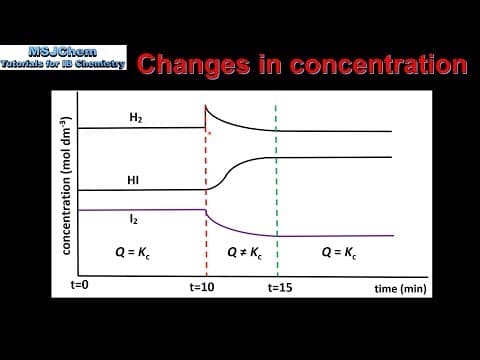
YouTube
MSJ Chem (Mike Sugiyama Jones): R2.3.4 Le Châtelier's principle, changes in concentration.
Changing the pressure
Pressure changes matter only for equilibria involving gases. At constant temperature, the pressure of a gas mixture is proportional to the total number of gas molecules in a given volume. Compressing an equilibrium mixture into a smaller volume increases the pressure, and the system opposes the increase by shifting towards the side with fewer gas molecules. Lowering the pressure shifts the equilibrium towards the side with more gas molecules.
Equilibrium
Moles of gas (left → right)
Effect of increasing pressure
NX2(g)+3HX2(g)2NHX3(g)
4 → 2
shifts right: more ammonia
NX2OX4(g)2NOX2(g)
2SOX2(g)+OX2(g)2SOX3(g)
HX2(g)+IX2(g)2HI(g)
CaCOX3(s)CaO(s)+COX2(g)
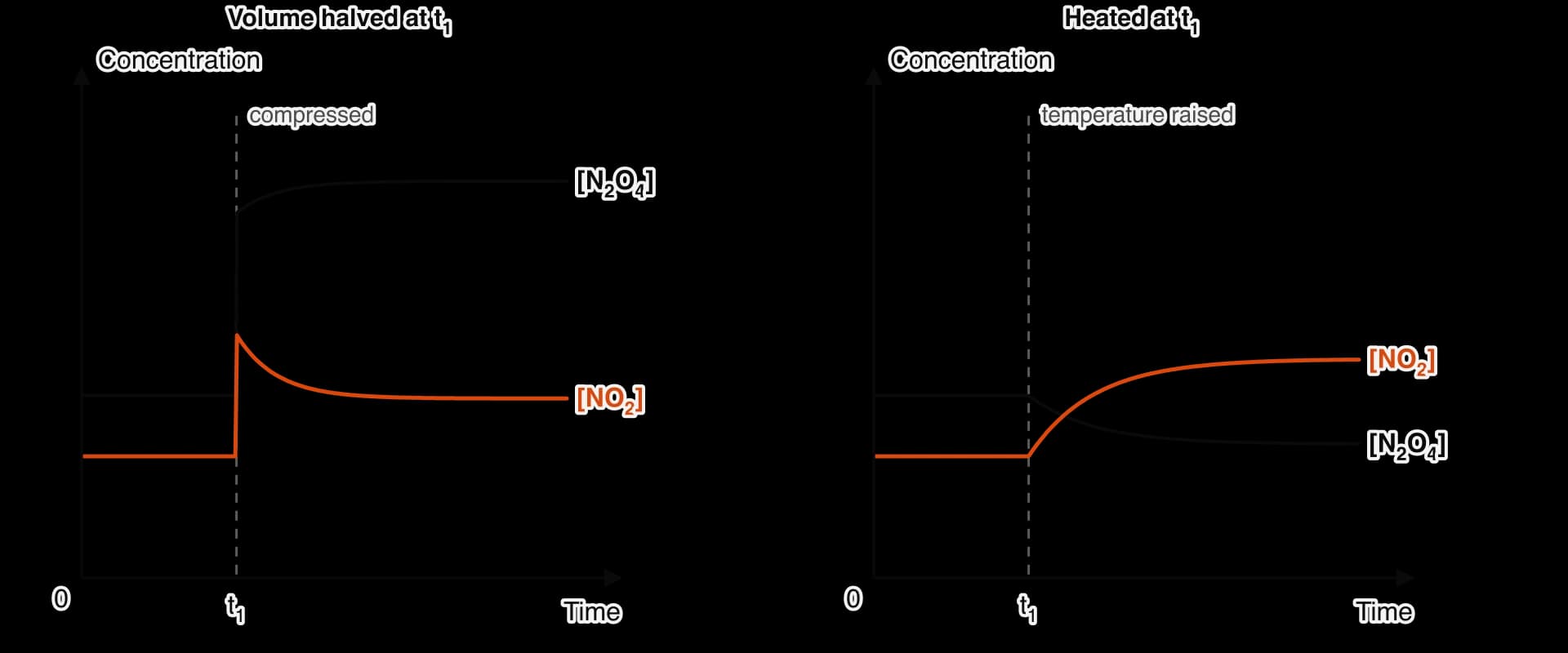
Brown nitrogen dioxide and colourless dinitrogen tetroxide show the effect directly. When a gas syringe containing the equilibrium mixture is pushed in quickly, the colour first darkens, because the same number of brown NOX2 molecules is packed into a smaller volume. Within seconds the colour becomes paler again, though not as pale as at the start, as some NOX2 combines to form NX2OX4. The left-hand concentration–time sketch shows the same sequence.
Halving the volume (left) doubles both concentrations at once; the equilibrium then shifts towards N₂O₄, the side with fewer gas molecules. Heating (right) causes no sudden jump; the equilibrium shifts gradually in the endothermic direction, towards NO₂ (orange), and K increases.
A change in pressure does not change K, as long as the temperature is constant. It changes the composition of the equilibrium mixture because the concentrations all change at once, by the same factor, and this upsets the balance of the expression whenever the numbers of gas molecules on the two sides differ.
Changing the temperature
A change in temperature affects an equilibrium differently from the other changes, because it changes the value of K itself. Every reversible reaction is exothermic in one direction and endothermic in the other. Raising the temperature favours the endothermic direction, which absorbs heat and so partly opposes the rise. Lowering the temperature favours the exothermic direction, which releases heat.
Nitrogen dioxide is again a clear example. The forward reaction is endothermic, because a bond must be broken to split NX2OX4 into two NOX2 molecules:
NX2OX4(g)2NOX2(g)ΔH⊖=+57kJ mol−1
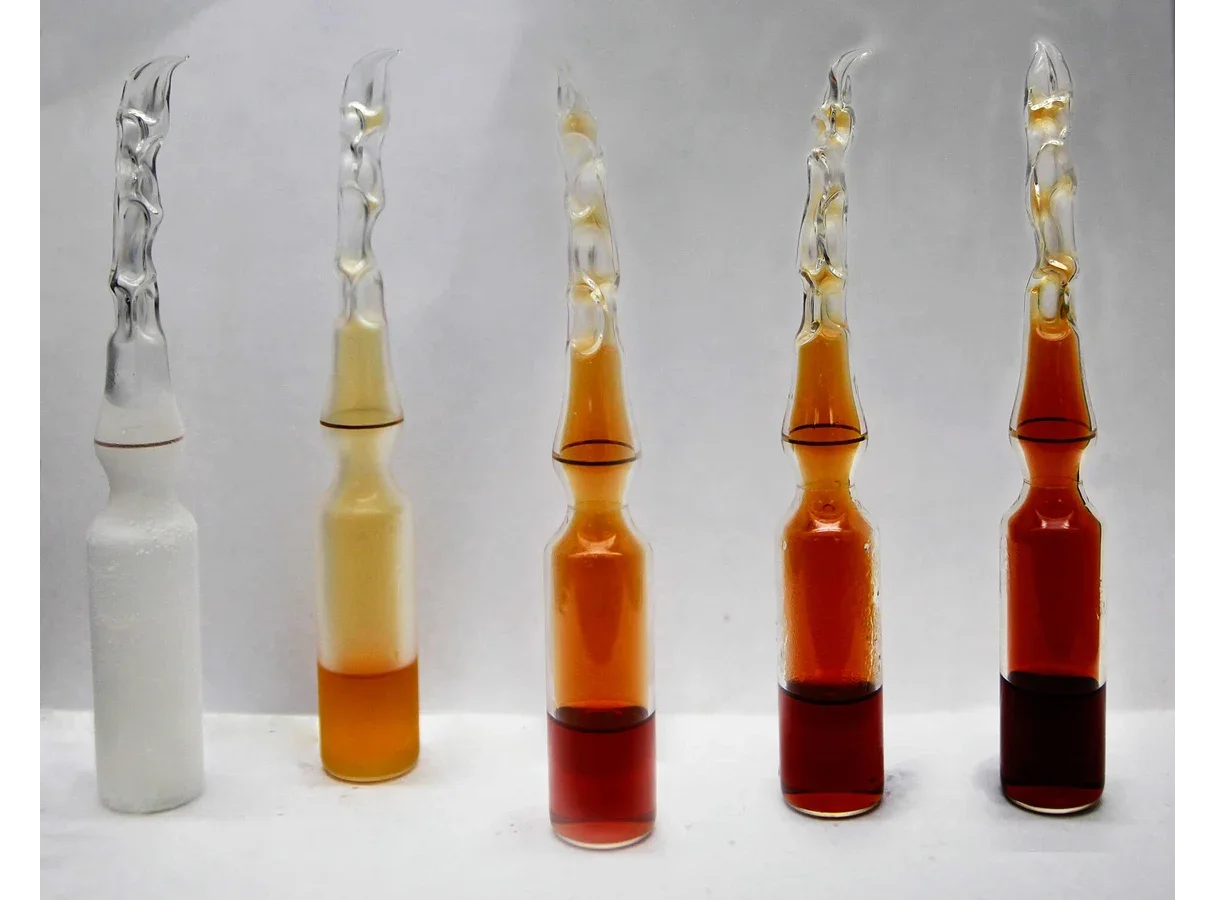
Heating the sealed mixture shifts the equilibrium to the right and the brown colour deepens; cooling it in ice shifts it to the left and the colour fades. The photograph of one sealed sample at five temperatures shows the effect.
The same sealed sample of NO₂ and N₂O₄ at −196 °C, 0 °C, 23 °C, 35 °C and 50 °C (left to right). The brown colour of NO₂ deepens as the temperature rises, because the endothermic forward reaction, N₂O₄ → 2NO₂, is favoured. At −196 °C the sample is solid, colourless N₂O₄. Image: Eframgoldberg, CC BY-SA 3.0, via Wikimedia Commons.
The concentration–time sketch for heating the NX2OX4–NOX2 mixture shows no sudden jump at the moment the temperature is raised: the concentrations change gradually as the system moves to the new equilibrium. Because [NOX2] rises and [NX2OX4] falls, the value of [NOX2]2/[NX2OX4] at the new equilibrium is larger: K has increased.
Forward reaction
Raising the temperature
Lowering the temperature
exothermic (ΔH<0)
shifts left; K decreases
shifts right; K increases
endothermic (ΔH>0)
shifts right; K increases
shifts left; K decreases
The cobalt(II) chloride equilibrium is a colourful classroom demonstration of both temperature and concentration effects. The pink hexaaquacobalt(II) ion and the blue tetrachlorocobaltate(II) ion are in equilibrium, and the forward reaction is endothermic:
Heating a purple mixture in a hot-water bath turns it blue (shift to the right, the endothermic direction); cooling it in ice turns it pink.
Adding concentrated hydrochloric acid, a source of chloride ions, turns it blue.
Adding water turns it pink. Water is a product, but the main effect is dilution: there are five dissolved particles on the left for every one on the right, so the equilibrium shifts towards the side with more dissolved particles, which partly restores their total concentration.
Adding a catalyst
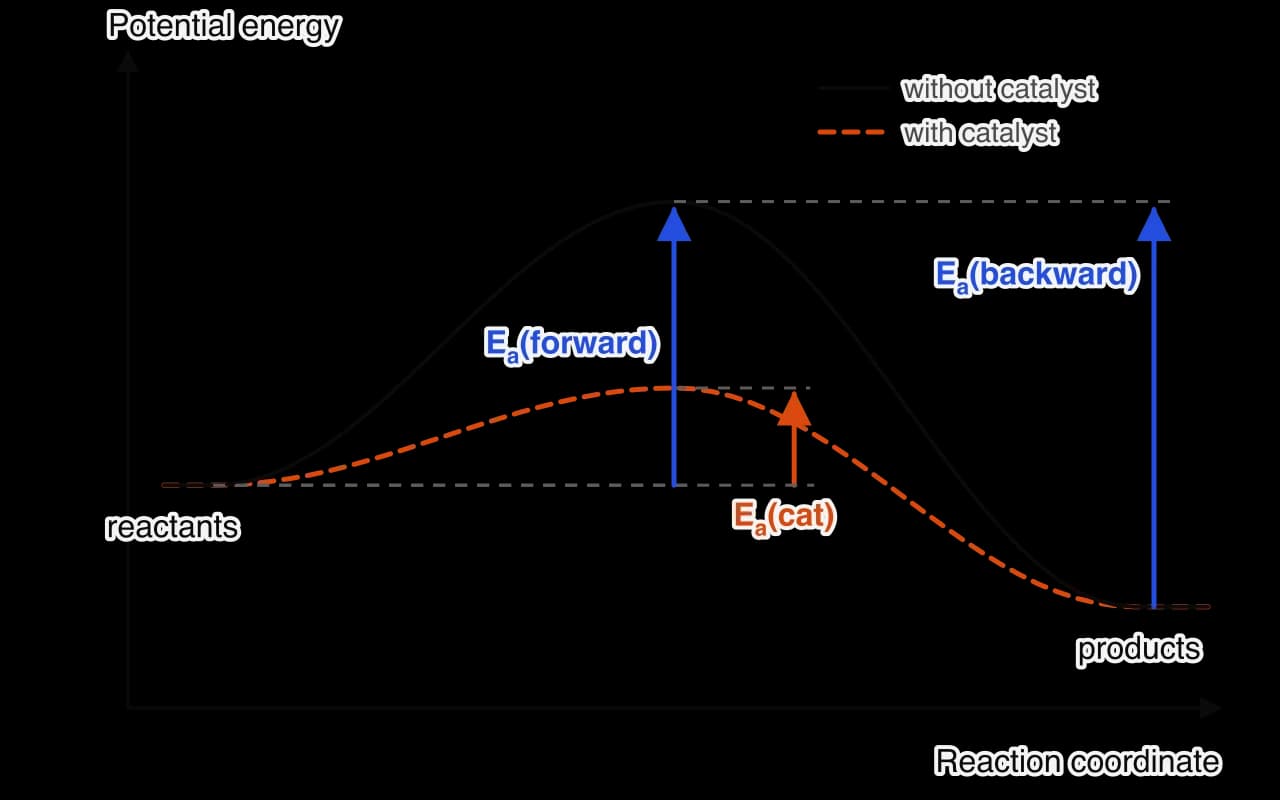
A catalyst provides an alternative reaction pathway with a lower activation energy. For a reversible reaction, the forward and backward reactions pass through the same transition state, so lowering the energy barrier lowers the activation energy of both directions by the same amount. The energy profile with and without a catalyst shows this.
A catalyst provides a path with a lower peak (dashed orange). It lowers the activation energy of the forward and the backward reaction by the same amount, so both rates increase by the same factor and the position of equilibrium is unchanged.
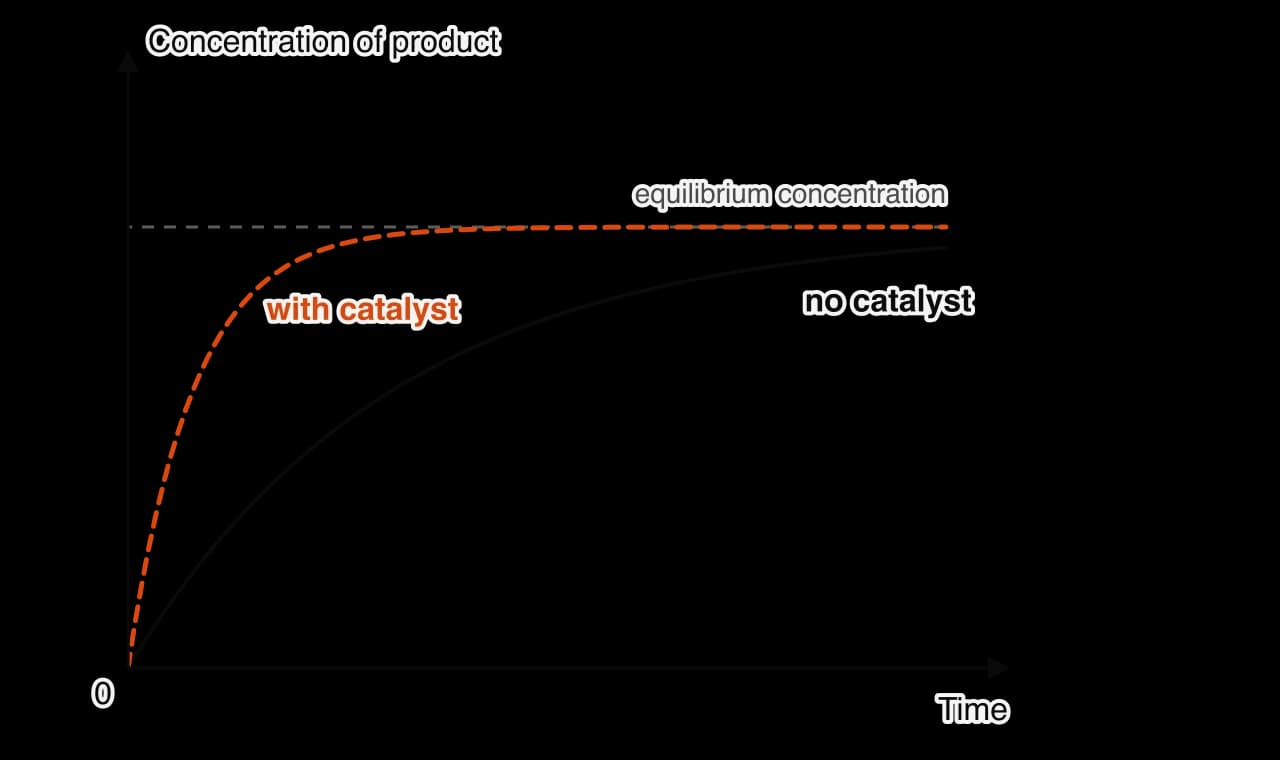
Both rates increase by the same factor, so they stay equal and the position of equilibrium does not change. The value of K is unchanged too. What the catalyst changes is the time needed to reach equilibrium, which is shorter. In industry this matters a great deal: a catalyst allows an acceptable amount of product to be made in a short time, often at a lower temperature than would otherwise be needed.
With a catalyst (dashed orange) equilibrium is reached sooner, but the equilibrium concentration of product is the same.
Summary of the effects
Change
Position of equilibrium
Value of K
Rates of reaction
Add a reactant or remove a product
shifts right
no change
forward rate increases until equilibrium is restored
Increase pressure (gases)
shifts towards fewer gas molecules
no change
both rates increase
Increase temperature
shifts in the endothermic direction
increases if the forward reaction is endothermic; decreases if exothermic
both rates increase
Add a catalyst
no shift
no change
both rates increase by the same factor
Applying Le Châtelier's principle to other systems
The principle applies to any equilibrium, including heterogeneous ones and systems never met before. The method is always the same: identify the species whose concentration (or the condition) changes, decide which direction partly reverses that change, and state the consequence that can be observed or measured.
Gases dissolving in liquids
Carbonated drinks are bottled under a pressure of carbon dioxide several times atmospheric pressure, typically 300–400 kPa in a sealed bottle of cola at room temperature. Carbon dioxide in the gas space above the drink is in equilibrium with dissolved carbon dioxide:
COX2(g)COX2(aq)
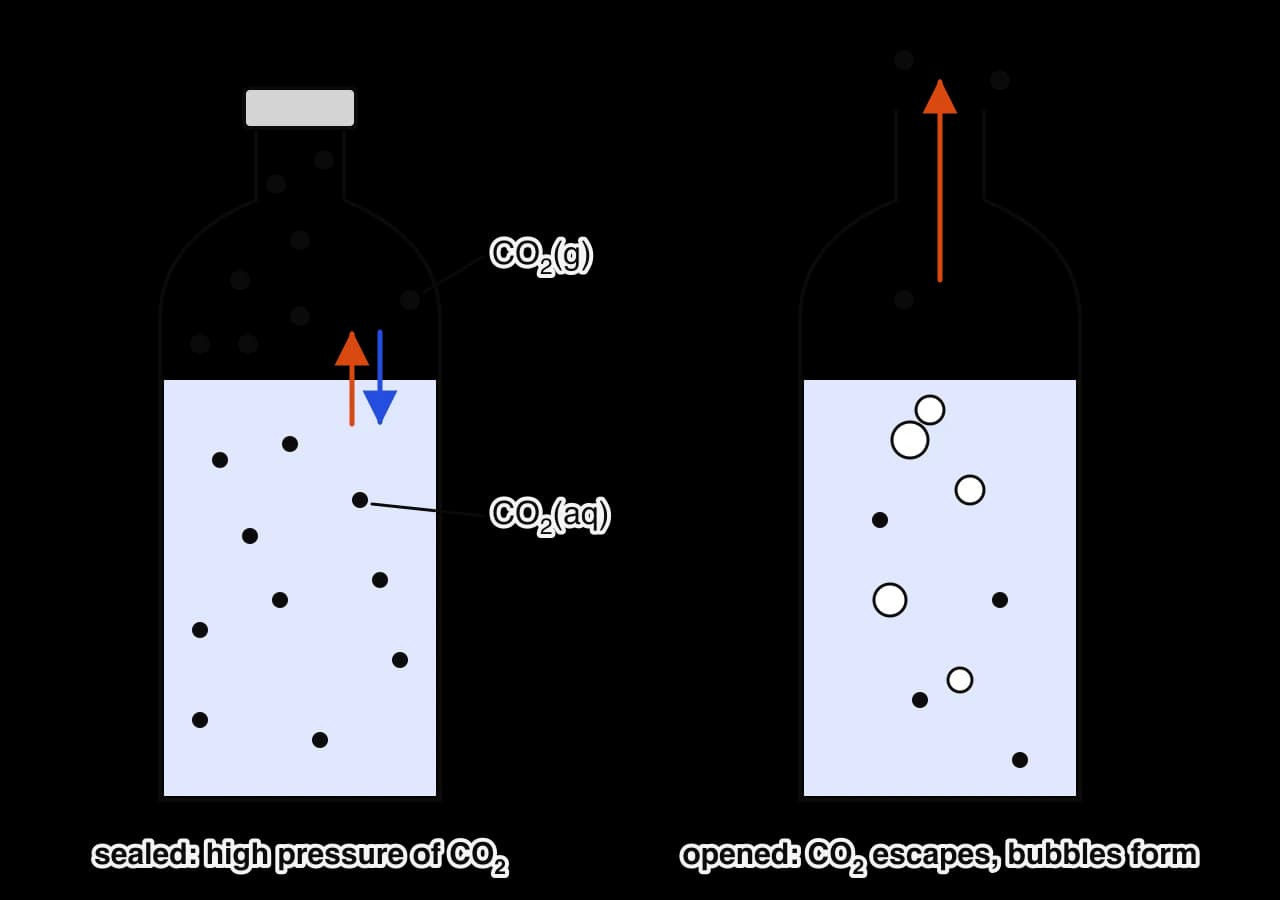
Opening the bottle lets the gas escape and the pressure of carbon dioxide above the drink falls to that of the air, where carbon dioxide is only about 0.04 % of the gas. The equilibrium shifts to the left, towards the side with gas molecules, and dissolved carbon dioxide comes out of solution as bubbles. A drink left open goes "flat" as the system moves towards a new equilibrium with almost no dissolved gas. Dissolving carbon dioxide is exothermic, so a warm drink also holds less gas than a cold one.
In the sealed bottle, CO₂ dissolves (blue arrow) and comes out of solution (orange arrow) at equal rates. Opening the bottle lets CO₂ gas escape, lowering its pressure above the drink, so the equilibrium CO₂(g) ⇌ CO₂(aq) shifts to the left and dissolved CO₂ forms bubbles.
Some of the dissolved carbon dioxide reacts with water to form carbonic acid, which makes fizzy drinks acidic:
When carbonated water is left open, the loss of COX2(aq) shifts these linked equilibria to the left as well, so [HX+] falls and the pH rises.
Oxygen transport at high altitude
Haemoglobin (Hb) in red blood cells carries oxygen from the lungs to the tissues. The binding can be summarised as an equilibrium:
Hb(aq)+4OX2(aq)Hb(OX2)X4(aq)
At the summit of Mount Everest the air pressure is about a third of that at sea level, so less oxygen dissolves in the blood. The equilibrium shifts to the left, less oxyhaemoglobin forms, and the tissues receive less oxygen: climbers suffer breathlessness, headaches and fatigue. Over several weeks at altitude the body makes more haemoglobin. The higher concentration of Hb shifts the equilibrium back to the right, restoring the amount of oxygen carried. Athletes use the same effect when they train at high altitude.
Dilution, acids and other added substances
A reagent is rarely added on its own. Dilute hydrochloric acid, for example, is mostly water, and its effect on an equilibrium depends on which of its components matters more.
Dilution. Adding water to an aqueous equilibrium lowers the concentration of every dissolved species at once. The equilibrium shifts towards the side with more dissolved particles. For the cobalt(II) chloride equilibrium (five dissolved particles on the left, one on the right), adding dilute hydrochloric acid turns the solution pink: the water it adds outweighs its chloride ions.
Choice of acid catalyst in esterification. Concentrated sulfuric acid is used as the catalyst for making esters. A dilute acid would add water, a product, and shift the equilibrium to the left, lowering the yield; concentrated sulfuric acid also absorbs some of the water formed. An excess of the cheaper reactant (often the alcohol) shifts the equilibrium further to the right.
Mixing bleach with acid. Household bleach contains chlorate(I) and chloride ions in an alkaline solution: ClX2(aq)+2OHX−(aq)OClX−(aq)+ClX−(aq)+HX2O(l). An acid such as vinegar removes OHX− ions, so the equilibrium shifts to the left and toxic chlorine gas is released. This is why bleach must never be mixed with acidic cleaners.
Equilibrium in industry: the Haber and Contact processes
Industrial chemists need as much product as possible, as quickly and cheaply as possible. Le Châtelier's principle tells them which conditions give a high equilibrium yield; collision theory and the Maxwell–Boltzmann distribution tell them which conditions give a high rate. Where the two disagree, compromise conditions are chosen.
The Haber process for ammonia
The Haber process combines nitrogen from the air with hydrogen made from methane and steam:
NX2(g)+3HX2(g)2NHX3(g)ΔH⊖=−92kJ mol−1
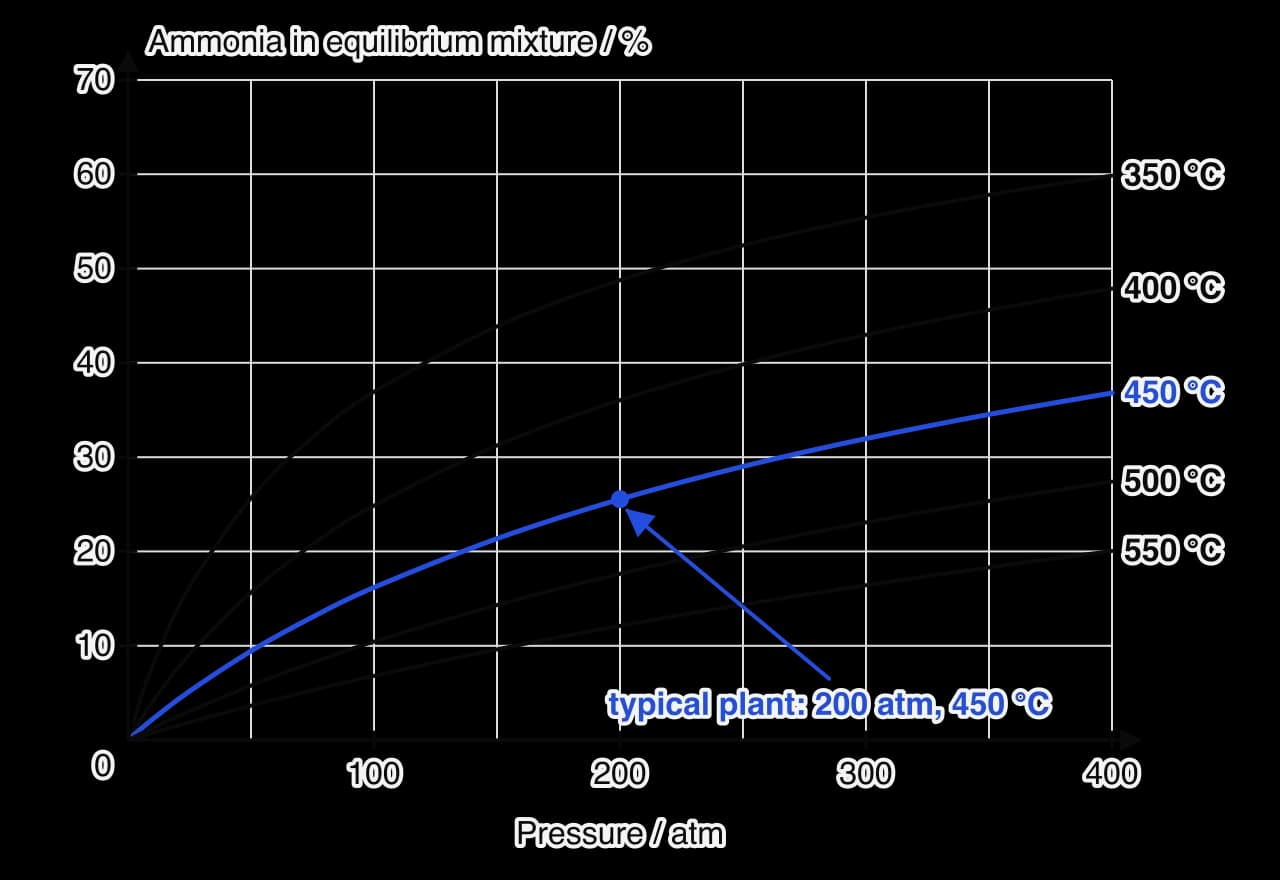
The ammonia is used mainly to make fertilizers such as ammonium nitrate and urea, and also nitric acid, explosives and nylon. The graph of the equilibrium percentage of ammonia shows how its yield depends on the conditions.
The equilibrium yield of ammonia rises with pressure and falls with temperature, as Le Châtelier's principle predicts for a reaction that is exothermic and reduces the number of gas molecules. Calculated for a 1 : 3 mixture of N₂ and H₂ treated as ideal gases, from NIST-JANAF thermochemical data for ammonia (4th edition, 1998).
The curves follow directly from Le Châtelier's principle:
Pressure. Four moles of gas become two, so a high pressure shifts the equilibrium to the right and increases the yield. High pressure also increases the rate, because the gases are more concentrated. However, very high pressures need expensive thick-walled vessels and powerful compressors, use a great deal of energy, and increase the risk of leaks. Plants typically operate at about 100–250 atm, often around 200 atm.
Temperature. The forward reaction is exothermic, so a low temperature gives a higher equilibrium yield (and a larger K). At low temperatures, however, the reaction is far too slow, even with a catalyst, and the iron catalyst works effectively only above about 400 °C. A compromise temperature of about 400–450 °C gives a reasonable yield at a reasonable rate.
Catalyst. Iron, with small amounts of potassium and aluminium oxides as promoters, speeds up both reactions so that the mixture approaches equilibrium in the short time the gases spend in the converter. It has no effect on the equilibrium yield.
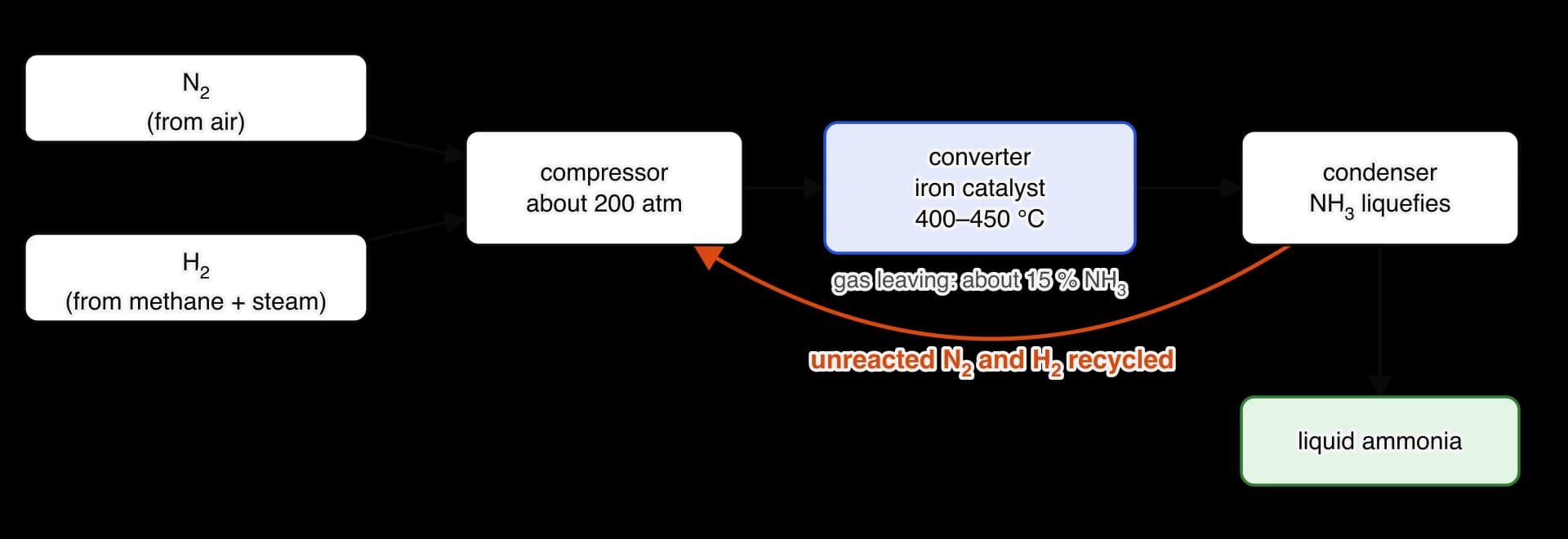
Removing the product. The gas leaving the converter is cooled, and ammonia (boiling point −33 °C) condenses and is removed. The unreacted nitrogen and hydrogen are recycled.
Only about 15 % of the gas is converted to ammonia on each pass through the converter, but the ammonia is removed as a liquid and the unreacted nitrogen and hydrogen are recycled (orange), so almost all of the feed is converted in the end.
Only about 15 % of the gas is converted on each pass, well below the equilibrium value of about 26 % at 200 atm and 450 °C, because the gases do not stay in the converter long enough to reach equilibrium. Recycling the unreacted gases means that about 98 % of the nitrogen and hydrogen fed in is eventually converted into ammonia.
The Contact process for sulfuric acid
Sulfuric acid is made by the Contact process. Sulfur is burned to sulfur dioxide, which is then oxidized to sulfur trioxide in a reversible, exothermic reaction:
2SOX2(g)+OX2(g)2SOX3(g)ΔH⊖=−198kJ mol−1
As for ammonia, a low temperature favours the yield but slows the reaction, so the gases pass over a vanadium(V) oxide, VX2OX5, catalyst at about 400–450 °C, in several beds with cooling between them. A high pressure would favour sulfur trioxide (three moles of gas become two), but the equilibrium already lies far to the right at these temperatures, so the process runs at only 1–2 atm: the small gain in yield would not pay for the compressors. Using excess air (oxygen) also shifts the equilibrium to the right. In modern plants, sulfur trioxide is absorbed between catalyst beds, which removes a product and drives the equilibrium further right, so that more than 99.5 % of the sulfur dioxide is converted.
The sulfur trioxide is absorbed in concentrated sulfuric acid rather than in water, because its reaction with water is so exothermic that it forms a corrosive mist of acid droplets.
The reaction quotient, Q (HL)
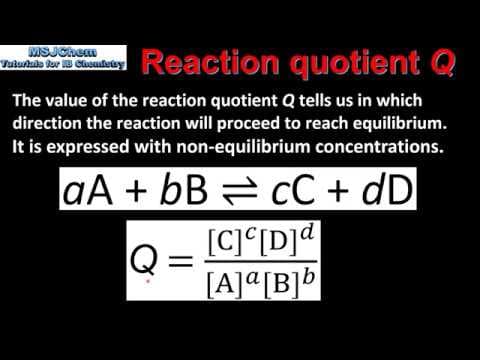
The equilibrium constant expression can be evaluated for any mixture, not only one at equilibrium. The result is the reaction quotient.
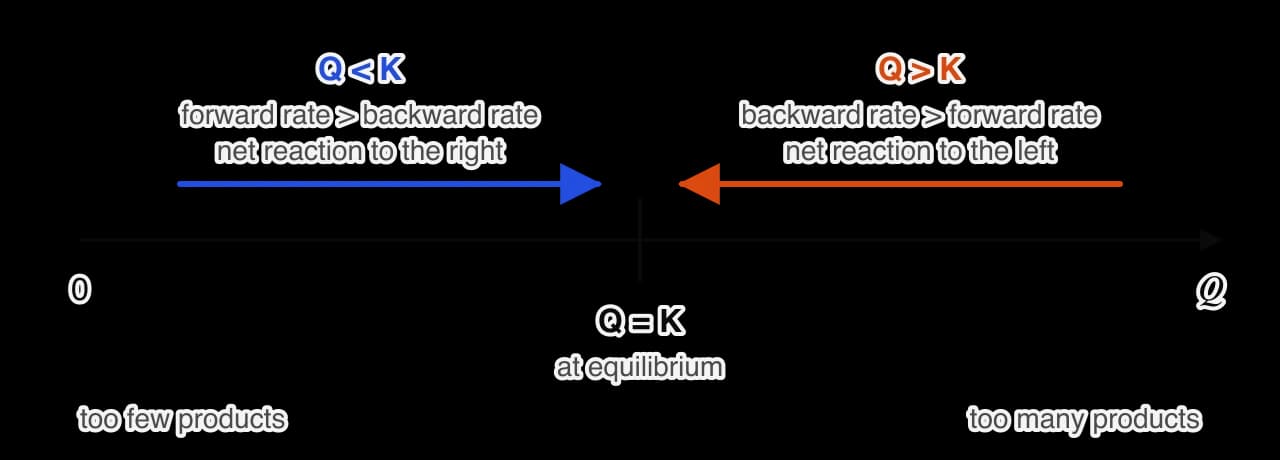
As a reaction proceeds, Q changes; at equilibrium it no longer changes, and Q=K. Comparing Q with K therefore shows how far a mixture is from equilibrium and in which direction it must react to get there.
Q<K: there is too little product compared with the equilibrium mixture. The forward reaction is faster than the backward reaction, so there is a net forward reaction until Q rises to K.
Q=K: the mixture is at equilibrium; the two rates are equal and there is no net change.
Q>K: there is too much product. The backward reaction is faster, so there is a net backward reaction until Q falls to K.
Whatever the starting mixture, the net reaction moves Q towards K. When Q < K the forward reaction is faster (blue); when Q > K the backward reaction is faster (orange); when Q = K the system is at equilibrium.
Le Châtelier's principle predicts the direction of a shift, and comparing Q with K gives the reason for it. Any change to a system at equilibrium either changes Q (concentration and pressure changes) or changes K (temperature changes). In both cases Q=K for a time, and the system reacts until they are equal again.
Concentration
Adding nitrogen to the Haber equilibrium increases [NX2], which is in the denominator of Q=[NX2][HX2]3[NHX3]2. Q falls below K, so the net reaction is forward until Q=K again: the equilibrium shifts to the right.
Pressure
Halving the volume of the Haber mixture doubles every concentration. The numerator of Q contains two concentration terms and the denominator four, so the denominator increases more:
Now Q<K, so the system reacts in the forward direction, forming more ammonia, until Q rises to K again. For HX2(g)+IX2(g)2HI(g), with two gas molecules on each side, the factors of 2 cancel, Q stays equal to K, and the equilibrium does not shift.
Dilution
Doubling the volume of the iron(III) thiocyanate equilibrium by adding water halves every concentration:
Qnew=21[FeX3+]×21[SCNX−]21[[FeSCN]X2+]=2K
Now Q>K, so the net reaction is backward: the equilibrium shifts towards the side with more dissolved particles, and the red colour becomes paler than dilution alone would make it.
Temperature
A change in temperature does not change the concentrations at the moment it happens, so Q is unchanged, but K changes. For the exothermic Haber reaction, raising the temperature makes K smaller. The existing mixture now has Q>Knew, so the net reaction is backward and some ammonia decomposes until Q falls to the new, smaller K.
Calculating the composition of equilibrium mixtures (HL)
Equilibrium problems are solved by tracking the amount of every species from the start of the reaction to equilibrium. An ICE table (Initial, Change, Equilibrium) organizes the working:
Write the balanced equation and, under it, the initial amount or concentration of every species.
Write the change for each species using the coefficients: if x mol of NX2 react, 3x mol of HX2 react and 2x mol of NHX3 form. Reactants decrease (−) and products increase (+).
Add the change to the initial value to get the equilibrium amount.
Convert amounts to concentrations by dividing by the volume (unless the volumes cancel), then substitute into the expression for K.
Finding K from equilibrium data
Determining K for esterification by titration
The equilibrium constant for the esterification of ethanoic acid can be measured in a school laboratory. Known amounts of ethanoic acid and ethanol are mixed in a sealed tube with a little hydrochloric acid as a catalyst, and left for about a week at room temperature to reach equilibrium. The mixture is then titrated with standard sodium hydroxide solution to find the total amount of acid left. A separate titration of the same volume of hydrochloric acid alone (a blank) gives the amount of acid due to the catalyst, which is subtracted. The rest is ethanoic acid. Equimolar amounts of acid and alcohol give a mixture with about two-thirds of the acid converted, which corresponds to K≈4.
Finding equilibrium concentrations from K
When K is known, an unknown change x can be found from the expression. Quadratic equations are avoided either because the expression is a perfect square or because K is so small that x is negligible compared with the initial concentrations.
The approximation for very small values of K
When K is very small, the reaction hardly proceeds, so the amount of reactant used up is tiny compared with the amount present at the start. The equilibrium concentration of each reactant can then be taken as equal to its initial concentration, the small K approximation:
[reactant]eqm≈[reactant]initialwhen K≪1
This removes x from the denominator and leaves a simple equation. The approximation is the same one used to calculate the pH of a weak acid solution, where only a tiny fraction of the acid dissociates. After solving, the assumption is checked: if x is less than about 5 % of the initial concentration, it was justified.
Equilibrium and Gibbs energy (HL)
The change in Gibbs energy, ΔG, shows whether a change is spontaneous at constant temperature and pressure: a reaction can proceed by itself in the direction in which ΔG is negative. The standard Gibbs energy change, ΔG⊖, refers to the complete conversion of reactants into products with every substance in its standard state. Its value fixes the position of equilibrium, through an equation given in the data booklet:
ΔG⊖=−RTlnK
Here R=8.31J K−1mol−1 (data booklet), T is the temperature in kelvin and ΔG⊖ must be in J mol−1. Rearranging gives K=e−ΔG⊖/RT.
ΔG⊖
lnK
K
Position of equilibrium
negative
positive
> 1
products favoured; lies to the right
zero
0
1
comparable amounts of reactants and products
positive
negative
< 1
reactants favoured; lies to the left
Because the relationship is exponential, a modest value of ΔG⊖ makes a large difference. At 298 K, ΔG⊖=−30kJ mol−1 gives K≈2×10⁵, and +30kJ mol−1 gives K≈5×10⁻⁶. Reactions with ΔG⊖ more negative than about −60kJ mol−1 effectively go to completion. The graph of K against ΔG⊖ shows the shape of the relationship near K=1.
K = e^(−ΔG⦵/RT) at 298 K
At 298 K, K falls steeply as ΔG⦵ increases. A negative ΔG⦵ gives K > 1 and a positive ΔG⦵ gives K < 1; each change of 5.7 kJ mol⁻¹ changes K by a factor of 10.
When no value of ΔG⊖ is given, it can be calculated from standard Gibbs energies of formation, in the same way as an enthalpy change from enthalpies of formation: products minus reactants, each multiplied by its coefficient.
The calculation also works in reverse: a measured value of K gives ΔG⊖ for the reaction at that temperature.
Gibbs energy before equilibrium is reached
For a mixture that is not at equilibrium, the Gibbs energy change depends on its composition through Q (data booklet):
ΔG=ΔG⊖+RTlnQ
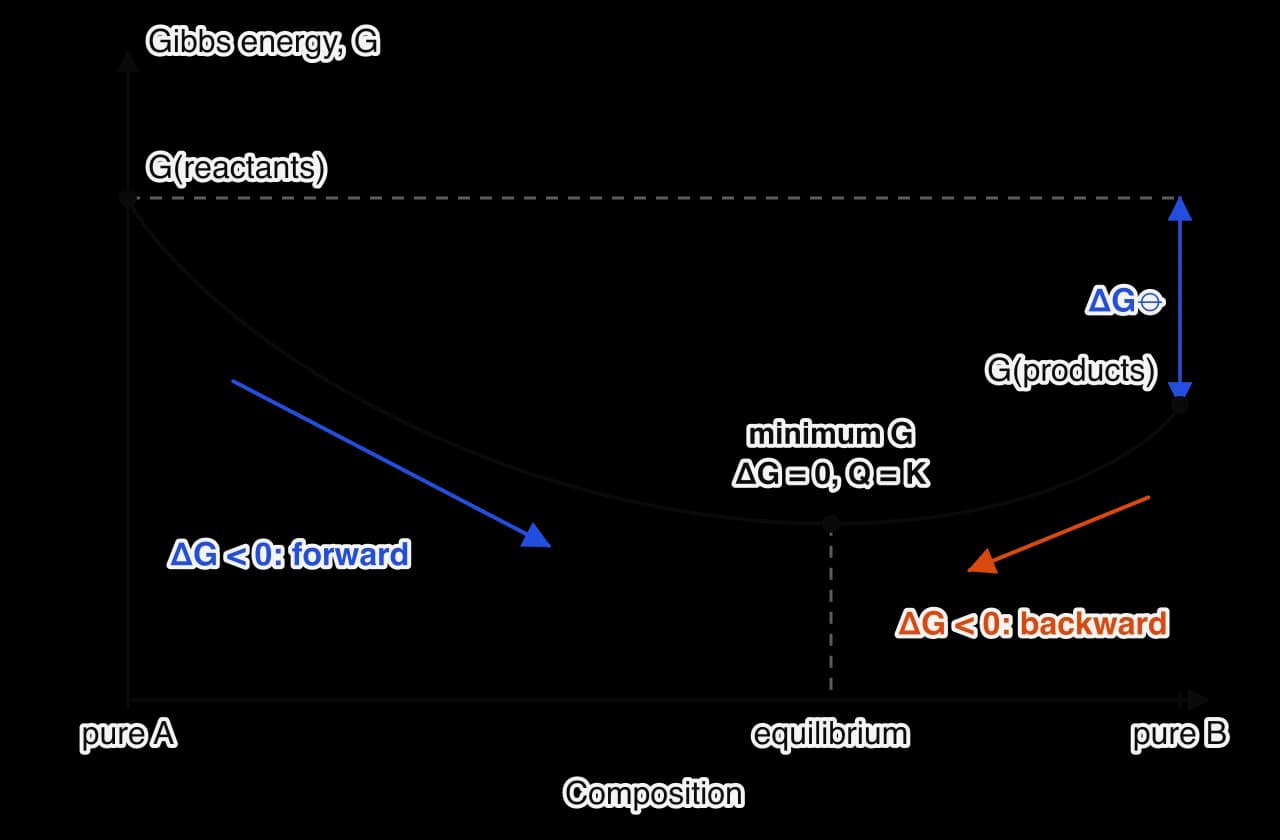
The sign of ΔG shows which direction is spontaneous for that mixture. When Q<K, ΔG is negative and the forward reaction is favoured. When Q>K, ΔG is positive, so the backward reaction is favoured. As the mixture reacts, Q approaches K and ΔG approaches zero. At equilibrium ΔG=0 and Q=K, so 0=ΔG⊖+RTlnK, which is where ΔG⊖=−RTlnK comes from. The graph of the Gibbs energy of the mixture against its composition shows the same idea as a valley, with equilibrium at the bottom.
The Gibbs energy of the mixture is lowest at the equilibrium composition. From either side the reaction runs downhill towards the minimum (ΔG < 0). ΔG⦵, the difference between pure products and pure reactants, decides where the minimum lies: here ΔG⦵ < 0, so the minimum is on the product side and K > 1.
The full treatment of Gibbs energy, including ΔG⊖=ΔH⊖−TΔS⊖ and the effect of temperature on spontaneity, belongs with entropy and spontaneity. Combining the two equations also explains why K changes with temperature.
Why K for an exothermic reaction falls as temperature rises
Combining ΔG⊖=−RTlnK with ΔG⊖=ΔH⊖−TΔS⊖ gives
lnK=−RTΔH⊖+RΔS⊖
If ΔH⊖ is negative, the first term is positive and becomes smaller as T increases, so lnK and K decrease. If ΔH⊖
Applying the ideas in exam questions
Paper 1A: an equilibrium constant expression
Paper 1A: K for a related equation
Paper 1A: changes that affect K
Paper 1B: the effect of temperature on a colour equilibrium
(Paper 1B style) A student investigated the equilibrium FeX3+(aq)+SCNX−(aq)[FeSCN]X2+(aq), in which only [FeSCN]X2+ is coloured (red). Equal volumes of the same iron(III) nitrate and potassium thiocyanate solutions were mixed in five tubes, and each tube was left in a water bath at a different temperature for 10 minutes. The absorbance of each mixture was then measured quickly with a colorimeter. Each absorbance is the mean of three readings.
Temperature / °C ± 0.5
15.0
25.0
35.0
45.0
55.0
Absorbance ± 0.005
0.620
0.550
0.481
0.423
0.370
Paper 2: the Contact process
Paper 2: methanol synthesis (HL)
Self-check
To do:
I can describe a reversible reaction and explain why equilibrium can be reached only in a closed system.
To do:
I can explain how dynamic equilibrium is reached in terms of the rates of the forward and backward reactions, and sketch rate–time and concentration–time graphs.
To do:
I can state the characteristics of a system at equilibrium, for physical and chemical systems.
To do:
I can deduce the equilibrium constant expression for a homogeneous equilibrium from its equation.
To do:
I can interpret the size of K (K ≪ 1, K < 1, K = 1, K > 1, K ≫ 1) in terms of the position of equilibrium and the extent of reaction.
To do:
I can state that K depends only on temperature, and relate K for a reverse or scaled equation to K for the original.
To do:
I can apply Le Châtelier's principle to changes in concentration, pressure and temperature, stating the shift, the effect on K and the reason.
To do:
I can explain why a catalyst affects neither the position of equilibrium nor K.
To do:
I can apply Le Châtelier's principle to heterogeneous and unfamiliar systems, such as carbonated drinks, haemoglobin, dilution and colour equilibria.
To do:
I can explain the conditions used in the Haber and Contact processes as compromises between yield, rate and cost.
To do:
I can calculate Q and use it to predict the direction of reaction and which rate is greater (HL).
To do:
I can use Q to explain the effects of concentration, pressure and temperature changes on an equilibrium (HL).
To do:
I can use ICE tables to calculate K from initial and equilibrium data, and equilibrium concentrations from K (HL).
To do:
I can use the approximation [reactant]eqm ≈ [reactant]initial when K is very small, and check it (HL).
To do:
I can calculate K from ΔG⦵ and ΔG⦵ from K using ΔG⦵ = −RT ln K, and relate the sign of ΔG⦵ to the position of equilibrium (HL).
To do:
I can use ΔG = ΔG⦵ + RT ln Q to decide which direction is spontaneous before equilibrium is reached (HL).
✓
Ignore state symbols. Accept → in place of ⇌.
(b)
Write an equation to show how the product in (a) releases hydrogen ions.
[1]1 mark
Markscheme (b)
H2CO3(aq)⇌H+(aq)+HCO3−(aq) ✓
Accept H3O+ with H2O as a reactant.
(c)
Calculate the factor by which the hydrogen ion concentration of surface seawater has increased.
[2]2 marks
Markscheme (c)
10−8.210−8.1 / 100.1 ✓ = 1.3 / 1.26 ✓
Award [2] for correct final answer. Accept "increased by 26 %".
(d)
Corals and shellfish build their skeletons and shells from calcium carbonate.
Ca2+(aq)+CO32−(aq)⇌CaCO3(s)
Explain, using an equation, why increasing hydrogen ion concentration makes it harder for these organisms to form shells.
[3]3 marks
Markscheme (d)
H+(aq)+CO32−(aq)→HCO3−(aq)
(e)
Outline why carbon dioxide is described as an acidic oxide.
[1]1 mark
Markscheme (e)
it is a non-metal oxide that reacts with water to form an acidic solution/reacts with bases ✓
Question 2 · CHEM-00763HL only · 9 marks
A solution of cobalt(II) chloride in water is pink because it contains [Co(H2O)6]2+. When concentrated hydrochloric acid is added, the solution turns blue.
(b) Every coefficient is halved, so take the square root:
K′′=8.7×10−5=9.3×10⁻³
Check by writing the expressions: K′′=[NX2]1/2[HX2]3/2[NHX3], which is the square root of [NX2][HX2]3[NHX3]2.
1 → 2
shifts left: more NX2OX4
3 → 2
shifts right: more SOX3
2 → 2
no shift
0 → 1
shifts left: only COX2 counts
Compare with K.Q=12.5<K=54, so the mixture is not at equilibrium. The rate of the forward reaction is greater than the rate of the backward reaction, and the mixture reacts to the right, forming more hydrogen iodide, until Q=54.
and
BrX2
, because of the 1 : 1 : 2 ratio.
IX2
BrX2
IBr
Initial / mol
0.600
0.400
0
Change / mol
−0.250
−0.250
+0.500
Equilibrium / mol
0.350
0.150
0.500
Substitute. Divide each amount by 2.00dm3; here the volumes cancel because there are two concentration terms on top and two underneath:
The result is close to the accepted value of about 4. Water added with the catalyst, or loss of volatile ester from an imperfectly sealed tube, would make the calculated value too low.
and
[HI]=2x
.
Substitute and take the square root of both sides, since both top and bottom are perfect squares:
Equilibrium concentrations:[HX2]=[IX2]=0.0100−0.00786=2.14×10⁻³mol dm−3 and [HI]=2(0.00786)=1.57×10⁻²mol dm−3, matching experiment 1 in the table of hydrogen iodide data.
reacts and
2x
of
NO
forms:
[NX2]=0.0400−x
,
[OX2]=0.0100−x
,
[NO]=2x
.
Approximation.K is very small, so x is negligible compared with 0.0400 and 0.0100: [NX2]≈0.0400 and [OX2]≈0.0100mol dm−3.
Check.x=3.2×10⁻⁵ is 0.3 % of 0.0100, so the approximation is valid.
K=e13.2=5.4×10⁵
K≫1, so at 298 K the equilibrium lies far to the right. The reaction is nevertheless far too slow to be useful at this temperature, which is why the Haber process uses a catalyst at a much higher temperature, where K is far smaller.
is zero:
ΔG⊖=(−394+0)−(−137+(−229))=−28kJ mol−1
Find K:
lnK=−8.31×298−28000=11.3K=e11.3=8×10⁴
The answer is given to one significant figure because K depends exponentially on ΔG⊖, which is known only to the nearest kJ mol−1: an error of 1kJ mol−1 changes K by about 50 %.
ΔG is positive, so the forward reaction is not spontaneous for this mixture; the backward reaction is. This agrees with comparing Q with K: Q=1.0×10⁶ is greater than K=8×10⁴.
is positive, the first term is negative and becomes less negative as
T
increases, so
K
increases. This is the quantitative form of Le Châtelier's prediction for temperature changes, and it has the same shape as the Arrhenius equation for rate constants.
B. 2[NO][BrX2]2[NOBr]
C. [NOBr]2[NO]2[BrX2]
D. [NO]2+[BrX2][NOBr]2
.
B reverses the equation but does not take the square root. D halves the coefficients but does not reverse the equation. A value of K can never be negative, so A is impossible.
at constant temperature
but does not change
K
, which depends only on temperature.
✓
at the same temperature.
[1]
✓
(b)
yield decreases AND equilibrium shifts to the left/towards reactants ✓
forward reaction is exothermic / ΔH is negative «so the endothermic backward reaction is favoured» ✓
Do not award M1 for an answer based only on rate.
(c)
a lower temperature would give a rate that is too slow / the catalyst would not work effectively «so 450 °C is a compromise between yield and rate» ✓
(d)
the equilibrium already lies far to the right / the yield is already high at low pressure ✓
the extra cost/energy of compression/stronger equipment is not justified by the small increase in yield ✓
(e)
no effect on the position AND no effect on K ✓
(f)
Any two of:
rate of forward reaction equals rate of backward reaction ✓
concentrations «of reactants and products» remain constant ✓
macroscopic properties «such as colour or pressure» remain constant ✓
occurs in a closed system ✓
both reactions continue to occur ✓
Do not accept "concentrations are equal".
(g)
K=2801=3.6×10⁻³ ✓
are placed in a sealed
1.00dm3
vessel at 600 K. At equilibrium the vessel contains
0.300mol
of
CHX3OH
. Calculate the value of
K
at 600 K.
[3]
and
0.20mol dm−3CHX3OH
. Deduce, by calculating
Q
, which of the forward and backward reactions is faster in this mixture.
[2]
, with
K=4.0×10⁻⁶
at a certain temperature. Calculate the equilibrium concentration of
X
when the initial concentration of
XX2
is
0.050mol dm−3
, stating the assumption you make.
[2]
/
0.700×1.4020.300
✓
K=0.219 ✓
Award [3] for correct final answer. Award [2 max] for 0.429 «hydrogen change taken as 0.300».
(b)
Q=0.50×1.020.20=0.40 ✓
Q>K «0.40 > 0.219» so the backward reaction is faster ✓
Accept ECF from (a).
(c)
increasing pressure increases all the concentrations «by the same factor» ✓
the denominator of Q «three concentration terms» increases more than the numerator «one term», so Q becomes less than K ✓
net forward reaction until Q=K again / equilibrium shifts to the right, so more methanol ✓
Award [2 max] for answers that do not refer to Q.
(d)
lnK=8.31×29825100=10.1 ✓
K=2.5×10⁴ ✓
Accept answers in the range 2.4×10⁴ to 2.5×10⁴.
Award [2] for correct final answer. Award [1 max] for using ΔG⊖ in kJ «K = 1.01».
(e)
forward reaction is exothermic, so increasing temperature shifts the equilibrium to the left / favours the endothermic backward reaction «and K decreases» ✓
(f)
assumption: [XX2]eqm≈0.050mol dm−3 / the amount of XX2 dissociated is negligible «because K is very small» ✓
[X]2=4.0×10−6×0.050=2.0×10⁻⁷
✓
concentration of carbonate ions decreases ✓
equilibrium shifts to the left, so less CaCO
3
forms/CaCO
3
dissolves ✓
625
and the colour expected to be observed.
[2]2 marks
(d)
Calculate the energy, in J, of one photon of light of wavelength 625 nm. Use sections 1 and 2 of the data booklet.
[2]2 marks
(e)
Suggest why the two complexes have different colours.
[2]2 marks
(f)
Deduce, giving a reason, in which complex the energy gap between the split d orbitals is larger.