The ideal gas model and its limits; how pressure, volume, temperature and amount of a gas are related; molar volume; and calculations with PV = nRT and the combined gas law.
Each is in the Chemistry glossary, with every other term in the subject.
For a fixed amount of gas,
124 exam-style questions on this subtopic, written in the style of the IB papers. The first has its markscheme open. Counted on
Which is an assumption of the ideal gas model?
The ideal gas model assumes that collisions are elastic (no loss of total kinetic energy), that the particles have negligible volume and that there are no intermolecular forces.
A describes a real gas. B confuses negligible volume with zero mass. C is wrong: the particles have a range of speeds; only the average kinetic energy is fixed by the temperature.
The answer is D.
Which statements describe an ideal gas?
I. The volume of the particles is negligible compared with the volume of the container.
II. There are no forces of attraction between the particles.
III. The average kinetic energy of the particles is proportional to the temperature in °C.
One of 56 short multiple-choice questions on S1.5. Pick an answer to see why it's right or wrong.
When does a real gas behave most like an ideal gas?
The official deck for this part of the syllabus.
Define pressure and state its SI unit.
State the value of standard pressure.
The entries of the chemistry data booklet that S1.5 uses. Each opens in the explained booklet.
With a free account, Augment remembers where you stopped and what you have practiced.
Two quantities are directly proportional when doubling one doubles the other; a graph of one against the other is a straight line through the origin.
A collision in which no kinetic energy is lost; the total kinetic energy of the particles is the same before and after.
Extending a line or trend on a graph beyond the measured data, for example extending a cooling line back to the time of mixing to correct for heat loss.
The constant in the ideal gas equation, .
A model gas whose particles are in continuous random motion, have negligible volume, exert no intermolecular forces and collide perfectly elastically; it obeys exactly.
: the relationship between the pressure (Pa), volume (), amount (mol) and absolute temperature (K) of an ideal gas.
Forces of attraction between separate molecules (or atoms of a noble gas), such as London (dispersion) forces, dipole–dipole forces and hydrogen bonds; much weaker than covalent bonds.
Two quantities are inversely proportional when doubling one halves the other, so their product is constant; a graph of one against the reciprocal of the other is a straight line through the origin.
The volume occupied by one mole of a gas, ; for an ideal gas at STP it is .
The SI unit of pressure, equal to a force of one newton acting on one square metre: .
Force per unit area, , measured in pascals (). In a gas it results from collisions of particles with the walls of the container.
An actual gas, whose particles have a finite volume and attract one another; it deviates from ideal behaviour most at high pressure and low temperature.
The reference conditions 298.15 K (25 °C) and 100 kPa; the molar volume of an ideal gas at SATP is about .
The reference conditions 273.15 K (0 °C) and 100 kPa, at which the molar volume of an ideal gas is .
An error that shifts every measurement in the same direction, such as heat loss in calorimetry; repeating the measurement does not reduce it.
The pressure exerted by the vapour of a liquid in equilibrium with the liquid in a closed container at a given temperature; it increases with temperature.
For a fixed amount of gas, pressure is inversely proportional to volume at constant temperature, and volume and pressure are each directly proportional to the absolute temperature.
The ideal gas equation, , links pressure, volume, amount and temperature, using SI units; the combined gas law, , applies to a fixed amount of gas.
The ideal gas equation allows the molar mass of a gas or volatile liquid to be found from experimental data.
Gases are the simplest state of matter to describe with a model. The air in a room, the carbon dioxide in a fire extinguisher and the methane in a gas pipe all respond in the same way to changes in pressure and temperature, and one equation predicts that behaviour closely enough for most purposes in chemistry and engineering.
The kinetic molecular theory (Structure 1.1) describes a gas as particles in constant, random motion, with large spaces between them, and links their average kinetic energy to the absolute temperature. The ideal gas model takes this picture and simplifies it further so that the behaviour of a gas can be predicted with simple equations.
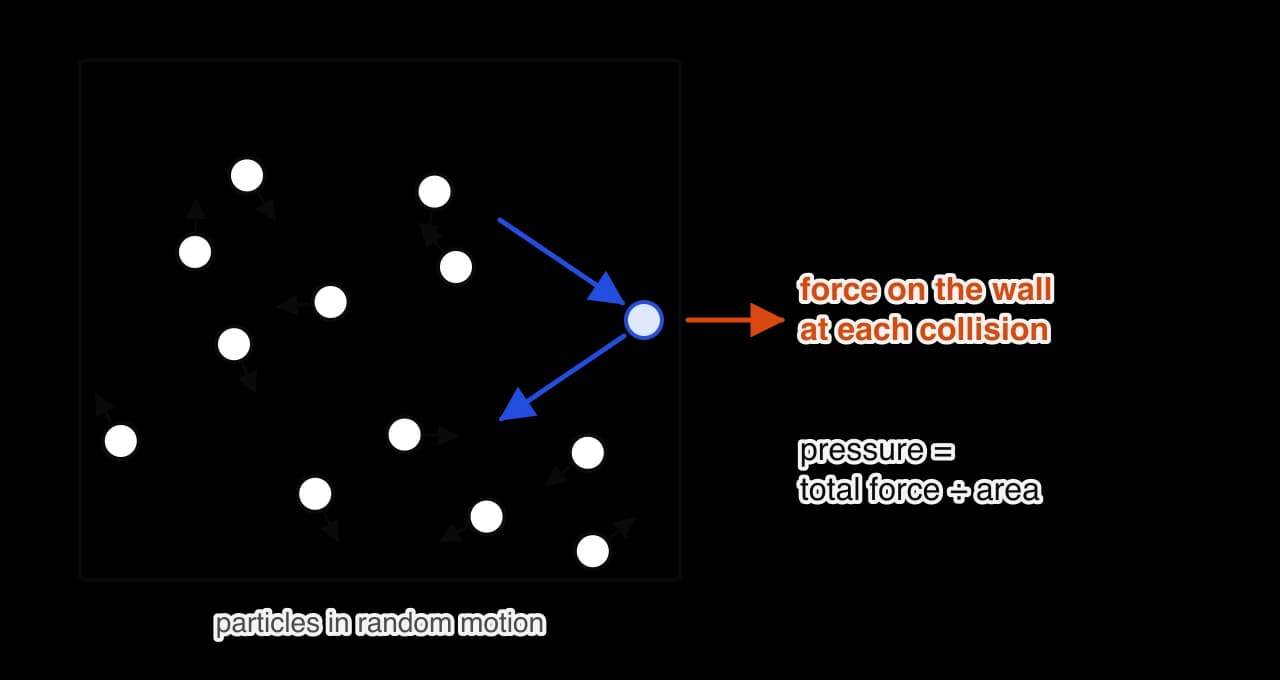
The particles of a gas collide with one another and with the walls of their container. Each collision with a wall pushes on it with a tiny force. Very large numbers of particles strike every square centimetre of the wall each second, so the individual pushes add up to a steady force spread over the surface.
The pressure of a gas depends on how often the particles hit the walls and how hard each one hits. Pressure increases if the particles collide with the walls more frequently, for example because more particles are packed into the same volume, or if each collision is more forceful, because the particles are moving faster at a higher temperature.
An ideal gas is a gas that would obey the gas laws exactly at all temperatures and pressures. No real gas does, but many come very close under ordinary conditions. The model rests on four assumptions:
Assumption | What it means |
|---|---|
The particles are in continuous, random motion. | They move in straight lines between collisions, in all directions with a range of speeds. |
The volume of the particles is negligible. | The particles are treated as points: their own volume is tiny compared with the volume of the container, which is almost entirely empty space. |
There are no intermolecular forces between the particles. | Particles neither attract nor repel one another except at the instant they collide, so each moves independently. |
All collisions are perfectly elastic. | No kinetic energy is lost in collisions between particles or with the walls, so the total kinetic energy of the gas stays constant at constant temperature. |
To these is added the result from kinetic theory: the average kinetic energy of the particles is directly proportional to the absolute temperature, in kelvin. Two gases at the same temperature therefore have the same average kinetic energy per particle, whatever their identity.
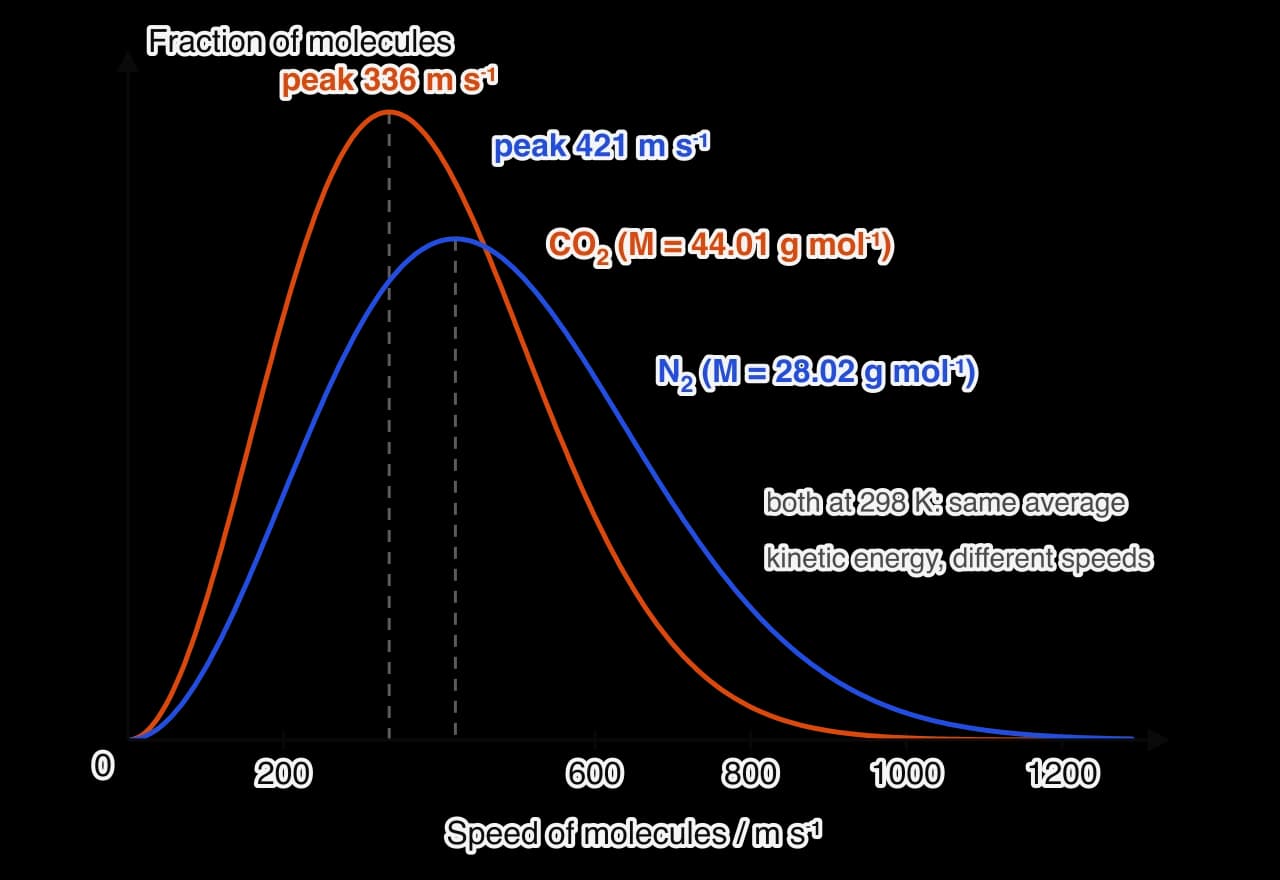
Kinetic energy depends on both mass and speed, . If two gases have the same average kinetic energy, the gas with heavier molecules must have a lower average speed. At 298 K, molecules of carbon dioxide () are on average slower than those of nitrogen (), and the distribution of their speeds is narrower. The speed distribution curves illustrate the idea; the shape of such distributions, drawn for energies rather than speeds, is used to explain reaction rates (Reactivity 2.2).
A real gas differs from an ideal gas in two ways. Its particles have a real, if small, volume, and they attract one another through intermolecular forces. Under most everyday conditions neither effect matters much, and real gases behave almost ideally. The model breaks down when the particles are forced close together.
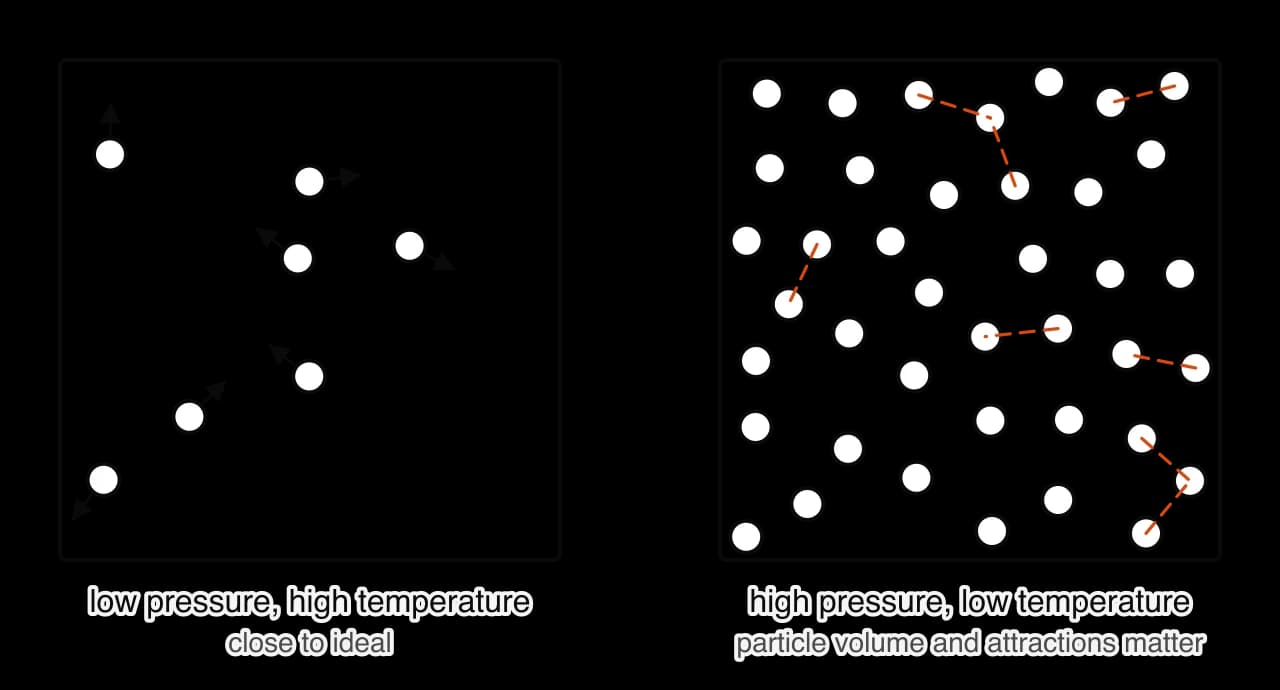
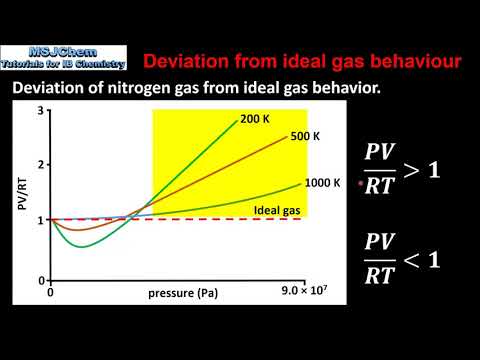
At high pressure the particles are squeezed close together. The volume of the particles themselves becomes a significant fraction of the total volume, so the space in which they can move is smaller than the volume of the container. The gas cannot be compressed as much as the ideal gas equation predicts, and at very high pressures its volume is larger than the ideal value.
At low temperature the particles move slowly. Slow particles spend longer near one another, so the attractions between them have a larger effect: they pull particles together and slow those about to hit a wall, so the walls are struck less often and less hard than the model predicts. The pressure, or the volume at constant pressure, is lower than the ideal value. When the gas is cooled far enough, the attractions hold the particles together and the gas condenses to a liquid. An ideal gas, with no attractions, could never condense.
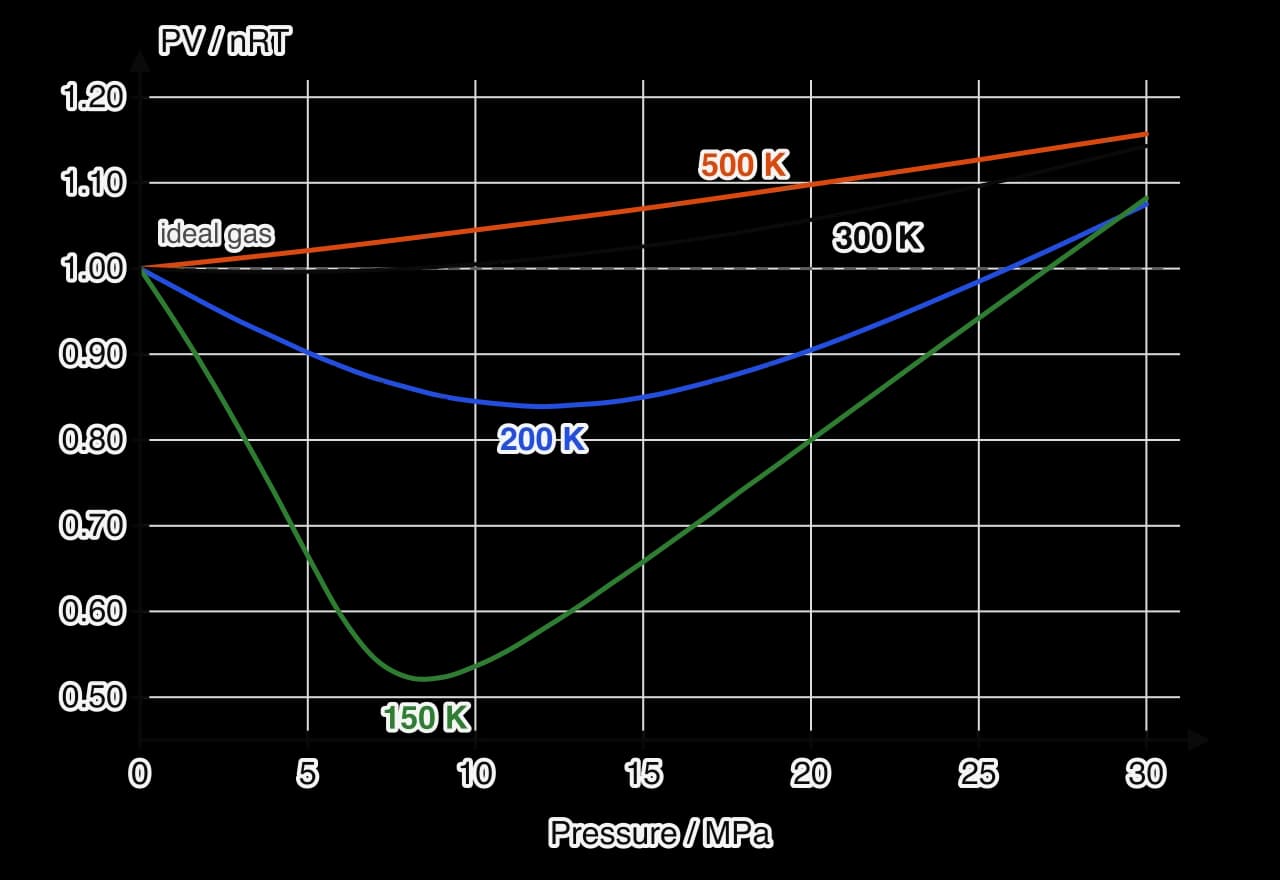
Real gases are therefore most nearly ideal at high temperature and low pressure, where the particles are far apart and moving fast. The ratio measures how ideal a gas is: it equals exactly 1 for an ideal gas. Values below 1 show that attractions dominate; values above 1 show that the volume of the particles dominates. The graph for nitrogen shows both effects.
 YouTube
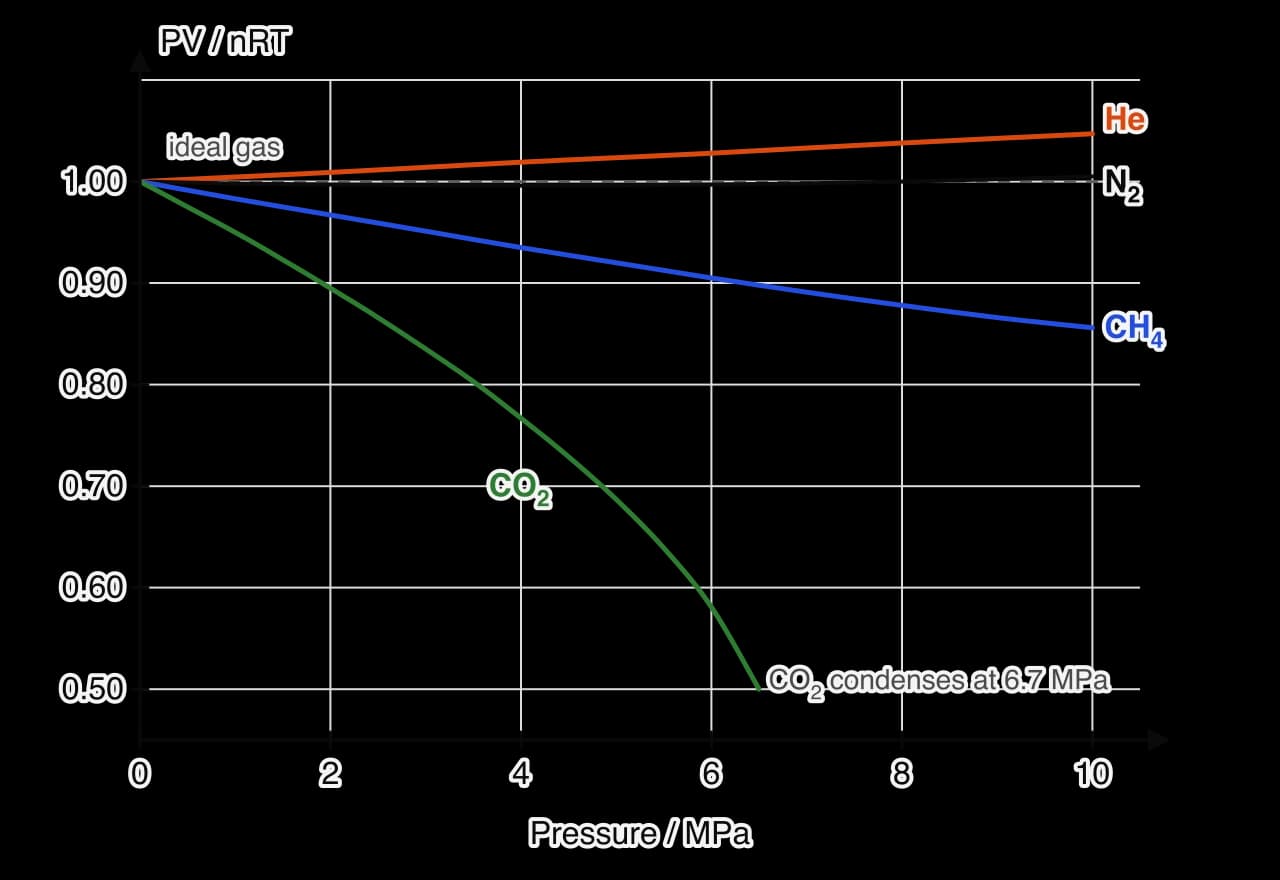
Under the same conditions, gases whose particles attract one another more strongly through intermolecular forces deviate more from ideal behaviour. The strength of the intermolecular forces depends on the size and polarity of the molecules (Structure 2.2). Helium, with only weak London (dispersion) forces between small atoms, is the most nearly ideal gas. Larger molecules such as carbon dioxide have stronger London forces, and polar molecules that form hydrogen bonds, such as ammonia and water, deviate most of all. The graph of for four gases at the same temperature shows the trend.
The same trend appears in the molar volumes of gases at STP. An ideal gas occupies per mole at 273.15 K and 100 kPa; gases with stronger attractions between their molecules occupy slightly less.
Gas | Main intermolecular forces | Molar volume at STP / |
|---|---|---|
ideal gas | none | 22.71 |
hydrogen, | very weak London forces | 22.73 |
helium, | very weak London forces | 22.72 |
nitrogen, | London forces | 22.70 |
carbon dioxide, | stronger London forces (larger molecule) | 22.56 |
ammonia, | hydrogen bonding | 22.37 |
Data: NIST Chemistry WebBook, calculated from measured densities at 273.15 K and 100 kPa.
The deviations matter wherever gases are stored at high pressure or cooled. A scuba cylinder is filled with compressed air to about 200–300 bar (20–30 MPa). At 20 MPa and room temperature, nitrogen, the main component of air, has , so the cylinder holds about 5% less gas than the ideal gas equation predicts. Calculations of how much air a diver can breathe from a full cylinder therefore use measured real-gas data.
The attractions that make a cooled gas fall below ideal behaviour are also what allow gases to be liquefied. Carbon dioxide in a fire extinguisher is stored as a liquid under its own vapour pressure, about 5.7 MPa at 20 °C, so a small cylinder holds a large mass of gas. Liquefied petroleum gas (LPG), a mixture of propane and butane, liquefies under modest pressure at room temperature: about 0.84 MPa for propane and 0.21 MPa for butane at 20 °C. Gases with weaker attractions, such as nitrogen and oxygen, cannot be liquefied by pressure alone at room temperature and are first cooled, in the Linde process by repeatedly compressing the gas, removing the heat and letting it expand.
Avogadro’s law (Structure 1.4) states that equal volumes of gases at the same temperature and pressure contain equal numbers of particles. For an ideal gas the identity of the gas does not matter, so one mole of any gas occupies the same volume under the same conditions.
The ideal gas equation explains why. Rearranged for one mole, , an expression that contains no property of the gas itself. In kinetic terms, heavier particles move more slowly at the same temperature but hit the walls harder, and the two effects balance exactly, because each particle’s contribution to the pressure depends on its kinetic energy, which is the same on average for every gas at a given temperature. Avogadro’s law describes the equal volumes; the kinetic model of an ideal gas explains them.
Standard temperature and pressure (STP) is 273.15 K (0 °C) and 100 kPa. At these conditions, and only these, the amount of a gas can be found directly from its volume:
The molar volume increases with temperature and decreases with pressure. Standard ambient temperature and pressure (SATP) is 298.15 K and 100 kPa. The data booklet gives no molar volume for SATP, but the ideal gas equation gives it: , or .
Because , the molar volume is directly proportional to the absolute temperature and inversely proportional to the pressure. Heating a gas from 273 K to 373 K at constant pressure increases its molar volume by a factor of ; doubling the pressure at constant temperature halves it.
Conditions | / K | / kPa | / |
|---|---|---|---|
STP | 273 | 100 | 22.7 |
SATP | 298 | 100 | 24.8 |
boiling water, standard pressure | 373 | 100 | 31.0 |
0 °C, twice standard pressure | 273 | 200 | 11.3 |
0 °C, half standard pressure | 273 | 50 | 45.4 |
The state of a sample of gas is described by four quantities: pressure , volume , temperature and amount . Changing one changes at least one of the others. The relationships are found by holding two of the quantities constant and measuring how the other two vary. Each was discovered experimentally and carries a historical name, given in brackets for reference.
When a fixed amount of gas is compressed at constant temperature, its pressure rises. Halving the volume doubles the pressure; reducing it to one third triples the pressure. Pressure is inversely proportional to volume (Boyle’s law):
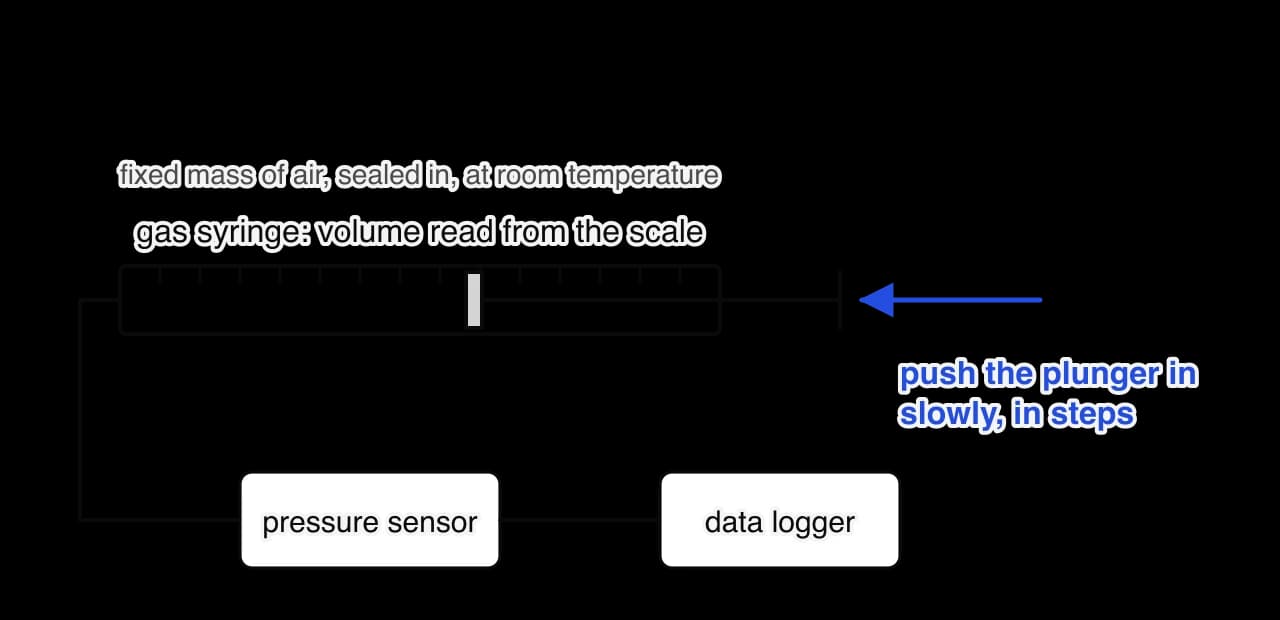
The kinetic explanation is that in a smaller volume the same number of particles, moving at the same average speed, reach the walls more often. More collisions per second with each unit area of wall means a greater pressure. The relationship is investigated with a sealed gas syringe connected to a pressure sensor.
A graph of pressure against volume is a curve (a hyperbola) that approaches both axes without touching them. The curve for a higher temperature lies further from the origin, because is larger.
Plotting pressure against instead turns the curve into a straight line through the origin, which is much easier to test with experimental data, because a straight line is easy to judge by eye and its gradient can be measured. Plotting against gives a horizontal line, since is constant.
When a gas is heated at constant pressure, it expands. The volume increases by the same amount for each degree of temperature rise, so a graph of volume against temperature in °C is a straight line. Extrapolated back to lower temperatures, the lines for every gas, and every amount of gas, meet the temperature axis at the same point: zero volume at −273 °C.
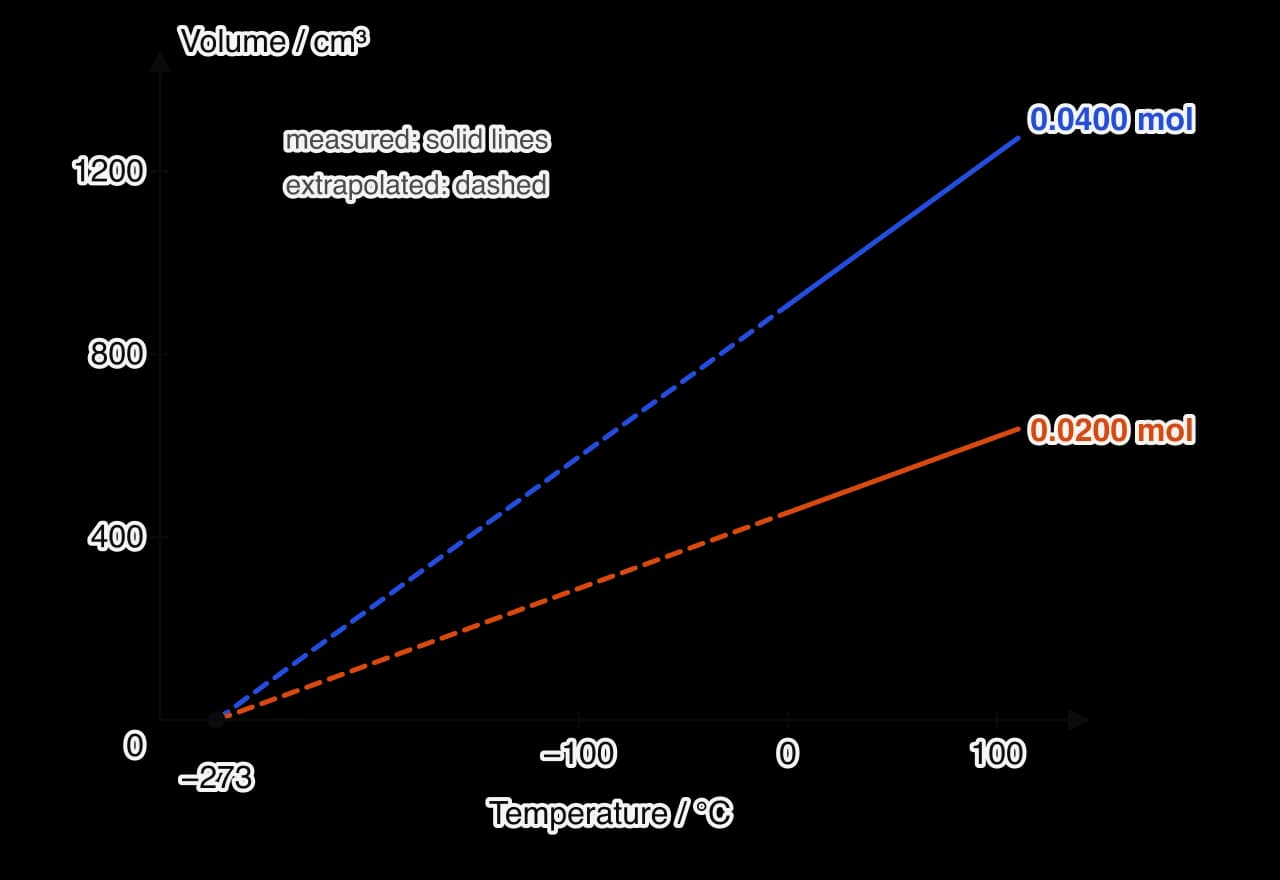
That temperature is absolute zero, 0 K, the zero of the Kelvin scale (Structure 1.1). On the Kelvin scale the line passes through the origin, and volume is directly proportional to absolute temperature (Charles’s law):
Faster-moving particles at a higher temperature strike the walls more often and with more force. If the pressure is to stay the same, as it does for a gas under a freely moving piston, the gas must expand until the collisions per unit area are back to their original rate. No real gas reaches zero volume: every gas condenses long before absolute zero, and the extrapolation describes the ideal gas.
A gas sealed in a rigid container cannot expand, so heating it raises its pressure. The relationship is investigated with a flask of air connected to a pressure sensor and held in a water bath.
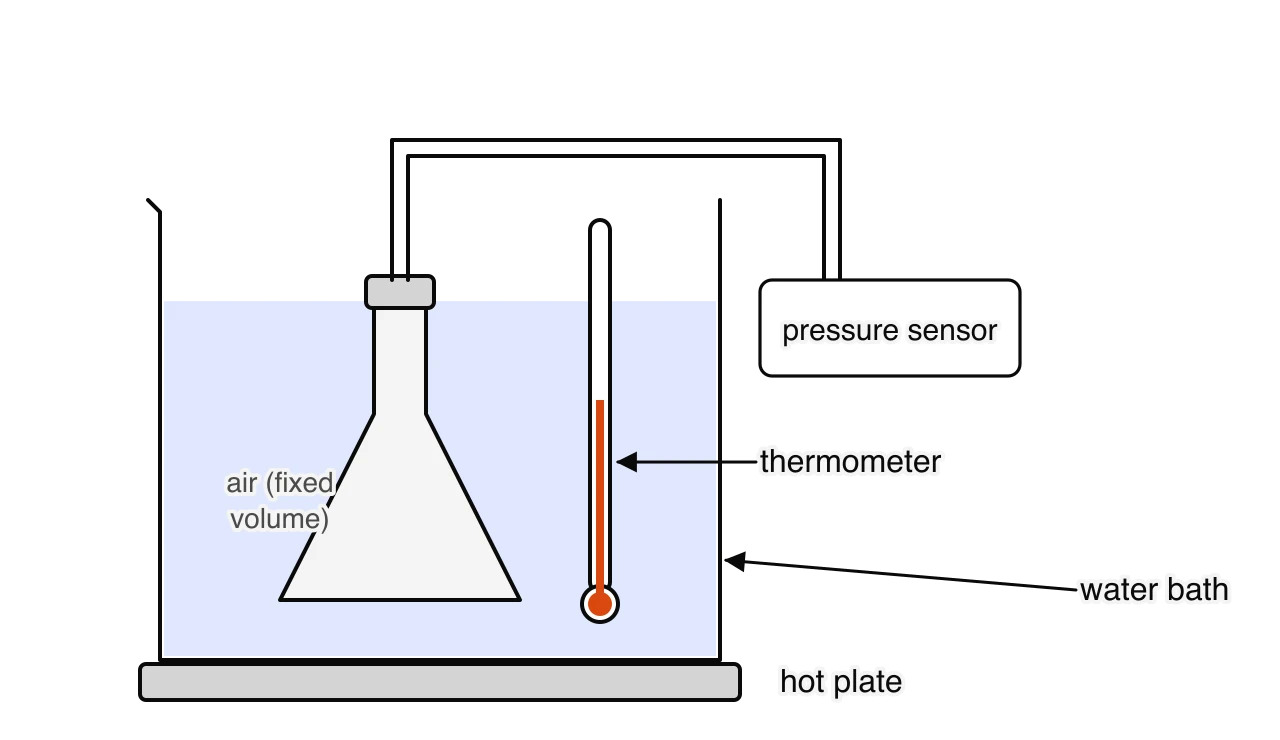
Pressure is directly proportional to absolute temperature (Gay-Lussac’s law):
At a higher temperature the particles move faster, so they strike the walls more frequently and each collision is more forceful. Both effects increase the pressure. The graph of the readings is a straight line which, extrapolated, passes through the origin on the Kelvin scale.
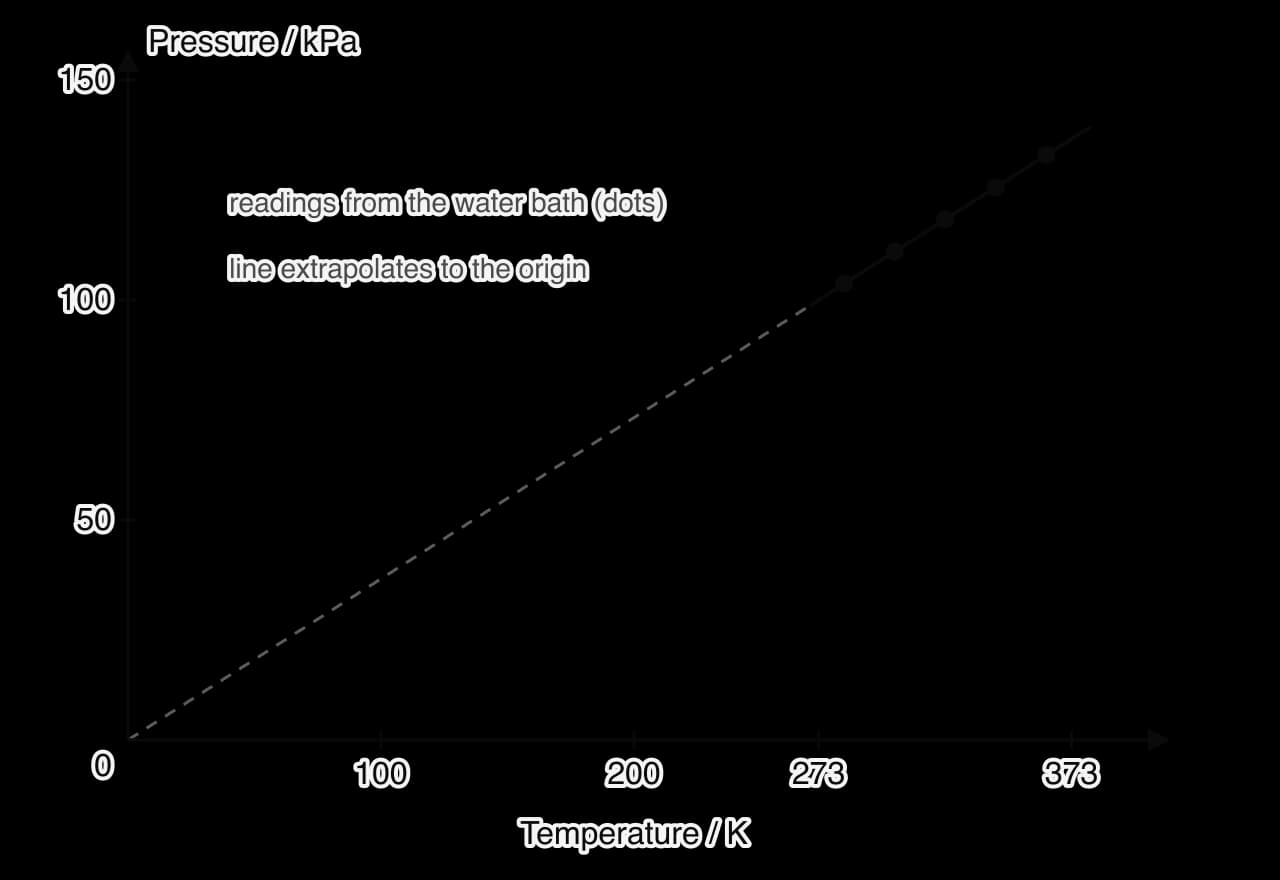
The same reasoning explains why aerosol cans carry a warning not to heat them: the pressure inside rises in proportion to the absolute temperature, and a can at 50 °C contains gas at about 10% higher pressure than at 20 °C (), before any liquid in it evaporates.
Adding more gas at constant temperature and pressure increases the volume in proportion: (Avogadro’s law). In a rigid container at constant temperature, adding gas increases the pressure instead: , because there are more particles to strike the walls. Pumping air into a bicycle tyre does both, first filling it out and then raising its pressure.
If both pressure and volume are fixed, the amount of gas the container holds depends on the temperature: . Heating an open flask drives gas out of it, so a graph of against is a curve, not a straight line.
Constant | Relationship | Graph that gives a straight line through the origin | Kinetic explanation |
|---|---|---|---|
, | (Boyle) | against | smaller volume, more frequent wall collisions |
, | (Charles) | against in K | faster particles; the gas expands to keep the collision rate per unit area the same |
, | (Gay-Lussac) | against in K | faster particles: more frequent and more forceful collisions |
, | (Avogadro) | against | more particles need more space at the same collision rate |
, | against | fewer, faster particles give the same pressure |
Graphs of these relationships can be drawn in two ways. A sketch shows the shape of a relationship, a curve or a straight line through the origin, with labelled axes but no scale, and is the quickest way to communicate a proportionality. A plotted graph of measured data, with scaled axes, data points and a line of best fit, tests the relationship: it shows how closely the data follow it, gives a gradient or intercept, and makes any deviation visible, but takes longer to draw and depends on the quality of the data.
The separate relationships combine into one: is proportional to and to and inversely proportional to , so is a constant, the same for every ideal gas. That constant is the gas constant, :
The ideal gas equation only gives correct answers if every quantity is in the SI units that match the value of :
Quantity | Symbol | SI unit | Conversions |
|---|---|---|---|
pressure | Pa | ; | |
volume | |||
amount | mol | ||
temperature | K | ||
gas constant |
The units are consistent because one pascal multiplied by one cubic metre is one joule (), matching the joules in .
 YouTube
The equation also shows how many molecules there are in an everyday volume of gas. A classroom measuring 8 m by 6 m by 3 m holds of air. At 20 °C and 101 kPa, , about molecules with a mass of roughly 170 kg.
Combining with gives a way to find the molar mass of a gas, or of a liquid that is easily vaporized, from four measurements: its mass, volume, temperature and pressure.
A simple version of the experiment uses the butane in a disposable lighter. The lighter is weighed, held under water below an inverted measuring cylinder full of water and opened to release gas, then dried and weighed again. The loss in mass is the mass of butane, and its volume is read from the cylinder.
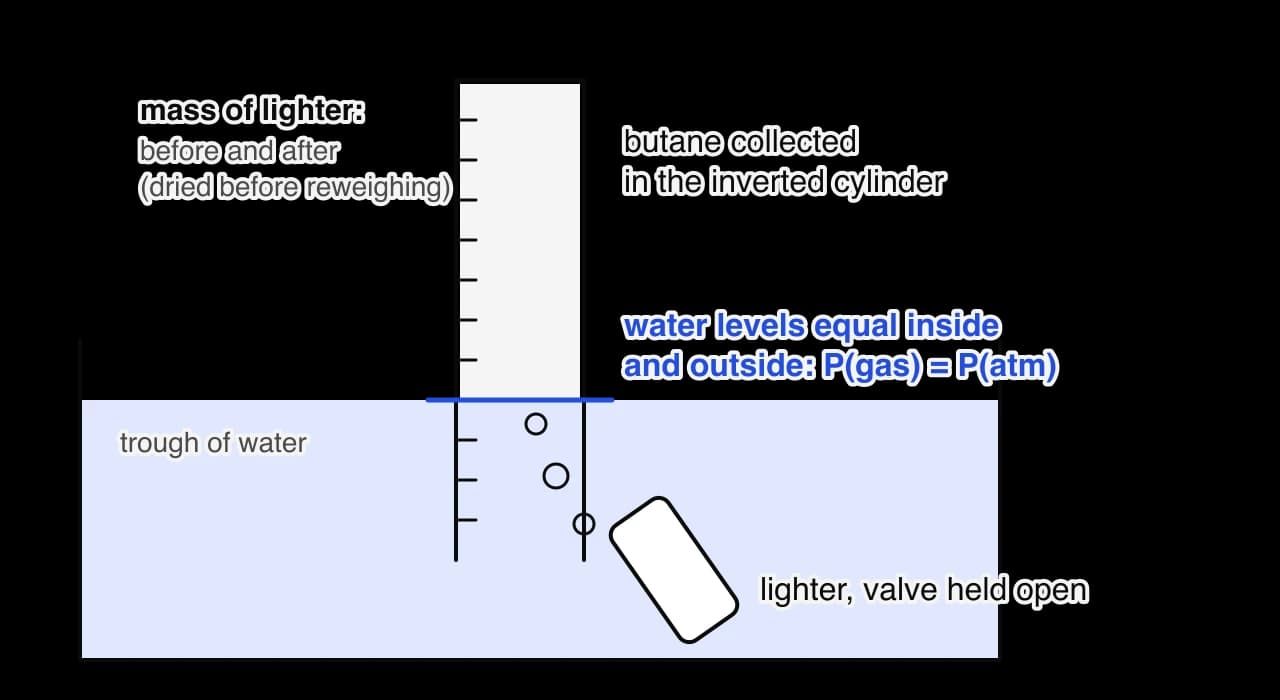
Three corrections or sources of error matter. The gas in the cylinder is a mixture of butane and water vapour, so the pressure of butane is atmospheric pressure minus the vapour pressure of water (about 2.5 kPa at 21 °C). A little butane dissolves in the water, and some may escape as bubbles that miss the cylinder, so the measured volume is too small. Water left on the lighter makes the second weighing too large and the mass of butane too small. Each of these has a definite direction, so it is a systematic error rather than a random one.
When a fixed amount of gas changes from one set of conditions to another, is constant, so is the same before and after. This gives the combined gas law, given in the data booklet:
Because the equation is a ratio, and may be in any units, provided each is in the same unit on both sides. Temperature must always be in kelvin, because the relationship is a proportionality to absolute temperature: a change from 10 °C to 20 °C does not double the volume of a gas, while a change from 10 K to 20 K would.
When pressure, volume and temperature all change, each factor is applied in turn: the volume ratio for the change in volume and the temperature ratio for the change in temperature.
If the amount of gas also changes, the ideal gas equation is used for each state, giving . In a rigid container, is proportional to .
At constant volume and temperature, the pressure of a gas mixture is proportional to the total amount of gas. A reaction that changes the number of moles of gas therefore changes the pressure, and the change can be predicted from the equation. In the decomposition of nitrosyl chloride, two moles of gas become three:
If the reaction goes to completion in a sealed vessel at constant temperature, the final pressure is of the initial pressure. Following the pressure with time is a convenient way to follow the rate of such a reaction (Reactivity 2.2). At a lower temperature, the same amount of gas in the same vessel starts at a lower pressure (), rises more slowly because the reaction is slower, and finishes at a lower pressure.
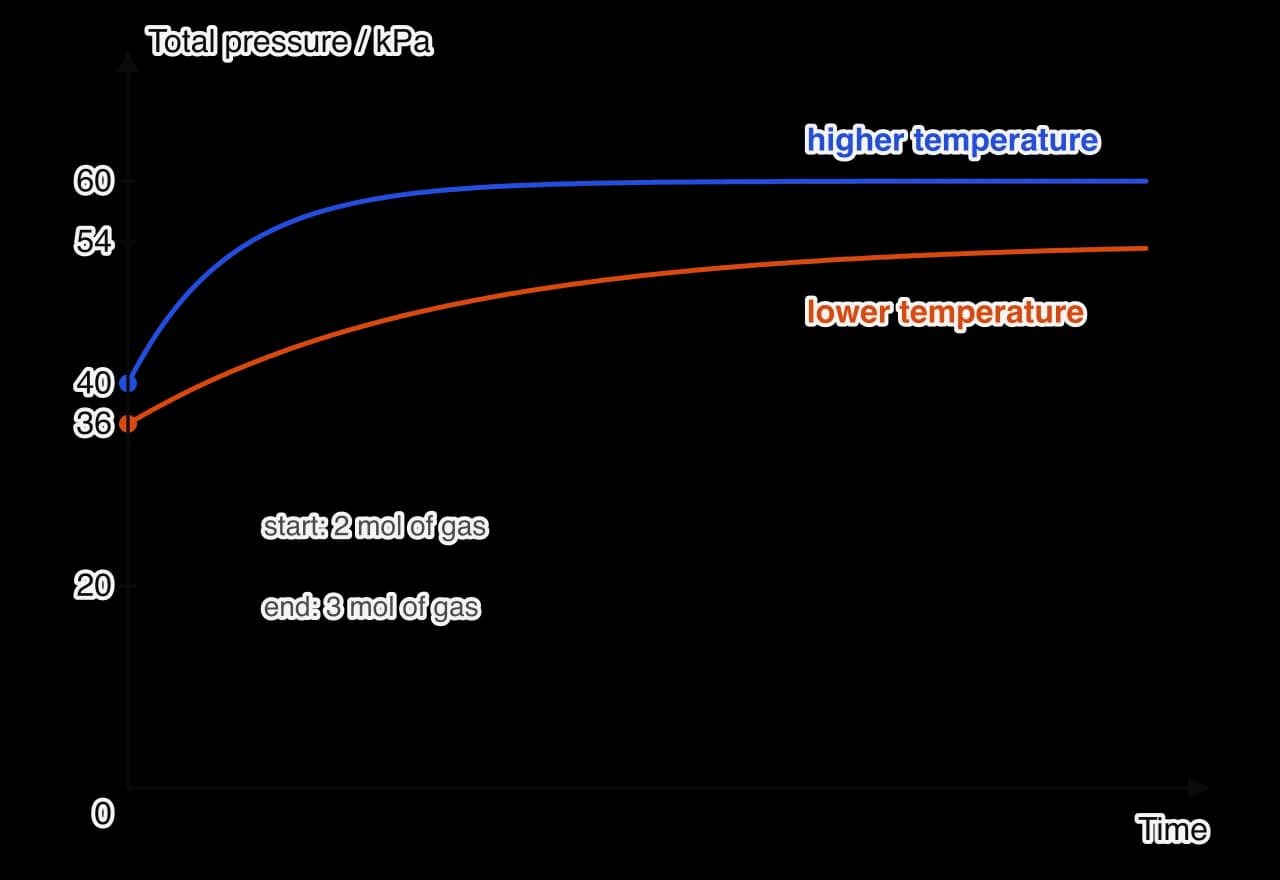
The reverse applies to reactions that reduce the amount of gas. In the synthesis of ammonia, , four moles of gas become two, so the pressure in a sealed vessel falls as the reaction proceeds, a point that also affects the position of equilibrium (Reactivity 2.3).
When two containers of gas are connected at constant temperature, each gas spreads out to fill the combined volume. Each gas then exerts a pressure as if it were alone in the whole volume, found from , and the total pressure is the sum of the two.
A student found the molar mass of butane, , by releasing gas from a lighter into an inverted measuring cylinder full of water.
Measurement | Value |
|---|---|
mass of lighter before / g () | 25.428 |
mass of lighter after drying / g () | 25.317 |
volume of gas collected / () | 46.0 |
temperature of water / °C () | 21.0 |
atmospheric pressure / kPa | 101.2 |
vapour pressure of water at 21 °C / kPa | 2.5 |
I can explain gas pressure in terms of the frequency and force of collisions with the walls.
I can state the four assumptions of the ideal gas model.
I can explain why gases at the same temperature have the same average kinetic energy but different average speeds.
I can explain why real gases deviate from ideal behaviour at high pressure and at low temperature.
I can explain why gases with stronger intermolecular forces deviate more, using examples such as ammonia and helium.
I can state the molar volume at STP and use it, and calculate molar volumes at other conditions.
I can describe and explain the relationships between pressure, volume, temperature and amount for a fixed mass of gas.
I can sketch and interpret graphs of P against V, P against 1/V, V against T and P against T, and say which are linear.
I can explain why extrapolated volume–temperature lines meet at −273 °C.
I can use PV = nRT with SI units, converting kPa, dm³, cm³ and °C correctly.
I can calculate the molar mass of a gas or volatile liquid from experimental data, and evaluate the method.
I can use the combined gas law, including when the amount of gas changes.
I can deduce pressure changes in gas-phase reactions from the moles of gas, and the total pressure when gases mix.
I and II only
I and III only
II and III only
I, II and III
Under which conditions does a real gas behave most like an ideal gas?
(a) At STP the molar volume can be used directly:
(b) At SATP the data booklet gives no molar volume, so the ideal gas equation is used with SI units (, ):
The volume at SATP is larger by the factor , as expected for a gas at a higher temperature and the same pressure.
Convert the constant to SI units. .
Find the amount from with :
Percentage error against the accepted value of : .
The extrapolation runs far beyond the measured range, from 20 °C down to −272 °C, so a small error in the gradient produces a large error in the result. Measurements over a wider range of temperatures, and more of them, make the gradient and therefore the estimate of absolute zero more reliable.
Convert to SI units. ; .
Convert to the unit asked. .
The answer can be checked from the total amount: is proportional to , so .
✓
Award [3] for correct final answer. Accept 59.6–59.9. Award [2 max] for 58.3 «using 101.2 kPa». Accept ECF from (a).
molar mass: ✓
Award [2] for correct final answer. Award [1 max] for 0.290 dm³ «using 25.0 K».
(c)
smaller AND attractions between molecules pull them together/reduce the frequency or force of wall collisions ✓
(d)
ammonia forms hydrogen bonds between molecules AND nitrogen has only London forces ✓
stronger attractions «in ammonia» cause a larger deviation from the ideal gas assumptions ✓
Do not accept "ammonia is polar" alone for M1.
(e)
high temperature AND low pressure ✓
Accept ECF from (a).
(c)
lower curve with a smaller initial gradient ✓
starts at a lower pressure AND levels off at a lower pressure «both about 1.5 times its own starting value» ✓
Award [1 max] if both curves start and end at the same pressures.
The expected shape is the pair of curves in the pressure–time graph for nitrosyl chloride.