S2.1 The ionic model · IB Chemistry | Augment Education
S2.1 The ionic model
How atoms form ions, how ions combine in ionic compounds and are named, and how the ionic lattice and lattice enthalpy explain volatility, conductivity, solubility and brittleness.
IB Chemistry
Part of S2 Models of bonding and structure
SL and HL
Key terms introduced here
Each is in the Chemistry glossary, with every other term in the subject.
Breaking or shattering when struck rather than bending; ionic solids are brittle because a shifted layer brings ions of the same charge together and they repel.
In a lattice, the number of nearest neighbours of opposite charge around an ion (six in sodium chloride); in a complex ion, the number of coordination bonds to the central ion.
The decomposition of a molten or dissolved ionic compound (an electrolyte) by a direct electric current, with ions gaining or losing electrons at the electrodes.
An ion surrounded by water molecules attracted to it: the δ−
Notes on S2.1 The ionic model
38 min readLast reviewed
Table salt, the limestone of chalk cliffs and the magnesium oxide that lines industrial furnaces are all ionic compounds: substances made of positive and negative ions held together by electrostatic attraction. The ionic model explains how these ions form, why each compound has a fixed formula, and why ionic compounds are hard, high-melting solids that conduct electricity only when they are melted or dissolved.
Questions on S2.1
123 exam-style questions on this subtopic, written in the style of the IB papers. The first has its markscheme open. Counted on
Question 1 · CHEM-000481 mark
An atom of element X has the electron configuration 1s2 2s2 2p6 3s2 3p4.
Which ion does X form in its ionic compounds?
A
X2−
B
X−
Try a quick-fire question
One of 61 short multiple-choice questions on S2.1. Pick an answer to see why it's right or wrong.
Why can many first-row transition elements form ions with different charges, such as 2+ and 3+?
Flashcards for S2.1
The official deck for this part of the syllabus.
S2.1 The ionic model · front
What is an ion?
S2.1 The ionic model · front
What is a cation?
S2.1 The ionic model183 cards
From the data booklet
The entries of the chemistry data booklet that S2.1 uses. Each opens in the explained booklet.
A giant three-dimensional regular arrangement of alternating cations and anions, each surrounded by ions of the opposite charge and held by non-directional electrostatic attraction.
The standard enthalpy change when one mole of a solid ionic compound is separated into its gaseous ions, e.g. NaCl(s)NaX+(g)+ClX−(g); it is positive and measures the strength of the ionic bonding.
An electron configuration the same as that of a noble gas, with a full outer level (eight electrons, or two for the helium arrangement); main-group ions usually have one.
A solvent whose molecules have a permanent dipole, such as water; polar solvents can attract and surround ions, so many ionic compounds dissolve in them.
An element whose atoms have an incomplete d-sublevel, or which forms at least one stable ion with an incomplete d-sublevel; most form ions with more than one charge.
The tendency of a substance to vaporize; substances with weak forces between their particles are volatile, while ionic compounds have low volatility.
How atoms become ions
An atom is electrically neutral because it contains equal numbers of protons and electrons. If an atom loses or gains one or more electrons, the numbers are no longer equal and the particle carries a net charge. A charged particle formed in this way is an ion.
Only electrons are lost or gained. The nucleus is unchanged, so the number of protons, and therefore the identity of the element, stays the same. A sodium ion still contains 11 protons; it has 10 electrons instead of 11, so its charge is (+11)+(−10)=+1.
Why metals form cations and non-metals form anions
The electrons that take part in bonding are the valence electrons, those in the outermost occupied main energy level. Metal atoms have few valence electrons (one, two or three for the main-group metals) and these are held weakly, because they are far from the nucleus and shielded from it by the inner electrons. Metals therefore have low first ionization energies, and their atoms lose their valence electrons relatively easily to form cations.
Non-metal atoms have five, six or seven valence electrons and a larger effective nuclear charge acting on them. Adding electrons to their partly filled outer level releases energy for the first electron (the first electron affinity of chlorine, for example, is −349kJ mol−1, data booklet), and non-metal atoms gain electrons to form anions.
In both cases the ion formed usually has the same electron configuration as the nearest noble gas, with a full outer level: eight electrons (an octet) for most ions, or two for ions such as LiX+ and BeX2+ that end up like helium. This noble gas configuration is a useful guide to the charge an ion will have. The noble gas configuration does not by itself make an ion stable: removing an electron from a sodium atom still needs energy (496kJ mol−1, data booklet). An ionic compound is stable because of the large amount of energy released when the oppositely charged ions attract each other in a solid lattice.
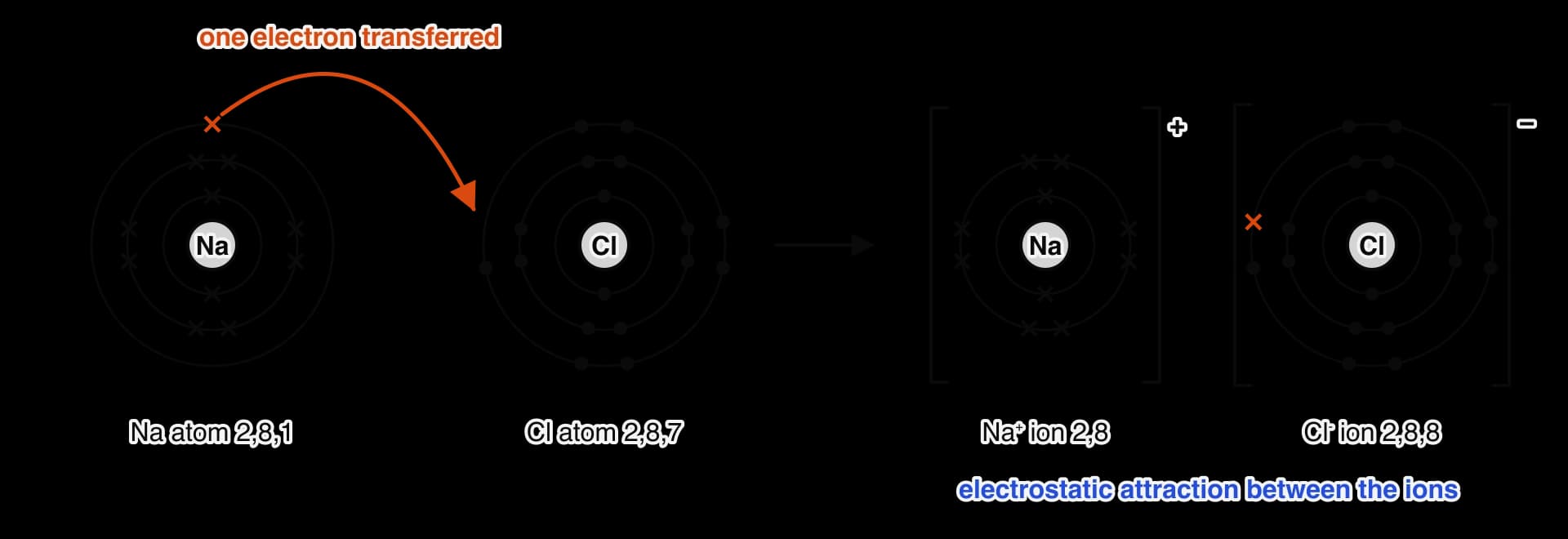
Sodium loses its single 3s electron and chlorine gains it. Both ions end with the electron arrangement of a noble gas (neon for Na⁺, argon for Cl⁻). The transferred electron is drawn in orange; crosses and dots only show where each electron came from, since all electrons are identical.
The shell diagrams show the whole process for sodium chloride. Sodium (2,8,1) loses its single outer electron and becomes NaX+ with the arrangement 2,8, the same as neon. Chlorine (2,8,7) gains that electron and becomes ClX− with the arrangement 2,8,8, the same as argon. In full electron configurations:
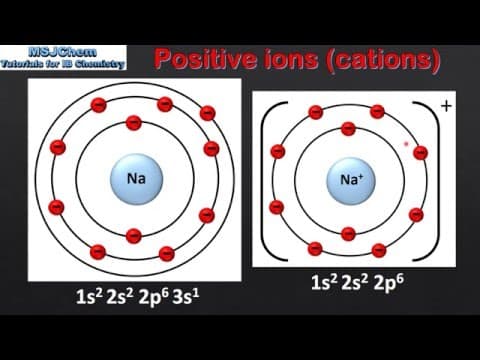
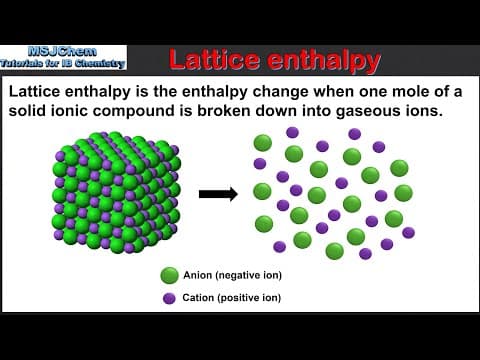
MSJ Chem (Mike Sugiyama Jones): S2.1.1 Ions, a short video on how atoms form ions.
Predicting the charge of an ion
For the main-group elements, the charge of the usual ion follows from the number of valence electrons, which is linked to the group number. A metal loses all its valence electrons; a non-metal gains enough electrons to complete its octet.
Group
Valence electrons
Change
Ion charge
Examples
1
1
loses 1
1+
LiX+, NaX+, KX+
2
2
loses 2
2+
MgX2+, CaX2+, BaX2+
13
3
loses 3
3+
AlX3+
15
5
gains 3
3−
NX3− (nitride), PX3− (phosphide)
16
6
gains 2
2−
OX2− (oxide), SX2− (sulfide)
17
7
gains 1
1−
FX−, ClX−, BrX−
18
8 (2 for He)
none
no ions
noble gases already have a full outer level
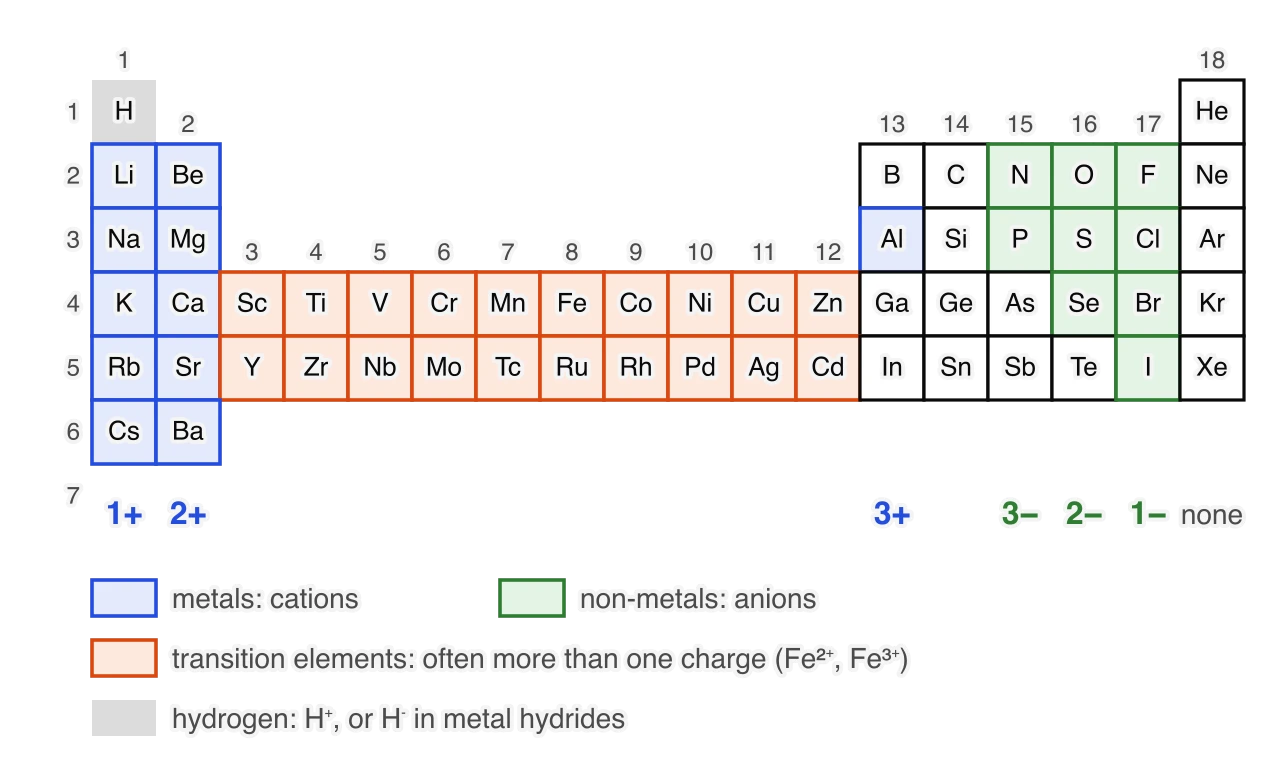
The periodic table coloured by ion type shows the same pattern at a glance: the charge on cations rises from 1+ to 3+ moving right across the metals, and the charge on anions falls from 3− to 1− approaching the noble gases.
The group number of a main-group element predicts the charge of its ion. Metals on the left lose their valence electrons; non-metals on the right gain enough electrons to fill their outer level. Noble gases (group 18) do not normally form ions.
A few elements need care. Hydrogen has one electron. It usually loses it to form HX+ (in acids), but with very reactive metals it gains one to form the hydride ion, HX−, with the configuration of helium, as in lithium hydride, LiH, and sodium hydride, NaH. The elements of group 14 (carbon, silicon) would need to lose or gain four electrons, which requires too much energy, so they normally form covalent bonds instead of simple ions. Boron in group 13 behaves in the same way, which is why only aluminium is shaded among the group 13 elements in the periodic table of ion charges.
Ions of the transition elements
The transition elements of the d-block do not follow the group pattern. Their 4s and 3d sublevels are close in energy, so different numbers of electrons can be lost for similar energy costs, and most of them form ions with more than one charge. Iron, for example, forms both FeX2+ and FeX3+, and copper forms CuX+ and CuX2+.
When a first-row transition element forms an ion, the 4s electrons are lost first, before any 3d electrons, even though 4s fills before 3d in the atom. Once the 3d sublevel is occupied it is lower in energy than 4s.
Atom or ion
Electron configuration
Electrons lost
Fe
[Ar]3d64s2
—
FeX2+
[Ar]3d6
both 4s
FeX3+
[Ar]3d5
both 4s and one 3d
Cu
[Ar]3d104s1
—
CuX+
[Ar]3d10
the 4s electron
CuX2+
[Ar]3d9
4s and one 3d
MnX2+
[Ar]3d5
both 4s
CrX3+
[Ar]3d3
the 4s and two 3d (Cr is [Ar]3d54s1
Because a transition element can form more than one ion, the name of its compound must say which ion is present. The charge is given as a Roman numeral in brackets after the name of the metal: iron(II) chloride is FeClX2 and iron(III) chloride is FeClX3. Zinc is an exception in practice, forming only ZnX2+, and silver almost always forms AgX+, so their compounds are usually named without a numeral (zinc oxide, silver nitrate). Successive ionization energies, an HL idea, explain why particular charges are favoured for each transition element.
The sizes of ions
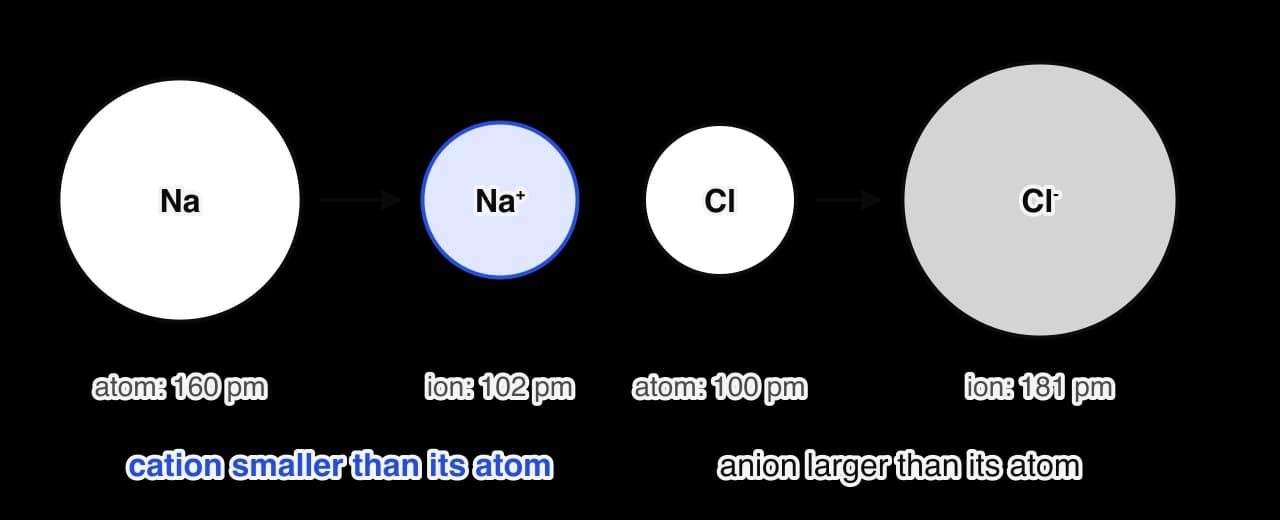
Forming an ion changes the size of the particle markedly. The ionic radius of a cation is smaller than the radius of its atom, and the radius of an anion is larger than the radius of its atom, as the atoms and ions of sodium and chlorine drawn to scale show.
Atoms and their ions drawn to the same scale. Losing the whole outer level shrinks sodium; adding an electron to the same outer level makes chlorine swell. Radii: IB Chemistry data booklet (2025).
Cations are smaller than their atoms. A sodium atom (2,8,1) loses its whole third energy level when it forms NaX+ (2,8). The remaining electrons are in levels closer to the nucleus, and the same 11 protons now attract only 10 electrons, so the ion is pulled in further.
Anions are larger than their atoms. A chlorine atom (2,8,7) gains an electron in the same outer level. The nuclear charge is unchanged (17 protons), but there are now 18 electrons, and the extra electron–electron repulsion makes the electron cloud spread out.
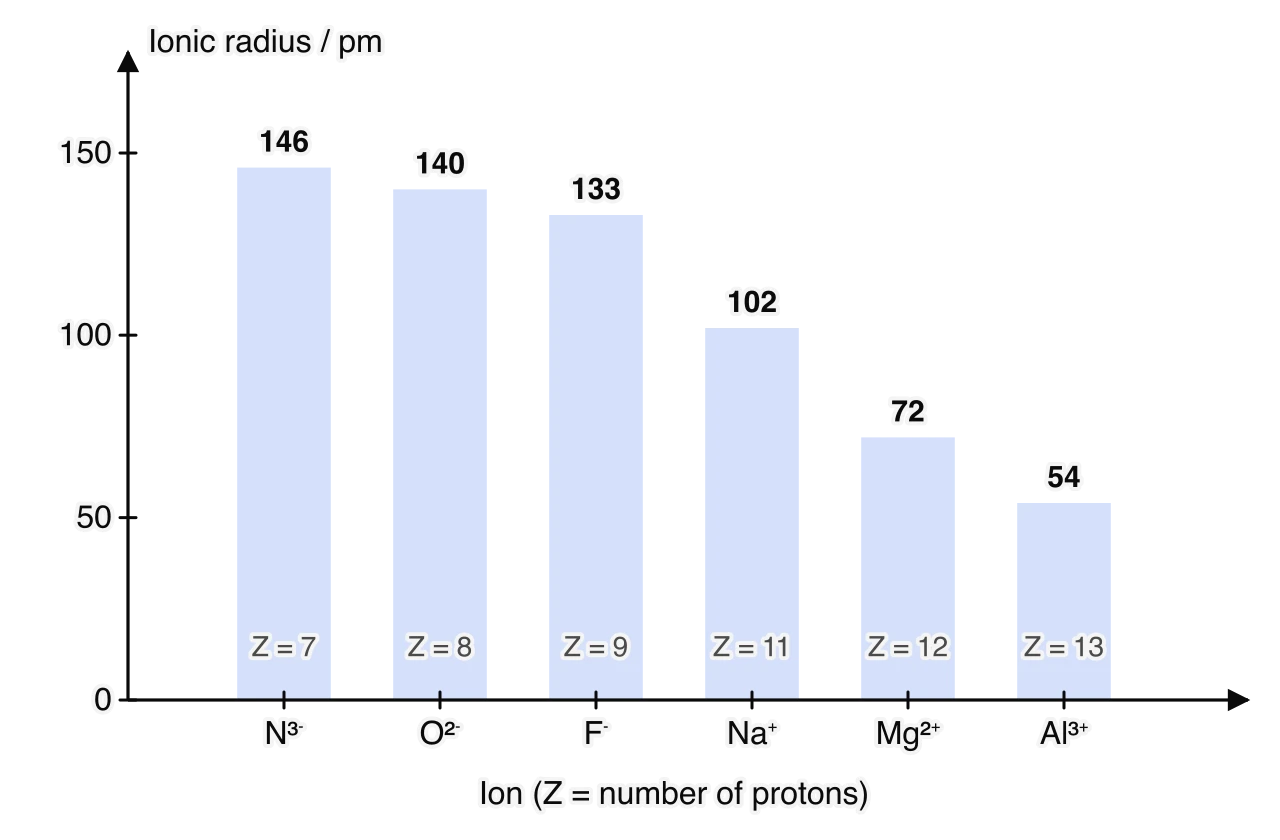
Ions with the same electron configuration are called isoelectronic. The ions NX3−, OX2−, FX−, NaX+, MgX2+ and AlX3+ all have ten electrons arranged as 1s22s22p6. Their radii fall steadily across the series because the number of protons rises from 7 to 13 while the number of electrons stays at ten.
Every ion in this series has the electron configuration 1s² 2s² 2p⁶. The radius falls as the number of protons rises, because the same ten electrons are pulled in by a larger nuclear charge. Data: IB Chemistry data booklet (2025).
Down a group, ionic radius increases because each ion has one more occupied energy level than the one above it: SX2− (184 pm) is larger than OX2− (140 pm), and KX+ (138 pm) is larger than NaX+ (102 pm) (data booklet). The trends in ionic radius across the periodic table are treated more fully with the other periodic trends.
The ionic bond
Once ions of opposite charge have formed, they attract each other strongly. This attraction is the ionic bond.
A description of how an ionic bond forms needs two stages: electrons are transferred from the metal atoms to the non-metal atoms, producing cations and anions, and the oppositely charged ions then attract each other. Either stage on its own is an incomplete description. In magnesium oxide, each magnesium atom transfers two electrons to an oxygen atom, forming MgX2+ and OX2−, which attract each other.
The electrostatic attraction acts equally in all directions around an ion; it is non-directional. An ion is therefore not bonded to one particular partner. Each ion attracts every oppositely charged ion around it (and repels every ion of the same charge), which is why ionic compounds form extended lattices rather than small molecules.
Lewis formulas of ionic compounds
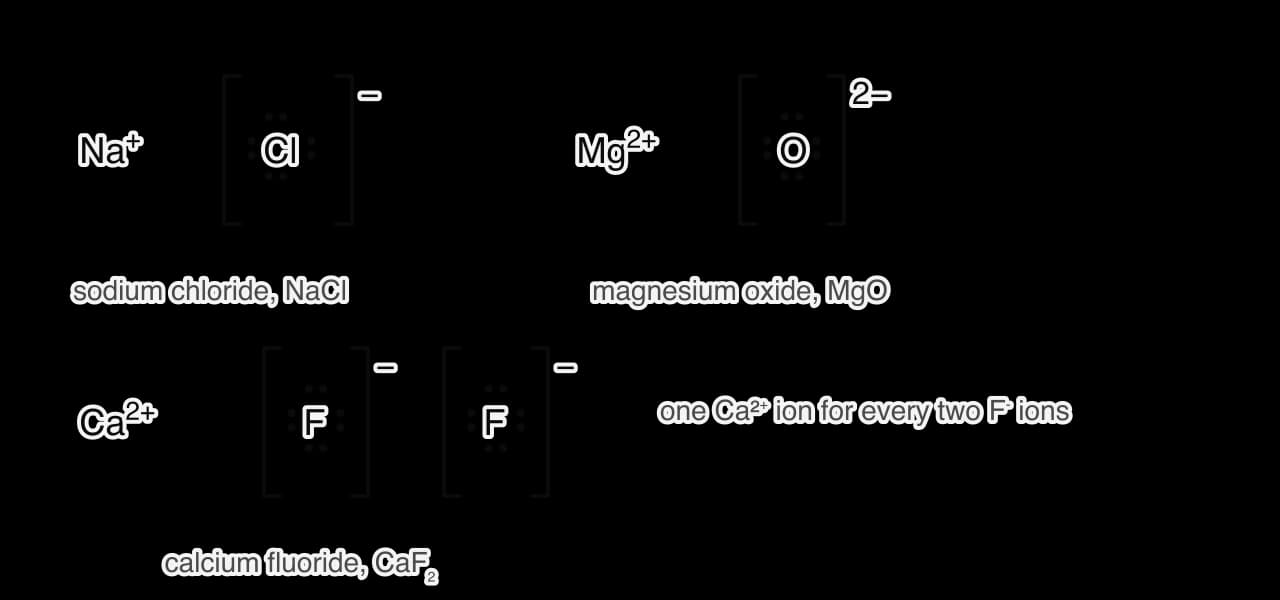
A Lewis formula for an ionic compound shows the separate ions, each with its charge. The anion is drawn with its complete octet of valence electrons and placed in square brackets with the charge outside; the cation has lost its valence electrons, so no electrons are drawn around it. The Lewis formulas of sodium chloride, magnesium oxide and calcium fluoride show this, with the number of each ion matching the formula.
Lewis formulas of ionic compounds show the separate ions. The cation has no valence electrons left to show; each anion has a full octet and sits in square brackets with its charge.
Which elements form ionic bonds
Ionic bonding needs one atom that loses electrons easily and another that gains them readily. This means the two elements must differ substantially in electronegativity, the ability of an atom to attract a shared pair of electrons. Typical ionic compounds form between a metal on the left of the periodic table (low electronegativity, for example Na 0.9, Mg 1.3) and a non-metal on the right (high electronegativity, for example O 3.4, Cl 3.2) (data booklet).
Two atoms of the same element have identical electronegativities, so neither can take electrons from the other. Ionic bonds therefore form only between different elements, whereas covalent bonds, in which electrons are shared, can form between identical atoms, as in ClX2 or OX2. In reality bonding varies continuously from ionic to covalent as the electronegativity difference falls; the bonding triangle, which places a compound on this continuum from the electronegativities of its two elements, is part of the study of materials.
Forming an ionic compound is a redox reaction
When sodium burns in chlorine, sodium atoms lose electrons and chlorine molecules gain them. Loss of electrons is oxidation and gain of electrons is reduction, so the formation of an ionic compound from its elements is a redox reaction:
The oxidation state of sodium rises from 0 to +1 and that of chlorine falls from 0 to −1. Every ionic compound made directly from its elements forms in this way, including magnesium oxide from burning magnesium ribbon, 2Mg(s)+OX2(g)2MgO(s). Redox reactions are treated in detail with electron transfer reactions.
Formulas of ionic compounds
An ionic compound is electrically neutral, so the total positive charge of its cations must equal the total negative charge of its anions. The formula gives the simplest whole-number ratio of ions that achieves this.
Binary ionic compounds
A binary ionic compound contains only two elements, one metal and one non-metal. Its formula is found in three steps.
Write the symbol and charge of each ion.
Find the smallest numbers of each ion that make the total charge zero (the lowest common multiple of the charges helps).
Write the cation first, with the numbers as subscripts; leave out the charges and any subscript 1.
Polyatomic ions
A polyatomic ion is a charged group of atoms joined by covalent bonds. The group behaves as a single unit in ionic compounds and keeps its identity through many reactions. Seven common polyatomic ions appear again and again in chemistry, so their names, formulas and charges are worth learning by heart.
Name
Formula
Charge
Related acid or molecule
Example compound
ammonium
NHX4X+
1+
ammonia, NHX3 (gains HX+
ammonium chloride, NHX4Cl
hydroxide
OHX−
1−
water, HX2O
nitrate
NOX3X−
1−
nitric acid, HNOX3
hydrogencarbonate
HCOX3X−
1−
carbonic acid, HX2COX3
carbonate
COX3X2−
2−
carbonic acid, HX2COX3
sulfate
SOX4X2−
2−
sulfuric acid, HX2SOX4
phosphate
POX4X3−
3−
phosphoric acid, HX3POX4
Each anion in the table is what remains when its parent acid loses all its acidic hydrogen ions as HX+, which is why the charge equals the number of hydrogen ions lost; the link between these anions and their acids is developed with proton transfer reactions. Other polyatomic ions appear in later topics, including sulfite, SOX3X2−, nitrite, NOX2X−, ethanoate, CHX3COOX−, permanganate (manganate(VII)), MnOX4X−, and dichromate(VI), CrX2OX7X2−.
When a formula contains more than one polyatomic ion of the same kind, the ion is placed in brackets with the number outside. The brackets show that the subscript multiplies every atom in the ion.
Compounds containing both ionic and covalent bonds
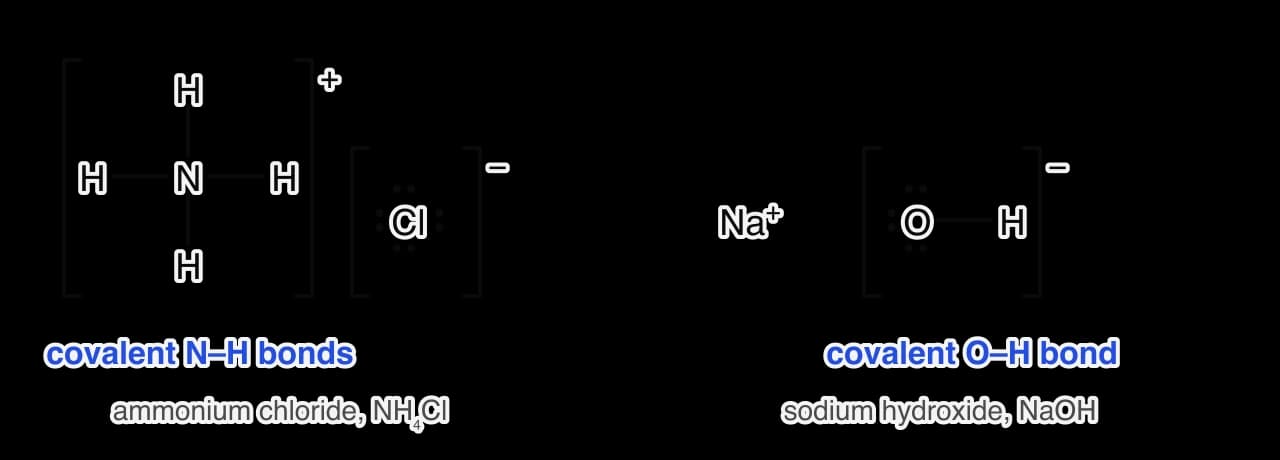
Inside a polyatomic ion the atoms are held together by covalent bonds: shared pairs of electrons. A compound such as sodium hydroxide therefore contains two kinds of bonding: covalent bonding between the O and H atoms within each hydroxide ion, and ionic bonding between the NaX+ and OHX− ions. Ammonium chloride, sodium hydrogencarbonate, potassium sulfate and sodium ethanoate, CHX3COONa, are other examples. The Lewis formulas of ammonium chloride and sodium hydroxide show the covalent bonds inside each polyatomic ion.
Compounds of polyatomic ions contain both kinds of bonding. The atoms inside each polyatomic ion share electrons in covalent bonds (blue labels); the ions are held to each other by ionic bonding.
Naming ionic compounds
Ionic compounds are named in a fixed order: the cation first, then the anion.
The cation keeps the name of the metal: sodium, calcium, aluminium. For metals that form more than one ion, a Roman numeral in brackets gives the charge: copper(II), iron(III).
A simple (monatomic) anion takes the stem of the non-metal with the ending -ide: chloride, bromide, iodide, fluoride, oxide, sulfide, nitride, phosphide, hydride.
Polyatomic ions keep their own names: ammonium, hydroxide, nitrate, hydrogencarbonate, carbonate, sulfate, phosphate. Hydroxide is the one polyatomic ion that ends in "-ide".
Formula
Ions
Name
KI
KX+, IX−
potassium iodide
CaX3NX2
AlX2SX3
LiH
LiX+, HX−
CuO
CuX2+, OX2−
CuX2O
CuX+
FeBrX3
FeX3+
(NHX4)X2COX3
To name a compound of a metal with a variable charge, work backwards from the anion: the anions have fixed charges, so the total negative charge fixes the charge on the metal.
Ionic lattices
Ionic compounds do not consist of separate molecules. In the solid, a vast number of cations and anions are arranged in a regular, repeating three-dimensional pattern called an ionic lattice. Each ion is surrounded by ions of the opposite charge, and because ionic bonding is non-directional, every ion attracts all its oppositely charged neighbours at once. The lattice extends in every direction to the edges of the crystal, so it is described as a giant structure.
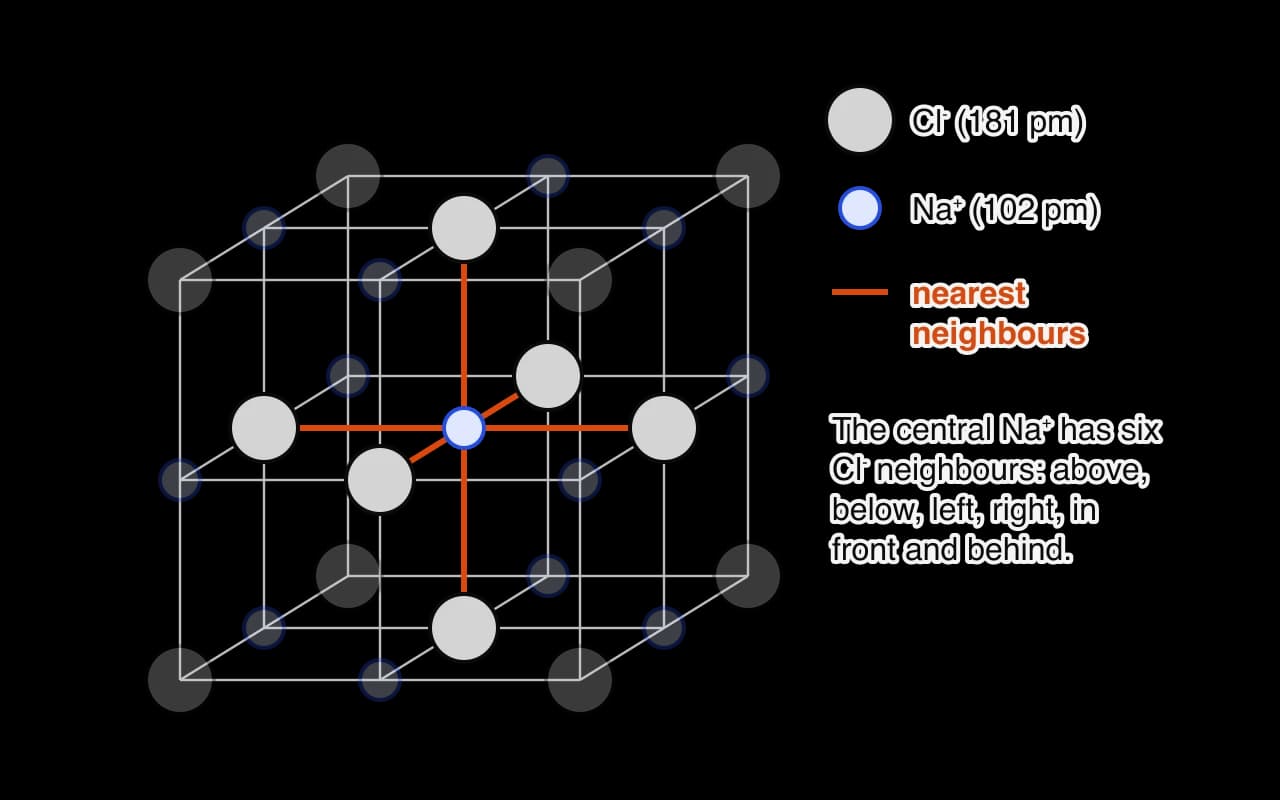
Part of the sodium chloride lattice. The central Na⁺ ion is joined by orange lines to its six nearest neighbours, all Cl⁻ ions, which sit at the corners of an octahedron; every ion in the crystal has the same surroundings. Grey lines only show the cubic geometry and are not bonds. The ions are drawn smaller than their true size so the arrangement can be seen.
In sodium chloride each NaX+ ion is surrounded by six ClX− ions, and each ClX− ion by six NaX+ ions, arranged at the corners of an octahedron. The number of nearest neighbours of opposite charge is the coordination number, so sodium chloride has 6:6 coordination. Other compounds have other arrangements depending on the relative sizes and charges of the ions: in caesium chloride, with its larger cation, each ion has eight neighbours, and in calcium fluoride each CaX2+ has eight FX− neighbours while each FX− has four CaX2+ neighbours. These structures do not need to be learned, but they show that the lattice adapts to the ions.
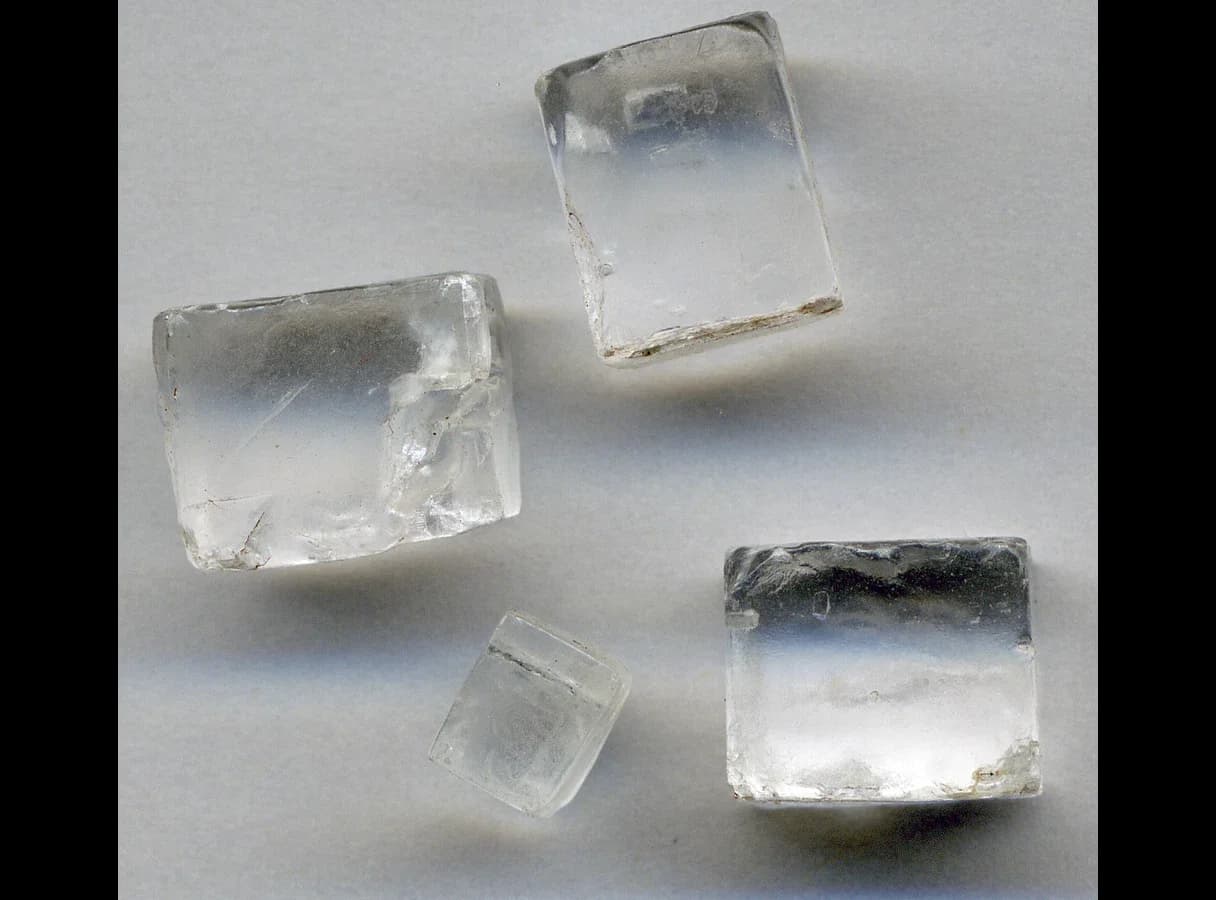
Crystals of halite, the mineral form of sodium chloride. Their flat faces meet at right angles because the ions are arranged in a cubic lattice, and the crystals split cleanly along these planes. Image: James St. John, CC BY 2.0, via Wikimedia Commons.
The regular arrangement of ions on the scale of picometres shows up in the shape of real crystals. Crystals of halite (rock salt) have flat faces at right angles, and when a crystal is struck it splits cleanly along planes of ions to give smaller cubes and rectangular blocks.
Empirical formulas and formula units
Because a crystal contains an enormous and variable number of ions, there is no molecule to describe. The formula of an ionic compound is an empirical formula: it gives only the simplest ratio of the ions in the lattice. NaCl means that sodium and chloride ions are present in a 1:1 ratio; CaFX2 means that there are two fluoride ions for every calcium ion.
The ionic model represents ions as hard, charged spheres held together only by electrostatic attraction. It explains the properties of compounds such as sodium chloride and magnesium oxide very well. Like every model it has limits. When a small, highly charged cation meets a large anion, the cation distorts the anion's electron cloud and the bond gains some covalent character, so compounds such as aluminium chloride or the silver halides do not behave as the simple ionic model predicts. Ionic and covalent bonding are better seen as two ends of a continuum, an idea developed with the bonding triangle in the study of materials.
Lattice enthalpy: the strength of ionic bonding
To compare the strength of ionic bonding in different compounds, chemists use the energy needed to break the lattice completely into separate gaseous ions.
Separating ions that attract each other always needs energy, so the process is endothermic and every lattice enthalpy defined this way is positive. The larger the lattice enthalpy, the stronger the ionic bonding in the solid. The same amount of energy is released when the gaseous ions come together to form the lattice. For a compound with ions of different charges the equation contains the right number of each ion: for calcium fluoride, CaFX2(s)CaX2+(g)+2FX−(g), and for aluminium oxide, AlX2OX3(s)2AlX3+(g)+3OX2−(g).
Lattice enthalpies cannot be measured directly, because no experiment turns a crystal straight into a gas of separate ions. The data booklet values are experimental values obtained indirectly from energy cycles (Born–Haber cycles, an HL topic) built from measurable quantities such as ionization energies and enthalpies of formation.
Factors that affect lattice enthalpy
The force between two charges is proportional to the product of the charges and inversely proportional to the square of the distance between their centres (Coulomb's law). Two properties of the ions therefore control the lattice enthalpy:
Ionic charge. Higher charges attract more strongly. Doubling both charges, from 1+/1− to 2+/2−, multiplies the product of the charges by four.
Ionic radius. Smaller ions can approach more closely, so the distance between the centres of neighbouring ions is shorter and the attraction is stronger.
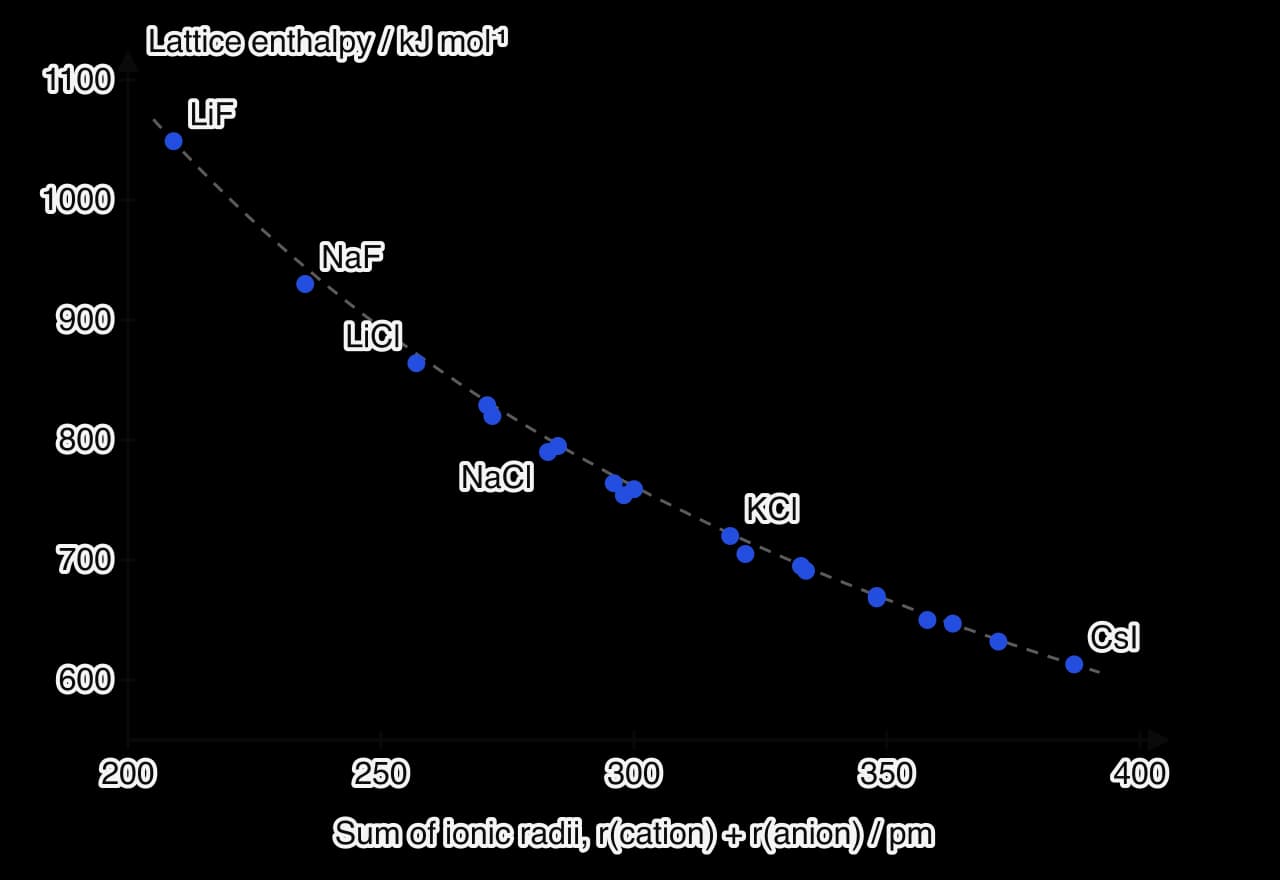
In short, small ions with high charges give the largest lattice enthalpies. The effect of size alone is clear among the alkali metal halides, which all contain 1+ and 1− ions: the lattice enthalpy falls steadily as the sum of the two ionic radii increases.
For the alkali metal halides (all 1+/1− compounds) the lattice enthalpy falls steadily as the ions get bigger and their centres further apart. The dashed curve is a guide to the eye. Data: IB Chemistry data booklet (2025), sections 10 and 16.
The effect of charge is even larger. The lattice enthalpies of compounds containing 2+ and 2− ions are about four times those of comparable 1+/1− compounds.
Compound
Ions
Product of charges
ΔHlattice⊖ / kJ mol−1
NaCl
NaX+ (102 pm), ClX− (181 pm)
1
790
NaF
NaX+ (102 pm), FX−
CaClX2
CaX2+
MgClX2
MgX2+
CaFX2
CaX2+
BaO
BaX2+ (135 pm), OX2−
CaO
CaX2+ (100 pm), OX2−
MgO
MgX2+ (72 pm), OX2−
Data: IB Chemistry data booklet (2025), sections 10 and 16.
Down group 2, the oxides show the size effect at constant charge: MgO>CaO>SrO>BaO (3791, 3401, 3223 and 3054 kJ mol−1). Compounds such as CaClX2 have a further reason for a larger value than NaCl: one mole of CaClX2 separates into three moles of ions, not two, so more attractions are broken per formula unit.
Experimental lattice enthalpies agree closely with values calculated from the simple ionic model for compounds such as the alkali metal halides. For the silver halides the experimental values are noticeably larger than the ionic model predicts, which is evidence that the bonding in these compounds has some covalent character. Comparing experiment with a model's prediction is a way of testing where the model works and where it does not.
Physical properties of ionic compounds
The properties of ionic compounds follow from their structure: a giant lattice of ions held together by strong, non-directional electrostatic attractions. A typical ionic compound is a hard, brittle, crystalline solid at room temperature, with a high melting point, which conducts electricity when molten or in aqueous solution but not as a solid, and which often dissolves in water but not in non-polar solvents.
Volatility, melting points and boiling points
Volatility is the tendency of a substance to vaporize. Ionic compounds have low volatility and high melting and boiling points. To melt the solid, the ions must gain enough energy to break free of their fixed positions; to boil the liquid, they must be separated completely. In both cases a very large number of strong electrostatic attractions between oppositely charged ions must be overcome throughout the lattice, which needs a great deal of energy.
Compound
Ion charges
ΔHlattice⊖ / kJ mol−1
Melting point / °C
CsI
1+, 1−
613
632
KCl
1+, 1−
720
770
NaCl
1+, 1−
790
801
NaF
1+, 1−
930
993
CaO
2+, 2−
3401
2613
MgO
2+, 2−
3791
2852
Data: lattice enthalpies from the IB Chemistry data booklet (2025); melting points from Wikipedia compound data pages (accessed 2026).
Melting points rise broadly with lattice enthalpy, and the compounds of 2+ and 2− ions melt at far higher temperatures than those of 1+ and 1− ions. The correlation is not exact (lithium fluoride, with the largest lattice enthalpy of the alkali halides, melts at 845 °C, below sodium fluoride), because melting only loosens the lattice and the ions in the liquid still attract each other strongly. Magnesium oxide is so difficult to melt that it is used as a refractory material: bricks of magnesium oxide line furnaces and kilns that operate at temperatures where most other materials would soften.
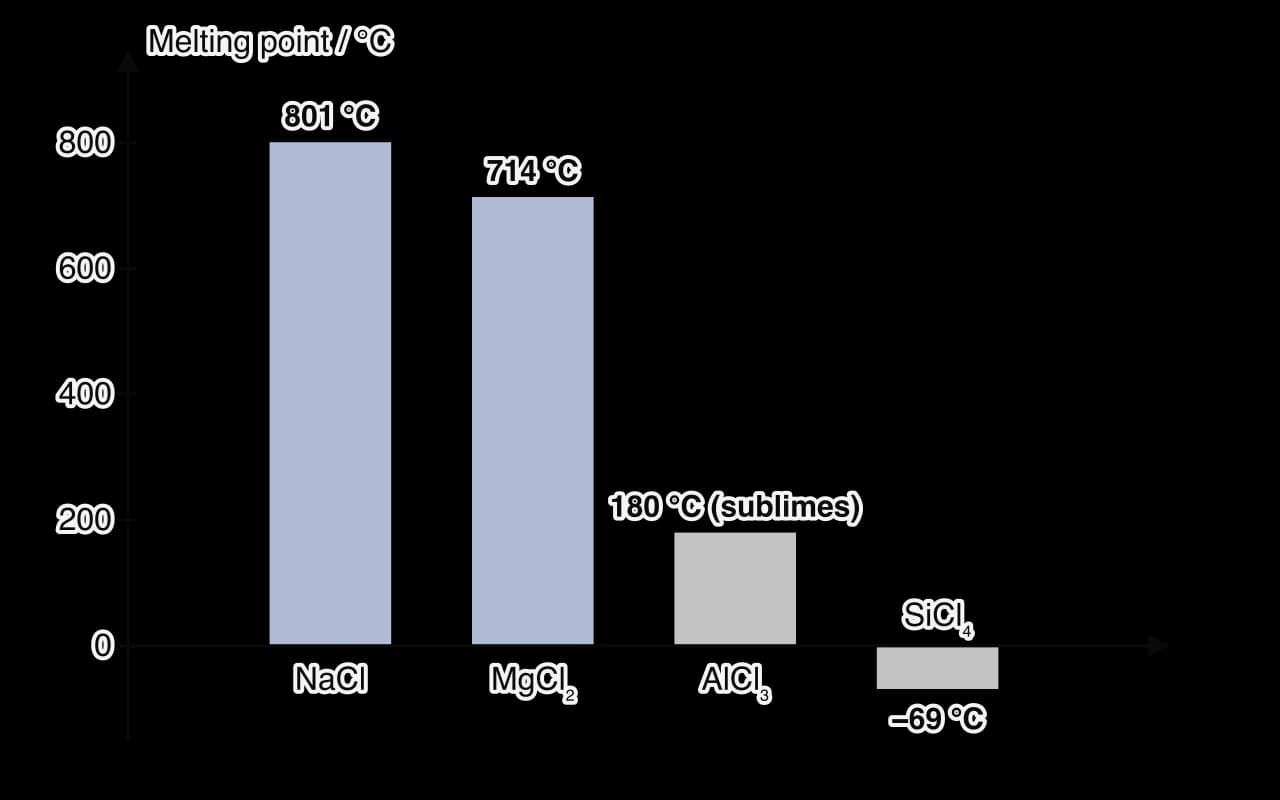
The melting points of the chlorides of the period 3 elements show where the ionic model stops applying. Sodium chloride and magnesium chloride are ionic and melt at several hundred degrees Celsius. Magnesium chloride melts slightly lower than sodium chloride even though its lattice enthalpy is about three times larger (2540 against 790 kJ mol−1), a first sign that the small, doubly charged MgX2+ ion distorts the chloride ions and gives the bonding some covalent character. Moving across the period, the electronegativity of the element rises and the difference from chlorine shrinks, so the bonding gains more and more covalent character. Aluminium chloride turns into AlX2ClX6 molecules when it sublimes at about 180 °C, and silicon tetrachloride is a simple molecular substance whose molecules are held together only by weak intermolecular forces.
Melting points of the chlorides of period 3. NaCl and MgCl₂ (blue) have giant ionic lattices. In aluminium chloride and silicon tetrachloride (grey) the electronegativity difference is too small for ionic bonding, and the bonding is largely covalent. Data: melting points from Wikipedia compound data pages (accessed 2026).
Electrical conductivity
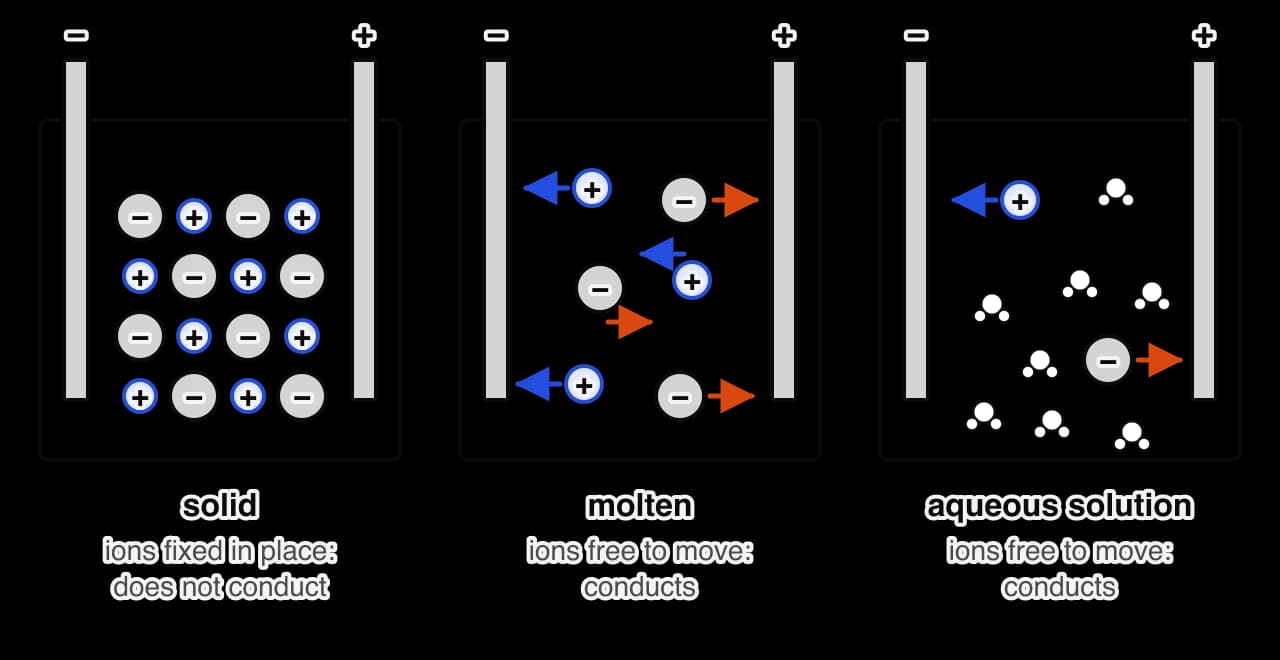
An electric current is a flow of charged particles. In an ionic compound the only charge carriers are the ions, so the compound conducts only when its ions are free to move.
Solid: does not conduct. The ions are held in fixed positions in the lattice and can only vibrate.
Molten (liquid): conducts. The lattice has broken down and the ions can move. When a potential difference is applied, cations move towards the negative electrode and anions towards the positive electrode.
Aqueous solution: conducts, for the same reason, when the compound dissolves. Water separates the ions, which are then free to move.
An ionic compound conducts only when its ions can move. In the melt and in solution, cations drift towards the negative electrode (blue arrows) and anions towards the positive electrode (orange arrows). In the solid the same ions are present but locked in the lattice.
No electrons flow through the ionic compound itself. At the electrodes, cations gain electrons and anions lose electrons, so the compound is decomposed; this process, electrolysis, is how sodium and chlorine are manufactured from molten sodium chloride. A substance that conducts electricity when molten or in solution and is decomposed by the current is an electrolyte. The products of electrolysis are studied with electron transfer reactions.
Solubility
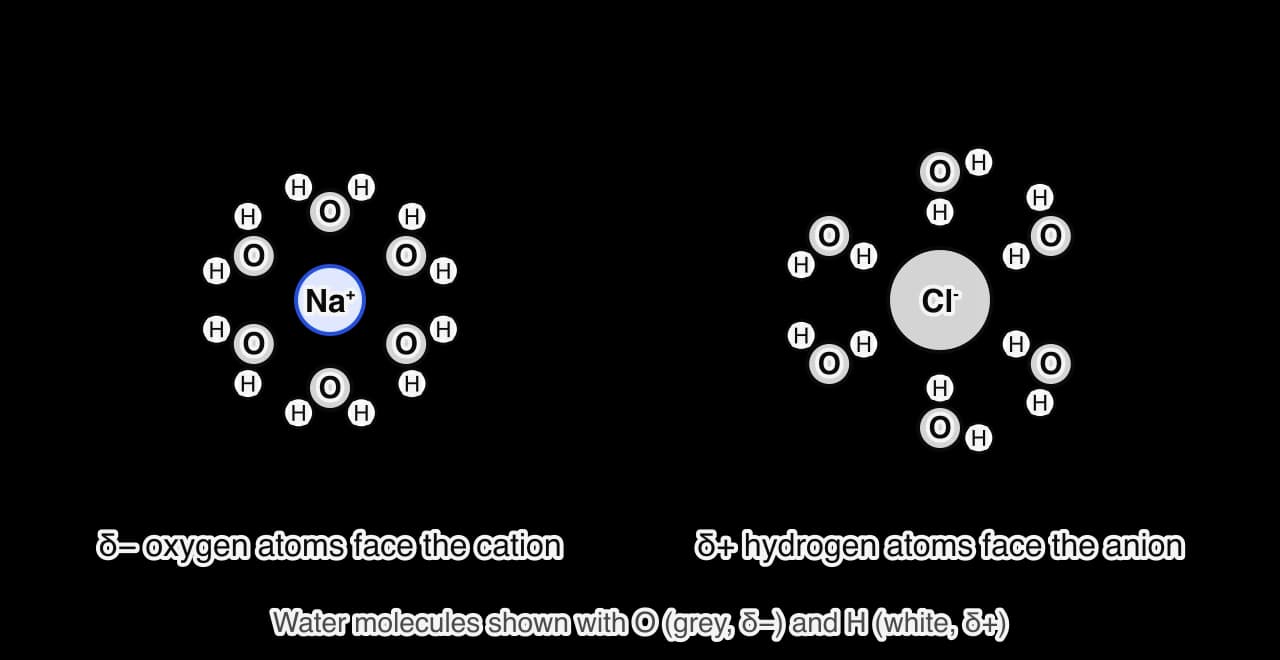
Many ionic compounds dissolve in water. Water is a polar solvent: its O–H bonds are polar, so each water molecule has a partially negative oxygen atom (δ−) and partially positive hydrogen atoms (δ+). At the surface of a crystal, water molecules are attracted to the ions. The δ− oxygen atoms are attracted to the cations and the δ+ hydrogen atoms to the anions. Water molecules surround each ion as it leaves the lattice, forming hydrated ions.
Hydrated ions. Water molecules are polar, so they turn their partially negative oxygen atoms towards a cation and a partially positive hydrogen atom towards an anion. The attractions released as the ions are hydrated help to pull them out of the lattice.
Dissolving requires energy to separate the ions from the lattice; energy is released as the ions become hydrated. A compound dissolves readily when the attractions between the ions and water molecules are strong enough to compensate for the attractions between the ions in the lattice. This is why solubility varies widely. Sodium chloride dissolves to about 36 g per 100 g of water at 25 °C, while compounds with very strong lattices, such as calcium carbonate and silver chloride, are practically insoluble. Solubility cannot be predicted from lattice enthalpy alone, because the energy of hydration changes too.
Ionic compounds are generally insoluble in non-polar solvents such as hexane. Hexane molecules have no partial charges, so they cannot form strong attractions to ions and cannot compensate for the energy needed to break up the lattice.
Brittleness
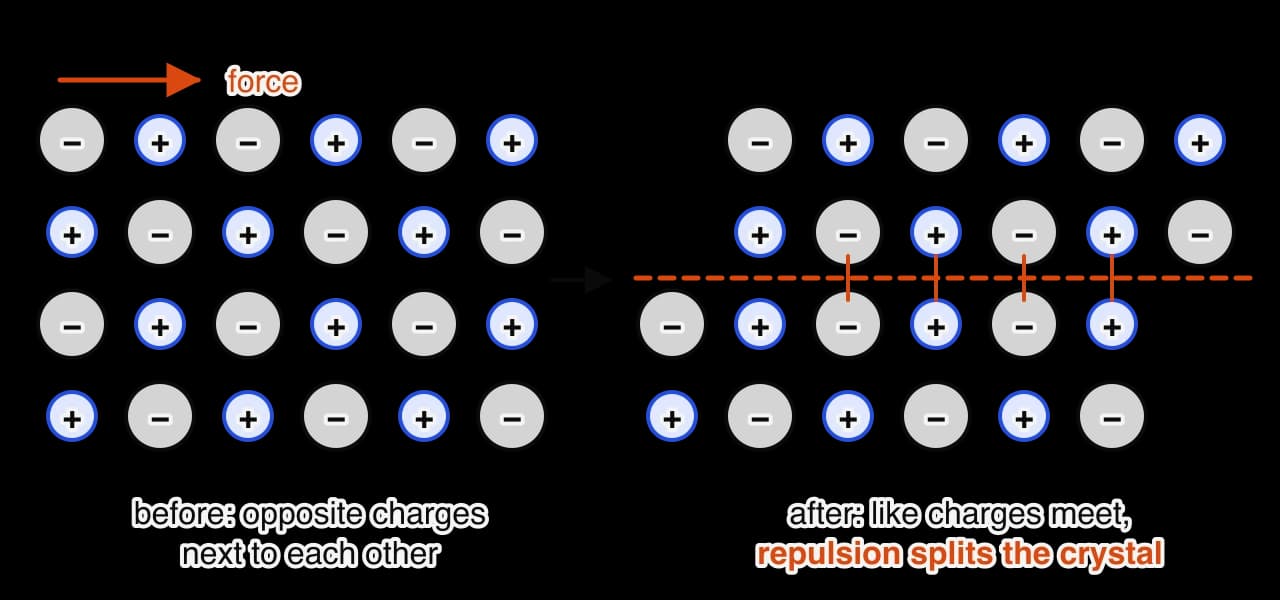
Ionic crystals are hard, because the ions are strongly bound in place, but they are brittle: they shatter rather than bend when struck. A force that moves one layer of ions past another by even one ion position brings ions of the same charge side by side. These ions repel each other strongly, and the crystal splits along that plane.
Why ionic solids are brittle. A force that moves one layer of ions by one position puts ions of the same charge next to each other. They repel, and the crystal cleaves along that plane instead of bending.
Metals behave differently. Their layers of ions can slide without bringing like charges together, so metals bend instead of breaking; the metallic model explains this malleability.
Investigating the properties of ionic compounds
The properties of ionic compounds can be demonstrated with simple laboratory tests, and the same tests help to classify an unknown solid.
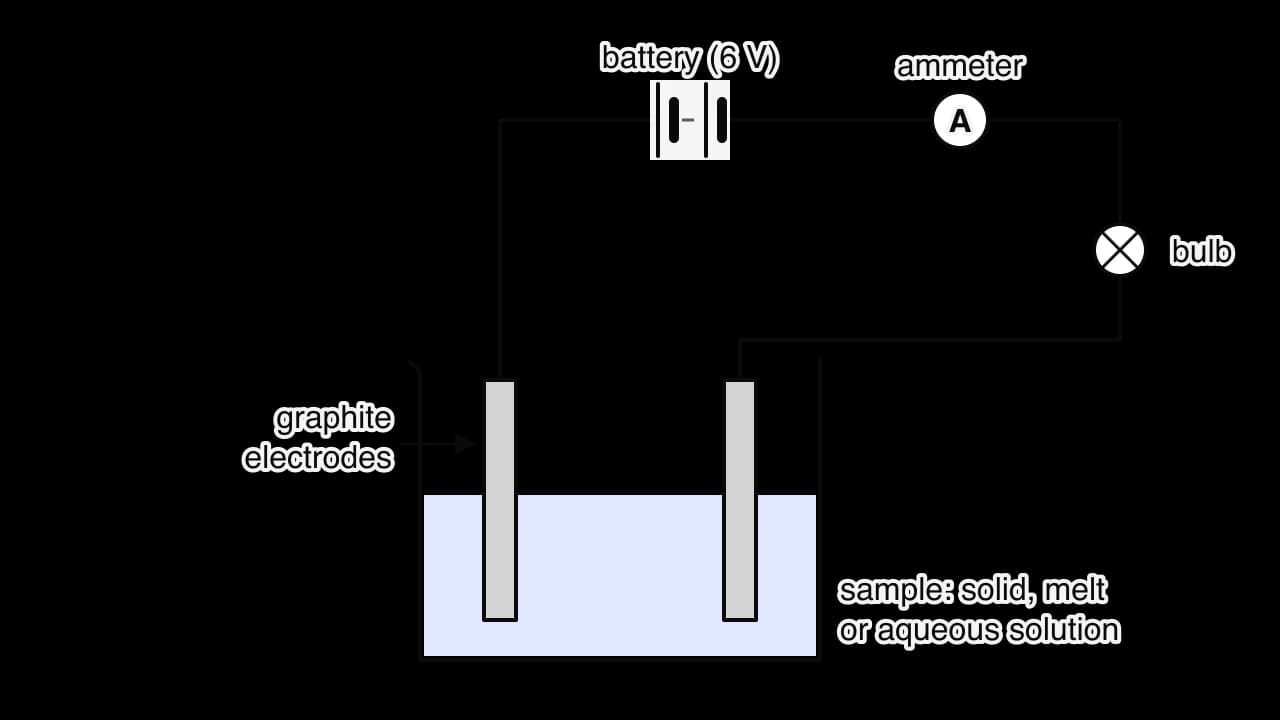
Conductivity. Two graphite electrodes connected in series with a power supply and an ammeter or bulb are placed in the sample. The solid, the melt and an aqueous solution are tested in turn. Deionized water and a sugar solution make useful controls: neither conducts significantly, which shows that the current in a salt solution is carried by the dissolved ions.
Melting point. A small sample in a capillary tube is heated in a melting-point apparatus. Melting-point apparatus is designed mainly for molecular solids, and ionic compounds such as sodium chloride (801 °C) do not melt in it at all, which is itself evidence of a very high melting point.
Solubility. Equal small masses of the solid are shaken with equal volumes of water and of a non-polar solvent such as hexane, and the amount that dissolves is compared.
Testing electrical conductivity. A reading on the ammeter (or a glowing bulb) shows that charge flows through the sample between the electrodes. A melt is heated in a crucible instead of a beaker.
A melt is usually tested with a salt of relatively low melting point, such as zinc chloride (melting point 290 °C), heated strongly in a crucible in a fume cupboard. Molten salts are extremely hot and can spit, and electrolysis of a molten chloride releases toxic chlorine, so eye protection and good ventilation are essential.
A student tests three white solids, X, Y and Z, and records the results in a table.
Test
X
Y
Z
Melting point
above 300 °C (did not melt in the apparatus)
80 °C
above 300 °C (did not melt in the apparatus)
Conductivity of the solid
none
none
none
Solubility in water
dissolves
insoluble
insoluble
Conductivity of the mixture with water
conducts
none
none
Solubility in hexane
insoluble
dissolves
insoluble
Applying the ideas in exam questions
Paper 1A: the formula of a compound with a polyatomic ion
Paper 1A: comparing lattice enthalpies
Paper 1A: the radius of isoelectronic ions
Paper 1B: classifying solids from experimental data
(Paper 1B style) A student investigates four solids, P, Q, R and S. The melting point of each was measured three times with a digital thermometer (±0.1 °C); solids that did not melt below 350 °C are recorded as ">350". The student also tested the electrical conductivity of each solid and of its melt, and its solubility in water.
Solid
Melting point, trial 1 / °C ±0.1
Trial 2 / °C ±0.1
Trial 3 / °C ±0.1
Solid conducts?
Melt conducts?
Soluble in water?
P
>350
>350
>350
no
yes
yes
Q
113.8
114.3
114.1
no
no
no
R
>350
>350
>350
yes
yes
no
S
290.6
289.5
290.2
no
yes
yes
Paper 2: lithium nitride
Paper 2: compounds of polyatomic ions
Self-check
To do:
I can explain why metal atoms form cations and non-metal atoms form anions.
To do:
I can predict the charge of an ion from the electron configuration of the atom or from its group.
To do:
I can write the electron configurations of ions, including transition element ions such as Fe²⁺ and Fe³⁺ (4s electrons lost first).
To do:
I can compare the radius of an ion with that of its atom, and order the radii of isoelectronic ions by nuclear charge.
To do:
I can define an ionic bond and describe its formation by electron transfer followed by electrostatic attraction.
To do:
I can draw Lewis formulas of ionic compounds with brackets and charges.
To do:
I can explain why the formation of an ionic compound from its elements is a redox reaction.
To do:
I can deduce the formula of an ionic compound from its ions, using brackets for polyatomic ions.
To do:
I can recall the names, formulas and charges of ammonium, hydroxide, nitrate, hydrogencarbonate, carbonate, sulfate and phosphate.
To do:
I can name ionic compounds and convert between names and formulas, using Roman numerals for variable charges.
To do:
I can identify compounds that contain both ionic and covalent bonds.
To do:
I can describe an ionic lattice and explain why ionic compounds are represented by empirical formulas.
To do:
I can define lattice enthalpy, write its equation with state symbols, and explain how ionic charge and radius affect it.
To do:
I can explain the volatility, electrical conductivity, solubility and brittleness of ionic compounds.
To do:
I can use experimental data to decide whether a solid is ionic.
C
X2+
D
X6+
Explanation
X has six valence electrons (3s2 3p4), so it is a non-metal in group 16 (sulfur). It gains two electrons to reach the configuration of argon, forming X2−.
B assumes one electron is gained (group 17). C confuses non-metals with metals, which lose electrons. D would require the loss of all six valence electrons, which does not happen in simple ionic compounds.
The answer is A.
Question 2 · CHEM-000491 mark
Element X is in group 2 and element Y is in group 15 of the periodic table.
What is the formula of the ionic compound formed between X and Y?
 YouTube
 YouTube