Notes on S1.4 Counting particles by mass: the mole
Atoms and molecules are far too small to count one by one: a single drop of water contains more than molecules. Chemists therefore count particles by weighing them, using a unit called the mole. Every calculation of how much of a substance reacts, how much product forms or how concentrated a solution is depends on it.
The mole and the Avogadro constant
Everyday counting units group large numbers of small items: a dozen eggs is 12 eggs, and a ream of paper is 500 sheets. The chemist’s counting unit is the mole, and it is enormous because atoms are so small. The amount of substance, symbol , is a measure of the number of particles in a sample, and its unit is the mole (symbol mol).
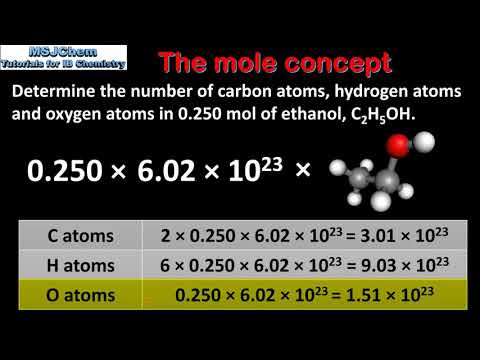
The Avogadro constant is a number of particles per mole, which is why its unit is . It plays the same role as "12 per dozen": multiplying an amount in moles by gives a number of particles, and dividing a number of particles by
Here is the number of particles (a pure number, with no unit) and is the amount in mol. Calculations use the data-booklet value, .
Why the number is so large, and why it is fixed
The value of was originally chosen so that one mole of carbon-12 atoms has a mass of exactly 12 g. That choice links the atomic mass scale to grams: one mole of any substance has a mass in grams equal to its relative formula mass. Since 20 May 2019 the definition has worked the other way round. The Avogadro constant is now fixed at exactly
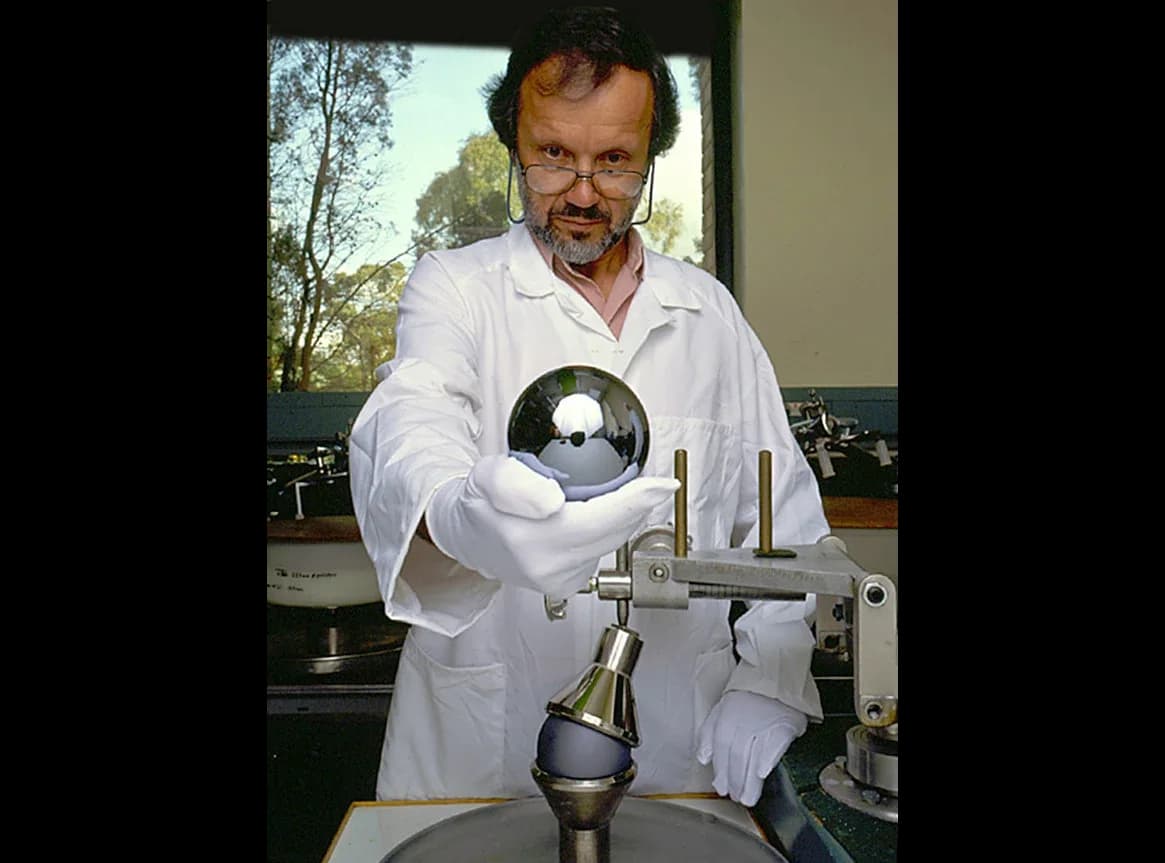
Much of the evidence for the fixed value came from very careful counting. Metrologists made almost perfect spheres of silicon enriched in the isotope silicon-28, each of mass about 1 kg. X-ray measurements gave the spacing of atoms in the crystal, and the volume of the sphere was measured to within a few atomic diameters, so the number of atoms in the sphere could be calculated. One such sphere contains about silicon atoms, or roughly 36 mol.
Naming the particle being counted
"One mole of oxygen" is ambiguous. It could mean one mole of oxygen atoms, , or one mole of oxygen molecules, , which contains two moles of oxygen atoms. The elementary entity must always be stated, preferably with a formula: 1 mol
The same care is needed inside a formula. One mole of water molecules, , contains 2 mol of hydrogen atoms, 1 mol of oxygen atoms and 3 mol of atoms in total. Ionic compounds are not made of molecules, so their particles are counted as formula units: one mole of sodium sulfate,
Sample | Particles in the formula | Amount of each particle in 1 mol of the substance |
|---|---|---|
1 mol | 1 molecule = 1 C atom + 2 O atoms | 1 mol |
 YouTube
Relative atomic mass and relative formula mass
The mass of a single atom is tiny: a carbon-12 atom has a mass of about . Numbers like this are awkward, so chemists compare the masses of atoms on a relative scale. The standard is the carbon-12 atom, which is given a mass of exactly 12 units. Every other atom is compared with one-twelfth of the mass of a carbon-12 atom.
The carbon-12 scale
The relative atomic mass is a weighted mean because most elements are mixtures of isotopes. Chlorine, for example, contains atoms of mass number 35 and 37, and its of 35.45 lies between them, closer to 35 because chlorine-35 is the more common isotope. How the mean is calculated from isotopic masses and abundances belongs to the nuclear atom (Structure 1.2). For calculations, the values printed to two decimal places in the periodic table of the data booklet are used: H 1.01, C 12.01, N 14.01, O 16.00, Na 22.99, Cl 35.45.
Because is a ratio of two masses, the units cancel and it has no units. A sodium atom is, on average, or about 1.9 times as heavy as a carbon atom, whatever unit of mass is used.
Relative atomic mass increases steadily through the periodic table and especially down each group: from lithium (6.94) to caesium (132.91) in group 1, and from fluorine (19.00) to iodine (126.90) in group 17. Several physical properties follow this increase in mass. Densities of the elements generally rise down a group, and the larger halogen molecules, with more electrons, have stronger London (dispersion) forces between them, so their boiling points rise, a trend examined with the periodic table (Structure 3.1).
Relative formula mass
The relative formula mass applies to every kind of substance: molecules (), ionic compounds (, counted per formula unit), polyatomic ions (
Molar mass: from grams to moles
The relative scale becomes useful in the laboratory through the molar mass. One mole of carbon-12 atoms has a mass of 12 g, and every other atom is a fixed multiple of the carbon-12 mass. One mole of any substance therefore has a mass in grams equal to its relative formula mass.
Substance | or (no units) | Molar mass / |
|---|
Moles, mass and molar mass are linked by an equation given in the data booklet:
Here is the amount in mol, the mass in g and the molar mass in . The units confirm the arrangement:
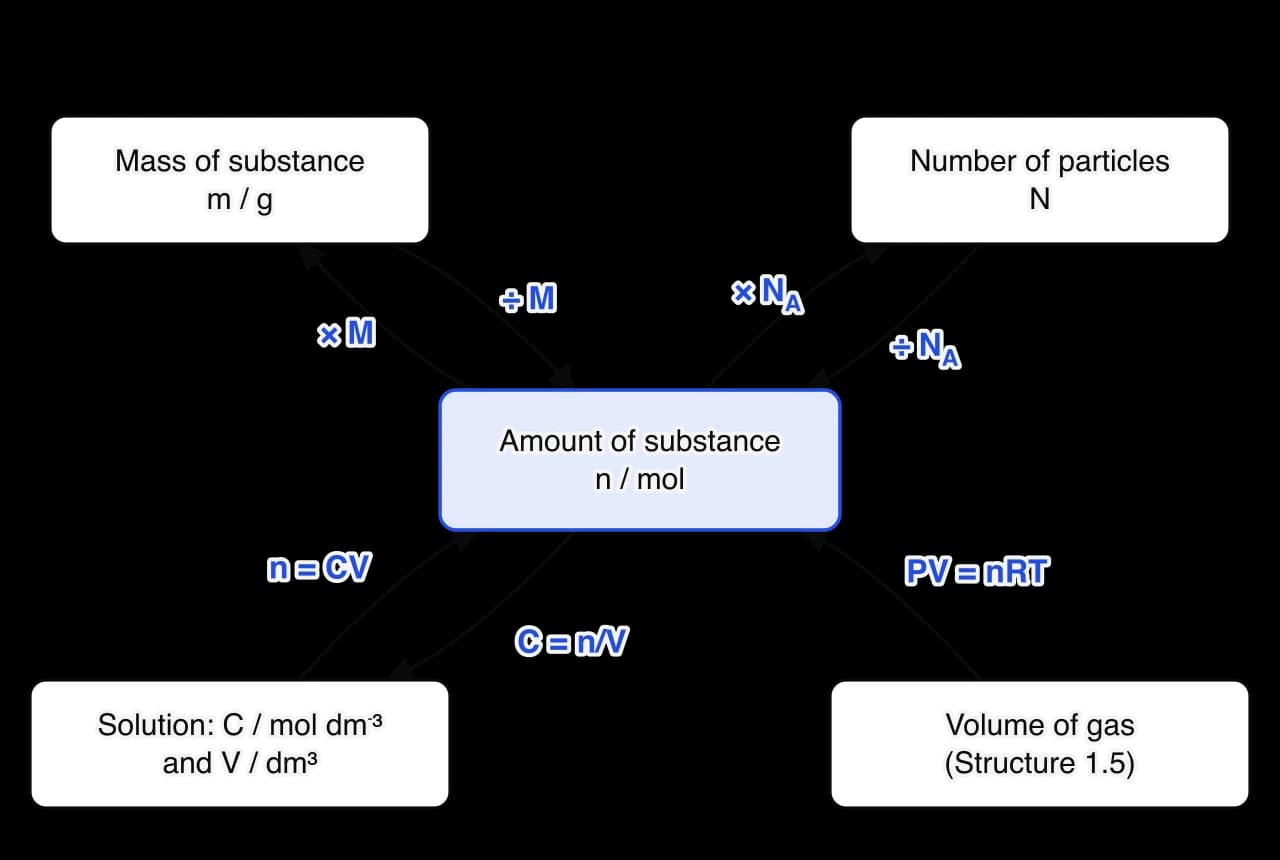
The same equation identifies an unknown substance. If a sample of mass is known to contain moles, its molar mass is . A white solid of which is has
The mass of a single particle
Dividing the molar mass by the Avogadro constant gives the mass of one particle, in grams. One molecule of water has a mass of . The result explains why chemists never weigh individual molecules: even the most sensitive laboratory balance reads to about
Comparing samples
Equal masses of different substances do not contain equal numbers of particles. of methane, (
Empirical and molecular formulas
A chemical formula can carry two different kinds of information. It can give the actual number of atoms of each element in one molecule, or only the ratio in which the atoms are combined.
The molecular formula is always a whole-number multiple of the empirical formula. Ethene has the molecular formula
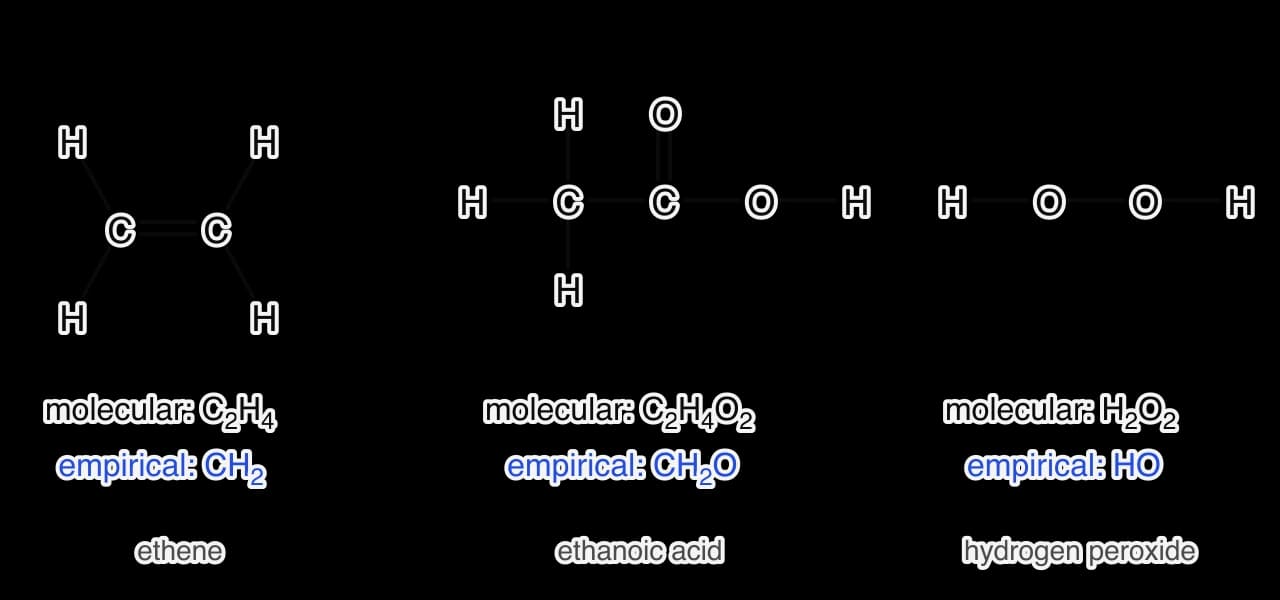
For many compounds the two formulas are the same, because the subscripts have no common factor: water (), methane (
Compound | Molecular formula | Empirical formula | Multiple |
|---|---|---|---|
ethene |
Percentage composition by mass
The percentage composition by mass of a compound gives the mass of each element in 100 g of the compound. It follows directly from the formula:
Finding an empirical formula from percentage composition
The reverse calculation finds the empirical formula from the masses or percentages of the elements, which are what an analysis measures. Taking 100 g of compound turns percentages into masses in grams. The method converts each mass into moles of atoms, because a formula is a ratio of numbers of atoms, not of masses.
Write the mass (or percentage) of each element.
Divide each by the element’s to get the amount of atoms in moles.
Divide every amount by the smallest of them.
If the results are not all close to whole numbers, multiply them all by the same small integer until they are.
Write the formula from the whole-number ratio.
Mole ratios close to 1.5, 1.33 or 1.25 are not errors in rounding: they show that the smallest whole-number ratio needs a multiplier. A ratio of becomes when multiplied by 2; becomes (×3);
Experimental mole ratios are never exact whole numbers. Masses carry measurement uncertainty, a reaction may be slightly incomplete, and a sample may be slightly impure. Deciding that a ratio of means is an approximation, justified because the deviation (about 1.5%) is similar to the uncertainty in the data, and because no simple formula fits better. A ratio of , in contrast, is too far from 2 to round: it means
Empirical formulas from experiments
Magnesium oxide
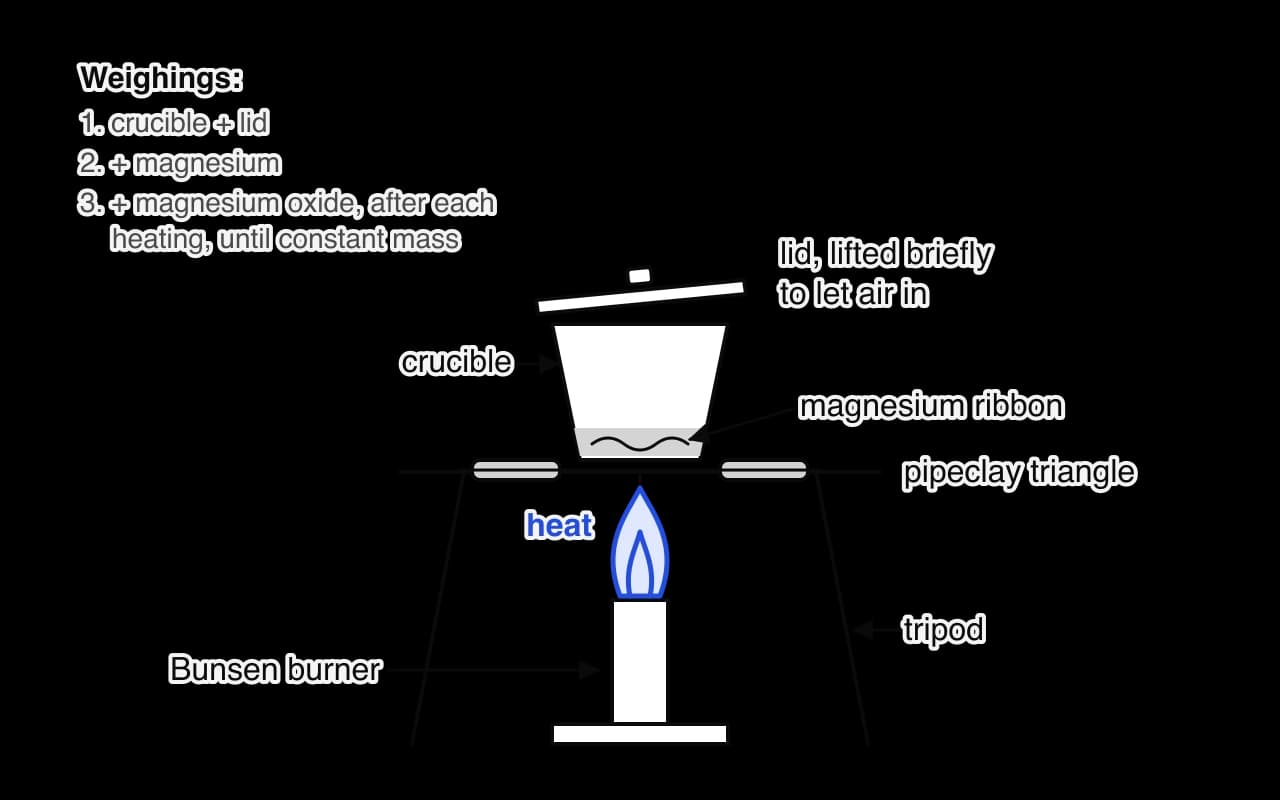
A classic experiment finds the formula of magnesium oxide from the masses of magnesium and oxygen that combine. A coil of clean magnesium ribbon is weighed in a crucible with a lid and heated strongly until it no longer glows. The lid is lifted briefly from time to time to let air in without letting the white magnesium oxide smoke escape. The crucible is cooled and weighed, then heated, cooled and weighed again until two readings agree.
Water of crystallization
Many salts crystallize from water with water molecules built into their crystal lattice, called water of crystallization. Blue copper(II) sulfate crystals are
The number of water molecules, in , is found by weighing a sample before and after heating. Heating stops only when the mass stops changing: heating to constant mass shows that all the water has gone. The graph of mass against number of heatings levels out when this point is reached.
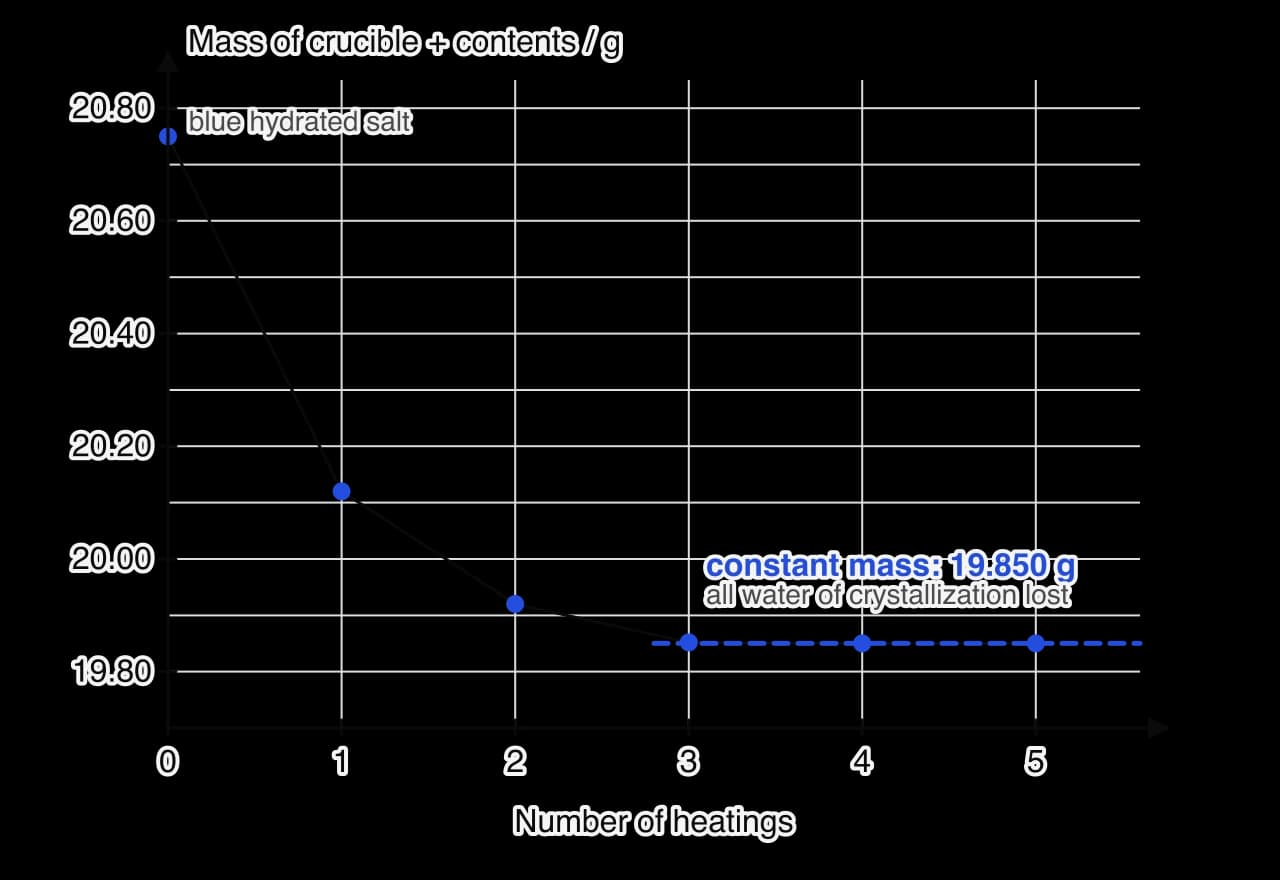
The method assumes that only water is lost. Some salts decompose further if heated too strongly; anhydrous copper(II) sulfate turns black above about 600 °C as it breaks down to copper(II) oxide, which would make too large. Heating gently but repeatedly, and cooling in a desiccator so that the anhydrous salt does not reabsorb water from the air before weighing, keeps the result reliable.
Combustion analysis of organic compounds
The empirical formulas of organic compounds are found by burning a weighed sample completely in excess oxygen. All the carbon ends up in carbon dioxide and all the hydrogen in water. The products are absorbed in weighed tubes, and the gains in mass give the masses of and
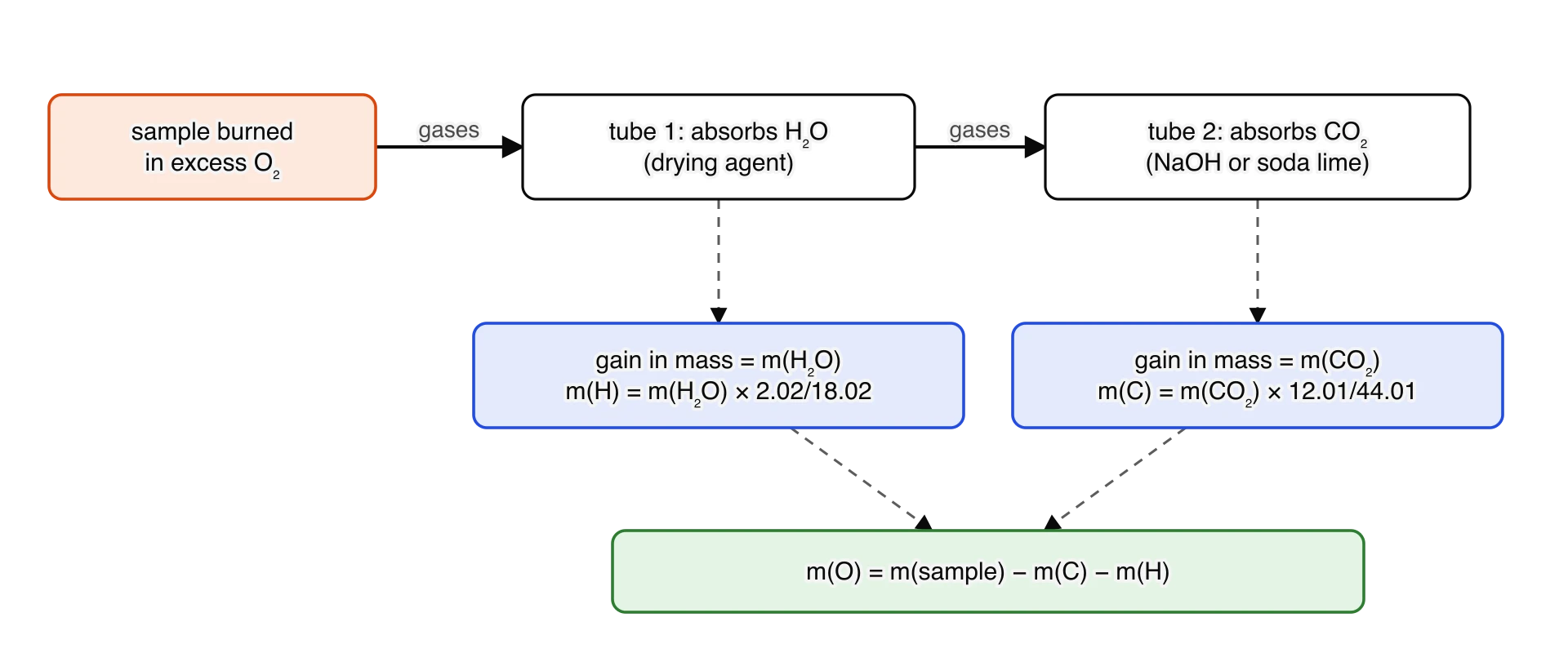
The fraction of each product’s mass that comes from the element of interest is fixed by the formula: carbon makes up of the mass of , and hydrogen makes up of the mass of
 YouTube
Molecular formulas from empirical formulas
An empirical formula alone cannot distinguish ethene () from cyclohexane (
Benzene, for example, has the empirical formula (empirical formula mass ) and a molar mass of . The multiple is , so its molecular formula is
Concentration of solutions
Most reactions in a laboratory, in industry and in living things happen in solution. A solution is a homogeneous mixture of a solute dissolved in a solvent; when the solvent is water, the solution is described as aqueous, (aq). Solutions are measured out by volume rather than by mass, so a way is needed to convert a volume of solution into an amount of solute.
Molar concentration
The relationship, given in the data booklet, is:
with in mol, in and in
The volume in is the volume of the solution, not of the solvent added. Dissolving 1.00 mol of solute in 1.00 dm³ of water gives a solution whose volume is not exactly 1.00 dm³, which is why standard solutions are made up to a fixed final volume in a volumetric flask.
Mass concentration
Concentration can also be stated as a mass concentration, the mass of solute per unit volume of solution, in . Converting between the two uses the molar mass:
Seawater shows why both are useful. Its salinity is about 35 g of dissolved salts per kilogram of seawater, a figure oceanographers use because mass does not change with temperature. Each kilogram contains about 19.4 g of chloride ions and 10.8 g of sodium ions. With a density of about , one cubic decimetre of seawater holds about 19.9 g of chloride, so
Concentrations of ions
An ionic compound that dissolves releases all its ions, so the concentration of each ion depends on the formula. In sodium sulfate,
When two solutions are mixed, the amount of each ion is the sum of the amounts from each solution, and the volume is the total volume of the mixture.
Preparing a standard solution
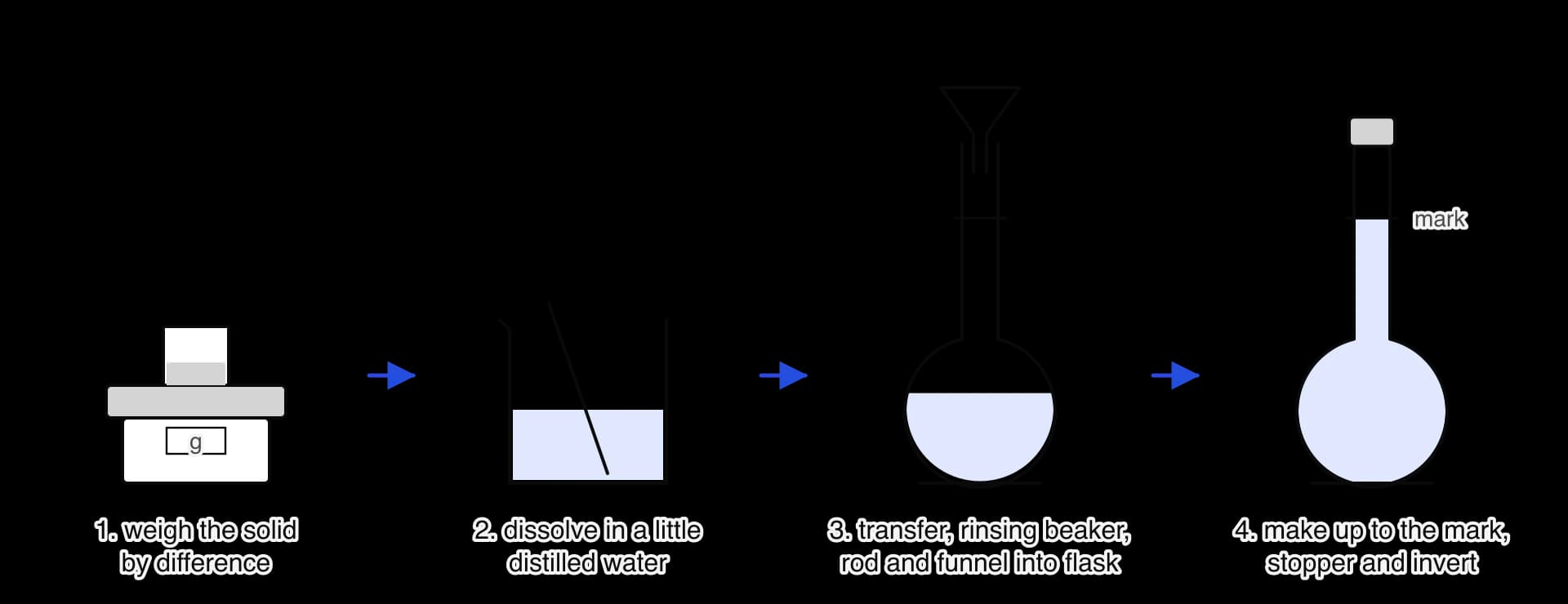
A standard solution is a solution of accurately known concentration. It is made by dissolving an accurately weighed mass of a pure solid and making the solution up to an exact volume in a volumetric flask, a flask with a long narrow neck and a single graduation mark, calibrated to hold one volume (for example ) at a stated temperature.
Calculate the mass of solid needed: .
Weigh the solid accurately by difference: weigh the weighing bottle with the solid, tip the solid into a beaker, and reweigh the bottle. The mass transferred is the difference, so any solid left clinging to the bottle does not cause an error.
Dissolve the solid in a small volume of distilled water in the beaker, stirring with a glass rod.
Pour the solution through a funnel into the volumetric flask. Rinse the beaker, the rod and the funnel several times with distilled water and add every rinsing to the flask, so that all the solute is transferred.
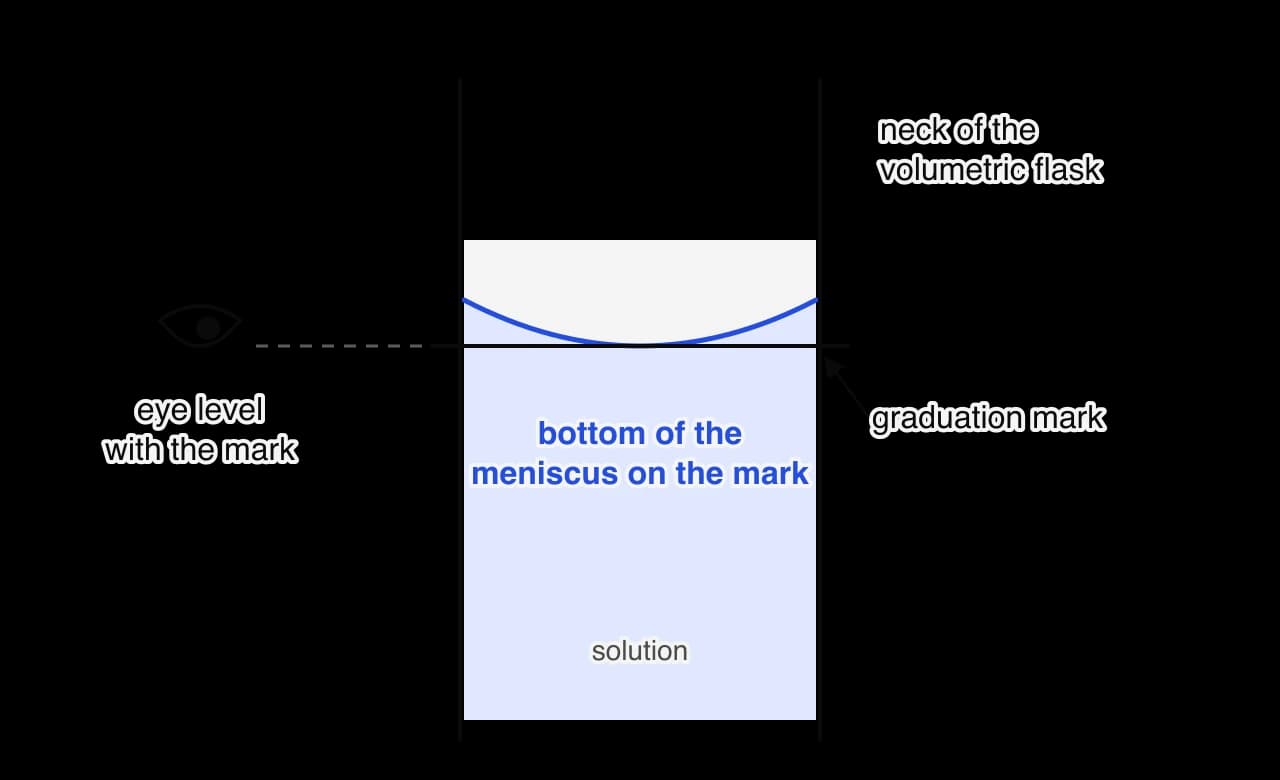
Add distilled water until the level is just below the mark, then add the last drops with a dropping pipette until the bottom of the meniscus sits on the graduation mark, viewed at eye level.
Stopper the flask and invert it several times, so that the concentration is the same throughout.
Water forms a curved surface, the meniscus, in a narrow tube. The volume is read at the bottom of the curve, with the eye level with the mark. Looking from above or below makes the liquid appear at a different height on the scale, a parallax error.
Choosing glassware
The precision of a concentration can be no better than the precision of the glassware used to measure volumes. Volumetric glassware (volumetric flasks, volumetric pipettes and burettes) is made and calibrated to deliver or contain one volume very precisely. Beakers, conical flasks and measuring cylinders are much less precise and are used only where the volume does not need to be known accurately, such as the water used to dissolve the solid before it goes into the flask.
Glassware | Typical use | Typical uncertainty | Percentage uncertainty |
|---|---|---|---|
volumetric flask, | making up a standard solution | ±0.1% | |
volumetric pipette, |
Flask, pipette and measuring cylinder: manufacturers’ tolerances for class B glassware (ISO 1042, ISO 648, ISO 4788); class A items are about twice as precise, and each item is marked with its own tolerance. Burette: a reading uncertainty of half the smallest division (0.1 cm³). A titre is the difference of two readings, so its uncertainty is twice the reading uncertainty.
Dilution
Dilution means adding solvent to a solution. The amount of solute does not change, only the volume it is spread through, so the concentration falls. Because before and after:
where and are the concentration and volume of the solution taken, and
A very dilute solution cannot be made accurately in one step: weighing a few milligrams of solid, or measuring of a solution, carries a large percentage uncertainty. A serial dilution solves this by diluting in stages by the same factor each time, so every transfer uses a volume large enough to measure precisely.
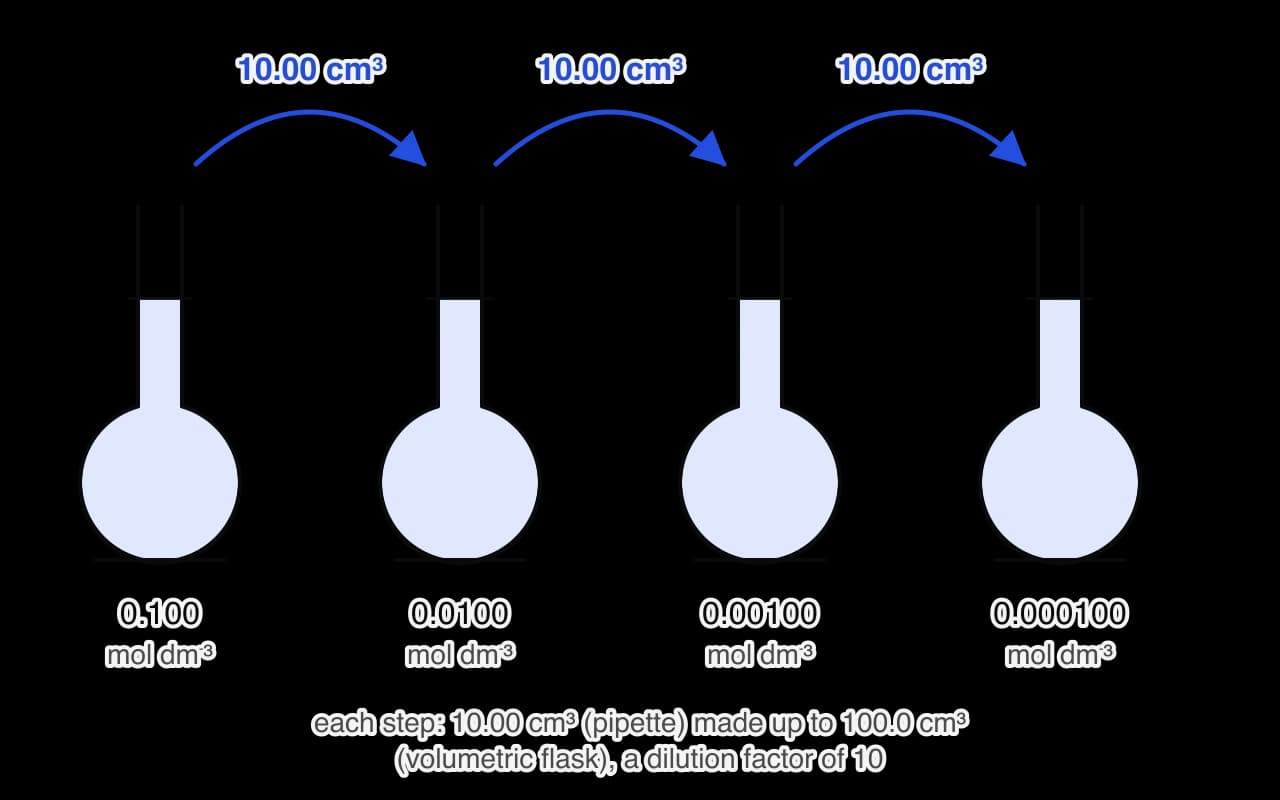
Serial dilutions produce the set of solutions of known concentration needed for a calibration curve, and the very dilute standards used to test drinking water for trace metals.
Calibration curves
The concentration of a coloured solution can be measured with a colorimeter or spectrophotometer, which shines light of one wavelength through the solution and measures its absorbance. The more concentrated the solution, the more light it absorbs. A calibration curve is made by measuring the absorbance of a series of standard solutions, prepared by dilution, and plotting absorbance against concentration. The absorbance of the unknown is then measured under exactly the same conditions, and its concentration is read from the line.
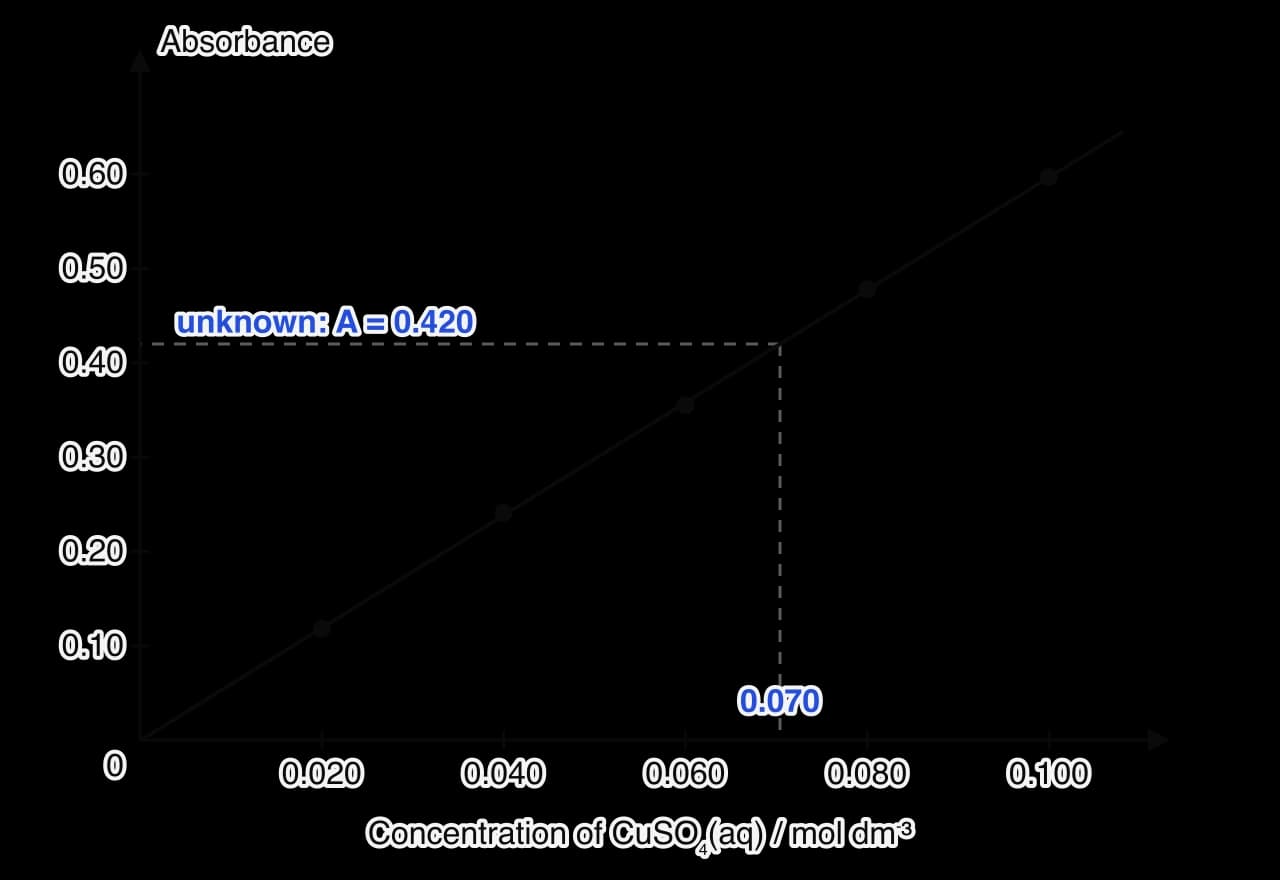
Reading a value between the plotted standards is interpolation, and it is reliable because the line has been tested over that range. An absorbance higher than that of the most concentrated standard would require extrapolation, which assumes the straight-line relationship continues; the unknown should instead be diluted by a known factor and measured again. A blank of the solvent alone is used to set the absorbance to zero before each set of readings, so that the cuvette and solvent do not add to the measured absorbance.
Avogadro’s law and the volumes of reacting gases
Gases behave in a much simpler way than solids and liquids. In a gas the particles are far apart, and their own size is tiny compared with the space between them. The volume of a gas sample therefore depends on the number of particles, the temperature and the pressure, but hardly at all on which gas it is.
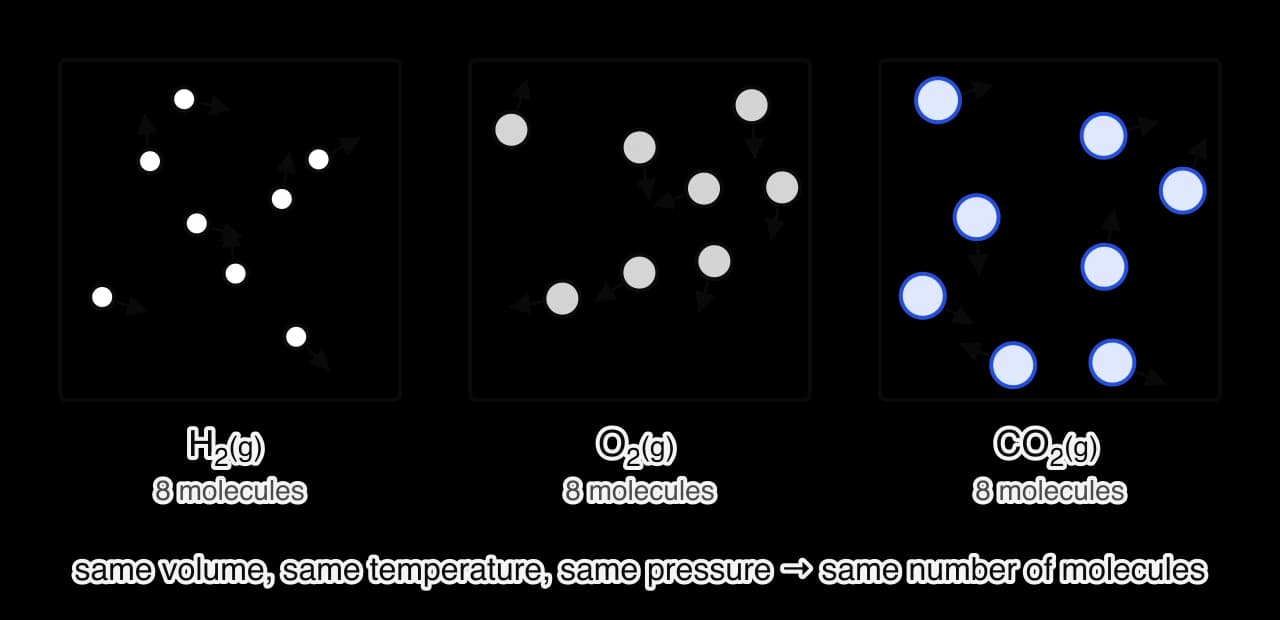
Avogadro’s law applies to any gas, including mixtures such as air, and to monatomic gases such as argon (where the particles are atoms). One consequence is that a mole of any gas occupies the same volume at a given temperature and pressure, the molar volume (Structure 1.5). Another is that, for gases at the same temperature and pressure:
The law describes what is observed without explaining why. The explanation comes from the kinetic model of an ideal gas, whose particles have negligible volume and do not attract one another. Real gases follow the law closely at room temperature and pressure but deviate at high pressure and low temperature, when the particles are close together; the ideal gas model (Structure 1.5) describes when and why.
Where the idea came from
In 1808 Joseph Gay-Lussac found that gases react in simple whole-number ratios by volume: two volumes of hydrogen with one of oxygen, for example. Amedeo Avogadro explained this in 1811 by proposing that equal volumes of gases hold equal numbers of particles, and that the particles of elements such as hydrogen and oxygen are molecules made of two atoms. His hypothesis was largely ignored until Stanislao Cannizzaro used it in 1860 to establish a consistent set of atomic masses.
Reacting volumes
Because volume is proportional to amount, the coefficients in a balanced equation give the ratio of the volumes of gaseous reactants and products, provided all are measured at the same temperature and pressure. For the reaction of hydrogen with oxygen above 100 °C, two volumes of hydrogen react with one volume of oxygen to give two volumes of steam.
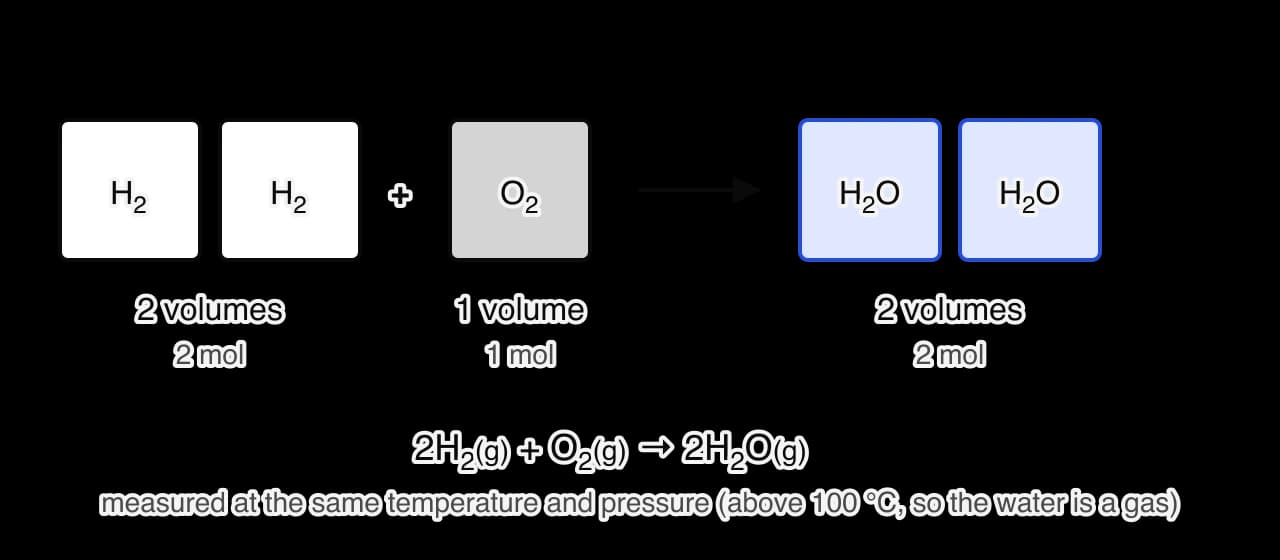
No molar volume and no conversion to moles is needed: the volumes can be used directly in the ratio from the equation. Two points need care. Only gases count, so solids and liquids take no part in the volume ratio. Liquid water produced at room temperature has a negligible volume compared with the gases.
Measurements of gas volumes before and after combustion can identify an unknown gaseous hydrocarbon. The volume of carbon dioxide is found by absorbing it in sodium hydroxide solution, and the volume of oxygen used from the volume left over.
Avogadro’s law also predicts how the volume or pressure of a gas mixture changes during a reaction. In the synthesis of ammonia,
Applying the ideas in exam questions
Paper 1A: counting atoms in a hydrate
Paper 1A: empirical formula of a hydrocarbon
Paper 1A: concentration of an ion
Paper 1B: water of crystallization in barium chloride
A student heated samples of hydrated barium chloride,
Trial | Mass of hydrated salt / g | Mass of anhydrous residue / g |
|---|---|---|
1 | 2.443 | 2.084 |
2 | 2.512 | 2.143 |
3 | 2.398 | 2.046 |
Paper 2: lactic acid
Paper 2: burning butane
Self-check
- To do:
I can define the mole and the Avogadro constant, and state the units of the Avogadro constant.
- To do:
I can convert between amount in moles and number of particles, naming the particle being counted.
- To do:
I can count the atoms or ions of each kind in a formula, including brackets and hydrates.
- To do:
I can define relative atomic mass and relative formula mass, and explain why they have no units.
- To do:
I can calculate relative formula masses from data-booklet values, including for ionic compounds and hydrates.
- To do:
I can use n = m/M in every arrangement and find the mass of one particle.
- To do:
I can chain conversions between mass, amount and number of particles, and compare different samples.
- To do:
I can distinguish empirical and molecular formulas and say which formulas are already empirical.
- To do:
I can calculate percentage composition by mass from a formula.
- To do:
I can determine an empirical formula from percentage composition, from experimental masses and from combustion data.
- To do:
I can determine the number of molecules of water of crystallization in a hydrated salt from heating data.
- To do:
I can determine a molecular formula from an empirical formula and a molar mass.