S1 Models of the particulate nature of matter
Structure 1: the particle model of matter, the nuclear atom, electron configurations, the mole and ideal gases, and exactly what HL adds to each subtopic.
- IB Chemistry
- SL and HL
5 subtopics in Models of the particulate nature of matter
Each one has its own page once something is published for it.
- S1.1Introduction to the particulate nature of matter90 questions · notes · 60 quick fire
- S1.2The nuclear atom83 questions · notes · 57 quick fire
- S1.3Electron configurations146 questions · notes · 81 quick fire
- S1.4Counting particles by mass: the mole175 questions · notes · 71 quick fire
- S1.5Ideal gases124 questions · notes · 56 quick fire
Key terms introduced here
Each is in the Chemistry glossary, with every other term in the subject.
- successive ionization energy
The energy needed to remove each further mole of electrons, one at a time, from one mole of gaseous ions, for example for the third.
An overview of S1 Models of the particulate nature of matter
Structure 1 sets up the particle model of matter that every other part of chemistry uses. It describes what matter is made of, how an atom is built from a nucleus and electrons, how those electrons are arranged, and how chemists count particles far too small to see by weighing them in moles.
How the subtopics fit together
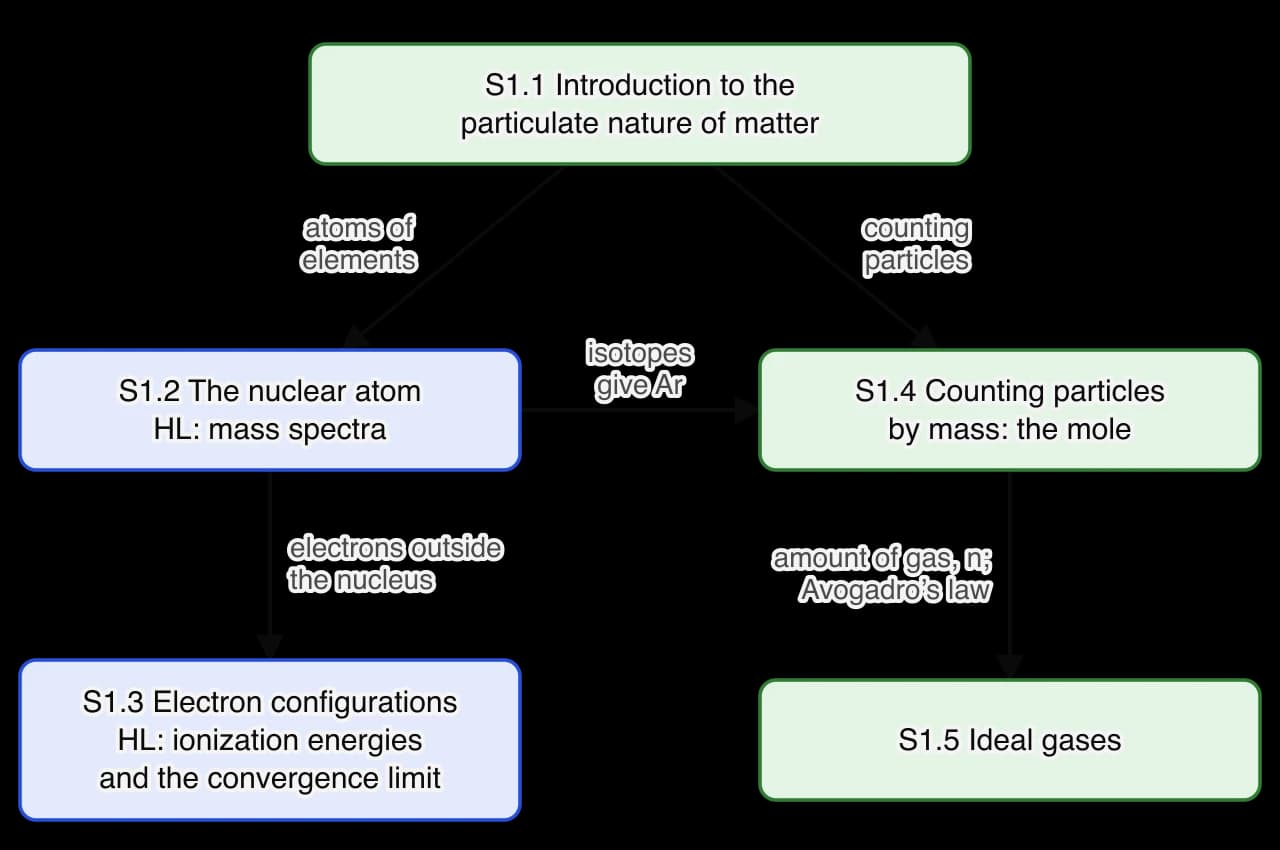
S1.1 Introduction to the particulate nature of matter. Elements, compounds and mixtures, and the physical methods that separate mixtures. The kinetic molecular theory explains the properties of solids, liquids and gases and the changes of state between them. Temperature in kelvin is a measure of the average kinetic energy of the particles.
S1.2 The nuclear atom. The atom as a small, dense, positive nucleus of protons and neutrons with electrons in the space around it. The nuclear symbol gives the numbers of each particle in atoms and ions. Isotopes of an element differ only in their number of neutrons, which is why most relative atomic masses are not whole numbers.
S1.3 Electron configurations. The line emission spectrum of hydrogen is evidence that electrons occupy discrete energy levels. Main energy levels hold up to electrons and divide into s, p, d and f sublevels made of orbitals. The Aufbau principle, Hund's rule and the Pauli exclusion principle give the electron configurations of atoms and ions up to krypton ().
S1.4 Counting particles by mass: the mole. The mole and the Avogadro constant link the number of particles to a mass that can be weighed. Relative atomic and formula masses, molar mass, empirical and molecular formulas, molar concentration of solutions and Avogadro's law for gases are the tools of every chemical calculation.
S1.5 Ideal gases. The ideal gas model and its assumptions, why real gases deviate from it at low temperature and high pressure, the molar volume of a gas, and the relationships between pressure, volume, temperature and amount in and the combined gas law.
Big ideas across the topic
Models and their limitations. Each subtopic is built around a model (particles in motion, the nuclear atom, energy levels and orbitals, the ideal gas) that explains a set of observations and fails beyond them. The ideal gas model ignores the volume of the particles and the forces between them, so it breaks down when gases are compressed or cooled; the intermolecular forces of the covalent model (S2.2) explain why some gases deviate from ideal behaviour more than others.
Electrons determine chemical behaviour. The number of protons fixes the element, but the arrangement of its electrons determines how it reacts. Electron configurations explain the layout of the periodic table, where the period number is the highest occupied main energy level and the blocks match the s, p, d and f sublevels (S3.1). They also give the charges of ions (S2.1) and the number of bonds an atom forms (S2.2).
Counting in moles. The mole connects the particle world with laboratory measurements of mass, volume and concentration. Every quantitative part of the Reactivity strand rests on it: reacting masses, gas volumes and yields (R2.1), enthalpy changes per mole of reaction (R1.1), equilibrium concentrations (R2.3) and titrations (R3.1).
Temperature and kinetic energy. Because temperature measures the average kinetic energy of particles, a spread of particle energies exists at any temperature. That spread, drawn as the Maxwell–Boltzmann distribution, explains how temperature affects the rate of reaction (R2.2). The difference between heat and temperature returns in calorimetry (R1.1).
Spectra as evidence. Emission spectra show that electron energies are quantized. At HL, mass spectra of elements give their isotopic composition, and the same instrument identifies organic molecules from their fragmentation patterns (S3.2).
Standard level and higher level
No subtopic in Structure 1 is HL only. HL students study every SL understanding and, in two subtopics, extra HL understandings that follow on from the SL ones. Structure 1 takes 17 teaching hours at SL and 21 at HL.
Subtopic | Studied at SL and HL | Added at HL |
|---|---|---|
S1.1 Introduction to the particulate nature of matter | All of it | Nothing |
S1.2 The nuclear atom | The nuclear atom; the nuclear symbol; isotopes; calculating a non-integer relative atomic mass from isotope masses and abundances given as data | Interpreting the mass spectrum of an element to find the identity and relative abundance of its isotopes, and from them its relative atomic mass |
S1.3 Electron configurations | Emission spectra and the hydrogen spectrum, described qualitatively; colour, wavelength, frequency and energy compared; ; sublevels, orbitals and the shapes of s and p orbitals; electron configurations of atoms and ions up to , including chromium and copper | The convergence limit of a spectrum as ionization; calculating a first ionization energy from the frequency or wavelength of the convergence limit with and ; explaining the trends in first ionization energy from electron configurations, including the discontinuities across a period (the general trends themselves are SL periodicity in S3.1); deducing the group of an element from successive ionization energies |
S1.4 Counting particles by mass: the mole | All of it | Nothing |
S1.5 Ideal gases | All of it | Nothing |
Some boundaries are easy to misplace. At SL, relative atomic mass is calculated from isotope data in a table or a sentence, while reading the values off a mass spectrum is HL. The SL treatment of light is qualitative: higher frequency means shorter wavelength and more energy per photon, but calculations with belong to HL. The general increase in first ionization energy across a period and its decrease down a group are SL periodicity (S3.1); explaining the dips between beryllium and boron, and between nitrogen and oxygen, is HL. Electron configurations of simple transition element ions such as and are SL, while linking successive ionization energies to the variable oxidation states of transition elements is HL (S3.1).
Flashcards for S1
The official decks for this part of the syllabus.
- S1.1 Introduction to the particulate nature of matter237 cards
- S1.2 The nuclear atom124 cards
- S1.3 Electron configurations255 cards
- S1.4 Counting particles by mass: the mole189 cards
- S1.5 Ideal gases127 cards
From the data booklet
The entries of the chemistry data booklet that S1 uses. Each opens in the explained booklet.
- Wave equation (speed of light)1. Some relevant equations
- Energy of a photon (Planck relation)1. Some relevant equations
- Amount of substance from mass1. Some relevant equations
- Amount of substance in a solution1. Some relevant equations
- Ideal gas equation1. Some relevant equations
- Combined gas law1. Some relevant equations
- Elementary charge2. Physical constants
- Electron rest mass2. Physical constants
- Proton rest mass2. Physical constants
- Neutron rest mass2. Physical constants
And 45 more in the data booklet.
Carry on with S1 in Augment
With a free account, Augment remembers where you stopped and what you have practiced.