S2 Models of bonding and structure
Structure 2: the ionic, covalent and metallic models of bonding, how they explain the properties of materials, and exactly what HL adds to each subtopic.
- IB Chemistry
- SL and HL
4 subtopics in Models of bonding and structure
Each one has its own page once something is published for it.
- S2.1The ionic model123 questions · notes · 61 quick fire
- S2.2The covalent model242 questions · notes · 132 quick fire
- S2.3The metallic model62 questions · notes · 46 quick fire
- S2.4From models to materials89 questions · notes · 60 quick fire
Key terms introduced here
Each is in the Chemistry glossary, with every other term in the subject.
- formal charge
The charge an atom in a Lewis formula would have if all bonding pairs were shared equally: (valence electrons minus lone-pair electrons minus half the bonding electrons).
- hybridization
The mixing of atomic orbitals on one atom to form an equal number of new, equivalent hybrid orbitals used to form sigma bonds and hold lone pairs.
- resonance structure
One of two or more valid Lewis formulas for a species that differ only in the positions of electrons, not of atoms; they are joined by a double-headed arrow, ↔.
An overview of S2 Models of bonding and structure
Structure 2 explains how particles are held together and why that decides the properties of a substance. Three models of bonding, ionic, covalent and metallic, each describe a different arrangement of nuclei and electrons, and together they account for the melting points, conductivity, solubility and hardness of materials from table salt to plastics.
How the subtopics fit together
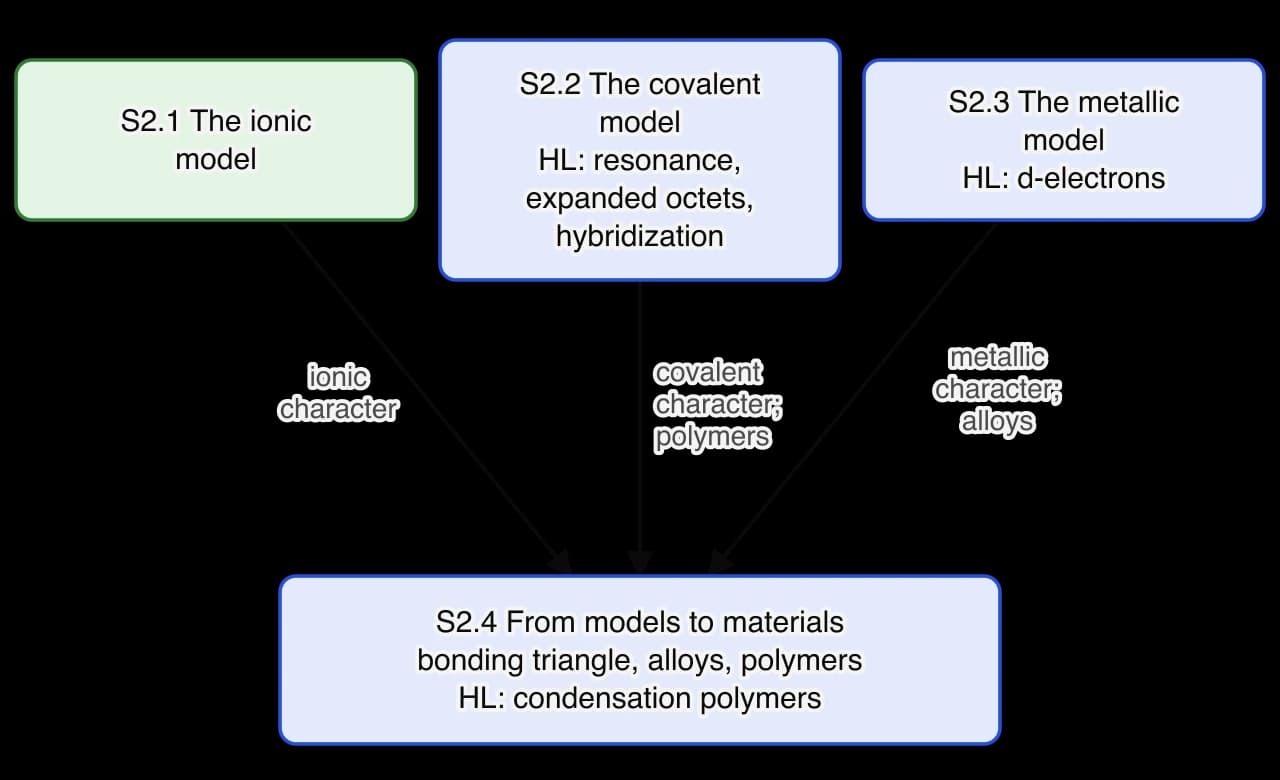
S2.1 The ionic model. Metal atoms lose electrons to form cations and non-metal atoms gain electrons to form anions, with charges predicted from their electron configurations. Ionic bonding is the electrostatic attraction between oppositely charged ions in a three-dimensional lattice. The formulas and names of ionic compounds, including those with polyatomic ions, follow from the charges. Lattice enthalpy measures the strength of ionic bonding and explains the volatility, conductivity and solubility of ionic compounds.
S2.2 The covalent model. A covalent bond is the attraction between a shared pair of electrons and two nuclei. Lewis formulas, single, double, triple and coordination bonds, and the VSEPR model give the shapes of molecules. Bond polarity from electronegativity and molecular shape together decide whether a molecule is polar. Covalent network structures (diamond, graphite, graphene, fullerenes, silicon and silicon dioxide), the four types of intermolecular force, the properties of covalent substances and chromatography complete the model.
S2.3 The metallic model. A metallic bond is the attraction between a lattice of cations and delocalized electrons. The model explains electrical and thermal conductivity and malleability, and the strength of the bond, which depends on the charge and radius of the metal ion, explains trends in melting point.
S2.4 From models to materials. Real bonds lie on a continuum between the three models, shown by a bonding triangle on which a substance is placed from electronegativity data. Alloys and polymers show how bonding and structure are used to design materials; addition polymers form when the double bond in each monomer breaks.
Big ideas across the topic
Structure determines properties. The same questions are asked of every substance: what particles are present, how strongly are they held, and are there charged particles free to move? Ionic lattices, giant covalent networks, simple molecules and metals give four characteristic sets of properties, and S2.4 uses them to explain and design real materials.
Electrostatic attraction underlies every bond. Ionic, covalent and metallic bonds are all attractions between positive and negative charges. The distinction between bonds within a structure and the weaker forces between molecules explains why melting a molecular solid such as ice needs far less energy than melting diamond. Changes of state (S1.1) can then be explained in terms of the forces overcome.
Models and their limitations. No single model describes every substance. The octet rule fails for some molecules, VSEPR predicts shapes but not bond energies, and many compounds have both ionic and covalent character. The bonding triangle treats bonding as a continuum, with the electronegativity trends of the periodic table (S3.1) deciding where a compound sits.
Bonding links to energy and reactivity. Bonds are broken and formed in every reaction, so bond enthalpies and lattice enthalpies return in energy cycles (R1.2). The strength of a bond affects its reactivity: multiple bonds make alkenes reactive towards electrophiles (R3.4), and a strong carbon–fluorine bond explains why CFCs release chlorine radicals rather than fluorine radicals (R3.3). Forming an ionic compound from its elements is a redox reaction (R3.2), and the coordination bond reappears as the product of every Lewis acid–base reaction (R3.4, HL).
Standard level and higher level
No subtopic in Structure 2 is HL only. HL students study all the SL content, and three of the four subtopics end with HL understandings that build on it. S2.2 has the most: its HL content takes nearly as long to teach as its SL content. Structure 2 takes 20 teaching hours at SL and 30 at HL.
Subtopic | Studied at SL and HL | Added at HL |
|---|---|---|
S2.1 The ionic model | All of it, including lattice enthalpy as a measure of the strength of ionic bonding and how ion charge and radius affect it | Nothing in S2.1; Born–Haber cycles, which calculate lattice enthalpies, are HL in R1.2 |
S2.2 The covalent model | Lewis formulas with up to four electron pairs on each atom; bond order, length and strength; coordination bonds; VSEPR shapes for up to four electron domains; bond and molecular polarity; covalent network structures; intermolecular forces; physical properties of covalent substances; chromatography and | Resonance structures; the structure of benzene and its evidence; expanded octets, with Lewis formulas and VSEPR shapes for five and six electron domains; formal charge; sigma and pi bonds; hybridization (sp, sp², sp³); coordination bonds in transition element complexes |
S2.3 The metallic model | The metallic bond; conductivity and malleability; melting point trends of s- and p-block metals | Delocalized d-electrons explaining the high melting points and electrical conductivity of transition elements |
S2.4 From models to materials | The bonding triangle; alloys; polymers and the properties of plastics; repeating units of addition polymers | Condensation polymers: the repeating units of polyamides and polyesters from their monomers |
Two boundaries are easy to misplace. At SL, delocalized electrons appear only in metals and in graphite, graphene and fullerenes; delocalization in molecules and ions such as the carbonate ion, ozone and benzene is HL. VSEPR shapes up to four electron domains (linear, trigonal planar, tetrahedral, and bent or trigonal pyramidal with lone pairs) are SL, while molecules such as , and with five or six domains are HL. The HL ideas of S2.2 are used again in HL Structure 3.2, where a molecule absorbs infrared radiation only if its dipole moment changes as it vibrates, and in HL Reactivity 3.4, where the resonance stability of benzene explains why it undergoes substitution rather than addition.
Flashcards for S2
The official decks for this part of the syllabus.
- S2.1 The ionic model183 cards
- S2.2 The covalent model548 cards
- S2.3 The metallic model102 cards
- S2.4 From models to materials206 cards
From the data booklet
The entries of the chemistry data booklet that S2 uses. Each opens in the explained booklet.
- Melting points and boiling points of the elements at 101.325 kPa8. Melting points and boiling points of the elements at 101.325 kPa
- First ionization energy, electron affinity and electronegativity of the elements9. First ionization energy, electron affinity and electronegativity of the elements
- Atomic and ionic radii of the elements10. Atomic and ionic radii of the elements
- Single bonds11. Covalent or average covalent bond lengths
- 11. Covalent or average covalent bond lengths › Single bonds
- 11. Covalent or average covalent bond lengths › Single bonds
- 11. Covalent or average covalent bond lengths › Single bonds
- 11. Covalent or average covalent bond lengths › Single bonds
- 11. Covalent or average covalent bond lengths › Single bonds
- 11. Covalent or average covalent bond lengths › Single bonds
And 163 more in the data booklet.
Carry on with S2 in Augment
With a free account, Augment remembers where you stopped and what you have practiced.