
How atoms share electrons: Lewis formulas, bond strength, coordination bonds, VSEPR shapes, polarity, covalent networks, intermolecular forces, properties and chromatography. HL: resonance, formal charge, σ and π bonds, hybridization.
Each is in the Chemistry glossary, with every other term in the subject.
One of two or more structural forms of the same element in the same physical state, such as diamond, graphite, graphene and fullerenes for carbon; allotropes differ in bonding and so in properties.
One of the two positions on the vertical axis of a trigonal bipyramid, 180° apart, each with three neighbouring electron domains at 90°.
The angle between two bonds from the same central atom, such as 104.5° for H–O–H in water.
The straight line joining the nuclei of two bonded atoms.
The separation of charge along a polar covalent bond, shown with partial charges or with an arrow pointing to the atom.
The energy needed to break one mole of a particular covalent bond in gaseous molecules to form gaseous atoms; always positive.
The distance between the nuclei of two covalently bonded atoms; more shared pairs between the same two atoms give a shorter bond.
242 exam-style questions on this subtopic, written in the style of the IB papers. The first has its markscheme open. Counted on
Which gas would deviate most from ideal behaviour at 300 K and 100 kPa?
One of 132 short multiple-choice questions on S2.2. Pick an answer to see why it's right or wrong.
What is the approximate bond angle in a water molecule?
The official deck for this part of the syllabus.
Define a covalent bond.
In a covalent bond, each nucleus is attracted to the […], so the pair holds the two nuclei together.
The entries of the chemistry data booklet that S2.2 uses. Each opens in the explained booklet.
With a free account, Augment remembers where you stopped and what you have practiced.
The number of shared electron pairs between two bonded atoms (1 single, 2 double, 3 triple); in a resonance hybrid it can be fractional, such as 1.5 in benzene.
A pair of electrons shared between two atoms in a covalent bond.
A covalent bond in which both electrons of the shared pair come from the same atom, as in the fourth N–H bond of .
The electrostatic attraction between a shared pair of electrons and the positively charged nuclei of the two bonded atoms.
A lattice of atoms joined by covalent bonds throughout, with no separate molecules, as in diamond, silicon and silicon dioxide.
The spreading of electrons over three or more atoms, so that they are not confined to one bond or one atom; delocalized pi electrons form where p orbitals on adjacent atoms overlap sideways.
The extra stability of a species with delocalized electrons compared with one localized structure; for benzene about , from enthalpies of hydrogenation.
An allotrope of carbon in which each atom is covalently bonded to four others tetrahedrally in a three-dimensional network; very hard and does not conduct electricity.
A measure of the separation of positive and negative charge in a molecule; a molecule whose bond dipoles do not cancel has a net dipole moment.
An attraction between the permanent dipole of a polar molecule and the dipole it induces in a neighbouring non-polar particle.
An attraction between the permanent dipoles of neighbouring polar molecules.
A covalent bond made of two shared pairs of electrons; shorter and stronger than a single bond between the same atoms.
A region of electron density around a central atom: a lone pair, a single bond or a multiple bond each count as one domain.
The arrangement of all the electron domains, bonding and non-bonding, around a central atom: linear, trigonal planar or tetrahedral for two, three or four domains.
A reaction in which an electrophile replaces an atom (usually hydrogen) on an aromatic ring, through a carbocation intermediate, the ring keeping its delocalized π system; for example the nitration of benzene.
The enthalpy change when hydrogen adds to the double bonds of one mole of an unsaturated compound to give the saturated compound, for example about for cyclohexene.
One of the three positions around the middle of a trigonal bipyramid, at 120° to each other; lone pairs occupy these positions because they have only two neighbouring domains at 90°.
A valence shell with more than eight electrons around a central atom, as in (10) and (12); possible only for atoms of period 3 and beyond.
A molecular allotrope of carbon made of closed cages of carbon atoms, such as ; the molecules are held together only by London forces.
A single layer of graphite, one atom thick: a very strong, light, flexible sheet that conducts electricity and heat well.
An allotrope of carbon made of layers of hexagonal rings, each atom bonded to three others with one delocalized electron; the layers are held by London forces, so it is soft and conducts electricity.
One of a set of equivalent orbitals formed by mixing s and p orbitals on an atom; each has one large lobe pointing in a definite direction.
An attraction between a hydrogen atom covalently bonded to N, O or F and a lone pair on an N, O or F atom of a neighbouring molecule; the strongest intermolecular force.
A central atom with fewer than eight valence electrons in a molecule, as for Be in (four) and B in (six).
A dipole created in an atom or molecule when a nearby dipole distorts its electron cloud.
A structure of benzene as a six-membered ring of carbon atoms with alternating single and double bonds; it describes one resonance structure, not the real molecule.
A diagram of a covalently bonded species that shows all its valence electrons: bonding pairs between the atoms and lone pairs on the atom that owns them, as dots, crosses or lines.
A molecule or ion with a lone pair of electrons that forms a coordination bond to a central metal ion, such as , , or .
An attraction between a temporary dipole and the dipole it induces in a neighbouring particle; it acts between all molecules and increases with the number of electrons and the contact area.
A pair of valence electrons that belongs to one atom only and is not shared in a bond.
The arrangement of the atoms (not the lone pairs) around a central atom, such as bent, trigonal pyramidal or tetrahedral.
A molecule with no net dipole moment, because its bonds are non-polar or its bond dipoles cancel by symmetry, such as and .
The arrangement of six electron domains around a central atom, pointing to the corners of an octahedron with all neighbouring domains at 90°, as in and many complex ions.
The tendency of atoms to gain, lose or share electrons until they have eight electrons in their valence shell (two for hydrogen).
A small charge, or , on an atom in a polar bond, smaller than the charge of an electron.
A covalent bond formed by the sideways overlap of two parallel p orbitals, with its electron density above and below the bond axis; a double bond contains one and a triple bond two.
A covalent bond in which the shared pair is attracted more strongly by one atom, because the atoms differ in electronegativity, giving partial charges and .
A molecule with a net dipole moment, because its bond dipoles do not cancel, such as and .
How easily the electron cloud of an atom or molecule is distorted; it increases with the number of electrons and size, and strengthens London forces.
The real structure of a species with resonance: a single structure that is an average of its resonance structures, with delocalized electrons and equivalent bonds of intermediate order.
The molecular geometry of a species with four bonding pairs and one lone pair (five electron domains), the lone pair equatorial, as in .
A solid, such as silicon or germanium, whose electrical conductivity lies between that of a conductor and an insulator and increases as the temperature rises.
A covalent bond formed by the head-on overlap of two orbitals, with its electron density concentrated along the bond axis; every single bond is a sigma bond.
A covalent bond made of one shared pair of electrons.
The mixing of one s and one p orbital to give two sp hybrid orbitals at 180°, leaving two p orbitals for pi bonds; found in atoms with two electron domains.
The mixing of one s and two p orbitals to give three hybrid orbitals in a plane at 120°, leaving one p orbital for a pi bond; found in atoms with three electron domains.
The mixing of one s and three p orbitals to give four hybrid orbitals pointing to the corners of a tetrahedron, 109.5° apart; found in atoms with four electron domains.
The molecular geometry of a species with four bonding pairs and two lone pairs opposite each other (six electron domains), as in ; the bond angles are 90°.
The molecular geometry of a species with five bonding pairs and one lone pair (six electron domains), as in .
The molecular geometry of a species with three bonding pairs and two equatorial lone pairs (five electron domains), as in , with bond angles just under 90°.
A short-lived dipole that forms when the electrons of an atom or molecule are momentarily spread unevenly.
The arrangement of five electron domains around a central atom: three equatorial at 120° in a plane and two axial at 90° to that plane, as in .
A covalent bond made of three shared pairs of electrons, as in ; the shortest and strongest bond between two given atoms.
The collective name for London (dispersion), dipole-induced dipole and dipole–dipole forces; it does not include hydrogen bonding.
The valence shell electron pair repulsion model: electron domains around a central atom repel each other and take up positions as far apart as possible, which predicts the shape of a molecule.
Formal charges identify the preferred Lewis formula among several possible ones (HL).
Sigma bonds form by head-on overlap of orbitals and pi bonds by sideways overlap of p orbitals (HL).
Hybridization mixes atomic orbitals into sp, sp² and sp³ hybrid orbitals that match the geometry around an atom (HL).
Most of the substances around us, from the gases of the air and the water in the oceans to plastics, medicines and DNA, are made of atoms joined by covalent bonds. The covalent model explains how atoms share electrons, why molecules have particular shapes and polarities, and why some covalent substances are gases at room temperature while others, such as diamond, are among the hardest materials known.
Atoms of non-metals have high ionization energies and high electronegativities. When two such atoms meet, neither can remove an electron from the other, so instead they share electrons. Each atom contributes one electron to a pair that sits between the two nuclei, and both nuclei attract that pair.
The attraction acts in both directions at once: the negative pair is pulled towards each positive nucleus, so it holds the two nuclei together. The covalent bond in a hydrogen molecule is the simplest case, with one pair of electrons shared between two protons.
Because the bond involves sharing rather than transfer, covalent bonds form between atoms of the same element, as in , and . An ionic bond needs one atom to lose electrons and another to gain them, which happens only between elements with very different electronegativities. Identical atoms have identical electronegativities, so they can only share.
Covalent bonding typically occurs between non-metal atoms. Water, carbon dioxide, ammonia, methane and hydrogen chloride are all covalent: every bond joins two non-metal atoms. The same model also describes the bonds inside polyatomic ions such as , and .
The electrons in the outermost occupied energy level, the valence electrons, are the ones that take part in bonding. For the main-group elements their number follows from the group number: one for group 1, two for group 2, and three to eight for groups 13 to 18.
An octet matches the electron configuration of a noble gas. A chlorine atom has seven valence electrons; by sharing one pair with another chlorine atom, each atom counts eight electrons around itself (six in its own lone pairs and two in the shared pair). Both electrons of a shared pair count towards the octet of each atom in the bond.
The octet rule also explains why the noble gases form so few compounds. Their atoms already have a full valence shell and very high first ionization energies, so they gain nothing by sharing electrons. Helium, neon and argon form no stable compounds at all. The heavier noble gases, with outer electrons further from the nucleus, can bond to very electronegative atoms: xenon forms fluorides such as and .
The octet rule is a model: it predicts the formulas of most compounds of carbon, nitrogen, oxygen and the halogens, but several kinds of molecule break it.
Incomplete octets. Beryllium, boron and aluminium have only two or three valence electrons to share. In the beryllium atom has four electrons around it, and in , and the central atom has six. Such molecules are electron-deficient and react readily with species that can donate a pair of electrons.
Odd numbers of electrons. Nitrogen monoxide, (11 valence electrons), and nitrogen dioxide, (17), cannot give every atom an octet, because an odd number of electrons cannot all be paired. Species with an unpaired electron are called radicals and are usually very reactive.
Expanded octets. Atoms of period 3 and beyond, such as phosphorus and sulfur, can have more than eight electrons around them, as in and
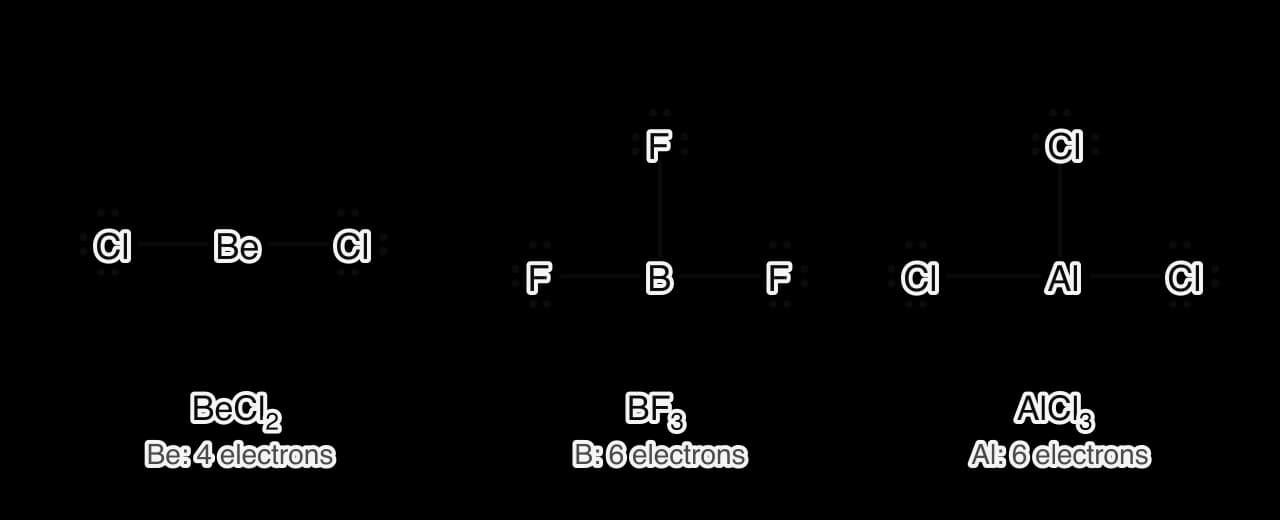
A Lewis formula (also called a Lewis structure or electron-dot structure) is a map of where the valence electrons are. A bonding pair is shared between two atoms; a lone pair belongs to one atom only and takes no part in a bond. Any combination of dots, crosses and lines is acceptable, provided every electron is shown: a line counts as two electrons. Ions are drawn inside square brackets with the charge at the top right.
Count the valence electrons of all the atoms. For an anion add one electron per negative charge; for a cation subtract one per positive charge. Divide by two to get the number of electron pairs to place.
Choose the central atom. It is usually the atom that forms the most bonds, which is usually the least electronegative atom other than hydrogen. Hydrogen forms only one bond, so it is never central. In oxyacids such as and the hydrogen atoms are bonded to oxygen, not to the central atom.
Join each outer atom to the central atom with a single bond (one pair).
Complete the octets of the outer atoms with lone pairs (hydrogen needs none).
Place any remaining pairs on the central atom as lone pairs.
Check the central atom. If it has fewer than eight electrons, move a lone pair from an outer atom into a second bond to make a double bond, and repeat if needed (a triple bond). Atoms such as B and Be are left with an incomplete octet instead.
Check the total: the number of electrons drawn must equal the count from step 1, and an ion needs brackets and its charge.
The Lewis formulas of simple molecules with single bonds show the common patterns. Every atom other than hydrogen has eight electrons around it: halogen atoms with one bond carry three lone pairs, oxygen with two bonds carries two, nitrogen with three bonds carries one, and carbon with four bonds carries none.
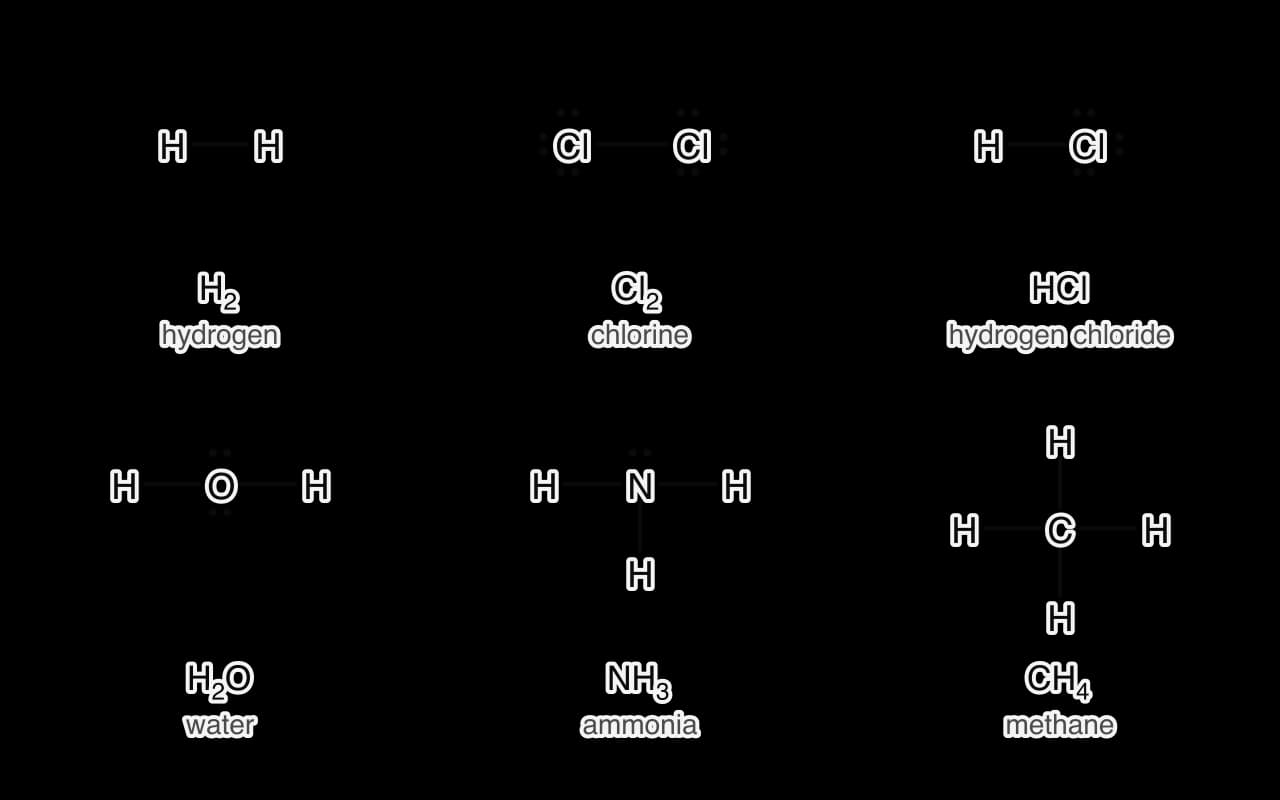
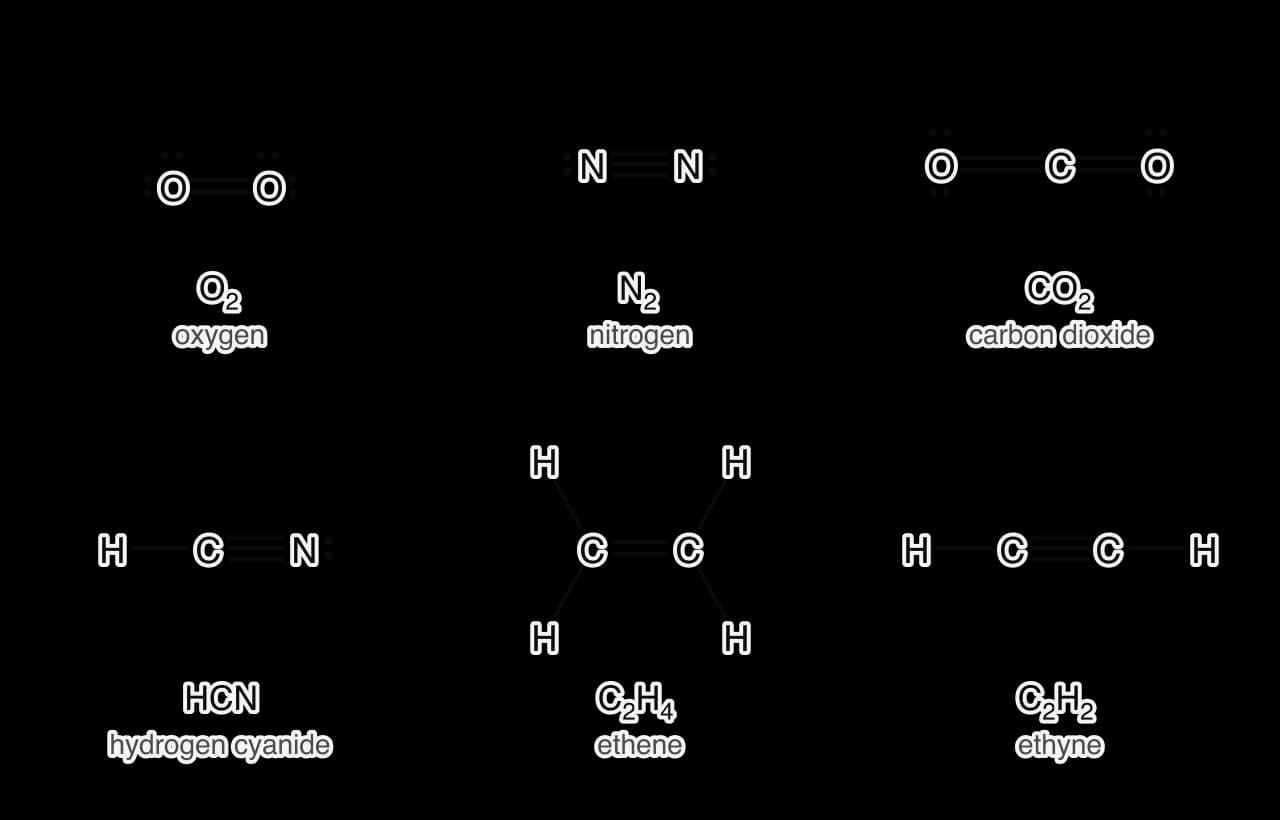
Double and triple bonds appear wherever single bonds would leave an atom short of an octet. In each oxygen atom shares two pairs; in each nitrogen shares three. Carbon dioxide has two double bonds, so carbon has its octet from four shared pairs and each oxygen keeps two lone pairs.
Elements of the same group form the same number of bonds, so their compounds have Lewis formulas of the same pattern. Sulfur, in group 16 like oxygen, forms two bonds and keeps two lone pairs in and ; oxygen does the same in . Phosphorus, in group 15 like nitrogen, forms three bonds and keeps one lone pair in , as nitrogen does in and . The lone pairs on the central atom are the ones most often left out, and they decide the shape of each molecule.
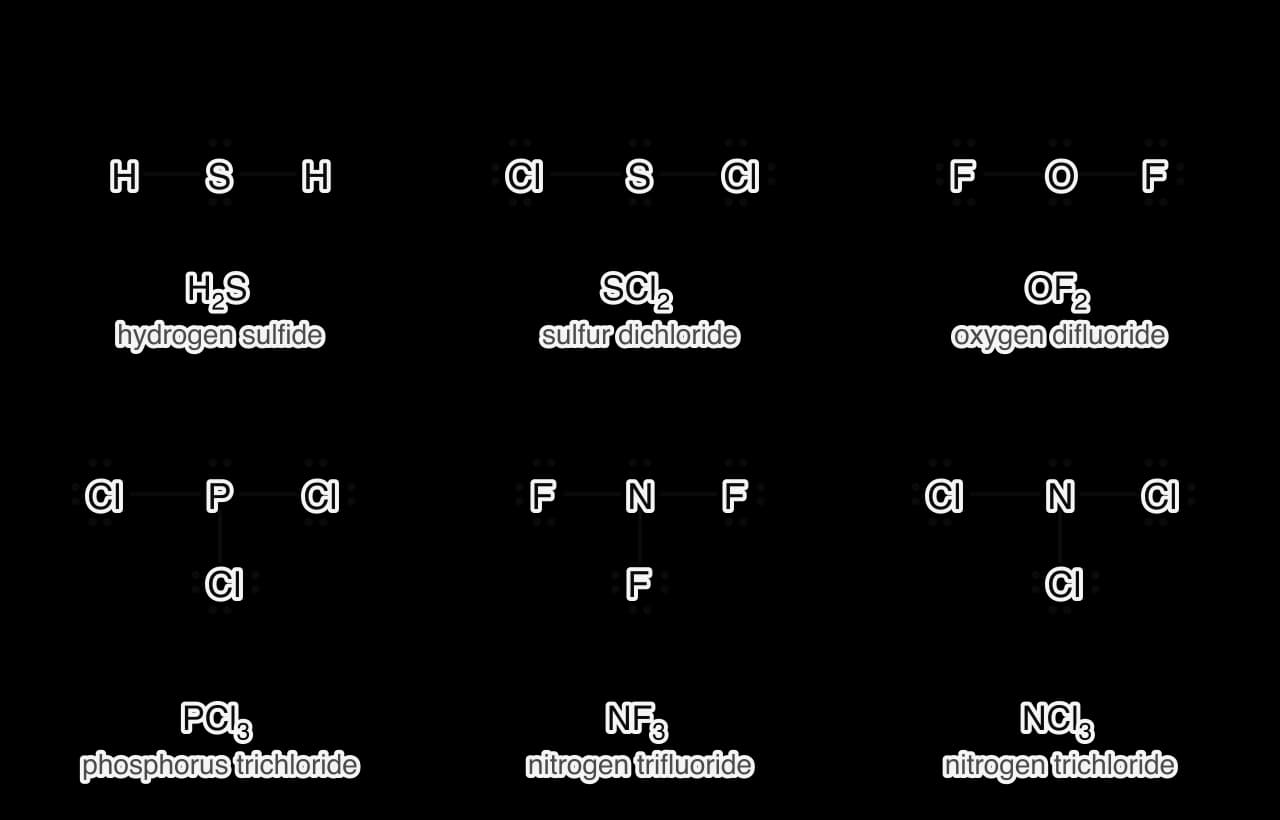
Each halogen atom in these molecules forms one bond and carries three lone pairs, so a molecule such as has ten lone pairs in all: one on phosphorus and nine on the chlorine atoms. Counting confirms it: valence electrons, or 13 pairs, of which 3 are bonding pairs.
Tetrachloromethane, ethane, carbon monoxide and white phosphorus complete the set of small molecules whose Lewis formulas are most often asked for. In carbon monoxide each atom has one lone pair and the two atoms share three pairs, as in , with which is isoelectronic.
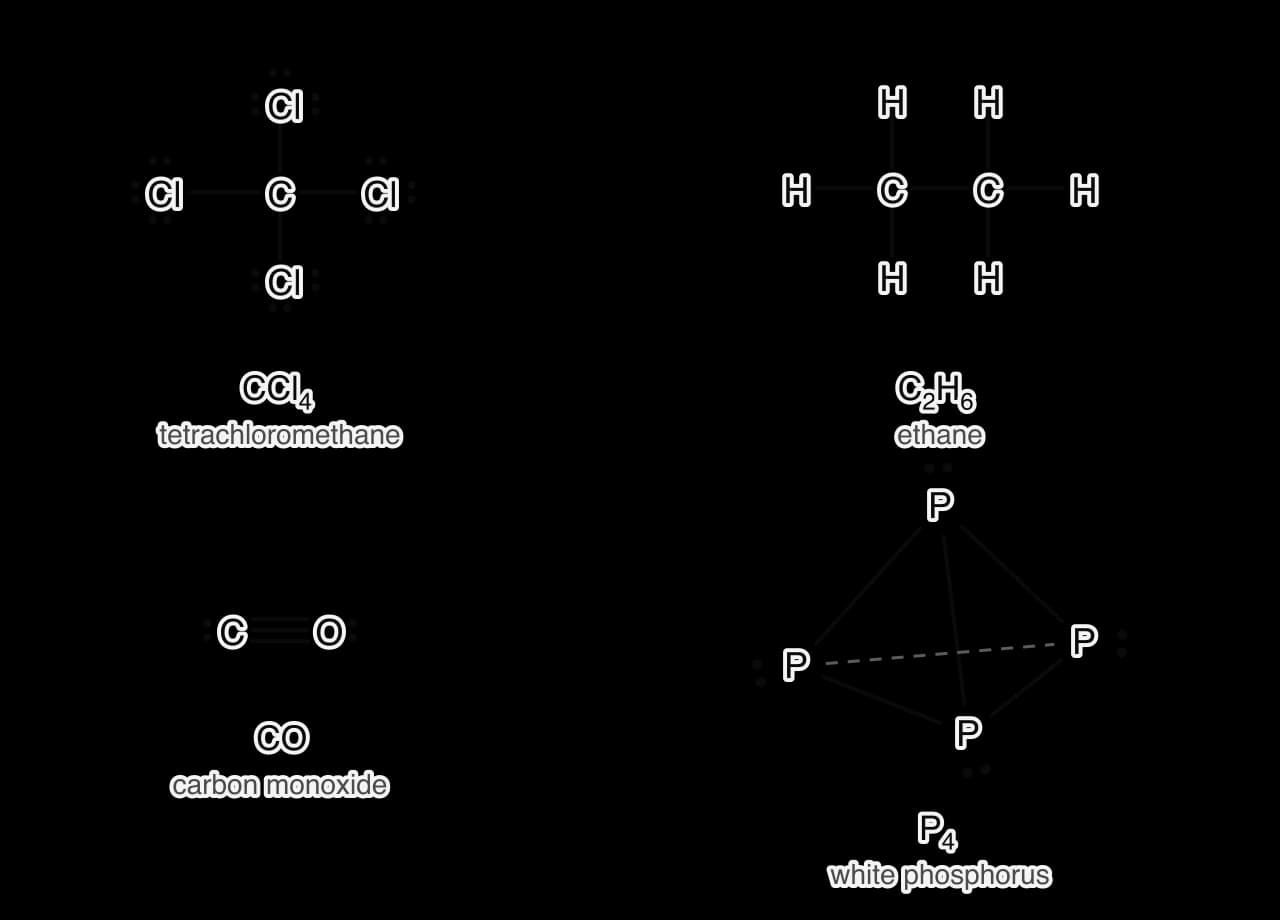
The same rules apply to larger molecules, where each atom in turn can be treated as a centre. In organic molecules carbon forms four bonds, hydrogen one, oxygen two (with two lone pairs) and nitrogen three (with one lone pair). In ethanoic acid one oxygen atom is joined to carbon by a double bond and the other by single bonds to both C and H; each oxygen keeps two lone pairs.
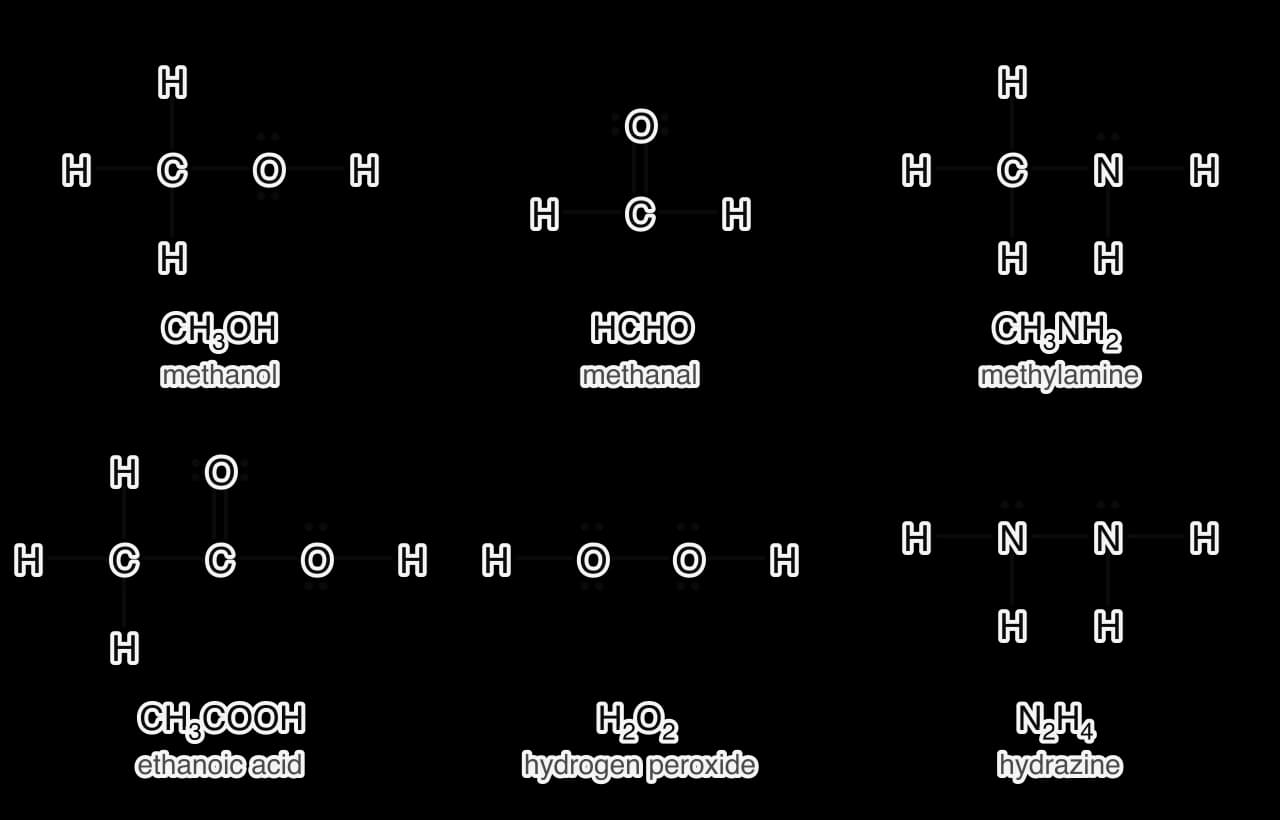
For an ion, the charge changes the electron count. The ammonium ion, , has electrons, or four bonding pairs and no lone pairs. The hydroxide ion, , has electrons: one bonding pair and three lone pairs on oxygen. The whole structure is placed in square brackets with the charge outside, because the charge belongs to the ion as a whole.
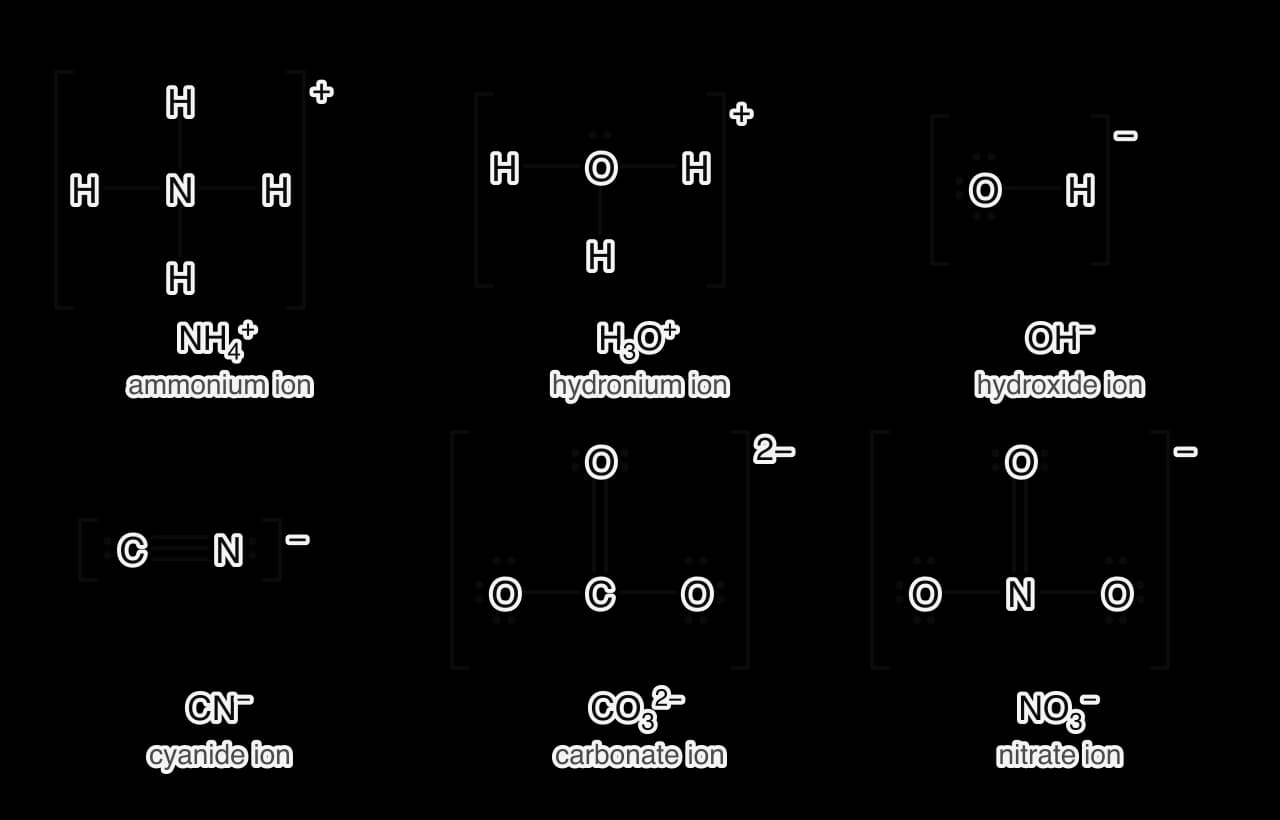
The double bond in the nitrate and carbonate ions could equally be drawn to any of the three oxygen atoms. Measured bond lengths show that all three bonds in each ion are in fact the same length; resonance, an HL idea, explains this.
A single bond is one shared pair of electrons, a double bond two shared pairs and a triple bond three. The number of shared pairs between two atoms affects how far apart the nuclei sit and how much energy is needed to separate them.
More shared pairs put more electron density between the two nuclei. Both nuclei are attracted to this larger negative charge, so they are pulled closer together and held more tightly. A triple bond is therefore shorter and stronger than a double bond, which is shorter and stronger than a single bond between the same two atoms. The data booklet values for bonds between carbon, nitrogen and oxygen follow this pattern in every series.
Bond | Shared pairs | Bond length / pm | Bond enthalpy / |
|---|---|---|---|
1 | 154 | 346 | |
2 | 134 | 614 | |
3 | 120 | 839 | |
1 | 143 | 358 | |
2 | 122 | 804 | |
3 | 113 | 1077 | |
1 | 146 | 158 | |
2 | 125 | 470 | |
3 | 110 | 945 | |
1 | 148 | 144 | |
2 | 121 | 498 |
Data: IB Chemistry data booklet (2025), sections 11 (lengths) and 12 (enthalpies). is the bond in carbon monoxide.
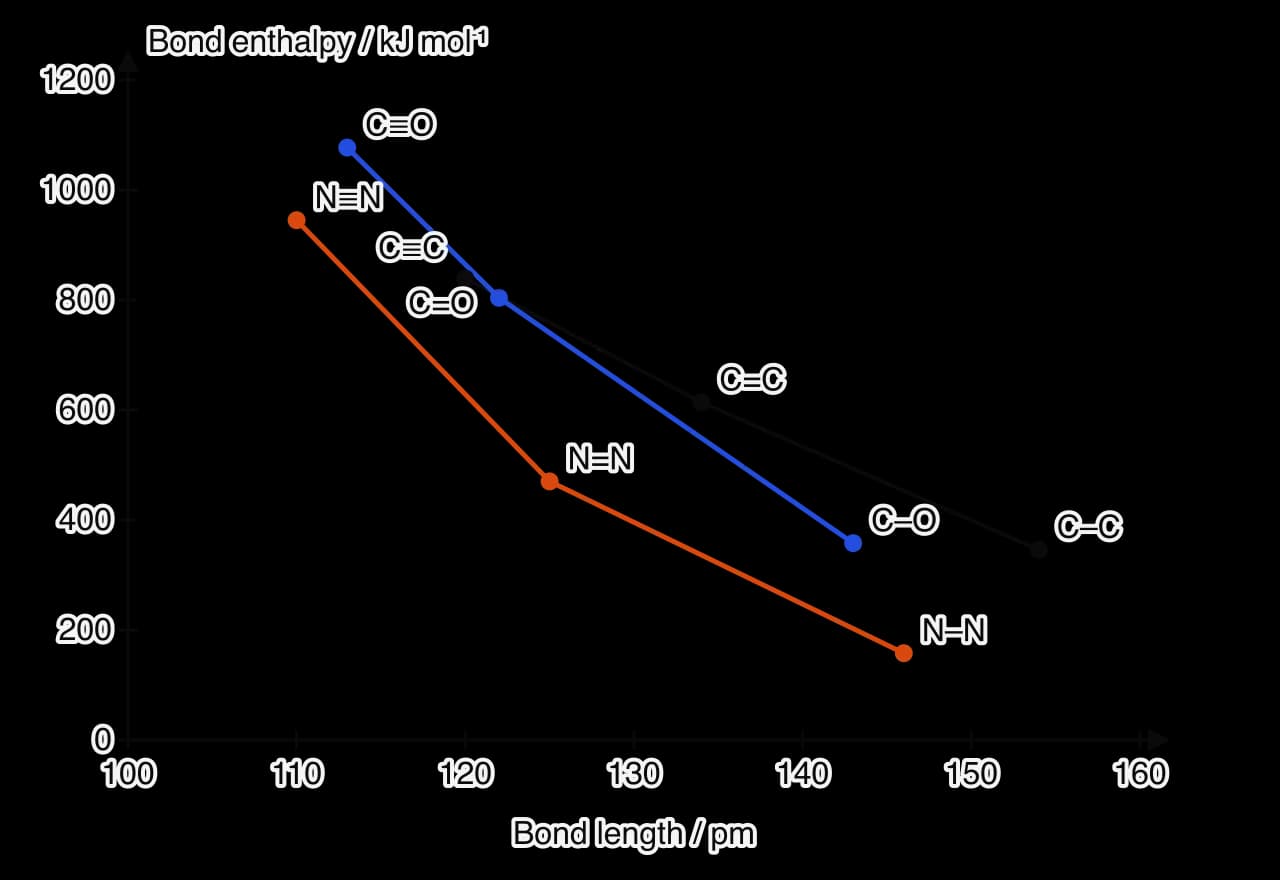
The strength of the triple bond in nitrogen, , makes very unreactive, even though it makes up about 78% of the air. Breaking it needs a great deal of energy, which is why nitrogen is used as an inert atmosphere for packaging food and why converting it into ammonia or nitrates needs high temperatures, catalysts or lightning. In contrast, the single bond in hydrogen peroxide () breaks easily, and hydrogen peroxide decomposes slowly even at room temperature.
A shorter bond is usually stronger, but not always. The bond is short (142 pm) yet weak (), weaker than (199 pm, ). Fluorine atoms are so small that the lone pairs on the two atoms are close together and repel each other, which weakens the bond.
A double bond is stronger than a single bond, yet alkenes react much more readily than alkanes. The bond enthalpy of () is less than twice that of (), so the second pair of a double bond is held less strongly than the first, and its electrons are more exposed. Reactions of alkenes break only this second part of the double bond. (The two parts of a double bond are the sigma and pi bonds of HL.)
In most covalent bonds each atom supplies one electron of the shared pair. In a coordination bond (also called a dative covalent bond) one atom supplies both. The donor atom must have a lone pair, and the acceptor must have an empty orbital in its valence shell that can take the pair.
The ammonium ion forms when ammonia meets a hydrogen ion. The ion has no electrons at all, and the nitrogen atom of has a lone pair. The lone pair becomes the shared pair of a new N–H bond:
A coordination bond can be shown in a structure as an arrow pointing from the donor atom to the acceptor atom. The hydronium ion forms in the same way when a water molecule uses one of its lone pairs to bond to : . Any acid dissolved in water forms hydronium ions by this reaction.
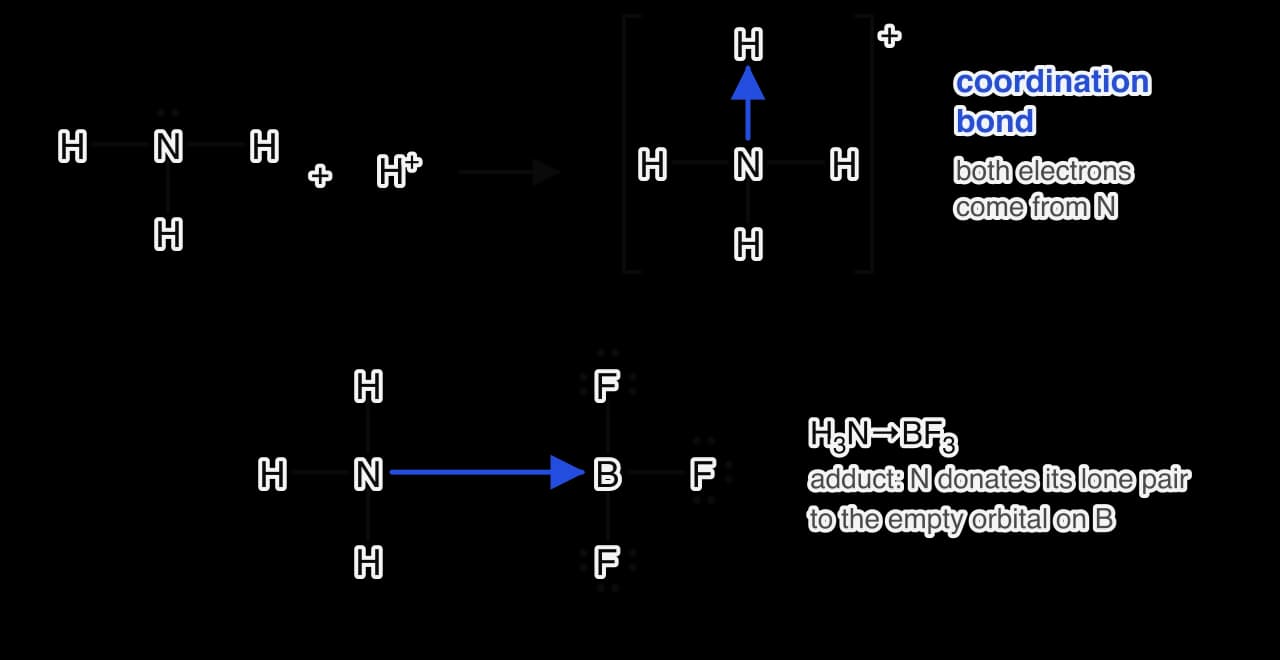
Once it has formed, a coordination bond is identical to any other covalent bond between the same two atoms. All four N–H bonds in have the same length and strength, and there is no way to tell which one was formed by coordination. The arrow describes how the bond formed, not a different kind of bond.
A coordination bond is present wherever an atom has more bonds than its usual number and its bonding partner has fewer than its usual share of electrons. Common examples:
and : nitrogen with four bonds and oxygen with three, each having donated a lone pair to .
Carbon monoxide, : carbon brings 4 valence electrons and oxygen 6. To give both atoms an octet, the two atoms share three pairs, of which two pairs come one electron from each atom and the third comes entirely from oxygen.
Adducts of electron-deficient molecules: the boron atom of has an empty orbital and accepts the lone pair of
Octet Lewis formulas of ozone, nitric acid and the nitrate ion: in ozone, , the central oxygen atom uses two of its six valence electrons in the double bond and keeps two as a lone pair; the last two form the single bond to the third oxygen atom, which supplies none. In nitric acid, , nitrogen uses one electron in the bond to the OH group and two in the
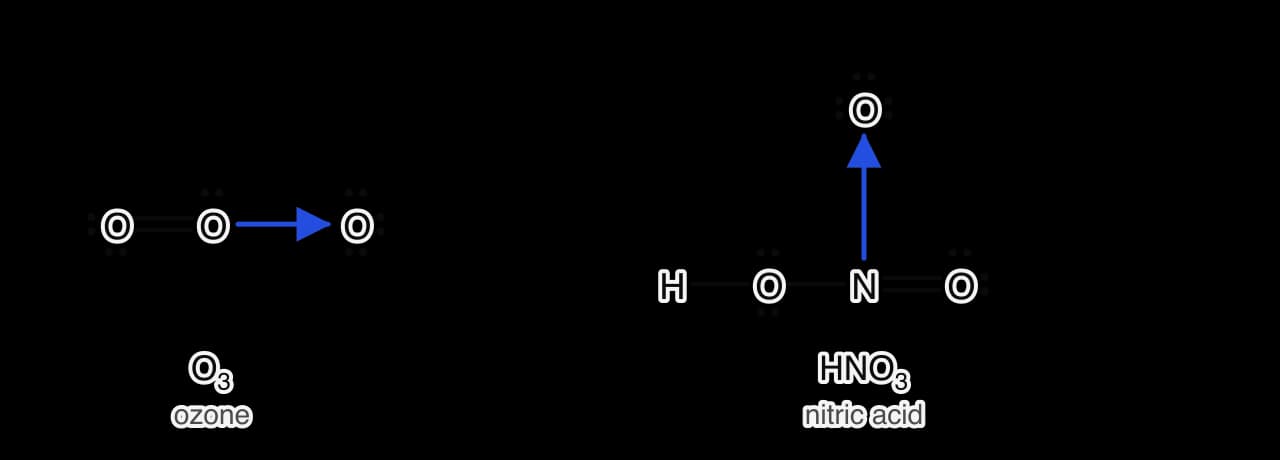
Metal ions in solution also form coordination bonds, with water molecules, ammonia molecules or anions donating lone pairs to the metal ion. These complex ions of the transition elements are studied at HL, where reactions that form coordination bonds are also described as Lewis acid–base reactions.
Molecules have definite three-dimensional shapes, measured by techniques such as X-ray crystallography and spectroscopy. The shape decides whether a molecule is polar, how it packs and how it reacts. The valence shell electron pair repulsion (VSEPR) model predicts the shape from the Lewis formula.
The VSEPR model rests on one idea: electron domains around a central atom all contain negative charge, so they repel each other and take up positions as far apart as possible. The number of domains fixes their arrangement in space.
Two domains point in opposite directions: linear, apart.
Three domains point to the corners of an equilateral triangle in one plane: trigonal planar, apart.
Four domains point to the corners of a tetrahedron: tetrahedral, apart.
A multiple bond counts as one domain because all its electrons lie between the same two atoms and point in the same direction. In the carbon atom has two double bonds, so two domains, and the molecule is linear.
When every domain is a bond, the two geometries are the same. When some domains are lone pairs, the molecular geometry describes only the positions of the atoms. Ammonia has four domains around nitrogen (three bonds and one lone pair), so its electron domain geometry is tetrahedral, but its atoms form a pyramid with N at the top: its molecular geometry is trigonal pyramidal. Water has four domains (two bonds and two lone pairs) and a bent molecular geometry.
Electron domains | Electron domain geometry | Bonding domains + lone pairs | Molecular geometry | Bond angle | Examples |
|---|---|---|---|---|---|
2 | linear | 2 + 0 | linear | 180° | , , , (each C) |
3 | trigonal planar | 3 + 0 | trigonal planar | 120° | , |
3 | trigonal planar | 2 + 1 | bent (V-shaped) | less than 120° (about 117°) | , |
4 | tetrahedral | 4 + 0 | tetrahedral | 109.5° | , |
4 | tetrahedral | 3 + 1 | trigonal pyramidal | about 107° | , |
4 | tetrahedral | 2 + 2 | bent (V-shaped) | about 104.5° | , |
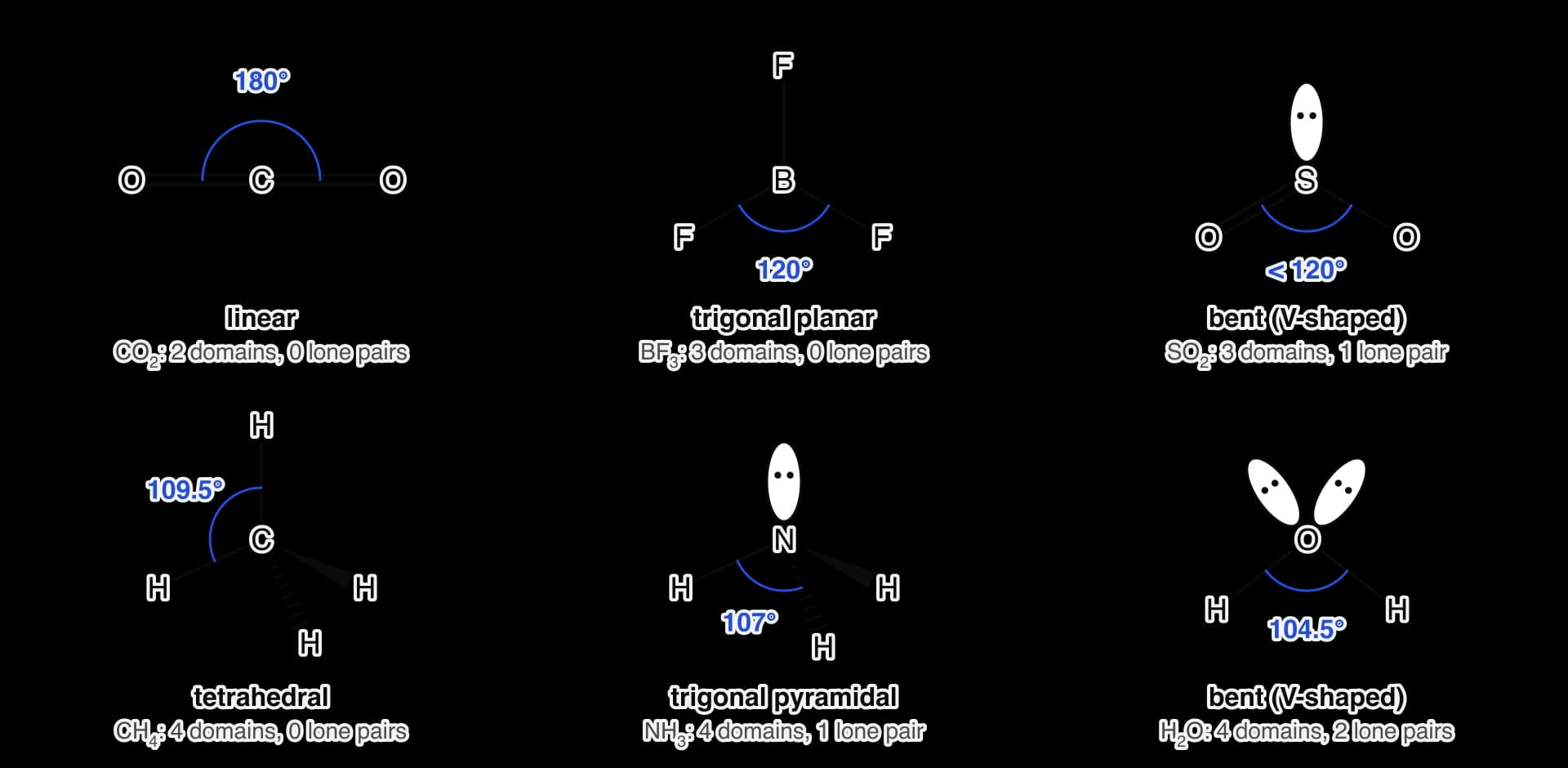
A lone pair is held by only one nucleus, so its electron density sits closer to the central atom and spreads out more widely than a bonding pair, which is pulled out between two nuclei. Lone pairs therefore repel more strongly than bonding pairs. The order of repulsion is:
Each lone pair pushes the bonding pairs closer together and reduces the bond angle between them by roughly to . Methane (no lone pairs) has H–C–H angles of , ammonia (one lone pair) and water (two lone pairs) , even though all three have four electron domains.
Multiple bonds have a similar effect. A double bond contains four electrons in one domain, so it repels the neighbouring domains more than a single bond does. In methanal, , the three domains around carbon are not equal: the H–C–O angles open to about and the H–C–H angle closes to about , compared with the perfect of .
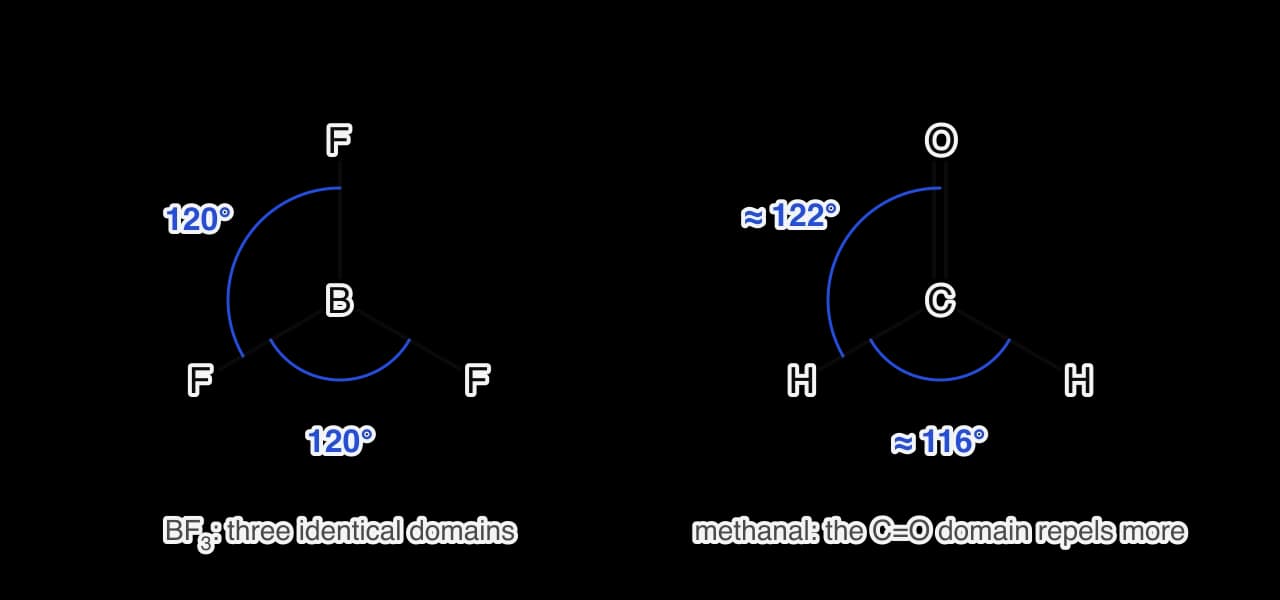
An explanation of a molecular shape follows the same chain each time: the Lewis formula, the number of electron domains and how many of them are lone pairs, repulsion to maximum separation, the electron domain geometry, then the molecular geometry and bond angle. The name of the shape alone is not an explanation.
In larger molecules, each atom with two or more neighbours is a centre with its own geometry. In ethanoic acid, , the carbon of the group has four domains (tetrahedral, ); the carbon of the group has three domains, one of them a double bond (trigonal planar, about ); and the oxygen of the O–H group has four domains, two of them lone pairs (bent, about ). In methylamine, , the nitrogen atom has three bonds and a lone pair, so the geometry around N is trigonal pyramidal.
The VSEPR model predicts the shapes of most molecules of the main-group elements correctly, using nothing more than a Lewis formula, and it explains the order of bond angles in series such as , and . Molecular model kits and computer modelling programs build the same shapes, and measured structures confirm them.
It is still a model with limits. Its bond angles are approximate: the measured H–S–H angle in is about , and the H–P–H angle in about , far below the and suggested by comparison with water and ammonia. VSEPR treats electron domains as simple charged clouds and says nothing about why bonds form or how strong they are; the orbital models of HL (hybridization and sigma and pi bonds) describe the bonding itself. It also works poorly for many compounds of the transition elements.
When two identical atoms share a pair of electrons, the pair is shared equally. When the atoms are different, the atom with the greater attraction for electrons pulls the shared pair towards itself.
Electronegativity increases across a period and decreases down a group; fluorine (4.0) is the most electronegative element, followed by oxygen (3.4), then chlorine (3.2) and nitrogen (3.0). These trends are explained by nuclear charge and atomic radius in the periodic table. The values in the table are those of the data booklet.
Element | H | B | C | N | O | F | Si | P | S | Cl | Br | I |
|---|---|---|---|---|---|---|---|---|---|---|---|---|
Electronegativity | 2.2 | 2.0 | 2.6 | 3.0 | 3.4 | 4.0 | 1.9 | 2.2 | 2.6 | 3.2 | 3.0 | 2.7 |
Data: Pauling electronegativities, IB Chemistry data booklet (2025), section 9.
The difference in electronegativity, , between two bonded atoms decides how unequally the pair is shared. If , as in or , the bond is a non-polar covalent bond. If the atoms differ, the electron density is pulled towards the more electronegative atom, which gains a small negative charge, written ("delta negative"), while the other atom is left with a small positive charge, . Such a bond is a polar covalent bond, and the separation of charge is a bond dipole.
Bond dipoles are shown either with partial charges or with a vector arrow along the bond that points towards the end, with a short cross-line at the end. In hydrogen chloride, chlorine (3.2) is more electronegative than hydrogen (2.2), so the bond is polar with on Cl.
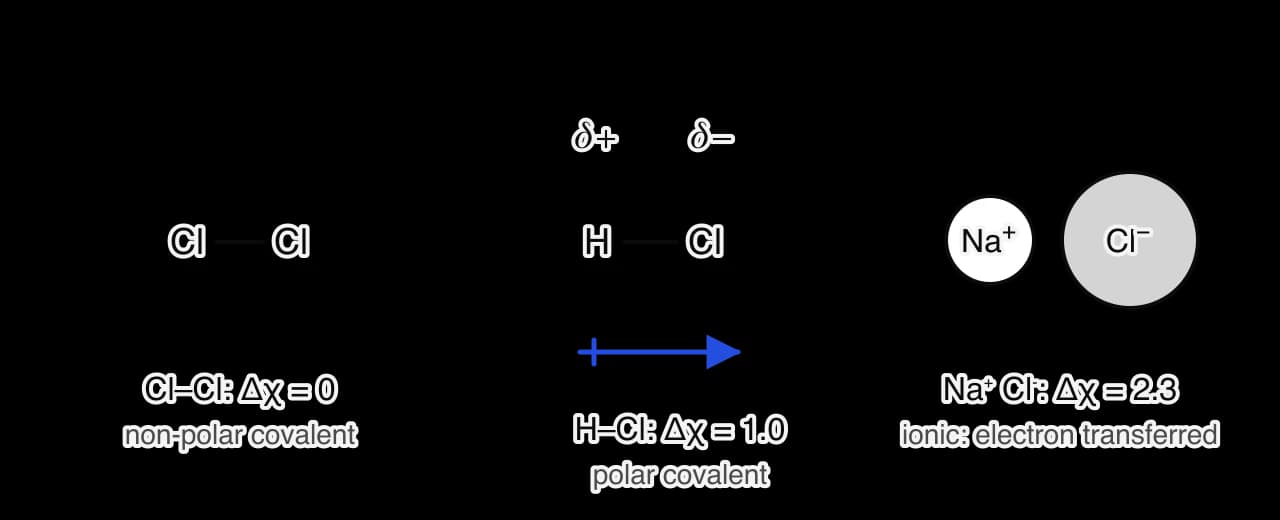
The larger the electronegativity difference, the more polar the bond. Polarity forms a continuum: at one end are non-polar bonds between identical atoms, in the middle polar covalent bonds, and at the far end ionic bonding, where the difference is so large (sodium chloride, ) that the electron is effectively transferred. The bonding triangle places compounds along this continuum using electronegativity values.
Compounds with very polar covalent bonds share some properties with ionic compounds. Hydrogen chloride is a covalent gas, but its strongly polar molecules dissolve in water and break up into ions, so the solution conducts electricity. Polar molecules also dissolve better in polar solvents such as water than non-polar ones do.
A molecule with polar bonds is not necessarily polar itself. Each bond dipole has a size and a direction, so the dipoles add up like vectors. If they cancel, the molecule has no net dipole and is non-polar; if they do not cancel, the molecule has a net dipole and is polar.
Whether bond dipoles cancel depends on the molecular geometry. In carbon dioxide the two bonds are polar, but they point in exactly opposite directions, so their effects cancel and is a non-polar molecule. In water the two O–H dipoles point partly in the same direction because the molecule is bent, so they reinforce each other and water is a polar molecule.
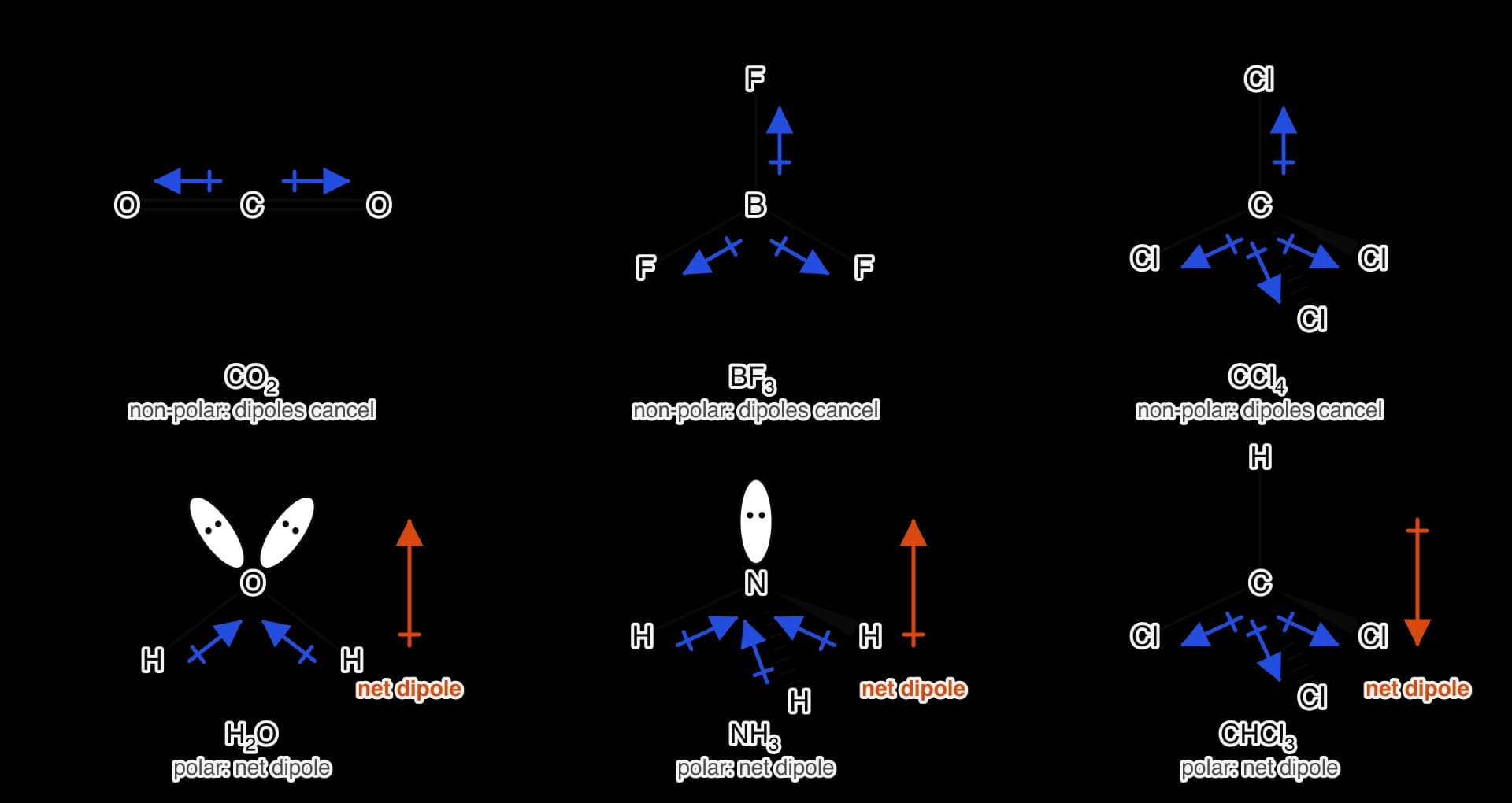
Polar bonds cancel only when they are identical and arranged symmetrically around the central atom with no lone pairs: linear , trigonal planar and tetrahedral molecules. Two things break the symmetry:
Lone pairs on the central atom, which make the shape bent or pyramidal (, , , , ).
Different outer atoms, which give bond dipoles of different sizes even in a symmetrical shape (,
Non-polar (dipoles cancel or no polar bonds) | Polar (net dipole) |
|---|---|
, (linear) | , |
, | |
, | |
, |
The same reasoning applies to ions. The three bond dipoles of the trigonal planar carbonate and nitrate ions cancel, so these ions have no dipole moment, although each ion carries a charge.
Molecular polarity matters in two further ways. It decides the type of force that acts between the molecules, and so their boiling points and solubility. It also decides how molecules absorb infrared radiation: a vibration absorbs infrared only if it changes the dipole moment, which is why and are greenhouse gases but and are not, a topic of infrared spectroscopy at HL.
Most covalent substances are made of separate molecules. A few elements and compounds instead form a continuous network in which every atom is covalently bonded to its neighbours, throughout the whole crystal. There are no separate molecules, so the formula gives only the ratio of atoms. These covalent network structures (also called giant covalent structures) include silicon, silicon dioxide and two of the forms of carbon.
Melting a covalent network structure means breaking strong covalent bonds, not overcoming weak forces between molecules, so these substances have very high melting points. They are hard, insoluble in all solvents, and, with the important exceptions of graphite and graphene, do not conduct electricity.
Carbon has several allotropes. In each one a carbon atom uses its four valence electrons in a different way, and the structure that results explains the properties.
In diamond every carbon atom forms four single covalent bonds to four other carbon atoms, arranged tetrahedrally at . The bonds extend in three dimensions through the whole crystal. Diamond is the hardest natural substance and has a very high melting point (about ), because many strong bonds must be broken to deform or melt it. All four valence electrons of each atom are held in localized bonds, so there are no mobile electrons and diamond does not conduct electricity. It does conduct heat very well, better than copper, because the stiff, strongly bonded lattice passes vibrations quickly from atom to atom. Diamond is used in jewellery and in the tips of drills and saws that cut rock, glass and concrete.
In graphite each carbon atom forms three covalent bonds to three other carbon atoms, at in a flat sheet of hexagonal rings. The fourth valence electron of each atom is not used in these bonds; it is delocalized, free to move across the whole layer. The layers are stacked 335 pm apart and held together only by weak London forces.
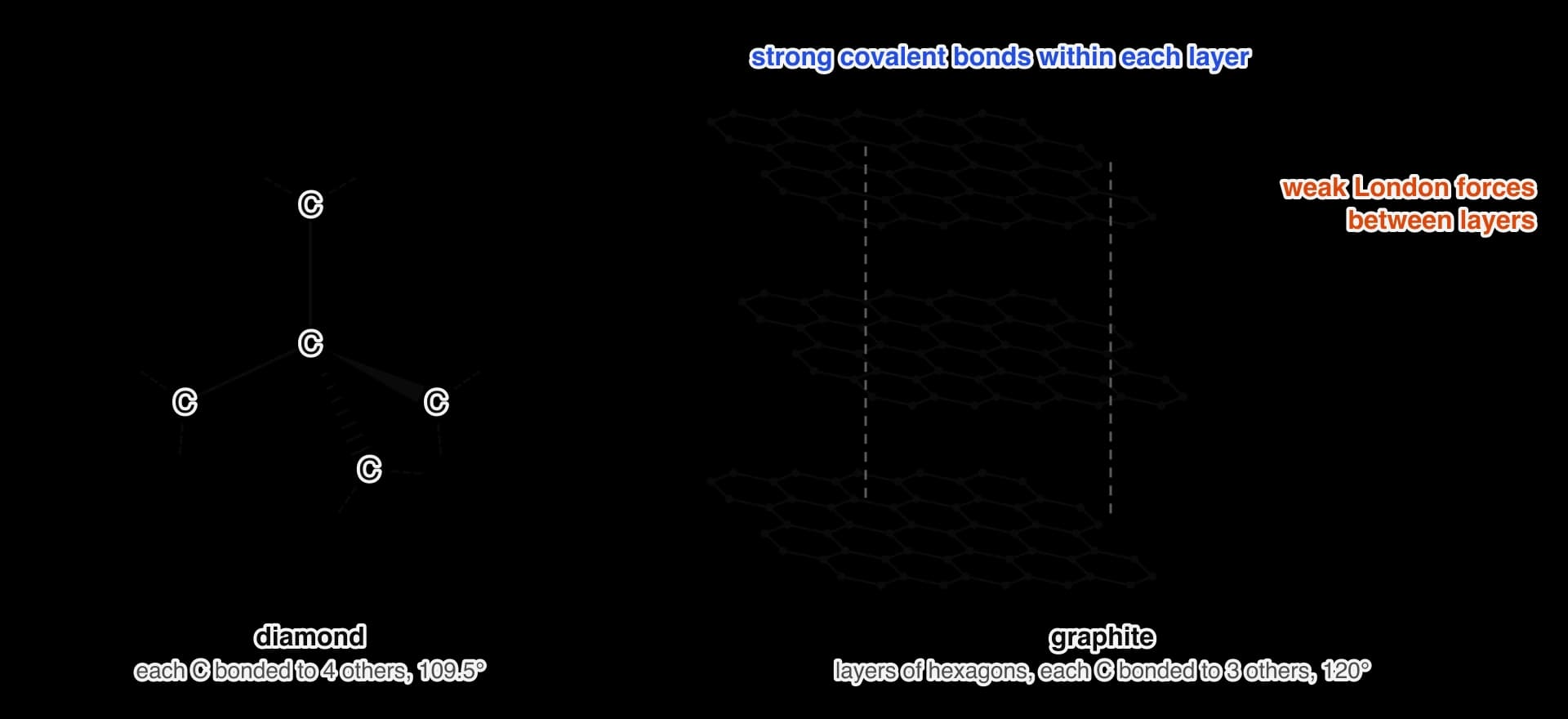
Electrical conductor. The delocalized electrons move along the layers when a voltage is applied, so graphite conducts electricity (much better along the layers than across them). It is used for electrodes in electrolysis.
Soft and slippery. The weak forces between layers let the layers slide over each other, so graphite is used as a lubricant and in pencil "leads", where layers rub off onto the paper.
Very high melting point. Melting breaks the strong covalent bonds within the layers, so graphite, like diamond, melts or sublimes only at well over .
Less dense than diamond ( against ), because of the wide gaps between the layers.
Graphene is a single layer of graphite: a two-dimensional sheet of hexagonal rings one atom thick, in which each carbon atom is bonded to three others and has one delocalized electron. It was first isolated in 2004 by Andre Geim and Konstantin Novoselov at the University of Manchester, who peeled flakes off graphite with adhesive tape, and the two shared the 2010 Nobel Prize in Physics for the work.
Graphene is an excellent conductor of electricity (delocalized electrons) and of heat. Its network of strong bonds makes it one of the strongest materials known for its mass, many times stronger than steel, yet it is flexible and almost transparent. Every atom is on the surface, so it has an enormous surface area for its mass. These properties are being developed for flexible screens, sensors, lightweight composites and battery electrodes.
Fullerenes are molecular forms of carbon: closed cages of carbon atoms. The best known, buckminsterfullerene, , was discovered in 1985 by Harold Kroto, Robert Curl and Richard Smalley (Nobel Prize in Chemistry, 1996). Its 60 atoms form a hollow sphere of 12 pentagons and 20 hexagons, the pattern of a football. Each carbon atom is bonded to three others, and the remaining electrons are delocalized over the cage.
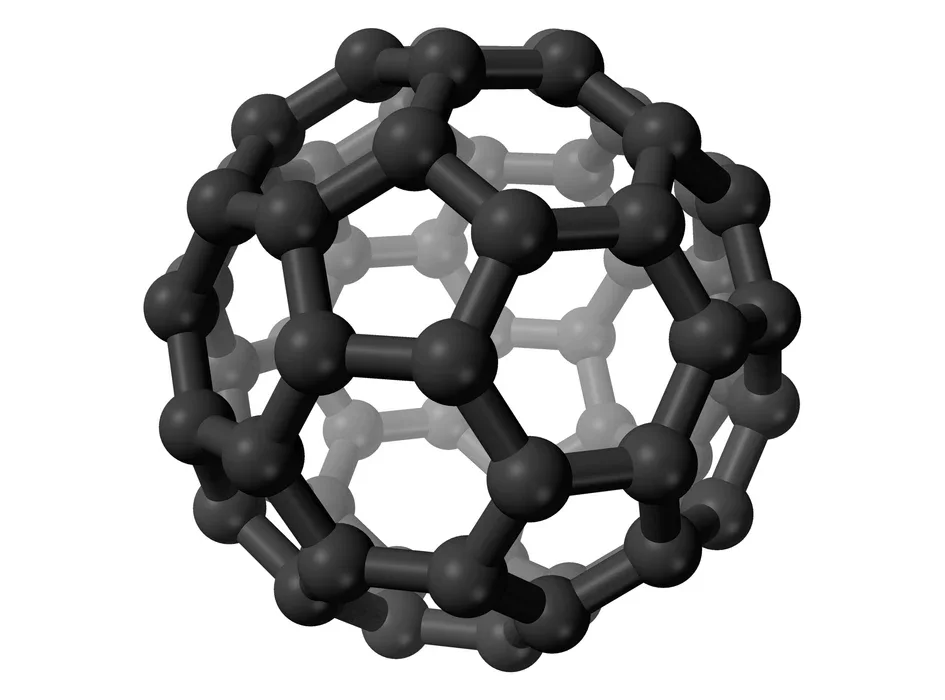
Because is a molecule, its solid is held together only by London forces between the cages. Fullerene therefore has a much lower melting point than diamond or graphite: it sublimes on heating at a few hundred degrees Celsius, while diamond needs well over . It is a poor conductor of electricity, because although the electrons are delocalized within each cage, they cannot move easily from one molecule to the next. Unlike diamond and graphite, dissolves in some non-polar solvents, such as methylbenzene, giving a purple solution, and it reacts more readily than the other allotropes.
Allotrope | Bonding and structure | Electrical conductivity | Other key properties |
|---|---|---|---|
Diamond | covalent network; each C bonded to 4 others, tetrahedral, 109.5° | does not conduct: no delocalized electrons | hardest natural substance; very high melting point; excellent conductor of heat |
Graphite | layers of hexagonal rings; each C bonded to 3 others, 120°; London forces between layers | conducts along the layers: one delocalized electron per C | soft, slippery (layers slide); very high melting point; less dense than diamond |
Graphene | a single layer of graphite, one atom thick | excellent conductor: delocalized electrons | very strong and light; flexible; nearly transparent; huge surface area |
Fullerene, | separate molecules: cages of 60 C; each C bonded to 3 others; London forces between molecules | poor conductor: electrons cannot pass between molecules | low sublimation temperature; soft; soluble in some non-polar solvents |
Silicon is in group 14 below carbon and has the same structure as diamond: each Si atom is bonded tetrahedrally to four others in a three-dimensional network. Silicon is hard, brittle and has a high melting point (). It is a semiconductor: its conductivity is low at room temperature but rises with temperature and with tiny amounts of added elements, which makes it the basic material of computer chips and solar cells.
The melting point of silicon is far lower than that of diamond because bonds are weaker than bonds. Silicon atoms are larger, so the bonding pair is further from the two nuclei and the bonds are longer (232 pm against 154 pm) and weaker ( against ). The same weakness is why silicon, unlike carbon, does not form long chains of atoms bonded to each other.
Silicon dioxide, , which occurs naturally as quartz and as most sand, is also a covalent network. Each silicon atom is bonded to four oxygen atoms arranged tetrahedrally, and each oxygen atom is bonded to two silicon atoms. The formula gives the 1 : 2 ratio of atoms; there are no molecules.

Quartz is hard and melts only at about , because melting it breaks strong bonds. It has no mobile electrons or ions, so it does not conduct electricity, and it is insoluble in water. Carbon dioxide, with the same type of formula, is completely different: its molecules are separate units held together by weak London forces, so it is a gas at room temperature and solid sublimes at .
Covalent bonds hold the atoms together inside a molecule. Separate molecules are attracted to each other by much weaker intermolecular forces. The two must be kept apart: the strong bonds within molecules are intramolecular, and the weak attractions between molecules are intermolecular.
When a molecular substance melts or boils, the molecules move apart but stay intact: only intermolecular forces are overcome, and no covalent bonds break. Steam is made of the same molecules as ice. The energy needed to boil water ( at ) is only a small fraction of the energy needed to break the two O–H bonds in each molecule ().
The strength of the force between molecules depends on their size and polarity. There are four types, described in order of increasing strength for molecules of similar size.
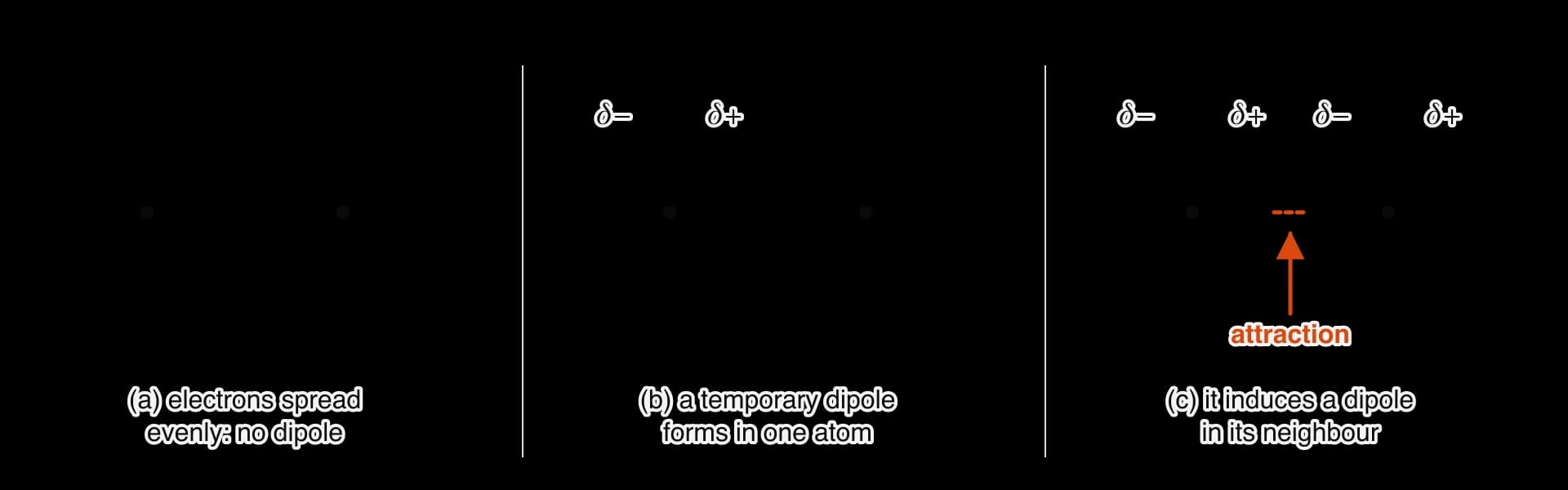
The electrons in an atom or molecule are always moving. At any instant they may be spread a little unevenly, making one side slightly negative and the other slightly positive: a temporary dipole (an instantaneous dipole). This dipole repels electrons in a neighbouring particle and creates an induced dipole in it, with opposite charges facing. The two dipoles attract. A moment later the electrons have moved and the dipoles have changed, but neighbouring dipoles keep forming in step, so on average there is a net attraction.
 YouTube
London (dispersion) forces are the only forces between non-polar molecules such as , , and , and between the atoms of the noble gases. Their strength depends on two things:
The number of electrons. A particle with more electrons, usually a larger molar mass, has a larger, more easily distorted electron cloud (it is more polarizable), so larger temporary dipoles form. Down group 17 the boiling points rise from fluorine () and chlorine (), which are gases, to bromine (), a liquid, and iodine (), a solid at room temperature.
The shape of the molecule. Long, straight molecules can lie alongside each other and touch over a large surface area; compact, branched molecules touch over a smaller area, so the forces between them are weaker.
London forces between individual molecules are weak, but they add up. A gecko can run up a glass window and hang from a ceiling because each foot carries hundreds of thousands of microscopic hairs, each split into hundreds of even finer tips. Every tip comes so close to the surface that London forces act between them, and the total over millions of contacts is enough to hold the animal's weight. Adhesives and tapes modelled on gecko feet use the same principle.
A polar molecule has a permanent dipole. When it comes close to a non-polar molecule or atom, its charged ends distort the electron cloud of the neighbour and induce a dipole in it, and the two attract. These dipole-induced dipole forces act, for example, between water and oxygen molecules, and help a small amount of oxygen to dissolve in water, the oxygen that fish breathe. They also act between hydrogen chloride and argon atoms in a mixture of the two gases.
Polar molecules have permanent dipoles, and they line up so that the end of one molecule is near the end of the next. The attraction between these permanent dipoles is a dipole–dipole force. It acts in addition to London forces, which act between all molecules.
For molecules with similar numbers of electrons, dipole–dipole forces make a polar substance less volatile than a non-polar one. Propane, (), is non-polar and boils at ; ethanal, (), has a polar group and boils at . Hydrogen cyanide (boiling point ) boils far higher than hydrogen chloride (), although it has a smaller molar mass, because the HCN molecule is much more polar.
The term van der Waals forces is used as a general name for London forces, dipole-induced dipole forces and dipole–dipole forces together. It does not include hydrogen bonding.
When a hydrogen atom is covalently bonded to a very electronegative atom, the bonding pair is pulled strongly away from the hydrogen. Hydrogen has no inner electrons, so its nucleus, a single proton, is left almost exposed with a large charge. This small, strongly positive hydrogen atom is attracted to a lone pair on an electronegative atom of a neighbouring molecule. The result is a hydrogen bond, the strongest type of intermolecular force.

A hydrogen bond is drawn as a dashed line from the hydrogen atom to the lone pair it is attracted to. The three atoms involved, such as O–H···O, lie close to a straight line, because the lone pair points towards the hydrogen atom. Hydrogen bonds form between molecules containing N–H, O–H or H–F bonds: water, ammonia, hydrogen fluoride, alcohols, carboxylic acids, amines and many molecules in living things.
Hydrogen bonds are typically about a tenth as strong as a covalent bond, roughly 5 to compared with for the O–H bond itself, but they are strong enough to change the properties of a substance dramatically.
Water's high boiling point. Water () boils at , while hydrogen sulfide (), with no hydrogen bonding, boils at . Without hydrogen bonding, water would be a gas at room temperature and there would be no liquid oceans.
Ice floats. In ice each water molecule is hydrogen bonded to four others in a tetrahedral arrangement, which holds the molecules in an open lattice with a lot of empty space. When ice melts, some hydrogen bonds break and the molecules pack more closely, so liquid water () is denser than ice (). Ice therefore forms on the top of lakes and insulates the water below, where aquatic life survives the winter.
DNA. The two strands of the DNA double helix are held together by hydrogen bonds between pairs of bases: adenine pairs with thymine through two hydrogen bonds, and guanine with cytosine through three. Each hydrogen bond is weak, so the strands can be separated when DNA is copied, but together millions of them hold the helix firmly.
The definition of a hydrogen bond has changed as experimental techniques have improved. Spectroscopic and diffraction measurements showed similar, weaker attractions involving hydrogen atoms bonded to carbon and acceptor atoms other than N, O or F. In 2011 IUPAC adopted a broader definition: an attraction between a hydrogen atom bonded to an atom more electronegative than hydrogen and an atom or group in the same or another molecule, where there is evidence of bond formation. For most purposes in introductory chemistry, hydrogen bonding is still limited to H bonded to N, O or F.
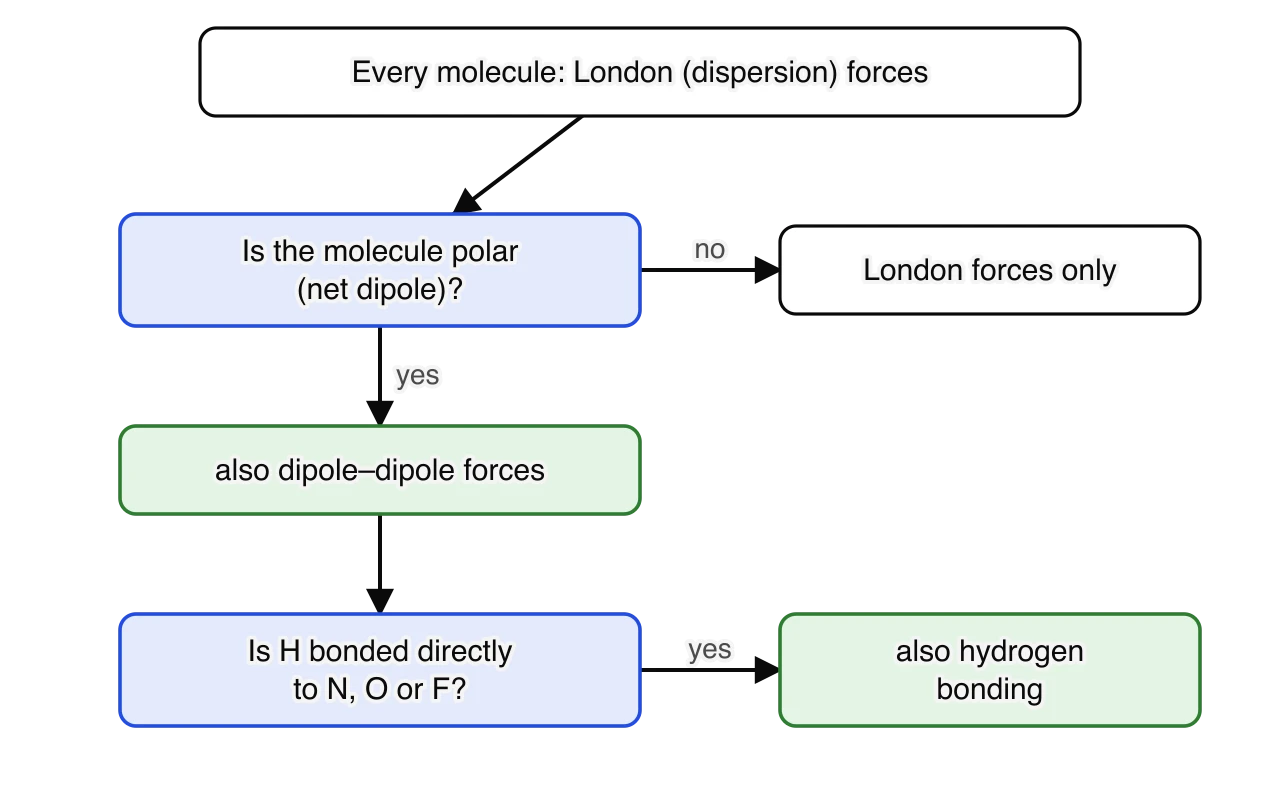
The forces between the molecules of a substance follow from its structure. Every substance has London forces; polar molecules also have dipole–dipole forces; molecules with H bonded to N, O or F also form hydrogen bonds.
Substance | Polar? | H on N, O or F? | Intermolecular forces (strongest last) |
|---|---|---|---|
methane, | no | no | London only |
iodine, | no | no | London only |
propanone, | |||
chloromethane, | yes | no | London, dipole–dipole |
methanol, | yes | yes (O–H) | London, dipole–dipole, hydrogen bonding |
ammonia, | yes | yes (N–H) | London, dipole–dipole, hydrogen bonding |
For molecules of comparable molar mass, the strengths of the intermolecular forces are generally:
All three are much weaker than covalent bonds. The order holds only when the molecules have similar numbers of electrons. London forces grow steadily with molecular size, so for large molecules they can outweigh the dipole–dipole forces or even the hydrogen bonding of much smaller ones. Iodine, held only by London forces between its large, electron-rich molecules, is a solid that boils at , higher than water. A long-chain alkane such as octane () boils higher than methanol ().
Intermolecular forces also explain why real gases do not behave ideally. The ideal gas model assumes no forces between particles; at high pressure and low temperature the particles of a real gas are close enough for these forces to matter, and gases with stronger intermolecular forces, such as ammonia, deviate more than helium or hydrogen.
The properties of a covalent substance follow from its structure. For a covalent network the strong bonds throughout the lattice decide everything. For a molecular substance, the properties that involve separating molecules (melting, boiling, dissolving) depend on the intermolecular forces.
Volatility is the tendency of a substance to evaporate. Molecular substances with weak intermolecular forces are volatile, with low melting and boiling points: many are gases or liquids at room temperature. The stronger the intermolecular forces, the more energy is needed to separate the molecules, and the higher the boiling point. The boiling points of the hydrides of groups 14 to 17 show both effects at once.
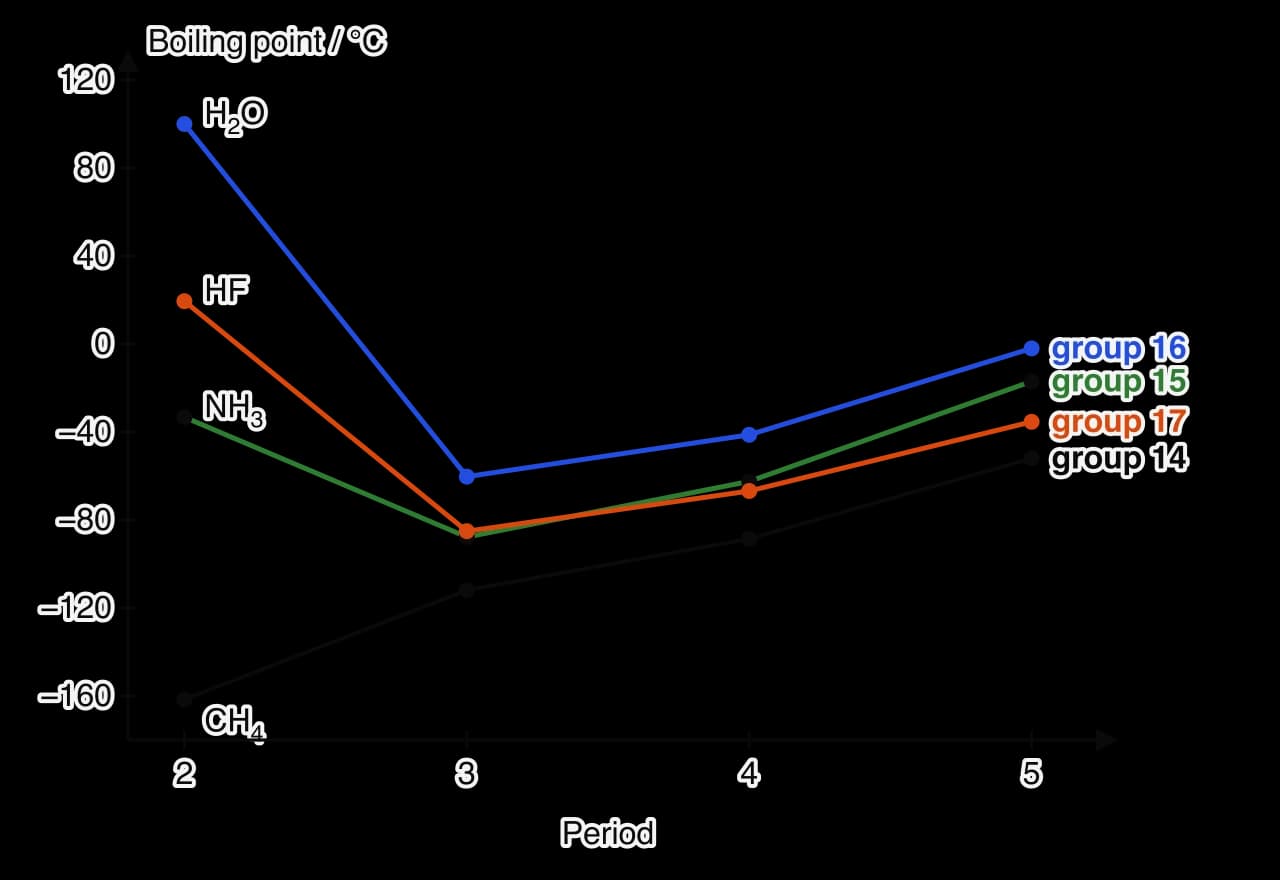
Down each group the hydrides have more electrons, so London forces increase and the boiling point rises, for example . The group 14 hydrides follow this trend all the way from , because their tetrahedral molecules are non-polar. In groups 15, 16 and 17, the first members, , and , boil far higher than the trend predicts: N, O and F are electronegative enough for hydrogen bonding. Water is furthest above the trend, because each molecule has two H atoms and two lone pairs and can form up to four hydrogen bonds, while and are limited by having only one H atom or one lone pair.
When molar masses are similar, London forces are similar too, and the type of polar group decides the order of boiling points. Organic compounds with about – show the full sequence.
Compound | Molar mass / | Strongest intermolecular force | Boiling point / °C |
|---|---|---|---|
butane, | 58.1 | London | −1 |
methoxyethane, | |||
propanal, | |||
propanone, | |||
propan-1-ol, | |||
ethanoic acid, | 60.1 | hydrogen bonding (O–H and C=O) | 118 |
Data: CRC Handbook of Chemistry and Physics (values rounded).
Ethanoic acid boils highest because its group has both an O–H group to donate a hydrogen bond and a oxygen to accept one; pairs of molecules hydrogen bond to each other through both groups, forming dimers even in the vapour. The same pairing explains why the molar mass of benzoic acid measured in a non-polar solvent such as hexane comes out at about twice its true value: the molecules exist there as hydrogen-bonded pairs.
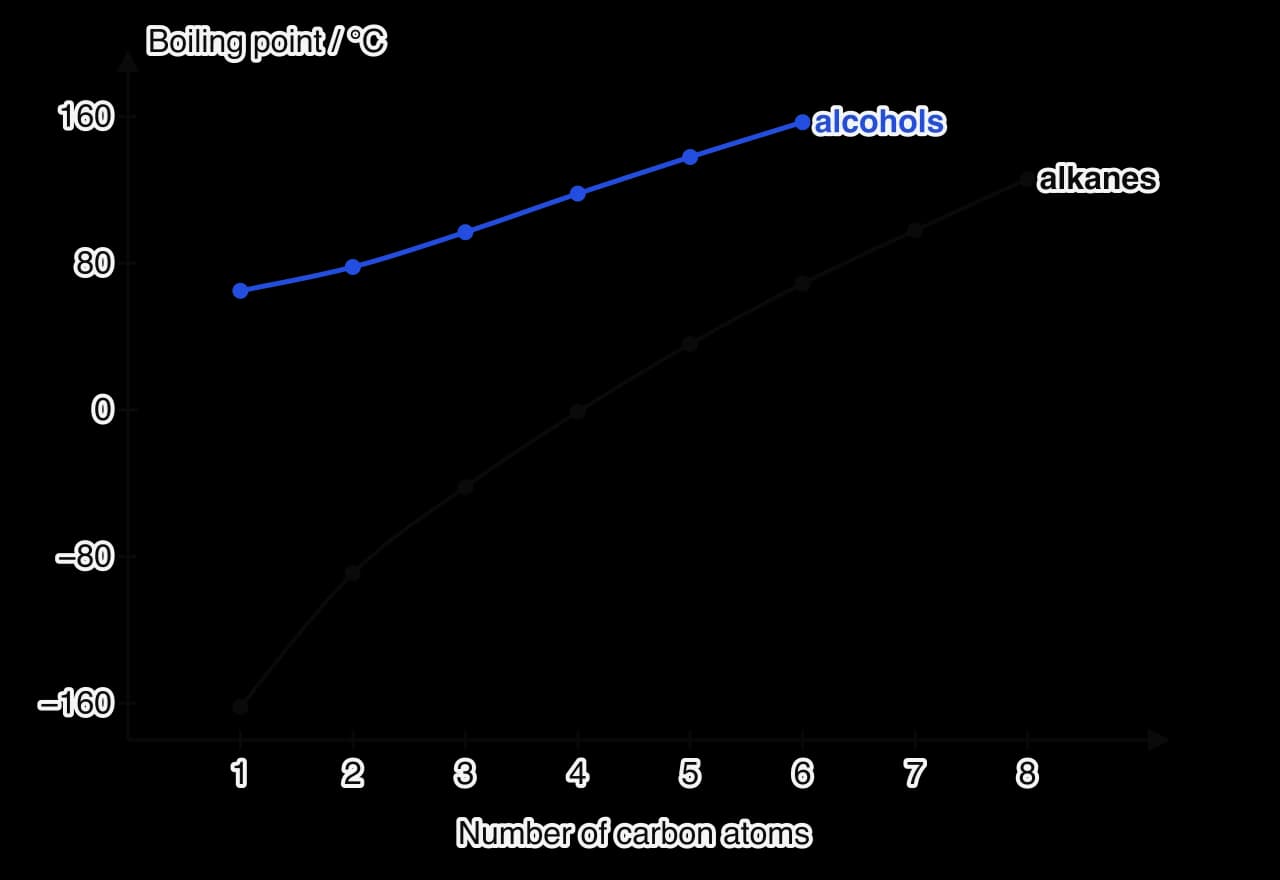
Within a homologous series each extra group adds electrons and surface area, so London forces increase and the boiling point rises steadily. Alcohols boil far higher than alkanes of the same chain length because of hydrogen bonding through the –OH group, but the difference becomes proportionally smaller as the chain grows and the London forces of the hydrocarbon part become more important.
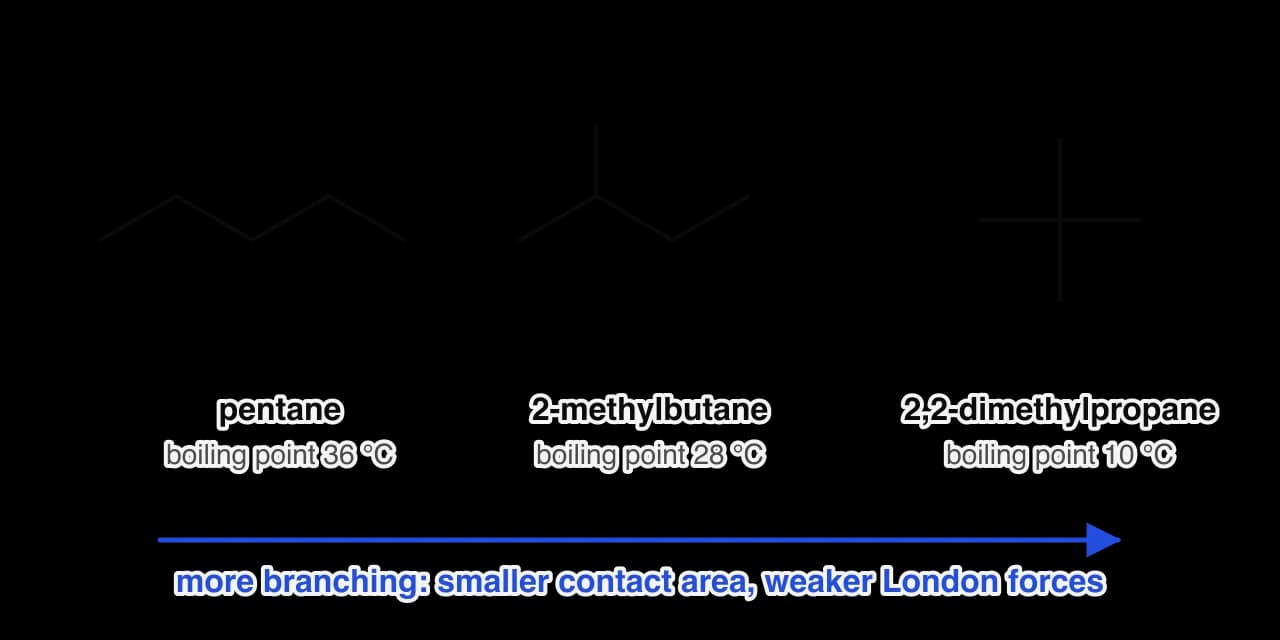
Isomers have the same molar mass, so differences in their boiling points come from shape. The three isomers of are all non-polar alkanes with only London forces between their molecules. The straight-chain isomer, pentane, can lie alongside its neighbours over its whole length. The more branched the molecule, the more nearly spherical it is, the smaller its area of contact with neighbouring molecules, and the weaker the London forces.
A substance conducts electricity when it contains charged particles that are free to move: delocalized electrons or mobile ions.
Molecular substances do not conduct in any state. Their molecules are uncharged, and all their electrons are held in bonds or lone pairs within each molecule. Pure water, ethanol, sugar and solid iodine are non-conductors.
Some molecular substances react with water to form ions, and their solutions conduct. Hydrogen chloride gas does not conduct, but its solution in water, hydrochloric acid, conducts well because ionizes completely to and ions. Ethanoic acid ionizes only slightly, so its solution conducts weakly, a difference explained by the strengths of acids.
Covalent networks do not conduct, with two exceptions: graphite and graphene conduct because of their delocalized electrons. Silicon is a semiconductor, conducting slightly at room temperature and better as it gets warmer.
A substance dissolves when the attractions between its particles and the solvent molecules can replace the attractions that hold the particles together and that hold the solvent molecules together. Dissolving is favoured when the solute and the solvent form similar kinds of intermolecular force. This is often summarized as "like dissolves like", but an explanation must name the forces involved.
Polar substances that can form hydrogen bonds dissolve in water. Short-chain alcohols, carboxylic acids, amines and sugars all dissolve, because their –OH, –COOH or groups form hydrogen bonds with water molecules. Methanol, ethanol and propan-1-ol mix with water in any proportion: they are miscible.
Non-polar substances dissolve in non-polar solvents. Iodine and fats dissolve in hexane, because they form London forces with the hexane molecules similar to those they break. Iodine dissolves only slightly in water: its non-polar molecules cannot form hydrogen bonds with water and cannot make up for the hydrogen bonds between water molecules that they would break apart.
Covalent networks are insoluble in every solvent. Dissolving diamond or quartz would mean breaking strong covalent bonds, which no attraction to a solvent can repay.
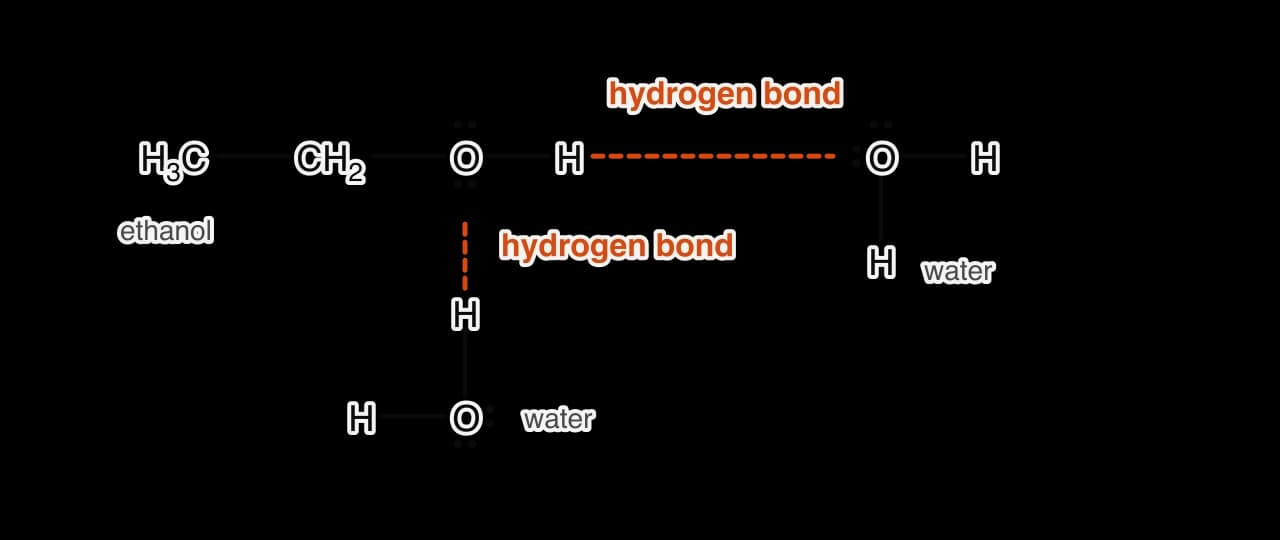
In a homologous series, solubility in water falls as the non-polar hydrocarbon chain gets longer. The –OH group of an alcohol forms hydrogen bonds with water, but the hydrocarbon chain cannot; it only disrupts the hydrogen bonding between water molecules. As the chain lengthens, this effect wins. At about 8 g of butan-1-ol dissolves in of water, about 2 g of pentan-1-ol and less than 1 g of hexan-1-ol, while the first three alcohols are miscible.
The same reasoning explains the difference between water-soluble and fat-soluble vitamins. Vitamin C (ascorbic acid) is a small molecule with several –OH groups, which form hydrogen bonds with water, so it dissolves in water and is not stored in the body. Vitamin A (retinol) has only one –OH group on a long non-polar hydrocarbon chain; it forms London forces with fat molecules, dissolves in fats and is stored in fatty tissue.
Experimental data distinguish the main types of structure: a melting-point measurement, a conductivity test of the solid, the melt and any solution, and solubility tests in water and in a non-polar solvent such as hexane. Each type of structure gives its own pattern of results.
Property | Molecular covalent | Covalent network | Ionic | Metallic |
|---|---|---|---|---|
Particles and bonding | molecules; strong bonds within, weak forces between | atoms joined by covalent bonds throughout | positive and negative ions; ionic bonds | cations and delocalized electrons |
Melting point | low | very high | high | usually high |
Electrical conductivity | none (some solutions conduct after reacting with water) | none, except graphite and graphene | only when molten or dissolved | good, solid and liquid |
Solubility in water | polar and hydrogen-bonding molecules dissolve; non-polar do not | insoluble | many dissolve | insoluble (some react) |
Examples | , , , | diamond, graphite, , | , | , |
Chromatography separates and identifies the components of a mixture, even when only tiny amounts are present. It is used to identify the dyes in inks and foods, check the purity of medicines, detect drugs in blood and urine, and follow the progress of a reaction in the laboratory. The separations depend on intermolecular forces between the components and the two phases.
Every form of chromatography uses two phases. The stationary phase does not move; the mobile phase, a liquid or gas, moves through or over it and carries the mixture with it. Each component is attracted to both phases and spends part of its time held by the stationary phase and part carried by the mobile phase. A component that is more strongly attracted to the mobile phase (more soluble in it) spends more time moving and travels further. A component more strongly attracted to the stationary phase lags behind. Because different substances form different intermolecular forces with the two phases, they travel different distances and separate.
Paper chromatography | Thin-layer chromatography (TLC) | |
|---|---|---|
Stationary phase | water held in the cellulose fibres of the paper (the cellulose itself is also very polar) | a thin layer of silica, , or alumina, , on a glass, plastic or aluminium sheet |
Mobile phase | a solvent (the eluent) that rises up the paper by capillary action | a solvent that rises through the layer |
Comparison | cheap and simple; slower; spots spread more | faster; sharper spots and better separation; works well for components of different polarity |
The surface of silica is covered with –OH groups, so it is very polar and can form hydrogen bonds. When a fairly non-polar solvent is used, polar components are held strongly by the silica and move little, while non-polar components dissolve well in the solvent and move far. Changing to a more polar solvent carries polar components further. Choosing the solvent is therefore the way to improve a separation.
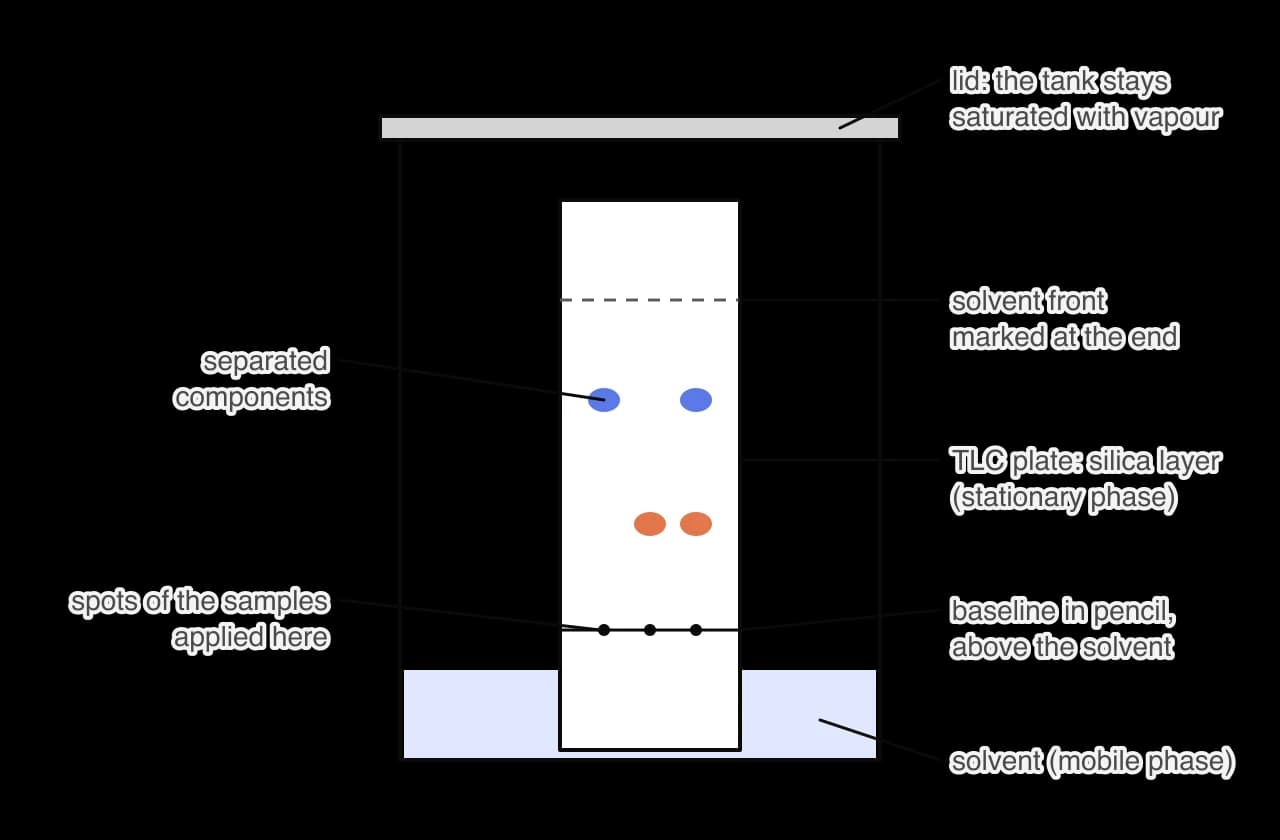
Draw a baseline (origin) in pencil about 1–2 cm from the bottom of the paper or plate. Pencil is graphite, which does not dissolve in the solvent or move up the plate; ink would separate along with the samples.
Use a capillary tube to put a small, concentrated spot of each sample on the baseline, letting each spot dry and adding more to the same place if needed. Small spots give sharp, separate results.
Stand the paper or plate in a container holding a shallow layer of solvent, with the solvent level below the baseline, so the spots are not washed off into the solvent. Cover the container with a lid so that the air inside is saturated with solvent vapour and the solvent does not evaporate from the plate.
Let the solvent rise until it is close to the top. Remove the plate and immediately mark the solvent front in pencil before the solvent evaporates.
Dry the plate and mark the centre of each spot. Coloured substances, such as dyes and plant pigments, are visible directly; colourless ones are made visible by other methods.
The distance a component travels depends on how far the solvent went, so results are compared using a ratio rather than a raw distance.
The retardation factor has no units and lies between 0 (the component stays on the baseline) and 1 (it moves with the solvent front). Under the same conditions (the same stationary phase, the same solvent and the same temperature) each substance has its own value, so values can be used to identify components.
Number of components. Each spot is at least one substance. A mixture gives several spots; a pure substance gives one.
Identification. A spot is identified by comparison with known substances run under the same conditions, preferably on the same plate. A sample and a standard with the same , or a single spot when the two are applied on top of each other ("co-spotting"), are probably the same substance.
Limits. Two different substances can have the same in one solvent, so a single spot does not prove purity. Running the chromatogram again with a different solvent usually separates them.
Polarity. On silica or paper with a non-polar solvent, more polar components have lower values, because they are held more strongly by the polar stationary phase. Changing the solvent changes every value, which is why the solvent must be stated with each value.
The pigments of green leaves are a classic separation. An extract of leaves ground with propanone, run on a TLC plate in a non-polar solvent mixture, separates into several coloured bands. Carotene, a hydrocarbon with no polar groups, has an close to 1, while the chlorophylls and xanthophylls, whose molecules contain oxygen atoms, are held more strongly by the silica and travel less far.
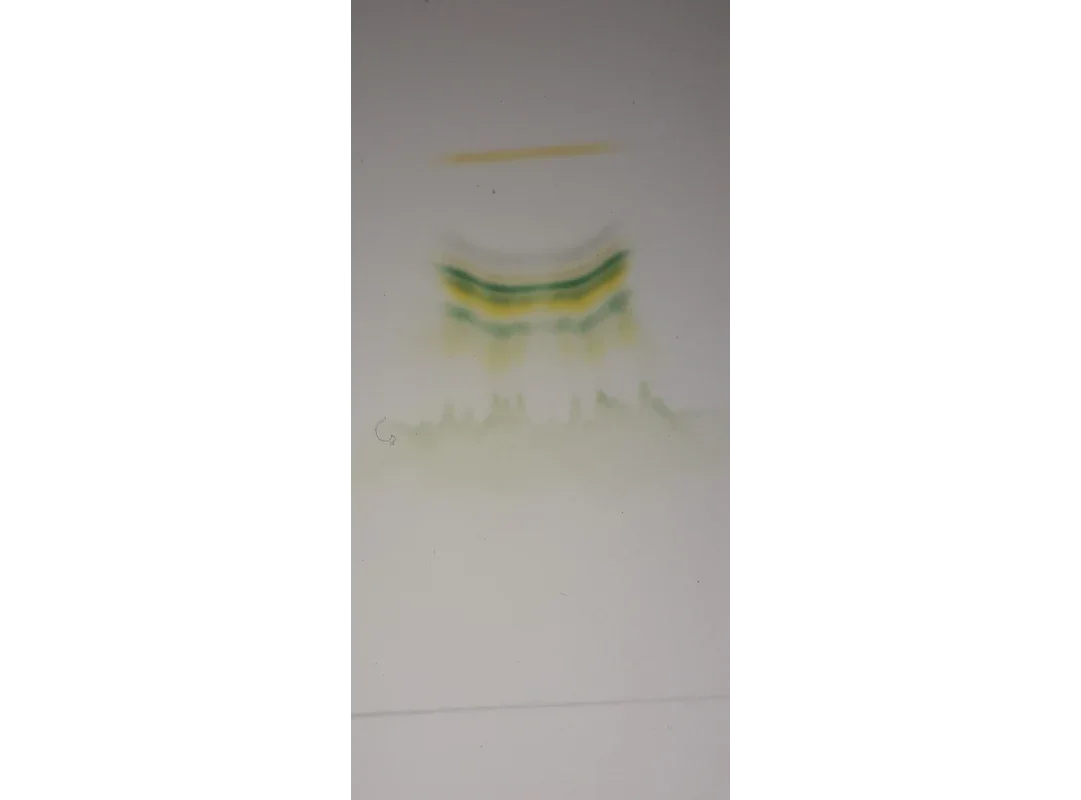
Gas chromatography (GC) and high-performance liquid chromatography (HPLC) use the same principle in instruments: the mobile phase is a gas or a liquid pumped through a narrow column packed with the stationary phase, and components are detected as they come out. They separate and measure very small amounts and are used in drug testing, food analysis and forensic science.
Transition element ions are small and highly charged, and they have empty orbitals of suitable energy. Molecules and ions with a lone pair, such as water, ammonia, chloride ions and cyanide ions, are attracted to them and donate that lone pair into an empty orbital on the metal ion. This is the same donor–acceptor bonding as in the ammonium ion, repeated several times around one metal ion.
The number of coordination bonds to the central ion is its coordination number. Six is the most common, and six ligands are arranged octahedrally around the metal ion, with every neighbouring pair of ligands at 90°. Four ligands give either a tetrahedral or a square planar complex. In the hexaamminecobalt(III) ion, , each ammonia molecule bonds to the cobalt(III) ion through the lone pair on its nitrogen atom.
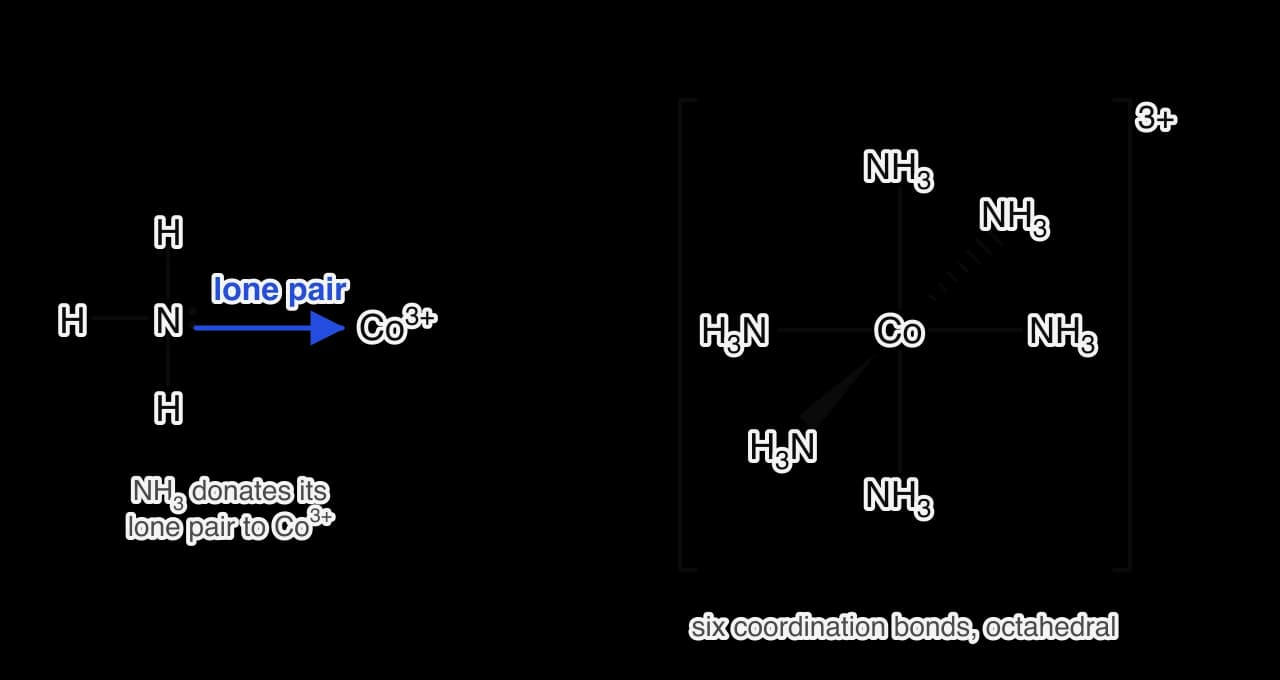
A complex ion is written in square brackets, with the metal first and the charge of the whole ion outside. The charge of the complex is the charge of the metal ion plus the charges of the ligands. Neutral ligands such as and add nothing, while each anionic ligand such as or adds −1:
: with six neutral water ligands, charge 2+ (the blue ion in copper(II) sulfate solution);
:
:
The ligand always supplies both electrons, so every metal–ligand bond in a complex is a coordination bond. In cyanide the donor atom is carbon, which carries a lone pair in the Lewis formula . The anticancer drug cisplatin, , is a neutral complex: a platinum(II) ion bonded to two ammonia ligands and two chloride ligands, which together cancel the 2+ charge of the metal.
Forming a complex is a reaction between an electron-pair donor (the ligand, a Lewis base) and an electron-pair acceptor (the metal ion, a Lewis acid), so every coordination bond can be seen as the product of a Lewis acid–base reaction. The colours of transition element complexes and the reasons these elements form so many of them belong to the chemistry of the transition elements.
Boron and beryllium compounds have fewer than eight electrons around the central atom. Many compounds of heavier non-metals break the octet rule in the other direction. In phosphorus pentachloride, , phosphorus forms five P–Cl bonds and so has ten electrons in its valence shell; in sulfur hexafluoride, , sulfur has twelve. Such a central atom has an expanded octet.
The second shell () has only one s orbital and three p orbitals, so it can hold at most eight electrons. Nitrogen, oxygen and fluorine therefore never have more than eight valence electrons. From period 3 onwards the valence shell also contains d orbitals ( has 3s, 3p and 3d), which are empty in phosphorus, sulfur and chlorine but close enough in energy to be used. In a simple model, these d orbitals allow the atom to accommodate extra electron pairs.
Atomic size matters as well. A phosphorus or sulfur atom is larger than a nitrogen or oxygen atom, so five or six other atoms can fit around it without the bonded atoms crowding each other. Expanded octets are most common when the outer atoms are small and very electronegative, such as fluorine, chlorine and oxygen. This explains pairs such as these:
Period 2 atom (octet only) | Period 3 or later atom (can expand) |
|---|---|
exists; does not | and |
exists; | |
forms only one bond (, ) |
The xenon fluorides, , and , are expanded-octet species too, as is the oxide . In each, xenon keeps its own eight valence electrons and gains a share of further electrons from the bonded atoms, so its valence shell holds ten, twelve or more.
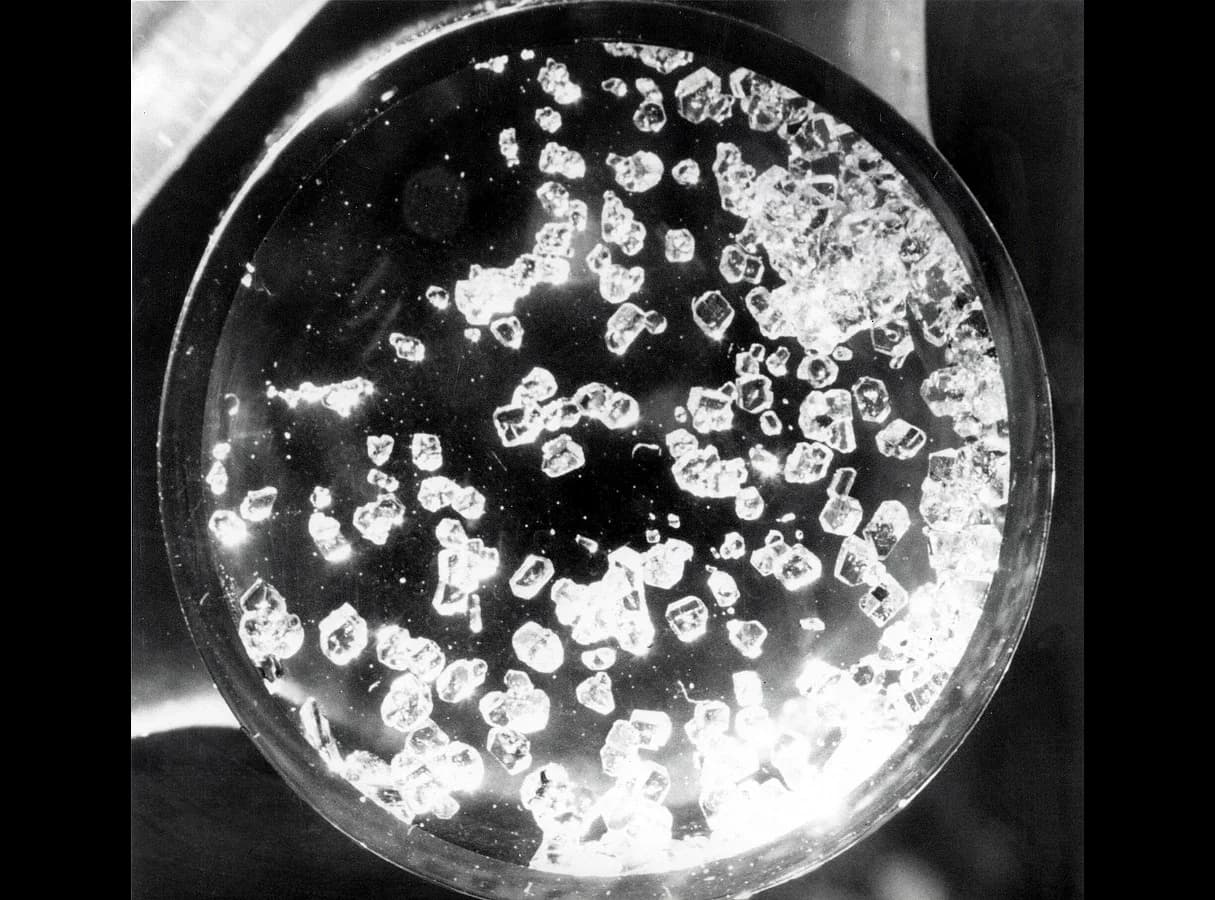
The idea that period 3 atoms use empty d orbitals to hold extra electron pairs is a simple model. Modern calculations suggest that the 3d orbitals contribute much less to the bonding in molecules such as than the model implies; the bonding is better described as electron density spread over all the bonds, with large partial positive charge on the central atom and partial negative charge on the fluorine atoms.
The model is still useful. It predicts correctly which elements form these compounds (period 3 and beyond, mostly with fluorine, chlorine and oxygen), and VSEPR, applied to the Lewis formulas it gives, predicts the observed shapes. Chemists keep it for these predictions while recognizing that it does not describe the electron distribution accurately.
The method is the same as for any Lewis formula, except that the central atom may finish with more than eight electrons:
Count the total number of valence electrons, adding one for each negative charge and subtracting one for each positive charge.
Put the least electronegative atom in the centre (never hydrogen or fluorine) and join each outer atom to it with a single bond.
Complete the octet of every outer atom with lone pairs.
Place any electrons that remain on the central atom as lone pairs, even if this takes it beyond eight.
Five electron domains around a central atom repel each other to the arrangement that keeps them furthest apart, a trigonal bipyramid: three domains around the middle at 120° to each other, and one above and one below at 90° to the middle three. Unlike the tetrahedron, its positions are not all equivalent.
The two axial positions lie on the vertical axis, 180° apart. Each has three neighbouring domains at 90°.
The three equatorial positions lie in a plane around the centre. Each has only two neighbouring domains at 90°, and two at 120°.
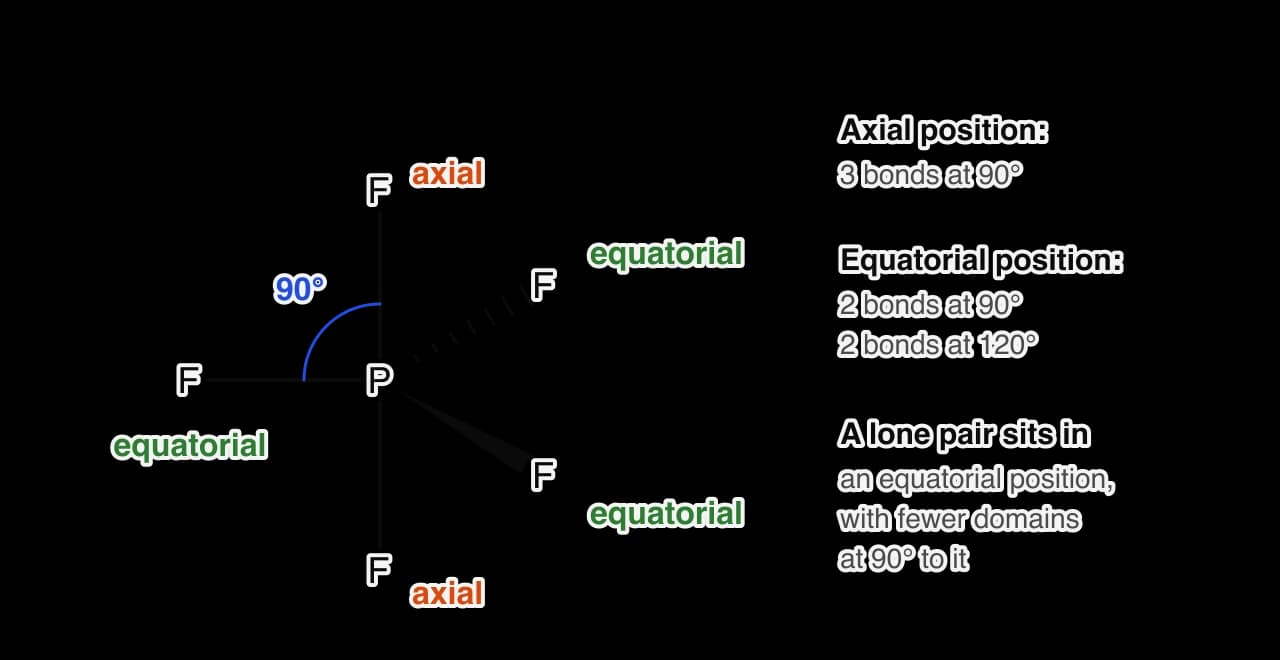
Repulsion between electron domains falls off very steeply with distance, so the repulsions between domains at 90° dominate. A lone pair is held closer to the central atom and repels more strongly than a bonding pair, so it takes the position with the fewest neighbours at 90°: an equatorial position. Lone pairs in a trigonal bipyramidal arrangement are therefore always equatorial, and this fixes the molecular geometry when one, two or three domains are lone pairs.
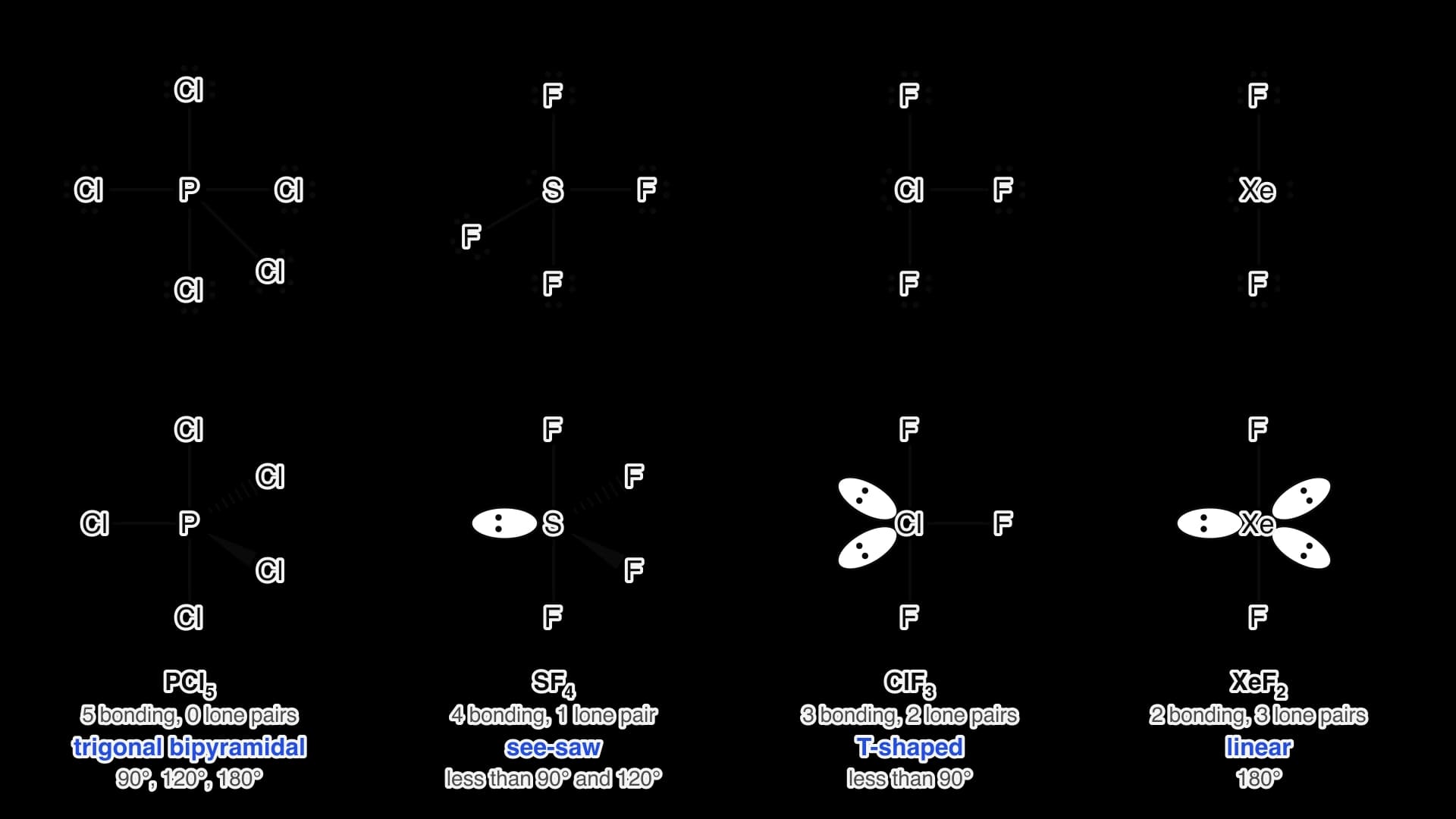
Bonding domains + lone pairs | Molecular geometry | Bond angles | Examples |
|---|---|---|---|
5 + 0 | trigonal bipyramidal | 90°, 120° and 180° | , |
4 + 1 | see-saw (distorted tetrahedral) | less than 90° and less than 120° | , |
3 + 2 | T-shaped | less than 90° | , |
2 + 3 | linear | 180° | , |
The see-saw shape of comes from one equatorial lone pair. It pushes the two axial S–F bonds away from it, so the axial F–S–F angle is about 173° instead of 180°, and it squeezes the two equatorial bonds together to about 102° instead of 120°. In the T-shaped molecule two equatorial lone pairs leave the three fluorine atoms in a T, with F–Cl–F angles of about 87.5°, just under 90°. In all three equatorial positions are lone pairs, so the two fluorine atoms are axial and the molecule is exactly linear.
Six electron domains point to the corners of an octahedron: four in a square around the middle and one above and one below, with every pair of neighbouring domains at 90°. All six positions are equivalent, so the first lone pair can go anywhere. A second lone pair goes opposite the first, at 180°, where the two lone pairs repel each other least.
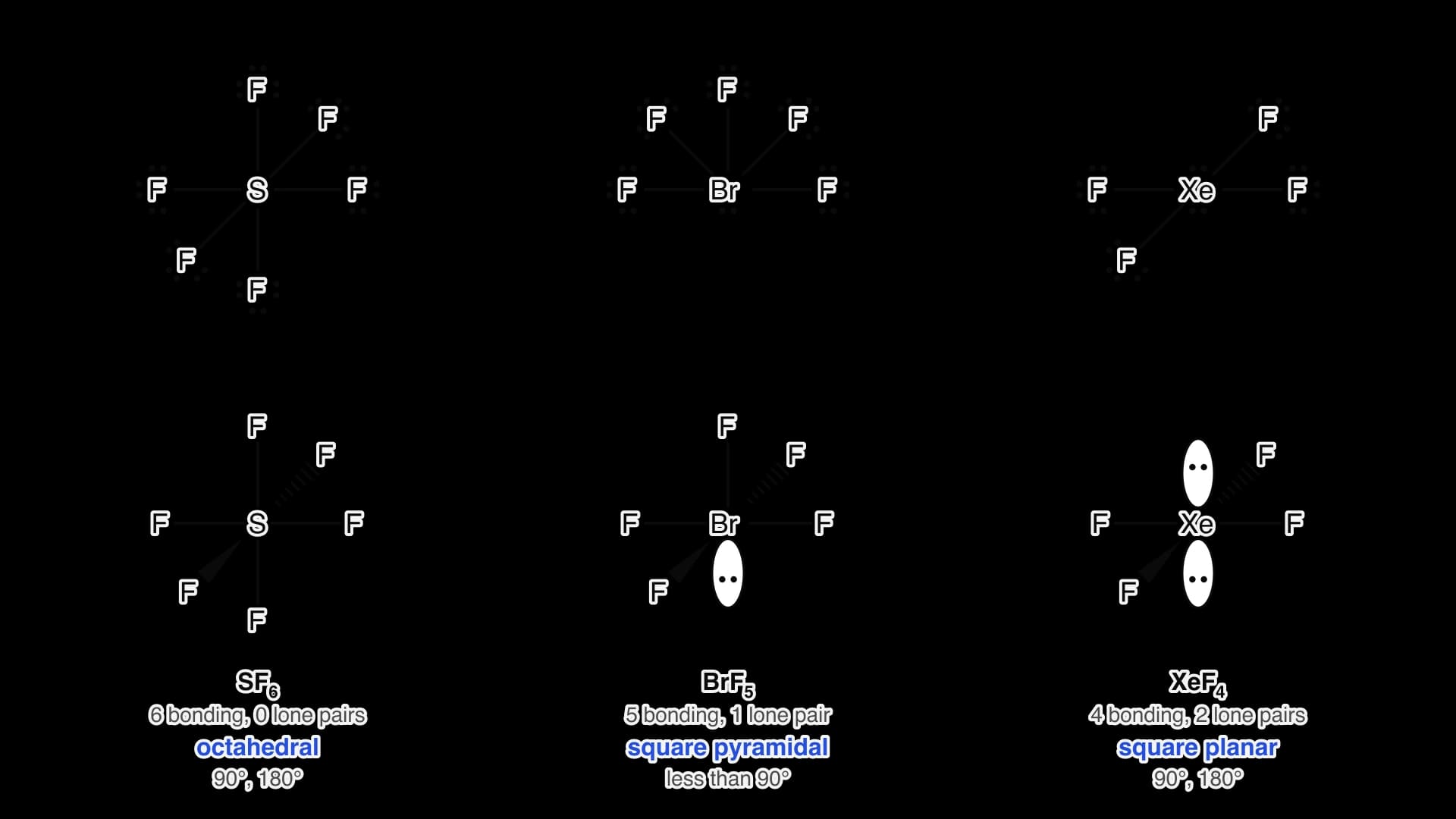
Bonding domains + lone pairs | Molecular geometry | Bond angles | Examples |
|---|---|---|---|
6 + 0 | octahedral | 90° and 180° | , , |
5 + 1 | square pyramidal | less than 90° | , |
4 + 2 | square planar | 90° and 180° | , |
In the square pyramidal molecule the lone pair below the bromine atom pushes the four basal fluorine atoms slightly upwards, so the angle between the apical and basal bonds is about 85°, a little less than 90°. In the square planar molecule the two lone pairs are opposite each other, their effects cancel, and the four F–Xe–F angles are exactly 90°.
Sulfur hexafluoride is a dense, colourless and very unreactive gas, and an excellent electrical insulator. About 80% of the world's is used in high-voltage switchgear in electricity networks. The six fluorine atoms surround the sulfur atom so completely that there is no easy route for other molecules to attack it. The same stability makes the most potent greenhouse gas assessed by the IPCC. Its atmospheric lifetime is about 3200 years, and over 100 years one kilogram traps about 25 200 times as much heat as one kilogram of carbon dioxide.
The same rules apply to ions and to molecules with double bonds; a double bond still counts as one electron domain. Two contrasting examples:
: xenon forms four Xe=O double bonds, which use all eight of its valence electrons. Four domains and no lone pairs make it tetrahedral, even though xenon has an expanded octet (16 electrons).
and : in the cation, domains give a tetrahedron; in the anion, domains give an octahedron. Solid phosphorus pentachloride is in fact made of these two ions, , while gaseous consists of trigonal bipyramidal molecules.
Molecular polarity follows the same reasoning as for smaller molecules: polar bonds arranged symmetrically, with identical outer atoms and no asymmetric lone pairs, cancel. , , and are non-polar. , and are polar, because the lone pairs make their shapes unsymmetrical and the bond dipoles do not cancel.
Changing one outer atom also breaks the symmetry. In the shape is still trigonal bipyramidal, but the P–F bond is more polar than the P–Cl bonds (fluorine is more electronegative than chlorine), so the bond dipoles no longer cancel and the molecule is polar.
For many species more than one valid Lewis formula can be drawn. Carbon dioxide could be or , and the sulfate ion can be drawn with four S–O single bonds or with two of them double. All of these contain the right number of electrons, but the real species is best described by one of them. Formal charge gives a simple way to decide which.
Because each bond contains two electrons, is simply the number of bonds to the atom, counting a double bond as two and a triple bond as three. An equivalent form is therefore:
The formal charges of all the atoms in a species always add up to the charge on the species: zero for a molecule, −2 for the sulfate ion. This is a useful check on the arithmetic.
A Lewis formula in which charge is separated (positive on one atom, negative on another) is higher in energy than one without separation. The preferred Lewis formula is therefore the one that:
has formal charges closest to zero (the smallest values, and the fewest atoms with a non-zero formal charge);
if two structures are equally good by the first rule, has any negative formal charge on the most electronegative atom.
Formal charge also explains why some species are best drawn with an expanded octet. In the sulfate ion the octet structure puts +2 on sulfur and −1 on every oxygen atom. Moving lone pairs from two oxygen atoms into S=O double bonds reduces the charge on sulfur to zero and leaves −1 on only two oxygen atoms, so the expanded-octet structure is preferred.
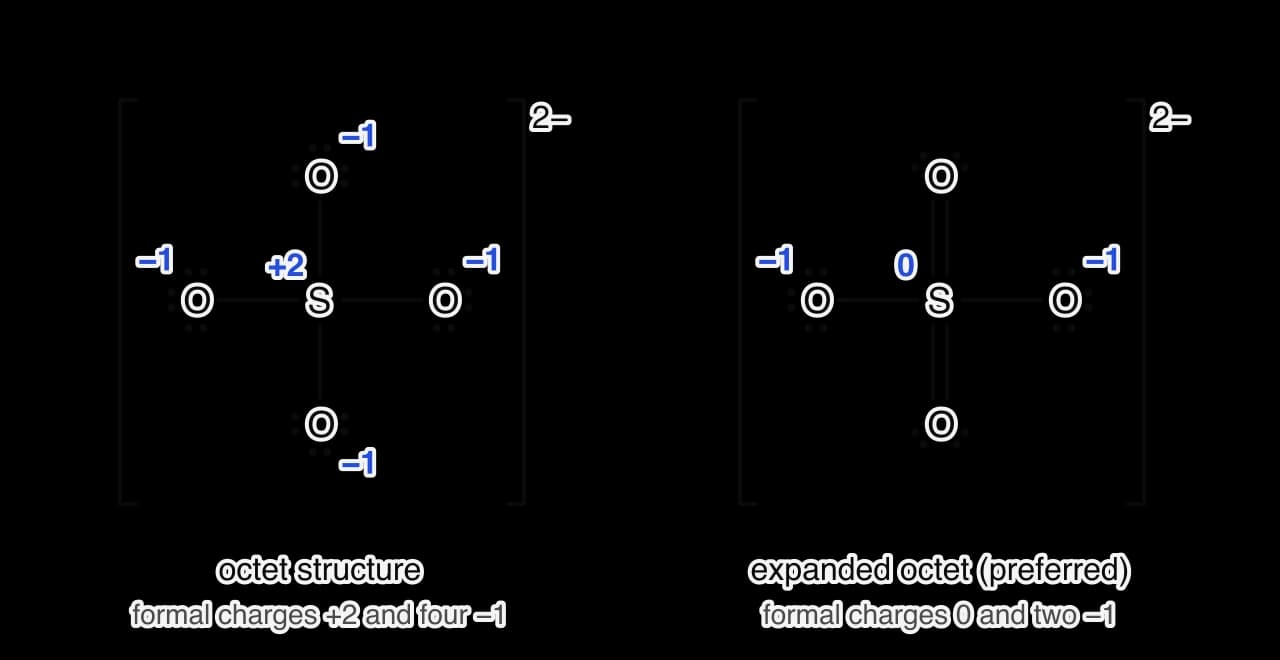
The same argument applies to , and : the structures with S=O or P=O double bonds have smaller formal charges than the octet structures. Both kinds of Lewis formula are valid drawings of these species; formal charge only identifies which one better represents the real distribution of electrons.
Formal charge is a rough guide to the distribution of electrons. For period 2 atoms it is weighed against the octet rule:
Boron trifluoride. Drawing a B=F double bond would give boron an octet but formal charges of −1 on boron and +1 on fluorine, the most electronegative element. The incomplete-octet structure, with three B–F single bonds and all formal charges zero, is preferred.
Carbon monoxide. The only structure that gives both atoms an octet is , with formal charges −1 on carbon and +1 on oxygen, the opposite of what electronegativity suggests. It is still the accepted Lewis formula, and in fact the small dipole moment of has its negative end on carbon.
Period 2 central atoms cannot reduce their formal charges by expanding the octet. In , and nitrogen keeps a formal charge of +1.
Formal charge and oxidation state both assign electrons to individual atoms, but they make opposite assumptions about the bonding electrons, so they usually give different numbers for the same atom.
Formal charge | Oxidation state | |
|---|---|---|
Assumption about each bond | The bonding pair is shared exactly equally (bonds treated as purely covalent) | Both bonding electrons belong to the more electronegative atom (bonds treated as ionic) |
Used for | Choosing between Lewis formulas | Tracking electron transfer in redox reactions and naming compounds |
O in | −2 | |
N in | ||
S in (preferred structure) | 0 | +6 |
Neither number is a real charge. The real distribution of electrons lies between the two extremes: in the hydronium ion the positive charge is spread mainly over the hydrogen atoms, which are less electronegative than oxygen.
A Lewis formula shows where the shared pairs are, but not where the electrons are in space. A more detailed model treats a covalent bond as the overlap of two atomic orbitals, each containing one electron, to give a region of increased electron density between the nuclei. Both nuclei are attracted to this shared pair, which is the electrostatic attraction that holds the atoms together. Orbitals can overlap in two different ways.
Any two orbitals that point at each other can overlap head-on: two s orbitals in , an s orbital and a p orbital in , two p orbitals in , or hybrid orbitals, which are mixtures of s and p orbitals on one atom. Every single bond is a bond. Because the electron density of a bond is symmetrical around the bond axis, rotating one end of the bond does not change the overlap, so there is free rotation about a single bond.
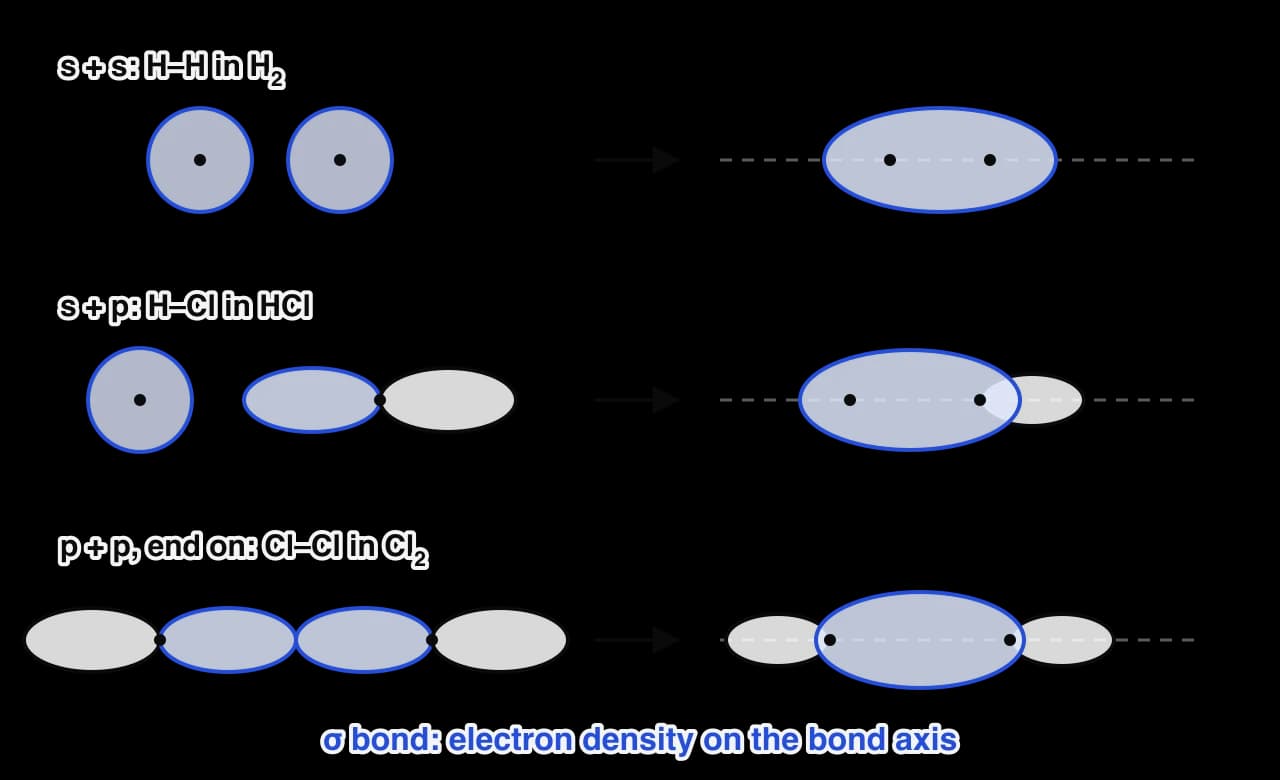
A bond can form only between two atoms already joined by a bond, because the bond holds the atoms close enough for their parallel p orbitals to overlap sideways. In ethene each carbon atom has one p orbital left over at right angles to the plane of the molecule, and these two orbitals overlap above and below the C–C axis. The two lobes together make up one bond containing two electrons.
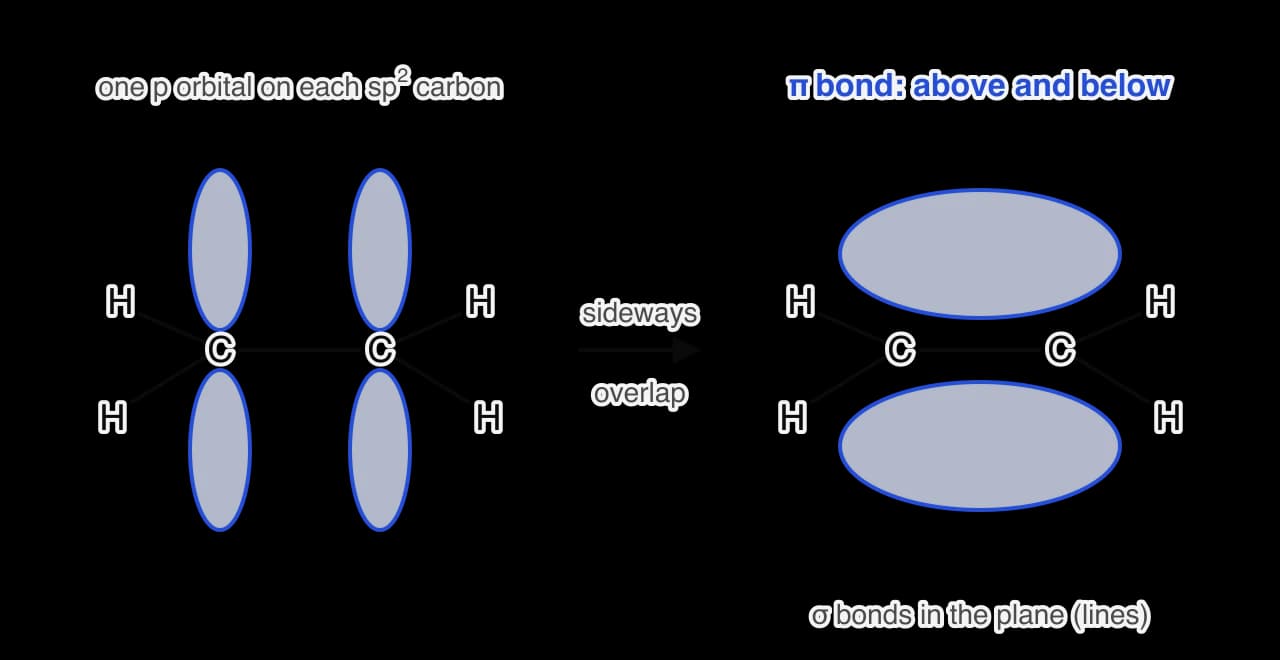
So a double bond is one bond plus one bond, and a triple bond is one bond plus two bonds. In a triple bond, such as the C≡C bond in ethyne or the N≡N bond in nitrogen, the two bonds are at right angles to each other: one formed from p orbitals pointing up and down, the other from p orbitals pointing to the front and back. Together their electron density forms a cylinder around the bond.
Bond | Composition | Example |
|---|---|---|
single | C–C in ethane, C–H, O–H | |
double | C=C in ethene, C=O in propanone | |
triple | C≡C in ethyne, C≡N in , N≡N in |
Sideways overlap of p orbitals is less effective than head-on overlap, so a bond is weaker than a bond between the same two atoms. This is why the C=C bond enthalpy () is less than twice the C–C value (): the second, weaker part of the double bond is its bond, worth only about .
The electrons of a bond are also more exposed, lying above and below the molecule rather than between the nuclei. Electron-deficient species (electrophiles) are attracted to them. This is why alkenes undergo addition reactions: the weaker bond breaks, two new bonds form, and the product is lower in energy.
A bond also prevents rotation. Twisting one end of a C=C bond would turn the two p orbitals away from parallel and break the sideways overlap, which needs roughly the energy of the bond. At room temperature this does not happen, so the groups on each carbon of a C=C bond are fixed in position. This restricted rotation is the origin of cis–trans isomerism in alkenes.
To count the bonds in a molecule, draw its full structural or Lewis formula, including every C–H bond, and apply three rules: each single bond is , each double bond , each triple bond .
Species | bonds | bonds | How |
|---|---|---|---|
1 | 2 | one triple bond | |
2 | 2 | H–C single, C≡N triple | |
2 | 2 | two C=O double bonds | |
(ethene) | 5 | ||
(ethyne) | 3 | ||
(ethanoic acid) | 7 | 1 | three C–H, C–C, C=O, C–O, O–H |
(carbonic acid) | |||
(ethanedioic acid) | 7 | 2 | two O–H, two C–O, C–C, two C=O |
A carbon atom in its ground state has the configuration , with only two unpaired electrons, in two 2p orbitals at 90° to each other. On this basis carbon would form two bonds at 90°. In methane, however, carbon forms four identical C–H bonds pointing to the corners of a tetrahedron, at 109.5°. Two ideas reconcile the atomic orbitals with this shape: promotion and hybridization.
Promotion. One 2s electron moves into the empty 2p orbital, giving and four unpaired electrons. This costs energy, but it is repaid many times over because the atom can now form four bonds instead of two.
Hybridization. The 2s orbital and the three 2p orbitals mix to form four new orbitals of equal energy. Each hybrid orbital has one large lobe, pointing in a definite direction, and the four lobes point to the corners of a tetrahedron.
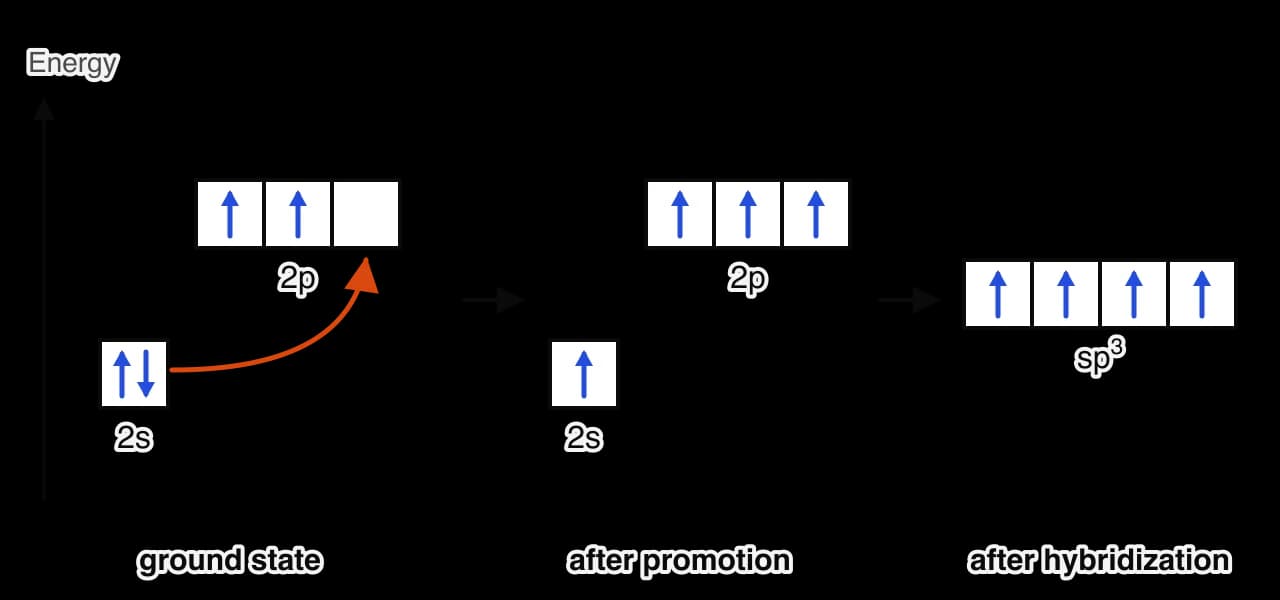
The large single lobe of a hybrid orbital overlaps head-on with an orbital of another atom more effectively than a p orbital can, so hybrid orbitals form strong bonds. Hybrid orbitals also hold lone pairs. They never form bonds: those come from p orbitals that were left out of the mixing.
Carbon (and other period 2 atoms) can mix its 2s orbital with three, two or one of its 2p orbitals. Which happens depends on how many electron domains the atom has.
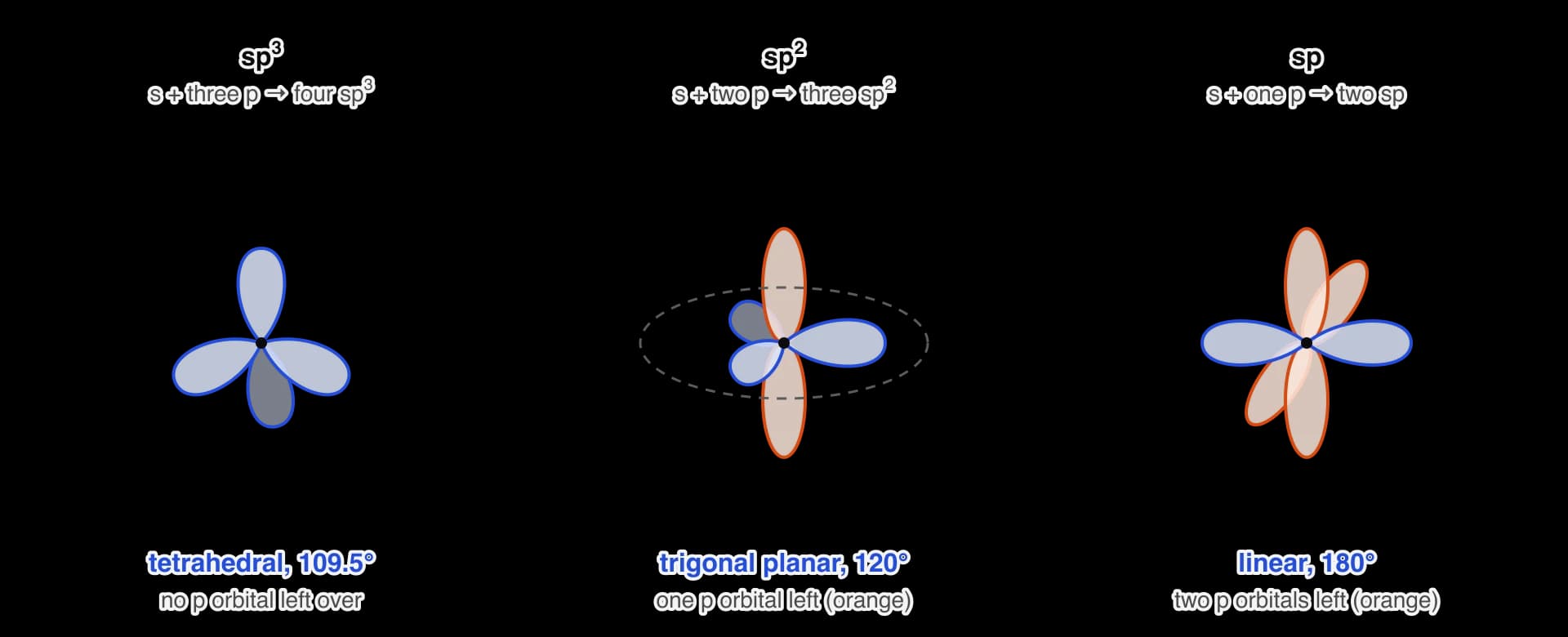
Mixing the s orbital with all three p orbitals gives four hybrid orbitals pointing to the corners of a tetrahedron, 109.5° apart; this is sp³ hybridization. No p orbitals are left, so the atom forms only single () bonds. Every carbon atom in an alkane is , as is every carbon atom in diamond.
Lone pairs occupy hybrid orbitals too. The nitrogen atom in ammonia has three bonding pairs and one lone pair, four domains in total, so it is hybridized; the lone pair sits in the fourth hybrid orbital. The oxygen atom in water (two bonds, two lone pairs) and in alcohols such as methanol is as well. The bond angles of 107° in and 104.5° in are close to the 109.5° of a tetrahedral set of hybrid orbitals, compressed slightly by the lone pairs.
Mixing the s orbital with two p orbitals gives three hybrid orbitals in a plane at 120°, in sp² hybridization. One p orbital is left unhybridized, at right angles to the plane, and it is available to form one bond. Each carbon in ethene is : its three hybrid orbitals form bonds to two hydrogen atoms and to the other carbon, and the remaining p orbitals overlap sideways to form the bond.
The carbon atom of every C=O group (aldehydes, ketones, carboxylic acids, esters) is , and so are the carbon atoms in benzene, graphite and graphene. Inorganic examples include boron in , which has three bonding domains and an empty p orbital, carbon in the carbonate ion and nitrogen in the nitrate ion.
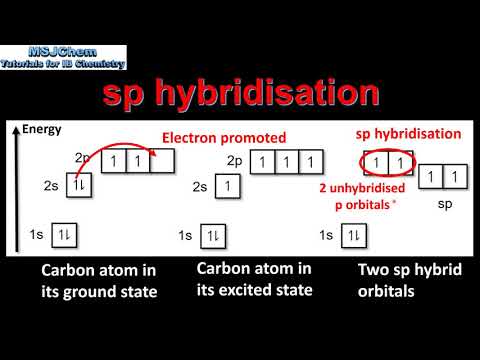
Mixing the s orbital with one p orbital gives two hybrid orbitals pointing in opposite directions, 180° apart, in sp hybridization. Two p orbitals are left, at right angles to each other and to the bond axis, and they can form two bonds. Each carbon in ethyne is : one hybrid orbital bonds to hydrogen and the other to the second carbon, while the two pairs of p orbitals form the two bonds of the triple bond.
The carbon and nitrogen atoms in , the carbon atom in (two double bonds, two domains), the central nitrogen atom in and beryllium in gaseous are also hybridized.
 YouTube
Hybridization does not predict a shape on its own. The shape comes from VSEPR; the hybridization is then the set of orbitals consistent with that shape. The working order is always Lewis formula → number of electron domains (lone pairs included, a multiple bond counted once) → electron domain geometry → hybridization.
Electron domains | Electron domain geometry | Hybridization | Angle between hybrids | Unhybridized p orbitals | Examples |
|---|---|---|---|---|---|
4 | tetrahedral | 109.5° | 0 | C in and diamond; N in , and amines; O in and | |
3 | trigonal planar | 120° | 1 | C in | |
2 | linear | 180° | 2 | C in |
The relationship works in both directions. An atom described as hybridized must have a trigonal planar electron domain geometry with angles of about 120°; an atom with a linear arrangement of domains must be hybridized. Atoms with five or six electron domains are described by their geometry alone, without a hybridization label.
The same reasoning explains the carbon allotropes. In diamond every carbon is and bonded tetrahedrally to four others. In graphite and graphene every carbon is , bonded to three others in a plane, and the unhybridized p orbitals, one per atom, overlap sideways across the whole sheet. The electrons in them are the delocalized electrons that let graphite and graphene conduct electricity.
A single Lewis formula of ozone, , has one O=O double bond and one O–O single bond, which would be different lengths: about and (data booklet). Experiment shows that the two bonds in ozone are identical, both long. The double bond could equally well be drawn on either side, and neither drawing on its own is correct.
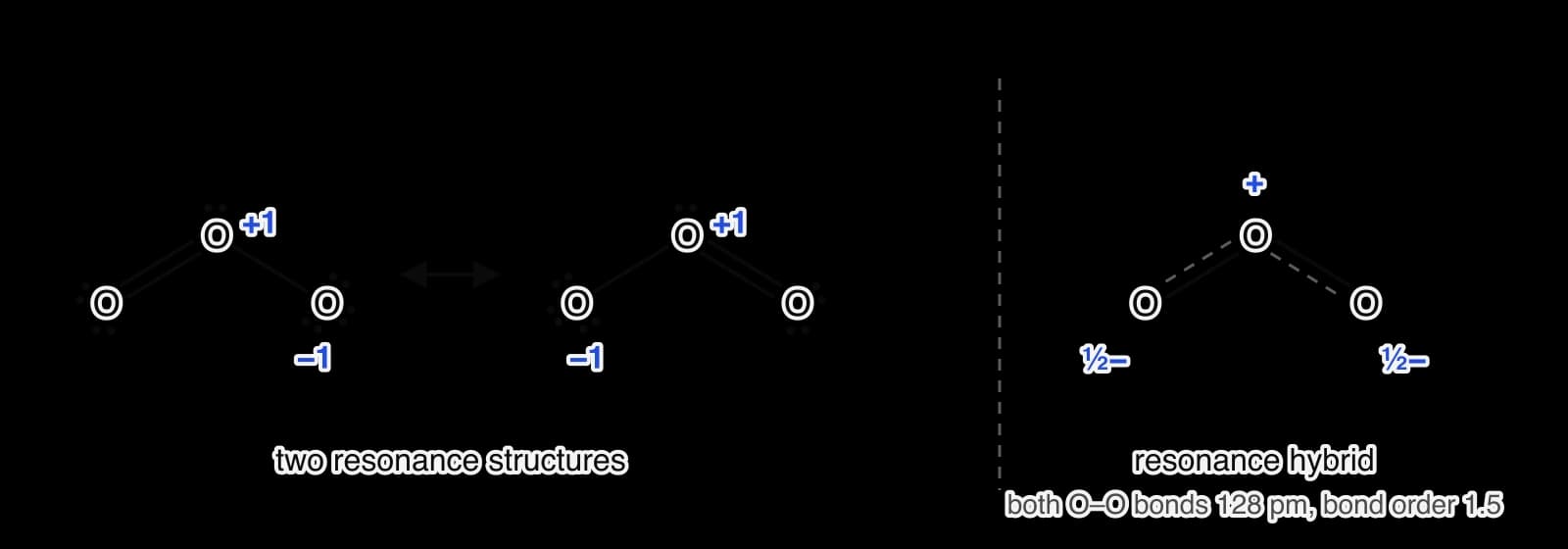
Resonance structures are joined by a double-headed arrow, ↔. The arrow does not mean that the molecule switches back and forth between the two forms: ozone has one structure at all times, in which the electrons of the second bond are spread over both O–O bonds. The individual resonance structures are only a way of describing this with Lewis formulas, which can show electron pairs only between two atoms.
In terms of orbitals, the central oxygen atom in ozone and both end atoms each have a p orbital at right angles to the plane of the molecule. These three p orbitals overlap sideways with each other, so the electrons are not confined between two atoms but spread over all three.
Delocalization spreads electron density and negative charge over a larger region, which lowers the energy of the species. A resonance hybrid is therefore more stable than any one of its resonance structures would be. The extra stability is called the delocalization energy (or resonance energy).
The bond order of a bond is the number of shared electron pairs between the two atoms: 1 for a single bond, 2 for a double bond, 3 for a triple bond. In a resonance hybrid the bond order of each equivalent bond is the total number of bonds shared between those atoms divided by the number of positions:
: 3 bonds over 2 positions, bond order 1.5;
and : 4 bonds over 3 positions, bond order ;
carboxylate ions such as and
benzene: 9 bonds over 6 C–C positions, bond order 1.5.
A bond of intermediate order has an intermediate length and strength, shorter and stronger than the single bond, longer and weaker than the double bond. The measured lengths confirm this:
Species | Bond | Single bond / pm | Double bond / pm | Measured in the hybrid / pm |
|---|---|---|---|---|
O–O | 148 | 121 | 128 | |
C–O | 143 | 122 | about 129 | |
N–O | 136 | 114 | about 125 | |
benzene | C–C | 154 | 134 | 139 |
Single and double bond lengths from the IB Chemistry data booklet (2025); measured values from structural studies of each species.
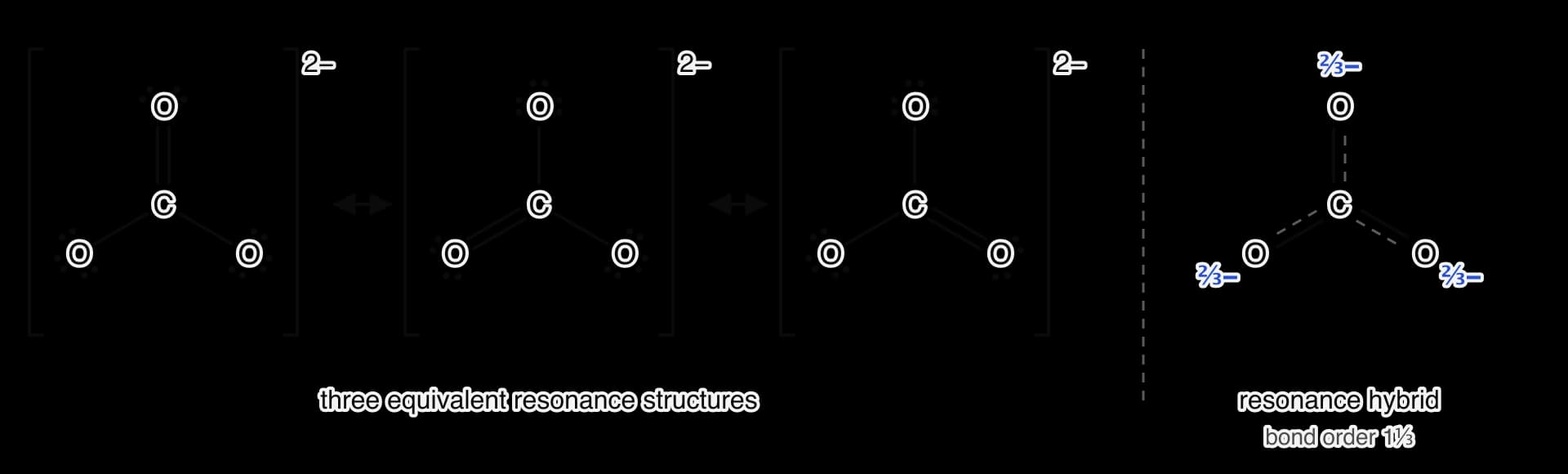
Resonance is possible when a double bond (or a lone pair next to a double bond) could be drawn in more than one position without moving any atom. A practical method:
Draw one valid Lewis formula, with formal charges.
Look for a double bond next to an atom with a lone pair or a negative formal charge, where the double bond could equally be drawn to that atom instead.
Redraw the structure with the double bond moved, keeping every atom and the total number of electrons the same.
Join the structures with ↔. If the structures are equivalent, all the bonds involved become identical in the hybrid.
Species with resonance (delocalized π electrons) | Species without resonance |
|---|---|
, (octet structure), | (only one good Lewis formula) |
, | |
, | |
benzene, phenol, graphite | (methanal), , alkenes with one C=C |
The contrast between a carboxylic acid and its anion is a common case. In methanoic acid, , one oxygen carries the hydrogen atom, so its bond to carbon must be single; moving the double bond to it would give oxygen three bonds and a positive formal charge, an unequal and much less favourable structure. The two C–O bonds therefore stay different (about and ). Removing the proton leaves the methanoate ion, , in which the two oxygen atoms are equivalent: two identical resonance structures, and two identical C–O bonds of about .
The different bond orders in (2) and (1.5) explain why the two molecules absorb different parts of the ultraviolet spectrum in the stratosphere. Breaking a bond needs a photon with at least the bond enthalpy per molecule; the photon energy depends on wavelength through . The weaker bonds in ozone are broken by photons of lower energy, and therefore of longer wavelength, than the double bond in oxygen.
Benzene is a colourless liquid with the molecular formula , the parent compound of the arenes, which include many dyes, drugs and plastics. Its formula has the same number of carbon and hydrogen atoms, so it must be highly unsaturated. In 1865 August Kekulé proposed a ring of six carbon atoms joined by alternating single and double bonds, with one hydrogen atom on each carbon. This Kekulé structure accounts for the formula and the ring, but several properties of benzene do not fit it.
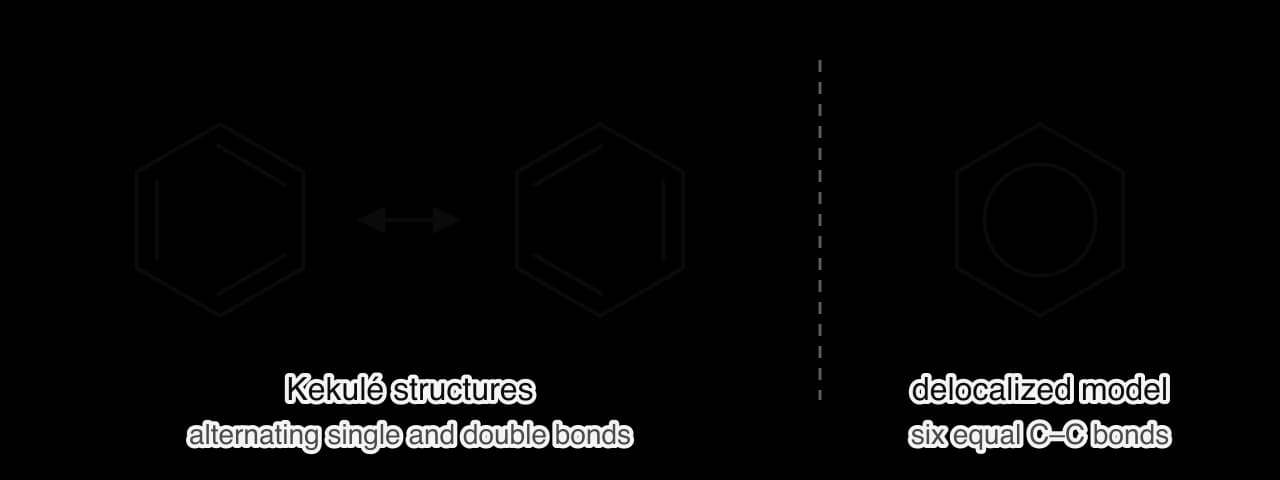
X-ray diffraction of crystalline benzene and its derivatives shows that the molecule is a flat, regular hexagon, with all six C–C bonds the same length, , and all bond angles 120°. A Kekulé structure would have three C–C single bonds () and three C=C double bonds (), giving an irregular hexagon. The measured length lies between the two, as expected for a bond order of 1.5.
Hydrogen adds to a C=C double bond in the presence of a nickel catalyst. For cyclohexene, which has one C=C bond in a six-membered ring, the enthalpy change of hydrogenation is about :
A Kekulé structure with three isolated C=C bonds should release three times as much, about , when converted to cyclohexane. The measured value for benzene is only about :
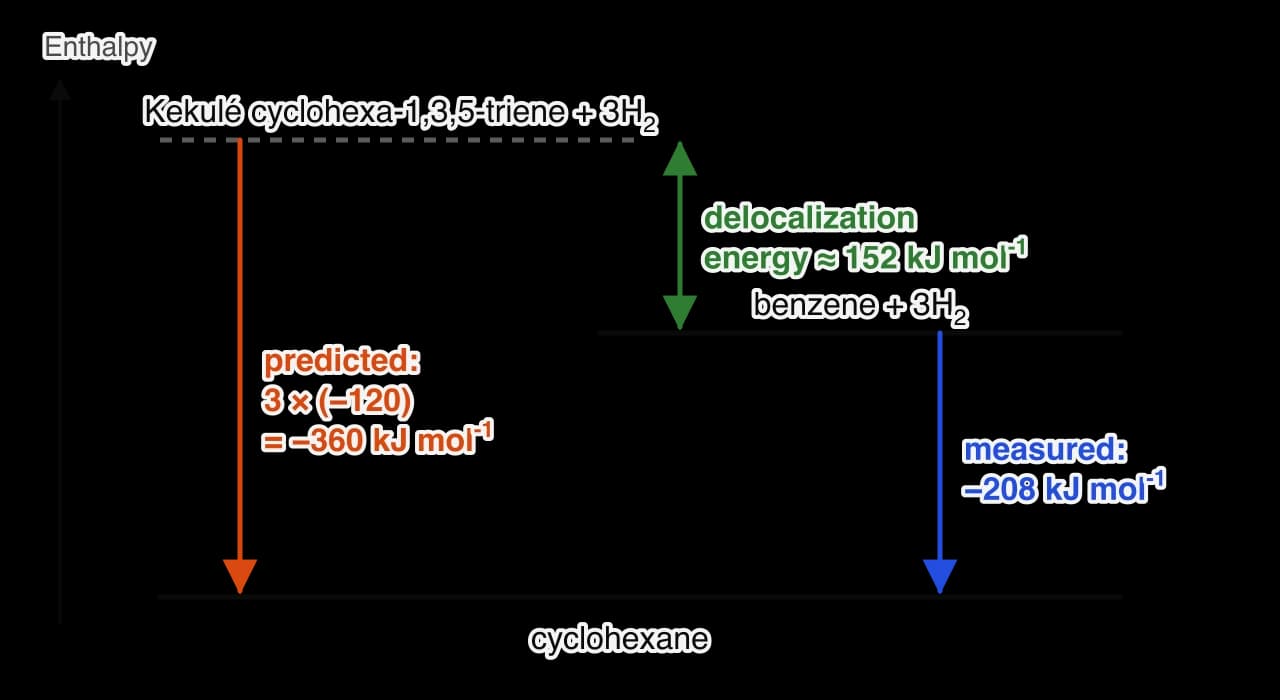
Benzene therefore starts about lower in enthalpy than the Kekulé structure would. This is the delocalization energy of benzene: the extra stability that comes from spreading the six electrons round the whole ring instead of confining them to three separate double bonds.
Alkenes such as cyclohexene decolourize bromine water rapidly at room temperature by an addition reaction across the C=C bond. Benzene, which a Kekulé structure suggests should be three times as unsaturated, does not decolourize bromine water under these conditions. It reacts with bromine only in the presence of a catalyst such as iron(III) bromide, and then by substitution, in which a hydrogen atom is replaced and the ring keeps all its delocalized electrons:
Addition would destroy the delocalized system and lose the delocalization energy, so it is energetically unfavourable. Substitution restores the delocalized ring in the product, so benzene reacts mainly by substitution. Its six delocalized electrons form a region of high electron density above and below the ring that attracts electrophiles, and the characteristic reaction of benzene is therefore electrophilic substitution.
A Kekulé structure predicts two different 1,2-disubstituted benzenes: one with the two substituents on carbon atoms joined by a double bond, and one with them on carbon atoms joined by a single bond. Only one 1,2-dibromobenzene has ever been isolated. Altogether there are exactly three dibromobenzenes (1,2-, 1,3- and 1,4-), which is what a ring of six identical bonds predicts.
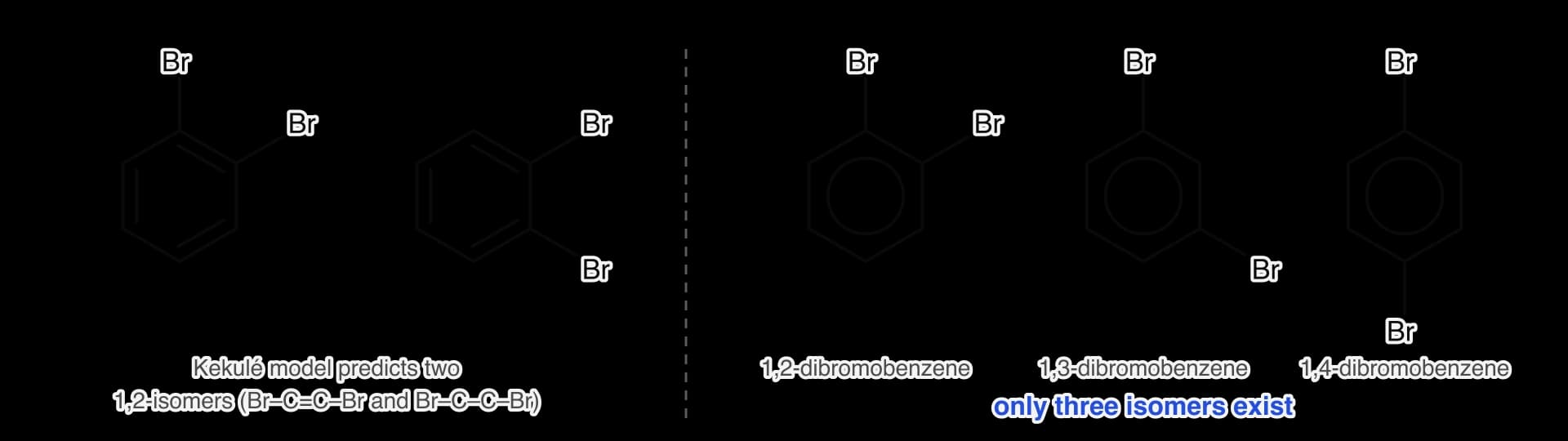
All the evidence is explained by a model in which:
each carbon atom is hybridized and forms three bonds, two to neighbouring carbon atoms and one to hydrogen, all in one plane at 120°;
the remaining p orbital on each carbon atom is at right angles to the ring, so the six p orbitals are parallel;
each p orbital overlaps sideways with both of its neighbours, forming one continuous system above and below the ring;
the six electrons are delocalized over all six carbon atoms, so every C–C bond has the same order (1.5) and length ().
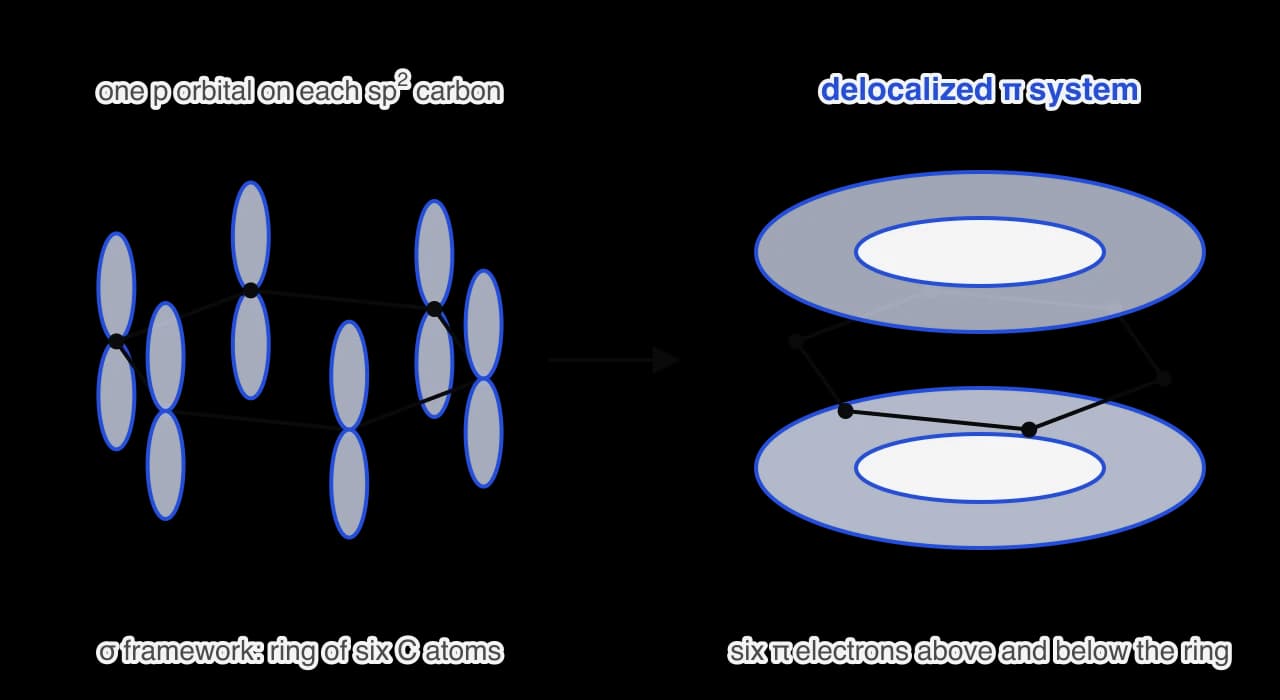
Benzene is represented either by the two Kekulé structures as resonance structures, or by a hexagon with a circle inside, the circle standing for the six delocalized electrons. Benzene has 12 bonds (six C–C and six C–H) and a delocalized system that holds the equivalent of three bonds.
Michael Faraday isolated benzene in 1825 from the oily residue of the gas used for street lighting. Its formula, , puzzled chemists for decades, because a molecule with so little hydrogen should be very reactive, yet benzene was unusually stable.
Kekulé's ring of 1865 explained why benzene forms only one monosubstituted product. To deal with the 1,2-isomer problem he suggested in 1872 that the double bonds switch rapidly between the two possible positions. The modern view is different: the two Kekulé structures are not real molecules in equilibrium but two descriptions whose average is the single real structure. In 1929 Kathleen Lonsdale used X-ray diffraction on crystals of hexamethylbenzene to show that the ring is flat, and later measurements confirmed that all six C–C bonds are equal.
(Paper 1B style) A student collected typical literature values for the enthalpy changes of hydrogenation of some cyclic hydrocarbons to cyclohexane, .
Compound | Number of C=C bonds in its Lewis formula | of hydrogenation / |
|---|---|---|
cyclohexene | 1 | −120 |
cyclohexa-1,4-diene | 2 | −240 |
cyclohexa-1,3-diene | 2 | −232 |
benzene | 3 (Kekulé structure) | −208 |
I can describe a covalent bond as the electrostatic attraction between a shared pair of electrons and two nuclei.
I can state the octet rule and explain why noble gases rarely form bonds.
I can describe the limitations of the octet rule: incomplete octets, odd-electron species and expanded octets.
I can draw Lewis formulas for molecules and ions with up to four electron pairs on each atom, showing every lone pair and, for ions, brackets and charge.
I can relate the number of shared pairs to bond length and bond strength using data booklet values, and explain the exceptions.
I can identify coordination bonds in species such as , , , the adduct and the octet Lewis formulas of , and .
I can define an electron domain and distinguish electron domain geometry from molecular geometry.
I can predict and explain the shapes and bond angles of species with two, three and four electron domains.
I can explain how lone pairs and multiple bonds change bond angles.
I can evaluate the VSEPR model as a model with uses and limitations.
I can deduce the polarity of a bond from electronegativity values and show it with partial charges or a dipole arrow.
I can deduce whether a molecule or ion has a net dipole from its bond polarities and shape.
I can describe and explain the structures and properties of diamond, graphite, graphene, fullerene, silicon and silicon dioxide.
I can explain why Si–Si bonds are weaker than C–C bonds.
I can distinguish intramolecular bonds from intermolecular forces.
I can describe London forces, dipole-induced dipole forces, dipole–dipole forces and hydrogen bonds, and deduce which act between given molecules.
I can explain how the number of electrons, chain length and branching affect London forces.
I can explain differences in volatility and boiling point, including the anomalous boiling points of ,
I can explain the electrical conductivity and solubility of covalent substances in terms of their structure.
I can describe how to carry out paper chromatography and TLC, and name the stationary and mobile phases.
I can calculate and interpret values to identify the components of a mixture, and relate them to polarity.
I can explain how ligands form coordination bonds to a transition element ion, and deduce the charge of a complex ion (HL).
I can explain why atoms of period 3 and beyond can expand their octet, and why nitrogen, oxygen and fluorine cannot (HL).
I can draw Lewis formulas for species with five and six electron domains around the central atom (HL).
I can deduce the electron domain geometry, molecular geometry and bond angles of species with five and six electron domains, placing lone pairs correctly (HL).
I can calculate the formal charge on each atom in a Lewis formula and use formal charges to choose the preferred Lewis formula (HL).
I can explain the difference between formal charge and oxidation state (HL).
I can describe how σ and π bonds form and where their electron density lies, and sketch both (HL).
I can count the σ and π bonds in organic and inorganic molecules and ions (HL).
I can explain hybridization, describe sp³, sp² and sp hybrid orbitals, and relate a Lewis formula to the number of electron domains, the geometry and the hybridization of an atom (HL).
I can deduce resonance structures, explain delocalization and calculate bond orders in resonance hybrids (HL).
I can use bond lengths to show which species have delocalized electrons, and explain why ozone and oxygen are broken by different wavelengths of UV radiation (HL).
I can discuss the physical and chemical evidence for the delocalized structure of benzene, including the delocalization energy from hydrogenation data (HL).
Deviation increases with the strength of the intermolecular forces. Ammonia molecules are polar and form hydrogen bonds with each other, so attractions between particles are far from negligible.
N2, H2 and He are non-polar with only weak London (dispersion) forces, so they behave much more ideally; He, with the weakest forces, is the most ideal.
The answer is A.
Why does the boiling point of the straight-chain alkanes increase from butane to hexane?
Which lists the isomers of in order of increasing boiling point?
And 140 more in the data booklet.
Order of increasing polarity: .
Partial charges. In , carbon is the more electronegative atom, so C is and H is . In all the others the atom bonded to carbon is and carbon is . The bond, with a difference of only 0.4, is often treated as almost non-polar.
, , (trigonal pyramidal) |
, , , (tetrahedral but unsymmetrical) |
, , (one polar bond) |
Net dipole. The four dipoles are not equal, so even in a tetrahedral arrangement they do not cancel. The net dipole points from the carbon atom towards the side between the two fluorine atoms. The molecule is polar.
On a diagram, draw an arrow along each bond pointing towards the halogen, then one larger arrow for the net dipole pointing between the two F atoms.
yes |
no |
London, dipole–dipole |
60.1 |
dipole–dipole (weakly polar C–O–C) |
7 |
58.1 |
dipole–dipole (C=O) |
48 |
58.1 |
dipole–dipole (C=O) |
56 |
60.1 |
hydrogen bonding (O–H) |
97 |
Comparison. The hydrogen bonds between water molecules are stronger in total than the London and dipole–dipole forces between molecules, so more energy is needed to separate water molecules. Water therefore has the higher boiling point and is less volatile.
Spots of X. and .
Conclusion. The spots of X match A and C, and no spot of X matches B. X is a mixture of A and C. The comparison is valid because all four samples were run on the same plate with the same solvent.
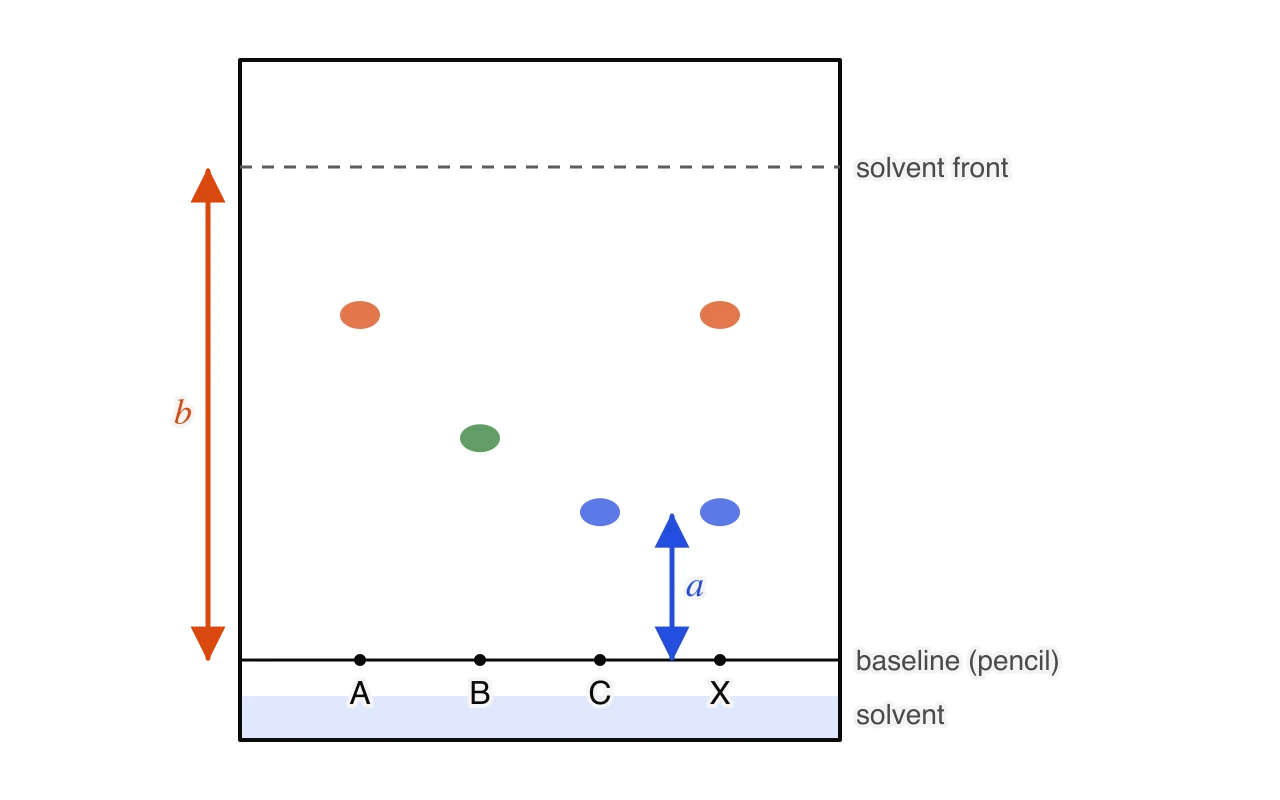
and both exist |
A third arrangement, , gives formal charges −2, +1 and +1 and is clearly worse. The measured bond lengths (N–N , close to a triple bond; N–O , between a single and a double bond) show that the real molecule is best described as a resonance hybrid of the first two structures.
−3 |
four C–H, one C=C |
two C–H, one C≡C |
9 |
1 |
six C–H, two C–C, one C=O |
5
1 |
two O–H, two C–O, one C=O |
bonds: (one in every bond, including the double and triple bonds).
bonds: one from C=C and two from C≡N, so 3.
2 single bonds + 1 double bond → 3 |
C of C≡N | 1 single + 1 triple bond → 2 |
N | 1 triple bond + 1 lone pair → 2 |
, , (single bonds only) |
, (H fixes one O as C–OH) |
absolute uncertainty ✓
Accept ±0.019. Award [1 max] for adding the absolute uncertainties.
(c)
yes AND the two spots of the tablet have the same values «0.50 and 0.15» as paracetamol and caffeine ✓
(d)
pencil/graphite does not dissolve in the solvent/does not move with the solvent ✓
above the solvent so the spots do not dissolve/wash into the solvent «in the tank» ✓
(e)
increase AND the components are attracted more strongly to/are more soluble in the «more polar» mobile phase «relative to the polar silica» ✓
melting it breaks strong «Si–O» covalent bonds, which needs a lot of energy ✓
is made of separate molecules with weak London forces between them, which need little energy to overcome ✓
Do not accept "covalent bonds break" for .
Do not award a mark for "S–F bonds are polar" alone.
(d)
oxygen is in period 2 / has no «2»d orbitals, so it cannot expand its octet / hold more than 8 valence electrons ✓
(e)
square planar ✓
90° ✓
Accept 90° and 180°. Award [1 max] for "octahedral, 90°".
in the methanoate ion the π electrons are delocalized/there is resonance between two equivalent structures ✓
so both bonds are the same, with bond order 1.5, intermediate between single and double ✓
Award [2 max] if bond strength rather than bond length is discussed.
(e)
double-bonded O: 0 AND single-bonded O: −1 ✓
Do not accept −2 for the single-bonded oxygen (oxidation state).