R2 How much, how fast and how far?
Reactivity 2: reacting quantities and yields, rates of reaction, and the extent of reversible reactions at equilibrium, with exactly what HL adds to each subtopic.
- IB Chemistry
- SL and HL
3 subtopics in How much, how fast and how far?
Each one has its own page once something is published for it.
- R2.1How much? The amount of chemical change220 questions · notes · 75 quick fire
- R2.2How fast? The rate of chemical change169 questions · notes · 101 quick fire
- R2.3How far? The extent of chemical change157 questions · notes · 81 quick fire
Key terms introduced here
Each is in the Chemistry glossary, with every other term in the subject.
- Arrhenius equation
The equation , which describes how the rate constant depends on temperature and activation energy. Its linear form is .
- Molecularity
The number of reacting particles (molecules, atoms, ions or radicals) that take part in a single elementary step.
- Rate-determining step
The slowest elementary step in a reaction mechanism. It has the largest activation energy and determines the rate of the whole reaction.
An overview of R2 How much, how fast and how far?
Reactivity 2 answers three questions about any reaction: how much product it can give, how fast it goes, and how far it goes before it reaches equilibrium. The answers decide how a reaction is run, from a titration in a school laboratory to the conditions chosen for an industrial process.
How the subtopics fit together
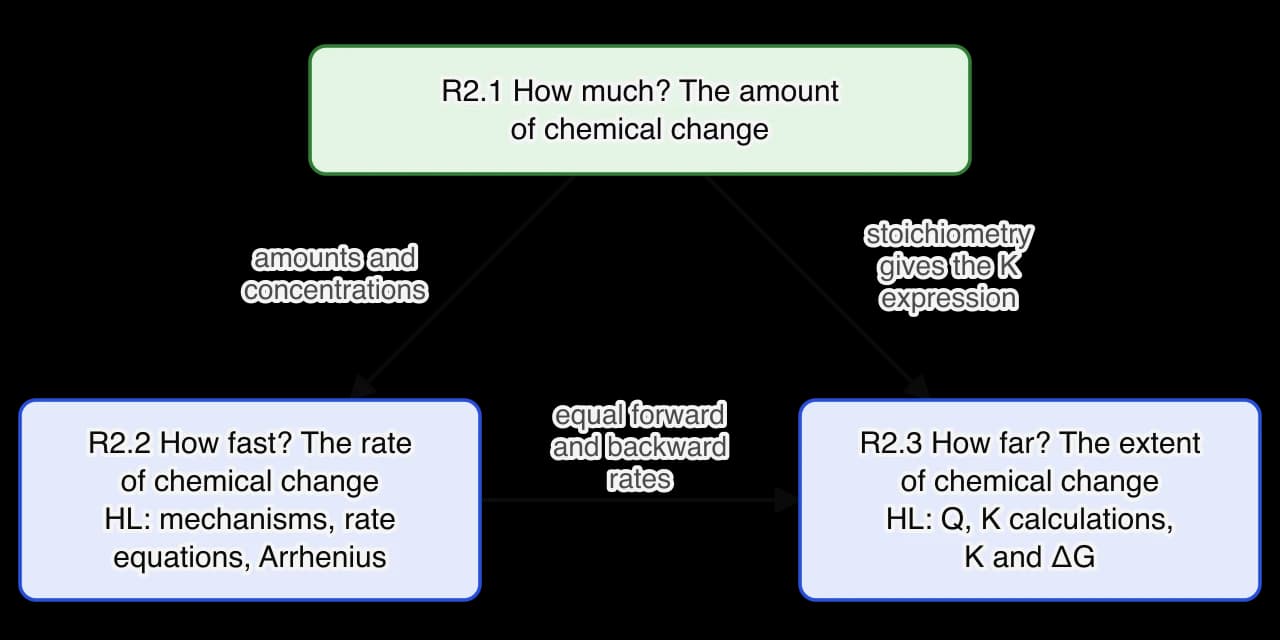
R2.1 How much? The amount of chemical change. Balanced equations with state symbols give the mole ratio of reactants and products, and from it reacting masses, gas volumes and solution concentrations. The limiting reactant fixes the theoretical yield; the percentage yield compares the experimental yield with it, and the atom economy measures how much of the reactants ends up in the desired product.
R2.2 How fast? The rate of chemical change. The rate of reaction as the change in concentration per unit time, measured from graphs. Collision theory explains the effects of concentration, pressure, surface area, temperature and catalysts. Activation energy and the Maxwell–Boltzmann distribution explain why a small rise in temperature has a large effect on rate, and catalysts provide a pathway with a lower activation energy.
R2.3 How far? The extent of chemical change. Dynamic equilibrium in a closed system, where forward and backward rates are equal. The equilibrium law gives the expression for the equilibrium constant , whose size shows how far a reaction goes and depends on temperature. Le Châtelier's principle predicts how an equilibrium responds to changes in concentration, pressure and temperature.
Big ideas across the topic
The mole underlies every answer. Reacting quantities, rates and equilibrium constants are all expressed through amounts and concentrations, the tools of S1.4. Avogadro's law and the molar volume of a gas (S1.4, S1.5) give reacting volumes, and the same calculations are used in titrations (R3.1) and in finding enthalpy changes per mole (R1.1).
Particles in motion. Collision theory extends the kinetic molecular theory of S1.1. Because temperature measures the average kinetic energy of particles, raising the temperature increases both the frequency of collisions and, much more importantly, the fraction of collisions with at least the activation energy.
Rate and extent are different questions. The energy profile of a reaction (R1.1) shows both its enthalpy change and its activation energy, but only the activation energy affects the rate. A catalyst speeds up the forward and backward reactions equally, so it changes neither nor the composition of the equilibrium mixture. An industrial process often has to compromise between a fast rate and a high equilibrium yield.
Equilibrium runs through the rest of Reactivity. Acid strength is the position of an acid dissociation equilibrium (R3.1), secondary cells depend on reversible electrode reactions (R3.2), and at HL the equilibrium constant is linked to the Gibbs energy change (R1.4). Mechanisms with intermediates and a rate-determining step (HL R2.2) explain the different rate equations of the two nucleophilic substitution mechanisms of halogenoalkanes (HL R3.4).
Efficiency and sustainability. Percentage yield and atom economy measure different kinds of efficiency. An addition polymerization has an atom economy of 100% because every atom of the monomer ends up in the polymer (S2.4), and catalysts lower the energy demand of industrial processes.
Standard level and higher level
No subtopic in Reactivity 2 is HL only. R2.1 is the same at both levels, while R2.2 and R2.3 end with HL understandings that make their ideas quantitative. Reactivity 2 takes 21 teaching hours at SL and 31 at HL.
Subtopic | Studied at SL and HL | Added at HL |
|---|---|---|
R2.1 How much? | All of it | Nothing |
R2.2 How fast? | Rate of reaction and its measurement; collision theory, including collision geometry; factors affecting rate; activation energy and Maxwell–Boltzmann distributions; catalysts and energy profiles with and without a catalyst | Elementary steps, reaction mechanisms, intermediates and the rate-determining step; energy profiles of multistep reactions; molecularity; rate equations deduced from experimental data; orders of reaction and their graphs; the rate constant and its units; the Arrhenius equation and its linear form; finding and the Arrhenius factor from data |
R2.3 How far? | Dynamic equilibrium; writing equilibrium constant expressions for homogeneous reactions; the meaning of the size of ; for the reverse reaction; Le Châtelier's principle | The reaction quotient and the direction a reaction moves to reach equilibrium; calculations of and equilibrium concentrations from initial concentrations; and the Gibbs energy change, |
At SL, kinetics is qualitative and graphical: rates are read from concentration–time graphs, and the effects of conditions are explained with collision theory and Maxwell–Boltzmann curves, without rate equations, orders, rate constants or mechanisms. At SL, equilibrium is described through the expression and size of and Le Châtelier's principle, and the only calculation is relating for a reaction to for its reverse (); and calculating or equilibrium concentrations from experimental data are HL. HL students make both topics quantitative, and their equilibrium calculations use the approximation that the equilibrium concentration of a reactant equals its initial concentration when is very small, so no quadratic equations are solved.
Flashcards for R2
The official decks for this part of the syllabus.
- R2.1 How much? The amount of chemical change214 cards
- R2.2 How fast? The rate of chemical change375 cards
- R2.3 How far? The extent of chemical change220 cards
From the data booklet
The entries of the chemistry data booklet that R2 uses. Each opens in the explained booklet.
- Percentage atom economy1. Some relevant equations
- Gibbs energy change and the reaction quotient1. Some relevant equations
- Gibbs energy change and the equilibrium constant1. Some relevant equations
- Arrhenius equation1. Some relevant equations
- Arrhenius equation (logarithmic form)1. Some relevant equations
- Gas constant2. Physical constants
Carry on with R2 in Augment
With a free account, Augment remembers where you stopped and what you have practiced.