R2.1 How much? The amount of chemical change · IB Chemistry | Augment Education
R2.1 How much? The amount of chemical change
Use balanced equations to calculate reacting masses, gas volumes and concentrations, identify limiting and excess reactants, and calculate percentage yield and atom economy.
IB Chemistry
Part of R2 How much, how fast and how far?
SL and HL
Key terms introduced here
Each is in the Chemistry glossary, with every other term in the subject.
A method in which a known excess of a reagent is added to a sample and the amount left over is found by titration; the amount that reacted with the sample is found by difference.
A representation of a reaction using formulas, with reactants on the left and products on the right of an arrow; when balanced, it has the same number of each kind of atom on both sides.
The number in front of a formula in a balanced equation; the coefficients give the ratio of the amounts, in moles, of the substances that react and form.
Titres that agree closely, usually within ±0.10cm3
Notes on R2.1 How much? The amount of chemical change
50 min readLast reviewed
A balanced chemical equation states the ratio in which substances react and form. Combined with the mole, it predicts exactly how much product a given amount of reactant can make, how much of each reactant is needed and how much waste a process produces. A pharmaceutical company uses these calculations to plan a synthesis; a water company uses them to work out how much chlorine to add; a student uses them to find the concentration of ethanoic acid in vinegar.
Questions on R2.1
220 exam-style questions on this subtopic, written in the style of the IB papers. The first has its markscheme open. Counted on
Question 1 · CHEM-001231 mark
Aqueous silver nitrate is added to aqueous sodium chloride and a white precipitate forms. Which equation shows the correct state symbols?
A
AgNO3(aq)+NaCl(aq)→AgCl(aq)+NaNO3(s)
Try a quick-fire question
One of 75 short multiple-choice questions on R2.1. Pick an answer to see why it's right or wrong.
The diagram shows a mixture of nitrogen and hydrogen molecules before they react. How many N2 molecules remain when the reaction is complete?
Flashcards for R2.1
The official deck for this part of the syllabus.
R2.1 How much? The amount of chemical change · front
Explain why a balanced equation has the same number of each kind of atom on both sides.
R2.1 How much? The amount of chemical change · front
What is a coefficient (stoichiometric coefficient) in a balanced equation?
R2.1 How much? The amount of chemical change214 cards
From the data booklet
The entries of the chemistry data booklet that R2.1 uses. Each opens in the explained booklet.
The point in a titration at which the indicator changes colour (or a self-indicating titrant gives a permanent colour); ideally it coincides with the equivalence point.
A method of analysis in which the amount of a substance is found by weighing, for example by precipitating it as an insoluble solid that is filtered, dried and weighed.
The design of chemical products and processes that reduce or eliminate the use and generation of hazardous substances, for example by high atom economy, safer solvents, catalysts, lower energy use and renewable feedstocks.
In a chemical reaction, mass is neither created nor destroyed: the total mass of the products equals the total mass of the reactants, because atoms are only rearranged.
A titration in which the titrant is an oxidizing or reducing agent, such as acidified potassium manganate(VII) used to find the amount of iron(II) in a sample.
Describes a titration in which a reactant changes colour itself at the end point, so no indicator is added; purple manganate(VII) is decolourized until the first permanent pink appears.
The maximum amount or mass of product that can be obtained from the limiting reactant, assuming complete reaction with no side reactions and no losses.
A technique in which a solution is added from a burette to a measured volume of another until the reaction between them is just complete, so that an unknown concentration or amount can be found.
The volume of titrant added from the burette to reach the end point: the final burette reading minus the initial reading.
Scope. Calculations use the relative atomic masses given to two decimal places in the data booklet, together with the relationships n=m/M, n=CV and PV=nRT and the molar volume of an ideal gas at STP (22.7dm3mol−1). The mole, molar concentration, Avogadro's law and the ideal gas equation are introduced with the mole and with ideal gases; here they are applied to reactions. Redox titrations use a balanced overall equation; writing half-equations belongs with electron transfer reactions. The equation for percentage atom economy is given in the data booklet.
Chemical equations as ratios
A chemical equation summarizes a reaction with formulas: reactants on the left, products on the right, and an arrow between them. In a balanced equation every atom on the left appears on the right, because atoms are neither created nor destroyed in a chemical reaction; they are only rearranged into new substances. This is the law of conservation of mass at the level of atoms.
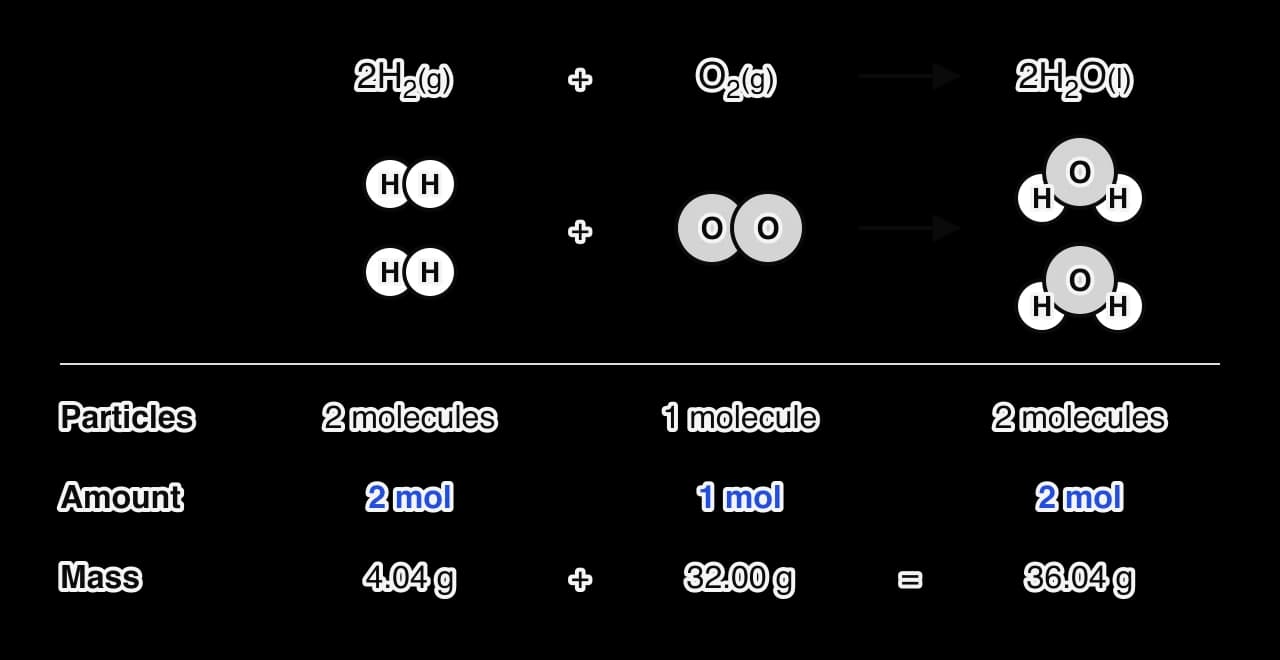
The numbers in front of the formulas are the coefficients. They state how many particles of each substance react or form. In the equation for the synthesis of water, two molecules of hydrogen react with one molecule of oxygen to give two molecules of water:
2HX2(g)+OX2(g)2HX2O(l)
Because a mole is a fixed number of particles (6.02×10²³), the same ratio holds for any number of particles, including moles. Two moles of hydrogen react with one mole of oxygen to give two moles of water. The ratio of the coefficients is the mole ratio, and it is the central idea of every calculation in reacting quantities, an area of chemistry known as stoichiometry.
The coefficients give the ratio of particles and therefore of moles (blue). Masses are not in the 2 : 1 : 2 ratio, but the total mass of the reactants equals the total mass of the products, because atoms are only rearranged.
The three rows of the diagram of the synthesis of water show what the coefficients do and do not mean. They give the ratio of particles and of amounts in moles. They do not give the ratio of masses: 2 mol of hydrogen has a mass of only 4.04g, while 1 mol of oxygen has a mass of 32.00g. Masses are linked through molar masses, which is why almost every calculation starts by converting masses into moles.
State symbols
A state symbol after each formula shows the physical state of the substance under the conditions of the reaction. State symbols carry real chemical information: they show whether a product is a gas that escapes, a solid that precipitates from solution or a substance dissolved in water. They also matter for energy, since forming liquid water releases more energy than forming water vapour.
Symbol
Meaning
Example
(s)
solid
CaCOX3(s), Mg(s), a precipitate such as AgCl(s)
(l)
liquid (a pure substance in the liquid state)
HX2O(l), BrX2(l)
(g)
gas
COX2(g), OX2(g)
(aq)
aqueous: dissolved in water
NaCl(aq), HCl(aq), CuX2+(aq)
Balancing equations by inspection
An equation is balanced by changing coefficients only. The formulas themselves are fixed by the identity of the substances: changing HX2O to HX2OX2 to make the oxygen atoms balance would turn water into hydrogen peroxide. A reliable order of working is:
Write the correct formula of every reactant and product. Elements that exist as diatomic molecules are written as such: HX2, NX2, OX2, FX2, ClX2, BrX2, IX2.
Balance the elements that appear in only one reactant and one product first, usually the metals and carbon.
Keep polyatomic ions such as SOX4X2−, NOX3X−
Balance hydrogen and then oxygen last, because they often appear in several substances.
If a fraction is needed (often for OX2), use it, then multiply every coefficient by the denominator to give whole numbers.
Count every atom on each side as a final check, and check that the coefficients are in the smallest whole-number ratio.
Writing equations from a description
Many equations are written from a description in words. Most reactions met in introductory chemistry follow a small number of patterns, so recognizing the type of reaction gives the products; balancing then follows. The table summarizes the common patterns.
Type of reaction
Pattern
Example
Acid + reactive metal
salt + hydrogen
Zn(s)+2HCl(aq)ZnClX2(aq)+HX2(g)
Acid + metal oxide or hydroxide
salt + water
CuO(s)+HX2SOX4(aq)CuSOX4(aq)+HX2O(l)
Acid + carbonate or hydrogencarbonate
salt + water + carbon dioxide
CaCOX3(s)+2HCl(aq)CaClX2(aq)+HX2O(l)+COX2(g)
Complete combustion of a hydrocarbon
carbon dioxide + water
CX3HX8(g)+5OX2(g)3COX2(g)+4HX2O(l)
Metal + oxygen
metal oxide
2Mg(s)+OX2(g)2MgO(s)
Thermal decomposition of a carbonate
metal oxide + carbon dioxide
CuCOX3(s)CuO(s)+COX2(g)
Displacement of a less reactive metal
more reactive metal takes its place
Zn(s)+CuSOX4(aq)ZnSOX4(aq)+Cu(s)
Precipitation
two solutions give an insoluble solid
BaClX2(aq)+NaX2SOX4(aq)BaSOX4(s)+2NaCl(aq)
Ionic equations and spectator ions
When ionic compounds dissolve, their ions separate and move independently in the solution. In many reactions in solution only some of these ions change. The others are spectator ions: they are present in the same form before and after the reaction. An ionic equation leaves out the spectator ions and shows only the species that react.
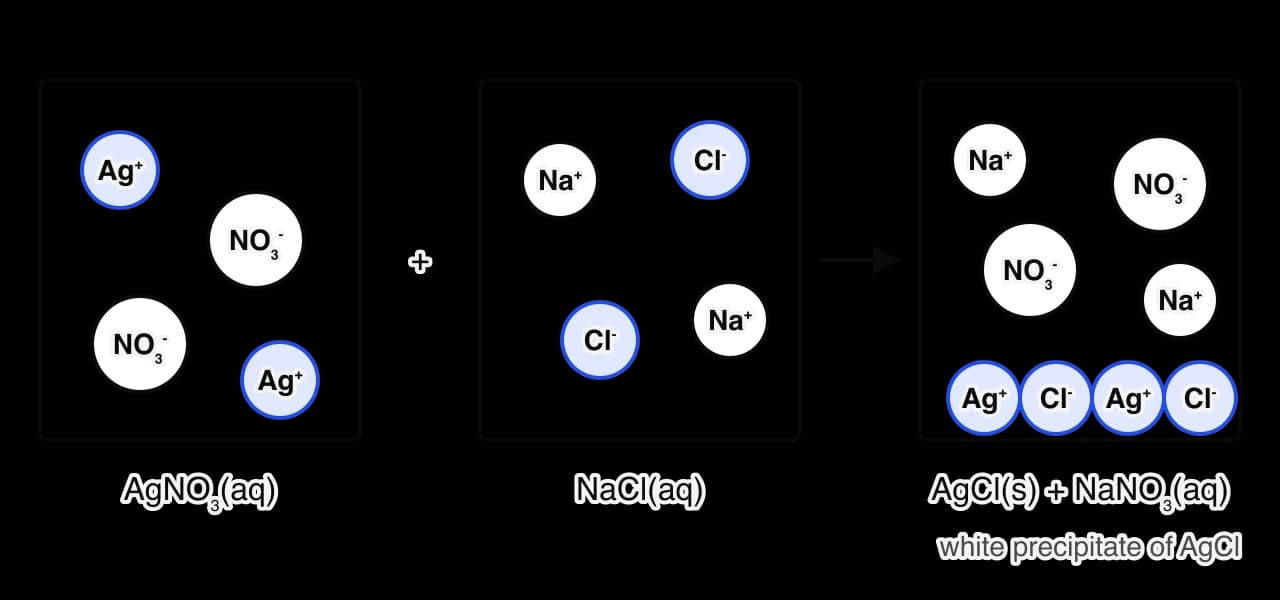
Mixing silver nitrate and sodium chloride solutions gives a white precipitate of silver chloride. The full equation is AgNOX3(aq)+NaCl(aq)AgCl(s)+NaNOX3(aq), but the sodium and nitrate ions stay dissolved throughout, as the particle diagram of the mixture shows.
Only the blue ions take part: Ag⁺ and Cl⁻ join to form solid silver chloride. Na⁺ and NO₃⁻ are spectator ions, present in the same form before and after, so the ionic equation leaves them out.
Writing every aqueous ionic compound as separate ions and then crossing out the ions that appear unchanged on both sides gives the ionic equation:
AgX+(aq)+ClX−(aq)AgCl(s)
The ionic equation is more general than the full equation. It describes the reaction of any soluble silver salt with any soluble chloride, which is why acidified silver nitrate is used as a test for chloride ions. In the same way, the ionic equation for every neutralization of a strong acid by a strong base in solution is the same:
HX+(aq)+OHX−(aq)HX2O(l)
An ionic equation must balance in two ways: the number of each kind of atom, and the total charge. In Mg(s)+2HX+(aq)MgX2+(aq)+HX2(g) the total charge is 2+ on each side. Solids, liquids, gases and molecular substances in solution (such as ethanoic acid, which is only slightly ionized) are written as complete formulas, not as ions.
Redox reactions involving ions need extra care, because the charges only balance when the electrons lost and gained are equal. For these reactions a method based on half-equations, one for oxidation and one for reduction, gives the balanced ionic equation reliably; it is developed with electron transfer reactions.
Calculating reacting masses
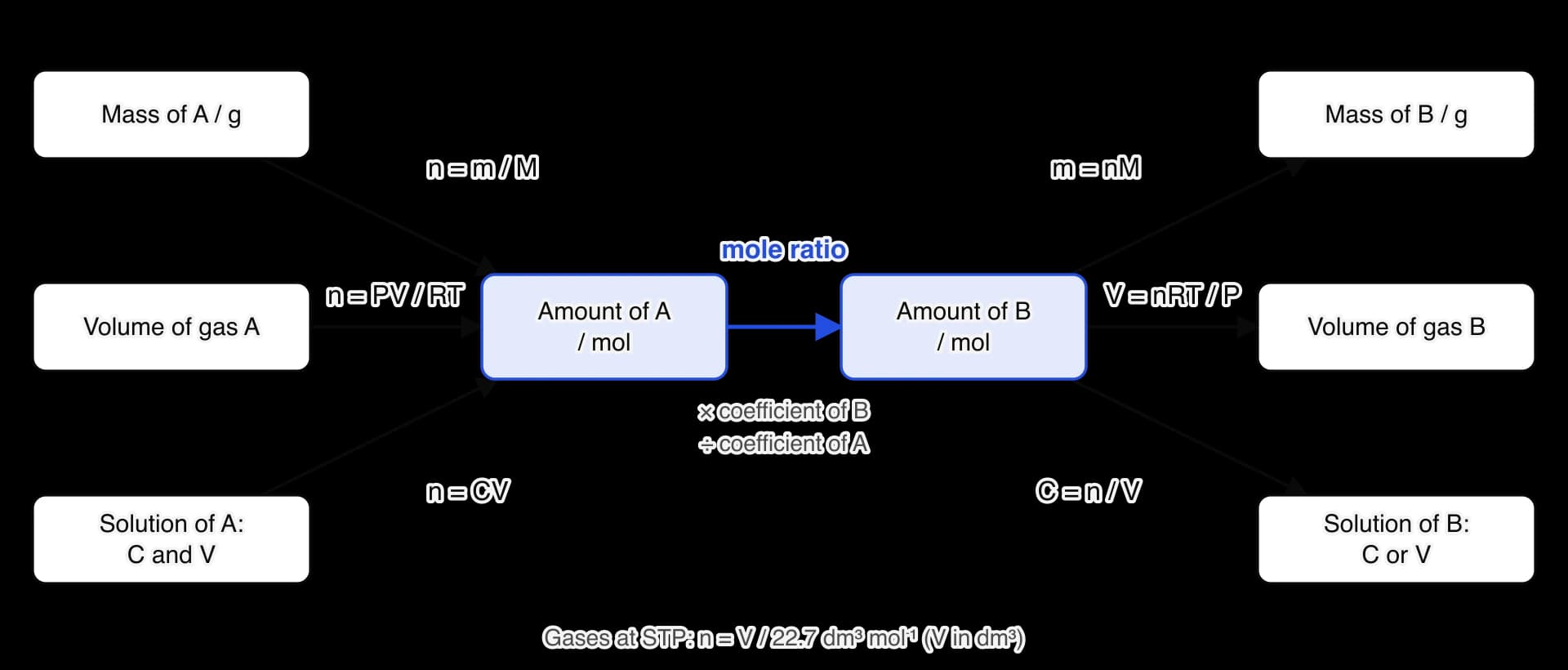
A balanced equation links amounts in moles, not masses. A calculation of reacting masses therefore has three steps: convert the known mass into moles, use the mole ratio from the equation to find the moles of the substance asked about, then convert those moles into the quantity asked for. The same three steps work whether the data are masses, gas volumes or solution concentrations, as the map of the routes between quantities shows.
Every reacting-quantity calculation passes through amounts in moles. The balanced equation is used only once, in the blue step: amount of B = amount of A × (coefficient of B ÷ coefficient of A).
In symbols, for a reaction aA+bB→cC, where a, b and c are the coefficients:
nC=nA×acandn=Mm
Molar masses are calculated from the relative atomic masses in the data booklet to two decimal places: M(FeX2OX3)=2(55.85)+3(16.00)=159.70g mol−1. Intermediate values are kept unrounded in the calculator, and only the final answer is rounded, to the same number of significant figures as the least precise data.
A fuel calculation follows the same steps. The combustion of 1.00kg of propane, CX3HX8(g)+5OX2(g)3COX2(g)+4HX2O(l), uses 1000/44.11=22.67 mol of propane. Each mole gives 3 mol of carbon dioxide, so 68.01 mol of COX2 forms, with a mass of 68.01×44.01=2.99×10³g, or about 3.0kg. The mass of carbon dioxide is three times the mass of the fuel because each carbon atom (12.01) leaves combined with two oxygen atoms taken from the air.
Problems with an extra step
Real data rarely arrive as a pure mass of one reactant. A percentage composition, a mass change or a hydrated formula adds a step before the mole ratio can be used. The order of operations is the same: first find the mass (or amount) of the substance that actually reacts.
Reacting volumes of gases
Avogadro's law states that equal volumes of all gases, measured at the same temperature and pressure, contain equal numbers of molecules. It follows that, for gases at the same temperature and pressure, the volume of a gas is proportional to its amount in moles. The coefficients of a balanced equation therefore give the ratio of the volumes of the gases that react and form, with no need to convert to moles at all.
For the combustion of propane, CX3HX8(g)+5OX2(g)3COX2(g)+4HX2O(l), 50cm3 of propane needs 5×50=250cm3 of oxygen and gives 3×50=150cm3 of carbon dioxide, all measured at the same temperature and pressure. The water is a liquid at room temperature, so it has a negligible volume and does not count as a gas.
Gas volumes from masses: the molar volume
Avogadro's law also means that one mole of any ideal gas occupies the same volume at a given temperature and pressure. This molar volume, Vm, is 22.7dm3mol−1 at STP (273K and 100kPa) (data booklet). At STP, a gas volume and an amount are linked by:
n=VmV=22.7dm3mol−1V(V in dm3)
Car airbags show how much gas a small mass of solid can produce. Early airbag inflators were triggered by a crash sensor to decompose sodium azide almost instantly: 2NaNX3(s)2Na(s)+3NX2(g). About 130g of sodium azide produces enough nitrogen to fill a typical driver's airbag, and the decomposition is complete in a few hundredths of a second.
Sodium azide is highly toxic, and the sodium metal formed is dangerously reactive, so inflators also contained compounds such as potassium nitrate and silica to convert the sodium into a harmless glassy solid. Most modern inflators use non-azide gas generators instead, many of them based on nitrogen-rich compounds such as guanidine nitrate, but the calculation of gas volume from the equation is the same.
Molar volume under other conditions
The value 22.7dm3mol−1 applies only at STP. Rearranging the ideal gas equation gives Vm=V/n=RT/P, so the molar volume is proportional to the absolute temperature and inversely proportional to the pressure. At 298K and 100kPa it is 24.8dm3mol−1. For any conditions other than STP, PV=nRT is used directly.
Vm = RT/P at 100 kPa
At constant pressure the molar volume of an ideal gas is proportional to the absolute temperature: 22.7 dm³ mol⁻¹ at STP (273 K, 100 kPa) and 24.8 dm³ mol⁻¹ at 298 K and 100 kPa. Doubling the pressure would halve every value.
Avogadro's law is a description: it states a relationship that measurements of gas volumes confirm, but it does not say why the relationship holds. The explanation comes from the kinetic theory of gases. Gas particles are so far apart that their own volume is negligible, so the volume a gas occupies depends on the number of particles, their speed (set by temperature) and the pressure, not on what the particles are. This is also why the law fails for real gases at high pressure or low temperature, when the particles' own volume and the attractions between them are no longer negligible.
Reactions in solution and titration
Many reactions are carried out in solution, where amounts are measured by volume rather than by mass. The amount of solute in a volume of solution follows from its molar concentration:
n=CV(C in mol dm−3,V in dm3)
Concentrations are written with square brackets: [NaOH]=0.150mol dm−3. Volumes measured in cm3 are divided by 1000 before use. With n=CV the mole map applies to solutions exactly as it applies to masses.
Precipitation reactions link a solution to a mass of solid. Adding excess sodium sulfate solution to 25.0cm3 of 0.200mol dm−3 barium chloride precipitates all 5.00×10⁻³ mol of the barium ions as barium sulfate, BaX2+(aq)+SOX4X2−(aq)BaSOX4(s). The mass of precipitate expected is 5.00×10−3×233.40=1.17g. Filtering, drying and weighing a precipitate in this way is called gravimetric analysis.
What a titration is
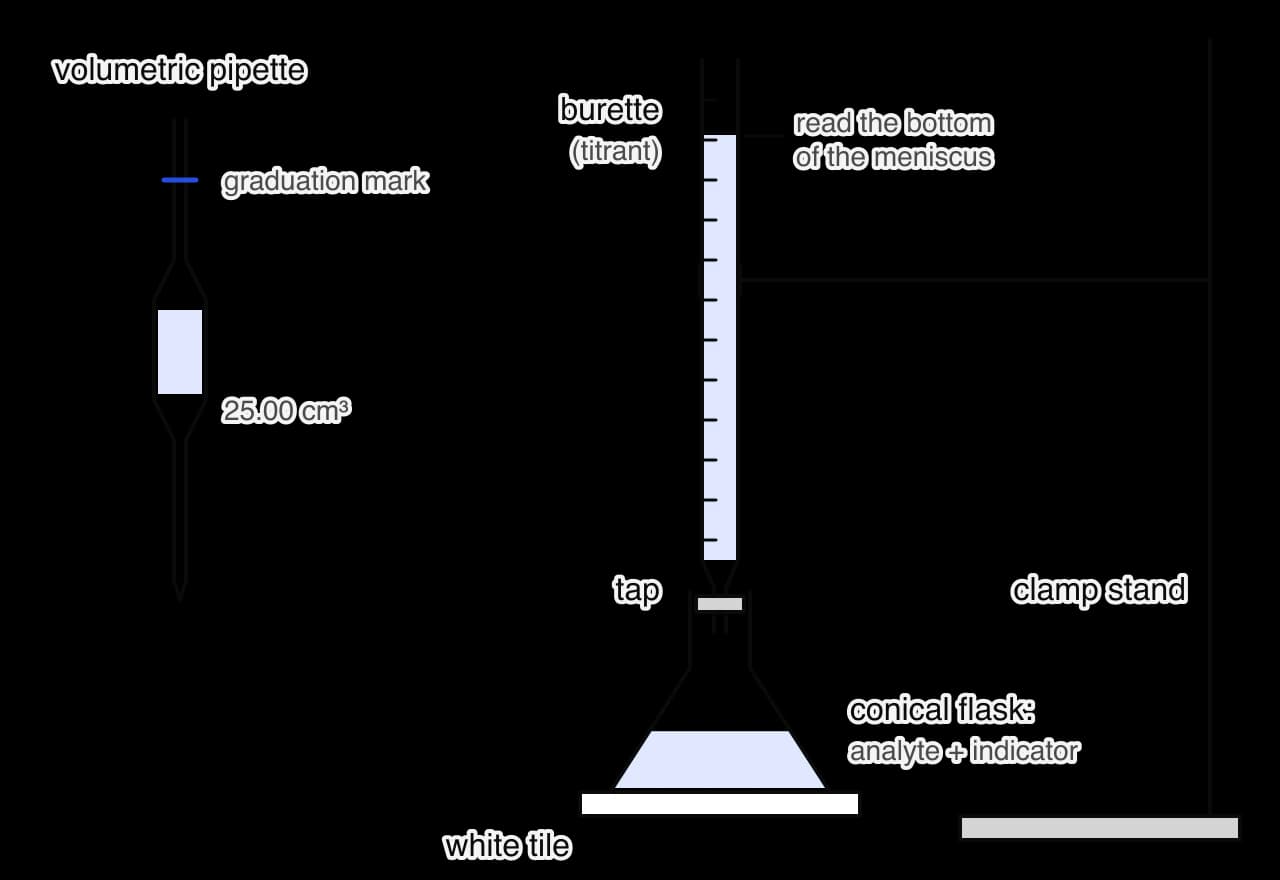
A titration measures the volume of one solution that reacts exactly with a known volume of another. One solution, the titrant, is added from a burette to a measured volume of the other, the analyte, until the reaction is just complete. If the concentration of one solution is known, the mole ratio gives the concentration of the other.
A pipette delivers one exact volume of the analyte into the conical flask. The titrant is added from the burette until the indicator just changes colour; the white tile makes the change easy to see.
The standard procedure, used for both acid–base and redox titrations, is:
Rinse the burette with a little of the titrant, then fill it, removing the air bubble below the tap. Rinse the pipette with a little of the analyte.
Use the pipette and a pipette filler to transfer an exact volume of the analyte (for example 25.00cm3) into a conical flask, then add two or three drops of indicator.
Record the initial burette reading, reading the bottom of the meniscus at eye level.
Add the titrant while swirling the flask. Do a rough titration first to find the approximate end point, then repeat, adding the titrant dropwise near the end point.
Record the final burette reading. The difference between the two readings is the titre.
Repeat until at least two titres are concordant (agree within ±0.10cm3), and use the mean of the concordant titres in the calculation.
The equipment is chosen for precision. A volumetric pipette and a burette measure volumes far more precisely than a measuring cylinder: a burette is read to ±0.05cm3, and since each titre is the difference between two readings, its uncertainty is ±0.10cm3. The white tile shows the colour change clearly, and swirling mixes each addition so that the colour change is not seen too early.
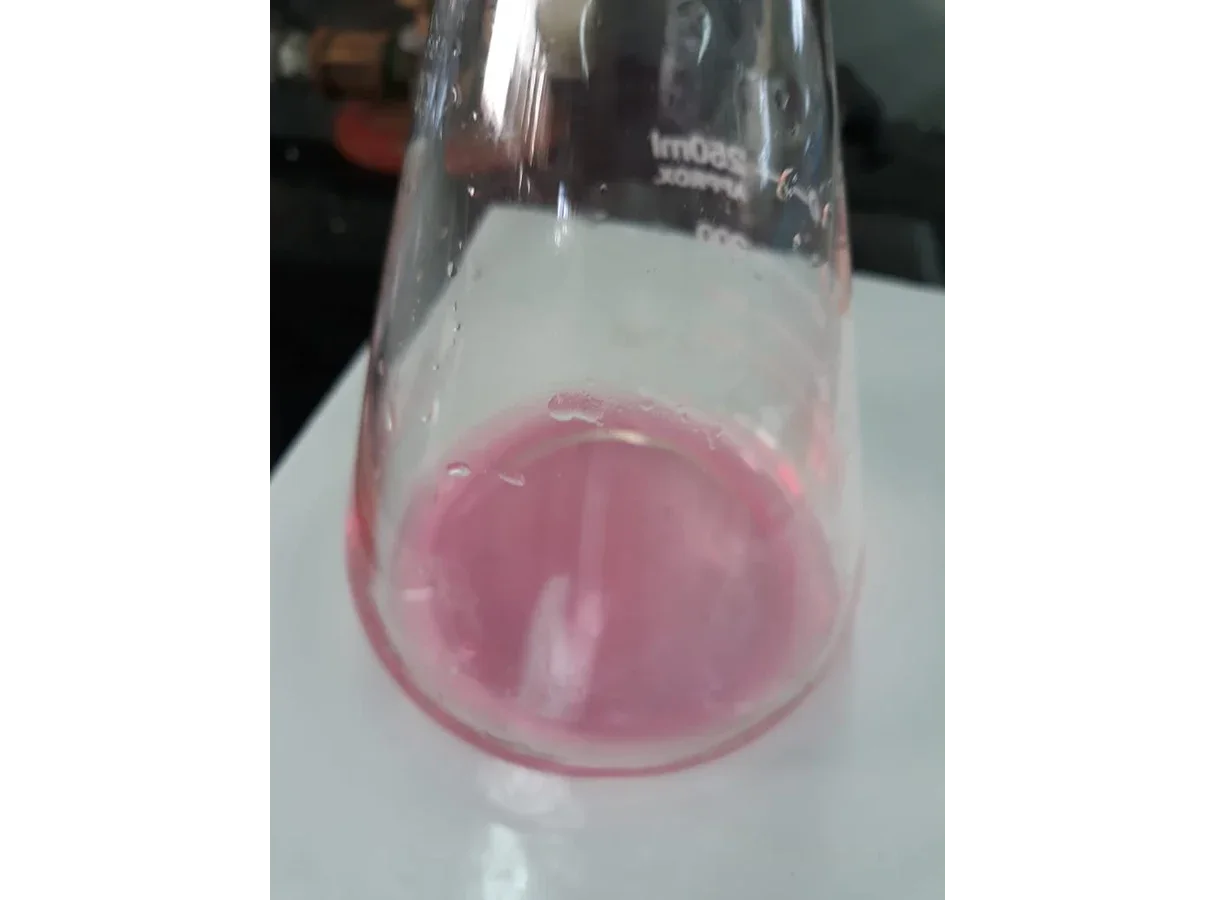
The end point of an acid–base titration with phenolphthalein: the first permanent pale pink colour. Adding alkali one drop at a time near the end point keeps the titre accurate. Image: آية تاج الدين, CC BY-SA 4.0, via Wikimedia Commons.
Rinsing matters for the same reason. Water left in a burette dilutes the titrant, so a larger titre is needed and the calculated concentration of the analyte comes out too high. Water left in the conical flask, by contrast, does no harm: it changes the concentration of the analyte but not the amount of it that the pipette delivered, and the amount is what the titration measures.
Acid–base titrations: the ethanoic acid in vinegar
Vinegar is a dilute solution of ethanoic acid, typically around 5 g per 100cm3. Its concentration is found by titration with standard sodium hydroxide solution and phenolphthalein indicator, which is colourless in acid and turns pink at the end point. Because vinegar is too concentrated to titrate conveniently with dilute alkali, it is first diluted accurately with a pipette and volumetric flask.
A dilution adds solvent but not solute, so the amount of solute is the same before and after. Since n=CV, the concentrations and volumes before (1) and after (2) dilution are linked by:
C1V1=C2V2
Any volume unit can be used here, as long as both volumes are in the same unit. Diluting 10.00cm3 of vinegar to 100.0cm3 divides its concentration by 10.
Redox titrations
In a redox titration the titrant is an oxidizing or reducing agent. A common example uses acidified potassium manganate(VII) to find the amount of iron(II) in a sample:
The manganate(VII) ion is deep purple and the manganese(II) ion is almost colourless, so the titration is self-indicating: each drop of titrant is decolourized while iron(II) remains, and the end point is the first permanent pale pink colour. The mole ratio MnOX4X−:FeX2+ is 1:5, which comes from the electrons transferred: each manganese gains five electrons, while each iron(II) ion loses only one.
Back titration
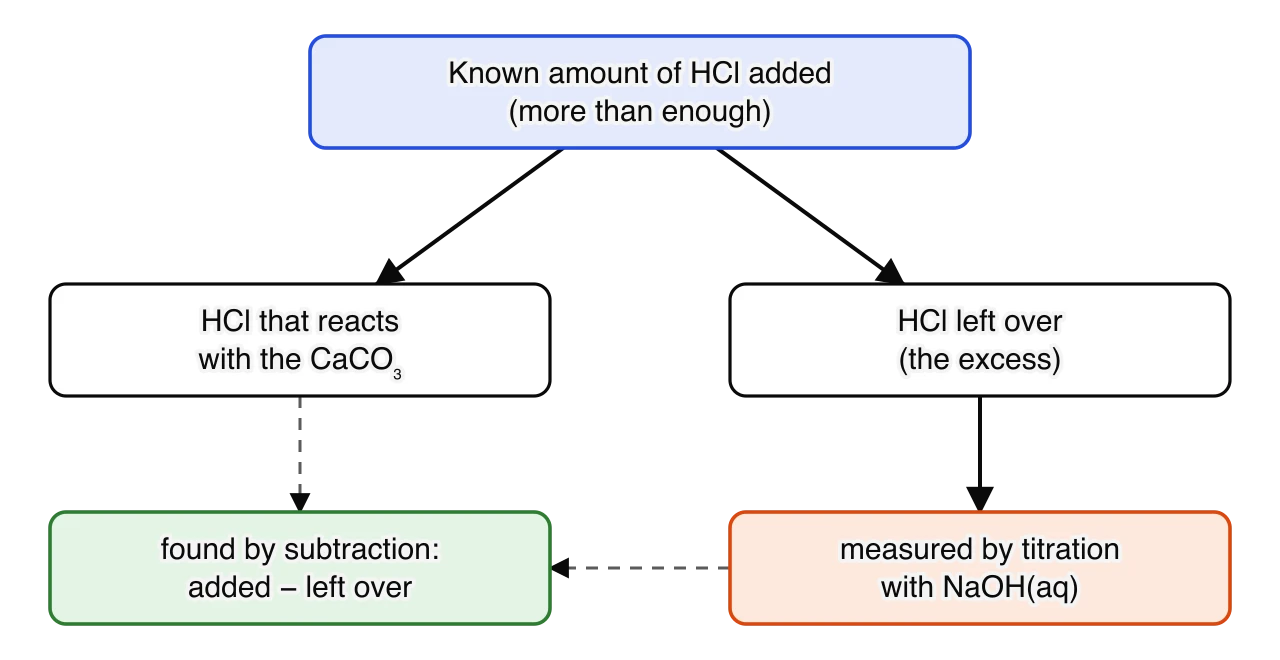
Some substances cannot be titrated directly: an insoluble solid such as calcium carbonate reacts too slowly with acid for a sharp end point, and a volatile base such as ammonia escapes from an open flask. In a back titration, a known amount of a reagent (more than enough) is added to the sample, and once the reaction is complete the amount of reagent left over is found by titration. The amount that reacted with the sample is the difference.
In a back titration the analyte is never titrated directly. The excess reagent is titrated (orange), and the amount that reacted with the sample is found by difference (green).
Limiting and excess reactants
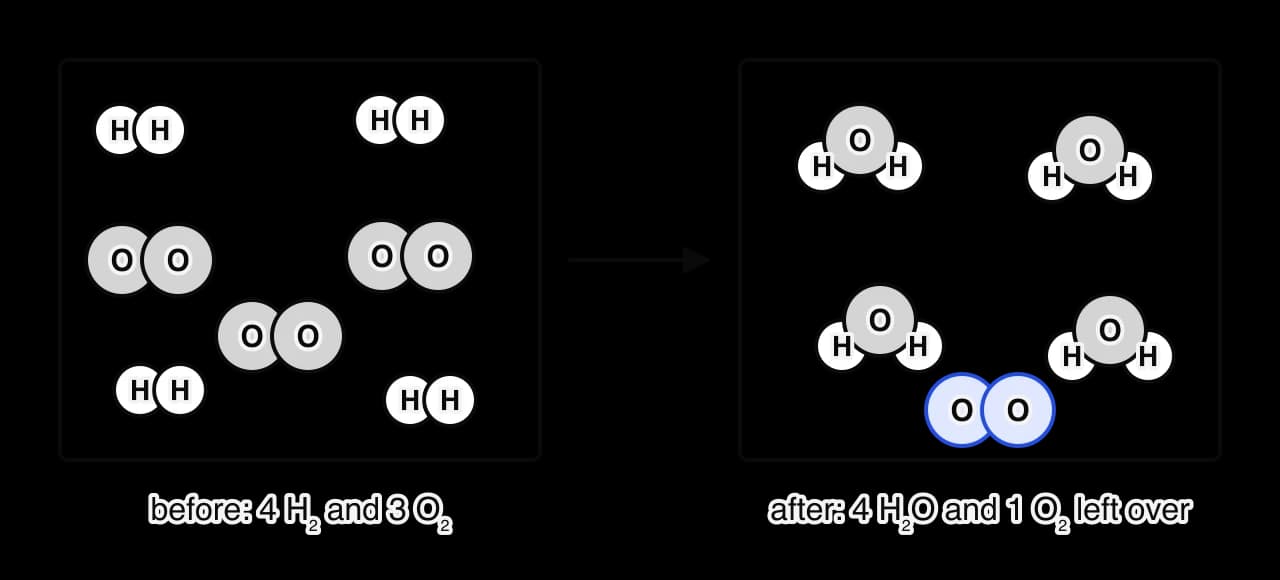
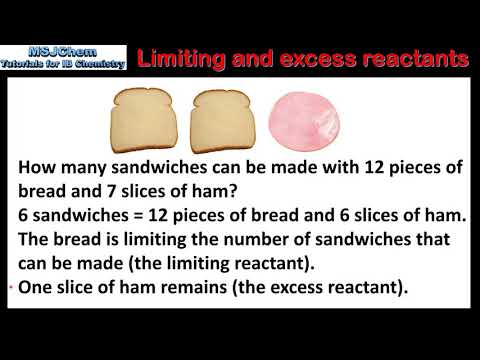
Reactants are seldom mixed in exactly the ratio of the equation. When they are not, one reactant is used up first and the reaction stops, however much of the others remains. The reactant that runs out is the limiting reactant; the others are in excess. A sandwich shop with 20 slices of bread and 15 slices of cheese can make only 10 cheese sandwiches (two slices of bread and one of cheese each): bread limits the number, and 5 slices of cheese are left over.
Four H₂ molecules can use only two of the three O₂ molecules (2H₂ + O₂ → 2H₂O). Hydrogen is the limiting reactant; the blue O₂ molecule is the excess and stays unreacted.
Identifying the limiting reactant
The limiting reactant cannot be found by comparing masses, or even by comparing moles directly, because the reactants do not react 1 : 1 in general. Two equivalent methods work:
Divide the amount of each reactant by its coefficient. The reactant with the smallest result is limiting. For 2HX2+OX22HX2O with 4 mol HX2 and 3 mol OX2: 4/2=2 and 3/1=3, so hydrogen is limiting.
Calculate the amount of product each reactant could form. The reactant that gives the smaller amount is limiting, and that smaller amount is the amount of product formed.
YouTube
Mike Sugiyama Jones (MSJ Chem): how to identify the limiting and excess reactants.
Once the limiting reactant is known, every other quantity is calculated from it: the amount of product, and the amount of each excess reactant that reacts. The amount of excess reactant left over is the amount present minus the amount that reacts.
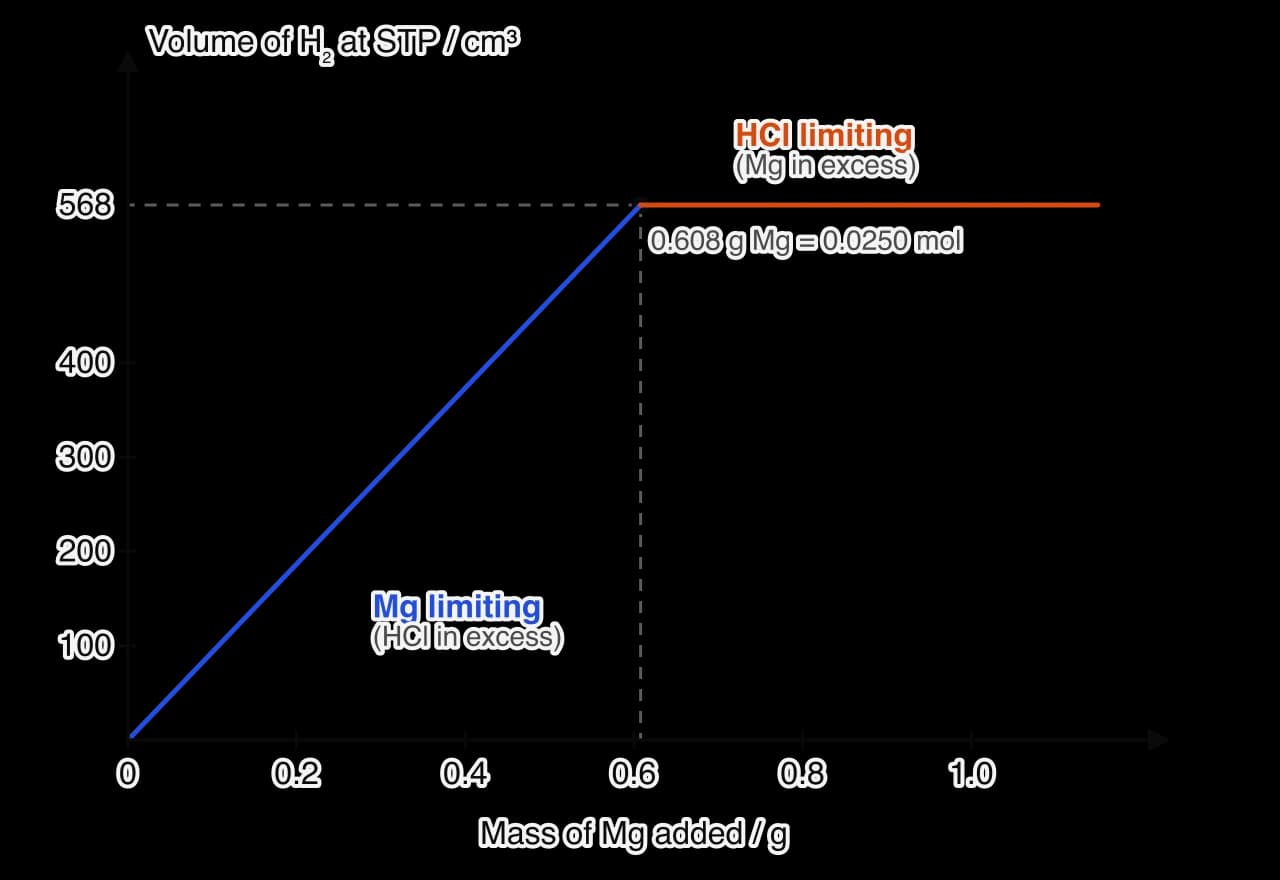
The same reaction shows how the limiting reactant changes as the proportions change. Adding increasing masses of magnesium to a fixed 50.0cm3 of the acid gives more hydrogen only while the magnesium is limiting. Once 0.608g (0.0250 mol) has been added, the acid becomes limiting and the volume of hydrogen stops rising.
Magnesium added to 50.0 cm³ of 1.00 mol dm⁻³ HCl (0.0500 mol). Up to 0.608 g the magnesium is limiting and each extra gram gives more hydrogen (blue). Beyond that the acid is limiting (orange): extra magnesium is left unreacted and the volume of hydrogen stays at 568 cm³.
The thermite reaction, used to weld railway lines on site, is a further example in which both reactants are solids: FeX2OX3(s)+2Al(s)AlX2OX3(s)+2Fe(l). A mixture of 100.0g of iron(III) oxide (0.6262 mol) and 30.0g of aluminium (1.112 mol) contains less aluminium than needed, since 1.112/2=0.556 is smaller than 0.6262/1. Aluminium is limiting, so 1.112 mol of molten iron forms (62.1g), and 0.070 mol (11.2g) of iron(III) oxide is left over.
Limiting reactants in gas reactions
With gases at the same temperature and pressure, volumes can be compared directly. If 30cm3 of methane is mixed with 50cm3 of oxygen, CHX4(g)+2OX2(g)COX2(g)+2HX2O(l), the methane would need 60cm3 of oxygen. Oxygen is limiting: 50cm3 of oxygen reacts with 25cm3 of methane, giving 25cm3 of carbon dioxide and leaving 5cm3 of methane unreacted.
In practice a chemist often chooses which reactant to put in excess. The cheaper or less hazardous reactant is usually added in excess, so that all of the expensive reactant is converted into product. Excess air ensures complete combustion of a fuel; excess acid ensures that all of a carbonate in a sample reacts. The excess has to be separated from the product afterwards, which is one reason why a large excess is avoided.
Theoretical, experimental and percentage yield
The amount of product calculated from the limiting reactant is the most that the reaction can give. The amount actually obtained in a laboratory or a factory is almost always smaller.
The two are compared as the percentage yield, with both yields in the same units (both masses or both amounts):
The causes of a low yield fall into two groups. Chemical causes mean that less product forms than the equation predicts; physical (practical) causes mean that product forms but is not all collected.
Cause
Explanation
Example
Incomplete reaction
The reaction has not finished, or some reactant does not come into contact with the other.
Magnesium ribbon coated with oxide that does not burn completely
Reversible reaction
The reaction reaches equilibrium with reactants still present.
Esterification, or the synthesis of ammonia
Side reactions
Some reactant forms a different product.
Magnesium burning in air forms some magnesium nitride, MgX3NX2
Losses during transfer
Product is left on glassware, filter paper or a stirring rod.
Solid left in a beaker after filtering
Losses during purification
Some product dissolves in the solvent during recrystallization, or evaporates.
Aspirin remaining dissolved in the cold water used to wash crystals
An experimental yield can also appear higher than the theoretical yield. This always points to an error: the product still contains water or solvent because it was not dried to constant mass, or it contains impurities such as unreacted reactant or a by-product. A percentage yield above 100% is impossible for a pure, dry product, so it is a signal to look for such an error rather than a result to report.
A gravimetric yield experiment: burning magnesium
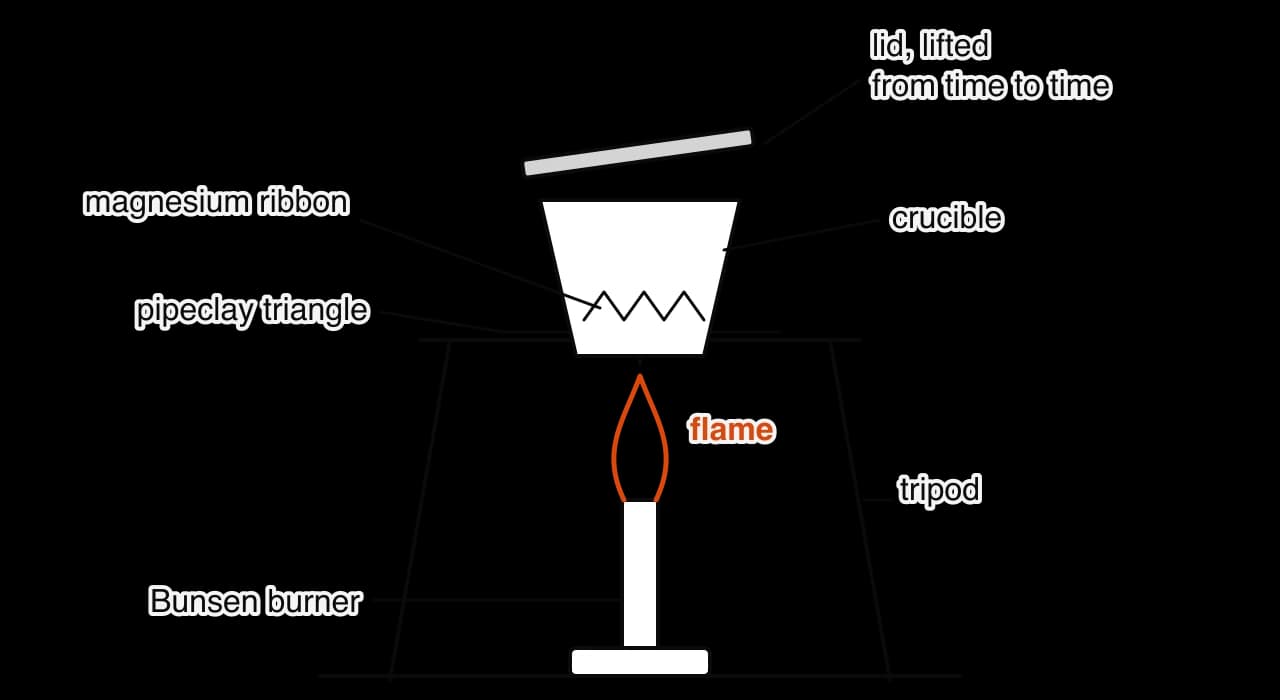
Heating magnesium ribbon in a crucible is a classic way to measure a yield by mass: 2Mg(s)+OX2(g)2MgO(s). The cleaned ribbon is weighed in a crucible with its lid, heated strongly until it no longer glows, cooled and weighed again. Heating, cooling and weighing are repeated until two masses agree, which shows that the reaction is complete; this is called heating to constant mass.
Magnesium is heated in a lidded crucible. Lifting the lid from time to time lets oxygen in while keeping the white magnesium oxide smoke inside; the crucible and contents are weighed after cooling.
The lid is lifted briefly from time to time with tongs to let air in, but kept on most of the time to stop the white magnesium oxide smoke from escaping. The crucible is allowed to cool before each weighing: a hot crucible sets up air currents around the balance and gives a falsely low reading.
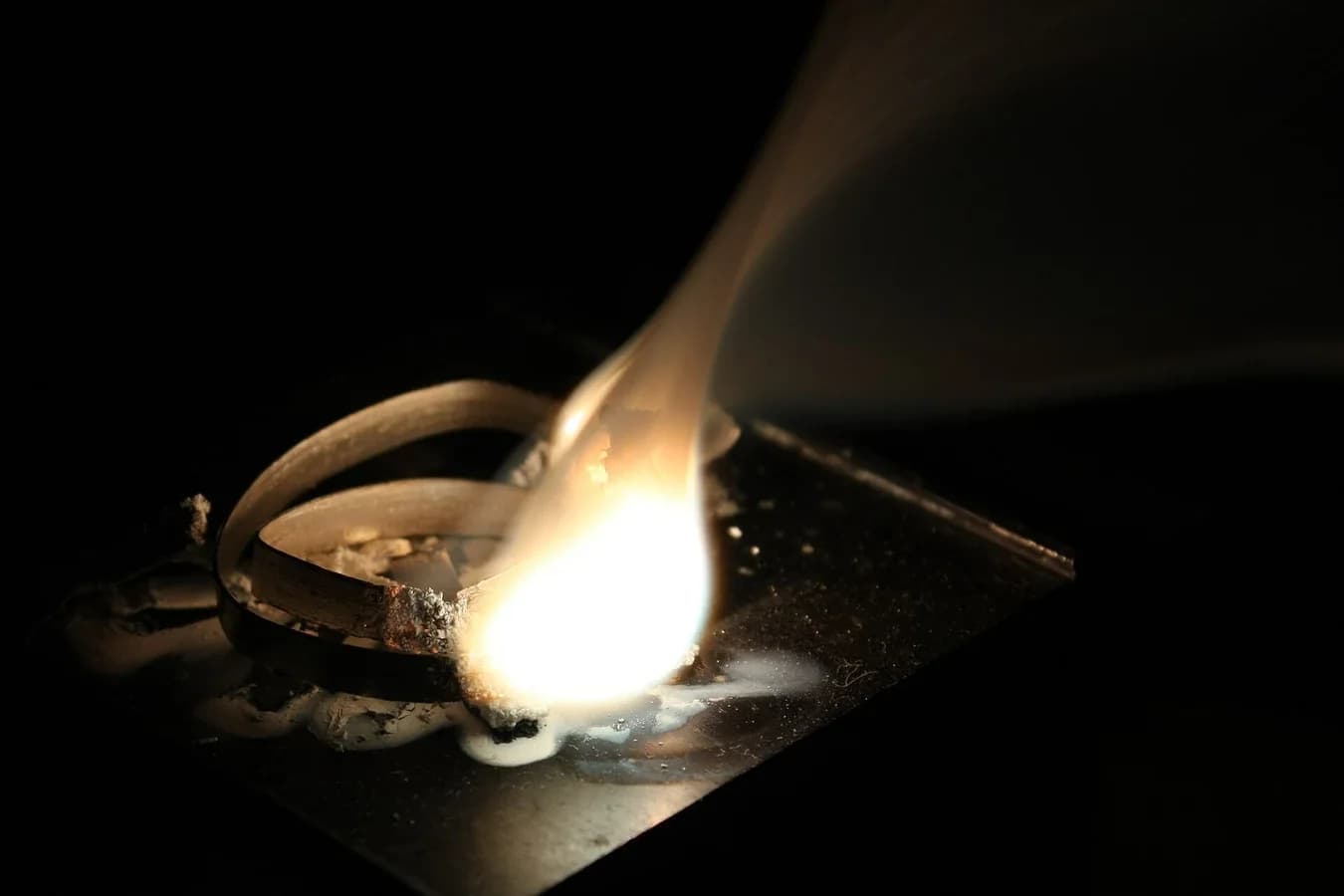
Magnesium burns in air with a brilliant white flame. The white smoke is magnesium oxide: any that escapes from a crucible is product lost, which lowers the measured yield. Image: Capt. John Yossarian, CC BY-SA 3.0, via Wikimedia Commons.
Yields in multistep synthesis
Medicines are usually made in a sequence of reactions, each with its own yield. The overall yield is the product of the yields of the individual steps, so it falls quickly as the number of steps grows. A six-step synthesis in which every step gives 90% has an overall yield of 0.96=0.53, or 53%; a ten-step route at 80% per step gives only 11%.
90% per step
80% per step
70% per step
The overall yield of a synthesis is the product of the yields of its steps. With 90% per step, six steps give 53%; with 80% per step, ten steps give only 11%.
For this reason pharmaceutical chemists put great effort into shortening routes and raising the yield of each step, especially the late steps, where the material carries the cost of every earlier step. Shorter routes also use fewer reagents and solvents, which links yield to waste and to the next idea, atom economy.
Atom economy
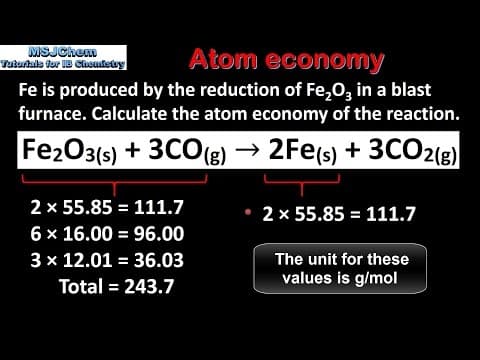
Percentage yield measures how much of the possible product is actually obtained. It says nothing about the other products of the reaction. A reaction with a 100% yield may still turn most of the mass of its reactants into substances nobody wants. Atom economy measures this second kind of efficiency from the balanced equation alone.
%atom economy=molar mass of all reactantsmolar mass of desired product×100
The equation is given in the data booklet. Because mass is conserved, the total molar mass of the reactants equals the total molar mass of the products, so the denominator can be calculated from either side. Every atom that does not end up in the desired product ends up in a by-product, which is waste unless a use is found for it. The higher the atom economy, the less waste a process produces for each kilogram of product: atom economy and waste are inversely related.
YouTube
Mike Sugiyama Jones (MSJ Chem): calculating the atom economy of a reaction.
Atom economy and the type of reaction
The type of reaction largely fixes the atom economy. In an addition reaction all the reactants combine into one product, so the atom economy is 100%. Addition polymerization is an addition reaction repeated thousands of times: every ethene molecule becomes part of the poly(ethene) chain, so the atom economy is 100%. Substitution and elimination reactions always produce a second product and so have lower atom economies.
Reaction type
Example
Atom economy
Addition
CX2HX4+HX2OCX2HX5OH (hydration of ethene)
100%
Addition polymerization
nCHX2=CHX2→[−CH2−CH2−]n
Substitution
CHX4+ClX2CHX3Cl+HCl
Elimination
CX2HX5OHCX2HX4+HX2O
Fermentation
CX6HX12OX62CX2HX5OH+2COX2
Atom economies calculated from the relative atomic masses in the data booklet (2025).
Case study: two syntheses of ibuprofen
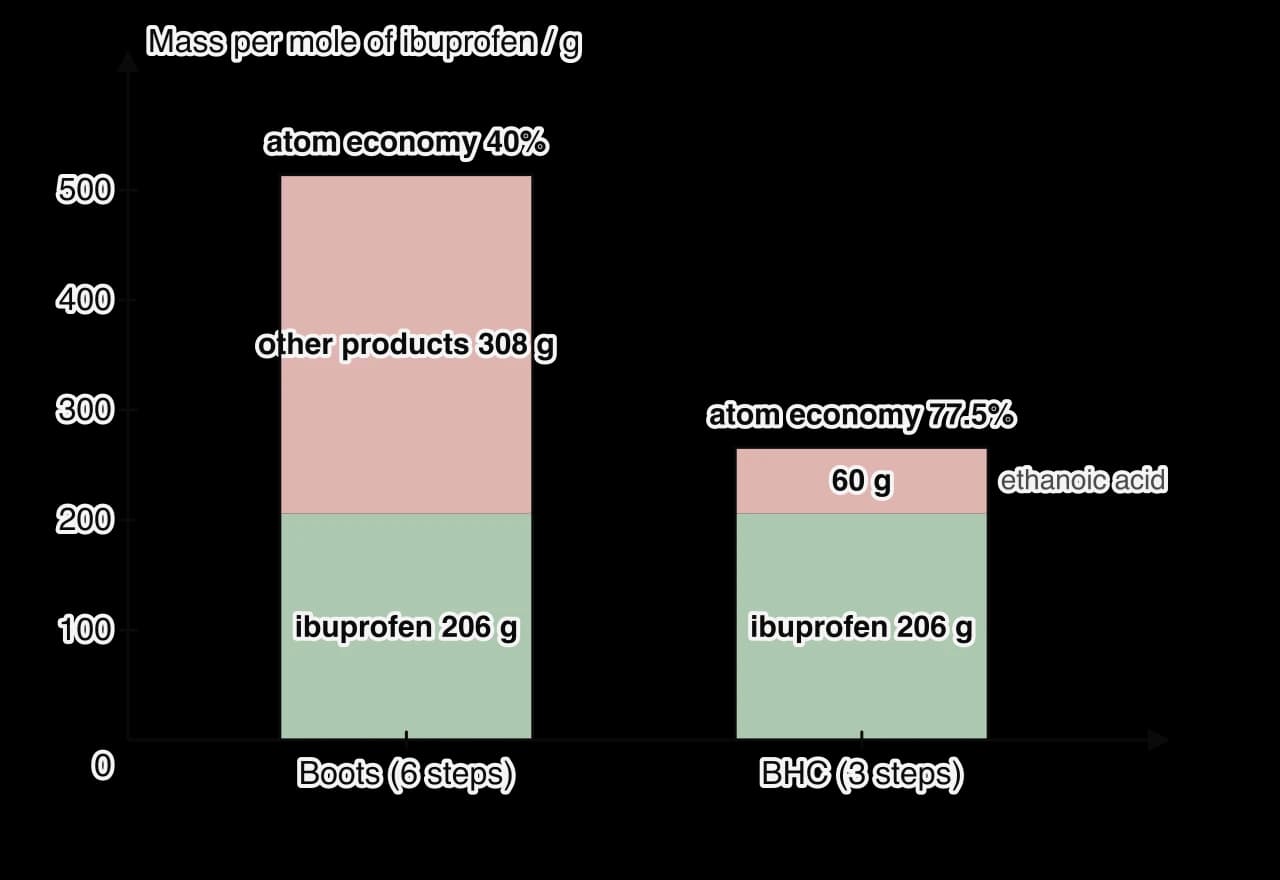
Ibuprofen, one of the most widely used painkillers, was developed by the Boots Company in the United Kingdom in the 1960s. The original Boots synthesis used six steps. Each step added reagents whose atoms did not end up in ibuprofen, and about 514 g of reactants were used for every mole (206 g) of ibuprofen made, an atom economy of about 40%. More than half of the mass of the reactants became waste, and with millions of kilograms of ibuprofen made every year, that waste had to be treated and disposed of.
In the 1990s the BHC Company developed a three-step route. Its overall equation, from 2-methylpropylbenzene (CX10HX14), ethanoic anhydride, hydrogen and carbon monoxide, is:
The only by-product is ethanoic acid, which is recovered and sold, so in practice nearly all the reactant atoms end up in useful products. Published figures for the process vary with the reactants counted: the US Environmental Protection Agency quotes about 80% atom utilization, or about 99% when the recovered ethanoic acid is included. The BHC process also uses catalysts that are recovered and reused (including hydrogen fluoride, recycled with better than 99.9% efficiency) instead of reagents that are used up. It received a US Presidential Green Chemistry Challenge Award in 1997.
Each bar is the total mass of reactants used per mole of ibuprofen: the green part ends up in the product, the red part in other substances. Data: Boots route, about 40%, as reported by the US EPA Presidential Green Chemistry Challenge (1997); BHC value calculated from its overall equation with data booklet relative atomic masses (the EPA quotes about 80%).
The comparison shows why atom economy is calculated at the design stage: it depends only on the chosen reactions, so a route with a poor atom economy cannot be rescued by running each step more carefully. Percentage yield, by contrast, can be raised by better practice and conditions.
Atom economy compared with percentage yield
Percentage yield
Atom economy
Measures
how much of the possible product is actually obtained
how much of the reactants' mass can end up in the desired product
Calculated from
experimental data and the theoretical yield
the balanced equation only
Lowered by
incomplete reaction, equilibrium, side reactions, losses
by-products formed by the reaction itself
Improved by
better conditions, technique and purification
choosing a different reaction or route
A process can score well on one measure and badly on the other. The chlorohydrin route to ethylene oxide could run with a good percentage yield and still waste three-quarters of its reactant mass; a direct oxidation with 100% atom economy is of little use if most of the ethene is lost by burning to carbon dioxide. Both measures are needed to judge efficiency.
Another measure of waste: the E-factor
Industry also uses the E-factor, introduced by Roger Sheldon in 1992: the mass of waste produced per unit mass of product. Unlike atom economy, it counts solvents, excess reagents and losses as well as by-products, so it reflects what actually leaves a factory. Typical E-factors are below 0.1 for oil refining, about 1–5 for bulk chemicals, 5–50 for fine chemicals and 25–100 or more for pharmaceuticals, where many steps and large volumes of solvent are used for each kilogram of product.
Green chemistry: judging the efficiency of a process
Green chemistry is the design of chemical products and processes that reduce or eliminate the use and generation of hazardous substances. It was set out as twelve principles by Paul Anastas and John Warner in 1998. Atom economy and percentage yield are two of the measures it uses; a full assessment of a process also looks at the following factors.
Factor
Greener choice
Example
Waste
prevent waste rather than treat it; find uses for by-products
Ethanoic acid from the BHC ibuprofen process is recovered and sold
Solvents
use less solvent, or safer solvents such as water or supercritical carbon dioxide
Supercritical carbon dioxide is used to decaffeinate coffee in place of chlorinated solvents
Catalysts
use catalysts, which are not used up, rather than stoichiometric reagents
The silver catalyst in the direct oxidation of ethene
Energy
run reactions at lower temperature and pressure; catalysts help
Enzyme-catalysed reactions near room temperature
Feedstocks
use renewable raw materials rather than finite ones
Ethanol made by fermenting sugar cane instead of from crude oil
Hazards
use and make less toxic substances; reduce the risk of accidents
Replacing toxic sodium azide in airbag inflators
Rate and extent
conditions that give a fast reaction and a high conversion
Catalysts and conditions that shift equilibria towards products
These factors can pull in different directions. Fermentation uses a renewable feedstock and runs near room temperature, but has an atom economy of only 51%, since a third of the carbon atoms leave as carbon dioxide. Weighing such factors against each other, and against cost and safety, is part of choosing a process. The speed and extent of a reaction, which also affect efficiency, depend on the factors that control rates and equilibria.
Applying the ideas in exam questions
Paper 1A: the limiting reactant
Paper 1A: reacting gas volumes
Paper 1B: collecting carbon dioxide from calcium carbonate
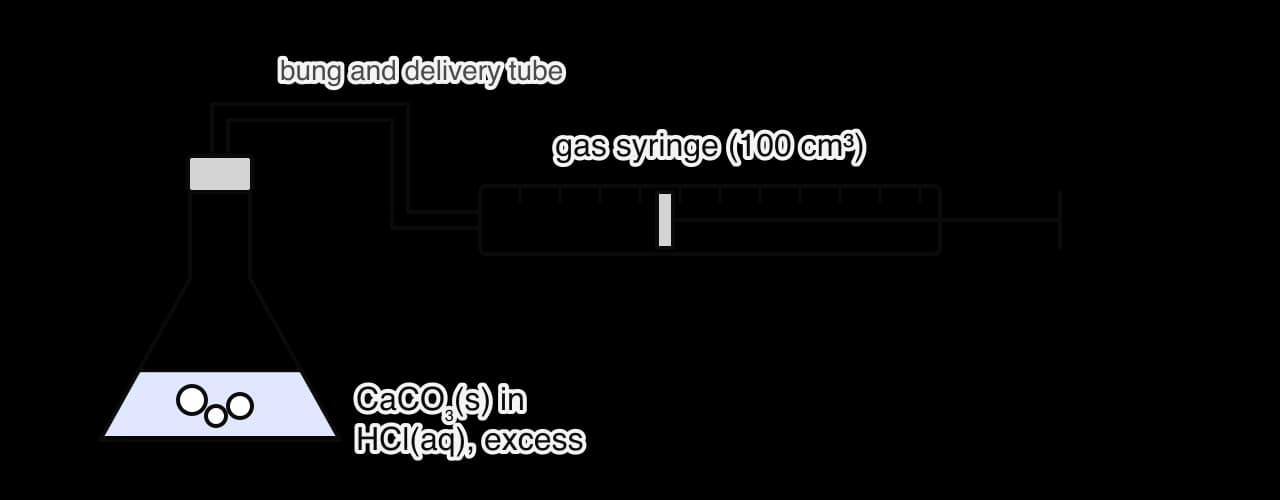
A student adds 0.250g (±0.001g) of powdered calcium carbonate to 20.0cm3 of 1.00mol dm−3 hydrochloric acid in the apparatus shown, inserting the bung immediately. The gas collected at 20.0∘C and 100kPa has a final volume of 54.0cm3 (±0.5cm3).
Carbon dioxide pushes the plunger of the gas syringe out; the final volume is read from the scale once the reaction has stopped and the apparatus has returned to room temperature.
Paper 2: standardizing hydrochloric acid
Paper 2: extracting titanium
Paper 2: two routes to hydrogen
Self-check
To do:
I can write balanced equations, with state symbols, from descriptions of reactions and from given reactants and products.
To do:
I can balance equations by inspection and give the sum of the smallest whole-number coefficients.
To do:
I can write ionic equations, identify spectator ions and check that charges balance.
To do:
I can explain why the coefficients of an equation give mole ratios but not mass ratios.
To do:
I can calculate reacting masses through the mole ratio, including problems with a percentage composition or a mass difference.
To do:
I can use volume ratios for gases at the same temperature and pressure, and deduce a formula from combustion volumes.
To do:
I can calculate gas volumes at STP with 22.7 dm³ mol⁻¹ and under other conditions with PV = nRT in SI units.
To do:
I can calculate amounts, concentrations and volumes of solutions that react, including precipitation reactions.
To do:
I can describe how to carry out a titration and explain the choice of glassware, concordant titres and rinsing.
To do:
I can process acid–base, redox and back titration data to find a concentration, a mass or a percentage purity.
To do:
I can identify the limiting and excess reactants and calculate the amount of excess reactant remaining.
To do:
I can distinguish theoretical yield from experimental yield and calculate a percentage yield.
To do:
I can explain why an experimental yield is lower, or appears higher, than the theoretical yield.
To do:
I can process gravimetric data from heating to constant mass, including the uncertainty in a mass difference.
To do:
I can calculate the overall yield of a multistep synthesis.
To do:
I can calculate atom economy from a balanced equation and explain why addition reactions have 100% atom economy.
To do:
I can explain the difference between atom economy and percentage yield, and the link between atom economy and waste.
To do:
I can discuss specific green chemistry factors, beyond atom economy and yield, that affect the efficiency of a process.
B
AgNO3(aq)+NaCl(aq)→AgCl(s)+NaNO3(aq)
C
AgNO3(s)+NaCl(s)→AgCl(s)+NaNO3(s)
D
AgNO3(aq)+NaCl(aq)→AgCl(l)+NaNO3(aq)
Explanation
Both reactants are dissolved in water, (aq). The precipitate is insoluble silver chloride, a solid, (s), and sodium nitrate stays dissolved, (aq): B.
A swaps the states of the two products. C treats the solutions as solids. D uses (l), which means a pure liquid, not a solid formed in a solution.
The answer is B.
Question 2 · CHEM-002541 mark
An organic compound contains carbon, hydrogen and oxygen only. Complete combustion of 0.450 g of the compound produces 0.660 g of CO2 and 0.270 g of H2O.
Check: the mass of iron is less than the mass of the oxide, as it must be, since the oxygen is removed. The proportion 2(55.85)/159.70=0.699 is also the mass fraction of iron in FeX2OX3.
.
n(S)=32.07g mol−12.5×10⁴g=779.5mol
Mole ratio 1 : 1, so n(SOX2)=779.5mol, and M(SOX2)=32.07+2(16.00)=64.07g mol−1:
m(SOX2)=779.5×64.07=4.99×10⁴g≈50kg
The answer is given to two significant figures, matching the 2.5% in the data. Burning one tonne of this coal releases about 50 kg of a gas that forms acid rain, which is why coal-fired power stations remove sulfur dioxide from their flue gases.
. The remaining
50cm3
is unused oxygen, so
V(OX2)used=150−50=100cm3
.
Volume ratio = mole ratio. For CxHy+(x+4y)OX2→xCOX2+2yHX2O:
x=2060=3x+4y=20100=5⇒4y=2,y=8
The hydrocarbon is CX3HX8, propane. Check:CX3HX8+5OX23COX2+4HX2O; 20cm3 needs 100cm3 of OX2 and gives 60cm3 of COX2, as measured.
Undo the dilution. The vinegar was diluted by a factor of 100.0/10.00=10, so the original concentration is 0.834mol dm−3.
Mass concentration:M(CHX3COOH)=60.06g mol−1, so 0.834×60.06=50.1g dm−3, which is 5.0 g per 100cm3.
in
25.00cm3
.
Scale up to the whole tablet (the 100.0cm3 flask held four portions): n=4×2.910×10−4=1.164×10⁻³mol.
Mass:1.164×10−3×55.85=0.0650g=65.0mg. This matches the iron content stated for a common supplement tablet containing 200 mg of dried iron(II) sulfate.
.
Acid that reacted with the carbonate:2.500×10⁻²−6.020×10−3=1.898×10⁻²mol.
Mole ratio 2 : 1:n(CaCOX3)=9.490×10⁻³mol; m=9.490×10−3×100.09=0.950g.
Percentage:0.950/1.000×100=95.0%. The rest of the shell is mainly protein and other minerals, which do not react with the acid; any that did react would make the result too high.
.
Divide by the coefficients: Mg 0.1000/1=0.1000; HCl 0.0500/2=0.0250. The acid gives the smaller value, so HCl is limiting and magnesium is in excess.
Hydrogen formed (2 mol HCl gives 1 mol HX2): n(HX2)=0.0250mol; V=0.0250×22.7=0.568dm3=568cm3 at STP.
Magnesium left over:0.0250 mol reacts, so 0.1000−0.0250=0.0750mol remains, a mass of 0.0750×24.31=1.82g.
;
n=2.00/138.13=1.448×10−2mol
.
Theoretical yield: the ratio is 1 : 1 and M(CX9HX8OX4)=180.17g mol−1, so the theoretical mass of aspirin is 1.448×10−2×180.17=2.61g.
percentage yield=2.6091.95×100=74.7%
. The ratio Mg : MgO is 1 : 1, so the theoretical mass of MgO is
1.481×10−2×40.31=0.597g
.
Mass of product =25.981−25.412=0.569g.
percentage yield=0.59690.569×100=95.3%
(b) The mass of product is the difference of two readings, so its absolute uncertainty is 2×0.001=±0.002g. The percentage uncertainty is 0.002/0.569×100=0.35%, about 0.4%.
(c) Yes. With nitrogen, 3Mg(s)+NX2(g)MgX3NX2(s); if all 1.481×10⁻² mol of Mg formed MgX3NX2 (M=100.95g mol−1), the mass would be 31×1.481×10−2×100.95=0.498g. Each magnesium atom gains less mass as nitride than as oxide, so a mixture of the two gives a mass between 0.498 g and 0.597 g, which is consistent with the 0.569 g obtained. The difference from 100% (4.7%) is much larger than the 0.4% uncertainty, so it is a real effect, not random error.
The old route turned three-quarters of the mass of its reactants into calcium chloride and water; the direct route, an addition reaction, has no by-product at all.
(poly(ethene))
100%
50.49/86.95=58.1%
(dehydration of ethanol)
28.06/46.08=60.9%
92.16/180.18=51.1%
forms
C. ClX2 is limiting and 1.3 mol of AlClX3 forms
D. ClX2 is limiting and 2.0 mol of AlClX3 forms
, so chlorine is limiting.
AlClX3
formed
=2.0×32=1.3
mol. B takes Al as limiting and converts all of it to
AlClX3
; D identifies the right limiting reactant but ignores the
3:2
ratio; A pairs the correct amount with the wrong reactant.
of
COX2
forms. Water is a liquid at room temperature. Total
=80+50=130cm3
. A forgets the excess oxygen; C counts
40cm3
of water vapour as gas; D adds the volumes of the reactants.
Award [2] for correct final answer. Accept 60.7–60.9 cm³. Award [1 max] for 4.15 cm³ (temperature in °C) or for 56.7 cm³ (22.7 dm³ mol⁻¹ used at 293 K).
(c)
54.0/60.8×100=88.8 «%» ✓ (ECF from (b))
(d)
0.5/54.0×100=0.9 «%» ✓
(e)
no AND the shortfall «about 11%» is much larger than the uncertainty «0.9%», so a systematic error is responsible ✓
(f) Any two of:
some carbon dioxide dissolves in the water of the acid solution ✓
gas escapes before the bung is inserted ✓
friction of the plunger in the barrel / gas leaks at the joints ✓
[2 max]. Do not accept "human error" or "inaccurate equipment". Accept "calcium carbonate impure" only if the impurity is said not to produce gas.
(g)
place the calcium carbonate in a small tube inside the flask and tip it into the acid after the bung is inserted ✓
OR
use acid already saturated with carbon dioxide ✓
✓
state symbols: NaX2COX3(aq)+2HCl(aq)2NaCl(aq)+HX2O(l)+COX2(g) ✓
Award the second mark only for a correctly balanced equation.