Notes on R1.4 Entropy and spontaneity
Ice melts on a warm day, perfume spreads through a room and a hot drink cools down, all without any help. Many spontaneous changes are exothermic, but melting ice and dissolving ammonium nitrate absorb heat, so the enthalpy change alone cannot predict which way a change will go. The missing quantity is entropy, and combining it with enthalpy gives the Gibbs energy change, which predicts the direction of any chemical change.
Spontaneous change and entropy
A spontaneous change is one that, once started, continues on its own without a continuous input of energy from outside. Water flows downhill, a gas spreads to fill its container, sodium reacts with chlorine and heat flows from a hot object to a cold one. The reverse of each of these never happens on its own.
Many spontaneous reactions are exothermic, and it is tempting to think that systems always move to lower energy. Several common changes show that this cannot be the whole story:
Ice melts at room temperature, although melting is endothermic ().
Ammonium nitrate dissolves in water so endothermically that the solution becomes very cold; instant cold packs use this.
Liquid water evaporates from a puddle at 20 °C, absorbing heat from the surroundings.
A gas spreads into an evacuated container with no change in energy at all.
In each case, matter or energy becomes more spread out. That tendency is measured by entropy.
Entropy as the dispersal of matter and energy
The spreading of a gas shows the idea most simply. Two flasks are joined by a tube with a tap; one contains a gas and the other a vacuum. When the tap is opened, the gas spreads through both flasks, and it never returns to one flask on its own.
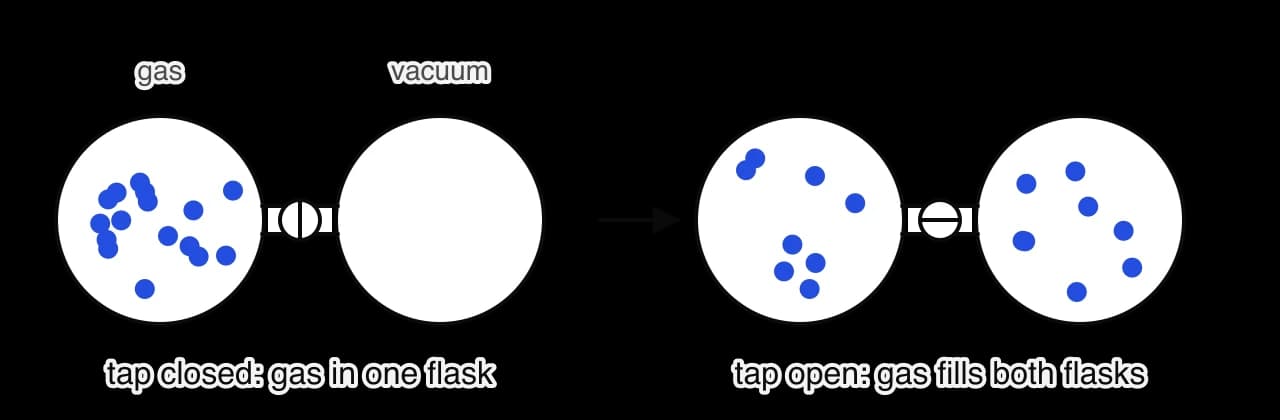
The reason is probability. Each particle moves randomly and is equally likely to be found in either flask. For one particle there is a 1 in 2 chance of finding it in the left flask; for four particles the chance that all four are on the left at once is
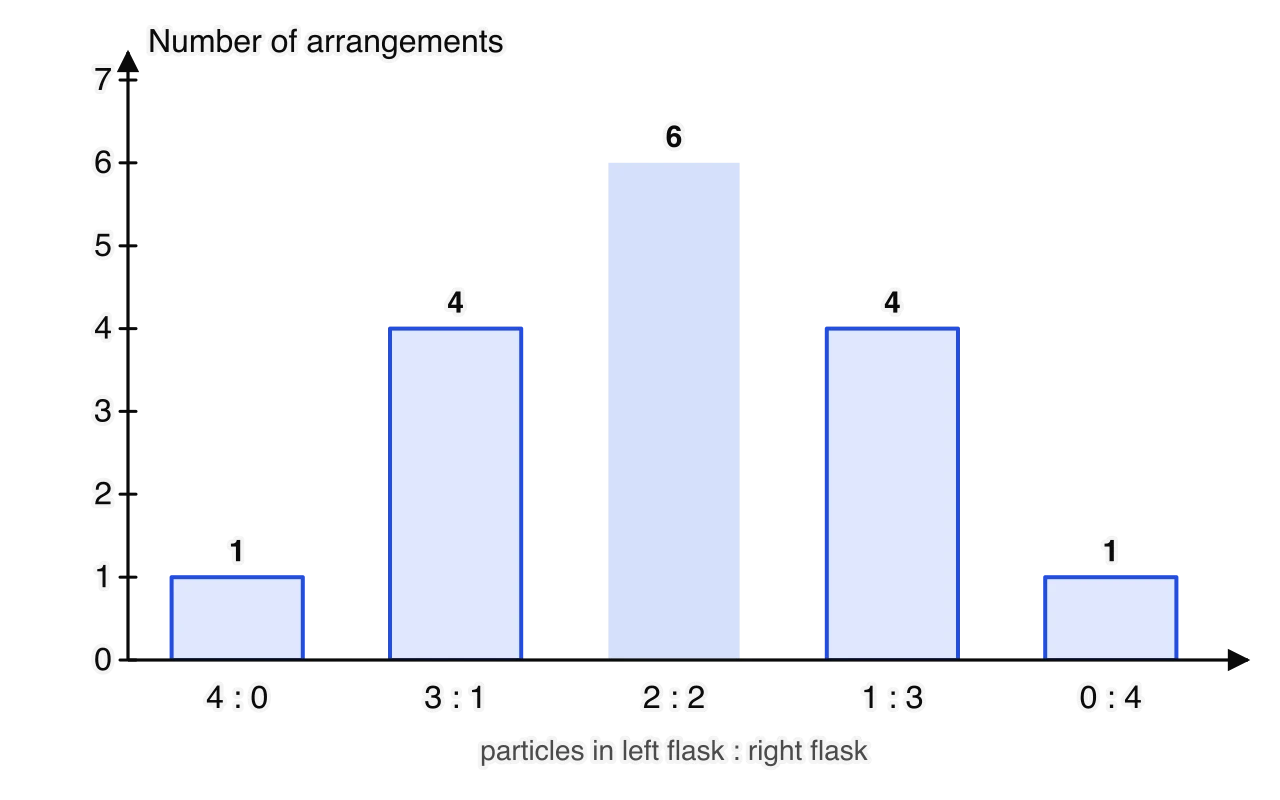
For a real sample of gas containing about particles, the chance of finding them all in one flask is
Energy behaves in the same way. The energy of a substance is held in the motion of its particles (translation, rotation and vibration) in small fixed amounts, or quanta. The more particles there are, and the more closely spaced their energy levels, the more ways the quanta can be shared among them. A system tends towards the state in which its energy can be distributed in the largest number of ways. Each particular way of arranging the particles and sharing their energy is a microstate.
Entropy is sometimes described as "disorder". The description gives the right predictions in many simple cases, but it can mislead, because entropy is about the number of ways energy can be shared, not about how untidy the particles look. Describing entropy as the dispersal of matter and energy is more accurate.
These ideas lead to the second law of thermodynamics: in any spontaneous change, the total entropy of the system and its surroundings increases.
 YouTube
Absolute entropy and the perfect crystal at 0 K
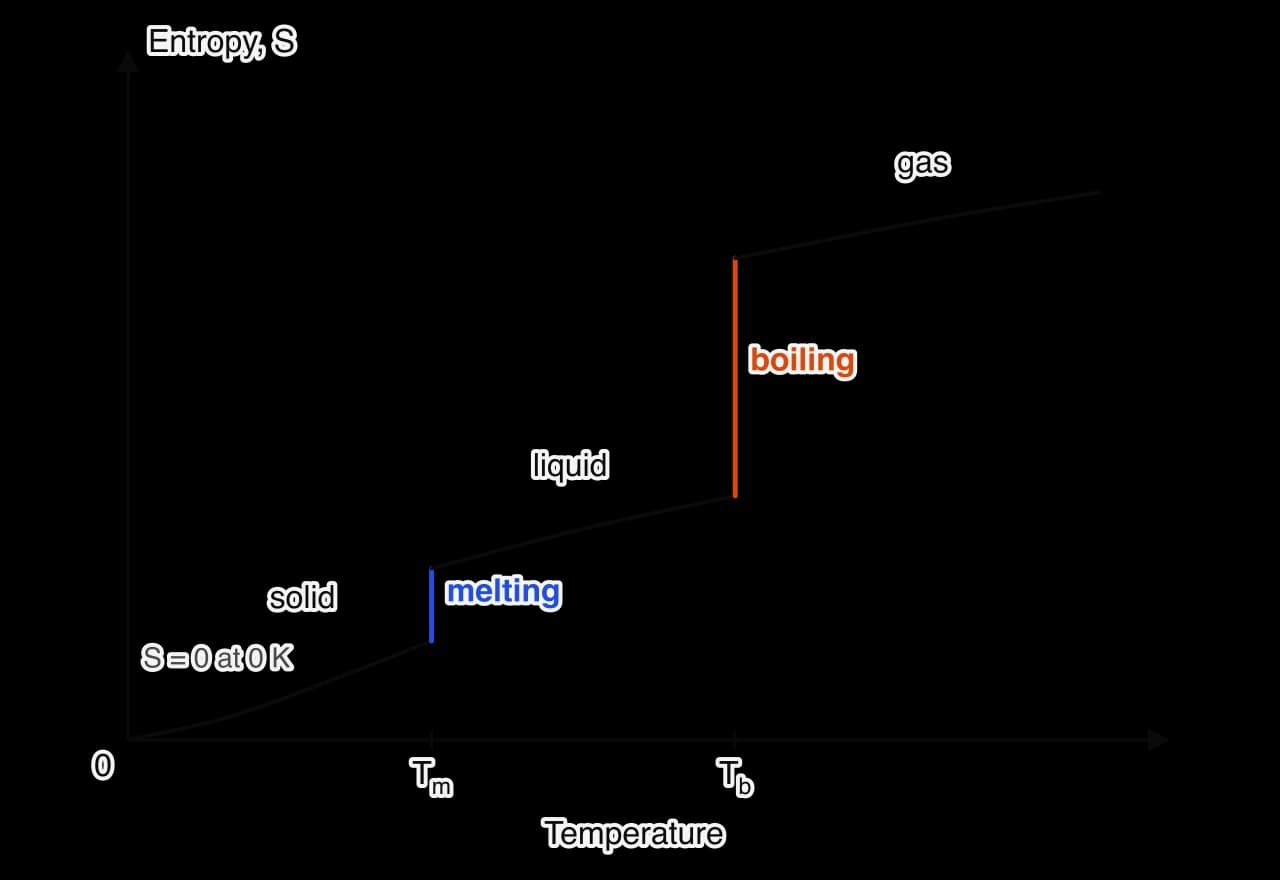
Unlike enthalpy, entropy has an absolute zero. In a perfect crystal at 0 K every particle sits at its lattice site in its lowest energy state, and there is only one way of arranging the particles and their energy. With only one microstate there is no dispersal at all, so the entropy is zero. This is the third law of thermodynamics.
Every substance above 0 K therefore has a positive entropy, which can be measured. The standard entropy, , of a substance is its entropy per mole in its standard state at 100 kPa, usually quoted at 298 K. Elements have positive standard entropies, even though their standard enthalpies of formation are zero by definition.
Optional depth: counting microstates (Boltzmann)
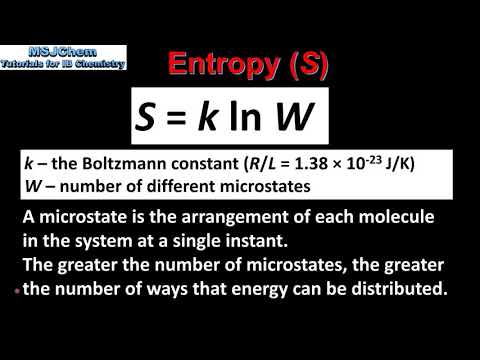
Ludwig Boltzmann linked entropy to the number of microstates, , by the equation , where is the Boltzmann constant,
What affects the entropy of a substance
Standard entropies follow clear patterns, each of which can be explained by the number of ways the particles can be arranged and their energy shared.
Physical state
Under the same conditions, the entropy of a gas is much greater than that of a liquid, which is greater than that of a solid. Particles in a solid vibrate about fixed positions. In a liquid they can also move past one another. In a gas they move freely and rapidly through a volume about a thousand times larger, with many more ways of sharing their translational energy.
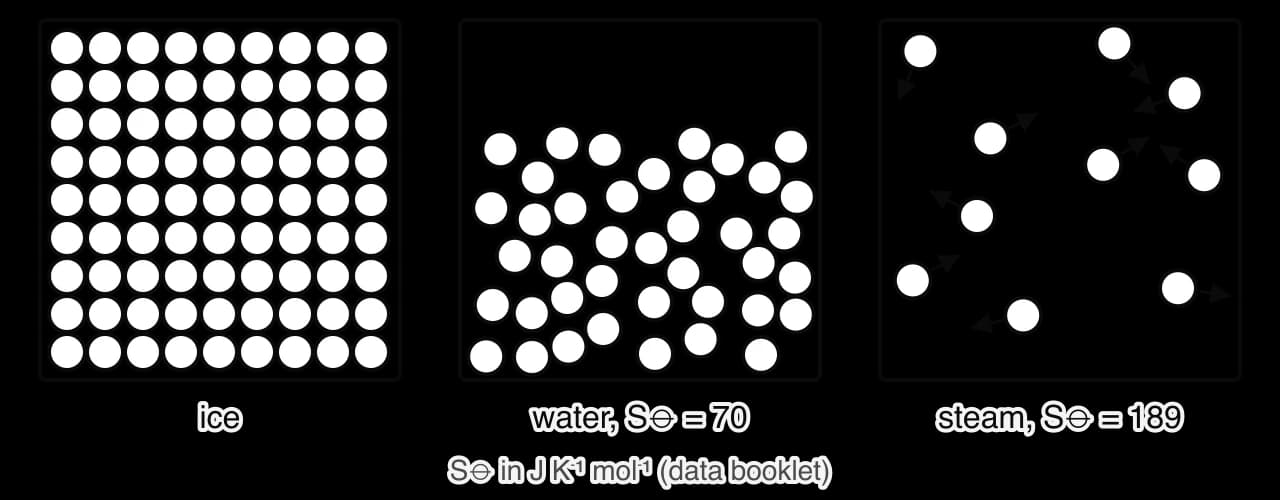
The data booklet gives
Temperature
Heating a substance gives its particles more energy, and more quanta can be shared among more energy levels, so the number of microstates and the entropy increase. At a melting point or boiling point the entropy rises sharply at constant temperature, because the particles gain new freedom of movement.
Size and complexity of the particles
Molecules with more atoms have more ways to rotate and vibrate, and so more ways to store energy. For substances in the same state, entropy therefore increases with the number of atoms in the molecule and with molar mass. The alkanes show this clearly:
Alkane (gas) | Formula | / |
|---|---|---|
methane |
Data: IB Chemistry data booklet (2025), section 13.
Mixing and dissolving
Mixing two gases or two miscible liquids increases entropy, because each component spreads through a larger volume and there are more ways of arranging two kinds of particle than one. Dissolving a solid in water usually increases entropy too, as ions or molecules leave a regular lattice and spread through the solution. There are exceptions: small, highly charged ions such as and
Factor | Change that increases entropy | Reason |
|---|---|---|
physical state | solid → liquid → gas | particles gain freedom of movement and a much larger volume |
temperature | higher temperature | more energy quanta shared among more energy levels |
molecular complexity | more atoms per molecule, larger molar mass | more ways to rotate and vibrate |
amount of gas | more moles of gas | more particles moving freely through a large volume |
mixing and dissolving | two substances mixed; a solid dissolved | particles spread through a larger volume, more arrangements |
Predicting the sign of an entropy change
The entropy change of a process, , is the entropy of the final state minus the entropy of the initial state. A positive means matter or energy has become more dispersed.
Physical changes
Changes of state follow directly from the order solid < liquid < gas:
Change | Example | Sign of |
|---|---|---|
melting (fusion) |
Chemical reactions: count the moles of gas
Gases have far higher entropies than liquids and solids, so the change in the amount of gas usually decides the sign of for a reaction:
More moles of gas in the products: is positive. Example:
Calculating standard entropy changes
Because standard entropies are absolute values, the standard entropy change of a reaction is found directly from them, products minus reactants, each multiplied by its coefficient in the equation:
The data booklet lists for many compounds but not for elements. Values for elements such as ,
The state of each substance matters. If the water in the same reaction were formed as steam,
With 3 mol of gas on each side, the entropy change is now almost zero, consistent with the rule that the moles of gas dominate.
Gibbs energy: combining enthalpy and entropy
The entropy change calculated from standard entropies is the entropy change of the system: the reacting chemicals. The second law, however, concerns the total entropy change, which also includes the surroundings. A reaction with a negative , such as the combustion of methane, can still be spontaneous if it increases the entropy of the surroundings by more.
The entropy change of the surroundings
When a reaction releases heat at constant pressure, that energy () passes into the surroundings and spreads out among their particles, increasing their entropy. An endothermic reaction takes heat from the surroundings and lowers their entropy. The size of the effect depends on the temperature: a given amount of heat makes a large difference to the dispersal of energy in cold surroundings, which have little energy to start with, and a smaller difference to hot ones. The entropy change of the surroundings is therefore:
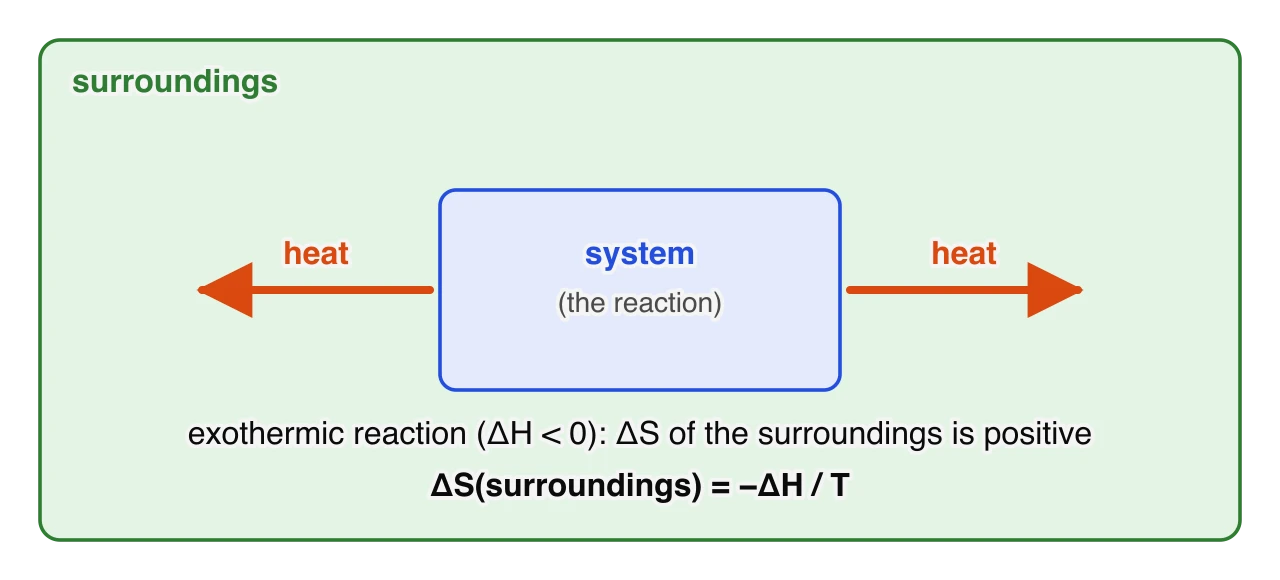
The total entropy change is the sum of the two parts, and for a spontaneous change it must be positive:
The Gibbs energy change
Multiplying the total-entropy condition by gives a single quantity that depends only on the system. This is the Gibbs energy change, (also called the Gibbs free energy change), the change in a property of the system called its Gibbs energy, :
Here is the entropy change of the system, and the term accounts for the entropy change of the surroundings caused by the transfer of heat. Because is always positive,
also has a practical meaning: it is the maximum amount of energy from a reaction that can be used to do useful work other than expansion, such as driving an electric current. The rest of the energy released, , cannot be converted to work.
Value of ΔG | Meaning |
|---|---|
spontaneous: the forward reaction is thermodynamically feasible | |
the system is at equilibrium | |
non-spontaneous: the reverse reaction is spontaneous |
Calculating ΔG⦵
The equation mixes units:
The same equation can be rearranged to find , or when the other values are known.
ΔG⦵ from standard Gibbs energies of formation
The data booklet also lists the standard Gibbs energy change of formation, , for many compounds. Gibbs energy, like enthalpy, is a state function, so for a reaction can be found from these values in the same way as
As with , elements in their standard states have
Spontaneous does not mean fast
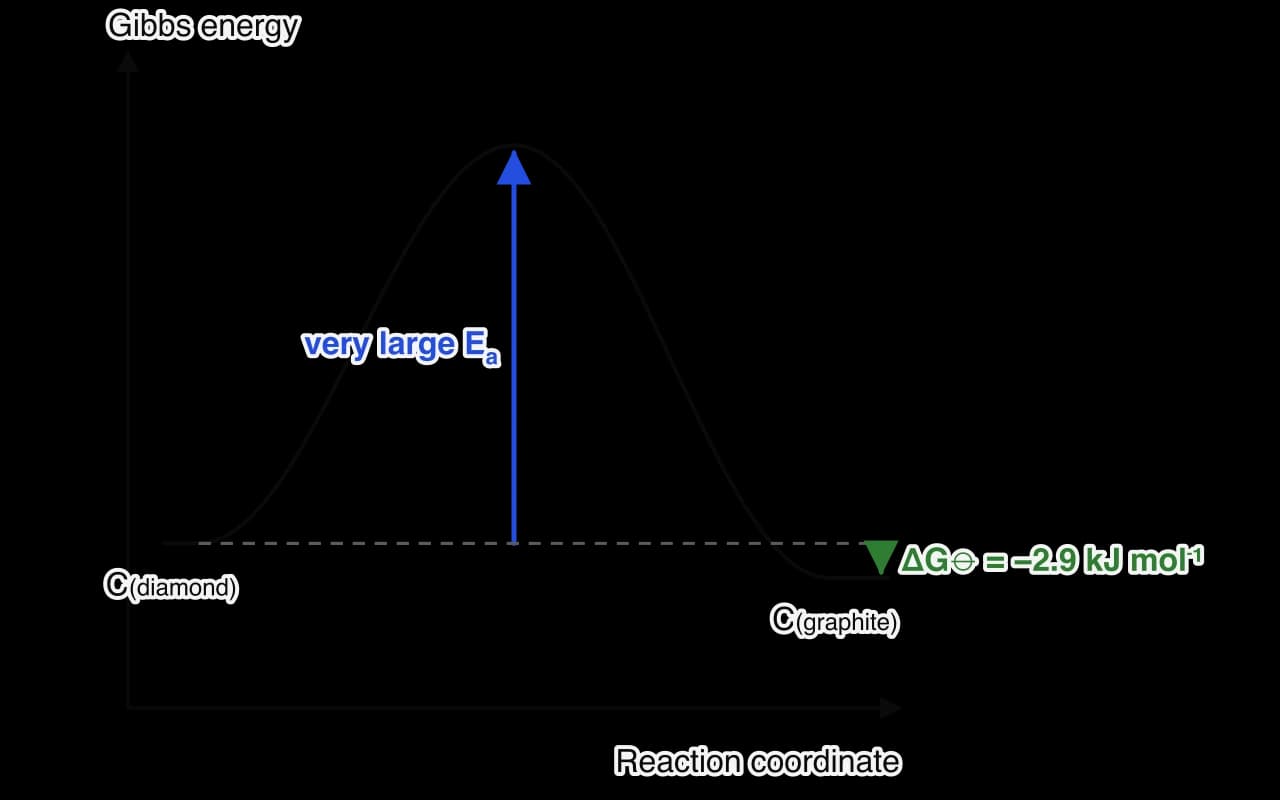
A negative shows that a reaction can happen, not that it will happen at a noticeable rate. The rate depends on the activation energy, which says nothing about. Methane and oxygen do not react until ignited, and diamond, which is less stable than graphite, does not turn into graphite at any measurable rate at room temperature. Such systems are kinetically stable even though they are thermodynamically unstable.
How temperature affects spontaneity
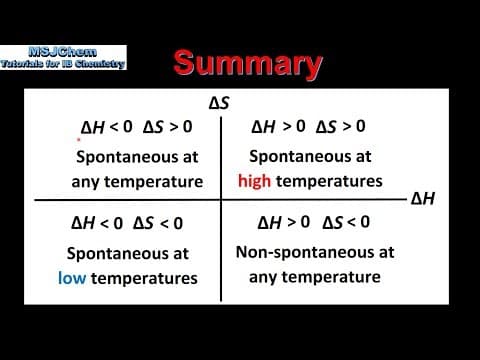
In , the entropy term is multiplied by the absolute temperature. At low temperatures usually dominates; at high temperatures does. The signs of
ΔH | ΔS | ΔG = ΔH − TΔS | Spontaneous? | Example |
|---|---|---|---|---|
negative (exothermic) | positive | always negative | at all temperatures |
A graph of against shows the same four cases. Assuming and do not change with temperature, each is a straight line that meets the axis at
 YouTube
The temperature at which a reaction becomes spontaneous
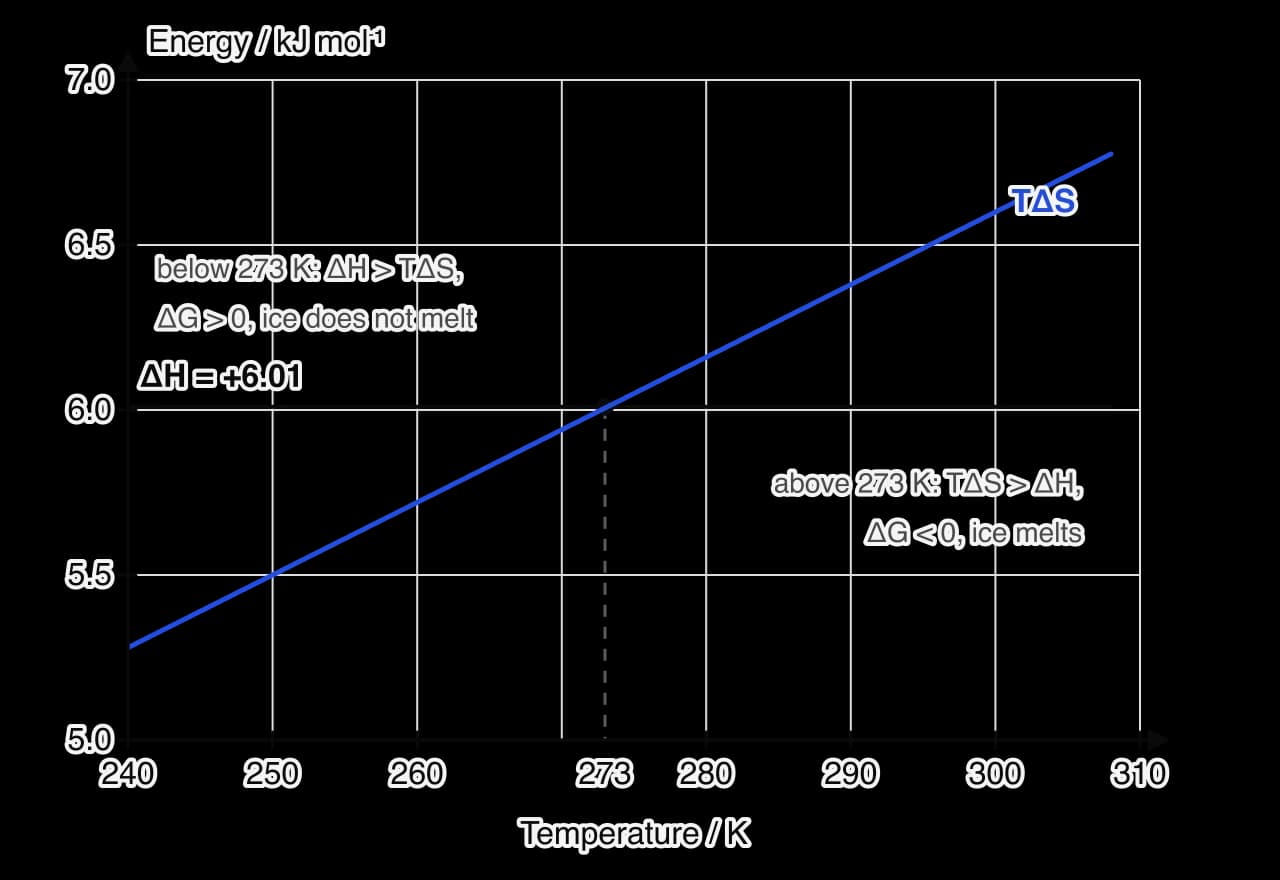
When and have the same sign, there is a temperature at which . Above or below it the reaction changes from non-spontaneous to spontaneous. Setting in
The calculation assumes that and stay the same at all temperatures. They do change a little, so the answer is an estimate, but usually a good one.
Melting ice shows the balance clearly. For
Case study: decomposing limestone
Quicklime, calcium oxide, is made by heating limestone, calcium carbonate, in a lime kiln. The product is used to make cement, steel and glass, and to neutralize acidic soils. The reaction is endothermic but produces a gas:
Substance | / |
|---|
Values for from the IB Chemistry data booklet (2025); values for the calcium compounds from the NBS tables of chemical thermodynamic properties (1982).
The enthalpy and entropy changes are:
At 298 K the reaction is far from spontaneous:
Limestone buildings and cliffs therefore last for centuries. Both and are positive, so raising the temperature makes larger until it outweighs . The reaction becomes spontaneous above:
Industrial lime kilns run at about 900–1100 °C, above this temperature, so that the decomposition is spontaneous and also fast. In practice the carbon dioxide is swept away as it forms, which keeps its partial pressure low and helps the decomposition further. Cement making is responsible for several per cent of global carbon dioxide emissions, partly because this reaction releases carbon dioxide from the limestone itself, in addition to the carbon dioxide from the fuel burned to heat the kiln.
Gibbs energy and equilibrium
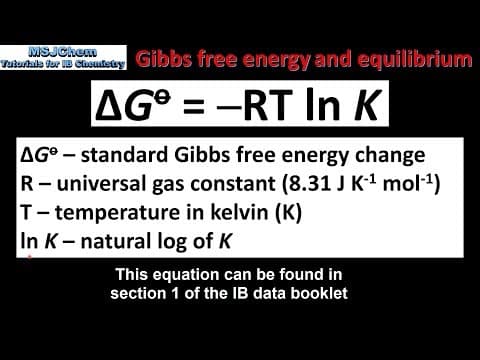
describes a reaction in which every substance is in its standard state, for example every solution at and every gas at 100 kPa. In a real reaction mixture the concentrations change as the reaction proceeds, and so does . The relationship uses the reaction quotient,
Here and is in kelvin. Because is in joules,
Why ΔG reaches zero at equilibrium
At the start of a reaction with only reactants present, is very small, is large and negative, and is negative: the forward reaction is spontaneous. As products form, increases, so becomes less negative and
The graph of the Gibbs energy of the reaction mixture against its composition shows the same thing. The mixture moves downhill in Gibbs energy from either side, and comes to rest at the minimum, which is the equilibrium composition.
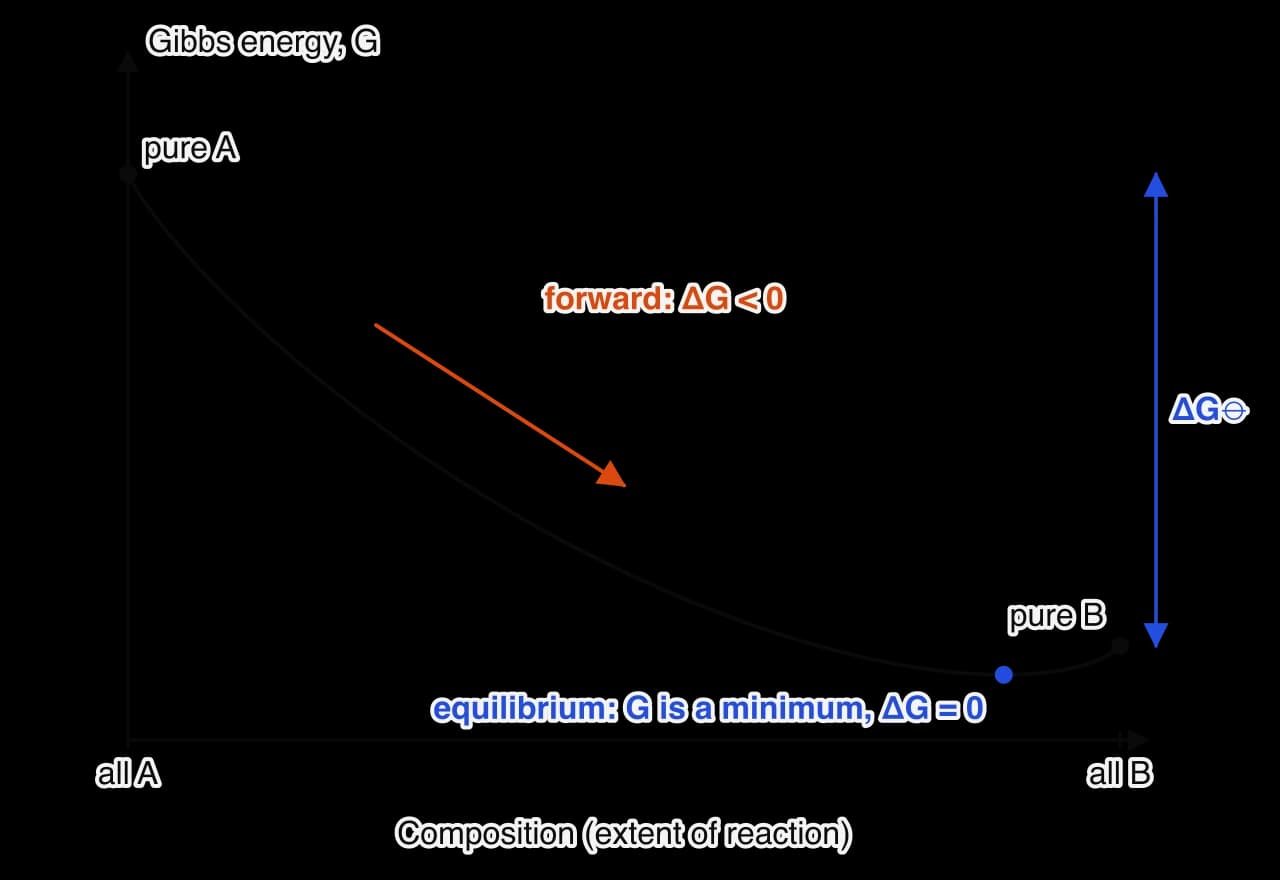
This is why reactions do not usually go to completion even when is negative: mixing reactants and products adds entropy, so the minimum of lies at a mixture rather than at pure products.
The link between ΔG⦵ and K
At equilibrium and , so
The sign of therefore shows which side of the equilibrium is favoured, and its size shows how far:
ΔG⦵ | K | Equilibrium mixture |
|---|---|---|
large and negative | mostly products; the reaction goes almost to completion | |
slightly negative | a little greater than 1 | more products than reactants |
zero | comparable amounts of reactants and products | |
slightly positive |
A positive does not mean that no reaction occurs. Some products always form until , but if is large and positive the amount is too small to detect. Because
 YouTube
Gibbs energy and cell potentials
Redox reactions can also be judged from electrochemical data. The standard Gibbs energy change is related to the standard cell potential by (data booklet), where is the number of moles of electrons transferred and
Spontaneous forward reaction | Non-spontaneous forward reaction |
|---|---|
Applying the ideas in exam questions
Paper 1A: the largest increase in entropy
Paper 1A: spontaneous only at high temperature
Paper 1A: ΔG⦵ and the equilibrium constant
Paper 1B: ΔH⦵ and ΔS⦵ from equilibrium data
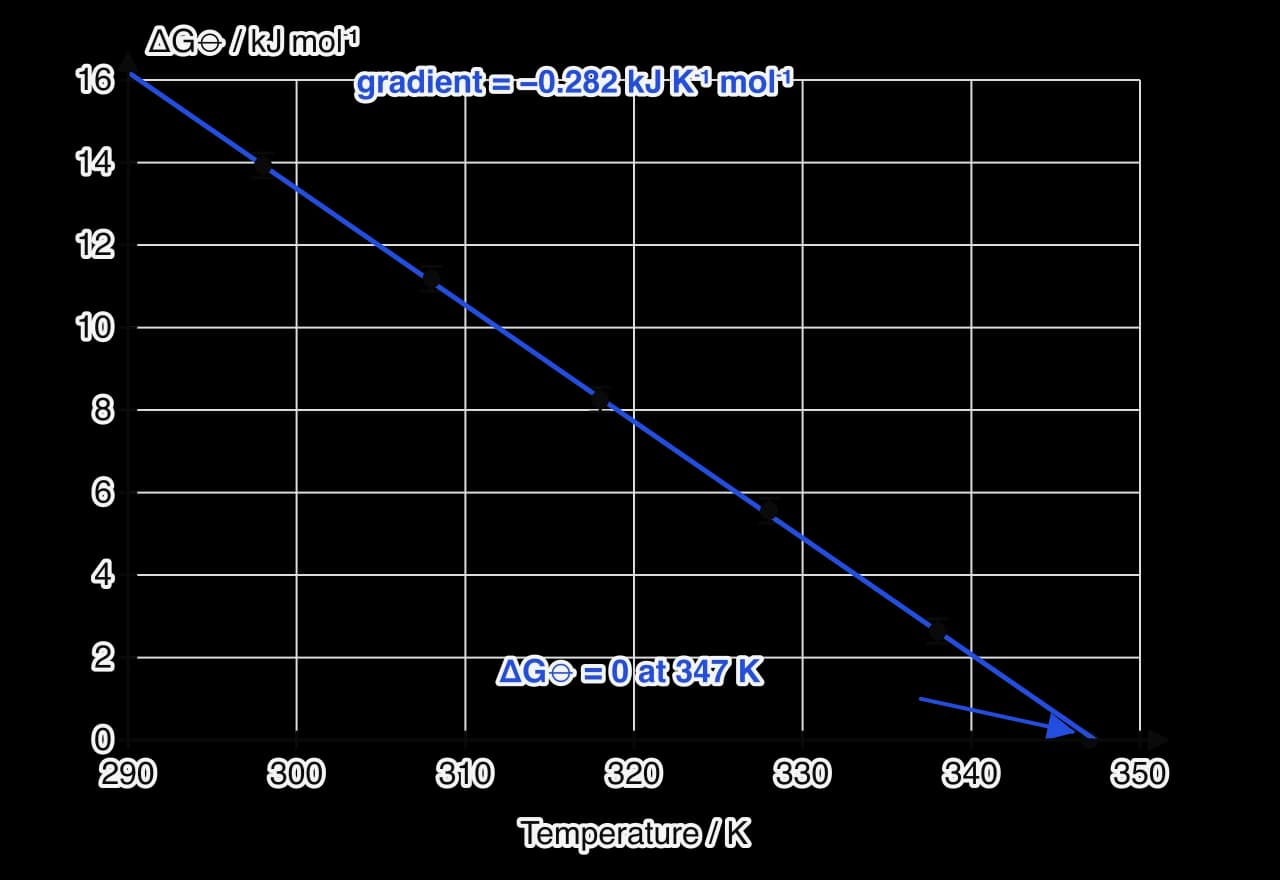
(Paper 1B style) A student measured the equilibrium constant, , for the dissolving of a sparingly soluble salt at five temperatures and calculated at each. The uncertainty in each value of is estimated as
Temperature / K ± 0.5 | K | / |
|---|---|---|
298 | 3.6 × 10⁻³ | 13.93 |
308 | 1.27 × 10⁻² | 11.18 |
318 | 4.4 × 10⁻² | to be calculated |
328 | 0.13 | 5.56 |
338 | 0.39 | 2.64 |
Paper 2: decomposition of magnesium carbonate
Paper 2: making methanol
Self-check
- To do:
I can explain what is meant by a spontaneous change, and why the enthalpy change alone cannot predict it.
- To do:
I can describe entropy as the dispersal of matter and energy, in terms of the number of ways of arranging particles and sharing their energy.
- To do:
I can state the second law of thermodynamics in terms of total entropy.
- To do:
I can explain why a perfect crystal at 0 K has zero entropy, and why every standard entropy, including that of an element, is positive.
- To do:
I can explain the effect of physical state, temperature, molecular complexity, mixing and dissolving on entropy.
- To do:
I can predict the sign of ΔS for physical changes and for reactions, using the change in the amount of gas.
- To do:
I can calculate ΔS⦵ from standard entropies, using coefficients and the correct states.
- To do:
I can explain how heat released or absorbed changes the entropy of the surroundings, and relate ΔG to the total entropy change.
- To do:
I can calculate ΔG⦵ from ΔH⦵ and ΔS⦵ with consistent units, and from ΔGf⦵ values.
- To do:
I can rearrange ΔG⦵ = ΔH⦵ − TΔS⦵ to find any unknown term.
- To do:
I can interpret the sign of ΔG and explain that a spontaneous reaction may still be very slow.
- To do:
I can describe the four combinations of signs of ΔH and ΔS and their effect on spontaneity at different temperatures.