Notes on 5.3 Lean production and quality management
Learning objectives
Describe the features of lean production: less waste and greater efficiency.
Identify the seven types of waste that lean production tries to remove.
Explain kaizen (continuous improvement) and just-in-time (JIT) as methods of lean production, including kanban and andon.
Explain the features of cradle to cradle design and manufacturing.
Distinguish between quality control and quality assurance.
Explain quality circles, benchmarking and total quality management (TQM) as methods of managing quality.
Evaluate the impact of lean production and TQM on an organisation.
Explain the importance of national and international quality standards.
Introduction
Lean production is an approach to operations management that aims to produce goods and services using as few resources as possible, by removing every activity that does not add value for the customer. Quality management is the set of methods a business uses to make sure that what it produces meets the standard customers expect. The two are closely linked: a faulty product is itself a form of waste, and most lean methods were developed alongside methods for building quality into production.
Both ideas came to the world mainly from Japanese manufacturers, above all Toyota, after the Second World War, and both have since spread to hospitals, banks, software firms and public services. They connect to all four key concepts. Lean methods are a response to change in competition and customer expectations; kaizen depends on the creativity of ordinary employees; cutting waste and designing products for reuse support sustainability; and the pressure lean production can put on workers and suppliers raises questions of ethics.
What lean production is
Traditional mass production makes large quantities of standardised products on long production runs. Output is planned in advance from sales forecasts, large stocks of materials are held "just in case" they are needed, and finished goods wait in warehouses until they are sold. The method gives low costs per unit when demand is stable, but it ties up money in stock, hides faults until large numbers of faulty items have been made, and adapts slowly when customers want something different.
Lean production starts instead from what the customer actually values, and asks which activities could be removed without any loss to the customer. Every step that uses time, space, materials or effort without making the product more useful to the customer is treated as waste. The business then removes that waste step by step, so that the same output is produced with fewer inputs, or more output with the same inputs.
The word "lean" was later adopted by Western researchers to describe the methods they had seen at Toyota. The Toyota Production System itself was developed over several decades from the late 1940s, mainly by the engineer Taiichi Ohno with the support of Eiji Toyoda, building on Kiichiro Toyoda’s just-in-time idea. Its two pillars are just-in-time (making only what is needed, when it is needed, in the amount needed) and jidoka (building in quality by stopping production as soon as a problem appears).
Feature 1: less waste
The first feature of lean production is a constant search for waste. Lean businesses map their processes step by step and ask of each one whether it adds value. Holding six weeks of stock, moving parts across a factory twice, waiting for a machine to be repaired and inspecting finished goods for faults all use resources without making the product better. Lean production treats each of these as a problem to be solved rather than as a normal part of running a business.
Less waste lowers costs directly (fewer materials scrapped, less space rented, less money tied up in stock) and indirectly, because problems that were hidden by large stocks become visible and can be fixed. Less waste also supports environmental sustainability, since fewer materials and less energy are used for each unit of output.
Feature 2: greater efficiency
The second feature is greater efficiency: producing more output from each unit of input. When waste is removed, the time and resources that were lost become available for useful work, so productivity rises. A lean factory typically has shorter lead times between an order and its delivery, less floor space per unit of output, smaller batches, faster changeovers between products and fewer defects.
Greater efficiency is not the same as working faster or cutting jobs. In a lean system, employees are trained to do several tasks, work in teams responsible for a section of the process, and are asked to suggest improvements. The aim is to make the process better, so that the same people produce more without extra effort.
Feature | Traditional mass production | Lean production |
|---|---|---|
Planning | Push: output planned from forecasts | Pull: output triggered by actual demand |
Stock | Large buffer stocks of materials and finished goods | Minimal stock; materials arrive when needed |
Batch size | Long runs of one product | Small batches; quick changeovers |
Quality | Inspected at the end of the line | Built in at every stage; any worker can stop the line |
Employees | Narrow, repetitive tasks; managers solve problems | Multi-skilled teams; everyone suggests improvements |
Suppliers | Many suppliers chosen mainly on price | Fewer, long-term suppliers chosen on reliability and quality |
The table shows that lean production changes almost every part of the operation, not only the production line. It affects how a business plans, how it treats its employees and how it works with its suppliers.
 YouTube
The seven types of waste
Lean thinking uses the Japanese word muda for waste. Taiichi Ohno grouped the wastes found in a factory into seven types. Learning them gives managers a checklist for examining any process, from a car assembly line to a hospital ward or a coffee shop.
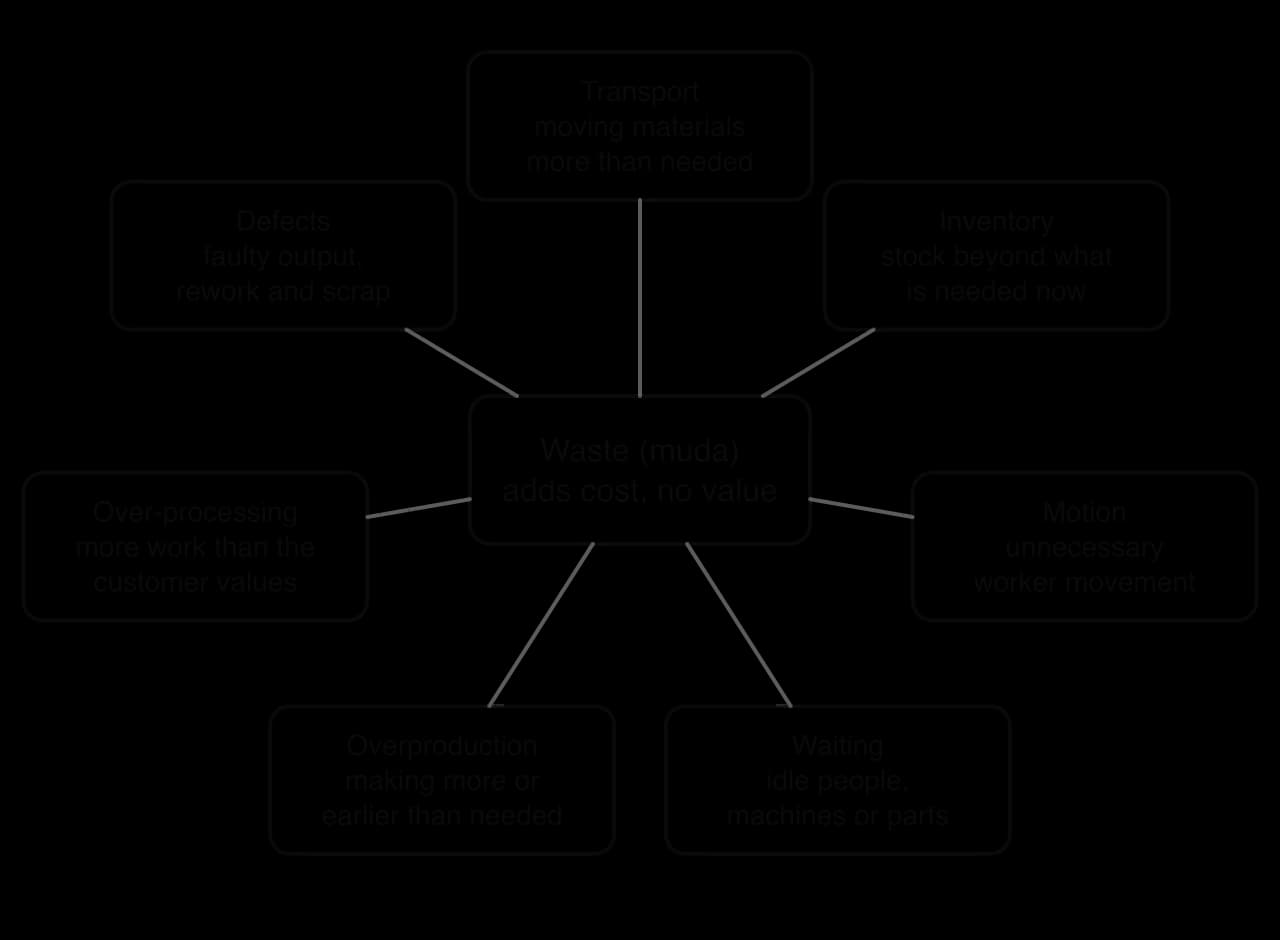
The diagram groups the wastes around the central idea that waste adds cost but not value. Each type has a clear meaning and a typical cause.
Waste | What it means | Example in a factory | Example in a service |
|---|---|---|---|
Transport | Moving materials or products more than necessary | Parts carried between buildings for each stage | Patient files sent between departments |
Inventory | Holding more stock than is needed now | Six weeks of components in a warehouse | Unsold cakes thrown away at closing time |
Motion | Unnecessary movement by people | Workers walking to fetch tools | Staff searching for equipment on a ward |
Waiting | People, machines or materials standing idle | A line stopped while a machine is repaired | Customers queuing at a single till |
Overproduction | Making more, or earlier, than customers need | Producing to a forecast that is too high | Printing reports nobody reads |
Over-processing | Doing more work than the customer values | Polishing hidden surfaces | Asking for the same information on three forms |
Defects | Faulty output that must be scrapped, reworked or replaced | Welds that fail inspection | A wrong order delivered to a customer |
Ohno regarded overproduction as the worst waste, because it causes several of the others: extra products must be stored (inventory), moved (transport) and checked, and they may never be sold. Later writers often add an eighth waste, the unused talent of employees whose ideas are never asked for.
Lean writers also use two related Japanese terms. Mura is unevenness: a process that is overloaded one day and idle the next. Muri is overburden: asking people or machines to work beyond their reasonable capacity. Lean businesses try to level the workload, because uneven and overloaded processes create waste of every kind.
Kaizen: continuous improvement
Kaizen is a Japanese word usually translated as "continuous improvement" or "change for the better". It is the method lean businesses use to remove waste: instead of waiting for one large investment to transform the operation, every employee looks for small improvements in their own work, every day. Each improvement may save only seconds or cents, but thousands of them, made year after year, add up to large gains in quality and productivity.
How kaizen works
Kaizen rests on the idea that the people who do a job know most about its problems. Employees are trained to spot waste, encouraged to suggest changes, and given time to test them. Many businesses run suggestion schemes, short daily team meetings at the workplace and "kaizen events": a few days in which a team studies one process in detail and redesigns it. Managers regularly go to the place where the work is done (in Japanese, the gemba) to see problems for themselves.
Improvements are usually tested with the plan-do-check-act (PDCA) cycle. A team identifies a problem and its cause, tries a change on a small scale, measures the result and, if it works, makes the new method the standard. The next cycle then starts from the higher standard.
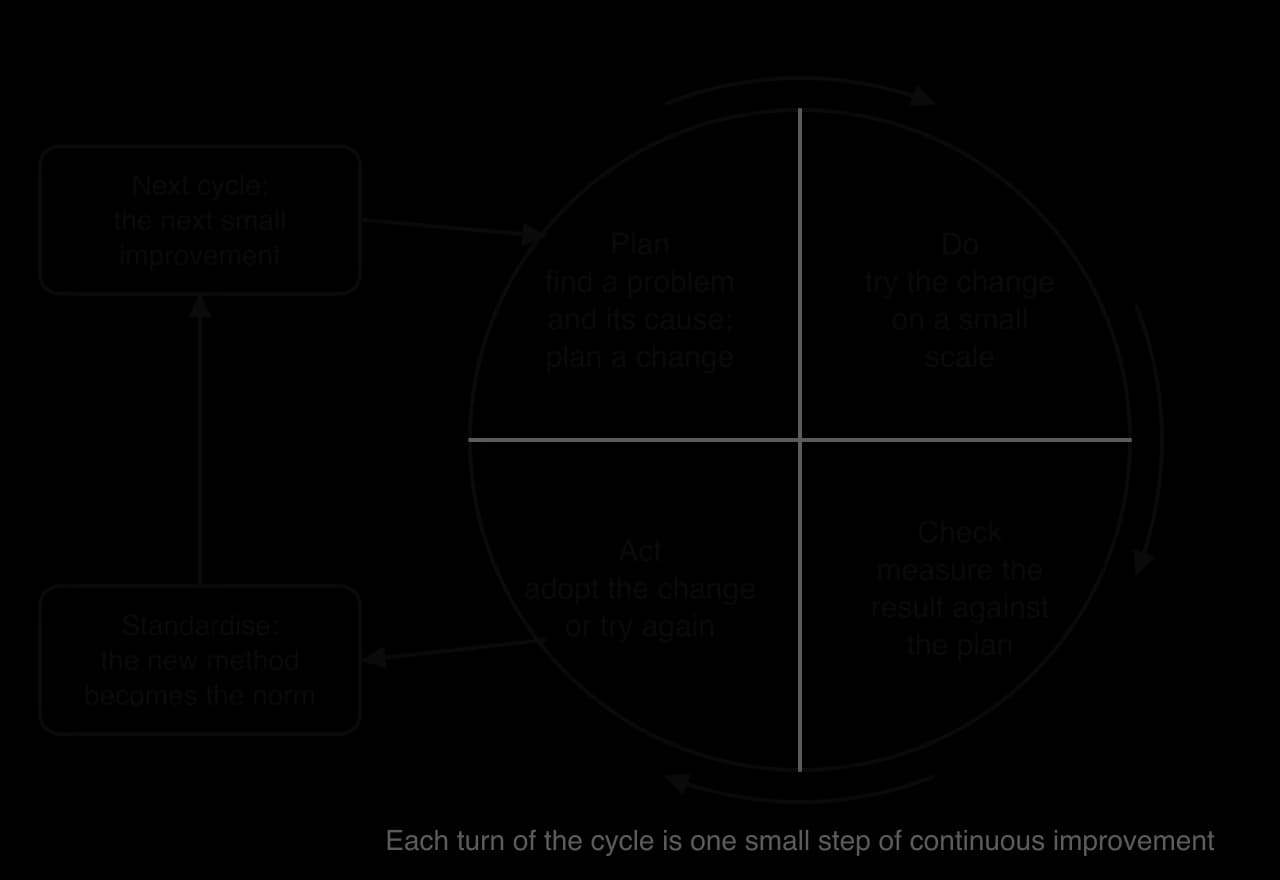
The diagram shows why kaizen is continuous. Once the "act" stage has adopted a change, the new method is written down and taught as the standard. That standard becomes the starting point for the next search for waste, so the process never stops improving.
Kaizen links closely to motivation theory. It gives employees responsibility and recognition, which Herzberg's theory identifies as motivators, and it relies on empowerment and teamwork. It is also a clear example of creativity in processes rather than products.
Lean methods also spread beyond factories. Virginia Mason Medical Center in Seattle adopted a version of the Toyota Production System across the whole hospital in 2002, with teams redesigning processes in short improvement workshops and any member of staff allowed to "stop the line" when they see a risk to patient safety. Savings of US$12–15 million over the first six years were reported.
Kaizen compared with radical change
Kaizen is incremental: it improves an existing process in small steps. Some changes, such as moving to a new technology or redesigning a whole factory, need a single large leap, sometimes called kaikaku (radical change) or innovation. The two approaches suit different situations and are often combined.
Kaizen (incremental change) | Radical change (innovation) | |
|---|---|---|
Size of each change | Small | Large |
Who makes it | All employees, mainly shop-floor teams | Senior managers, specialists, consultants |
Cost | Low; little capital needed | High; often large capital expenditure |
Risk | Low; easy to reverse | Higher; harder to reverse |
Speed of results | Gradual, cumulative | Sudden, if it succeeds |
Best when | The basic process is sound | The process or technology is outdated |
Advantages and limitations of kaizen
Kaizen costs little to introduce, uses the knowledge of the whole workforce and tends to raise motivation, because employees see their ideas put into practice. Small changes are easy to test and to reverse, so the risk of each one is low. Over time, kaizen builds a culture in which problems are reported and solved rather than hidden.
Its limitations are that results are slow and may be too small when a business faces a sudden threat, such as a competitor with a new technology. It also depends on trust: employees will not suggest ways to save time if they fear that the saving will be used to cut jobs. Gains can level off once the obvious waste has gone, and the constant pressure to improve can become stressful if it is managed badly.
Just-in-time (JIT)
Just-in-time is the lean method of managing materials and production so that each item arrives exactly when it is needed. Instead of holding large stocks "just in case", a JIT business orders materials in small quantities, often several times a day, and produces only what has already been ordered. The aim is to reduce stock, and the costs of holding it, as close to zero as possible.
How JIT works: pull rather than push
Traditional production is a push system: each stage makes as much as the plan says and pushes it on to the next stage, whether or not the next stage is ready. JIT is a pull system: nothing is made until the next stage, and ultimately the customer, asks for it. A customer order pulls a car off the end of the line, which pulls parts from the assembly stage, which pulls components from the supplier.
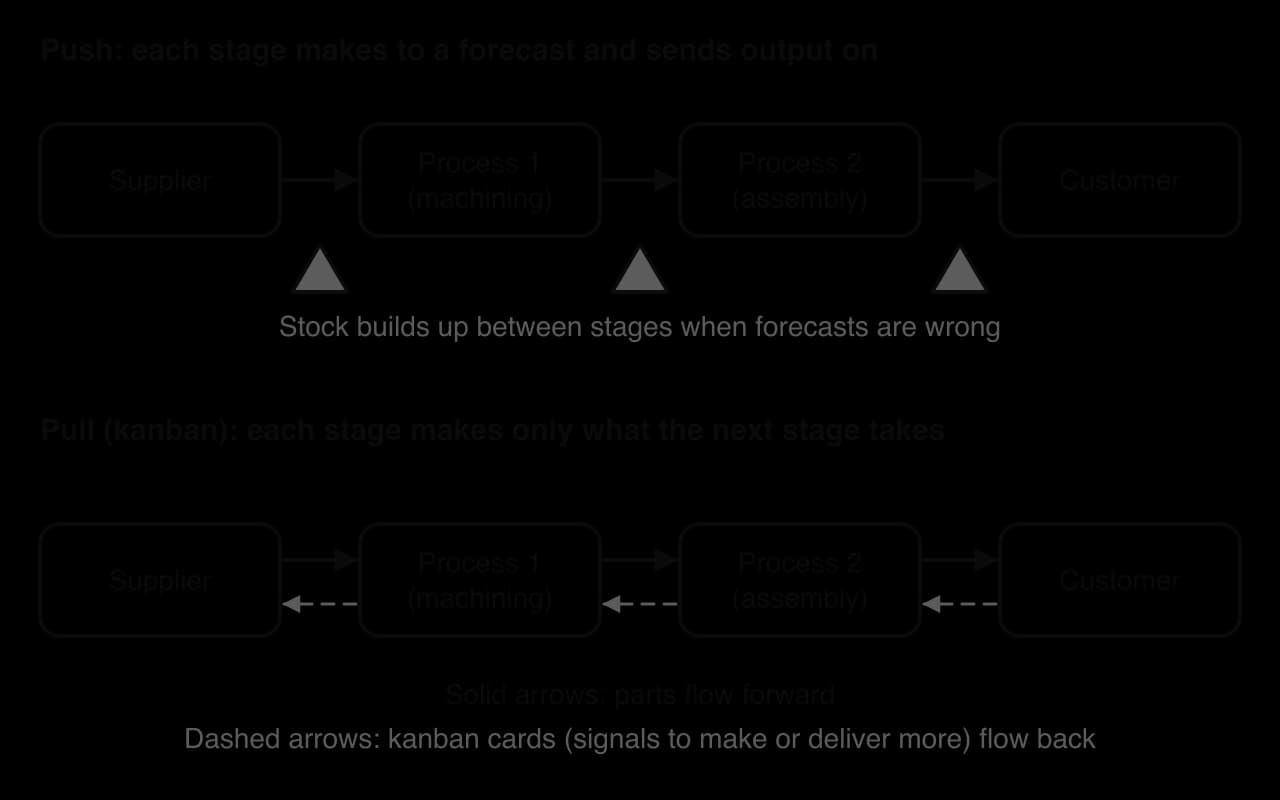
The diagram contrasts the two systems. In the push system the arrows run only forwards and stock builds up between stages. In the pull system, information (the dashed arrows) flows backwards from the customer, so each stage replaces only what has just been used.
The signal that pulls production is often a kanban, the Japanese word for a card or signboard. When a worker uses up a container of parts, the kanban card attached to it is sent back to the stage that makes those parts, as an instruction to make or deliver exactly one more container. Many businesses now use electronic kanban, in which scanning an empty container sends an order automatically.
JIT works only if production is reliable, because there is no stock to cover a breakdown or a faulty batch. Toyota therefore combines JIT with jidoka, "automation with a human touch". Machines stop automatically when they detect a fault, and any worker can stop the line by pulling a cord. An andon board above the line then lights up to show where the problem is, so that team leaders come at once to fix its cause.
What JIT needs in order to work
JIT is demanding. A business can use it successfully only when several conditions are met:
Reliable suppliers that deliver the right quantity and quality on time, often several times a day. Lean businesses usually work with fewer suppliers on long-term contracts and share production plans with them.
Suppliers located close by, so that deliveries are quick and frequent.
Very low defect rates, because there is no spare stock to replace a faulty item.
Flexible, multi-skilled employees and machines that can be changed over quickly between products, so that small batches are economic.
Fairly steady demand, or at least demand that can be forecast and levelled over the week.
Good information systems that pass demand quickly back along the supply chain.
Advantages and disadvantages of JIT
Advantages | Disadvantages |
|---|---|
Lower stock-holding costs: less warehouse space, insurance, damage and theft. | No buffer against supply disruption: one late or missing part can stop the whole line. |
Less working capital tied up in stock, which improves cash flow. | Higher ordering and delivery costs from many small deliveries; fewer bulk-buying discounts. |
Less risk of stock becoming obsolete, damaged or unsaleable. | Heavy dependence on suppliers and on transport networks. |
Faults are exposed and fixed quickly, which raises quality. | Difficult to meet a sudden rise in demand, because there is no stock to sell. |
Production responds to actual orders, so less overproduction. | Needs high levels of training, planning and trust with suppliers. |
The comparison shows a trade-off between efficiency and resilience. JIT keeps costs low while every link in the supply chain works, but a failure at one supplier can stop production quickly because there is little stock to cover it. In April 2016, earthquakes in Kumamoto in southern Japan damaged plants of the Toyota supplier Aisin Seiki, which made door and engine parts, and Toyota suspended production on almost all of its vehicle assembly lines in Japan in stages between 18 and 23 April.
Many businesses therefore hold a small buffer stock of critical parts, or a larger one of parts that come from distant or risky sources, while keeping JIT for the rest. The choice between JIT and holding stock just-in-case is a production planning decision that weighs these costs and risks.
Cradle to cradle design and manufacturing
Most products follow a linear path, often described as "cradle to grave": raw materials are extracted, made into a product, used and then thrown away into landfill or burned. Even recycling usually "downcycles" materials into lower-quality uses, so their value is gradually lost. Cradle to cradle design aims to break this pattern by designing products so that, at the end of their life, every material becomes the raw material for something new.
The idea was set out by the American architect William McDonough and the German chemist Michael Braungart in their book Cradle to Cradle: Remaking the Way We Make Things (2002). Its central principle is "waste equals food": in nature, the waste of one organism feeds another, so nothing is wasted, and products can be designed to behave in the same way.
Biological and technical nutrients
Cradle to cradle design sorts every material in a product into one of two groups and designs the product so that the groups can be separated at the end of its life.
Biological nutrients are materials that can safely break down in nature, such as natural fibres, wood and plant-based packaging. They must be free of harmful chemicals, so that when they decompose they feed the soil and grow new raw materials.
Technical nutrients are materials such as metals and many plastics that do not biodegrade. They are designed to be recovered, taken apart and reused in new products at the same quality, again and again, without ever entering the environment.
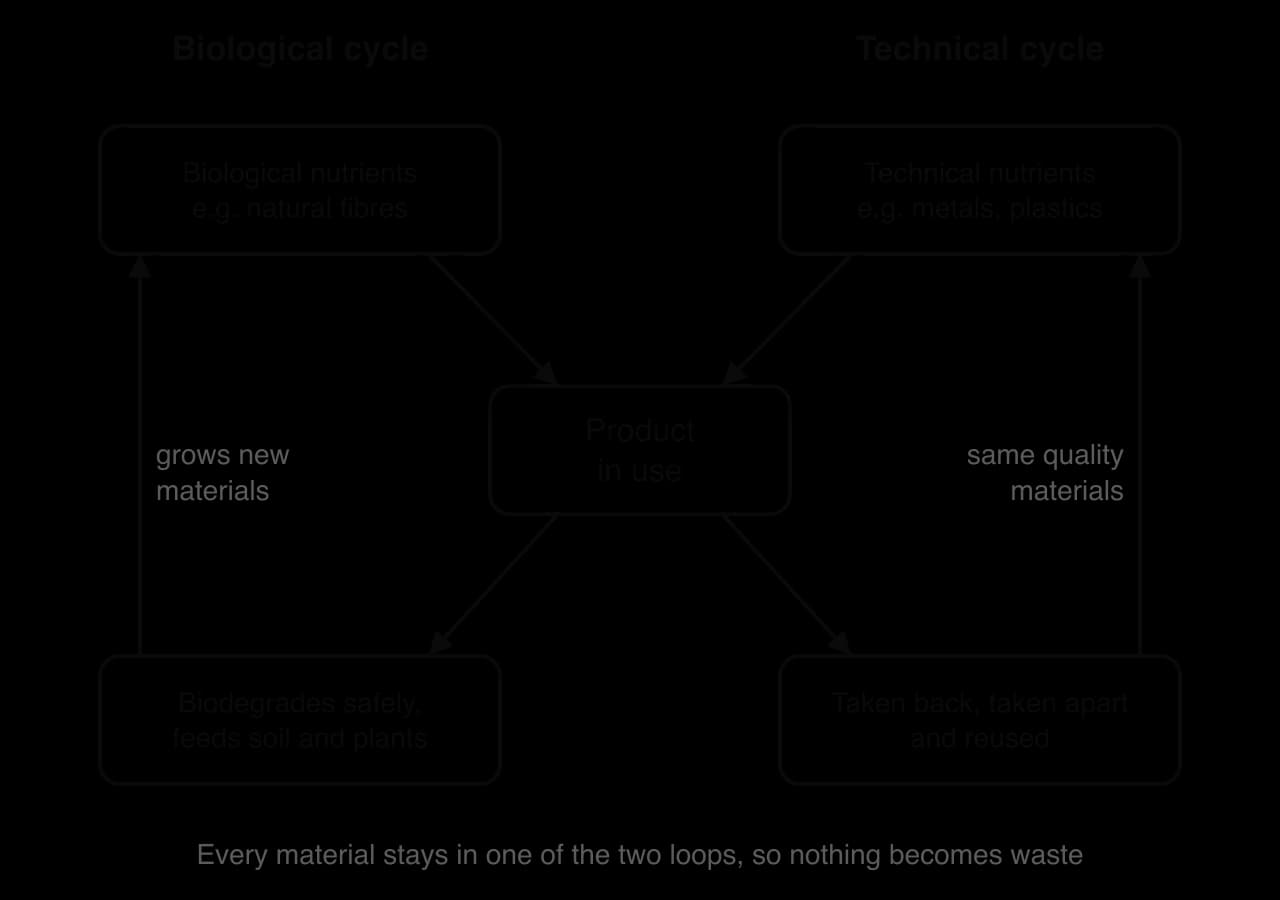
The diagram shows the two cycles meeting in the product. A product that mixes the two kinds of material in a way that cannot be separated, such as a natural fabric glued permanently to a plastic backing, can go round neither loop and becomes waste.
Features of cradle to cradle products
Safe materials: every ingredient is checked for its effects on human health and the environment, and harmful substances are replaced.
Design for disassembly: products are built so that they can be taken apart easily, with fewer glues and mixed materials, so that each material can go back into its own cycle.
Take-back systems: the producer collects products at the end of their life, sometimes by leasing them instead of selling them.
Renewable energy and clean water in manufacturing.
Social fairness in how the product is made.
Products can be certified under the Cradle to Cradle Certified standard, run by the independent Cradle to Cradle Products Innovation Institute. Each product is rated in five categories: material health, product circularity, clean air and climate protection, water and soil stewardship, and social fairness. It receives one of four levels (Bronze, Silver, Gold or Platinum), and its overall level is set by its lowest category, so a business cannot hide a weakness in one area behind strength in another.
An early example is Climatex, an upholstery fabric made by the Swiss firm Rohner Textile that is designed to be composted safely at the end of its life. Cradle to cradle thinking is one way of putting a circular business model into practice: it moves a business from a linear economy towards a circular economy.
Benefits and challenges for a business
Cradle to cradle design can lower the cost of raw materials over time, because recovered materials replace new ones, and it reduces the risk of future regulation on waste and harmful chemicals. It can also strengthen a brand with customers who care about the environment, and help in winning contracts from organisations with strict sustainability rules.
Cradle to cradle design also brings challenges. Redesigning products and finding safe replacement materials costs time and money. Take-back systems need logistics to collect used products, and they work only if customers return them. Certification is costly for small businesses, and some products, such as complex electronics, are very hard to separate into pure materials. Claims of circularity that are not backed by certification or evidence can also be criticised as greenwashing.
Quality and why it matters
In business management, quality does not mean luxury. A cheap bus ticket and an expensive watch can both be of high quality if they do what their customers expect. Quality is judged by the customer: a good or service is of high quality when it is fit for its purpose and meets or exceeds the expectations of the people who buy it.
Customers judge goods and services on different features, so quality has to be defined for each product.
Goods: features of quality | Services: features of quality |
|---|---|
Performance: does it do the job well? | Reliability: is the service delivered as promised? |
Durability: how long does it last? | Responsiveness: how quickly are customers served? |
Reliability: how often does it break down? | Competence and courtesy of staff |
Design and appearance | The physical environment (cleanliness, comfort) |
Safety | Trust: security, honesty, privacy |
Quality matters because poor quality is expensive. Faulty items must be scrapped or reworked, returns and replacements must be paid for, and dissatisfied customers tell others and stop buying. Serious faults can lead to product recalls, legal claims and damage to the brand that lasts for years. High quality, by contrast, supports brand loyalty, allows a higher price and can become a unique selling point.
The cost of preventing a fault is usually far lower than the cost of finding it after production, and much lower again than the cost of a fault that reaches the customer. This idea explains the shift in quality management from inspecting products to preventing faults.
Quality control and quality assurance
Businesses manage quality in two broad ways. One is to check products after they are made and remove the faulty ones. The other is to design the whole process so that faults are not made in the first place.
Quality control
Quality control is the traditional approach. Specialist inspectors check output at the end of production, or at key points, against agreed standards. Checking every item is often too slow and costly, so inspectors test a sample from each batch and accept or reject the batch according to the results.
Quality control is simple to understand and is still essential where safety is at stake, as in medicines, food and aircraft parts. Its weaknesses are that it finds faults only after resources have been used to make them, it needs a separate team of inspectors, and it can make production workers feel that quality is someone else's job. Sampling also means that some faulty items still reach customers.
Quality assurance
Quality assurance moves the focus from finding faults to preventing them. The business sets standards for every stage of production, from the choice of suppliers and the design of the product to training and working methods, and checks that these standards are followed. The aim is to get things "right first time".
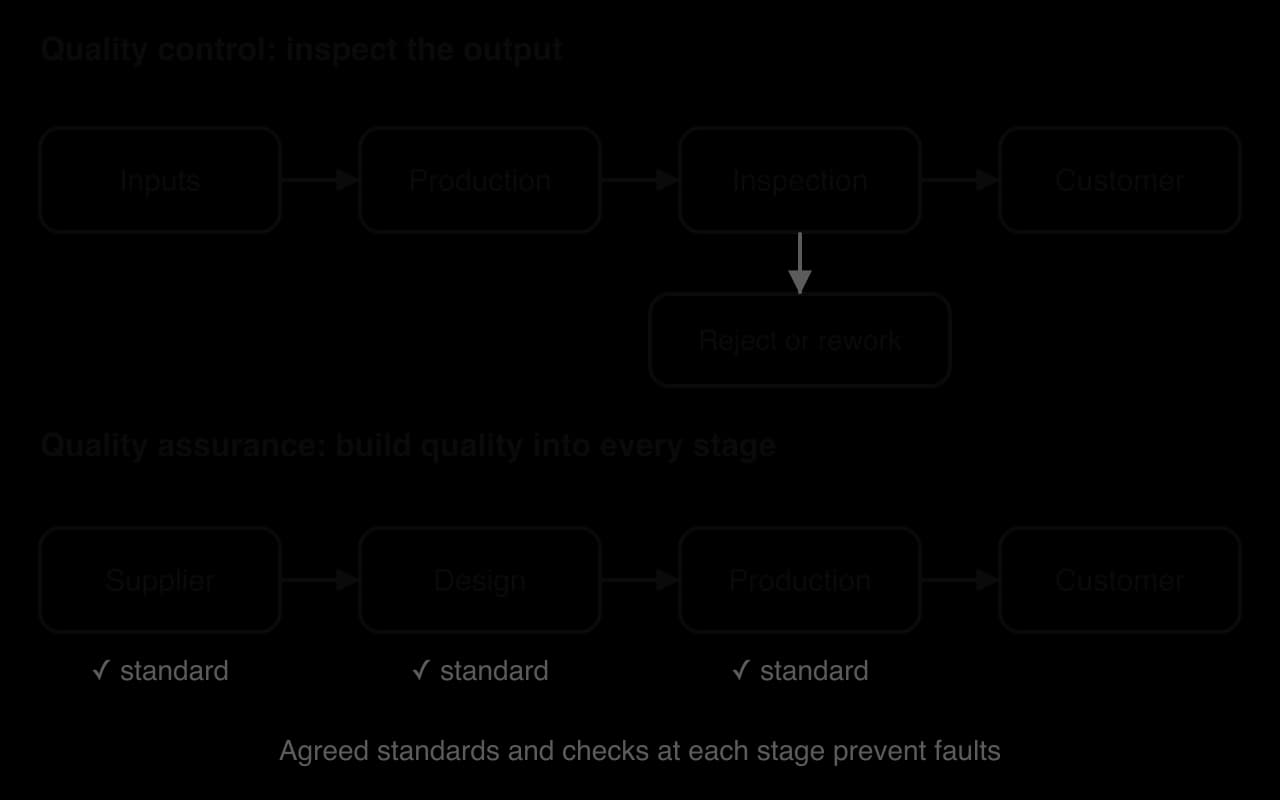
The diagram shows the difference in where checking happens. Under quality control, the inspection box sits after production and sends faulty items back for rework. Under quality assurance, each stage works to its own standard, so far fewer faults reach the final stage.
Quality control | Quality assurance | |
|---|---|---|
Aim | Detect faults | Prevent faults |
When | After production (or at set points) | At every stage, before and during production |
Who is responsible | Specialist inspectors | Every employee, and suppliers |
Cost | Cost of inspection, scrap and rework | Cost of training and systems; less scrap |
Effect on staff | Quality is "someone else's job" | Staff own the quality of their work |
Methods of managing quality
Three methods are widely used to put quality assurance into practice: quality circles, benchmarking and total quality management. They differ in scale, from a small group of workers to the culture of the whole organisation.
Quality circles
A quality circle is a small group of employees, typically between three and twelve, who do similar work and meet regularly, often for an hour a week in working time, to identify and solve problems in their area. A supervisor or trained facilitator usually leads the group. Members collect data, find the causes of problems, propose solutions to management and, where possible, put the solutions into practice themselves.
The first quality circles began in Japan in 1962, and the idea was spread by the quality expert Kaoru Ishikawa. They became fashionable in Western companies in the 1980s, but many failed, because managers treated them as a way of finding fault or ignored their proposals. The idea survives in kaizen teams and other forms of employee participation.
Quality circles use the knowledge of the people closest to the work, cost little and can raise motivation through involvement and recognition. Their drawbacks are the working time they take, the need to train members in problem-solving, and the frustration they cause if management does not act on their ideas. They tend to deal with local problems rather than the strategy of the business.
Benchmarking
Benchmarking means comparing a business's products, processes or performance with those of the best organisations, then learning from them to close the gap. The "benchmark" is the standard of best practice. It may come from a competitor, from another branch of the same business or from an organisation in a completely different industry that is excellent at one particular process.
There are three main types:
Internal benchmarking: comparing departments, branches or factories of the same organisation, so the best one becomes the model for the others.
Competitive benchmarking: comparing performance with direct competitors, for example on delivery times, prices or customer satisfaction.
Functional (process) benchmarking: learning a particular process from the best organisation in any industry.
A benchmarking exercise usually follows these steps:
Choose the product, process or measure to improve.
Measure current performance.
Identify the organisation that performs best and collect data on its performance and methods.
Find the gap between the two and the reasons for it.
Set targets and plan changes, and communicate them to staff.
Put the changes into practice, then measure again and repeat.
A well-known example of functional benchmarking comes from Great Ormond Street Hospital for Children in London. Surgeons noticed that the handover of a patient from the operating theatre to intensive care resembled a Formula 1 pit stop, so they studied how the Ferrari team works: one person in charge, a fixed sequence of tasks, checklists and rehearsal. After the hospital introduced a new handover routine based on these ideas, the average number of technical errors per handover fell from 5.42 to 3.15, and the average number of pieces of information left out fell from 2.09 to 1.07.
Sources: Catchpole, K. et al., "Patient handover from surgery to intensive care: using Formula 1 pit-stop and aviation models to improve safety and quality", Paediatric Anaesthesia 17(5), 2007; Elliott, M., Gresham College lecture, 2015.
Benchmarking gives realistic targets based on what others have already achieved, and it can bring in ideas that a business would never have thought of on its own. Its limitations are that competitors rarely share data, so information may be incomplete; that copying another organisation's methods may not work in a different culture or market; and that a business that only copies will always be one step behind the leader.
Total quality management (TQM)
Total quality management is the broadest approach. It makes quality the responsibility of everyone in the organisation, in every department, at every level, all the time. Quality becomes part of the organisation's culture rather than the job of one department. TQM grew out of the work of quality experts such as W. Edwards Deming, who taught statistical quality methods to Japanese managers after the Second World War.
The main principles of TQM are:
Customer focus: quality is defined by the customer. TQM also uses the idea of the internal customer: each department or worker is the customer of the one before it, so the payroll team serves employees and the paint shop serves assembly.
Everyone is involved, from the chief executive to cleaners and suppliers.
Right first time and zero defects: the aim is to prevent faults completely, not to accept a "normal" level of defects.
Continuous improvement: kaizen is part of TQM.
Decisions based on data: problems are measured, and their causes are analysed before solutions are chosen.
Long-term relationships with suppliers, who must meet the same standards.
TQM therefore combines many of the other methods. Quality assurance provides the standards, quality circles and kaizen provide the improvements, and benchmarking provides the targets. Introducing it usually requires a change of organisational culture, heavy investment in training and strong commitment from senior management.
Method | Scale | Who is involved | Main strength | Main limitation |
|---|---|---|---|---|
Quality circle | One work area | A small group of employees | Uses shop-floor knowledge; motivating | Deals mainly with local problems |
Benchmarking | One process or measure | Managers and specialists | Realistic targets from best practice | Data hard to obtain; copying may not fit |
TQM | The whole organisation | Every employee and supplier | Quality built into the culture | Slow, costly, needs long-term commitment |
The table shows that the three methods work at different scales and can be combined. A business with TQM is likely to use quality circles and benchmarking as part of it, while a business without TQM may still use either method on its own.
The impact of lean production and TQM on an organisation
Lean production and TQM are not only operations techniques. They change how people are managed, how money is used, how products are marketed and how the business deals with its suppliers. Their impact on each area is the basis for judging whether they are worth introducing.
Impact on each business function
Function | Possible positive impact | Possible negative impact |
|---|---|---|
Operations | Less waste, shorter lead times, higher productivity and fewer defects | Greater exposure to supply disruption; heavy planning workload |
Human resources | Multi-skilled, empowered teams; more motivating work; ideas from staff | Training costs; work intensification and stress; fear that efficiency gains will cost jobs |
Finance | Lower stock and scrap costs; working capital released; better cash flow | Set-up costs (training, new systems, redesigning layouts); returns take time |
Marketing | Higher and more consistent quality; faster delivery; a stronger brand | Less ability to meet sudden rises in demand from stock |
Suppliers and other stakeholders | Long-term contracts and shared improvement | Pressure on suppliers to deliver often, hold stock themselves and cut prices |
The positive and negative columns are often two sides of the same change. Holding less stock lowers costs but removes a cushion against problems; giving workers responsibility raises motivation but also asks more of them, so the final effect depends on how the change is managed.
Evaluation: lean production
The strongest argument for lean production is its record. Toyota's methods allowed it to produce cars of high reliability at low cost and to become one of the world's largest carmakers, and lean methods have since cut costs and waiting times in industries from aircraft maintenance to healthcare. Because it lowers costs and raises quality at the same time, lean production can give a lasting competitive advantage that is hard to copy, since it rests on culture and skills rather than on machines that competitors can buy.
Lean production also has serious weaknesses. A lean supply chain is efficient but fragile, so natural disasters, pandemics and shortages of parts can halt production quickly. Lean methods can be applied badly, as a cost-cutting programme that removes staff and stock without building the skills, trust and supplier relationships that make the system work. Employees on a lean line may feel constant pressure to work faster, which critics see as a modern form of Taylor's theory of motivation rather than empowerment.
In the short run, lean production usually raises costs and causes disruption, because staff must be trained, layouts changed and supplier contracts renegotiated. The benefits build up in the long run as waste falls and improvements accumulate.
Evaluation: TQM
TQM can transform an organisation, because it lowers the total cost of quality, raises customer satisfaction and gives employees a sense of ownership of their work. It is especially valuable where faults are dangerous or costly, such as in healthcare, aviation and food.
It is, however, expensive and slow. It needs years of training and consistent leadership, and it can produce large amounts of paperwork, meetings and measurement. Many TQM programmes fail when senior managers lose interest after the first year, or when the business faces a crisis and returns to short-term cost-cutting. For a small business, the cost of a full TQM programme may outweigh the benefits.
What the impact depends on
Organisational culture and leadership: both methods need trust, openness about mistakes and committed leaders. In a culture of blame, employees hide problems instead of solving them.
The workforce: skills, attitudes to change and the relationship with trade unions. Lean production works best when employees believe that improvements will not be used to cut their jobs.
Suppliers and location: JIT needs reliable suppliers close by. Long, global supply chains make it much riskier.
Type of product and demand: lean methods suit repetitive production with fairly steady demand; they are harder to apply to one-off, highly customised work or very seasonal demand.
Size and finance: large firms can afford training, consultants and certification; small firms may adopt only selected lean tools.
The external environment: in a period of natural disasters, trade conflicts or shortages, the risks of very low stock rise.
On balance, lean production and TQM are most likely to succeed when they are introduced as a long-term change in culture, supported by leaders and employees, with some protection built into the supply chain against disruption. Introduced as short-term cost-cutting, they often fail to deliver and can damage motivation.
Key concept | How it applies to lean production and quality management |
|---|---|
Change | Lean production and TQM require deep changes to culture, jobs and supplier relationships, and kaizen makes change continuous. |
Creativity | Kaizen and quality circles rely on employees' ideas for improving processes; cradle to cradle design requires creative product design. |
Ethics | Lean pressure can intensify work and push costs onto suppliers; honest quality claims and certification protect customers. |
Sustainability | Less waste and energy per unit, and cradle to cradle design, support environmental sustainability; fragile supply chains can threaten economic sustainability. |
National and international quality standards
Customers, especially other businesses, often cannot check the quality of a supplier's products and processes for themselves. A quality standard solves this problem: it sets out agreed requirements, and an independent body checks whether a business meets them. A business that meets the standard can then show a certificate or a mark that customers trust.
International standards: ISO 9001 and ISO 14001
The International Organization for Standardization (ISO), based in Geneva, publishes international standards agreed by the national standards bodies of its member countries. The best known are management system standards, which set requirements for how an organisation runs its processes rather than for a particular product.
ISO 9001 is the international standard for quality management systems. It was first published in 1987, based on the British standard BS 5750, and most certified organisations work to the 2015 edition (ISO 9001:2015). It requires an organisation to set quality objectives, document its key processes, train staff, monitor customer satisfaction, deal with faults and complaints, and improve continuously using the plan-do-check-act cycle. It is built on seven quality management principles: customer focus, leadership, engagement of people, a process approach, improvement, evidence-based decision making and relationship management. More than a million ISO 9001 certificates are held by organisations worldwide.
Certification is carried out by independent certification bodies. Auditors examine the organisation's processes and records, and certified organisations are audited again regularly to keep their certificate. The standard assesses whether a reliable system is in place; it does not by itself guarantee that every product is excellent.
ISO 14001 applies the same approach to the environment. First published in 1996, with its latest edition (ISO 14001:2026) published in April 2026, it sets requirements for an environmental management system: identifying the organisation's environmental impacts, complying with environmental law, setting targets and improving continuously. It does not set levels of environmental performance; each organisation chooses its own targets.
CE marking
In the European Economic Area (EEA), many products, including toys, electrical goods, machinery and medical devices, can be sold only if they carry CE marking. The manufacturer assesses the product against the relevant EU requirements for safety, health and environmental protection, prepares the technical documents and then fixes the mark. Products made outside the EEA need it too, so a Chinese or Indian exporter of toys must meet the same rules as a German manufacturer.
National standards bodies and industry awards
Most countries have a national standards body that develops national standards and represents the country at ISO, such as the British Standards Institution (BSI) in the United Kingdom, the Bureau of Indian Standards and the Standardization Administration of China. Some also run product marks. The BSI Kitemark, registered in 1903, is a voluntary mark shown on products such as crash helmets, smoke alarms and electric vehicle chargers after BSI has tested them independently. Because it is voluntary, firms use it to stand out from competitors.
Industry awards recognise outstanding quality management. The Deming Prize, awarded by the Union of Japanese Scientists and Engineers since 1951 and named after W. Edwards Deming, is one of the oldest. Its winners include the Indian companies Mahindra & Mahindra (2003) and Tata Steel (2008). Similar national awards include the Malcolm Baldrige National Quality Award in the United States.
Why quality standards matter
For customers, standards reduce risk: a certificate or mark shows that an independent body has checked the product or process. For businesses, certification can be essential to win contracts, because many large firms and governments buy only from ISO 9001-certified suppliers. It also opens export markets, since CE marking is a condition of selling many goods in Europe. Working towards a standard forces a business to examine and document its processes, which often exposes waste and reduces faults.
Standards also have limitations. Certification costs money and management time, which weighs more heavily on small businesses. The paperwork can become an end in itself, and a certified system can still produce poor products if staff follow procedures without caring about the result. Since many competitors hold the same certificates, ISO 9001 is often a basic requirement for entering a market rather than a source of advantage.
Case study: the Toyota Production System and the 2011 earthquake
Toyota Motor Corporation is the clearest real example of lean production, because the methods were developed there. The Toyota Production System grew from ideas in the Toyoda family's loom business, where Sakichi Toyoda built looms that stopped automatically when a thread broke (the origin of jidoka), and from Kiichiro Toyoda's belief in making only what was needed. Taiichi Ohno turned these ideas into a complete system of just-in-time production, kanban, andon and continuous improvement.
A complete car cannot be built if even one part is missing.
— Kiichiro Toyoda, quoted by Toyota Motor Corporation, "Toyota Production System", global.toyota
The quotation explains both the strength and the weakness of JIT. Because Toyota holds very little stock, every part must arrive on time, and the system forces the company and its suppliers to remove waste and solve problems at once. For the same reason, a missing part stops production almost immediately.
What happened in 2011
On 11 March 2011 the Great East Japan Earthquake and tsunami caused massive damage in the Tōhoku region. Many of Toyota's suppliers were in Tōhoku and eastern Kantō, so production at all of Toyota's vehicle plants in Japan stopped in the days after the disaster. Later in 2011, floods in Thailand damaged Toyota's suppliers there and disrupted production in other countries as well.
Effect on Toyota's output, year ended 31 March 2012 | Vehicles (approximate) |
|---|---|
Output delayed by the earthquake, to June 2011 | 760,000 |
Output recovered from July 2011 onwards | 600,000 |
Net loss of output from the earthquake | 150,000 |
Net loss of output from the Thailand floods | 240,000 |
Total net loss from both disasters | 390,000 |
Initial estimate of the loss from both disasters | about 1,000,000 |
Sources: Toyota Motor Corporation, Annual Report 2012, "Impact of the Disasters and Recovery Efforts".
Toyota’s figures are rounded, so the delayed and recovered output do not subtract exactly to the net loss. Toyota says its domestic production was back to almost normal levels by July 2011 and fully restored by September, earlier than expected. The table shows that most of the lost output was later recovered: the two disasters were first expected to cost about a million vehicles, but the final net loss was about 390,000.
How lean methods shaped the response
Toyota's recovery relied on the same methods that had made it vulnerable. Following the principle of genchi genbutsu (going to see the problem on site), teams investigated every first-tier supplier and the effects on the suppliers behind them, and supported about 200 supply sites directly. Long-term relationships meant that suppliers shared information openly, and the company's problem-solving culture allowed fast decisions. Toyota looked for substitute parts only where a supplier's own production could not be restored.
After the disasters, Toyota mapped its supply chain down to third- and fourth-tier suppliers, many of which it had not dealt with directly before. It moved some at-risk parts to more than one source and redesigned parts to use more standard components that several factories could make. In other words, it kept JIT but added resilience where the risk was highest.
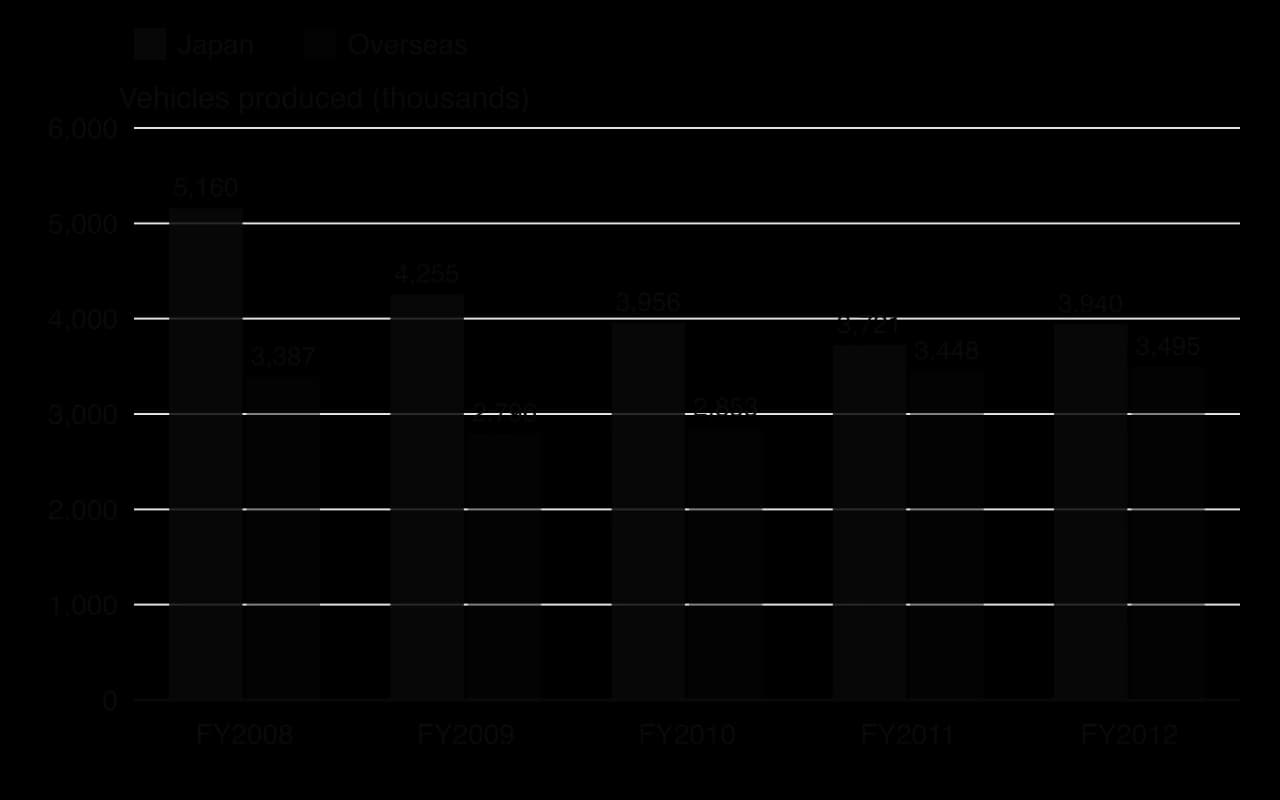
The chart shows Toyota's consolidated vehicle production by fiscal year, ending 31 March. The year to March 2011 includes only the first weeks after the earthquake, so most of its effect falls in the year to March 2012, when production in Japan rose to 3.94 million vehicles because lost output was made up later in the year. The chart also shows a long-term shift of production overseas, from 40% of the total in 2008 to 47% in 2012.
 YouTube
What the case shows, and its limits
The case shows that lean production is efficient in normal times but exposed to large shocks, because there is little stock to absorb them. It also shows that the culture behind lean production, including teamwork, problem-solving and close supplier relationships, can make recovery faster than in a business that relies on stock alone. Toyota kept JIT, but it mapped its supply chain in more detail and protected the most critical parts, combining lean methods with contingency planning.
The case has limits. Toyota's supplier network was built over decades in one region, and many suppliers were part of its own group, which smaller firms cannot copy. The figures are Toyota's own and are approximate. Lean methods did not prevent later disruption either. In 2016 earthquake damage at a supplier's plants again stopped most of Toyota's assembly lines in Japan for several days.
Explain why Toyota's use of JIT made it vulnerable to the 2011 earthquake.
Analyse how kaizen, teamwork and long-term supplier relationships helped Toyota recover its lost output.
To what extent do the 2011 and 2016 disruptions show that lean production is unsuitable for businesses with global supply chains?
Sources: Toyota Motor Corporation, Annual Report 2012; Toyota Motor Corporation, "Toyota Production System" (global.toyota, 2026); Toyota Motor Corporation, news releases on production after the Kumamoto earthquakes, 17 and 20 April 2016.
Exam practice
Lean production and quality management appears on Paper 2 at HL and can be the context for a Paper 3 plan. Most questions are qualitative ("explain", "distinguish", "evaluate"), but calculations such as stock-holding savings or the cost of quality can appear in Paper 2, and related HL calculations such as the defect rate come from production planning.
Extended responses on lean production and quality usually ask for a judgment about introducing a method in a particular business.
Structured questions often pair a definition with an application to a business in the stimulus.
Calculation questions usually give the data in a short table and ask for a comment on the result.
The 10-mark extended response asks for a balanced judgment set in a short case.
At HL, lean and quality ideas can also form part of a Paper 3 plan for a social enterprise.
Summary
Lean production aims to minimise waste of every resource while meeting customer needs, so that output is produced more efficiently and at higher quality.
The seven wastes are transport, inventory, motion, waiting, overproduction, over-processing and defects (TIMWOOD).
Kaizen is continuous, incremental improvement by all employees, usually through the plan-do-check-act cycle.
JIT is a pull system that holds minimal stock, signalled by kanban; it lowers costs but makes production vulnerable to supply disruption.
Cradle to cradle design keeps biological nutrients in natural cycles and technical nutrients in industrial cycles, so products create no waste.
Quality control detects faults by inspection; quality assurance prevents them by setting standards at every stage. Quality circles, benchmarking and TQM are methods of managing quality.
The impact of lean production and TQM depends on culture, leadership, suppliers, the type of product and the business environment; both work best as long-term changes in culture.
Quality standards such as ISO 9001, ISO 14001 and CE marking reassure customers and open markets, but certify systems and minimum requirements, not excellence.
Self-check
- To do:
I can describe the features of lean production and explain how less waste leads to greater efficiency.
- To do:
I can identify the seven types of waste and give an example of each in a factory and a service.
- To do:
I can explain how kaizen and the PDCA cycle produce continuous improvement.
- To do:
I can explain how JIT works as a pull system, including kanban and andon, and calculate the savings it brings.
- To do:
I can explain the features of cradle to cradle design, including biological and technical nutrients.
- To do:
I can distinguish between quality control and quality assurance and calculate the cost of quality under each.
- To do:
I can explain quality circles, benchmarking and TQM, with a real example.
- To do:
I can evaluate the impact of lean production and TQM on an organisation, saying what it depends on.
- To do:
I can explain the importance of ISO 9001, ISO 14001, CE marking and national standards for a business and its stakeholders.