Explain the quantitative and qualitative factors behind a location decision, compare sites with cost data, and evaluate outsourcing, offshoring, insourcing and reshoring as ways of reorganising production.
Each is in the Business glossary, with every other term in the subject.
A geographical concentration of interconnected businesses, suppliers and related institutions in one industry, giving each firm access to shared skilled labour, specialist suppliers and knowledge.
Bringing a business activity that was previously outsourced back in-house, so that it is carried out by the business's own employees and resources.
The cost of labour needed to produce one unit of output, found by dividing the wage cost per hour by the output per worker per hour; it combines wage rates with productivity.
The geographical site where a business carries out its production or other operations, chosen by weighing the costs and benefits of the alternative sites available.
The relocation of business activities to a country close to the home country, usually a neighbouring country with lower costs, combining lower costs with shorter and less risky supply chains.
The relocation of a business activity, such as manufacturing or customer service, from the home country to another country, either to the business's own operations abroad or to a foreign subcontractor.
The transfer of a business activity, such as manufacturing, IT, cleaning or customer service, to an external business that carries it out under contract instead of the business doing it in-house.
Explain the reasons for choosing a specific location of production.
Distinguish between quantitative and qualitative location factors.
Calculate and compare the costs of alternative locations, including labour cost per unit.
Analyse the trade-offs between location factors in a real location decision.
Define outsourcing (subcontracting), offshoring, insourcing and reshoring.
Explain the reasons why businesses reorganise production nationally and internationally.
Evaluate outsourcing, offshoring, insourcing and reshoring for a business and its stakeholders.
Location is the place where a business carries out its operations, such as a factory, an office, a warehouse or a shop. Choosing it is one of the most important operations decisions a business makes, because it affects costs, access to customers and workers, and the risks the business faces for many years.
Location decisions have become more frequent and more complex as globalisation has allowed businesses to produce almost anywhere. Firms now decide not only where to build, but also which parts of their production to carry out themselves and which to hand to other businesses, at home or abroad. These choices reflect change in costs, technology and trade policy, and they raise questions of ethics and sustainability when production moves to places with weaker protection for workers or the environment.
68 exam-style questions on this subtopic, written in the style of the IB papers. The first has its markscheme open. Counted on
Tarang Analytics is a data-science consultancy with 120 employees in Bengaluru, India, a city with hundreds of technology firms. Tarang benefits from the city’s large pool of software graduates, local universities and specialist suppliers of cloud services. However, office rents in its district have risen by 35 % in four years, salaries for experienced data scientists are rising quickly as firms compete for them, and staff spend up to three hours a day commuting in heavy traffic.
Distinguish between external economies of scale and external diseconomies of scale, using examples from Tarang Analytics.
4 marks
External economies of scale are falls in average costs that come from the growth of the industry in an area, not from the firm’s own size; they benefit all firms located there. Tarang benefits from a pool of trained software graduates (lower recruitment and training costs), local universities and nearby specialist cloud suppliers.
External diseconomies of scale are rises in average costs caused by the over-concentration of the industry in an area. For Tarang these are rising office rents (+35 %), competition for experienced staff pushing up salaries, and traffic congestion that wastes staff time.
Award [1] for each correct definition, up to [2], and [1] for each relevant example from the case, up to [2].
Suggest one way in which Tarang Analytics could reduce the effect of the external diseconomies of scale.
The official deck for this part of the syllabus.
Define location (in operations management).
State four situations in which a business faces a location decision.
With a free account, Augment remembers where you stopped and what you have practiced.
Factors affecting a location decision that are difficult to measure in money, such as infrastructure, access to markets, skilled labour, political stability, regulations and local culture.
Factors affecting a location decision that can be measured numerically, such as the costs of land, labour and transport and the value of government incentives.
The return of production or other business activities from another country to the business's home country, reversing an earlier decision to offshore them.
A business faces a location decision when it starts up, when it grows and needs more space, when its current site becomes too costly or unsuitable, and when it expands into other countries. A start-up café may compare two streets in the same town; a multinational company may compare countries on different continents.
Location decisions are difficult because they are long term and expensive to reverse. Building or fitting out a site is capital expenditure that cannot easily be recovered, and moving later means redundancy costs, lost customers and disruption. The right site depends on the type of business: a mine must be where the minerals are, a hairdresser must be near its customers, and an online software firm can be almost anywhere with good internet access.
Managers compare sites using two kinds of factors. Some can be measured in money and added up; others are just as important but are matters of judgment.
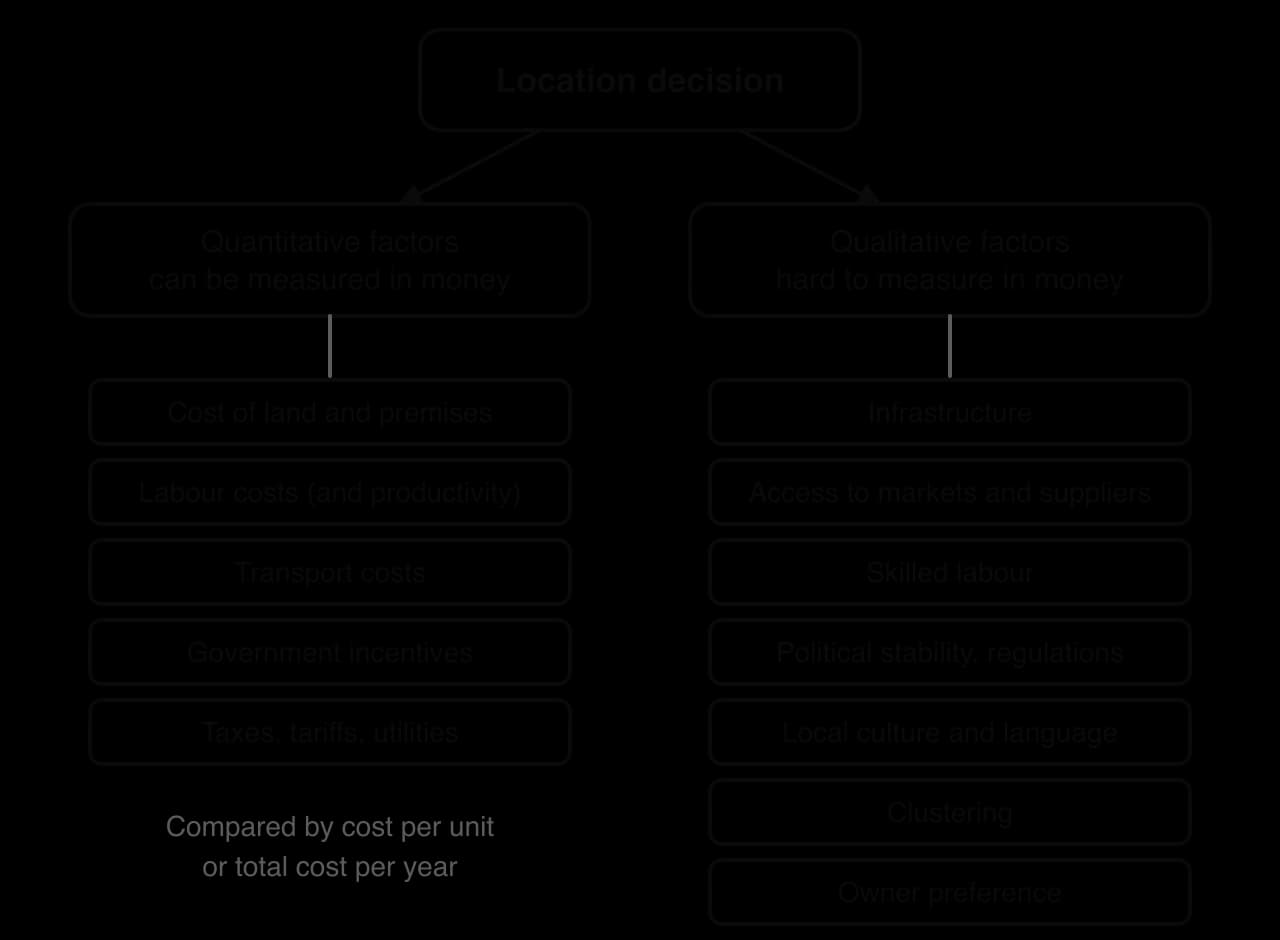
The diagram sorts the main location factors into the two groups. A full location decision uses both: the quantitative factors show which site is cheapest, and the qualitative factors show whether the cheapest site will work.
Quantitative location factors are those whose effect can be measured in numbers, usually as costs or revenues. They allow managers to calculate and compare the total cost of operating at each site.
Land and buildings are usually most expensive in city centres and capital cities, and cheapest in rural areas and less developed regions. A business may buy, build or rent its premises; either way, the cost affects its fixed costs for years. Retailers and restaurants often accept high rents because a busy location brings more customers, while a warehouse or factory that needs a large area and few visitors will look for cheap land on the edge of a city or near a motorway.
Wages differ greatly between and within countries, so labour costs are often the largest single difference between sites, especially for labour-intensive production such as clothing and electronics assembly. Labour costs include wages, social security contributions, training and the cost of meeting employment laws such as a minimum wage.
Low wages do not always mean low labour costs. If workers in a high-wage country use better machinery and skills, they may produce many more units an hour. The figure that matters is the labour cost per unit: the wage cost divided by the number of units each worker produces. This is why productivity has to be considered alongside wages.
The table compares two possible countries for a new assembly plant (hypothetical data).
Country X | Country Y | |
|---|---|---|
Wage cost per worker per hour | $30 | $6 |
Output per worker per hour (units) | 15 | 4 |
Transport cost per unit to the main market | $0.20 | $0.90 |
Transport costs depend on the distance from suppliers and customers and on the nature of the product. Economists and geographers distinguish two kinds of industry:
Bulk-reducing (weight-losing) industries | Bulk-increasing (weight-gaining) industries | |
|---|---|---|
What happens in production | The finished product is lighter or smaller than the raw materials | The finished product is heavier, bulkier or more fragile than the inputs |
Best location | Near the source of raw materials | Near the market |
Examples | Steel, sugar refining, timber processing, mining | Soft drinks, bottled water, bread, ready-mixed concrete, furniture assembly |
The table shows why sawmills are built in forests and drinks are bottled near the cities where they are sold: each business locates where it moves the lighter, cheaper load the shortest distance. Transport costs matter less for products of high value and low weight, such as microchips and pharmaceuticals, which can be flown across the world.
Governments compete to attract investment and jobs, especially to regions with high unemployment. They offer government grants towards the cost of buildings and machinery, tax reductions, cheap land, subsidies for each job created, and special economic zones with lower taxes and simpler rules. Incentives lower the cost of a site and can make a marginal location the cheapest.
In 1984 the UK government signed an agreement with Nissan to build a car plant at Sunderland in north-east England, a region with high unemployment, and the land was sold to Nissan at agricultural prices of about £1,800 an acre. Nissan began production there in 1986. In 2020 Japan's government went further, paying 57 companies a total of 57.4 billion yen to build or expand production in Japan and another 30 to invest in South-East Asia, to reduce their dependence on factories in China.
Sources: Wikipedia, "Nissan Motor Manufacturing UK" (2026); Al Jazeera, "Decoupling from China: Japan to pay its firms to invest at home", 20 July 2020.
Taxes: rates of corporation tax, property taxes and local taxes differ between countries and regions.
Tariffs: taxes on imports can make it cheaper to produce inside a market than to export to it, which is one reason many car makers build factories in the markets where they sell.
Utilities: the cost and reliability of electricity and water matter for energy-intensive industries such as aluminium smelting and data centres.
Exchange rates: a weaker currency in the host country makes local costs cheaper for a foreign investor, but the rate can change.
Quantitative factors are often brought together in a table of annual costs for each site. The table sets out the annual costs of two possible sites for a garden furniture maker (hypothetical data).
Annual cost ($000) | Site P (city edge) | Site Q (rural region) |
|---|---|---|
Rent | 400 | 150 |
Labour | 2,400 | 2,100 |
Transport | 300 | 650 |
Government grant (per year) | 0 | (200) |
Qualitative location factors cannot easily be measured in money, but they often decide whether a site succeeds. Managers judge them using research, visits, the advice of local partners and their own experience.
Infrastructure is the network of transport, energy, water and communications that a business needs. Good roads, ports, airports, reliable electricity and fast internet reduce costs and delays; poor infrastructure means power cuts, slow deliveries and the need to build private generators or roads. When Nissan chose Sunderland, the site lay close to ports on the Wear and the Tyne, the A1 and A19 trunk roads and Newcastle Airport, so cars could be exported easily to the rest of Europe.
Being close to customers matters most for services, which are usually produced and consumed in the same place, and for bulk-increasing products. It also helps a business understand local tastes. Being close to suppliers allows smaller, more frequent deliveries, lower stock levels and closer cooperation on quality. Many car parts makers locate near the assembly plants they supply for this reason.
Some businesses need workers with particular skills: engineers, software developers, nurses, chefs. A site with low wages is of little use if these workers are not available. Universities, technical colleges and the presence of similar firms all increase the supply of skilled labour in an area. Sunderland offered Nissan a large workforce with manufacturing skills after the decline of shipbuilding and coal mining in the region.
Businesses prefer countries where governments, laws and taxes are stable and contracts are enforced by courts. Political instability, corruption, the risk of assets being taken by the state, sudden changes in tax or trade rules, and conflict all raise the risk of investing. Regulations also differ: stricter environmental, planning and employment laws may raise costs but also give a business a predictable and reputable place to operate.
Differences in language, business customs, attitudes to work and consumer tastes can make it harder to manage a site and to sell from it. A business may prefer a country whose culture is close to its own, or it may employ local managers to bridge the gap. Culture also affects working practices such as hours, holidays and the acceptance of shift work.
Firms in the same industry often gather in one area, forming an industrial cluster. Silicon Valley in California (technology), the City of London (finance) and Shenzhen in China (electronics) are well-known examples. A cluster attracts more firms because it offers a pool of skilled workers, specialised suppliers and services, shared research and a reputation that customers recognise. These benefits are external economies of scale: they lower costs for every firm in the area, whatever its size.
Sialkot in Pakistan shows that clusters are not only found in rich countries. The city is the world's largest producer of hand-sewn footballs, and since 2014 the official match balls for the FIFA World Cup have been made by Forward Sports, a Sialkot company. It is also the world's largest centre for making surgical instruments, where large manufacturers pass specialised work to many small workshops nearby.
Sources: Wikipedia, "Sialkot" (2026).
Small businesses are often located where their owners already live, or where they want to live, even if another site would be cheaper. Larger firms also consider the quality of life an area offers, because it affects their ability to attract and keep managers and specialists: schools, housing, healthcare, safety and the environment all count.
Factor | Quantitative or qualitative? | Usually most important for |
|---|---|---|
Cost of land and premises | Quantitative | Factories, warehouses, retailers in cities |
Labour costs and productivity | Quantitative | Labour-intensive manufacturing, call centres |
Transport costs | Quantitative | Bulky or heavy products |
Government incentives | Quantitative | Large investments in regions of high unemployment |
Infrastructure | Qualitative | Manufacturers and exporters |
Access to markets | Qualitative | Services, retailers, bulk-increasing products |
Skilled labour | Qualitative | Technology, finance, healthcare, engineering |
Political stability | Qualitative | Foreign investors making long-term investments |
Clustering | Qualitative | Technology, fashion, finance, specialised manufacturing |
The table shows that the most important factor differs by industry. A location decision therefore starts by asking which factors matter most for this business, before any site is compared.
 YouTube
No site is best on every factor. A city centre offers customers and skilled workers but high rents; a rural region offers cheap land and grants but fewer workers and longer journeys. Managers must therefore weigh one factor against another.
Cost against access to customers: cheaper sites are often further from the market.
Wages against skills and productivity: low-wage areas may lack the skills a business needs, so its labour cost per unit may not be lower.
Incentives against long-term suitability: a grant lasts a few years, but the site must work for decades.
Cost against risk: the cheapest country may be politically unstable or far from the business's other operations.
Profit against ethics and reputation: a site with weak labour or environmental laws may cut costs but harm the brand.
One way to combine quantitative and qualitative factors is a weighted scoring (factor rating) method. Managers list the factors that matter, give each a weight according to its importance (the weights add up to 1), score each site on each factor (for example out of 10), multiply each score by its weight and add the results. The site with the highest total is the best match for the business's priorities.
A food manufacturer has weighted five location factors and scored two sites out of 10 (hypothetical data).
Factor | Weight | Site A score | Site B score |
|---|---|---|---|
Labour costs | 0.30 | 8 | 5 |
Access to markets | 0.25 | 5 | 8 |
Infrastructure | 0.20 | 6 | 8 |
Skilled labour | 0.15 | 5 | 8 |
Political stability | 0.10 | 7 | 9 |
When the return from a site depends on uncertain future demand, a decision tree can compare the options using probabilities. Each option is a branch from a decision node (a square); each uncertain outcome is a branch from a chance node (a circle) with its probability. The expected value of each option is the sum of each outcome multiplied by its probability, minus the cost of the option.
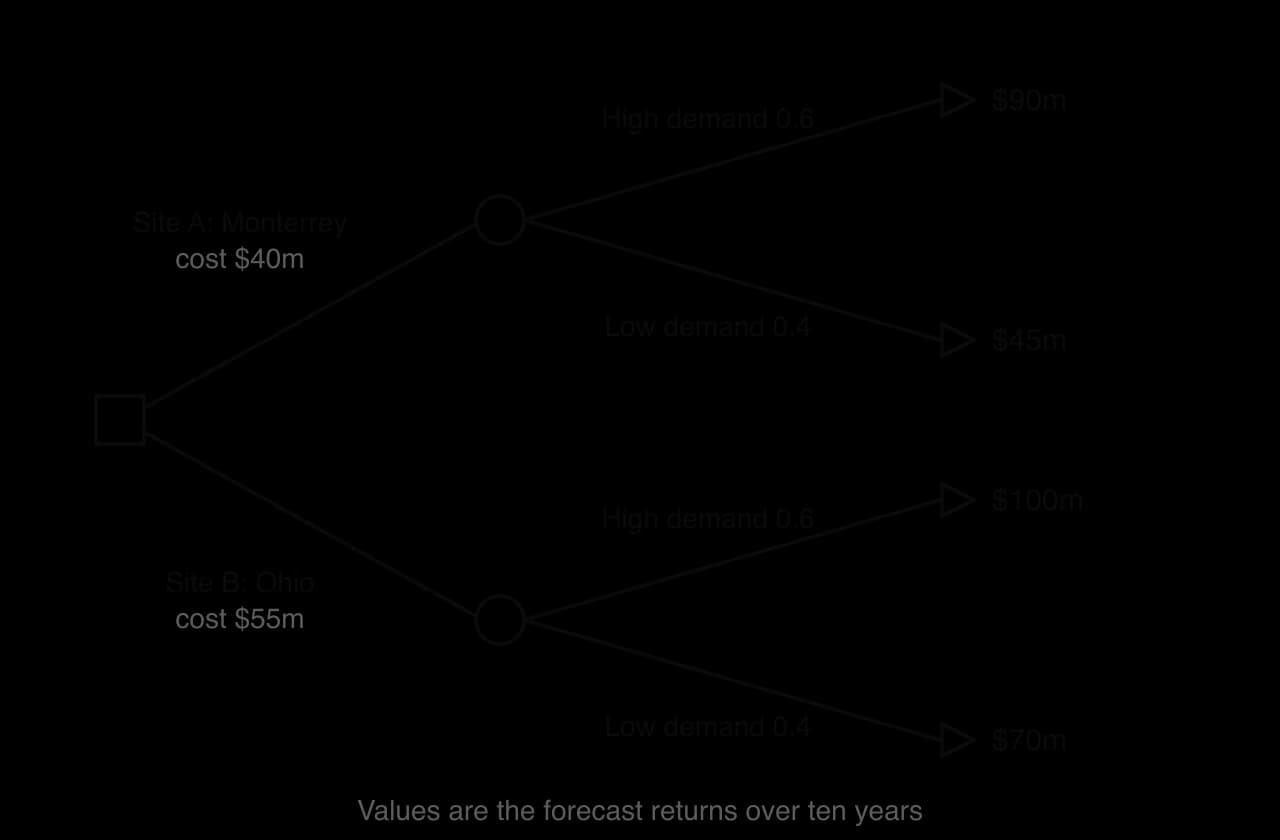
The decision tree sets out a choice between two factory sites. The square is the decision; the circles are the uncertain outcomes, high or low demand, each with its probability and forecast return over ten years.
Type of business | Main location factors | Example |
|---|---|---|
Primary sector (farming, mining, fishing) | The natural resource itself, climate, transport to processors | Mines must be where the ore is |
Manufacturing | Labour cost per unit, land, transport, suppliers, infrastructure, incentives | Car plants near ports and parts suppliers |
Retail and personal services | Access to customers, footfall, visibility, rent | Cafés on busy streets; dentists in town centres |
Online and knowledge-based services | Skilled labour, internet and power, taxes, quality of life | Software firms in technology clusters |
Businesses whose location makes little difference to their costs or revenues, such as many online firms, are described as footloose: they can move easily to wherever conditions are best.
A good location decision balances cost against revenue and risk over the whole life of the site, not just in the first year. The cheapest site in quantitative terms may lose money if it is far from customers or lacks skilled workers, while an expensive site can be justified by higher sales. Decisions should also consider how factors may change: wages rise as countries develop, governments change trade policy, and incentives end.
What the best site is depends on the type of product, the business's objectives (lowest cost, fastest delivery, highest quality, a strong ethical reputation), its finance, the stability of the countries considered and the attitudes of its stakeholders. Quantitative methods such as cost tables, weighted scores and decision trees give structure to the decision, but every one of them depends on forecasts and judgments.
Location decisions are not only about where to build. Businesses also decide who should carry out each part of production: the business itself or another firm. Combining "who" and "where" gives four ways of reorganising production that businesses use, often at the same time for different activities.
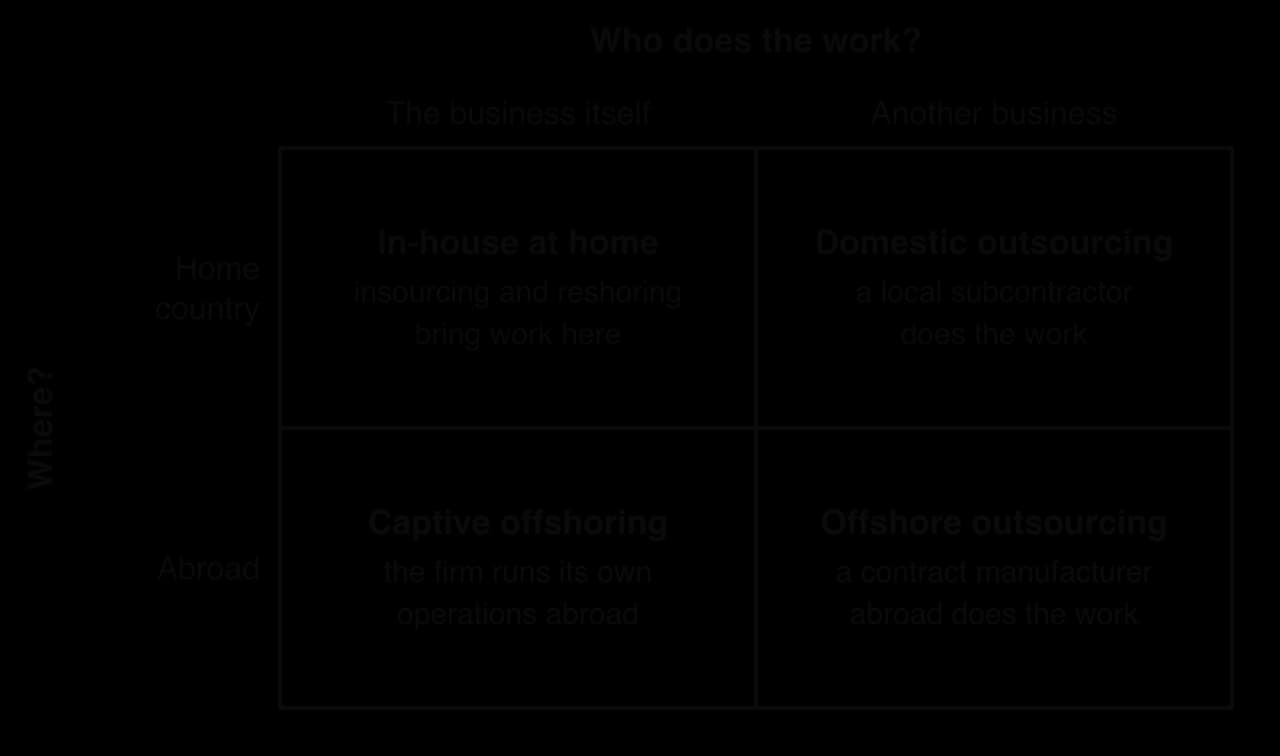
The grid shows that outsourcing and offshoring are different decisions, even though they often happen together. Both cells in the bottom row are offshoring: in captive offshoring (bottom left) the business runs its own operations abroad, and in offshore outsourcing (bottom right) it both moves an activity abroad and hands it to another firm. Insourcing and reshoring move activities back towards the top left.
Outsourcing means transferring an activity that a business used to carry out itself, or could carry out, to another business that specialises in it. The other business is the subcontractor; the outsourcing business pays it under a contract and usually sets standards for price, quality and delivery. The terms outsourcing and subcontracting are used with the same meaning.
Businesses outsource both support activities (cleaning, catering, payroll, IT, security, logistics) and core activities such as manufacturing. Many brands of clothing, shoes and electronics own no factories at all: they design and market the products and pay contract manufacturers to make them.
Lower costs: the specialist may have lower wages, economies of scale or better technology.
Access to expertise and technology the business lacks, such as cybersecurity or advanced manufacturing.
Focus on core activities: managers can concentrate on what gives the business its edge, such as design, research or marketing.
Flexibility: output can be increased or reduced by changing the contract, without hiring or making staff redundant, so some fixed costs become variable costs.
Less capital needed: the business does not need to buy factories or equipment.
Loss of control over quality, delivery times and working conditions.
Dependence on the supplier, which may raise prices once the business can no longer do the work itself.
Risks to confidentiality: designs and customer data are shared with another firm.
Reputation and ethics: the business is blamed for problems at its subcontractors, even though it does not employ their workers.
Redundancies among the business's own staff, which can lower morale and lead to conflict with trade unions.
Dyson shows the ethical risk. Since the 2000s it has used contract manufacturers in Malaysia to make many of its products, but in 2021–2022 it ended its contract with the supplier ATA IMS after allegations of forced labour at the supplier's factories. Dyson did not employ the workers concerned, but its brand was linked to the allegations in the media.
Offshoring means moving an activity from the home country to another country. The business may do it by opening its own factory or office abroad (captive offshoring, a form of foreign direct investment) or by outsourcing the work to a firm abroad (offshore outsourcing).
Dyson moved the production of its vacuum cleaners from Malmesbury in England to Malaysia in 2002, and of its washing machines in 2003, when production there was about 30% cheaper. The move was criticised by trade unions for the loss of jobs in Wiltshire, while Dyson said the savings paid for research and development at its English head office.
Sources: Wikipedia, "Dyson (company)" (2026).
Advantages of offshoring | Disadvantages of offshoring |
|---|---|
Lower labour, land and other costs | Longer, more complex supply chains; slower delivery and higher transport costs |
Access to large and growing foreign markets | Risks from exchange rates, tariffs and political change |
Access to skills in short supply at home | Communication problems across time zones, languages and cultures |
Production in several countries spreads risk | Quality may be harder to control from a distance |
Production inside a market avoids its import tariffs | Job losses at home and possible damage to reputation |
The comparison shows that offshoring usually trades lower production costs for higher coordination costs and risks. As wages rise in host countries and transport becomes less predictable, the balance can shift.
Insourcing is the opposite of outsourcing: a business brings an activity back in-house, so that its own employees carry it out instead of an external firm. It is often a response to problems with quality or control, or to a change in how important the activity has become.
In 2012 General Motors decided to bring most of its IT work back in-house. About 90% of its IT work had been carried out by outside firms when its new chief information officer arrived that year, and GM planned to hire thousands of IT staff over the following years and to consolidate 23 data centres into two. Its reasoning was that software was becoming central to its cars and its business, so it wanted direct control over it.
Sources: MIT Technology Review, "With computerized cars ahead, GM puts IT outsourcing in the rearview mirror", 2012; Dice, "GM Poised to Hire Thousands as It Insources IT", 2012.
Advantages of insourcing | Disadvantages of insourcing |
|---|---|
Greater control over quality, timing and confidential information | Higher fixed costs: staff, equipment and premises |
Builds skills and knowledge inside the business | Needs capital and time to recruit and train staff |
Easier to coordinate with other departments | Loses the specialist's expertise and economies of scale |
Can strengthen the brand ("made by us") and employee morale | Less flexible when demand falls |
Reshoring (also called onshoring or backshoring) is the return of production from abroad to the business's home country. It reverses offshoring. A reshored activity may be carried out by the business itself or by a domestic subcontractor.
Rising costs abroad: wages in many host countries have risen, narrowing the cost gap.
Supply chain risk: pandemics, natural disasters and shipping disruption have shown the danger of long supply chains.
Tariffs and trade policy: import tariffs make goods produced abroad more expensive in the home market.
Government incentives: grants and tax breaks for producing at home, such as Japan's 2020 payments to firms that moved production out of China.
Automation: robots reduce the importance of labour costs, so production can return to high-wage countries.
Quality, speed and reputation: being close to customers allows faster delivery, easier quality control and the appeal of products "made at home".
Reshoring has its own costs. Labour, land and energy are usually more expensive at home, suitable suppliers and skilled workers may no longer exist after years of offshoring, and building new capacity takes years. Many firms therefore reshore only selected activities, such as the final stages of production or products with high value, while keeping the rest abroad.
 YouTube
Nearshoring is a middle path: moving production to a country closer to the home market, often a neighbouring country with lower costs. US businesses nearshore to Mexico, and Western European businesses to Central and Eastern Europe, North Africa or Turkey. Nearshoring keeps some of the cost advantage of offshoring while shortening supply chains and reducing time differences.
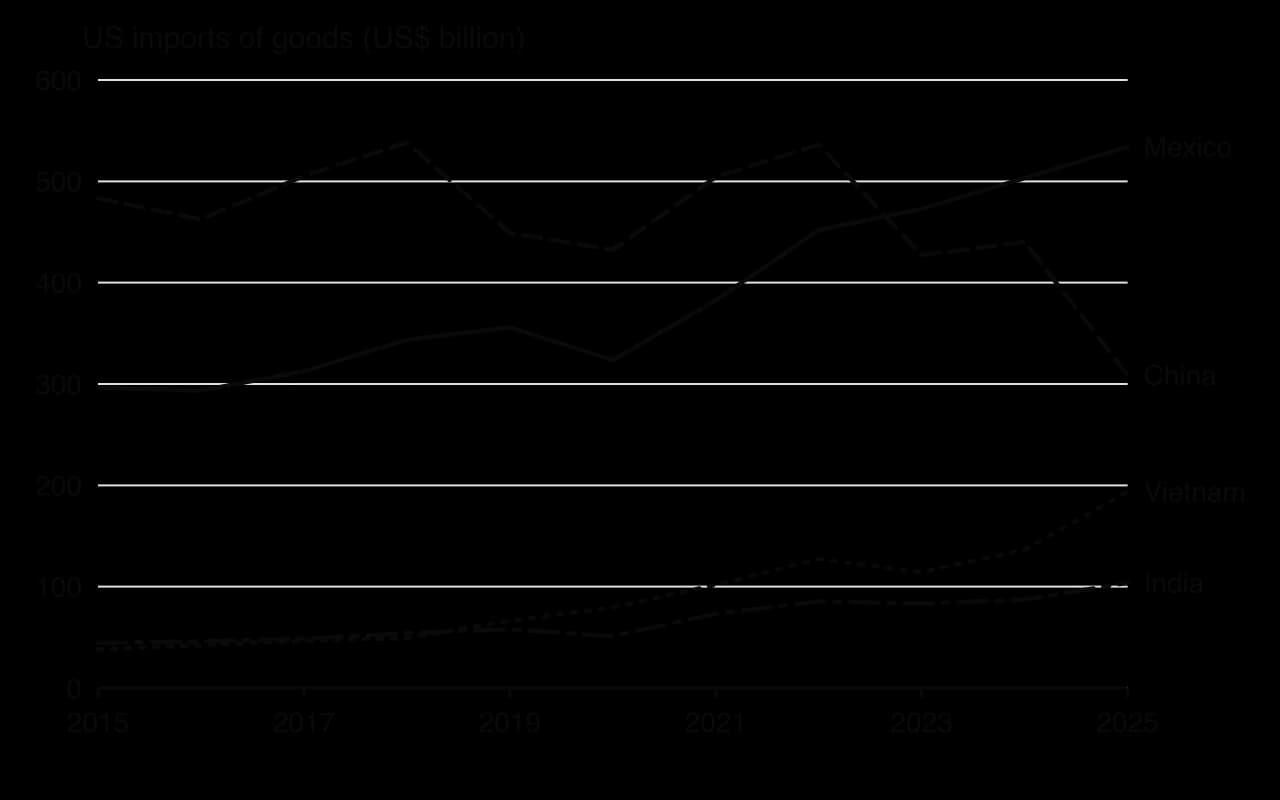
The chart shows the effect of these decisions on trade. US imports of goods from Mexico rose by about 80% between 2015 and 2025, while imports from China fell by about 36%, most sharply in 2025. Some of the production that left China went to Mexico (nearshoring) and some to Vietnam and India (offshoring to new locations), rather than back to the United States.
Method | What changes | Main reason | Main risk | Real example |
|---|---|---|---|---|
Outsourcing | Who does the work (another firm) | Lower cost, expertise, focus | Loss of control; reputation | Dyson's contract manufacturers in Malaysia |
Offshoring | Where the work is done (abroad) | Lower cost, access to markets | Long supply chains; political risk | Dyson moves production to Malaysia (2002) |
Insourcing | Who does the work (back in-house) | Control, quality, strategic skills | Higher fixed costs | General Motors IT (2012) |
Reshoring | Where the work is done (back home) | Risk, tariffs, incentives, speed | Higher costs at home | Japan's 2020 subsidies |
Nearshoring | Where (a nearby country) | Balance of cost and proximity | Cost advantage smaller than far offshoring | US imports from Mexico |
Each method has winners and losers, and the right choice depends on the activity, the business and the time period. Managers weigh five main issues.
Cost against control. Outsourcing and offshoring usually lower costs but reduce control over quality, delivery and confidential information. Insourcing and reshoring restore control at a higher cost.
Quality. A specialist subcontractor may produce better quality than the business could itself, but distance and divided responsibility can also cause faults that are hard to trace.
Ethics. Lower costs abroad sometimes reflect low wages, long hours or weak safety and environmental rules. Businesses that outsource to such suppliers face ethical questions and must check conditions through audits and a supplier code of conduct.
Supply chain risk. Long chains with one main supplier or country are vulnerable to disasters, conflict and tariffs. Spreading production across several countries or bringing some home reduces risk but loses economies of scale.
Reputation. Customers, employees and governments may react badly to job losses at home or problems at suppliers abroad; reshoring can earn goodwill.
Stakeholder | Outsourcing and offshoring | Insourcing and reshoring |
|---|---|---|
Shareholders | Gain if costs fall and profits rise; lose if quality or reputation suffers | May lose from higher costs; gain from lower risk and more control |
Employees at home | Lose jobs or face pressure on wages | Gain jobs and security |
Workers in the host country | Gain jobs and skills; may face poor conditions | Lose jobs when work returns home |
Customers | Gain from lower prices; may lose from slower service or lower quality | May pay more; gain from faster delivery and reliability |
Governments | Home government loses tax and jobs; host government gains investment | Home government gains jobs and tax |
The table shows that the same decision affects stakeholders in opposite ways, so there is rarely a choice that benefits everyone. The balance a business chooses reflects its objectives and its view of corporate social responsibility.
In the short run, outsourcing and offshoring can cut costs quickly, but reorganising production always involves set-up costs, redundancy payments and a period of disruption. In the long run, the gains may shrink as wages abroad rise and as the business loses skills it once had. Reshoring and insourcing usually raise costs in the short run, while their benefits (resilience, control, faster response to customers) build up over time.
The right way to reorganise production depends on how important the activity is to the business's competitive position (core activities are more often kept in-house), how standardised it is (standard activities are easier to outsource), the reliability of available suppliers, the size of the cost difference, the political and trade environment, and the values of the business and its customers. Many large firms now combine the methods: they outsource standard production, insource strategic activities such as software, and spread production across several countries to reduce risk.
Key concept | Link to location and reorganising production |
|---|---|
Change | Rising wages, new tariffs, automation and supply disruptions keep changing the best location, so location decisions are revisited. |
Ethics | Outsourcing to low-cost suppliers raises questions about workers' conditions; offshoring and reshoring affect communities at home and abroad. |
Sustainability | Shorter supply chains can cut transport emissions; relocating to countries with weak environmental rules can damage environmental sustainability. |
Apple designs its products in the United States but owns almost no factories. For most of its history, nearly all iPhones were assembled in China by contract manufacturers, above all Foxconn (Hon Hai Precision Industry) of Taiwan. Apple's operations therefore combine outsourcing (assembly is done by other firms) with offshoring (it is done outside the United States). Since the late 2010s, Apple has moved a growing share of this assembly from China to India.
Apple's contract manufacturers began assembling iPhones in India in 2017, when Wistron started production near Bengaluru; Foxconn followed at Sriperumbudur, near Chennai in Tamil Nadu, in 2019. Pegatron later joined them, and the Indian conglomerate Tata Group entered iPhone assembly when its subsidiary Tata Electronics took over the Indian operations of Wistron and Pegatron. India's share of iPhone production then rose quickly.
Measure | 2024 | 2025 |
|---|---|---|
iPhones assembled in India (million units, Bloomberg estimate) | 36 | 55 |
India's share of global iPhone assembly (Smart Analytics Global estimate) | 14% | 23% |
China's share of global iPhone assembly (Smart Analytics Global estimate) | 83% | 74% |
Sources: Bloomberg (Bloomberg Government), "Apple Now Makes About 25% of iPhones in India After China Pivot", 10 March 2026; National Herald, citing Smart Analytics Global, 15 May 2026.
The table shows that India's output rose by about 53% in a single year, although China still assembled about three-quarters of all iPhones in 2025. The two sources use different methods and their figures do not match exactly, so the numbers are best read as estimates of the trend. Over five years, iPhones worth nearly US$70 billion were made in India under its production-linked incentive (PLI) scheme, of which about US$51 billion, roughly 73%, were exported.
Several quantitative factors favoured India. The PLI scheme pays manufacturers incentives linked to the value of the phones they produce, which lowers the cost of producing there. Labour costs are lower than in China. Above all, tariffs changed the cost comparison. On its earnings call on 1 May 2025, Apple said that most iPhones sold in the United States in the June quarter would come from India, and estimated that tariffs would add US$900 million to its costs in that quarter.
Qualitative factors were just as important. Relying on one country for most of its production left Apple exposed to political tension between the United States and China, as well as to disruptions such as the pandemic lockdowns of 2020–2022. India offered a large, young workforce, a government keen to attract electronics manufacturing, and a large domestic market for smartphones. Against this, India's infrastructure and its networks of component suppliers are less developed than China's clusters, so many parts are still imported.
The United States government wanted more than a shift from China to India. On 23 May 2025, President Trump said that he expected iPhones sold in the United States to be made there, and threatened a tariff of at least 25% otherwise. In August 2025 Apple raised its planned US investment to US$600 billion over four years and launched an American Manufacturing Program with suppliers such as Corning (cover glass in Kentucky) and Texas Instruments (chips). Apple's announcement covered components, materials and servers, not iPhone assembly, which remained in Asia.
This response shows partial reshoring: Apple brought some high-value, highly automated stages of production to the United States while keeping labour-intensive assembly abroad, where labour costs and the supply of trained workers favour it.
Outsourcing also brings risks that Apple does not control directly. In December 2020, workers rioted at Wistron's iPhone plant at Narasapura in Karnataka, causing damage estimated at US$7 million. In December 2021, more than 250 workers at Foxconn's Sriperumbudur plant fell ill after eating food in company hostels, leading to protests and a temporary closure while Foxconn, Apple and the Tamil Nadu government made changes. Because Apple's brand is on the product, problems at its subcontractors affect its reputation.
The case shows that location and production decisions are driven by a mix of factors that change over time: costs and incentives, but also political risk, tariffs and the wish to spread risk across countries. It also shows that the four ways of reorganising production can be combined: Apple outsources assembly, has offshored it from China to India, and is reshoring some components to the United States. Its choice of India reflects trade-offs between lower risk and the deeper supplier clusters of China.
The case has limits. The production figures are estimates from analysts and unnamed sources, not Apple's own disclosures, and trade policy has changed several times since 2025, so the balance between China, India and the United States may continue to move.
Explain two quantitative and two qualitative factors that led Apple to expand iPhone assembly in India.
Distinguish between Apple's use of outsourcing and its use of offshoring.
Discuss whether Apple should reshore iPhone assembly to the United States.
Sources: Bloomberg, 10 March 2026; National Herald, 15 May 2026; MacRumors, "Tim Cook explains how tariffs are impacting Apple's business", 1 May 2025; Onmanorama/PTI, 23 May 2025; Apple Newsroom, "Apple increases U.S. commitment to $600 billion", 6 August 2025; Wikipedia, "Foxconn" and "Wistron" (2026).
Location appears in Paper 1 and Paper 2. Short questions ask you to define the four ways of reorganising production or to explain location factors; Paper 2 can include a cost comparison of sites, labour cost per unit or a decision tree. Section B questions ask you to evaluate outsourcing, offshoring, insourcing or reshoring for the business in the case.
Short-answer questions often ask for two factors explained in the context of the case.
Paper 2 questions may combine a calculation with a comment.
The 10-mark question asks for a balanced judgment in a short case.
Location is the site where a business carries out its operations; location decisions are long term, costly to reverse and differ by type of business.
Quantitative location factors (land, labour cost per unit, transport, incentives, taxes) can be measured and compared in money.
Qualitative location factors (infrastructure, access to markets and suppliers, skilled labour, political stability, regulations, culture, clustering, owner preference) need judgment.
Cost tables, weighted scoring and decision trees help compare sites, but all depend on forecasts and subjective judgments.
Outsourcing changes who does the work; offshoring changes where it is done. Insourcing and reshoring reverse them, and nearshoring moves work to a nearby country.
Reorganising production trades cost against control, quality, ethics, supply chain risk and reputation, with different effects on each stakeholder.
Apple's shift of iPhone assembly towards India shows costs, incentives, tariffs and risk diversification combining in one decision.
I can explain the reasons for choosing a specific location of production, with a real example.
I can distinguish between quantitative and qualitative location factors and classify factors from a case.
I can calculate labour cost per unit and compare the total costs of alternative sites.
I can use weighted scoring and a decision tree to compare locations.
I can analyse the trade-offs between location factors.
I can define outsourcing, offshoring, insourcing, reshoring and nearshoring and tell them apart.
I can explain why businesses reorganise production nationally and internationally.
I can evaluate each way of reorganising production for a business and its stakeholders, saying what the decision depends on.
Allow hybrid or remote working to cut commuting time and office space needs.
Open a second office in a cheaper district or smaller city (e.g. a tier-2 city) with lower rents and salaries.
Recruit and train graduates internally rather than competing for experienced staff.
Award [1] for a relevant suggestion and [1] for explaining how it reduces the effect of a named external diseconomy at Tarang.
Vembanad Hospital
[1] Vembanad Hospital (Vembanad) is a privately held company that runs a 180-bed hospital in Kochi, India. It was founded in 2011 by two doctors, Anjali Menon and Ravi Pillai. Vembanad’s mission is “to give every patient the care we would want for our own families”. It offers general surgery, maternity care and a 24-hour emergency department, and employs 410 staff, including 95 nurses.
[2] Vembanad’s operations manager, Suresh Nair, is responsible for turning the hospital’s resources (staff time, medicines, equipment, beds and energy) into patient care. In 2025 patient numbers rose by 14 %, but the average waiting time in the emergency department rose from 40 minutes to 95 minutes. Online reviews began to complain about delays, and two senior nurses resigned, saying that their workload had become “unsafe”.
[3] Suresh believes that part of the problem lies in the hospital’s support services. The laundry and the kitchen are run in-house by 48 employees and use old equipment that consumes large amounts of electricity and water. Suresh has received an offer from CleanServe, a large national company, to take over both functions. CleanServe would cut Vembanad’s annual laundry and catering costs by 22 %, and the laundry building could be turned into a new outpatient clinic.
[4] Anjali is unsure. Several of the laundry and kitchen staff have worked at Vembanad since it opened, and patients often praise the hospital’s food, which is cooked to meet each patient’s dietary needs. CleanServe would deliver meals prepared in a central kitchen 60 km away. Vembanad’s finance director points out that the money saved could pay for 12 additional nurses.
Define the term operations management.
2 marks
Explain two ways in which operations management at Vembanad is linked to other functions of the business (paragraphs 2 and 4).
4 marks
Explain one economic and one social sustainability issue in Vembanad’s current operations.
4 marks
Discuss whether Vembanad should outsource its laundry and catering services to CleanServe.
10 marks
Maple & Birch Furniture
Maple & Birch Furniture Inc. (M&B) is a Canadian public limited company based in Quebec. It makes solid-wood dining tables and chairs and sells mainly to furniture retailers in Canada and the United States (US). About 55 % of its sales are now in the US.
M&B’s board is considering setting up a wholly owned subsidiary with a factory in Monterrey, Mexico. The factory would supply the US market and allow M&B to sell to Mexico’s growing middle class. The investment would cost CAD 18 million. Mexican wages are lower than in Quebec, and Monterrey is close to the US border.
The chief executive, Jean-Luc Tremblay, argues that international expansion is essential because Canadian sales have been flat for four years. The union representing M&B’s 400 Quebec employees fears job losses. Some board members are concerned about security, changes in trade agreements between the US, Mexico and Canada, and how Mexican consumers would view a Canadian brand.
Table 1: Forecast cost per dining table delivered to US customers (CAD)
Made in Quebec | Made in Monterrey | |
|---|---|---|
Production cost per table | 1 150 | 820 |
Transport cost to US customers per table | 90 | 60 |
Total cost per table | 1 240 | 880 |
Using Table 1, calculate the percentage saving in the total cost per table delivered to US customers if M&B makes tables in Monterrey (show all your working).
2 marks
Explain two opportunities for M&B of operating in Mexico.
4 marks
To what extent should M&B set up a wholly owned subsidiary in Mexico?
10 marks