
Describe job, batch, mass/flow production and mass customisation, explain their effects on HR, finance and marketing, and evaluate which method, and which mix of capital and labour, suits a business.
Each is in the Business glossary, with every other term in the subject.
A method of manufacturing that builds an object layer by layer from a digital design, so that each item can be different without new tools or moulds.
A method of production in which a group of identical products is made together, with each batch completing one stage of production before moving to the next.
Describes production that uses a high proportion of machinery and equipment relative to labour, so that capital costs make up a large share of total costs.
The time during which machinery is stopped and reset to switch production from one product or batch to another, so that no output is made.
A method of production in which a single, unique product or service is made to an individual customer’s specification, one job at a time, usually by skilled workers.
Describes production that uses a high proportion of labour relative to machinery and equipment, so that labour costs make up a large share of total costs.
A method of production that combines the high volume and low unit costs of mass production with the ability to tailor each product to an individual customer’s choices, usually using flexible technology.
Define job production, batch production, mass/flow production and mass customisation.
Describe the features of each operations method, with real examples.
Distinguish between capital-intensive and labour-intensive production.
Explain the implications of each method for human resources, finance and marketing.
Explain how technology such as online configurators and 3D printing makes mass customisation possible.
Calculate the effect of batch size on the cost per unit.
Evaluate the suitability of each operations method for a given business.
Evaluate the decision to change from one operations method to another.
An operations method is the way a business organises production: one unique item at a time, a group of identical items at a time, a continuous stream of identical items, or a stream of items each tailored to one customer. The choice of method decides the unit cost, the variety a business can offer, the skills and number of workers it needs and how much capital it must invest.
Operations methods show clearly how creativity in production can disrupt markets. Ford’s moving assembly line in 1913 turned the car from a luxury into a mass-market product, and today online configurators and 3D printing let businesses make individual products at close to mass-production cost. Each change of method also brings change for employees and raises questions of ethics, from repetitive work on a production line to jobs lost to automation.
45 exam-style questions on this subtopic, written in the style of the IB papers. The first has its markscheme open. Counted on
Eko Frames Studio
[1] Eko Frames Studio (EFS) is a private limited company in Lagos, Nigeria, founded in 2018 by Tolu Adeyemi and Chinedu Okafor. It produces animated advertisements, music videos and short films for clients such as banks, telecoms companies and musicians. Every project is designed from scratch to the client’s brief and can take from three weeks to six months.
[2] EFS employs 22 animators and hires freelancers when it is busy. Its computers run day and night to render animations, and because of frequent power cuts the studio relies on diesel generators. Before deadlines, animators often work 14-hour days; two of the most talented left in 2025 to join a studio in London.
[3] Demand for EFS’s work is growing, but many small businesses that contact EFS cannot afford its prices, which start at NGN 8 million per advertisement. Chinedu wants EFS to offer “EFS Express”: a range of 30 standard animated advertisement templates. Customers would choose a template, add their logo, colours and text, and EFS would produce the advertisements in groups of 20 each week for NGN 600 000 each.
[4] Tolu is worried. She says EFS’s reputation is built on “original work that nobody else has” and that the best animators joined EFS for creative freedom. She also fears that EFS Express would take animators away from the high-value projects.
Define the term job production.
2 marks
Award [1] for a partial definition that shows some understanding, e.g. “making one product at a time” or “making products to order”.
Award [2] for a full definition, e.g. a method of production in which a single, unique product (or service) is made to an individual customer’s specification, from start to finish, often by skilled workers.
The official deck for this part of the syllabus.
What is an operations method?
State the four operations methods.
With a free account, Augment remembers where you stopped and what you have practiced.
A method of production in which large quantities of standardised products are made continuously, each unit moving from one stage to the next along a production line.
Scope: This subtopic is the same at SL and HL: the features, advantages, disadvantages and suitability of job, batch, mass/flow production and mass customisation, the related ideas of capital-intensive and labour-intensive production, and the evaluation of which method suits a business and of changing method.
Two features of what a business sells shape its choice of operations method more than anything else. Volume is how many units it needs to produce. Variety is how different each unit is from the others. A shipyard building one cruise ship produces very low volume and every ship is different; a soft-drinks plant produces millions of identical cans.
The diagram shows that the traditional methods involve a trade-off. Producing one-off products allows complete variety but only low volume and a high cost per unit. Producing in large volumes allows a low cost per unit through economies of scale, but only if the units are standardised. Batch production sits between the two. Mass customisation tries to escape the trade-off by using flexible technology to tailor each unit while keeping volumes high.
Other factors also affect the choice of method:
The size and stability of the market: mass production needs large and steady demand; job production suits small or one-off orders.
The nature of the product: a bridge or a wedding dress is unique by nature; a tin of beans is standard.
Customer expectations: some customers want a product made to their own specification and will pay for it; others want the lowest price.
Finance: mass production and mass customisation need large investment in machinery and technology.
Technology and skills available: craft skills suit job production; automation needs engineers and technicians.
The business’s objectives: a business aiming to be the lowest-cost producer chooses differently from one that competes on craftsmanship.
Job production is the production of a single, unique item, or a small number of items, to the exact requirements of an individual customer. Each job is a separate project, often designed with the customer, and is usually completed before the next job starts. The method suits products that cannot be standardised: buildings, bridges, ships, tailored clothes, custom furniture, wedding cakes, portraits, websites built for one client and consultancy projects.
Each product is unique and made to order, so production starts only when the customer has ordered.
Workers are usually highly skilled and able to carry out many tasks; the work is often done by hand or with general-purpose tools.
Production is labour-intensive: wages are a large share of total cost.
The customer is often involved in design and may change requirements during production.
The cost per unit and the price are high, and each job is usually priced separately.
Job production is not confined to small businesses. Large organisations use it for very large projects: shipyards build cruise ships one at a time and construction firms build stadiums and airports to unique designs. Rolls-Royce Motor Cars, owned by BMW, works close to the job end of the scale. Its plant at Goodwood in England delivered 5,712 cars in 2024, built to order by more than 2,500 employees, and its Bespoke service lets customers specify unique paint, embroidery, woodwork and artwork. A mass-market car plant can build that many cars in a few days.
Sources: Rolls-Royce Motor Cars, press release on 2024 results (January 2025).
Advantages | Disadvantages |
|---|---|
Meets each customer’s exact needs, so customer satisfaction is high. | High cost per unit: no economies of scale, and skilled labour is expensive. |
High prices and high added value are possible, because the product is unique. | Production is slow; each job takes time to design and make. |
Skilled, varied work is motivating; workers see the finished product and take pride in it. | Depends on scarce skilled workers, who are hard to recruit and replace. |
Flexible: the business can make many different products with general tools. | Demand is irregular, so cash flow can be uneven; materials may have to be bought before payment. |
Little stock of finished goods, because items are made to order. | Hard to standardise quality, because each job is different. |
Human resources: recruiting, training and keeping skilled, multi-skilled staff is critical; non-financial rewards such as job satisfaction and pride matter; the work suits teamwork and empowerment.
Finance: costs are estimated job by job; customers are often asked for a deposit or stage payments to protect cash flow; little capital is tied up in specialised machinery.
Marketing: the product is sold on quality, uniqueness and service, usually at a premium price; personal selling and reputation (word of mouth, past work) matter more than mass advertising.
Batch production is the production of a group of identical items together. The whole batch completes one stage of production before it moves to the next stage, and when one batch is finished the equipment is reset to make a different batch. A bakery uses batch production when it makes 200 white loaves, then 150 wholemeal loaves, then 300 rolls on the same equipment. Other examples are clothing made in batches of each size and colour, furniture made in batches of each design, and medicines, which are made and recorded in numbered batches so that any problem can be traced to the exact production run.
Batch production allows a business to offer variety (several products from the same equipment) with some of the cost benefits of larger volumes. The main cost is the time lost between batches. Every time the business switches from one product to another, machines must be stopped, cleaned, reset or retooled and tested. This changeover time produces nothing, but the business still pays for workers and equipment.
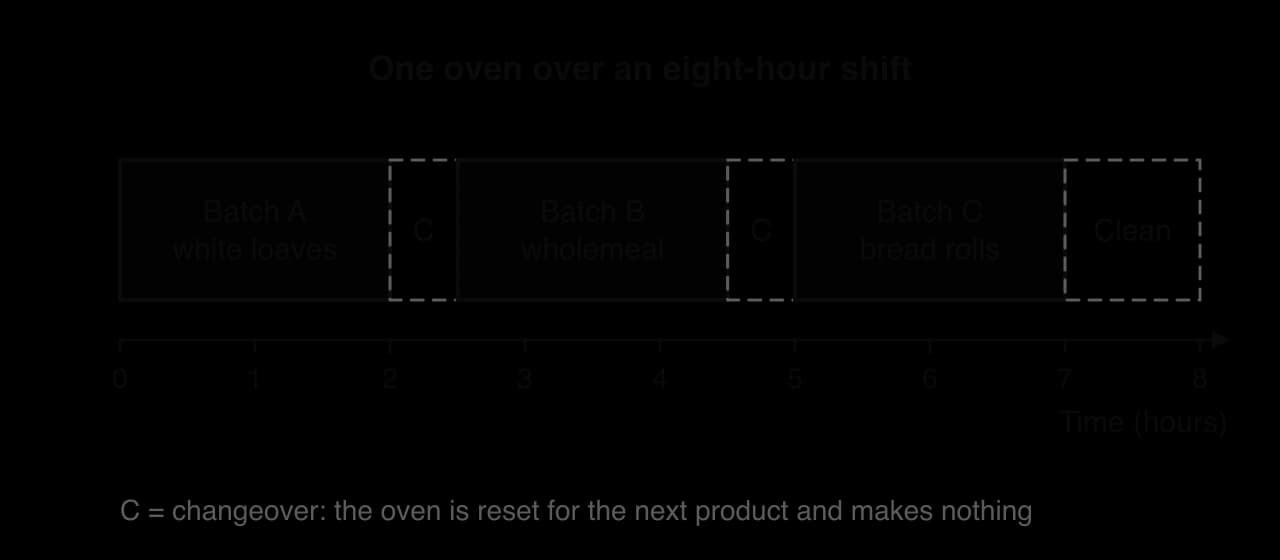
The timeline shows one oven over a shift. Three batches are produced, but a quarter of the shift is lost to changeovers and cleaning. Fewer, larger batches would cut the time lost, but the bakery would then hold more stock of each product, which uses storage space and may go stale. Choosing the batch size is therefore a trade-off between changeover costs and the costs of holding stock.
Advantages | Disadvantages |
|---|---|
Offers variety from the same equipment, so it can meet different customer needs. | Changeover time is lost output, and reset machines may need testing. |
Lower cost per unit than job production, because costs are spread across each batch. | Stock builds up between stages (work in progress) and in finished batches, which costs money to hold. |
Some specialisation of machines and workers is possible. | Planning and scheduling are complex: which batch, how large, in which order. |
Production can be adjusted to demand: a popular product gets more or larger batches. | Work can be repetitive within a batch, and workers may wait while machines are reset. |
Risk is spread across several products. | If a batch is faulty, the whole batch may have to be scrapped or recalled. |
Human resources: workers need to be semi-skilled and flexible enough to switch between products; training in fast changeovers is valuable; work may be more repetitive than in job production.
Finance: more capital is needed than for job production (machines for each stage); cash is tied up in stock between batches; costing each batch accurately matters.
Marketing: the business can offer a product line with several variations (sizes, flavours, colours) and target different segments; prices are lower than for one-off products.
Mass/flow production is the continuous production of large quantities of a standardised product. Each unit moves from one stage to the next without stopping, usually along a production line or a conveyor, and the line runs for long periods (sometimes 24 hours a day) making the same product. Cars, smartphones, soft drinks, newspapers, light bulbs and processed foods are made this way. Process industries such as oil refining, cement and steel are an extreme form, in which production never stops at all.
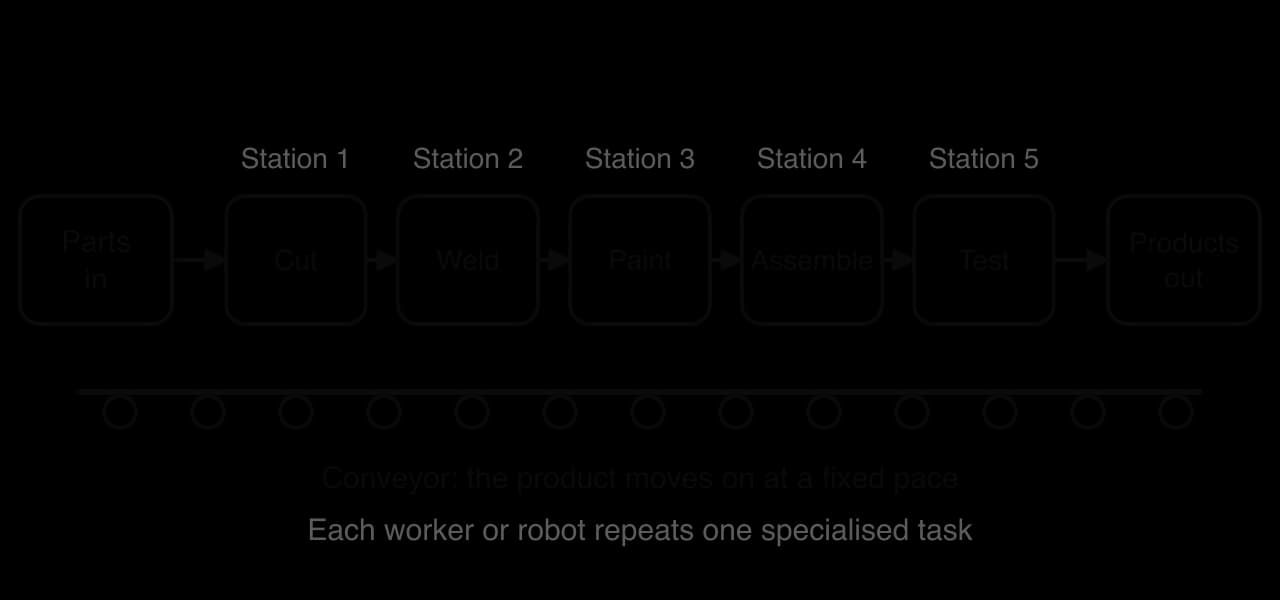
The diagram shows the key feature of flow production: the work is divided into many small, simple tasks performed in sequence. This is specialisation, also called the division of labour. Each worker or machine does one task again and again, so it becomes very fast at it, and the equipment can be designed for that one task. The line moves at a fixed pace, so the output per hour is predictable.
The method was transformed by Ford in 1913, when it introduced a moving assembly line at its Highland Park plant in Michigan. A Model T could then be built in about 90 minutes. Lower production costs allowed Ford to cut the price of the car from $825 in 1908 to $260 by 1925, turning the car into a mass-market product.
Sources: Ford Motor Company, corporate history, “The moving assembly line”.
Advantages | Disadvantages |
|---|---|
Very low cost per unit: high volume gives large economies of scale, especially in buying and in technical costs. | Very high start-up cost: specialised machinery, robots and large factories. |
High, predictable output; easy to plan supplies and staffing. | Inflexible: changing the product means stopping and rebuilding the line. |
Consistent, standardised quality, often checked automatically. | Repetitive, monotonous work can cause boredom, low motivation, absence and high labour turnover. |
Low prices make products affordable to a mass market. | A breakdown at one stage can stop the whole line. |
Easy to automate, which raises productivity further. | Depends on large, stable demand; if demand falls, expensive capacity stands idle and fixed costs are spread over fewer units. |
Human resources: many roles need little skill and short training; jobs are narrow and repetitive, which links to Taylor’s theory of motivation (pay for output) and to the risk of demotivation; firms use job rotation and teamwork to reduce boredom; automation reduces the number of manual jobs and raises demand for technicians.
Finance: very large capital expenditure is needed, so large businesses with access to share capital or loans use the method; fixed costs are high, so high sales volumes are needed to break even.
Marketing: products are standardised and sold to a mass market at low prices; heavy advertising and wide distribution are needed to sell the volumes produced; brands differentiate largely through promotion and packaging rather than the product.
 YouTube
Mass customisation combines the low unit cost of mass production with the variety of job production. The business produces high volumes, but each unit is tailored to an individual customer’s choices. It is made possible by flexible technology: computer-controlled machines that can switch between designs with no changeover time, robots, 3D printing and online systems that send each customer’s choices straight to the factory.
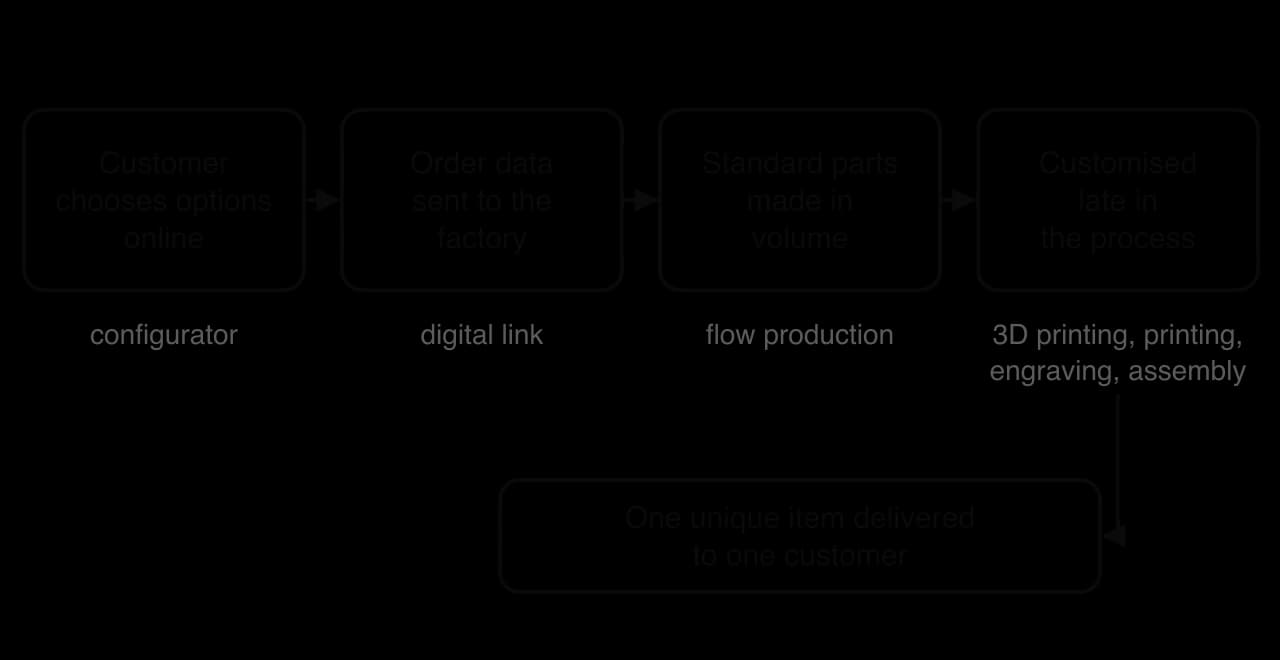
Most mass customisation follows the pattern in the diagram. The customer chooses options on a website or app, called a configurator, which shows the result and the price. The order data goes directly to the factory. The product is built mostly from standard modules or parts that are made in volume, and the individual features (colour, size, print, name, fit) are added late in the process. Because only the last steps differ, the business keeps most of the cost benefits of volume while each customer receives a unique product.
Three technologies make this possible:
Online configurators collect each customer’s choices accurately and turn them into production instructions without extra staff. Nike, for example, lets customers choose the colours and materials of some of its trainers on its website before they are made.
Flexible, computer-controlled machinery and robots can switch between designs in seconds, so the changeover time that limits batch production almost disappears.
3D printing builds each object layer by layer from a digital file, so every item can be different without new moulds or tools.
A clear example is Invisalign, the clear dental aligner made by Align Technology. Each patient’s teeth are scanned digitally, software plans how the teeth should move, and a series of aligners is made to fit that one patient. Every aligner is unique, yet the company produces them in very large volumes in its own factories, including plants in Mexico and China, and has treated more than 20 million patients.
Sources: Align Technology, “About Align” (2026); Kellogg School of Management, “Invisalign: Orthodontics Unwired” (2004).
Advantages | Disadvantages |
|---|---|
Customers get a product made to their choices, so satisfaction and willingness to pay are high. | Very high investment in flexible machinery, software and IT systems. |
Higher prices and margins than standard products; strong differentiation from competitors. | Unit costs are usually higher than for standard mass production. |
Products are made to order, so there is little unsold stock and less waste. | Delivery takes longer than buying from stock, which some customers will not accept. |
The configurator collects valuable data on what customers want. | Complex logistics: every order is different and must reach the right customer. |
Supports brand loyalty, because customers have helped design their product. | Customised products are hard to resell, so returns are costly. |
Human resources: fewer manual production workers but more engineers, programmers and data specialists; staff must be multi-skilled and trained to work with changing technology.
Finance: high capital cost, so the business must be confident of enough demand at a premium price; customers usually pay in advance, which helps cash flow.
Marketing: the customisation itself is the selling point; the configurator must be easy and enjoyable to use; promotion stresses individuality and personal design; delivery promises must be realistic.
Every operations method combines machinery and people, but the balance differs. Capital-intensive production relies mainly on machinery, equipment and technology, with relatively few workers. Labour-intensive production relies mainly on people, with relatively little machinery. The balance determines a business’s cost structure: in a capital-intensive business most costs are fixed (depreciation, maintenance, interest on loans for machines); in a labour-intensive business most costs are wages.
A car assembly plant in which robots weld and paint the bodies is capital-intensive: a few hundred technicians supervise machines worth hundreds of millions of dollars. A restaurant kitchen is the opposite.
Mass/flow production and mass customisation tend to be capital-intensive: car plants, bottling plants, chip factories and automated warehouses. Job production and many services tend to be labour-intensive: hairdressing, restaurants, care homes, consultancy, handmade crafts. The link is not fixed, however. Garment sewing is labour-intensive even in large factories that make clothing in huge batches, because sewing fabric is still hard to automate, which is why so much clothing is made in countries with low wages.
Capital-intensive production | Labour-intensive production | |
|---|---|---|
Main resource | Machinery, robots, technology | Workers’ time and skills |
Cost structure | High fixed costs; low variable cost per unit | Lower fixed costs; high labour cost per unit |
Productivity | High output per worker | Lower output per worker |
Consistency | Very consistent, precise output | Output varies with the worker; can be personalised |
Flexibility | Hard to change once set up | People can switch tasks and adapt quickly |
Suited to | High volumes of standard products; high-wage countries; tasks needing precision | Low volumes; personal services; craft products; low-wage countries; tasks hard to automate |
Risks | Idle machines if demand falls; breakdowns; technology becoming outdated | Rising wages; skills shortages; labour disputes |
The right balance depends on the relative cost of labour and capital, the volume and type of product, the skills available, the finance the business can raise and what customers value. Rising wages, cheaper robots and labour shortages push many industries towards capital intensity over time. But customers sometimes pay more for products and services because they are made by people: handmade goods, personal service and craftsmanship are labour-intensive by choice.
Feature | Job | Batch | Mass/flow | Mass customisation |
|---|---|---|---|---|
Volume | One or very few | Medium | Very high | High |
Variety | Every item unique | Several versions | Standardised | Every item tailored, from standard parts |
Cost per unit | Highest | Medium | Lowest | Low to medium |
Capital or labour | Labour-intensive | Mixed | Capital-intensive | Capital-intensive |
Worker skills | Highly skilled, multi-skilled | Semi-skilled, flexible | Mostly low-skilled, specialised; some technicians | Technicians, engineers, IT staff |
Flexibility | Very high | Medium | Very low | High |
Motivation of workers | Usually high (varied, creative work) | Medium | Risk of boredom and alienation | Depends on the role |
Stock | Little finished stock | Work in progress between batches | Large stocks of materials and finished goods | Little finished stock (made to order) |
Examples | Bridge, tailored suit, wedding cake, Rolls-Royce Bespoke | Bread, medicines, furniture ranges | Soft drinks, standard cars, phones | Clear aligners, customised trainers |
The table shows that no method is best in every respect. Each involves a trade-off. Job production accepts a high cost in return for uniqueness, mass production accepts little variety in return for a low cost, and mass customisation invests heavily in technology to achieve both. Most businesses use more than one method. A car maker mass-produces engines, builds cars on a flow line, offers customers a configurator, and makes prototypes for new models by job production.
Businesses change operations method as they grow, as demand changes and as technology develops. A craft brewery that begins by brewing small batches may move to larger batches and then to continuous production as it wins supermarket contracts. A furniture maker that has made one-off pieces may begin producing a standard range in batches. A mass producer may add a configurator to offer customised versions of its products.
Growth in demand: higher volumes make larger batches or flow production worthwhile, and lower unit costs allow lower prices.
Competition: a competitor with lower costs or more variety forces a response.
Changing customer expectations: customers increasingly expect personalised products and fast delivery.
New technology: flexible machinery, robots and 3D printing make new methods affordable.
Falling or more uncertain demand: a business may move from flow to batch production to avoid idle capacity and unsold stock.
Cost and finance: new equipment and factory layouts need large capital expenditure, and output may fall while the change is made.
People: workers may need retraining or may lose their jobs; changing from skilled craft work to repetitive line work can cause resistance to change and lower motivation.
Quality and brand: moving from handmade to machine-made can damage a brand built on craftsmanship, and new processes may produce more defects at first.
Marketing: the business may need to change its prices, target market and promotion to sell larger volumes.
Risk: if the expected demand does not arrive, the business is left with expensive capacity it cannot use.
The change is usually most successful when it is gradual, when employees are involved and trained, and when the business keeps what customers valued about the old method. Many businesses run two methods side by side, for example a standard range made in batches alongside a made-to-order service.
Choosing an operations method is a strategic decision, because it commits the business for years to a level of investment, a type of workforce and a market position. The right answer depends on several factors, and they often point in different directions.
The market: how large is demand, how stable is it, and do customers want variety or low prices? Mass production needs large, steady demand for a standard product.
The product: some products are unique by nature (a building); others are standard (a light bulb).
Finance: can the business raise the capital for automated lines or flexible technology, and can it afford the risk of idle capacity?
People: are skilled craft workers or technicians available locally, and at what wage?
Objectives and positioning: a premium brand that sells on craftsmanship would damage its brand by moving to mass production; a business aiming to be the cost leader in its market must produce at scale.
Technology: flexible technology is reducing the trade-off between volume and variety, making mass customisation possible in more industries.
Sustainability and ethics: mass production of standard goods can lead to overproduction and waste, while make-to-order methods (job production, mass customisation) waste less stock; repetitive line work and low-wage labour raise ethical questions; automation cuts some jobs and creates others.
In general, small businesses serving local or specialist customers suit job or batch production; large businesses selling standard products to mass markets suit flow production; and businesses whose customers value personalisation and will pay for it, with the finance to invest in technology, may suit mass customisation. In practice, successful businesses rarely use one method alone: they match the method to each product and each stage of production, and change it as their market and technology change.
Key concept | Link to operations methods |
|---|---|
Change | Growth, new technology and new customer expectations push businesses from one method to another, with effects on workers, costs and marketing. |
Creativity | New methods, from the moving assembly line to 3D printing, have changed what products cost and who can buy them. |
Ethics | Flow production can mean monotonous work; labour-intensive production is often moved to low-wage countries; automation replaces jobs. |
Sustainability | Making to order (job, mass customisation) reduces unsold stock; mass production saves resources per unit but can encourage overproduction. |
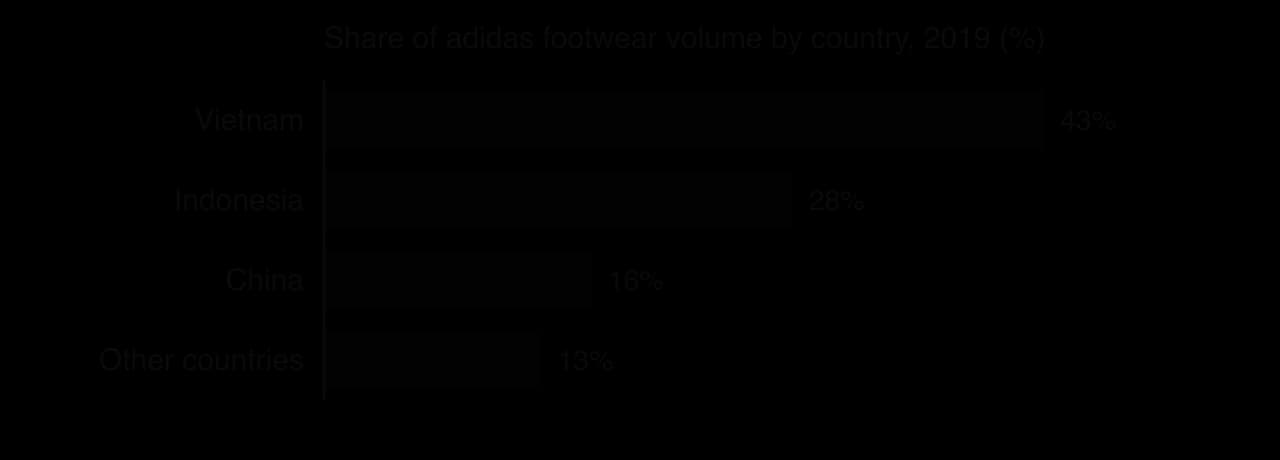
adidas, the German sportswear company, makes almost all of its footwear through independent suppliers in Asia. In 2019 it produced about 448 million pairs of shoes, 43% of them in Vietnam, 28% in Indonesia and 16% in China. These suppliers use labour-intensive batch and flow production: large factories in which thousands of workers cut, stitch and glue shoes, which are then shipped to markets in Europe and North America. The model gives low unit costs, but it is slow. Shoes are designed long before they reach the shops, and adidas must forecast demand far in advance.
In 2016 adidas opened a highly automated factory, the Speedfactory, in Ansbach in Germany, followed in 2017 by a second in Atlanta in the United States. Both were operated by its technology partner Oechsler. Robots and computer-controlled machines replaced much of the manual work, so the factories needed few workers. The aim was to bring production close to the company’s largest markets, so that adidas could respond quickly to demand, produce limited runs of shoes for particular customers and events, and cut the time and emissions of shipping from Asia.
In operations terms, the Speedfactory was a move from labour-intensive production far from customers to capital-intensive, flexible production near them. It aimed at the objectives of speed and flexibility rather than the lowest cost, and it was a step towards mass customisation: if automated machines could switch designs easily, shoes could one day be made to individual customers’ choices close to where they lived.
On 11 November 2019 adidas announced that production at both Speedfactories would end by April 2020 at the latest. Instead, it would use the Speedfactory technology at two of its suppliers in Asia, which news reports named as being in Vietnam and China. The company said this would make better use of existing production capacity and give more flexibility in product design, and that shoes made with these methods would still have a short production time.
Through shortened development and production lead times, we’ve provided select customers with hyper-relevant product for moments that matter. This was our goal from the start.
— Martin Shankland, Member of the Executive Board of adidas AG, Global Operations, adidas press release, 11 November 2019
A company spokesperson explained that more than 90% of adidas products were made in Asia, so it made more sense to concentrate Speedfactory production where the know-how and the suppliers were. The two factories had been targeting about 1 million pairs a year between them. Set against 448 million pairs in total, that is about 0.2% of adidas’s footwear output.
The Speedfactory shows the difficulty of combining high variety with low cost. The technology worked, but the factories were small, produced a narrow range (mainly running shoes) and could not reach the scale of the Asian suppliers, so the high fixed cost of the robots was spread over few pairs. Robotic lines are also hard to reconfigure for new designs without specialist engineers, while human workers can be retrained for a new pattern quickly. The labour-intensive suppliers in Asia already had the skills, the materials suppliers and the capacity.
The case also shows that efficiency and effectiveness must be judged together. The Speedfactory was more effective at speed and closer to customers, but less efficient at adidas’s volumes. adidas kept the learning: the processes moved to its suppliers, and development work continued at its adiLab site in Scheinfeld, Germany, and with Oechsler on 3D-printed soles. adidas therefore changed where and at what scale it used the automated methods, and continued to invest in automation. The limits of the case as evidence are that adidas did not publish the costs of the factories, so the financial reasons can only be inferred from what the company and journalists reported.
Sources: adidas, press release “adidas deploys Speedfactory technology at Asian suppliers by end of 2019” (11 November 2019); adidas Annual Report 2019; CNN Business (12 November 2019); TechCrunch (11 November 2019).
Explain why the Speedfactory was more capital-intensive than adidas’s Asian suppliers.
Analyse why automated production near customers did not give adidas lower costs at its volumes.
To what extent does the closure of the Speedfactories show that mass customisation is not suitable for footwear?
Questions on operations methods range from definitions and explanations to full evaluations and recommendations of which method a business should use. Calculation questions may ask for the cost per unit at different batch sizes or volumes.
“Explain two disadvantages” questions are marked as two separate points, each identified, developed and applied to the case.
A Section B question on operations methods expects a recommendation that weighs the methods against the business’s market, finance, people and brand.
Job production makes one unique item at a time to a customer’s order: high quality, variety and price, but high cost and slow.
Batch production makes groups of identical items; it offers variety at lower cost but loses output during changeovers and holds stock between stages.
Mass/flow production makes standardised products continuously on a line: the lowest unit cost at high volumes, but inflexible, capital-intensive and often repetitive for workers.
Mass customisation uses configurators, flexible machinery and 3D printing to tailor products at high volume; it needs heavy investment.
Capital-intensive production relies mainly on machinery and has high fixed costs; labour-intensive production relies mainly on people and has high labour costs.
Each method has implications for HR, finance and marketing, and most businesses use more than one.
The best method depends on the market, the product, finance, skills, the brand and sustainability; changing method brings costs and resistance as well as benefits.
I can define job, batch, mass/flow production and mass customisation.
I can describe the features of each method and give a real example of each.
I can distinguish between capital-intensive and labour-intensive production.
I can explain the implications of each method for human resources, finance and marketing.
I can explain how configurators, flexible machinery and 3D printing make mass customisation possible.
I can calculate the cost per unit for different batch sizes and comment on the result.
I can evaluate which operations method suits a given business.
I can evaluate the benefits and problems of changing from one method to another.
Award [0] for a tautological answer, e.g. “producing a job”.
Candidates are not expected to word their definition exactly as above.
Explain two sustainability problems in EFS’s current operations (paragraph 2).
4 marks
Possible problems include:
Environmental: computers rendering day and night powered by diesel generators produce emissions and consume fossil fuel.
Economic: generator fuel is expensive and power cuts may delay projects and deadlines; losing two talented animators raises recruitment costs and may affect quality.
Social: 14-hour days before deadlines harm animators’ well-being and contribute to staff leaving.
Mark as 2 + 2. For each problem, award [1] for identifying it and [1] for explaining it in the context of EFS.
Discuss whether EFS should introduce “EFS Express”.
10 marks
Arguments for EFS Express (batch production of standardized templates):
Opens a new market segment: small businesses that cannot pay NGN 8 million; 20 advertisements a week at NGN 600 000 is NGN 12 million a week of potential revenue.
Templates are designed once and reused, so cost per advertisement is low; batch production spreads costs.
More regular, predictable work may smooth demand and cash flow between large projects, and may reduce the need for crunch periods.
Junior staff or freelancers could produce Express work, freeing senior animators.
Arguments against:
EFS’s brand is “original work that nobody else has”; standard templates could damage its premium image with banks and telecoms clients.
Animators joined for creative freedom; repetitive template work may demotivate them and increase labour turnover, which is already a problem.
Express work may take capacity and computer rendering time from high-value projects; the studio already runs computers day and night.
More output means more generator use, worsening environmental and cost problems.
Possible conclusion: e.g. launch Express under a separate brand with dedicated junior staff and limited capacity, reviewing it after six months; or reject it to protect the premium brand. Any well-supported judgement can gain full marks.
Limitations of the case: no cost data for Express, no market research on demand from small businesses, and no information on EFS’s current capacity utilization or profitability.
Marks should be allocated according to the markbands below.
Additional guidance:
If the candidate discusses EFS Express without considering its effect on EFS’s existing bespoke (job production) work, award a maximum of [5].
If there is no reference to the case information (e.g. NGN 8 million vs NGN 600 000, creative freedom, staff turnover), award a maximum of [4].
A response without a conclusion is unlikely to gain more than [6].
Markbands (10-mark extended response, Papers 1 and 2)
Marks | Level descriptor |
|---|---|
0 | The response does not reach the standard described below. |
1–2 | Little understanding of what the question demands. Business management tools and theories are barely used, or are irrelevant or inaccurate. Little or no reference to the stimulus material. No arguments are made. |
3–4 | Some understanding of what the question demands. Some use of tools and theories, but mostly inaccurate or not relevant. Use of the stimulus is superficial, often no more than the name of the organisation or person. Arguments are mostly unsubstantiated. |
5–6 | Understands what the question demands but addresses it only partially. Some relevant, accurate use of tools and theories. Some relevant use of the stimulus beyond names, but it does not effectively support the argument. Arguments are substantiated but mostly one-sided. |
7–8 | Mostly addresses what the question demands. Mostly relevant, accurate use of tools and theories. The stimulus generally supports the argument, with some lapses in clarity or relevance. Arguments are substantiated and show some balance. |
9–10 | Clear focus on what the question demands. Relevant, accurate use of tools and theories. Relevant stimulus material is integrated effectively to support the argument. Arguments are substantiated and balanced, and the limitations of the case or stimulus material are explained. |
A response with no judgement or conclusion is unlikely to reach the top band of a discuss, evaluate, examine or recommend question.
Pamukova Towels is a textile manufacturer in Denizli, Türkiye. Until now, its 40 weavers have been paid a piece rate for each towel they weave on manual looms. To compete with low-cost imports, the company is replacing the manual looms with automated looms, leased for a fixed monthly payment. Only eight technicians, on fixed salaries, will be needed to operate them.
Explain how the move to automated looms will change Pamukova Towels’ cost structure.
4 marks
Atelier Noor
[1] Atelier Noor (AN) is a sole trader business in Amman, Jordan, owned by the designer Noor Haddad. AN makes wedding and evening dresses to order. Each dress is designed with the customer over several meetings, cut and sewn by hand by one of AN’s nine seamstresses, and fitted three times before it is finished. A dress takes about 12 weeks to complete and sells for between JOD 2 500 and JOD 6 000.
[2] AN has an excellent reputation: its dresses have been worn by television presenters and appear regularly in fashion magazines. However, Noor turns away about 40 customers a year because the workshop is fully booked, and many younger customers who contact AN cannot afford its prices.
[3] Noor’s nephew, Sami, who studied engineering in Germany, has proposed “Noor Edit”. Customers would use an app to choose from 8 base designs, 5 necklines and 12 fabrics, and enter their measurements. A computer-controlled laser cutter would cut each dress from standard digital patterns adjusted to the measurements, and a team of machinists would sew it. Each Noor Edit dress would sell for JOD 450 and be delivered within three weeks.
[4] Noor is not convinced. She says: “Every Atelier Noor dress is a one-off. If brides see the same dress at three weddings, our name is finished.” The laser cutter and software would cost JOD 85 000, and AN would need to rent a second workshop. Two of the senior seamstresses have said they would not want to work as machinists.
Define the term mass customization.
2 marks
Describe one feature of job production at AN.
2 marks
Explain one advantage and one disadvantage for AN of using job production.
4 marks
Discuss whether AN should introduce Noor Edit.
10 marks