Explain how operations management turns inputs into goods and services efficiently and effectively, how its objectives and productivity shape competitiveness, and how operations affect sustainability.
Each is in the Business glossary, with every other term in the subject.
The ability of an organisation to operate profitably and efficiently over the long term, using its resources in ways that allow it to survive, invest and grow.
The extent to which an organisation achieves its intended objectives, such as producing what customers want, at the quality they expect and when they need it.
How well an organisation uses its resources to produce output, measured by the inputs or cost needed for each unit of output, such as cost per unit or output per worker.
Operating in a way that does not damage the natural environment or use up natural resources faster than they can be replaced, for example by cutting emissions, waste and pollution.
The planning, organising, controlling and improvement of the activities that transform resources into goods and services, so that they meet customers’ needs efficiently and effectively.
The five aspects of performance that operations managers aim to improve to satisfy customers and support a business’s strategy: quality, speed, dependability, flexibility and cost.
The process of using resources such as land, labour, capital and enterprise to make goods or provide services that satisfy customers’ needs and wants.
Define operations management, production and the transformation process.
Explain the role of operations management in turning inputs into goods and services.
Distinguish between efficiency and effectiveness, and between productivity and production.
Explain why productivity matters and how a business can raise it.
Explain the five operations objectives (quality, cost, speed, dependability, flexibility) and the trade-offs between them.
Analyse how operations management links with human resources, finance and marketing.
Explain how operations management affects economic, social and environmental sustainability.
Apply the role of operations management to a real organisation.
Every organisation produces an output. A car plant makes cars, a hospital treats patients, a bank processes payments and a school turns lessons into learning. Operations management is the part of management that plans, runs and improves the activities that produce these goods and services. It decides what the business can offer its customers, at what cost, how fast and how reliably.
Operations sit at the centre of the four key concepts. New technology and new customer expectations bring constant change to how things are made; creativity in production processes can disrupt whole markets, as Zara’s fast production of clothing did; and the way goods are made raises questions of ethics and sustainability, from factory safety to the energy and materials each product uses.
35 exam-style questions on this subtopic, written in the style of the IB papers. The first has its markscheme open. Counted on
Mvule Logistics
[1] Mvule Logistics (ML) is a privately held company that runs two large warehouses on the outskirts of Nairobi, Kenya. It stores and distributes goods for supermarkets, pharmaceutical wholesalers and online retailers across East Africa. ML employs 310 people. Most of the 240 warehouse operatives have worked for ML for more than six years and were trained by the same shift supervisors.
[2] Demand for ML’s services has grown quickly because of the rise of online shopping. Its largest client, an online retailer, now expects orders received before 22:00 to be dispatched the same night. To meet this, the chief executive, Wanjiru Mwangi, plans to install an automated warehouse management system in 2026. Hand-held scanners and conveyor sorting would replace most paper-based picking, and some tasks would be carried out by robots.
[3] Wanjiru estimates that the new system will reduce the number of warehouse operatives needed by about 20 %. She also wants the remaining operatives to work flexible shifts, some starting at 16:00 and finishing at 01:00. Several younger operatives have already left to work as self-employed delivery riders through mobile apps, which pay per delivery and let them choose their own hours.
[4] When rumours of the new system spread, absenteeism rose. Joseph Otieno, a shift supervisor for 14 years, told Wanjiru: “My team know nothing about computers, and nobody has told us who will keep their job. They think the robots are coming for them.” Many supervisors also worry that the system will report each picker’s speed directly to head office, so they will no longer be needed to check their team’s work.
[5] ML’s HR manager, Peter Kamau, has proposed two possible approaches. Option 1 is to introduce the system in one warehouse first, involve operatives in testing it and offer retraining to all staff who want it. Option 2 is to install the system in both warehouses at the same time over a four-week shutdown, so that ML can meet the client’s deadline quickly, and to offer a cash bonus to operatives who accept the new shift patterns.
The official deck for this part of the syllabus.
Define operations management.
Define production.
With a free account, Augment remembers where you stopped and what you have practiced.
A measure of the efficiency of production that compares the quantity of output with the quantity of inputs, such as workers, labour hours or machines, used to produce it.
Operating in a way that respects the rights and wellbeing of people, including employees, workers in the supply chain, customers and local communities, now and in the future.
The process by which an organisation converts inputs such as materials, labour, information and equipment into goods and services that are worth more to customers than the inputs alone.
Scope: This subtopic is the same at SL and HL: the role of operations management, including the transformation process, efficiency, effectiveness, the general idea of productivity, the operations objectives, the links with other functions, and operations and sustainability. HL students later calculate productivity and capacity measures in production planning.
A business exists to meet customers’ needs and wants by producing goods or services. The function that actually does the producing is called operations (or the production department in a manufacturing business). The other three business functions support it: marketing finds out what customers want and sells the output, finance pays for the resources, and human resources provides the people.
Production is the act of making the output itself: baking the bread, assembling the phone, cutting the hair or delivering the parcel. Operations management is wider. It includes deciding where and how to produce, which materials to buy and from whom, how much stock to hold, how to check quality, how to schedule staff and machines, and how to get the output to the customer.
Operations managers work at every level of an organisation. The operations director of a car maker decides which plants will build a new model and how much to invest in robots. A shift manager in the same plant decides which workers staff which part of the line today and what to do when a machine breaks down. A restaurant’s head chef is the operations manager of the kitchen: the chef plans the menu with the owner, orders ingredients, organises the cooks and checks every plate before it leaves.
Operations management applies to services as much as to goods. Most people in high-income economies work in the tertiary sector, so most operations managers run services: hospitals, airlines, banks, hotels, schools, delivery firms and software companies. The tasks are the same in kind (plan, organise, control, improve), but services differ from goods in ways that change how they are managed.
Feature | Operations producing goods | Operations producing services |
|---|---|---|
Tangibility | The output can be seen, touched and tested before it is sold (a chair). | The output is intangible: an experience or a result (a haircut, a flight). |
Storage | Goods can be made in advance and stored as stock until demand arrives. | Services cannot be stored: an empty seat on today’s flight is lost for ever. |
Customer involvement | The customer is usually absent from production. | The customer is often present and takes part (a patient, a diner). |
Timing | Production and consumption happen at different times. | Production and consumption often happen at the same time. |
Consistency | Machines can make identical units, so quality is easier to standardise. | Output depends on the people delivering it, so it varies more from one customer to the next. |
Measuring output | Easy to count: units made, defects found. | Harder to count: customers served, waiting times, satisfaction scores. |
These differences explain why service operations pay so much attention to matching staff to demand hour by hour, to training front-line staff, and to the customer’s experience while the service is being produced. A factory can build up stock before a busy season; a hotel can only set a price or take bookings in advance.
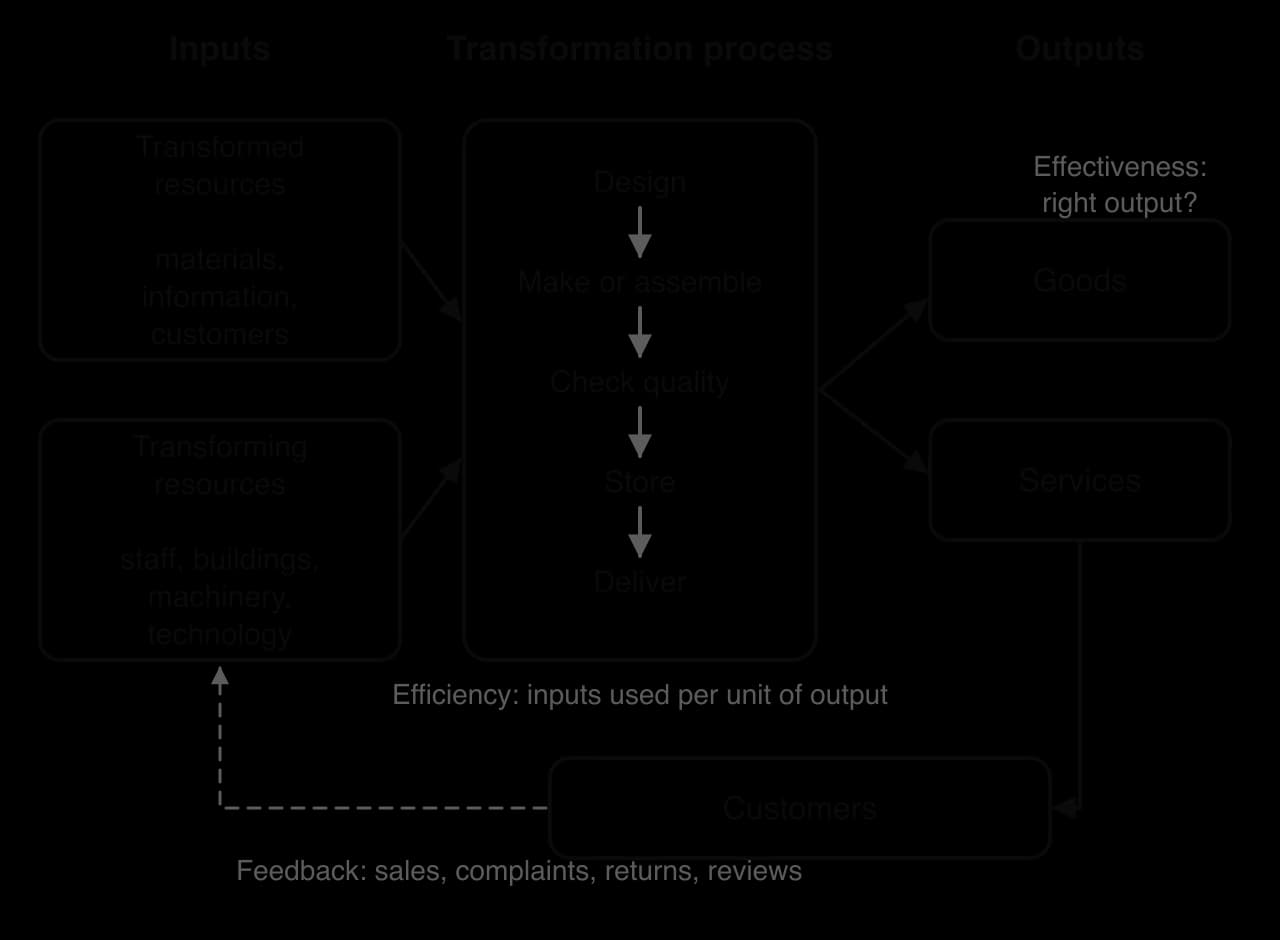
Operations can be described as a transformation process: resources go in, something is done to them, and goods and services come out. The inputs are the factors of production the business brings together; the outputs are what it sells to its customers. The value of the outputs to customers should be greater than the cost of the inputs bought in, and this difference is the added value that pays for wages, rent and profit.
Operations managers find it useful to split the inputs into two groups. Transformed resources are the things that are changed by the process: materials (flour, steel, fabric), information (a tax form, a customer’s order) and sometimes customers themselves (a patient, a passenger, a student). Transforming resources are the things that do the changing: staff, buildings, machinery and technology. A bakery transforms flour, water and yeast using bakers, ovens and a shop.
The diagram shows the process as a chain of steps: designing the product or service, making or assembling it, checking its quality, storing it and delivering it. Each step uses resources and each can go wrong, so operations managers control every one. The feedback loop matters as much as the forward arrows. Sales figures, complaints, returns and online reviews tell managers whether the outputs met customers’ needs, and they use this information to change the inputs and the process.
The diagram also shows where two key measures of operations apply. Efficiency is about the left-hand side: how much input is used to make each unit of output. Effectiveness is about the right-hand side: whether the output is what customers and the business actually wanted.
Not every operation changes a physical material. The kind of transformation depends on what the business sells, which is why the model applies to every sector of the economy.
What is transformed | How it is changed | Examples |
|---|---|---|
Materials: physical properties | Shape, composition or assembly | A furniture maker turns timber into tables; a chocolate maker turns cocoa into bars. |
Materials: location | Moved from one place to another | A parcel delivery company, a shipping line, a removals firm. |
Materials: ownership or storage | Bought, stored and sold on | A supermarket, a wholesaler, a warehouse. |
Information | Processed, analysed or stored | An accounting firm, a bank, a market research agency. |
Customers: physical state | Healthier, better looking, moved | A hospital, a hairdresser, an airline. |
Customers: knowledge or feelings | Educated or entertained | A school, a theatre, a theme park. |
The role of operations management is to make the transformation process work: to produce the right goods and services, in the right quantity, at the right quality, at the right time and at the lowest cost consistent with these aims. In practice this means making decisions in several areas, some long term and some day to day.
Area of decision | Typical questions operations managers answer |
|---|---|
Product and process design | How will the product or service be made? Which steps, in which order, with which equipment? |
Production method | One-off job production, batch production, mass production or mass customisation? How much to rely on machines rather than people? |
Location and layout | Where should the factory, shop or office be? How should machines, desks or counters be arranged? |
Scale | How much should the business be able to produce each week? Should it build a larger plant? |
Materials and suppliers | Which materials, from which suppliers, delivered how often? Make a part or buy it in? |
Stock | How much stock of materials and finished goods to hold? |
Quality | What standard is acceptable, and how will it be checked and improved? |
Scheduling and staffing | Who works when, on which task? Which orders are produced first? |
Maintenance and improvement | When are machines serviced? How can the process be made faster, cheaper or more reliable? |
Decisions about location, scale and production method are strategic: they commit the business for years and involve large sums of capital. Decisions about schedules, staffing and daily quality checks are made far more often by supervisors and team leaders. Both must fit the business’s strategic objectives: a luxury brand and a discount brand need very different operations.
Operations managers judge their work by two different standards. The first is how well resources are used; the second is whether the right results are achieved. The two words sound alike, but they measure different things, and a business needs both.
Efficiency is usually measured by cost per unit or by output per unit of input: the cost of making one loaf, the number of calls handled per call-centre employee per hour, the fuel used per flight. An efficient operation keeps waste low: little scrap, few idle machines, few hours lost to waiting, little stock thrown away. Efficiency is important because it lowers the average cost of each unit, which allows the business to charge lower prices or earn a higher profit margin.
Effectiveness is measured against objectives: the percentage of orders delivered on time, customer satisfaction scores, the share of products that pass inspection, the number of patients treated within a target time. An operation can be very efficient and still ineffective. A factory that makes thousands of phones a day at a low unit cost is efficient, but if customers no longer want that model the output is wasted and the operation is ineffective.
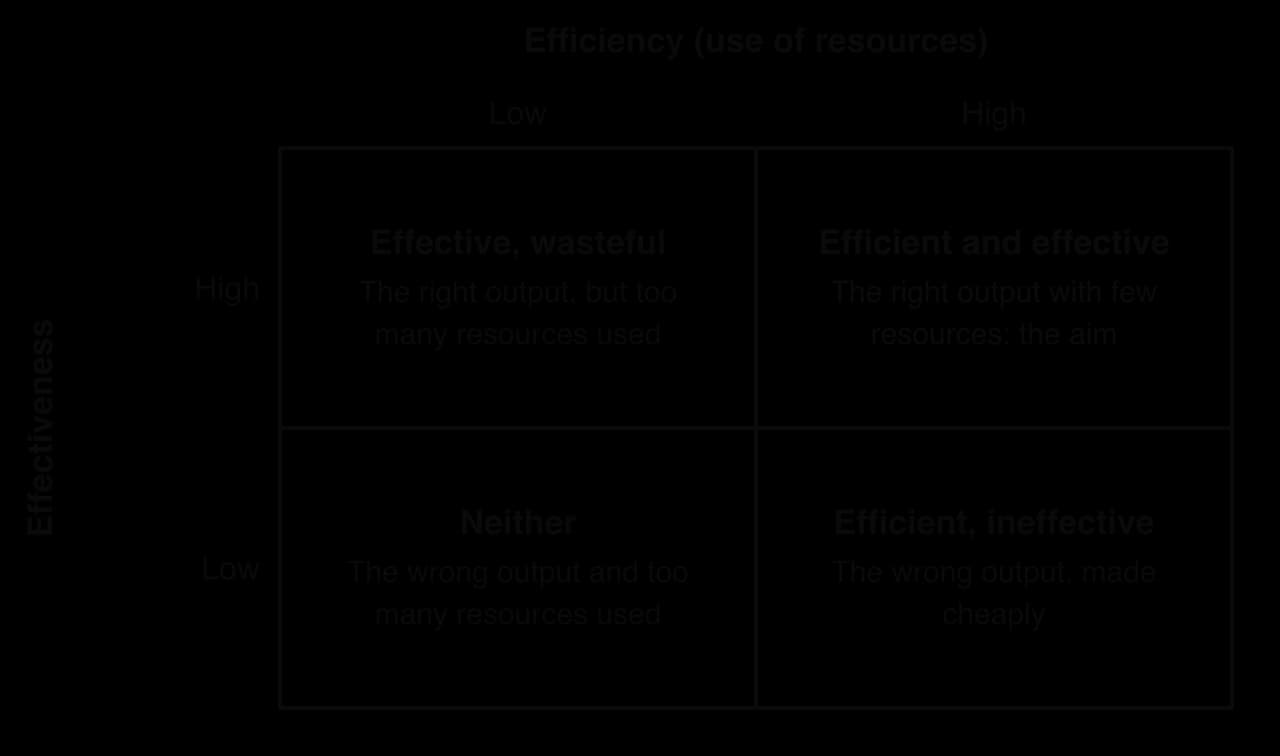
The two can conflict. A hospital can cut its cost per patient by employing fewer nurses, but if waiting times rise and patient outcomes worsen, it has become more efficient and less effective. A restaurant can raise effectiveness by offering every dish on the menu at any time, at the cost of more wasted food. Good operations management looks for changes that improve both, such as a better layout that cuts walking time for staff and also speeds up service.
Efficiency is often measured by productivity, one of the most widely used numbers in business and economics. Productivity compares the quantity of output with the quantity of input used to make it. If a factory produces more cars with the same number of workers and machines, its productivity has risen.
The input can be any resource. Output per worker or per hour worked measures the productivity of labour; output per machine or per dollar of equipment measures the productivity of capital. A call centre might measure calls answered per agent per hour; a farm, tonnes of wheat per hectare; a hotel, rooms cleaned per housekeeper per shift.
Higher productivity means that each unit of output uses fewer resources, so the cost per unit falls. This gives the business a choice: cut prices to win market share, or keep prices and earn a higher profit margin. Higher productivity also allows a business to pay higher wages without raising prices, because each worker produces more value. For a whole economy, rising productivity is the main source of rising living standards over time.
Productivity differs enormously between countries. The chart compares the value of output per person employed in ten economies, adjusted for differences in price levels.

The chart shows that a worker in the United States produced about $154,000 of output in 2024 against about $21,000 in Bangladesh. The gap mainly reflects the resources each worker has, rather than how hard people work: machinery, technology, infrastructure, education and training, and the mix of industries in the economy. This is why low-wage countries attract labour-intensive production such as garment making, and why businesses in high-wage countries must achieve high productivity, often through automation, to stay competitive.
Investment in capital and technology: more modern machinery, automation and software let each worker produce more. A warehouse that installs automated sorting can handle more parcels per employee.
Training: skilled workers make fewer mistakes, work faster and can use better equipment. Investment in training raises the quality as well as the quantity of output.
Better methods and layout: reorganising the workplace reduces wasted movement and waiting; specialisation lets each worker become expert at one task.
Motivation: motivated employees work with more care and effort and suggest improvements; motivation links productivity to human resource management.
Maintenance and reliability: machines that break down less often lose fewer hours.
Good management of materials: having the right materials in the right place avoids idle time.
Raising productivity has costs and limits. New machinery requires finance and may take years to pay for itself. Pushing workers to produce more can lower quality, raise stress and increase absence. If productivity rises faster than demand, the business needs fewer workers, which may lead to redundancies and poor employee relations. Higher productivity therefore benefits a business only if the extra output is what customers want and quality and the workforce do not suffer.
Operations can help a business compete in five main ways. Together these are known as the operations objectives: quality, speed, dependability, flexibility and cost. Each objective benefits customers directly, and each also brings internal benefits for the operation itself.
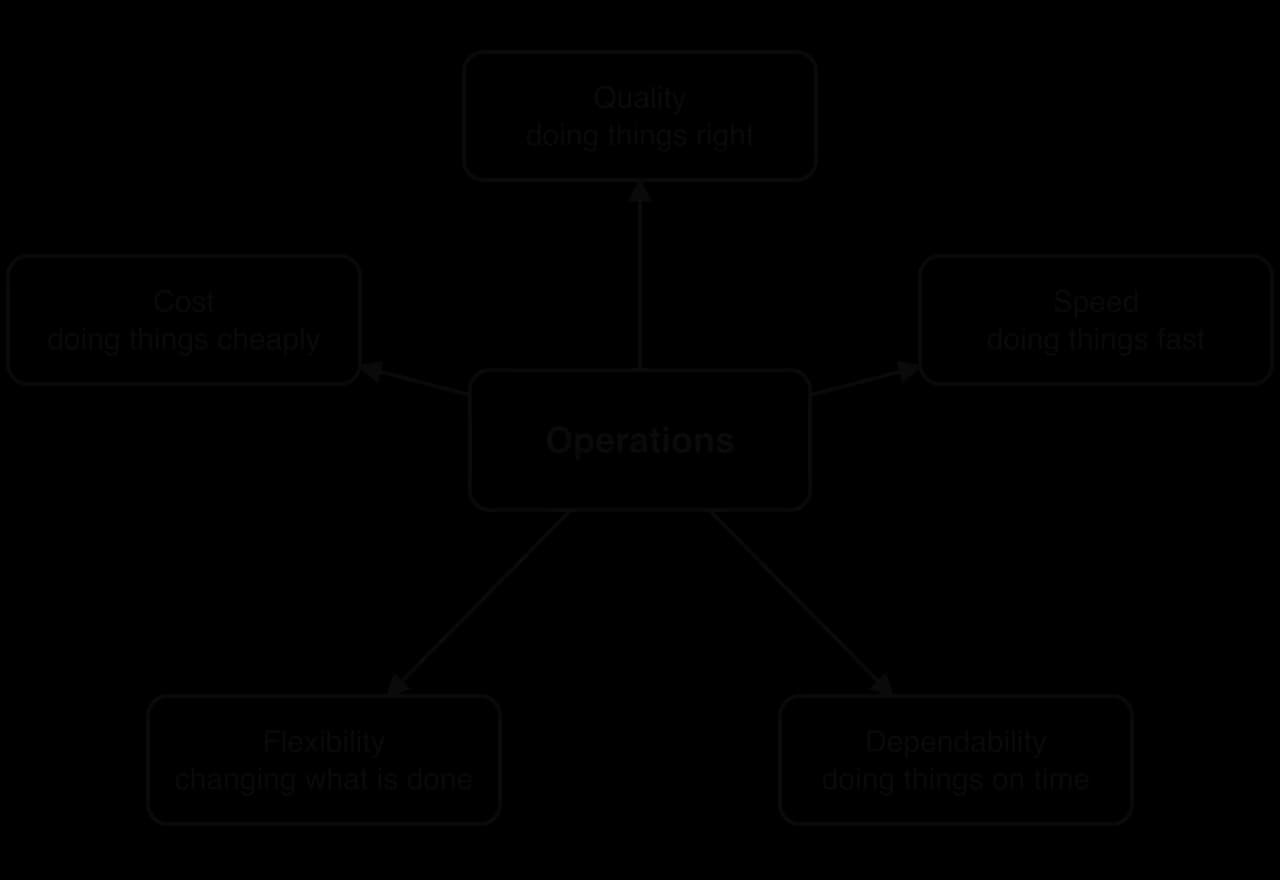
Quality means producing goods and services that are fit for their purpose and meet or exceed the standard customers expect, without errors. For customers, high quality means a reliable product and a good experience; for the business, it builds a strong brand image and repeat sales and allows a higher price. Inside the operation, doing things right first time saves the cost of scrap, reworking, refunds and complaints. A car maker that has to recall thousands of vehicles to fix a fault pays far more than it would have spent on preventing the fault.
Speed is the time between a customer’s request and the customer receiving the good or service. Fast delivery is valuable in itself (a pizza in 20 minutes, a parcel the next day) and it lets a business respond to new trends before competitors. Internally, a fast process means less work in progress and less stock waiting between stages, which cuts costs. Zara’s ability to make and deliver new designs within the same season is a speed advantage over clothing retailers that plan their ranges many months ahead.
Dependability means keeping promises: delivering on the date and at the time agreed, every time. Customers who depend on a supplier, such as a car plant waiting for parts or a café waiting for bread, value reliability as much as speed. Inside the operation, dependable processes make planning easier and reduce the cost of emergency fixes. Japan’s Tokaido Shinkansen high-speed railway is a well-known example. In the 2023 financial year it ran 372 trains a day, and the average delay was 1.6 minutes per train, including delays caused by natural disasters.
Sources: Central Japan Railway Company, “About the Tokaido Shinkansen” (financial year 2023), accessed 2026.
Flexibility is the ability to change the operation when needed. It has several forms: changing the product (offering new designs or customised versions), changing the mix (making more of one product and less of another), changing the volume (producing more or less as demand rises and falls) and changing delivery dates. Flexible operations cope better with change in the market and with emergencies, such as a sudden surge in demand or a supplier failing. The cost is that flexible equipment and multi-skilled staff are often more expensive than specialised ones.
Cost means producing at the lowest cost per unit consistent with the other objectives. For businesses that compete on price, such as discount supermarkets and budget airlines, low cost is the main objective, and every operations decision (simple products, standard processes, high use of equipment, little waste) serves it. For all businesses, lower operating costs raise profit or allow lower prices. The other four objectives all affect cost: high quality reduces waste, speed reduces stock, dependability reduces disruption and flexibility reduces the cost of change.
An operation cannot usually be the best at all five objectives at the same time, so managers choose which to put first. Offering wide choice (flexibility) adds cost; delivering faster may mean paying for extra staff or transport; the highest quality takes time. The right priority depends on the business’s strategy and its customers.
Business | Objective put first | Why |
|---|---|---|
Discount supermarket | Cost | Customers choose it for low prices; a narrow range of standard products keeps costs down. |
Luxury watchmaker | Quality | Customers pay high prices for craftsmanship and precision; speed matters little. |
Emergency plumber | Speed | A burst pipe must be fixed today; customers accept a higher price. |
Parts supplier to a car plant | Dependability | A late delivery can stop the customer’s whole production line. |
Fashion retailer | Speed and flexibility | Trends change quickly; the retailer must change its range and volumes within the season. |
Wedding caterer | Flexibility and quality | Every event has a different menu, number of guests and setting. |
The trade-offs are not fixed. Better methods and technology can improve several objectives at once: fewer defects cut cost and improve dependability, and a shorter process improves speed and reduces stock. Businesses that compete well often improve one objective without giving up much of another.
Operations cannot work alone. Every operations decision depends on information and resources from the other functions, and every operations decision has effects on them. A change in operations, such as a new production method or a new factory, therefore changes the work of the whole organisation.
Function | What operations needs from it | How operations affects it |
|---|---|---|
Marketing | Sales forecasts, product specifications, information on what customers value (price, quality, speed), promotion plans | What can be offered and when; product quality and reliability; delivery times; the cost that limits the price; whether demand from a promotion can be met |
Finance and accounts | Capital to buy machinery, buildings and stock; budgets; cost information | Cost of sales and other costs; capital expenditure; the stock held; cash tied up in work in progress; profit |
Human resources | The right number of workers with the right skills, when needed; training; motivation | Workforce planning, recruitment and training needs; job design and working conditions; shift patterns; redundancies when processes are automated |
These links work in both directions. If marketing promises customers next-day delivery without checking with operations, the business may break its promise and damage its reputation. If finance refuses to pay for new machinery, operations may be unable to cut costs or improve quality. If human resource management cannot recruit enough skilled staff, output falls even when demand is strong. For these reasons, major operations decisions are usually planned jointly by all the functions.
Operations is where most of a business’s impact on people and the planet happens. Factories and offices use energy, water and materials; transport produces emissions; production creates waste; and the working conditions of millions of people are set by operations decisions, in the business’s own sites and in the factories of its suppliers. For this reason, sustainability in business is largely a question of how operations are run.
Sustainability means meeting the needs of the present without compromising the ability of future generations to meet their own needs. Businesses often consider it in three parts, the triple bottom line of people, planet and profit. Each part has its own meaning for operations.
Environmental sustainability in operations includes using renewable energy, designing products that use less material and can be repaired or recycled, reducing packaging, cutting transport distances, treating waste water and preventing pollution. Many of these actions also cut costs, because waste and energy are costs. Moving towards a circular economy, in which products and materials are kept in use for longer, is one way in which operations can reduce their environmental impact.
Social sustainability in operations means safe workplaces, fair pay and working hours, no child or forced labour (including at suppliers), safe products, and good relations with the communities near factories and offices. The collapse of the Rana Plaza building in Bangladesh on 24 April 2013 shows what happens when it is ignored. The building housed five garment factories that made clothing for global brands, and 1,134 people died. The disaster led many brands and retailers to sign the Accord on Fire and Building Safety in Bangladesh, a legally binding agreement with trade unions to inspect and repair the factories they used.
Sources: The Guardian (2015); IndustriALL Global Union (2013).
Economic sustainability in operations means being efficient enough to make a profit, investing in equipment and skills so that the business stays competitive, and building operations that can survive shocks, such as the failure of a supplier. A business that cuts maintenance or training to boost this year’s profit is not economically sustainable, because it damages its future output.
Operations decision | Environmental effects | Social effects | Economic effects |
|---|---|---|---|
Switching factories to renewable electricity | Lower emissions | Cleaner air for local communities | Higher or lower energy costs, depending on prices; protection from future carbon taxes |
Moving production to the cheapest supplier abroad | Longer transport, more emissions | Risk of poor working conditions at the supplier | Lower unit costs; more supply risk |
Automating a production line | Often less waste and energy per unit | Fewer manual jobs; new skilled jobs | Higher productivity; large capital cost |
Designing products to be repaired | Less waste and material use | Local repair jobs | Fewer replacement sales, but new repair revenue and loyalty |
The three parts can support or conflict with each other. Cutting waste helps the environment and lowers costs at the same time. Paying suppliers enough to provide safe factories raises costs in the short term but protects the brand from scandals and disruption. Operations that are cheap only because they damage people or the environment are not sustainable in any of the three senses: sooner or later they bring regulation, boycotts, accidents or shortages.
Claims about sustainable operations need careful checking. A business may publicise one small green initiative while most of its production is unchanged, which is greenwashing. Reliable evidence includes measured results over several years (emissions, water use, accident rates), independent audits and certification, and whether the claims cover the whole supply chain or only the business’s own sites.
Key concept | How it applies to operations |
|---|---|
Change | New technology (automation, 3D printing, AI), changing customer expectations of speed and choice, and new regulations force operations to adapt; a change in operations then changes HR, finance and marketing. |
Creativity | New production processes can disrupt markets: the moving assembly line, flat-pack furniture and fast fashion all came from creative operations, not new products alone. |
Ethics | Operations decisions affect workers’ safety and pay, product safety and the environment, including at suppliers the business does not own. |
Sustainability | Efficient operations use fewer resources per unit; sustainable operations also protect people and the planet so that the business can keep operating in the long run. |
Inditex, based in Arteixo in north-west Spain, is one of the largest fashion retail groups in the world. It owns Zara, Pull&Bear, Massimo Dutti, Bershka, Stradivarius, Oysho, Zara Home and Lefties, and in the year to 31 January 2026 it sold €39.9 billion of clothing and other goods through 5,460 stores and online, and earned a net income of €6.2 billion. The Zara concept (Zara, Zara Home and Lefties) accounts for about 70% of group sales. Analysts usually explain the group’s success by its operations as much as by its designs.
Most clothing retailers decide their ranges many months before a season and order large volumes from low-cost factories in Asia. Inditex works differently. It produces in short runs that are adjusted to demand during the season, using data from its stores and online platforms about what customers are buying. A significant portion of its garments is made in factories near its headquarters, in Spain, Portugal, Morocco and Türkiye, which the company calls proximity sourcing. Close factories can make and ship new designs while the season is still under way, so the company can make more of what sells and stop making what does not.
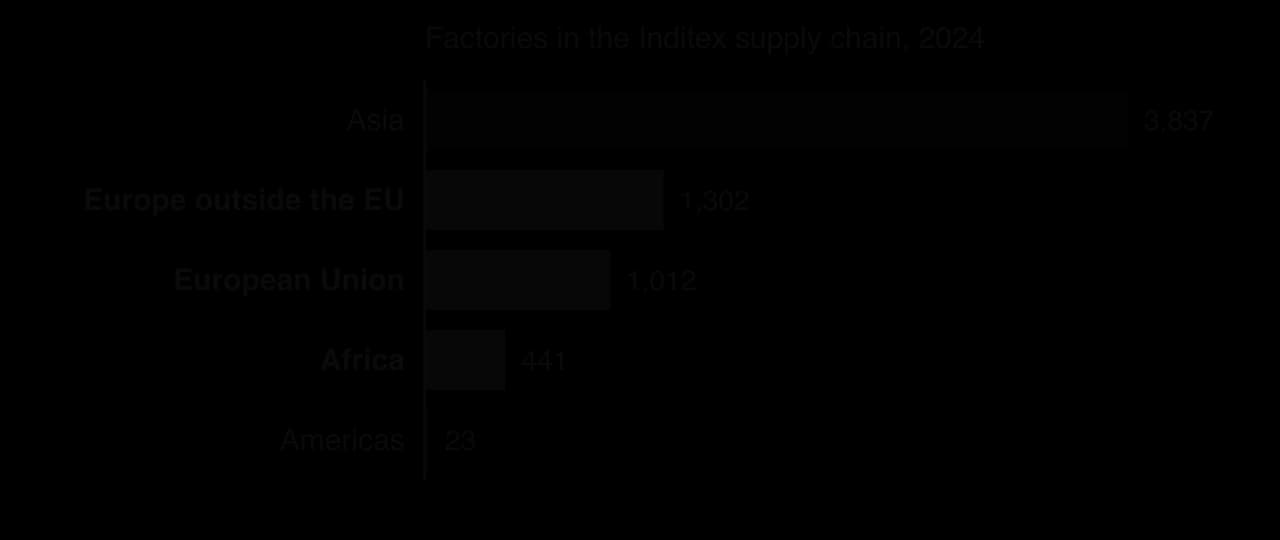
The chart shows that Inditex does not make everything close to home. Of the 6,615 factories in its supply chain in 2024, 3,837 were in Asia. Basic items with steady demand can be ordered early from distant, lower-cost suppliers, while fashion items whose demand is uncertain are made in proximity, where speed and flexibility matter more than the lowest cost. The company reports that this model keeps unsold stock very low: surplus clothing was 0.67% of all the articles it sold.
Inditex’s operations try to be both effective (the right clothes in the right stores at the right time) and efficient (little unsold stock, fewer but larger stores, a single pool of stock shared by stores and online). Each garment carries an RFID tag, so the group knows where every item is and can send an online order from the nearest store. Over the three years to 2025, sales rose by 22% while the number of stores fell by 6%, as the group closed smaller stores and enlarged others.
Year (to 31 January of the next year) | 2023 | 2024 | 2025 |
|---|---|---|---|
Net sales (€ million) | 35,947 | 38,632 | 39,864 |
Number of stores at year end | 5,692 | 5,563 | 5,460 |
Total selling space (m²) | 4,557,170 | 4,650,575 | 4,720,703 |
Net sales per store (€ million) | 6.32 | 6.94 | 7.30 |
Net sales per m² of selling space (€) | 7,888 | 8,307 | 8,445 |
Sources: Inditex Group Annual Report 2024; Inditex FY2025 Results (March 2026). Sales per store and per m² calculated from these figures; sales include online sales (€10.2 billion in 2024, €10.7 billion in 2025).
Sales per store and sales per square metre are rough productivity measures for a retailer. Both rose each year, which suggests that the group is getting more output from its retail space. The figures must be read with care: they include online sales, which do not use selling space, so part of the rise reflects growth in online shopping rather than better use of the stores themselves.
 YouTube
Fast fashion is criticised for encouraging people to buy and throw away more clothing, and for poor conditions in garment factories. Inditex’s operations are under pressure on all three parts of sustainability. Environmentally, it reported a 26% fall in water consumption across its supply chain in 2025 compared with 2020, and that 88% of the textile fibres in its garments were lower-impact fibres.
Its clothing collection programme recovered 19,484 tonnes of garments and footwear in 2024, and Zara Pre-Owned offers repairs, resale and donation in 17 markets. Socially, its supply chain employs more than three million people, most of them in factories it does not own, which it monitors through its Code of Conduct for Manufacturers and Suppliers.
The case shows the limits of an operations-led model. Speed and short runs reduce unsold stock, but the business model still depends on customers buying new clothes frequently, which conflicts with environmental sustainability. Proximity factories are faster but usually more expensive than Asian ones, and relying on thousands of independent suppliers makes it hard to guarantee conditions in every factory. Inditex’s results show that operations can be a source of advantage over competitors, but the same operations are central to the ethical and environmental questions the company faces.
Sources: Inditex Group Annual Report 2024 (supply chain, surplus, clothing collection, Zara Pre-Owned); Inditex FY2025 Results, March 2026 (sales, stores, water, fibres).
Explain how proximity sourcing helps Inditex achieve the operations objectives of speed and flexibility.
Using the data in the table, comment on whether Inditex became more efficient between 2023 and 2025.
To what extent can a fast-fashion business be environmentally sustainable?
Questions on operations management are mostly short structured questions (define, explain, distinguish, calculate) or parts of extended responses that combine operations with other units. Questions on the role of operations ask you to explain, analyse or apply it. A 10-mark question that asks you to discuss or evaluate combines it with a specific decision, such as a change of production method, a location or a new supplier.
Distinguish questions need both terms explained and the difference made clear, ideally with the same business used for both.
Productivity calculations are usually followed by “comment on your answer”. A good comment compares the figures, gives a likely reason from the case and states what the change means for costs.
Operations management plans, organises, controls and improves the transformation of inputs into goods and services.
The transformation process converts transformed resources (materials, information, customers) using transforming resources (staff, buildings, machinery) into outputs, with feedback from customers.
Efficiency is how well resources are used (cost or input per unit); effectiveness is whether objectives are achieved. A business needs both.
Productivity is output per unit of input; higher productivity lowers unit costs and supports higher wages and competitiveness.
The five operations objectives are quality, speed, dependability, flexibility and cost; businesses choose which to put first according to their strategy.
Operations depend on, and affect, marketing, finance and human resources, so a change in operations changes the whole business.
Sustainable operations consider environmental, social and economic effects together, including in the supply chain.
I can define operations management, production and the transformation process.
I can draw the transformation process and apply it to a manufacturer and to a service business.
I can distinguish between efficiency and effectiveness, with a measure of each.
I can explain the difference between productivity and production and calculate output per worker.
I can explain ways a business can raise productivity and their limits.
I can explain the five operations objectives and the trade-offs between them.
I can analyse how operations decisions affect marketing, finance and human resources.
I can explain how operations affect economic, social and environmental sustainability, using a real example.
Define the term human resource planning.
2 marks
Award [1] for a partial definition that shows some understanding, e.g. “planning how many workers a business needs” or “working out staffing”.
Award [2] for a full definition, e.g. the process of forecasting the number and type (skills) of employees an organization will need in the future, and planning how to meet that need, for example through recruitment, training or redeployment.
Award [0] for a tautological answer that only repeats the term.
Candidates are not expected to word their definition exactly as above.
Explain two reasons why ML’s supervisors and operatives may resist the introduction of the automated warehouse management system (paragraph 4).
4 marks
Reasons may include:
Job insecurity / fear of redundancy: Wanjiru expects a 20 % cut in operatives and “nobody has told us who will keep their job”, so operatives see the robots as a direct threat.
Fear of the unknown / lack of skills: Joseph says his team “know nothing about computers”; long-serving staff fear they will not cope with scanners and new software.
Loss of status or power: supervisors may no longer be needed to check work because picking speed is reported straight to head office, reducing their role and authority.
Poor communication / low trust: change is spreading through rumours rather than official information, which increases anxiety (absenteeism has risen).
Disruption of habits and social relationships: staff trained by the same supervisors for years are used to the paper-based routine.
Accept any other relevant reason.
Mark as 2 + 2. For each reason, award [1] for identifying a relevant reason for resistance and [1] for explaining it with reference to ML.
Award a maximum of [2] in total for a theoretical answer with no reference to ML.
Explain two external factors that may influence ML’s human resource planning.
4 marks
Factors may include:
The gig economy: younger operatives are leaving to work as app-based delivery riders, so ML may find it harder to keep and recruit staff; it must plan for higher labour turnover or offer more flexibility.
Technological change: automation reduces the number of operatives needed and changes the skills required (IT and scanner skills rather than manual picking).
Changing customer demand / growth of online shopping: same-night dispatch requires evening and night shifts, so ML must plan for flexible working patterns (flexi-time / shift work).
Labour market conditions: the availability of workers with IT skills in Nairobi affects whether ML can recruit externally or must retrain.
N.B. Do not credit internal factors (e.g. ML’s budget or objectives) unless clearly linked to an external cause.
Mark as 2 + 2. For each factor, award [1] for identifying a relevant external factor and [1] for explaining its effect on ML’s HR planning.
Discuss whether ML should choose Option 1 or Option 2 to introduce the automated warehouse management system (paragraph 5).
10 marks
Option 1 (phased introduction with involvement and retraining):
Involving operatives in testing the system (participation) reduces fear of the unknown and gives staff a sense of ownership; resistance and absenteeism may fall.
Retraining addresses Joseph’s concern that staff “know nothing about computers” and lets ML keep loyal, experienced staff, reducing recruitment costs.
Problems can be found and fixed in one warehouse before the second, lowering operational risk.
However, it is slower: ML may not meet the online retailer’s same-night dispatch deadline and could lose its largest client. Running two systems at once is also costly and complex, and retraining costs money and time.
Option 2 (simultaneous installation with a cash bonus):
Faster: ML meets its largest client’s requirement and protects revenue in a growing market.
A cash bonus (negotiation / incentive) may persuade operatives to accept late shifts; it competes with the flexibility of gig-economy work.
However, a four-week shutdown risks disrupting service to all clients at once; any failure affects both warehouses.
A bonus does not remove fear of redundancy or lack of skills; resistance may continue or turn into low morale, more absenteeism and staff leaving. It may be seen as “buying” compliance, damaging trust.
Neither option addresses communication: staff still do not know who keeps their job.
Possible conclusion: a judgement such as Option 1, combined with clear and early communication about the 20 % reduction and redeployment, because the main causes of resistance (fear, lack of skills, low trust) are better addressed by involvement and training; or Option 2 if keeping the largest client is judged critical. A combination (phased roll-out with targeted incentives) can be credited. Any well-supported judgement can reach full marks.
Limitations of the case that strong answers may note: no data on the costs of each option, on how long Option 1 would take, on the client’s willingness to wait, or on how many operatives would accept retraining.
Additional guidance: Marks should be allocated according to the markbands. If only one option is discussed, award a maximum of [5]. If there is no reference to the case (e.g. the 20 % cut, the same-night deadline, Joseph’s comments), award a maximum of [4]. A response without a conclusion is unlikely to exceed [6].
Markbands (10-mark extended response, Papers 1 and 2)
Marks | Level descriptor |
|---|---|
0 | The response does not reach the standard described below. |
1–2 | Little understanding of what the question demands. Business management tools and theories are barely used, or are irrelevant or inaccurate. Little or no reference to the stimulus material. No arguments are made. |
3–4 | Some understanding of what the question demands. Some use of tools and theories, but mostly inaccurate or not relevant. Use of the stimulus is superficial, often no more than the name of the organisation or person. Arguments are mostly unsubstantiated. |
5–6 | Understands what the question demands but addresses it only partially. Some relevant, accurate use of tools and theories. Some relevant use of the stimulus beyond names, but it does not effectively support the argument. Arguments are substantiated but mostly one-sided. |
7–8 | Mostly addresses what the question demands. Mostly relevant, accurate use of tools and theories. The stimulus generally supports the argument, with some lapses in clarity or relevance. Arguments are substantiated and show some balance. |
9–10 | Clear focus on what the question demands. Relevant, accurate use of tools and theories. Relevant stimulus material is integrated effectively to support the argument. Arguments are substantiated and balanced, and the limitations of the case or stimulus material are explained. |
A response with no judgement or conclusion is unlikely to reach the top band of a discuss, evaluate, examine or recommend question.
Hanamizuki Care
Hanamizuki Care (HC) operates 12 residential care homes for elderly people in Osaka, Japan. Government rules require care homes to employ at least one full-time equivalent (FTE) care worker for every three residents. HC’s homes are full, and there is a long waiting list.
Japan’s population is ageing and the number of people of working age is falling. HC finds it increasingly difficult to recruit care workers. In 2025 HC began recruiting trained care workers from Vietnam and Indonesia under a government scheme, and it is trialling lifting robots and night-time monitoring sensors in two homes.
Table 1: Selected data for Hanamizuki Care
2023 | 2025 | 2027 (forecast) | |
|---|---|---|---|
Number of residents | 540 | 600 | 690 |
Care workers employed (full-time equivalent) | 198 | 220 | — |
Care workers aged 55 and over | 58 | 74 | — |
Care workers recruited from overseas | 0 | 24 | — |
Note: to cover holidays, sickness and training, HC employs 10 % more FTE care workers than the minimum required by the rule (1.1 FTE care workers for every care worker required).
Using Table 1, calculate the percentage of HC’s care workers aged 55 and over in 2025 (show all your working).
2 marks
Using Table 1 and the note, calculate how many more full-time equivalent care workers HC will need to employ in 2027 than in 2025, assuming the 2025 workforce stays the same (show all your working).
3 marks
Explain two factors that are likely to influence HC’s human resource planning over the next five years.
4 marks
HC plans to introduce lifting robots and night-time monitoring sensors in all 12 homes. Many long-serving care workers fear that the technology will replace the human contact that residents value, and some older workers lack confidence with digital devices. Discuss the human resource strategies HC could use to reduce resistance to this change.
10 marks
Vembanad Hospital
[1] Vembanad Hospital (Vembanad) is a privately held company that runs a 180-bed hospital in Kochi, India. It was founded in 2011 by two doctors, Anjali Menon and Ravi Pillai. Vembanad’s mission is “to give every patient the care we would want for our own families”. It offers general surgery, maternity care and a 24-hour emergency department, and employs 410 staff, including 95 nurses.
[2] Vembanad’s operations manager, Suresh Nair, is responsible for turning the hospital’s resources (staff time, medicines, equipment, beds and energy) into patient care. In 2025 patient numbers rose by 14 %, but the average waiting time in the emergency department rose from 40 minutes to 95 minutes. Online reviews began to complain about delays, and two senior nurses resigned, saying that their workload had become “unsafe”.
[3] Suresh believes that part of the problem lies in the hospital’s support services. The laundry and the kitchen are run in-house by 48 employees and use old equipment that consumes large amounts of electricity and water. Suresh has received an offer from CleanServe, a large national company, to take over both functions. CleanServe would cut Vembanad’s annual laundry and catering costs by 22 %, and the laundry building could be turned into a new outpatient clinic.
[4] Anjali is unsure. Several of the laundry and kitchen staff have worked at Vembanad since it opened, and patients often praise the hospital’s food, which is cooked to meet each patient’s dietary needs. CleanServe would deliver meals prepared in a central kitchen 60 km away. Vembanad’s finance director points out that the money saved could pay for 12 additional nurses.
Define the term operations management.
2 marks
Explain two ways in which operations management at Vembanad is linked to other functions of the business (paragraphs 2 and 4).
4 marks
Explain one economic and one social sustainability issue in Vembanad’s current operations.
4 marks
Discuss whether Vembanad should outsource its laundry and catering services to CleanServe.
10 marks