 YouTube
Explain vision and mission statements, the hierarchy of objectives and SMART objectives, evaluate strategic and tactical objectives, and evaluate ethical objectives and corporate social responsibility.
Each is in the Business glossary, with every other term in the subject.
The broad, long-term goals of a business, expressed in general terms, that set out what it intends to achieve in order to fulfil its mission.
A document that sets out the ethical principles and rules of behaviour that an organisation expects its employees and managers to follow.
The commitment of a business to behave ethically and to consider the interests of all its stakeholders, society and the environment in its decisions, beyond its legal obligations.
The publication by a business of information on its environmental impact, its treatment of people and communities, and how it is governed, so that stakeholders can assess it beyond profit.
Targets based on moral principles, such as fair treatment of workers and suppliers or care for the environment, that a business pursues even when the law does not demand them.
The moral principles that guide the behaviour of a person or group, used to judge whether a decision or action is right or wrong.
The practice of giving a misleading impression of how environmentally friendly a business, product or activity is, in order to improve its image or sales.
Distinguish between a vision statement and a mission statement, and explain how each guides a business.
Explain the hierarchy of objectives, from vision and mission to operational objectives.
Explain why objectives should be SMART, and rewrite a vague objective in SMART form.
Explain the common business objectives of growth, profit, protecting shareholder value and ethical objectives, and others such as survival and market share.
Explain why business objectives change over time.
Evaluate the setting of strategic and tactical objectives, and explain why they must be aligned.
Explain the meaning of ethics and the benefits and costs of ethical objectives.
Evaluate corporate social responsibility (CSR) from the point of view of different stakeholders.
Every business needs to know what it is trying to achieve. Objectives are the targets that turn a broad purpose into specific results that managers can plan for, measure and review. Without them, departments pull in different directions, resources are wasted and nobody can tell whether the business is succeeding.
Objectives are closely linked to the four key concepts. They respond to change in markets, technology and society; setting them well requires creativity in planning; and decisions about which objectives to pursue raise questions of ethics and sustainability. A clothing company that puts protecting the environment ahead of short-term profit, as Patagonia has done, shows how far objectives can shape everything a business does.
133 exam-style questions on this subtopic, written in the style of the IB papers. The first has its markscheme open. Counted on
Aguas de Oaxaca is a Mexican company that has made a hibiscus-flavoured soft drink, Jamaica Fresca, since 2003. It is sold in 600 ml plastic bottles in convenience stores across southern Mexico. Sales have been flat for four years. The marketing manager, Rosa Hernández, proposes relaunching the drink in 330 ml aluminium cans with a modern label and the message “100 % recyclable”. A new canning line would cost MXN 9 million.
Outline one reason why sales of Jamaica Fresca may have stopped growing.
2 marks
Possible reasons: the drink is in the maturity stage, as most potential customers in southern Mexico already buy it; competition from new flavoured drinks; changing tastes (e.g. demand for low-sugar drinks); the packaging looks dated.
Award [1] for a relevant reason and [1] for outlining it in the context of Jamaica Fresca.
Examine the use of new packaging as an extension strategy for Jamaica Fresca.
6 marks
Advantages:
A modern can and label refresh the image of a 20-year-old product and may attract younger customers who see it as old-fashioned.
The smaller 330 ml can is a different usage occasion (single serving, lunchboxes), opening a new segment.
The official deck for this part of the syllabus.
Define the term vision statement.
Which question does a vision statement answer?
With a free account, Augment remembers where you stopped and what you have practiced.
The levels of goals in an organisation, from its vision and mission through its aims and strategic objectives to tactical and operational objectives, each level supporting the one above.
A short statement of an organisation's current purpose, setting out what it does, for whom it does it and the values that guide how it does it.
Specific, measurable targets that a business sets in order to achieve its aims, usually with a deadline.
Short-term, specific objectives for teams and individuals, set by junior managers or supervisors, that contribute to achieving tactical objectives.
The objective of making the largest possible profit, by producing the output at which the difference between total revenue and total costs is greatest.
The objective of making the highest possible sales revenue, even if this means accepting lower profit, for example to grow market share or meet managers' sales targets.
The view that the main responsibility of a company's managers is to maximise returns to its shareholders, within the law, rather than to pursue wider social goals.
The value a company creates for its shareholders, shown by the dividends they receive and the market value of their shares.
Objectives that are specific, measurable, achievable, realistic (or relevant) and time-bound, so that they are clear to everyone involved and progress towards them can be checked.
An independent assessment of the impact of a business's activities on society and the environment, such as its treatment of workers, community involvement and emissions.
The long-term objectives of an organisation as a whole, set by senior management, that determine its overall direction and the strategies it follows.
A long-term plan of action, set by senior managers, that shows how a business intends to achieve its aims and strategic objectives.
The objective of continuing to trade by covering costs and having enough cash to pay debts as they fall due; the main objective of most start-ups and of businesses in a crisis.
Medium- to short-term objectives set for a department or division, usually by middle managers, that contribute to achieving the organisation's strategic objectives.
The short- to medium-term actions and methods a business uses to carry out its strategy, usually decided by middle managers within one department.
An approach that judges the performance of a business on its social (people), environmental (planet) and economic (profit) results, rather than on profit alone.
A statement of what an organisation aspires to become or achieve in the long term, setting out its ideal future and giving a sense of direction to everyone in it.
Scope: This subtopic is the same at SL and HL. It covers vision and mission statements, the common business objectives (growth, profit, protecting shareholder value and ethical objectives), strategic and tactical objectives, and corporate social responsibility, with evaluation of the last two.
Before a business sets measurable targets, its owners and senior managers decide what the business is for and what it hopes to become. These broad ideas are usually written down in two short statements. They are aimed at many stakeholders at once: employees who need a sense of direction, customers and investors who want to know what the business stands for, and the wider public.
A vision statement describes the long-term future that a business wants to create. It answers the question "Where do we want to be?" It is aspirational: it may never be fully achieved, and it is meant to inspire rather than to be measured.
IKEA, the Swedish furniture retailer, states its vision as "To create a better everyday life for the many people." The vision says nothing about furniture, prices or stores. It describes the effect IKEA wants to have on people's lives, and it is broad enough to guide decisions about products, sustainability and the communities where IKEA sources its materials. Tata Steel, one of India's largest steel makers, aspires "to be the global steel industry benchmark for Value Creation and Corporate Citizenship", which combines an economic aim with a social one.
A mission statement describes the purpose of the business now: what it does, for whom, and often the values it holds while doing it. It answers the question "Why do we exist and what do we do?" A mission is more concrete than a vision and changes more often, because it reflects the business's present activities.
Google states that its mission "is to organize the world's information and make it universally accessible and useful." The statement names the activity (organising information) and the benefit to users (making it accessible and useful). IKEA adds a "business idea" to its vision: "to offer a wide range of well-designed, functional home furnishing products at prices so low that as many people as possible will be able to afford them." The business idea works as IKEA's mission, because it explains how IKEA will move towards its vision.
Feature | Vision statement | Mission statement |
|---|---|---|
Question it answers | Where does the business want to be in the future? | What does the business do now, for whom, and why? |
Time frame | Long term (often decades) | Present and medium term |
Focus | The ideal future and the change the business wants to make | The current purpose, customers and values |
How often it changes | Rarely | When the business's activities or markets change |
Main audience | Employees and investors (to inspire and give direction) | Employees, customers and the public (to explain purpose and values) |
Example | IKEA: "To create a better everyday life for the many people." | Google: "to organize the world's information and make it universally accessible and useful." |
Vision and mission statements sit at the top of the business's planning. They do not tell managers what to do next month, but they set the limits within which objectives are chosen. A business whose mission stresses low prices for as many people as possible will set objectives for cost reduction and high sales volumes; a business whose purpose is environmental will set objectives for emissions, materials and repair.
The statements also help with decisions that the objectives do not cover. When a new opportunity appears, managers can ask whether it fits the mission. When employees face a choice between two courses of action, the stated values give them a reference point. In this way the statements support the organisational culture of the business, the shared values and ways of working of its people.
YouTubeSupporters argue that the statements give a business a shared sense of purpose. They can motivate employees who want their work to mean something, attract customers and investors who share the business's values, and help managers make consistent decisions across many countries and departments.
Critics point to several weaknesses. Many statements are so vague that they could belong to any business ("to be the best", "to delight our customers"). Some are written mainly for public relations and are not reflected in what the business actually does, which can damage trust when the gap becomes public. Statements are hard to measure, so it is difficult to tell whether they make any difference to performance. They can also become outdated when the business changes, and few employees may know what their organisation's statement says.
The value of a statement therefore depends less on its wording than on how it is used. A statement that is short, specific to the business, backed by the behaviour of senior managers and built into objectives, recruitment and rewards is more likely to influence decisions. A statement that managers ignore when profit is at stake has little value, and it can reduce trust when employees and customers see the gap between words and actions.
Vision and mission statements are too broad to plan from. Businesses therefore break them down into aims, which are general intentions, and then into objectives, which are specific, measurable targets. The difference matters: "to become a leading brand in East Africa" is an aim, while "to reach a 12% share of the Kenyan juice market by 2029" is an objective.
Objectives give the aims a form that can be planned and checked. They tell managers what has to be achieved, by when, so that resources can be allocated and progress measured.
Together, these statements form a hierarchy of objectives. Each level serves the one above it: operational objectives help achieve tactical objectives, which help achieve strategic objectives, which help achieve the aims, mission and vision.

The pyramid shows two things at once. Moving down, objectives become more specific, more short term and more numerous: a business may have one vision but hundreds of operational targets. Moving up, objectives become broader and are set by more senior people. The hierarchy also shows how a business coordinates its work. If every target at the bottom serves a target above it, the efforts of thousands of employees add up to progress towards the vision.
An objective is only useful if people can act on it and tell whether it has been met. Managers therefore try to write objectives that are SMART.
Letter | Meaning | Why it matters | Weak version → SMART version |
|---|---|---|---|
S: Specific | States exactly what is to be achieved, and where | Everyone knows what the target is | "Grow sales" → "Increase sales revenue from online orders in Germany" |
M: Measurable | Expressed as a number or a clear standard | Progress can be tracked and success judged | "Improve service" → "Raise the customer satisfaction score from 72% to 80%" |
A: Achievable | Possible with the resources the business has | Targets that cannot be met demotivate staff | "Double market share this year" with no extra budget → "Raise market share by 2 percentage points" |
R: Realistic (or relevant) | Sensible in the market conditions and linked to the aims | Effort goes into what matters for the business | A luxury brand aiming to be the cheapest → aiming to raise repeat purchases among existing customers |
T: Time-bound | Has a deadline | Creates urgency and a date for review | "Cut waste" → "Cut packaging waste by 15% by 31 December 2027" |
Some textbooks use "relevant" for the R, meaning that the objective supports the business's aims. Either reading leads to the same practical test: the objective should make sense for this business, in this market, at this time.
SMART objectives are not always possible or desirable. Some important goals, such as building a culture of trust or encouraging creativity, are hard to measure, and forcing them into numbers can lead managers to measure the wrong thing. In a fast-changing market a precise target set a year ago can become meaningless, so objectives need regular review. Very tight targets can also encourage people to hit the number by any means, for example by misreporting results or by selling customers products they do not need.
Businesses pursue many objectives at once, and the balance between them depends on their size, ownership, stage of development and the environment they operate in. Four objectives are especially common: growth, profit, protecting shareholder value and ethical objectives. Others, such as survival, sales revenue maximisation, market share and customer satisfaction, are also important.
Growth means increasing the size of the business. It can be measured by sales revenue, the volume of output, market share, the number of stores or employees, or the value of the business. Many businesses see growth as essential: a larger business can benefit from economies of scale, gain more power over suppliers and spread its risks across more markets and products.
Growth is a common objective for young businesses in new markets, where the first business to reach a large customer base can become hard to challenge. It also matters to investors, who often value a company on its expected future growth. Growth brings risks, however: it needs finance, it can strain cash flow, and rapid expansion can lead to loss of control and falling quality.
Profit is the difference between a business's revenue and its costs. Profit rewards the owners for the risk they take, provides finance for reinvestment and signals that the business is using resources efficiently. For most private sector businesses, making a profit is a central objective, although few pursue profit maximisation, the largest possible profit at every moment.
In practice, managers rarely know enough about their costs and demand to find the exact profit-maximising output. Many businesses aim instead for a satisfactory level of profit while pursuing other objectives, such as growth or good relations with employees. There is also a difference between short-run and long-run profit: cutting training or maintenance raises profit this year but may reduce it in the future.
For a company owned by shareholders, one of the main objectives is to protect and increase the value of their investment. Shareholders gain in two ways: through dividends, the share of profit paid out to them, and through a rise in the share price, which increases what their shares are worth.
Companies protect shareholder value by increasing profits steadily, managing risk, paying reliable dividends and sometimes buying back their own shares. In April 2024 Alphabet, Google's parent company, announced its first-ever dividend together with a share buyback programme of US$70 billion; its market value passed US$2 trillion for the first time later that month. The objective is especially important for a publicly held company, whose shares can be sold by unhappy investors at any time, which lowers the share price and can make the company a target for a takeover.
Critics argue that a narrow focus on shareholder value encourages short-termism: managers may cut investment, research or wages to raise this year's profits and share price, at the expense of the business's long-term health and of other stakeholders.
Ethical objectives are targets based on moral principles rather than on financial results alone: paying suppliers a fair price, eliminating child labour from a supply chain, cutting emissions or treating employees with respect. They raise questions about the purpose of a business that go beyond the other objectives, and they are closely linked to the idea that a business has responsibilities to society as well as to its owners.
A new business, or one facing a crisis, may concentrate on a single objective, which is to stay in business.
In 2020, when the COVID-19 pandemic grounded most flights, survival became the overriding objective of airlines. The German airline Lufthansa accepted a €9 billion rescue package that gave the German government a 20% stake in the company; its shareholders approved the rescue on 25 June 2020.
Sales revenue maximisation may appeal to managers whose pay or status depends on the size of the business rather than its profit. Market share is the percentage of total sales in a market made by one business; a high share gives a business power over prices and makes it harder for competitors to win customers. Customer satisfaction is a common objective in service businesses, where repeat custom and recommendations drive future sales.
Objective | Typical measure | When it is most likely to be a priority | Possible conflict |
|---|---|---|---|
Survival | Cash balance; covering costs each month | Start-ups; recessions; crises | May mean cutting jobs or accepting outside control |
Growth | Sales revenue, output, outlets, market share | Young businesses in new or fast-growing markets | Needs finance; can strain cash flow and quality |
Profit | Profit for the year; profit margin | Established private sector businesses | Short-run profit may harm long-run investment |
Protecting shareholder value | Share price; dividends | Publicly held companies | Short-termism; less spending on employees or the environment |
Sales revenue maximisation | Sales revenue | Managers rewarded on size; price-competitive markets | Lower profit per sale |
Ethical objectives | Emissions, fair-trade sourcing, wage levels | Businesses whose brand rests on values; markets with strong public scrutiny | Higher costs; lower short-run profit |
Objectives are not fixed. They change as the business develops and as its environment changes, and a business that keeps the same objectives regardless of circumstances risks pursuing targets that no longer make sense.
The stage of the business. A start-up concentrates on survival; once it has a stable customer base it usually turns to growth; a large, mature business may focus on profit, shareholder value and protecting its market share.
A change of owners or leaders. A new chief executive, a change from a family business to a publicly held company, or a takeover by another firm often brings new priorities.
Performance. Repeated losses push a business towards cost-cutting and survival; strong profits can free resources for growth or ethical objectives.
Financial position. A business short of cash or heavily in debt cannot pursue expensive growth objectives, however attractive they look.
The state of the economy. In a recession, falling demand makes survival and cost control more important; in a boom, growth objectives become realistic.
Competition. The arrival of a strong competitor may force a business to defend its market share instead of raising prices to increase profit.
Technology. New technology can create growth opportunities or make a business model out of date.
Laws and social expectations. New laws on emissions or reporting, and changing public attitudes to issues such as climate change, push businesses to adopt ethical and environmental objectives.
Shocks. A pandemic, a war or a natural disaster can turn every business's attention to survival within weeks.
Meta Platforms, the owner of Facebook and Instagram, shows how quickly objectives can change. After years of heavy investment and rapid hiring, it cut 11,000 jobs in November 2022, about 13% of its workforce, and announced a further 10,000 job cuts in March 2023 in order to become more efficient. Its chief executive said that the earlier decision to increase investment so sharply had been a mistake. The objective had moved from rapid expansion to cost control and profitability, in response to stronger competition, a weaker economy and slower growth in advertising revenue. Meta's share price nearly tripled during 2023.
Objectives are also classified by their time span, by how much of the business they cover and by who sets them. This classification links objectives to the way a business plans.
A strategy is a long-term plan for achieving the business's aims, such as entering a new country or becoming the low-cost producer in a market. Tactics are the shorter-term actions used to carry out the strategy, such as a price promotion or the opening of a new distribution centre.
Strategies are put into practice through many smaller decisions. Each department turns the strategy into actions it can take within its own budget and time frame.
Strategic objectives are the long-term targets of the business as a whole. They are set by the board of directors and senior managers, usually for three to five years or more, and they shape decisions about markets, products and major investments. Examples are "to become the market leader in Southeast Asia by 2030" or "to reach net zero greenhouse gas emissions by 2040".
Tactical objectives are the medium- to short-term targets of a department or division, usually set by middle managers for a period of about one to two years. They break the strategic objective into the contributions of each function: marketing, operations management, finance and human resource management (HRM).
Operational objectives are the day-to-day or week-to-week targets for teams and individuals, set by junior managers and supervisors. They are very specific, such as the number of customer calls answered within one minute or the number of units produced per shift.
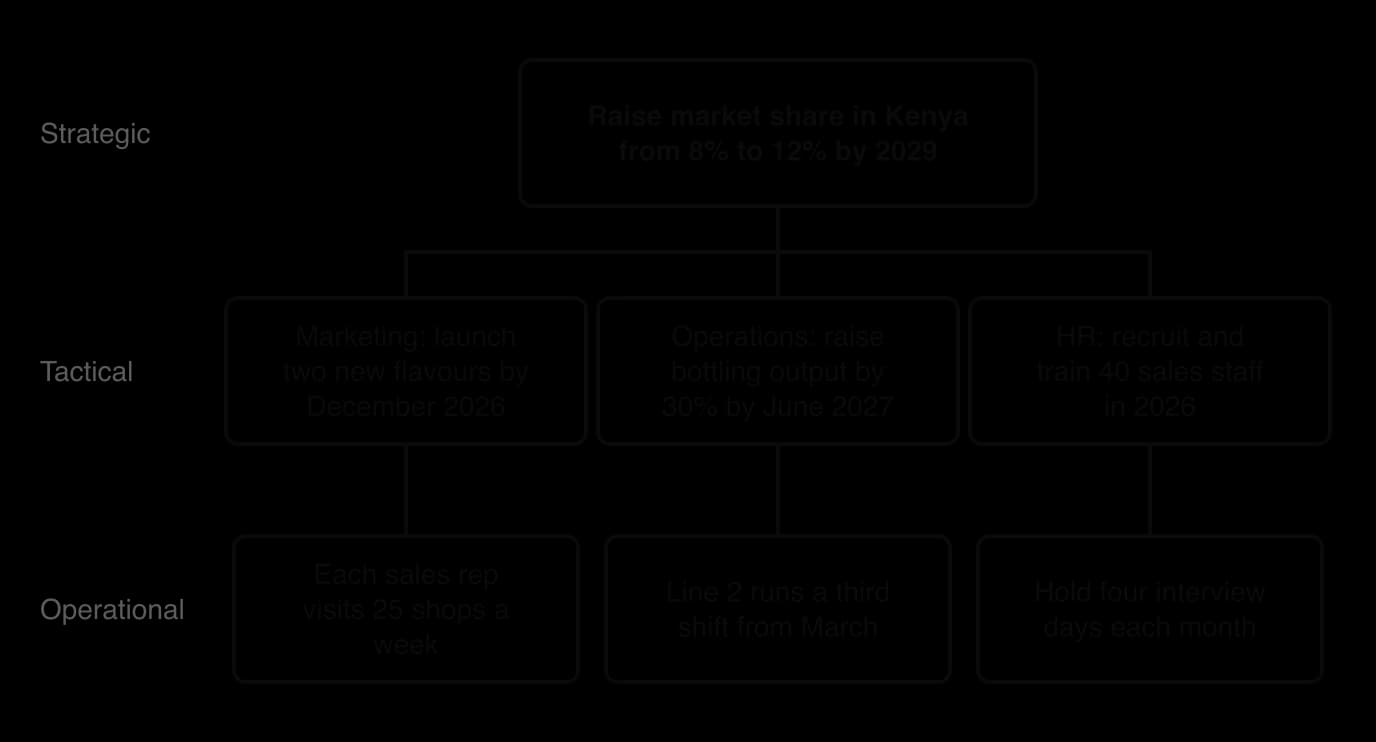
The tree shows how a single strategic objective spreads through the business. The juice maker's board wants a larger share of the Kenyan market. Marketing contributes new flavours, operations contributes the extra output that higher sales will need, and HR contributes the sales staff. Each of these is then turned into targets that a sales team, a production line or an HR officer can work on this week.
Feature | Strategic objectives | Tactical objectives | Operational objectives |
|---|---|---|---|
Time span | Long term (3–5 years or more) | Medium to short term (about 1–2 years) | Short term (days, weeks, months) |
Scope | The whole organisation | One department or division | One team or individual |
Set by | Board of directors and senior managers | Middle managers (heads of department) | Junior managers and supervisors |
Level of detail | Broad | More detailed | Very detailed and specific |
Risk and cost of being wrong | High: commits the whole business | Moderate | Low: easy to adjust |
Example (a supermarket) | Become the second-largest grocer in the country by 2030 | Open 20 new stores in the north in 2027 | Restock fresh produce shelves by 7 a.m. each day |
Lower-level objectives only help the business if they point in the same direction as the strategic objectives. When they do not, departments can each meet their own targets while the business as a whole fails. A purchasing department rewarded for cutting costs may buy cheaper materials that raise the defect rate, harming a strategic objective of becoming the premium brand. A sales team rewarded for revenue may offer discounts that destroy profit margins.
Alignment needs communication from the top (so that managers understand the strategy), involvement from below (so that targets are realistic) and regular review (so that targets change when the strategy changes). Many businesses use a planning cycle in which senior managers set the strategic objectives and departments then propose tactical objectives that are checked against them before budgets are agreed.
Setting clear strategic and tactical objectives has several advantages:
Direction and coordination. Everyone knows what the business is trying to achieve, so departments can plan their work to support each other.
A basis for decisions. Managers can judge proposals by asking whether they help meet the objectives, which makes decisions faster and more consistent.
Measuring performance. Progress can be checked against targets, so problems are spotted early and resources moved where they are needed.
Motivation and delegation. Clear targets give employees something to aim for and allow senior managers to delegate decisions with confidence.
Communication with stakeholders. Published objectives show investors, employees and lenders where the business is going.
There are also drawbacks and risks:
Time and cost. Setting, communicating and monitoring objectives takes management time, and the process can become bureaucratic.
Rigidity. In a fast-changing market, a five-year strategic objective can become outdated, and managers may keep chasing it after it has stopped making sense.
Conflict between departments. Tactical objectives can compete for the same budget, or one department's target can make another's harder to meet.
Short-termism and gaming. When pay depends on meeting targets, people may hit the number in ways that harm the business. At the US bank Wells Fargo, aggressive sales targets led employees to open about 1.5 million deposit accounts and 565,000 credit card accounts without customers' permission between 2011 and 2016. The bank was fined US$185 million in 2016, fired about 5,300 employees over the practice, and its chief executive resigned.
Unrealistic targets. Objectives set at the top without input from those who must meet them can be impossible, which demotivates staff.
Whether strategic and tactical objectives help a business therefore depends on several factors: how well they are communicated and aligned; whether those who carry them out are involved in setting them; how stable the market is (long-term targets suit stable markets better than fast-moving ones); how the objectives are linked to rewards; and the organisational culture, since a culture that values results at any cost turns targets into pressure to cheat. On balance, most businesses benefit from clear strategic objectives, provided tactical objectives are reviewed often and are flexible enough to change with the environment.
Every business decision affects people: employees, customers, suppliers, communities and future generations. Ethics concerns whether those decisions are morally right. A decision can be legal and profitable and still be judged unethical, for example paying suppliers very late because the law allows it, or selling a product that is harmful but not banned.
Ethical behaviour by a business means acting in line with these principles, even when the law does not demand it and when a less ethical choice would be cheaper. What counts as ethical differs between cultures and changes over time: practices that were accepted fifty years ago, such as large-scale use of single-use plastics, are now criticised by many customers and governments.
Ethical objectives turn moral principles into targets that a business can plan for and report on. Common examples are sourcing raw materials only from suppliers who pay a living wage, removing child labour from a supply chain, cutting greenhouse gas emissions, paying all suppliers within 30 days, and closing the gap between men's and women's pay.
For some businesses an ethical objective is the reason they exist. Tony's Chocolonely, a Dutch chocolate company, states that it "exists to end exploitation in the cocoa industry – fighting poverty, child labor and deforestation." Its sourcing and pricing decisions follow from that purpose: it buys cocoa from partner cooperatives it can trace and pays farmers more than the market price. For most businesses, ethical objectives sit alongside financial ones and must be balanced against them.
Many businesses publish a code of conduct that sets out the standards of behaviour expected of employees and managers, for example on bribery, conflicts of interest, discrimination, safety and the treatment of suppliers.
The Tata Code of Conduct, first formalised under Ratan Tata, applies across the Tata group's companies in India and abroad and sets out the group's commitments to each of its stakeholders. A code is only as strong as its enforcement: it needs training, a safe way for employees to report breaches, and visible consequences when senior people break it.
Reputation and brand. A record of ethical behaviour builds trust with customers, which can support higher prices and loyalty.
Recruitment and motivation. Many people, especially younger employees, prefer to work for businesses whose values they share, which can reduce labour turnover.
Lower risk. Ethical behaviour reduces the risk of fines, legal action, boycotts and damaging media coverage.
Access to finance and partners. Investors and large customers increasingly check the ethical record of businesses before investing in them or buying from them.
Long-term sustainability. Treating suppliers, communities and the environment well protects the resources and relationships the business will depend on in the future.
Higher costs. Fair prices to suppliers, safer working conditions and cleaner production usually cost more, which lowers profit margins at least in the short run.
Competitive disadvantage. Competitors that do not follow the same standards may undercut the business on price.
Conflicts with other objectives. Shareholders who expect higher dividends may object to spending on ethical objectives.
Difficulty of measurement and checking. It can be hard to verify conditions in distant supply chains, so claims may be inaccurate even when made in good faith.
Different views of what is ethical. Stakeholders may disagree, for example on whether closing a polluting factory is more ethical than keeping its workers employed.
Corporate social responsibility (CSR) is the idea that a business has responsibilities to society and the environment as well as to its owners. A business that accepts CSR considers the effects of its decisions on all its stakeholders and takes action that goes beyond what the law demands.
CSR and ethical objectives are closely related. Ethical objectives are specific targets; CSR is the wider approach to running the business of which those targets are a part.
Stakeholder or area | Examples of CSR activities |
|---|---|
Employees | Paying above the legal minimum wage; training and career development; flexible working; strong health and safety standards |
Customers | Honest labelling and advertising; safe products; fair complaints procedures; protecting customer data |
Suppliers | Paying fair prices and paying on time; long-term contracts; helping small suppliers meet standards |
Local community | Sponsoring schools and sport; employee volunteering; buying from local firms; limiting noise and traffic |
The environment | Cutting emissions and waste; using recycled materials; repairing and taking back products; protecting habitats |
Society as a whole | Paying a fair share of tax; donating part of profits to charity; avoiding bribery and corruption |
Businesses adopt CSR for a mix of moral and commercial reasons. Some owners believe that business has a duty to society. Others see CSR mainly as a way to protect and improve the business's position. The main commercial arguments are:
Brand image and customer loyalty. Customers may prefer, and pay more for, brands they see as responsible, and may stay loyal after a mistake if the business has built trust.
Recruitment and retention. A reputation for responsible behaviour helps attract and keep skilled employees.
Investor pressure. Many investors now assess companies on environmental, social and governance (ESG) criteria and avoid those with poor records, which affects the cost and availability of finance.
Lower risk of regulation and conflict. Businesses that act responsibly face fewer protests, fines and legal disputes, and may be trusted by governments when new rules are designed.
Efficiency. Some CSR activities, such as cutting energy use or packaging, also reduce costs.
To show what they are doing, many large businesses publish reports on their social and environmental performance alongside their financial results.
A social audit is the process that produces much of this information. An independent check gives the results more credibility than a business's own claims.
Critics of CSR make three main arguments, about its cost, about the purpose of a company and about greenwashing.
CSR activities cost money and management time. For a small business with thin profit margins, spending on CSR may threaten survival. Even for large businesses, the benefits are often uncertain and long term, while the costs are immediate.
The strongest argument against CSR comes from shareholder primacy, the view that the managers of a company should serve its owners. In an essay in The New York Times Magazine on 13 September 1970, the economist Milton Friedman argued that there is "one and only one social responsibility of business": to use its resources to increase its profits, as long as it stays within the rules of the game, meaning open and free competition without deception or fraud. In this view, managers who spend shareholders' money on social causes are spending other people's money on their own priorities; social problems are for governments and individuals to solve.
Supporters of CSR reply that serving shareholders and serving society are often compatible in the long run, because a business that damages its stakeholders eventually damages its own profits. In 2019 the US Business Roundtable, a group of chief executives of large American companies, published a new statement of the purpose of a corporation that moved away from shareholder primacy towards serving all stakeholders, at least on paper.
A further criticism is that much CSR is public relations rather than real change. When a business exaggerates or invents its environmental achievements, it is accused of greenwashing.
In 2024 a Dutch court ruled that 15 of 19 environmental claims in advertising by the airline KLM, including the claim that it was on its way to "a more sustainable future", were vague, overstated the effect of its measures and were therefore misleading and unlawful. Greenwashing harms the businesses that make real improvements, because customers learn to distrust every claim. Stricter advertising rules and reporting laws are partly a response to it.
What society expects of business is not fixed. Fifty years ago few companies reported on their emissions or their suppliers' working conditions; today customers, employees and investors in many countries expect them to. Some of what began as voluntary CSR has become law, which turns it from a choice into a legal obligation:
In India, the Companies Act 2013 requires companies above certain thresholds of net worth, turnover or net profit to spend 2% of their average net profit of the previous three years on CSR activities, under rules that came into effect on 1 April 2014.
In the European Union, the Corporate Sustainability Reporting Directive entered into force on 5 January 2023 and required large companies to publish detailed sustainability reports, the first of them in early 2025 covering 2024. In February 2025 the European Commission proposed to simplify the rules and delay them for many companies, which shows that obligations can be loosened as well as tightened when governments weigh the costs to business.
Expectations also change after scandals and crises, and with technology: issues such as the use of customer data or artificial intelligence were not part of CSR a generation ago. Businesses therefore need to review their CSR policies regularly, rather than treating them as a fixed set of activities.
One way of thinking about responsible business is to measure success in three ways rather than one. The term triple bottom line was introduced by John Elkington in 1994. The "bottom line" is the final line of a business's accounts, its profit; the triple bottom line adds a social and an environmental line to the financial one.
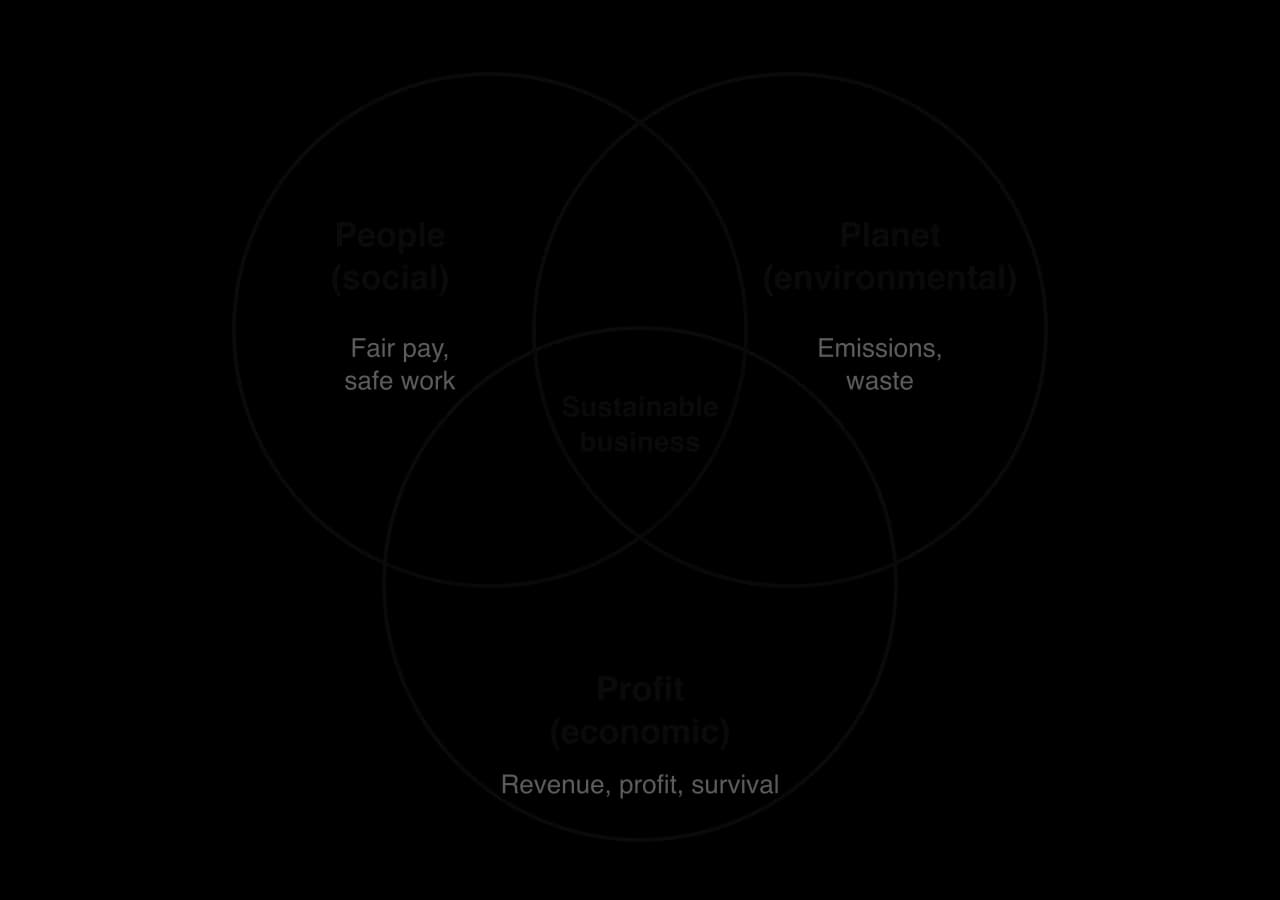
The diagram shows why the three lines are linked. A business that ignores profit cannot survive to do any social or environmental good. A business that ignores people and planet may be profitable for a time, but it risks losing customers, workers and the resources it depends on. The triple bottom line is the basis of the key concept of sustainability in business.
 YouTube
The case for CSR is strongest where the business sells to customers who care about how products are made, where it depends on scarce skilled employees, where it needs a licence to operate from a local community or government, or where its activities have large environmental effects. In these situations CSR protects the business's long-term profits as well as benefiting society.
The case is weaker for a small business struggling to survive, in markets where customers choose only on price, or where the business cannot verify that its CSR activities achieve anything. In these cases CSR may raise costs without benefits, or turn into greenwashing.
Different stakeholders gain and lose. Employees, communities and the environment usually gain; shareholders may lose dividends in the short run but gain from lower risk and a stronger brand in the long run; customers may pay higher prices but receive products they trust. Whether CSR is worthwhile therefore depends on the size and finances of the business, its objectives and ownership, its market, the expectations of its stakeholders and the law in the countries where it operates. It is most credible when it is built into the core of the business and checked independently, and least credible when it is a separate activity designed for publicity.
Patagonia is an American outdoor clothing company founded in 1973 by Yvon Chouinard, a climber who began by making climbing equipment for himself and his friends. It sells around the world and has about 3,000 employees. It shows what happens when a business places an ethical objective, protecting the natural environment, at the top of its hierarchy of objectives.
In 2018 Patagonia changed its purpose statement to "We're in business to save our home planet." The statement works as both vision and mission: it describes the future the company wants and the reason it exists. It is backed by commitments that turn it into objectives. Since 1985 Patagonia has given 1% of its sales each year to grassroots environmental organisations; in its 2025 financial year this came to US$14.7 million given to 824 non-profit organisations. The company is a certified B Corp and a California benefit corporation, legal forms that write its social and environmental purpose into its charter.
In September 2022 Chouinard and his family gave away their ownership of the company. In a letter published on 14 September 2022, Chouinard explained that selling the company or taking it public would have risked its values, because "Even public companies with good intentions are under too much pressure to create short-term gain at the expense of long-term vitality and responsibility." The new structure is shown in the table.
Owner | Share of the company | Type of stock | Role |
|---|---|---|---|
Holdfast Collective (a non-profit organisation) | 98% | All the non-voting stock | Receives the profits that are not reinvested in the business, as a dividend, and uses them to fight the environmental crisis |
Patagonia Purpose Trust | 2% | All the voting stock | Protects the company's values: approves board members and any change to its charter, including its purpose and B Corp commitments |
Sources: Patagonia, "Earth is now our only shareholder" (ownership letter and questions and answers), 14 September 2022.
The structure answers the shareholder primacy argument in an unusual way. Patagonia remains a for-profit company that must stay profitable, but its "shareholder" is in effect the environment: profits after reinvestment go to environmental causes rather than to private owners. The Purpose Trust makes the ethical objective hard to reverse, because the purpose cannot be changed without its approval.
Patagonia has set objectives for greenhouse gas emissions that are checked against the Science Based Targets initiative: to cut its absolute emissions from its supply chain and transport by 55% by its 2030 financial year, and to reach net-zero emissions across its value chain by 2040, both from a 2017 base year. These are SMART strategic objectives: specific, measurable in tonnes, time-bound and based on what climate science says is needed.
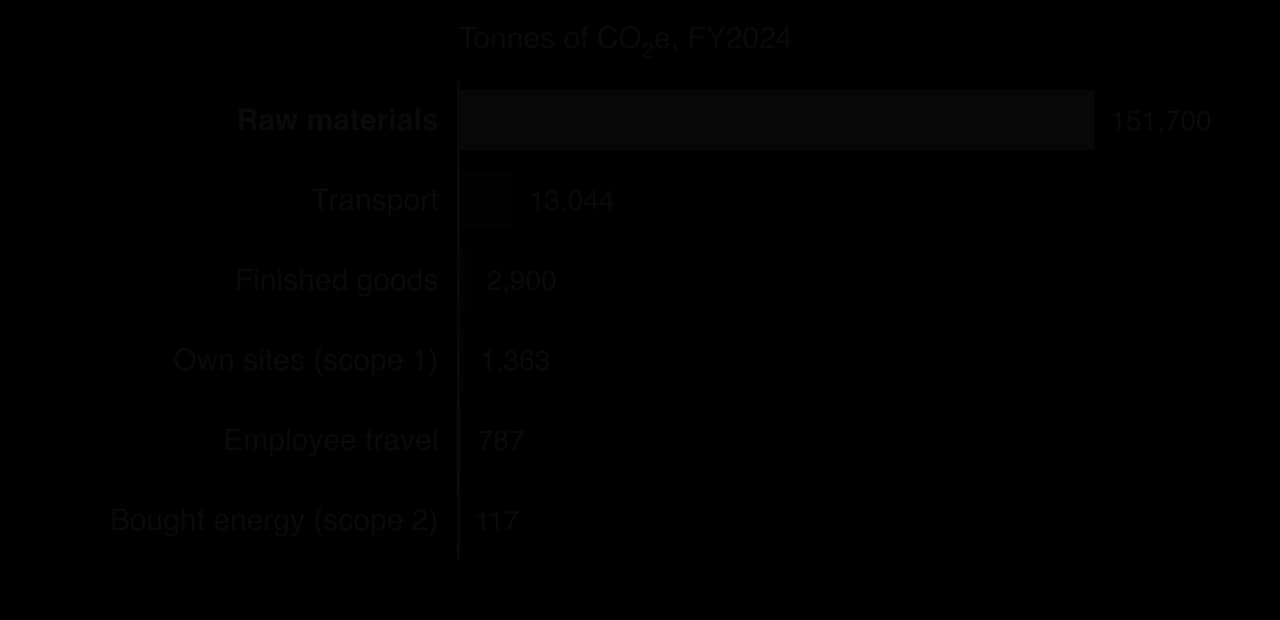
The chart shows why the objective is hard to meet. Almost all of the emissions arise in the factories of suppliers that make fabrics and yarn, which Patagonia does not own. Cutting them means persuading suppliers to change their energy sources and processes, and possibly paying more for materials. The company's 2025 progress report put its emissions at 182,646 tonnes of CO₂e for FY2025, about 7.5% higher than the 169,911 tonnes of FY2024, so progress towards the 2030 target was not steady.
Patagonia shows that ethical objectives and CSR can sit at the centre of a business's strategy rather than at its edges. Its purpose shapes its products (durable gear that it repairs: 174,799 repairs in FY2025), its giving, its legal form and its ownership. Its reputation supports a premium price and strong customer loyalty, which helps pay for these commitments.
The case also shows the limits. Patagonia was privately held by one family, so it could choose its ownership structure without persuading thousands of shareholders; a publicly held company could not easily copy it. Its own report admits that many of its products still have no end-of-life solution and that it uses some of the same factories as fast-fashion brands. And growth itself creates tension: selling more clothing raises emissions, yet the company must stay profitable to fund its purpose. Its experience suggests that a clear purpose can guide a business, but that it does not remove the trade-offs between objectives.
Sources: Patagonia, "Earth is now our only shareholder" (2022); Patagonia, Climate Goals (FY2024 emissions); Patagonia, Work in Progress Report 2025.
Explain how Patagonia's purpose statement guides its strategic and tactical objectives.
Using the emissions data, explain why Patagonia's emissions objective depends on its suppliers.
To what extent does Patagonia's ownership structure answer Milton Friedman's argument against CSR?
Structured questions on objectives often ask you to apply ideas to the business in the case: why an objective suits it, how its objectives link together, or why they have changed.
Section B questions on objectives and CSR usually ask for a balanced judgment about ethical objectives, CSR or the choice of objectives in a specific case.
A vision statement describes the future a business wants to create; a mission statement describes its current purpose, what it does and for whom.
The hierarchy of objectives runs from vision and mission through aims and strategic objectives to tactical and operational objectives, each serving the level above.
SMART objectives are specific, measurable, achievable, realistic and time-bound, so that they can be acted on and checked.
Common objectives are growth, profit, protecting shareholder value and ethical objectives, alongside survival, sales revenue maximisation, market share and customer satisfaction.
Objectives change with the stage of the business, its leadership and performance, and with the economy, competition, technology, laws and shocks.
Strategic objectives are long term and cover the whole business; tactical objectives are medium term and cover a department; they must be aligned to work.
Ethical objectives and CSR can improve reputation, recruitment and long-term sustainability, but they raise costs and can conflict with shareholder primacy; greenwashing undermines trust.
The triple bottom line judges a business on people, planet and profit.
I can distinguish between a vision statement and a mission statement, with a real example of each.
I can explain the hierarchy of objectives and draw it from memory.
I can explain what makes an objective SMART and rewrite a vague objective in SMART form.
I can explain growth, profit, protecting shareholder value, ethical objectives and survival as business objectives.
I can explain internal and external reasons why a business changes its objectives.
I can classify objectives as strategic, tactical or operational and explain why they must be aligned.
I can evaluate the setting of strategic and tactical objectives for a given business.
I can explain the meaning of ethics and the benefits and costs of ethical objectives.
I can evaluate CSR, including shareholder primacy, greenwashing and the triple bottom line.
The “100 % recyclable” message responds to concern about plastic waste (sustainability), differentiating the drink and improving brand image.
The product itself is unchanged, so the drink’s existing loyal customers keep the taste they like.
Disadvantages:
MXN 9 million is a large investment; if sales rise only briefly, the extension may not repay the cost.
Repackaging does not change the product; if the cause of flat sales is changing tastes, it may not work.
Existing customers may prefer the larger bottle; the smaller can may cannibalize bottle sales.
Competitors can copy the move easily.
Award [1]–[2] for a description of packaging as an extension strategy with little application or balance.
Award [3]–[4] for an examination that considers advantages or disadvantages in the context of Jamaica Fresca, or both with limited application.
Award [5]–[6] for a balanced examination of advantages and disadvantages, applied to the case, with a supported judgement.
Tindra Outdoor
[1] Tindra Outdoor (TO) is a public limited company in Tromsø, Norway, that makes outdoor clothing. Its product portfolio has three main lines: the Polar fleece jacket (launched 2004), the Ridge waterproof shell (launched 2017) and Loop, a range of jackets made from recycled fishing nets (launched 2024).
[2] The Polar fleece was once TO’s best seller, but its sales have fallen by about 12 % a year since 2021 as customers switch to lighter synthetic jackets. It still makes a small profit because its design and machinery were paid for long ago, and some older customers remain very loyal to it. The Ridge shell is now TO’s main source of profit and cash, with steady sales in a market that has stopped growing.
[3] Loop has received excellent reviews and won a design prize for sustainability. Its sales are growing fast, but it is not yet profitable because TO is spending heavily on promotion and on new machinery to process the recycled nets.
[4] Chief executive Silje Haugen wants to withdraw the Polar fleece in 2026 and move its production staff and factory space to Loop. The marketing director, Anders Lie, disagrees. He wants to keep Polar with a modified design and a lower price, arguing that it is part of TO’s heritage and that its loyal customers might switch to rivals if it disappears.
Define the term product portfolio.
2 marks
Explain the relationship between the product life cycle and cash flow for Loop and the Ridge shell.
4 marks
Discuss whether TO should withdraw the Polar fleece in 2026.
10 marks
Kestrel E-Bikes
[1] Kestrel E-Bikes (Kestrel) is a private limited company based in Utrecht, the Netherlands. It was founded in 2016 by Daan Visser and Femke de Groot, two engineers who designed a lightweight electric cargo bike for parents carrying children around the city. Kestrel assembles 9 000 bikes a year in a small factory and sells them online and through 40 independent bicycle shops in the Netherlands and Belgium.
[2] Demand has grown quickly. Kestrel’s order book is full for the next seven months and some customers have cancelled their orders because of the waiting time. Kestrel buys its battery packs in small quantities from a supplier in Germany and pays a higher price per pack than its larger rivals. Daan believes that Kestrel’s average costs are too high for it to compete on price as the market becomes more crowded.
[3] Daan and Femke have set a strategic objective of selling 30 000 bikes a year within four years. They are considering two ways of growing:
[4] Option 1: build a second, larger assembly line next to the existing factory and recruit 60 more workers. This would be financed by a bank loan and retained profit, and would take about two years to complete.
[5] Option 2: acquire Velomaas, a struggling family-owned bicycle maker in Rotterdam. Velomaas has a modern factory that is only half used, an experienced workforce of 85 people and a network of 120 retailers in Germany and France. Velomaas makes traditional bicycles, has had three different managing directors in five years, and its workers fear that Kestrel would close their factory.
[6] Femke is worried that rapid growth could change Kestrel’s informal, close-knit way of working, where every employee knows the founders personally and suggests design improvements.
Define the term economies of scale.
2 marks
With reference to Kestrel, explain two internal economies of scale that Kestrel could gain by producing 30 000 bikes a year.
4 marks
Explain two diseconomies of scale that Kestrel might face as it grows (paragraphs 5 and 6).
4 marks
Discuss whether Kestrel should choose Option 1 (internal growth) or Option 2 (acquiring Velomaas) to achieve its strategic objective.
10 marks