Identify internal and external stakeholders and their interests, construct a stakeholder map, and explain why stakeholders conflict and how businesses resolve those conflicts.
Each is in the Business glossary, with every other term in the subject.
Individuals and groups outside an organisation who are affected by, or can affect, its activities, such as customers, suppliers, government, financiers, the local community and pressure groups.
Stakeholders who are members of the organisation, such as its employees, managers, directors and owners or shareholders.
An organisation of people who share an interest or cause and campaign to influence the decisions of businesses, governments or the public on that issue, without seeking election.
An individual or group that has an interest in the activities of a business, because they affect the business or are affected by its decisions.
A situation in which the interests or objectives of different stakeholder groups cannot all be met at the same time, so that a decision benefits some groups at the expense of others.
A method of analysing stakeholders by placing each group on a matrix according to its power over the business and its interest in a decision, in order to decide how to manage it.
Define a stakeholder and distinguish between a stakeholder and a shareholder.
Distinguish between internal and external stakeholders, with examples of each.
Explain the interests of each main stakeholder group and how each can influence a business.
Construct a stakeholder map (Mendelow's matrix) and use it to suggest how a business should manage each group.
Explain why the interests of different stakeholders conflict, using real examples.
Explain where stakeholders share interests, and the idea of mutual benefit.
Explain the methods businesses use to resolve or reduce stakeholder conflict.
Apply stakeholder analysis to a real business decision.
A business affects many more people than its owners. Its decisions change the pay and security of its employees, the prices its customers pay, the orders its suppliers receive, the taxes its government collects and the environment of the community around it. These groups are its stakeholders, and understanding what each of them wants is essential for making decisions that can be carried out and that last.
Stakeholders are at the centre of the key concepts. Most business change creates winners and losers among stakeholders, which is why change so often brings conflict. Questions of ethics are largely questions about how a business treats its stakeholders, and sustainability depends on balancing their interests over the long term rather than serving one group at the expense of the others.
115 exam-style questions on this subtopic, written in the style of the IB papers. The first has its markscheme open. Counted on
Grand Harvest is a national supermarket chain in South Africa. To improve its cash position, its board has told all suppliers that from next month it will pay invoices after 75 days instead of 30 days. Many of its suppliers are small farms and family businesses, such as Sizwe Dairy, owned by Thandeka Dlamini, which sells 80 % of its milk and yoghurt to Grand Harvest. Thandeka says she will need an overdraft to pay her workers and feed suppliers while she waits for payment.
Analyse the implications for Grand Harvest of increasing its creditor days from 30 to 75 days.
6 marks
Possible positive implications for Grand Harvest:
Cash stays in the business for 45 more days, improving liquidity and its cash flow position without paying interest; trade credit is a free source of short-term finance.
The extra cash could fund expansion, new stores or price cuts without borrowing, which also helps keep gearing down.
Small suppliers that depend on Grand Harvest (Sizwe Dairy sells 80 % of its output to it) have little bargaining power, so they are unlikely to stop supplying.
Possible negative implications for Grand Harvest:
Ethics and reputation: shifting its cash flow problem onto small farms and family firms may be seen as unethical; media coverage or campaigns could damage the brand and customer loyalty.
Supplier failure: suppliers like Sizwe Dairy may need costly overdrafts, raise prices or even become insolvent, disrupting the supply of fresh products.
Worse supplier relations: suppliers may lower quality, give priority to other retailers or refuse special orders; they may add the cost of waiting into their prices.
Possible regulatory action or bad publicity if government or industry codes of practice protect small suppliers.
The official deck for this part of the syllabus.
Define the term stakeholder.
Other than a financial stake, state four things through which a group may have a stake in a business.
With a free account, Augment remembers where you stopped and what you have practiced.
Scope: This subtopic is the same at SL and HL. It covers internal and external stakeholders and their interests, and conflict between stakeholders, including stakeholder mapping as a way of analysing them and the methods businesses use to resolve conflict.
Any individual or group that is affected by what a business does, or that can affect what it does, has a "stake" in the business. Some stakeholders have a financial stake, such as the owners and lenders. Others have a stake because their jobs, their health, their environment or their choices as customers depend on the business's decisions.
The term is often confused with "shareholder". A shareholder owns shares in a company and so is one of its owners. Every shareholder is a stakeholder, but most stakeholders are not shareholders. The LEGO Group, the Danish toy maker, is owned by the Kirk Kristiansen family's holding company, KIRKBI (75%), and the LEGO Foundation (25%). These are its only shareholders, yet its stakeholders include its employees in Denmark, Mexico, Hungary and China, millions of children and parents, retailers, suppliers of plastic, the town of Billund and the governments of the countries where it operates.
The idea that managers should consider all stakeholders, and not only shareholders, is sometimes called the stakeholder approach. It is the opposite of shareholder primacy, the view that managers should serve the owners first. In practice most businesses lie between the two: they aim to make returns for their owners while keeping the support of the other groups they depend on.
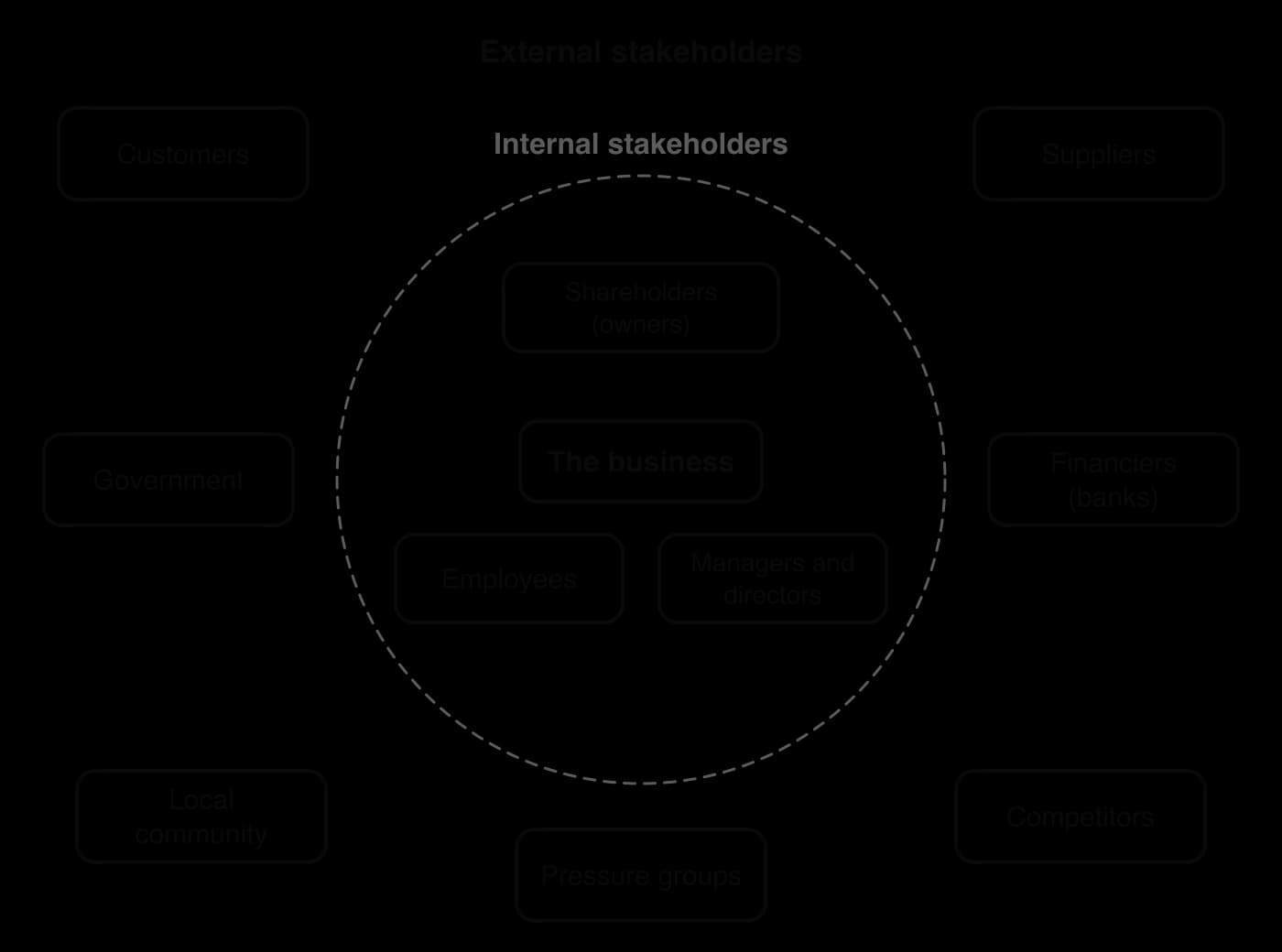
Stakeholders are usually divided into two groups, internal stakeholders and external stakeholders, according to whether they are part of the organisation or outside it.
Internal stakeholders work in or own the business, so they are directly involved in its decisions and share in its success or failure.
The diagram shows the usual classification. The boundary between the groups is not always sharp. An employee who owns shares through a share scheme is both an employee and a shareholder. A customer of a cooperative may also be one of its owners. A sole trader is at the same time the owner, the manager and often the main employee. When a person belongs to more than one group, their interests in each role can pull in different directions.
Employees want fair pay and benefits, job security, safe and pleasant working conditions, opportunities for training and promotion, and a say in decisions that affect them. Their influence comes from their skills (a business cannot operate without them), from the quality of their work and, collectively, from the possibility of industrial action through a trade union. In some countries, such as Germany, employees also elect works councils that have legal rights to be consulted on many workplace decisions.
Managers and directors run the business on behalf of its owners. They want a good salary and bonuses, career progression, status and the success of the parts of the business they control. Their influence is large because they make most decisions. Their interests can differ from those of the shareholders: a manager may prefer growth, which increases their status and pay, while shareholders may prefer higher dividends.
Shareholders want a return on their investment, through dividends and a rising share price, and they want the business to be well run so that their investment is safe. In a privately held company or a family business the owners may also value control and the reputation of the family name. Shareholders influence the business by voting at the annual general meeting, electing the board of directors, and, in a publicly held company, by selling their shares, which lowers the share price.
Customers want good-quality products at fair prices, reliable service, honest information and choice. They influence the business through their buying decisions, through reviews and social media, and through consumer protection law. In competitive markets customers have a great deal of power, because they can switch to a rival easily.
Suppliers want regular orders, fair prices, payment on time and long-term relationships. Large buyers often have more power than their suppliers, which can lead to unfair treatment. In the United Kingdom the Groceries Code Adjudicator was set up in 2013 to enforce a code of practice between large supermarkets and their direct suppliers; in January 2016 its investigation found that Tesco had breached the code by delaying payments to suppliers.
National and local governments want businesses to create jobs, pay taxes, obey the law and contribute to economic growth. They influence businesses through laws (on employment, competition, health and safety and the environment), taxes and subsidies, planning permission for new buildings, and as major customers. Governments also often compete to attract large investments, offering grants and fast approvals.
People who live near a business want jobs and spending in the local area, but also a safe and clean environment with little noise, traffic or pollution. Their influence comes through local councils, planning objections, protests, the media and their votes in local elections.
A pressure group is an organisation that campaigns to change the behaviour of businesses or governments on a particular issue, such as the environment, animal welfare, human rights or consumer protection.
Pressure groups use publicity, petitions, boycotts, legal action, lobbying and protest. Greenpeace, an international environmental group that does not accept funding from governments, corporations or political parties, has campaigned against companies it links to tropical deforestation, including Nestlé over the palm oil used in KitKat; several of the companies targeted changed their sourcing policies. Pressure groups are powerful when their message attracts media attention and public support, and weak when the public is indifferent.
Competitors are interested in a business because its decisions on prices, products and recruitment affect their own sales and costs. They are a stakeholder in an unusual sense: they rarely want the business to succeed, but they can affect it strongly, for example by starting a price war, and they may cooperate with it on industry standards or in joint lobbying of the government.
Banks and other lenders want to be repaid with interest and want the business to stay solvent. They influence the business through the terms of loans and overdrafts, and by refusing further credit when they see high risk. Investors who provide finance in return for shares become shareholders and so internal stakeholders.
Stakeholder | Internal or external | Main interests | How they can influence the business |
|---|---|---|---|
Employees | Internal | Pay, job security, working conditions, training, a voice | Quality of work, productivity, trade unions and works councils, leaving |
Managers and directors | Internal | Salary and bonuses, career, status, success of their area | Making and carrying out decisions |
Shareholders (owners) | Internal | Dividends, rising share price, safety of investment, control | Voting at the AGM, electing directors, selling shares |
Customers | External | Quality, price, service, honest information, choice | Buying or not buying, reviews, complaints, consumer law |
Suppliers | External | Regular orders, fair prices, prompt payment | Prices and credit terms, refusing to supply |
Government | External | Jobs, taxes, legal compliance, economic growth | Laws, taxes, subsidies, planning permission |
Local community | External | Jobs, local spending, safety, a clean and quiet environment | Planning objections, protests, local councils, media |
Pressure groups | External | Their cause (environment, human rights, animal welfare) | Publicity, boycotts, legal action, lobbying |
Competitors | External | Their own market share and profits | Prices, new products, recruiting staff |
Financiers (banks) | External | Repayment with interest, low risk | Loan terms, refusing credit |
A business cannot give every stakeholder everything it wants, and it cannot spend the same time and effort on every group. Stakeholder mapping helps managers decide which stakeholders need the most attention and how to deal with each.
The best-known map is Mendelow's matrix, proposed by the management researcher Aubrey Mendelow. It uses two dimensions:
Power: how far the stakeholder can affect the business or the decision. Power comes from resources (money, skills, votes), from legal rights (a government's right to refuse permission) and from the ability to attract public support.
Interest: how much the stakeholder cares about the decision, which depends on how strongly it is affected and how willing it is to act.
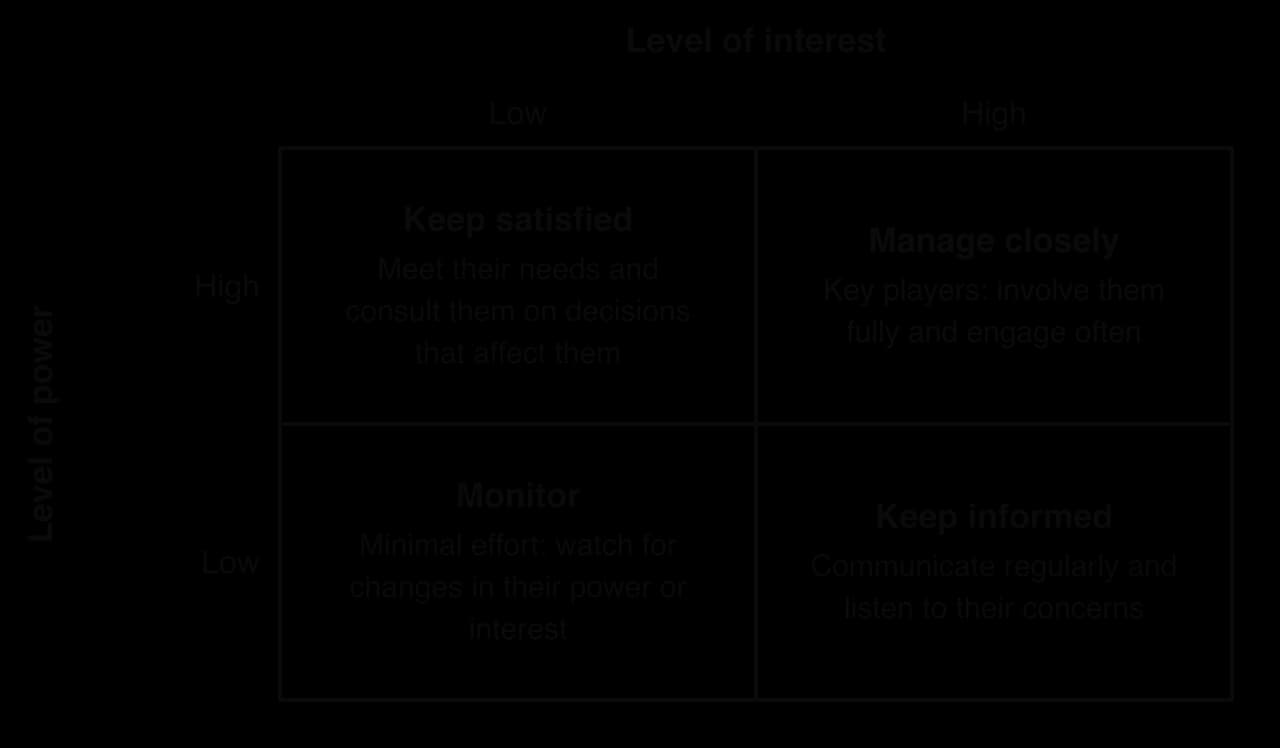
Each quadrant suggests a different approach:
High power, high interest: manage closely. These are the key players. The business should involve them in the decision, consult them early and try to win their support, because they can stop it. Examples are major shareholders on a takeover, or a local council on a planning application.
High power, low interest: keep satisfied. These groups could affect the decision but are not paying much attention. The business should meet their needs and avoid surprising them, so that they do not move into the top-right quadrant as opponents. A national government is often here for routine decisions.
Low power, high interest: keep informed. These groups care a great deal but have limited influence on their own. The business should communicate regularly, explain its decisions and listen, because they may gain power by joining together, by attracting media attention or through the law.
Low power, low interest: monitor. These groups need minimal effort, but the business should watch for changes in their position.
State the decision. A stakeholder map is drawn for a particular decision (opening a factory, raising prices, cutting jobs), because the same group can have high interest in one decision and none in another.
Identify the stakeholders affected by that decision, as specifically as possible ("residents within 2 km of the site" rather than "the community").
Judge each group's power over the decision and its interest in it, giving reasons from the evidence.
Place each group on the matrix.
Suggest a strategy for each quadrant, and identify which groups might move and why.
A stakeholder map is a snapshot. Power and interest shift as events unfold, and groups with little power on their own can gain a great deal by acting together or by winning public support.
The destruction of the Juukan Gorge rock shelters in Western Australia shows how quickly positions can change. On 24 May 2020 the mining company Rio Tinto blasted the shelters, a site about 46,000 years old, to expand an iron ore mine; it had legal permission, granted in 2013, and the Puutu Kunti Kurrama and Pinikura peoples, the traditional owners, had little formal power to stop it.
After the blast, public anger, a parliamentary inquiry and criticism from investors moved these concerns to the top of the company's agenda. Senior executives lost bonuses, and on 11 September 2020 Rio Tinto announced that its chief executive and two other executives would step down.
Stakeholder mapping is simple, quick and visual, but every position on the map is a judgment. The table compares its strengths with its limits.
Strengths | Limitations |
|---|---|
Makes managers think about every group before a decision is made, not after a protest begins | Positions are judgments, often made by managers who may underestimate opponents |
Shows where limited time and money for managing stakeholders should go | Treats each group as uniform, although some employees may support a decision while others oppose it |
Gives a starting point for a communication plan for each group | Is static, while power and interest change, as the Juukan Gorge case shows |
Is easy to draw, explain and update | Shows how to manage groups, not whose interests are morally right; a group with low power may have the strongest ethical claim |
Stakeholder mapping is therefore most useful when it is updated regularly, based on evidence rather than managers' assumptions, and used together with ethical judgment about the groups it places in the low-power quadrants. Used in this way, it helps a business find the groups that could block a decision and also the groups whose concerns deserve attention even though they cannot block it.
 YouTube
Stakeholders' interests often point in different directions, so a decision that pleases one group can harm another. Stakeholder conflict arises because the resources of a business are limited: money paid out as dividends cannot also be spent on higher wages or lower prices, and land used for a factory cannot also remain a forest.
Limited resources. Profit can be divided between owners, employees, customers (through lower prices) and investment, but more for one group means less for another.
Different time horizons. Some shareholders want returns this year; employees and communities often care about the business over decades.
Different values. Groups may disagree about what matters most, such as jobs against the environment, or growth against tradition.
Different information. Managers know more than employees or the community, which can lead to mistrust even when interests are similar.
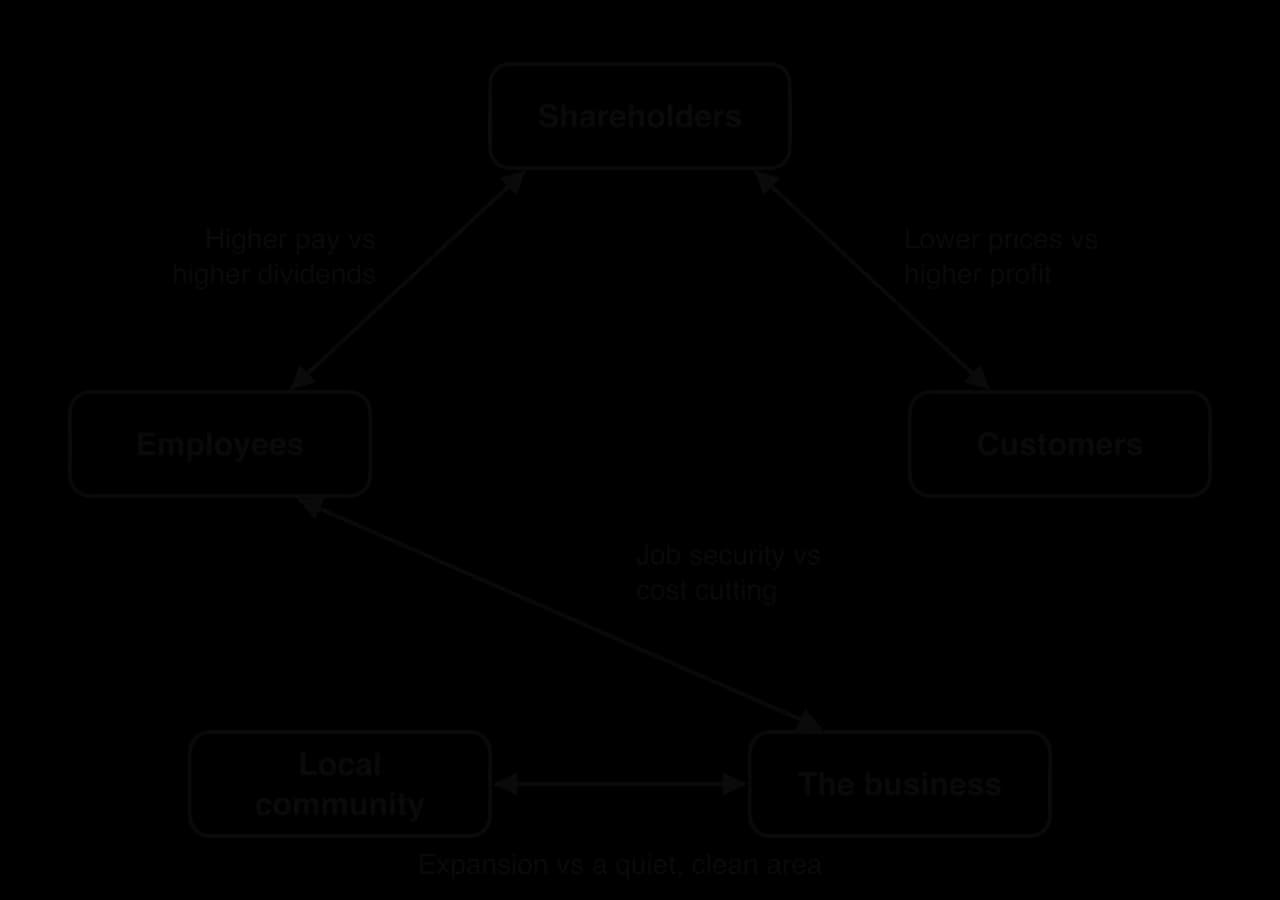
The diagram shows the most common conflicts between pairs of groups, starting with pay. Higher wages, more staff or better conditions raise costs and reduce the profit available for dividends. Decisions to introduce automation, relocate production or cut jobs usually benefit shareholders through lower costs but threaten employees' security. Conflicts of this kind are the main subject of negotiations between employers and trade unions.
Customers want lower prices and better quality; shareholders want higher profit. A price rise may increase profit in the short run but anger customers, especially when the business has a strong market position. When a utility company raises energy prices while paying large dividends, for example, it often faces criticism from customers and governments.
Expansion brings jobs and spending to an area but also traffic, noise, pollution and loss of green space. The community may support the business's existence while opposing its growth, as the residents of Grünheide in Germany did over Tesla's plans to expand its factory there.
Managers control the business day to day, while shareholders own it. Managers may pursue objectives that raise their own pay and status, such as growth through acquisitions, rather than the profits shareholders want. This problem, which arises from the divorce of ownership and control, is why many companies link directors' pay to share price performance, although that can itself encourage short-termism.
A buyer wants low prices and long payment periods; suppliers want fair prices and quick payment. Large retailers can use their buying power to delay payment, which improves their own cash position at their suppliers' expense, as the Groceries Code Adjudicator found at Tesco.
Conflict is not only between groups. Shareholders seeking a quick return may disagree with long-term investors; employees at a factory threatened with closure may disagree with those at a factory that would gain the work; some residents of a town want the jobs a new factory brings while others want to protect the forest.
Although conflict is common, stakeholders also share many interests. Almost every group gains when the business is successful and well run over the long term. A profitable business can pay higher wages, reward its shareholders, invest in better products for its customers, pay more tax and place larger orders with its suppliers.
Some decisions benefit several groups at once. Training employees can raise productivity and quality, which benefits customers through better service, shareholders through higher profit and employees through better pay and prospects. Cutting energy use lowers costs and reduces emissions, which benefits both shareholders and the community. Paying suppliers fairly and on time builds reliable relationships that protect the business from shortages.
This overlap is the reasoning behind corporate social responsibility and the triple bottom line: a business that treats its stakeholders well is more likely to survive and prosper. The overlap is not complete, however. Some trade-offs cannot be avoided, especially in the short run, and managers must still decide whose interests come first when they clash.
Conflict between stakeholders cannot always be avoided, but it can be reduced and managed. Businesses use a range of methods, often several at once.
Many conflicts grow from misunderstanding and mistrust. Explaining a decision early, sharing the evidence behind it and listening to concerns can reduce opposition. Consultation can take the form of public meetings, surveys, meetings with community leaders, or formal consultation with employee representatives. In Germany, works councils have legal rights to be informed and consulted on many workplace changes, which forces this kind of communication.
When interests genuinely conflict, a business may change its plans so that each group gains something. Wage negotiations with trade unions usually end in a compromise between what employees ask for and what managers first offer. A company planning a new building may reduce its size, change its design or add facilities for the community.
Stakeholder mapping helps a business decide which groups must be satisfied for a decision to succeed. Key players in the top-right quadrant are involved closely; others are kept informed or satisfied. This is a practical method, but it carries the risk that groups with little power are ignored, which can be unethical and can backfire if they later gain power.
A business with genuine CSR policies and ethical objectives may prevent conflicts arising, by building trust and taking stakeholders' interests into account from the start. When conflicts occur, a record of responsible behaviour makes the business's promises more credible.
A business may compensate the groups that lose from a decision, for example by paying redundancy money above the legal minimum, funding local facilities near a new factory, planting new forest to replace trees it clears, or offering employees shares so that they share in the profits.
Where agreement cannot be reached, conflicts may be settled through formal processes: planning inquiries, courts, regulators or independent arbitration. These give a final decision but can be slow, costly and damaging to relationships.
Method | Advantages | Limitations |
|---|---|---|
Communication and consultation | Cheap; builds trust; may bring out better options | Takes time; does not remove real conflicts of interest; can look like public relations if views are ignored |
Compromise and negotiation | Each group gains something; agreement is more likely to last | No group gets all it wants; may raise costs or delay plans |
Prioritising by power and interest | Focuses effort where it matters for the decision | May ignore weak groups with strong ethical claims; positions change |
CSR and ethical objectives | Prevents conflict; builds long-term reputation | Costly; benefits are slow and uncertain |
Compensation and incentives | Reduces the losses of affected groups | Expensive; may be seen as buying support |
Formal and legal processes | Gives a clear, enforceable decision | Slow, costly and adversarial; damages relationships |
Which method works best depends on the size of the conflict, the power of the groups involved, the business's objectives and culture, the time available and the law of the country. A business that needs the long-term support of a community, such as a factory that cannot easily move, has strong reasons to consult and compromise rather than simply to use its power.
In 2019 Tesla chose a site in Grünheide, a small municipality in the German state of Brandenburg about 30 km south-east of Berlin, for its first European car factory. The plant, expected to cost about €4 billion, was built on a site of about 300 hectares in a pine forest and opened on 22 March 2022 after the state environment agency approved it, with conditions, on 4 March. It makes the Model Y and employed almost 12,000 people in 2024. The project created clear benefits for some stakeholders and serious concerns for others, and those concerns grew when Tesla planned to expand the site.
The state government of Brandenburg supported the factory strongly, because it brought thousands of jobs, tax revenue and investment to a region with lower incomes than western Germany. Many local people welcomed the jobs.
Other residents and environmental groups were worried about water: the site lies partly in a water protection zone, and the region already has limited water supplies. Tesla's forecast water use for the first stage was cut from a maximum of 3.3 million to about 1.4 million cubic metres a year, the regional water association said its supply was enough only for the first stage of the factory, and in 2023 it began rationing water for new customers. Forest clearing, traffic and the safety of chemicals stored on site were further concerns.
Employees and the trade union IG Metall had a different set of interests. Tesla did not apply the collective agreement that covers the German metal and electrical industry, and in 2020 the planned gross monthly pay in the lowest pay group was reported as €2,700. IG Metall campaigned for a collective agreement and better conditions; Tesla's management rejected the demand for a collective agreement.
Tesla then proposed to add about 170 hectares to the site for a freight railway station, warehouses and other facilities, as part of a plan to double the factory's capacity to 1 million cars a year. More than 100 hectares of the extra land was forest. The proposal turned the community's concerns into open conflict, as the timeline shows.
Date | Event | Stakeholders involved |
|---|---|---|
22 March 2022 | Factory opens after approval with conditions; about 3,000 employees at the start | Tesla, state government, employees |
20 February 2024 | Non-binding residents' vote on the expansion plan: 3,499 against and 1,882 in favour (about 65% against) | Residents, municipal council |
28 February 2024 | Activists occupy the forest on the expansion site and build treehouses ("Tesla stoppen") | Pressure groups, police |
5 March 2024 | Arson attack on a nearby power pylon, claimed by the far-left Vulkangruppe; the plant loses power and production stops for several days | Extremist group, employees, Tesla shareholders |
10 May 2024 | About 800 protesters try to enter the site and are stopped by police; the plant closes for the day | Pressure groups, police, employees |
16 May 2024 | Municipal council approves a revised plan by 11 votes to 6 (2 abstentions): 118 hectares for a freight station, with forest clearing cut from about 100 to 50 hectares and the logistics areas and a planned day-care centre dropped | Tesla, council, residents |
March 2026 | Works council election: the non-union list Giga United wins about 41% of the vote; IG Metall's list about 31% (13 of 37 seats); IG Metall later asks a court to declare the election invalid | Employees, IG Metall, management |
Sources: Clean Energy Wire, 21 February 2024; electrive, 21 February 2024; The Boston Globe (The New York Times), 21 February 2024; CNBC, 5 March 2024; BBC News, 10 May 2024; electrive, 17 May 2024 and 5 March 2026; Wikipedia (Tesla Gigafactory Berlin-Brandenburg), citing Deutsche Welle (2019), rbb24 and Handelsblatt.
The residents' vote did not bind the council, but it changed the power of the local community. Residents had been a high-interest, low-power group; after the vote, the mayor said the plan could not be adopted in its existing form, and councillors who had to decide on it had to take their view into account.
Tesla and the council responded with a compromise. The revised plan kept the freight station, which the municipality expected to cut lorry traffic by moving new cars by rail, but cleared about half as much forest. The remaining forest on the site had to stay in a protected conservation area and in state ownership, a condition added at the last minute to stop the area being cleared bit by bit later.
Protest groups, whose interest was very high, had little formal power, and some activists turned to direct action. The forest occupation and the attempt to enter the site drew media attention but also closed the plant for a day and diverted large numbers of police. The arson attack, which Tesla condemned, cost production but did not change the decision. The conflict shows that pressure groups can gain influence through public support, but that tactics which harm employees and the public can reduce that support.
The conflict between Tesla and IG Metall remained unresolved. In March 2026 employees elected a works council in which non-union lists held most seats, which Tesla's plant manager described as a clear signal for union-independent co-determination. IG Metall accused management of an unfair campaign and challenged the result in court. The employees were divided: many valued the jobs and pay Tesla offered, while others wanted the protection of a collective agreement.
 YouTube
The Grünheide factory shows the main ideas about stakeholders in one place. The same decision affected internal stakeholders (employees, managers, shareholders) and external ones (government, residents, pressure groups, the water association) in different ways. Interests overlapped on jobs and growth, and conflicted on water, forest and the role of the union.
Power shifted when residents voted and when protests drew attention, and the business resolved part of the conflict through compromise while other parts went to the courts. The case also has limits as evidence: many accounts come from news reports written during the conflict, and the full costs and benefits of the factory for the region will only be clear over many years.
Explain why the residents of Grünheide had more influence over the expansion after February 2024 than before.
Analyse the conflict between Tesla's management and IG Metall from the point of view of the factory's employees.
Explain how the revised expansion plan of May 2024 gave something to more than one stakeholder group.
Structured questions often ask you to explain a conflict between two named groups in the case, or to construct a stakeholder map from a short description.
A stakeholder is any individual or group with an interest in a business; shareholders, the owners of a company, are only one stakeholder group.
Internal stakeholders (employees, managers and directors, shareholders) are part of the organisation; external stakeholders (customers, suppliers, government, local community, pressure groups, competitors, financiers) are outside it.
Each group has its own interests and its own ways of influencing the business.
Stakeholder mapping places groups by power and interest: manage closely, keep satisfied, keep informed or monitor.
Stakeholder conflict arises from limited resources, different time horizons, values and information; it can occur between and within groups.
Stakeholders also share interests in the long-term success of the business, which is the basis of mutual benefit and CSR.
Businesses reduce conflict through communication, compromise, prioritising by power and interest, CSR, compensation and formal processes.
I can define a stakeholder and explain the difference between a stakeholder and a shareholder.
I can classify stakeholders as internal or external, with examples.
I can explain the interests of each main stakeholder group and how it can influence a business.
I can construct a stakeholder map for a decision and suggest a strategy for each quadrant.
I can explain why stakeholder positions on a map change over time.
I can explain why stakeholders' interests conflict, using real examples.
I can explain areas of mutual benefit between stakeholders.
I can explain and compare the methods businesses use to resolve stakeholder conflict.
The improvement is a one-off: once the new terms are in place, cash flow does not keep improving.
Accept any other relevant implication.
Award [1]–[2] for a limited answer that identifies one or two implications with little analysis or context.
Award [3]–[4] for an answer that analyses implications in context, but is one-sided or only partly developed.
Award [5]–[6] for a balanced analysis of positive and negative implications, well applied to Grand Harvest and its suppliers (for example, Sizwe Dairy).
Lagoon Air
[1] Lagoon Air is a small airline based in Nadi, Fiji. It operates seven turboprop aircraft on domestic routes between Fiji’s islands, carrying mainly tourists from resorts. Lagoon Air is a private limited company owned by a group of Fijian investors. Its chief executive, Litia Naivalu, has built a reputation for punctual flights and friendly crews.
[2] Most of Lagoon Air’s passengers arrive in Fiji on long-haul flights operated by Tasman Pacific, a large Australian airline. Tasman Pacific has proposed a strategic alliance. Passengers would be able to book a single ticket from Sydney or Melbourne to an island resort, with their luggage checked through to their final destination. Tasman Pacific’s frequent-flyer members would earn points on Lagoon Air flights, and the two airlines would share check-in staff at Nadi airport.
[3] Litia expects passenger numbers to rise by 25 %. However, Lagoon Air would have to adjust its timetable to fit Tasman Pacific’s arrival times, which could mean fewer flights for local Fijian passengers in the middle of the day. The Fijian pilots’ union is concerned that Tasman Pacific might later try to take over Lagoon Air.
Outline one difference between a strategic alliance and a joint venture.
2 marks
Explain two advantages for Lagoon Air of the proposed strategic alliance.
4 marks
Analyse the possible impact of the strategic alliance on two of Lagoon Air’s stakeholder groups (paragraph 3).
6 marks
Brightwave Software
[1] Brightwave Software (Brightwave) is a publicly held company in Tallinn, Estonia. It develops accounting software for small businesses in the Baltic states and Finland. Brightwave was founded in 2011 by Kadri Tamm, who still owns 18 % of the shares and is chief executive. Brightwave is known for its flat structure, flexible working and generous share scheme for its 210 employees.
[2] Growth has slowed in the last two years. Brightwave’s share price has fallen by 30 %, partly because larger competitors offer cloud-based packages that include payroll and banking services. Kadri believes Brightwave can recover by spending €6 million on developing its own cloud platform, financed by retained profit, but this would take three years.
[3] Last week NordLedger, a Swedish software group ten times Brightwave’s size, announced a hostile takeover bid. It has offered shareholders €9.60 per share, 40 % above the current share price. NordLedger says it will integrate Brightwave’s products into its own cloud platform, move development work to its Stockholm office and keep the Brightwave brand for small customers.
[4] Brightwave’s board has recommended that shareholders reject the bid. Several investment funds, which together own 45 % of the shares, are in favour of accepting. Employees have started a social media campaign to keep Brightwave independent.
Define the term takeover.
2 marks
Outline why Brightwave is vulnerable to a takeover.
2 marks
Explain the conflicting interests of three of Brightwave’s stakeholder groups in the takeover bid.
6 marks
Discuss whether Brightwave’s shareholders should accept NordLedger’s takeover bid.
10 marks