Notes on 1.2 Types of business entities
Learning objectives
Distinguish between the private sector and the public sector, and explain why governments provide some goods and services.
Explain the difference between unincorporated and incorporated businesses, and between unlimited and limited liability.
Describe the main features of sole traders, partnerships, privately held companies and publicly held companies.
Evaluate the advantages and disadvantages of each type of for-profit commercial business.
Recommend a suitable legal form for a business in a given situation, and explain when a business might change its form.
Describe the main features of for-profit social enterprises: private sector companies, public sector companies and cooperatives.
Describe the main features of NGOs as non-profit social enterprises, and how they are financed and governed.
Evaluate social enterprises, including the conflict between financial and social objectives.
Introduction
Every business has a legal form that decides who owns it, who controls it, who receives its profit and who must pay its debts if it fails. A hairdresser working alone, a law firm of twelve partners, a family company, a multinational listed on a stock exchange, a farmers' cooperative and an international charity are all organised in different ways, and each form suits a different purpose and stage of growth.
The choice of legal form raises questions linked to the key concepts. Social enterprises and cooperatives are built around ethics and sustainability: they exist to meet social or environmental aims as well as to trade. Businesses also change their legal form as they grow, which is a form of change that brings new owners, new finance and new obligations.
The private sector and the public sector
The first way to classify an organisation is by who owns it. Organisations owned by private individuals or groups of individuals are in the private sector. Organisations owned and controlled by the government, at national or local level, are in the public sector.
Most businesses are in the private sector: shops, factories, restaurants, banks, technology companies, farms and most media companies. Their owners provide the finance and take the risk, and in return they keep the profit. The private sector also contains organisations that are not run for profit, such as charities and other non-governmental organisations, because they are owned and run by private citizens, not by the state.
The public sector includes government departments (education ministries, tax authorities, the armed forces), local authorities (which may run schools, waste collection and libraries) and businesses owned by the state that sell goods and services. These businesses are state-owned enterprises (SOEs), also called public corporations. Examples include Chile's copper miner Codelco, Norway's Equinor (majority state-owned), and the train operators the UK government has taken back into public ownership since 2025.
Private sector | Public sector | |
|---|---|---|
Owners | Private individuals, families, shareholders, members | The government on behalf of citizens |
Control | Owners or the managers they appoint | Ministers, government officials or boards appointed by the government |
Main aims | Usually profit; also growth, survival, social aims | Providing a public service, meeting social needs, often at low or no price; some SOEs also aim for profit |
Main sources of finance | Owners' capital, loans, retained profit, share issues | Taxation and government borrowing; sales revenue for SOEs |
Accountable to | Owners, customers, lenders | The government, parliament and voters |
Why governments provide goods and services
Governments run organisations in the public sector when they believe the private sector would not provide enough of a product, would provide it at too high a price, or would serve only those able to pay.
Public goods. Some services, such as street lighting, national defence and flood defences, benefit everyone and no one can be excluded from them, so people would not pay voluntarily. Private businesses would not provide them.
Essential services for everyone. Healthcare and education benefit society as well as the individual. If they were sold only at market prices, many people would use too little of them. The UK's National Health Service, for example, provides most healthcare free at the point of use, paid for by taxation.
Natural monopolies. Industries such as water supply, rail track and electricity grids are often cheapest when one organisation runs the whole network. The state may own them so that a private monopoly cannot charge high prices.
Strategic industries. Energy, defence and some natural resources may be kept under state control for national security, or so that the profit from a country's natural resources goes to the government.
Employment and regional support. Governments sometimes keep a loss-making business open to protect jobs in a region.
Privatisation and nationalisation
The boundary between the sectors moves over time. Privatisation transfers organisations or activities from the public sector to the private sector, usually by selling shares to private investors. Nationalisation does the opposite: it transfers a private sector business into public ownership.
The UK privatised many state industries in the 1980s and 1990s, including telecommunications, gas, electricity and water. Royal Mail, the national postal service, was floated on the London Stock Exchange in October 2013; in April 2025 its parent company was bought by EP Group, owned by the Czech businessman Daniel Křetínský, for £3.6 billion, the first time Royal Mail came under foreign ownership. Privatisation can also be partial: Saudi Arabia sold a small share of the state oil company Saudi Aramco in December 2019, raising about US$25.6 billion, but the government still owns more than 80% of it.
Nationalisation is often a response to a crisis or to dissatisfaction with private provision. Several governments bought large stakes in banks during the 2008 financial crisis to stop them collapsing. In the UK, the Passenger Railway Services (Public Ownership) Act 2024 allows train operating contracts to return to public ownership as they end; South Western Railway was the first, transferring on 25 May 2025.
Arguments made for | Arguments made against | |
|---|---|---|
Privatisation | The profit motive and competition make businesses more efficient and innovative; the government raises money from the sale; private owners can invest without adding to government debt | Private owners may cut services that are unprofitable but socially useful; a privatised monopoly may raise prices; jobs may be cut; assets may be sold too cheaply |
Nationalisation | Essential services can be run for the public interest rather than for profit; the government can protect jobs and plan long-term investment; profits stay with the state | State businesses may be less efficient without the pressure of profit; investment competes with other government spending; political interference in decisions; cost of compensating the previous owners |
Mixed economies
Almost every country is a mixed economy, in which both the private sector and the public sector produce goods and services. The balance differs between countries and over time. In Singapore and Hong Kong the private sector produces most goods and services; in Norway and France the state owns large stakes in energy, transport and other industries. Even in the most market-based economies, governments usually provide defence, the legal system and much of education and healthcare.
Types of business entity
Within each sector, organisations take different legal forms. The diagram classifies the forms by sector and by purpose.
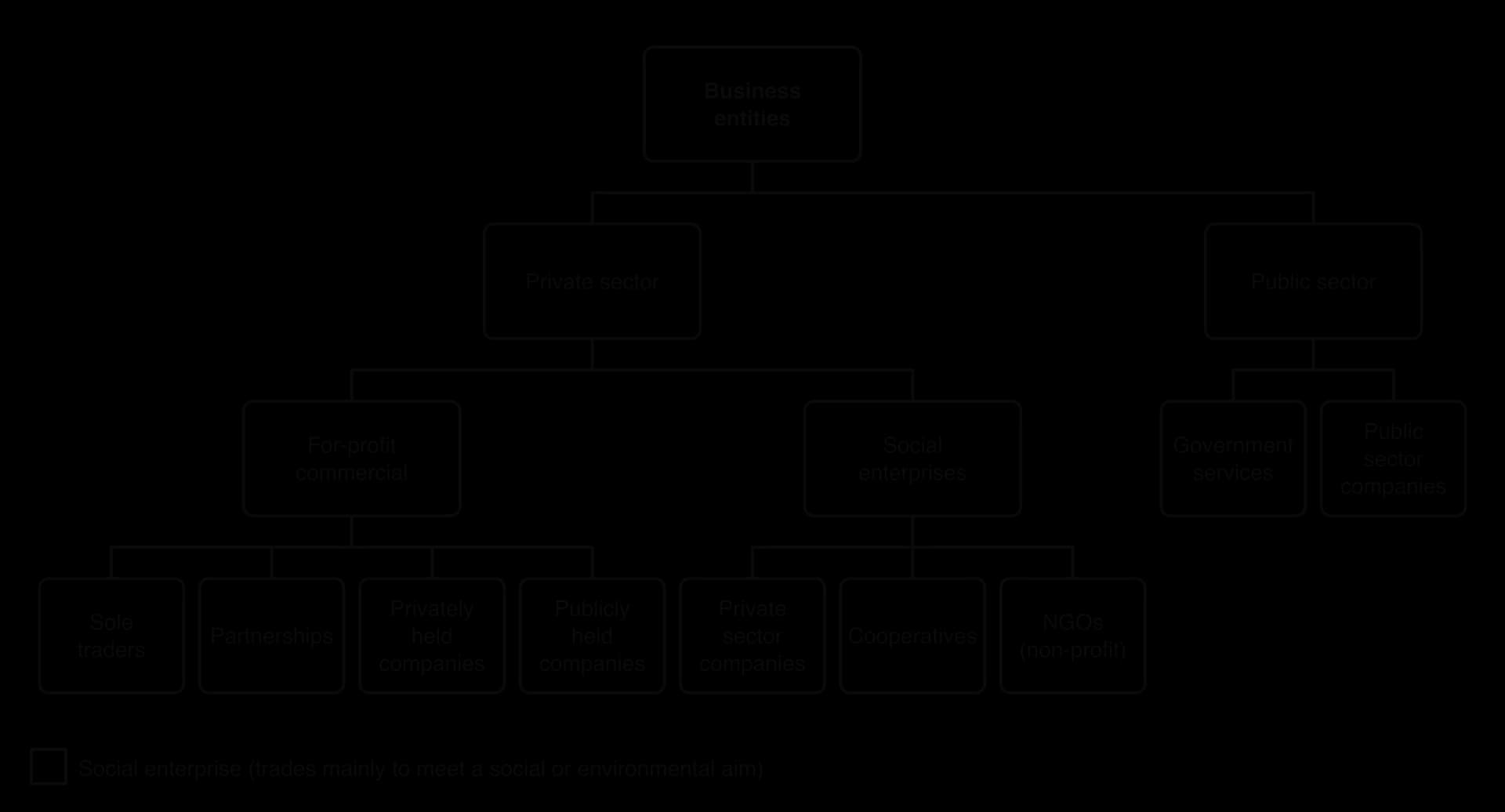
Commercial businesses aim mainly to make a profit for their owners. Social enterprises (shaded) also sell goods or services, but their main aim is social or environmental, and they reinvest most of their profit in that aim. For-profit social enterprises can be private sector companies, public sector companies or cooperatives; non-profit social enterprises are NGOs, which distribute no profit at all.
Liability and incorporation
Two legal ideas separate the simplest forms of business from companies. The first is whether the business is a legal person in its own right. The second is how much of their own money the owners can lose if the business fails.
Unincorporated and incorporated businesses
A sole trader or an ordinary partnership is unincorporated: in law, the business and its owners are the same. The business cannot own property, sign contracts or be sued in its own name; the owners do these things personally. A company is created by incorporation, a legal process of registering the business with the government. The company then becomes a separate legal entity from its owners.
As a separate legal entity, a company can own assets, employ people, borrow, sign contracts, sue and be sued in its own name. It also has continuity: it continues to exist if an owner dies or sells their shares, because the company itself has not changed.
Unlimited and limited liability
Liability is the legal responsibility for the debts of a business. Owners of unincorporated businesses have unlimited liability: if the business cannot pay its debts, the owners must pay them from their personal assets, such as savings, cars and homes. Shareholders in a company have limited liability: they can lose only the money they invested in their shares, because the debts belong to the company, not to them.
Limited liability is available only to the owners of incorporated businesses, because only a separate legal entity can owe debts in its own name.
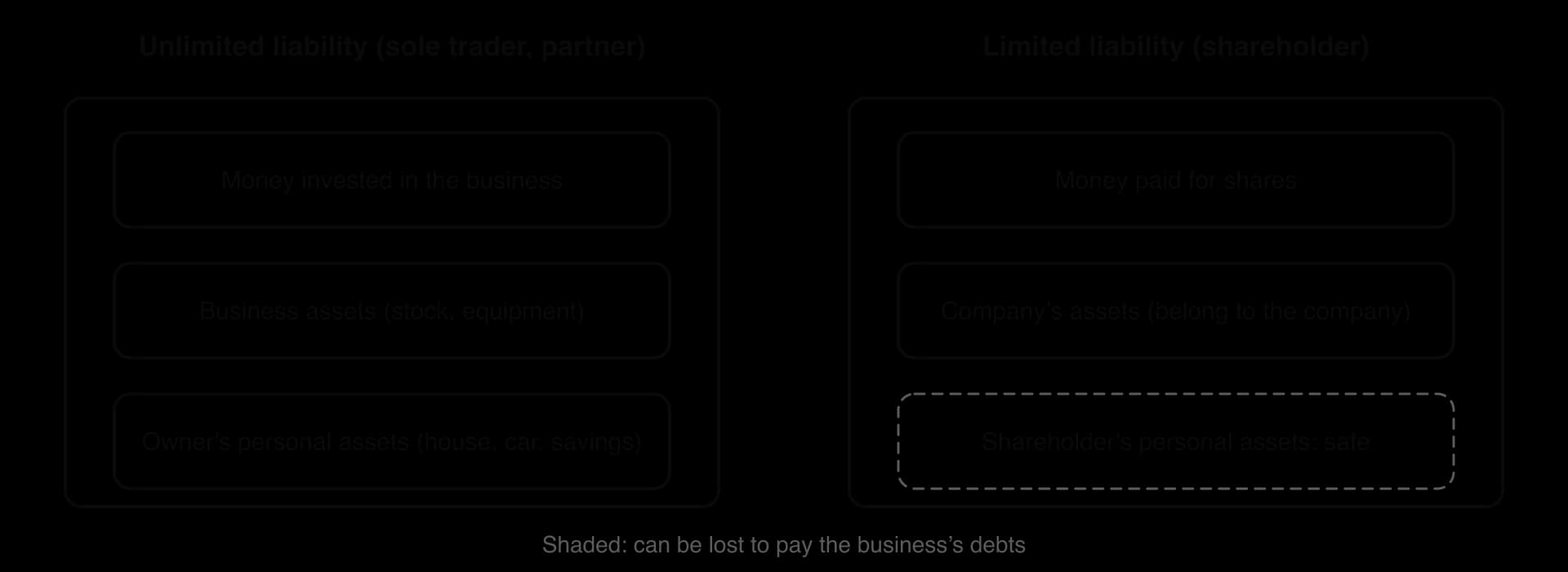
Limited liability makes it much easier to raise finance, because investors know the most they can lose. Without it, few people would buy shares in a company whose managers they do not know, since a single failure could cost them their homes. The protection has a cost for those who deal with the company: suppliers and lenders cannot claim from the owners if it fails, so they often ask the directors of small companies for personal guarantees.
 YouTube
Sole traders
A sole trader (also called a sole proprietor) is a business owned by one person. It is the most common form of business in most countries: plumbers, hairdressers, market traders, photographers, freelance designers, tutors and small shopkeepers often trade in this way. The owner can employ other people; "sole" refers to ownership, not to the number of workers.
Main features of a sole trader
Feature | Sole trader |
|---|---|
Ownership | One person |
Control | The owner makes every decision |
Liability | Unlimited |
Legal personality | Unincorporated: the owner and the business are the same in law |
Sources of finance | Personal savings, family and friends, bank loans and overdrafts, government grants and microfinance; no shares |
Profit | All kept by the owner, who pays personal income tax on it |
Continuity | None: the business ends if the owner dies, retires or stops trading |
Disclosure | Accounts are private, shared only with the tax authorities |
Setting up | Quick, cheap and simple; often only registration for tax and any licences |
Advantages and disadvantages of sole traders
Advantages | Disadvantages |
|---|---|
Easy and cheap to set up, with few legal formalities | Unlimited liability puts the owner's personal assets at risk |
Full control: decisions are quick and flexible | Limited finance, because only the owner's funds and borrowing are available |
The owner keeps all the profit, which is a strong incentive to work hard | Long hours and stress; difficult to take holidays or be ill |
Financial privacy: accounts are not published | The owner may lack skills in some functions, such as marketing or accounts |
Close contact with customers allows personal service | No continuity: the business may end with the owner |
Can be run from home with low costs | Small scale means higher costs per unit than larger rivals |
Being a sole trader suits small, low-risk businesses that need little capital, such as services provided by one skilled person. It becomes less suitable as the business grows, takes on debt or needs investment, because the owner's personal risk rises with the size of the business.
Partnerships
A partnership is a business owned by two or more people, the partners, who share its capital, its decisions and its profits. Partnerships are common in professions such as law, accounting, architecture and medicine, where clients value the experience of several professionals and where professional rules have traditionally limited other forms of ownership.
In an ordinary partnership, every partner has unlimited liability, and each partner is responsible for business decisions made by the others. If one partner signs a contract or runs up debts in the business's name, all partners must pay. Many countries also allow limited partnerships, in which "sleeping" partners invest money but take no part in management, and limited liability partnerships (LLPs), which are incorporated and protect partners' personal assets.
The deed of partnership
Because partners can disagree, they normally sign a deed of partnership, a legal agreement that sets out how the business will be run. Without one, the law of the country applies, which in many places means that profits are split equally whatever each partner invested.
how much capital each partner contributes
how profits and losses are shared (often in proportion to capital invested)
the role, responsibilities and voting rights of each partner
how new partners are admitted and how a partner can leave
what happens if a partner dies or retires
how disputes are resolved
Advantages and disadvantages of partnerships
Advantages | Disadvantages |
|---|---|
More capital than a sole trader, because each partner contributes | Unlimited liability (in an ordinary partnership), including for the decisions of other partners |
Shared skills and specialisation (one partner manages finance, another clients) | Disagreements between partners can slow decisions or end the business |
Shared workload, so partners can take holidays or be ill | Profits must be shared |
Still simple to set up, with financial privacy | Limited finance compared with a company; no shares can be sold to the public |
Partners are motivated because they own the business | Lack of continuity: the partnership may have to be dissolved and re-formed when a partner leaves or dies |
A partnership suits professionals who want to combine their skills and capital while keeping control within a small group. It works best when the partners trust each other and have a clear deed of partnership; disputes between partners are one of the most common reasons why partnerships end.
Companies: shares, shareholders and directors
A company is owned by its shareholders, each of whom holds one or more shares. A share is a unit of ownership: a person who owns 1,000 of a company's 100,000 shares owns 1% of the company. Ordinary shares normally carry one vote each at shareholders' meetings and the right to a share of any profit the company pays out.
Shares can be held by individuals, families, employees, other companies and investment funds such as pension funds. Together, these holders are the owners of the company.
Shareholders receive part of the company's profit as dividends. The directors decide how much of the profit for the period to pay out and how much to keep in the business as retained profit for investment. Dividends are paid per share, so a shareholder with more shares receives more.
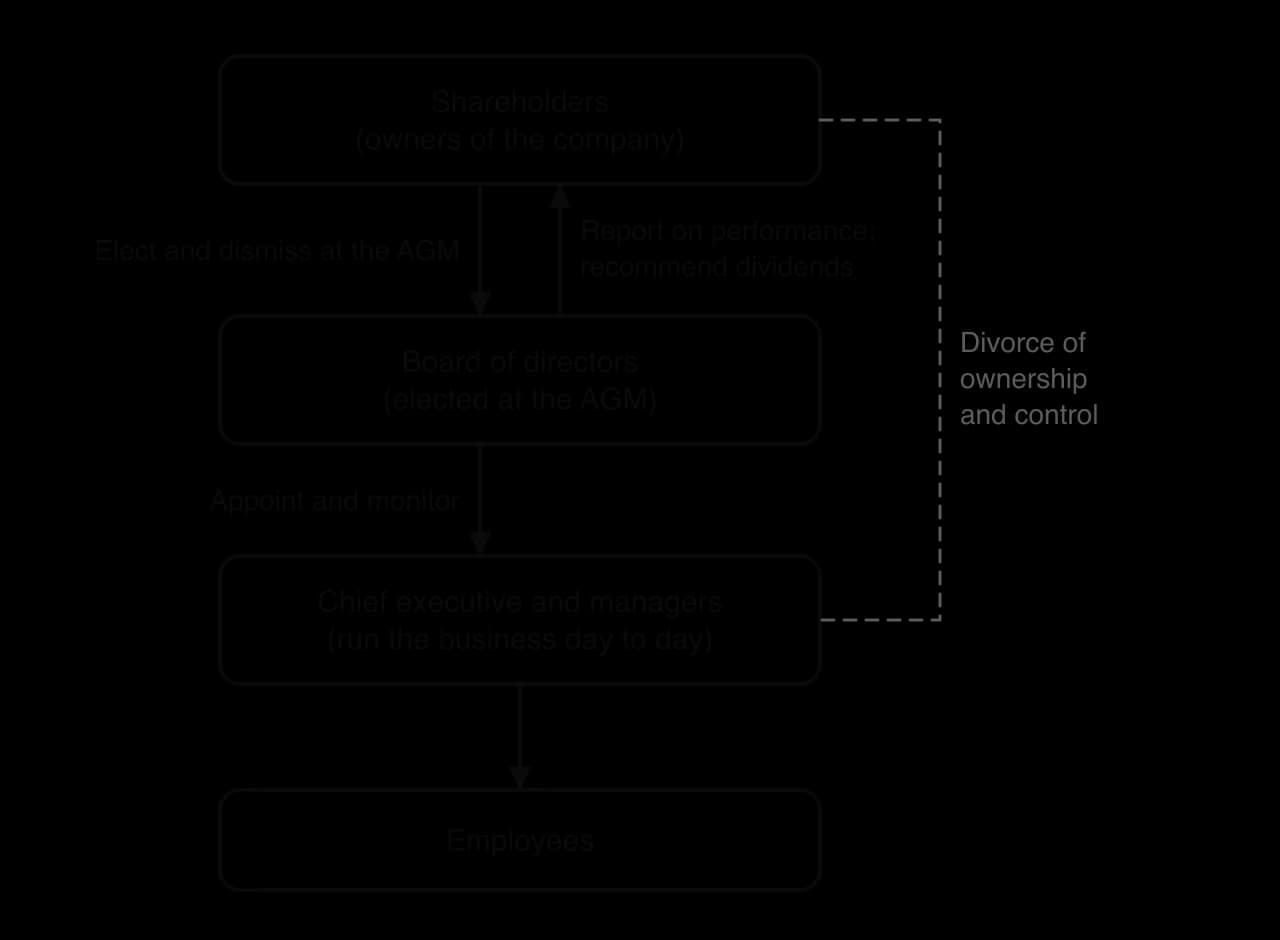
Shareholders do not usually run the company themselves. They elect a board of directors to run it on their behalf. The board sets the company's objectives and strategy, appoints the chief executive and senior managers, and is responsible for the company obeying the law and publishing its accounts.
Shareholders hold the directors to account at the annual general meeting (AGM). At the AGM the directors present the annual report and accounts, and the shareholders vote on matters such as the election of directors, the appointment of the auditors and the final dividend. Each ordinary share usually carries one vote, so large shareholders, such as pension funds or a founding family, have far more influence than small ones.
Privately held companies
A privately held company is a company whose shares are not sold to the general public. Its shares are usually held by the founders, their families, employees or a small number of investors, and they can be sold only with the agreement of the other shareholders. The names differ between countries: "Ltd" (private limited company) in the UK and Hong Kong; "Pvt Ltd" in India; "GmbH" in Germany, Austria and Switzerland; "Pty Ltd" in Australia and South Africa; "Pte Ltd" in Singapore; "Inc." or "LLC" in the United States.
Many small and medium-sized businesses are privately held companies, but some are very large. Mars, Incorporated, the maker of M&M's, Snickers and pet foods, is a privately held company owned by the Mars family. Canva, the Australian design platform, was still privately held in 2026, even though it was valued at US$42 billion in 2025.
Main features of a privately held company
Feature | Privately held company |
|---|---|
Ownership | Shareholders: often a family, founders, employees or a few investors |
Control | A board of directors elected by the shareholders; owners are often also directors |
Liability | Limited |
Legal personality | Incorporated: a separate legal entity |
Sources of finance | Share capital from existing or invited shareholders, retained profit, bank loans, venture capital and business angels; no sale of shares to the public |
Profit | Paid out as dividends or retained; the company pays corporation tax |
Continuity | Yes: the company continues if shareholders change |
Disclosure | Must register and file accounts with the authorities (often in a simplified form for small companies) |
Setting up | Registration with legal documents (such as articles of association); more cost and paperwork than a sole trader |
Advantages and disadvantages of privately held companies
Advantages | Disadvantages |
|---|---|
Limited liability for shareholders, which makes it easier to attract investors | More expensive and complicated to set up and run than a sole trader or partnership |
Continuity, because the company is a separate legal entity | Some accounts must be filed with the authorities and become available to others, including competitors |
More finance than unincorporated businesses, from several shareholders | Shares cannot be sold to the public, which limits the finance available compared with a publicly held company |
Owners keep control, because they choose who may buy shares | Shareholders who want to sell may find it hard to find a buyer |
Protection from hostile takeover, because shares cannot be bought on the open market | Profit is shared among shareholders, and the company pays corporation tax |
Often perceived as more credible than an unincorporated business by banks and suppliers | Banks may still ask directors for personal guarantees, which reduces the benefit of limited liability |
A privately held company suits a growing business whose owners want the protection of limited liability and the ability to bring in some new investors, while keeping control in a small group. It is the usual next step for a sole trader or partnership whose risks or finance needs have grown.
Publicly held companies
A publicly held company (also called a public limited company) is a company whose shares can be bought and sold by anyone, usually on a stock exchange. In the UK their names end in "plc"; equivalents include "AG" in Germany, "SA" in France and Spain, and "Inc." or "Corp." for listed companies in the United States. Most of the world's largest businesses are publicly held, such as Toyota, Nestlé, HSBC and Reliance Industries.
The shares of a publicly held company are usually traded on a stock exchange, which sets strict rules on what listed companies must disclose and how their shares are bought and sold.
A privately held company becomes publicly held through an initial public offering (IPO), also called flotation or going public. It sells shares to investors for the first time, the shares are listed on a stock exchange, and from then on they can be traded freely. The British chip designer Arm Holdings listed on the Nasdaq exchange in New York in September 2023, raising US$4.87 billion; its owner, SoftBank, kept about 90% of the shares.
Money from an IPO goes to the company only when it issues new shares; when existing shareholders sell their own shares, as SoftBank did in the Arm IPO, the money goes to them. After the IPO, shares are bought and sold between investors on the stock exchange, and the company receives nothing from these trades. The share price then reflects what investors think the company is worth.
Main features of a publicly held company
Feature | Publicly held company |
|---|---|
Ownership | Shareholders, who may number in the hundreds of thousands: individuals, pension funds, investment funds, other companies, sometimes governments |
Control | A board of directors elected at the AGM; managers run the business day to day |
Liability | Limited |
Legal personality | Incorporated: a separate legal entity |
Sources of finance | All the sources open to privately held companies plus share issues to the public, large loans and bonds |
Profit | Paid out as dividends or retained; the company pays corporation tax |
Continuity | Yes |
Disclosure | Must publish detailed annual reports and accounts, audited by independent accountants, and report important news to the market promptly |
Setting up | Expensive and slow: the IPO needs banks, lawyers and regulators, and must meet the stock exchange's rules |
Divorce of ownership and control
In a large publicly held company, the thousands of shareholders who own it cannot run it. They elect directors, who appoint professional managers. The owners and the people who control the business are therefore different groups, a situation called the divorce of ownership and control.
The divorce can lead to conflicts of interest. Shareholders usually want high profits and a rising share price. Managers may prefer objectives that benefit themselves, such as growth that raises their status and pay, or a quiet life without risky decisions. Companies try to align the two groups by linking managers' bonuses to profit or the share price, giving managers shares, and having independent directors on the board. These solutions bring their own problems: bonuses tied to the share price can encourage short-term decisions that raise the price this year at the expense of the company's future.
Advantages and disadvantages of publicly held companies
Advantages | Disadvantages |
|---|---|
Access to very large amounts of finance by selling shares to the public | Expensive to float and to meet the stock exchange's continuing rules |
Limited liability and continuity | Detailed public disclosure: competitors can see results and plans |
Shares are easy to buy and sell, so investors are more willing to invest | Risk of a hostile takeover, because anyone can buy shares on the market |
A listing raises the company's profile and status with customers, suppliers and banks | Divorce of ownership and control can cause conflicts between shareholders and managers |
Shares can be used to reward staff or to pay for acquisitions | Pressure from shareholders for short-term results can discourage long-term investment |
Size allows economies of scale and lower costs per unit | Founders lose control as their share of ownership falls |
A takeover happens when one company or investor buys enough shares in another to control it. Because the shares of a publicly held company are on sale to anyone, a buyer can gain control even if the directors oppose it. Royal Mail's parent company, International Distribution Services, was publicly held when EP Group, which had already built up a large stake, bought it in 2025. Privately held companies are protected from this, because their shareholders must agree to any sale of shares.
Comparing the four for-profit forms
The four forms can be compared feature by feature. Moving from left to right, the business gains access to more finance and greater protection for its owners, but the original owners lose control and privacy, and costs rise.
Feature | Sole trader | Partnership | Privately held company | Publicly held company |
|---|---|---|---|---|
Owners | One person | Two or more partners | Shareholders (restricted) | Shareholders (anyone) |
Liability | Unlimited | Usually unlimited | Limited | Limited |
Separate legal entity | No | No (except LLPs) | Yes | Yes |
Control | Owner | Partners | Board, often the owners | Board and professional managers |
Finance | Owner's funds and loans | Partners' capital and loans | Private share capital, loans, venture capital | Public share issues, loans, bonds |
Profit | Kept by the owner | Shared by the deed of partnership | Dividends or retained | Dividends or retained |
Continuity | No | Limited | Yes | Yes |
Disclosure | Private | Private | Some accounts filed | Full published accounts |
Changing legal form
Businesses often change their legal form as they grow. The usual path is from sole trader or partnership to privately held company, and for a few businesses on to publicly held company.
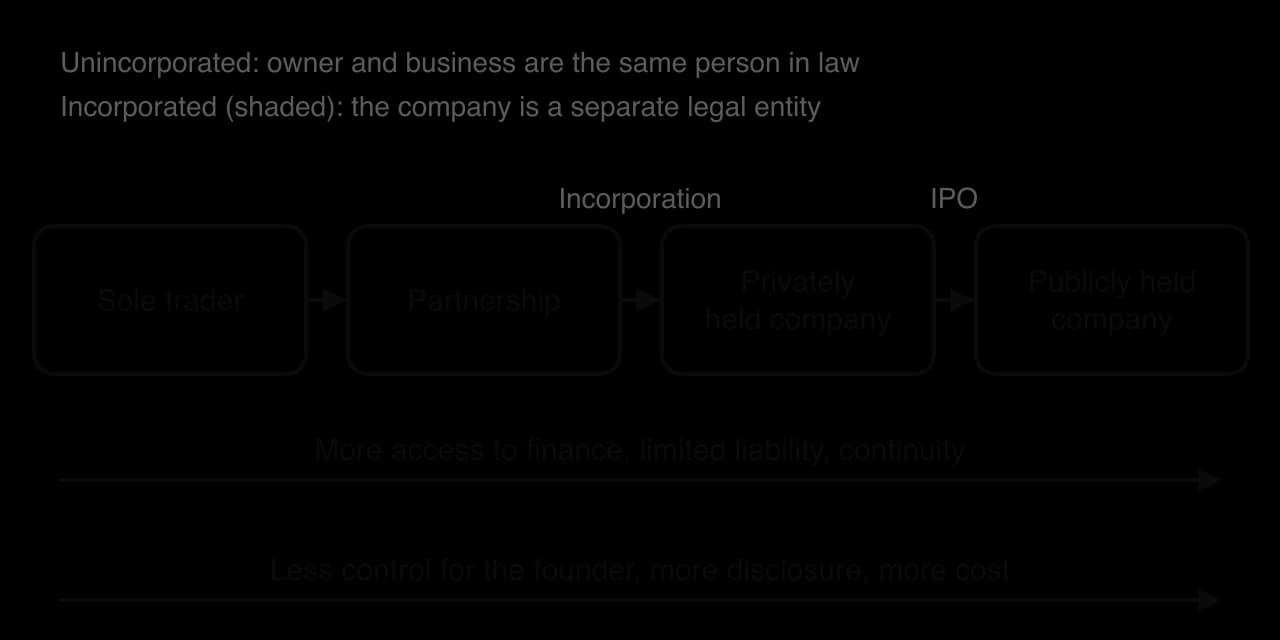
From sole trader or partnership to privately held company
A sole trader usually incorporates when the business has grown enough that unlimited liability is a serious risk: it has employees, large contracts, debts or premises. Incorporation protects the owner's personal assets, gives the business continuity, and lets the owner bring in investors by selling them shares while keeping control. It may also reduce tax, depending on the country. The costs are the extra paperwork, the filing of accounts and some loss of privacy.
From privately held to publicly held company
A privately held company goes public when it needs more finance than its owners and private investors can provide, for example to expand internationally, or when its early investors want to sell their shares. The costs are high: fees for the IPO, continuing disclosure, pressure from shareholders for short-term results, and the risk of a takeover. Many founders decide that these costs are too high. Some large businesses stay privately held for decades, and some publicly held companies are bought by investors and taken private again; SoftBank bought Arm Holdings in 2016, removed it from the London Stock Exchange and listed it again in New York in 2023.
Evaluation: which legal form is most suitable?
No legal form is best in every situation. The most suitable form depends on several factors:
The amount of finance needed. A business that needs little capital can remain a sole trader; one that needs millions must incorporate and may need to go public.
The level of risk. The greater the possible debts, the stronger the case for limited liability.
The owners' wish for control. Founders who want to keep control may prefer a privately held company to a listing.
The size and stage of the business. Forms usually change as the business grows.
The need for privacy. Unincorporated businesses and small private companies publish little; publicly held companies publish a lot.
The type of business and the law. Some professions traditionally use partnerships; tax rules and the cost of registration differ between countries.
Social enterprises
A social enterprise is a business that trades, selling goods or services like any other business, but whose main purpose is to achieve a social or environmental aim. It earns most of its income from sales rather than from donations, and it reinvests most of its profit (or surplus) in its mission rather than paying it to owners.
Social enterprises combine features of commercial businesses and charities. Like a commercial business, a social enterprise must cover its costs from sales, compete for customers and manage its finances carefully. Like a charity, it measures success by the social or environmental good it does. The aims can include employing people who find it hard to get jobs, providing affordable services in poor communities, reducing waste, or paying farmers fair prices.
Social enterprises fall into two groups. For-profit social enterprises may make and distribute some profit, but put their social aims first. Non-profit social enterprises distribute no profit at all: any surplus stays in the organisation.
Private sector companies with a social purpose
Some privately or publicly held companies are set up, or changed, so that a social or environmental purpose comes before profit. They are legally ordinary companies, but their owners commit them to a mission, often written into the company's founding documents. They raise finance from investors who accept lower returns in exchange for social impact (social or "impact" investors), as well as from sales and loans.
One way such companies show their commitment is certification as a B Corp. B Lab, a non-profit organisation, certifies companies that meet its standards of social and environmental performance, accountability and transparency, and certified companies must write their commitment to stakeholders into their governing documents. By March 2025, 9,576 companies in 102 countries had been certified. In France, the food company Danone became in 2020 the first listed company to adopt the legal status of entreprise à mission, which writes social and environmental objectives into its articles of association.
Public sector companies with a social purpose
Some state-owned enterprises trade like businesses but exist mainly to meet a social need. They earn revenue from sales, but the government sets them social objectives, and any surplus is reinvested or returned to the government rather than paid to private owners. Channel 4, a UK television broadcaster, is publicly owned but funded by advertising rather than taxation; it has a public service remit to provide innovative and diverse programmes and reinvests its surplus in content. Many countries run postal services, public transport companies or housing agencies on similar lines.
Public sector social enterprises can provide services that private businesses would find unprofitable, such as post offices in remote villages, while their commercial income reduces the cost to taxpayers. Their weaknesses are those of the public sector generally: less pressure to be efficient, political interference, and the risk that governments cut their funding or sell them when budgets are tight.
Cooperatives
A cooperative is a business owned and run by its members for their mutual benefit. The members are the people who use the business: its workers, its customers or its suppliers. Each member usually has one vote, however much capital they have invested, and the profit (often called the surplus) is shared among members in proportion to how much they have used the business, or reinvested.
Cooperatives follow a set of principles agreed internationally, including voluntary and open membership, democratic control by members, members contributing capital fairly, independence from government, education and training for members, cooperation among cooperatives, and concern for the community. Many register as companies with limited liability, but their governance differs from that of an ordinary company because control depends on membership, not on the number of shares held.
Types of cooperative
Type | Owned by | Purpose | Example |
|---|---|---|---|
Worker cooperative | The people who work in it | Secure jobs and a fair share of the surplus for workers, who elect managers | Mondragon, Spain: a federation of worker cooperatives founded in 1956, with 71,415 workers and revenue of €11.3 billion in 2025 |
Consumer cooperative (retail cooperative) | Its customers | Good-value products and a share of the surplus for members, usually in proportion to their spending | The Co-operative Group in the UK, owned by millions of member-customers; consumer cooperatives in Japan and Switzerland |
Producer cooperative (agricultural cooperative) | Producers, usually farmers | Collective buying, processing and marketing so that small producers gain the bargaining power and scale of a large business | Fonterra, owned by New Zealand dairy farmers, which handles about 30% of world dairy exports; Amul in India |
In a worker cooperative the employees are the owners, so the divorce of ownership and control disappears. At Mondragon, worker-owners vote on the ratio between the highest and lowest pay in each cooperative, which ranges from 3:1 to 9:1 and averages about 5:1, far narrower than in most large companies. In a consumer cooperative the members are customers, who receive a share of the surplus in proportion to what they buy. In a producer cooperative, small farmers who would each have little power against large buyers combine to process and sell their output together.
Advantages and disadvantages of cooperatives
Advantages | Disadvantages |
|---|---|
Democratic control (one member, one vote) gives every member a say | Decision-making can be slow when many members must be consulted or vote |
Members are motivated because they own the business and share the surplus | Hard to raise large amounts of finance: outside investors cannot buy control, and members may have little capital |
Profit is not drained by outside shareholders, so more can go to members, prices or the community | Members may lack management skills and may be reluctant to pay for professional managers |
Small producers gain bargaining power, economies of scale and access to markets | Conflicts between members' short-term interests (higher payments now) and the cooperative's need to invest |
Usually limited liability for members | May grow more slowly than profit-maximising rivals |
Strong links with the community and a reputation for ethical behaviour | The one member, one vote rule may discourage members who invest more |
Cooperatives work best where members have a strong common interest and the business is large enough to give them real benefits, as in agriculture, where thousands of small farmers face a few large buyers. They find it harder to compete in industries that need very large and fast investment, such as technology, where publicly held companies can raise capital more easily.
Non-profit social enterprises: NGOs
A non-governmental organisation (NGO) is an organisation that is independent of government and works for a social, humanitarian or environmental cause without aiming to make a profit for owners. NGOs range from small local groups to international organisations such as Médecins Sans Frontières (Doctors Without Borders), Oxfam, BRAC in Bangladesh and the World Wide Fund for Nature (WWF). They are the main form of non-profit social enterprise.
Many NGOs are registered as charities, a legal status that brings tax advantages, such as not paying tax on income or allowing donors to claim tax relief, in exchange for meeting rules about their purposes and their accounts. A charity must have purposes that benefit the public, such as relieving poverty, advancing education or protecting the environment.
How NGOs are financed
NGOs need income to pay their staff and fund their work. Their main sources are:
Donations from individuals, often regular monthly gifts, and from appeals after disasters.
Grants from governments, international bodies such as the European Union or UN agencies, and private foundations.
Trading income. Many NGOs run businesses whose surplus funds their work, such as charity shops selling donated goods or fees for services.
Legacies and corporate sponsorship. Gifts left in wills and donations or partnerships with companies.
Some NGOs choose their funding to protect their independence. Médecins Sans Frontières receives about 98% of its funding from private donors, so that governments cannot influence where and how it provides medical care in conflicts.
Surplus and governance
When an NGO's income is greater than its spending, the difference is a surplus, not a profit. The surplus is never distributed to owners, because an NGO has no owners in the commercial sense; it stays in the organisation to fund future work or to build reserves.
An NGO is governed by a board of trustees (or a similar board), who are responsible for making sure that it pursues its stated purposes, uses its money properly and obeys the law. Trustees are often volunteers. Large NGOs also employ professional managers and staff, so they face a version of the divorce of ownership and control: trustees, donors and the people the NGO serves may all have different views of what it should do.
NGOs, charities and pressure groups
The three terms overlap. NGO describes independence from government and a non-profit purpose. Charity is a legal status that many NGOs hold. A pressure group is an organisation that tries to influence government policy or business behaviour, through campaigns, lobbying or protest. Many NGOs do both: Oxfam provides aid and also campaigns on inequality, and Greenpeace is mainly a campaigning NGO that does not accept money from governments or companies.
Advantages and limitations of NGOs
Advantages | Limitations |
|---|---|
Can focus entirely on their cause, with no owners demanding profit | Dependent on donations and grants, which fall in recessions or when public attention moves on |
Often trusted by the public, which helps fundraising and volunteering | Fundraising itself is costly; donors may criticise spending on administration |
Tax advantages as charities in many countries | Strict rules limit political activity and trading in some countries |
Can work where governments and businesses do not, such as in conflict zones | May lack the efficiency pressure of a competitive market |
Attract volunteers and motivated staff who share the mission | Hard to measure success, so it is difficult to know whether money is well spent |
Evaluating social enterprises
Social enterprises try to do two things at once: trade successfully and achieve a social aim. This double objective gives them strengths that commercial businesses and charities lack, but it also creates tensions.
Competing financial and social objectives
Every social enterprise must earn enough to survive, but decisions that improve its finances can weaken its mission, and the reverse. A café that employs people recovering from homelessness may need more staff and training than a commercial café, so its costs are higher. If it raises prices to cover them, it loses customers; if it hires fewer such workers, it does less good. Managers must constantly balance the two.
Mission drift
When a social enterprise grows, takes on commercial investors or faces financial pressure, it may slowly move away from its original purpose. This is mission drift.
Microfinance in India shows the risk. SKS Microfinance began in 1997 as a non-profit society lending small sums to poor women in Andhra Pradesh, inspired by Grameen Bank. It created a for-profit company in 2003 and listed on the Bombay Stock Exchange in July 2010, where its shares were heavily oversubscribed. Later in 2010 the state government of Andhra Pradesh investigated microlenders, including SKS, after reports of over-indebted borrowers and aggressive debt collection, and lending in the state collapsed. Critics argued that the pressure to grow and satisfy shareholders had pushed lending beyond what poor borrowers could repay.
Sources: Wikipedia, “SKS Microfinance” (and its cited reports), accessed October 2026.
Reliance on donations and grants
Social enterprises that depend partly on donations or grants are exposed when these fall. In a recession, donations drop just when demand for many social services rises. Earning more income from trading reduces this risk but can shift attention towards activities that sell rather than those that do the most good.
Scale and finance
Social enterprises find it harder than commercial businesses to raise finance for growth. Investors who want high returns are not attracted, cooperatives cannot sell control to outsiders, and NGOs cannot sell shares at all. Many social enterprises therefore stay small, which limits their impact. Some overcome this by joining together, as cooperatives do in federations, or by finding impact investors who accept lower returns.
Strengths of social enterprises | Weaknesses and risks |
|---|---|
Meet social and environmental needs that markets and governments neglect | Higher costs from pursuing social aims, which makes it harder to compete on price |
Earn their own income, so they are less dependent on donations than charities | Mission drift as they grow or take on investors |
Attract customers, staff and partners who share their values (ethics as a source of loyalty) | Difficult to raise large-scale finance |
Profits are reinvested in the community rather than paid to outside owners | Success is hard to measure: social impact has no single number like profit |
Can innovate in ways that commercial businesses and governments do not | Governance can be complicated when members, trustees and managers disagree |
Whether a social enterprise is the best way to tackle a problem depends on the nature of the problem and the market. Where customers will pay for the product, as with fair-trade coffee or recycled goods, trading can fund the mission sustainably. Where those who benefit cannot pay, such as refugees needing medical care, an NGO funded by donations or a public sector service is more suitable. The strongest social enterprises measure their social impact carefully, have governance that protects their mission, and grow only as fast as they can without losing it.
Case study: Amul and the cooperative model
Amul is India's largest dairy brand. It is owned by the Gujarat Cooperative Milk Marketing Federation (GCMMF), which is in turn owned by millions of small dairy farmers in the state of Gujarat. It shows how a cooperative can compete with large private companies while keeping ownership and control with its producer-members.
The cooperative began on 14 December 1946 as the Kaira District Co-operative Milk Producers' Union in Anand, Gujarat. Small farmers, many owning only one or two buffaloes, had to sell their milk to traders and agents who paid low prices. Led by the farmer and activist Tribhuvandas Patel, they formed a union to collect, process and sell their milk themselves.
Verghese Kurien, a dairy engineer who joined in 1949, became its general manager and later led the national programme, Operation Flood, which copied the model across India and helped make it the world's largest milk producer. In 1973 the district unions of Gujarat set up GCMMF to market their products, and the Amul brand was transferred to it.
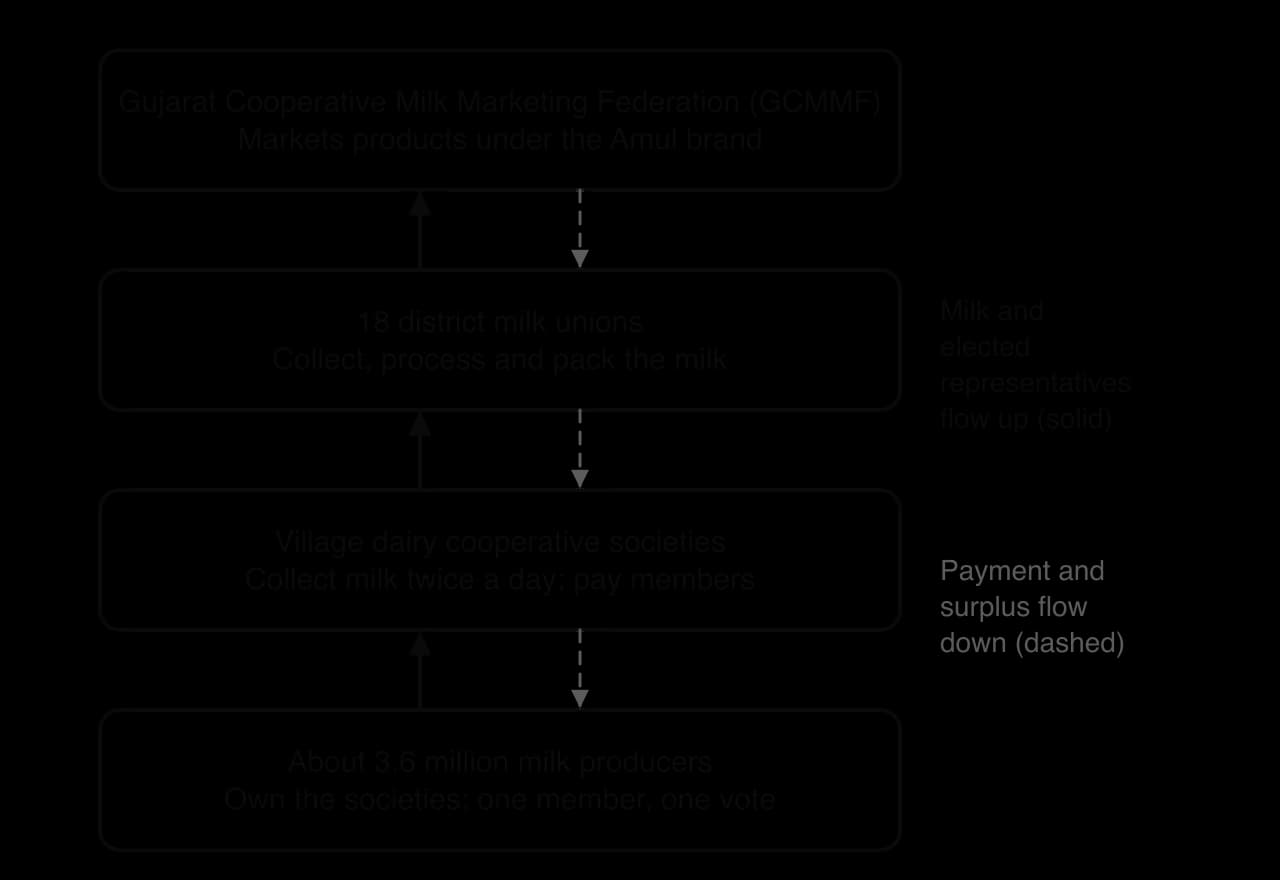
The structure, known as the Anand pattern, has three tiers. At the bottom, village dairy cooperative societies collect milk from members twice a day, test it, and pay them according to quantity and quality. Members elect the society's management committee. The village societies own the 18 district milk unions, which process the milk into products such as butter, cheese, milk powder and ice cream. The district unions own GCMMF, which markets everything under the Amul brand and runs distribution. By 2025 the federation represented about 3.6 million farmers in some 18,600 villages, collecting around 31 million litres of milk a day.
Indicator | 2023/24 | 2024/25 | 2025/26 |
|---|---|---|---|
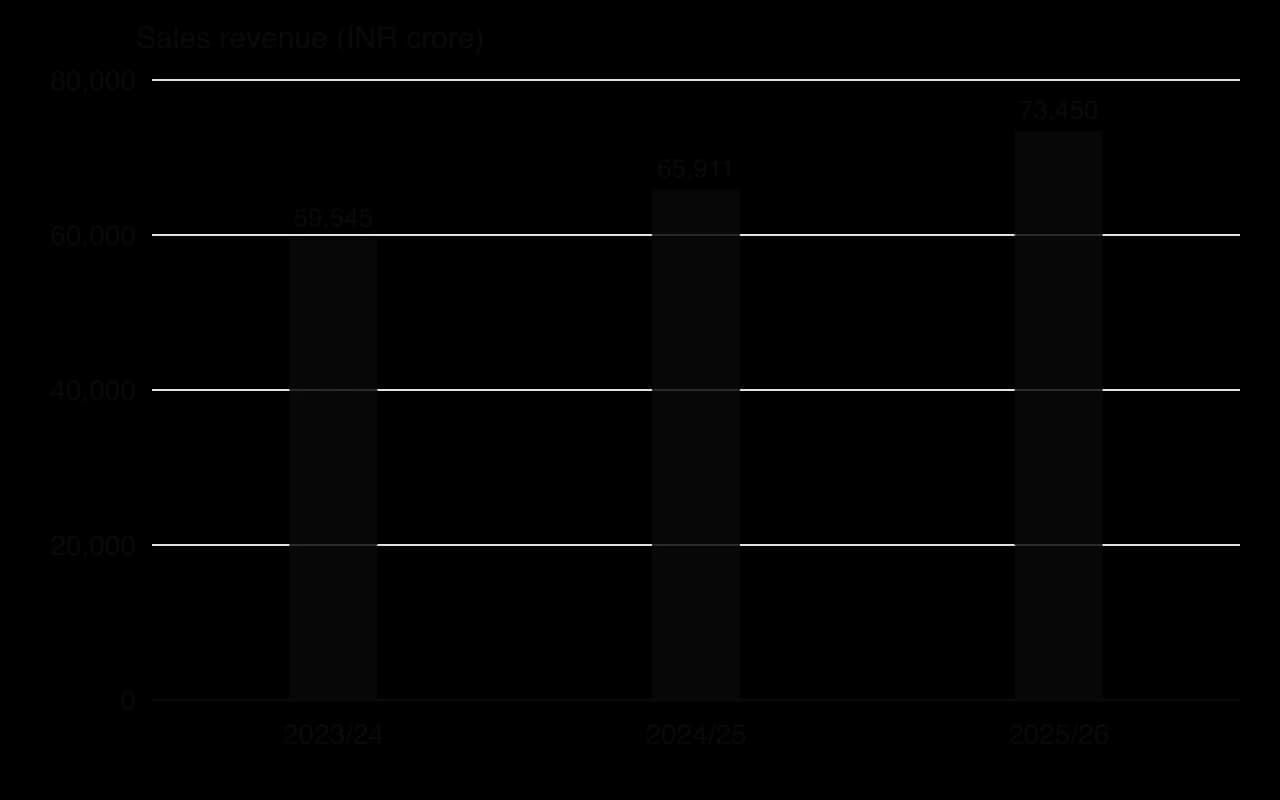
GCMMF sales revenue (INR crore) | 59,545 | 65,911 | 73,450 |
Annual growth | 8% | 10.7% | 11.4% |
Amul brand sales revenue, including the unions (INR crore) | 80,000 | 90,000 | over 100,000 |
Milk producers (members) | 3.6 million | 3.6 million | 3.6 million |
The figures show a large and growing business: GCMMF's sales rose from INR 59,545 crore in 2023/24 to INR 73,450 crore (about US$7.9 billion) in 2025/26, and the sales revenue of the whole Amul brand, including the district unions, passed INR 1 lakh crore (100,000 crore). One crore is ten million, so INR 73,450 crore is INR 734.5 billion.
Amul shows the main features of a producer cooperative. Ownership lies with the farmers who supply the milk, not with outside investors. Control is democratic: members elect village committees, which send representatives to the district unions and on to the federation. The surplus goes back to the producers through the price paid for milk and payments at the end of the year, rather than to shareholders. Combining millions of small producers gives them the economies of scale and bargaining power of a large business: the federation can invest in processing plants, cold chains, a national brand and advertising that no single farmer could afford.
The case also shows the limits of the model. Decision-making passes through three tiers of elected bodies, which can be slow, and elections in large cooperatives can become entangled with local politics. Members want high milk prices now, while the federation needs to keep part of the surplus to invest and to keep consumer prices competitive against private dairies and multinational companies.
Growing beyond Gujarat has needed new structures. In July 2025 the Sardar Patel Cooperative Dairy Federation was launched, registered as a multi-state cooperative, to bring dairy cooperatives from other states into the same model. Most of the figures come from GCMMF's own statements as reported in the press; independent audited accounts for the whole group are less easy to find.
 YouTube
Explain two ways in which Amul's ownership and control differ from those of a publicly held dairy company.
Analyse how the cooperative structure benefits small dairy farmers.
Discuss whether a cooperative is the most suitable form of organisation for Amul as it grows.
Sources: Storyboard18, “Amul’s parent body GCMMF registers Rs 65,911 crore turnover in FY25”, 2 April 2025; DT Next, 29 September 2024; Dairy Business MEA, 9 April 2026; Wikipedia, “Amul”, accessed October 2026.
Exam practice
Types of business entity appear throughout the exams. Section A questions ask for definitions (limited liability, deed of partnership, cooperative), features, and explanations of advantages and disadvantages for the business in the case. Because the statements are at AO3, extended responses can ask whether a business should change its legal form, or evaluate a social enterprise's way of working.
"Distinguish" questions need both items defined and the difference made explicit, ideally with an example.
Summary
The private sector is owned by individuals and groups and usually aims for profit; the public sector is owned by the government and provides public services. Most countries are mixed economies, and privatisation and nationalisation move organisations between the sectors.
Sole traders and ordinary partnerships are unincorporated and have unlimited liability; companies are separate legal entities whose shareholders have limited liability.
Sole traders offer control and simplicity; partnerships add capital and skills, governed by a deed of partnership; both are limited in finance and continuity.
Privately held companies restrict the sale of shares and keep control with a small group; publicly held companies sell shares to the public on a stock exchange after an IPO, gaining finance but facing disclosure, takeover risk and the divorce of ownership and control.
Shareholders own a company, elect the board of directors at the AGM and receive dividends.
Social enterprises trade mainly to meet social or environmental aims; for-profit forms are private sector companies, public sector companies and cooperatives, and the non-profit form is the NGO.
Cooperatives are owned by their workers, customers or producers, with one member, one vote and the surplus shared among members.
Social enterprises face conflicts between financial and social objectives, mission drift, reliance on donations and difficulty growing; the best form depends on the aim, the finance needed and who will pay.
Self-check
- To do:
I can distinguish between the private and public sectors and explain why governments provide some goods and services.
- To do:
I can explain privatisation, nationalisation and the idea of a mixed economy, with a real example of each.
- To do:
I can explain the difference between unlimited and limited liability and why incorporation matters.
- To do:
I can describe the features of sole traders, partnerships, privately held and publicly held companies.
- To do:
I can evaluate each for-profit legal form and recommend a suitable form for a business in a case.
- To do:
I can explain the roles of shareholders, the board of directors and the AGM, and the divorce of ownership and control.
- To do:
I can describe private sector, public sector and cooperative social enterprises, and the three types of cooperative.
- To do:
I can describe how NGOs are financed and governed, and evaluate social enterprises, including mission drift.