Notes on T.12 Porter’s generic strategies
Learning objectives
Explain the meaning of competitive advantage and its two main sources.
Explain the three generic strategies: cost leadership, differentiation and focus (cost focus and differentiation focus).
Construct Porter’s matrix and use it to classify the strategy of a real organisation.
Calculate and compare the profits of a cost leader under different pricing choices.
Explain why a business that is “stuck in the middle” is likely to earn low profits.
Apply Porter’s generic strategies to recommend a competitive strategy for an organisation.
Evaluate Porter’s generic strategies, including the challenge from hybrid strategies.
Introduction
Porter’s generic strategies are a model of the basic ways a business can compete in its market. Michael Porter, a professor at Harvard Business School, set them out in Competitive Strategy (1980) and developed them in Competitive Advantage (1985). The model is built on two questions: will the business compete by having lower costs than its rivals or by offering something different, and will it serve the whole market or a narrow part of it?
The model connects closely to the key concepts. A competitive strategy is a response to change in costs, technology and customer tastes; differentiation depends on creativity; cost leadership raises ethics questions when low costs come from low wages or weak environmental standards; and a growing number of firms differentiate on sustainability.
Competitive advantage
In most markets several firms sell similar products to the same customers. Some of these firms earn much higher profits than others over many years. Porter argued that the difference is explained by competitive advantage: something a business does better than its rivals that allows it to earn profits above the average for its industry.
Porter identified two basic sources of competitive advantage. A business can have lower costs than its rivals, so it makes more profit at the same price, or can afford to charge less. Alternatively, it can offer differentiation: a product that customers see as better or different in a way they value, so they are willing to pay more for it. Both routes lead to above-average profit, but they need very different operations, people and marketing.
A competitive advantage is valuable only if it lasts. An advantage that rivals can copy within months, such as a temporary price cut or a single new feature, gives little lasting benefit. Sustainable advantages are built on things that take time or money to copy: very large scale, a strong brand, patents, skilled staff, an efficient supply chain or an established reputation.
The three generic strategies
Porter called his strategies “generic” because they can be used by any type of business in any industry, from airlines to supermarkets to car makers. Each strategy combines a choice about the source of competitive advantage (lower cost or differentiation) with a choice about the competitive scope (a broad target covering most of the market, or a narrow target such as one segment).
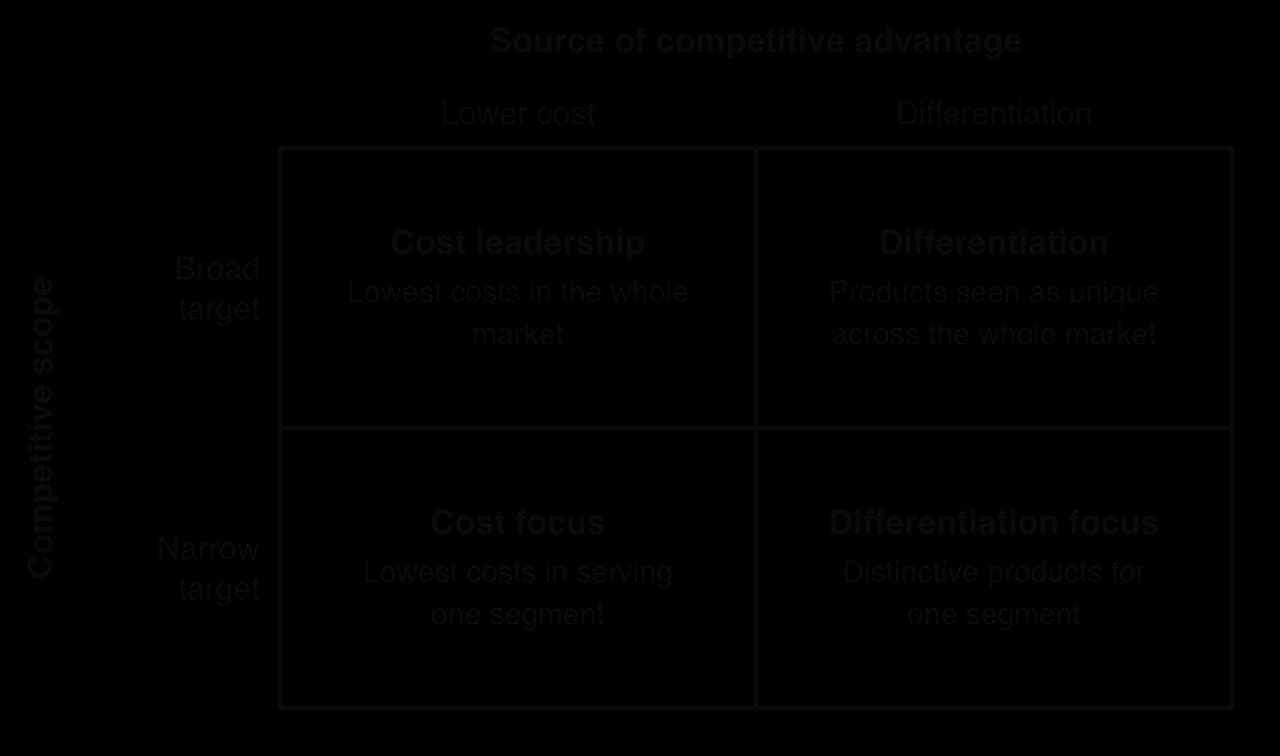
The matrix gives four cells but three strategies, because focus has two forms. For a broad target, a business chooses between cost leadership and a differentiation strategy. For a narrow target, it follows a focus strategy, which can be based on low cost (cost focus) or on differentiation (differentiation focus). Porter’s central argument is that a business must choose clearly. One that tries to do everything, with average costs and an average product for everyone, is likely to end up with no advantage at all.
 YouTube
Cost leadership
A business following cost leadership aims to be the lowest-cost producer in a broad market. It offers a standard product that is acceptable to most customers and keeps every cost as low as possible. Its advantage comes from the gap between its costs and its rivals’ costs, which allows it to earn more profit than they do at any given price.
How cost leaders keep costs low
Scale: very high output brings economies of scale, spreading fixed costs over more units and giving bargaining power over suppliers.
Standardisation: a narrow range of standard products is cheaper to make, stock and sell than many variants.
Efficient processes: simple, repeated processes, automation and high productivity reduce the cost of each unit.
Low overheads: basic premises, few layers of management and minimal spending on anything customers do not value.
Tight control of the supply chain: long-term contracts with suppliers, low stock levels and cheap distribution.
Aldi, the brand name of two family-owned German discount supermarket chains, is a well-known cost leader in grocery retailing. Its stores are known for a no-frills format, a limited range of mainly own-brand products, and usually no more than two other brands for any given item. With more than 13,600 stores in 18 countries, it buys in very large volumes from a small number of suppliers per product.
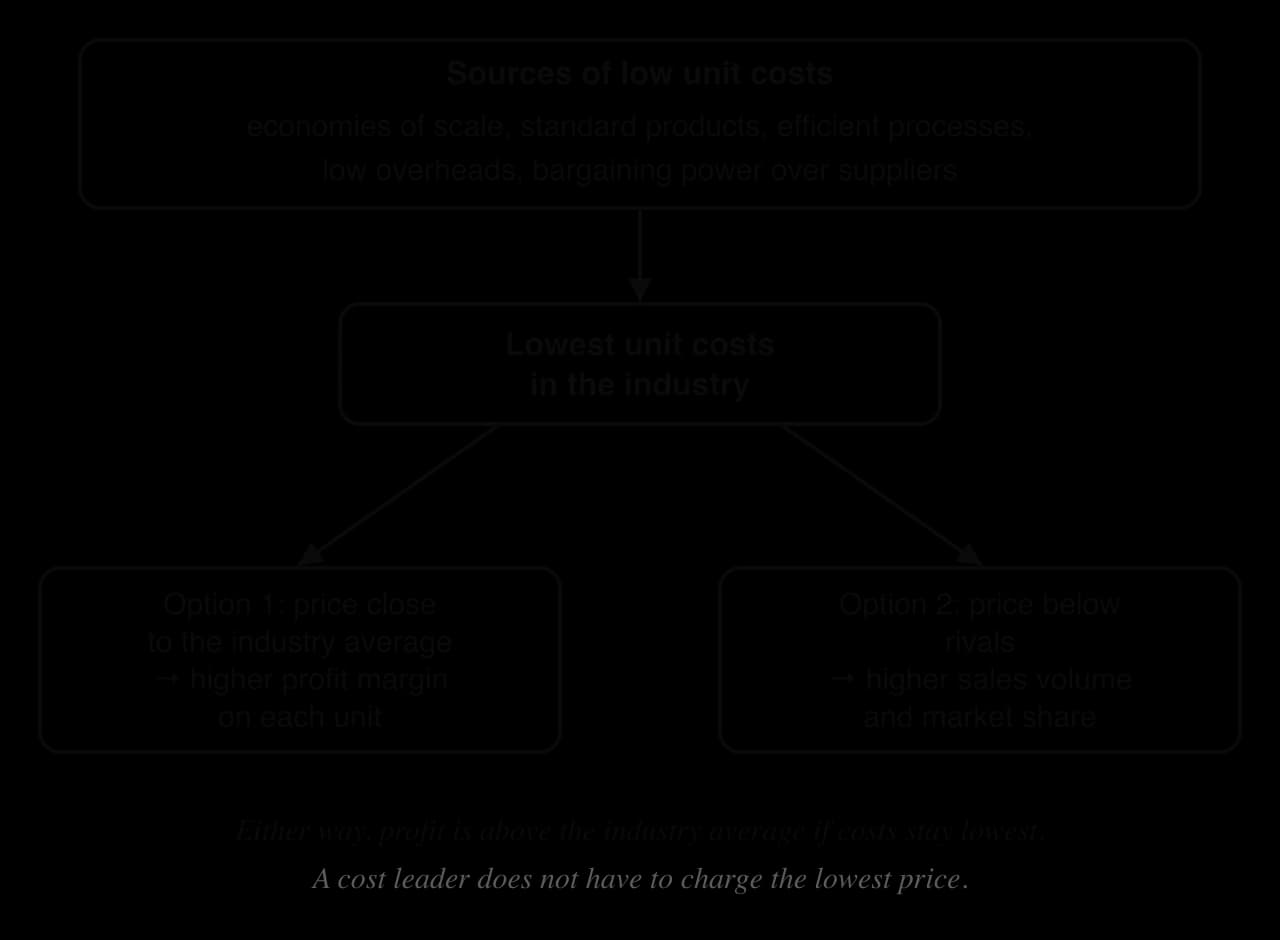
The diagram shows a point that is often misunderstood. Cost leadership is defined by costs; it does not require the lowest prices. A cost leader can charge the same price as its rivals and keep the extra margin as profit, or it can charge less to win customers. Which option it chooses depends on how price-sensitive customers are and how rivals are likely to respond.
Advantages and risks of cost leadership
Advantages | Risks and disadvantages |
|---|---|
Above-average profit at the market price, because costs are lowest. | Rivals may find a way to cut costs too (new technology, cheaper locations), which removes the advantage. |
Ability to win a price war: the cost leader can cut prices further than rivals before making a loss. | Focus on cost may lead to poor quality or service that drives customers away. |
Protection against powerful buyers and suppliers, because a margin remains even if prices are pushed down. | Customers may move towards quality, design or ethics, which a standard low-cost product does not offer. |
High volumes bring economies of scale that make the advantage self-reinforcing. | Large investment in efficient, specialised assets can make it hard to adapt when the market changes. |
A clear message for customers: reliable low prices. | Low costs achieved through low pay or poor conditions can damage reputation and staff motivation. |
Differentiation
A business following a differentiation strategy aims to be seen as unique in a broad market, on features that many customers value. Because customers see no close substitute, they are willing to pay a premium price, and the business earns above-average profit as long as the premium is larger than the extra cost of being different.
The sources of differentiation are the same as those of product differentiation in general: product features and technology, quality, design, branding, customer service, distribution and reputation. As a generic strategy, differentiation means that the whole business is organised around being different: research and development, recruitment and training of staff, the choice of suppliers and the marketing mix all support the unique position.
Singapore Airlines is an example of differentiation in the airline industry. It has built its reputation on service quality, with branding centred on its cabin crew (the “Singapore Girl”), and has been ranked the world’s best airline by the rating agency Skytrax six times. It runs its own low-cost airline, Scoot, as a separate brand, which keeps the two strategies apart.
Advantages and risks of differentiation
Advantages | Risks and disadvantages |
|---|---|
Customers pay a premium price, giving higher profit margins. | The cost of being different (research, quality, service, promotion) may exceed the premium customers will pay. |
Brand loyalty makes demand less sensitive to price and to rivals’ promotions. | Rivals may copy successful features, so the difference shrinks. |
Less direct price competition with rivals. | Customers may decide the difference is not worth the price, especially in a recession. |
A strong brand helps to launch new products and enter new markets. | The business must keep innovating to stay different, which is costly and uncertain. |
Focus strategies
A focus strategy targets a narrow part of the market, such as one market segment, one region or one type of customer, and aims to serve it better than broad-market rivals that try to meet everyone’s needs. The firm gives up the chance of a large share of the whole market in exchange for a strong position in its segment. Focus is the generic strategy most closely linked to a niche market.
Cost focus
A business following cost focus aims to have the lowest costs in serving its chosen segment. It succeeds when the segment has needs that broad-market firms meet in an expensive way, or when serving that segment allows special cost savings.
Dollar General, the largest discount retailer in the United States by number of stores, shows cost focus in practice. It had 20,959 stores at the end of February 2026, about 80% of them in towns of 20,000 people or fewer. Its stores are small, no-frills buildings with low running costs and a focused range, most products cost $10 or less, and consumables such as food and cleaning products made up 82% of its sales in 2025. Large supermarkets find it too costly to open in such small communities, which leaves the segment to Dollar General.
Differentiation focus
A business following differentiation focus offers a distinctive product to a narrow segment whose special needs broad-market firms do not fully meet. Customers in the segment usually pay high prices, so the firm can be profitable on small volumes.
Ferrari is a clear example. It shipped 13,640 cars in 2025, a tiny number by the standards of the car industry, yet earned net revenues of €7,146 million and an operating profit margin of 29.5%. The company deliberately keeps production below demand to protect its exclusivity; its order book in early 2026 extended towards the end of 2027.
Advantages and risks of focus
Focus allows a business with limited resources to compete with much larger firms, because it concentrates its effort where it can be the best. It builds deep knowledge of one group of customers and strong loyalty. The risks come from the narrowness of the market: the segment may shrink or change, broad-market rivals may decide to serve it more closely, and new focused rivals may divide the segment into even smaller niches. A successful focused firm also faces the temptation to grow beyond its segment, which may weaken the specialism that made it successful.
Strategy | Target | Source of advantage | Typical marketing mix | Real example | Main risk |
|---|---|---|---|---|---|
Cost leadership | Broad | Lowest costs | Standard product, low or average price, mass distribution, little promotion beyond price | Aldi; Ryanair | Rivals cut costs too; quality falls too far |
Differentiation | Broad | Uniqueness valued by many | Distinctive product, premium price, strong brand promotion | Singapore Airlines | Premium not worth the cost; imitation |
Cost focus | Narrow | Lowest costs in one segment | Basic product for the segment’s needs, low price, convenient local place | Dollar General | Segment shrinks; broad rivals enter |
Differentiation focus | Narrow | Uniqueness for one segment | Specialised or luxury product, high price, exclusive distribution | Ferrari | Segment too small; tastes change |
The table brings the four cells together. Each strategy needs a marketing mix and operations that are consistent with it, which is why Porter argued that a firm cannot pursue two of them at the same time in the same business without weakening both.
Stuck in the middle
Porter warned that a business which fails to choose a generic strategy, or tries to pursue all of them at once, will be stuck in the middle. Its costs are higher than those of the cost leader, so it cannot compete on price, and its products are less distinctive than those of the differentiators, so customers will not pay a premium. It also lacks the depth of a focused rival in any one segment.
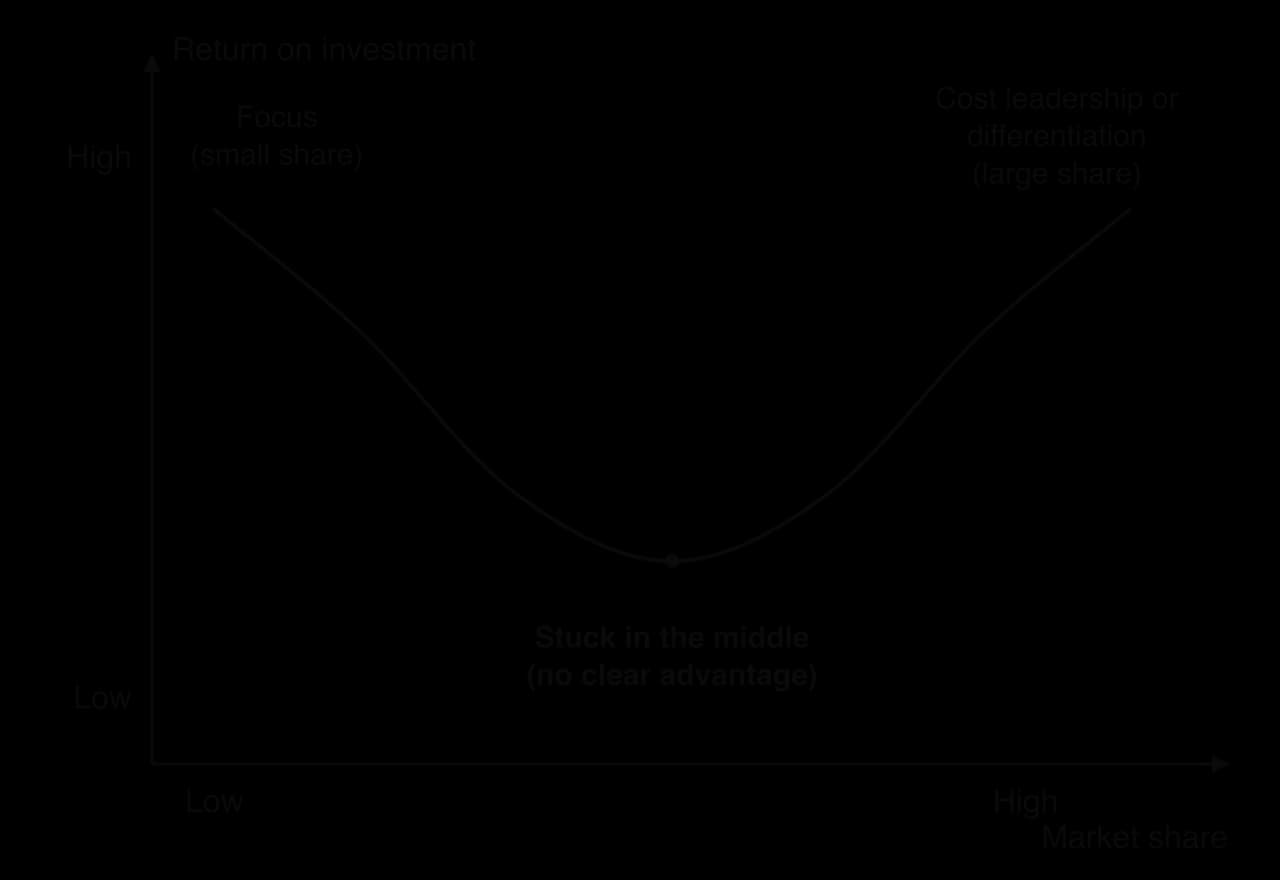
The curve summarises Porter’s argument. Small, focused firms earn high returns because they serve their segments well; large firms earn high returns because their scale supports either the lowest costs or a strong, well-funded brand. Firms with a moderate share and no clear strategy are squeezed from both sides and earn the lowest returns.
Debenhams, a British department store chain that traded for 243 years, is often described as a business that became stuck in the middle. It faced discount and online retailers on price, and specialist and premium retailers on distinctiveness, with high costs from its large stores.
Debenhams entered administration in April 2019 and again in April 2020; its brand and website were bought by the online retailer Boohoo for £55 million in January 2021, and its remaining stores closed in May 2021 with the loss of up to 12,000 jobs. Many factors contributed, including heavy debt and the pandemic, so the case shows the danger of an unclear position rather than proving that it was the only cause.
Hybrid strategies
Many businesses today seem to combine low cost and differentiation successfully, which challenges Porter’s claim that the two cannot be pursued together. A hybrid strategy offers customers good value: prices lower than the premium brands, with quality, design or features better than the cheapest rivals.
Uniqlo, the Japanese clothing retailer, combines elements of both strategies. It controls every stage from product planning and materials to production, distribution and its own stores, which keeps costs low and prices moderate. It differentiates on function and fabric technology, with ranges such as Heattech and AIRism developed with the materials company Toray, under the idea of “LifeWear”: simple, high-quality everyday clothing. In May 2026 it had 2,529 stores worldwide.
Hybrid strategies are possible for several reasons. Some sources of differentiation also reduce costs: high quality means fewer returns and less waste, and a strong brand lowers the cost of winning customers. Lean production methods and modern technology can cut costs without reducing quality. Very large scale can pay for both low prices and heavy investment in design or innovation. Porter accepted that a firm can sometimes achieve both at once, for example after a major innovation that rivals cannot yet copy, but argued that such positions are usually temporary.
Applying Porter’s generic strategies
The tool is used in two ways: to analyse the strategy a business is currently following, and to help choose a strategy for the future. In both cases the analysis follows a sequence of questions.
Define the market and its segments. Which customers does the business serve, and how do their needs differ? (Market segmentation provides the answer.)
Identify the source of advantage. Are the business’s costs lower than rivals’? Do customers see its products as different and pay more for them? Look for evidence: prices compared with rivals, profit margins, unit costs, customer ratings, brand strength.
Identify the scope. Does the business serve most of the market or one segment?
Place the business in a cell of the matrix, and check that its operations and marketing mix are consistent with that strategy.
Compare with rivals. Is another firm already the cost leader or the clear differentiator? A business can hold an advantage only if no rival does the same thing better.
Judge whether the advantage can last, and whether the business is at risk of being stuck in the middle.
Porter’s generic strategies are often used alongside other tools. The table shows the main links.
Tool or concept | How it works with Porter’s generic strategies |
|---|---|
SWOT analysis | Strengths such as low costs or a strong brand show which generic strategy the business can support; threats show what could remove the advantage. |
STEEPLE analysis | External changes (new technology, rising wages, tariffs, consumer attitudes) can make one strategy easier or harder to sustain. |
Ansoff matrix | Ansoff shows where a business will grow (markets and products); Porter shows how it will compete there. |
Position map | A map of price against quality shows whether customers see a firm as a low-cost, differentiated or stuck-in-the-middle brand. |
Break-even analysis | A cost leader’s lower variable costs give a higher contribution per unit and a lower break-even quantity at any price. |
Operations management | Cost leadership depends on mass production, productivity and lean methods; differentiation depends on quality, design and research and development. |
Limitations of Porter’s generic strategies
Porter’s model is one of the most widely taught frameworks in business strategy, because it is simple and forces managers to make a clear choice. It also has important limitations, which need to be explained whenever the tool is applied.
Hybrid strategies work. Many successful firms combine low cost and differentiation, which contradicts the warning that firms must choose one.
Classification is subjective. Whether a firm is “differentiated” or “low cost” depends on the market definition and on judgement; two analysts may place the same firm in different cells.
Data are hard to obtain. Rivals do not publish their unit costs, and perceptions of differentiation change; the evidence used to place a firm is often incomplete or comes from the firm itself.
It is static. The model describes a position at one time, but technology and tastes change, and a strategy that worked for decades can be overtaken quickly.
Only one cost leader. In any market only one firm can have the lowest costs, so the strategy is unavailable to most firms.
Industry focus. The model was developed for single-industry businesses; large firms with many divisions may follow different strategies in each, as Singapore Airlines does with Scoot.
It ignores ethics and sustainability. Low costs achieved through poor working conditions or environmental damage may give a short-term advantage but long-term risk.
The usefulness of the tool depends on how it is used. As a way of asking “what is our advantage, and for which customers?”, it is valuable for almost any business, including small firms and social enterprises. As a rigid rule that firms must never combine low cost and differentiation, it is less reliable. The most convincing analysis uses the matrix to frame the discussion, supports each placement with evidence, and then asks whether the advantage can be sustained.
Case study: Ryanair and the limits of cost leadership
Ryanair Group, an airline group based near Dublin in Ireland, is the clearest example of cost leadership in European aviation. In its 2026 financial year (to 31 March 2026) it carried 208.4 million passengers on more than 2,600 routes to 235 airports, with a fleet of 647 aircraft and about 30,000 staff. Total revenue was €15,544 million and profit after tax €2,174 million. The company describes itself as a low-fare, low-cost airline serving short-haul, point-to-point routes.
Ryanair’s business model follows the logic of cost leadership closely. It flies mainly one aircraft type, the Boeing 737, which reduces the cost of training, maintenance and spare parts. Point-to-point routes avoid the cost of transferring passengers and bags between flights. Short turnarounds of about 25 minutes and high aircraft use spread fixed costs over more flights.
More than 80% of tickets are sold through its own website and app, which avoids travel agents’ commissions, and passengers check in online, which reduces airport staff and facilities. Where possible, the airline negotiates low charges with airports that want to grow traffic, and it closes bases where costs rise sharply, as it announced for Berlin from October 2026.
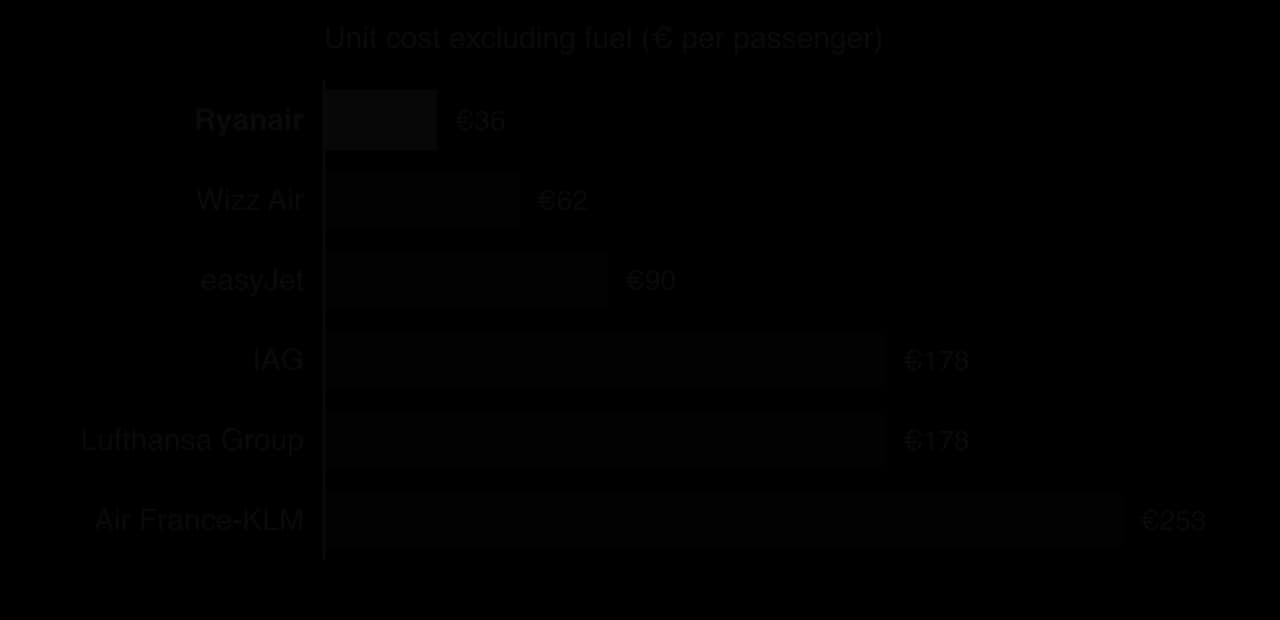
The chart shows the size of the cost gap. Excluding fuel, Ryanair’s cost per passenger was €36, compared with €62 for Wizz Air, another low-cost airline, €90 for easyJet and between €178 and €253 for the large network airline groups. Ryanair uses this gap mainly to charge low fares: its average fare in fiscal 2026 was €50.66. It also earns ancillary revenue (€23.94 per passenger) from optional extras such as checked bags, priority boarding and reserved seats, which made up 32% of total revenue. Charging separately for extras keeps the basic fare low while allowing customers who want more to pay for it.
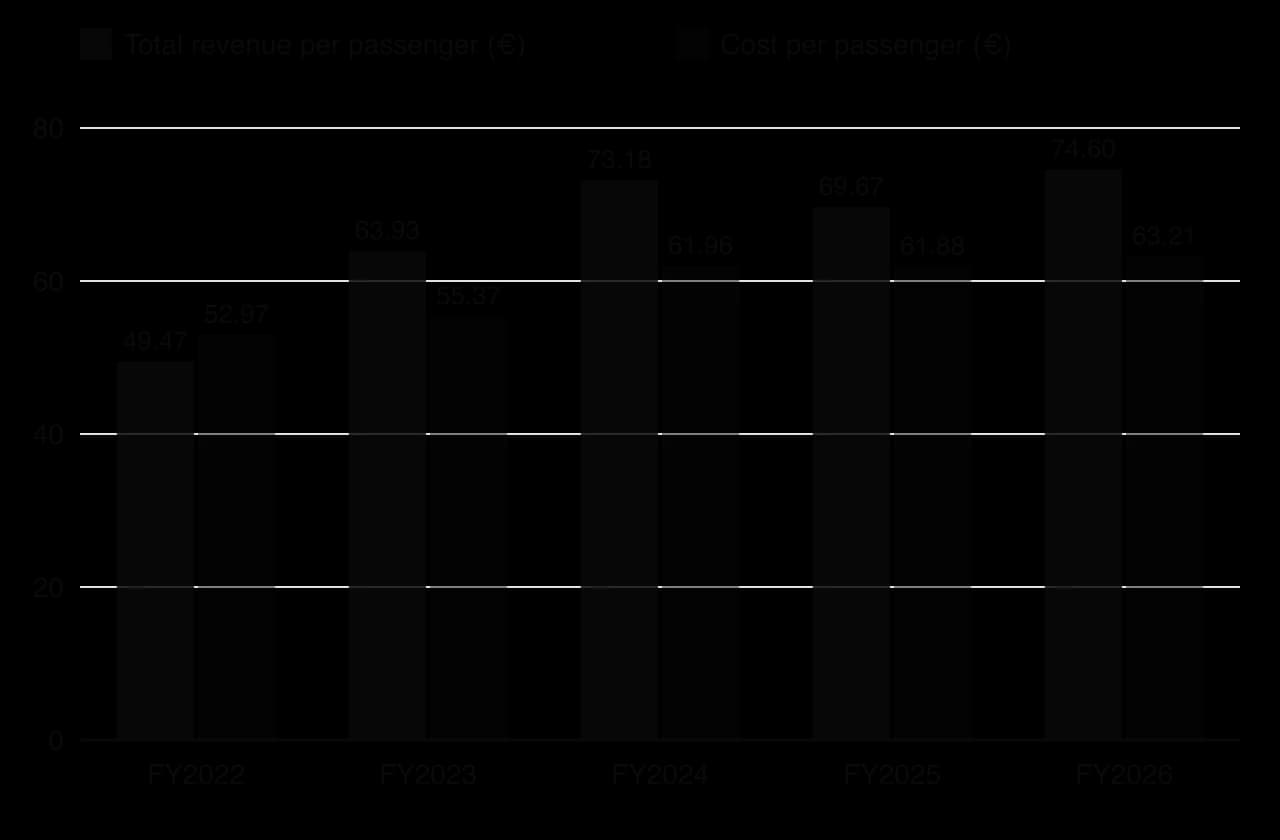
The second chart shows how thin the margin on each passenger is. In fiscal 2026, revenue per passenger was €74.60 and cost per passenger €63.21, a gap of €11.39, or about 15% of revenue. The company’s chief executive described its record profit as “just €10.80 per passenger”. A cost leader in a price-sensitive market depends on very high volumes: Ryanair filled 94% of its seats, while it needed about 80% to break even. A small fall in load factor or a sharp rise in fuel prices can wipe out much of the profit, which is why it hedges most of its fuel a year ahead.
The case also shows the limits of the strategy. Cost leadership does not mean ignoring customers. In 2013 Ryanair launched its “Always Getting Better” programme to improve customer service, and since then it has flown to more primary airports, which have higher charges. By fiscal 2026 it reported record customer satisfaction scores of 89% and 80% of flights on time. A cost leader still has to offer a level of quality that customers accept. Its advantage also depends on factors outside its control, including airport and air traffic control charges, environmental taxes and aircraft deliveries from Boeing.
Porter’s model explains much of Ryanair’s success: a clear choice of a broad, price-sensitive market and close control of unit costs. It explains less well how Ryanair raised customer satisfaction while keeping its cost gap, which looks closer to a hybrid approach. The evidence also has limits. The cost comparison was prepared by Ryanair itself, rivals measure costs in different ways, and the network airlines carry long-haul and business passengers that Ryanair does not serve, so the gap overstates the difference on identical routes.
Sources: Ryanair Group, Annual Report 2026 (financial summary, chairman’s report, Group CEO shareholder letter, strategy section and selected operating data).
Explain two ways in which Ryanair’s operations support its strategy of cost leadership.
Using the data, explain why Ryanair’s profit is very sensitive to changes in load factor and fuel prices.
To what extent is Ryanair a pure cost leader rather than a business following a hybrid strategy?
Exam practice
Porter’s generic strategies appear in HL Paper 2 and in Paper 3, and can support any extended answer on strategy, growth or marketing. Questions ask students to define a strategy, explain or apply it to the case, complete or construct the matrix, use data on costs and prices, or recommend a strategy.
In Paper 3, the tool can help to frame a social enterprise’s plan, because many social enterprises compete with larger commercial firms by serving a narrow segment better.
Summary
Competitive advantage allows a business to earn above-average profits, through lower costs or valued differentiation.
Porter’s generic strategies combine a source of advantage (lower cost or differentiation) with a scope (broad or narrow target).
Cost leadership means the lowest costs in a broad market; the leader can price at the market level for higher margins or below rivals for higher volume.
Differentiation means being seen as unique across a broad market, so customers pay a premium that exceeds the extra cost.
Focus serves a narrow segment, through cost focus or differentiation focus.
A firm with neither the lowest costs nor a valued difference is stuck in the middle and usually earns low profits.
Hybrid strategies, subjective classification, limited data and change in markets are the main limitations of the model.
Self-check
- To do:
I can explain what competitive advantage is and its two main sources.
- To do:
I can explain cost leadership, differentiation, cost focus and differentiation focus, with a real example of each.
- To do:
I can construct Porter’s matrix with both axes labelled and place a real organisation in it, with evidence.
- To do:
I can calculate and compare a cost leader’s profit at different prices.
- To do:
I can explain why a business that is stuck in the middle is likely to earn low profits.
- To do:
I can apply the model to recommend a competitive strategy for a business, using data from a case.
- To do:
I can evaluate Porter’s generic strategies, including the challenge from hybrid strategies.