 YouTube
Explain how goals improve motivation and performance, distinguish outcome, performance and process goals, apply SMART goals and goal ladders and, at HL, explain the goal-setting paradox, goal adjustment and open goals.
Each is in the SEHS glossary, with every other term in the subject.
A non-specific goal in which the individual is simply asked to try as hard as possible, with no defined target or standard of performance.
The regular review and modification of goals, by raising, lowering, re-timing or replacing them, in response to progress, setbacks or changed circumstances, so that they stay challenging, achievable and meaningful.
A sequence of progressively harder short-term goals, arranged like the rungs of a ladder, that lead step by step to a long-term goal.
A psychological skill in which an individual sets specific targets to work towards, in order to direct attention, increase motivation and improve performance or behaviour in sport, exercise or health.
The finding that individuals who set harder goals tend to perform better but feel less satisfied with their performance, because a harder goal raises the standard needed for satisfaction; elite athletes may feel deflated after success.
A self-referenced goal that focuses on improving one’s own performance or the technique and strategy used, rather than on beating others; it includes performance goals and process goals.
A goal to be achieved over a long period, usually months or years, that gives overall direction to training or behaviour change.
Outline what goal setting is and why it is used in sport, exercise and health.
Explain how goals improve performance by directing attention, mobilising effort, increasing persistence and prompting new strategies.
Distinguish between outcome goals and learning-focused goals (performance goals and process goals), and between short-term and long-term goals.
Apply SMART principles and a goal ladder to write a goal set for an athlete, an exerciser or a patient in rehabilitation.
Explain why the effectiveness of each goal type depends on the individual and their achievement motivation.
Evaluate goal setting using research evidence.
Explain the goal-setting paradox and why goal adjustment is considered more important than goal setting (HL).
Evaluate when do-your-best and open goals may be more effective than specific goals (HL).
Goal setting is one of the most widely used psychological skills in sport and exercise. A goal gives a person something specific to aim for, focuses attention on what matters and helps them keep going when progress is slow. Coaches use goals to structure a season, physiotherapists use them to guide rehabilitation, and health professionals use them to help inactive people become active.
Goal setting serves both lenses of the course. For performance, a sprinter’s plan to improve block starts or a team’s target to win more second balls turns a long-term ambition into daily work. For health, a goal such as walking 30 minutes on five days a week helps an inactive adult build a habit, and a staged set of goals keeps a patient motivated through months of recovery after a knee operation.
With a free account, Augment remembers where you stopped and what you have practiced.
A non-specific, exploratory goal with a measurable activity but no fixed target, such as seeing how far one can walk in 30 minutes, so that any result counts as an outcome rather than a failure.
A norm-referenced goal that focuses on the result of a competition compared with other people, such as winning, finishing in a certain place or being selected.
A self-referenced goal that specifies a measurable standard representing an improvement on the individual’s own previous performance, independent of other competitors.
A self-referenced goal that focuses on the technique, strategy or behaviour needed to perform a skill well, such as keeping the head still during a putt.
A goal to be achieved in the near future, usually within days or weeks, that acts as a step towards a long-term goal and provides frequent feedback and success.
A practical aid for writing goals, in which each goal is specific, measurable, achievable, realistic and time-bound; SMARTER adds evaluate and re-adjust.
Scope: C.5.1 covers what goal setting is, how goals improve motivation and performance, outcome, performance and process goals, and how their effectiveness depends on the individual. HL students also study the goal-setting paradox, goal adjustment, and do-your-best and open goals.
A goal is a target or standard that a person tries to reach, usually within a set time. Goal setting is the process of choosing such targets deliberately and using them to guide behaviour. In sport psychology it is part of psychological skills training, alongside imagery, self-talk and relaxation.
Goal setting is closely linked to motivation, the internal and external forces that direct, energise and sustain behaviour. A goal gives motivation a direction (what to do) and an intensity (how hard to try). It also links to attention, because a clear goal tells the performer which information to focus on and which to ignore.
YouTubeMost of the research on goals comes from goal-setting theory, developed over several decades by the psychologists Edwin Locke and Gary Latham, first in work settings and later in sport and exercise. Its central finding is that specific, challenging goals lead to higher performance than vague goals or no goals, as long as the person is committed to the goal and receives feedback on progress. Locke and Latham describe four mechanisms through which goals affect performance.
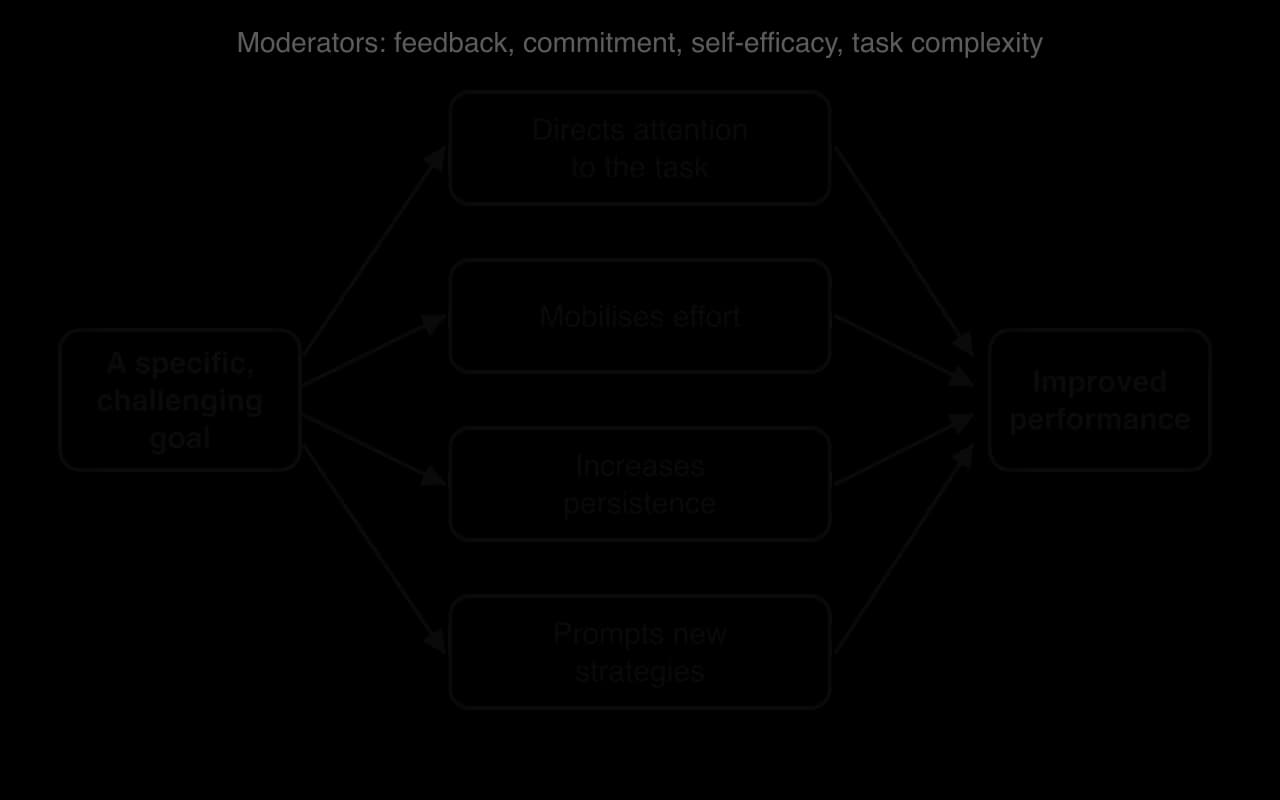
Goals direct attention. A goal focuses attention and effort on activities relevant to the goal and away from irrelevant ones. A tennis player with a goal of 70% first serves in plays every service game thinking about the serve routine rather than the score.
Goals mobilise effort. Harder goals lead to more effort than easy ones. A cyclist chasing a target power output on an ergometer pushes harder than one told simply to ride.
Goals increase persistence. A goal makes people continue for longer, especially when the task becomes difficult or boring. A rower aiming to complete every interval in a session keeps going in the last, painful repetitions.
Goals prompt new strategies. When the current approach is not enough to reach a goal, people search for new methods. A basketball player who cannot reach a free-throw target may change the pre-shot routine or the shooting technique.
Several factors moderate these effects, meaning they make goals more or less effective. Feedback is essential: a person cannot adjust effort or strategy without knowing how they are progressing, so goals combined with feedback work better than goals alone.
Commitment matters: a goal that the athlete does not accept or value has little effect, which is why goals set with the athlete, rather than imposed, are usually more effective. Self-efficacy, a person’s belief that they can succeed at a specific task, increases commitment and the choice of harder goals. Task complexity matters too: for simple tasks, a hard goal improves performance almost directly; for complex tasks that are still being learned, the athlete first needs to find the right strategy.
Sources: Locke and Latham, American Psychologist, 2002.
Goals differ in what they ask the athlete to achieve and in how much the athlete controls whether they are achieved. The main distinction is between outcome goals, which focus on the result of a competition, and learning-focused goals, which focus on the athlete’s own improvement. Learning-focused goals are of two kinds: performance goals and process goals.
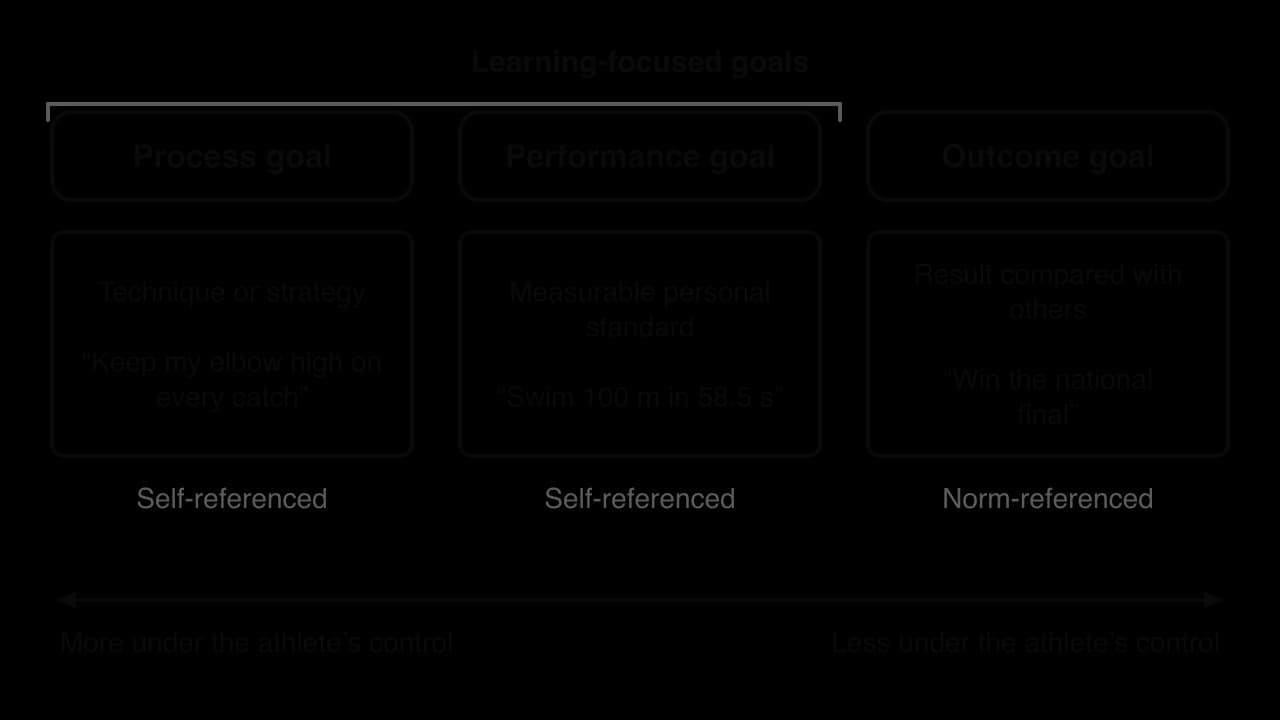
Outcome goals are norm-referenced: success is judged by comparison with others. “Win the league”, “finish in the top three at the national championships” and “be selected for the national squad” are outcome goals. They are objective and easy to measure, and many athletes find them highly motivating, especially in the long term.
Their weakness is that they depend partly on factors outside the athlete’s control: the opponents’ performance, the officials, the weather and luck. A swimmer can swim a personal best and still finish fourth; another can swim badly and win because the main rivals are absent. Relying only on outcome goals can increase anxiety before competition, because the athlete worries about things they cannot control, and can reduce motivation after a defeat even when performance was good.
Learning-focused goals are self-referenced: success is judged by comparison with the athlete’s own previous standard. They keep attention on the parts of performance that the athlete can control and improve.
Performance goals set a measurable target that improves on the athlete’s previous performance: “run 800 m in 2:05”, “score 85% of free throws in matches this month”, “increase my squat one-repetition maximum from 80 kg to 90 kg”. They are more controllable than outcome goals, because the swimmer can achieve a personal best regardless of who else is in the race, and they give clear feedback on progress.
Process goals focus on how a skill is performed: “keep my head still through the putt”, “drive my arms on the bend”, “communicate with my defender at every set piece”. They are the most controllable type of goal, because they concern actions rather than results. They are also the most useful during performance itself: a process goal gives the athlete a single cue to focus on, which can prevent attention from narrowing on to worries about the result.
Feature | Outcome goal | Performance goal | Process goal |
|---|---|---|---|
Referenced to | Others (norm-referenced) | Self (own previous standard) | Self (own technique or strategy) |
Example: 100 m swimmer | Win the national final | Swim 100 m freestyle in 58.5 s | Keep a high elbow on every catch |
Example: footballer | Win the cup | Complete 85% of passes in a match | Check my shoulder before receiving the ball |
Control by athlete | Low | Moderate to high | High |
Main strength | Highly motivating; clear and objective | Measurable; shows improvement | Directs attention during performance; reduces anxiety |
Main limitation | Depends on others; can increase anxiety | May still be affected by conditions (wind, pool, opponents’ tactics) | May seem unrelated to success unless linked to performance |
Best time to use | Long-term, away from competition | Training cycles and before competition | During training and performance |
The three types work best together, as a chain. The outcome goal gives long-term direction and motivation; performance goals translate it into measurable standards that would make the outcome likely; and process goals specify what to do in training and competition to reach those standards. Sport psychologists often advise athletes to set outcome goals but to focus on process goals on the day of competition.
Goals also differ in the time over which they are set. A long-term goal is a major target months or years away, such as completing a first marathon, regaining full fitness after an injury or making a national team. A short-term goal is a target for the coming days or weeks, such as completing every session this week or adding 5 kg to a lift by the end of the month.
Both kinds of goal are needed, and they play different roles.
Short-term goals are the steps that make a long-term goal achievable. They provide frequent feedback, so the athlete can see progress and adjust effort; they build self-efficacy, because each success increases confidence; and they keep motivation high during the long period when the long-term goal still seems far away. Locke and Latham reported that people working on complex, uncertain tasks did better when a distant goal was broken into nearer goals than when they had only the distant goal.
A goal ladder (or goal staircase) arranges short-term goals in order, each one a little harder than the one before, leading to a long-term goal at the top. Each rung should be challenging but achievable from the previous one.
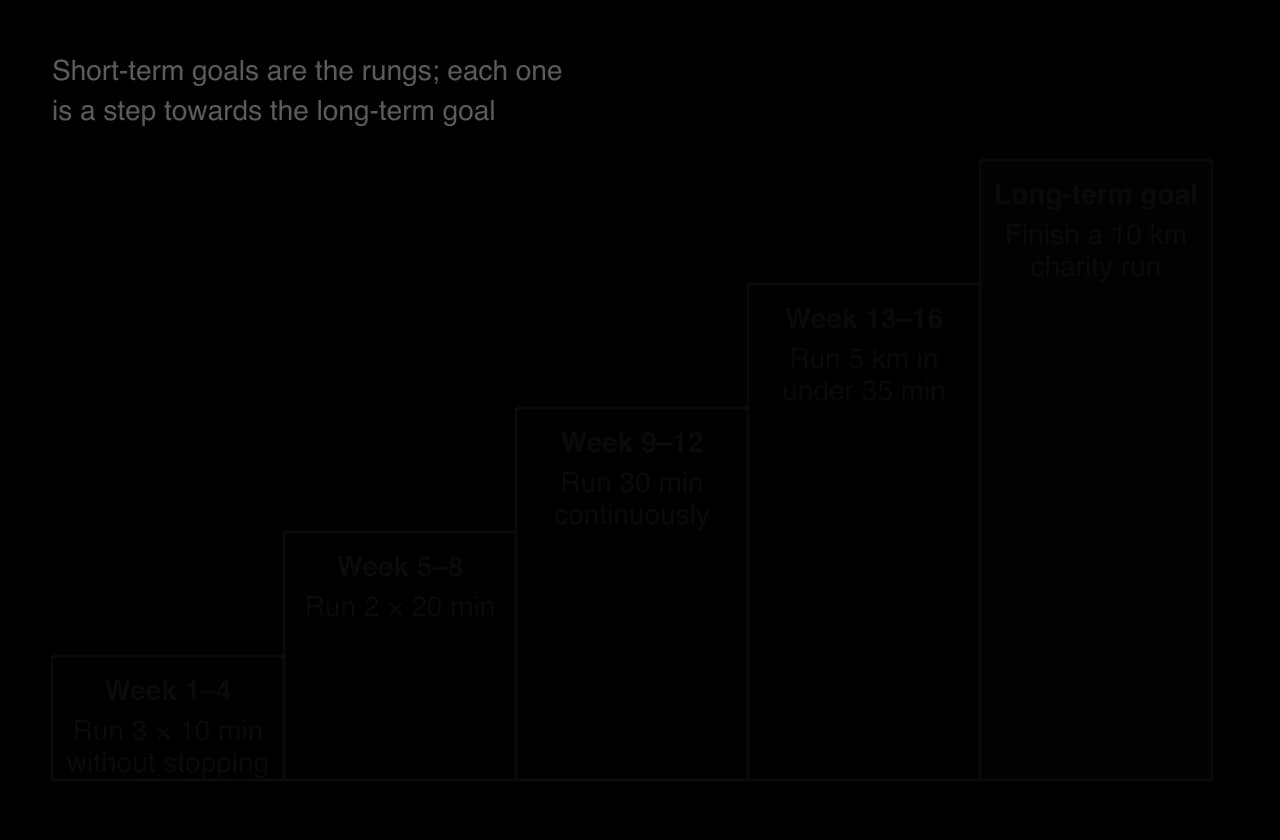
A goal ladder links directly to periodisation in training. The long-term goal sits at the level of the macrocycle (the season or year), the main rungs correspond to mesocycles of several weeks, and weekly or daily goals match the microcycles. Planning goals and training together means that each block of training has a clear purpose that the athlete understands.
SMART goals are a practical checklist for writing effective goals. The letters are interpreted in slightly different ways by different authors; a common version follows. Some add two more letters, E and R, to make SMARTER.
Letter | Meaning | Why it helps | Example: a recreational swimmer |
|---|---|---|---|
S | Specific | Directs attention to a clear target rather than “get better” | Improve 200 m freestyle time |
M | Measurable | Gives objective feedback on progress | From 3:40 to 3:30 |
A | Achievable (or agreed) | Builds commitment and self-efficacy; set with the athlete | Coach and swimmer agree it is possible |
R | Realistic | Fits the athlete’s time, ability and resources | Three sessions a week are available |
T | Time-bound | Creates urgency and a date for evaluation | By the club gala in 12 weeks |
E | Evaluate | Progress is reviewed regularly | Timed 200 m every 4 weeks |
R | Re-adjust | Goals are changed if they prove too easy or too hard | Target changed after an illness |
SMART is a memory aid, not a scientific theory. It summarises some findings of goal-setting research (specific, measurable goals with feedback and commitment), but it says nothing about the type of goal, and research has not tested the acronym as a whole.
Goal setting is used in elite sport, recreational exercise and health care. The principles are the same, but the balance of goal types and the way goals are set change with the person.
Elite athlete (international rower) | Recreational exerciser (inactive 45-year-old) | Patient in rehabilitation (after ACL reconstruction) | |
|---|---|---|---|
Long-term goal | Win an Olympic medal (outcome) | Walk 30 min on five days a week for a year | Return to amateur football 10–12 months after surgery |
Short-term goals | 2,000 m ergometer time under target by the spring trial (performance) | Walk 10 min a day this week, increasing by 5 min each fortnight | Full knee extension by week 2; walking without crutches by week 6 |
Process goals | Hold the catch timing and stroke rate in the middle 1,000 m | Walk at a pace that makes talking possible but harder | Complete home exercises twice daily with correct knee alignment |
Main purpose of goals | Direct training, maintain motivation over years | Build a habit; increase self-efficacy; enjoyment | Structure recovery, maintain adherence, prevent too early a return |
Main risk | Over-focus on outcome; disappointment | Goals too hard, leading to failure and dropout | Frustration when progress is slow or uneven |
In health settings, goals are often set together with a professional, such as a physiotherapist, doctor or exercise specialist. Shared goal setting increases commitment and allows the professional to check that goals are safe. For an inactive person, early goals should be easy enough to produce early success, because confidence and enjoyment are more important at this stage than a demanding target.
The same goal can motivate one person and discourage another. The effectiveness of each goal type depends on the individual, especially on their achievement motivation, their confidence and their personality.
In achievement goal theory, people differ in how they judge their own success. A person with high task orientation judges success by personal improvement and effort; a person with high ego orientation judges success by comparison with others, by winning and by showing more ability than others.
High task orientation: performance and process goals fit naturally, because they are self-referenced. These athletes tend to persist after defeats and choose challenging tasks.
High ego orientation with high perceived ability: outcome goals can be very motivating while the athlete is winning.
High ego orientation with low perceived ability: outcome goals can be harmful. When the athlete expects to lose, an outcome goal increases anxiety and may lead to reduced effort or excuses to protect self-esteem. Learning-focused goals help by giving this athlete a target they can achieve.
In need achievement theory, individuals differ in their need to achieve (approaching challenges for the satisfaction of success) and their need to avoid failure (avoiding challenges for fear of the shame of failure). A high achiever usually prefers realistic but challenging goals with about an even chance of success. A person high in the need to avoid failure tends to choose goals that are very easy (certain success) or very hard (failure can be excused), so a coach may need to set short-term, process-focused goals that bring early success and build confidence.
Athletes with low self-efficacy are less likely to commit to a hard goal, so their goals should start smaller and become harder as confidence grows. Anxious athletes benefit from process goals during competition, because a focus on technique reduces cognitive anxiety about the result. Personality may matter too: people high in conscientiousness may enjoy detailed goal plans, while people who value spontaneity may find rigid goals restrictive. These differences mean that goal setting should be individualised rather than applied in the same way to a whole squad.
Goal setting has been studied in hundreds of experiments in work, education, sport and exercise. In work settings the evidence that specific, difficult goals improve performance more than “do your best” instructions is very consistent. In sport the effect is positive but more variable, and the type of goal matters a great deal.
A meta-analysis of goal setting in sport and exercise published in 1995 found a small overall effect on performance (effect size 0.34). A meta-analysis published in 2022 analysed 27 experiments in sport selected from more than 17,000 articles. Process goals had a large effect on performance (Cohen’s d = 1.36), performance goals a small to moderate effect (d = 0.44) and outcome goals almost no effect (d = 0.09). Process goals also had a large positive effect on self-efficacy (d = 1.11).

The chart supports the advice to focus on learning-focused goals, especially process goals, during training and competition. Cohen’s d expresses the difference between groups in standard deviations: about 0.2 is usually described as small, 0.5 as moderate and 0.8 or more as large.
Sources: Kyllo and Landers, Journal of Sport and Exercise Psychology, 1995, as reported in Williamson et al., International Review of Sport and Exercise Psychology, 2022.
Strengths | Limitations |
|---|---|
Supported by a large body of research; specific, challenging goals with feedback improve performance in many settings | Effects in sport are smaller and more variable than in work settings; outcome goals show almost no effect on performance |
Simple, cheap and usable at every level, from elite sport to rehabilitation and public health | Depends on commitment, feedback and self-efficacy: imposed or unrealistic goals do not work |
Flexible: outcome, performance and process goals can be combined over different time scales | Hard outcome goals can increase anxiety and pressure, and repeated failure to reach goals can reduce motivation and lead to dropout |
Builds self-efficacy and adherence through short-term successes | A narrow focus on one goal can lead athletes to neglect other important behaviours (for example, recovery) or to take risks |
Goal setting works best when it is individualised to the athlete’s orientation and confidence, when it combines types of goal (outcome for direction, performance and process for daily focus), and when goals are set with the athlete and reviewed regularly. It is a tool to support motivation and attention, not a guarantee of success: its value depends on the person, the task and the quality of feedback.
Goals do two jobs at once. They are a target to aim for, and they are the standard against which a person judges whether they are satisfied with their performance. Exceeding the goal brings satisfaction; falling short brings dissatisfaction. This creates the goal-setting paradox: the people who set the hardest goals usually perform best, yet they are often the least satisfied with what they achieve.
Locke and Latham’s explanation is that people with high goals produce more because they are dissatisfied with less. In one study they describe, business students who aimed for an A grade expected more benefits from their grades (pride, scholarships, better jobs) than students aiming for a C, but expected the least satisfaction from any given grade. The high standard that drives effort also makes satisfaction harder to reach.
Sources: Locke and Latham, American Psychologist, 2002 (reporting Mento, Locke and Klein, 1992).
In elite sport the paradox takes the form of deflation after success. An athlete may train for years towards a world title or an Olympic medal. When the goal is reached, the satisfaction can be brief and followed by a feeling of emptiness, low mood or loss of direction. Evidence for this pattern comes mainly from interviews and athletes’ own accounts rather than from experiments, and applying Locke and Latham’s satisfaction findings to it is an interpretation, not a tested prediction. Several processes are thought to contribute:
The standard moves. Each achievement becomes the new baseline, so the athlete immediately compares it with the next, harder target rather than enjoying it.
Loss of purpose and structure. A single long-term goal organised daily training, identity and social life; once it is reached, that structure disappears.
External pressure. Success raises the expectations of coaches, media, sponsors and the public, so the next goal feels like an obligation rather than a choice.
Ego-involved goals. Athletes whose goals are mainly outcome goals, judged against others, may feel that any result below the top is a failure.
The paradox links goal setting to athlete well-being. Prolonged deflation may contribute to low motivation and, in some athletes, to burnout or mental health problems. Sport psychologists therefore help athletes plan beyond the major event before it happens, set a balance of process and performance goals that can still be pursued afterwards, and value mastery and enjoyment as well as results.
A goal set at the start of a season is based on the information available then. Injuries, illness, plateaus in improvement, unexpectedly fast progress, changes in selection or in life outside sport can all make the original goal too hard, too easy or irrelevant. Goal adjustment is the process of reviewing goals regularly and changing them in the light of such events.
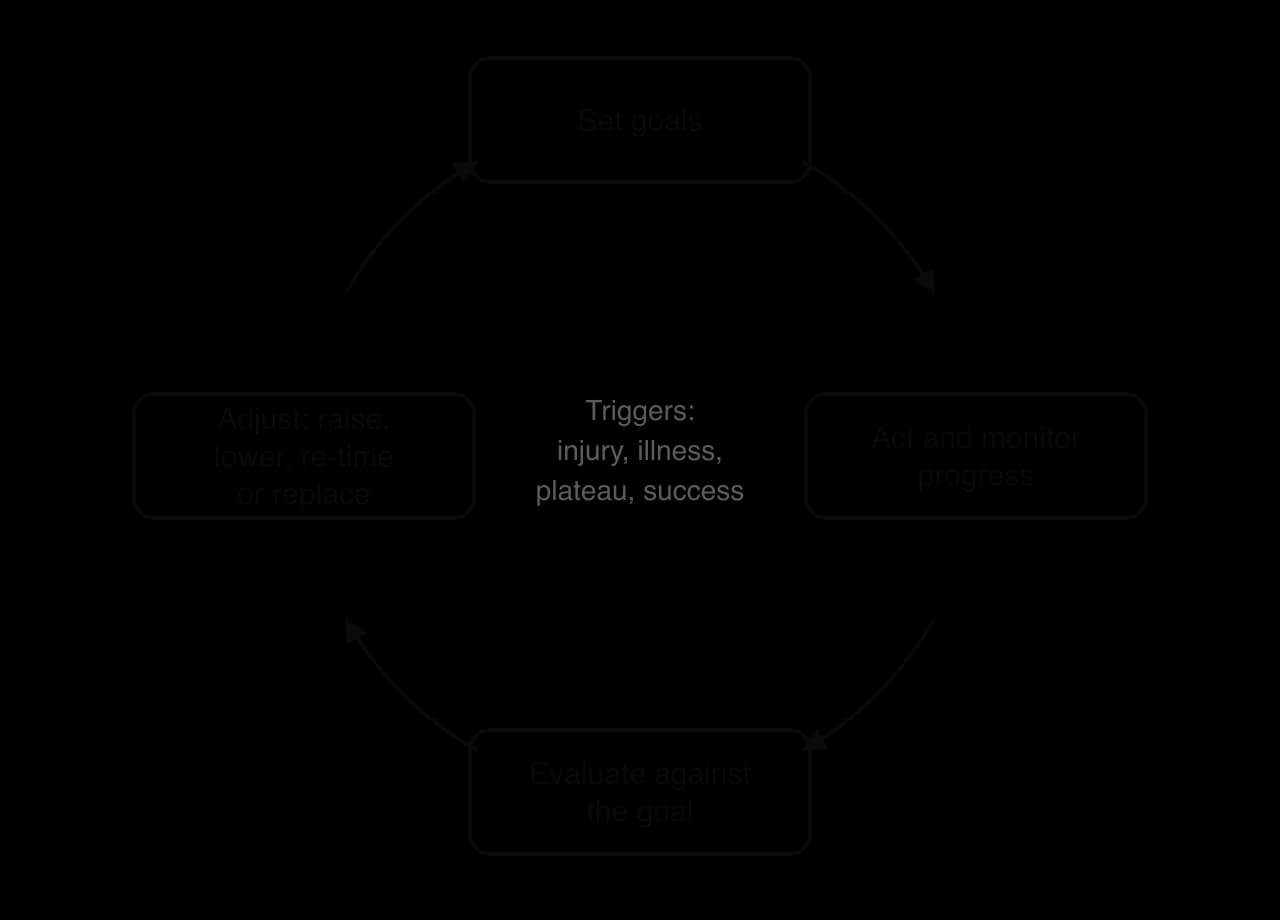
Goals that are no longer realistic damage motivation. An injured athlete who keeps a goal they can no longer reach experiences repeated failure, which lowers self-efficacy and can lead to dropout.
Goals that are too easy stop driving improvement. A beginner who reaches every goal easily needs harder goals to keep mobilising effort.
Adjustment keeps feedback meaningful. Goals only work with feedback; regular evaluation turns training data into decisions.
Adjustment protects well-being. Research on everyday goals shows that people who can let go of unattainable goals and commit to new ones report higher well-being. In three studies of students, younger and older adults, and parents of children with cancer, the capacity to disengage from unattainable goals and re-engage with new goals was associated with higher subjective well-being.
Sources: Wrosch, Scheier, Miller et al., Personality and Social Psychology Bulletin, 2003.
Adjusting a goal is different from giving up on it. A footballer who ruptures an anterior cruciate ligament in October does not abandon the aim of playing professionally; the outcome goal for the season is replaced by rehabilitation goals (full knee extension, running by month four, return to contact training) and a new long-term goal for the following season. A swimmer who improves faster than expected raises the performance goal rather than easing off.
Goal-setting theory recommends specific, challenging goals. Some people, however, perform as well or better, or enjoy activity more, with non-specific goals. Two kinds of non-specific goal are studied: do-your-best goals and open goals.
A do-your-best goal, such as an instruction simply to try as hard as possible in today’s session, is the traditional comparison condition in goal-setting experiments. In work settings, specific difficult goals have consistently produced higher performance, because do-your-best goals have no external reference point: each person defines “best” in their own way, and people asked to do their best usually do not reach their maximum.
For complex tasks, however, Locke and Latham noted that when a person is still discovering how to perform, urging them to do their best sometimes leads to better strategies than a specific performance target, because the pressure of a specific target can make people try strategies in a hurried, unsystematic way.
Open goals were developed more recently, mainly by a research group led by Christian Swann. An open goal is phrased as an exploration, for example “see how far I can walk in the next 30 minutes” or “see how many good passes I can make in this drill”. It is measurable, because the activity can be counted or timed, but there is no fixed line between success and failure, so every result counts as an outcome rather than a pass or fail.
A 2025 review that defined open goals identified 16 studies with data on them. Early findings suggest that open goals can produce similar increases in physical activity to specific goals while making the experience more positive. In a pilot randomised trial of a six-week walking programme with 30 adults who had low to moderate activity levels, both open and specific goals increased daily steps to a similar extent; the open-goal group showed the largest increase within the group (an average of 2,965 more steps a day) and reported more positive experiences, although their step counts fell more steeply after the programme ended.
Who benefits seems to depend on the person. In an interview study, active adults responded more positively to specific goals, while insufficiently active adults responded more positively to non-specific (open and do-your-best) goals and more negatively to specific goals. For a beginner, a specific target may feel like a test that can be failed; an open goal removes that threat. In sport, the 2022 meta-analysis found no significant difference in performance between specific goals (d = 0.37) and non-specific goals (d = 0.72), although few studies tested non-specific goals.
Sources: Swann et al., Health Psychology Review, 2025; Goddard et al., Psychology of Sport and Exercise, 2026; Hawkins et al., Research Quarterly for Exercise and Sport, 2023; Williamson et al., International Review of Sport and Exercise Psychology, 2022.
Goal type | Most suitable for | Less suitable for |
|---|---|---|
Specific, challenging performance goal | Experienced, confident athletes on well-learned tasks; training blocks with clear measures | Beginners, anxious or low-confidence individuals; very complex new skills |
Process goal | Performance under pressure; learning technique; anxious athletes | Situations where a clear measurable target is needed for selection or planning |
Do-your-best goal | Complex new tasks in the early phase of learning; low-pressure sessions | Simple tasks where a specific target reliably raises effort |
Open goal | Inactive people starting exercise; beginners; rehabilitation where failure would discourage | Elite performers preparing for a specific standard; long-term planning |
Non-specific goals challenge a central claim of goal-setting theory, that specific goals are always better than vague ones. The evidence for open goals is still small: most studies are short, many involve single sessions or small samples of mostly female or middle-aged adults, and long-term effects on activity are uncertain. They do, however, suggest a practical rule: the best goal depends on the person and the stage of learning. For a newly active or recovering person, an open goal that removes the fear of failure may build the enjoyment and self-efficacy needed to continue; as confidence and skill grow, specific performance goals can be introduced through goal adjustment.
In October 2019, the Kenyan runner Eliud Kipchoge became the first person to run the marathon distance in under two hours, finishing the INEOS 1:59 Challenge in Vienna in 1 h 59 min 40.2 s. The attempt was the second of two specially organised events designed around a single outcome goal: to break two hours for 42.195 km. It is a clear example of how an outcome goal can be broken down into performance and process goals, and of what happens when a goal is first missed.
The outcome goal of “under two hours” was translated into a performance goal: an exact pace. To finish in exactly 2:00:00, a runner must average about 2:50.6 per kilometre, or 14:13.2 for every 5 km. The organisers set up the event so that this pace could be monitored continuously. Laser lines projected on to the road showed the target pace, so any deviation was visible immediately, providing continuous feedback.
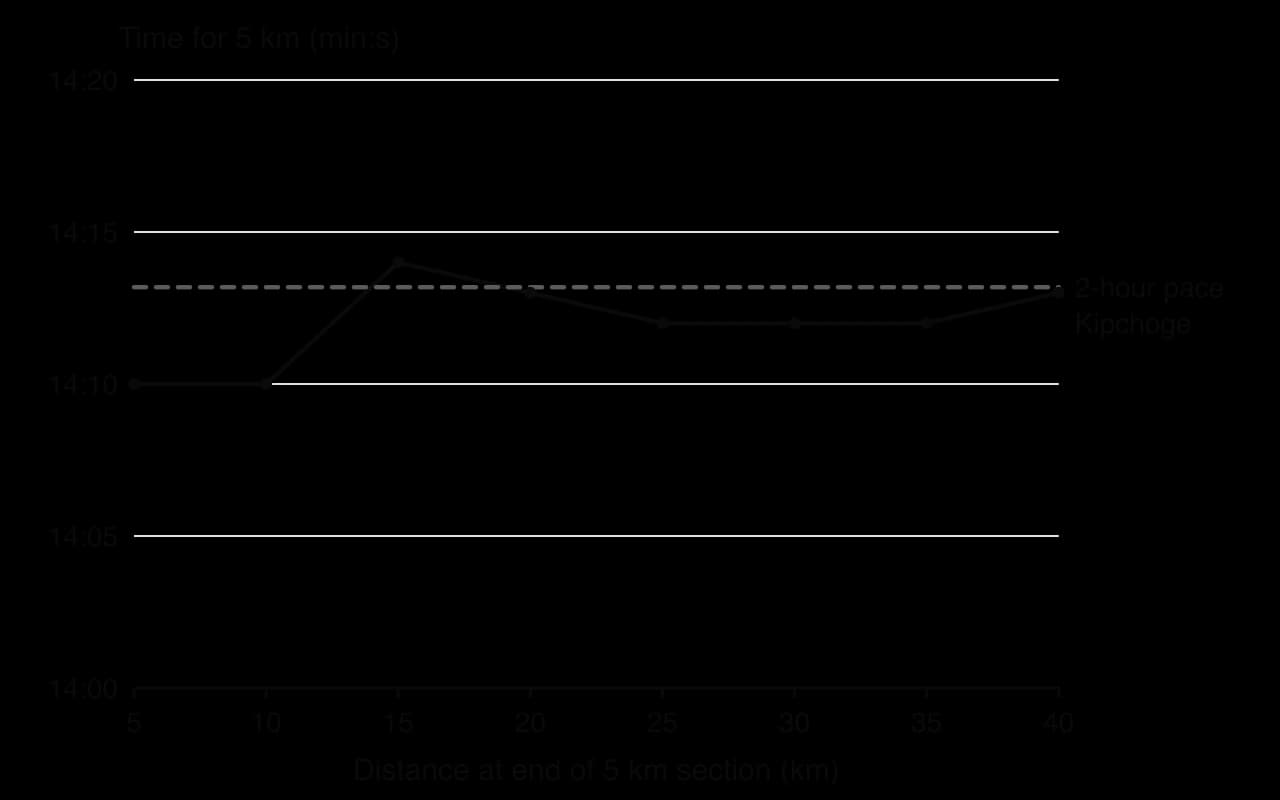
The splits were very even. Kipchoge ran the first 10 km slightly faster than two-hour pace (14:10 for each 5 km), slowed to 14:14 between 10 and 15 km, and then held 14:12–14:13 for every remaining 5 km section. His average speed was 5.88 m s⁻¹. The narrow range of the splits is what the performance goal demanded: a large early lead would have risked fatigue, while falling behind would have required a faster finish than was likely to be possible.
Much of the attempt was designed around process goals that the runner and his team could control. Forty-one pacemakers rotated in groups of seven, running in a V-shaped formation in front of and behind Kipchoge so that he could stay in the same position throughout. Drinks were handed to him from a bicycle rather than collected from tables. The course in the Prater park was almost flat, and an eight-day reserve window allowed the attempt to be moved if the weather was poor.
For the runner, the process goals can be analysed as staying in position within the formation, following the laser pace rather than racing, and taking fluid and energy at the planned points.
The first attempt, Breaking2, took place on a motor racing circuit at Monza, Italy, on 6 May 2017. Kipchoge finished in 2 h 0 min 25 s, 25 s short of the goal, with temperature and humidity above the ideal range. In outcome terms the goal was missed; in performance terms the run was only 25 s from the target. The goal was not abandoned. A new attempt was announced on 6 May 2019, at a venue chosen after a search that weighed the expected weather, the time zone and the number of spectators who could watch.
This shows no-one is limited.
— Eliud Kipchoge after the INEOS 1:59 Challenge, Vienna, 12 October 2019, as reported by BBC Sport
The case shows the goal chain working: an outcome goal provided direction and motivation, a precise performance goal (pace) defined what had to be done, and process goals, supported by technology that gave continuous feedback, kept attention on controllable actions during a run of almost two hours. Goal-setting theory predicts all three parts: a specific, challenging goal, commitment from the athlete and a large team, and constant feedback.
The case also has limits as evidence. It is a single, exceptional athlete, so it cannot show that goal setting caused the result: physiology, years of training, shoe technology, pacemaking and drafting all contributed. Because the rotating pacemakers and the drinks system were not allowed under competition rules, the time was not ratified as a world record. On 26 April 2026, Sabastian Sawe won the London Marathon in 1 h 59 min 30 s, the first sub-two-hour time in a competitive marathon. A barrier first broken under specially controlled conditions had been broken in a race run under normal competition rules.
Sources: BBC Sport, 12 October 2019 (INEOS 1:59 Challenge time, splits and quotation); Wikipedia, “Ineos 1:59 Challenge” (pacemakers, venue and Breaking2 details), accessed 2026; BBC Sport and The Guardian, 26 April 2026 (London Marathon).
State one outcome goal, one performance goal and one process goal in the INEOS 1:59 Challenge, and explain how they are linked.
Explain how the laser pacing system acted as feedback, and why feedback makes goals more effective.
Discuss to what extent a single case like this can show that goal setting improves performance.
Goal setting appears in Paper 1A (goal types and their features), Paper 1B (data from goal-setting studies) and Paper 2, where questions often ask you to distinguish goal types, apply them to a named athlete, or evaluate goal setting as a psychological skill.
The second question tests the mechanisms of goal setting.
Hypothetical data. Thirty-six club basketball players were randomly allocated to three groups of 12. For four weeks, the process-goal group focused on “elbow under the ball and full follow-through” on every free throw; the outcome-goal group aimed to “score more free throws than your teammates”; and the control group was told to “do your best”. Free-throw accuracy (% of 50 shots) was measured before and after the four weeks.
Group | Pre-test mean accuracy (%) ± SD | Post-test mean accuracy (%) ± SD |
|---|---|---|
Process goal | 62.4 ± 6.1 | 71.8 ± 5.2 |
Outcome goal | 61.9 ± 5.8 | 64.3 ± 6.4 |
Do-your-best (control) | 62.8 ± 6.0 | 65.1 ± 6.3 |
A question using SMART principles needs each feature shown in the goal itself.
Explain questions need the link between the goal and the outcome.
An HL extended response may ask for a judgment on non-specific goals.
Goal setting is a psychological skill that directs attention and increases motivation in sport, exercise and health.
Specific, challenging goals improve performance by directing attention, mobilising effort, increasing persistence and prompting new strategies, provided the person is committed and receives feedback.
Outcome goals are norm-referenced (results compared with others); learning-focused goals are self-referenced and include performance goals (a measurable improvement) and process goals (technique or strategy).
Short-term goals form the rungs of a goal ladder towards a long-term goal, providing feedback, success and self-efficacy.
SMART(ER) principles are a practical aid for writing goals, not a scientific theory.
The effectiveness of each goal type depends on the individual, including task or ego orientation, need achievement, confidence and anxiety.
A 2022 meta-analysis found large effects of process goals, moderate effects of performance goals and almost no effect of outcome goals on sport performance.
The goal-setting paradox describes how harder goals bring better performance but less satisfaction, with deflation after success in elite athletes (HL).
Goal adjustment, the regular review and modification of goals, is considered more important than setting them; do-your-best and open goals suit some individuals, such as beginners and inactive people, better than specific goals (HL).
I can outline what goal setting is and why it is used in sport, exercise and health.
I can explain the four mechanisms through which goals improve performance and the role of feedback and commitment.
I can distinguish between outcome, performance and process goals, and between short-term and long-term goals.
I can apply SMART principles and a goal ladder to write a goal set for an athlete, an exerciser or a patient.
I can explain how achievement motivation and other individual differences affect which goals work best.
I can evaluate goal setting using research evidence.
I can explain the goal-setting paradox and why goal adjustment matters (HL).
I can evaluate when do-your-best and open goals may be more effective than specific goals (HL).