C.5 Psychological skills
Explain how goal setting and, at HL, imagery improve motivation, learning and performance, and design and evaluate their use for athletes, exercisers and patients in rehabilitation.
- IB Sports, Exercise and Health Science
- SL and HL
What C.5 covers
From the subject guide: what you need to know and be able to do.
Psychological techniques that improve sporting performance.
2 subtopics in Psychological skills
Each one has its own page once something is published for it.
- C.5.1Goal settingnotes
- C.5.2ImageryHL onlynotes
An overview of C.5 Psychological skills
Psychological skills are mental techniques that athletes, exercisers and patients learn and practise in order to improve motivation, learning, performance and well-being. They are among the most widely used interventions in sport psychology, and the same skills that help an Olympic athlete prepare for a final help an inactive adult start exercising or a patient keep going through a long rehabilitation.
The questions behind the topic
The topic is built around one central question: how can interventions from sport psychology enhance performance in sport, and the same benefits be carried into exercise and health? It answers the question through two skills, goal setting and imagery, that are trained and practised in the same way as physical skills. Real situations make the question concrete:
Why does a goal of improving a personal best often motivate more effectively than a goal of winning?
Why is “walk for 30 minutes on five days a week” a more useful goal for an inactive adult than “get fitter”?
Why might an elite athlete feel less satisfied after reaching a hard goal than after reaching an easy one? (HL)
How can mentally rehearsing a movement improve performance without any physical practice? (HL)
Why does a gymnast rehearse a routine in the competition kit, at its real speed, with the nerves of competition? (HL)
What the topic covers
Subtopic | Main question it answers | Level |
|---|---|---|
C.5.1 Goal setting | Why do goals improve motivation and performance, which types of goal are there, and how does their effectiveness depend on the individual? | SL and HL, with an HL-only part |
C.5.2 Imagery | What is imagery, what can it be used for, and how can it be made as close to real performance as possible? | HL only |
Goal setting explains why goals work: they direct attention, mobilise effort, increase persistence and lead people to develop new strategies. It separates outcome goals, which compare a result with others, from learning-focused goals, which include performance goals and process goals, and shows how short-term goals build towards a long-term goal. Imagery describes how a skill or situation can be created in the mind using several senses, classifies its purposes with Paivio’s framework, and uses the PETTLEP model to make it as realistic as possible.
How the subtopics connect
The two skills work together, as the concept map shows. Goal setting gives direction: what to improve and by when. Imagery provides a way to practise and prepare without physical fatigue. One function of imagery, motivational specific imagery, consists of picturing a goal being reached, so imagery is often used to strengthen commitment to goals. Both skills lead to better performance, and both are used outside elite sport, in exercise programmes and in injury rehabilitation.
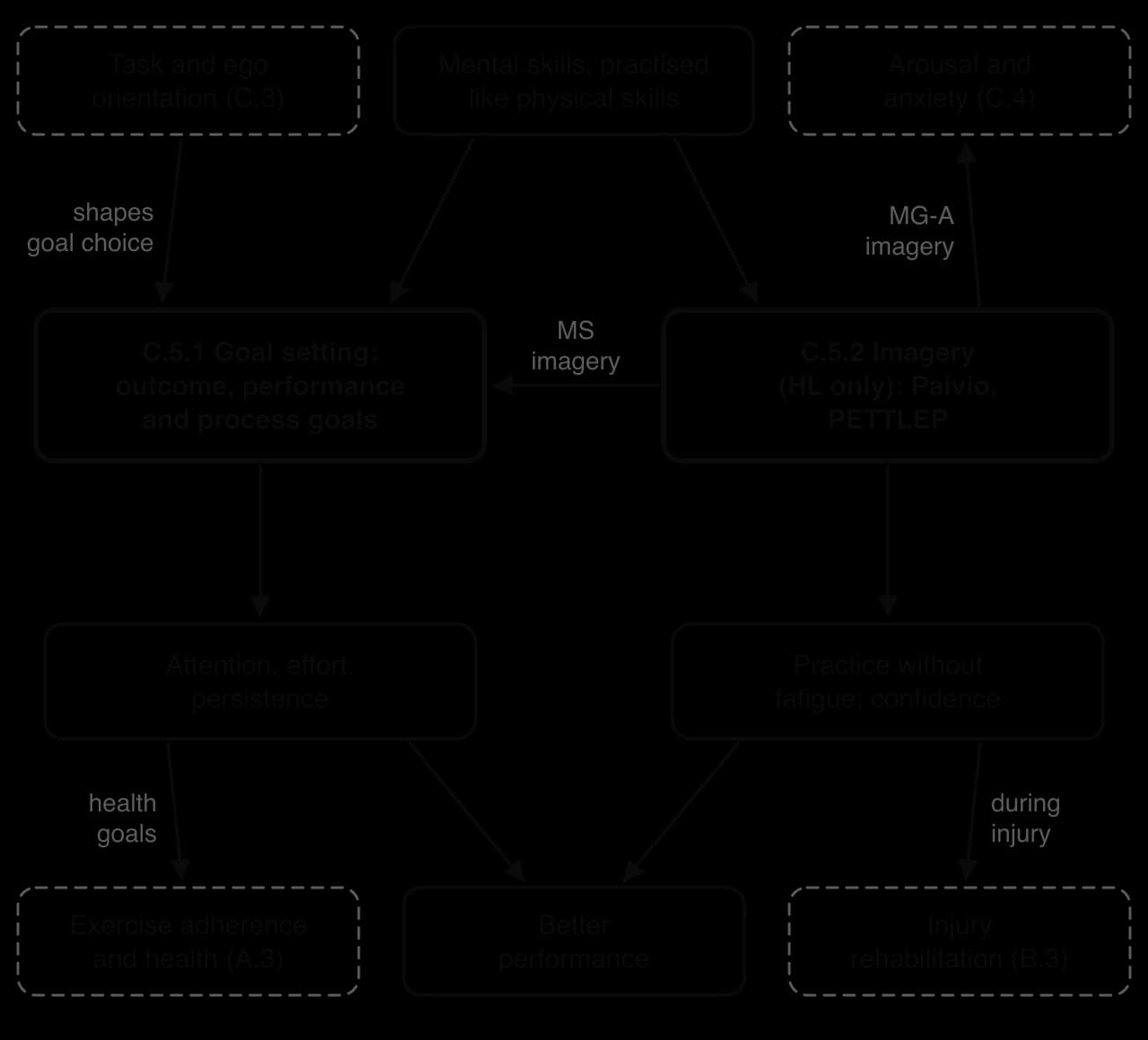
The map also shows links with other topics. Which goals suit a person depends on their achievement motivation: someone with a strong task orientation responds well to learning-focused goals, while a strong ego orientation draws attention to outcome goals. Motivational general-arousal imagery is used to raise or lower arousal, which links imagery to the theories of anxiety and to coping. In exercise physiology, goals support the long-term adherence to physical activity that brings its health benefits, and in biomechanics, imagery and staged goals help injured athletes through rehabilitation.
Health and performance lenses
Health lens | Performance lens |
|---|---|
Specific, staged goals help inactive adults build an exercise habit; open goals can suit beginners who find specific targets off-putting (HL). | Process and performance goals turn a long-term ambition into daily training targets, such as improving a start or a pacing strategy. |
Goals give structure to rehabilitation after an injury or an operation, and are adjusted as recovery progresses (HL). | Regular goal adjustment after injuries, plateaus or success keeps goals challenging but realistic (HL). |
Imagery helps patients relearn movements and manage anxiety during recovery (HL). | Imagery adds high-quality practice without fatigue and helps athletes control nerves before competition (HL). |
Psychological skills also connect to motor learning. Imagery is a form of mental practice, and it tends to work better for athletes who already have an accurate picture of the skill, which links it to the stages of learning. Goals that focus on technique are a form of process goal and direct attentional focus to the right cues during practice.
How SL and HL differ
HL students study everything SL students study, plus additional higher level material. In this course that extra material is mostly added inside subtopics rather than as separate subtopics. Most pages are therefore read by everyone, and contain sections with headings ending “(HL only)” that SL students can skip. Questions on the HL material appear only in the HL papers.
Psychological skills is one of the two topics in the course with a whole HL-only subtopic. For this topic, the HL material is:
Imagery, the whole subtopic: the senses used in imagery, internal and external perspectives, functional equivalence and other explanations of how imagery works, Paivio’s framework and its five functions, the PETTLEP model, imagery scripts, measuring imagery and the evidence for its effects;
within Goal setting, the goal-setting paradox, why goal adjustment matters more than setting goals in the first place, and when do-your-best goals and open goals suit people better than specific goals.
SL students study the rest of Goal setting: why goals work, the types of goal, short- and long-term goals, SMART principles and how the individual affects which goals are effective.
Assessment
Questions on Psychological skills appear in all three parts of the external assessment. Paper 1A asks multiple-choice questions, for example which type of goal a statement describes or which function of imagery an example shows. Paper 1B gives data from a study, such as performance in groups that set different types of goal, and asks students to describe the results, calculate changes and evaluate the design. Paper 2 asks short-answer and extended-response questions. Imagery and the HL-only parts of goal setting appear only in the HL papers.
The topic tends to produce these kinds of question:
distinguishing outcome, performance and process goals, and classifying example goals;
writing a set of short-term and long-term goals for a named athlete, exerciser or patient;
explaining why goal setting improves performance;
evaluating goal setting for different individuals, including the goal-setting paradox and goal adjustment (HL);
classifying examples using Paivio’s framework and designing an imagery script with PETTLEP (HL);
evaluating the evidence for imagery and its use in rehabilitation or anxiety control (HL).
Carry on with C.5 in Augment
With a free account, Augment remembers where you stopped and what you have practiced.