Explain how athletes appraise stressors, distinguish problem-, emotion- and avoidance-focused coping, use self-talk and relaxation to control heart rate and, at HL, match coping to controllability and judge which strategies work.
Each is in the SEHS glossary, with every other term in the subject.
A relaxation technique in which an individual repeats self-suggestions about sensations such as heaviness and warmth in the limbs and a calm heartbeat to produce deep relaxation.
Coping strategies that try to prevent the negative impact of a stressor by physically or psychologically distancing oneself from it, such as ignoring, procrastinating, distraction or quitting.
A technique in which devices measure a physiological variable such as heart rate, heart rate variability, skin conductance or muscle activity and display it, so the individual learns to control it voluntarily.
A controlled breathing technique with four equal phases, usually of 4 seconds each: breathe in, hold, breathe out, hold; it slows breathing and lowers heart rate and arousal.
An appraisal in which an individual perceives that their resources are sufficient to meet the demands of a stressful situation, so it is seen as an opportunity for gain or growth.
A stressor that the individual can change, remove or influence through their own actions, such as their preparation, fitness, tactics or technique.
The constantly changing cognitive and behavioural efforts an individual makes to manage specific external or internal demands that are appraised as taxing or exceeding their resources.
Define stress, stressor, eustress and distress, and outline how a stressor causes psychological strain that can be positive or negative.
Describe the transactional model of stress, including primary and secondary appraisal and challenge and threat appraisals.
Distinguish between problem-focused, emotion-focused and avoidance-focused coping strategies, with sporting examples of each.
Describe unintentional, instructional and motivational self-talk and the practical techniques used to develop it.
Explain how relaxation skills such as diaphragmatic breathing, progressive muscle relaxation and biofeedback lower heart rate.
Evaluate self-talk and relaxation as coping strategies, using research evidence.
Apply the distinction between controllable and uncontrollable stressors to choose a coping strategy (HL).
Evaluate the effectiveness of seeking support and other coping strategies, and distinguish effective from maladaptive coping (HL).
Discuss how individual and cultural differences and athlete welfare systems affect coping (HL).
Coping is the set of thoughts and actions an individual uses to manage a situation that places demands on them. Every athlete meets such situations, from a penalty kick in a final to an injury, a disagreement with a coach or important school tests in the week of a competition, and the way they cope affects both their performance and their well-being.
Coping matters through both lenses of the course. For performance, the right coping strategy helps an athlete keep arousal and anxiety in a useful range so that skills are executed as they were practised. For health, the same strategies help people manage the stress of injury, illness, a demanding exercise programme or life outside sport, and poor coping is linked with
With a free account, Augment remembers where you stopped and what you have practiced.
A specific, deliberate thought or action used to manage a stressor or the emotional response to it, such as making a plan, seeking advice, using self-talk or slow breathing.
Slow, deep breathing in which the diaphragm, not the chest and shoulders, does most of the work, so the abdomen rises on inhalation; it lowers heart rate and arousal.
A maladaptive coping strategy in which an individual reduces or stops their effort to deal with a stressor or reach a goal, either mentally (not thinking about the task) or behaviourally (giving up).
A negative form of stress in which a demand is perceived as threatening or overwhelming, producing fear, worry and helplessness that usually harm performance and well-being.
Coping strategies that do not change the stressor but regulate the emotional response to it, such as relaxation, self-talk, reframing and seeking emotional social support.
A positive form of stress in which a demand is perceived as a challenge or opportunity, producing excitement and energy that can improve motivation and performance.
The proposal that coping is most effective when the strategy matches the controllability of the stressor: problem-focused coping for controllable stressors, emotion-focused coping for uncontrollable ones.
Self-talk that directs attention to the technical or tactical aspects of a skill, such as the cue "high elbow" in swimming; most effective for fine and newly learned skills.
Coping strategies that may reduce distress in the short term but are associated with poorer performance, well-being or goal attainment over time, such as disengagement, venting and self-blame.
Self-talk that aims to increase effort, energy, confidence or positive mood, or to control arousal, such as "come on" or "stay strong".
The stage of cognitive appraisal in which an individual judges whether a situation is relevant to their goals and well-being, and whether it represents harm, a threat or a challenge.
Coping strategies that aim to alter or remove the stressor itself, such as problem solving, removing the source of stress, seeking information, planning and increasing effort.
A relaxation technique, developed by Edmund Jacobson, in which each major muscle group is tensed and then relaxed in turn, so the individual learns to recognise and release muscle tension.
A coping technique in which an individual deliberately changes the interpretation of a thought, feeling or situation so that it becomes helpful, such as seeing a racing heart as readiness, not fear.
Learned methods, such as controlled breathing, progressive muscle relaxation and biofeedback, that reduce physiological and psychological arousal by decreasing sympathetic and increasing parasympathetic activity.
The stage of cognitive appraisal in which an individual evaluates the resources and coping options available and judges whether they are enough to meet the demands of the situation.
A coping strategy in which an individual turns to others for practical help and information (problem-focused) or for comfort and reassurance (emotion-focused); the most effective coping strategy for athletes.
The statements, words or phrases individuals say to themselves, aloud or silently, which can direct attention, regulate emotions and influence behaviour; it can be instructional or motivational.
The psychological and physiological response that occurs when an individual perceives that the demands of a situation are significant and must be met, especially when they may exceed the resources available.
Any environmental, physical or psychological demand that an individual perceives as requiring a response, such as a final, an injury, a selection decision or a hostile crowd.
A technique in which an athlete recognises a negative thought, interrupts it with a trigger such as the word "stop" or a physical action, and replaces it with a planned positive or instructional statement.
An appraisal in which an individual perceives that the demands of a stressful situation exceed their resources, so it is seen as a potential source of harm or loss.
A model, proposed by Lazarus and Folkman, in which stress results from the interaction between a person and their environment, determined by the person's appraisal of the demands and of their resources to meet them.
A stressor that the individual cannot change or influence through their own actions, such as the weather, an opponent's form, an official's decision or a selection made by others.
In everyday speech “stress” can mean the cause of a problem, the feeling it produces or both. Sport psychology separates the cause from the response. The cause is the stressor, and the response is stress.
A stressor creates psychological strain, a state in which the person feels that something important is at stake and that they need to respond. That strain is not automatically harmful. An athlete looking forward to an Olympic final is under strain, and so is an athlete who fears letting the team down, but the two experiences feel very different and have different effects.
The stress response is partly physiological. When a stressor is detected, the hypothalamus activates the sympathetic nervous system and the adrenal medulla releases epinephrine, so heart rate, breathing rate, blood pressure and muscle tension rise. Over a longer period the adrenal cortex releases cortisol. These changes are the same changes that make up physiological arousal, which is why stress, arousal and anxiety are closely related.
Hans Selye, the physiologist who first described the stress response, divided stress into a positive and a negative form. The same stressor can produce either form, depending on how the person interprets it.
Eustress and distress describe two ways of experiencing a demand, and the same event can produce either. An athlete can move from one to the other as the situation, or their appraisal of it, changes.
Eustress is the strain of a young swimmer who is nervous but excited before her first national championships and swims a personal best. Distress is the strain of the same swimmer a year later, after a poor season, when she believes she will be dropped from the squad if she fails, and her stroke becomes tense and short. The demand (a championship race) is similar, but the meaning she gives it has changed.
Research on athletes groups stressors into three broad types. Competitive stressors come from performing itself. Organisational stressors come from the sport system the athlete works in. Personal stressors come from life outside sport but still affect training and competition.
Type of stressor | What it involves | Examples |
|---|---|---|
Competitive (performance) | Demands of preparing for and performing in competition | A final or a penalty shoot-out; a strong opponent; making a mistake; injury during competition; the crowd; officials’ decisions |
Organisational | Demands from the team, club or governing body | Selection decisions; relationship with the coach; travel and accommodation; funding; media pressure; contract negotiations |
Personal | Demands from life outside sport | School or university tests and deadlines; family illness or bereavement; money worries; relationships; balancing sport with work |
Organisational and personal stressors are easy to overlook, but they are common in elite sport and can be just as damaging as competitive ones. A long-distance runner may cope well with races yet struggle with the stress of a coaching change or a funding cut. Coping strategies therefore need to be planned for stressors outside competition as well as inside it.
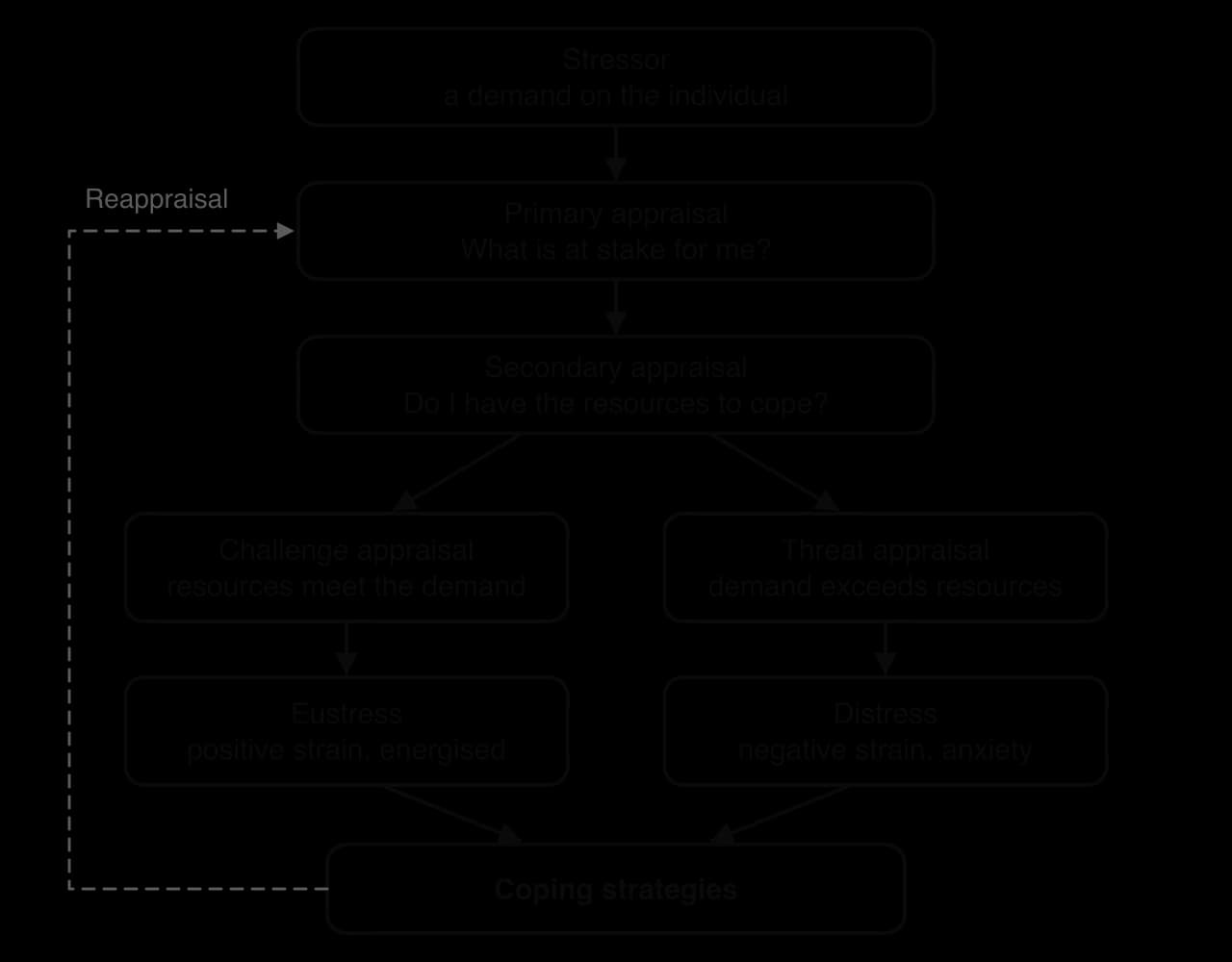
The same final can excite one player and frighten another. The most widely used explanation of this difference comes from Richard Lazarus and Susan Folkman (1984). Their transactional model of stress proposes that stress is not caused by a stressor alone, nor by the person alone, but by the transaction (interaction) between them. The key step is cognitive appraisal, the person’s judgment of what the stressor means.
The model has four stages. The flow chart shows how each stage leads to the next and how the process repeats.
In primary appraisal, the person judges whether the situation matters to them and how. A situation can be appraised as irrelevant (it has no bearing on their goals), benign-positive (it is good news) or stressful. A stressful appraisal can take three forms: harm or loss (damage has already happened, such as an injury), threat (harm may happen in future) or challenge (there is a chance of gain or growth).
Primary appraisal depends on what the person values. A friendly match is irrelevant to a professional footballer’s career but highly relevant to a 17-year-old trialist being watched by a scout. The more that is at stake, the larger the stress response.
In secondary appraisal, the person judges their resources: skills, fitness, preparation, experience, confidence, and the support of coaches, teammates and family. The question is whether these resources are enough to meet the demand.
The words “primary” and “secondary” do not mean that one always comes first. The two appraisals happen almost together and influence each other. A climber who has trained a route many times (strong resources) is less likely to see a difficult section as a threat in the first place.
When the two appraisals are combined, the result is usually a challenge appraisal or a threat appraisal. When the person believes their resources match or exceed the demand, they see a challenge. When they believe the demand exceeds their resources, they see a threat.
Challenge appraisals are linked with eustress, positive emotions, effort and a focus on the task. Physiologically, a challenge state is associated with a rise in cardiac output that is accompanied by dilation of the blood vessels, an efficient pattern for supplying the muscles and brain. Athletes often describe this as feeling “up for it”.
Threat appraisals are linked with distress, cognitive anxiety, negative self-talk and an attentional focus on what might go wrong. Physiologically, a threat state is associated with constriction of the blood vessels and a larger rise in blood pressure, a less efficient pattern. In skills that need fine control, such as a golf putt or a basketball free throw, a threat state can disrupt movement, which is one route to choking.
Once a situation has been appraised as stressful, the person responds by coping. Coping changes either the situation or the person’s response to it, and the situation is then appraised again. This is reappraisal. A tennis player who is broken early in a set may first appraise the score as a threat. After taking a few slow breaths and reminding herself that she has come back from a break many times before, she may reappraise the same score as a challenge.
Reappraisal is the reason the model is described as a process, not a single event. Appraisals shift during a match, a season and a career. It also explains why coping strategies that change how a person thinks, such as self-talk, can be as powerful as strategies that change the situation itself.
Coping is what people do in response to the demands they have appraised as stressful. Lazarus and Folkman defined it as constantly changing efforts, in thought and in behaviour, to manage specific demands that are appraised as taxing or exceeding a person’s resources.
Three features of the definition matter. Coping is effortful and conscious, so automatic reactions such as a reflex flinch are not coping. Coping is a process that changes as the situation changes. And coping is defined by the effort, not by the result, so a strategy is still coping even if it does not work.
Coping strategies are grouped into three categories according to their aim: to change the stressor, to manage the emotional response to it, or to get away from it.
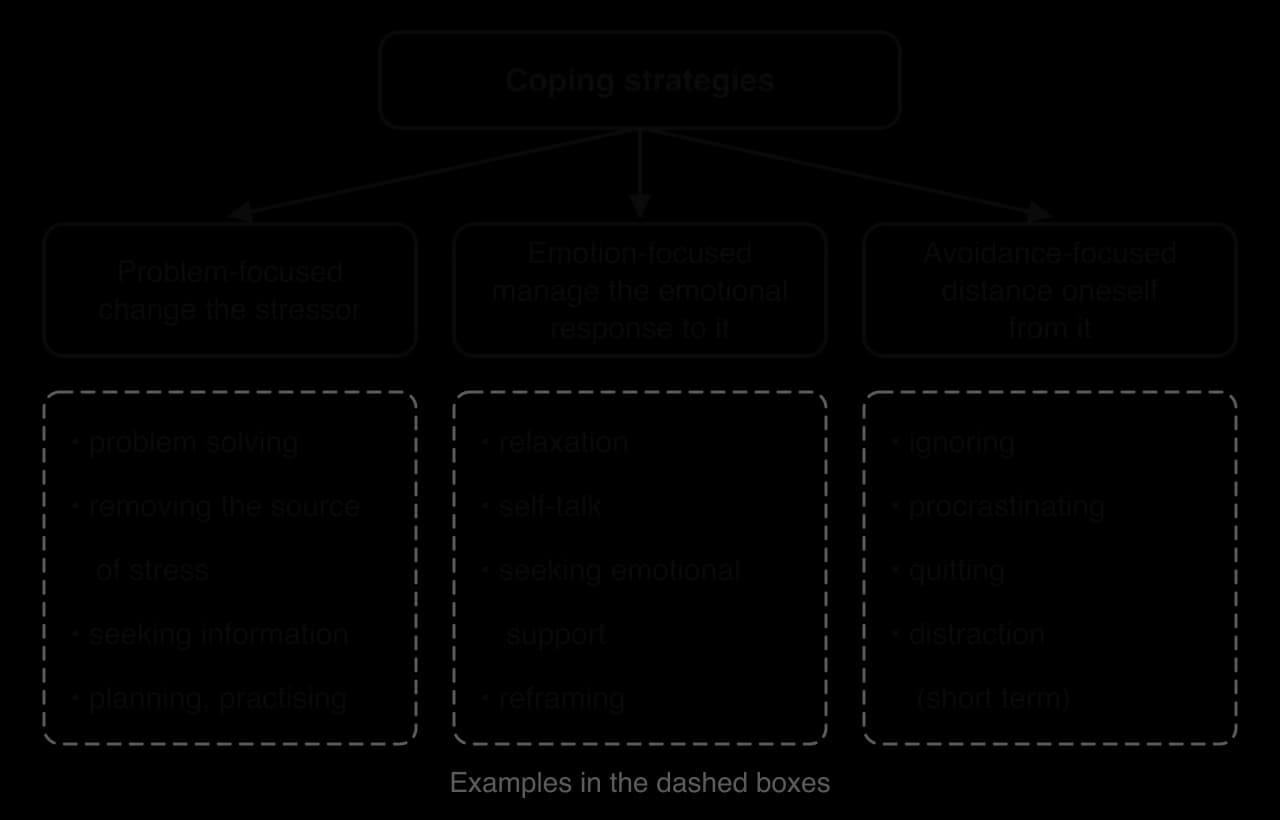
Problem-focused coping acts on the cause. Typical strategies are problem solving (working out what is wrong and how to fix it), removing the source of stress (changing a training venue that causes long commutes), information seeking (asking the coach exactly why a player was dropped and what to improve), planning, time management and putting in extra practice on a weak skill.
A rugby goal-kicker who misses three kicks into a strong crosswind in the first half uses problem-focused coping if, at half-time, he asks the kicking coach about wind adjustment and changes his aiming point. The stressor (missing kicks) is tackled directly. Problem-focused coping is most useful when the athlete can actually change something about the situation.
Emotion-focused coping acts on the person’s reaction. Typical strategies are relaxation techniques, self-talk, reframing the situation (seeing a noisy away crowd as a sign that the opponents are worried), seeking emotional support from friends or family, and acceptance. The stressor remains, but the person feels and functions better.
A marathon runner who wakes on race day to heavy rain cannot change the weather. If she accepts it, reminds herself that everyone faces the same conditions and uses slow breathing to settle her nerves on the start line, she is using emotion-focused coping. Emotion-focused strategies are especially useful when the stressor cannot be changed or when strong emotions would otherwise get in the way of problem-focused coping.
Avoidance-focused coping creates distance from the stressor. Psychological distance includes ignoring the problem, denying it or distracting oneself. Physical distance includes skipping a training session, procrastinating over a difficult rehabilitation exercise or quitting the sport. In the short term avoidance can lower distress. A gymnast who chats with a teammate between rotations, instead of watching the scoreboard, is using a brief form of distraction that can help.
Over longer periods avoidance usually leaves the stressor unresolved, so it returns or grows. An injured player who avoids his physiotherapy appointments because they are painful and frustrating feels better that week but recovers more slowly. Persistent avoidance is a common feature of athletes who drop out of sport.
Feature | Problem-focused | Emotion-focused | Avoidance-focused |
|---|---|---|---|
Aim | Change or remove the stressor | Regulate the emotional response to the stressor | Create physical or psychological distance from the stressor |
Typical strategies | Problem solving, removing the source of stress, information seeking, planning, extra practice, time management | Relaxation, self-talk, reframing, seeking emotional support, acceptance | Ignoring, denial, distraction, procrastinating, skipping sessions, quitting |
Sporting example | A goalkeeper studies video of the penalty takers she will face | A goalkeeper uses slow breathing and the cue “big and calm” before the shoot-out | A goalkeeper refuses to watch any video and pretends the shoot-out will not happen |
Best suited to | Stressors the athlete can change | Stressors the athlete cannot change, or strong emotions | Brief use only, for minor or temporary stressors |
Main limitation | Ineffective, and can increase frustration, when the stressor cannot be changed | Leaves the cause in place; little use if the stressor could have been fixed | Stressor usually returns; long-term use is linked with poorer performance and dropout |
Athletes rarely use one category on its own. A player preparing for a cup final may watch video of the opponents (problem-focused), practise breathing techniques (emotion-focused) and spend the evening before playing a video game to switch off (brief distraction). Effective copers have a range of strategies and choose between them.
 YouTube
Most people talk to themselves, silently or aloud, many times a day. In sport this inner voice can be a powerful coping tool or a source of extra stress. Self-talk is simple, costs nothing and can be used in the middle of competition, which is why it is one of the most widely taught psychological skills.
Self-talk can be a problem-focused or an emotion-focused strategy, depending on its aim. A cyclist who tells herself “change down a gear and spin” before a climb is solving a problem: the words change what she does. A cyclist who tells herself “stay calm, I have trained for this” is regulating her emotions: the climb is unchanged, but her response to it is calmer.
Much self-talk is unintentional (spontaneous). It happens automatically in reaction to events, often without the athlete noticing. Unintentional self-talk can be positive (“Good, that’s the rhythm”) or negative (“Typical, I always double-fault on big points”). Negative self-talk is common after mistakes and under threat appraisals, and it tends to increase cognitive anxiety, narrow attention onto errors and lower confidence.
The first step in any self-talk programme is awareness. Athletes are often asked to keep a self-talk log after training and competition, writing down what they said to themselves, when and how it affected their performance. Patterns usually appear quickly, such as negative self-talk after the first mistake of a match or during the last kilometre of a race.
Intentional (strategic) self-talk is planned in advance and practised, so that it becomes a reliable cue. It is divided into two types according to its function.
Instructional self-talk acts as a reminder of a key technical point. It helps the athlete attend to the right cue at the right moment and is most useful for skills that need precision and timing. A beginner learning a tennis serve may say “toss, reach, snap” in rhythm with the action.
Motivational self-talk works on the drive and emotions behind the skill. It is useful for maintaining effort in endurance events, for lifting confidence after an error and for psyching up before a strength task. A rower in the last 500 m of a 2,000 m race may repeat “strong legs, strong legs” to keep driving through fatigue.
Self-talk is most effective when it is short, specific, positive in wording and practised in training until it is automatic. Three practical techniques are used to build it.
The athlete links self-talk to a memory of a past good performance: “I’ve done this before. Feel it like the final in Lyon.” Recalling the feelings of a successful performance (the rhythm, the calm, the confidence) builds confidence for the present one. This technique overlaps with imagery, since the athlete partly relives the experience.
The athlete builds a short acronym whose letters stand for helpful reminders, so that several cues can be recalled at once. A well-known example in basketball shooting is BEEF: Balance, Eyes on the target, Elbow under the ball, Follow-through. Before a free throw, saying “BEEF” brings back the whole technical checklist in one word.
The athlete chooses one word that captures the feel of the movement, such as “push” for a sprint start, “smooth” for a golf swing, “snap” for a volleyball spike or “long” for a rowing stroke. Single words are quick enough to use during fast skills, and they direct attention to the movement as a whole instead of to its parts, which helps experienced performers avoid over-thinking a well-learned skill.
Two techniques deal directly with negative self-talk. Both need practice, because negative thoughts are often fast and habitual.
Thought stopping has three steps: notice, stop, replace. A golfer who hears herself thinking “Don’t hit it into the water” says “Stop” silently, taps her glove, and then says “Smooth tempo to the flag”. The physical trigger (tapping the glove) helps make the interruption a habit, and the replacement keeps the mind from returning to the old thought.
Reframing (also called cognitive restructuring) does not deny the feeling. It changes its meaning. “My heart is pounding, I’m going to choke” becomes “My heart is pounding, my body is ready to go”. Reframing links the coping literature to the idea of facilitative anxiety: the same symptoms can help or harm depending on how they are interpreted. In transactional-model terms, reframing is a deliberate reappraisal.
Research suggests that the best type of self-talk depends on the task. A meta-analysis that pooled 32 studies (62 effect sizes) found that self-talk interventions had a moderate positive effect on sports performance overall, with an effect size of 0.48. The effect was larger for fine motor tasks than for gross motor tasks, and larger for novel tasks than for well-learned ones. Instructional self-talk was more effective than motivational self-talk for fine tasks, and interventions that included training in how to use self-talk were more effective than those that did not.
Finding of the self-talk meta-analysis | Practical implication |
|---|---|
Overall effect size 0.48 (moderate) across 32 studies | Self-talk is worth teaching to most athletes |
Larger effect for fine tasks (e.g. darts, golf putting) than gross tasks (e.g. jumping, sprinting) | Self-talk is especially useful for precision skills |
Larger effect for novel tasks than for well-learned tasks | Beginners in the cognitive phase of learning benefit most |
Instructional self-talk more effective than motivational for fine tasks | Use technical cue words (“smooth”, “follow through”) for precision |
Interventions with self-talk training more effective | Self-talk must be practised in training, not just used on the day |
Sources: Hatzigeorgiadis, Zourbanos, Galanis and Theodorakis, Perspectives on Psychological Science, 2011.
The pattern makes sense in terms of how skills are learned. A beginner relies on conscious attention to technical points, so instructional cues help directly. An expert runs the skill automatically, so detailed instructions can interfere, while a single cue word or a motivational phrase helps without breaking the flow of the movement. For gross, effortful tasks such as a sprint or a heavy lift, motivational self-talk can raise effort and arousal.
Strengths | Limitations |
|---|---|
Supported by meta-analytic evidence of a moderate positive effect on performance | Many studies are short laboratory tasks with students, not elite competition |
Free, quick and usable during competition, even in fast open skills | Needs training and practice to work; untrained “positive thinking” has a smaller effect |
Flexible: can be problem-focused (instructional) or emotion-focused (motivational) | Hard to verify what athletes actually say to themselves (self-report) |
Suits athletes of all ages and levels, and exercisers in health settings | Positive statements that the athlete does not believe can backfire and increase doubt |
Self-talk is one of the best-supported coping strategies in sport psychology, and it is particularly valuable for precision skills and for beginners. Its effectiveness depends on matching the type of self-talk to the task and the performer, on the athlete believing the statements, and on deliberate practice. It is less able to deal with a stressor that has a concrete cause, such as a technical fault or a selection problem, where problem-focused action is also needed.
Under stress, sympathetic activation raises heart rate, breathing rate and muscle tension. These changes help with gross, explosive actions, but for many skills they push the athlete beyond optimal arousal. A biathlete arriving at the shooting range at a heart rate of over 170 beats min⁻¹, or a golfer whose hands are trembling over a short putt, needs to bring arousal down quickly. Relaxation skills are learned techniques for doing this.
Relaxation is an emotion-focused coping strategy: it does not change the stressor but changes the body’s and mind’s response to it. Because heart rate is easy to measure, relaxation is also one of the few coping strategies whose effect can be tracked objectively during training.
Heart rate is set by the sinoatrial node, the heart’s pacemaker. Sympathetic nerves and circulating epinephrine speed it up, while the parasympathetic nervous system, acting through the vagus nerve, slows it down. Relaxation techniques shift the balance toward parasympathetic control.
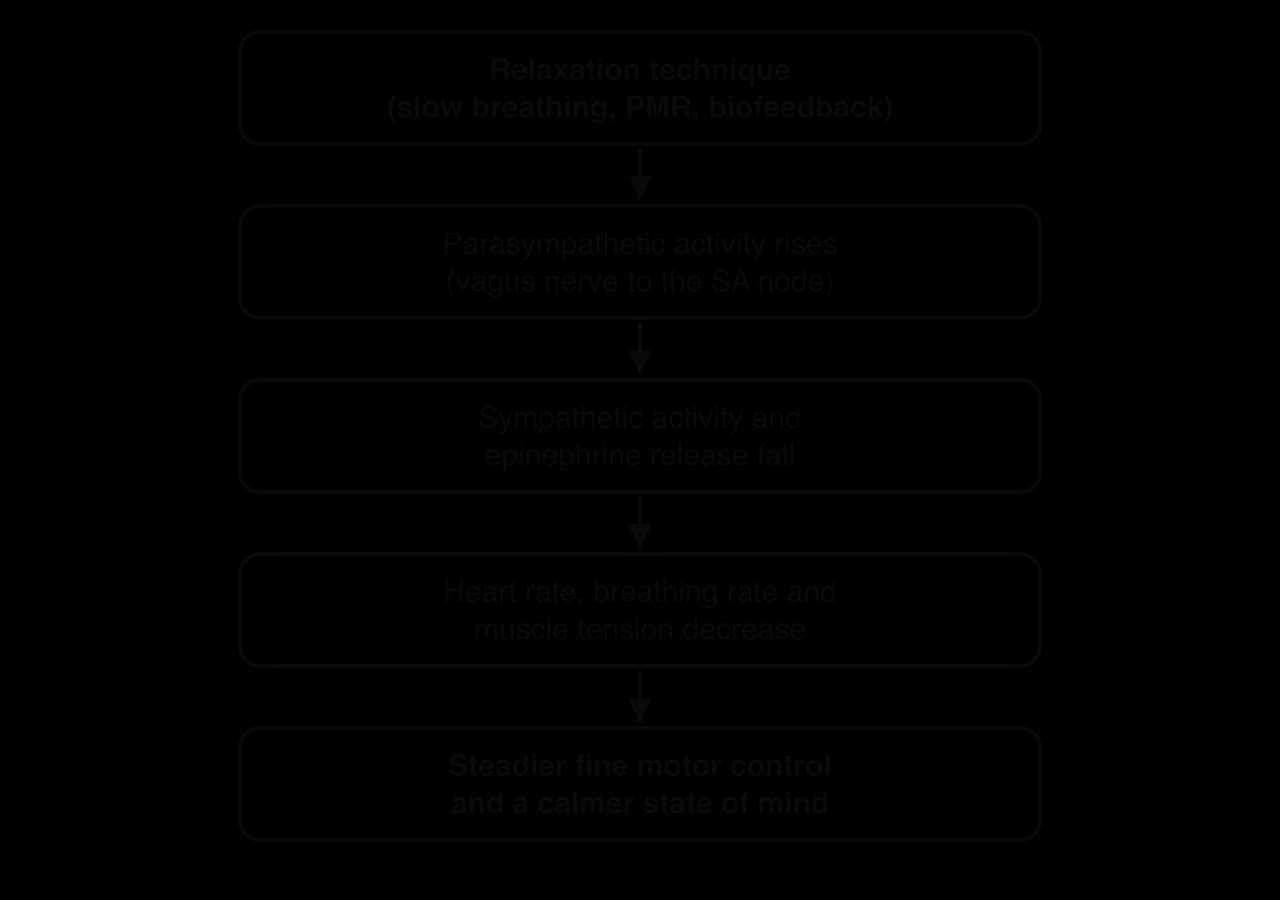
Slow breathing has a direct effect. Heart rate naturally rises slightly during inhalation and falls during exhalation, because vagal activity is reduced as the lungs fill and restored as they empty. Breathing slowly, with long exhalations, makes these falls larger and longer. Muscle-based techniques work partly through feedback: relaxed muscles send fewer signals to the brain that the body is under threat, and the person feels calmer.
In diaphragmatic breathing, the athlete places one hand on the chest and one on the abdomen and breathes in slowly through the nose so that only the lower hand moves. The exhalation is longer than the inhalation, for example in for 4 seconds and out for 6 seconds, which gives about 6 breaths per minute. Under stress people tend to take fast, shallow breaths from the upper chest, so learning to breathe from the diaphragm reverses one of the main signs of anxiety.
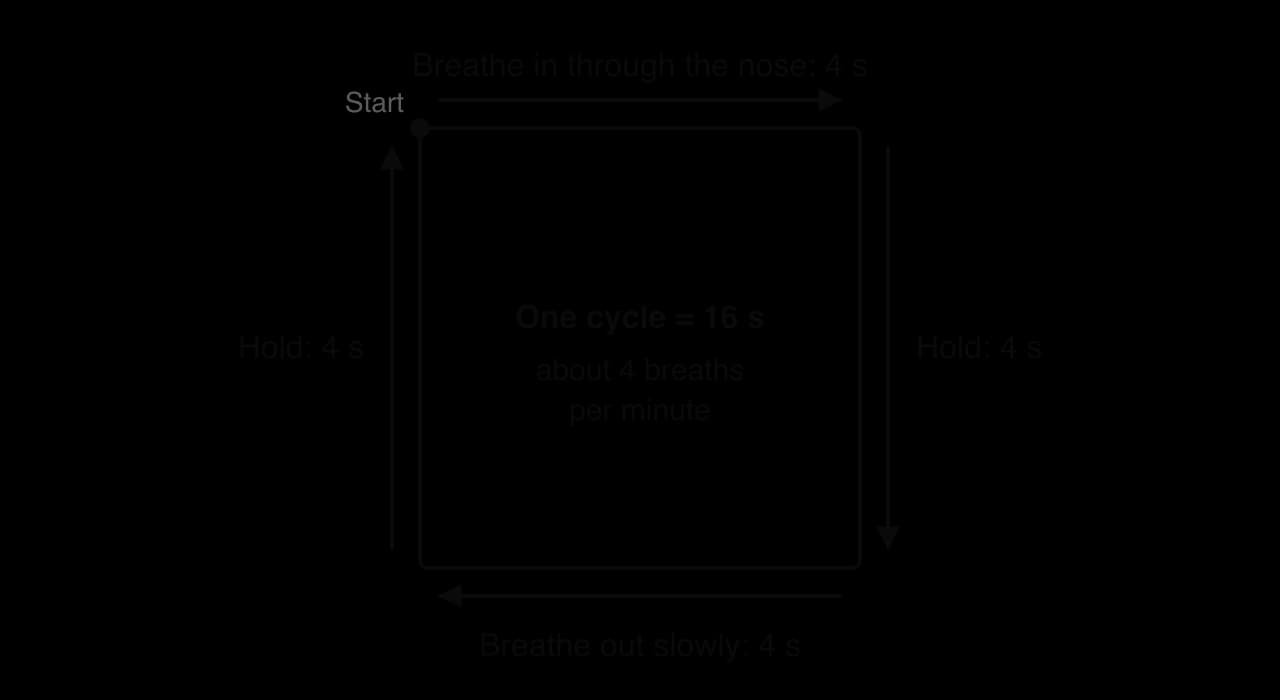
Box breathing is easy to teach and to remember because the count is the same for every side of the “box”. Counting the phases also acts as a short attentional anchor, so the technique has a cognitive effect as well as a physiological one. It can be used in a minute before a race, during a break in play or in the call room.
 YouTube
Centring is a very short breathing technique used just before a skill. The athlete takes one slow, deep diaphragmatic breath, focuses attention on the body’s centre of mass just below the navel, lets the shoulders drop on the exhalation and then turns attention to a single task cue. Centring takes only a few seconds, so it fits into the pre-performance routine of a penalty taker, a high jumper or a basketball player at the free-throw line.
In progressive muscle relaxation, the athlete works through the body in a fixed order, for example hands, forearms, upper arms, shoulders, face, chest, abdomen, thighs, calves and feet. Each group is tensed for about 5–7 seconds and then released for about 20–30 seconds while the athlete attends to the difference between tension and relaxation. The contrast teaches the athlete to notice tension that would otherwise go unnoticed, such as a tight grip on a racket or raised shoulders before a serve.
Full PMR takes 20–30 minutes, so it is practised away from competition, often in the evening or before sleep. With practice, athletes learn shortened versions that relax several muscle groups at once, and eventually “release only” versions that can be used in a few seconds before a performance. PMR is also used widely in health settings to treat anxiety and insomnia, which makes it a strategy that serves both lenses.
Autogenic training, developed by the German psychiatrist Johannes Schultz, uses self-suggestion instead of muscle tension. The athlete repeats phrases that focus on bodily sensations of relaxation, such as “My arms are heavy”, “My legs are warm” and “My heartbeat is calm and regular”, while lying or sitting quietly. Feelings of heaviness and warmth reflect muscle relaxation and dilation of blood vessels in the skin.
Autogenic training takes several weeks to learn and is less popular than breathing techniques in sport, but some athletes find it easier than PMR, especially those with injuries for whom tensing muscles is uncomfortable.
Physiological changes during stress are usually hard to feel accurately. Biofeedback makes them visible. An athlete wears a heart rate monitor or a finger sensor, watches the value on a screen and experiments with breathing or relaxation until the value changes in the desired direction. Over many sessions the athlete learns which mental and physical actions control the response, and eventually can do so without the device.
Type of biofeedback | What is measured | What a fall (or rise) shows | Sporting use |
|---|---|---|---|
Heart rate | Beats per minute from a chest strap or optical sensor | Lower heart rate shows reduced sympathetic activation | Shooters, archers and biathletes lowering heart rate before a shot |
Heart rate variability (HRV) | Variation in the time between successive heartbeats | Higher HRV indicates greater parasympathetic (vagal) activity | Resonance-frequency breathing training, often at about 6 breaths per minute |
Skin conductance (galvanic skin response) | Electrical conductance of the skin, which rises with sweating | Lower conductance shows reduced sympathetic arousal | Learning to stay calm when imagining pressure situations |
Electromyography (EMG) | Electrical activity of a muscle | Lower EMG shows less muscle tension | Releasing tension in the forearm of a golfer or the shoulders of a swimmer |
Heart rate variability needs a short explanation. A healthy heart does not beat like a metronome: the interval between beats changes slightly from beat to beat, mainly because of vagal activity rising and falling with each breath. More variation at rest generally indicates stronger parasympathetic control and better capacity to recover from stress. HRV biofeedback trains athletes to breathe in a way that maximises this variation.
Sources: Jiménez Morgan and Molina Mora, Applied Psychophysiology and Biofeedback, 2017; Laborde et al., Neuroscience and Biobehavioral Reviews, 2022.
Technique | Time to learn | Usable during competition? | Equipment | Best suited to |
|---|---|---|---|---|
Diaphragmatic and box breathing | Days | Yes, in breaks and before skills | None | Almost everyone; closed, self-paced skills |
Centring | Days to weeks | Yes, in a few seconds | None | Pre-performance routines (penalties, free throws, serves) |
Progressive muscle relaxation | Weeks (full version 20–30 min) | Only short “release” versions | None | Athletes with high muscle tension; sleep before competition |
Autogenic training | Several weeks | Rarely | None | Athletes who dislike tensing muscles; general stress management |
Biofeedback | Weeks of sessions | No (the skill learned is used later) | Sensors and software | Precision sports; athletes who like objective data |
Breathing techniques are the most practical relaxation skill because they are quick to learn, need no equipment and can be used during competition. PMR, autogenic training and biofeedback require more time and are better seen as training methods that build the ability to relax, which is then applied with short cues on the day. Relaxation suits sports that need fine control and a low or moderate optimal arousal, such as shooting, archery and golf. It can be counterproductive just before explosive events such as a sprint or a weightlift, where athletes may need to raise arousal instead, and some athletes interpret any drop in activation as a loss of readiness. As with self-talk, the right choice depends on the person, the sport and the moment.
The same coping skills serve very different goals depending on who uses them. The table compares how the main SL strategies are applied for health and for performance.
Strategy | Health lens | Performance lens |
|---|---|---|
Appraisal and reappraisal | A patient in cardiac rehabilitation reappraises an exercise class as a challenge she can manage, not a threat to her heart | A sprinter reappraises pre-race nerves as readiness |
Problem-focused coping | An office worker plans walking meetings to fit exercise into a busy week | A volleyball team watches video of an opponent’s serve to plan reception |
Self-talk | An older adult uses “one more lap” to keep walking on a tired day | A golfer uses “smooth” before a pressure putt |
Relaxation | Slow breathing and PMR to manage anxiety, insomnia or high blood pressure | A biathlete lowers heart rate before shooting |
Avoidance (when overused) | Skipping exercise sessions and rehabilitation appointments | Withdrawing effort in matches, dropping out of the sport |
Linking coping to health also means linking it to physiology. Long-lasting distress keeps cortisol and sympathetic activity raised, which affects sleep, recovery and immune function, and can contribute to overtraining syndrome when combined with heavy training. Exercise itself is also a coping strategy for many people: regular physical activity is widely recommended for managing stress and low mood, including during pregnancy and the menopause, when other coping resources may be under strain.
The coping categories describe what a strategy aims to do. They do not say which category works best. Research on coping effectiveness shows that the answer depends heavily on one property of the stressor: whether the athlete can do anything about it.
Most athletes face both kinds of stressor at the same event, so the first step in coping is often to sort them.
Controllability depends on the athlete’s own power to act and is separate from how serious the stressor is. A small controllable stressor (a loose shoelace) and a large uncontrollable stressor (a cancelled Olympic Games) call for different kinds of coping.
Controllable stressors | Uncontrollable stressors |
|---|---|
Amount and quality of preparation and training | Weather, altitude, the playing surface |
Tactical plan; choice of equipment | Officials’ decisions, including video review outcomes |
Technique faults that can be corrected | An opponent’s performance on the day |
Sleep, nutrition and recovery routines | Injury news that has already happened; a bad draw |
How the athlete responds to a mistake | Selection decisions, crowd behaviour, travel delays |
The goodness-of-fit hypothesis was developed from the work of Folkman and colleagues in the 1980s. It proposes that coping is most effective when the type of strategy fits how controllable the situation is.
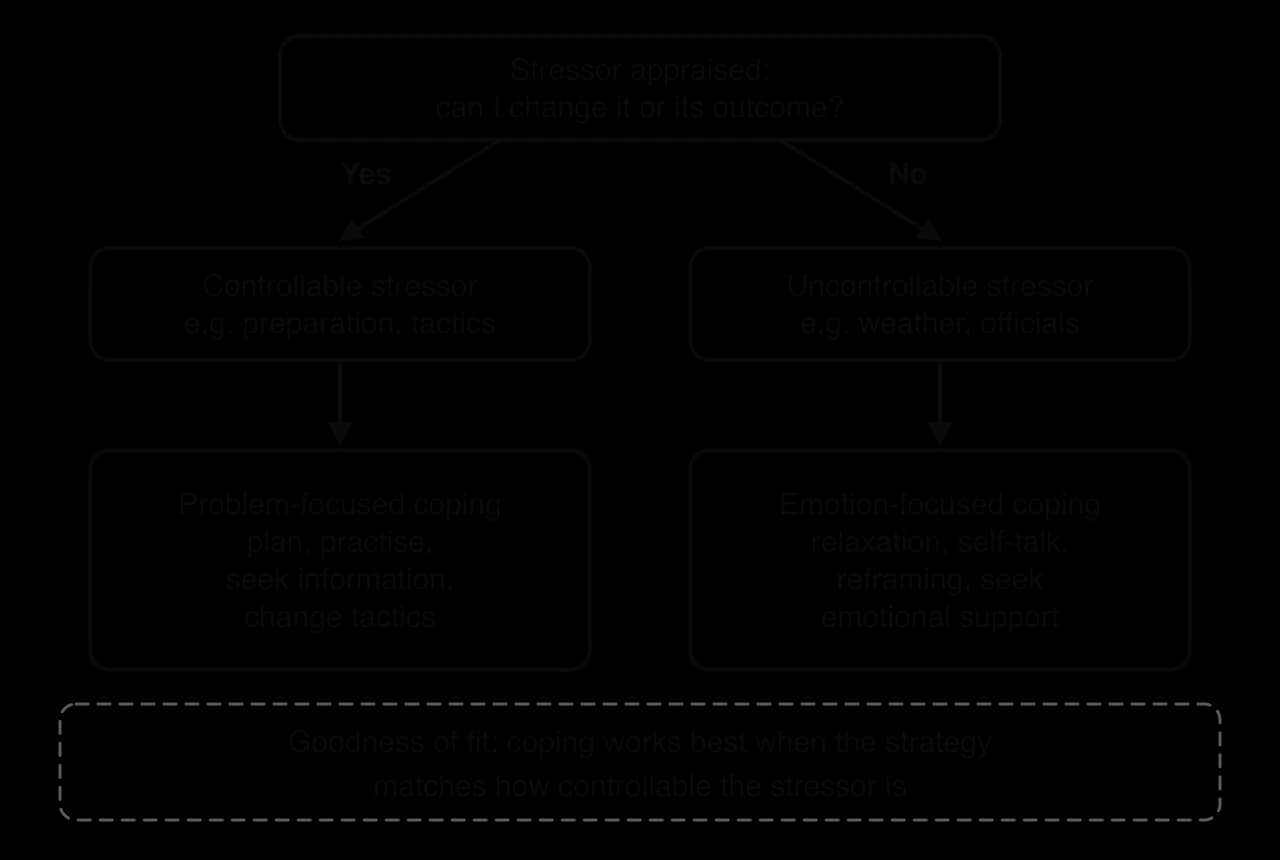
Problem-focused coping is more effective for controllable stressors because acting on the cause can remove it. A footballer who keeps losing aerial duels can analyse his timing, practise heading and change his position. If he only relaxed and told himself not to worry, the cause would remain and the stress would return in the next match.
Emotion-focused coping is more effective for uncontrollable stressors because effort spent trying to change something that cannot change is wasted and tends to increase frustration and anger. A tennis player who keeps arguing with the umpire about a line call that has already been confirmed is trying to change the unchangeable. Accepting the call, taking a slow breath and saying “next point” protects her concentration and emotional state.
Many real stressors are a mixture. An injury cannot be undone, but the rehabilitation programme, sleep and nutrition can be controlled. A crowd cannot be silenced, but where an athlete directs attention can. Skilled copers break a stressor into its parts and use problem-focused coping on the controllable parts and emotion-focused coping on the rest. Coaches often summarise this as “control the controllables”.
Classifying stressors is the first step in applying goodness of fit, and many real situations need more than one judgment.
No coping strategy works for every athlete in every situation. A strategy that helps one swimmer before a final may distract another, and a strategy that helps during a match may be harmful over a season. Research therefore asks two questions: which strategies are associated with better outcomes on average, and for whom and when.
Seeking support is generally regarded as the most effective type of coping strategy for athletes. It is unusual because it can fall into either of the first two coping categories, depending on what is sought and from whom.
Form of support | What is sought | Typical source | Coping category |
|---|---|---|---|
Instrumental (informational) support | Advice, information, practical help, a plan | Coach, physiotherapist, team doctor, sport psychologist, experienced teammate | Problem-focused: changes the stressor |
Emotional support | Comfort, understanding, reassurance, someone to listen | Family, partner, friends, teammates | Emotion-focused: changes the response |
Esteem support | Reminders of one’s ability and worth | Coach, teammates, family | Mainly emotion-focused; also builds confidence for problem-focused action |
A young sprinter worried about a sudden drop in form might ask the coach to analyse her start (instrumental support, problem-focused) and talk to her parents about her worries (emotional support, emotion-focused). Social support works through both routes at once: it adds resources to the athlete’s secondary appraisal, so situations are more often appraised as challenges, and it reduces the emotional impact of stressors that cannot be changed.
Seeking support is effective only when good support is available and the athlete is willing to ask. Support from the wrong source can backfire, for example reassurance from a parent who is visibly more anxious than the athlete, or technical advice from several people that conflicts. The quality of the relationship matters as much as the support itself.
Studies that ask athletes which strategies they used and relate these to performance satisfaction identify a group of strategies that are consistently effective. Mental imagery, effort expenditure, thought control, relaxation and logical analysis have all been positively related to how satisfied athletes are with their performance.
Strategy | What it involves | Example | Category |
|---|---|---|---|
Logical analysis | Breaking the problem down calmly and working out its causes and a solution | A tennis player analyses why she is losing long rallies and changes her tactics | Problem-focused |
Relaxation | Breathing, PMR or centring to lower arousal | A penalty taker uses one centring breath before the run-up | Emotion-focused |
Mental imagery | Rehearsing the skill or the response to a stressor in the mind | A diver images a calm, clean entry before a difficult dive | Problem- or emotion-focused |
Thought control | Thought stopping, reframing and positive self-talk to manage negative thoughts | A batter replaces “don’t get out” with “watch the ball” | Emotion-focused |
Effort expenditure | Deliberately increasing effort and intensity in response to a setback | A rower who falls behind lifts the stroke rate and drive | Problem-focused |
As a coping strategy, imagery lets an athlete rehearse the planned response to a stressor (a false start, a hostile crowd, falling behind) before it happens, so that the real situation is appraised as familiar and manageable. It is studied in its own right as a psychological skill.
Distraction means turning attention away from a stressor onto something unrelated: music, a conversation, a game on a phone. Used briefly to manage feelings, it acts as an emotion-focused strategy; when it becomes a way of never dealing with the stressor, it is avoidance-focused. Between heats, before a match or in a long rain delay, distraction can stop an athlete from overthinking and keep arousal from rising too early.
Distraction is not effective for reaching goals. Studies of athletes’ goal attainment have found task-oriented coping positively associated with reaching goals, while distraction-oriented coping was not associated with goal attainment at all. Distraction lowers distress but does nothing about the stressor or the task, so the athlete must turn back to the task when it matters.
Three groups of maladaptive coping strategies are consistently linked with poor outcomes in athletes.
Disengagement (mental or behavioural withdrawal). A basketball player who stops tracking back once his team falls 20 points behind has behaviourally disengaged. A runner who “switches off” mentally and lets the pace drop has mentally disengaged. Disengagement protects self-esteem in the moment (“I wasn’t really trying”) but guarantees a poorer result.
Venting unpleasant emotions. Shouting, swearing, smashing a racket or arguing with officials releases tension briefly but raises arousal, uses up attention, can bring penalties and keeps attention on the stressor.
Self-blame. Repeatedly criticising oneself for a mistake (“It’s all my fault, I’m useless”) increases cognitive anxiety and lowers confidence. Over time it is linked with learned helplessness and low mood.
A meta-analysis of 18 studies with 3,900 athletes grouped coping into mastery coping (strategies that take control of the situation and eliminate the stressor, close to problem-focused coping), internal regulation (managing internal stress responses, including emotion-focused, acceptance and distraction strategies) and goal withdrawal (disengagement and venting). The chart shows its main findings.
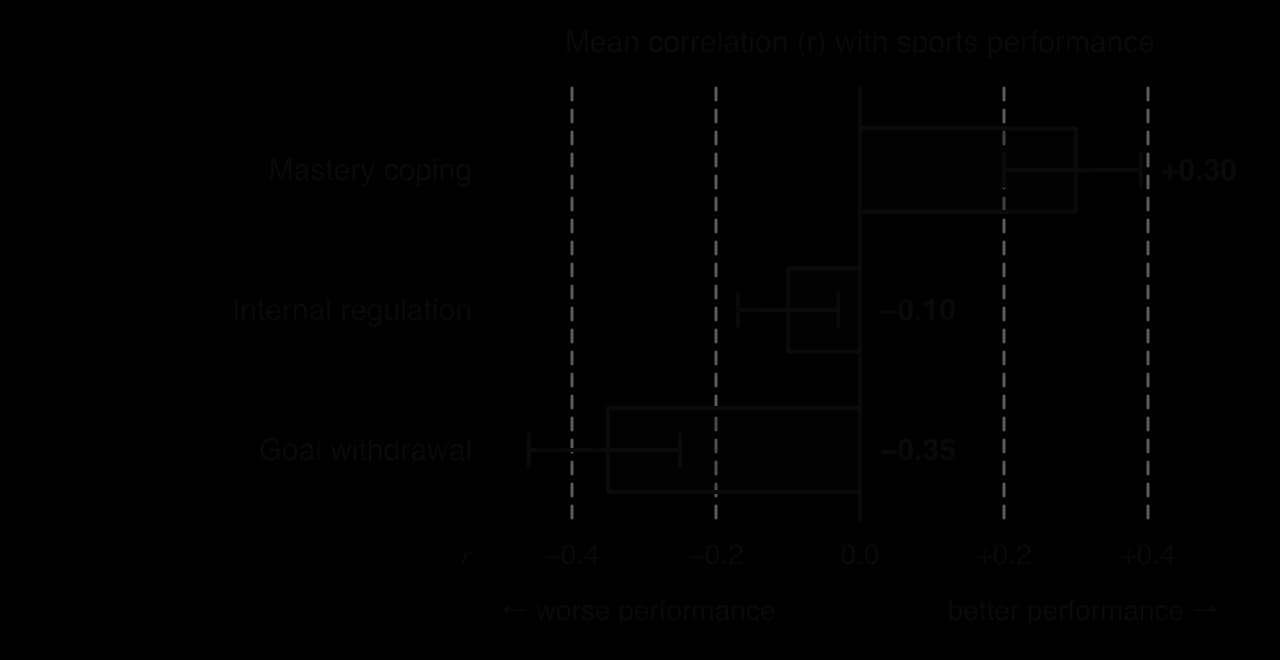
The pattern supports the HL statements. Strategies that tackle the stressor are linked with better performance; strategies that give up on the goal are linked with worse performance. The small negative result for internal regulation probably reflects the mixing of helpful emotion-focused strategies with distraction and avoidance in the same category, and the fact that athletes who are already performing badly use more emotion-focused coping. The correlations are moderate at best, so coping explains only part of performance.
Strategy | Usual effect | Judgment |
|---|---|---|
Seeking social support | Positive: adds resources and reduces emotional impact | Most effective overall, if good support is available and the athlete will ask |
Logical analysis, effort expenditure | Positive for controllable stressors | Effective; may increase frustration if the stressor cannot be changed |
Relaxation, thought control, imagery | Positive, especially under pressure and for uncontrollable stressors | Effective when practised; little use if the cause could be fixed and is ignored |
Distraction | Short-term reduction in distress | Useful briefly; not effective for reaching goals |
Disengagement, venting, self-blame | Negative for performance and well-being | Maladaptive; should be replaced through coping skills training |
Taken together, the evidence supports a flexible coping repertoire led by seeking support and problem-focused strategies, with emotion-focused strategies for what cannot be changed and distraction only in short bursts. The best strategy still depends on the athlete, the stressor and the moment, which is why effective copers are often described as flexible rather than as users of one “best” strategy.
Coping preferences vary between people. Athletes high in neuroticism tend to appraise more situations as threats and to use more emotion-focused and avoidance strategies, while mentally tough athletes tend to appraise stressors as challenges and use more problem-focused strategies. Experience matters too: older and more experienced athletes usually have more strategies and better judgment about which to use, because they have met similar stressors before.
Culture affects seeking support in particular. Studies comparing Korean, Asian American and European American students found that the Asian and Asian American participants reported using social support less to cope with stress, because they were more concerned about burdening others and disturbing relationships. A later review concluded that people from these cultural backgrounds are more likely to use and benefit from support that does not require openly disclosing their distress, such as spending time with close others. Coaches and support staff working with multicultural teams therefore need to offer support in more than one form, instead of waiting for athletes to ask.
Sources: Taylor et al., Journal of Personality and Social Psychology, 2004; Kim, Sherman and Taylor, American Psychologist, 2008.
Coping strategies help athletes manage everyday stressors, but they are not a substitute for professional help when stress becomes a mental health problem. Mental health symptoms are common in elite sport. A 2019 meta-analysis found that the prevalence of symptoms in current elite athletes ranged from 19% for alcohol misuse to 34% for anxiety or depression, and a 2026 update covering 72 studies reported prevalences from 4% for drug misuse to 33% for distress. Both are based on self-reported symptoms, not clinical diagnoses.
Young elite athletes describe stigma as the most important barrier to seeking help, followed by poor knowledge of mental health and negative past experiences. Facilitators include encouragement from others, an established relationship with a provider and a coach with a positive attitude to mental health. This links the HL finding about seeking support directly to the way sport is organised: athletes are more likely to seek support when the environment makes it normal and safe.
Sports organisations have responded with athlete welfare policies. The International Olympic Committee published a consensus statement on mental health in elite athletes in 2019 and an updated statement in 2026. It recommends routine screening for mental health symptoms with validated questionnaires, management that promotes well-being as well as treating disorders, attention to the training and competition environment, and treatment that may include psychotherapy and medication. It also notes that many athletes can continue to train and compete safely with appropriate support, while some need to modify their participation.
Sources: Gouttebarge et al., British Journal of Sports Medicine, 2019; Gouttebarge et al., Sports, 2026; Gulliver, Griffiths and Christensen, BMC Psychiatry, 2012; Reardon et al., British Journal of Sports Medicine, 2026.
Simone Biles of the United States arrived at the Tokyo 2020 Olympic Games, held in the summer of 2021, as the reigning Olympic all-around champion and a multiple world champion. She was expected to win several gold medals. Instead, she withdrew from most of her events because of “the twisties”, a temporary loss of air awareness during twisting skills, and later returned to win a bronze medal on the balance beam. Her decisions became one of the most discussed examples of an elite athlete coping with stress in public.
Date | Event | Outcome |
|---|---|---|
25 July 2021 | Qualification | Qualified first in the all-around and qualified for all four apparatus finals, despite errors on floor, vault and beam |
27 July 2021 | Team final, first rotation (vault) | Planned a vault with 2.5 twists but completed only 1.5; scored 13.766, then withdrew from the rest of the team final. The United States team won silver (166.096) behind the ROC (169.528) |
28 July 2021 | Individual all-around final | Withdrawal announced, after further medical evaluation, to focus on her mental health |
30–31 July 2021 | Vault, uneven bars and floor finals | Withdrawals announced (vault and bars on 30 July, floor on 31 July) after further medical evaluation |
3 August 2021 | Balance beam final | Competed a modified routine with a non-twisting double pike dismount; won bronze with 14.000 |
5 August 2023 | US Classic (return to competition) | Won the all-around with 59.100 |
October 2023 | World Championships, Antwerp | Gold in the team, all-around, beam and floor events; silver on vault |
Summer 2024 | Paris 2024 Olympic Games | Gold in the team, all-around and vault events; silver on floor |
Sources: Olympic results via Wikipedia event pages (Tokyo 2020 women’s artistic team all-around and balance beam), 2021; Wikipedia, “Simone Biles” (citing Olympics.com and USA Gymnastics results), accessed 2026; Business Insider (Kelly McLaughlin), 21 October 2021.
The stressor and its appraisal. The twisties are a sudden loss of the gymnast’s sense of where she is in the air during twisting skills. On the vault in the team final, Biles planned 2.5 twists and completed 1.5, landing safely but well short of the skill. Biles explained afterwards that she withdrew to protect her own safety and the team’s chance of a medal.
In transactional-model terms, the stakes in primary appraisal were extremely high: an Olympic final, enormous public expectation and, above all, the risk of a serious head or neck injury from landing a twisting skill wrongly. Her secondary appraisal was that her normal resources, the automatic air awareness built over many years, were not available. Demand exceeded resources.
Problem-focused coping. Several of her decisions acted on the stressor. Withdrawing from the twisting events removed the source of physical danger. She sought information through medical evaluation before each withdrawal. For the beam final she changed her routine to a double pike dismount, which contains no twists, solving the problem of competing safely with the skills that were still reliable. This was problem solving: separating the parts of her gymnastics that were affected from those that were not.
Seeking support. Her teammates, Sunisa Lee, Jordan Chiles and Grace McCallum, completed the team final without her, and she stayed on the floor to support them. In an interview in October 2021 she described the therapy she had been receiving.
Getting the mental health therapy I need has been really relieving for me.
— Simone Biles, NBC Today, reported by Business Insider, 21 October 2021
In coping terms, she sought information and practical help from coaches and medical staff (problem-focused) and emotional support from teammates, family and a therapist (emotion-focused). She also spoke publicly about her mental health during the Games, which was unusual for an athlete at the peak of her career.
Avoidance or effective coping? On the surface, withdrawing from events looks like avoidance-focused coping (“quitting”). Classifying a strategy by its aim gives a different answer. Biles did not withdraw to escape an uncomfortable feeling while the danger remained; she withdrew because the danger itself, an uncontrolled landing, could be removed only by not performing the skills. She kept working on the problem and returned to competition in the event she could do safely. Her later results, including four world titles in 2023 and three Olympic gold medals in 2024, are consistent with a stressor that was managed, not avoided.
What the case shows and its limits. The case shows that coping in elite sport involves several strategies at once, that seeking support can be central, and that athlete safety and mental health are part of coping, not separate from it. As evidence, however, the case has clear limits, because it concerns a single, highly unusual athlete.
Most of what is known about her appraisals comes from her own public statements and media reports, which are self-report given after the event and may be incomplete. The causes of the twisties are not well understood scientifically, and it is not possible to say which strategy, if any, caused her later success. Testing coping theory requires studies of many athletes in which strategies and outcomes are measured.
Using the transactional model, explain why the same vault that Biles had performed successfully many times was appraised so differently in the Tokyo team final.
Discuss whether withdrawing from competition should be classified as problem-focused or avoidance-focused coping, using this case and one other sporting example.
Suggest how coaches and national federations could make it easier for athletes to seek support for mental health concerns before a major championship.
Coping appears in Paper 1A multiple-choice questions (classifying strategies), in Paper 1B data-based questions on interventions such as relaxation or self-talk, and in Paper 2 structured and extended-response questions. Most marks are lost by giving examples without stating the aim of a strategy, and by describing a strategy without linking it to the stressor or the outcome.
Questions on relaxation often carry a mark for the physiological mechanism. Name the parasympathetic nervous system and its effect on heart rate; “it calms you down” does not earn that mark.
A second common question type tests the stages of the transactional model.
Self-talk questions often ask about the type of self-talk that suits a task.
Paper 1B questions describe a study and give its results. The data in this question are hypothetical.
Paper 1B: Researchers investigated whether a breathing programme improves performance in archery. Twenty-four university archers were randomly allocated to an intervention group (n = 12), who practised diaphragmatic and box breathing for 10 minutes a day for 6 weeks and used one slow breath before each arrow, or a control group (n = 12), who continued normal training. Before and after the 6 weeks, each archer shot 30 arrows (maximum score 300) in a simulated competition with spectators and a prize. Heart rate was recorded in the 5 seconds before each release.
Group | Pre-release heart rate before (beats min⁻¹), mean ± SD | Pre-release heart rate after (beats min⁻¹), mean ± SD | Score before (out of 300), mean ± SD | Score after (out of 300), mean ± SD |
|---|---|---|---|---|
Intervention (n = 12) | 98 ± 8 | 86 ± 7 | 241 ± 12 | 252 ± 11 |
Control (n = 12) | 97 ± 9 | 96 ± 8 | 243 ± 13 | 245 ± 12 |
Questions on the categories usually ask for an outline with an example.
Self-talk questions reward clear distinctions with examples.
Mechanism questions on relaxation link psychology to physiology.
Structured HL questions often ask for an explanation of seeking support.
Extended HL questions combine controllability with the effectiveness evidence.
A stressor is a demand perceived as needing a response; stress is the psychological and physiological response, which can be positive (eustress) or negative (distress).
In the transactional model, primary appraisal judges what is at stake and secondary appraisal judges the resources available; together they produce a challenge or a threat appraisal.
Problem-focused coping changes the stressor, emotion-focused coping regulates the emotional response, and avoidance-focused coping distances the person from the stressor.
Self-talk can be unintentional (positive or negative) or strategic (instructional or motivational); cue words, acronyms, recalling past successes, thought stopping and reframing make it effective.
Self-talk has a moderate positive effect on performance, largest for fine and novel tasks, and instructional self-talk suits fine skills.
Relaxation skills such as diaphragmatic and box breathing, PMR, autogenic training and biofeedback lower heart rate by increasing parasympathetic activity.
Problem-focused coping is more effective for controllable stressors and emotion-focused coping for uncontrollable stressors (HL).
Seeking support is the most effective coping strategy for athletes; disengagement, venting and self-blame are maladaptive, and distraction helps only in the short term (HL).
Coping is shaped by personality, experience and culture, and serious mental health problems need professional support within athlete welfare systems (HL).
I can define stress, stressor, eustress and distress, and give a sporting example of each.
I can describe the transactional model of stress, including primary and secondary appraisal and challenge and threat appraisals.
I can distinguish between problem-focused, emotion-focused and avoidance-focused coping and classify a strategy by its aim.
I can describe unintentional, instructional and motivational self-talk and the techniques used to develop it.
I can explain how breathing techniques, PMR and biofeedback lower heart rate.
I can evaluate self-talk and relaxation using research evidence.
I can apply goodness of fit to match coping strategies to controllable and uncontrollable stressors (HL).
I can evaluate seeking support and distinguish effective from maladaptive coping strategies (HL).
I can discuss how individual and cultural differences and welfare systems affect coping (HL).