Explain need achievement theory and achievement goal theory, apply them to coaching, PE and exercise settings and, at HL, explain why high ego orientation becomes a problem when task orientation and perceived ability are low.
Each is in the SEHS glossary, with every other term in the subject.
A theory proposing that people strive to feel successful and competent, and judge success either against their own previous performance (task orientation) or against other people (ego orientation).
A person’s drive to strive for success, master tasks and do well in situations where their performance can be evaluated against a standard or against other people.
Behaviour in which a person seeks out and engages with achievement situations, for example choosing realistic challenges, persisting after failure and welcoming evaluation.
Behaviour in which a person withdraws from or minimises involvement in achievement situations, for example avoiding competition, choosing very easy or very hard tasks, withdrawing effort or making excuses.
Withdrawal from a sport or physical activity before a person has reached their potential or chosen to stop for positive reasons, often linked to low perceived ability, low enjoyment or an ego-involving environment.
A goal orientation in which a person judges success and competence in a norm-referenced way, by outperforming others or performing equally well with less effort.
Defensive behaviour, such as blaming others, rejecting feedback or withdrawing effort, that a person uses to protect their self-esteem and the appearance of ability when it is challenged.
Outline what is meant by motivation and achievement motivation, and distinguish between the direction and the intensity of effort.
Describe the personality factors (need to achieve and need to avoid failure) and the situational factors (probability of success and incentive value) in need achievement theory.
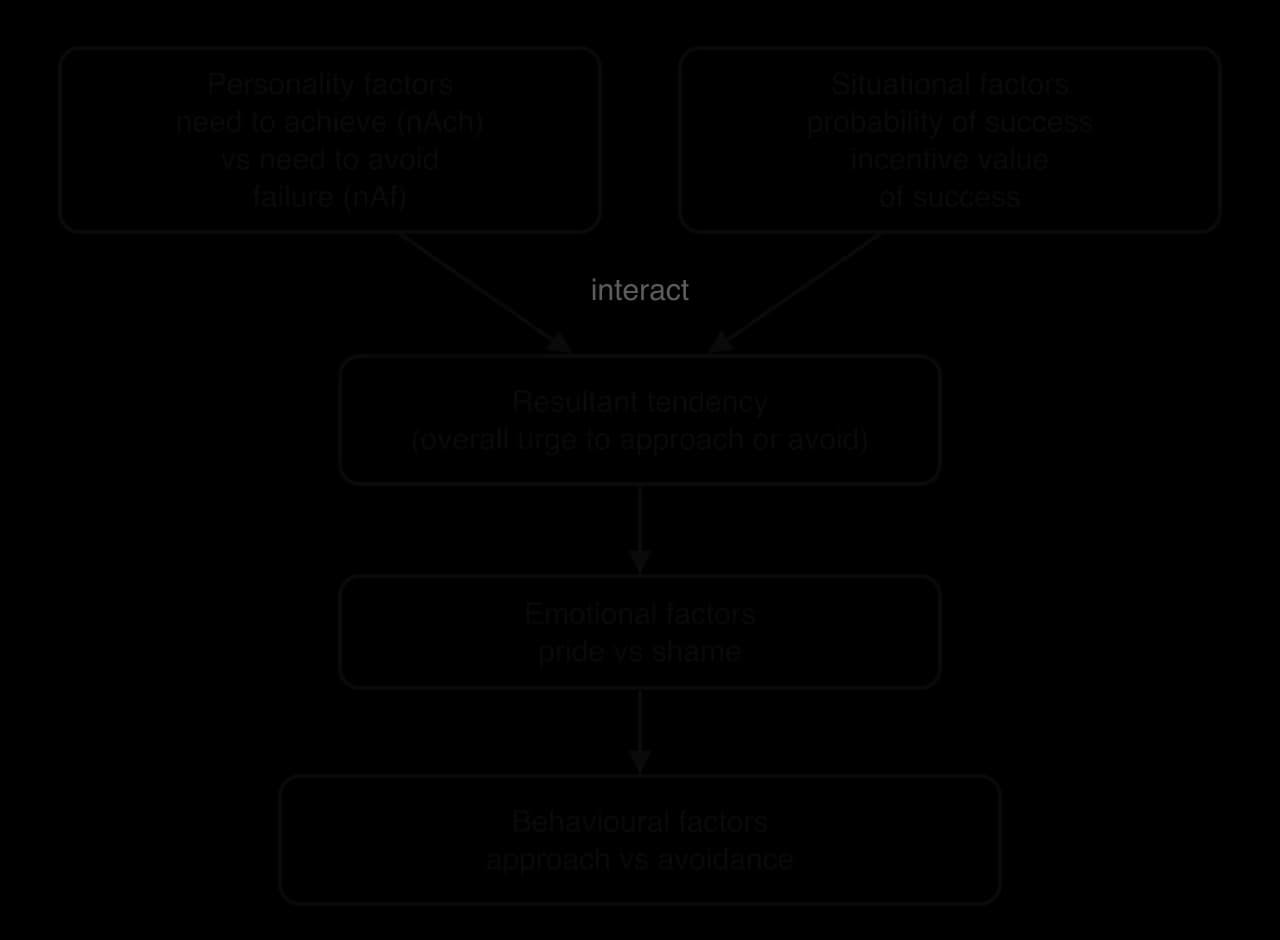
Explain how personality and situational factors interact to produce the resultant tendency, emotional factors and approach or avoidance behaviour.
Explain why people high in the need to achieve prefer tasks with about a 50% chance of success.
Suggest how coaches, sport scientists and health professionals can change situational factors to encourage approach behaviour.
Distinguish between task orientation and ego orientation, and describe how goal orientations are measured with the TEOSQ.
Explain why high task orientation is associated with greater effort, perseverance and enjoyment.
Evaluate need achievement theory and achievement goal theory as explanations of behaviour in sport and exercise.
Explain why high ego orientation becomes a problem when task orientation and perceived ability are low (HL).
Achievement motivation concerns why some people seek out difficult challenges, train hard and keep going after failure, while others avoid competition, give up quickly or make excuses. In sport and exercise the same questions decide who chooses to enter a race, who returns to training after a defeat and who stays physically active for life.
The topic matters through both lenses of the course. For performance, motivation shapes how much effort an athlete invests and how they respond to setbacks, both of which limit how far physical talent can be developed. For health, the people who most need to be active, such as inactive adults referred to exercise by a doctor, are often those most worried about failing in front of others; understanding their motivation helps practitioners design sessions they will keep attending.
With a free account, Augment remembers where you stopped and what you have practiced.
A situational factor in need achievement theory: how much pride or satisfaction success at a task would bring, which is greater when success is less likely (Is = 1 − Ps).
The internal and external forces that determine the direction of a person’s behaviour (what they choose to do) and the intensity of their effort (how hard and how long they try).
An interactionist theory, developed by Atkinson and McClelland, proposing that personality factors and situational factors interact to produce a resultant tendency, which creates emotions (pride or shame) that drive approach or avoidance behaviour.
A personality factor in need achievement theory describing a person’s motivation to seek out challenges, persist and experience pride in success; also called the motive to achieve success (nAch).
A personality factor in need achievement theory describing a person’s motivation to avoid situations in which they might fail and feel shame; also called the motive to avoid failure (nAf).
A person’s own judgement of how competent they are at an activity, including their belief about how able other people think they are; also called perceived competence.
A situational factor in need achievement theory: the person’s estimate of how likely they are to succeed at a task, from 0 (certain failure) to 1 (certain success).
In need achievement theory, the overall motivation to approach or avoid an achievement situation, produced by the interaction of personality factors (nAch and nAf) with the probability and incentive value of success.
Creating or claiming obstacles to success before a performance, such as withdrawing effort or reporting an injury, so that failure can be blamed on the obstacle rather than on a lack of ability.
A goal orientation in which a person judges success and competence in a self-referenced way, by mastering skills, improving on their own previous performance and giving maximum effort.
A 13-item self-report questionnaire (7 task and 6 ego items), the Task and Ego Orientation in Sport Questionnaire, that measures dispositional task and ego orientation in sport, each scored from 1 to 5.
In everyday speech, "motivated" usually means "keen". Psychologists use a more precise idea with two parts. The direction of effort is what a person chooses to do: whether they join a club, which events they enter and whether they approach or avoid a particular challenge. The intensity of effort is how hard they try once they have chosen: how much effort they put into each session and how long they persist when it becomes difficult.
A swimmer who chooses the 400 m rather than the 100 m shows the direction of motivation; the same swimmer pushing through the last length when their muscles ache shows its intensity. Both can be observed in behaviour: choices, effort, persistence and performance. Motivation itself cannot be seen directly, so it is inferred from these behaviours or measured with questionnaires.
Motivation can come from inside the activity or from outside it. Intrinsic motivation is doing an activity for its own sake, for the enjoyment or satisfaction it brings, while extrinsic motivation is doing it as a means to an end, such as a medal, money or praise. These forms, and the continuum that links them, are explained by self-determination theory. Achievement motivation asks a narrower question: how people behave in situations where their competence can be judged.
An achievement situation has three features: a task with an outcome that can be judged, a standard of excellence (a time, a score, an opponent, a previous best) and someone, often the performer themselves, who evaluates the result. A competitive match, a fitness test in a PE lesson and a first visit to a gym in front of experienced members are all achievement situations. Two theories explain how people behave in them: need achievement theory and achievement goal theory.
Need achievement theory was developed by David McClelland and John Atkinson in the 1950s and 1960s. It takes an interactionist approach: behaviour is explained by the interaction of a stable personality factor (the person’s achievement motives) with situational factors (how likely success is and how much it would be worth). Neither factor alone predicts what a person will do.
The theory has five components that link in a chain. Personality factors and situational factors combine to give a resultant tendency, the overall strength of the urge to approach or avoid the situation. The resultant tendency produces emotional factors, the feelings the person expects (pride or shame), and these drive behavioural factors, what the person actually does.
Each component is described in turn, using the same example throughout: a 15-year-old tennis player deciding whether to enter a regional tournament.
Everyone has two achievement motives, in different amounts. The motive to achieve success, usually called the need to achieve (nAch), is the capacity to feel pride in accomplishment. The motive to avoid failure, the need to avoid failure (nAf), is the capacity to feel shame after failing. A person’s achievement personality depends on which motive is stronger.
A person high in nAch and low in nAf looks forward to being tested. They focus on the pride they will feel if they succeed, so they seek out competition and challenging opponents, take risks and value feedback because it helps them improve. When they fail, they tend to see failure as information about what to work on.
A person high in nAf and low in nAch focuses on the shame they will feel if they fail, so evaluation feels threatening. They tend to avoid challenges, choose tasks that are very easy (success is certain) or very hard (failure is no disgrace), dislike being watched or assessed, and give up more readily. High nAf is closely linked to trait anxiety, the general tendency to feel threatened in evaluative situations.
Feature | High nAch, low nAf (approach success) | High nAf, low nAch (avoid failure) |
|---|---|---|
Focus before the task | The pride of succeeding | The shame of failing |
Choice of task | Realistic challenges, about 50/50 | Very easy or very hard tasks |
Attitude to evaluation | Welcomes it; wants feedback | Fears it; prefers not to be watched |
Response to failure | Persists; tries harder or changes strategy | Gives up; avoids similar situations |
Typical attributions | Success to ability and effort; failure to lack of effort | Failure to lack of ability; success to luck |
Performance under pressure | Often improves when evaluated | Often worsens when evaluated |
The table describes two extremes. Most people sit somewhere between them, and the balance can differ between settings: a student may have high nAch in football, where they feel competent, and high nAf in gymnastics. The attributions in the table link to attribution theory, which explains how the causes people give for success and failure affect their future motivation.
Two features of the situation decide how strongly the motives are aroused. The probability of success (Ps) is how likely the person thinks success is, from 0 (certain failure) to 1 (certain success). What matters is the person’s own estimate, which depends on the opponent, the difficulty of the task and their view of their own ability.
The incentive value of success (Is) is how much satisfaction or pride success would bring. In Atkinson’s model it depends on the probability of success: the harder the task, the more pride success would bring. Beating a much stronger opponent is worth a great deal; beating a beginner is worth almost nothing. Atkinson expressed this as Is = 1 − Ps.
For the tennis player, a tournament against players of a similar standard gives a probability of success near 0.5 and a moderate incentive value. A tournament full of nationally ranked players gives a low probability of success (perhaps 0.1) but a very high incentive value, while a local club competition against beginners gives a high probability of success (perhaps 0.9) but little incentive value.
The resultant tendency is the outcome of the interaction between personality and situational factors: the overall strength and direction of a person’s motivation to take part. When the need to achieve outweighs the need to avoid failure, the resultant tendency is to approach the situation; when the need to avoid failure is stronger, it is to avoid it.
Atkinson summarised the interaction in words that can be written as an equation. The tendency to approach success equals the need to achieve multiplied by the probability of success and by the incentive value of success. The tendency to avoid failure is built in the same way from the need to avoid failure. Because the incentive value falls as the probability of success rises, the product of the two situational factors is largest when Ps = 0.5.
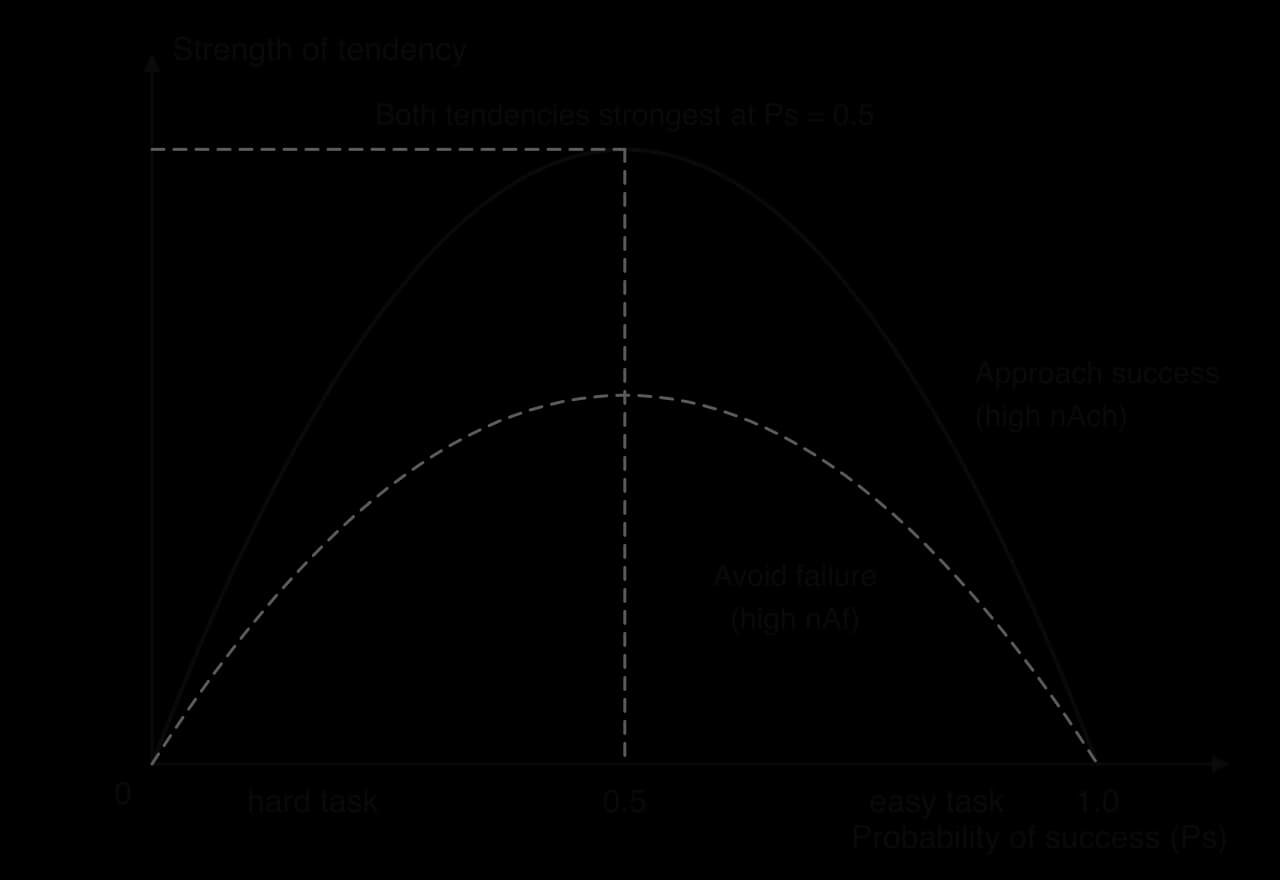
The graph shows why the two personality types choose such different tasks. For the high-nAch tennis player, a 50/50 tournament gives the strongest pull, so they enter it. For a high-nAf player, the same tournament gives the strongest threat, because failure there would be both likely and meaningful. A very easy competition (certain success) or a very hard one (failure is likely and no disgrace) arouses less fear of failure, so a high-nAf player tends to choose one of these, or not to enter at all.
The resultant tendency creates emotional factors: the feelings a person expects before the task and experiences after it. A person with an approach tendency anticipates pride; a person with an avoidance tendency anticipates shame and feels anxiety about evaluation. These expected emotions are what make the situation attractive or threatening.
The emotions in turn drive behavioural factors, which are what a coach can actually observe. Approach behaviour includes seeking challenges, choosing evenly matched opponents, trying hard, persisting after mistakes, taking calculated risks and wanting feedback. Avoidance behaviour includes not entering competitions, choosing very easy or impossibly hard tasks, withdrawing effort, making excuses, feigning injury and dropping out.
A 13-year-old who volunteers to take the penalty in a school match and then asks the PE teacher how to improve their technique shows approach behaviour. A classmate who "forgets" their kit on the day of a fitness test shows avoidance behaviour; the excuse protects them from being seen to fail.
Personality changes slowly, but the situation can be changed quickly. Coaches, PE teachers, sport scientists and health professionals cannot easily alter a person’s balance of nAch and nAf, but they can control how difficult a task looks, how success is defined and rewarded, and how public the evaluation is. The aim is to move the probability of success into the range that encourages approach and to reduce the threat of shame for people high in nAf.
Strategy | How it works in the theory | Sport example | Health and exercise example |
|---|---|---|---|
Match task difficulty to ability | Brings perceived Ps close to 0.5 for everyone | Ability-based groups; handicaps in golf; graded swimming squads | Exercise referral sessions with several levels of each exercise |
Break tasks into smaller steps | Raises Ps for each step, so success is experienced early | Learning a tumble turn in stages | A walking programme that builds from 10 to 30 minutes |
Redefine success as improvement | Makes success possible for every individual, whoever wins | Personal-best targets alongside race results | Progress recorded as minutes walked, not as body mass alone |
Lower public evaluation | Reduces anticipated shame for high-nAf people | Practising new skills away from spectators | Women-only or beginners-only gym sessions |
Attribute failure to controllable causes | Protects perceived ability, so Ps stays realistic | “Late to the ball: that can be trained” | A missed session explained by planning, not "lack of willpower" |
Give informational praise and rewards | Raises the value of effort and mastery | Recognising the most improved player | Badges for attendance and progress in a club or app |
These strategies work through the situational factors in the model. Matching difficulty and breaking a task into steps change the probability of success. Redefining success and recognising improvement change what counts as success, which links to achievement goal theory. Reducing public evaluation and using constructive attributions reduce the emotional threat for people high in nAf. The setting of realistic, step-by-step targets is the core of goal setting, and process goals in particular keep attention on actions the performer controls.
Real programmes use these ideas. Youth football in many countries uses small-sided games on smaller pitches for younger age groups, which gives every child more touches of the ball and more chances of success than 11-a-side on a full-size pitch. In health settings, parkrun times its free 5 km events but presents them as runs rather than races, and walking is explicitly welcomed, which lowers the threat of finishing last for inactive beginners.
Need achievement theory has lasting strengths. It explains a pattern that coaches see every season: some athletes seek out tough opponents while others avoid them. It is interactionist, so it accounts for the same person behaving differently in different situations, and it leads directly to practical strategies, because the situational factors are under a coach’s control.
Its weaknesses are also clear. The theory predicts choice of task better than performance; knowing someone’s nAch says little about how fast they will run. Its original measures were projective tests with low reliability, and later questionnaires are self-reports open to social desirability bias. The model treats incentive value as fixed at 1 − Ps, but real athletes also value money, selection, friends and fun. Most of the early evidence came from laboratory games with young American men, which limits how far it generalises to women, children, other cultures and elite sport.
Most importantly, the theory assumes that everyone defines success in the same way: as doing better than a standard. It cannot explain why two athletes who both finish fourth in a race can feel completely different, one delighted with a personal best and the other ashamed at missing a medal. That difference in how success is defined is the focus of achievement goal theory, which has largely replaced need achievement theory in research, while need achievement theory remains a useful practical framework for choosing task difficulty.
Achievement goal theory, also called goal orientation theory, was developed by John Nicholls in education and applied to sport by Joan Duda and colleagues from the late 1980s. It starts from a simple assumption: in achievement situations people want to feel successful and to demonstrate competence. What differs between people is how they judge whether they have been successful, and that judgement shapes their effort, persistence and emotions.
Nicholls showed that young children do not separate effort from ability: to a 6-year-old, the child who tries hardest is the most able. From around 11–12 years, children understand that ability is a capacity, so that someone who needs to try harder to achieve the same result must be less able. Once this "differentiated" view of ability develops, a person can judge their competence in two different ways, which are the two goal orientations.
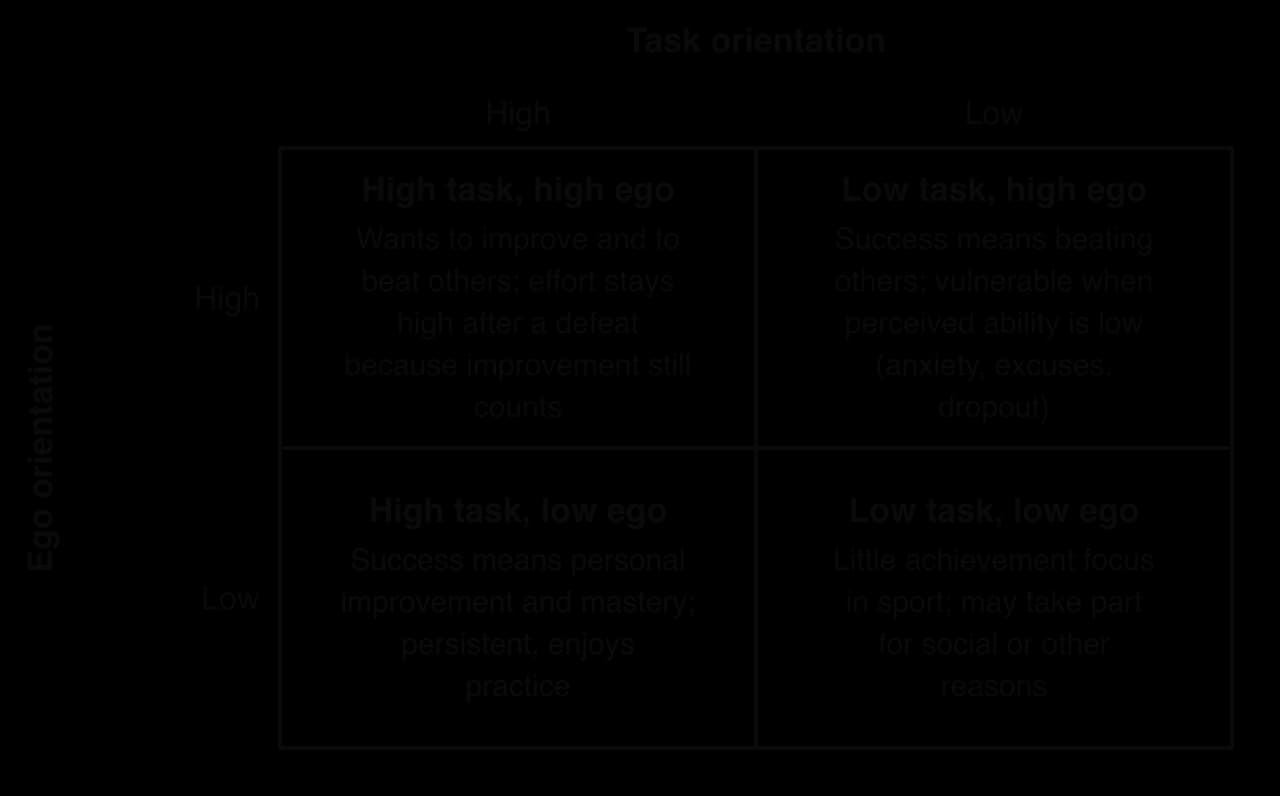
A person high in task orientation judges success against themselves: success means learning a skill, improving on a previous performance or giving full effort. The reference point is self-referenced. A distance runner with high task orientation who finishes tenth but takes 20 seconds off their personal best feels successful.
A person high in ego orientation judges success against other people: success means beating others, or achieving the same result with less effort than others. The reference point is norm-referenced (a norm is the typical performance of a comparison group). The same runner, if ego-oriented, may feel that tenth place is a failure whatever the time.
Feature | Task orientation | Ego orientation |
|---|---|---|
Success means… | Improving, mastering a skill, trying hard | Beating others, being the best, winning with little effort |
Reference point | Self-referenced (own past performance) | Norm-referenced (other people) |
Belief about the cause of success | Effort, practice and cooperation | Natural ability or talent (and sometimes deception) |
Choice of task | Realistic challenges that allow learning | Tasks that guarantee looking able, or excuses if not |
Response to a mistake | Information about what to work on | A threat to how able the person looks |
Typical statement | "I feel successful when I learn something new" | "I feel successful when I’m the best" |
Each orientation is linked to beliefs about what causes success. Among 75 elite young Dutch footballers at a renowned club academy, those higher in task orientation believed that hard work, team play and supportive parents led to success, while those higher in ego orientation believed that ability and innate talent were what mattered. Over one season, players whose skill improved most in the coaches’ ratings were those with the stronger task orientation.
Task and ego orientation are orthogonal: they are independent of each other, not opposite ends of one scale. A person can be high in both, low in both, or high in one and low in the other. Many successful athletes are high in both: they want to win and they also value improvement, so a defeat does not destroy their motivation because they can still see progress.
Goal orientation is a fairly stable disposition, but the goal a person actually pursues in a given moment also depends on the situation. A task-oriented swimmer can become ego-involved at a championship final with a crowd and live television, and an ego-oriented swimmer can become task-involved in a technical drill with no clock. Researchers call the momentary state goal involvement and the stable tendency goal orientation.
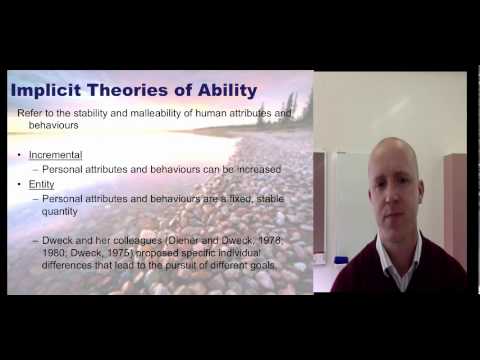 YouTube
Goal orientations are usually measured with the Task and Ego Orientation in Sport Questionnaire (TEOSQ), developed by Duda. It contains 13 statements that complete the stem "I feel most successful in sport when…". Seven items measure task orientation (for example "…I learn a new skill by trying hard") and six measure ego orientation (for example "…I can do better than my friends"). Each item is rated on a five-point scale from 1 (strongly disagree) to 5 (strongly agree), and the person receives a separate mean score for each orientation.
A large body of research links a high task orientation with positive outcomes. A systematic review of 98 studies (110 samples, more than 21,000 participants) found that task orientation was associated with the belief that effort leads to success, motives of skill development and team membership, higher perceived competence, more positive and less negative affect, and more adaptive behaviour. Ego orientation was associated with the belief that ability leads to success and with motives of status and recognition.
The mechanism explains why the pattern appears. Because a task-oriented person defines success as improvement, success is under their own control: anyone can improve, whatever the opposition. Every training session offers a chance to succeed, so effort is always worth giving and mistakes are part of learning. This produces greater effort and perseverance, more enjoyment, the use of adaptive strategies (practising weaknesses, seeking feedback) and lower anxiety, because failing to win is not the same as failing.
An ego-oriented person’s success depends on other people. While they are winning this can be highly motivating, but when they meet a stronger opponent, change to a higher level or are injured, success is no longer in their control. Ego orientation has also been linked to less sporting behaviour: among 199 college basketball players, higher ego orientation in women was related to lower moral judgement and greater acceptance of deliberately injuring an opponent, although the relationship was weak.
Sources: Biddle, Wang, Kavussanu & Spray, European Journal of Sport Science, 2003; Van Yperen & Duda, Scandinavian Journal of Medicine and Science in Sports, 1999; Kavussanu & Roberts, Journal of Sport and Exercise Psychology, 2001.
Goal orientations are learned through socialisation. Children pick up what counts as success from the people around them: a parent who asks whether the child won after every match sends a different message from one who asks what the child learned. Coaches, teachers, peers and the media all contribute. Studies of parents and children show that a parent’s own goal orientation, and the child’s perception of what the parent values, are related to the child’s orientation.
The strongest situational influence is the motivational climate that coaches and teachers create in training. A mastery climate, which rewards effort and improvement, is associated with higher task orientation, while an ego climate, which rewards winning and comparison, is associated with higher ego orientation. For goal orientation, the key point is that the environment can strengthen or weaken an orientation over time.
Goal orientation also links to self-determination theory. A task-oriented athlete takes part largely for the satisfaction of improving, so their motivation tends to be more autonomous; an ego-oriented athlete’s motivation depends more on comparison and recognition, which is closer to controlled motivation. This is one reason task orientation predicts long-term participation.
Achievement goal theory improves on need achievement theory by explaining differences in how people define success, which allows it to predict effort, persistence and emotion after both success and failure. It has produced reliable measures (the TEOSQ, and climate questionnaires), a large evidence base across many sports, countries and ages, and clear practical implications for coaching and PE.
The evidence has limits. Most studies are cross-sectional and use self-report questionnaires, so they show that task orientation and enjoyment go together, not that one causes the other. Samples are dominated by young people in Western countries. The theory also needed revision: researchers later separated approach goals (trying to show competence) from avoidance goals (trying not to look incompetent), because the problems of ego orientation seem to come mostly from the avoidance form. Even so, the central finding, that a strong task orientation supports effort and enjoyment, has been replicated many times and is accepted by most sport psychologists.
A high ego orientation is not harmful in itself. Whether it causes problems depends on two other factors: the person’s task orientation and their perceived ability, their belief about how competent they are, and in particular how competent they think others believe them to be.
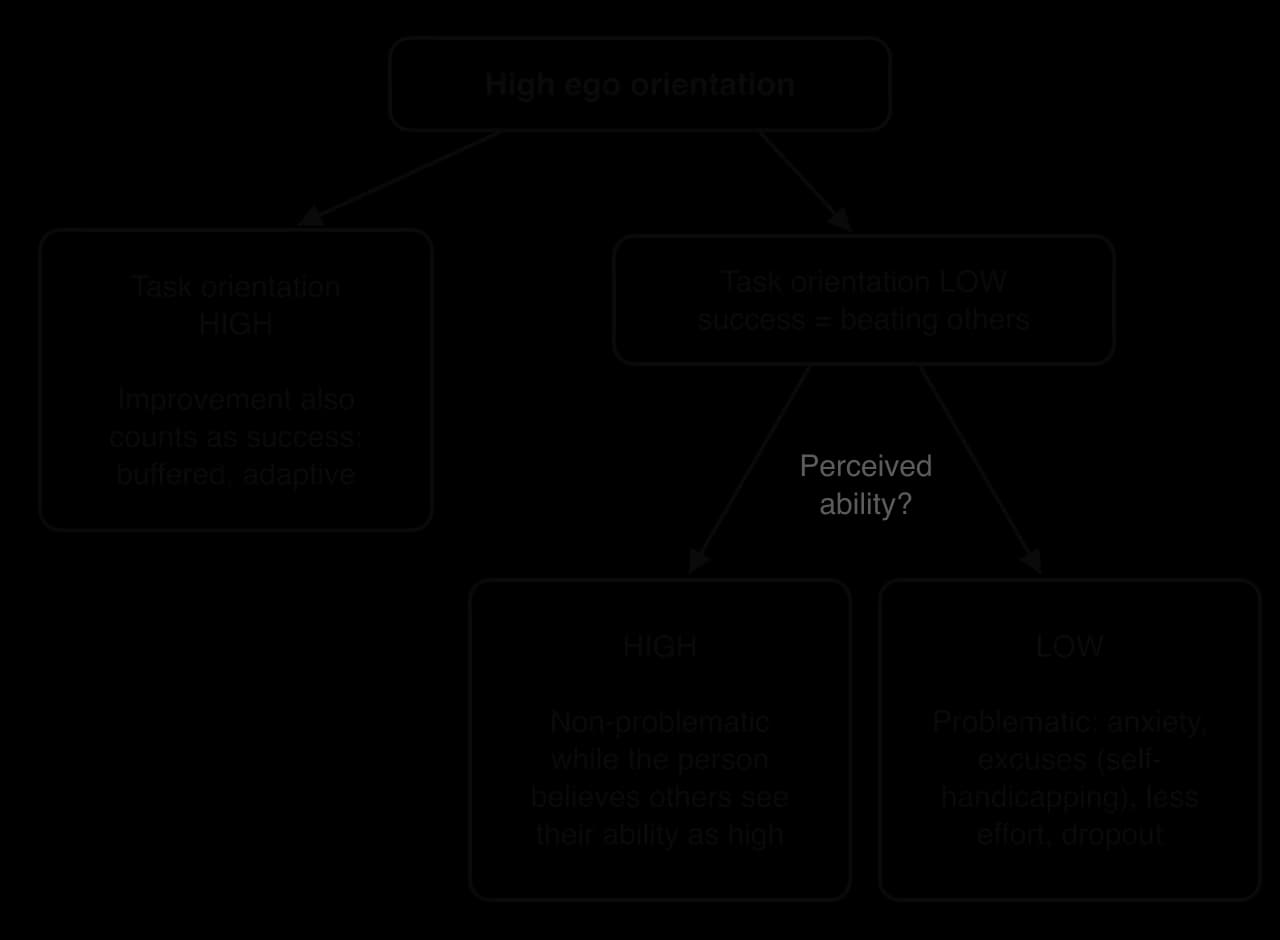
An ego-oriented athlete who believes they are among the best, and believes that coaches, teammates and spectators see them that way, has a high expectation of beating others. Competition confirms their competence, so they approach it eagerly, try hard and often perform well. In this situation a high ego orientation is non-problematic: it behaves much like a high need to achieve.
The difficulty is that this state is fragile. Perceived ability depends on comparison, and comparison changes. A junior who dominated an age group may move up to senior level, meet older and stronger players, be dropped from a team or return from injury behind their rivals. Each of these events lowers perceived ability, and for an athlete who has no task orientation to fall back on, the source of their motivation disappears.
When an ego-oriented person with low task orientation believes that others see their ability as low, every achievement situation threatens to confirm that they are incompetent. Trying hard and still losing would be the worst possible outcome, because it would show that they lack ability. The person therefore protects their self-worth rather than pursuing improvement. Four outcomes are typical.
Anxiety: evaluation is threatening, so cognitive anxiety (worry about failing and being judged) rises before and during competition.
Reduced effort: by not trying fully, the person keeps an explanation for failure that does not involve ability ("I wasn’t really trying").
Excuses and self-handicapping: creating or claiming obstacles before performing.
Avoidance and dropout: missing sessions, avoiding competition and eventually leaving the sport.
Self-handicapping is the most distinctive of these. Before a performance the person creates an obstacle (skipping the warm-up, staying out late, not practising) or claims one ("my ankle’s sore", "I hardly slept"). If they then fail, the handicap provides the explanation; if they succeed despite it, they appear especially able. Either way their perceived ability is protected, but the strategy reduces both performance and learning.
An experiment with 70 British secondary school students (average age about 12) tested whether the situation alone could produce self-handicapping. Students were randomly assigned to complete a running endurance task in either an ego-involving condition (emphasis on comparison with others) or a task-involving condition (emphasis on personal improvement). Before running, they had the chance to report handicaps such as poor sleep or illness. Those in the ego-involving condition reported significantly more handicaps, and perceiving the climate as ego-involving was the strongest predictor of self-handicapping, while task orientation predicted less of it.
Sources: Standage, Treasure, Hooper & Kuczka, British Journal of Educational Psychology, 2007.
Because an ego-oriented person’s sense of worth depends on looking competent, any challenge to their ability is felt as a threat to the self. Ego protection describes the defensive responses that follow: rejecting a coach’s feedback, blaming teammates, officials, equipment or the weather, refusing to try a new technique in front of others, arguing when substituted, or criticising the coach. These responses protect self-esteem in the short term but block learning, because the athlete never accepts the information they need in order to improve.
A useful contrast is two players dropped from a starting line-up. A task-oriented player asks the coach what to work on. An ego-oriented player with low perceived ability may complain that the coach has favourites, train half-heartedly and talk about moving to another club. The second response protects self-esteem, but it also makes being reselected less likely, which lowers perceived ability further.
Dropout from sport is highest in adolescence, the period when comparison with others becomes intense, selection begins and perceived ability is most often challenged. For an athlete high in ego orientation and low in task orientation, leaving the sport removes the threat altogether. Not every athlete who stops is a "dropout" in this sense: many young people move to another sport or reduce to recreational play for positive reasons. The concern is withdrawal driven by a sense of incompetence, which can also turn people away from physical activity in adult life.
The problem also connects with injury. An ego-oriented athlete who fears looking weak may hide pain and keep playing, which raises the risk of a minor injury becoming more serious, while another may report or exaggerate a minor injury as a self-handicap. Both responses show how perceived ability and goal orientation can act as psychological risk factors for injury.
The analysis points to clear strategies for coaches and PE teachers working with ego-oriented athletes.
Problem | Strategy | Why it helps |
|---|---|---|
Low task orientation | Set and praise individual improvement targets; teach athletes to evaluate their own progress | Gives a second, controllable source of success that buffers the ego orientation |
Falling perceived ability | Use self-referenced feedback ("faster than last month") and progressive challenges | Rebuilds competence without relying on beating others |
Public comparison | Avoid ranking in front of the group; give feedback privately | Lowers the threat that triggers self-handicapping and ego protection |
Excuses and defensiveness | Respond calmly; focus the conversation on specific, controllable actions | Makes it safer to accept feedback than to defend against it |
Ego-involving environment | Create a mastery climate (task design, recognition, grouping, evaluation) | Shifts the momentary goal involvement towards task goals |
None of these strategies asks an athlete to stop wanting to win. The aim is to add a strong task orientation so that the athlete’s motivation survives defeats, selection decisions and injuries. In PE, where pupils of very different abilities work side by side and cannot choose their opponents, this matters even more, because the pupils most at risk of low perceived ability are also the least likely to be active outside school.
Youth sport loses many of its participants in adolescence, including talented athletes selected for development programmes. Achievement goal theory predicts that young athletes who define success by improvement (high task orientation) and who train in task-involving environments should be more likely to stay. A study of elite young judokas in national training centres, carried out by researchers at the University of Montpellier and published in 2009, tested this prediction in two parts.
Study 1 compared 52 judokas who had persisted in the training centres with 52 who had dropped out. Both groups completed questionnaires on their goal orientations, their perceived competence and self-perceptions, their intention to drop out, and the motivational climate they perceived to be created by three groups of people: their coaches, their parents and their peers. Study 2 followed 82 judokas who stayed in the centres over their first two years, measuring the same variables repeatedly.
Variable | Study 1: dropouts compared with persisters (n = 52 + 52) | Study 2: change in persisters over two years (n = 82) |
|---|---|---|
Task orientation | Lower in dropouts | Not reported as changing |
Task-involving climate created by coaches, parents and peers | Perceived as lower by dropouts | Decreased for all three groups |
Ego-involving climate created by coaches | No difference reported | Increased |
Intention to drop out | Higher in dropouts | Increased |
Self-perceptions | No difference reported | Became more positive |
Best predictor of persistence | The combination of task-involving climates from peers, coaches and parents | – |
Sources: Le Bars, Gernigon & Ninot, Scandinavian Journal of Medicine and Science in Sports, 2009 (findings from the published abstract).
Study 1 supports achievement goal theory. The athletes who left were less task-oriented: they had fewer self-referenced reasons to feel successful, so their motivation depended more on comparison with highly selected peers. They also saw the people around them as less focused on effort and improvement. The strongest predictor of staying was not one source alone but the combination of task-involving climates from coaches, parents and peers, which suggests that the whole social environment matters.
Study 2 shows that climates can change over time. Even among athletes who stayed, perceptions of task-involving climates fell and perceptions of an ego-involving coaching climate rose over two years, and intention to drop out increased, although self-perceptions improved. The authors concluded that task-involving climates seem to deteriorate naturally in elite competition: as selection and ranking pressures rise, environments drift towards comparison unless coaches work actively against it. For an athlete with a high ego and low task orientation, that drift is exactly the condition in which perceived ability is most threatened.
The study has clear strengths: a real high-performance setting, a group of actual dropouts rather than people who only intended to leave, and a longitudinal second study. Its limits matter for interpretation. The design is correlational, so it cannot show that low task orientation caused dropout; athletes who were already struggling may have rated their environment and their goals differently. The sample was small and from one sport and one country, and all the measures were self-reports. Elite judo, with weight categories, early selection and individual combat, may differ from team sports and from recreational exercise.
Through the performance lens, the findings suggest that talent programmes lose athletes partly for psychological reasons that coaches can influence. Through the health lens, the same processes help explain why many adolescents stop organised sport altogether at the age when lifelong activity habits form.
Explain, using achievement goal theory, why a judoka with high ego orientation and low task orientation might be more likely to drop out after moving to a national training centre.
Suggest how a study could be designed, using a control group, to test whether a coaching intervention that raises task orientation reduces dropout.
Discuss whether findings from elite young judokas can be applied to adults attending an exercise referral programme.
Achievement motivation appears in multiple-choice questions on the components of the two theories, in data-based questions using questionnaire scores, and in structured and extended questions that ask for application to a coaching, PE or exercise setting.
Questions on goal orientation often test whether students can recognise the reference point in a statement.
Some questions test the precise meaning of a term in the model.
A researcher gave the TEOSQ to 60 competitive swimmers aged 13–16 at the start of a season and recorded which swimmers were still training 12 months later. The results are shown in the table (hypothetical data). Scores range from 1 to 5.
Group | n | Task orientation, mean ± SD | Ego orientation, mean ± SD |
|---|---|---|---|
Continued swimming | 41 | 4.21 ± 0.48 | 3.05 ± 0.72 |
Dropped out | 19 | 3.62 ± 0.61 | 3.18 ± 0.80 |
Application questions name a setting and ask for strategies linked to the theory.
Explain questions need each outcome linked to its cause.
Structured HL questions usually ask for the conditions under which ego orientation becomes problematic and the behaviours that follow.
Motivation is the direction and intensity of effort; achievement motivation is the drive to succeed in situations where performance is evaluated.
In need achievement theory, personality factors (need to achieve, need to avoid failure) interact with situational factors (probability of success, incentive value) to produce a resultant tendency, emotions (pride or shame) and approach or avoidance behaviour.
Because incentive value equals 1 − probability of success, people high in nAch prefer 50/50 challenges, while people high in nAf prefer very easy or very hard tasks.
Coaches and health professionals encourage approach behaviour by adjusting task difficulty, breaking tasks into steps, reducing public evaluation and defining success as improvement.
Achievement goal theory proposes that people judge success either against themselves (task orientation) or against others (ego orientation).
The two orientations are independent, are measured with the TEOSQ and are shaped by parents, coaches, peers and the motivational climate.
High task orientation is associated with greater effort, perseverance, enjoyment, adaptive strategies and lower anxiety, because improvement is controllable.
Most evidence is cross-sectional and self-reported, so it shows associations rather than causes.
High ego orientation is unproblematic while perceived ability is high, but with low task orientation and low perceived ability it leads to anxiety, self-handicapping, ego protection and dropout (HL).
I can define motivation and achievement motivation, and distinguish the direction from the intensity of effort.
I can describe nAch, nAf, the probability of success and the incentive value of success.
I can draw and explain the need achievement flow from personality and situational factors to behaviour.
I can explain why high achievers prefer about a 50/50 chance of success, and why high-nAf people prefer extremes.
I can suggest strategies that change situational factors in sport, PE and exercise settings.
I can distinguish task from ego orientation and explain why they are independent dimensions.
I can describe the TEOSQ and calculate a task and an ego score.
I can explain why high task orientation supports effort, perseverance and enjoyment.
I can evaluate need achievement theory and achievement goal theory.
I can explain when high ego orientation becomes problematic and describe self-handicapping, ego protection and dropout (HL).