5.9 Further differentiation · IB Maths AI | Augment Education
5.9 Further differentiation
Differentiate rational powers, sin x, cos x, tan x, eˣ and ln x, combine them with the chain, product and quotient rules, and use the chain rule to solve related rates of change problems in context.
IB Mathematics: Applications and Interpretation
Part of 5 Calculus
HL only
Key terms introduced here
Each is in the Maths AI glossary, with every other term in the subject.
The rates of change with respect to time of two or more quantities that are linked by an equation; differentiating the equation with the chain rule connects the rates, so that an unknown rate can be found from a known one.
The derivative of a basic function that is used as a known result, without further working, when differentiating more complicated functions.
Notes on 5.9 Further differentiation
49 min readLast reviewed
Learning objectives
Find the derivative of xn for any rational power n, after rewriting roots and fractions as powers.
Write down the derivatives of sinx, cosx, tanx, ex and lnx, with x in radians for the trigonometric functions.
Find the derivative of a composite function using the chain rule, including ekx, sin(kx), cos(kx) and ln(kx)
Find the derivative of a product of two functions using the product rule.
Find the derivative of a quotient of two functions using the quotient rule, or the product rule as an alternative.
Determine which rule, or combination of rules, a function needs, and check a derivative with the GDC.
Use these derivatives to find gradients, tangents, stationary points and optimal values in context.
Solve related rates of change problems by linking rates with the chain rule, and interpret the result with its units.
Introduction
The power rule of subtopic 5.3, Differentiating polynomials, handles functions built from whole-number powers of x. Most models in science, economics and medicine are built from other pieces: square roots and fractional powers, exponential growth and decay, logarithms, and the sine and cosine curves of periodic motion. These pieces are also joined together in ways that the power rule cannot handle: one function is fed into another, two functions are multiplied, or one is divided by another. Three rules, the chain rule, the product rule and the quotient rule, together with five standard derivatives, are enough to differentiate every such function.
The chain rule has a second use. When two quantities are linked by a formula and one of them changes with time, the chain rule gives how fast the other changes. The wind chill index used by weather services in Canada, the United States and the United Kingdom is a formula of this kind: when the wind strengthens, the chain rule gives how quickly the temperature "felt" by the skin is falling.
Derivatives of rational powers
Extending the power rule
Subtopic 5.3 established the power rule for integer powers: if f(x)=axn, then f′(x)=anxn−1
f(x)=xn,n∈Q⇒f′(x)=nxn−1
A numerical check makes the rule believable for n=21. The gradient of y=x
0.0014.001−4=0.0012.000249…−2≈0.2500
The power rule predicts f′(x)=21x−21=2x1
Rewriting before differentiating
The power rule only works on a term of the form axn. Roots, fractions with x in the denominator, and products of powers must first be rewritten with the laws of exponents from subtopics 1.5 and 1.10.
Original form
Rewritten as axn
Derivative
x
x21
The exponent of the derivative is always one less than the original exponent, and subtracting 1 from a fraction is where most slips happen: 21−1=−21 and −31−1=−34
Domains of rational powers
A power such as x21 is defined only for x≥0, and its derivative 2x1
Standard derivatives
Five functions besides xn are differentiated so often that their derivatives are learned as facts. All the other functions met here are differentiated by combining them with the chain, product and quotient rules.
f(x)
f′(x)
Condition
xn
nxn−1
The exponential function
Every exponential function y=ax with a>1 grows at a rate proportional to its own value. The gradient of y=ax
Base a
2
2.5
2.718…
3
Gradient of y=ax at x=0
0.693
0.916
1.000
1.099
There is exactly one base, between 2.5 and 3, for which the gradient at x=0 is exactly 1. That base is Euler's number e=2.71828…, met in subtopic 1.5. The gradient of any exponential function at a point x is its value there multiplied by its gradient at 0, because a chord from x to x+h
hax+h−ax=ax×hah−1
The second factor is the gradient of the chord from 0 to h, which approaches the gradient at 0 as h shrinks. For a=e that gradient is 1, so the function ex is its own derivative.
f(x)=ex⇒f′(x)=ex
At every point on the curve y=ex, the gradient equals the height. At x=0 both are 1; at x=3 both are e3≈20.1
The natural logarithm
The natural logarithm lnx is the inverse of ex, so the graph of y=lnx is the reflection of y=ex
f(x)=lnx⇒f′(x)=x1,x>0
The graph of the two functions shows the reflection: the tangent to y=ex at (1,e) has gradient e, and its mirror image, the tangent to y=lnx
The derivative x1 is positive for every x>0, so lnx is always increasing. The gradient x1
Sine and cosine
The gradient of y=sinx can be read from its graph. At x=0 the curve climbs most steeply; at x=2π
The size of the gradient at 0 depends on the angle unit. With x in radians, xsinx gets closer and closer to 1 as x approaches 0, so the curve leaves the origin with gradient exactly 1.
x (radians)
0.5
0.1
0.01
xsinx
0.9589
0.9983
0.99998
That gradient of 1 at the origin makes the derivative of sinx exactly cosx, with no extra constant. The same reasoning applied to cosx, whose graph is the sine curve moved 2π
dxd(sinx)=cosx,dxd(cosx)=−sinx
Tangent
The derivative of tanx=cosxsinx follows from the quotient rule, applied to this fraction. The result, cos2x1
The chain rule
Composite functions: inner and outer functions
A function such as y=(3x2−5)4 cannot be differentiated term by term without first expanding a fourth power, and y=sin(2x+5)
The second function in the chain acts on the output of the first. Naming the inner function u turns the composite function into two simple functions, each of which has a standard derivative.
Composite function
Inner function u
Outer function y
(3x2−5)4
3x2−5
A reliable way to find the outer function is to ask which operation would be done last when the function is evaluated on a calculator. For 25−x2 the square root is pressed last, so the square root is the outer function.
Why the rates multiply
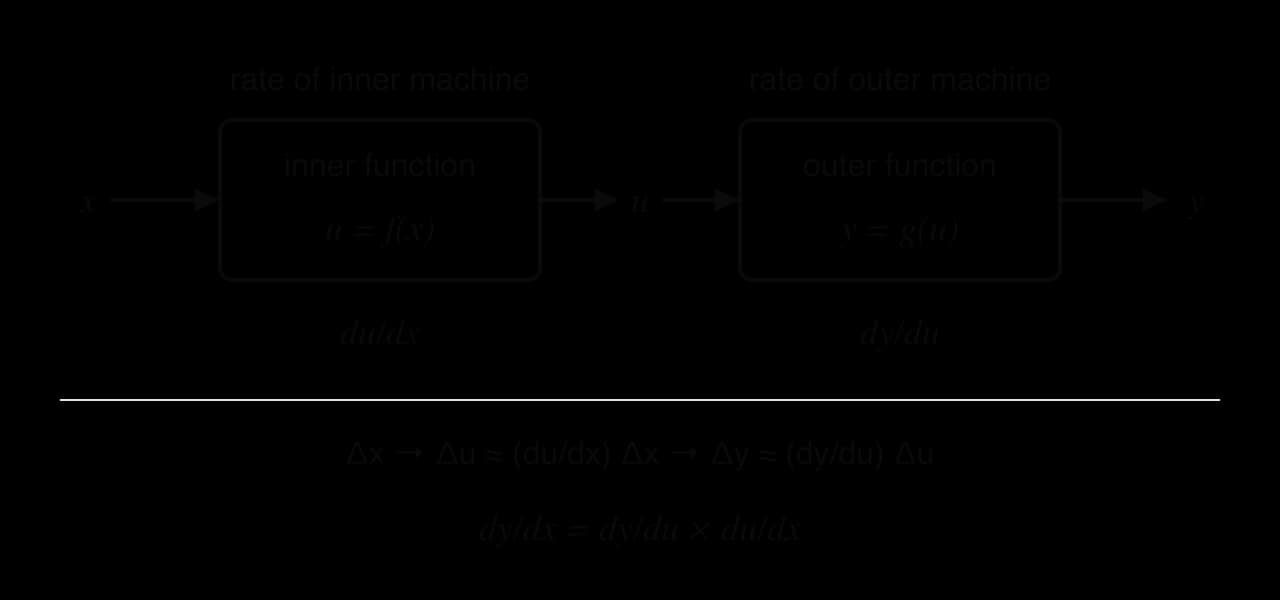
A composite function is a chain of two machines: x goes into the inner machine and comes out as u, and u goes into the outer machine and comes out as y. Each machine has its own rate of change. If u changes 3 times as fast as x, and y
A small change in x is multiplied by du/dx in the inner machine and then by dy/du in the outer machine, so the overall rate is the product of the two rates.
The same idea in symbols: a small change Δx produces a change Δu in the inner function, which produces a change Δy in the outer function. Writing the overall ratio as a product of two ratios and letting Δx shrink to 0 gives the rule.
ΔxΔy=ΔuΔy×ΔxΔu⟶dxdy=dudy×dxdu
The chain rule method
Identify the inner function and call it u; write y as a function of u.
Find dudy
With practice, steps 1 to 4 merge into one line: "derivative of the outside, with the inside left alone, times derivative of the inside". Writing out u is still the safest layout in a long question, and it shows the method clearly.
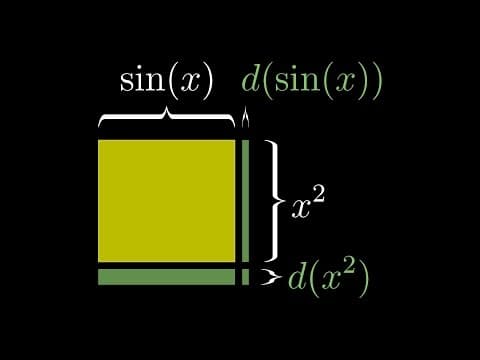
The 3Blue1Brown video shows the chain rule as a small nudge passing through two functions in turn, as in the function-machine diagram, and the product rule as the growth of a rectangle's area.
YouTube
3Blue1Brown, “Visualizing the chain rule and product rule | Chapter 4, Essence of calculus”: watch how a small nudge to x is stretched once by the inner function and again by the outer one, and how a rectangle's area grows when both of its sides change.
Linear inner functions: e^{kx}, sin(kx), cos(kx) and ln(kx)
When the inner function is u=kx (or kx+b), its derivative is the constant k, and the chain rule simply multiplies the standard derivative by k. These results are used constantly in models, so they are worth knowing at sight.
Function
Derivative
Reason
ekx
kekx
outer eu
The result for ln(kx) can look wrong at first, but the laws of logarithms from subtopic 1.9 explain it: ln(kx)=lnk+lnx, and lnk is a constant whose derivative is 0. Multiplying x
General forms: e^{f(x)} and ln f(x)
Two further patterns come from the chain rule with any inner function f(x).
dxd(ef(x))=f′(x)ef(x),dxd(lnf(x))=f(x)f′(x)
For example, dxd(ex2)=2xex2
Applying the chain rule more than once
Some functions are chains of three or more functions. The chain rule extends by multiplying one rate for each link. For y=sin2(3x)=(sin(3x))2, the last operation is squaring, inside that is the sine, and inside that is 3x
dxdy=2sin(3x)×cos(3x)×3=6sin(3x)cos(3x)
Each factor is the derivative of one layer, working from the outside in, with everything inside that layer left unchanged.
The product rule
Differentiating a product
The derivative of a product is not the product of the derivatives. For y=x2×x3=x5, the derivative is 5x4
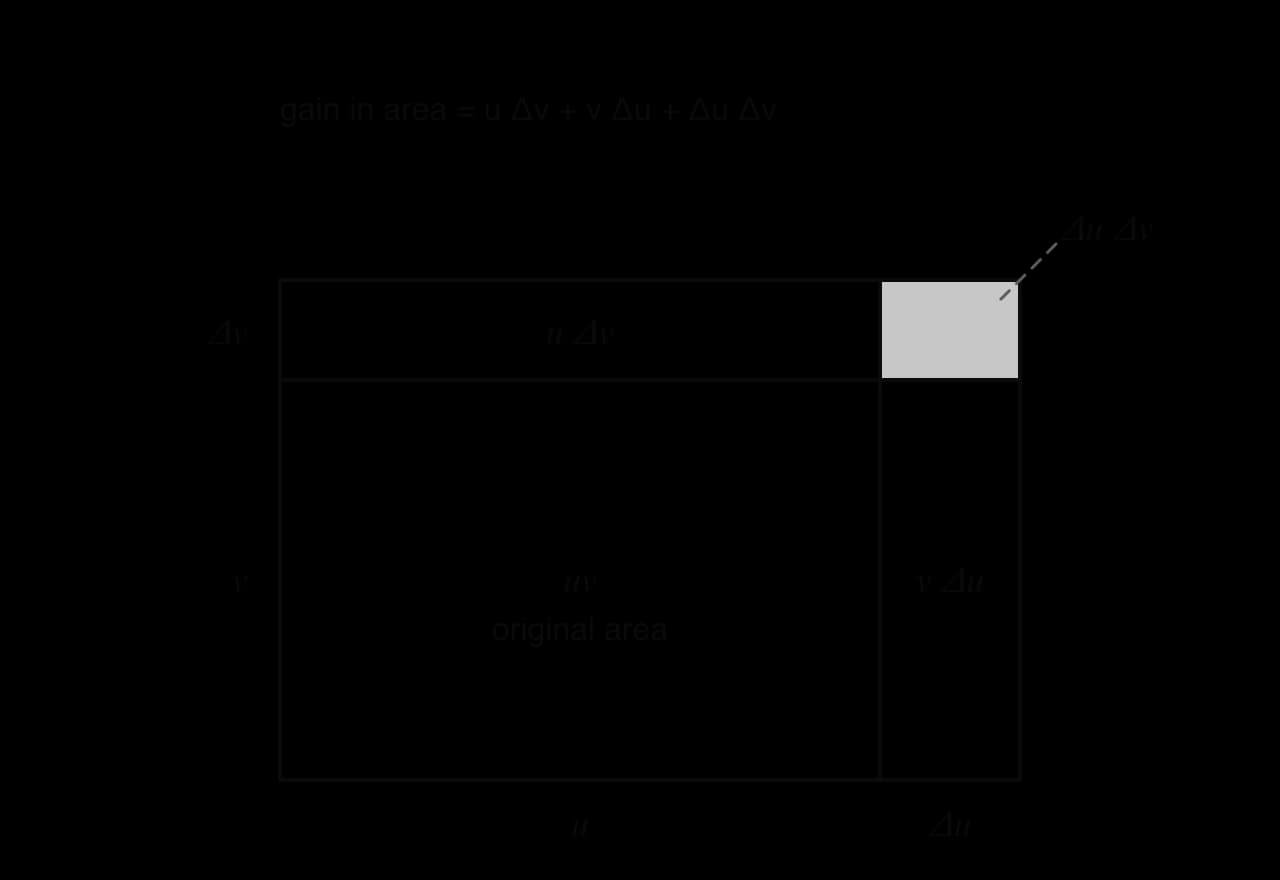
A picture of area explains the rule. A rectangle with sides u and v has area y=uv. If both sides grow, u by a small amount Δu and v
When both sides of a rectangle grow, the area gains two strips, uΔv and vΔu, and a corner ΔuΔv that becomes negligible as the changes shrink.
Δy=uΔv+vΔu+ΔuΔv
Dividing by Δx and letting Δx shrink to 0 makes the corner term vanish, because it is a product of two small quantities divided by one small quantity, and so tends to 0. What remains is the product rule.
dxdy=udxdv+vdxdu
The check with x2×x3 confirms it: u=x2, v=x3
Setting out the product rule
A clear layout lists the four ingredients before combining them, so each derivative is found separately and nothing is lost.
Function
Derivative
first
u=…
dxdu=…
Then the rule udxdv+vdxdu
Products with an exponential factor
Models of a quantity that rises and then dies away often have the form y=ate−bt: the factor at makes the quantity grow at first, and the decaying exponential eventually pulls it back to 0. The concentration of a drug in the bloodstream after a single dose is a standard example. Taking out the exponential factor in the derivative shows at once where the maximum is.
The quotient rule
Deriving the quotient rule
A quotient y=vu is the product u×v−1. The product rule, with the chain rule for
The subtraction makes the order important, unlike in the product rule. Swapping the two terms changes the sign of the whole answer. A memory aid is "bottom times derivative of top, minus top times derivative of bottom, all over bottom squared". The denominator v2 is best left unexpanded, because leaving it squared keeps the answer factorised and shows at once where the derivative is undefined.
The derivative of tan x
The quotient rule proves the standard derivative of tanx. Let u=sinx and v=cosx, so dxdu=cosx
The last step uses sin2x+cos2x=1, true for every angle because (cosx,sinx)
The product rule as an alternative
Any quotient can be written as a product with a negative power, so the product rule (with the chain rule) can always replace the quotient rule. For y=xlnx=lnx×x−1
dxdy=lnx×(−x−2)+x−1×x1=x21−lnx
The quotient rule gives the same result in one step: x2x×x1−lnx×1=x21−lnx
Optimisation with the quotient rule
The optimisation method of subtopic 5.7 stays the same: build the objective function in one variable from a constraint, differentiate, solve dxdy=0, justify the nature of the point and interpret. What changes is that the objective function may now be a quotient, a root or an exponential, and the quotient rule often leads to a numerator that can be set to 0 and solved exactly.
The graph of the area function confirms the result: A rises steeply for small angles, peaks at θ=1, and falls slowly as the bed becomes a nearly full circle of small radius.
Combining the rules
Choosing the rule
Many functions need two or three rules. The rule to apply first is decided by the last operation in the function, the one that would be carried out last if it were evaluated. That operation's rule gives the overall structure, and the other rules are used inside it to find the pieces.
Function
Last operation
Structure of the derivative
xx2+9
multiplication
product rule; chain rule for x2+9
Simplifying before differentiating saves work where it is possible. The laws of logarithms turn ln(xex) into lnx+x, with derivative x1+1
Checking a derivative with the GDC
A GDC without a computer algebra system cannot differentiate symbolically, but it can find the numerical value of a derivative at a point, which is the quickest check of an algebraic derivative. The method is to evaluate the algebraic answer at some convenient value of x and compare it with the GDC's numerical derivative of the original function at the same value.
On a TI-84 Plus CE, the numerical derivative is MATH → 8:nDeriv(; on a graph, 2ndTRACE (CALC) → 6:dy/dx gives the gradient at a traced point.
On a Casio fx-CG50, in the Run-Matrix menu, OPTN → CALC → d/dx gives the numerical derivative.
With trigonometric functions the GDC must be in radian mode.
For y=e0.5xsinx, the product rule gives dxdy=e0.5x(0.5sinx+cosx)
Related rates of change
Rates linked by a formula
In many situations two or more quantities change at the same time and are linked by a formula. When a spherical balloon is inflated, its volume V and radius r both increase with time t, and V=34πr3
The connection is the chain rule with time as the original variable. Time t is the input, x depends on t, and y depends on x: the inner function is x(t) and the outer function is y(x)
dtdy=dxdy×dtdx
The formula also works in reverse. If dtdy is known and dtdx
The method for related rates
Draw a diagram if the situation is geometric, and name every quantity that changes with a letter. Keep fixed quantities as numbers.
Write down the rate that is given, with its sign and units (a quantity that is decreasing has a negative rate), and the rate that is wanted.
Find an equation linking the two quantities whose rates are involved. If a third variable appears, remove it with another relation (similar triangles, Pythagoras, a given constraint).
Differentiate the equation with respect to the variable it contains, to get dxdy.
Combine with the chain rule, dtdy=dxdy×dtdx
Eliminating a variable
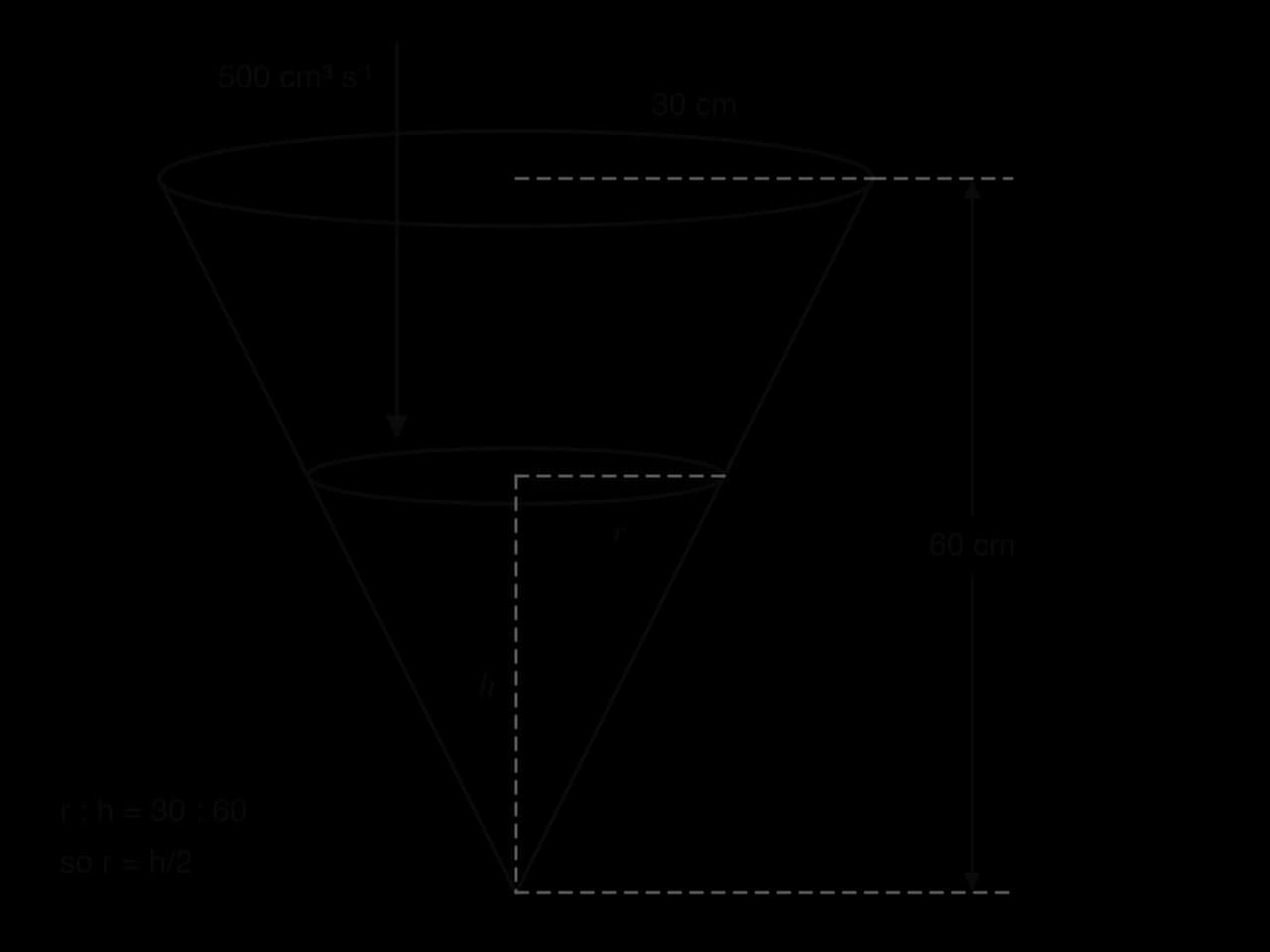
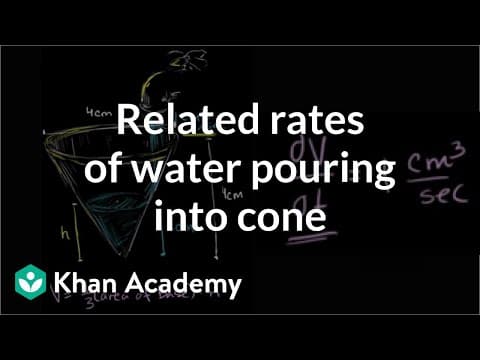
A cone filling with water has three changing quantities: the volume V, the depth h and the radius r of the surface. The formula V=31πr2h
The water forms a smaller cone similar to the tank, so r/h = 30/60 at every depth, and the volume can be written in terms of h alone.
The Khan Academy video works through a problem of this type, a cone of water being filled, and shows how the similar triangles remove the radius before differentiating.
YouTube
Khan Academy, “Related rates: water pouring into a cone”: watch how similar triangles turn the volume into a function of the depth alone before the chain rule links the two rates.
Related rates in other contexts
The same method applies whenever a formula links two changing quantities, not only in geometry. In electricity, the voltage of an alternating current supply varies sinusoidally with time, and the rate of change of the voltage is found with the chain rule on sin(ωt), where ω is the angular frequency. Mains electricity in the United Kingdom has frequency 50 Hz and a nominal voltage of 230 V, with peak voltage 2302≈325
A rate along a curve
A related rate can also come from a curve given as a graph rather than a geometric formula. If a point moves along the curve y=f(x), its vertical and horizontal rates of change are linked by the gradient of the curve at that point: dtdy=f′(x)×dtdx
Case study: The wind chill index
Wind makes cold air feel colder, because moving air carries heat away from exposed skin faster than still air. In November 2001, Canada, the United States and the United Kingdom adopted a new wind chill index, based on a model of heat loss from a bare face walking into the wind. The index is approximated, to within one degree, by a formula in the air temperature Ta (°C) and the wind speed v (km/h) measured at the standard height of 10 m.
Twc=13.12+0.6215Ta−11.37v0.16+0.3965Tav0.16
Source: Wikipedia, "Wind chill" (the 2001 Joint Action Group for Temperature Indices formula), accessed 2026.
The index is defined only for air temperatures of 10 °C or below and wind speeds above 4.8 km/h. The power 0.16 is a rational exponent, so the formula is differentiated with the extended power rule. As a check of the formula, at Ta=−20 °C it gives −24.3 at 5 km/h and −32.6 at 30 km/h, which round to the published values of
Wind chill at a fixed air temperature
On a day when the air temperature is −15 °C, the formula becomes a function of wind speed alone. Collecting the constant terms and the v0.16 terms:
The derivative gives the change in the felt temperature per extra km/h of wind.
dvdW=−17.3175×0.16v−0.84=−2.7708v−0.84
Wind speed v (km/h)
5
10
20
40
60
Wind chill W (°C)
−18.6
−21.2
−24.2
−27.4
−29.5
dvdW
The derivative is negative at every wind speed, so stronger wind always makes it feel colder. Its size shrinks quickly, because the power −0.84 is negative. Going from calm to a light wind makes a large difference, while an extra km/h in a gale changes the felt temperature by less than a tenth of a degree.
A strengthening wind
Suppose the wind speed is 20 km/h and increasing at 6 km/h every hour as a storm approaches, with the air temperature steady at −15 °C. The wind chill changes with time because the wind speed does, so the chain rule links the two rates.
dtdW=dvdW×dtdv=−2.7708×20−0.84×6=−1.342…
At that moment the felt temperature is falling at about 1.34 °C per hour. The same increase in wind at 40 km/h would lower the wind chill by only 0.125×6≈0.750 °C per hour, so for the same rise in wind speed per hour, the felt temperature drops faster while the wind is still light.
Limitations of the model
The formula is an approximation, accurate to about one degree, of a more detailed heat-loss model. It assumes a bare face in an open field, walking into the wind at about 5 km/h, and corrects the wind speed measured at 10 m to the speed at face height. It holds only for Ta≤10 °C and v>4.8 km/h, so its derivative should not be used at very low wind speeds, where v−0.84
Exam focus
Further differentiation is examined on HL Papers 1 and 2, and it supports many of the calculus questions on Paper 3. Short Paper 1 questions ask you to find a derivative (2–3 marks), often followed by a gradient, a tangent or a stationary point. Paper 2 and Paper 3 questions use the rules inside longer models: show that a derivative has a given form (so that a later part can use it), hence find a maximum, or show that a rate is always positive (which needs a reason, R1). Related rates questions are usually 4–6 marks and are not always labelled as such: a phrase like "the radius is increasing at 3 mm per second" is the signal.
Markschemes give (M1) for an attempt at the right rule (the correct structure of the chain, product or quotient rule, even with a slip), and A1 for each correct part. In related rates, the given rate is often worth (A1) on its own, the chain rule product (M1), and the final value with units and sign A1. When a derivative leads to an equation that cannot be solved by hand, solve it on the GDC and write down the equation you solved.
The commonest losses in further differentiation come from the chain rule left incomplete inside another rule: dtde−0.2t written as e−0.2t
Related rates questions reward a clear statement of each rate before any calculation. Writing "dtdv=6" and "dtdW=dvdW×dtdv
Practice questions
Let f(x)=5x52, x>0
Answers
f′(x)=2x−53; f′(32)=2×81=0.25
Summary
For any rational n, dxd(xn)=nxn−1
Self-check
To do:
I can rewrite x, x1
Questions on 5.9
66 exam-style questions on this subtopic, written in the style of the IB papers. The first has its markscheme open. Counted on
Question 1 · AI-0015617 marks
A pendulum consists of a small bob on a light rod of length 1.2 m. The angle, θ radians, between the rod and the vertical t seconds after the bob is released is modelled by
θ(t)=0.3cos(2.5t),t≥0.
(a)
Write down the greatest angle between the rod and the vertical, in radians. Hence find this angle in degrees.
[2]2 marks
Markscheme (a)
0.3 (radians) A1
17.2°(17.1887…)A1
[2 marks]
(b)
Find the length of the arc travelled by the bob as it swings from one extreme position to the other.
[2]2 marks
Markscheme (b)
1.2×0.6
Question 2 · AI-0024715 marks
The depth of water, D metres, at a jetty in the port of Saint-Malo, t hours after midnight, is modelled by
D(t)=1.9sin(0.506(t−2.1))+5.3,0≤t≤24.
Question 3 · AI-0025215 marks
A city council introduces a rental scheme for electric scooters. The number of registered users of the scheme, U, t years after it starts, is modelled by
U(t)=1+Ce−kt80000,t≥0,
From the formula booklet
The entries of the mathematics: applications and interpretation formula booklet that 5.9 uses. Each opens in the explained booklet.
, the chain, product and quotient rules, and related rates of change. Trigonometric functions are differentiated in radians. Implicit differentiation is not required. A GDC is used to check derivatives numerically and to solve the equations that derivatives lead to; second derivatives are taught in subtopic 5.10.
. The same rule holds when
n
is any rational number, so it applies to
x21
,
x−31
,
x0.16
and
x23
. A
rational exponent
has the meaning given in subtopic 1.10, Rational exponents:
x21=x
,
x31=3x
and
xnm=(nx)m
.
at
x=4
can be estimated with the gradient of a short chord from
x=4
to
x=4.001
.
, which gives
2×21=0.25
at
x=4
. The two agree. A general justification for
x
comes from its link with
x2
: the graph of
y=x
is the reflection of
y=x2
(for
x≥0
) in the line
y=x
. Reflection swaps the run and the rise of every tangent, so gradients become reciprocals. At the point
(a2,a)
on
y=x
, the matching point on
y=x2
is
(a,a2)
, where the gradient is
2a
; so the gradient of
x
is
2a1=2x1
, exactly as the power rule gives.
21x−21=2x1
x1
x−21
−21x−23
3x2
x32
32x−31
3x6
6x−31
−2x−34
xx
x23
23x21
5x0.16
5x0.16
0.8x−0.84
. Decimal powers such as
0.16
are rational too (
0.16=254
), so the same rule applies:
0.16−1=−0.84
.
. The power rule acts on a single power of
x
, so
x1
must first become
x−21
. Its derivative is
−21x−23
, which can be written back as
−2xx1
if needed.
only for
x>0
. At
x=0
the tangent to
y=x
is vertical, so the gradient does not exist. Negative powers such as
x−21
need
x>0
as well. In models the variable is usually a positive quantity (a length, a wind speed, a time), so these restrictions rarely cause trouble, but a gradient should never be evaluated at a value outside the domain.
, for
x>0
.
(a) Findf′(x). [3]
(b) Find the exact value of f′(8). [2]
Show the solution
(a) Rewrite every term as a power of x first.
f(x)=6x21−12x−31+2x23
Apply the power rule to each term, multiplying by the power and subtracting 1 from it.
The exact value is 4272+1, which is about 9.80. A GDC's numerical derivative of f
,
ex
and
lnx
; the chain, product and quotient rules say how to combine them.
n∈Q
sinx
cosx
x in radians
cosx
−sinx
x in radians
tanx
cos2x1
x in radians, cosx=0
ex
ex
all x
lnx
x1
x>0
and
lnx
are printed, together with the chain, product and quotient rules. The derivatives of
ekx
,
sin(kx)
,
cos(kx)
and
ln(kx)
are not printed: they come from the chain rule.
at
x=0
depends on the base. Estimating it with a very short chord gives the values in the table.
factorises:
. This property is why
e
is the natural base for growth and decay models: in
P=P0ekt
, the rate of growth is
kP
, proportional to the population itself, which is the differential equation of subtopic 5.14.
in the line
y=x
. Reflection in
y=x
swaps
x
and
y
, and so it turns a gradient
m
into
m1
. The point
(a,lna)
on the logarithm curve matches the point
(lna,a)
on the exponential curve, where the gradient is
elna=a
. The gradient of
lnx
at
x=a
is therefore
a1
.
at
(e,1)
, has gradient
e1
.
y = eˣ
y = ln x
y = x
tangent y = ex
tangent y = x/e
Reflecting eˣ in y = x gives ln x, and every tangent's gradient m becomes 1/m: the tangent of gradient e at (1, e) reflects to the tangent of gradient 1/e at (e, 1).
itself decreases towards 0 as
x
grows, so the logarithm rises more and more slowly. This matches its use on logarithmic scales (subtopic 1.5), where each tenfold increase in a quantity adds the same fixed amount.
it reaches its maximum and the gradient is 0; at
x=π
it falls most steeply; at
x=23π
it is at its minimum. Plotting these gradients against
x
gives a curve that starts at its highest value, is 0 at
2π
, lowest at
π
and back to 0 at
23π
. That is the shape of
cosx
.
to the left, gives the derivative
−sinx
: just after
x=0
the cosine curve falls, so its gradient is negative where
sinx
is positive.
y = sin x
y = cos x (the gradient of sin x)
Where sin x reaches a maximum or minimum, cos x crosses zero; where sin x is steepest, cos x is at its maximum or minimum. The cosine curve is the gradient of the sine curve.
. The standard derivatives hold only in radians. Set the GDC to radian mode before evaluating any trigonometric derivative, and convert any angle given in degrees.
, is never negative, which matches the graph of
y=tanx
: it increases on every branch between its vertical asymptotes at
x=2π,23π,…
, where
cosx=0
and the gradient grows without limit. At
x=0
the gradient is
11=1
, the same as
sinx
, because for small angles
tanx≈sinx≈x
.
.
(a) Findf′(x). [3]
(b) Find the equation of the tangent to the graph of f at x=1, giving the coefficients correct to 3 significant figures. [3]
Show the solution
(a) Use the standard derivatives term by term, keeping each constant multiple.
f′(x)=4ex−x3−5sinx
The sign of the last term changes because the derivative of cosx is −sinx.
The tangent is y=3.67x+9.91. The unrounded values were kept until the last line; rounding f(1) and f′(1) first would change the intercept.
or
y=e−0.05t
cannot be expanded at all. Each is a
composite function
: one function is applied first, and a second function is applied to its output.
becomes the input of the outer function.
In y=(3x2−5)4, the inner function is u=3x2−5.
.
In y=(3x2−5)4, the outer function is y=u4.
u4
sin(2x+5)
2x+5
sinu
e−0.05t
−0.05t
eu
25−x2
25−x2
u21
ln(x2+1)
x2+1
lnu
cos2x=(cosx)2
cosx
u2
changes 4 times as fast as
u
, then
y
changes
4×3=12
times as fast as
x
. Rates of change along a chain multiply, in the same way that gear ratios multiply in a bicycle.
.
In words: differentiate the outer function, leaving the inner function inside it unchanged, then multiply by the derivative of the inner function.
(the outer derivative) and
dxdu
(the inner derivative).
Multiply them.
Replace u by its expression in x, and simplify.
[2]
(b) y=sin(2x+5) [2]
(c) y=25−x2, and the gradient of its graph at x=3 [3]
Show the solution
(a) Let u=3x2−5, so y=u4.
dudy=4u3,dxdu=6x⇒dxdy=4(3x2−5)3×6x=24x(3x2−5)3
Expanding the fourth power and differentiating term by term would give the same answer with far more work.
(b) Let u=2x+5, so y=sinu.
dxdy=cosu×2=2cos(2x+5)
(c) Let u=25−x2, so y=u21
dxdy=21u−21×(−2x)=25−x2−x
At x=3: 16−3=−43
, inner derivative
k
sin(kx)
kcos(kx)
outer sinu, inner derivative k
cos(kx)
−ksin(kx)
outer cosu, inner derivative k
ln(kx), k>0
x1
kx1×k=x1
(ax+b)n
an(ax+b)n−1
outer un, inner derivative a
by
k
moves the graph of
lnx
up by
lnk
without changing any gradient.
. Both forget the inner derivative. The derivative of
e3x
is
3e3x
, and the derivative of
ln(2x)
is
2x1×2=x1
. Writing
u
and
dxdu
explicitly whenever the inside of a function is more than a plain
x
prevents both errors.
and
dxdln(x2+1)=x2+12x
. The exponential keeps its whole exponent and is multiplied by the exponent's derivative; the logarithm becomes "derivative of the inside over the inside". Reversing these two patterns is the basis of integration by inspection in subtopic 5.11.
, and similar patterns hold for other functions. Integration by inspection and by substitution in subtopic 5.11, Further integration, are the chain rule in reverse.
. [2]
(b) Find the rate of change of the temperature 10 minutes after the tea is poured, and interpret your answer. [2]
(c) Explain why the tea is always cooling according to this model. [2]
Show the solution
(a) The constant 20 has derivative 0. For 70e−0.05t, the inner function is u=−0.05t, with derivative −0.05.
dtdT=70×(−0.05)e−0.05t=−3.5e−0.05t
(b) At t=10:
dtdT=−3.5e−0.5=−2.1228…≈−2.12
Ten minutes after it is poured, the tea's temperature is falling at about 2.12 °C per minute.
(c) e−0.05t>0 for every t, so dtdT=−3.5e−0.05t
.
where A and c are positive constants and T>0.
(a) Show thatdTdk is always positive. [3]
(b) For one reaction, c=6014 (an activation energy of 50 kJ mol⁻¹ divided by the gas constant 8.314 J mol⁻¹ K⁻¹). Find the ratio of the rate constant at 308.15 K (35 °C) to the rate constant at 298.15 K (25 °C). [2]
Show the solution
(a) Write the exponent as a power of T: −Tc=−cT−1. The inner function is u=−cT−1.
dTdu=−c×(−1)T−2=T2c
The outer function is Aeu, with derivative Aeu. By the chain rule:
A 10 °C rise nearly doubles the rate constant, which matches the chemists' rule of thumb that many reactions run about two to three times faster for every 10 °C rise.
, while multiplying the separate derivatives gives
2x×3x2=6x3
, which is wrong. A product needs its own rule.
by
Δv
, the area gains three pieces: a strip
uΔv
along one side, a strip
vΔu
along the other, and a tiny corner
ΔuΔv
.
.
In words: the first function times the derivative of the second, plus the second function times the derivative of the first.
, so
dxdy=x2×3x2+x3×2x=3x4+2x4=5x4
.
second
v=…
dxdv=…
is written out with the four entries substituted. Factorising the answer, especially taking out a common exponential factor, makes solving
dxdy=0
much easier. A constant multiplier does not need the product rule:
5x3
is a constant times a function, differentiated with the constant multiple rule of subtopic 5.3.
. [2]
(b) Find the coordinates of the local maximum of the curve. [3]
Show the solution
(a) Let u=3x and v=5−ex, so dxdu=3 and dxdv=−ex.
dxdy=3x(−ex)+(5−ex)(3)=15−3ex−3xex
(b) At a stationary point, dxdy=0. The equation 15−3ex−3xex=0
x=0.94445…
Then y=3(0.94445…)(5−e0.94445…)=6.881…. The derivative changes from positive to negative there (for example dxdy=12
.
(a) Show thatdtdC=4e−0.5t(2−t). [3]
(b) Hence find the maximum concentration, and the time at which it occurs. [3]
(c) Find the rate of change of the concentration 5 hours after the tablet is taken. [1]
Show the solution
(a) Let u=8t and v=e−0.5t. Then dtdu=8 and, by the chain rule, dtdv=−0.5e−0.5t.
(b) The numerator is −7, which is never 0, so f′(x)=0 for every x in the domain and there are no stationary points. In fact f′(x)<0
:
. The derivative is 0 when
lnx=1
, at
x=e
, where
y=e1
. Either method is valid. The product route often leaves negative powers that need combining over a common denominator before the derivative can be set to 0, so the quotient rule is usually quicker when a simplified answer is needed.
. The answer then has the wrong sign everywhere, so increasing intervals become decreasing and maxima appear as minima. Writing the rule out in full before substituting, with the denominator
v
first, avoids the error.
. [2]
(b) Show that the area of the bed is A=(1+θ)272θ. [2]
(c) FinddθdA, simplifying your answer. [3]
(d) Hence find the value of θ that gives the largest area, justify that it is a maximum, and find the maximum area. [4]
Show the solution
(a) The edging is one radius plus the arc, and the arc length is rθ with θ in radians.
r+rθ=12⇒r(1+θ)=12⇒r=1+θ12
(b) The area of a sector is 21r2θ (subtopic 3.7).
Cancelling the common factor (1+θ) before solving is the key simplification.
(d) dθdA=0 when 1−θ=0, so θ=1
A=2272×1=18 m2,r=212=6 m
The largest bed has angle 1 radian (about 57.3°), radius 6 m and area 18 m². The arc is then 6×1=6 m, exactly half of the edging.
A = 72θ/(1 + θ)²
The area of a sector bed with 12 m of edging along one radius and the arc is greatest at θ = 1 radian; the curve is flat at the maximum, where dA/dθ = 0.
x2+1e2x
division
quotient rule; chain rule for e2x
e0.5xsinx
multiplication
product rule; chain rule for e0.5x
ln(xex)
logarithm
chain rule, or rewrite as lnx+x first
(x2+1)3e−x
multiplication
product rule; chain rule for both factors
, and
xx2+3
splits into
x23+3x−21
, which needs only the power rule.
, giving your answer as a single fraction, and find the gradient at
x=4
. [4]
(b) Let g(x)=x2+1e2x. Show thatg′(x)=(x2+1)22e2x(x2−x+1), and hencejustify that g is increasing for all x. [5]
Show the solution
(a) Product rule with u=x, v=(x2+9)21. By the chain rule, dxdv=21(x2+9)−21×2x=x2+9x.
The quadratic x2−x+1 has discriminant (−1)2−4=−3<0
. At
x=1
this is
1.5845…
, and the GDC's numerical derivative of
e0.5xsinx
at
x=1
is also
1.5845…
, so the derivative is almost certainly right. A mismatch shows at once that a sign or a factor has been lost.
of a product). Use the GDC to check, then to solve
f′(x)=0
or
f′(x)=k
when the equation has no algebraic solution, writing down the equation you solved.
at every instant. If the rate at which air is pumped in,
dtdV
, is known, the rate at which the radius grows,
dtdr
, is fixed by the formula. Problems of this type are related rates of change problems.
.
.
is wanted, dividing gives
dtdx=dtdy÷dxdy
. The units check the setup: in
dtdV=drdV×dtdr
, the units are
cm3 s−1=cm2×cm s−1
, and the centimetres cancel as the
dr
terms do.
, then substitute the values at the instant in question.
State the answer with units, and interpret its sign in words ("increasing at…", "decreasing at…").
when
r=10
.
The link is V=34πr3, so drdV=4πr2.
By the chain rule:
dtdV=drdV×dtdr⇒50=4πr2×dtdr
At r=10:
dtdr=4π×10050=8π1=0.0397…
The radius is increasing at about 0.0398 cm s⁻¹. Although air goes in at a constant rate, the radius grows more and more slowly, because each new layer of air is spread over a larger surface area 4πr2.
first gives a constant volume, whose derivative is 0. The formula must be differentiated while
r
is still a variable; the values at the instant (
r=10
) go in only at the end.
contains two variables besides
V
, so one of them must be removed before differentiating. The shape of the cone links them: by similar triangles, the ratio
hr
for the water is the same as the ratio of the cone's full radius to its full height.
(c) Explain why the depth rises more slowly as the tank fills. [1]
Show the solution
(a) By similar triangles, hr=6030, so r=2h.
V=31πr2h=31π(2h)2h=12πh3
(b) Given dtdV=500. Differentiating, dhdV=123πh2=4πh2
dtdh=dtdV÷dhdV=4π×202500=100π500=1.591…
The depth is increasing at about 1.59 cm s⁻¹.
(c) dtdh=πh22000
V.
. [2]
(b) Find the rate of change of the voltage when t=0.002. [2]
(c) Write down the greatest rate of change of the voltage, and state the value of V at the times it occurs. [2]
Show the solution
(a) The inner function is u=100πt, with derivative 100π.
dtdV=325×100πcos(100πt)=32500πcos(100πt)
(b) With the GDC in radian mode, at t=0.002:
dtdV=32500πcos(0.2π)=82602.0…≈82600 V s−1
(c) The greatest value of cos(100πt) is 1, so the greatest rate is 32500π≈102000 V s⁻¹. It occurs when cos(100πt)=1, so sin(100πt)=0
. The same idea covers a ladder sliding down a wall, where the height of the top is a function of the distance of the foot from the wall.
. [1]
(b) Find the rate at which the top of the ladder moves down the wall when the foot is 3 m from the wall. [4]
Show the solution
(a) By Pythagoras, x2+y2=52, so y=25−x2 (taking the positive root, since y is a height).
(b) Given dtdx=0.4. By the chain rule (outer u21
dxdy=25−x2−x
At x=3, dxdy=−43
dtdy=dxdy×dtdx=−43×0.4=−0.3
The top of the ladder is moving down the wall at 0.3 m s⁻¹. The negative sign shows that the height is decreasing.
. Writing the chain rule with the units next to each factor shows the error: the inner variable must cancel, as in
dtdy=dxdy×dtdx
, where
dx
appears once on the bottom and once on the top.
−24
and
−33
.
(°C per km/h)
−0.717
−0.401
−0.224
−0.125
−0.0889
W = 3.7975 − 17.3175v^0.16
tangent at v = 20
At an air temperature of −15 °C the wind chill falls steeply in light winds and levels off in strong ones; the tangent at 20 km/h has gradient −0.224 °C per km/h. Formula: 2001 wind chill index (Wikipedia, 'Wind chill').
becomes large and the formula no longer applies. Wind chill is also a steady-state measure: it describes the effect of a constant wind, while the skin actually cools fastest at the start of an exposure.
,
ef(x)
,
lnf(x)
, a product, a quotient), its derivative, and one worked line from your own example. Add a second table of the related rates formulas you meet (sphere, cone, cylinder, circle) with
drdV
or
drdA
for each.
.
(a) Finddtdr. [2]
(b) Find the rate at which the area of the slick is increasing when t=5. [4]
The thickness of the slick, in millimetres, is modelled by 3e−0.2t, so that the volume of oil in the slick, in m³, is V=1000πr2×3e−0.2t.
(c) Show thatV=4.8πt1.2e−0.2t. [2]
(d) Show thatdtdV=4.8πt0.2e−0.2t(1.2−0.2t). [3]
(e) Hence find the greatest volume of oil in the slick, and the time at which it occurs. [3]
Show the markscheme
(a) use of power rule (M1)
dtdr=24t−0.4A1
(b) A=πr2, drdA=2πr(A1)
dtdA=drdA×dtdr=2πr×24t−0.4
at t=5: r=40×50.6=105.06…, dtdr=12.607…
dtdA=8320 m² per hour (8322.33…) A1
Note: accept A=1600πt1.2, dtdA=1920πt0.2
(c) r2=1600t1.2A1
V=1000π×1600t1.2×3e−0.2tM1
=4.8πt1.2e−0.2tAG
(d) attempt at product rule M1
dtdV=4.8π(1.2t0.2e−0.2t+t1.2×(−0.2)e−0.2t)
Note: award A1 for 1.2t0.2 and A1 for −0.2e−0.2t seen in the rule.
=4.8πt0.2e−0.2t(1.2−0.2t)AG
(e) dtdV=0⇒1.2−0.2t=0 (since t0.2e−0.2t>0
t=6 hours A1
V=4.8π×61.2e−1.2=39.0 m³ (38.995…) A1
Total [14]
, or the derivative of
e−c/T
attempted without first writing
T1
as
T−1
.
" earns method marks even if a later value is wrong.
.
Find
f′(x)
and the value of
f′(32)
. [3]
Finddxdy for y=e4x−ln(3x)+cos(2x), and the gradient of the curve at x=0.5. [4]
Consider y=x3e−x, x≥0. (a) Show thatdxdy=x2e−x(3−x). (b) Hence find the exact coordinates of the local maximum. [6]
Find the gradient of y=x+1x2 at the point where x=1. [3]
Find the equation of the tangent to y=xlnx at the point where x=e. [4]
A spherical snowball melts so that its volume decreases at 12 cm³ per minute. Find the rate of change of its radius, and the rate of change of its surface area S=4πr2, when the radius is 6 cm. [6]
A hemispherical bowl of radius 20 cm holds water of depth h cm, where the volume is V=3πh2(60−h). Water is poured in at 30 cm³ s⁻¹. Find the rate at which the depth is increasing when h=5. [5]
A 6.5 m ladder leans against a vertical wall. Its foot slides away from the wall at 0.3 m s⁻¹. Find the speed at which the top slides down the wall when the foot is 2.5 m from the wall. [5]
The number of fish in a lake t years after stocking is modelled by P=1+9e−0.4t500. (a) FinddtdP. (b) Find the rate of growth when t=5. (c) Use your GDC to find the time at which the population grows fastest, and the greatest rate of growth. [7]
Explain why ln(5x) and lnx have the same derivative, using a law of logarithms. [2]
.
dxdy=4e4x−x1−2sin(2x); at x=0.5: 4e2−2−2sin1=25.9 (radians).
(a) Product rule: 3x2e−x−x3e−x=x2e−x(3−x). (b) x=3 (the derivative changes from positive to negative); (3,27e−3), about (3,1.34).
dxdy=(x+1)2(x+1)(2x)−x2=(x+1)2x2+2x; at x=1: 43.
dxdy=lnx+1=2 at x=e; point (e,e); y=2x−e.
dtdr=4π×36−12=−12π1≈−0.0265 cm per minute; dtdS=8πrdtdr=−4 cm² per minute.
V=20πh2−3πh3, dhdV=π(40h−h2)=175π at h=5; dtdh=175π30≈0.0546 cm s⁻¹.
y=42.25−x2=6 at x=2.5; dtdy=−62.5×0.3=−0.125; the top slides down at 0.125 m s⁻¹.
(a) dtdP=(1+9e−0.4t)21800e−0.4t (chain rule on 500(1+9e−0.4t)−1). (b) 49.5 fish per year. (c) GDC maximum of dtdP: t=5.49 years, rate 50.0 fish per year (when P=250).
ln(5x)=ln5+lnx; ln5 is a constant with derivative 0, so both derivatives are x1.
; rewrite roots and fractions as powers first, such as
x1=x−21
.
Standard derivatives: sinx→cosx, cosx→−sinx, tanx→cos2x1, ex→ex, lnx→x1, with angles in radians.
Chain rule: dxdy=dudy×dxdu: differentiate the outer function, keep the inner function, multiply by the inner derivative.
Product rule: dxd(uv)=udxdv+vdxdu; factorise the result before solving =0.
Quotient rule: dxd(vu)=v2vdxdu−udxdv; the product rule with v−1 is a valid alternative.
Choose the rule from the last operation in the function; simplify with the laws of exponents and logarithms first where possible; check with the GDC's numerical derivative.
Related rates: dtdy=dxdy×dtdx; differentiate before substituting the values at the instant, and state the answer with units and its sign in words.
,
3x2
and
nxa
as powers and differentiate them.
To do:
I can write down the derivatives of sinx, cosx, tanx, ex and lnx from memory.
To do:
I can explain why the trigonometric derivatives need radians.
To do:
I can identify the inner and outer functions of a composite function.
To do:
I can differentiate ekx, sin(kx), cos(kx), ln(kx) and (ax+b)n at sight.
To do:
I can apply the chain rule more than once, as in sin2(3x).
To do:
I can differentiate a product, setting out u, v and their derivatives, and factorise the answer.
To do:
I can differentiate a quotient with the quotient rule, in the correct order, and with the product rule instead.
To do:
I can derive the derivative of tanx from the quotient rule.
To do:
I can decide which rule a function needs from its last operation.
To do:
I can check an algebraic derivative with the GDC's numerical derivative.
To do:
I can use these derivatives to find tangents, stationary points and optimal values in context.
To do:
I can justify that a derivative is always positive or negative by reasoning about each factor.
To do:
I can solve a related rates problem, eliminating a third variable where needed, and state the rate with units and direction.
(M1)
0.72 mA1
Note: Award the method mark only for 0.36.
[2 marks]
(c)
Find the period of the model.
[2]2 marks
Markscheme (c)
2.52π(M1)
2.51 s(0.8π,2.51327…)A1
[2 marks]
(d)
Find all the times in the first 3 seconds at which θ=0.15.
[3]3 marks
Markscheme (d)
0.3cos(2.5t)=0.15 OR sketch of θ with the line θ=0.15(M1)
t=0.419,2.09,2.93(0.418879…,2.09439…,2.93215…)A2
Note: Award A1 for two correct values. Award at most A1 if any extra value is given.
[3 marks]
(e)
The horizontal displacement of the bob from its lowest position is x=1.2sinθ metres. Find the greatest value of x.
[2]2 marks
Markscheme (e)
1.2sin0.3(M1)
0.355 m(0.354624…)A1
[2 marks]
(f)
Find θ′(t).
[2]2 marks
Markscheme (f)
θ′(t)=−0.75sin(2.5t)A1A1
Note: Award one mark for −0.75 and one mark for sin(2.5t).
[2 marks]
(g)
The speed of the bob is 1.2∣θ′(t)∣m s−1. Find the greatest speed of the bob and the first time at which it occurs.
[3]3 marks
Markscheme (g)
greatest value of ∣θ′(t)∣ is 0.75(M1)
0.9 m s−1A1
t=5π(0.628) s A1
Note: Accept t=0.628 from a graph of ∣θ′(t)∣.
[3 marks]
(h)
Suggest one reason why this model may not be suitable for large values of t.
[1]1 mark
Markscheme (h)
the model predicts the pendulum swings with the same amplitude for ever, but air resistance or friction would make the swings smaller R1
[1 mark]
(a)
Write down the depth of water at high tide and at low tide.
[2]2 marks
(b)
Find the time between two consecutive high tides. Give your answer in hours and minutes, correct to the nearest minute.
[2]2 marks
(c)
Find the time of the first high tide after midnight. Give your answer to the nearest minute.
[2]2 marks
(d)
The ferry Corsaire needs a depth of at least 6 m to dock at the jetty. Find the length of time between midnight and noon during which the Corsaire can dock. Give your answer to the nearest minute.
[4]4 marks
(e)
Find D′(t).
[2]2 marks
(f)
Hence write down the greatest rate at which the depth of water decreases, and find the first time after midnight at which this occurs.
[2]2 marks
(g)
Suggest one reason why the model may not be suitable for predicting the depth of water a month later.
 YouTube
 YouTube