5.4 Tangents and normals · IB Maths AI | Augment Education
5.4 Tangents and normals
Find the equations of the tangent and the normal to a curve at a given point, in any required form, solve reverse problems from a given gradient or parameter, and check with the GDC.
IB Mathematics: Applications and Interpretation
Part of 5 Calculus
SL and HL
Key terms introduced here
Each is in the Maths AI glossary, with every other term in the subject.
The property of a smooth curve that, close enough to any point on it, the curve is almost indistinguishable from its tangent at that point, so the tangent gives a good approximation to the curve there.
Find the equation of the tangent to a curve at a given point, by hand and with technology.
Find the gradient and the equation of the normal to a curve at a given point, including a vertical normal where the tangent is horizontal.
Write equations of tangents and normals in the form y=mx+c or ax+by+d=0 with integer coefficients.
Determine the point or points where the tangent or the normal has a given gradient, and justify how many tangents are parallel to a given line.
Find an unknown parameter from information about a tangent, and show that a given line is a tangent.
Use a tangent as a local linear approximation to a curve, and interpret tangents and normals in context.
Introduction
A tangent is the straight line that touches a curve at a point and has the same direction as the curve there. Subtopic 5.1 introduced it as the limit of chords, and subtopic 5.3 gave a fast way to find its gradient from the derivative. Turning that gradient into the full equation of a line, and finding the line at right angles to it, the normal, describes the behaviour of a curve at one point by two straight lines that can be written down, drawn and used.
Tangents and normals describe real directions. A car that loses grip on a bend continues along the tangent to its path, and a ski jumper leaves the ramp along the tangent to its profile. In optics, the angles at which light meets and leaves a curved mirror are measured from the normal to the mirror's surface. The methods combine the derivative with the equations of straight lines from subtopic 2.1, Equations of straight lines.
Tangents to a curve
The point of contact and its gradient
Every tangent touches its curve at one particular point. Everything about the tangent is fixed by that point: the line must pass through it, and its gradient must equal the gradient of the curve there, which is the value of the derivative at that x.
Two different numbers come from a, and each comes from a different function. The y-coordinate of the point of contact comes from the original function, f(a): it is the height of the curve. The gradient of the tangent comes from the derivative, f′(a): it is the steepness of the curve. Mixing up these two values is a frequent source of error.
What is needed
Where it comes from
For f(x)=x3−2x2+3 at x=2
x-coordinate of the point of contact
given: a
2
y-coordinate of the point of contact
the function: f(a)
f(2)=8−8+3=3
gradient of the tangent
the derivative: f′(a)
f′(x)=3x2−4x
The equation of the tangent
Once the point of contact (a,f(a)) and the gradient m=f′(a) are known, the tangent is the straight line through a known point with a known gradient. The point-gradient form of a line from subtopic 2.1 writes it down immediately.
y−f(a)=f′(a)(x−a)
The method has four steps, and each step uses one piece of information.
Find the point of contact: substitute x=a into f(x) to get f(a) (skip this if the point is given).
Differentiate to find f′(x).
Substitute x=a into f′(x) to get the gradient m=f′(a)
Substitute the point and the gradient into y−y1=m(x−x1), then rearrange into the form the question asks for.
An equivalent fourth step substitutes the point into y=mx+c and solves for c. Both give the same line; the point-gradient form avoids a separate equation for c.
y = x³ − 2x² + 3
tangent y = 4x − 5
The tangent at (2, 3) has the same gradient as the curve there, 4, and touches the curve at that point; further away the curve bends away from the line.
The notation dxdyx=2 means "the value of dxdy when x=2", the same number as f′(2).
Forms of the answer
The same tangent can be written in several equivalent forms, and a question often specifies one. The gradient-intercept form y=mx+c shows the gradient and the y-intercept. The general form ax+by+d=0 is usually requested with a,b,d∈Z, so every coefficient must be an integer. Moving every term to one side and multiplying through by the lowest common denominator of any fractions produces it.
y−234y−64y−63x−4y=43(x−2)=3(x−2)(multiply every term by 4)=3x−6=0
Any integer multiple of a correct general form describes the same line, so 3x−4y=0 and −3x+4y=0 are both correct, as is 6x−8y=0. Writing the version with the smallest integers and a positive coefficient of x is tidy and conventional.
A tangent's equation can also be used to prove a property of the line, such as passing through a given point. The tangent is found exactly as before, and the property is then read from the equation.
YouTube
Khan Academy, “Equation of a tangent line”: watch the point of contact found from the function and the gradient found from the derivative before the line is written.
Local linearity
A tangent as an approximation
A smooth curve that is magnified more and more around one point looks straighter and straighter, and at a high enough magnification it cannot be told apart from its tangent. Close to the point of contact, the tangent is therefore a good approximation to the curve. Far from the point the curve bends away from the line and the approximation becomes poor.
The same curve and tangent as before, viewed on a window only 0.4 units wide around x=2, show this clearly. On the wide window the curve visibly bends away from the line; on the narrow one the two are almost on top of each other.
y = x³ − 2x² + 3
tangent y = 4x − 5
Zoomed in to 1.8 ≤ x ≤ 2.2, the curve and its tangent are nearly the same line: at x = 2.1 they differ by only 0.041.
The tangent gives a quick estimate of a function's value near the point of contact: substitute the nearby x into the equation of the tangent instead of into the function. This is the same idea as estimating a change by "rate × change in x": moving from x=a to x=a+h changes y by about f′(a)×h.
Normals to a curve
The perpendicular line at the point of contact
The normal to a curve at a point is the line through the point of contact at right angles to the tangent. Two lines are perpendicular when the product of their gradients is −1, so the gradient of the normal is the negative reciprocal of the tangent's gradient.
mtangent×mnormal=−1⇒mnormal=−f′(a)1
The normal passes through the same point of contact as the tangent, so the method is the tangent method with one extra step: after finding f′(a), take its negative reciprocal, then substitute the point and the new gradient into the point-gradient form.
The curve y=3x3−x2+2 at (3,2) shows both lines. The tangent y=3x−7 has gradient 3 and the normal y=−31x+3 has gradient −31; the product of the gradients is −1, and on axes with equal scales the two lines meet at a right angle.
y = x³/3 − x² + 2
tangent y = 3x − 7
normal y = −x/3 + 3
At (3, 2) the tangent has gradient 3 and the normal gradient −1/3; on equal scales they cross at a right angle.
Horizontal tangents and vertical normals
When f′(a)=0 the tangent is horizontal, with equation y=f(a). The negative reciprocal −01 is not defined, so the formula cannot give the normal's gradient. A line perpendicular to a horizontal line is vertical, though, so the normal is the vertical line through the point of contact, x=a. Points where the tangent is horizontal are the stationary points of subtopic 5.6.
Normals in optics: the law of reflection
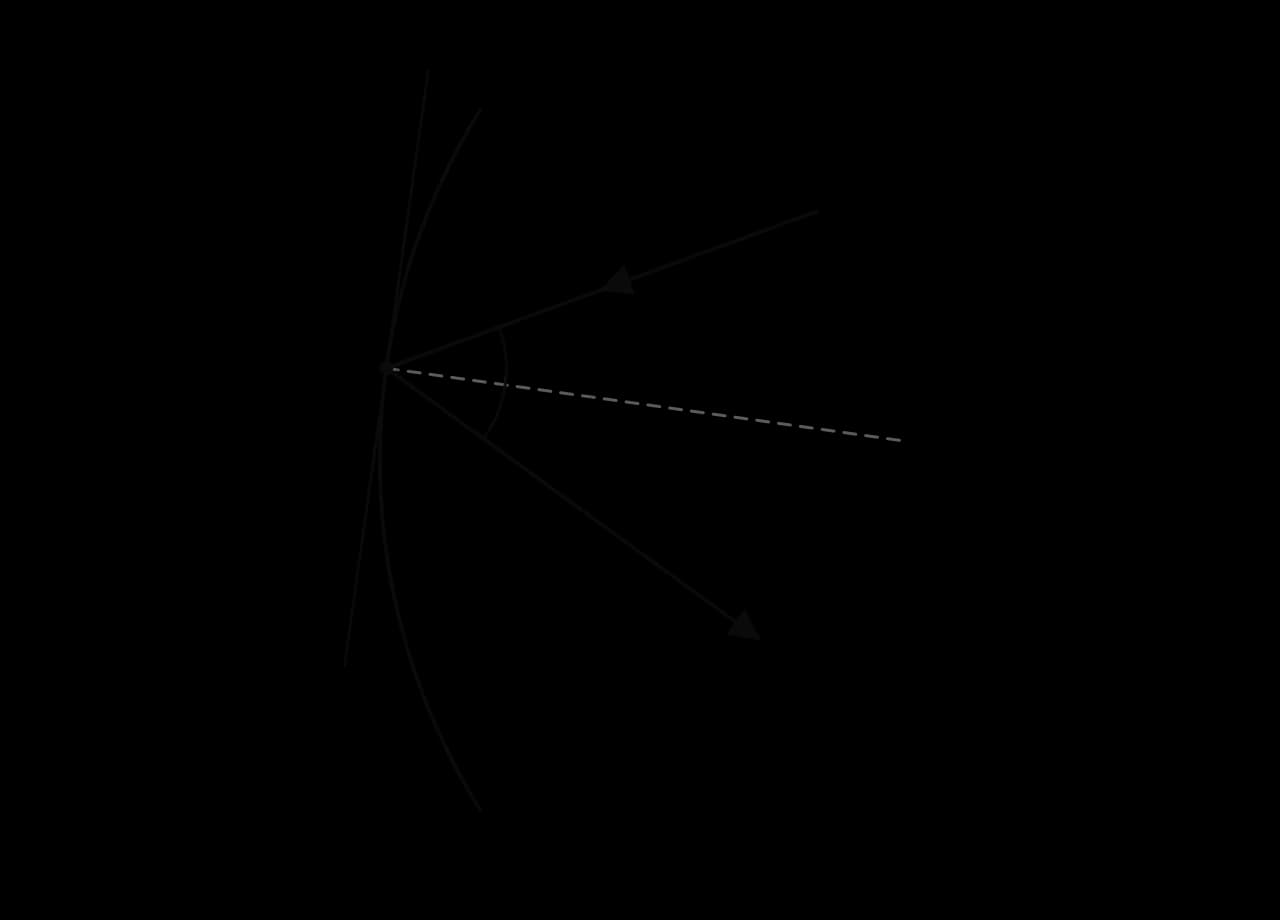
When light meets a mirror, the angle of incidence equals the angle of reflection, and both angles are measured from the normal to the surface at the point where the light strikes, not from the surface itself. For a flat mirror the normal is the same everywhere. For a curved mirror, such as a car's wing mirror or the dish of a reflecting telescope, the normal changes from point to point, and finding it at the point of contact uses exactly the method for the equation of a normal.
At a curved mirror the incoming and outgoing rays make equal angles i and r with the normal at the point where the light strikes; the tangent at P plays the role of a tiny flat mirror.
The tangent at the point of contact behaves like a small flat mirror placed there, which is local linearity again. The normal, perpendicular to that tangent, is the reference line from which both angles are measured, so a curved mirror's effect on every ray is fixed by the normals along its surface.
YouTube
Khan Academy, “Equation of normal line”: watch the tangent gradient found from the derivative, turned into the negative reciprocal, and used with the point of contact.
A real reflector: the FAST radio telescope
The Five-hundred-meter Aperture Spherical Telescope (FAST) in Guizhou, China, pulls part of its reflecting surface into the shape of a parabola, and the radio waves collected by a circle 300 m across are focused on a receiver in a feed cabin suspended about 140 m above the dish. A parabola y=4fx2 sends every ray that arrives parallel to its axis through the point (0,f), its focus. Taking f=140 gives a model of the working reflector, y=560x2 for −150≤x≤150, with x and y in metres, and the equation of a normal shows why a ray striking the very edge still reaches the receiver.
Dimensions: 300 m illuminated aperture, feed cabin about 140 m above the reflector, Wikipedia, "Five-hundred-meter Aperture Spherical Telescope", accessed 2026. The parabola is a model built from these two figures.
Where a normal meets the curve again
A tangent or normal is a straight line, and a straight line can cross a curve at more than one point. Finding the other intersection means solving the equation of the curve and the equation of the line simultaneously: set the two expressions for y equal. The point of contact is always one solution, which is a useful check.
Using technology
Gradients and tangent lines on the GDC
The GDC supports every step of the tangent method. It finds a numerical derivative at a point (TI-84 Plus CE: MATH → 8:nDeriv(; Casio fx-CG50: MENU → Run-Matrix, then OPTN → CALC → d/dx; or, on a graph, TI-84 Plus CE 2ndTRACE (CALC) → dy/dx), which gives f′(a) directly when the differentiation is awkward or needs checking. Most models also draw the tangent at a chosen point of a graph and display its equation: on a TI-84 Plus CE, 2ndPRGM (DRAW) → 5:Tangent( from the graph screen; on a Casio fx-CG50, the Sketch menu of the graph screen has Tangent; on a TI-Nspire, the Graphs application's geometry tools include a tangent.
The displayed equation is rounded, and it gives no working, so it is a check rather than a method. A tangent found by hand that disagrees with the GDC's tangent usually has the y-coordinate taken from the derivative, or a sign error in a negative power.
Graph y=f(x) in a window that shows the point of contact.
Use the draw-tangent tool at x=a and read the equation y=mx+c.
Compare m with the hand value of f′(a), and c with the constant in the hand-derived equation.
A "show that" question about a tangent is different, because the result is already stated and the derivation is what is being asked for.
Working backwards from a tangent
Finding the point where the tangent has a given gradient
A common reverse problem gives the gradient of a tangent and asks where on the curve it occurs. The gradient of the tangent at x is f′(x), so the x-coordinates are the solutions of the equation f′(x)=m. Each solution gives a point of contact; the y-coordinate again comes from f(x), not from f′(x).
The equation f′(x)=m may have one solution, several or none, and each solution is a separate tangent with gradient m. Tangents with the same gradient are parallel, so counting the solutions of f′(x)=m counts the tangents parallel to a given line. Graphing y=f′(x) together with the horizontal line y=m shows the number of solutions at a glance, and the GDC finds each one.
If the gradient of the normal is given instead, it is converted to the tangent's gradient first, using the negative reciprocal again: a normal gradient of −51 means a tangent gradient of 5.
y = x² + 2/x
y = x^2 + 2/x
tangent at x = −1
tangent at x = 0.618
tangent at x = −1.618
Three tangents to y = x² + 2/x have gradient −4, so they are parallel; they touch the curve at the three solutions of f′(x) = −4.
Finding a parameter from a tangent
When a curve's equation contains an unknown parameter, a condition on a tangent gives an equation for it. The usual conditions are a gradient at a given x (substitute into the derivative and set equal to the gradient), a tangent parallel to a given line (equal gradients) or a point that the curve passes through (substitute into the function). Two unknowns need two such conditions, giving a pair of simultaneous equations.
Where a tangent meets the axes
A tangent meets the x-axis where y=0 and the y-axis where x=0. Together with the origin, these two points form a right-angled triangle whose area is half the product of the two intercepts' distances from the origin. The same idea finds where a tangent meets any other line: solve the two equations simultaneously.
Tangents and normals in context
Moving along a tangent
An object moving along a curved path has, at each instant, a direction of motion along the tangent to the path. If the force holding it on the curve disappears, it continues in a straight line along that tangent, as Newton's first law states: a car that hits ice on a bend slides off along the tangent, and a hammer thrower's hammer, when released, flies off along the tangent to its circle. The equation of that tangent predicts where the object goes next, at least until other forces act.
Joining a straight edge smoothly to a curve
Designers of roads, rails, metal sheets and furniture often join a curved section to a straight one. For the join to have no corner, the straight section must continue in the direction of the curve at the join, so it lies along the tangent at the point where they meet. Railway and road engineers take this further and match the curvature as well, but matching the tangent is the first requirement, and it is a direct use of the equation of a tangent.
Exam focus
Tangents and normals appear in short Paper 1 questions worth 4–7 marks and as parts of longer Paper 2 questions, almost always straight after a part that asks for the derivative. The command terms are find (the equation of the tangent or normal, the gradient, the coordinates of a point), write down (a gradient read from a derivative already found, or a vertical normal), show that (a given equation of a tangent, or a parameter value, derived algebraically) and determine or justify (the number of tangents with a given gradient, with a reason). Answers are frequently required in a stated form, especially ax+by+d=0 with integer coefficients, and the final accuracy mark is withheld when fractions remain or another form is given. Follow-through from a wrong derivative is allowed in later parts, provided the method is shown.
In part (d) the GDC solves the equation, but the equation itself must be written down, and the solution x=2 has to be recognised as P and discarded. By hand, multiplying by 2x2 gives 6x4−21x2−12=0, so x2=4 and x=±2.
Questions that ask "how many" tangents have a property need a reason as well as a number.
Practice questions
Find the equation of the tangent to y=x3−5x+2 at the point where x=2. [4]
Find the equation of the normal to y=x4 at the point (2,2). [4]
The function f is defined by f(x)=2x2−x+3. Find the equation of the normal to the graph of f at x=1
The curve y=x2−6x+10 has a horizontal tangent at the point A. Find the coordinates of A and write down the equation of the normal at A
Find the coordinates of the points on the curve y=x3−3x2+1 at which the tangent is parallel to the line y=9x−4
The curve y=kx2+x3, x=0
The normal to the curve y=3x3+2 at the point P has gradient −41
The tangent to y=x2+1 at the point where x=2 meets the x-axis at A
Let f(x)=x4−2x. (a) Find the equation of the tangent to the graph of f at x=1. [3] (b) Use the tangent to estimate f(1.05)
Answers
Point (2,0); dxdy=3x2−5=7 at x=2; y=7x−14.
dxdy=−x24=−1
f(1)=4, f′(x)=4x−1, f′(1)=3
2x−6=0, so x=3 and A(3,1); the normal is x=3
3x2−6x=9, so x2−2x−3=0
(a) dxdy=2kx−3x−2; 2k−3=5
The tangent gradient is 4, so x2=4 and x=±2; P(2,314)
Tangent y=4x−3; A(0.75,0), B(0,−3); area =21×0.75×3=1.125
(a) f(1)=−1, f′(x)=4x3−2
Summary
The tangent to y=f(x) at x=a passes through the point of contact (a,f(a)) and has gradient f′(a): y−f(a)=f′(a)(x−a).
The y-coordinate comes from the function and the gradient from the derivative; the gradient is a number, never an expression in x.
The normal is perpendicular to the tangent at the point of contact, with gradient −f′(a)1, because perpendicular gradients multiply to −1.
A horizontal tangent y=f(a) has the vertical normal x=a.
Answers in the form ax+by+d=0 with a,b,d∈Z need every fraction cleared; integer multiples are equivalent.
Points where the tangent has gradient m solve f′(x)=m; the number of solutions is the number of tangents parallel to a line of gradient m.
A parameter is found by turning a condition on a tangent into an equation; "show that" working starts from the given facts.
Close to the point of contact, the tangent approximates the curve (local linearity); the GDC's tangent tool is a check, not a substitute for working.
Self-check
To do:
I can find the point of contact (a,f(a)) from the original function.
To do:
I can find the gradient of a tangent by substituting x=a into the derivative.
To do:
I can write the equation of a tangent using y−y1=m(x−x1).
To do:
I can rearrange an equation into y=mx+c or into ax+by+d=0 with integer coefficients.
To do:
I can find the gradient of a normal as the negative reciprocal of the tangent's gradient.
To do:
I can write down the normal x=a when the tangent is horizontal.
To do:
I can find a tangent or normal for a curve containing a term such as x6.
To do:
I can find where a tangent or normal meets the curve again or meets the axes.
To do:
I can find the points where the tangent has a given gradient by solving f′(x)=m.
To do:
I can convert a given normal gradient into a tangent gradient before solving.
To do:
I can count and justify the number of tangents parallel to a given line.
To do:
I can find a parameter from a condition on a tangent, working forwards in a "show that".
To do:
I can use a tangent to estimate a nearby value of a function and judge how reliable it is.
To do:
I can use the GDC's numerical derivative and draw-tangent tool to check my answers.
where x is the horizontal distance, in metres, from the start of the mound and y is the height in metres. The two curves meet at x=4 and have the same gradient there, so that the track is smooth. The second curve passes through the point (10,2.2).
(a)
Find the height of the track and the gradient of the track when x=4.
[2]2 marks
Markscheme (a)
height =0.1(4)2=1.6 (m) A1
gradient =0.2(4)=0.8A1
[2 marks]
(b)
Show that 8a+b=0.8.
[2]2 marks
Markscheme (b)
dxdy=2ax+b
(c)
Write down two further equations in a, b and c.
[2]2 marks
Markscheme (c)
16a+4b+c=1.6
(d)
Find the values of a, b and c.
[2]2 marks
Markscheme (d)
attempt to solve the system using technology (M1)
a=−0.117, b=1.73
(e)
Find the maximum height of the mound.
[2]2 marks
Markscheme (e)
2ax+b=0OR maximum seen on a graph (M1)
x=7.43, height =2.97
(f)
After x=10 the track continues in a straight line which is a tangent to the second curve at x=10. Find the horizontal distance from the start of the mound to the point where this straight section reaches the ground (y=0).
[4]4 marks
Markscheme (f)
gradient =2(−0.11666…)(10)+1.7333…
Question 2 · AI-0026813 marks
The edge of a lake is modelled by the curve
y=f(x)=−0.05x3+0.6x2−1.3x+4,0≤x≤10,
where x and y are measured in hundreds of metres. The point P(2,3.4) lies on the edge of the lake.
(a)
Find f′(x).
[2]2 marks
(b)
Show that the gradient of the curve at P is 0.5.
[1]1 mark
(c)
A straight path is built along the tangent to the curve at P. Find the equation of the tangent in the form y=mx+c
The point of contact is (2,3). Differentiate, then substitute x=2 for the gradient.
dxdy=3x2−4x,dxdyx=2=12−8=4
Substitute the point and the gradient into the point-gradient form and rearrange.
y−3=4(x−2)⇒y=4x−5
As a check, the line passes through (2,3): 4(2)−5=3.
.
(b) Point of contact: f(−2)=3(4)−−28=12+4=16, so the point is (−2,16).
Gradient: f′(−2)=6(−2)+48=−12+2=−10.
Equation of the tangent:
y−16y−1610x+y+4=−10(x+2)=−10x−20=0
The brackets matter: x−(−2)=x+2. All three coefficients, 10, 1 and 4, are integers, as required.
, so the point is
(2,23)
.
Gradient: dxdy=2x−x−2, so at x=2 the gradient is 1−41=43.
Equation of the tangent:
y−23=43(x−2)⇒y=43x−23+23=43x
The equation has no constant term, so when x=0, y=0: the tangent passes through the origin. In integer form the tangent is 3x−4y=0.
In a "show that" question the conclusion has to be stated. Here that means writing the equation and saying why it shows the line passes through (0,0), rather than only quoting a GDC result.
(c) At x=2.5 the tangent gives 4(2.5)−5=5, while the curve has y=15.625−12.5+3=6.125, an error of about 18%. The point x=2.5 is too far from the point of contact: the curve bends away from the tangent, so the linear approximation is only reliable close to x=2.
.
The normal is perpendicular to the tangent, so its gradient is the negative reciprocal of 3.
mnormal=−31
Substitute the point (3,2) and this gradient into the point-gradient form, then clear the fraction by multiplying every term by 3.
y−23y−6x+3y−9=−31(x−3)=−x+3=0
Check: 3+3(2)−9=0, so the point (3,2) lies on the line.
The gradient of the tangent at x=2 is 0, so the tangent is horizontal.
(b) The point of contact is (2,f(2)), with f(2)=4−6+2=0. The horizontal tangent through (2,0) is y=0, which is the x-axis itself. The normal is perpendicular to it, so it is the vertical line x=2.
is
(150,40.2)
(3 s.f.). The derivative is
dxdy=5602x=280x
, so the gradient at
E
is
280150=2815=0.536
(3 s.f.).
(b) The normal's gradient is the negative reciprocal, −1528=−1.87 (3 s.f.).
y−40.18=−1528(x−150)⇒y=−1.87x+320 (3 s.f.)
(c) The tangent at E makes an angle tan−1(2815) with the horizontal. The normal is perpendicular to the tangent and the ray is perpendicular to the horizontal, so the angle between the ray and the normal is the same angle.
i=tan−1(2815)=28.18∘…=28.2∘ (3 s.f.)
(d) The reflected ray makes an angle 2i=56.36…∘ with the vertical and heads towards the axis, which is 150 m away horizontally. In the right-angled triangle formed by the ray, the vertical through E and the horizontal, the ray rises
tan56.36∘150=1.5035…150=99.8 m,
so it crosses x=0 at a height of 40.18+99.82=140 m, the height of the receiver.
The same calculation at any other point of the parabola also ends at (0,140), which is why one receiver collects the waves from the whole 300 m circle.
.
y−1=−21(x−1)⇒y=−21x+23
(b) At an intersection the two y-values are equal.
x22x2+x−3(2x+3)(x−1)=−21x+23=0=0
The solution x=1 is the point A, as expected. The other is x=−1.5, with y=(−1.5)2=2.25, so B is (−1.5,2.25). With the GDC, graph y=x2 and y=−0.5x+1.5 and find both intersections.
. The gradient of
L
is
−4
.
(b) A tangent parallel to L has gradient −4, so its point of contact satisfies
2x−x22=−4.
Graphing y=2x−x22 and y=−4 on the GDC (or solving the equivalent cubic x3+2x2−1=0, found by multiplying by x2 and dividing by 2) gives three solutions: x=−1.62, x=−1 and x=0.618. One of them, x=−1, is the point P itself, so there are two other tangents parallel to L.
(c) Substitute each x into f(x), not f′(x).
f(0.618…)=3.62,f(−1.618…)=1.38(3 s.f.)
The points of contact are (0.618,3.62) and (−1.62,1.38). By hand, the cubic factorises as (x+1)(x2+x−1)=0, giving x=2−1±5.
Substitute x=1 and set the result equal to 9.
3+2k2kk=9=6=3
The working starts from the given information and arrives at k=3 without using that value; substituting k=3 to check that the gradient is 9 would not show the result.
(b) With k=3, the point of contact has y=1+3−5=−1. The tangent passes through (1,−1) with gradient 9.
y+1=9(x−1)⇒y=9x−10
gives
dxdy=−12x−2
, so the gradient at
x=2
is
−412=−3
.
y−6=−3(x−2)⇒y=−3x+12
(b) On the x-axis y=0, so x=4 and A is (4,0). On the y-axis x=0, so B is (0,12). The area of the right-angled triangle is 21×4×12=24 square units.
(c) At x=a the point of contact is (a,a12) and the gradient is −a212.
Setting y=0 gives a212x=a24, so x=2a; setting x=0 gives y=a24. The area is
21×2a×a24=24 square units,
which does not depend on a, so every tangent to C forms a triangle of area 24 with the axes. The working uses a general point, so it proves the result for all a>0, not just the one checked in part (b).
. The take-off point is 16.6 m above the ground.
(b) dxdy=0.007x−0.6, so at x=60 the gradient is 0.42−0.6=−0.18.
y−16.6=−0.18(x−60)⇒y=−0.18x+27.4
(c) The gradient of a line is the tangent of its angle of inclination (subtopic 2.1). The gradient −0.18 means the line falls, so the skier's direction is below the horizontal by
tan−1(0.18)=10.2∘ (3 s.f.).
The skier leaves the ramp heading about 10.2∘ below the horizontal. The model ignores the skier's own push at take-off and air resistance, so this is only the initial direction.
The ramp profile is hypothetical.
. [4]
A1A1
Award A1 for 3x2−4 and A1 for −6x−2. Award at most (M1)A1A0 if any extra term is seen.
(b) f′(2)=3(2)2−4−226M1
=12−4−1.5A1
=6.5AG
(c) mnormal=−6.51=−132M1
y−3=−132(x−2)M1
13y−39=−2x+4(A1)
2x+13y−43=0A1
Accept any integer multiple. Do not award the final A1 if the answer is not in the required form.
(d) 3x2−4−x26=6.5(M1)
x=−2 (from the GDC; x=2 is P) A1
f(−2)=−8+8−3=−3, so Q(−2,−3)A1
(e) y+3=6.5(x+2)(M1)
y=6.5x+10A1
Total [14]
, in the form
ax+by+d=0
, where
a,b,d∈Z
. [5]
. [4]
. [5]
, has gradient 5 at the point where
x=1
. (a)
Find
the value of
k
. [3] (b)
Find
the equation of the tangent at
x=1
. [2]
.
Find
the possible coordinates of
P
. [5]
and the
y
-axis at
B
.
Find
the area of triangle
OAB
, where
O
is the origin. [5]
, and
calculate
the percentage error of the estimate. [3]
at
x=2
, so the normal gradient is 1;
y−2=1(x−2)
, so
y=x
.
, normal gradient
−31
;
y−4=−31(x−1)
, so
x+3y−13=0
.
.
, giving
x=3
or
x=−1
; points
(3,1)
and
(−1,−3)
.
, so
k=4
. (b)
y(1)=7
;
y=5x+2
.
or
P(−2,−32)
.
square units.
,
f′(1)=2
;
y=2x−3
. (b) Estimate
2(1.05)−3=−0.9
; exact
f(1.05)=−0.88449…
; percentage error
=−0.88449−0.9−(−0.88449)×100%=1.75%
(3 s.f.).
for the second curve
M1
2a(4)+b=0.8A1
8a+b=0.8AG
[2 marks]
A1
100a+10b+c=2.2A1
[2 marks]
,
c=−3.47
(−607,1526,−1552)
A1
[2 marks]
(m)
(2.97142…)
A1
[2 marks]
(M1)
=−0.6(A1)
y−2.2=−0.6(x−10)(M1)
0=2.2−0.6(x−10)
x=13.7 (m) (13.6666…)A1
Note: Follow through from part (d). Accept 341.
[4 marks]
.
[2]2 marks
(d)
The path meets the edge of the lake again at the point Q. Find the coordinates of Q.
[2]2 marks
(e)
Find the length of the path from P to Q, in metres.
[2]2 marks
(f)
A straight jetty is to be built from P along the normal to the curve at P. Find the equation of the normal, giving your answer in the form ax+by+d=0, where a,b,d∈Z.
[3]3 marks
(g)
The line y=0 represents a straight road. Write down the x-coordinate of the point where the line of the jetty, if extended, would meet the road.
 YouTube
 YouTube