5.3 Differentiating polynomials · IB Maths AI | Augment Education
5.3 Differentiating polynomials
Differentiate any sum of integer powers of x by the power rule, including negative powers such as 3/x, rewrite products and quotients first, keep parameters constant, and check derivatives with the GDC.
IB Mathematics: Applications and Interpretation
Part of 5 Calculus
SL and HL
Key terms introduced here
Each is in the Maths AI glossary, with every other term in the subject.
A power xn in which n is a negative integer, so that x−k=xk1 for a positive integer k; a term xka written as ax−k is ready to be differentiated by the power rule.
The rule that the derivative of axn, for a constant a and an integer n, is anxn−1, so the coefficient is multiplied by the power and the power is reduced by 1.
The derivative of a sum or difference of functions is the sum or difference of their derivatives, so dxd(f(x)±g(x))=f′(x)±g′(x) and each term can be differentiated separately.
for any integer
n
, and explain where the pattern comes from.
Differentiate polynomials term by term, using the derivative of a constant, the constant multiple rule and the sum rule.
Differentiate terms with negative integer powers, such as x3 and 2x25, after writing them in the form ax−k.
Find the derivative of a product or a quotient by first expanding or splitting it into a sum of powers of x.
Differentiate functions written with variables other than x and y, such as drdV and dtds, treating any parameter as a constant.
Calculate the gradient or rate of change at a given point by substituting into the derivative, and interpret it with units.
Use technology to find a numerical derivative at a point and to check a derivative found by hand.
Introduction
Subtopic 5.1, Limits and the derivative, describes the derivative as the gradient of a curve at each point, found as the limit of the gradients of chords. That idea is clear but slow: estimating one gradient needs a table of chord gradients. For the functions used most often in modelling, sums of powers of x, a single rule gives the whole gradient function at once. With it, a cost function becomes a marginal cost, a distance becomes a speed and a volume becomes a rate of growth, in one line of algebra.
The rule comes from a pattern in the gradients of x2, x3, x4, …, and the same pattern turns out to hold for negative powers such as x−1=x1. Together with two simple facts, that multiplying a function by a number multiplies its gradient by that number and that the gradient of a sum is the sum of the gradients, it allows any function built from integer powers to be differentiated term by term. Every later subtopic of calculus at this level, from tangents to optimisation, starts from this skill.
The power rule
A pattern in the gradients of powers of x
The gradient of y=x2 at x=3 can be estimated from chords, as in subtopic 5.1. A chord from (3,9) to a nearby point (3+h,(3+h)2) has gradient h(3+h)2−9. As h shrinks, these chord gradients close in on the gradient of the tangent. The same calculation for y=x3 at x=2 gives a second column.
h
chord gradient of y=x2 at x=3
chord gradient of y=x3 at x=2
1
7
19
0.1
6.1
12.61
0.01
6.01
12.0601
0.001
6.001
12.006001
limit as h→0
6
12
Repeating the calculation at other points and for other powers fills in a table of gradients. Each row shows the gradient of the curve at x=1, 2 and 3, and the last column the formula that fits every value in the row.
Function
gradient at x=1
gradient at x=2
gradient at x=3
gradient function
y=x2
2
4
6
2x
y=x3
3
12
27
3x2
y=x4
4
32
108
4x3
For x3 the gradients 3, 12, 27 are three times the squares 1, 4, 9, so the gradient function is 3x2. For x4 the gradients 4, 32, 108 are four times the cubes 1, 8, 27, giving 4x3. In each row the old power comes down in front as a multiplier and the new power is one less than the old one.
f(x)=axn⇒f′(x)=anxn−1,n∈Z
In Leibniz notation the same rule reads dxd(axn)=anxn−1. The symbol dxd in front of an expression is an instruction: differentiate what follows with respect to x. So dxd(x4)=4x3, and if y=x4 then dxdy=4x3; both say the same thing.
Why the power comes down
The tangents to y=x2 drawn at x=−1, 1 and 2 have gradients −2, 2 and 4, exactly 2x at each point. The tangent at a negative x slopes down and the gradient formula gives a negative value there, so one formula describes the steepness on both sides of the vertex.
y = x²
tangent at x = −1, gradient −2
tangent at x = 1, gradient 2
tangent at x = 2, gradient 4
Each tangent to y = x² has gradient 2x: −2 at x = −1, 2 at x = 1 and 4 at x = 2, so the steepness doubles as x doubles.
The pattern can be justified for every positive integer power with a short piece of algebra. The chord gradient of y=xn between x and x+h is h(x+h)n−xn, and the key step is expanding (x+h)n.
Why the derivative of xⁿ is nxⁿ⁻¹ for positive integers n
Write (x+h)n as a product of n brackets, (x+h)(x+h)⋯(x+h). Expanding it means choosing either x or h from every bracket and multiplying the choices.
Choosing x from every bracket gives xn, once.
Choosing h from exactly one bracket and x from the other n−1 gives xn−1h
h(x+h)n−xn=hxn+nxn−1h+(terms in h2,h3,…)−xn=nxn−1+(terms in h,h2,…)
As h→0, every term that still contains h tends to 0, leaving nxn−1. For n=2 this is the familiar h(x+h)2−x2=2x+h
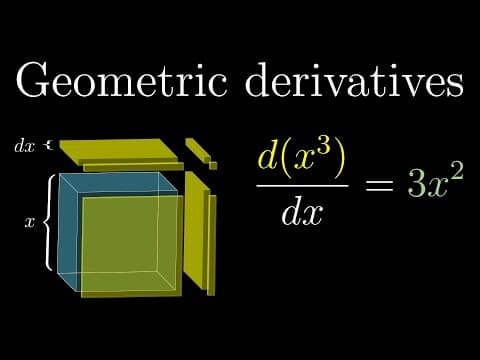
The 3Blue1Brown video "Derivative formulas through geometry" makes the same argument with pictures: a square of side x grows by two thin strips of area x×dx when its side grows a little, and a cube grows by three thin slabs, which is where the 2 in 2x and the 3 in 3x2 come from.
YouTube
3Blue1Brown, “Derivative formulas through geometry | Chapter 3, Essence of calculus”: watch how the extra area of a growing square and the extra volume of a growing cube produce 2x and 3x².
The powers 1 and 0
Two special cases of the power rule describe straight lines. The line y=x is x1, and the power rule gives 1×x0=1: the line has gradient 1 everywhere, as its graph confirms. More generally dxd(mx)=m, the familiar gradient of a straight line from subtopic 2.1.
A constant such as y=7 can be written 7x0, because x0=1 for x=0. The power rule then gives 7×0×x−1=0. The graph of y=7 is a horizontal line, which has gradient 0 at every point, so the rule and the picture agree.
A constant added to a function moves its graph up or down without changing its shape, so it changes no gradients. The curves y=x2, y=x2+5 and y=x2−3 are vertical translations of one another and all have gradient function 2x. The constant term of a polynomial therefore disappears when it is differentiated.
Constant multiples and sums
The constant multiple rule
Multiplying a function by 3 stretches its graph vertically by a factor of 3. Every point moves to three times its height, so every rise between two points becomes three times as large while every run stays the same. Every chord gradient is multiplied by 3, and so is every tangent gradient. In symbols, the chord gradient of 3f is h3f(x+h)−3f(x)=3×hf(x+h)−f(x), and the factor 3 is still there in the limit.
The coefficient a in the power rule axn⇒anxn−1 is exactly this rule at work: differentiate xn to get nxn−1, then multiply by a. The rule holds for any constant, including fractions and negative numbers, and it explains why 8x4 has derivative 84x3=2x3.
The sum rule
When two functions are added, their heights add at every x, and so do their rises over any run. The chord gradient of f+g splits into two pieces:
As h→0, the first piece tends to f′(x) and the second to g′(x). Subtraction works the same way, because subtracting g is adding −1×g.
Differentiating a polynomial term by term
The three rules together differentiate any polynomial: each term axn becomes anxn−1, the constant term becomes 0, and the results are added. Because every power drops by 1, the derivative of a polynomial of degree n is a polynomial of degree n−1: a cubic has a quadratic derivative, a quadratic a linear one, and a linear function a constant one.
Writing the derivative one term at a time, in the same order as the original, keeps the work easy to check. Each coefficient should be simplified to a single number.
Fractional coefficients
Models often have fractional coefficients, such as 8x4 or −32x3. The power rule treats them like any other number: multiply the coefficient by the power and simplify. A fraction written over a number, such as 8x4, is the same as 81x4, so its derivative is 81×4x3=2x3.
Negative integer powers
Rewriting fractions as powers
Functions such as x3, x128 and x25 appear whenever one quantity is divided by another: the height of a box of fixed volume, the average cost per item, the time for a journey at a given speed. None of these is written as a power of x, so the power rule cannot be applied to them as they stand. The negative exponent rule x−k=xk1 from subtopic 1.5 rewrites each one as a power.
Only the part of the term that is in the denominator moves into the power; a number in the denominator stays in the coefficient as a fraction. The table shows the commonest rewritings.
Original term
Rewritten as a power
Derivative
Derivative as a fraction
x1
x−1
−x−2
−x21
x3
3x−1
−3x−2
x25
5x−2
−10x−3
2x31
21x−3
3x4
34x−1
Why the power rule still works
The power rule was found from positive powers, so it needs checking for n=−1. The chord gradient of y=x1 between x and x+h can be simplified by putting the two fractions over a common denominator.
As h→0 this tends to −x21=−x−2, which is exactly what the power rule gives for x−1: bring down the −1 and reduce the power to −2. Numerically, the chord gradients at x=2 for h=1,0.1,0.01,0.001 are −0.1667, −0.2381, −0.2488 and −0.2499, closing in on −41. The same kind of argument works for every negative integer power.
The graph of y=x1 falls from left to right on each side of the vertical asymptote x=0, so every tangent has a negative gradient, and −x21 is negative for every x=0. The tangents are steepest close to the asymptote, where x2 is small and x21 large, and almost flat far from it.
y = 1/x
y = 1/x
tangent at x = 1, gradient −1
tangent at x = 2, gradient −1/4
tangent at x = −1, gradient −1
Every tangent to y = 1/x slopes downwards, matching the derivative −1/x², which is negative for all x ≠ 0 and largest in size near x = 0.
The function x1 is not defined at x=0, and neither is its derivative. A function containing a negative power always comes with the condition x=0, and its derivative carries the same condition.
Subtracting 1 from a negative power
Reducing a negative power by 1 makes it more negative: −1 becomes −2, −2 becomes −3, and −5 becomes −6. The coefficient also picks up a negative factor, so a positive term xka always has a negative derivative −xk+1ka, and a negative term has a positive one.
A negative power in physics: gravity and height
Gravity weakens with distance from the Earth's centre according to an inverse-square law. At a distance r metres from the centre, outside the Earth, the gravitational field strength is modelled by g(r)=r2GM in m s−2, where GM≈3.986×10¹⁴ m3 s−2 is a measured constant for the Earth. Rewritten as a power, g(r)=GMr−2, the model can be differentiated with respect to r by the power rule.
g(r)=GMr−2⇒g′(r)=−2GMr−3=−r32GM
The derivative is negative for every r, so the field strength falls as the distance grows, and the size of the derivative is the loss of field strength per metre of extra height. Because r3 grows quickly, the rate of loss becomes smaller further from the Earth.
Sources: GM for the Earth (geocentric gravitational constant) and mean radius 6,371 km, Wikipedia, "Standard gravitational parameter" and "Earth radius", accessed 2026.
Rewriting products and quotients before differentiating
Products: expand first
The rules so far apply to sums of powers. A product such as (2x−1)(x2+3) is not a sum, and there is no rule at this level for differentiating a product directly. Expanding the brackets turns it into a polynomial, which the power rule handles term by term.
It is tempting to differentiate each factor and multiply the results, but this gives the wrong answer. The simplest case shows why: x2×x3=x5, whose derivative is 5x4, while differentiating the factors separately gives 2x×3x2=6x3. The two expressions are not equal, so the derivative of a product is not the product of the derivatives.
Quotients with a single-term denominator: split first
A quotient whose denominator is a single term, such as 2xx3−4x+8, can be split into separate fractions, one for each term of the numerator. Each fraction then simplifies by the laws of exponents to a single power of x.
2xx3−4x+8=2xx3−2x4x+2x8=21x2−2+4x−1
A denominator with more than one term, such as x+11, cannot be split in this way: x+11 is not x1+1. Functions of that kind need the quotient or chain rule and are not differentiated at this level.
Derivatives with other variables and parameters
Other letters for the variables
Models use letters that suggest their meaning: V for volume, r for radius, s for distance, t for time, C for cost, q for quantity. The rules of differentiation do not depend on the letters. If V=34πr3, the derivative of V with respect to r is written drdV and found by the power rule with r in place of x.
V=34πr3⇒drdV=34π×3r2=4πr2
The notation drdV is read "the derivative of V with respect to r", and it is the rate of change of volume as the radius grows, measured in units of volume per unit of length, for example cm3 per cm. The result 4πr2 is also the surface area of the sphere: a thin layer added to the outside of a sphere has a volume of about its surface area times its thickness.
Free fall: from distance to speed
An object dropped from rest near the Earth's surface, with air resistance ignored, falls a distance s=21gt2 metres in the first t seconds, where g is the acceleration due to gravity. Taking g≈9.8 m s−2 (standard gravity is defined as 9.80665 m s−2) gives s=4.9t2. Differentiating distance with respect to time gives the instantaneous rate of change of distance, the speed.
s=4.9t2⇒dtds=9.8t
The speed grows by 9.8 m s−1 every second, which is what an acceleration of 9.8 m s−2 means. One application of the power rule converts the distance formula into a speed formula.
Parameters are constants
Many models contain a parameter, a letter such as k, a or b that stands for a fixed number whose value is not yet known. When differentiating with respect to x, a parameter behaves exactly like a number: kx3 has derivative 3kx2, k2x has derivative k2, and a term such as 5k or k2 on its own is a constant with derivative 0. The value of the parameter is usually found afterwards from a condition, such as a known gradient at a point.
Two unknown parameters need two conditions. Each condition on the gradient gives one equation, and the pair is solved as simultaneous equations, by hand or with the GDC's simultaneous equation solver (subtopic 1.8).
Gradients at a point and technology
Substituting into the derivative
The derivative f′(x) is a function: it gives the gradient at every value of x. The gradient at one particular point x=a is the number f′(a), found by substituting a into the derivative, never into the original function. The value f(a) is the height of the graph at x=a, and f′(a) is its steepness there.
A function and its derivative can be drawn one above the other on the same x-scale. The cubic y=x3−3x has derivative y=3x2−3. Where the cubic rises, the derivative is above the x-axis; where it falls, between x=−1 and x=1, the derivative is below it; and at the two turning points the derivative is exactly 0.
y = f(x) = x³ − 3x
y = f′(x) = 3x² − 3
The derivative 3x² − 3 is negative exactly where x³ − 3x falls (−1 < x < 1) and is zero where the cubic is flat.
Whether f′(x) is positive or negative shows where a function is increasing or decreasing (subtopic 5.2), and where f′(x)=0 the graph is flat (subtopic 5.6, Stationary points). Both start from a derivative found by the rules here.
The GDC's numerical derivative
A GDC does not differentiate algebraically. It estimates the gradient at a single point numerically, by calculating the gradient of a very short chord across the point, much as the tables in subtopic 5.1 do. This gives a fast way to find f′(a) and a reliable check on a derivative found by hand.
Enter the function, using the same variable as the calculator (usually X).
Use the numerical derivative at a value. On a TI-84 Plus CE: MATH → 8:nDeriv(, then enter the expression, the variable and the value. On a Casio fx-CG50: MENU → Run-Matrix, then OPTN → CALC → d/dx. On a TI-Nspire, use the derivative template.
Alternatively, graph the function and use the graph's derivative tool (TI-84 Plus CE: 2ndTRACE → 6:dy/dx) at the required x.
Compare with the hand value. If they differ, check the rewriting of any fractions and the signs of negative powers.
A second check graphs the hand derivative and the calculator's numerical derivative together (on a TI-84 Plus CE, Y2=nDeriv(Y1,X,X)). If the hand derivative is right, the two graphs lie on top of each other.
Rates in a design: the surface area of an open box
A packaging designer wants an open box (a box with no lid) with a square base of side x cm and a volume of 4000 cm3. The height h is fixed by the volume: x2h=4000, so h=x24000. The box uses card for the base, area x2, and four sides, each of area xh, so the area of card in cm2 is the following function.
S=x2+4xh=x2+4x×x24000=x2+x16000
The volume condition has produced a negative power, x16000=16000x−1, which is how such terms arise in practice. Differentiating gives the rate at which the area of card changes as the base is widened.
dxdS=2x−16000x−2=2x−x216000
Base side x (cm)
10
20
30
S (cm2)
1700
1200
1433.3
dxdS (cm2 per cm)
−140
0
42.2
At x=10 the derivative is −140: widening the base by a small amount reduces the card needed by about 140 cm2 for every centimetre added, because the tall, narrow box gets shorter faster than its base grows. At x=30 the derivative is positive, so widening the base further now increases the card used. At x=20 the derivative is 0, and the table shows the least area of the three, 1200 cm2. Finding such a value systematically, and proving it is the least, is the method of subtopic 5.7, Optimisation; here the derivative already shows in which direction a change in the design helps.
The box is a hypothetical design; all values are calculated from the model.
Exam focus
Differentiation by the power rule is the most frequently tested calculus skill in the course. Almost every calculus question on Paper 1 or Paper 2 opens with findf′(x) or finddxdy, usually for 2–3 marks, and then uses the derivative in later parts: a gradient at a point, an equation of a tangent or normal (subtopic 5.4), an interval where the function increases (5.2), or the solution of f′(x)=0 (5.6 and 5.7). The markscheme gives one accuracy mark per correct term of the derivative and withholds the last one if any extra term is present, such as a leftover constant. A term like x2 carries its own method mark for being written as 2x−1, which can be implied by a correct −2x−2 or −x22 in the answer.
Other recurring shapes are: a product to expand before differentiating (with a method mark for the expansion), a derivative left in terms of a parameter k and then used to find k from a given gradient, the derivative of a model such as cost, profit, area or volume interpreted as a rate with units, and show thatf′(x)=0 leads to a given equation, followed by hence solve it with the GDC.
In part (e) the answer is given, so every step must be written forwards from A′(x)=0; substituting the root back into the cubic proves nothing. In part (f) the GDC does the solving, but the equation it solves must be written down.
Many questions then give a point on the curve, for example "the point (2,9)", and ask for the gradient there or for the equation of the tangent through it (subtopic 5.4). The two coordinates play different roles.
Practice questions
Write downdxdy for y=4x6−3x3+9. [2]
Findf′(x) for f(x)=x25−4x+2
Finddxdy for y=(3x+2)2
The function g is defined by g(x)=x22x4−x+6
The function h is defined by h(x)=6x3−4x+x18
A paper cone has a fixed height of 12 cm. When its base radius is r cm, its volume is V=4πr2cm3. (a) FinddrdV
The curve y=ax3−4x2+1 has gradient 8 at the point where x=2. Find the value of a
Consider the curve y=x2+x16, x=0
A student writes that the derivative of x2×x3 is 2x×3x2=6x3
Answers
24x5−x2
f(x)=5x−2−41x+2, so f′(x)=−10x−3−41=−x310−41.
Expand: y=9x2+12x+4, so dxdy=18x+12
Split: g(x)=2x2−x−1+6x−2, so g′(x)=4x+x−2−12x−3=4x+x21−x312
(a) h′(x)=2x2−4−x218
(a) drdV=8πr. (b) 40π=126 cm3
dxdy=3ax2−8x; 12a−16=8
dxdy=2x−x216=−14
The derivative of a product is not the product of the derivatives. Simplify first: x2×x3=x5, so the derivative is 5x4
Summary
The power rule: f(x)=axn⇒f′(x)=anxn−1 for every integer n; the power comes down as a multiplier and drops by 1.
The derivative of a constant is 0; the derivative of mx is m.
Constant multiples stay: dxd(af(x))=af′(x)
The derivative of a polynomial of degree n is a polynomial of degree n−1.
Terms such as xka are rewritten as ax−k first; their derivatives are −kax−k−1
Products are expanded and quotients with a single-term denominator are split into powers before differentiating; the derivative of a product is not the product of the derivatives.
Letters other than x work the same way (drdV, dtds
The gradient at x=a is f′(a), a rate of change with units of output per unit of input; the GDC's numerical derivative finds it and checks a hand derivative.
Self-check
To do:
I can explain the pattern in the gradients of x2, x3 and x4 that leads to the power rule.
To do:
I can differentiate axn for positive, zero and negative integer n.
To do:
I can explain why the derivative of a constant is 0, using the graph of y=c.
To do:
I can differentiate a polynomial term by term and simplify every coefficient.
To do:
I can rewrite x3, x25
To do:
I can reduce a negative power by 1 correctly, so that x−1 becomes −x−2.
To do:
I can expand a product of brackets before differentiating.
To do:
I can split a quotient with a single-term denominator into separate powers of x.
To do:
I can differentiate with respect to t, r or q, using the matching notation.
To do:
I can keep a parameter such as k as a constant and then find it from a given gradient.
To do:
I can calculate f′(a) by substituting the x-coordinate into the derivative.
To do:
I can interpret a derivative's value in context, with units such as cm3 per cm.
To do:
I can find a numerical derivative on my GDC and use it to check a hand derivative.
To do:
I can solve an equation f′(x)=m with my GDC and write down the equation I solved.
where h is the height in metres at a horizontal distance x metres from the start of the ramp, and p and q are constants. The two pieces meet at x=4 with no jump and no sharp corner, so that h is continuous and its gradient is continuous at x=4.
(a)
Find the value of p and the value of q.
[4]4 marks
Markscheme (a)
h′(x)=0.2x for 0≤x≤4(M1)
p=0.2×4=0.8A1
0.1×42=4p+q(M1)
1.6=3.2+q so q=−1.6A1
[4 marks]
(b)
Find the horizontal distance from the start of the ramp at which the height of the ramp is 5 m.
[2]2 marks
Markscheme (b)
0.8x−1.6=5(M1)
x=8.25 (m) A1
Note: Follow through from part (a) provided 4<x≤10
Question 2 · AI-00154HL only · 17 marks
Inés uses a rotating sprinkler to water a lawn. The sprinkler waters a region in the shape of a sector of a circle with radius r m and angle θ radians.
Inés first sets the sprinkler so that r=12 and θ=2.3.
(a)
Find the area of lawn watered.
[2]2 marks
(b)
Find the perimeter of the watered region.
[2]2 marks
(c)
Write down the value of θ in degrees.
[1]1 mark
(d)
Inés now plans a new flower bed in the shape of a sector with radius r m and angle θ radians. The area of the flower bed must be 90 m2.
Show that θ=r2180
(e)
The whole perimeter of the flower bed will be edged with metal strip. Show that the length of strip needed, P m, is given by
P=2r+r180.
[2]2 marks
(f)
Find drdP.
[2]2 marks
(g)
Hence find the value of r that minimizes P, and the minimum length of strip needed.
[3]3 marks
(h)
Find the corresponding value of θ.
[1]1 mark
(i)
The metal strip costs 14.50 euros (EUR) per metre. Find the minimum cost of the strip. Give your answer correct to two decimal places.
The profile of a mound on a BMX track is modelled by two curves joined at x=4:
y={0.1x2,ax2+bx+c,0≤x≤44<x≤10
where x is the horizontal distance, in metres, from the start of the mound and y is the height in metres. The two curves meet at x=4 and have the same gradient there, so that the track is smooth. The second curve passes through the point (10,2.2).
(a)
Find the height of the track and the gradient of the track when x=4.
g′(R)=−(6.371×10⁶)32×3.986×1014=−3.08×10⁻⁶m s−2 per metre (3 s.f.)
The negative sign means that the field strength decreases as the height above the surface increases.
(c) Over a small change in r, the change in g is about the rate multiplied by the change in r. For 9 km, that is 9000×3.0828×10−6=0.0277 m s−2 (3 s.f.), which as a percentage of the surface value is
9.820…0.0277…×100%=0.283% (3 s.f.).
Substituting r=R+9000 directly into g(r) gives a fall of 0.282%, so the estimate from the derivative is very close: 9 km is small compared with the radius of the Earth.
Now differentiate term by term.
dxdy=6x2−2x+6
(b) Split the fraction over the single-term denominator, then simplify each part.
y=2xx3−2x4x+2x8=21x2−2+4x−1
Differentiate: the constant −2 disappears and 4x−1 becomes −4x−2.
dxdy=x−4x−2=x−x24
As a check on (a), differentiating the factors separately would give 2×2x=4x, which differs from 6x2−2x+6 at almost every x: at x=1 the correct gradient is 10, not 4.
(b) Substitute t=3.
dtds=9.8×3=29.4
Three seconds after it is dropped, the stone is falling at 29.4 m s−1: the distance fallen is increasing at 29.4 metres per second at that instant.
(c) Set the rate equal to 20 and solve.
9.8t=20⇒t=9.820=2.04 s (3 s.f.)
The stone reaches 20 m s−1 about 2.04 seconds after release. This is inside the domain 0≤t≤4, so the answer is valid for the model.
Differentiate with respect to x, keeping k as a constant: kx becomes k, −0.2x3 becomes −0.6x2 and −500 becomes 0.
dxdP=k−0.6x2
(b) Substitute x=20 and set the derivative equal to 0.
k−0.6(20)2=0⇒k−240=0⇒k=240
With k=240, the profit is P(x)=240x−0.2x3−500. The derivative dxdP is the marginal profit: the approximate extra profit, in dollars, from one more chair at the current level of production.
as constants.
dxdy=2ax−bx−2
At x=1 the gradient is −6, so 2a(1)−12b=−6, which gives 2a−b=−6.
(b) At x=2 the gradient is 9.
2a(2)−22b=9⇒4a−4b=9⇒16a−b=36
Subtracting 2a−b=−6 from 16a−b=36 gives 14a=42, so a=3, and then b=2a+6=12.
(c) With a=3 and b=12, the gradient is 6x−x212. Setting it equal to 0 and multiplying by x2:
6x3−12=0⇒x3=2⇒x=32=1.26 (3 s.f.)
A check with the GDC's numerical derivative of 3X2+12/X at X=1 and X=2 gives −6 and 9.
(b) Substitute x=2.
g′(2)=3(4)−6−48=12−6−2=4
The GDC's numerical derivative of X3−6X+8/X at X=2 gives 4 (or a value such as 4.000001, which rounds to 4), agreeing with the hand calculation.
(c) Set the derivative equal to 1.
3x2−6−x28=1
Solve on the GDC, by graphing y=3x2−6−x28 with y=1 and finding the intersections, or with the equation solver. There are two solutions.
x=−1.78orx=1.78(3 s.f.)
By hand, multiplying by x2 gives 3x4−7x2−8=0, a quadratic in x2 with positive root x2=67+145=3.17…, so x=±1.7815…, which confirms the GDC.
. [2]
(M1)
A′(x)=x−6−64x−2(=x−6−x264)A1A1
Award A1 for x−6 and A1 for −64x−2. Award at most (M1)A1A0 if any extra term is seen. The (M1) may be implied by −64x−2 or −x264 in the answer.
(c) A′(4)=4−6−1664(M1)
=−6 (dollars per hundred chairs) A1
(d) When 400 chairs are made each week, the average cost per chair is falling by about $6 for each extra hundred chairs made. A1
The answer must refer to the average cost decreasing (or its rate) in context.
(e) x−6−x264=0M1
x3−6x2−64=0 (multiplying every term by x2) A1
The equation x3−6x2−64=0 must be seen. AG
(f) Attempt to solve x3−6x2−64=0 with the GDC (polynomial root finder or graph) (M1)
x=7.23 (7.22577…) A1
Total [11]
,
x=0
. [3]
. [3]
,
x=0
.
Find
g′(x)
. [3]
,
x=0
. (a)
Find
the gradient of the graph of
h
at
x=3
. [3] (b)
State
, with a reason, whether
h
is increasing or decreasing at
x=3
. [1]
. [1] (b)
Calculate
drdV
when
r=5
, giving its units, and
interpret
the value. [3]
. [3]
.
Find
the coordinates of every point on the curve where the gradient is
−14
. [5]
.
Explain
the error and
find
the correct derivative. [2]
.
.
;
h′(3)=4.5−4−2=−1.5
. (b) Decreasing, because
h′(3)<0
.
per cm (3 s.f.): when the radius is 5 cm, the volume is increasing at about
126 cm3
for each extra centimetre of radius.
, so
a=2
.
. GDC (intersection of
y=2x−16/x2
and
y=−14
, or solving
2x3+14x2−16=0
):
x=1
,
x=−1.17
or
x=−6.83
(exactly
−4±22
). Points:
(1,17)
,
(−1.17,−12.3)
,
(−6.83,44.3)
.
.
. Sums and differences are differentiated term by term.
, and the power becomes more negative.
); parameters are treated as constants.
and
2x31
as powers of
x
, keeping numbers in the coefficient.
.
[2 marks]
.
[2]2 marks
,
b
and
c
.
[2]2 marks
(d)
Find the values of a, b and c.
[2]2 marks
(e)
Find the maximum height of the mound.
[2]2 marks
(f)
After x=10 the track continues in a straight line which is a tangent to the second curve at x=10. Find the horizontal distance from the start of the mound to the point where this straight section reaches the ground (y=0).
 YouTube