Notes on 5.14 Setting up differential equations
Learning objectives
Identify a differential equation and state its order, and verify that a given function is a solution by differentiating and substituting.
Write down a differential equation from a description of a rate of change in context, including "proportional to" statements, signs for decreasing quantities and parameters.
Solve a differential equation of the form by direct integration.
Solve a separable differential equation by separation of variables, with one constant of integration.
Distinguish between the general solution and a particular solution, and use an initial condition to find the particular solution.
Show that is the general solution of
Apply separation of variables to Newton's law of cooling, Torricelli's law for a draining tank and motion with resistance.
Determine long-term behaviour by setting a rate equal to zero, and comment on the limitations of a differential equation model.
Introduction
Many laws of nature and of economics are statements about rates of change. A population grows faster when there are more individuals to reproduce; a hot drink cools faster when it is much hotter than the room; a tank drains faster when it is full. Each statement links a quantity to its own rate of change, and writing it in symbols gives an equation that contains a derivative: a differential equation. Solving that equation turns a rule about how fast something changes into a formula for how much there is at any time.
Setting up and solving differential equations is the core of modelling with calculus. The exponential models of subtopic 2.5, Modelling with functions, reappear as solutions of the simplest growth equation, which explains why exponential functions describe so many real processes. The same technique, separation of variables, solves the models of cooling, draining and falling that recur throughout science and engineering.
The Revision Village introduction to differential equations sets up a first model from a statement about a rate and solves it: the same two stages, writing the equation and then solving it, run through every model of the subtopic.
 YouTube
Differential equations and their solutions
What a differential equation is
An ordinary equation such as has a number as its unknown. A differential equation has a function as its unknown, and it describes that function through its derivative. The equation
In contexts the variable is usually time , and the unknown is whatever quantity changes: a population , a temperature , a volume , a velocity . The letter in the numerator of the derivative is the dependent variable (the unknown function) and the letter in the denominator is the independent variable. In
The order of a differential equation
Differential equations are classified by the highest derivative they contain. Equations with only a first derivative describe how a quantity changes; equations with a second derivative describe how its rate of change changes, as in Newton's second law of motion, where acceleration is the second derivative of position.
Differential equation | Unknown function | Independent variable | Order |
|---|---|---|---|
First-order equations are solved by direct integration or by separation of variables. Second-order equations are solved in subtopic 5.18, Second-order differential equations, by rewriting them as two first-order equations.
Verifying a solution
Because a solution is a function, checking a proposed solution means differentiating it and substituting both the function and its derivative into the equation. If the two sides agree for every value of the variable, the function is a solution. This check needs no solving technique at all, and it is the quickest way to confirm an answer found by separation of variables.
The two sides are equal for every , so the claim is true. The calculation also works with replaced by any constant, which is a first sign that a differential equation has a whole family of solutions.
Setting up a differential equation from a context
Rates of change as derivatives
Every differential equation model starts from a sentence about a rate. The rate of change of a quantity with respect to time is , measured in units of per unit of time. "The rate of change of the population" is
The phrase "is proportional to" means "is a constant multiple of", exactly as in direct variation in subtopic 2.5. If is proportional to , then for some constant of proportionality . Applied to a rate, "the rate of growth of is proportional to
Signs: increasing and decreasing quantities
A derivative is positive while a quantity increases and negative while it decreases. When a context says a quantity is decreasing, leaking, decaying, cooling or slowed by resistance, the derivative must be negative. The usual convention keeps the constant positive and puts the minus sign in the equation, so that measures the size of the effect and the sign shows its direction.
Statement in words | Differential equation () |
|---|---|
The population grows at a rate proportional to its size. |
In the rumour model the rate is large at first, when almost everyone has not heard, and falls to zero as approaches 8000. Reading an equation back into words like this is a reliable check that it describes the situation intended: each term should have a meaning, and the sign of the derivative should match whether the quantity rises or falls.
Parameters in a model
Models often contain several constants with meanings in the context, for example for a computer virus, where is the number of computers in a city and measures how easily the virus spreads. Such letters are parameters: they are fixed for a given situation, so in calculus they are treated exactly like numbers. The product
Two laws written as differential equations
Two physical laws are used so often in modelling that they have names. Each one states a rate, so each one is a differential equation as soon as it is written in symbols.
The minus sign makes the law work in both directions. A hot object has , so
The second law describes water draining through a small hole in the base of a tank, as in the diagram of a cylindrical tank. Evangelista Torricelli found in 1643 that the water leaves the hole at the speed it would reach by falling freely through the depth , which is where is the acceleration due to gravity.
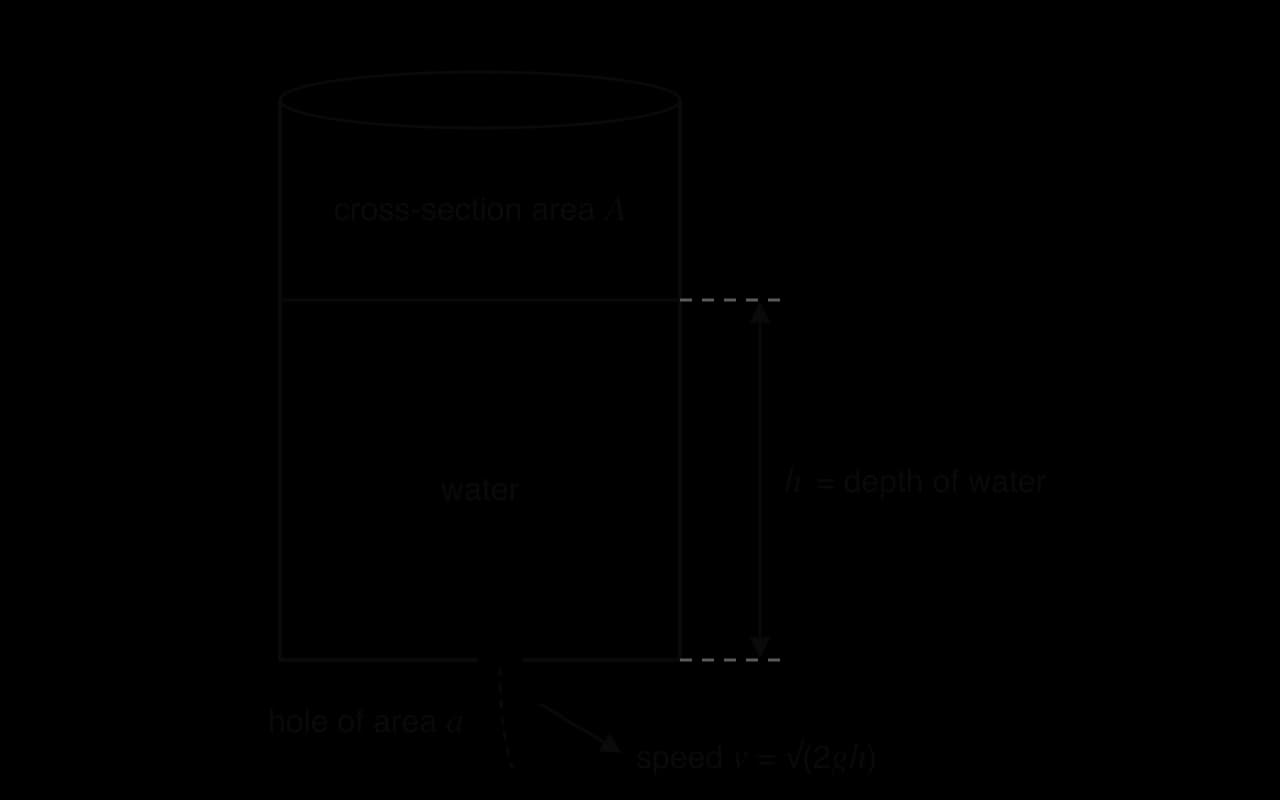
The rate at which volume leaves is the area of the hole times the speed of the water, . For a cylinder of cross-section area , the volume is
All the physical details (the hole size, the tank's cross-section, gravity) combine into one constant . In practice is rarely calculated from these details; it is found from a measurement, such as the depth after a few minutes of draining.
Solving by direct integration
Equations of the form dy/dx = f(x)
The simplest differential equations give the derivative as a function of the independent variable alone, . Finding means finding a function whose derivative is
Because of the constant of integration, the answer is a whole family of functions. For , the integral gives
General and particular solutions
The family of curves in the graph of is the whole set of solutions of
For the curve through , substituting and into
Separation of variables
Separable equations
Most rate laws involve the unknown itself: cannot be integrated directly, because cannot be found while
Equations of this shape are called separable. ,
Why the method works
Dividing both sides of by puts everything involving
The last step is the chain rule read backwards: if is an anti-derivative of , then
One constant of integration
Integrating both sides seems to produce two constants, . Subtracting
The method step by step
Rearrange so that all terms in the unknown (and its ) are on one side and all terms in the independent variable are on the other:
The Khan Academy video on separable equations works through this sequence with a first example, including the step where the single constant appears.
 YouTube
When the unknown appears as a factor , separating gives , and making
Exponential models as solutions of dy/dx = ky
The general solution
The equation says the rate of change is proportional to the amount present. Separating the variables gives the general solution in four lines.
Since can be any positive number and the allows either sign, can be any non-zero constant. The constant function also satisfies the equation (both sides are 0), so the general solution
The sign of decides the behaviour. For the solution shows exponential growth; for it shows exponential decay towards 0. The family of solutions of
Growth constants, doubling times and half-lives
For with , the time for to double satisfies
The exponential form and the form from subtopic 2.5 describe the same functions. Since
Form | Growth factor per unit time | Constant in | Example |
|---|---|---|---|
A model with parameters
The virus model is solved in exactly the same way, with treated as a single constant. The parameters stay as letters until numerical values are needed, which keeps the meaning of each constant visible in the answer.
Newton's law of cooling solved
The general solution
Newton's law is separable, with
At , , so
Long-term behaviour from the equation
The long-term temperature can be read from the differential equation without solving it. The rate is zero exactly when , so once the object reaches room temperature it stays there:
Torricelli's law solved
The draining-tank equation
So falls linearly with time, and is a quadratic in . Unlike exponential decay, the tank empties in a finite time:
The graph of the depth shows the level falling quickly while the tank is full and slowly near the bottom, as Torricelli's law predicts. The formula is a parabola that would rise again for , which makes no physical sense: once the tank is empty, it stays empty.
Long-term behaviour and equilibrium
Setting the rate to zero
A value of the unknown at which the rate of change is zero is an equilibrium: if the quantity starts there, it never changes. Equilibria can be found from the differential equation alone, by solving , and they often give the long-term value without any integration. The full theory of equilibrium points for systems of equations is in subtopic 5.17, Phase portraits.
A falling object with air resistance proportional to its velocity has . The velocity stops changing when
The logistic model
Exponential growth cannot continue for ever in a limited environment. The logistic model adds a factor that slows growth as the population approaches a carrying capacity .
When is small, and the equation is close to
The logistic curve with , and starts at
When data are fitted to the logistic equation, rearranging it helps. Dividing by gives
Exam focus
Differential equations from contexts are examined on HL Paper 1 as short questions of 5 to 8 marks (set up and solve by separation, find a constant from a second data point, find when a quantity reaches a value) and on Papers 2 and 3 as the opening of long modelling questions that continue with Euler's method, regression or coupled systems. Common command terms are write down (a differential equation from words, or an equilibrium), show that (a given solution, by separating the variables and using the initial conditions), find (the general solution, a constant, a time), hence and comment (on the validity of a model for large ).
Markschemes award an M1 for an attempt to separate the variables (reaching ), separate A1 marks for each side, an A1 for the constant of integration, and an M1 for clearly using the initial condition, where "" or "initially" must be seen. In a "show that" question every step must be written, and the final line, the given result, must be stated.
The examiners' reports for questions of this kind point to two recurring problems. Candidates who could solve failed with , because the parameters seemed unfamiliar, and many switched between
Doubling times and times to reach a value must come from the model, not from the data table. A doubling time read off a table of observed values is not what the question asks for when a fitted model is available, and markschemes do not follow through from it.
Practice questions
State the order of each differential equation: (a) ; (b)
Answers
(a) First order. (b) Second order.
,
Summary
A differential equation links an unknown function to its derivatives; its order is that of the highest derivative, and a solution is a function, checked by differentiating and substituting.
"Proportional to" means "equals a constant multiple of"; decreasing quantities need a negative rate, written with ; parameters are treated as constants.
Self-check
- To do:
I can state the order of a differential equation and name its unknown function and independent variable.
- To do:
I can verify that a function solves a differential equation by differentiating and substituting, without relying on one value.
- To do:
I can translate "proportional to", "rate of decrease" and "inversely proportional" into a differential equation with the correct sign.
- To do:
I can treat parameters such as , and as constants when integrating.
- To do:
I can solve