Notes on 5.13 Kinematics
Learning objectives
Find the velocity and acceleration of an object moving in a straight line by differentiating its displacement, using and .
Use dot notation and for rates of change with respect to time.
Find acceleration in terms of displacement using .
Determine when an object is at rest, when it changes direction, when it returns to its starting point and when it is speeding up or slowing down.
Find the speed of an object and its greatest speed over an interval, including where the velocity is negative.
Find velocity and displacement from acceleration by integration, using initial conditions to find the constants.
Calculate the displacement over an interval as and the total distance travelled as
Interpret velocity–time graphs, including terminal velocity and models of real motion such as braking.
Introduction
Kinematics describes how things move: where an object is, how fast it is going, in which direction, and how its speed is changing. For motion along a straight line (a train on a straight track, a lift in its shaft, a ball thrown straight up, a car braking on a straight road), all of this can be described with three functions of time: displacement, velocity and acceleration. Calculus links the three. Differentiating moves from displacement to velocity to acceleration, and integrating moves back.
These links are used every day in engineering and safety. The typical stopping distances printed in a driving manual, the smooth start and stop of a lift and the speed a skydiver reaches before the parachute opens all come from the same two operations applied to motion.
 YouTube
Describing position on a line
The origin and the positive direction
Before any motion can be described, two choices are made: a fixed point on the line, called the origin, and a positive direction. On a horizontal track the positive direction is usually to the right; for a lift or a thrown ball it is usually upwards; for a falling skydiver it is often downwards, because then every quantity in the fall is positive. The choice is a convention. Changing it changes the signs of the answers but not the motion they describe.
The word displacement is also used for a change in position: the displacement of an object from time to time is
Displacement is not distance
Displacement depends only on where the object ends up compared with where it started. Distance depends on the whole journey. A runner who completes one lap of a 400 m track finishes where she started, so her displacement is zero, yet she has travelled 400 m. On a straight line the same thing happens whenever an object turns round: the backward part of the journey cancels some of the forward part in the displacement, but adds to the distance.
Journey along a line | Displacement | Distance travelled |
|---|---|---|
5 m forward | 5 m | |
5 m forward, then 2 m back | 7 m | |
5 m forward, then 5 m back | 0 m | 10 m |
5 m forward, then 8 m back | 13 m |
Displacement is a signed quantity, so it can be negative or zero. Distance is never negative. In calculus the two become different integrals, one of velocity and one of speed.
Velocity as the rate of change of displacement
From average to instantaneous velocity
Prior learning gives speed as distance divided by time. The same idea with signs gives the average velocity over an interval: the change in displacement divided by the time taken. On a graph of against it is the gradient of the chord joining two points, which is the average rate of change of from subtopic 5.1, Limits and the derivative.
Shrinking the interval towards a single instant turns the chord into a tangent and the average into the derivative. The velocity at an instant is therefore the derivative of displacement with respect to time, the gradient of the displacement–time graph.
A positive velocity means is increasing, so the object moves in the positive direction. A negative velocity means is decreasing, so it moves in the negative direction. This links motion to subtopic 5.2, Increasing and decreasing functions, because the sign of the derivative gives the direction of travel.
Speed
Speed answers "how fast" without "which way". It is the size of the velocity, which is its absolute value.
The distinction matters most when velocity is negative. A velocity that falls from to is decreasing, yet the speed rises from 2 to 10: the object is moving faster in the negative direction. Any statement about speed therefore uses , and the greatest speed may come from the most negative value of .
Units
Units follow from the rate-of-change definition: velocity is displacement units per time unit, and acceleration is velocity units per time unit. With metres and seconds, is in and in . With kilometres and hours,
Acceleration
The rate of change of velocity
Velocity can change, and its rate of change is the acceleration. Since velocity is itself the derivative of displacement, acceleration is the second derivative of displacement from subtopic 5.10, The second derivative.
The three quantities form a chain. The gradient of the – graph is , and the gradient of the – graph is . A local maximum or minimum of
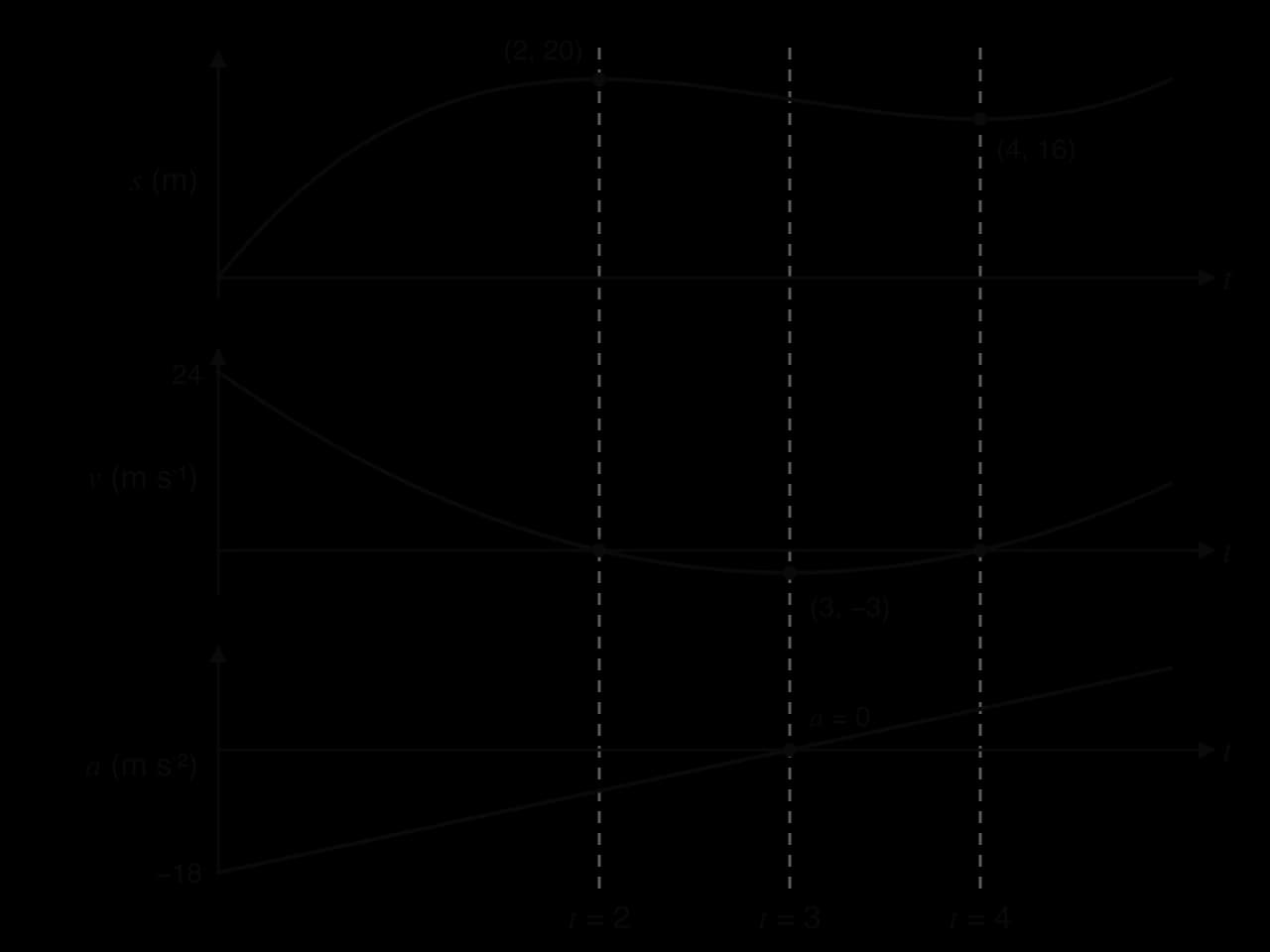
The displacement graph rises until , falls until and then rises again. The velocity graph is positive, then negative, then positive in exactly those intervals. The acceleration is negative until , which is where the velocity reaches its lowest value.
Speeding up and slowing down
A negative acceleration does not always mean slowing down, and a positive acceleration does not always mean speeding up. What matters is whether the acceleration acts with the motion or against it. If and have the same sign, the velocity is moving away from zero and the speed increases. If they have opposite signs, the velocity is moving towards zero and the speed decreases.
The word deceleration is sometimes also used for the size of a negative acceleration, as in "the car brakes with a deceleration of ". Read the context: "a deceleration of " in a braking question means in the direction of motion.
Direction of motion | Speed | ||
|---|---|---|---|
positive | increasing | ||
For the particle with ,
Interval | Sign of | Sign of | Motion |
|---|---|---|---|
Dot notation
In mechanics, derivatives with respect to time are so common that they have a short form: a dot over a variable means its derivative with respect to time, and two dots mean the second derivative. The notation comes from Newton, who called a rate of change a "fluxion"; the form comes from Leibniz.
Dot notation is used only for time derivatives. A derivative with respect to or is always written in full, for example . The notation reappears in subtopics 5.16 to 5.18, where systems of differential equations are written as
The relation says the acceleration always points back towards the rest position and grows with the distance from it. Equations of this kind are second-order differential equations, solved in subtopic 5.18, Second-order differential equations.
Acceleration in terms of displacement
Sometimes velocity is known as a function of position rather than of time. A car's speed may be recorded at each marker post along a road, or a model may give in terms of . The acceleration is still , but
The factor is how quickly velocity changes per metre travelled, and multiplying by (metres per second) turns it into a change per second. An object moving fast passes many metres each second, so the same change per metre gives a larger acceleration.
The same identity gives a useful result for constant acceleration. Since
where is the velocity at . For a vehicle braking from speed to rest with constant deceleration (so ), setting
Key moments in the motion
Instantaneous rest
An object is at rest at an instant when its velocity is zero. On the – graph, this is a point with a horizontal tangent, a stationary point of .
To find when an object is at rest, solve . For a quadratic velocity this can be done by factorising or with the GDC's polynomial root finder; for anything else, graph and find its zeros. Only solutions inside the stated time interval count, and unless stated otherwise.
Change of direction
An object changes direction when its velocity changes sign, from positive to negative or the other way. That can only happen at an instant of rest, so a change of direction is always found among the solutions of .
The converse is false: does not guarantee a change of direction. A particle with is at rest when
Returning to the start
An object is back at the origin when , and back at its starting point when . These are equations in for the displacement function, not the velocity function. A useful picture of the whole motion is a motion diagram: a number line for with arrows showing each stage of the journey. The motion diagram for
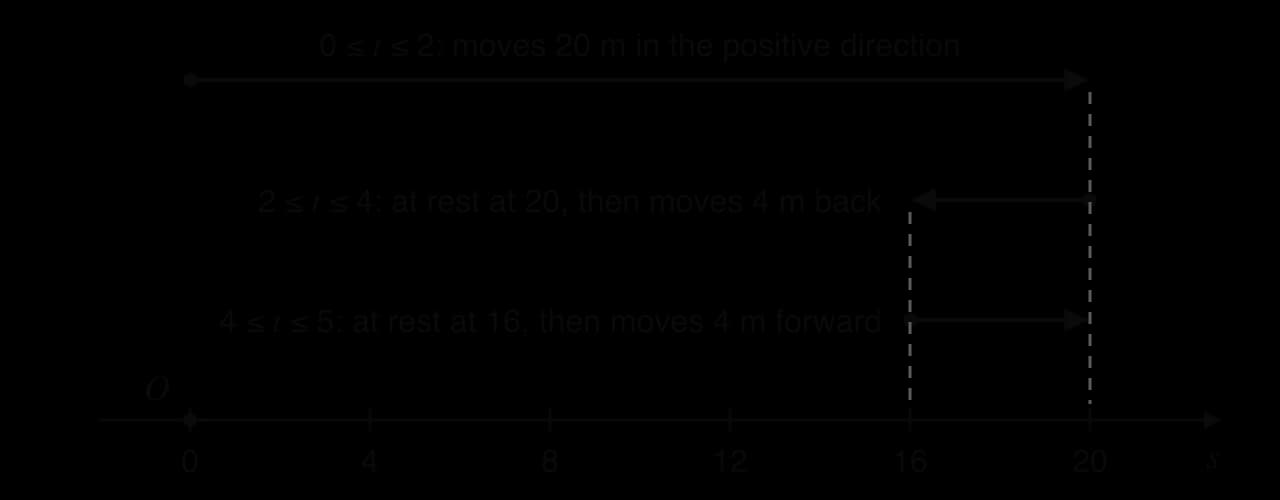
The diagram makes the difference between displacement and distance concrete. The particle's displacement after 5 seconds is , but the arrows add up to of travel. The particle never returns to , because stays positive for
Greatest speed on an interval
Speed is , so the greatest speed on an interval is the larger of two candidates: the greatest value of and the size of the least value of . Each candidate can occur at a turning point of (where ) or at an endpoint of the interval. A sketch of
From acceleration back to displacement
Integration undoes differentiation
Since is the derivative of and is the derivative of , integrating goes back down the chain. Each indefinite integral produces a constant of integration, which is fixed by information about the motion at a known time, an initial condition such as "the particle starts from rest" ( when
The constant has a physical meaning. In it is tied to the initial velocity, and in it is tied to the initial position. Knowing the acceleration alone cannot say where an object is or how fast it started; those facts must be supplied.
Two conditions on displacement
Integrating an acceleration twice gives two unknown constants. If the initial velocity is not given, two facts about the displacement at different times are needed instead, and the constants come from a pair of simultaneous linear equations, solved by hand or with the GDC as in subtopic 1.8, Equations and systems using technology.
Displacement and total distance from velocity
Displacement as a definite integral
Over a short time , an object with velocity moves about : forwards if , backwards if
On a graph of velocity against time this integral is the signed area between the curve and the -axis from subtopic 5.12, Areas and volumes: area above the axis counts as positive (forward movement) and area below counts as negative (backward movement).
Total distance travelled
Distance counts every movement as positive, whatever its direction. Replacing by the speed does exactly that, so the total distance is the integral of speed. On the velocity–time graph it is the total area between the curve and the axis, with every region counted as positive.
If does not change sign on the interval, the two integrals have the same size and the distance is the absolute value of the displacement. They differ only when the object changes direction. The velocity–time graph of shows such a case.
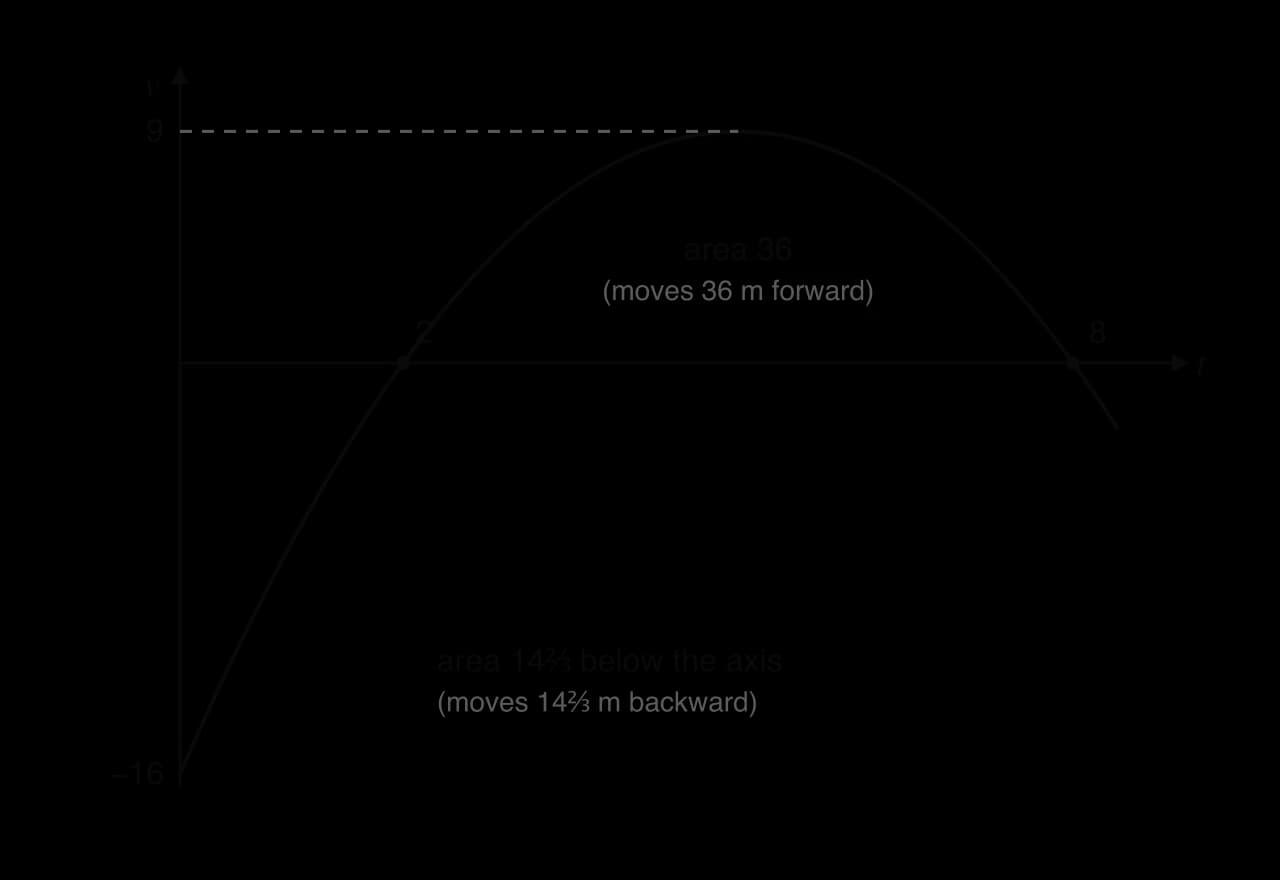
By hand, the total distance is found by splitting the interval at each zero of , integrating over each piece, and adding the absolute values of the results. The method works because has one sign on each piece, so each piece's integral is plus or minus the distance covered in it.
 YouTube
Using the GDC for displacement and distance
Most velocity functions in practice cannot be integrated neatly by hand, and even when they can, the GDC is quicker and less error-prone. The steps are the same on every model.
Graph with the time interval as the horizontal window, and find its zeros in the interval. These are the instants of rest and possible changes of direction.
For displacement, evaluate the definite integral
The graph of the cart's velocity shows why the distance is so much larger than the displacement: the long stretch below the axis after is backward travel that the displacement subtracts and the distance adds.
Velocity–time graphs made of straight lines
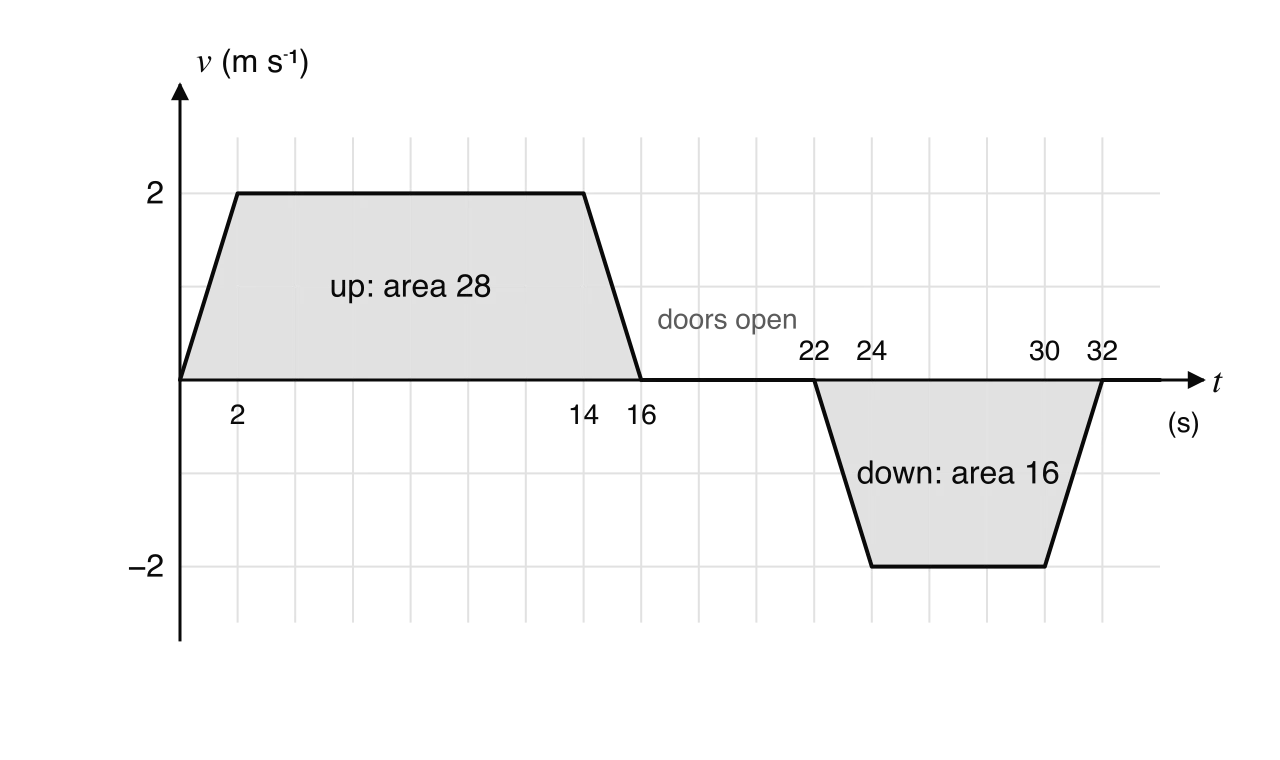
Many everyday journeys are modelled with a piecewise velocity–time graph made of straight segments: a period of constant acceleration, a period of constant velocity and a period of constant deceleration. Lifts, trains and trams are designed to move this way, because a steady acceleration is comfortable for passengers. The graph's gradient on each segment is the acceleration, and areas of triangles, rectangles and trapezoids give the displacements, with no algebra of integrals needed.
Terminal velocity
An object falling through air does not keep accelerating. Air resistance grows as the speed grows, so the net downward force, and with it the acceleration, gets smaller. The velocity approaches a limiting value at which air resistance balances the weight and the acceleration is zero.
A simple model for a falling object measures downwards as positive and takes
for a skydiver before the parachute opens. As increases, and , so the terminal velocity is
which starts at , close to the acceleration due to gravity, and decays towards zero. Writing in terms of shows the mechanism:
The acceleration is proportional to how far the velocity is below 45, and setting gives the terminal velocity directly. Building and solving equations of this kind is the subject of subtopic 5.14, Setting up differential equations.
Terminal velocity in thin air
Terminal velocity depends on the density of the air, because thinner air pushes back less. On 14 October 2012, in the Red Bull Stratos project, Felix Baumgartner jumped from a balloon capsule at an altitude of almost 39 km, where the air is very thin, and fell much faster than any skydiver in the lower atmosphere.
Quantity | Value |
|---|---|
Exit altitude | 38,969 m |
Top speed | 1,357.64 km h⁻¹ (377.1 m s⁻¹, Mach 1.25) |
Time to top speed | about 40 s of free fall |
Free fall before the parachute opened | 4 min 19 s |
Source: Wikipedia, "Red Bull Stratos" and "Felix Baumgartner" (records verified by the Fédération Aéronautique Internationale), 2025.
Reaching in about 40 seconds gives an average acceleration of about
Case study: stopping distances in the Highway Code
The UK Highway Code (Rule 126) gives typical stopping distances for a car, split into a thinking distance (travelled before the driver reacts and brakes) and a braking distance (travelled while braking). Kinematics explains the shape of both columns.
Speed (mph) | Speed (m s⁻¹) | Thinking distance (m) | Braking distance (m) | Stopping distance (m) |
|---|---|---|---|---|
20 | 8.94 | 6 | 6 | 12 |
30 | 13.41 | 9 | 14 | 23 |
40 | 17.88 | 12 | 24 | 36 |
50 | 22.35 | 15 | 38 | 53 |
60 | 26.82 | 18 | 55 | 73 |
70 | 31.29 | 21 | 75 | 96 |
Source: Department for Transport, The Highway Code, Rule 126, "Typical stopping distances" (GOV.UK, 2024). Speeds in m s⁻¹ use 1 mph = 0.44704 m s⁻¹.
Thinking distance: constant velocity
Before braking starts, the car moves at constant velocity , so in a reaction time it travels . The thinking distance should therefore be proportional to speed, and the table shows exactly that: it rises by 3 m for every 10 mph. Dividing each thinking distance by the speed in m s⁻¹ gives the same reaction time every time,
Braking distance: constant deceleration
During braking, the car's velocity falls from to 0 with an approximately constant deceleration . From and
Every row gives a deceleration between and , so the table is built on a constant deceleration of about . With
Interpreting the model
The square law is why speed matters so much on the road. Going from 30 mph to 60 mph doubles the speed and the thinking distance, but multiplies the braking distance by about four (14 m to 55 m). The time spent braking is , which is proportional to speed: about 2.1 s from 30 mph and 4.8 s from 70 mph.
The model has clear limitations. A deceleration of assumes a dry road, good tyres and good brakes; on a wet or icy road is much smaller, and since the braking distance is
Exam focus
Kinematics appears on HL Paper 1 as short questions of 4–7 marks and on HL Paper 2 as a structured question of 10–16 marks. It never appears on SL papers. A typical Paper 2 question gives as a function of and asks, in order, for the times at rest, an acceleration (often its magnitude), the greatest speed on an interval, an expression for displacement from an initial condition, and the total distance over an interval. Paper 1 questions often give and ask for and , or give
The GDC working that must be written down: the equation solved () with its solutions; the integral with its limits and integrand for displacement and for distance (
The two sides of the total distance answer show why the integral must be written. The working ,
Questions on greatest speed reward a sketch. Draw the graph of over the given interval, mark the turning points and the endpoint values, and state which one gives the largest . A greatest speed taken from a local maximum of when an endpoint value or the minimum is larger in size loses the answer mark.
Practice questions
A particle moves along a straight line with displacement metres after seconds. Find expressions for
Answers
Summary
Displacement is signed position from a fixed origin; velocity is
Self-check
- To do:
I can choose an origin and a positive direction and explain what the sign of and means.
- To do:
I can differentiate to find and , including with the chain and product rules.
- To do: