Notes on 5.12 Areas and volumes
Learning objectives
Explain why a definite integral is negative where the curve lies below the -axis, and distinguish signed area from total area.
Find the area enclosed by a curve and the -axis over an interval in which the curve crosses the axis, using or by splitting the integral at the roots.
Find the area enclosed by a curve and the -axis, writing as a function of and using
Find the area of a region between two curves, or a region made of several parts, by adding and subtracting integrals.
Find the volume of a solid formed by rotating a region through about the -axis, using
Find the volume of a solid formed by rotating a region through about the -axis, using
Determine volumes of containers as functions of the depth of liquid, and interpret areas and volumes in context.
Calculate areas and volumes exactly where required, and with a GDC otherwise, writing down the integral used.
Introduction
Subtopic 5.5, Introduction to integration, found the area under a curve lying above the -axis. Real regions are not always so convenient: part of a curve may fall below the axis, the region may sit against the -axis instead, or it may be bounded by two curves. A small extension of the same idea handles every one of these cases. Rotating a region about an axis then turns the same integrals into volumes. A curve drawn on paper becomes the profile of a bowl, a vase, a barrel or a cooling tower, and its capacity can be calculated before anything is built.
Container design is a natural use of these ideas. When the inside profile of a glass is described by a curve, its capacity is a volume of revolution, and the depth at which it holds a standard measure comes from the same formula with a variable upper limit.
Signed area and negative integrals
Why an integral can be negative
A definite integral is built from thin strips. Over a short interval of width , the strip at contributes , its height times its width, and the integral is the limit of the sum of these contributions. Where the curve is above the -axis,
For example, is below the -axis for
The region between this curve and the axis has an area of 36 square units; the integral is because the region lies below the axis. The negative sign records the side of the axis on which the region lies, and the size, 36, records the area.
Total area
An area, as a measurement of a region, is never negative. When a curve crosses the -axis within the interval, integrating straight across adds positive and negative parts together, and they partly or completely cancel. The graph of shows the extreme case.

The integral from 0 to 2 is 4 and the integral from 2 to 4 is , so the integral from 0 to 4 is 0. The total area enclosed by the curve and the axis is square units. To find a total area, every part must be counted as positive.
The formula uses the absolute value to turn every negative height into a positive one, so every strip contributes a positive amount.
There are two ways to use it.
Split at the roots. Find where the curve crosses the axis in the interval, integrate separately over each piece, and add the sizes (absolute values) of the results. This is the method for exact answers.
Integrate on the GDC. Enter the absolute value of the function inside the GDC's definite integral, for example
The sign of a signed integral still carries information. It shows on which side of the axis most of the region lies, which is useful when interpreting a rate, but it is never itself an area.
Net change and total amount in context
When the integrand is a rate, the two kinds of answer mean different things. The signed integral gives the net change: gains minus losses. The integral of the absolute value gives the total amount that moved, in either direction. The same distinction appears in subtopic 5.13, Kinematics, where the integral of velocity gives the displacement and the integral of speed, , gives the total distance travelled.
 YouTube
Area between a curve and the y-axis
Horizontal strips
Some regions are bounded by a curve, the -axis and two horizontal lines. Vertical strips are awkward for such a region, because each one would run from the curve to a different boundary. Horizontal strips fit naturally: each strip at height runs from the -axis to the curve, so its length is the -coordinate of the curve at that height, and its thickness is .
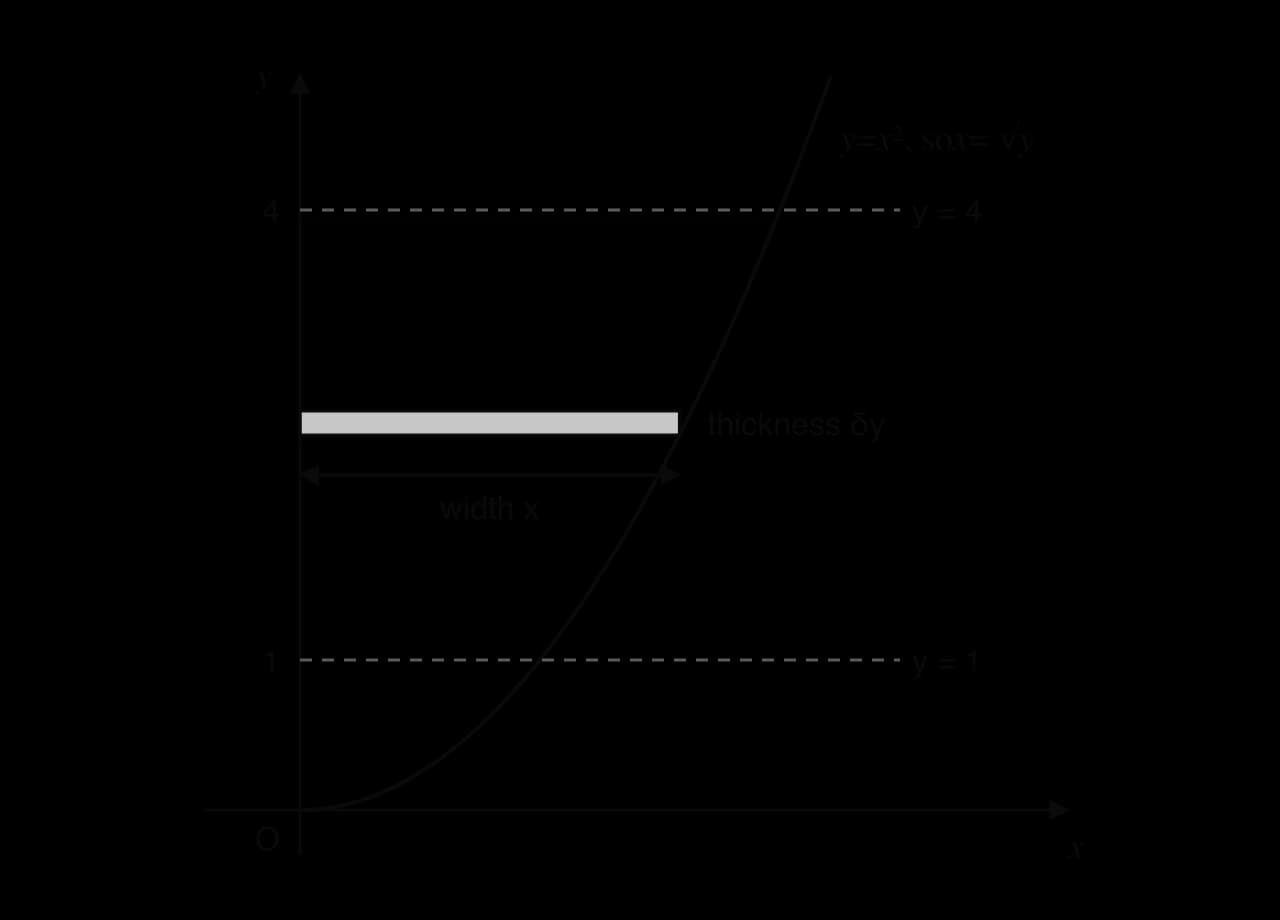
Adding the strips and letting gives an integral with respect to . The roles of and are exchanged: the integrand is written as a function of
The method has three steps.
Rearrange the equation of the curve to give in terms of . This is the same algebra as finding an inverse function.
Find the limits as -values: the heights of the horizontal boundaries, or the -coordinates where the curve meets the -axis.
Integrate
Horizontal strips can also turn a region that would need two integrals with vertical strips into a single integral. The region under bounded by the -axis is an example: its lower edge changes from the -axis to the curve at , but its right-hand edge, measured from the
Regions to the left of the y-axis
When a curve lies to the left of the -axis, its -values are negative and is negative, just as is negative below the
Writing on this interval removes the absolute value for an exact calculation. On the GDC, which works in , the same integral is entered as
Areas between curves and composite regions
The area between two curves
Subtopic 5.5 found the area between two curves lying above the -axis by subtracting one area from another. The subtraction can be done inside a single integral. If on , each vertical strip between the curves has length
If the curves cross within the interval, the upper curve changes, and the integral is split at the intersection, or the GDC is used with . The limits are usually the -coordinates of the points of intersection, found by solving
When the curves meet at points that cannot be found algebraically, the GDC finds the intersections and evaluates the integral numerically. The intersection values are intermediate results, so they are stored in the GDC's memory rather than rounded.
Composite regions
A region with a boundary made of several pieces (a line, then a curve, then the axis) is split into parts that each have a single formula. Each part is found with its own integral, or with a simple formula when it is a triangle, rectangle or trapezium, and the parts are added or subtracted. A careful sketch, with every boundary point labelled, shows which parts to add and which to remove.
Solids of revolution and the disc method
Rotating a region about the x-axis
When a region is rotated through a full turn, or radians, about a line, it sweeps out a three-dimensional solid. A rectangle rotated about one of its sides gives a cylinder; a right-angled triangle rotated about one of its shorter sides gives a cone; a semicircle rotated about its diameter gives a sphere. Any curve can be rotated in the same way, which is how vases, bowls, bottles, barrels and lamp shades are designed.
The line chosen for the rotation matters as much as the region. The same region rotated about the -axis and about the -axis gives two different solids, usually with different volumes.
The idea for finding the volume is the same as for an area: cut the solid into thin slices, approximate each one by a shape with a known volume, add them up, and let the slices become infinitely thin. For a region under from to rotated about the
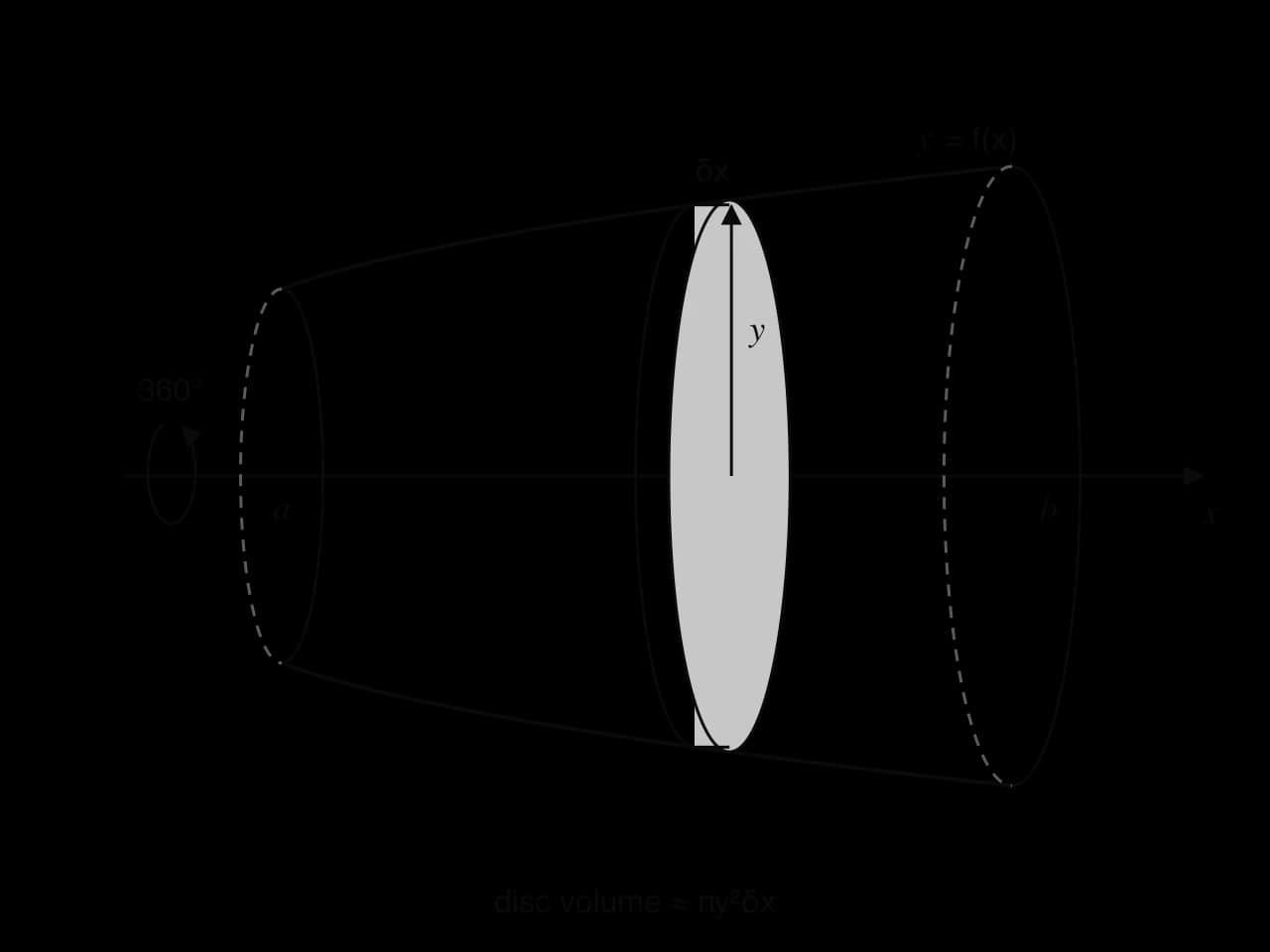
A disc is a very short cylinder, so its volume is . Adding all the discs and taking the limit gives an integral.
The method is named after the slices it uses.
Because is squared, the sign of does not matter: a region below the -axis rotated about the axis gives the same solid as its reflection above the axis. Volumes of revolution are never negative, so no absolute value is needed.
Checking the formula on known solids
The formula can be tested on solids whose volumes are already known from subtopic 3.1, Volume and surface area in three dimensions. A cone of radius and height is formed by rotating the line , for
A sphere of radius is formed by rotating the semicircle
Both results agree with the familiar formulas, which confirms that adding discs gives the right volume.
Examples about the x-axis
Rotating the region between two curves
When the region between two curves and , with
For example, the region between and for (the line is above the curve there) rotated about the
 YouTube
Volumes of revolution about the y-axis
Discs stacked along the y-axis
When a region is rotated about the -axis, the slices perpendicular to the axis are horizontal. A slice at height is a disc whose radius is the distance from the -axis to the curve, which is , and whose thickness is . The same reasoning as for rotation about the
The integrand must be written in terms of , and the limits are -values. Often only is needed, not
Containers filled to a depth h
A bowl or glass is a solid of revolution about a vertical axis, so it is natural to measure height up the -axis from the bottom. If liquid stands to a depth , the liquid itself is the solid formed by the part of the profile from to . Its volume is an integral with a variable upper limit, and so a function of
This function gives the main quantities for a container: its full capacity (put equal to the full height), the depth at which it holds a given volume (solve the volume), and how the depth changes as it fills. Because a bowl widens towards the top, half the capacity is reached well above half the height.
The graph of shows how the volume grows faster and faster with the depth, so the same extra volume raises the level less and less as the bowl fills.
Cooling towers and hyperboloids
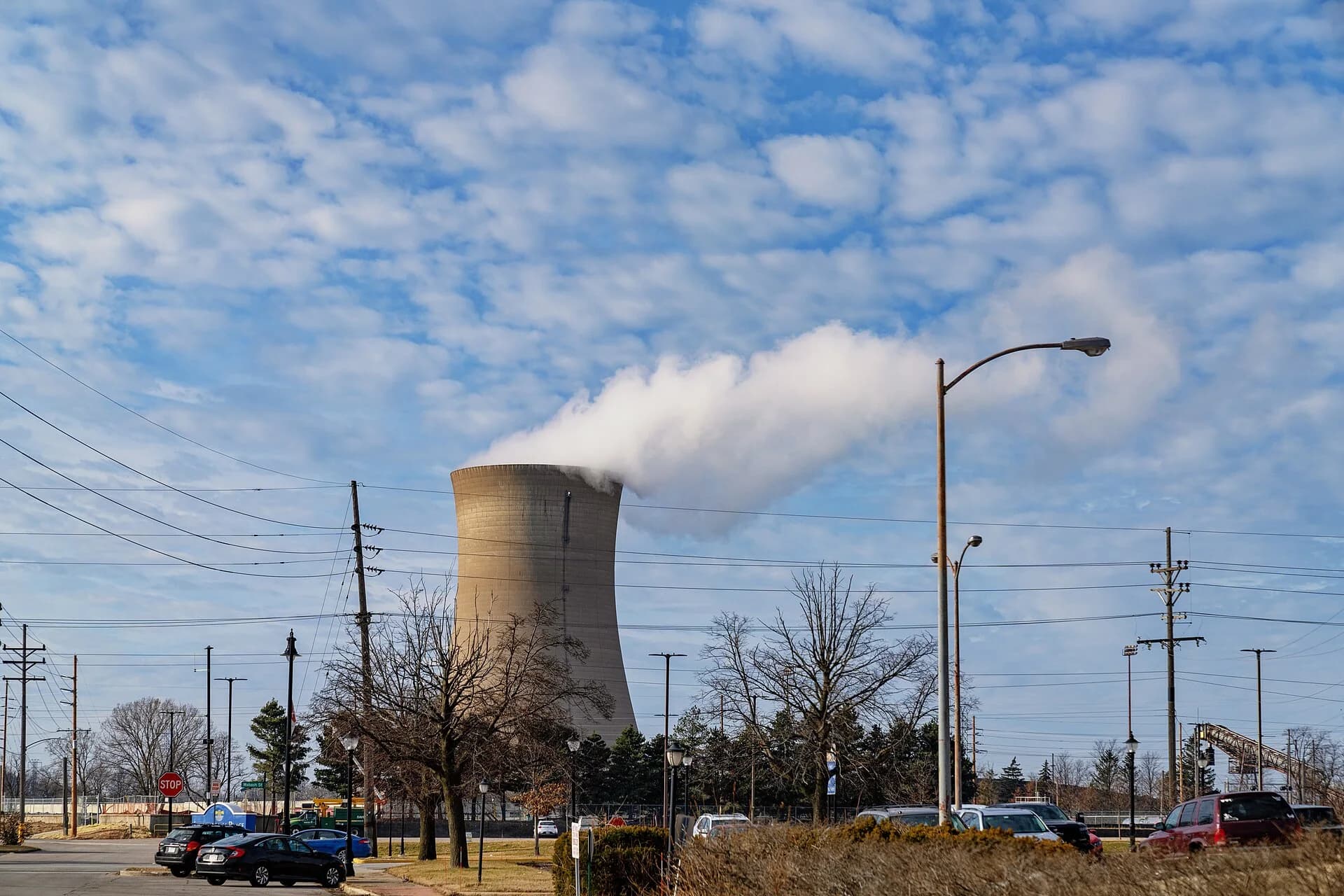
The cooling towers of many power stations have walls that narrow to a waist and flare out again. The shape is a hyperboloid of revolution, formed by rotating a hyperbola about a vertical axis. The first hyperboloid structures were built by the Russian engineer Vladimir Shukhov (1853–1939), who saw that such a curved surface can be made entirely of straight bars and is very strong for the material it uses.
Composite solids and containers from data
Solids with a profile in several pieces
Real profiles are rarely one simple curve. A cupcake, a bottle or a glass may have a profile that is a straight line for one stretch and a curve for the next. The volume is then a sum of integrals, one for each piece, with each piece's own equation and limits. A piece that is a straight line rotated about the axis gives a cylinder or a frustum of a cone, whose volume can also be checked with the formulas from subtopic 3.1.
Estimating a volume from measurements
When a container's profile is known only from measurements, the volume integral can be estimated with the trapezoidal rule of subtopic 5.8. The values used in the rule are the squares of the measured radii, because the integrand is , and the result is multiplied by .
Case study: Kepler and the volume of a wine barrel
Nova stereometria doliorum vinariorum ("New stereometry of wine barrels") is the astronomer Johannes Kepler's study of the volumes of containers, printed in 1615 at his own expense. It grew out of his own wine purchase in 1613, when he saw the standard way of gauging a barrel: a measuring rod pushed diagonally from the bung hole to the bottom of the cask, giving a single length. One length cannot capture the curved shape of a barrel, and Kepler set out to analyse the volumes of such containers mathematically. Kepler's work on the volumes of shapes was an important step towards integral calculus, and the approximation now called Simpson's rule is still known in German as Keplersche Fassregel, "Kepler's barrel rule".
Source: Wikipedia, "Johannes Kepler", 2026.
A barrel bulges in the middle and is narrower at its two ends, so it can be modelled as a solid of revolution. Take a barrel (hypothetical dimensions) of length 0.90 m, end radius 0.28 m and middle radius 0.34 m, lying along the -axis with its middle at . A parabola through the three known points models the profile: the radius is 0.34 at and falls by 0.06 to 0.28 at .
The volume is the volume of revolution of this profile about the -axis.
Since litres, the model gives a capacity of about 290 litres. The table compares this with simpler estimates.
Method | Volume (litres) | Difference from the model |
|---|---|---|
Cylinder with the end radius 0.28 m | 222 | 24% too small |
Cylinder with the middle radius 0.34 m | 327 | 13% too large |
Kepler's barrel rule |
The two cylinders bracket the true volume but are far from it, because a barrel is neither as narrow as its ends nor as wide as its middle all along its length. Kepler's barrel rule uses only the three cross-sectional areas, , at the ends and the middle, m is the length, and it agrees with the integral to within half a percent. The rule weights the middle four times as heavily as each end, which matches how a smoothly curved barrel distributes its volume.
The model has limitations. A real barrel's staves follow a curve that need not be a parabola, the wood has thickness so the inside radius is less than the outside one, and the ends are often set slightly inside the staves. Measuring the inside radius at several points and using the trapezoidal rule on , as for the vase, would test the parabolic model against the real shape.
Exam focus
Areas and volumes are examined on HL Paper 1 (4–7 marks) and as parts of longer Paper 2 questions, usually in a design context such as a bowl, a vase, a glass, a cake or a metal plate. Longer questions sometimes build a profile from a photograph or data with regression and then find its volume. The command terms are write down (the integral expression, worth marks on its own), find (a value by GDC or by hand), show that (a volume formula with a variable depth, or an exact value), hence (use an earlier anti-derivative or formula) and justify or explain (why a model is suitable, or why an answer is an over- or underestimate).
Recurring question shapes:
write down an integral for an area or volume (A1 for the integrand, A1 for the limits, or required), then evaluate it with the GDC;
a region partly below the -axis, where the answer needs or a split at a root;
a volume about the -axis, needing
Volume questions reward the written integral more than the final number. A correct expression with , the squared function, matching limits and the right or usually earns most of the marks even if the value is miscopied, while a correct number with no integral risks losing the method marks.
Practice questions
Let . (a) Find
Answers
(a)
Summary
A definite integral is a signed area: regions above the -axis count as positive and regions below count as negative, so parts can cancel.
Total area between a curve and the -axis is
Self-check
- To do:
I can explain why is negative when the curve is below the -axis.
- To do:
I can find a total area when a curve crosses the axis, by splitting at the roots or by integrating