Notes on 5.11 Further integration
Learning objectives
Find indefinite integrals of for any rational , including , where .
Find indefinite integrals of , ,
Integrate functions of a linear expression by inspection, including the factor .
Use integration by substitution to find integrals of the form .
Determine a function from its derivative and a boundary condition when the derivative involves these functions.
Calculate exact values of definite integrals using , and check them with a GDC.
Interpret the result of an integral in context as an accumulated total.
Introduction
Integration reverses differentiation. Subtopic 5.5, Introduction to integration, reversed the power rule for whole-number powers; subtopic 5.9, Further differentiation, then added the derivatives of , ,
These integrals appear wherever a rate is known and a total is wanted: the total oil from a well whose output falls over time, the total amount of a drug removed from the body, or the average voltage of an alternating current. A GDC can evaluate any definite integral numerically, so integration by hand is used mainly to find a formula. That formula may be a function that holds for every value of the variable, an exact answer such as , or a general result with letters in it.
Integration as reversing differentiation
An anti-derivative of a function is any function with . Since adding a constant does not change a derivative, every function with one anti-derivative has infinitely many, and the indefinite integral collects them all with a constant of integration
All integration methods rest on this equivalence. Each derivative already known gives an integral directly, and any integral found can be checked by differentiating the answer. Such a check is quick and catches most sign errors and missing factors.
The table pairs each standard derivative from subtopic 5.9 with the integral it gives. Reading each row from right to left is differentiation; reading it from left to right is integration.
Function | Anti-derivative | Derivative used |
|---|---|---|
, |
Each anti-derivative in the table is followed by in an indefinite integral. The rules from subtopic 5.5 still apply: a constant multiple stays outside the integral, and a sum is integrated term by term.
Powers of x with rational exponents
The power rule for any rational power
The power rule for integration was first met for whole-number powers. It holds for every rational exponent , because the derivative it reverses holds for every rational power (subtopic 5.9). Differentiating the proposed answer confirms it.
Roots and reciprocals must first be written as powers of . The laws of exponents do this:
Integrand | As a power | Integral |
|---|---|---|
A quotient with a single power of in the denominator is split into separate terms before integrating. There is no rule for integrating a quotient as a whole, and integrating the top and bottom separately gives a wrong answer.
The exception n = −1 and the natural logarithm
The power rule fails for , because it would divide by . No power of has derivative
The natural logarithm is only defined for positive , but is also defined for negative . For
Both cases are covered by one formula using the absolute value, since when and when
When a context makes the variable positive (time after a start, a population, a length), the absolute value bars can be dropped and written. On the graph of , the area under the curve from 1 to is exactly 1, since
Parameters and variables
Integrals in models often contain letters that are not the variable of integration. A letter that stays constant while the variable changes, such as a rate constant or a radius , is a parameter, and it is treated exactly like a number. The symbol after (, ,
The same integrand gives different answers because the variable is different. In the first integral is a constant multiplier, so its integral with respect to is , just as
Exponential and trigonometric functions
The exponential function
The exponential function is its own derivative, so it is also its own anti-derivative.
This holds only for base . An exponential with another base is first rewritten with base , using , and then integrated by inspection as
Sine, cosine and 1/cos²x
The derivatives of sine and cosine run in a cycle: . Integration runs the cycle backwards, which is where the minus sign in
These results depend on being measured in radians. The derivative is only true in radians (in degrees an extra factor
Integration by inspection
Functions of a linear expression
The chain rule (subtopic 5.9) says that differentiating a function of produces an extra factor , the derivative of the inner function. For example,
The justification is a single application of the chain rule to the right-hand side.
The rule only works when the inner function is linear. Its derivative is then a constant, and a constant can be divided out. When the inner function is not linear, its derivative contains , which cannot be divided out in the same way; that case needs substitution.
The method is "guess, differentiate, adjust". The guess is the standard integral of the outer function with the inner expression left in place; differentiating the guess shows which constant has appeared; the final answer divides by that constant.
Integrand | Guess | Derivative of guess | Integral |
|---|---|---|---|
Rates in context: logarithms and exponentials
Rates that fall away over time are often modelled by or by . Integrating the rate gives the total accumulated, and inspection gives a formula for that total at any time. The two models behave differently in the long run:
Integration by substitution
The reverse chain rule
Inspection handles linear inner functions. For a general inner function , the chain rule gives
where . Reading this backwards gives an integral.
The key feature is that the derivative of the inner function, , appears as a factor of the integrand. When it does, the integral is found by integrating the outer function and leaving the inner function in place. When it appears only up to a constant multiple (for example instead of ), the constant is adjusted, as in inspection.
 YouTube
The substitution method
Substitution makes the reverse chain rule mechanical. The inner function is renamed , and the whole integral is rewritten in terms of .
The steps are the same every time.
Choose to be the inner function, the expression inside a bracket, root, exponent or trigonometric function whose derivative appears elsewhere in the integrand.
Differentiate:
Writing treats
 YouTube
Adjusting by a constant, but never by a variable
A constant factor can always be moved in or out of an integral, so a derivative that is "out by a constant" is no obstacle. In , the inner function is with derivative
A missing variable cannot be adjusted in the same way. The integral has inner function , but no factor is present, and
Two patterns to recognise
Two shapes of integrand come up often enough to be recognised on sight. Each is the reverse chain rule with a particular outer function.
The first applies whenever the numerator is the derivative of the denominator, or a constant multiple of it. The second applies whenever a power of an expression is multiplied by the expression's derivative.
Equivalent answers
Two correct methods can give answers that look different. For , choosing gives
so the two anti-derivatives differ only by the constant , which the absorbs. Their graphs are vertical translations of each other, with identical gradients at every .
Finding a function from its derivative
Subtopic 5.5 used a boundary condition to fix the constant of integration for polynomials. The method is unchanged with the new integrals: integrate with , substitute the known point into the integrated function, solve for , and write the function in full. The only new demands are exact values of , and trigonometric functions at the given point, which use the laws of logarithms and the facts
Exact definite integrals
Evaluating with F(b) − F(a)
A definite integral is evaluated exactly from any anti-derivative of the integrand: the value is the anti-derivative at the upper limit minus its value at the lower limit. Square brackets record the anti-derivative before the limits are substituted.
The constant of integration is left out of definite integrals, because it would appear in both and and cancel. A GDC gives the same value numerically, so it checks every exact answer, but it cannot give the exact form:
Definite integrals by substitution
When a definite integral needs a substitution, the limits must be handled consistently. There are two correct ways.
Change the limits. Convert the -limits into -limits using , and evaluate the -integral between them. The answer never returns to .
Substitute back first. Find the indefinite integral in terms of
Mixing the two (using -limits in a -integral) gives a wrong answer. Changing the limits is usually quicker, and it makes the working shorter to set out.
The average value of a sine wave
The mains electricity supply alternates: its voltage follows a sine wave, positive for half of each cycle and negative for the other half. The mean height of a function over an interval is the height of the rectangle on the same base with the same area, so it equals the definite integral divided by the width of the interval. For one positive half-cycle of , from 0 to , the integral is found exactly.
Dividing by the width gives the mean value . A sinusoidal voltage with peak
Case study: the Moscow Mathematical Papyrus
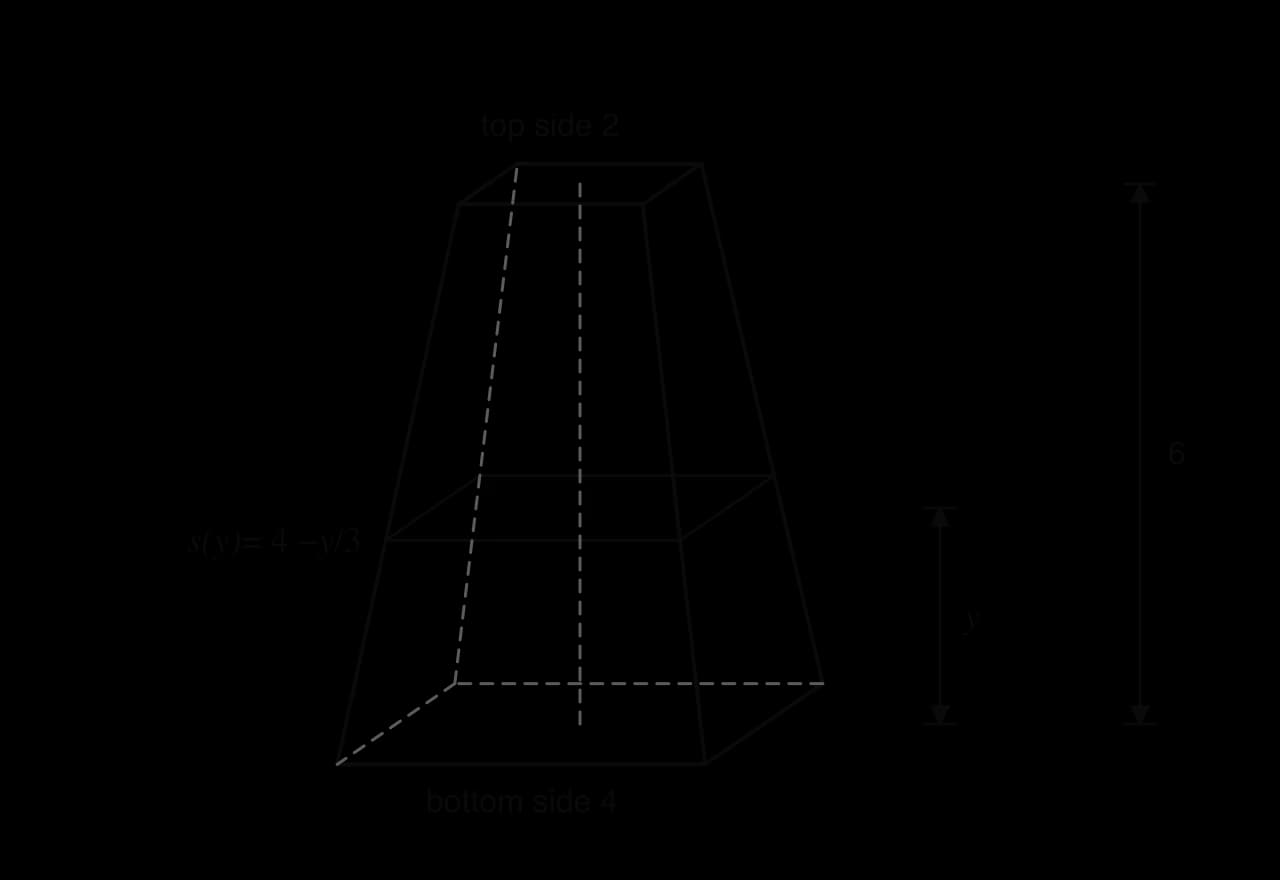
The Moscow Mathematical Papyrus is an Egyptian document of 25 problems with solutions, written down in the 13th Dynasty from older material dating to about 1850 BC. Its problem 14 asks for the volume of a truncated square pyramid, a frustum, with a square base of side 4, a square top of side 2 and a height of 6. The scribe's working gives 56, which is correct. The papyrus states no derivation, and how the Egyptians found the method is unknown, but integration with a linear inner function reproduces it in a few lines.
Source: Moscow Mathematical Papyrus, problem 14 (about 1850 BC); Wikipedia, "Moscow Mathematical Papyrus", 2026.
Slice the frustum horizontally. At height above the base, the cross-section is a square whose side falls steadily from 4 at to 2 at , so is a linear function of
A thin slice of thickness is almost a square prism, with volume about . Adding all the slices and letting their thickness tend to zero turns the sum into an integral of the cross-sectional area, the same limiting process that turns rectangles under a curve into an area in subtopic 5.5.
The integrand is a function of the linear expression , with coefficient
The integral agrees with the scribe's answer of 56 cubic units. The same calculation with letters gives the general formula: for a frustum with base side , top side and height , the side at height is
using the factorisation
Exam focus
Further integration is examined on HL Papers 1 and 2, usually for 3–8 marks, and as a step in Paper 3 modelling questions. It also appears within longer questions on areas and volumes (subtopic 5.12), kinematics (subtopic 5.13) or differential equations (subtopic 5.14). The command terms are find (an indefinite integral or a function from its derivative), hence (use an expansion or derivative from the previous part), show that (reach a given result, often with or shown) and write down or give your answer in the form (an exact answer such as
Recurring question shapes:
find from involving ,
In further integration questions the GDC checks the integration but does not replace it. An indefinite integral has no numerical value, so it must be done by hand. A definite integral can be found on the GDC unless the question asks for an exact value or says "hence"; then the anti-derivative and the substitution of limits must be written down.
Practice questions
Find
(b) Hence find the value of for which the integral equals 3. [2]
Answers
Summary
Integration reverses differentiation: exactly when
Self-check
- To do:
I can rewrite roots and reciprocals as powers of and integrate them with the power rule.
- To do:
I can explain why the power rule fails for and integrate