1.4 Financial applications of geometric sequences · IB Maths AA | Augment Education
1.4 Financial applications of geometric sequences
Calculate compound interest and depreciation with geometric sequences, find the rate, time or present value by formula and with a GDC finance solver, and compare investments allowing for inflation.
IB Mathematics: Analysis and Approaches
Part of 1 Number and algebra
SL and HL
Key terms introduced here
Each is in the Maths AA glossary, with every other term in the subject.
Interest calculated on the original amount plus all the interest already added, so the balance is multiplied by the same factor each period. The balances form a geometric sequence.
The length of time between two consecutive additions of interest, for example one month for monthly compounding. The number of periods per year is written k.
The loss in value of an asset, such as a car or a machine, over time. With a fixed annual percentage rate the values form a geometric sequence with ratio less than 1.
Notes on 1.4 Financial applications of geometric sequences
20 min readLast reviewed
Questions on 1.4
24 exam-style questions on this subtopic, written in the style of the IB papers. The first has its markscheme open. Counted on
Question 1 · AA-006505 marks
Kofi invests $1000 in an account that pays a nominal annual interest rate of 5%, compounded n times per year. The value of his investment after one year, in dollars, is
A(n)=1000(1+n0.05)n.
Try a quick-fire question
One of 36 short multiple-choice questions on 1.4. Pick an answer to see why it's right or wrong.
$1000 is invested at 10% per year compound interest, added annually. What is the value after 2 years?
From the formula booklet
The entries of the mathematics: analysis and approaches formula booklet that 1.4 uses. Each opens in the explained booklet.
Interest calculated only on the original amount, so the same interest is added every year. The balances form an arithmetic sequence.
for annual, half-yearly, quarterly and monthly compounding.
Use Vn=V0(1−100r)n for annual depreciation.
Find the present value, the interest rate or the time needed, by algebra, logarithms or a GDC.
Use a GDC finance solver, with the correct sign convention for money paid out and received.
Compare investments with different rates and compounding frequencies.
Calculate the real value of money after inflation.
Money placed in a savings account earns interest, and that interest then earns interest of its own. Each year the balance is multiplied by the same factor, so the balances form a geometric sequence. Cars, computers and machinery lose value in the same way, by a fixed percentage of their value each year. Geometric sequences therefore describe how savings grow, how loans build up and how assets lose value, and they are the basis of the calculations that banks, businesses and governments make every day.
Simple and compound interest
When money is invested, the bank pays interest as a percentage of the amount in the account. The amount invested at the start is the present value PV, and the amount it has grown to at a later date is the future value FV. There are two ways to calculate the interest.
With simple interest, the interest is always a percentage of the original amount, so the same interest is added every year and the balances form an arithmetic sequence (see 1.2). With compound interest, the interest each year is a percentage of the current balance, which includes the interest already earned, so the balance is multiplied by the same factor every year and the balances form a geometric sequence.
The difference between the two methods is small at first but grows quickly. Simple interest gives straight-line growth; compound interest gives exponential growth, because each year's interest is larger than the last.
simple interest: 5000 + 200n
compound interest: 5000 × 1.04ⁿ
5000 euros at 4% per year. After 30 years compound interest gives 16 217 euros, nearly 50% more than the 11 000 euros from simple interest, although both start with the same 200 euros of interest in year 1.
The compound interest formula
Interest added once a year
If the interest rate is r% per year, then each year the balance is multiplied by 1+100r. After n years the present value has been multiplied by this factor n times.
FV=PV×(1+100r)n
The balances form a geometric sequence with common ratio 1+100r. The power is n, not n−1, because the present value is the balance at time zero and the value after n years has had n multiplications applied.
Interest added several times a year
Banks often add interest more often than once a year. The interest rate is still quoted per year (the nominal annual rate), but it is shared equally between the compounding periods. With compounding periods of one month, for example, an annual rate of 6% means 126=0.5% is added every month, and in n years there are 12n additions.
With k periods per year, the rate per period is kr% and there are kn periods in n years. This gives the general compound interest formula.
FV=PV×(1+100kr)kn
Symbol
Meaning
FV
Future value
PV
Present value
r
Nominal annual interest rate, as a percentage (for 3.6%, r=3.6)
k
Number of compounding periods per year
n
Number of years
The effect of compounding frequency
For the same nominal annual rate, more frequent compounding gives a slightly larger future value, because interest starts earning interest sooner. The table shows 10 000 dollars invested for one year at a nominal rate of 6%.
Compounding
k
Value after 1 year (dollars)
Effective annual rate
Annually
1
10600.00
6.000%
Half-yearly
2
10609.00
6.090%
Quarterly
4
10613.64
6.136%
Monthly
12
10616.78
6.168%
Daily
365
10618.31
6.183%
The effective annual rate is the actual percentage increase over a whole year, (1+100kr)k−1, written as a percentage. The gains from more frequent compounding get smaller and smaller: the values approach a limit of 10618.37 dollars. That limit, continuous compounding, leads to the number e, introduced in 1.5.
Finding the present value, the rate or the time
The compound interest formula links five quantities: FV, PV, r, k and n. When all but one are known, the remaining one can be found. The present value comes from rearranging, the rate from taking a root, and the time from logarithms (see 1.7) or a GDC.
Finding the present value
Rearranging the formula gives
PV=(1+100kr)knFV
which answers questions such as "how much must be invested now to reach a target later?"
Finding the interest rate
When PV, FV and n are known, divide to isolate the power, then take the nth root.
Finding the time
When the time is unknown it appears in the exponent. A GDC solver or table finds it directly; with logarithms, ax=b gives x=logalogb. The answer usually needs interpreting: interest is only added at the end of each compounding period, so the time is rounded up to a whole number of periods.
The GDC finance solver
A graphic display calculator (GDC) has a finance solver, often called the TVM (time value of money) solver. It works with the same formula, and it can find any one of the variables when the others are entered. The names vary slightly between calculators, but the variables are the same.
Variable
Meaning
Note
N
Total number of compounding periods
kn, for example 60 for 5 years monthly (when P/Y = C/Y)
I%
Nominal annual interest rate
As a percentage, for example 3.6
PV
Present value
Negative when money is paid out (invested)
PMT
Regular payment
Always 0 in this course
FV
Future value
Positive when money is received
P/Y
Payments per year
Set equal to C/Y
C/Y
Compounding periods per year
k: 1, 2, 4 or 12
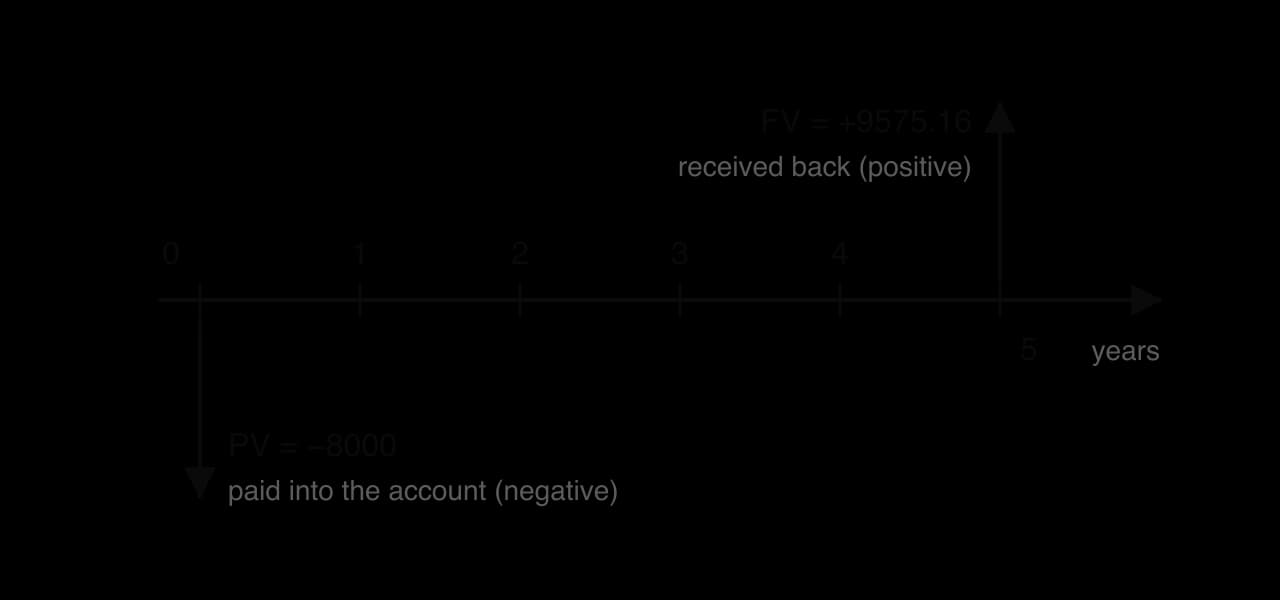
The solver uses a sign convention for the direction of money. Money that leaves you, such as a deposit into an account, is entered as negative; money that comes back to you is positive. So for an investment, PV is negative and FV is positive. For a loan, the borrower receives PV (positive) and repays FV (negative).
For an investment, the money paid in at the start is negative and the money received at the end is positive. Leo pays in 8000 dollars and receives 9575.16 dollars after 5 years.
Depreciation
Most assets lose value over time. A new car is worth less after a year of use, and a computer bought today will be worth very little in five years. This loss of value is depreciation. When the value falls by the same percentage each year, the values form a geometric sequence with common ratio between 0 and 1.
The formula has the same structure as compound interest, with the factor 1−100r in place of 1+100r. A depreciation rate of 15% gives a ratio of 0.85, so each year the asset keeps 85% of its value from the start of that year. The value approaches zero but never reaches it.
V = 32 000 × 0.85ⁿ
A car losing 15% of its value each year loses most in the early years: 4800 dollars in year 1 but only about 1500 dollars in year 8. Its value first falls below 10 000 dollars after 8 years.
The same equation can be used the other way round. When the starting and final values are known, the annual rate of depreciation is found by taking a root, exactly as for an interest rate.
Comparing investments
To decide between investments, calculate what each one is worth at the same future date, or compare their effective annual rates. A higher nominal rate does not always win: the compounding frequency, the length of time and any fees all affect the outcome.
Inflation and the real value of money
Over time, the prices of most goods and services rise. This general rise in prices is inflation, measured as an annual percentage. A sum of money that stays the same buys less each year, so its real value falls. Inflation is itself a form of compound growth: prices are multiplied by the same factor each year.
Statistical agencies measure inflation with a price index, such as a consumer price index (CPI), which tracks the cost of a typical basket of goods and services. The table shows the annual average of the US consumer price index for three recent years.
Year
CPI (US, all urban consumers)
Increase on previous year
2021
270.970
2022
292.655
8.0%
2023
304.702
4.1%
Source: US Bureau of Labor Statistics, CPI-U annual averages (1982–84 = 100), 2021–2023.
The price rises from 2021 to 2023 compound: 270.970304.702=1.1245, so prices rose by about 12.4% over the two years, not 8.0%+4.1%=12.1%. To keep the same buying power, a salary of 60 000 dollars in 2021 would have needed to rise to 60000×1.1245≈67470 dollars by 2023.
Real value after inflation
To find the real value of a future amount in today's money, divide it by the factor by which prices have risen. If inflation is i% per year for n years, prices are multiplied by (1+100i)n, so
real value=(1+100i)nfuture value
An investment only increases in real value if its interest rate is higher than the inflation rate.
Exam-style questions on financial applications
Financial questions usually appear on the calculator paper, where the finance solver can be used, but simple compound interest and depreciation calculations with friendly numbers can appear without a calculator.
On the calculator paper the same ideas are combined in longer questions, often with a finance solver, an effective rate and an inflation adjustment in one context.
Self-check
To do:
I can explain why simple interest gives an arithmetic sequence and compound interest a geometric one.
To do:
I can use FV=PV×(1+100kr)kn for any compounding frequency.
To do:
I can find the present value, the rate or the time, and round the time correctly in context.
To do:
I can use a GDC finance solver, entering the values with the correct signs and writing them down as working.
To do:
I can calculate depreciation with Vn=V0(1−100r)n
To do:
I can compare investments using future values or effective annual rates.
To do:
I can find the real value of money after inflation and explain why it differs from the face value.
The following table shows some values of A(n), correct to two decimal places.
n
1
4
12
365
8760
A(n)
1050.00
1050.95
p
q
r
(a)
Find the value of p, the value of q and the value of r.
[2]2 marks
Markscheme (a)
attempt to substitute at least one of n=12,365,8760 into A(n)(M1)
p=1051.16, q=1051.27, r=1051.27A1
(b)
Use the table to write down an estimate of n→∞limA(n), correct to two decimal places.
[1]1 mark
Markscheme (b)
1051.27A1
(c)
A second account pays a nominal annual interest rate of 5.13%, compounded once per year. Kofi claims that if the first account compounded interest often enough, it would give him more money after one year than the second account.
Use your answer to part (b) to determine whether Kofi is correct.
[2]2 marks
Markscheme (c)
second account gives 1000×1.0513=1051.30 (dollars) A1
A(n) approaches 1051.27<1051.30
Question 2 · AA-008135 marks
Elena invests €6400 in a savings account that pays a nominal annual interest rate of 3.2%, compounded quarterly. She makes no further deposits or withdrawals.
(a)
Find the value of Elena's investment after 7 years. Give your answer correct to two decimal places.
[2]2 marks
(b)
Find the interest Elena earns during these 7 years.
[1]1 mark
(c)
Find the number of complete years after which the value of Elena's investment first exceeds €9000.
Jamal has USD 12 000 to invest. He wants his investment to be worth at least USD 15 000 after 6 years. He finds an account that pays a nominal annual interest rate of r%, compounded monthly, where r is given correct to two decimal places. He makes no further deposits or withdrawals.
(a)
Find the least value of r that allows Jamal to reach his target.
[3]3 marks
(b)
Jamal invests his USD 12 000 at this rate. Find the value of his investment after 8 years. Give your answer correct to two decimal places.