1.3 Geometric sequences and series · IB Maths AA | Augment Education
1.3 Geometric sequences and series
Use the nth term and sum formulas for geometric sequences, find the common ratio, first term or number of terms, tell arithmetic from geometric patterns, and model growth and decay.
IB Mathematics: Analysis and Approaches
Part of 1 Number and algebra
SL and HL
Key terms introduced here
Each is in the Maths AA glossary, with every other term in the subject.
60 exam-style questions on this subtopic, written in the style of the IB papers. The first has its markscheme open. Counted on
Question 1 · AA-0042615 marks
Asha and Bruno play a game in which they take turns to throw a dart at a small target, with Asha throwing first. The first player to hit the target wins and the game stops.
Each time Asha throws, the probability that she hits the target is 0.3. Each time Bruno throws, the probability that he hits the target is 0.4. All throws are independent.
(a)
Find the probability that Bruno wins with his first throw.
[2]2 marks
Markscheme (a)
0.7×0.4(M1)
=0.28
Try a quick-fire question
One of 39 short multiple-choice questions on 1.3. Pick an answer to see why it's right or wrong.
A geometric sequence has u1=2 and r=3. What is u5
From the formula booklet
The entries of the mathematics: analysis and approaches formula booklet that 1.3 uses. Each opens in the explained booklet.
The sum of the terms of a geometric sequence. For r=1, the sum of the first n terms is Sn=r−1u1(rn−1).
to find any term of a geometric sequence.
Derive and use Sn=r−1u1(rn−1)=1−ru1(1−rn), r=1, for the sum of a geometric series.
Find u1, r or n from given information, using simultaneous equations, logarithms or a GDC table.
Write and evaluate geometric sums in sigma notation, by formula and with a GDC.
Distinguish arithmetic from geometric patterns in data.
Model growth and decay, such as population growth, the spread of a virus and the heights of a bouncing ball, with geometric sequences.
When a quantity is multiplied by the same factor at each step, it forms a geometric sequence. A colony of bacteria in which every cell divides into two each generation doubles in size again and again: 1,2,4,8,16,… The same pattern, with different factors, describes a population growing by a fixed percentage each year, the value of an investment earning compound interest, and the shrinking heights of a bouncing ball. A geometric sequence is a discrete model of exponential change, and it grows (or shrinks) far faster than an arithmetic sequence.
Geometric sequences
In the sequence 3,6,12,24,… each term is twice the one before. In 64,32,16,8,… each term is half the one before. Sequences like these, built by repeated multiplication, are geometric sequences, and the fixed multiplier is the common ratio.
In recursive form, a geometric sequence satisfies un+1=run. To test whether a list of numbers is geometric, divide each term by the term before it: the sequence is geometric only if every ratio is the same. Neither u1 nor r can be zero, because a zero term would make every later term zero and the ratios undefined.
How the common ratio shapes a sequence
The value of r decides how a geometric sequence behaves. For a positive first term:
Common ratio
Behaviour
Example
r>1
Increases, ever more quickly
3,6,12,24,… (r=2)
r=1
Constant
5,5,5,5,…
0<r<1
Decreases towards 0
64,32,16,8,… (r=21
−1<r<0
Alternates in sign, shrinking towards 0
48,−24,12,−6,… (r=−21
r=−1
Alternates between two values
2,−2,2,−2,…
r<−1
Alternates in sign, growing in size
1,−3,9,−27,… (r=−3)
A negative ratio makes the terms switch between positive and negative. A ratio between −1 and 1 makes the terms shrink in size, which is the case that leads to infinite sums in 1.8.
growth: uₙ = 3 × 2ⁿ⁻¹
decay: uₙ = 64 × 0.5ⁿ⁻¹
Terms of a geometric sequence lie on an exponential curve. With r = 2 each step up is twice the last; with r = 0.5 the terms halve each time and approach 0 without reaching it.
The nth term of a geometric sequence
Writing the terms in terms of u1 and r shows the pattern. Each step multiplies by r once, so the second term has one factor of r, the third has two, and the nth has n−1.
Term
u1
u2
u3
u4
⋯
un
In terms of u1 and r
u1
u1r
un=u1rn−1
The structure matches the arithmetic formula un=u1+(n−1)d: repeated addition of d becomes repeated multiplication by r, so (n−1)d becomes rn−1.
Finding the first term and the common ratio
Given two terms, write each with un=u1rn−1. Dividing one equation by the other cancels u1 and leaves a power of r. This is the geometric version of subtracting the equations for an arithmetic sequence.
For three consecutive terms a,b,c of a geometric sequence, the ratios are equal, so ab=bc, which gives b2=ac. This is the multiplicative version of 2b=a+c for arithmetic sequences.
Finding the number of terms
When the value of a term is known but its position n is not, the unknown is in the exponent: u1rn−1=value. If the value is an exact power, n can be found by inspection. Otherwise use a GDC table of un against n, or logarithms (see 1.7), which turn rn−1=c into n−1=logrlogc.
Questions about when a sequence first passes a value lead to an inequality instead of an equation. The solution of the matching equation is usually not a whole number, so the answer is the next whole number above it, confirmed by checking the terms on either side.
Geometric series
The sum of the terms of a geometric sequence is a geometric series. As with arithmetic series, there is a formula for the sum of the first n terms, but the trick that finds it is different: the series is multiplied by r and subtracted from itself.
Deriving the sum formula
Write the sum, then multiply every term by r. Each term moves one place along, so the two lines share all but their first and last terms.
Subtracting the first line from the second cancels every shared term.
rSn−Sn=u1rn−u1⟹Sn(r−1)=u1(rn−1)
Dividing by r−1, which is allowed only if r=1, gives the sum formula. Multiplying the top and bottom by −1 gives an equivalent second form.
Sn=r−1u1(rn−1)=1−ru1(1−rn),r=1
Both forms give the same value. The first is neater when r>1 and the second when r<1, since each then has a positive numerator and denominator. When r=1 every term equals u1, so Sn=nu1.
Sigma notation for geometric series
Sigma notation, introduced for arithmetic series in 1.2, works in the same way for geometric series. A sum such as ∑k=1nark−1 has first term a (when k=1), ratio r and n terms. When the expression is ark instead, or the lower limit is not 1, write out the first two or three terms to find u1 and r, and count the terms as upper limit minus lower limit plus one.
Finding n or r from a sum
When the sum is given, the sum formula becomes an equation for the unknown. If n is unknown, it is in an exponent, so use a GDC table, a GDC solver or logarithms. If r is unknown and n is small, writing out the sum often gives a polynomial equation in r.
Arithmetic or geometric?
Data and patterns do not come labelled. To decide which model fits, calculate both the differences and the ratios of consecutive values. Constant differences show an arithmetic sequence; constant ratios show a geometric sequence. If neither is constant, the sequence is neither, although one of them may still be a good approximate model.
Feature
Arithmetic
Geometric
Rule
Add d each time
Multiply by r each time
Test
un+1−un constant
unun+1 constant
nth term
u1+(n−1)d
u1rn−1
Sum of n terms
2n(2u1+(n−1)d)
Graph of un against n
Points on a straight line
Points on an exponential curve
Kind of change
Linear: same amount each step
Exponential: same percentage each step
The two kinds of growth start in a similar way, but their long-term behaviour is very different. An arithmetic sequence with d>0 adds the same amount every step. A geometric sequence with r>1 adds more each step, because the increase is a fixed percentage of an ever larger value, so it eventually overtakes any arithmetic sequence.
arithmetic: 100, 120, 140, … (d = 20)
geometric: 100, 120, 144, … (r = 1.2)
Both sequences start at 100 and have the same second term, 120. By the 12th term the geometric sequence (743) is more than twice the arithmetic one (320).
Applications of geometric sequences
Whenever a quantity changes by the same percentage in each time period, its values form a geometric sequence. An increase of p% multiplies the quantity by 1+100p, and a decrease of p% multiplies it by 1−100p. So a growth of 3% gives r=1.03, and a loss of 25% gives r=0.75.
Counting periods correctly
In applications, it matters whether the starting value counts as u1 or as "time zero". If a population starts at P and grows by a factor r each year, then after 1 year it is Pr, after 2 years Pr2, and after t years Prt. With u1=P as the starting value, the value after t years is the term ut+1=Prt.
Population growth and cell division
Bacteria such as E. coli can divide about every 20 minutes under ideal laboratory conditions. Each division doubles the number of cells, so the counts form a geometric sequence with r=2, and in a few hours a small sample becomes millions of cells.
The wheat and chessboard problem
A well-known puzzle places one grain of wheat on the first square of a chessboard, two on the second, four on the third, and so on, doubling on each of the 64 squares. The numbers of grains form a geometric sequence with u1=1 and r=2.
The result in part (b) holds for doubling in general: the sum of all the terms so far is one less than the next term, since 1+2+4+⋯+2n−1=2n−1. Doubling therefore produces more in its last step than in all the earlier steps combined.
The spread of a virus
In the early stages of an outbreak, when almost everyone is still susceptible, each infected person passes the virus on to roughly the same number of new people. The numbers of new cases in successive generations of infection then form an approximately geometric sequence.
Bouncing balls
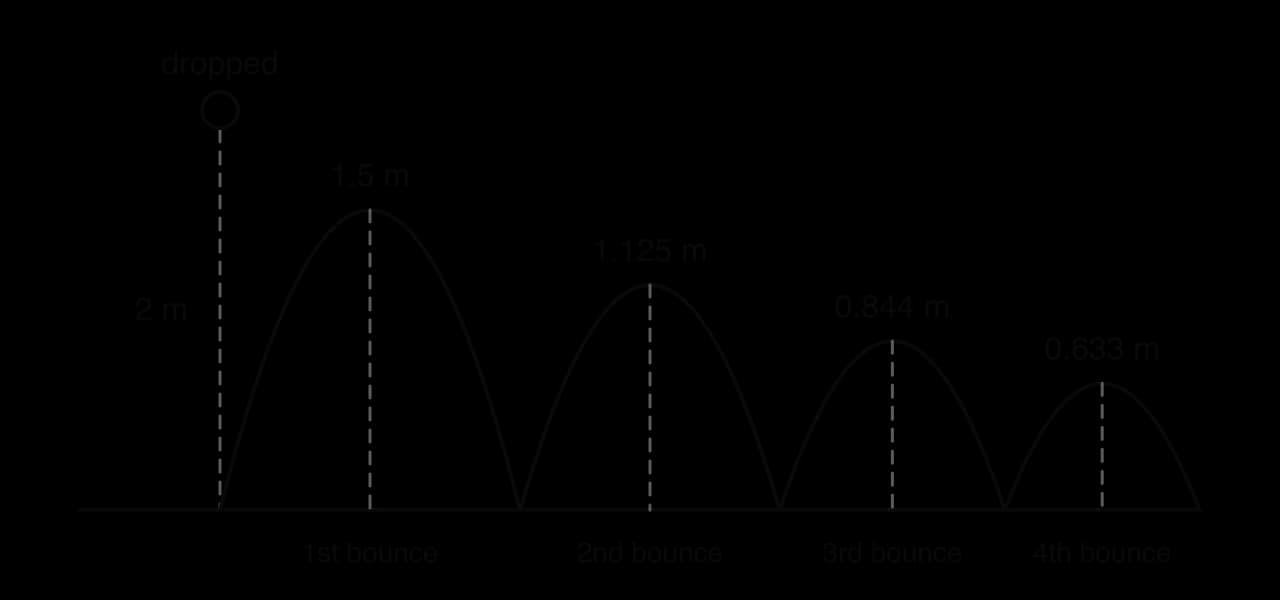
A ball dropped onto a hard floor rises to a fixed fraction of its previous height after each bounce. The bounce heights form a geometric sequence with 0<r<1, so they decrease towards zero.
Each bounce reaches 75% of the height of the previous one, so the heights 1.5, 1.125, 0.844, 0.633 m form a geometric sequence with r = 0.75.
The total vertical distance the ball travels, if it keeps bouncing, needs an infinite geometric series and is found in 1.8.
Exam-style questions on geometric sequences
Geometric sequences appear on both papers. Non-calculator questions use exact powers and fractions; calculator questions are usually set in context and need a GDC table, solver or logarithms to find n.
Self-check
To do:
I can decide whether a sequence is geometric and find its common ratio, including negative and fractional ratios.
To do:
I can explain why un=u1rn−1 and use it to find any term.
To do:
I can find u1 and r from two terms, and give both values of r when the power is even.
To do:
I can derive the sum formula by multiplying by r and subtracting, and use both forms.
To do:
I can evaluate geometric sums in sigma notation, including sums that start at k=0.
To do:
I can find the number of terms, or the first term or sum that passes a value, using a GDC table or logarithms.
To do:
I can tell arithmetic and geometric patterns apart from data, using differences and ratios.
To do:
I can model growth and decay with geometric sequences and comment on the limits of the model.
A1
(b)
Show that the probability that Asha wins with her nth throw is 0.3×0.42n−1.
[3]3 marks
Markscheme (b)
before Asha's nth throw, Asha and Bruno have each missed n−1 times M1
probability that one round with both missing is 0.7×0.6=0.42A1
P(Asha wins with her nth throw)=(0.7×0.6)n−1×0.3A1
=0.3×0.42n−1AG
(c)
Find the probability that Asha wins the game.
[3]3 marks
Markscheme (c)
recognition of an infinite geometric series with u1=0.3, r=0.42(M1)
1−0.420.3(A1)
=0.517(2915=0.517241…)A1
(d)
Given that the game ends within the first three throws, find the probability that Asha wins.
[4]4 marks
Markscheme (d)
P(ends within three throws)=1−0.7×0.6×0.7=0.706(M1)(A1)
P(Asha wins within three throws)=0.3+0.42×0.3=0.426(A1)
0.7060.426=0.603(0.603399…)A1
Note: Accept P(ends within three throws)=0.3+0.28+0.126.
(e)
Find the least number of throws, n, such that the probability that the game lasts for more than n throws is less than 0.01.
[3]3 marks
Markscheme (e)
attempt to find P(no hit in the first n throws) for odd and even n(M1)