1.5 Exponents and introduction to logarithms · IB Maths AA | Augment Education
1.5 Exponents and introduction to logarithms
Use the laws of exponents with integer exponents, convert between exponential and logarithmic form, evaluate logarithms in base 10 and base e, and solve simple equations such as 10^x = 50.
IB Mathematics: Analysis and Approaches
Part of 1 Number and algebra
SL and HL
Key terms introduced here
Each is in the Maths AA glossary, with every other term in the subject.
The irrational constant e≈2.71828, the limit of (1+n1)n as n grows without bound. It is the base of the natural logarithm and of the exponential function ex.
The number written as a superscript in a power such as an, showing how many times the base is used as a factor when n is a positive integer. For example, in 25 the exponent is 5.
A logarithm with base e, written lnx. So lnx=y exactly when ey=x, for x>0.
,
ex=3
and
lnx=2
, giving exact or decimal answers.
Use base 10 logarithms in a real context, such as the pH scale.
An exponent is a compact way of writing repeated multiplication: 210 is ten 2s multiplied together. Exponents describe anything that grows or shrinks by a constant factor, such as money earning compound interest, a population of cells or the decay of a radioactive substance. A logarithm answers the reverse question: given the result of such a multiplication, which exponent produced it? Logarithms turn multiplication into addition, compress very large ranges of numbers into small ones (as the pH scale does) and are the main tool for solving equations in which the unknown is an exponent.
Powers, bases and exponents
What a power means
For a positive integer n, the power an means n copies of a multiplied together:
an=n factorsa×a×⋯×a
The number a is the base and n is the exponent. The whole expression an is read "a to the power n" or "a to the nth". Other names for the exponent are the index (plural indices) and the power.
Small powers come up so often that it saves time to recognise them on sight. The table lists the ones used most in calculations without a calculator.
n
1
2
3
4
5
6
7
8
9
10
2n
2
4
8
16
32
64
128
256
512
1024
3n
3
9
27
81
243
729
5n
5
25
125
625
3125
10n
10
100
1000
104
105
106
Negative bases and brackets
When the base is negative it must be written in brackets. The sign of the result depends on whether the exponent is even or odd: an even number of negative factors gives a positive product, and an odd number gives a negative one. So (−2)4=16 but (−2)3=−8.
Without brackets, the exponent applies only to the number it is attached to. The expression −24 means −(24)=−16, because powers are evaluated before the minus sign in the order of operations.
The laws of exponents
The laws of exponents follow directly from the meaning of a power as repeated multiplication. Each one is a shortcut for counting factors, and seeing why each law holds makes them much easier to remember and to use correctly.
Multiplying and dividing powers with the same base
Multiplying am by an joins m factors of a to another n factors of a, giving m+n factors in total. For example, 23×24=(2×2×2)×(2×2×2×2)=27.
am×an=am+n
Dividing am by an (with m>n) cancels n of the factors in the numerator, leaving m−n. For example, 5256=5×55×5×5×5×5×5=54.
anam=am−n,a=0
Both laws need the same base. A product such as 23×32 cannot be combined into a single power; it is just 8×9=72.
Powers of powers, products and quotients
Raising a power to a power repeats a block of factors. (am)n is n copies of am, and each copy contains m factors of a, so there are mn factors altogether: (23)2=23×23=26.
(am)n=amn
A product raised to a power can be split up, because the factors can be reordered: (ab)3=ab×ab×ab=a3b3. The same reasoning works for a quotient.
(ab)n=anbn(ba)n=bnan,b=0
The zero exponent
The division law can be used when the two exponents are equal. On one hand, anan=1, because any non-zero number divided by itself is 1. On the other hand, the division law gives anan=an−n=a0. For the laws to stay consistent, a0 must equal 1.
a0=1,a=0
So 70=1, (−3)0=1 and (52)0=1. The expression 00 is left undefined in this course.
Negative exponents
The division law also works when the exponent in the denominator is larger. Cancelling directly, 2523=2×2×2×2×22×2×2=221, while the law gives 23−5=2−2. So 2−2 must mean 221=41.
a−n=an1,a=0
A negative exponent means "the reciprocal of", not "a negative number". The value of 2−2 is 41, which is positive. For fractions, taking the reciprocal turns the fraction upside down:
(ba)−n=(ab)n
so (32)−2=(23)2=49.
Summary of the laws
All the laws hold for any integers m and n (positive, zero or negative), with a,b=0 wherever a division, a zero exponent or a negative exponent appears.
Law
In symbols
Example
Multiplying, same base
am×an=am+n
x5×x−2=x3
Dividing, same base
am÷an=am−n
y7y4=y−3
Power of a power
(am)n=amn
(t−2)3=t−6
Power of a product
(ab)n=anbn
(3x)2=9x2
Power of a quotient
(ba)n=bnan
Zero exponent
a0=1
(5xy)0=1
Negative exponent
a−n=an1
4−2=161
Simplifying algebraic expressions
The laws apply to letters exactly as they do to numbers. A good routine is to deal with the numerical coefficients first, then each letter in turn, and finally rewrite any negative exponents if the question asks for positive exponents only.
A coefficient in front of a power is not affected by the power's exponent. In 3x−2 the exponent −2 applies only to x, so 3x−2=x23, whereas (3x)−2=9x21.
Writing numbers as powers of a common base
Many expressions become simple once every number is written as a power of the same prime. Powers of 2, 3 and 5 from the table at the start of the section are the ones that appear most often: 8=23, 16=24, 41=2−2, 27=33, 91=3−2, 125=53.
The same idea answers questions such as "find n if 2n=64". Since 64=26, the exponent is n=6. When the number is not an exact power of the base, as in 2n=50, no integer works, and a new tool is needed to find the exponent. That tool is the logarithm.
Logarithms
The question a logarithm answers
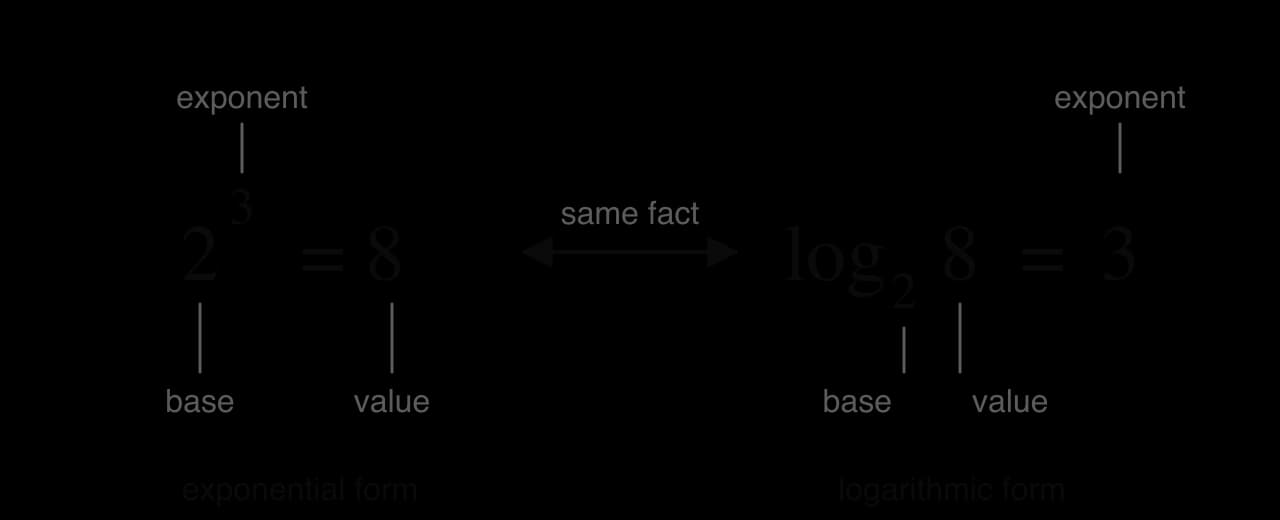
An exponent and a logarithm describe the same relationship from two directions. The statement 23=8 answers the question "what is 2 multiplied by itself 3 times?". The logarithm answers the reverse question "to what power must 2 be raised to give 8?". The answer, 3, is written log28=3 and read "log base 2 of 8 equals 3".
The double arrow ⟺ means that each statement implies the other: they are two ways of writing the same fact. A logarithm is therefore always an exponent.
The base stays the base in both forms. The logarithm is the exponent, and the value of the power goes inside the logarithm.
Evaluating logarithms without a calculator
To evaluate logab by hand, write b as a power of a. The exponent of that power is the logarithm. It often helps to set the logarithm equal to x and rewrite the statement in exponential form.
Parts (c) and (e) are special cases that hold for every valid base. Because a0=1 and a1=a,
loga1=0logaa=1
More generally, logaax=x: the logarithm to base a undoes raising a to a power. These facts are developed further, with the other laws of logarithms, in 1.7.
Logarithms that are not whole numbers
Most logarithms are not integers. Since 23=8 and 24=16, and 10 lies between 8 and 16, the number log210 lies between 3 and 4. A calculator gives log210=3.3219…, which can be checked by evaluating 23.3219≈10.000. Estimating between known powers like this is a useful check on any calculator answer.
Why the base and the argument must be positive
The number inside a logarithm is called its argument. For a positive base a, every power ax is positive, whatever the value of x. The graph of y=2x shows this: the curve stays above the x-axis everywhere, approaching it on the left without ever reaching it.
y = 2ˣ
Every value of 2ˣ is positive, so 2ˣ can never equal 0 or a negative number. Each step of 1 to the right doubles the value; each step to the left halves it.
So there is no exponent x with 2x=0 or 2x=−4, and log20 and log2(−4) do not exist. The restrictions on the base have similar reasons. A base of 1 gives 1x=1 for every x, so log15 could not have any value and log11 could have every value. A negative base produces powers that jump between positive and negative values and are not even defined for many fractional exponents, such as (−2)1/2.
Common logarithms: base 10
Notation and powers of ten
Logarithms to base 10 are called common logarithms. They match the decimal number system, so they are the natural choice for measuring size on a scale of powers of ten. In IB notation, logx with no base written means log10x. Some calculators and books use lgx for the same thing.
x
0.001
0.01
0.1
1
10
100
1000
106
logx
−3
−2
−1
0
1
Each time x is multiplied by 10, logx increases by 1. Numbers between powers of ten have logarithms between the corresponding integers: log50 lies between log10=1 and log100=2, and a calculator gives log50=1.69897…. The integer part of logx is one less than the number of digits before the decimal point of x (for x≥1), which is why logx is a measure of order of magnitude.
Solving 10x=b
By the definition, 10x=b has the solution x=logb. A calculator gives a decimal value, and the solution can be checked by substituting it back.
y = 10ˣ
The line y = 50 meets y = 10ˣ where x = log 50 ≈ 1.70, between x = 1 (where y = 10) and x = 2 (where y = 100).
A base 10 scale: pH
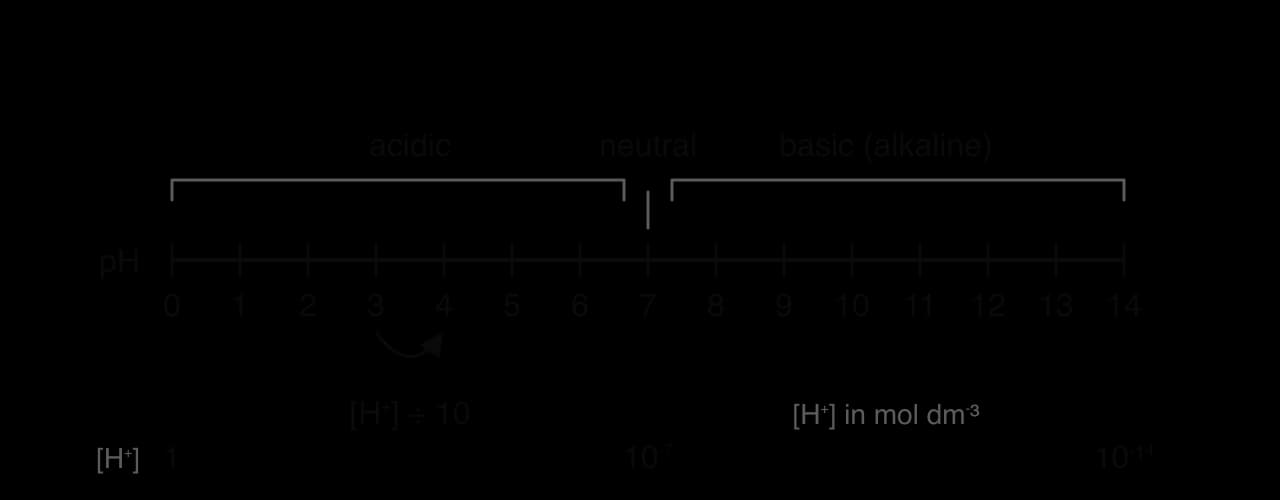
Quantities that range over many powers of ten are often measured on a logarithmic scale. In chemistry, the acidity of a solution depends on its concentration of hydrogen ions, [H+], measured in moles per cubic decimetre (mol dm−3). This concentration varies from about 1 in strong acids to about 10−14 in strong alkalis, so it is described by its pH instead:
pH=−log[H+]⟺[H+]=10−pH
The minus sign makes the pH of most solutions positive, since [H+]<1 gives a negative logarithm. Pure water at 25∘C has [H+]=10−7, so its pH is 7, which is called neutral. A lower pH means a higher concentration of hydrogen ions and a more acidic solution.
Equal steps along the pH scale are equal factors of 10 in concentration. A rise of 1 in pH divides the hydrogen ion concentration by 10.
Because pH is a logarithm, a difference in pH corresponds to a ratio of concentrations. Two solutions whose pH values differ by d have hydrogen ion concentrations in the ratio 10d. A solution of pH 3 is therefore 102=100 times as concentrated in hydrogen ions as one of pH 5, not "a little more acidic".
Euler's number e and natural logarithms
Continuous compounding and the number e
Suppose 1 dollar is invested for one year at an interest rate of 100% per year. With the interest added once at the end of the year, the investment becomes 1+1=2 dollars. If the interest is added twice, at 50% each half-year, it becomes (1+21)2=2.25 dollars, because the second half-year earns interest on the first half-year's interest. In general, compounding n times a year at n100% each time gives
(1+n1)n
dollars after one year. Compound interest itself is treated in 1.4; the question here is what happens as n becomes very large.
Compounding
n
(1+n1)n
yearly
1
2
half-yearly
2
2.25
quarterly
4
2.44141
monthly
12
2.61304
weekly
52
2.69260
daily
365
2.71457
hourly
8760
2.71813
every minute
525 600
2.71828
The values increase, but by less and less, and they settle towards a fixed number close to 2.71828. More frequent compounding never makes the investment grow beyond this value. The limiting case, in which interest is added at every instant, is called continuous compounding, and the limiting value is the number e.
y = (1 + 1/x)ˣ
As n increases, (1 + 1/n)ⁿ rises towards the dashed line y = e but never reaches it.
Euler's number is named after the Swiss mathematician Leonhard Euler. It is the base that makes calculus with exponential functions simplest: the function ex is its own derivative, a fact used throughout 5.6 and later. The idea of a value that a sequence approaches without reaching it is the idea of a limit, made precise in 5.1. On a calculator, ex is a separate key or function, and e itself is e1.
The same reasoning works for other interest rates. At an annual rate of 5% compounded n times a year, one dollar grows to (1+n0.05)n after one year, and as n increases this approaches e0.05. Continuous compounding at a rate r (as a decimal) multiplies an amount by er each year, and by ert after t years.
The natural logarithm
A logarithm to base e is called a natural logarithm and is written lnx (from the Latin logarithmus naturalis). Like any logarithm, it is an exponent: lnx is the power to which e must be raised to give x.
The special cases of logarithms in any base apply to ln as well: ln1=0 because e0=1, and lne=1 because e1=e. More generally, lnex=x for every real x and elnx=x for every x>0, because taking ln undoes raising e to a power, and raising e to a power undoes taking ln.
Base 10
Base e
10x=b⟺x=logb
ex=b⟺x=lnb
log1=0, log10=1
ln1=0, lne=1
log10x=x, 10logx=x
lnex=x
logx undefined for x≤0
lnx undefined for x≤0
Solving simple exponential and logarithmic equations
Equations of the form ex=b and 10x=b
An equation such as ex=3 is solved by rewriting it in logarithmic form, x=ln3. This is the exact answer; a calculator gives the decimal value 1.0986…. When the exponential term is part of a larger expression, first rearrange to get the power on its own, then take the logarithm.
The method in three steps:
Rearrange so that the power (e… or 10…) is alone on one side.
Rewrite in logarithmic form with the matching base: ln for e, log for 10.
Solve the resulting linear equation for x, then evaluate if a decimal answer is wanted.
Equations with a logarithm
When the unknown is inside a logarithm, rewrite the equation in exponential form. A solution must give a positive argument, so it is worth checking each answer in the original equation.
Other bases
An equation such as 2x=10 uses a base other than 10 or e. Its exact solution is x=log210, and many calculators can evaluate this directly. Alternatively, the solution can be found as the x-coordinate of the intersection of the graphs of y=2x and y=10 on a graphic display calculator (GDC), which gives x=3.32 (3 s.f.). The algebraic method for any base, using the change of base formula log210=ln2ln10, is developed in 1.7.
Exam-style questions on exponents and logarithms
Questions on this content appear both without a calculator, where answers must be exact (such as ln5 or 21+ln3), and with a GDC, often in a context such as pH or continuous growth. The two worked examples show both types with the setting out that earns full credit.
Further points that earn or lose marks on this content:
When a question says "write down", the answer should follow from a known fact, such as log327=3 or ln1=0; no working is expected.
An answer of ln(−2) or log0 is never valid. If an equation leads to one, say that there is no solution and give the reason.
Final answers are exact or correct to 3 significant figures unless the question says otherwise.
Self-check
To do:
I can explain why a0=1 and a−n=an1 using the division law.
To do:
I can simplify expressions with integer exponents and write answers with positive exponents only.
To do:
I can convert between ax=b and x=logab in both directions.
To do:
I can evaluate logarithms such as log232, log391
To do:
I can explain why logab is undefined when b≤0.
To do:
I can explain how e arises from (1+n1)n and state its value to 5 decimal places.
To do:
I can solve equations such as 10x=50, 3ex+2=20 and ln(2x−1)=−1
To do:
I can calculate a pH from a hydrogen ion concentration, and the concentration from a pH.
thousand)
4.6
6.2
9.3
12.4
18.6
25.1
37.4
(a)
The regression line of y on t has equation y=at+b. Find the value of a and the value of b.
[2]2 marks
Markscheme (a)
a=5.20(5.19642…), b=−4.56(−4.55714…) A1A1
(b)
Write down the value of r, Pearson's product-moment correlation coefficient, for these data.
[1]1 mark
Markscheme (b)
r=0.954(0.953849…)A1
(c)
A scatter diagram suggests that the relationship between t and y is not linear. Let z=lny.
The regression line of z on t has equation z=ct+d
(d)
Find the value of Pearson's product-moment correlation coefficient for t and z. Hence state which of the two regression lines gives the better model for the data.
[2]2 marks
Markscheme (d)
r=0.999(0.999274…)A1
the line of z
(e)
Show that the equation z=ct+d can be written in the form y=Aekt, and find the value of A
(f)
Use the model y=Aekt to estimate the number of downloads in week 9.
[2]2 marks
Markscheme (f)
y=3.17601…×e0.349165…×9
(g)
Comment on the reliability of your estimate in part (f).
[1]1 mark
Markscheme (g)
t=9 is outside the range of the data, so this is an extrapolation and may be unreliable R1
(h)
According to the model y=Aekt, find the first week in which the number of downloads is more than 100 thousand.
[3]3 marks
Markscheme (h)
3.17601…e0.349165…t>100
Question 2 · AA-006375 marks
Consider the curve y=2x, where x∈R. The point P(1,2) lies on the curve.
The point Q(1+h,21+h), where h>0, also lies on the curve. The gradient of the chord [PQ]
The following table shows some values of h and the corresponding values of m, correct to five significant figures.
h
1
0.1
0.01
0.001
m
2.0000
(a)
Use your GDC to find p and q.
[2]2 marks
(b)
Hence write down an estimate for the gradient of the tangent to the curve at P.
[1]1 mark
(c)
Use your answer to part (b) to find the equation of the tangent to the curve at P. Give your answer in the form y=ax+b
Kofi invests $1000 in an account that pays a nominal annual interest rate of 5%, compounded n times per year. The value of his investment after one year, in dollars, is
A(n)=1000(1+n0.05)n.
The following table shows some values of A(n), correct to two decimal places.
n
1
4
12
365
8760
A(n)
(a)
Find the value of p, the value of q and the value of r.
[2]2 marks
(b)
Use the table to write down an estimate of n→∞limA(n)
The exact answer is x=1+log0.4. The value of log0.4 is negative because 0.4<1.
(c) Rewrite in exponential form: x=102.5=316.227…≈316.
This lies between 3 and 4, as expected, since 10−4<3.2×10⁻⁴<10−3.
(b) Use the exponential form:
[H+]=10−8.2=6.31×10⁻⁹mol dm−3 (3 s.f.)
(c) The ratio of the concentrations is
10−3.910−2.4=10−2.4−(−3.9)=101.5=31.6 (3 s.f.)
The hydrogen ion concentration of A is about 31.6 times that of B. The answer depends only on the difference in pH, 1.5.
,
elnx=x
:
e21=e−2
, so
lne−2=−2
.
(c) ln7 is the power of e that gives 7, so raising e to that power gives eln7=7.
(d) e=e1/2, so lne=21.
(c) Isolate the power first.
3ex=18⇒ex=6⇒x=ln6=1.7917…≈1.79
(d) Since ex>0 for every real x, the equation ex=−2 has no solution. Writing x=ln(−2) is not an answer, because ln of a negative number is undefined.
, so
x=21+e−1=21+2e1
Check: 2x−1=e−1>0, so the logarithm is defined.
(c) Divide by 5 first: log(x+3)=2. Then x+3=102=100, so x=97.
One mark for 8x6 (each part of the bracket raised to the power 3), one for the final answer.
(b) "Write down" means no working is expected: 25=32, so log232=5.
(c) Write the argument as a power of 10: 1000=(103)1/2=103/2. Hence
log101000=23
(d) Rewrite in logarithmic form, then solve the linear equation.
2x−1=ln5⇒2x=1+ln5⇒x=21+ln5
So a=1, b=5, c=2.
. Use the unrounded value from (a).
[H+]=10−3.84678…=1.42×10⁻⁴mol dm−3 (3 s.f.)
(c) "Hence" means use part (b).
1.4230…×10−44.5×10−3=31.6 (3 s.f.)
This equals 101.5, as a difference of 1.5 in pH predicts.
and
lne4
without a calculator.
, exactly and with technology.
. Find the value of
c
and the value of
d
.
[2]2 marks
Markscheme (c)
c=0.349(0.349165…), d=1.16(1.15562…) A1A1
Note: The values of z are 1.526,1.825,2.230,2.518,2.923,3.223,3.622 (to 3 d.p.).
on
t
, since its value of
r
is closer to 1
R1
and the value of
k
.
[3]3 marks
Markscheme (e)
lny=ct+d⇒y=ect+dM1
y=edectA1
A=e1.15562…=3.18(3.17601…) and k=0.349A1
Note: Award the final A1 for both values correct. Follow through from their values of c and d.
(M1)
73.6 thousand (73.5609…)A1
Note: Accept 73.5 from 3 s.f. values.
(M1)
t>9.87939…(A1)
week 10 A1
Note: Accept an equation, or a table of values showing 73.6 thousand in week 9 and 104 thousand in week 10, for the (M1)(A1).
is
m
.
1.4355
p
q
.
[2]2 marks
1050.00
1050.95
p
q
r
, correct to two decimal places.
[1]1 mark
(c)
A second account pays a nominal annual interest rate of 5.13%, compounded once per year. Kofi claims that if the first account compounded interest often enough, it would give him more money after one year than the second account.
Use your answer to part (b) to determine whether Kofi is correct.