1.2 Arithmetic sequences and series · IB Maths AA | Augment Education
1.2 Arithmetic sequences and series
Use the nth term and sum formulas for arithmetic sequences, work with sigma notation, find unknown terms, differences and numbers of terms, and model real situations with arithmetic sequences.
IB Mathematics: Analysis and Approaches
Part of 1 Number and algebra
SL and HL
Key terms introduced here
Each is in the Maths AA glossary, with every other term in the subject.
The sum of the terms of an arithmetic sequence. The sum of the first n terms is Sn=2n(u1+un)
Notes on 1.2 Arithmetic sequences and series
27 min readLast reviewed
Questions on 1.2
80 exam-style questions on this subtopic, written in the style of the IB papers. The first has its markscheme open. Counted on
Question 1 · AA-000027 marks
A theatre has rows of seats. The table shows how many seats there are in the first three rows. The number of seats in each row forms an arithmetic sequence.
Row
1
2
3
Seats
24
27
30
(a)
Write down the common difference.
[2]2 marks
Markscheme (a)
d=3A2
(b)
Find the number of seats in row 20.
[2]2 marks
Try a quick-fire question
One of 40 short multiple-choice questions on 1.2. Pick an answer to see why it's right or wrong.
A sequence has u1=10 and un+1=un−4
From the formula booklet
The entries of the mathematics: analysis and approaches formula booklet that 1.2 uses. Each opens in the explained booklet.
One number in a sequence. The term in position n is written un, so u1 is the first term; a formula for un in terms of n is called the general term.
to find any term, the number of terms, or whether a value is a term.
Derive and use Sn=2n(2u1+(n−1)d)=2n(u1+un) for the sum of an arithmetic series.
Write and evaluate sums in sigma notation, by formula and with a GDC.
Find u1, d or n from given information, including with simultaneous equations and inequalities.
Model real situations with arithmetic sequences and comment on how well the model fits.
A sequence is a list of numbers that follow a pattern. The simplest pattern is to add the same amount each time, as in the seats in a theatre where each row has two more seats than the row in front, or a salary that rises by a fixed amount every year. Sequences of this kind are called arithmetic sequences. They describe any quantity that changes by equal steps, and their sums answer questions such as how many seats the whole theatre holds or how much is earned over a whole career.
Sequences and their notation
A sequence is an ordered list of numbers. Each number in the list is a term, and its position matters: the sequence 2,5,8,11 is different from 11,8,5,2. A sequence can be finite, ending after a certain number of terms, or infinite, continuing for ever, which is shown by three dots: 2,5,8,11,…
The subscript in un gives the position of a term, not its value. In the sequence 2,5,8,11,…, the first term is u1=2 and the fourth term is u4=11. The term after un is un+1, and the term before it is un−1.
Two ways to define a sequence
A sequence can be given by a formula for the nth term, sometimes called the general term. Substituting n=1,2,3,… produces the terms in order, and any term can be found directly. For example, un=3n−1 gives u1=2, u2=5, u3=8 and u100=299.
A sequence can also be given by a recursive formula, which describes how to get each term from the one before, together with a first term. The recursive formula un+1=un+3 with u1=2 produces the same sequence 2,5,8,11,… A recursive rule shows clearly how the sequence grows, but finding u100 from it means working through all the terms before it.
Arithmetic sequences
In the sequences 2,5,8,11,… and 16,12,8,4,… the gap between consecutive terms is always the same: +3 in the first and −4 in the second. Any sequence with this property is an arithmetic sequence, and the fixed gap is its common difference.
The common difference can be positive (an increasing sequence), negative (a decreasing sequence) or zero (a constant sequence such as 5,5,5,…). In recursive form, every arithmetic sequence satisfies un+1=un+d. To decide whether a list of numbers is arithmetic, subtract each term from the next one: the sequence is arithmetic only if every difference is the same.
The nth term of an arithmetic sequence
Writing out an arithmetic sequence in terms of u1 and d shows a pattern. To reach the second term, d is added once; to reach the third term, it is added twice; and so on.
Term
u1
u2
u3
u4
⋯
un
In terms of u1 and d
u1
u1+d
In every column, the number of d's is one less than the position of the term, because the first term has no differences added to it. This gives the formula for the nth term.
un=u1+(n−1)d
Arithmetic sequences and straight lines
Expanding un=u1+(n−1)d gives un=dn+(u1−d), which has the form y=mx+c with gradient m=d. Plotting the terms against their positions therefore gives points that lie on a straight line. The sequence is a linear function whose domain is the positive integers, so the graph is a set of separate points rather than a continuous line.
y = 3x − 1 (guide line)
The terms of 2, 5, 8, 11, … plotted against n lie on a line of gradient 3, the common difference. Only the points at whole-number n belong to the sequence.
This link explains the shape of every arithmetic sequence: a positive d gives points rising at a constant rate, a negative d gives points falling at a constant rate, and d=0 gives a horizontal row of points. Arithmetic sequences are the discrete version of the linear models in 2.1, and they represent change that happens by equal steps.
Finding the position of a term and the number of terms
The formula un=u1+(n−1)d links four quantities. When three of them are known, the fourth can be found. Setting un equal to a given value and solving for n shows whether that value is in the sequence: it is a term only if n is a positive integer.
The same idea counts the terms in a finite sequence. The last term is un, so solving u1+(n−1)d=last term gives the number of terms n.
Finding the first term and the common difference
When two terms of an arithmetic sequence are given, each one gives an equation in u1 and d. Solving the two equations simultaneously finds both unknowns, and then any other term or sum can be found.
Questions sometimes give three terms in algebraic form and ask for the value of an unknown. Because consecutive terms have equal differences, the middle term of any three consecutive terms is the mean of the other two: if a,b,c are consecutive terms then b−a=c−b, so 2b=a+c.
Arithmetic series
Adding the terms of a sequence gives a series. The sum of the first n terms is written Sn, so for the sequence 2,5,8,11,… the sum S4=2+5+8+11=26. When the sequence being added is arithmetic, the sum is an arithmetic series.
Deriving the sum formula
Adding many terms one at a time is slow, but arithmetic series have a shortcut. Consider 1+2+3+⋯+100. Pairing the first and last terms gives 1+100=101, the second and second-last give 2+99=101, and every such pair has the same total. There are 50 pairs, so the sum is 50×101=5050.
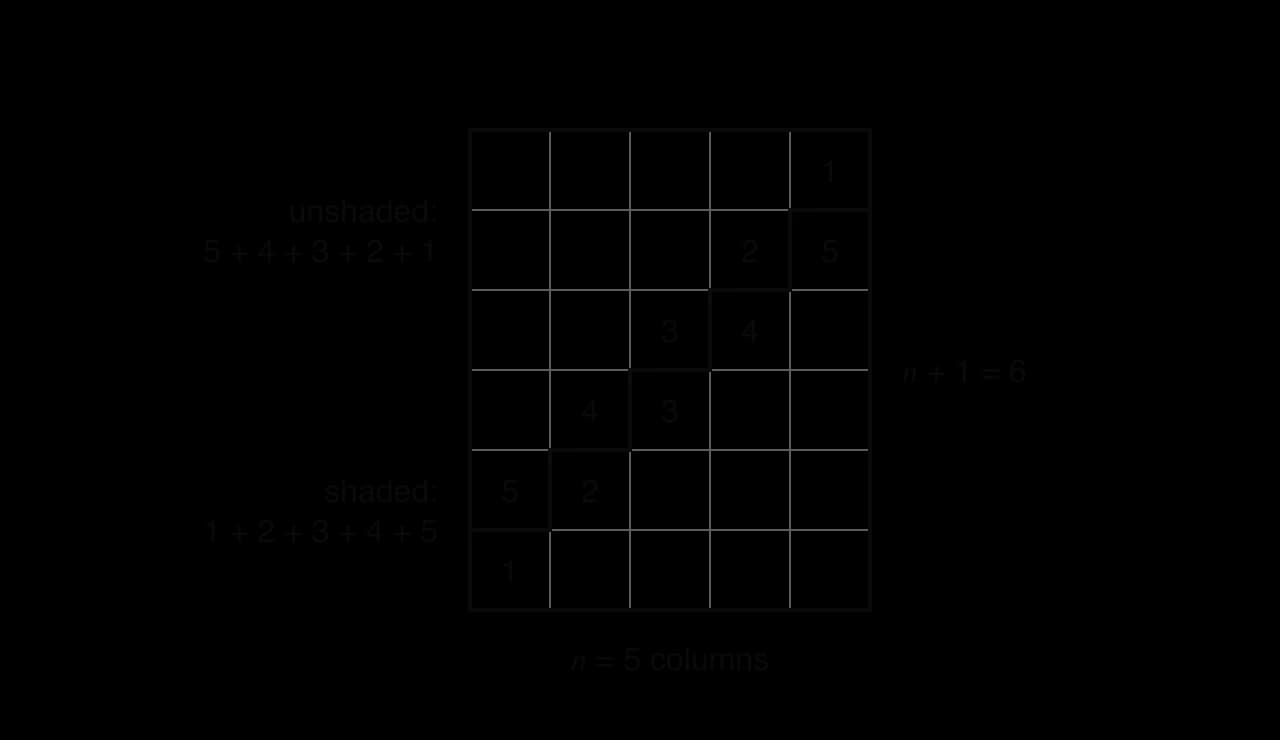
The same idea can be seen in a picture. Two copies of the staircase 1+2+3+4+5, one turned upside down, fit together to make a rectangle.
Each column holds one term from the forward sum and one from the backward sum, and every column has the same height, 6. Two copies of the sum fill a 5 × 6 rectangle, so 1 + 2 + 3 + 4 + 5 = (5 × 6) ÷ 2 = 15.
The general proof writes the sum forwards and backwards. Each term in the forward sum is d larger than the one before, and each term in the backward sum is d smaller, so when the two lines are added, every column has the same total, u1+un.
There are n columns, so 2Sn=n(u1+un). Dividing by 2 gives the first form of the sum formula. Substituting un=u1+(n−1)d gives the second form.
Sn=2n(u1+un)Sn=2n(2u1+(n−1)d)
The first form says that the sum is the number of terms multiplied by the mean of the first and last terms. It is the quicker form when the last term is known. The second form is used when the common difference is known instead.
Finding the number of terms from a sum
When the sum is known and n is not, the sum formula becomes a quadratic equation in n. Solve it with the quadratic formula, by factorising or with a GDC, and keep only a positive integer solution. In questions that ask when a total first passes a value, solve the equation, then check the whole numbers on either side.
Finding a term from a formula for the sum
Sometimes the formula for Sn is given and a term is needed. Since Sn is the sum of the first n terms and Sn−1 is the sum of the first n−1, their difference is the nth term on its own:
un=Sn−Sn−1(n≥2),u1=S1
Sigma notation
Long sums are written compactly with sigma notation. The symbol Σ is the Greek capital letter sigma, for "sum". A variable, usually k (sometimes r or i), counts through whole numbers from a lower limit to an upper limit, and the expression after Σ gives the term for each value of k.
For example, ∑k=14(3k−1)=2+5+8+11=26. The number of terms in ∑k=ab is b−a+1, because both limits are included. So ∑k=530 has 26 terms, not 25.
A GDC evaluates sigma notation directly, either with a summation template (Σ) or by summing a generated list (a "sum" of a "sequence" command). This is useful for checking a hand calculation, and for sums that do not start at k=1.
Applications of arithmetic sequences
Many situations change by a fixed amount at each step: rows of seats that each hold a few more than the row in front, salaries with a fixed yearly rise, stacks in which each layer has one fewer item than the layer below. In each case the first step is to identify u1, d and what n counts, and the second is to decide whether the question asks for a single term (un) or a total (Sn).
Salaries and simple interest
A salary scale with a fixed annual increment is an arithmetic sequence: u1 is the starting salary, d is the yearly rise and un is the salary in year n. The total earned over the first n years is Sn. In the same way, simple interest adds the same amount of interest each year, so the balance of a simple-interest account is an arithmetic sequence. Compound interest, where the balance is multiplied by a fixed factor, gives a geometric sequence instead (see 1.4).
Stacking problems
Objects stacked in layers, with one fewer in each layer, give arithmetic series. When the total number of objects is known, the number of layers comes from solving a quadratic equation in n.
Models that are only approximately arithmetic
Real data rarely follow a pattern exactly. When the differences between successive values are roughly equal, an arithmetic sequence can still be a useful model. A sensible estimate of the common difference is the mean of the differences, which equals number of gapslast value−first value. The model can then be used to predict, but its predictions need interpreting with care.
Year n
1
2
3
4
5
6
Height of a young tree (m)
1.20
1.52
1.81
2.14
2.43
2.75
Increase on previous year (m)
0.32
0.29
0.33
0.29
0.32
The yearly increases in this (hypothetical) data set vary between 0.29 m and 0.33 m, so the heights are close to arithmetic but not exactly so. The mean increase is 52.75−1.20=0.31 m per year, which gives the model hn=1.20+0.31(n−1).
model hₙ = 1.20 + 0.31(n − 1)
The measured heights lie close to the model line, so the model fits years 1 to 6 well. The prediction for year 10 lies outside the data and depends on growth continuing at the same rate.
Using a model to estimate between known values (interpolation) is usually reliable when the model fits well. Using it beyond the data (extrapolation) is less reliable, and the further the prediction goes, the less trust it deserves. A complete answer to a modelling question states whether the prediction is interpolation or extrapolation and gives a reason based on the context.
Exam-style questions on arithmetic sequences
Arithmetic sequences appear in short questions on both papers and as the opening parts of longer questions. The questions below show typical structures: two given terms, a "show that" for Sn, a quadratic for n, and a comparison in context that needs a GDC.
Self-check
To do:
I can write down terms of a sequence from a formula for un or from a recursive formula.
To do:
I can decide whether a sequence is arithmetic and find its common difference.
To do:
I can explain where un=u1+(n−1)d comes from and use it to find a term, a position or the number of terms.
To do:
I can find u1 and d from two terms by solving simultaneous equations.
To do:
I can derive the sum formula by writing the series forwards and backwards.
To do:
I can find Sn, and find n from a given sum, including "first exceeds" questions.
To do:
I can read, write and evaluate sums in sigma notation, by formula and with a GDC.
To do:
I can model a real situation with an arithmetic sequence and comment on whether a prediction is reliable.
Markscheme (b)
u20=24+19×3M1
=81 seats A1
(c)
The theatre has 20 rows. Find the total number of seats.
[3]3 marks
Markscheme (c)
S20=220(24+81)M1A1
=1050 seats A1
Question 2 · AA-000104 marks
An arithmetic sequence has first term u1=3 and common difference d=2.
. They are all equal, so the sequence is arithmetic with
d=6
. (b) The differences are
3
,
6
,
12
. They are not equal, so the sequence is not arithmetic. Each term is double the one before, so this is a geometric sequence, covered in 1.3. (c) The differences are
−41−21=−43
, then
−1−(−41)=−43
, then
−47−(−1)=−43
. The sequence is arithmetic with
d=−43
.
u1+2d
u1+3d
⋯
u1+(n−1)d
.
u20=7+(20−1)×4=7+76=83
(b) Substitute u1=7 and d=4 and simplify.
un=7+(n−1)×4=7+4n−4=4n+3
Check: u1=4+3=7 and u20=80+3=83, as in (a).
Since 75 is a positive integer, 301 is the 75th term: u75=301. (b) Set the nth term equal to 150.
4n+1=150⟹n=37.25
There is no 37.25th term, because n must be a positive integer. So 150 is not a term. It lies between u37=149 and u38=153.
u1+11d=45(2)
Subtract equation (1) from equation (2) to eliminate u1.
7d=28⟹d=4
Substitute into (1): u1+16=17, so u1=1. Then
u40=1+39×4=157
A shortcut for d: going from u5 to u12 adds 12−5=7 differences, so 7d=45−17=28.
.
3x−3=−x+9⟹4x=12⟹x=3
The terms are 2(3)+1=7, 5(3)−2=13 and 4(3)+7=19, so d=6. The differences are equal, which confirms the answer.
.
S30=230(2×5+29×3)=15×(10+87)=15×97=1455
(b) The series has u1=50 and d=−3, and the last term is −37. First find how many terms there are.
50+(n−1)(−3)=−37⟹(n−1)(−3)=−87⟹n−1=29⟹n=30
Now use the form with the last term.
S30=230(50+(−37))=15×13=195
. The least number of terms is
26
.
Subtract.
un=Sn−Sn−1=(3n2+2n)−(3n2−4n+1)=6n−1
Check the first term separately: u1=S1=3+2=5, and 6(1)−1=5, so the formula holds for n=1 too. Then
un+1−un=(6(n+1)−1)−(6n−1)=6
which is constant, so the sequence is arithmetic with d=6.
. The first term (
k=1
) is
5
and the last (
k=20
) is
62
.
k=1∑20(3k+2)=220(5+62)=10×67=670
(b) The sequence 7,11,15,… has u1=7 and d=4, so uk=7+4(k−1)=4k+3. The last term gives the upper limit.
4k+3=87⟹k=21
7+11+⋯+87=k=1∑21(4k+3)
and
d=200
. After 15 years,
.
Then u1=11−3×4=−1. (b) Substitute into the formula from the booklet and simplify, showing each step.
Sn=2n(2(−1)+(n−1)×4)=2n(4n−6)=n(2n−3)=2n2−3n
(c) "Hence" means using the result from (b).
2n2−3n=1175⟹2n2−3n−1175=0
n=43±9+9400=43±97
So n=25 or n=−23.5. Since n must be a positive integer, n=25.