1.13 Polar and Euler form · IB Maths AA | Augment Education
1.13 Polar and Euler form
Write complex numbers in polar form r cis θ and Euler form re^(iθ), find the principal argument in any quadrant, and multiply and divide by multiplying moduli and adding arguments, seen as rotations and enlargements.
IB Mathematics: Analysis and Approaches
Part of 1 Number and algebra
HL only
Key terms introduced here
Each is in the Maths AA glossary, with every other term in the subject.
The way of writing a non-zero complex number by its modulus r and argument θ: z=r(cosθ+isinθ)=rcisθ.
Notes on 1.13 Polar and Euler form
23 min readLast reviewed
The Cartesian form a+bi describes a complex number by how far it is across and how far up on an Argand diagram. A point can equally be described by its distance from the origin and its direction, in the same way that a ship's position can be given by a distance and a bearing from a port. This second description, by modulus and argument, is the polar form. It makes multiplication and division much simpler than in Cartesian form, it shows what multiplication does geometrically, and through Euler's formula it links complex numbers with the exponential function and the circular functions.
Modulus and argument
For a non-zero complex number z=a+bi, the modulus r=∣z∣=a2+b2
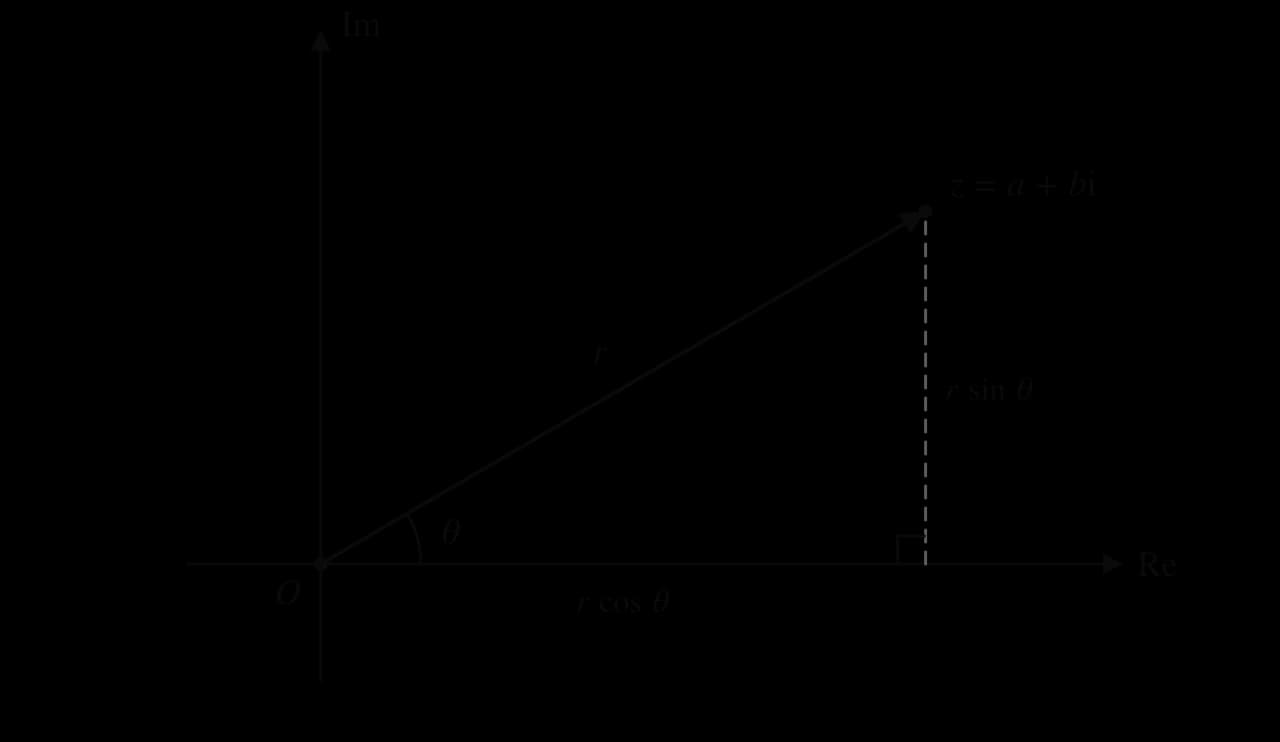
a=rcosθ,b=rsinθ
These relations come from the definitions of cosine and sine on a circle of radius r, and they hold in every quadrant, because cosθ and sinθ take the correct signs automatically.
The horizontal and vertical sides of the triangle are r cos θ and r sin θ, so a + bi = r cos θ + (r sin θ)i.
The principal argument
Turning through a full turn of 2π brings a line back to the same direction, so θ, θ+2π, θ−2π and in general θ+2kπ
−π<argz≤π
Numbers above the real axis have positive principal arguments, numbers below it have negative ones, and a negative real number has argument π. The number 0 has no argument.
Finding the argument in each quadrant
The equation tanθ=ab is true for every z, but it does not fix θ: the calculator value arctanab
Position of z=a+bi
Principal argument θ
First quadrant (a>0, b>0
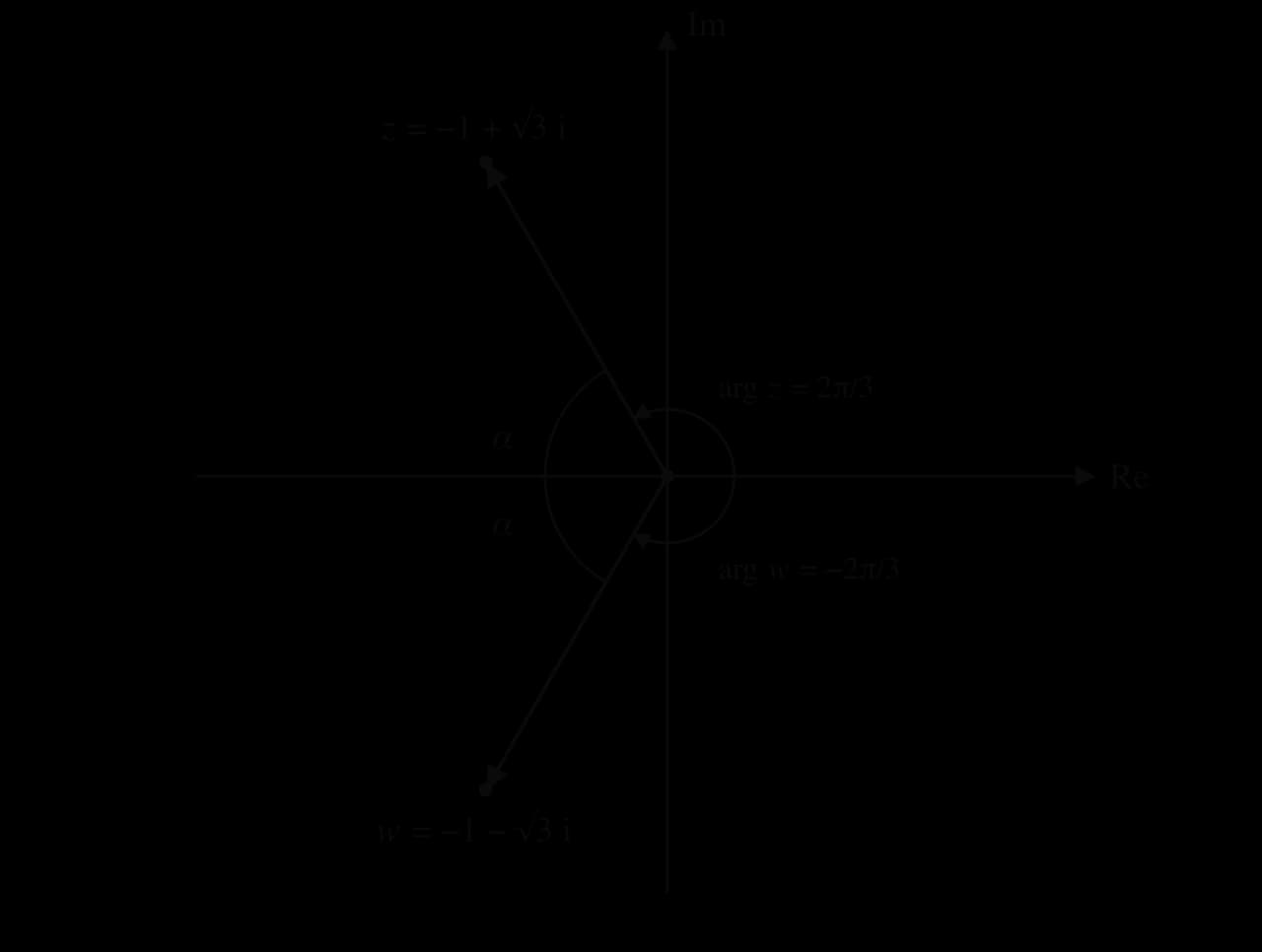
For z=−1+3i and w=−1−3i
Both points make the same acute angle α = π/3 with the negative real axis. Measured from the positive real axis, the argument is π − α above the axis and −(π − α) below it.
Polar form
Substituting a=rcosθ and b=rsinθ into z=a+bi
The number cisθ itself has modulus cos2θ+sin2θ=1
Converting between Cartesian and polar form
To convert from Cartesian to polar form, find r and θ as in the previous section. To convert from polar to Cartesian form, evaluate rcosθ and rsinθ.
Recognising polar form
An expression is in polar form only if it matches r(cosθ+isinθ) exactly: a positive real number r outside the bracket, cosine first, a plus sign, and the same angle in both functions. Expressions that look similar can be rewritten using the symmetry identities cos(−θ)=cosθ
Euler form
The polar form can be written more compactly with the exponential function. The key fact, discovered by Leonhard Euler, links e, i and the circular functions.
So rcisθ and reiθ are two notations for the same number, and both appear in the formula booklet: z=r(cosθ+isinθ)=reiθ=rcisθ
Why Euler's formula is reasonable
A full proof uses the power series of ex, sinx and cosx, met in 5.19. Two simpler observations show why the formula fits.
First, the function cisθ obeys the same law as powers. The product rule for polar form, proved with the compound angle identities, states that cisA×cisB=cis(A+B), which is exactly the index law eiA×eiB=ei(A+B)
Second, differentiating cosθ+isinθ with respect to θ, treating i as a constant, gives
−sinθ+icosθ=i(cosθ+isinθ)
so cisθ satisfies dθdf(θ)=if(θ), with f(0)=1
YouTube
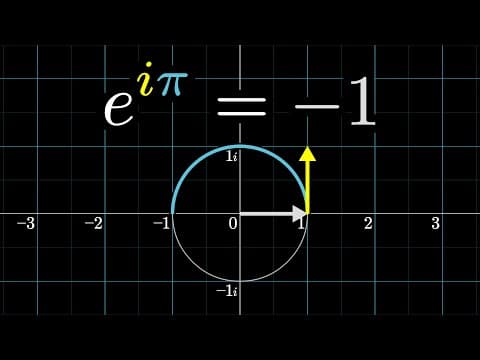
Watch how a velocity always at right angles to the position, of the same size, carries the point e^(it) round the unit circle, reaching −1 after time π.
Euler's identity
Putting θ=π in Euler's formula gives eiπ=cosπ+isinπ=−1
eiπ+1=0
This single equation connects five fundamental constants: 0, 1, π, e and i. Other values follow in the same way: eiπ/2=i
The three forms each have their uses. Cartesian form suits addition and subtraction; polar and Euler forms suit multiplication, division and powers.
Form
Notation
Best for
Cartesian
z=a+bi
Adding, subtracting, equating real and imaginary parts
Polar
z=r(cosθ+isinθ)=rcisθ
Multiplying and dividing in polar form
The product rule
Multiplying two numbers in polar form, then using the compound angle identities from 3.10, gives a simple rule. With z1=r1cisθ1 and z2=r2cisθ2
In Euler form the same result is the index law: r1eiθ1×r2eiθ2=r1r2ei(θ1+θ2)
The quotient rule follows from the product rule. The reciprocal of rcisθ is r1cis(−θ), because their product is cis0=1
The rules make products of numbers given in Euler form a one-line calculation. Mixed questions often give the numbers in Cartesian form, so the first step is to convert.
Conjugates and reciprocals in polar form
The conjugate reflects z in the real axis, which keeps the modulus and changes the sign of the argument. The reciprocal follows from the quotient rule with z1=1=cis0. For z=rcisθ=reiθ
z∗=rcis(−θ)=re−iθ,z1=r1cis(−θ)=r1e−iθ
So z∗ and z1 point in the same direction; they differ only in length. In particular, zz∗=r2e0=r2=∣z∣2
Multiplication as enlargement and rotation
The product rule has a clear geometric meaning. Multiplying z by w=rcisα multiplies the distance from the origin by r and adds α to the direction. On an Argand diagram, multiplication by w
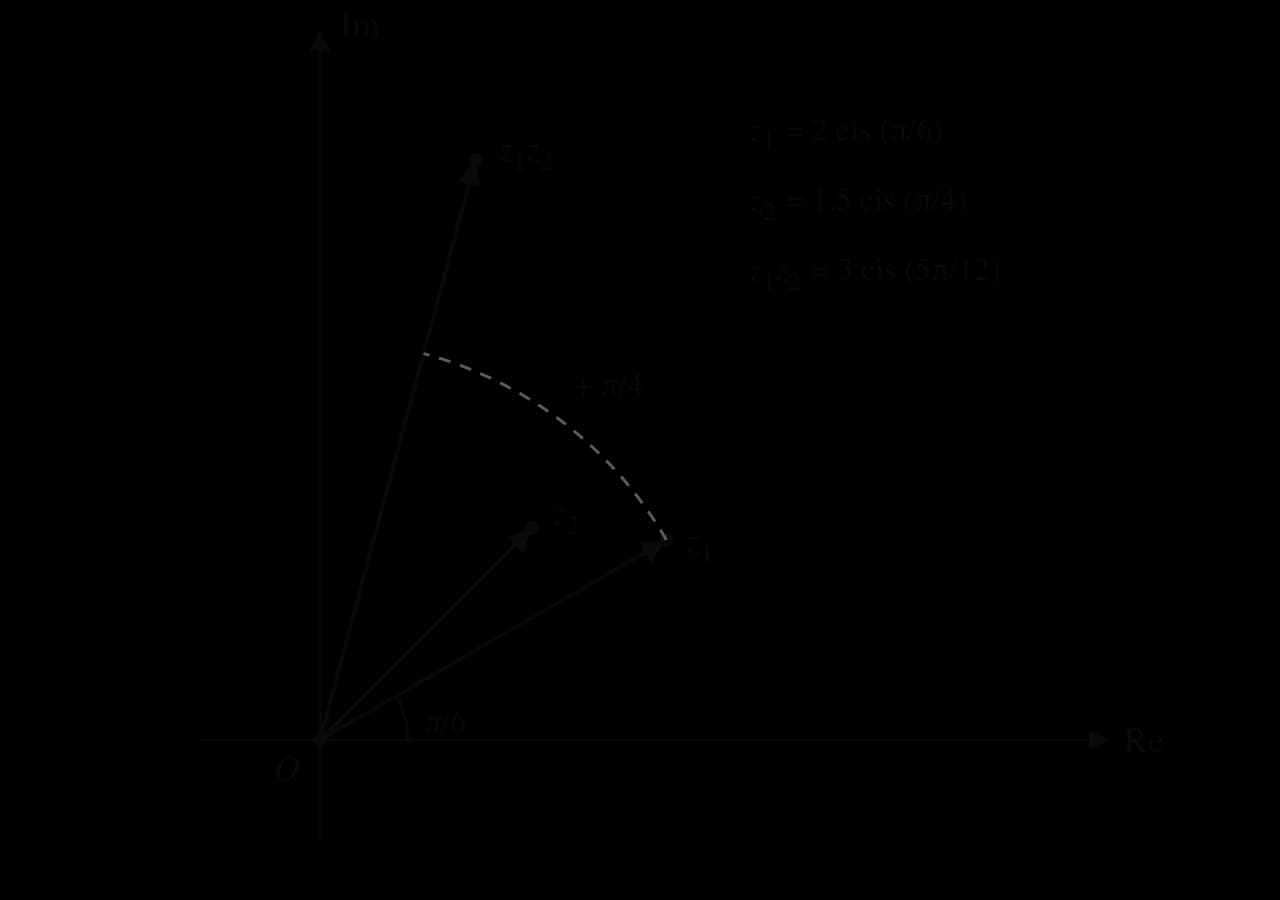
Multiplying z₁ by z₂ = 1.5 cis(π/4) stretches z₁ by a factor 1.5 and turns it a further π/4 anticlockwise, giving the product 3 cis(5π/12).
Several special cases are worth knowing:
Multiplying by i=cis2π is a rotation through 2π
To rotate a point z through an angle α about a point c instead of the origin, translate c to the origin, rotate, and translate back: the image is c+(z−c)eiα
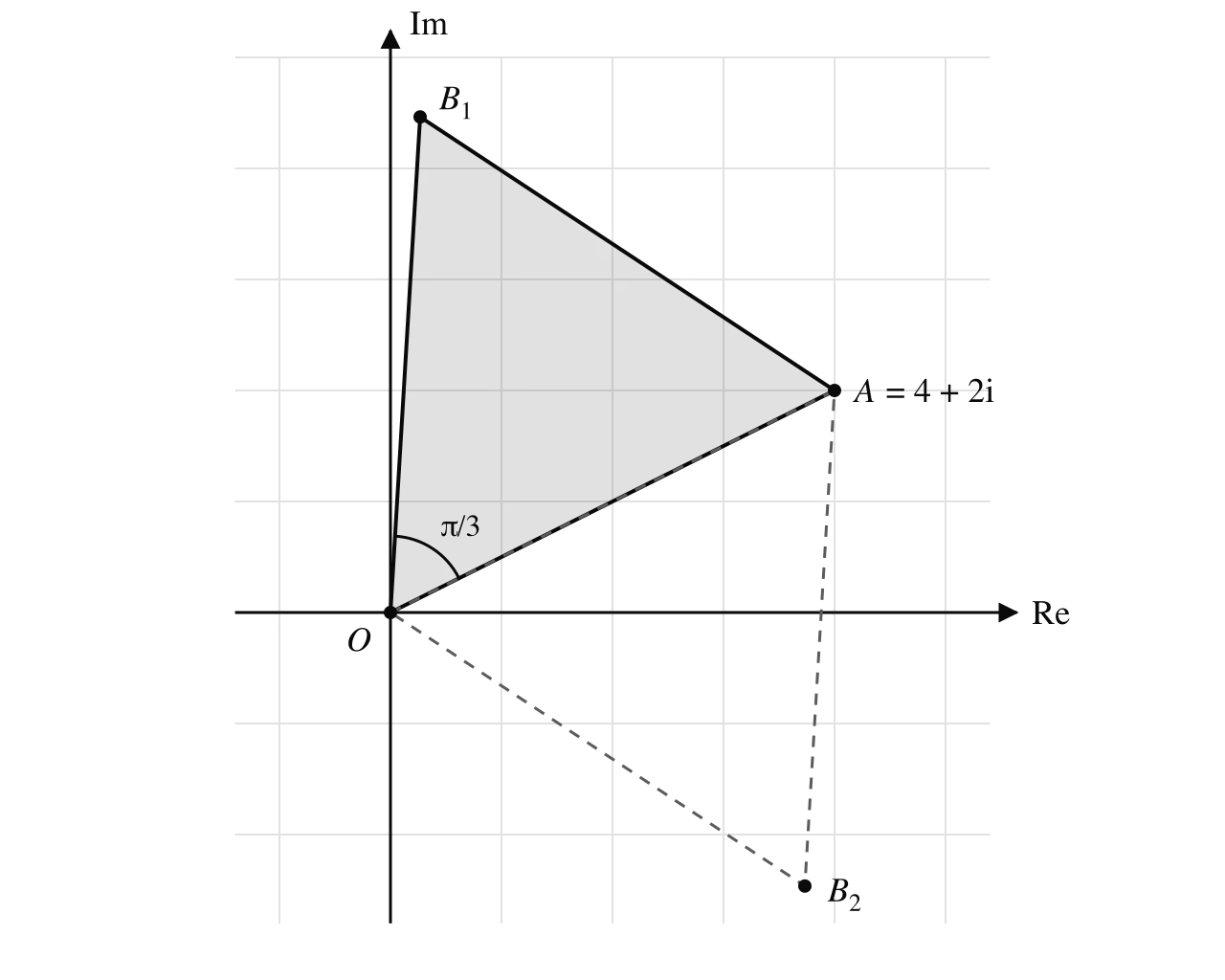
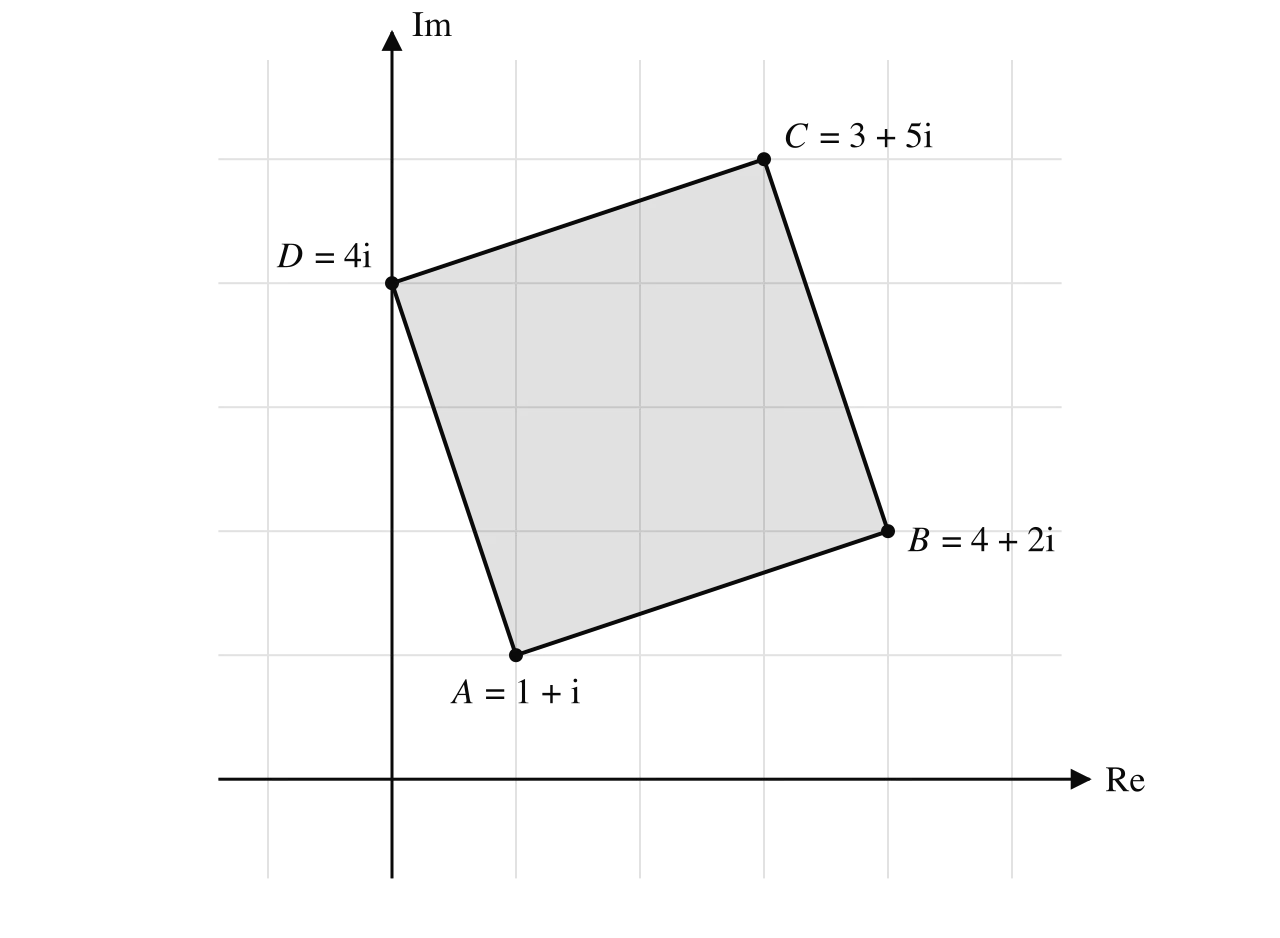
Rotations through a right angle need no trigonometry at all, since they are multiplications by ±i. This makes squares and right angles on an Argand diagram straightforward.
Sums in polar form
There is no simple rule for adding numbers in polar form: in general the sum must be found by converting to Cartesian form. One special case is worth knowing because it appears often. For −π<θ<π, factorising out eiθ/2 gives
1+eiθ=eiθ/2(e−iθ/2+eiθ/2)=2cos2θeiθ/2
because e−iθ/2+eiθ/2=2cos2θ
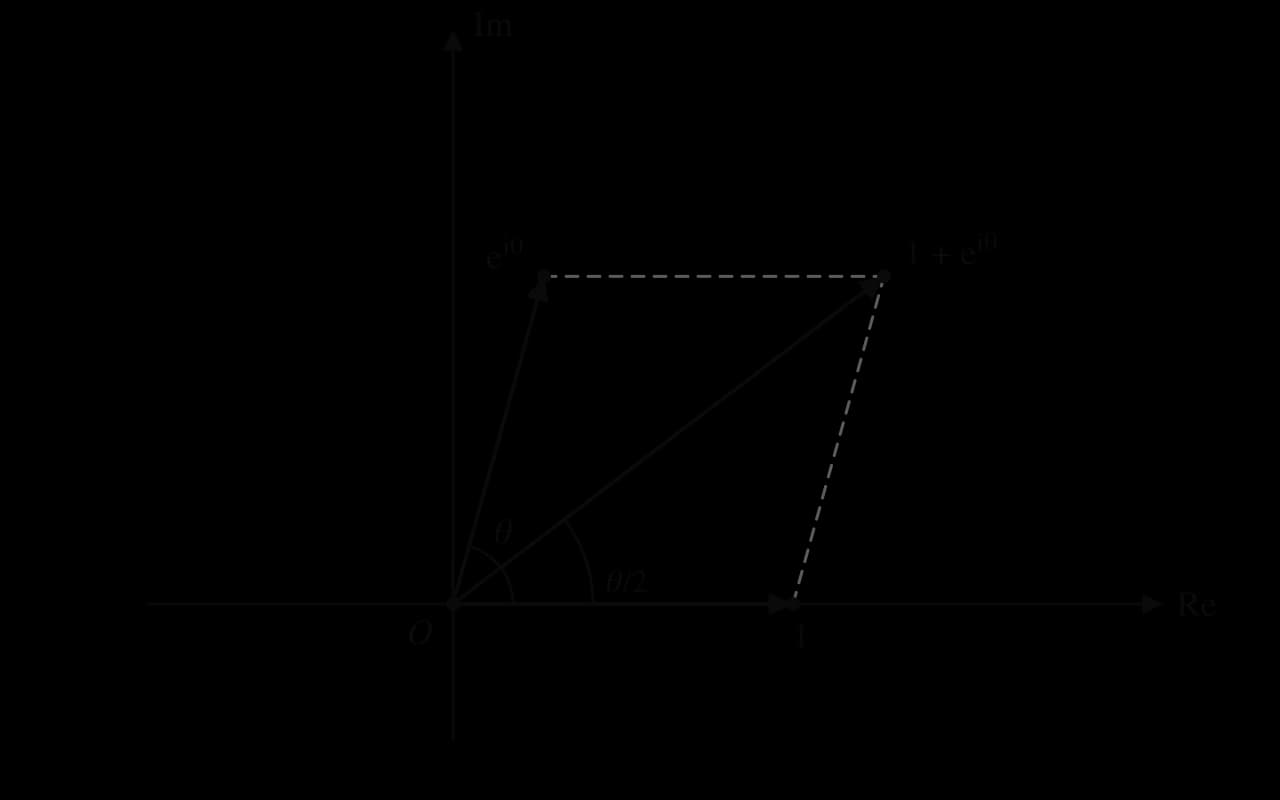
The sum of two numbers of equal modulus lies on the bisector of the angle between them, so 1 + e^(iθ) has argument θ/2.
Euler's formula and trigonometry
Replacing θ by −θ in Euler's formula gives e−iθ=cosθ−isinθ
cosθ=2eiθ+e−iθ,sinθ=2ieiθ−e−iθ
These expressions turn trigonometric identities into algebra with exponentials, where the index laws do the work. They are an extension beyond the core content, but they give short proofs of results that are long with trigonometry alone.
The same approach, combined with De Moivre's theorem in 1.14, produces multiple angle formulae such as cos3θ=4cos3θ−3cosθ.
Exam-style questions on polar and Euler form
Questions on this content often combine forms: a calculation is done twice, once in Cartesian form and once in polar form, and comparing the two results gives an exact value or an identity.
Questions are also set with the numbers given only by their moduli and arguments. These test the rules directly, and a GDC is no help.
A parameter question gives the argument of an expression and asks for an unknown. Write the expression in Cartesian form, then use tanθ=ab together with the quadrant.
The final question combines a calculator calculation with a geometric interpretation.
Self-check
To do:
I can find the modulus and principal argument of any non-zero complex number, sketching it first to get the quadrant right.
To do:
I can write a complex number in polar form rcisθ and Euler form reiθ, and convert back to a+bi
Questions on 1.13
30 exam-style questions on this subtopic, written in the style of the IB papers. The first has its markscheme open. Counted on
Question 1 · AA-000056 marks
Let z=1+3i.
(a)
Express z in the form reiθ, where r>0 and −π<θ≤π
Question 2 · AA-007756 marks
Consider the complex number z=−23+2i.
(a)
Express z
Question 3 · AA-007766 marks
Let z1=6cis(65π)
Try a quick-fire question
One of 35 short multiple-choice questions on 1.13. Pick an answer to see why it's right or wrong.
For z=rcisθ with r>0, what is z1?
From the formula booklet
The entries of the mathematics: analysis and approaches formula booklet that 1.13 uses. Each opens in the explained booklet.
Two complex numbers are equal only if their real parts and imaginary parts are equal. Since A and B are real, all the cosines and sines are real, so equating parts gives
Check: 10cos(0.119902…)=9.928… and 10sin(0.119902…)=1.196…. ✓
Multiplication by w=2eiπ/3 is an enlargement with scale factor 2, centre the origin, combined with an anticlockwise rotation through 3π
left unadjusted can lose the final mark when the question asks for the principal argument. On a GDC, set the angle mode to radians before using its complex argument function.
is
6cis2π=6i
, not
5cis2π
. Only the arguments are added.
.
To do:
I can rewrite expressions such as 3(cosθ−isinθ) or −2cisθ in correct polar form.
To do:
I can multiply and divide in polar and Euler form, adjusting the argument into −π<θ≤π.
To do:
I can prove the product rule using compound angle identities.
To do:
I can describe multiplication by a complex number as an enlargement and a rotation, and use rotations to find vertices of triangles and squares.
To do:
I can state Euler's identity eiπ+1=0 and use cosθ=2eiθ+e−iθ to prove simple identities.
To do:
I can compare Cartesian and polar forms of the same number to deduce exact values such as cos12π.
.
[3]3 marks
Markscheme (a)
r=2A1
θ=3πA1
z=2eiπ/3A1
(b)
Hence find z6.
[3]3 marks
Markscheme (b)
z6=26ei2πM1
=64A1A1
in the form
reiθ
, where
r>0
and
−π<θ≤π
.
[3]3 marks
(b)
Write down z∗ in the form reiθ, where r>0 and −π<θ≤π.
 YouTube